
Connecticut homeowners insurance is regulated by the Connecticut Insurance Department (CID), which publishes its own consumer guidance. A standard policy typically covers wind and fire but excludes flood, and a hurricane deductible can replace your normal deductible only in a narrow, legally defined window. Published 2022 averages put the state above the national figure, but your price depends on coast distance, roof, home age and claims history. The CT FAIR Plan is the last-resort market.
Key takeaways
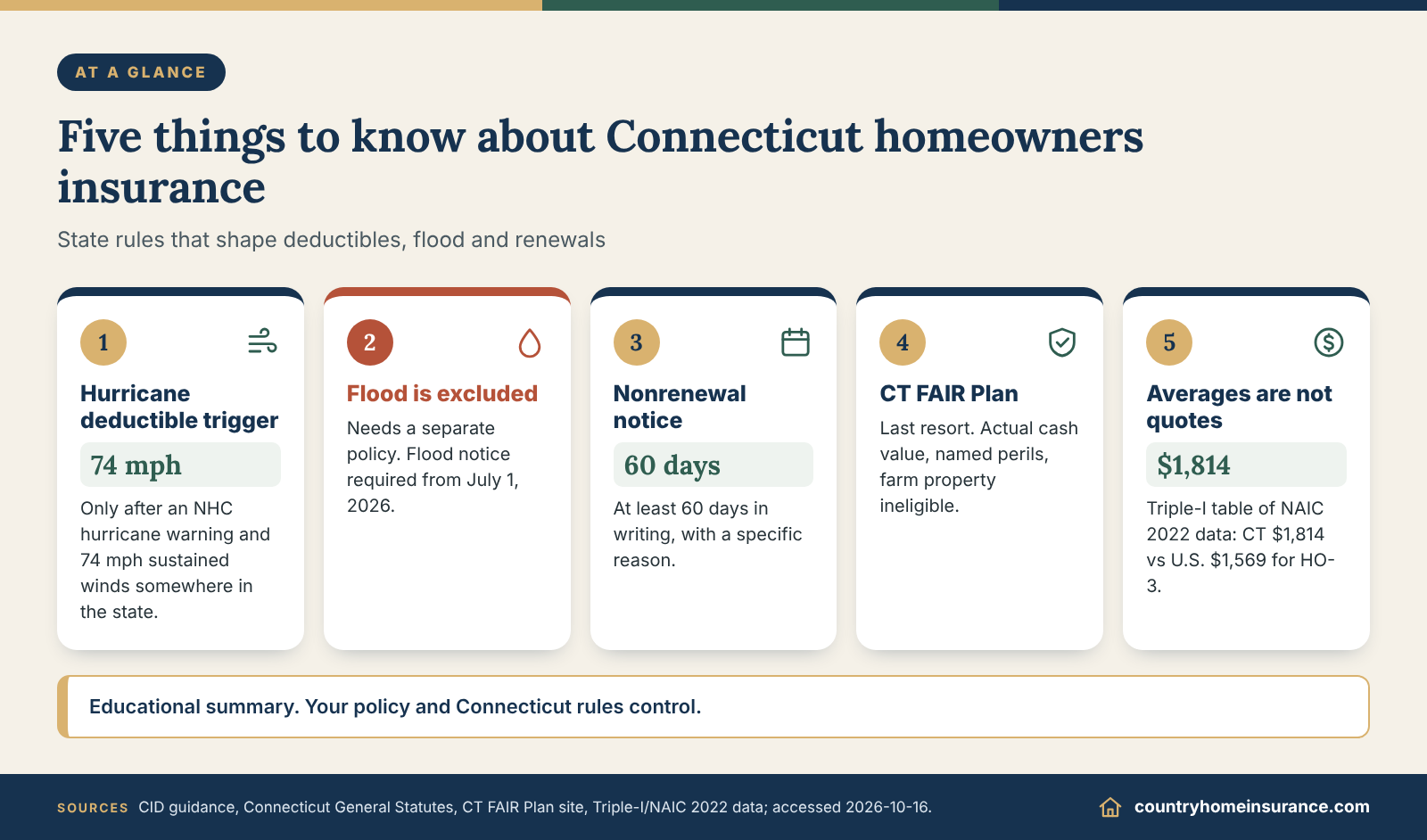
- Connecticut law lets insurers apply a hurricane deductible only after a National Hurricane Center hurricane warning and sustained winds of 74 mph or more somewhere in the state; Hurricane Sandy did not meet that test.
- Flood, including storm surge and surface water, is excluded from homeowners policies. Starting July 1, 2026, insurers must give Connecticut policyholders a state-approved notice saying so.
- Insurers must give at least 60 days’ written notice of nonrenewal with a specific reason, and the CID says cosmetic roof staining should not support underwriting action.
- The CT FAIR Plan writes actual cash value, named-peril dwelling fire coverage, has no theft, freezing or water damage coverage, and treats farm property as ineligible.
- Triple-I’s table of NAIC 2022 data lists a Connecticut average HO-3 premium of $1,814 against $1,569 nationally, but averages are not quotes.
Connecticut homeowners insurance at a glance
Connecticut homeowners insurance is shaped by a short list of local facts: a long Long Island Sound shoreline that carries hurricane and storm-surge exposure, nor’easters and ice, homes of every age from colonial-era farmhouses to new builds, and a regulator that has been unusually specific about how insurers may use hurricane deductibles, roof inspections and nonrenewal notices. This guide walks through those Connecticut-specific rules and then gives you a way to compare policies without guessing.
Everything here is educational. Your declarations page, policy form and endorsements control what is actually paid, and the rules below are explained so you can ask better questions of your insurer.
What makes the Connecticut market different?
Who regulates it and where can you take questions?
The Connecticut Insurance Department regulates insurers and agents in the state. Its Consumer Affairs Division takes questions and complaints at (860) 297-3900 or toll-free at (800) 203-3447, and by email at [email protected]. Since September 8, 2026, the department’s in-person services have been at 280 Trumbull Street, Floor 7, Hartford. The CID homeowners insurance page collects the department’s consumer guidance on homeowners policies.
In December 2025 the CID launched a Consumer Information Center that, according to Insurance Journal’s report, includes checklists, step-by-step claim guides and a property-level climate risk mapping tool. The department’s Be Weather Ready CT page organizes this into four steps: know your risk, review your coverage, protect your home and create a plan. It also links to a home inventory app and checklist.
How big is the market and who owns the homes?
The Census Bureau’s QuickFacts page lists an owner-occupied housing rate of 66.5% and a median owner-occupied home value of $366,900 for Connecticut, using 2020-2024 American Community Survey five-year estimates. The NAIC’s most recent Homeowners Insurance Report, which covers 2023 data and was published in July 2026, counts about 776,567 house-years of owner-occupied homeowners coverage in Connecticut. A house-year is NAIC’s unit for twelve months of coverage on one dwelling. These figures describe the market’s scale, not the price you will pay.
What does a standard Connecticut policy cover and leave out?
Which perils and exclusions does the CID highlight?
The CID’s consumer FAQ explains that most homeowners forms apply a deductible to Section I losses, meaning damage to the dwelling, other structures, unscheduled personal property and additional living expenses. It also notes that most policies exclude animals, vehicles and business property, and typically exclude flood, surface water, sewer or drain backup, earth movement, nuclear damage and war. On wind, the CID’s storm-claims guidance says wind damage is covered even when a storm is described as an act of God, a hurricane or a tornado, and that an HO-3 form (an “all-perils” form on the building) covers everything not specifically excluded, while an HO-2 form (named perils) covers only the perils it lists.
What do Coverage A through F mean in plain English?
Coverage A (Dwelling) pays for the house itself. Coverage B (Other Structures) covers detached items such as a garage, shed or fence. Coverage C (Personal Property) covers belongings. Coverage D (Loss of Use) pays additional living expenses when a covered loss makes the home unlivable. Coverage E (Personal Liability) responds when you are legally responsible for injuring someone or damaging their property, and Coverage F (Medical Payments to Others) pays small medical bills for guests hurt on your property. The NAIC’s homeowners page describes the same building blocks and recommends setting the dwelling limit to the cost to fully rebuild the home, which is a different number from its market value.
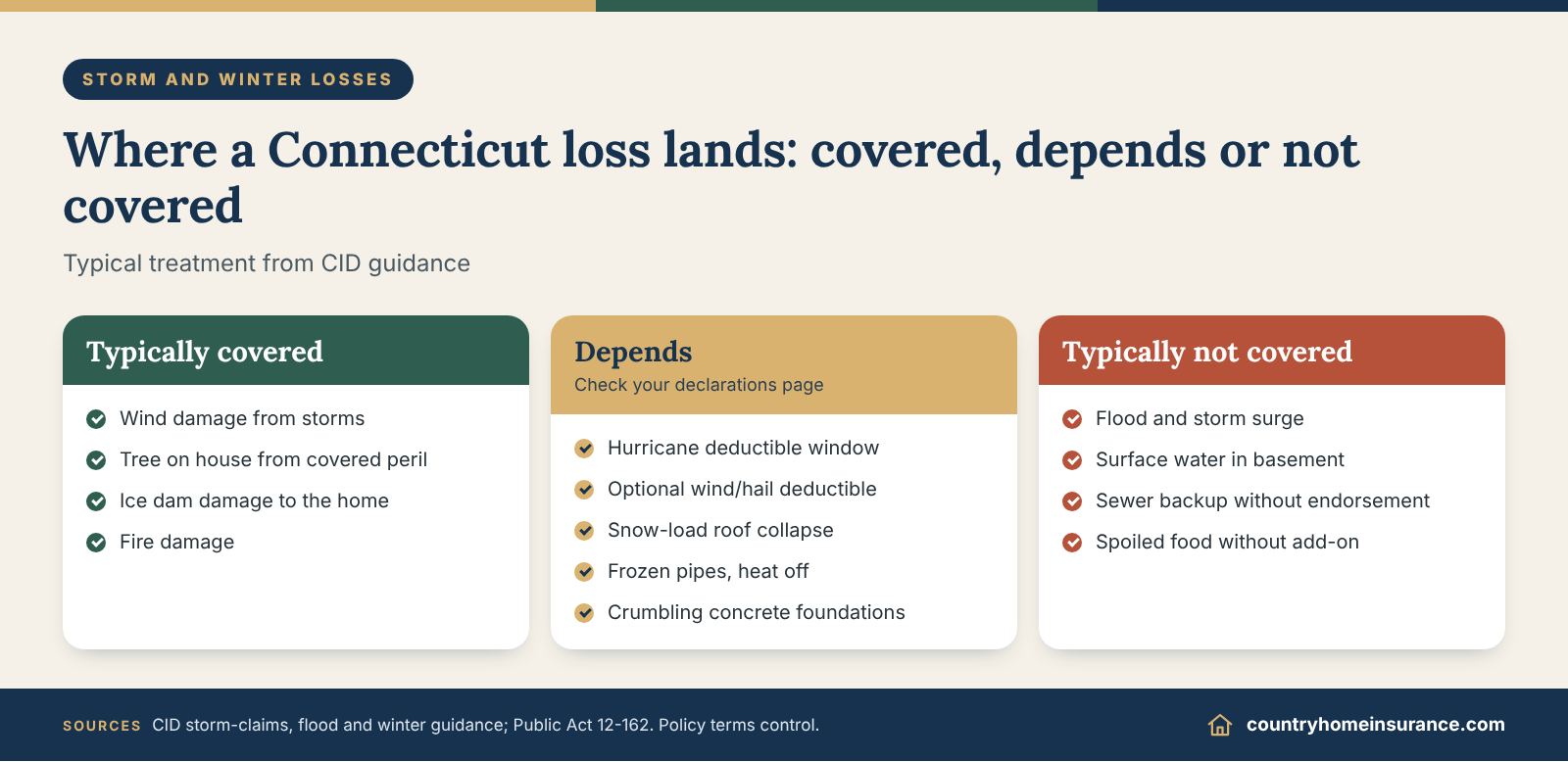
| Situation | Typical treatment | What to verify |
|---|---|---|
| Wind damage from a thunderstorm or nor’easter | Typically covered. The CID says wind is covered under standard forms. | Whether your policy has an optional wind/hail deductible. |
| Hurricane wind damage | Depends. Covered wind loss, but a separate hurricane deductible may apply during a legally defined window. | Hurricane deductible percentage and its dollar equivalent on the declarations page. |
| Storm surge, river overflow, rising surface water | Typically not covered. Flood needs a separate NFIP or private flood policy. | Flood zone, lender requirement and the 30-day waiting period. |
| Sewer or drain backup, failed sump pump | Depends. Typically excluded unless a water-backup endorsement is added. | Endorsement limit and whether it includes sump pump overflow. |
| Ice dam damage to ceilings and walls | Typically covered, per the CID, though many policies do not pay to remove the ice dam. | Whether the cost of removal is excluded or capped. |
| Snow-load roof collapse | Depends. Sudden and accidental collapse is normally covered; age-related or pre-existing damage can be denied. | Roof condition records and any maintenance exclusions. |
| Frozen pipe damage | Depends. Typically covered, but coverage may not apply if heat was turned off without winterizing the home. | Vacancy and heat-maintenance conditions. |
| Tree falls on the house from a covered peril | Typically covered, with tree removal generally limited to about $500 per the CID. | Your actual removal sublimit. |
| Tree falls without hitting a structure | Typically not covered, though some insurers offer limited coverage. | Debris removal terms and driveway blockage language. |
| Spoiled food after a power outage | Typically not covered. A small-premium add-on is often available. | Where the add-on measures the outage. |
| Crumbling concrete foundations | Depends. GAO reported in 2020 that insurers mostly denied these claims. | Policy language on deterioration and collapse, plus any state-backed assistance program. |
How much does homeowners insurance cost in Connecticut?
There is no single Connecticut price. What you can do is read published averages correctly, understand the factors that move a quote and learn how to read your renewal notice. The state’s rules about billing notices and nonrenewal give you more visibility than many shoppers realize.
What do published averages show, and how should you read them?
What does the Triple-I table list for Connecticut?
The Triple-I’s homeowners facts and statistics page reproduces NAIC data for 2022. For Connecticut it lists an average HO-3 premium of $1,814, ranked tenth highest among states, compared with a national average of $1,569. The table’s methodology is that average premium equals premiums divided by exposure in house-years, with HO-3 defined as the most common homeowners package for owner-occupied one- to four-family dwellings. The Triple-I notes that the figures include state funds, residual markets and some wind pools, and that the NAIC does not rank state premiums or endorse conclusions drawn from the data. See the Triple-I table for the full methodology.
Because this table reflects 2022 data, treat it as a snapshot of relative cost rather than a current price. Premiums can move from year to year, so rely on current quotes for your own address and ask the NAIC or the Connecticut Insurance Department where to find the latest state-level premium data.
Why is an average not a prediction of your premium?
An average blends coastal and inland homes, new and old roofs, low and high dwelling limits, and every deductible option. Two neighbors with the same address can pay very different amounts if one has a 22-year-old asphalt roof and a prior water claim. Treat the $1,814 figure as a sanity check on whether a quote is wildly off, not as a target. The dwelling limit is usually the single biggest lever on price, which is why quotes must be compared at equal limits.
Which cost drivers matter most in Connecticut?
How do coast distance and storm exposure affect price?
Connecticut’s coastal underwriting guidelines define the coast as salt water: ocean, sound, bay or inlet, measured from the median high water mark. Distance to that line matters twice. It affects how an insurer prices wind risk, and it determines the maximum percentage a hurricane deductible can reach (covered in detail in the hurricane deductible section below). The CID’s guidelines also say it will closely scrutinize methods that produce an unreasonably broad definition of the coastline.
How does roof age and condition change eligibility and price?
The CID’s roof-risk FAQ says insurers commonly review roof age and condition when deciding whether to issue or renew a policy. It reports that non-permanent materials such as asphalt, wood and rubber often face eligibility limits of about 15 to 20 years, architectural shingles may qualify for 25 years or more, and tile and slate are generally treated as lifetime materials. For how roof age changes quotes in practice, see the roof age and homeowners insurance cost guide.
Do claims history and the home’s age matter?
Insurers commonly check the Comprehensive Loss Underwriting Exchange, known as CLUE, a claims database run by LexisNexis. The CID’s CLUE FAQ explains that it holds up to seven years of personal property claims history and that reporting an actual loss may count as a claim even if nothing is paid, while a simple coverage question is generally an inquiry. You can request your own report and add a personal statement. Our guide on how claims history affects homeowners insurance rates goes deeper, and the older home insurance cost guide covers age-of-house pricing.
How do deductibles and coverage choices change the premium?
The CID’s FAQ states that higher deductibles such as $500 or $1,000 are available at a reduced premium, and that some companies offer an optional deductible that applies only to wind or hail. Raising a deductible lowers premium but raises what you must have available after a loss. The same logic applies to endorsements: water backup, refrigerated food and scheduled valuables each add premium but fill a gap the base policy leaves.
How do you read a Connecticut renewal and billing notice?
What must the premium billing notice show?
CID Bulletin PC-88, dated July 23, 2019, says a premium billing notice showing the actual renewal premium (not just a percentage increase) must be sent at least 30 days before the renewal or anniversary date. Connecticut General Statutes section 38a-323 contains the 30-day billing requirement. If you are not given the required notice, the bulletin says you are entitled to renewal for a term of at least one year and may cancel pro rata at the lower of the current or prior year’s rate if you act within 60 days of renewal.
What is a conditional renewal and why should you read it twice?
A conditional renewal is a renewal on less favorable terms: lower limits, narrower coverage or higher deductibles. The same section requires 60 days’ written notice and identification of the changes. This is where hurricane deductibles, roof payment schedules or new exclusions can appear. Read the changes list, not just the premium line.
| Item | What the source says | Source and date |
|---|---|---|
| Hurricane deductible trigger | After a National Hurricane Center hurricane warning for any part of Connecticut, if sustained winds of 74 mph or more occur in the state. Ends at the earlier of 24 hours after the last warning ends or 24 hours after the last downgrade from hurricane status. | Public Act 12-162 (2012); CID storm-claims guidance |
| Hurricane deductible size | Up to 5% within 2,600 feet of the coast; up to 2% beyond, with extra conditions on renewals. | CID coastal guidelines, amended July 25, 2014 |
| Mandatory wind or wind/hail deductible | Prohibited. Optional wind or wind/hail deductibles allowed if actuarially justified. | CID coastal guidelines, 2014 |
| Nonrenewal notice | At least 60 days’ written notice with the reason. | C.G.S. 38a-323 (2026 supplement) |
| Cancellation notice, nonpayment | 10 days. | C.G.S. 38a-316g, effective July 1, 2025 |
| Cancellation notice, other permitted reasons | 30 days. | C.G.S. 38a-316g, effective July 1, 2025 |
| Premium billing notice | At least 30 days before renewal. | C.G.S. 38a-323; CID Bulletin PC-88 (2019) |
| NFIP residential limits | Up to $250,000 building; contents up to $100,000 at additional premium; 30-day wait. | CID flood fact sheet, Sept. 3, 2024 |
| CT FAIR Plan dwelling limit | Coverage A $350,000 and Coverage C $75,000 for 1-4 family habitational risks. | CT FAIR Plan website (accessed 2026-10-16) |
| CLUE claims history | Up to 7 years of personal property claims. | CID CLUE FAQ |
How do hurricane and wind deductibles work in Connecticut?
Connecticut is one of the states where the law, not just the insurer’s form, decides when a percentage hurricane deductible can replace your normal deductible. That makes it worth reading closely, because the trigger is narrower than most homeowners assume.
When can a hurricane deductible apply?
What are the legal trigger and time window?
Public Act 12-162, which amended section 38a-316a of the Connecticut General Statutes effective October 1, 2012, lets an insurer use a hurricane deductible in place of the overall policy deductible on covered personal-risk policies. The deductible may apply only after the National Hurricane Center issues a hurricane warning for any part of Connecticut, and only if the storm produces sustained surface winds of at least 74 mph somewhere in the state. The window starts no earlier than the warning and ends at the earlier of 24 hours after the last warning is terminated or 24 hours after the storm’s last downgrade from hurricane status. The CID’s storm-claims guidance describes the same window and says the dollar amount or percentage appears on the declarations page if your policy includes it.
Why did Hurricane Sandy not trigger it?
On November 1, 2012, the governor and insurance commissioner announced that, based on National Weather Service data, Sandy did not meet the state’s criteria and that insurers could not impose a hurricane deductible on Connecticut claims from the storm. The state’s announcement is a useful illustration: a devastating storm can still fall outside the legal definition. The National Hurricane Center’s report adds that Sandy made landfall in New Jersey as a post-tropical cyclone. Wind losses from such a storm fall under the ordinary deductible, and surge flooding remains a separate flood-policy question.
How large can a hurricane deductible be?
What do the CID’s coastal guidelines allow?
The CID’s coastal underwriting guidelines, amended July 25, 2014 and effective October 1, 2014, set the following caps: for new business, up to 5% within 2,600 feet of the coast and up to 2% beyond 2,600 feet. For renewals the guidelines describe the same 5% figure within 2,600 feet and a 2% figure farther inland but only where the dwelling lacks storm shutters or other storm mitigation. The guidelines also require the deductible to appear prominently on the declarations page, with a dollar-equivalent calculation for percentage deductibles, and require notice when a new or renewed policy adds a hurricane deductible the prior policy lacked. Insurers file their own rules with the department, so ask your insurer for the exact percentage in your policy and its dollar equivalent, and check the Connecticut Insurance Department website for its current coastal guidance.
What does that look like in dollars?
Hypothetical example: A home has a $400,000 Coverage A limit and a $1,000 standard deductible. If a qualifying hurricane damages the roof and siding, a 5% hurricane deductible equals $20,000 and a 2% deductible equals $8,000, each replacing the $1,000 figure for that event. For a covered repair estimate of $26,000, the 5% scenario leaves $6,000 for the insurer to pay before other policy terms apply, while the 2% scenario leaves $18,000. These numbers are illustrative only and are not a quote or a prediction of any payment.
What about wind and hail deductibles and storm shutters?
Can an insurer require a separate wind or wind/hail deductible?
The CID’s storm-claims guidance describes the wind/hail deductible as optional: insurers may offer one, the homeowner may choose it in place of the standard deductible, and insurers in Connecticut may not require it. It can be a flat dollar amount or a percentage of Coverage A. The 2014 coastal guidelines say mandatory wind or wind/hail deductibles are prohibited. If a quote includes a separate wind percentage, ask whether you chose it and what discount it buys.
Do shutters, impact glass or FORTIFIED roofs earn a credit?
Under the same statute, an insurer cannot refuse to issue or renew a homeowners policy solely because the home lacks permanent storm shutters. The CID reads “storm shutters” broadly to include plywood and other mitigation products, and it will not approve guidelines that require them as a condition of quoting or issuing. Permanent shutters or impact-resistant glass call for consideration of an actuarially justified premium credit (section 38a-316b, as cited in the guidelines), and applying a hurricane deductible requires an actuarially justified credit. The department also says insurers should consider lower deductibles or added discounts for homes designated FORTIFIED or Resilience STAR. “Consider” is not a mandate, so ask what your insurer actually offers. Our guide to wind damage coverage covers the underlying coverage logic.
What coastal storm and flood risks should Connecticut homeowners plan for?
Connecticut homeowners face several different storm problems: hurricanes that reach the Long Island Sound coast, tropical storms that bring wind and tree damage inland, and heavy rain that can flood areas away from the shore. Insurance treats each of these differently.
What does storm history show for Connecticut?
How severe have major coastal storms been?
The National Hurricane Center’s history page describes the 1938 New England hurricane as making landfall over Long Island and Connecticut as a Category 3 storm, with surge of 10 to 12 feet along parts of the coast. Hurricane Carol in 1954 also struck Long Island and Connecticut as a Category 3 hurricane, with sustained winds of 80 to 100 mph reported over much of eastern Connecticut. Those events are historical context, not forecasts, but they explain why insurers and regulators treat the shoreline as a distinct underwriting zone.
What did recent storms do?
The NHC report on Sandy (October 2012) records surge of about 9.83 feet above normal tide levels at Bridgeport and 9.14 feet at New Haven, both record water levels, with roughly 3,000 homes damaged and preliminary Connecticut damage estimates near $360 million. Hurricane Irene in August 2011 brought station gusts of about 41 to 58 knots in Connecticut and, according to the report, outages for up to 3 million residents mainly across Connecticut and Long Island, lasting up to around a week, per the NHC’s Irene report. In August 2020, the NHC’s Isaias report says nearly 700,000 customers lost power across Connecticut, Rhode Island and Massachusetts combined. See the Sandy report for the surge data.
Does homeowners insurance cover flooding in Connecticut?
What does the CID say about flood and storm water?
The CID’s September 3, 2024 fact sheet, written after the August 18, 2024 severe rain event, says homeowners, condo and renters policies cover most storm damage, including wind and fire, but exclude flood. It uses the National Flood Insurance Program definition of a flood: a general and temporary condition of partial or complete inundation of at least two acres of normally dry land or of two or more properties, from causes such as overflow of inland or tidal waters, rapid accumulation or runoff of surface water, mudflow or shoreline erosion collapse. The fact sheet adds that people outside high-risk areas file more than 25% of flood claims nationwide. Rain that runs across the ground into a basement is a surface-water question, which is why the flood damage coverage guide and our sewer backup guide are worth reading together.
What does separate flood insurance cost and limit?
The same CID fact sheet states that a standard NFIP residential policy covers up to $250,000 for the building, with contents coverage of up to $100,000 available for an additional premium, that basements and ground-level enclosures have limited coverage, and that a flood policy typically takes effect 30 days after purchase. It cites FEMA’s estimate of an average homeowner premium of about $800 to $1,200 per year, which depends on flood risk, coverage amount and deductible. Private flood insurance is also available, and lenders may set their own requirements. Because of the waiting period, buying flood coverage after a storm is forecast is generally too late.
What is new in Connecticut flood disclosure?
What does section 38a-316h require?
Section 38a-316h, effective July 1, 2026, requires that each insurer that delivers, issues or renews a homeowners or renters policy on a Connecticut residential dwelling give the insured a notice, prescribed or approved by the Insurance Commissioner, stating clearly and in plain language that the policy does not cover loss caused by flood and that flood insurance is available separately, including information on eligibility and access. The text appears in the 2026 supplement to Chapter 700 of the General Statutes.
What should you do when the notice arrives?
Treat it as a prompt, not a formality. Look up your property in the climate risk tool the CID links from its Be Weather Ready page, ask your agent for an NFIP and a private flood quote, and read how each handles basements and contents. For coastal storms, our hurricane evacuation insurance guide explains how living-expense coverage works if you must leave.
How do nor’easters, ice and winter weather affect Connecticut coverage?
Winter claims in Connecticut tend to involve the same few mechanisms: weight on a roof, water backing under shingles, burst pipes and long power outages. The CID’s winter claim tips, listed with a June 23, 2026 date, give a plain summary of how standard policies usually respond.
What do winter claims usually involve?
How are ice dams and snow-load collapses treated?
The CID says interior or exterior damage from an ice dam is generally covered but that many policies do not pay for ice dam removal. It also says sudden and accidental roof collapse is normally covered, while damage from age or pre-existing conditions could be denied. The practical implication is documentation: keep dated photos of attic insulation, roof repairs and any prior leaks so that the cause of loss is clearly sudden rather than long-term. The CID notes that homeowners insurance does not cover your own injuries during snow removal, and professionals you hire should carry their own insurance.
When does a frozen pipe claim run into trouble?
Most policies cover pipe replacement and water damage from a freeze, according to the CID, but coverage may not apply if the furnace was turned off for the season without winterizing the home. This matters for seasonal houses and rural properties left unheated. The CID’s FAQ also lists vacancy of more than 60 consecutive days as an example of a physical change that can justify cancellation. Our frozen pipe coverage guide covers the details.
What about power outages, trees and debris?
Is tree removal covered after a storm?
According to the CID, if a covered peril drops a tree on your house, the damage is covered, and removal is generally covered up to $500 if the tree damages a covered structure or blocks a driveway. A tree that falls without damaging structures is generally not covered, though some insurers offer limited coverage. If a neighbor’s tree falls on your house, your own policy generally responds and your insurer may seek recovery from the neighbor if negligence is shown. Our tree-on-house claim guide walks through the workflow.
Are spoiled food and hotel costs covered in an outage?
Standard policies usually exclude spoiled food, but the CID notes that refrigerated food coverage is often available for a nominal additional premium. Ask your agent about its scope, such as whether it responds to a power failure and which causes it includes. The CID adds that standard policies generally do not cover hotel costs from a widespread outage away from your property, and its winter tips say most policies won’t pay for shelter during extended outages unless the home is uninhabitable due to damage. Additional living expense coverage applies when a covered loss makes the home unlivable.
What should you do before and after a winter loss?
What should you prepare before the season?
Photograph the roof edge, attic and basement before winter, store a home inventory outside the house or digitally, and confirm who to call at your insurer’s claim line. The CID’s flood fact sheet recommends an accurate inventory stored away from the home and mentions a free regulator-created inventory app, which applies equally to winter losses.
What should you do after damage occurs?
The CID’s winter tips say to call the insurer’s 24-hour claim line promptly, photograph or video the damage, make repairs needed to prevent further damage but hold off on permanent repairs until the insurer inspects, save receipts and keep a record of calls and emails. Do not discard damaged property before the adjuster has seen it.
How do older homes, roofs and foundations affect coverage in Connecticut?
Older houses often predate modern building codes, which raises practical insurance questions about roofs, wiring, heating systems and foundations. The points below focus on how insurers and the CID treat age-related conditions.
How do insurers judge roofs on older houses?
What does the CID say about aerial imagery and roof findings?
The CID’s roof-risk FAQ (dated March 26, 2026) says insurers may use in-person inspections, aerial imagery or both, and that aerial images are often a screening step. The department advises that images showing only discoloration, streaking or other cosmetic issues should not support underwriting action, and that insurers must rely on clear indicators of roof condition consistent with their guidelines. Conditions the FAQ lists as legitimate concerns include missing or damaged shingles, multiple roofing layers, unrepaired damage, heavy debris or moss, and overhanging tree limbs.
What can you do if your insurer flags the roof?
The CID suggests asking the insurer for specifics, documenting completed or scheduled repairs, asking about temporary extensions or alternatives, and contacting the department if the insurer is unresponsive. Insurers may reconsider if corrected inspection information is provided. For how roof findings change quotes and eligibility, see our roof leak coverage guide.
What replacement-cost questions come up with older homes?
What is ordinance or law coverage and why ask about it?
Ordinance or law coverage is an endorsement or extension that helps pay the extra cost of rebuilding to current building codes after a covered loss. Because older houses may not meet today’s codes, the extra cost can be significant. Limits for this coverage differ by insurer and policy, so ask for the exact limit and whether it sits inside or on top of Coverage A.
Which systems should you ask about?
Questions that matter for older houses include whether the insurer has restrictions on aging electrical panels or wiring, whether an oil heating tank is covered and what pollution exclusions say about cleanup, and how plumbing age affects water-damage terms. These are questions to put to an agent, not conclusions; policy forms vary. Pricing and eligibility patterns by house age are covered in the guide linked earlier.
What about crumbling concrete foundations?
What did GAO find?
GAO report GAO-20-649, released July 29, 2020, found that homes with confirmed pyrrhotite, a mineral that expands when exposed to water and oxygen and can make concrete crack and crumble, were likely undercounted as of December 2019. It said insurers had mostly denied related claims, that the state provided up to $175,000 toward foundation replacement, and that total remediation costs could reach $150,000 or more. See the GAO summary for the report’s detail.
What should buyers and owners do now?
The main relief channel has been a state-backed captive insurer, the Connecticut Foundation Solutions Indemnity Company (CFSIC). Its website outlines a six-step process: check eligibility, determine the claim type, apply online, submit additional information, undergo evaluation and receive payment. A June 17, 2026 notice from the Town of South Windsor says CFSIC will not accept new claims after June 30, 2030. A legislative caucus page dated August 8, 2025 reports that the State Bond Commission granted $25 million to the fund. A July 8, 2026 Connecticut Public report adds that the program helps with the foundation itself and does not extend to related work such as driveways, porches, garages or landscaping.
If you are buying a house with a poured concrete foundation, ask for foundation inspection records and the age and source of the concrete if known. Whether you can apply, and for how much, depends on your own eligibility, so check the requirements on CFSIC’s website and with the Connecticut Insurance Department. Do not assume your homeowners policy will respond.
What is the Connecticut FAIR Plan and when does it make sense?
If several insurers decline your home, Connecticut’s residual market is the CT FAIR Plan. It is a safety net with narrower coverage than a standard policy, so compare it carefully.
What is the CT FAIR Plan, and what does it cover?
What is its legal basis and purpose?
The Connecticut Property Insurance Placement Facility, known as the CT FAIR Plan, was established under the Urban Property Protection and Reinsurance Act of 1968 and Title 38a of the Connecticut General Statutes. Its own site describes it as a last resort for basic property insurance, not a competitor to the voluntary market, and the regulations in Subtitle 328 of the Connecticut Administrative Code cover inspections, declinations, rates, nonrenewal and a right of appeal. Applicants must be unable to obtain coverage in the normal market and the property must meet reasonable underwriting standards.
What are the limits, valuation and perils?
According to the FAIR Plan’s general information page, coverage is standard fire insurance written at actual cash value, not replacement cost, on a named-peril basis; theft, freezing and water damage are not included. For habitational risks of one to four families, Coverage A is $350,000 and Coverage C is $75,000, with Coverages B and D able to apply at 10% of the building amount, which the page says is not additional insurance. Deductible options run from $250 to $10,000 for habitational risks. The page lists the dwelling form as DP 00 01. The plan’s terms can change over time, so confirm the current limits and deductible options with your producer when you apply.
| Feature | CT FAIR Plan (per its website) | Standard HO-3 (per CID guidance) |
|---|---|---|
| Valuation | Actual cash value, not replacement cost. | Depends on the policy; replacement cost is common but ask. |
| Perils on the dwelling | Named perils; theft, freezing and water damage not included. | All perils not excluded on the dwelling. |
| Dwelling limit | $350,000 for 1-4 family habitational risks. | Set by the insured and insurer; should reflect rebuild cost. |
| Hurricane deductible | Within 2,600 feet of the shoreline, a separate hurricane deductible of 5% of Coverage A. | Allowed only under the state trigger; caps in CID guidelines. |
| Liability | Personal liability with $1,000 medical payments on eligible 1-3 family dwellings; options from $25,000 to $300,000. | Coverage E and F in the base policy. |
| Farm property | Ineligible. | Depends on the carrier; farm exposures often need a separate form. |
| Flood | Not covered; separate flood policy needed. | Not covered; separate flood policy needed. |
How do you apply, and how does C-MAP fit in?
What is the application process?
Only a Connecticut-licensed producer can place business with the FAIR Plan, and per its producer page the application is ACORD 66 CT. An inspection is ordered once the application is received, and the plan has 20 days to send a quote or declination after receiving a completed, signed application. Quotes are valid for 60 days and coverage becomes effective on receipt of the full annual premium. No producer can bind coverage in the FAIR Plan, so you are not insured until the plan says so. Renewal notices go out 60 to 90 days before expiration, and coverage lapses if the full premium is not received by the expiration date.
What is the Coastal Market Assistance Program?
The C-MAP page says the program was created by the insurers writing homeowners coverage in Connecticut, is administered by the FAIR Plan under CID authorization, and helps coastal homeowners who cannot obtain insurance. Applicants use a coastal dwelling fire (DP-2) application and a self-certification notice through an agent. Ask your agent which insurers participate and what documentation the application requires.
What gaps should you plan around?
What does the FAIR Plan leave to you?
Because the plan excludes theft, freezing and water damage in its standard dwelling form and values at actual cash value, owners often ask their agent whether a supplementary policy or a return to the standard market is possible. Ask for any answer in writing, and do not assume the plan’s gaps are filled until you see a policy that says so.
How do you get back to the standard market?
Because the plan is described as a last resort, treat it as temporary. Fix what caused the declinations, such as a flagged roof or an unrepaired loss, document the repair, and reshop with independent agents. Our guide to comparing homeowners insurance quotes shows how to compare on equal terms.
What are your rights on cancellation and nonrenewal in Connecticut?
Connecticut sets firm notice rules for homeowners policies. They changed in part on July 1, 2025, and the specifics below come from the General Statutes supplement and CID guidance.
What notice must an insurer give?
How does nonrenewal work?
Section 38a-323 requires at least 60 days’ advance written notice of nonrenewal with the reason stated. The CID’s Bulletin PC-88 adds that reasons must be specific: vague terms such as “claims experience” or “underwriting judgment” are unacceptable, losses relied on must be listed by date, type and amount, and a stated increase in hazard must name the hazard. If the insurer fails to give the required notice, you are entitled to a renewal of at least one year, per section 38a-323. For a missed premium billing notice, the bulletin also gives a pro rata cancellation right at the lower rate within 60 days of renewal.
When can a policy be canceled mid-term?
As reported in the 2026 supplement, section 38a-316g (for policies delivered or renewed on or after July 1, 2025) limits cancellation of a policy that has been in force 60 days or more, or a renewal, to nonpayment, material fraud or misrepresentation, or a material physical change increasing the hazard. Nonpayment requires 10 days’ notice; the other permitted reasons require 30. The CID’s FAQ lists vacancy of more than 60 consecutive days as an example of a change that makes property uninsurable. You may cancel yourself at any time by written notice.
What practical protections does the law add?
Can someone else receive your notices?
Section 38a-323a, for homeowners and auto policies issued or renewed on or after July 1, 2025, requires insurers to offer a form on which you can name a third-party designee. The designee’s copies are sent in an envelope marked “IMPORTANT INSURANCE POLICY INFORMATION: OPEN IMMEDIATELY.” This is useful for seasonal owners, rural owners who travel and families helping older relatives.
How is notice delivered?
Notices may be sent by registered, certified, certificate-of-mailing or USPS tracked mail, or electronically if you agreed. The 2025 amendments added USPS intelligent mail barcode tracking as a valid method. Check your account preferences so electronic notices do not land in a spam folder.
What should you do after receiving a notice?
What steps help in the first week?
Read the stated reason, request any loss details cited, photograph and document repairs, and ask in writing whether the insurer will reconsider. Start shopping immediately because you generally have a 60-day runway for nonrenewal. Keep copies of the notice and the envelope or email header.
When should you contact the CID?
If the stated reason is vague, cosmetic or inconsistent with the bulletin, contact the department’s Consumer Affairs Division. The CID’s roof-risk FAQ makes the same suggestion when an insurer is unresponsive.
What discounts and premium reducers are documented in Connecticut?
Discount lists on comparison sites vary and often overstate. This section sticks to what Connecticut sources actually document.
Which discounts or credits are supported by sources?
Do storm shutters and impact glass earn a credit?
The CID’s coastal guidelines say permanent shutters or impact-resistant glass require consideration of an actuarially justified premium credit and say insurers should consider lower deductibles or additional discounts for FORTIFIED or Resilience STAR homes. These are expectations on insurers, not guaranteed discounts. Ask whether your insurer filed a mitigation credit and what proof it needs.
How much can a higher deductible save?
The CID states that $500 and $1,000 deductible options are available at a reduced premium and that an optional wind/hail deductible can replace the standard one. The savings are not quantified, so ask for quotes at two or three deductible levels and compare them against your emergency funds.
What should you not assume?
Are bundling, alarm or claim-free discounts guaranteed?
Do not assume a bundling, alarm, new-roof or claim-free discount applies automatically. Insurers may offer them under their filed rating plans, but amounts and eligibility differ. Ask for the discount list in writing and the conditions attached.
Should you reduce coverage to save money?
Cutting the dwelling limit below the cost to rebuild is a false economy. The NAIC recommends the dwelling limit be enough to fully rebuild the home. If the budget is tight, adjust deductible, shop other insurers or fix the underwriting issue, as covered in our guide on how much homeowners insurance you need.
What should rural and northwest Connecticut homeowners know?
Connecticut’s hill towns, farms and wooded roads bring exposures that a coastal discussion does not cover: trees, long outages, distance from fire service, wells, septic systems and outbuildings. The points here connect general policy logic to those conditions and flag what to ask your insurer.
How does rural location change underwriting?
How do fire protection and distance matter?
Insurers commonly consider how far a home is from a fire station and hydrant and whether the fire department is volunteer or paid, often expressed through a protection class. Ask your insurer what protection class it assigns to your address and whether improvements such as a closer water source would change it. Our rural home insurance guide covers this in more depth.
Why do trees and outages matter more inland?
Wooded lots raise the chance of limbs on roofs and lines, and the CID’s tree-removal and outage guidance above applies directly. Ask about the tree-removal sublimit, refrigerated food coverage and whether a standby generator is covered or affects any discount.
What about outbuildings, wells and acreage?
How is Coverage B used for barns and sheds?
Coverage B (Other Structures) normally covers detached buildings, and the NAIC lists fences and sheds as examples. A barn, workshop or studio can exceed a standard percentage-of-dwelling limit, so ask for the Coverage B limit in dollars and whether the structure is valued at replacement cost. Our country home insurance for acreage guide goes through the options.
When does homeowners insurance stop and farm insurance begin?
The CT FAIR Plan lists farm property as ineligible, which is a reminder that farm exposures are often treated differently from residential ones. If you keep livestock, sell farm products or run equipment, see our guide on small farm insurance versus homeowners insurance. Ask whether wells, pumps and septic components are covered and under which coverage part.
How should you shop for and verify Connecticut homeowners insurance?
A repeatable process beats chasing the lowest number. The steps below build on the Connecticut rules above and on the CID’s consumer resources.
What is a sensible shopping sequence?
What should you gather before requesting quotes?
Collect roof age and material, upgrade dates for electrical, plumbing and heating, distance to the coast, a rebuild-cost estimate, your CLUE report, and a current declarations page. Having the same information in hand lets you compare policies on the same terms.
What should every quote show?
Each quote should state the Coverage A to F limits, valuation basis for the roof and dwelling, the standard deductible, any hurricane or wind/hail deductible with its dollar equivalent, and the endorsements included. Request flood quotes in parallel.
What belongs on your verification checklist?
Which items should you document and ask about?
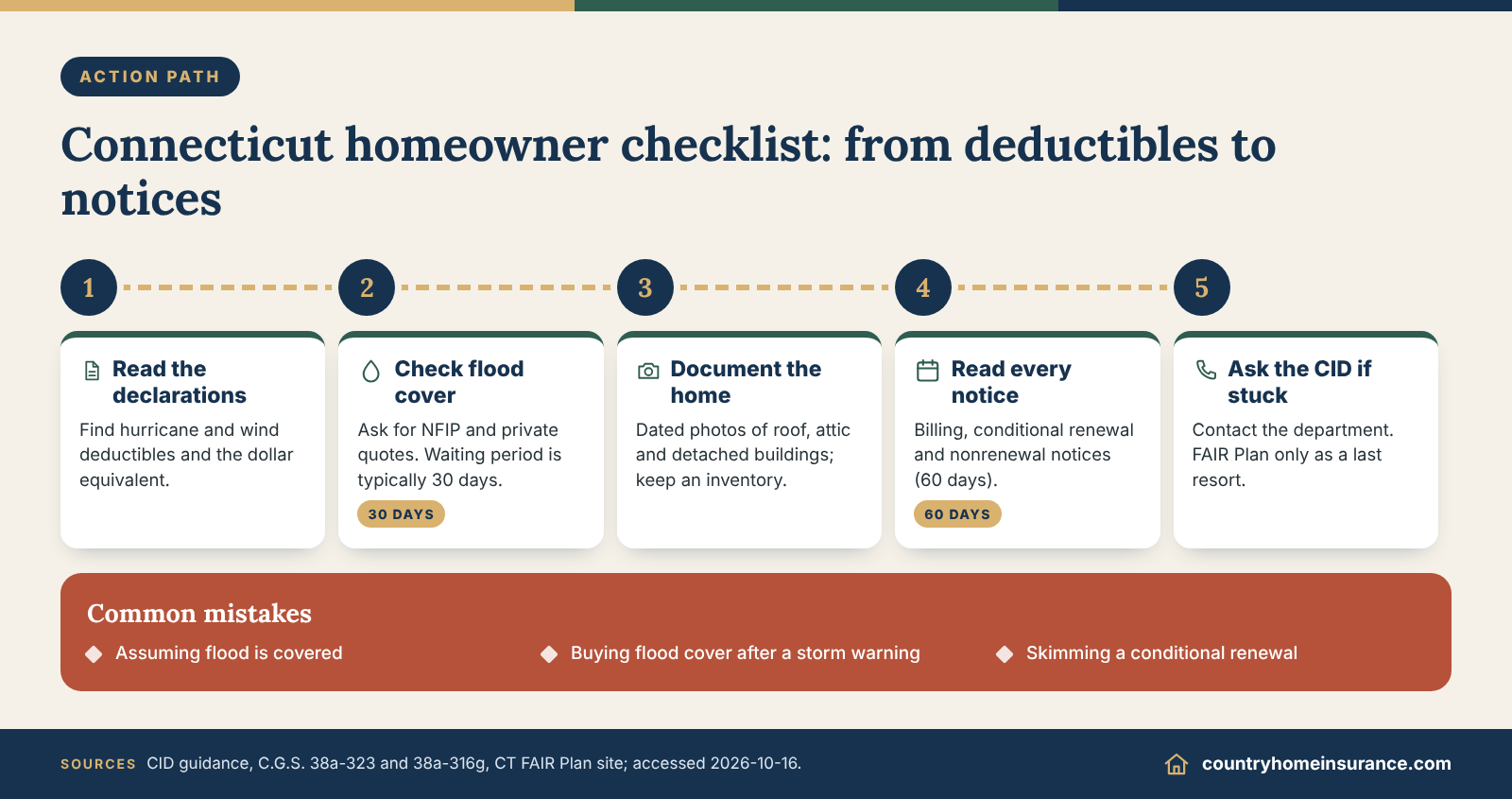
Use the checklist below at each renewal. It combines the Connecticut-specific items above with the documentation the CID recommends.
| Area | Verify or document | Ask the insurer or agent |
|---|---|---|
| Hurricane and wind deductible | Percentage, dollar equivalent and trigger wording on the declarations page. | Is it in lieu of my standard deductible and does my distance to the coast change the percentage? |
| Flood | Flood zone, lender requirement and the new state flood notice received with the policy. | What are the NFIP and private flood quotes, and when does coverage begin? |
| Roof | Dated photos, repair invoices and roof age. | What age and condition rules do you apply and is roof settlement replacement cost or actual cash value? |
| Water and sewer backup | Basement, sump pump and drain locations. | Is a backup endorsement available, with what limit? |
| Winter | Heat settings when away, attic insulation, ice dam history. | Is ice dam removal excluded and what are the vacancy conditions? |
| Outbuildings and trees | Photos and values of detached structures. | What is the Coverage B limit and the tree-removal sublimit? |
| Notices | Renewal billing notice and any conditional renewal changes list. | Can I name a third-party designee and enable electronic notices? |
| Last-resort option | Written declinations and repair documentation. | Would CT FAIR Plan or C-MAP be needed and what would it not cover? |
When should you ask the CID instead of the insurer?
Contact the CID when an insurer’s explanation seems to conflict with the rules above, when notice was missing or vague, or when a claim dispute stalls. The department can advise on appraisal, arbitration or mediation options for claim disputes, according to its flood fact sheet.
Frequently asked questions
Costs and discounts
Is Connecticut homeowners insurance more expensive than average?
Triple-I’s table of NAIC 2022 data lists a Connecticut average HO-3 premium of $1,814 against a national average of $1,569, ranking the state tenth highest. Averages are not quotes, and later years may differ.
Can I choose a higher deductible to lower my premium?
Yes, the CID says $500 and $1,000 options are available at reduced premium, and an optional wind/hail deductible may be offered. Keep the amount within what you could pay after a loss.
Storms, flood and winter
Is flood covered by my Connecticut homeowners policy?
No. Standard homeowners policies exclude flood, and a separate NFIP or private flood policy is needed. The NFIP policy typically takes effect 30 days after purchase.
When does a hurricane deductible apply in Connecticut?
Only after a National Hurricane Center hurricane warning for any part of Connecticut and sustained winds of at least 74 mph somewhere in the state, for a window ending 24 hours after the last warning or downgrade.
Does insurance cover ice dams and burst pipes?
The CID says ice dam damage is generally covered but removal often is not, and frozen pipe damage is typically covered unless heat was off without winterizing. Policy terms control.
Nonrenewal and the FAIR Plan
How much notice must an insurer give before not renewing?
At least 60 days in writing with the reason stated, per section 38a-323, and CID Bulletin PC-88 says the reason must be specific.
Can an insurer drop me because of roof staining?
The CID’s position is that cosmetic issues such as streaking or discoloration should not support underwriting action. Real condition problems, such as missing shingles, can still be used.
Is the CT FAIR Plan the same as a regular homeowners policy?
No. Per its website it writes named-peril, actual cash value dwelling fire coverage with no theft, freezing or water damage coverage, and it is a last resort.
Sources
- Connecticut Insurance Department — Homeowners Insurance FAQs (undated; accessed 2026-10-16)
- Connecticut Insurance Department — Homeowners storm claims guidance (listed Aug. 21, 2025; accessed 2026-10-16)
- Connecticut Insurance Department — Understanding How Insurers Evaluate Roof Risk FAQs (Mar. 26, 2026; accessed 2026-10-16)
- Connecticut Insurance Department — Storm Water Coverage and Flood Insurance fact sheet (Sept. 3, 2024; accessed 2026-10-16)
- Connecticut Insurance Department — Winter Insurance Claim Tips (listed June 23, 2026; accessed 2026-10-16)
- Connecticut Insurance Department — CLUE FAQs (undated; accessed 2026-10-16)
- Connecticut Insurance Department — Coastal homeowners underwriting guidelines (amended July 25, 2014; accessed 2026-10-16)
- Connecticut Insurance Department — Bulletin PC-88, cancellation, nonrenewal and renewal premium billing (July 23, 2019; accessed 2026-10-16)
- Connecticut Insurance Department — Be Weather Ready CT (accessed 2026-10-16)
- Connecticut General Assembly — General Statutes Chapter 700, 2026 supplement (accessed 2026-10-16)
- Connecticut General Assembly — Public Act 12-162 (2012; accessed 2026-10-16)
- State of Connecticut — Governor announces insurers cannot impose hurricane deductibles (Nov. 1, 2012; accessed 2026-10-16)
- CT FAIR Plan — General information and coverages (accessed 2026-10-16)
- CT FAIR Plan — Producer information (accessed 2026-10-16)
- Justia — Connecticut Administrative Code, Title 38a, Subtitle 328 (FAIR Plan) (accessed 2026-10-16)
- NOAA National Hurricane Center — Tropical Cyclone Report: Hurricane Sandy (2012 event; accessed 2026-10-16)
- NOAA National Hurricane Center — Tropical Cyclone Report: Hurricane Irene (2011 event; accessed 2026-10-16)
- NOAA National Hurricane Center — Tropical Cyclone Report: Hurricane Isaias (2020 event; accessed 2026-10-16)
- NOAA National Hurricane Center — Hurricanes in History (accessed 2026-10-16)
- Triple-I — Facts + Statistics: Homeowners and renters insurance (NAIC 2022 data) (accessed 2026-10-16)
- NAIC — Homeowners Insurance Report (2023 data) (published July 2026; accessed 2026-10-16)
- NAIC — Homeowners insurance consumer topic page (accessed 2026-10-16)
- U.S. Census Bureau — QuickFacts: Connecticut (2020-2024 ACS five-year estimates; accessed 2026-10-16)
- U.S. Government Accountability Office — GAO-20-649, pyrrhotite foundation damage (July 29, 2020; accessed 2026-10-16)
- Connecticut Foundation Solutions Indemnity Company — program website (accessed 2026-10-16)
- Town of South Windsor — Important update regarding crumbling foundation claims (June 17, 2026; accessed 2026-10-16)
- Connecticut House Democrats — Crumbling Foundations Assistance Fund (legislative caucus announcement; Aug. 8, 2025; accessed 2026-10-16)
- Connecticut Public — CT homeowners facing crumbling foundations could get relief with federal bill (July 8, 2026; accessed 2026-10-16)
- Insurance Journal — Connecticut launches site to help consumers understand insurance needs (Dec. 2, 2025; accessed 2026-10-16)
Important coverage note
Coverage depends on the actual policy, endorsements, exclusions, limits, deductible and cause of loss. State laws, regulations and insurance programs change, and the Connecticut rules described here were checked on 2026-10-16 against the sources listed above. This guide is educational and is not legal advice or an insurance quote. For case-specific questions, review your declarations page and policy form with your insurer or a licensed agent, and contact the Connecticut Insurance Department for regulatory questions or complaints.
About the editorial team
This guide was prepared by the countryhomeinsurance.com editorial team as general, educational information for homeowners. We research and summarize publicly available material, including state insurance departments, the NAIC, federal agencies, regulators’ consumer guides and published insurer and industry resources. We draw only on the sources that were available to us when we wrote this guide, and we list them in the Sources section with dates where we could find them.
Insurance rules, rates, products and program terms change, differ by state and by insurer, and can apply differently to your situation. We cannot guarantee that this content is complete, current or free of errors. It is not legal, financial, tax or insurance advice, it is not an offer to sell insurance or a recommendation of any insurer, agent or product, and reading it does not create a professional relationship of any kind.
To the fullest extent permitted by law, countryhomeinsurance.com and its editorial team, authors and contributors exclude all liability for any loss, damage or decision arising from the use of, or reliance on, this content. For questions about your own policy or claim, contact your insurer, a licensed agent or broker, your state Department of Insurance or another qualified professional.
Content created: October 16, 2026