Quick answer
Alabama homeowners insurance usually costs more than the national average because wind, hail, tornadoes and Gulf hurricanes drive a large share of claims. Published 2026 averages run from roughly $3,250 to $4,300 a year depending on the publisher’s assumptions, and your quote can land far from either figure. Standard policies typically exclude flood, many coastal policies carry percentage hurricane deductibles, and Alabama law requires insurers to give discounts on the wind portion of premium for qualifying FORTIFIED homes. Verify details with your insurer and the Alabama Department of Insurance.
Key takeaways
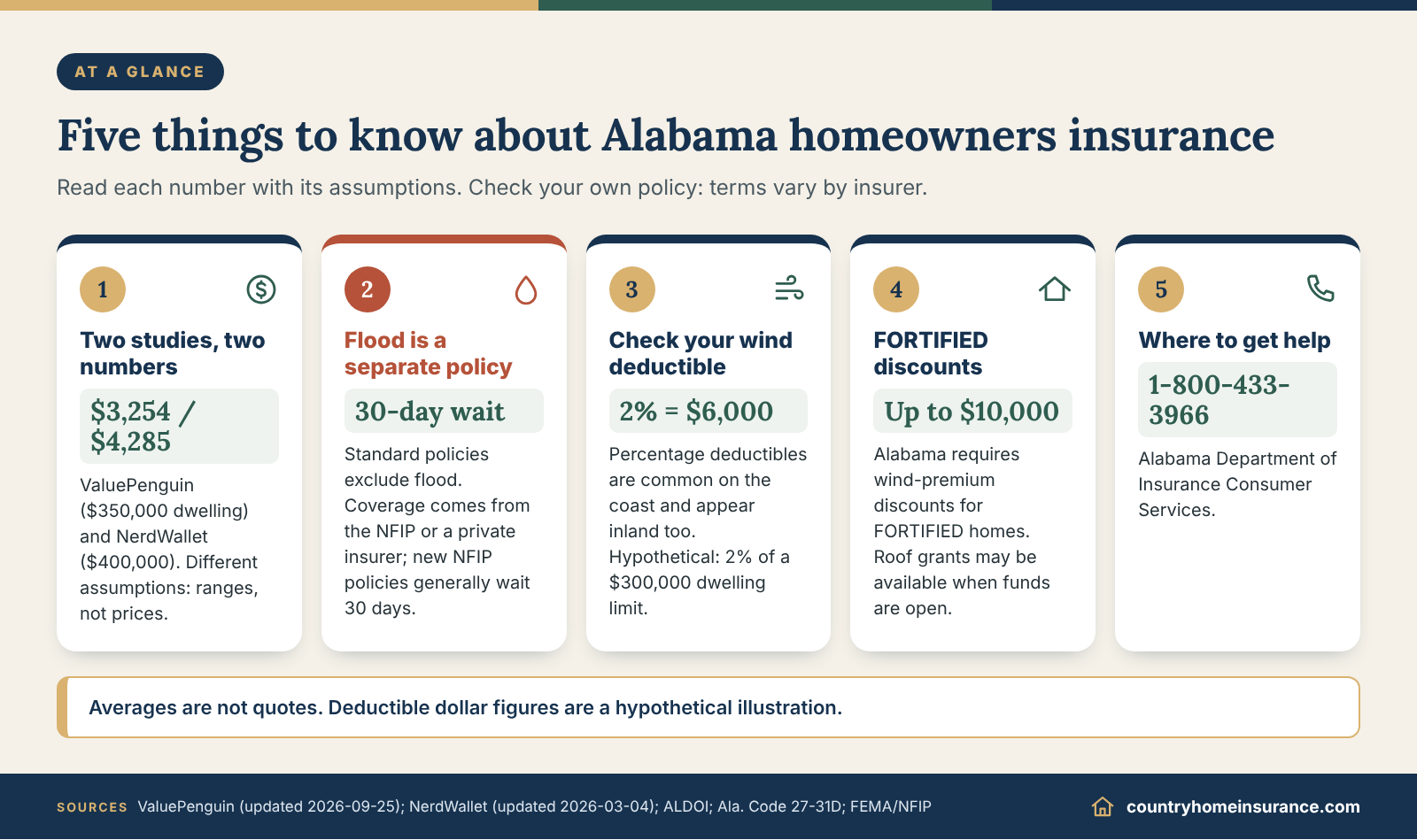
- Two 2026 rate studies put the typical Alabama premium at about $3,254 (ValuePenguin, $350,000 dwelling) and $4,285 (NerdWallet, $400,000 dwelling). They use different assumptions, so treat them as ranges, not prices.
- Flood is not covered by a standard homeowners policy. Coverage comes from the NFIP or a private flood insurer, and new NFIP policies generally have a 30-day waiting period.
- Percentage wind or hurricane deductibles are common on the coast and appear inland too. At 2% on a $300,000 dwelling limit, you’d carry the first $6,000 of a qualifying storm loss.
- Alabama requires property insurers to include discounts for homes built or retrofitted to IBHS FORTIFIED standards, and the Strengthen Alabama Homes program offers grants of up to $10,000 toward a FORTIFIED Roof when funds are available.
- For coastal Baldwin and Mobile counties, the Alabama Insurance Underwriting Association (AIUA) is the residual-market option for wind and other perils when the private market won’t write a home.
- If an insurer imposes a new hurricane deductible or nonrenews a group of policyholders to cut catastrophe exposure, an Alabama regulation requires 120 days’ written notice to you.
| Loss or exposure | Typical treatment in a standard HO-3 policy | Alabama-specific note |
|---|---|---|
| Tornado or straight-line wind damage | Typically covered, subject to the wind/hail deductible | Some inland policies use a percentage wind/hail deductible, not just the all-other-perils amount |
| Hurricane wind on the coast | Covered unless wind is excluded; hurricane or named-storm deductible may apply | Some coastal homes buy wind from the AIUA and the rest of the coverage from a private insurer |
| Flood, storm surge, rising water | Not covered | Requires NFIP or private flood coverage; Sally (2020) showed inland rain flooding risk |
| Hail damage to roof | Typically covered; cosmetic-damage limits may apply by endorsement | Roof age and roof type can change how the claim is valued |
| Roof replaced to FORTIFIED standard after a covered loss | Depends on endorsement | Insurers must offer an optional FORTIFIED Roof endorsement for an added premium |
| Tree falls on house | Damage typically covered; removal often capped | ALDOI notes removal limits of a few hundred dollars per tree are common |
| Barns, workshops, fences | Covered under Coverage B up to its limit, if not used for business or farming | Farming use may require a farm or ranch policy |
| Wear, tear, rot, gradual leaks | Not covered | ALDOI says the homeowner pays the difference when a whole roof needs replacing due to wear |
How the Alabama home insurance market is set up
Before you compare a single quote, it helps to know who sells coverage in Alabama, who polices those sellers and where you can turn when the regular market says no. Alabama homeowners insurance looks a lot like coverage in other states on paper, but the state has its own coastal residual market, its own mitigation laws and its own notice rules. Those pieces shape your price and your options more than most people realize.
Who regulates homeowners insurance in Alabama?
The Alabama Department of Insurance (ALDOI) licenses insurers and agents, reviews rate and form filings, handles consumer complaints and enforces fire-safety law through the State Fire Marshal’s Office. The commissioner is appointed by the governor; Mark Fowler has held the post since his appointment took effect on January 16, 2023, after serving as acting commissioner from July 2022.
What the Department of Insurance can and can’t do for you
ALDOI describes itself as an unbiased source of information on insurers and coverage. In practice, that means it can tell you whether a company and agent are licensed, give you complaint history and financial-stability information, and point you to the coverage levels Alabama law requires. It can also step in when an insurer isn’t following claim-handling rules or when a repair estimate is far out of line with industry rates.
What it generally won’t do is negotiate the dollar amount of your claim line by line. The department’s own storm FAQ makes that point plainly: you’re expected to bring your own contractor estimates to the table. It also has no authority over mortgage companies, which matters if your lender is holding claim money or has placed coverage on your home.
How to reach consumer services and file a complaint
ALDOI’s Consumer Services Division can be reached at 334-241-4141 or toll-free at 1-800-433-3966, and by email at [email protected]. The main office line is 334-269-3550. The department suggests calling first, because many questions get answered without a formal complaint.
If you do file, ALDOI asks that complaints be submitted in writing and include your name, address, ZIP code, daytime phone number, policy number and the insurer’s name. Attach supporting documents, keep copies of everything and take notes on phone calls, including the date, time and the name of the person you spoke with.
Checking licenses before you sign
The department warns that a business card isn’t proof of a license. Before you pay a premium or sign an application, confirm that both the agent and the insurer are licensed in Alabama, and never sign a blank form. This sounds basic, but after a big storm, out-of-state sellers and contractors show up quickly, and a minute of checking can save you a world of trouble.
Where Alabama homeowners get coverage
Most Alabama homeowners buy from what the industry calls the admitted, or voluntary, market. When that market won’t write a home, usually because of coastal wind exposure, there are two main fallbacks: the AIUA and the surplus-lines market. Each works differently, and the differences matter at claim time.
Admitted insurers: the regular market
An admitted insurer is a company licensed by ALDOI to sell in Alabama. Its rates and policy forms go through the department’s filing process, and if it becomes insolvent, the Alabama Insurance Guaranty Association steps in on covered claims. According to the National Conference of Insurance Guaranty Funds’ summary of Alabama law, current through December 31, 2024, that association pays up to $300,000 per covered claim and up to $10,000 in unearned premium per policy.
National carriers, regional mutuals and farm-bureau-affiliated companies all write homeowners coverage here. Because market shares shift year to year, use ALDOI’s company search and the NAIC’s Consumer Insurance Search tool to check any insurer you’re considering rather than relying on an old ranking.
The AIUA: Alabama’s coastal market of last resort
The Alabama Insurance Underwriting Association is a nonprofit joint underwriting association organized in 1970. Under Alabama Code Section 27-1-24, every insurer authorized to write fire and extended coverage in the state must belong to it. The association serves the “beach area,” defined in the statute as the gulf front, beach and seacoast areas of Baldwin and Mobile counties as designated by the Insurance Services Office. In 2000, ALDOI announced a wind-and-hail-only option for property south of the 31st parallel in those two counties, alongside the association’s fire and extended coverage policy.
The AIUA’s website includes a maps tool for checking whether a property sits in an eligible territory. You’ll find more on how it works in the coastal section below.
Surplus lines: flexible terms, fewer guarantees
Surplus-lines (also called excess and surplus, or E&S) insurers aren’t licensed as admitted carriers in Alabama, though they must be eligible to write here through a licensed surplus-lines broker. They can set their own rates and forms, which lets them take on homes the admitted market avoids. The trade-off is that their policies may be narrower, and the state guaranty association protections that apply to admitted carriers may not extend to them. Ask the broker in writing which protections apply before you buy.
What does Alabama homeowners insurance cost in 2026?
Cost is usually the first question, and it’s the one with the least satisfying answer: it depends. Still, published averages give you a sense of the neighborhood you’re in. The key is to read each number with its assumptions attached, because two respectable studies can produce figures more than $1,000 apart without either one being wrong.
| Publisher and update date | Headline Alabama average | Key assumptions | Other figures reported |
|---|---|---|---|
| NerdWallet, updated 2026-03-04 | $4,285 per year (about $357 a month) | $400,000 dwelling, $300,000 liability, $1,000 deductible, good credit, no recent claims | National average $2,490 for the same profile; $7,185 with poor credit |
| NerdWallet by dwelling amount | $2,635 at $200,000; $3,440 at $300,000; $5,635 at $600,000 | Same profile, dwelling limit varied | $4,910 at $500,000 |
| ValuePenguin, updated 2026-09-25 | $3,254 per year | $350,000 dwelling; 199,760 quotes from 10 large insurers across 686 Alabama ZIP codes | $2,181 at $200,000; $4,335 at $500,000 |
| GAO-26-107867, released 2026-03-30 | No Alabama average published | National premium data, 2019–2024, inflation-adjusted | National average up 3% after inflation; some southern coastal high-wind areas up 25% or more |
What the 2026 rate studies actually say
Two consumer publishers updated Alabama figures in 2026. Neither number is a quote, and neither should be read as a price you’ll be offered. They’re useful mainly for orientation and for spotting whether a quote you’ve received is wildly out of line.
NerdWallet’s Alabama figures
NerdWallet’s Alabama page, updated March 4, 2026, puts the average at $4,285 a year for a sample policy with $400,000 in dwelling coverage, $300,000 in liability, a $1,000 deductible, good credit and no recent claims. For the same sample profile, its national figure is $2,490, so Alabama runs roughly 72% higher under that method. The same page shows how strongly credit matters in its sample: with poor credit, the Alabama average jumps to $7,185.
NerdWallet’s city figures are fairly tightly bunched. Gadsden ($3,820), Opelika ($3,875) and Auburn ($3,885) sit at the low end, while Huntsville and Madison ($4,480 each) and Montgomery ($4,450) sit near the top. Mobile and Foley both come in at $4,335.
ValuePenguin’s Alabama figures
ValuePenguin’s Alabama page, updated September 25, 2026, reports an average of $3,254 a year for $350,000 in dwelling coverage. It says the figure comes from 199,760 quotes across 686 ZIP codes from 10 of the state’s larger insurers. At a $200,000 dwelling limit, its average drops to $2,181; at $500,000 it rises to $4,335.
Because the published excerpt doesn’t fully describe the sample home’s age, construction or deductible, use these numbers as a general range rather than a benchmark for any particular house.
Why the two numbers don’t match
The gap between $3,254 and $4,285 mostly reflects different dwelling limits, different quote samples and different ways of averaging, not a disagreement about Alabama’s risk. Never compare one publisher’s average with another publisher’s average as if they measured the same thing. Compare your own quotes against each other, using identical limits and deductibles, and use published averages only as a sanity check.
Why Alabama premiums run above the national average
Alabama isn’t an outlier because of one storm or one bad year. It sits in a part of the country where several weather perils overlap, and wind in particular accounts for a big slice of what insurers expect to pay out.
Wind is a large share of the price
When ALDOI announced its updated FORTIFIED discount benchmarks in December 2016, it estimated that wind exposure made up roughly 70% to 80% of the cost of homeowners insurance on the coast and about 40% to 60% upstate. Those percentages are a regulator’s estimate from 2016, not a current measurement, but they explain why wind deductibles and wind-mitigation discounts carry so much weight in this state. If most of your premium is priced for wind, anything that changes your wind risk changes your bill.
What federal researchers found about disaster-prone areas
The U.S. Government Accountability Office’s 2026 report on homeowners premiums found that, nationally, average premiums rose about 3% from 2019 to 2024 after adjusting for inflation. The picture was different in disaster-prone places: rates in parts of certain states rose 25% or more, particularly in southern coastal areas with high wind risk, and homes in high-wind-risk areas paid about 58% more than similar homes in medium-wind-risk areas. The report doesn’t single out Alabama by name, but coastal Alabama fits the profile it describes.
How location changes the price within Alabama
Location is one of the strongest rating factors, but in Alabama it works in two directions at once. Coastal counties carry hurricane exposure, while the northern half of the state sees frequent tornado and hail activity. The result is less of a smooth gradient from cheap to expensive than you might expect.
The city spread is narrower than you might think
In NerdWallet’s 2026 city list, the gap between the lowest and highest Alabama city averages is only about $660, and some inland cities price higher than Mobile in that sample. That doesn’t mean coastal homes cost the same to insure as inland homes in every case. It means the sample’s assumptions, including a fixed deductible, can hide the differences that matter most on the coast, such as a separate hurricane deductible or a wind exclusion.
Coast versus north Alabama
On the Gulf Coast, the big variables are distance to the water, whether wind is included or split off, the size of the hurricane deductible and whether the home has a FORTIFIED designation. In north and central Alabama, the variables shift toward roof condition, hail and tornado history, fire protection and construction type. A rural home in north Alabama far from a fire hydrant can end up paying more than a newer suburban home closer to the coast, so it’s worth getting quotes rather than assuming your region dictates your price.
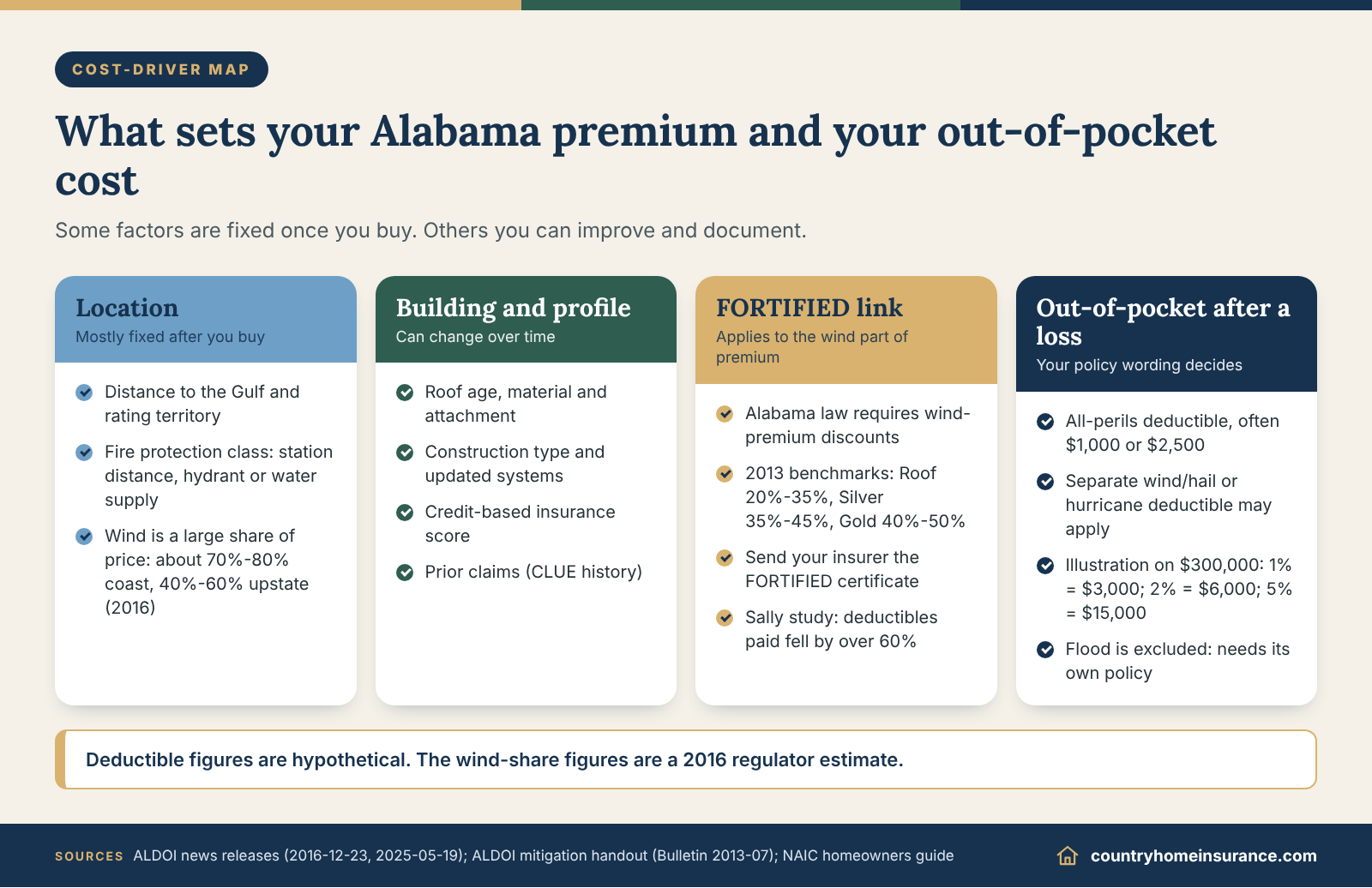
What drives your premium up or down in Alabama
Insurers price each home on dozens of factors, but a handful do most of the work. The NAIC’s homeowners insurance guide lists location, construction, age and condition, coverage amounts, deductible and available discounts as the main levers. In Alabama, wind exposure and roof condition deserve extra weight because of how much of the premium is tied to storms.
| Factor | Why insurers care | Can you influence it? |
|---|---|---|
| Distance to the Gulf and rating territory | Drives hurricane wind exposure and deductible rules | Not after you buy; check before you buy |
| Roof age, material and attachment | Roofs are the first point of failure in wind and hail | Yes: replacement, FORTIFIED Roof designation |
| Fire protection (protection class) | Response time and water supply affect fire losses | Partly: hydrant distance is fixed, but a local department’s rating can change |
| Construction type and age of systems | Masonry and updated wiring, plumbing and heating tend to lower loss risk | Yes, through updates you document |
| Credit-based insurance score | Used by many insurers as a rating factor where permitted | Over time |
| Prior claims (CLUE history) | Recent claims can signal future claims | Over time; avoid small claims near the deductible |
| Dwelling limit and deductible choices | Higher limits cost more; higher deductibles cost less | Yes, at every renewal |
| FORTIFIED designation | Required wind-premium discounts under Alabama law | Yes, through retrofit or new construction |
How location shapes your rate
Two homes with identical floor plans can be priced very differently based on where they sit. In Alabama, location affects both the expected cost of storms and the expected cost of fires.
Rating territory and coastal distance
Insurers divide the state into rating territories. Closer to the Gulf, hurricane wind becomes the dominant risk, which brings separate hurricane deductibles, possible wind exclusions and, for some homes, a split between a private policy and the AIUA. Farther inland, territories reflect tornado and hail frequency instead. You can’t move your house, but you can check the territory picture before you buy one, and that’s one of the most valuable things a home buyer can do.
Fire protection class
Protection class is a rating that reflects how well a community can fight fires, based on factors such as fire department capability, distance to the station and access to a hydrant or other water supply. The NAIC notes that protection class is part of how location affects your rate. For rural Alabama, this matters a lot. A home served by a volunteer department several miles away, with no hydrant nearby, may rate in a worse class than a similar home in town. Ask your agent which class your address carries and what information the insurer used to assign it.
How the building itself affects price
After location, insurers look at the structure. Here’s where homeowners have the most room to change the outcome, because many building factors can be improved and documented.
The roof matters more than almost anything else
In a state where wind and hail drive so many claims, the roof is the insurer’s first concern. Age, material, slope and how the decking is fastened all play a role. An older roof may push the policy toward actual cash value settlement for roof claims, raise the premium, or in some cases limit which insurers will write the home. A newer roof, and especially one with a FORTIFIED Roof designation, can work in your favor. Keep your roofing invoice, permit and any designation certificate, and send copies to your agent when you replace a roof.
Age, systems and construction type
The NAIC notes that brick and other masonry homes often cost less to insure than frame homes, and that insurers may require updated heating, plumbing, wiring and roofing before covering an older home. If you’ve rewired, replaced galvanized pipes or swapped an aging HVAC system, tell your insurer and provide proof. Some features can push the price up rather than down; the NAIC gives examples like a new wood-burning fireplace or a wooden deck.
How your profile and choices affect price
The last group of factors is about you and the coverage you select. Some change slowly; others you can adjust at your next renewal.
Credit-based insurance scores
Many insurers use a credit-based insurance score, which is built from credit report information but isn’t the same as a lending score. NerdWallet’s 2026 Alabama sample shows how large the effect can be: its average rises from $4,285 with good credit to $7,185 with poor credit for the same sample policy. That’s one publisher’s sample, not a rule, but it’s a reminder that improving credit over time can matter as much as shopping around.
Prior claims and your CLUE report
Insurers check loss-history databases, commonly known by the name of one of them, the Comprehensive Loss Underwriting Exchange (CLUE) report. ALDOI publishes a short explainer on CLUE reports. Several recent claims, or claims for water damage, can raise a premium or affect eligibility. That’s one reason many homeowners choose not to file small claims that barely exceed the deductible, though whether that makes sense depends on the size of the loss and your policy terms.
Your limit and deductible choices
The NerdWallet dwelling-limit figures show the obvious pattern: insuring a home for more costs more. But underinsuring to save money is a false economy. ALDOI and the NAIC both point to insuring for at least 80% of replacement value, and many homeowners aim for full replacement cost. A higher all-perils deductible can lower your premium, but ALDOI suggests talking through the trade-offs with your agent and making sure you could pay that deductible after a loss.
What a standard Alabama homeowners policy covers
Alabama doesn’t use a special state homeowners form. Most policies are built on national templates, with Alabama-specific endorsements layered on top. Understanding the core coverage parts helps you read your declarations page, which is the summary sheet listing your limits, deductibles and endorsements.
The six standard coverage parts
A typical homeowners policy bundles property and liability coverage. The NAIC describes them as dwelling, other structures, personal property, additional living expense, personal liability and medical payments.
Coverage A (Dwelling) and Coverage B (Other Structures)
Coverage A pays to repair or rebuild the house itself, up to the limit on your declarations page. Coverage B covers structures not attached to the house, such as a detached garage, shed, fence or workshop, and is often set as a percentage of Coverage A. For country properties with barns and pole buildings, that default percentage may fall well short. Coverage B also usually excludes structures used for business or rented to others, which can trip up hobby farmers and anyone running a side business out of a shop.
Coverage C (Personal Property)
Coverage C protects your belongings, wherever they are in the world in many policies, subject to sublimits. The NAIC notes that categories such as jewelry, furs, firearms and computers often carry sublimits in the $500 to $1,000 range unless you schedule them with an endorsement. Hunting rifles, collections and tools are common Alabama examples worth reviewing.
Coverage D (Loss of Use / Additional Living Expense)
If a covered loss makes your home unlivable, Coverage D pays the extra cost of living elsewhere, such as hotel bills and the difference in meal costs. ALDOI’s natural-disaster preparedness guide states that Alabama homeowners policies that include additional living expense must provide coverage for at least twelve months, though a dollar limit may still apply. Keep every receipt, and ask your adjuster early how long and how much your policy allows.
Coverage E (Personal Liability) and Coverage F (Medical Payments)
Liability coverage defends you and pays covered claims if you’re legally responsible for injuring someone or damaging their property. ALDOI’s homeowners FAQ notes that it protects you and household members. Medical payments coverage pays limited medical bills for guests hurt on your property regardless of fault. On acreage with ponds, ATVs, horses or hunting guests, liability limits deserve a closer look, and an umbrella policy may make sense.
Policy forms you’ll see in Alabama
The policy form determines which causes of loss are covered and how. Two homes with the same limits can have very different protection depending on the form.
HO-3 and HO-5 policies
The HO-3 is the most common homeowners form. It generally covers the dwelling on an open-perils basis, meaning any cause of loss not specifically excluded, while covering personal property only for named perils. An HO-5, where available, typically extends open-perils treatment to personal property as well. Exact wording varies by insurer, so read the “perils insured against” and “exclusions” sections rather than assuming the label tells the whole story.
Named-peril and dwelling fire policies
Some older, vacant, rental or hard-to-insure homes are written on dwelling fire or named-peril forms. These cover only the causes of loss listed, and they may settle at actual cash value. ALDOI’s 2000 announcement on the AIUA noted that named-peril policies many coastal consumers had settled for didn’t include replacement cost, liability or theft coverage. If you’re offered one of these, compare it line by line against a standard homeowners form.
How claims are valued: RCV, ACV and limits
The loss-settlement section of your policy decides how much you’re paid, not just whether you’re paid. This is where many Alabama storm claims turn into disputes.
Replacement cost value versus actual cash value
The NAIC explains that replacement cost value (RCV) pays to repair or replace with similar materials without subtracting depreciation, while actual cash value (ACV) subtracts depreciation for age and wear. ALDOI’s storm FAQ adds an important practical point: replacement cost policies usually pay ACV first, and the remaining amount, called recoverable depreciation, is typically paid once you repair, rebuild or replace. Read your policy for any deadline to complete repairs and claim the holdback.
Extended replacement cost and the 80% rule
Extended replacement cost adds a cushion, often a set percentage above your dwelling limit, if rebuilding costs spike after a widespread storm. Guaranteed replacement cost, offered by some insurers for an added premium, goes further. Many policies also contain a coinsurance-style condition: if you insure for less than a set share of replacement cost, commonly 80%, the insurer may reduce partial-loss payments. ALDOI’s coastal guidance has warned that some insurers apply a penalty when homes are underinsured. Report additions and improvements to your agent so your limit keeps pace.
Coverage gaps Alabama homeowners should know about
Most coverage surprises come from a handful of exclusions and limits. In Alabama, flood, water, wear and tear, and tree removal produce more frustration after storms than almost anything else. Knowing these before a loss lets you fill the gaps or at least plan for them.
Flood is a separate policy
This is the single most important gap to understand. Hurricane winds and storm surge often arrive together, and the policy that pays for one may not pay for the other.
Why homeowners policies exclude flood
ALDOI’s homeowners FAQ states that most homeowners policies don’t protect against flood losses, and points readers to the water-damage exclusions in the policy. The NAIC adds that standard policies exclude flooding from rising groundwater, rain runoff and snowmelt, while sudden water damage from a burst pipe or a roof leak caused by a covered peril is typically covered. That distinction matters in Alabama because heavy rain from slow-moving tropical systems can flood homes far from the beach. When Hurricane Sally made landfall at Gulf Shores in September 2020, the National Hurricane Center recorded 29.99 inches of rain at Orange Beach and noted that several rivers reached record levels.
NFIP limits and the waiting period
The National Flood Insurance Program, managed by FEMA, offers residential building coverage up to $250,000 and contents coverage up to $100,000, according to FEMA’s flood insurance overview. Building and contents are purchased separately, each with its own deductible. New NFIP policies generally take effect after a 30-day waiting period; ALDOI notes an exception when flood coverage is required in connection with a mortgage. FloodSmart reports that NFIP policyholders received average claim payments of $68,000 from 2016 to 2021 and that 99% of U.S. counties experienced a flood event in the previous 20 years.
Private flood and higher-value homes
Private flood insurers also write coverage in Alabama, sometimes with higher limits, additional living expense or shorter waiting periods. Terms vary widely, so compare the declarations, exclusions and claims process carefully. The policy counts in FEMA’s April 2025 Alabama comparison of its Risk Rating 2.0 pricing add up to roughly 52,600 NFIP policies in the state, and by our tally about four in five of them saw increases under the newer method. If your home needs more than the NFIP building limit, ask whether excess flood coverage is available.
Water, mold, wear and maintenance
Homeowners insurance is built to cover sudden, accidental damage. It isn’t a maintenance plan. The line between the two is where many water and roof claims get decided.
Sudden versus gradual water damage
A pipe that bursts during a hard January freeze is the classic sudden loss and is typically covered, subject to your deductible and policy conditions. A slow leak under a sink that rots the subfloor over months usually isn’t. The NAIC also lists mold, termites and other infestations among common exclusions or limitations. In humid Alabama summers, moisture problems can grow quickly, so fix leaks fast and report sudden ones promptly.
Roof wear and partial repairs
ALDOI’s homeowners FAQ addresses a common dispute directly. The insurer is responsible only for repairing the part of the roof damaged by a covered peril. If the whole roof needs replacing because of normal wear and tear, the homeowner pays the difference. Alabama has no specific statute requiring insurers to match undamaged shingles, according to United Policyholders’ Alabama claim FAQ, although policyholders sometimes argue for matching under the policy’s “like kind and quality” language.
Sewer and drain backup
Water that backs up through drains or sewer lines is typically excluded unless you add a water-backup endorsement. ALDOI’s preparedness guide lists sewer or drain backup and sump-pump failure among the items to check before a storm. These endorsements usually carry their own limit, which may be modest, so ask what it is.
Trees, debris and vehicles
Alabama’s pine and hardwood canopy is beautiful until it isn’t. After tornadoes and hurricanes, tree claims are among the most common, and the coverage rules aren’t always intuitive.
Tree removal limits
According to ALDOI’s storm FAQ, policies usually pay to remove a fallen tree only if it damaged covered property or blocks a driveway or wheelchair ramp, and even then removal is often capped, for example at a few hundred dollars per tree and about $1,000 in total. The damage the tree caused to the house is handled separately under Coverage A, subject to your deductible. A tree that falls in the woods without hitting anything usually isn’t covered for removal at all.
Cars under the carport
ALDOI reminds homeowners that a vehicle damaged under a carport or in a garage isn’t covered by homeowners insurance; that falls to the comprehensive coverage on your auto policy. Personal belongings inside the vehicle may still be covered under Coverage C. It’s worth checking that comprehensive is still on older farm trucks and second vehicles before storm season.
How wind, hail and hurricane deductibles work in Alabama
If there’s one line on an Alabama declarations page worth reading twice, it’s the wind or hurricane deductible. Many homeowners know their all-perils deductible, often $1,000 or $2,500, and assume it applies to every claim. On a storm claim, it may not. ALDOI has urged homeowners statewide, not only on the coast, to check whether their policy carries a separate wind, hail or hurricane deductible.
| Deductible type | How it is calculated | Amount you’d carry on a covered storm loss | Payment on a $20,000 covered loss (before depreciation or limits) |
|---|---|---|---|
| Flat all-perils deductible, $1,000 | Fixed dollar amount | $1,000 | $19,000 |
| 1% wind/hurricane deductible | 1% of the $300,000 Coverage A limit | $3,000 | $17,000 |
| 2% wind/hurricane deductible | 2% of the $300,000 Coverage A limit | $6,000 | $14,000 |
| 5% wind/hurricane deductible | 5% of the $300,000 Coverage A limit | $15,000 | $5,000 |
Figures above are a hypothetical example for illustration only. Some policies calculate percentage deductibles on a different base, apply minimum dollar amounts or treat roof losses differently, so the actual amount depends on your policy wording.
How percentage deductibles are calculated
A percentage deductible is based on the insured value of the home, not the size of the loss. That’s the point people most often miss, and it explains why a modest roof claim can fall entirely within the deductible.
The math behind a percentage deductible
ALDOI’s long-standing example shows how it works: on a $200,000 home, a 1% deductible equals $2,000 and a 5% deductible equals $10,000. ALDOI’s natural-disaster guide makes the same point in general terms, noting that these deductibles are often a percentage of the home’s insured value rather than a percentage of the loss. If your Coverage A limit rises at renewal, a percentage deductible rises with it, even if the percentage stays the same.
Flat dollar versus percentage options
Some insurers let you choose between a flat dollar wind deductible and several percentage options, with lower premiums attached to higher deductibles. Others set a minimum percentage in certain territories. ALDOI reported in 2009 that percentage hurricane deductibles in Mobile and Baldwin counties usually ranged from 1% to 5%, with higher optional amounts available. Ask your agent to quote two or three options side by side so you can see what each extra point of deductible saves in premium.
When a hurricane or wind deductible applies
The trigger language decides which deductible applies to a given storm. It varies from one insurer to the next, so the definitions section of your policy matters here.
Hurricane versus named-storm triggers
ALDOI has explained the difference this way: a hurricane deductible applies only when a hurricane has been declared, not for tropical storms, while some named-storm deductibles apply to both tropical storms and hurricanes. In its 2009 coastal guidance, the department also described deductible periods that generally run from the issuance of a hurricane watch until 24 hours after the last watch or warning ends. Treat those as examples of how such clauses are commonly written. Your own policy’s definition controls, and you should read it before the next storm rather than after.
Inland wind and hail deductibles
Percentage deductibles aren’t only a coastal issue. As far back as 2003, ALDOI noted that some insurers applied percentage hurricane or wind deductibles in inland counties too. In north and central Alabama, a separate wind/hail deductible can apply to tornado and hailstorm claims. If your policy has one, it typically applies to every wind or hail claim, not just named storms, which can make a big difference for roof claims after spring storms.
Choosing a deductible you can live with
The right wind deductible is a cash-flow decision as much as an insurance one. A lower premium doesn’t help if a storm leaves you unable to pay your share of the repair.
Matching the deductible to your savings
A simple test: could you write a check for your wind deductible next week without borrowing? If the answer is no, a lower deductible may be worth the higher premium. If you keep a healthy emergency fund, a higher deductible can trim the bill. Either way, ask whether the deductible applies per occurrence or per season, and whether more than one storm in a year could mean paying it twice.
Alabama’s catastrophe savings accounts
Alabama offers a tax-advantaged way to set money aside for storm deductibles. Under Alabama Code Section 40-18-312, as explained in the Alabama Department of Revenue’s catastrophe savings FAQ, residents can deduct contributions to a qualified catastrophe savings account tied to their principal residence. If your qualifying deductible is $1,000 or less, the contribution limit is $2,000. If it’s higher, the limit is the lesser of $15,000 or twice the deductible. Interest isn’t taxed while it stays within the limits, and qualified withdrawals for uninsured storm or flood repairs aren’t taxed. One catch: after you use the money for qualified repairs, the account can’t be replenished for further deductions. Legislators also discussed expanding qualifying expenses in the 2026 session, so check with the Department of Revenue or a tax professional for current rules.
Coastal Alabama: the AIUA, wind-only policies and surplus lines
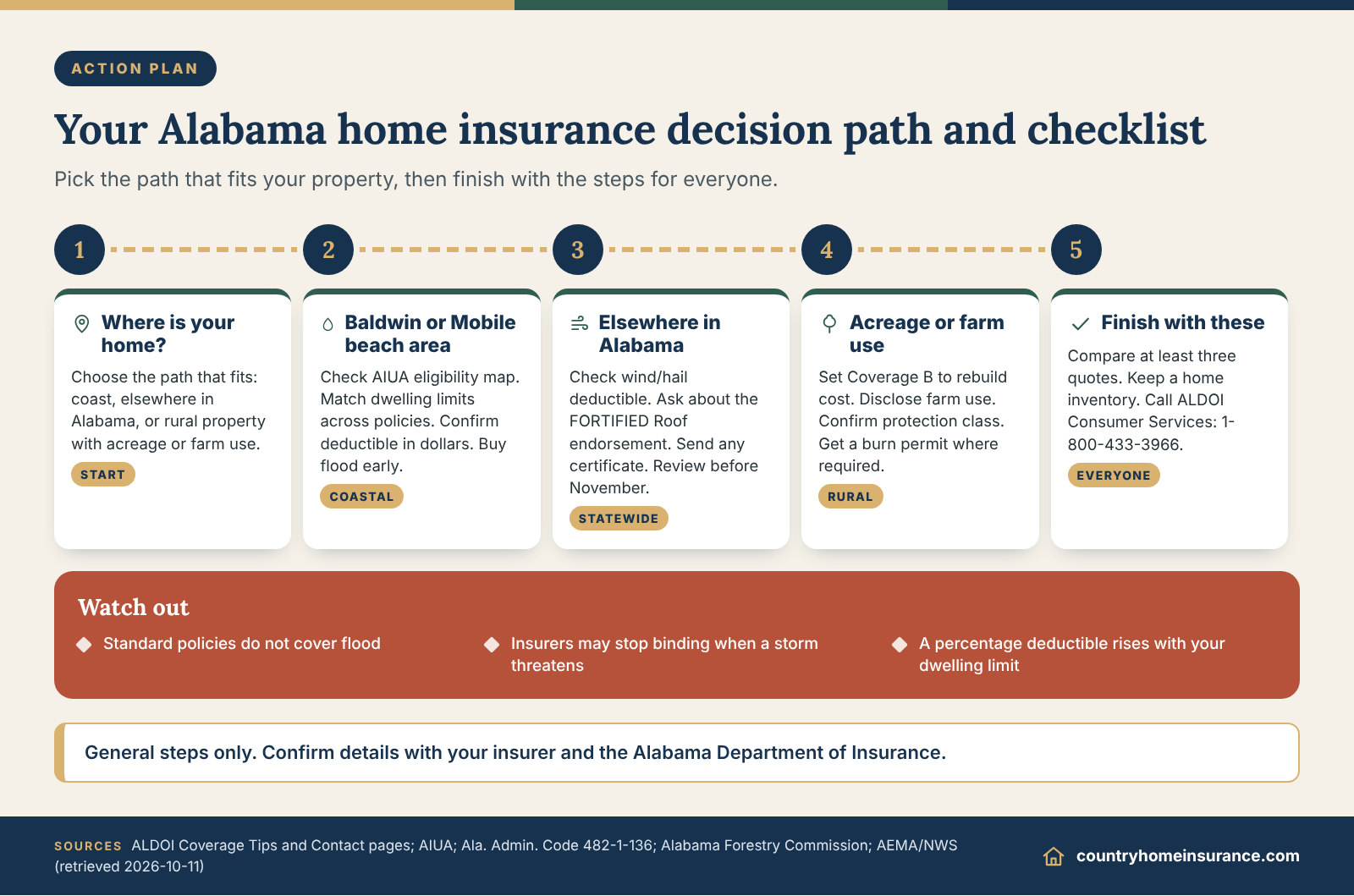
For homes in the gulf-front and beach areas of Baldwin and Mobile counties, buying coverage can mean assembling two or three policies instead of one. That’s normal here, but it creates room for gaps. Understanding how the pieces fit is the best way to avoid paying for overlap or, worse, finding a hole after a storm.
How the AIUA works
The AIUA is the coastal residual market. It isn’t a state agency and it isn’t funded by taxpayers; it’s an association of insurers created to make coverage available where the voluntary market won’t write.
What the AIUA is and who it serves
As described in Alabama Code Section 27-1-24, the AIUA is an unincorporated nonprofit joint underwriting association formed in 1970, and membership is mandatory for insurers writing fire and extended coverage in Alabama. It serves the designated beach area in Baldwin and Mobile counties. The NAIC describes residual-market plans generally as a last resort: they’re often more expensive than voluntary coverage and more limited, and they generally don’t include liability or loss-of-use protection. That’s why many coastal homeowners pair AIUA wind coverage with a private policy for everything else.
How to apply and pay
According to the AIUA’s website, agents submit applications through the association’s agent portal, and consumers can use a consumer quote tool to estimate premium. The site also provides an eligibility maps tool. Payment in full is required before the AIUA binds coverage, and it doesn’t accept cash. Policy limits, deductible options and eligibility rules can change, so confirm current terms with the AIUA or an agent who writes its business rather than relying on figures from older articles.
Binding restrictions when storms approach
Insurers commonly stop binding new coverage when a tropical system threatens. ALDOI’s 2009 guidance said most insurers won’t bind once a storm crosses west of 80 degrees longitude or north of 20 degrees latitude, an area that meets south of central Cuba. The AIUA posts its own restrictions; on October 7, 2026, its site announced that new business applications would not be accepted because of a named storm. Don’t wait for a storm in the Gulf to buy or increase coverage, because you may not be able to.
Pairing a wind exclusion with a wind-only policy
One common coastal setup is a homeowners policy that excludes windstorm and hail, combined with a separate wind-and-hail policy. Done well, the two policies cover what one standard policy would. Done carelessly, they leave gaps.
How the pairing works
The private homeowners policy handles fire, theft, liability, loss of use and other perils, while the wind policy, whether from the AIUA or another insurer, handles wind and hail damage. Each policy has its own limits and deductibles. Your mortgage lender will usually want to see proof of both. Make sure the dwelling limits on the two policies are consistent, so you aren’t insured for $350,000 on one and $275,000 on the other.
Watch for gaps between the two policies
The trickiest claims involve damage with mixed causes, such as wind tearing off shingles followed by rain entering the house, or debris that may have been moved by wind or water. Ask both insurers how they handle wind-driven rain, loss of use after a wind loss, and personal property damaged by wind. Also confirm whether your wind policy includes contents and additional living expense; residual-market policies often limit or omit them. And remember that neither policy typically covers flood or storm surge.
When a surplus-lines policy is the offer
If both the voluntary market and the AIUA aren’t a good fit, an agent may suggest a surplus-lines policy. These can be useful, but they deserve a slower read.
What changes with a surplus-lines insurer
Surplus-lines insurers aren’t bound by the same rate and form filing process as admitted insurers, which gives them flexibility on price and terms. ALDOI regulates surplus-lines brokers and maintains filing requirements for the insurers they place. Expect possible differences in roof-settlement terms, exclusions, minimum premiums and cancellation provisions. Ask for the full policy form, not just a quote summary, before you buy.
Guaranty association protection
The Alabama Insurance Guaranty Association protects policyholders of insolvent admitted insurers, up to $300,000 per covered claim under the NCIGF summary of Alabama law. Surplus-lines policies may not qualify for that protection. Ask your broker in writing whether the policy is covered by any guaranty fund, and look at the insurer’s financial strength rating before you commit.
Nonrenewals, coverage restrictions and notice rules in Alabama
A nonrenewal letter or a renewal that suddenly carries a new hurricane deductible can be unsettling. Alabama has a specific rule for some of these situations, and knowing it helps you plan the next move instead of scrambling.
Alabama’s rule on group restrictions and nonrenewals
ALDOI’s regulation on coverage restrictions, codified as Chapter 482-1-136 of the Alabama Administrative Code, was adopted in 2005 and amended in 2007. Its stated purpose is to give policyholders enough time to shop.
What counts as a coverage restriction
Under the rule, a coverage restriction means imposing a wind exclusion or a hurricane deductible, or increasing an existing hurricane deductible, for a category or group of existing insureds at renewal, when the change isn’t a result of the policyholder’s own claims history. A nonrenewal under the rule means an insurer’s decision not to renew a group of existing insureds in order to reduce its exposure to a catastrophic event such as a hurricane. The rule applies to authorized insurers writing residential or commercial property insurance in Alabama.
The 150-day and 120-day notices
For these group actions, the insurer must notify the named insured in writing at least 120 days before the renewal or expiration date, according to Rule 482-1-136-.05. It must also notify the commissioner at least 150 days ahead, listing the affected policy types, the number of policyholders and the counties where they live. That 120-day window is meant to give you a full season of shopping time, so start right away rather than waiting until the last month.
Individual cancellations and nonrenewals
Not every nonrenewal is part of a group action. An insurer may decline to renew a single policy because of claims, condition of the home or other underwriting reasons, and different notice rules may apply.
What notice to expect for individual actions
In a 2023 news report, ALDOI said the general notice requirement for canceling, reducing or not renewing property coverage was 30 days. Policy language may give more, and the reason for cancellation, such as nonpayment, can affect timing. Because individual notice rules depend on the statute, the policy and the circumstances, call ALDOI Consumer Services if a notice seems too short or doesn’t explain itself.
Legislative proposals to watch
Alabama lawmakers have considered longer notice periods. A 2024 House bill would have required 90 days’ notice and barred cancellations until 90 days after storm repairs were finished; it passed the House in April 2024, but we couldn’t confirm that it became law. Treat any article claiming a 90-day rule with caution and confirm current law with ALDOI before relying on it.
What to do if you receive a notice
A notice is a deadline, not a verdict. Most homeowners who act early find replacement coverage, even if it costs more or comes in a different structure.
Your first 30 days after a notice
- Read the notice for the reason, the effective date and whether it’s a nonrenewal or a coverage change.
- Ask your agent whether fixing a specific issue, such as a roof or electrical panel, could change the decision.
- Request quotes from at least three insurers, as ALDOI recommends, and ask an independent agent to check the voluntary market, the AIUA if you’re eligible and surplus lines.
- Gather documents that can help: roof invoices, FORTIFIED certificates, inspection reports and photos of updates.
- Tell your mortgage servicer if a lapse is possible, because a lender can buy force-placed coverage that protects mainly its own interest.
When to call the Department of Insurance
Contact ALDOI if the notice gives no reason, seems to arrive late, or looks like a group action that didn’t come with 120 days’ notice. The department can also explain your options and confirm whether a replacement insurer is licensed. Keep copies of the notice, the envelope and any correspondence.
FORTIFIED homes, grants and discounts in Alabama
Alabama has built more of its home-insurance policy around wind mitigation than any other state. The idea is simple: a roof that stays on in a storm means fewer claims, smaller claims and, in theory, lower premiums. The state backs that idea with a discount law, a grant program, a required endorsement offer and tax incentives. Together, they’re the most powerful cost lever many Alabama homeowners have.
| Mitigation level | Existing home, roof older than 5 years | Existing home, roof 5 years old or newer | New home, 5 years old or newer |
|---|---|---|---|
| FORTIFIED for Safer Living | 50% | 60% | 60% |
| FORTIFIED Home Gold | 40% | 50% | 50% |
| FORTIFIED Home Silver | 35% | 45% | 45% |
| FORTIFIED Home Bronze (now called FORTIFIED Roof) | 20% | 35% | 35% |
| Built to 2006 IRC or later with hurricane provisions | 10% | 20% | 20% |
These benchmarks apply to the wind portion of the premium, not the whole bill, and they come from a 2013 bulletin described in an older ALDOI handout. ALDOI announced revised county-level benchmarks in Bulletin 2016-07, describing discounts of 35% to 60% on the hurricane portion and 20% to 35% on other wind premium. Ask your insurer which current benchmark it uses and how it applies to your county.
Alabama’s FORTIFIED discount law
The discount requirement isn’t a marketing perk; it’s in the Alabama Code. That gives homeowners real leverage when they’ve done the work.
Who must offer a discount
Alabama Act 2009-500, codified at Sections 27-31D-1 through 27-31D-5, requires property insurers to include a premium discount or rate reduction in their rating plans for homes built to the 2006 International Residential Code with hurricane provisions or to IBHS FORTIFIED standards. ALDOI’s older mitigation handout describes the discounts as mandatory for property in Baldwin and Mobile counties, and the department’s December 2016 announcement states that, under Act 2015-313, all insurers in Alabama must provide the benchmark discounts. A 2025 University of Alabama study described Alabama as the only state with mandatory minimum FORTIFIED discounts.
How the benchmark levels work
The discount depends on the designation level, the age of the roof and, under the newer benchmarks, the county. FORTIFIED Roof focuses on the roof deck and sealing it against water. Silver adds protection for openings, gable ends and porches. Gold adds a continuous load path from roof to foundation, which is most practical in new construction or major renovation. To receive the discount, you generally need to send your insurer the FORTIFIED certificate, so keep a digital copy handy and resend it whenever you switch carriers.
The FORTIFIED Roof endorsement
Alabama also requires insurers to offer a way to upgrade a roof to FORTIFIED standards when a covered loss forces a full replacement. Many people decline it without knowing what it is.
When insurers must offer it
Under Alabama Code Section 27-31D-2.1, enacted by Act 2019-240, insurers writing homeowners coverage must offer a FORTIFIED roof endorsement when they write a new policy on a non-FORTIFIED home and at the first renewal of an existing policy after January 1, 2020. ALDOI’s 2019 announcement explained that the endorsement costs an additional premium and applies only when covered damage requires a full roof replacement. Partial roof replacements don’t qualify.
What it costs and who’s eligible
IBHS’s Alabama endorsement page cites sample estimates showing a FORTIFIED roof costing roughly $700 to $1,700 more than a standard replacement, before the third-party evaluator’s fee, which IBHS says typically runs $300 to $600. Roof size is the biggest variable. Not every home qualifies: IBHS lists exclusions such as roof sheathing thinner than 7/16 inch unless it’s replaced, gapped decking that isn’t overlaid or replaced, and homes without an adequate foundation connection, including some manufactured homes. If your insurer offers the endorsement, ask for the premium in dollars and compare it with the potential discount you’d earn after an upgrade.
Strengthen Alabama Homes grants
Strengthen Alabama Homes (SAH), created by the Strengthen Alabama Homes Act of 2011, funds FORTIFIED Roof retrofits for owner-occupied homes. Its rules were updated effective January 1, 2026.
Who qualifies for a grant
According to the NAIC’s summary of state mitigation programs, SAH covers up to the full project cost, capped at $10,000, and is funded by the insurance industry. The current SAH regulation, ALDOI Chapter 482-1-159, sets these core requirements:
- The home must be a single-family, owner-occupied primary residence in a county where grants are being approved; condominiums, townhomes and mobile homes don’t qualify.
- The home can’t be listed for sale and must be in good repair, apart from damage from hurricane, wind or hail.
- You need an in-force wind insurance policy, plus a flood policy if the home sits in a special flood hazard area.
- The retrofit must achieve the FORTIFIED Roof designation and be completed within three months of grant approval.
How the grant process works
Applicants create an online profile, upload a recent federal tax return and their homeowners and wind declarations pages, and pick a certified evaluator, whose fee the homeowner pays. The evaluator checks whether the home can be FORTIFIED. The homeowner then gets bids from three approved contractors. Grants are awarded first-come, first-served, subject to available funds, and the money goes directly to the contractor after the FORTIFIED certificate is issued. Afterward, you send the certificate to your insurer for the wind credit and upload your new declarations page to the SAH portal. ALDOI reported in May 2025 that the program had retrofitted 8,660 homes.
Does FORTIFIED actually pay off?
Discounts are only part of the value. The bigger question is whether these roofs perform when a hurricane hits, and Alabama now has real data on that.
What the Hurricane Sally study found
In May 2025, ALDOI released a peer-reviewed study by the University of Alabama’s Center for Risk and Insurance Research. It looked at more than 40,000 insured coastal properties affected by Hurricane Sally, which made landfall near Gulf Shores as a Category 2 storm in September 2020. Compared with conventional homes, FORTIFIED homes saw loss frequency fall by at least 55% and up to 74%, claim severity fall by 15% to 40%, and policyholder deductibles paid fall by more than 60%. Tree-fall claims were excluded from the analysis, which matters because FORTIFIED doesn’t protect against falling trees. ALDOI also reported in 2024 that more than 95% of the 17,000-plus coastal FORTIFIED homes had little or no damage from Sally.
State tax incentives
The FORTIFIED Home program’s Alabama incentives page describes a state income tax deduction for retrofitting a home to resist wind or flood damage, limited to the lesser of 50% of the cost or $3,000. Tax rules change, and eligibility depends on what work you do and how you document it, so confirm with the Alabama Department of Revenue or a tax preparer before counting on it. Stacking a grant, a discount and a deduction is possible in some cases, but each has its own rules.
Alabama weather risks and what they mean for coverage
Alabama’s insurance story is a weather story. Tornadoes, hail, hurricanes, drought and occasional hard freezes all show up in claim files here. Each peril interacts with your policy a little differently, so it’s worth matching your coverage review to the risks your part of the state actually faces.
Tornadoes and severe thunderstorms
Tornado and hail damage is generally covered by a standard homeowners policy as windstorm or hail, subject to your deductible. The challenge in Alabama is frequency.
How often tornadoes strike Alabama
The National Weather Service office in Birmingham keeps a statewide tornado database. Through preliminary data as of September 13, 2026, it shows Alabama averaging 60.0 tornadoes a year over the past 10 years and 64.05 a year over 20 years, compared with 35.7 a year since 1950. Some of that long-term increase reflects better detection and reporting, so don’t read it as a simple trend line. The human toll can be severe: Pew notes that the April 27, 2011, outbreak killed 240 people in Alabama.
Two severe-weather seasons, including this fall
Alabama’s primary severe-weather season runs in spring, roughly March through May. According to the Alabama Emergency Management Agency and the NWS Birmingham office, the state also has a secondary severe-weather season that typically runs from early November to mid-December and occasionally starts in late October or stretches into late December. If you’re reading this in the fall, that second season is right around the corner. It’s a good time to confirm your wind/hail deductible, update your home inventory and photograph your roof while it’s in its pre-storm condition.
Hurricanes and tropical storms
Hurricanes are the defining risk on the coast, but their effects reach well inland through wind, tornadoes spawned in rain bands and flooding rain.
Lessons from Hurricane Sally
The National Hurricane Center’s report on Sally recorded landfall near Gulf Shores on September 16, 2020, with maximum sustained winds of about 95 knots, a Category 2. The storm’s slow movement produced extreme rainfall, including 29.99 inches at Orange Beach, and storm-surge inundation of roughly 5 to 7 feet above ground along the Baldwin County coast. NOAA estimated total U.S. damage at $7.3 billion. For homeowners, Sally was a reminder that a single storm can trigger wind claims, hurricane deductibles and uninsured flood losses all at once.
The 2026 season and its end date
The Atlantic hurricane season runs from June 1 to November 30. NOAA’s updated outlook issued August 6, 2026, called for a 75% chance of a below-normal season, with 7 to 13 named storms, 2 to 6 hurricanes and 0 to 2 major hurricanes. A below-normal forecast isn’t a promise; it takes only one landfall to make it a bad year for your street. Until the season closes at the end of November, keep your documents organized and remember that binding restrictions can kick in quickly when a storm forms.
Wildfire, drought and outdoor burning
Alabama isn’t usually mentioned alongside the West when people talk about wildfire, but drought years bring real fire risk to rural and wooded properties, and outdoor burning is a common way fires start.
Burn permits and fire alerts
The Alabama Forestry Commission says state law requires a burn permit before burning woodland, grassland, a field or wood debris larger than one-quarter acre, or any burn within 25 feet of flammable material. Permits are available at 1-800-392-5679. During drought, the State Forester can issue fire alerts that restrict burning; on April 13, 2026, the commission issued a statewide fire alert after about 50 wildfires burned more than 2,300 acres in a single weekend. Fire damage to your home is generally covered under a homeowners policy, but breaking burn rules can create legal trouble and complicate liability claims.
Liability when a burn escapes
If a debris fire you set spreads to a neighbor’s property, your homeowners liability coverage may respond, subject to the policy’s terms and exclusions. Farming-related burns can fall outside a homeowners policy entirely if the land is used for a farming business. Before you burn, confirm the permit, watch the weather and stay with the fire until it’s out. If you regularly burn pasture or timber, talk with your agent about whether you need farm liability coverage.
Insuring rural and country homes in Alabama
A lot of Alabama is rural: homes on a few acres outside a county seat, farmhouses with a barn or two, cabins at the end of a gravel road. These properties raise questions a standard suburban quote doesn’t always ask. A country home isn’t just a suburban house with more yard, and insuring it as if it were can leave gaps.
Acreage, outbuildings and farm-like use
The more land and buildings you have, the more important it is to match the policy to how the property is actually used.
Getting Coverage B right for barns and shops
Coverage B is often set at a percentage of the dwelling limit by default. For a home with a large equipment barn, a detached shop and a long run of fencing, that default may not come close to replacement cost. List every structure, estimate what it would cost to rebuild, and ask whether you can raise Coverage B or schedule specific buildings. Be clear about how each building is used, because many policies exclude structures used for business or rented to others.
When a hobby farm needs more than a homeowners policy
Homeowners policies are designed for residential use. If you sell hay, raise cattle for market, board horses or run a small agritourism venture, you may have farm exposures that a homeowners policy limits or excludes, including farm equipment, livestock and business liability. Depending on scale, the answer may be a farm endorsement, a farm and ranch policy or a separate commercial policy. Tell your agent what really happens on the land, even if it’s small; an undisclosed business use can cause problems at claim time, and the NAIC notes that undisclosed home businesses can even lead to cancellation.
Fire protection in the country
Fire protection is one of the most rural-specific pricing factors. It can also be one of the most surprising lines on a quote.
Volunteer fire departments and protection class
Much of rural Alabama relies on volunteer fire departments. Insurers look at the protection class assigned to your address, which reflects factors such as distance to the responding station and the department’s capabilities. Homes that are farther from a station, or outside any fire district, may rate higher. If your local volunteer department has improved its rating, or if a new station has opened nearby, ask your agent to re-check your protection class at renewal.
Water supply when there’s no hydrant
Without a nearby hydrant, firefighters depend on tanker trucks, ponds or dry hydrants. Some insurers consider whether a credible water source is within a set distance of the home. Keep your driveway passable for heavy trucks, mark your address clearly at the road and keep vegetation trimmed back from the house. These steps don’t guarantee a better rate, but they make a real difference when the trucks arrive.
Wells, septic systems, private roads and manufactured homes
Rural infrastructure brings its own coverage questions, and the answers depend heavily on policy wording.
Wells, septic and private roads
A well pump, pressure tank and septic system are part of the property, but coverage depends on the cause of loss. Sudden damage from a covered peril, such as lightning frying a well pump, may be covered, often under Coverage A or B depending on the policy. Wear, clogging and gradual failure generally aren’t. Some insurers sell equipment-breakdown or service-line endorsements that fill part of this gap; ask what’s included. If you share a private road, find out who owns it, who maintains it and whether a road-maintenance agreement assigns liability, because a guest hurt on a washed-out road may become a liability question for your policy.
Manufactured and mobile homes
Manufactured homes are common in rural Alabama, and they’re usually insured on a separate manufactured-home policy rather than a standard homeowners form. They aren’t eligible for Strengthen Alabama Homes grants, and IBHS notes that homes with inadequate foundation connections, including some HUD-code homes with anchors that allow movement, can’t earn the FORTIFIED Roof designation. Proper tie-downs and anchoring matter for both safety and underwriting. Ask your insurer what installation documentation it requires and how it values the home after a loss.
How to file a homeowners claim in Alabama
The hours and days after a storm are stressful, and the steps you take then can shape the outcome of your claim. ALDOI’s guidance and its handling rules give you a roadmap. The aim is to protect the property, document everything and keep a clear paper trail.
| Stage | Your action | Insurer obligation or typical practice | Records to keep |
|---|---|---|---|
| First 24–48 hours | Make sure everyone is safe; report the claim; make temporary repairs such as tarping | Most policies pay reasonable costs to prevent further damage | Photos and video before and after temporary repairs; receipts |
| Within about 15 days of notice | Provide requested information; ask for forms in writing | Under Ala. Admin. Code 482-1-125-.06, as summarized by claim-law sources, acknowledge the claim and reply to written communications within 15 days | Claim number, adjuster name, dated notes of every call |
| Inspection | Be present; show all damage; don’t discard damaged items before the adjuster sees them | Timing varies; widespread catastrophes slow inspections | Your own contractor estimates, ideally at least two |
| Initial payment | Review the estimate line by line; ask about depreciation | Replacement cost policies usually pay ACV first | Estimate, payment letter, depreciation schedule |
| Repairs and holdback | Complete repairs; submit invoices for recoverable depreciation | Remaining replacement cost typically paid after repair or replacement | Contracts, invoices, permits, completion photos |
| Dispute | Appeal in writing; consider appraisal; contact ALDOI | Appraisal clause may apply to disagreements over amount of loss | All correspondence, estimates and the written denial if any |
The first days after a loss
What you do first is mostly about preventing more damage and creating a record. Both protect your claim.
Report quickly and prevent further damage
Contact your insurer or agent as soon as it’s safe. ALDOI advises making only the repairs needed to stop further damage, such as tarping a roof or boarding a window, because permanent repairs made before the adjuster sees the damage may not be reimbursed. Keep receipts for tarps, plywood and labor. If the home is unlivable, keep every receipt for hotels, meals and other added costs; Alabama policies with additional living expense coverage must provide at least 12 months, subject to any dollar limit.
Document the damage and your belongings
Photograph and video every room, the exterior, outbuildings and any damaged contents. ALDOI’s storm FAQ notes that insurers usually require a personal property inventory before paying the full contents limit, and suggests starting with high-value items and listing where you bought them, the brand, the approximate age and price. Credit card statements and store records can help fill gaps. If you made a home inventory before the storm, this step goes much faster.
Alabama claim-handling rules and payments
Alabama regulates how insurers handle claims, and knowing the basics helps you keep things moving.
Acknowledgment and response timelines
According to a policyholder-side law firm’s summary of Alabama Administrative Code Rule 482-1-125-.06, insurers must acknowledge a first-party claim within 15 days of notice and reply within 15 days to written communications that ask for a response; they must also respond to ALDOI inquiries within 10 working days. United Policyholders’ Alabama FAQ also describes a 30-day window to pay or deny after satisfactory proof of loss. Because we relied on secondary summaries for these rules, check the current regulation text or ask ALDOI before citing a specific deadline in a dispute. A practical tip: put important requests in writing and say clearly that you’re asking for a response.
Checks, mortgage companies and releases
ALDOI’s storm FAQ explains that if your lender is listed on the policy, claim checks may be made out to both you and the mortgage company, and for large losses the lender may release money in stages as repairs are documented. Cashing an initial payment generally doesn’t end your right to negotiate, but signing a settlement release typically closes the claim. Read any release carefully before you sign it.
Depreciation holdbacks
On replacement cost policies, your first payment usually reflects actual cash value. The withheld depreciation is typically paid after repairs are completed, so track any deadline in your policy for finishing work and submitting final invoices. ALDOI’s guidance also notes that standard policies generally don’t pay for building-code upgrades unless you carry ordinance or law coverage, an endorsement worth asking about for older homes.
When you disagree with the insurer
Disagreements are common after widespread storms, especially on roof claims. Most can be resolved with better documentation, but you have options when they can’t.
Your own estimates and the appraisal clause
ALDOI tells homeowners that adjusters write estimates based on what they observe, and recommends getting at least two estimates from reputable contractors to support your position. Verify contractor licenses with the Alabama Licensing Board for General Contractors and be wary of large upfront payments. If you and the insurer agree the damage is covered but disagree on the amount, your policy’s appraisal clause may provide a way to resolve it through independent appraisers and an umpire. United Policyholders cautions that appraisal results are generally binding, so understand the process before invoking it.
Public adjusters and attorneys in Alabama
Alabama is unusual here. United Policyholders and a policyholder law firm both report that Alabama doesn’t license public adjusters, and that negotiating a claim on someone else’s behalf could be treated as the unauthorized practice of law. In practice, policyholders who need representation in a large dispute often turn to an Alabama-licensed attorney. Be cautious of anyone who knocks on your door after a storm offering to handle your claim for a percentage.
Filing a complaint with ALDOI
If you believe the insurer isn’t following the rules, isn’t responding or is treating you unfairly, contact ALDOI Consumer Services. Submit the complaint in writing with your policy number, claim number and copies of key documents. ALDOI may not set your settlement amount, but it can require the insurer to respond and can act on violations.
How to shop for homeowners insurance in Alabama
Shopping well is less about finding the lowest number and more about comparing apples to apples. The cheapest quote can turn expensive if it carries a 5% hurricane deductible, ACV roof settlement or thin Coverage B limits for your outbuildings.
| Item to compare | Question to ask the agent or insurer | Why it matters in Alabama |
|---|---|---|
| Dwelling limit and valuation | Is this replacement cost, and is there extended replacement cost? | Post-storm rebuilding costs can spike across a whole region |
| Wind/hail or hurricane deductible | Is it a flat amount or a percentage, and what triggers it? | A 2% to 5% deductible can exceed many roof claims |
| Roof settlement terms | Is the roof settled at RCV or ACV, and does age change that? | Roof claims are among the most common after hail and tornadoes |
| FORTIFIED discount and endorsement | What discount applies to my designation, and what does the FORTIFIED Roof endorsement cost? | Discounts are required by law, but you must provide proof |
| Flood coverage | Am I in a special flood hazard area, and what would NFIP or private flood cost? | Standard policies exclude flood; NFIP generally has a 30-day wait |
| Other structures and farm use | Are my barn, shop and fences covered, and is any use excluded? | Rural properties often exceed default Coverage B limits |
| Insurer type | Is this an admitted insurer, the AIUA or a surplus-lines carrier? | Affects rate filing oversight and guaranty association protection |
Comparing quotes the right way
ALDOI recommends comparing at least three companies. The trick is to make sure all three are quoting the same thing.
Line up the same limits and endorsements
Give every insurer the same dwelling limit, the same liability limit and the same list of endorsements you want, such as water backup, ordinance or law, and scheduled personal property. Then compare the declarations pages side by side. If one quote is much cheaper, look for what’s missing before you get excited.
Compare deductibles, not just premiums
Write down the all-perils deductible and the wind or hurricane deductible for each quote, in dollars. A quote with a lower premium and a 2% wind deductible may cost you more after a single spring storm than one with a slightly higher premium and a $2,500 flat wind deductible. Run the math on a realistic roof claim for your home.
Check the insurer, not just the price
Use ALDOI’s resources to confirm licensing and ask about complaint history and financial stability, which the department says it can provide. The NAIC’s Consumer Insurance Search tool can help, too. A low premium from a company that’s slow to pay after catastrophes isn’t much of a bargain.
Discounts worth asking about
Discounts vary by insurer, and not every company offers every one. Ask directly rather than assuming they’ve been applied.
Common discounts
ALDOI lists multi-policy discounts, which it says commonly run 5% to 15% when you buy two or more policies from the same company, along with discounts for safety equipment such as alarms, long-time policyholder discounts and the savings from choosing a higher deductible. The NAIC adds deadbolts and alarm systems. NerdWallet’s Alabama page notes that at least one large insurer offers roofing discounts for certain impact-resistant products, so ask whether a newer or impact-rated roof earns a credit with each company you’re considering.
Stacking mitigation savings
In Alabama, wind mitigation is the discount with the most potential, because it applies to the wind portion of premium, which ALDOI has estimated is a large share of the total. A FORTIFIED designation, documented with a certificate, can be paired in some cases with an SAH grant to pay for the work and a state tax deduction for part of your out-of-pocket cost. Ask your agent to show you the premium with and without the FORTIFIED credit so you can see the dollar effect.
Timing your purchase
When you shop can matter almost as much as where you shop, especially near the coast.
At renewal
Start shopping 45 to 60 days before your renewal date. That gives you time to gather roof documentation, request quotes and compare declarations without pressure. If you received a 120-day notice of a coverage restriction or group nonrenewal, use the full window.
When buying a home
Get insurance quotes before your inspection contingency expires, not the week of closing. Ask the seller for roof age, any FORTIFIED certificate, the flood zone and the claims history if available. The NAIC notes that your lender can’t require you to buy from its recommended insurer, but it will require proof of coverage and may require flood insurance if the home sits in a special flood hazard area. Check the flood zone early so flood coverage is lined up well before closing and nothing catches you flat-footed at the closing table. ALDOI notes that the usual 30-day NFIP wait doesn’t apply when a lender requires flood coverage in connection with the mortgage, but you’ll still want quotes in hand early.
Three Alabama homeowner scenarios
The rules make more sense when you see them applied to real-world situations. The three scenarios below are hypothetical examples. The figures are illustrative only and don’t represent quotes, guaranteed discounts or predicted claim payments.
Hypothetical example: a coastal Baldwin County home
Picture a 1990s frame home a few miles inland from the beach in Baldwin County, insured for $350,000 on Coverage A. The owner’s private insurer excludes wind, so wind and hail coverage comes from a separate wind policy, and the home sits just outside a special flood hazard area.
How the coverage pieces fit together
The private policy handles fire, theft, liability and loss of use for non-wind losses. The wind policy carries a 2% hurricane deductible, or $7,000 on a $350,000 limit. Even though the lender doesn’t require flood coverage, the owner buys an NFIP policy after reading about Sally’s rainfall totals. Before hurricane season, the owner lines up both declarations pages and checks that dwelling limits match, that the wind policy’s treatment of contents and living expenses is clear, and that renewal dates aren’t months apart.
Where FORTIFIED changes the math
The roof is 14 years old, so the owner applies for a Strengthen Alabama Homes grant when funds open, gets an evaluator’s report and receives three contractor bids. After the FORTIFIED Roof certificate is issued, the owner sends it to the wind insurer and asks how much the wind premium drops under the current benchmark. In this hypothetical, the owner also sets up a catastrophe savings account to hold enough cash to cover the hurricane deductible, so a storm doesn’t turn into a debt problem.
Hypothetical example: a suburban home near Birmingham
Now consider a 2005 brick home in a suburb south of Birmingham with a $300,000 Coverage A limit, a $1,000 all-perils deductible and a 1% wind/hail deductible. A spring hailstorm damages the roof and two skylights.
How the deductible applies
Because the loss is caused by hail, the 1% wind/hail deductible applies, which is $3,000 on this home, not the $1,000 all-perils amount. If the adjuster’s estimate for roof and skylights comes to $16,000 at replacement cost, the owner would typically receive an initial payment reflecting actual cash value minus the $3,000 deductible, with recoverable depreciation paid after the roof is replaced, subject to the policy terms. The owner gets two independent roofing estimates, compares them with the adjuster’s, and asks about the FORTIFIED Roof endorsement offered at the last renewal.
Lessons for the next renewal
After the claim, the owner reviews whether a lower wind/hail deductible is worth the added premium and asks the agent how the claim may affect renewal pricing. The owner also asks whether the new roof qualifies for any discount, and files the roofing invoice, permit and photos with the policy documents. Fall is a good time for this review, since the state’s secondary severe-weather season typically begins in November.
Hypothetical example: a rural home in north Alabama
Finally, picture a farmhouse on 22 acres in north Alabama, served by a volunteer fire department about six miles away, with a well, a septic system, a 40-by-60 pole barn and a few head of cattle sold at auction each year.
Spotting gaps before a loss
The owner’s Coverage B is 10% of a $280,000 dwelling limit, or $28,000, well below the cost of rebuilding the barn and fencing. Because cattle are sold for income, the owner also asks whether the homeowners policy treats the barn and the livestock operation as a farming business that’s excluded. The agent recommends looking at a farm and ranch policy or a farm endorsement, and the owner gathers photos and measurements of every structure to support accurate limits.
Lowering risk and price on a rural property
The owner asks the agent to confirm the property’s protection class and whether a pond near the house counts as a water source. Before burning brush, the owner calls the Forestry Commission for a permit, and checks whether liability for an escaped burn would fall under the homeowners or a farm policy. The owner also asks about an equipment-breakdown endorsement for the well pump and reviews liability limits given the pond, the cattle and guests who come to hunt.
Frequently asked questions
Questions about cost and discounts
Why is homeowners insurance so expensive in Alabama?
Wind is the main reason. ALDOI estimated in 2016 that wind made up roughly 70% to 80% of homeowners premium on the coast and 40% to 60% inland. Alabama faces hurricanes, frequent tornadoes and hail, and the GAO found that premiums in southern coastal high-wind areas rose much faster than the national average from 2019 to 2024. Rebuilding costs, roof condition and credit-based scores also play a role.
Is there a law requiring insurers to discount FORTIFIED homes?
Yes. Alabama Code Sections 27-31D-1 through 27-31D-5 require property insurers to include discounts or rate reductions for homes built to FORTIFIED standards or the 2006 IRC with hurricane provisions, and ALDOI has said all insurers must provide its benchmark discounts. The discount applies to the wind portion of the premium, and you’ll typically need to provide your FORTIFIED certificate to receive it.
Can I get help paying for a FORTIFIED roof?
Possibly. Strengthen Alabama Homes offers grants of up to $10,000 for FORTIFIED Roof retrofits on owner-occupied, single-family primary residences in counties where grants are being approved, first-come, first-served while funds last. You’ll need in-force wind coverage, plus flood coverage if you’re in a special flood hazard area, and you pay the evaluator’s fee. Check the program’s website for current application windows.
Questions about coverage
Does Alabama homeowners insurance cover hurricane damage?
Wind damage from a hurricane is typically covered unless your policy excludes wind, which some coastal policies do. A hurricane or named-storm deductible may apply. Storm surge and flooding aren’t covered by a standard homeowners policy and require separate flood insurance through the NFIP or a private insurer.
Is tornado damage covered?
Tornado damage is generally covered as windstorm damage under a standard homeowners policy, subject to your deductible, which may be a separate wind/hail deductible. Debris removal and tree removal may have their own limits. Damage to vehicles is handled by the comprehensive coverage on your auto policy, not your homeowners policy.
Does Alabama have a FAIR Plan?
Alabama’s residual market for property is the Alabama Insurance Underwriting Association, which serves designated beach areas of Baldwin and Mobile counties. It isn’t a statewide FAIR Plan like those in some other states. Homeowners elsewhere who can’t find coverage in the admitted market usually turn to independent agents and the surplus-lines market.
Questions about claims and policy changes
How long does my insurer have to respond to a claim in Alabama?
Claim-law summaries of ALDOI’s rules describe a 15-day window to acknowledge a claim and to reply to written communications that ask for a response. Put requests in writing and keep dated notes. If an insurer isn’t responding, contact ALDOI Consumer Services at 1-800-433-3966. Confirm current deadlines with ALDOI, because we relied on secondary summaries of the rule.
Can my insurer add a hurricane deductible at renewal?
Insurers can change terms at renewal, but when the change is a new or larger hurricane deductible or a wind exclusion applied to a group of existing customers, and it isn’t based on your claims history, ALDOI’s regulation requires at least 120 days’ written notice before renewal. Use that time to shop and compare.
Can I hire a public adjuster in Alabama?
Alabama doesn’t license public adjusters, and policyholder advocates report that negotiating a claim for someone else may be treated as the unauthorized practice of law. If you need help with a large or disputed claim, consider consulting an Alabama-licensed attorney, and use ALDOI’s complaint process if you believe the insurer isn’t following the rules.
Sources
- Alabama Department of Insurance: Coverage tips and complaint guidance (retrieved 2026-10-11)
- Alabama Department of Insurance: Contact and Consumer Services (retrieved 2026-10-11)
- Alabama Department of Insurance: FAQs after a storm (undated; retrieved 2026-10-11)
- Alabama Department of Insurance: Insurance preparedness guide for natural disasters (undated; retrieved 2026-10-11)
- Alabama Department of Insurance: Homeowner’s insurance FAQ (retrieved 2026-10-11)
- Alabama Administrative Code Chapter 482-1-136: Notice requirements for coverage restrictions and non-renewals (retrieved 2026-10-11)
- ALDOI handout: Windstorm damage mitigation discounts (Bulletin 2013-07) (retrieved 2026-10-11)
- ALDOI: New mitigation discounts for IBHS FORTIFIED structures (December 23, 2016)
- ALDOI: Endorsement for FORTIFIED roofs (September 23, 2019)
- Code of Alabama Section 27-31D-2.1: FORTIFIED roof endorsement offer (retrieved 2026-10-11)
- ALDOI Chapter 482-1-159: Strengthen Alabama Homes rules (effective January 1, 2026)
- ALDOI: FORTIFIED homes performed better during Hurricane Sally (May 19, 2025)
- IBHS: Alabama FORTIFIED Roof endorsement (retrieved 2026-10-11)
- Code of Alabama Section 27-1-24: Alabama Insurance Underwriting Association (retrieved 2026-10-11)
- Alabama Insurance Underwriting Association website (retrieved 2026-10-11)
- NAIC: Fair Access to Insurance Requirements (FAIR) plans (updated December 13, 2024)
- National Hurricane Center: Tropical Cyclone Report, Hurricane Sally
- National Weather Service Birmingham: Alabama tornado database (data through September 13, 2026, preliminary)
- NOAA Climate Prediction Center: 2026 Atlantic hurricane outlook update (August 6, 2026)
- FloodSmart: Flood insurance basics (retrieved 2026-10-11)
- U.S. GAO: Homeowners insurance premiums generally tracked inflation but rose more in disaster-prone areas (GAO-26-107867)
- NerdWallet: Alabama home insurance rates (updated March 4, 2026)
- ValuePenguin: Alabama homeowners insurance rates (updated September 25, 2026)
- NAIC: State mitigation programs summary
- FORTIFIED Home: Alabama incentives (retrieved 2026-10-11)
- Alabama Forestry Commission: Burn permit reminder (March 8, 2021)
- Alabama Emergency Management Agency: Fall severe weather awareness
- United Policyholders: Property damage claim FAQ for Alabama (policyholder advocacy source)
- Alabama Department of Revenue: Catastrophe savings account FAQ
- FEMA: Alabama Risk Rating 2.0 methodology comparison (April 2025)
- Insurance Journal: Alabama study on hurricane resilience programs (May 28, 2025)
- Pew: How Alabama is becoming a model in disaster resilience (November 10, 2025)
- FOX10 News: Alabama Forestry Commission statewide fire alert (April 13, 2026)
- NCIGF: Alabama Insurance Guaranty Association summary (current through December 31, 2024)
Important coverage note
Coverage depends on your actual policy, endorsements, exclusions, limits, deductible and the cause of loss. State laws and insurance programs vary and change, and the Alabama rules described here may be updated after our review. For case-specific questions, check your declarations page and policy, and contact your insurer or agent and the Alabama Department of Insurance. This article is educational information only. It is not legal advice and is not a substitute for the insurance contract.
About the editorial team
This guide was prepared by the countryhomeinsurance.com editorial team as general, educational information for homeowners. We research and summarize publicly available material, including state insurance departments, the NAIC, federal agencies, regulators’ consumer guides and published insurer and industry resources. We draw only on the sources that were available to us when we wrote this guide, and we list them in the Sources section with dates where we could find them.
Insurance rules, rates, products and program terms change, differ by state and by insurer, and can apply differently to your situation. We cannot guarantee that this content is complete, current or free of errors. It is not legal, financial, tax or insurance advice, it is not an offer to sell insurance or a recommendation of any insurer, agent or product, and reading it does not create a professional relationship of any kind.
To the fullest extent permitted by law, countryhomeinsurance.com and its editorial team, authors and contributors exclude all liability for any loss, damage or decision arising from the use of, or reliance on, this content. For questions about your own policy or claim, contact your insurer, a licensed agent or broker, your state Department of Insurance or another qualified professional.
Content created: October 12, 2026