Quick answer
Alaska homeowners insurance typically covers fire, wind and many winter losses, but earthquake and flood are usually separate policies, and earth movement such as landslides is commonly excluded. Published averages for the state run well below national figures, yet each publisher uses different home profiles, so treat them as context rather than quotes. Your deductible, dwelling limit, location, remoteness and credit information all move the price. Confirm exact terms on your declarations page and with the Alaska Division of Insurance.
Key takeaways
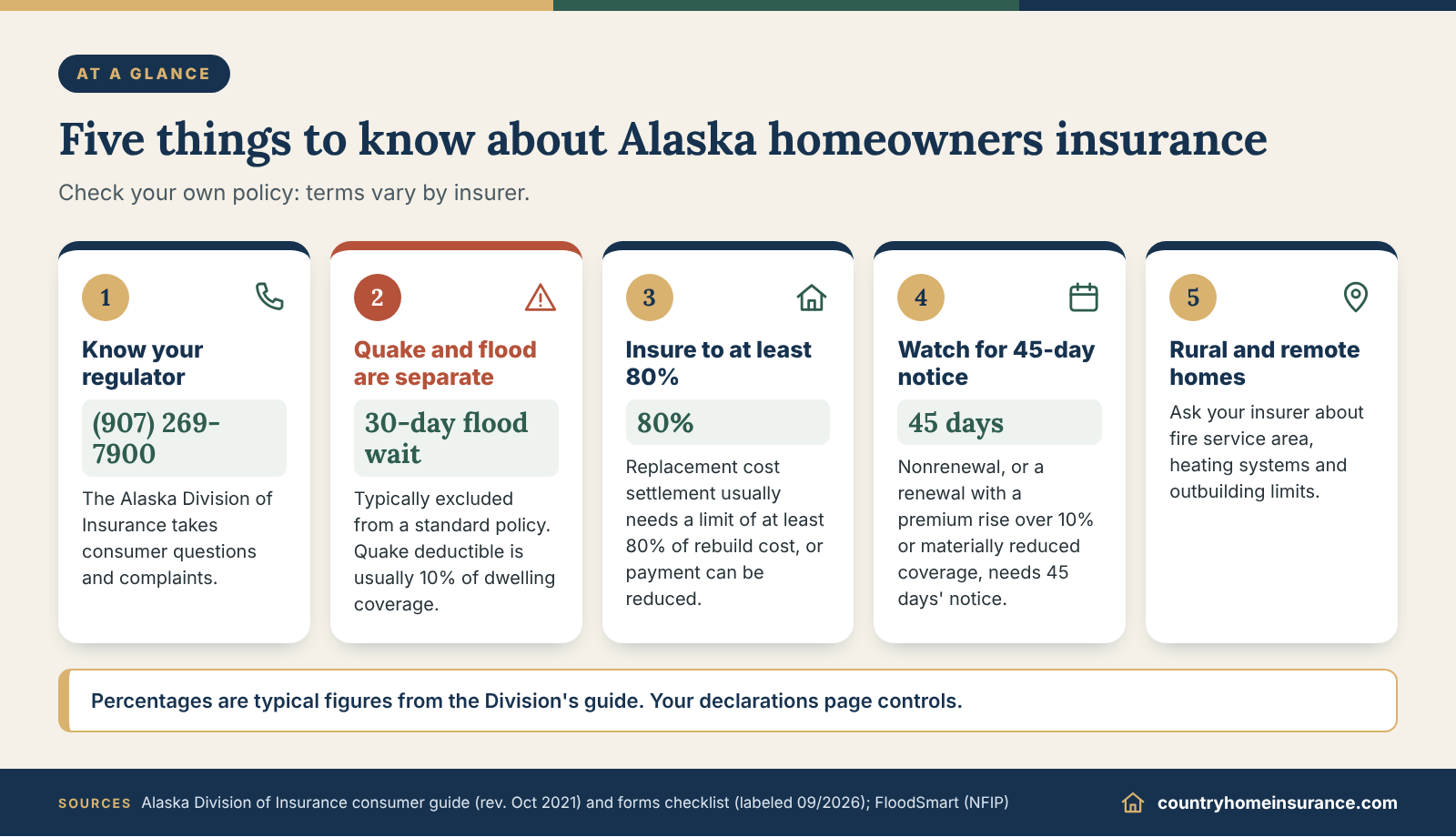
- The Alaska Division of Insurance says most residential policies do not cover earthquake damage, and its consumer guide describes an earthquake deductible that is usually 10% of dwelling coverage; its earthquake page says 10% to 20% is possible.
- Flood is not part of a standard homeowners policy. NFIP flood coverage generally starts 30 days after purchase, with some exceptions, so waiting for a warning can leave you uninsured.
- Three rate publishers report Alaska averages from about $1,197 to $1,630 a year, but their sample homes and coverage limits differ, so the numbers should not be compared with one another.
- Alaska law, as summarized in the Division’s forms checklist, requires at least 45 days of notice before a nonrenewal, and also before a renewal that raises the premium by more than 10% or materially restricts coverage.
- Rural and off-road properties raise extra questions: fire service boundaries, outbuilding limits, heating systems and how long the home sits empty. The Division’s guide does not answer these, so ask your insurer directly.
- We could not verify whether Alaska has a FAIR Plan or similar residual homeowners program. Ask the Division before assuming one exists.
| Scenario | Typical treatment under a standard homeowners policy | What decides the outcome |
|---|---|---|
| Fire, including wildfire | Generally covered, according to the Division’s disaster page | Cause of loss, dwelling limit, whether you hold replacement cost coverage, any vacancy or heating-system conditions in your policy |
| Wind, heavy snow, ice, freezing pipes | Usually part of an all-perils dwelling form, but maintenance-related losses are generally not covered | Policy form, named-perils versus all-perils wording, whether the damage came from a sudden event or neglect |
| Earthquake | Typically excluded; requires a separate earthquake policy or endorsement | Separate deductible (often a percentage of the dwelling limit), limits, and whether fire after a quake is handled under your homeowners policy |
| Flood, glacial outburst flood, mudslide | Typically excluded from homeowners; NFIP or private flood policy needed | Flood zone, 30-day waiting period, building and contents limits, definition of flood in the flood policy |
| Landslide and other earth movement, including permafrost thaw | Commonly excluded; specialized coverage may exist through surplus lines | Exact exclusion wording, the Division’s dominant-cause rule, and any endorsement |
| Detached garage, shed or workshop | Covered under Coverage B (Other Structures), usually about 10% of the dwelling limit | Whether the building is used for business or rented to someone else, and whether the limit is enough |
How Alaska’s insurance market and regulator work
Insurance is regulated state by state, and Alaska homeowners deal with a market that looks different from the Lower 48 in a few ways: a small population spread over a huge area, many communities off the road system, and hazards that range from earthquakes to glacial floods to boreal wildfire. Before getting into coverage and cost, it helps to know who sets the rules and where to turn when something goes wrong.
What does the Alaska Division of Insurance do for homeowners?
The Division of Insurance sits inside the Department of Commerce, Community, and Economic Development. Its stated mission is to regulate the insurance industry to protect Alaska consumers. For a homeowner, that means three practical things: licensing of agents and adjusters, review of the policy forms and rates insurers file, and a consumer services desk that takes questions and complaints.
Consumer services and complaints
The Division’s Anchorage office takes calls at (907) 269-7900, and callers elsewhere in Alaska can use 1-800-INSURAK. The Juneau office is reachable at (907) 465-2515, and the general email address is [email protected]. Complaints are filed online through the Division’s website. The Division’s complaints page says it can look into claim delays and denials, cancellations and nonrenewals, premium refund delays, high-pressure sales and underwriting errors. It does not state a filing deadline, so don’t wait.
What the Division cannot do
The same page is clear about limits. The Division cannot give legal advice, act as your adjuster or lawyer, negotiate a settlement, recommend one insurer over another, decide who is at fault, or interfere in a pending lawsuit. It also generally cannot resolve a dispute that comes down to your word against someone else’s with no supporting evidence. That’s a good reason to document everything in writing from the first day of a claim.
Finding which insurers write homeowners policies
The Division’s home insurance page points readers to its annual reports for a list of insurers offering homeowners coverage in Alaska, under the property and casualty market share section for homeowners multiple peril. We could open the 2024 and 2025 annual reports, but the portion we could read did not include that homeowners market-share table, so this article does not name top insurers or market shares. Check the table directly in the current annual report on the Division’s site.
Which kinds of insurers and programs can you buy from?
Most homeowners policies come from admitted insurers, meaning companies licensed by the state whose forms and rates are filed with the regulator. When an admitted insurer declines a risk, some homeowners turn to non-admitted or surplus-lines companies, often called E&S. Some states also run a FAIR Plan, a residual-market program that offers basic property coverage when the regular market will not.
Admitted insurers and the forms they file
The Division reviews homeowners policy forms against a published checklist, which is why several consumer protections discussed later in this article, including nonrenewal notice periods and the dominant-cause rule, show up in that checklist. The practical takeaway is that policy language you receive from an admitted insurer has been through a state form-filing process. It still varies by company, so read your own policy rather than relying on a general description.
Surplus lines and difference-in-conditions policies
The Division’s consumer guide notes that surplus-lines policies must be placed through a licensed surplus lines broker rather than bought directly from the insurer. It also says that landslide damage is typically excluded from both homeowners and earthquake policies, and that difference-in-conditions policies from surplus lines insurers may cover earth movement, though not slides caused by rain, snow, flooding or earthquakes. If you are told your property needs this kind of policy, ask the broker for the full policy form before you pay.
Is there an Alaska FAIR Plan?
We could not confirm this. The National Association of Insurance Commissioners (NAIC), the organization of state insurance regulators, says 33 states had some form of FAIR plan as of October 2024, but the page names only a handful of states and does not mention Alaska either way. The Division’s homeowners pages we reviewed also do not describe one. If you have been nonrenewed and cannot find coverage, ask the Division’s consumer services staff what options exist for your property, and ask your agent about surplus lines.
What a standard Alaska homeowners policy covers
A homeowners policy is a package of coverages with letter names. The Division’s consumer guide and coverage options page describe the usual structure and typical percentages. Individual policies vary, and the declarations page lists your actual limits, so use these figures as a starting point for questions, not as promises.
How are Coverage A through F usually set up?
Most policies tie several coverages to the dwelling limit, which is why choosing the right Coverage A number matters so much. A low dwelling limit quietly lowers other coverages too.
Dwelling and other structures
Coverage A (Dwelling) pays to repair or rebuild the house. Coverage B (Other Structures) covers detached buildings such as garages and workshops, and the Division says it is usually about 10% of the dwelling limit. It typically excludes buildings rented to tenants and those used for business. On a country property with a barn, a shop and a guest cabin, ten percent can be thin, so ask whether the limit can be raised or whether a building needs its own coverage.
Personal property and loss of use
Coverage C (Personal Property) is usually about 50% of the dwelling limit and, per the Division, is generally written on a named-perils basis, meaning only the listed causes of loss are covered. Property away from home is often capped around 10% of the personal property limit. Coverage D (Loss of Use), also called additional living expense (ALE), pays the extra cost of living elsewhere after a covered loss and is usually up to about 20% of the dwelling limit, sometimes with monthly or time limits.
Liability and medical payments
Coverage E (Personal Liability) usually starts at no less than $100,000, and Coverage F (Medical Payments to Others) at no less than $1,000 for most policies, according to the Division. Higher liability limits are available. If you have livestock, a pond, a private road or guests who use ATVs and snow machines, ask your agent whether the base limit is enough and whether an umbrella policy makes sense.
| Item | Typical figure or rule | Source and what to verify |
|---|---|---|
| Coverage B, other structures | Usually about 10% of dwelling limit | Division guide (Oct 2021) and coverage options page; check whether your outbuildings fit under that figure |
| Coverage C, personal property | Usually about 50% of dwelling limit; away-from-home often about 10% of that | Division coverage options page; ask about replacement cost on contents |
| Coverage D, loss of use (ALE) | Usually about 20% of dwelling limit, possibly with time limits | Division guide; the Post-Disaster Claims Guide says ALE limits are not specified and must be confirmed with your insurer |
| Coverage E and F | Liability usually at least $100,000; medical payments at least $1,000 | Division coverage options page; ask about higher limits |
| Replacement cost threshold | Insuring to at least 80% of rebuild cost is the usual condition | Division guide and NAIC; payment can be reduced below that level |
| Earthquake deductible | Usually 10% of dwelling coverage in the guide; 10% to 20% of the limit on the earthquake page | Division guide and earthquake page; policy terms control |
| NFIP flood limits (homeowner) | Up to $250,000 building and $100,000 contents | FloodSmart and NAIC flood pages (undated); confirm current limits |
How do replacement cost, actual cash value and the 80% rule work?
The loss-settlement section of your policy says how a covered loss is valued. That single clause often matters more at claim time than any headline coverage amount.
Replacement cost versus actual cash value
The NAIC explains that replacement cost value (RCV) pays to repair or replace damaged property with materials of like kind and quality, while actual cash value (ACV) takes age and wear into account, so it often pays less. The Division’s guide defines ACV as replacement cost minus depreciation, which is the decline in value from age and use. For a roof on a twenty-year-old house, that difference can be large. The NAIC’s January 2025 explainer also notes that market value includes the land, which is not what your dwelling limit is meant to measure.
The 80% condition
The NAIC says it is important to insure the home for at least 80% of its replacement value, and the Division’s guide ties replacement cost settlement to a limit of at least 80% of rebuild cost. The Division’s claims page adds that if coverage falls below the percentage specified in the policy, usually 80%, the insurer pays less than full replacement cost, and payment never exceeds policy limits. The formula differs by policy, so ask your agent to show you the actual clause and a worked example with your numbers.
Why rebuild cost is a moving target in Alaska
The Division’s inflation guide, which is undated, cites a 44% rise in construction material prices from December 2019 to December 2021 and says building and repair costs in Alaska keep going up. It encourages homeowners to review limits regularly and to ask about inflation guard, extended replacement cost and ordinance or law coverage. Extended replacement cost, per the Division’s coverage page, often adds a 20% or 25% cushion above the limit. Hauling materials and crews to remote sites can add to rebuild costs, so use a local estimate rather than a national per-square-foot figure.
What rules govern the cause of a loss in Alaska?
How an insurer decides whether a loss was caused by a covered peril can swing a claim. Alaska has several regulations on this point, which the Division describes in its homeowners forms checklist, labeled 09/2026. That checklist is a review guide for insurers’ filings, so confirm the current statute text if a dispute turns on one of these rules.
Dominant cause and excluded perils
According to the checklist, citing AS 21.36.096, a claim may not be denied when a covered peril is the dominant cause of the loss, even if an excluded cause contributed secondarily, and exclusions worded as “in whole or in part” conflict with that rule. This matters in Alaska where a storm, a freeze and a power outage can stack up in the same event. It does not mean every claim will be paid, because the dominant cause itself still has to be a covered one.
Mold, labor depreciation and late notice
The same checklist says fungus and mold may not be excluded when they result from a covered loss, that labor in residential policies may not be depreciated unless offered as an optional stand-alone endorsement (AS 21.60.030), and that claim-filing deadlines are impermissible unless the insurer was actually prejudiced by late notice. Despite that, report losses promptly. Waiting makes damage worse and can make cause harder to prove.
Alaska weather and geologic risks: what your policy does about each
Alaska’s hazards are different from those in most other states, and so are the coverage gaps. The key habit is to match each hazard to a specific policy rather than assuming “homeowners insurance” handles everything. This section walks through the perils that tend to raise questions, and Table 1 above gives the quick version.
Earthquakes, landslides and ground movement
Alaska is seismically active. The U.S. Geological Survey (USGS) notes that the state has had 144 earthquakes above magnitude 6 since the 1964 magnitude 9.2 quake, so earthquake coverage is a real planning question rather than a theoretical one.
Earthquake coverage is a separate purchase
The Division’s earthquake page says most residential property policies do not cover earthquake damage. Earthquake policies typically address shaking and cracking repairs, detached structures, personal property, the extra cost of stabilizing land, debris removal and temporary living costs. The Division’s consumer guide describes the earthquake deductible as usually 10% of dwelling coverage, while its earthquake page says it may run 10% to 20% of the limit. Hypothetical example: on a $400,000 dwelling limit, a 10% deductible would be $40,000 and a 20% deductible would be $80,000 before the policy pays anything. These figures are illustrations only.
What the 2018 Anchorage earthquake showed
USGS reports that a magnitude 7.0 earthquake struck north of Anchorage on November 30, 2018, originating within the subducting Pacific slab. The agency says liquefaction and landslides likely damaged infrastructure and describes ground cracking in south Anchorage and lateral spreading near Wasilla. The Division’s same-day press release told homeowners to review their policies, photograph damage, keep receipts for protective expenses, avoid permanent repairs before inspection, and verify the license of anyone claiming to be an adjuster.
Landslide, permafrost thaw and other earth movement
The Division’s consumer guide says landslide is typically excluded from homeowners and earthquake policies. MoneyGeek, a consumer rate publisher, states that standard policies exclude earth movement including permafrost thaw and that specific endorsements would be needed. We could not find an official Alaska source on permafrost coverage, so treat that as a question for your agent: ask in writing how your policy treats ground settlement and thaw-related foundation damage.
Flood, glacial outburst floods and mudslides
Alaska flooding comes from rivers, coastal storms, snowmelt, ice jams and, in Juneau, glacial outburst events. A standard policy does not respond to any of them.
Flood coverage and who sells it
The Division states that flood coverage is sold as a separate policy and may include direct physical flood damage, flood-related erosion, abnormal tidal surges and mudslides. The National Flood Insurance Program (NFIP) offers policies through private companies, and lenders may require flood coverage if the home sits in a high-risk area. For a single-family home, FloodSmart and the NAIC list maximums of $250,000 for the building and $100,000 for contents. Private flood insurance, per the NAIC, may offer higher limits or broader terms, so compare. Both of those pages are undated, so confirm the limits before you buy.
The 30-day waiting period and its exceptions
According to FloodSmart, NFIP coverage generally begins 30 days after purchase. There is no wait when you buy in connection with making, increasing, extending or renewing a mortgage. There is a one-day wait for homes in a newly designated high-risk flood zone if you buy within 12 months of the map update, and for a flood caused or worsened by a federal-land wildfire if you buy within 60 days of containment. The Division’s disaster page also advises that flood coverage generally needs to be in place 30 or more days before a flood.
Juneau’s glacial outburst floods as a case study
The Alaska Division of Insurance posted an alert on its disaster page about the Suicide Basin flood in Juneau. The Anchorage Daily News reported on August 11, 2026 that about 1,900 residences sit in the inundation zone this year, that the 2025 flood damaged about 50 homes, and that the 2024 flood damaged nearly 300 homes before sand-filled HESCO barriers were deployed. The article did not discuss insurance, so we can’t say how many of those homes had flood policies. The lesson is general: if you live near a river or lake with a known flood history, ask an agent about flood coverage well ahead of the next high-water season.
Wildfire, heating fires and winter damage
Fire is the peril most owners think of first, and it is generally the one a standard policy handles best. Alaska adds two twists: wildfire in the interior, and heating systems that work hard for much of the year.
Wildfire in Alaska and what mitigation looks like
The Division’s wildfire page notes that fire is a natural part of the boreal forest and says the risk of large, severe fires is increasing. It also says wildfire damage is generally covered by standard property insurance. The Mukluk Fire near Tok began on August 17, 2026, grew to just over 5,000 acres within about two days, and damaged or destroyed at least 20 structures, according to the Anchorage Daily News, which reported that a downed power line appeared to have started it. For mitigation, an IBHS-attributed guide hosted by the Division recommends a noncombustible zone within five feet of the house, firewood and large propane tanks at least 30 feet away, a Class A roof covering and ember-resistant vents.
Home heating and fire safety
The State Fire Marshal’s office warned in a December 2022 release that space heaters, wood and oil stoves, and heat lamps can start fires if used improperly, and that firewood, hay, feed and flammable liquids should stay away from heat sources. Its 2025 fire-death summary lists 13 fire deaths and says smoke alarms were not present or did not operate in all of those cases. The Division’s guide does not describe underwriting rules for wood stoves or heating-oil tanks, so ask your insurer what it requires, such as professional installation or chimney inspections, before you rely on a secondary heat source.
Snow, ice and frozen pipes
One rate publisher, Insurify, says standard Anchorage policies cover damage from snow, ice and freezing, and MoneyGeek lists frozen pipes and ice dams as common claim types. The Division, for its part, notes that maintenance-related losses are generally not covered, which is why heat-loss while you are away, or slow leaks, can be treated differently from a sudden burst. If you leave a cabin unheated for part of the year, ask what conditions the policy attaches, such as minimum heat or draining the system.
How much does homeowners insurance cost in Alaska?
No official statewide average premium turned up in the sources we could retrieve, so the numbers below come from consumer rate publishers. Each uses a different sample home, a different data method and a different date, and that is the first thing to understand before you quote any of them back to an agent.
What do published Alaska averages show?
Three publishers report Alaska averages, from roughly $1,197 to $1,630 per year for a good-credit, no-claims profile. Two of the three also give a national figure that is far higher, but because each publisher defines its own benchmark, only that publisher’s own comparison is meaningful.
Three publishers, three different sample homes
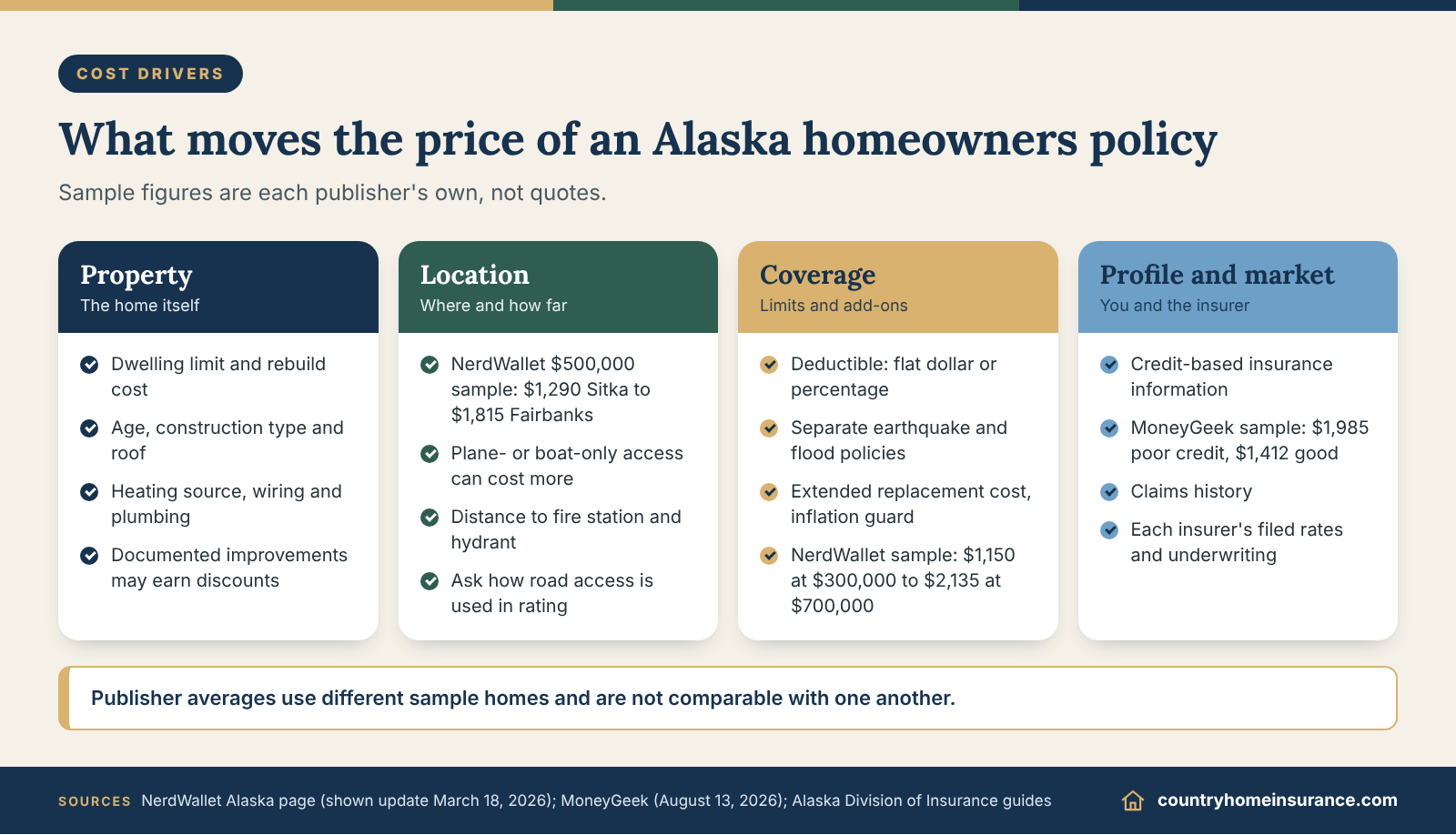
Table 3 lays out what each publisher says and, more important, what each assumed. NerdWallet’s Alaska page uses a $500,000 dwelling limit. Insurify uses $300,000 and a 1980 construction year. MoneyGeek uses a $250,000 dwelling limit and a frame house built in 2000. Dwelling limit alone does not explain the spread: NerdWallet’s own $300,000 data point is $1,150, while MoneyGeek reports $1,412 on a smaller $250,000 limit. Method, data source and home profile all differ, so the averages are not a ranking of which source is right.
| Publisher | Alaska average (per year) | Sample home and coverage assumptions | Date shown and caveats |
|---|---|---|---|
| NerdWallet | $1,630 (publisher’s national figure for the same coverage: $3,005) | $500,000 dwelling, $300,000 liability, $1,000 deductible, good credit, no recent claims | Page shows an update of March 18, 2026, but some sample quotes carry later dates; verify before quoting |
| Insurify (with Quadrant Information Services data) | $1,197 statewide; Anchorage about $1,163 | $300,000 dwelling, $1,000 deductible, $25,000 personal property, $300,000 liability, 1980 construction, no claims, good credit | Page labeled updated May 5, 2025, though copyright references 2026; may be older than other figures |
| MoneyGeek | $1,412; stated range $1,004 to $1,985 (publisher’s national figure: $3,467) | $250,000 dwelling, $125,000 personal property, $200,000 liability, $1,000 deductible, frame house built 2000, composition roof, no claims in five years | Article dated August 13, 2026; calculator note shows a later rate-update date; method is the publisher’s own |
| Your own quote | Unknown until you ask | Your rebuild cost, roof age, heating system, protection class, distance to fire service and deductible | Request quotes on matching limits and deductibles from several insurers |
Why these averages cannot be blended
Averaging $1,630, $1,197 and $1,412 would produce a number that describes no real home. The sample houses differ in value, age and coverage, and the data come from different insurers and time periods. A fair reading is narrower: in each publisher’s sample, an Alaska home with a clean record cost well below that publisher’s national figure. That says something about relative risk and rate levels, not about what your premium will be.
How the dwelling limit moves one publisher’s number
NerdWallet publishes a ladder for its own sample: $1,150 at a $300,000 dwelling limit, $1,385 at $400,000, $1,630 at $500,000, $1,860 at $600,000 and $2,135 at $700,000. The pattern is that premium rises with the amount of coverage, but not in a straight line. Treat the ladder as a direction of travel and remember it measures the cost of insuring rebuild value, not the cost of the land or the market price.
What factors move the price of an Alaska policy?
Insurers price expected losses, and the factors that matter in Alaska overlap with national ones plus a few local twists.
Location, remoteness and fire protection
NerdWallet’s city figures illustrate how location matters even within one state: Fairbanks $1,815, North Pole $1,775, Anchorage $1,465 and Sitka $1,290, all on its $500,000 sample. MoneyGeek reports that homes reachable only by plane or boat carry higher premiums because insurers factor in the cost of getting materials and labor there. That fits common sense, but we couldn’t verify any insurer’s actual surcharge, so ask how your distance to a fire station and road access are used in rating.
Dwelling characteristics
Age, construction type, roof material and condition, heating source and updates to wiring and plumbing all tend to matter. The Division says improvements may qualify for discounts and that you should notify the insurer of additions or major improvements. Details like a new metal roof or an upgraded electrical panel are worth documenting, because an underwriter can’t credit what it doesn’t know about.
Credit-based insurance information
The Division’s consumer guide says Alaska law permits insurers to use credit information in selecting applicants and setting rates, and that consumers may dispute inaccurate information, request an exception for extraordinary life circumstances and ask for reconsideration of an adverse action. NerdWallet reports about $3,800 a year for poor credit versus $1,630 for good credit on its sample, and MoneyGeek reports $1,985 for poor credit versus $1,412 for good. The dollar gaps differ because the samples differ. The direction is the same: credit history can change the price noticeably.
How does Alaska fit the national price picture?
National price studies don’t always break out Alaska, so the national picture is only partial context. That does not mean Alaskans are immune to rising costs.
What the federal watchdog found nationally
The U.S. Government Accountability Office (GAO) reported in February 2026 that the average U.S. homeowners premium rose about 3% after inflation from 2019 to 2024, with increases of 25% or more in parts of certain southern coastal states. The page we reviewed does not mention Alaska, so we can’t say how Alaska premiums changed over that period.
Why rebuild costs still matter
The Division’s inflation guide says construction costs in Alaska are climbing, and it encourages owners to ask about inflation guard, extended replacement cost and ordinance or law coverage. Even without a dramatic rate shock, a dwelling limit that has not been updated for several years can leave a gap between what you carry and what a rebuild would cost.
Reading a renewal that jumps
If your renewal premium rises by more than 10%, or your coverage is materially cut back, the Division’s forms checklist says the insurer must give at least 45 days of notice before expiration (AS 21.36.235). That timeline gives you room to shop. Ask your agent which factor changed, whether it was your dwelling limit, a rate filing or a surcharge, before you accept or leave.
Deductibles and discounts: where Alaska homeowners can save without losing protection
Two levers sit squarely in your hands at renewal: how much of each loss you agree to carry, and which credits you can document. Both can lower the bill, but both can backfire if you pull them without thinking about worst-case claims.
How should you choose a deductible?
A deductible is the part of a covered loss you pay before the insurer pays. The Division’s consumer guide advises choosing the largest deductible your budget can handle in order to lower the premium, and the NAIC makes the same point while adding that you should be able to pay it if you file a claim.
Flat-dollar deductibles
Most homeowners policies use a flat amount, such as $1,000 or $2,500, for ordinary losses. The Division’s guide does not name a standard amount, so what you see on your declarations page is what applies. When you compare quotes, hold the deductible constant so that a lower premium is not simply a higher deductible in disguise.
Percentage deductibles and earthquake
The Division’s Post-Disaster Claims Guide says deductibles can be a flat dollar amount or a percentage, and that some policies carry separate deductibles for wind, hurricane or specific parts of the home. The clearest Alaska example is earthquake, where the consumer guide says the deductible is usually 10% of dwelling coverage. Hypothetical example: if your earthquake policy has a $350,000 dwelling limit and a 10% deductible, you would absorb $35,000 of a covered quake loss before the policy pays. Only you can decide whether that structure fits your savings.
Small claims and the deductible math
The Division’s guide suggests estimating repair costs before filing, since small losses near the deductible may be better paid out of pocket. That is practical advice, but it is a judgment call, and we could not verify how Alaska insurers treat small or inquiry-only claims in pricing or renewal decisions. Ask your agent, before you need to, how a small claim or a coverage inquiry that doesn’t become a claim is recorded and how it could affect your policy.
Which discounts are worth asking about?
We could not verify any Alaska-specific discount amounts or any state-mandated discount, so this section sticks to what regulators and consumer organizations say is commonly available. Anything an insurer offers should be confirmed in writing.
Common discounts regulators mention
The NAIC lists bundling home and auto policies, deadbolts, alarm systems and roof replacement as examples of discounts to ask about. The Division’s coverage options page adds that notifying your insurer of additions or major improvements may help you qualify for discounts. Whether your insurer actually offers any of these, and for how much, is its own filing, so ask for a written list.
Wildfire mitigation and documentation
The Division’s wildfire page says mitigation work may qualify for homeowner’s premium discounts and tells readers to ask their agent. Keep dated photos and receipts for work like clearing a firebreak, moving combustibles, upgrading to a fire-resistant roof or installing ember-resistant vents. If you ever have a dispute about what condition the property was in, those records are your evidence.
Savings that cost you protection
A cheaper policy is not a better one if it drops the replacement cost clause, trims the dwelling limit below 80% of rebuild cost, or removes an endorsement you’d need after a loss. The Division also notes that insurers may not add or change coverage once a disaster is impending, so reviewing your policy in advance is the only practical window. Don’t get caught flat-footed by finding out on the day of a wildfire evacuation that you wanted a higher limit.
Country, acreage and remote property: what Alaska owners should ask
Much of Alaska is rural by any definition, and the Division’s general homeowners guide is written for a broad audience. It does not cover several issues that matter on acreage or off the road system, so this section turns them into questions you can put to your insurer. None of the specifics below is an insurer requirement unless your policy says so.
Outbuildings, home businesses and liability on acreage
A country place usually holds more than a house. Shops, sheds, guest cabins, boat storage, fish-processing space and equipment buildings all raise coverage questions.
Cabins, shops and sheds
Coverage B is usually around 10% of the dwelling limit, and the Division says it typically excludes buildings rented to tenants and business buildings. If your detached garage holds a snow machine, tools and a workshop, the limit may be tight and contents may be treated differently from items inside the house. Ask for a list of every structure on the declarations page and how each is valued.
Home business and guest use
The Division notes that home business coverage varies by insurer, from added liability and business property coverage to limited coverage for business items. If you rent a cabin to guests, run a guiding or repair operation, or keep equipment for hire, assume a standard homeowners policy may not respond until your insurer confirms in writing. Disclosing the use up front is far safer than explaining it after a loss.
Liability, private roads and guests
Liability coverage typically starts at $100,000, with higher limits available. On acreage, injuries involving visitors, ATVs, boats, dogs or livestock are the kinds of risks owners ask about. We couldn’t find an Alaska source on how insurers rate these exposures, so bring a list of what happens on your land and ask whether an umbrella policy makes sense. A conversation like that costs nothing and can reveal gaps.
Fire service boundaries and road access
Fire protection is not uniform across Alaska. Some areas have municipal departments, some have volunteer departments serving defined service areas, and many properties have neither.
Know whether your home is inside a fire service area
The Division’s consumer guide lists distance to the nearest hydrant and fire department among the questions insurers may ask. A January 2008 Firehouse.com report, now old, described a house near Fairbanks that burned after a volunteer department turned back because the property lay about 180 feet outside its service boundary. Boundaries and policies have likely changed since, but the lesson holds: confirm in writing which department, if any, serves your address, and tell your insurer the answer.
Road, ferry and air access
MoneyGeek says properties reachable only by plane or boat carry higher premiums, and its remote-community sample showed higher figures than Anchorage, though it did not give a source for the size of that gap. For claims, access also matters in practice: ask whether the insurer limits payment for contractor travel costs, how it handles adjuster visits to remote sites, and whether ALE can cover the cost of staying in a regional hub.
Choosing a contractor after a loss
The Post-Disaster Claims Guide advises verifying contractor licenses, registration and insurance, getting multiple itemized estimates, confirming permits and avoiding large upfront payments. In small communities where options are limited, that can take patience. Ask your adjuster early about timelines so that you can request more time for recoverable depreciation if repairs are delayed.
Heating, power and seasonal or vacant cabins
Many Alaska homes depend on wood, oil, propane or electricity under winter conditions, and many second homes sit empty for months. Insurers may attach conditions to these situations, but the Division’s guide does not describe them.
Secondary heat and fuel storage
Ask your insurer what it requires for wood stoves, pellet stoves, fuel-oil tanks and propane. Typical questions include whether a professional must install the unit, how often chimneys need inspection, and whether the tank must meet particular standards. The State Fire Marshal’s December 2022 guidance supports the practical side: keep combustibles away from heat sources, test smoke alarms, and in barns, keep detectors clean since dust can clog them.
Defensible space around outbuildings
The IBHS-attributed guide the Division hosts suggests keeping sheds and similar structures at least 10 feet from the house, ideally 30 feet, and no more than three within 30 feet. It also suggests firewood and large propane tanks at least 30 feet from structures. Those are risk-reduction recommendations, not insurer rules, but they pair well with the discount conversation above.
Vacancy, winterization and long absences
The Division’s guide does not address vacancy. Ask your insurer how many consecutive days a home can be unoccupied before coverage for losses like vandalism or freezing is limited, and what you must do to winterize. Get the answer in writing, since the difference between a seasonal home and a vacant one is a policy-language question, not a matter of common sense.
Cancellation, nonrenewal and claim rights under Alaska rules
Alaska law sets some floors for how insurers can end coverage and handle claims. The best consolidated summary we could retrieve is the Division’s homeowners forms filing checklist, labeled 09/2026, which lists the statutes and regulations insurers’ forms must follow. It is written for insurers, not consumers, so use it as a pointer and verify the statute or regulation text before relying on it in a dispute.
When can an insurer cancel or decline to renew?
These rules apply to personal policies other than personal auto, according to the checklist, and the details differ for new policies and for policies in force less than a year.
Cancellation grounds and notice
For policies in force for a while, the checklist says an insurer may cancel mid-term only for specific reasons: nonpayment, certain criminal convictions, fraud or misrepresentation, grossly negligent acts that substantially increase hazards, or physical changes that make the property uninsurable. Written notice must be mailed at least 10 days before cancellation for fraud or material misrepresentation, 20 days for nonpayment, and 30 days for other reasons (AS 21.36.220). Those limits do not apply the same way to new policies in effect less than 60 days when notice is mailed.
Nonrenewal and changed renewal terms
Nonrenewal notice is required at least 45 days before expiration, per the checklist (AS 21.36.240), and the same 45-day period applies if the renewal premium rises more than 10% or coverage is materially restricted or reduced (AS 21.36.235). The checklist also says nonrenewal cannot rest solely on your earliest claim in the prior three years when it arose from a third party’s criminal act.
Disaster-aid claims and your own cancellation
The Division’s disaster page cites AS 21.36.245: an insurer cannot cancel or refuse to renew a property policy merely because you filed a claim to support a government disaster aid application, if the insurer paid nothing on it. If you cancel yourself, the checklist says any fee may not exceed 7.5% of unearned premium and that unearned premium must be returned within 45 days of your request or the cancellation date, whichever is later (AS 21.36.255).
| Situation | Timing or limit stated | Statute cited | What you can do |
|---|---|---|---|
| Insurer cancels for fraud or material misrepresentation | At least 10 days’ mailed notice | AS 21.36.220(a) | Request the reason in writing and contact the Division if you believe it is wrong |
| Insurer cancels for nonpayment | At least 20 days’ mailed notice | AS 21.36.220(a) | Pay promptly or ask about reinstatement terms; keep proof of payment |
| Insurer cancels for another permitted reason | At least 30 days’ mailed notice | AS 21.36.220(a) | Begin shopping at once; check the cancellation grounds against the notice |
| Insurer does not renew | At least 45 days before expiration | AS 21.36.240(a) | Request quotes immediately and ask the Division about options if you are declined |
| Renewal premium rises more than 10% or coverage is materially reduced | At least 45 days before expiration | AS 21.36.235(a) | Compare the new declarations page to the old one line by line |
| You cancel mid-term | Fee capped at 7.5% of unearned premium; refund within 45 days of request or effective date, whichever is later | AS 21.36.255 | Get the cancellation fee and refund method confirmed in writing |
How should an insurer handle your claim?
Claim handling is where policy language and regulation meet. The checklist and the Division’s claims guides outline several expectations, though the Division also says some deadlines are not set out and must be confirmed with your insurer.
Payment timing
The checklist says undisputed portions of first-party claims must be paid within 30 working days (3 AAC 26.070(a)(2)). The Post-Disaster Claims Guide adds that a reasonable wait for adjuster contact on a minor claim is about three to five days, and longer after a large disaster. Neither source promises an outcome, and “undisputed” matters: the part of a claim in disagreement can take longer.
Depreciation and recoverable amounts
If your policy pays actual cash value first and releases the rest after repairs, the Division’s guide says recoverable depreciation is usually available for six months to a year depending on state law and the policy, and that you can request more time after a large-scale disaster. The Division’s claims page also says small building damage claims are paid at replacement cost whether or not repairs are complete, while for large losses the difference is paid after repair or replacement.
Documenting the loss
The Division advises reporting the loss right away, photographing or filming damage before cleanup, keeping damaged property until the adjuster says otherwise, keeping receipts for temporary repairs and living costs, and waiting on permanent repairs until the insurer has inspected. A sworn proof of loss on a standard form may be required. A current home inventory with photos and receipts, stored somewhere other than the house, makes all of this easier.
What if you disagree with the insurer?
A disagreement does not end the claim. You have several steps short of litigation, and the Division can look into whether the insurer followed insurance law.
Written reasons and appraisal
The Post-Disaster Claims Guide advises asking for any denial in writing with reasons. If you dispute the amount, the Division’s claims page suggests explaining your reasoning in writing and then, if still unresolved, using appraisal when the policy provides for it. The checklist states appraisal must follow AS 21.96.035 and that each side pays its own expenses, except umpire fees.
Complaints, public adjusters and legal help
The Division can review claim delays, denials and settlement issues for compliance with insurance law but cannot negotiate settlements or give legal advice. A public adjuster, who works for you rather than the insurer, charges a fee that you pay and should provide a written contract. The checklist also notes a three-year limit to sue on an insurance contract that starts after a breach such as a denial, but because deadlines and exceptions are fact-specific, talk to an Alaska attorney rather than relying on this summary.
A practical plan for shopping, renewing and reviewing Alaska coverage
Good decisions in insurance come from preparation more than from price hunting. The plan below pulls together the verified points in this article into a sequence you can follow before a quote, during a comparison and after you buy.
What should you gather before asking for quotes?
Agents and online forms ask many of the same questions, and your answers drive both the price and the accuracy of the policy. Having them ready means you can compare offers on equal footing.
A rebuild estimate and honest home details
Start with the cost to rebuild, not the purchase price or tax assessment. Ask a local builder, or the insurer’s estimating tool, what it would cost to rebuild with similar materials in your community, and write down the year built, square footage, roof type and age, heating sources and recent updates. The Division reminds owners that replacement cost can differ from the value assigned when they bought, so revisit the figure every year or two.
A hazard profile for your address
Look up your flood zone on FEMA’s map service, which the Division’s flood page mentions, and note whether your area has a history of high water. Identify your fire department and service area, your distance to a hydrant if any, and your road or air access. Ask yourself whether your land is steep, near a slope or on frozen ground. These details change which endorsements or separate policies you may need.
A home inventory stored off-site
The Division offers a free home inventory checklist and recommends photos or video of the house and its contents, receipts for high-value items, and a copy stored away from home or emailed to yourself. It takes an afternoon and pays off disproportionately after a fire or quake.
| Step | What to verify or document | Question to ask your insurer or agent |
|---|---|---|
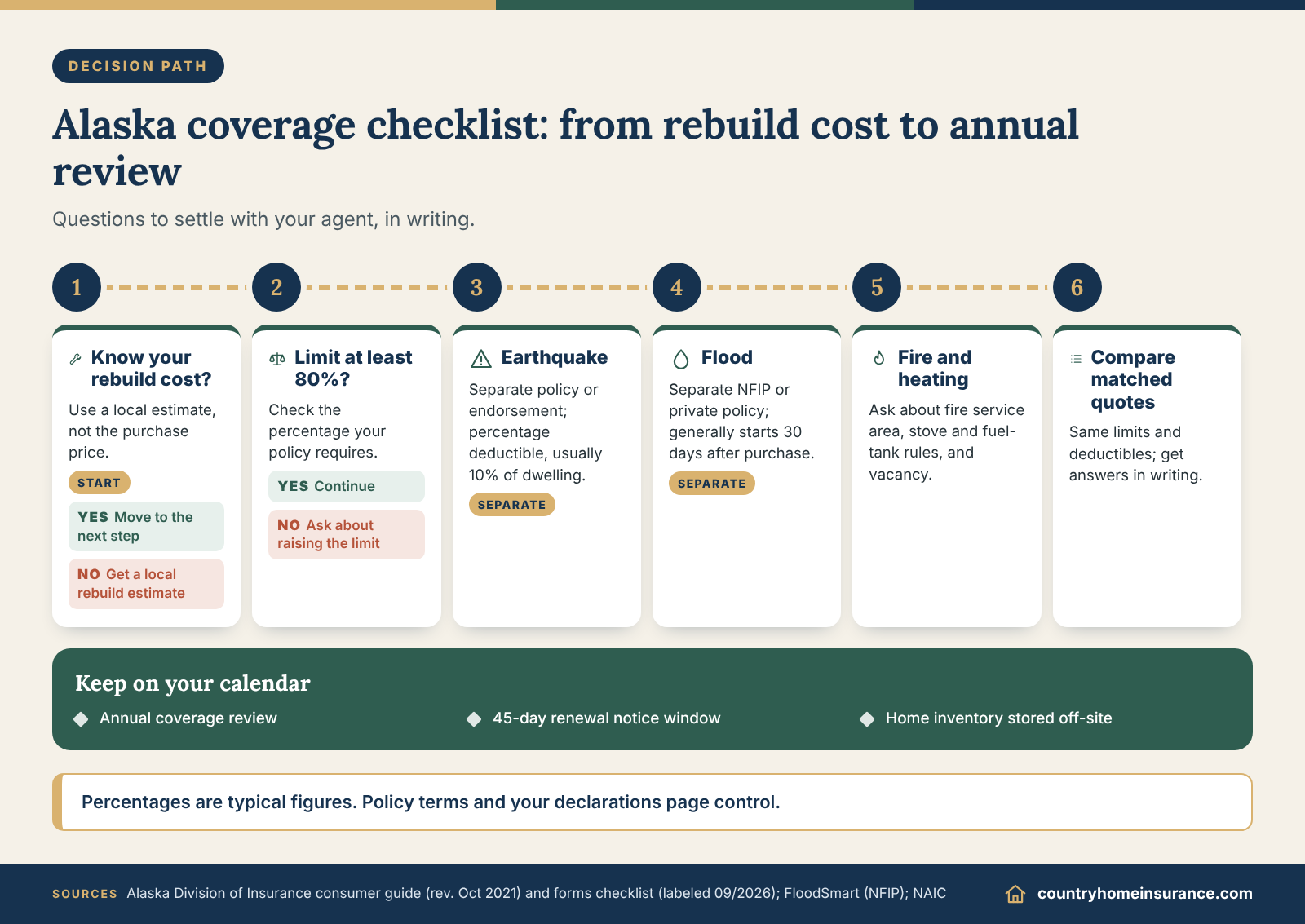
| 1. Dwelling limit | Local rebuild estimate; the 80% replacement cost condition | “Is my limit at least the required percentage of rebuild cost, and do I have extended replacement cost and ordinance or law coverage?” |
| 2. Earthquake | Whether you have a separate policy or endorsement; dollar amount of the percentage deductible | “What would I pay out of pocket after a covered quake at my current limit?” |
| 3. Flood | FEMA flood zone, elevation certificate if needed, 30-day waiting period | “Does a flood policy exist for my address, and when would it take effect?” |
| 4. Outbuildings and business use | List of structures, uses and tenants | “How is each building valued, and is any activity excluded?” |
| 5. Fire protection and heating | Fire service area, hydrant distance, stove and fuel-tank details, smoke alarms | “What heating, inspection and vacancy conditions apply?” |
| 6. Mitigation records | Dated photos and receipts for roofing, vents, defensible space | “Which discounts apply, and what proof do you need?” |
| 7. Home inventory | Photos, video, receipts, stored off-site | “What proof of loss would you require for contents?” |
| 8. Renewal notices | Compare each declarations page to the last one | “Why did my premium or coverage change?” |
How do you compare Alaska quotes fairly?
Price comparison only means something if the policies are the same size and shape. Otherwise you are comparing apples and oranges.
Match limits, deductibles and endorsements
Write down the dwelling limit, the other-structures percentage, the personal property basis, the deductible, ALE terms and each endorsement for every quote. Ask each insurer whether the loss settlement is replacement cost or actual cash value for the roof and for contents. A $200 lower premium that comes with a $2,500 higher deductible and actual cash value on the roof is a different product.
Check licenses and complaints
The Division licenses agents and adjusters, and its licensing desk can be reached at [email protected]. After the 2018 earthquake, the Division told consumers to ask for adjusters’ licensing credentials and verify them on its website. It also tracks complaints, and its annual report lists complaint counts by line of insurance for the year. A count alone doesn’t tell you whether an insurer pays claims fairly, but it is one more data point alongside financial strength ratings and agent reviews.
Request the policy form before paying
This is especially important for surplus lines, earthquake and flood coverage, where terms vary widely. Ask for the policy form and read the exclusions and conditions sections, not only the summary. If something is unclear, ask for the explanation in writing. That’s what reading the fine print is for.
What should you do after you buy, and every year?
A policy is a living document. Your house changes, rebuild costs change, and insurer rules change.
Annual review
The NAIC recommends reviewing coverage with your agent at least once a year, especially after remodeling. Use the checklist above, update the home inventory, and ask whether your dwelling limit still tracks the cost to rebuild. The Division’s inflation guide recommends reviewing limits even when an inflation guard is in place.
Before a disaster, not during one
The Division’s wildfire page points out that insurers may not add or change coverage once a disaster is impending. That means a fire evacuation notice or a flood forecast is too late to raise limits or buy a policy, and the 30-day NFIP waiting period makes the same point. Schedule your reviews for calm weeks.
Keep paperwork and contacts together
Store your declarations page, policy forms, endorsements, agent and claims numbers, and inventory in a place you can reach if the house is not accessible. Include the Division’s consumer services number, (907) 269-7900, and your insurer’s claim line. If you live where the mail is slow, ask whether your insurer will send notices electronically, keeping in mind the checklist’s rules about mailed notice and confirmation of electronic delivery.
Frequently asked questions about Alaska homeowners insurance
Coverage and cost questions
Does homeowners insurance in Alaska cover earthquakes?
Typically no. The Alaska Division of Insurance says most residential policies do not cover earthquake damage and that earthquake coverage is a separate policy, often with a deductible set as a percentage of the limit. Fire that follows a quake is generally handled by the standard policy according to the Division. Because endorsements vary, ask your agent for the earthquake terms in writing and compare the deductible in dollars, not percentages alone.
Is flood covered by a standard Alaska homeowners policy?
No. The Division states that flood is sold as a separate policy, available through the NFIP or private insurers. NFIP coverage generally begins 30 days after purchase, with exceptions for coverage bought with a mortgage and certain newly mapped or wildfire-related situations. If you are near water, a mapped flood zone or a glacial outburst area, ask about flood coverage before the next high-water season, not after the forecast.
Is Alaska homeowners insurance cheaper than the national average?
In the samples of the three publishers we reviewed, Alaska averages came out lower than the national numbers those publishers show: NerdWallet reports $1,630 versus $3,005, and MoneyGeek reports $1,412 versus $3,467, for their respective sample homes. Those samples differ, and your price depends on your home, location, credit information and coverage choices, so get actual quotes. These figures are market context, not a prediction of your premium.
Rules and claims questions
Can my insurer cancel because I filed a claim for disaster aid?
The Division’s disaster page cites AS 21.36.245, which says an insurer cannot cancel or refuse to renew a property policy merely because you filed a claim to support a government disaster aid application, if the insurer paid nothing on that claim or provided no coverage for it. That rule is narrow. It doesn’t prevent a nonrenewal for other lawful reasons, so read any notice carefully and ask the Division if you doubt the stated reason.
How much notice must I get before a nonrenewal?
According to the Division’s homeowners forms checklist, at least 45 days before expiration, and the same period applies if the renewal premium rises by more than 10% or coverage is materially restricted. The checklist says notices must be mailed first class with a certificate of mailing, or sent electronically only with confirmation of receipt. Since that checklist is aimed at insurers, confirm the statute text with the Division if timing is in dispute.
Is there an Alaska FAIR Plan if we can’t find coverage?
We could not verify that. The NAIC says 33 states had some form of FAIR plan as of October 2024, but its page does not say whether Alaska is one of them, and the Division’s homeowners pages we reviewed do not describe one. Call the Division’s consumer services line at (907) 269-7900 or 1-800-INSURAK, and ask your agent about surplus lines options and whether any program exists for your property.
Sources
- Alaska Division of Insurance: Home insurance (undated; reviewed 2026-10-11)
- Alaska Division of Insurance: Consumer Guide to Homeowners Insurance (revised October 2021)
- Alaska Division of Insurance: Homeowners coverage options (undated)
- Alaska Division of Insurance: Homeowners Insurance Forms Filing Checklist (labeled 09/2026)
- Alaska Division of Insurance: Home Owners Insurance and Inflation (undated)
- Alaska Division of Insurance: Disaster response and preparedness (alerts current as of 2026-10-11)
- Alaska Division of Insurance: Earthquake insurance (undated)
- Alaska Division of Insurance: Flood insurance (undated)
- Alaska Division of Insurance: Wildfire insurance (undated)
- Alaska Division of Insurance (IBHS-attributed): Wildfire-ready home preparation upgrades (undated)
- Alaska Division of Insurance: Your property casualty claims rights (undated)
- Alaska Division of Insurance: Post-Disaster Claims Guide (undated)
- Alaska Division of Insurance: Complaints and inquiries (undated)
- Alaska Division of Insurance: Take a home inventory (undated)
- Alaska Division of Insurance: Earthquake guidance press release (November 30, 2018)
- NAIC: Homeowners insurance consumer page (undated; reviewed 2026-10-11)
- NAIC: Actual cash value versus replacement cost (January 2, 2025)
- NAIC: Flood insurance (undated)
- NAIC: Fair Access to Insurance Requirements (FAIR) plans (last updated December 13, 2024)
- FloodSmart (NFIP): Buy a flood insurance policy (undated; reviewed 2026-10-11)
- U.S. GAO: Homeowners insurance premiums generally tracked inflation but rose more in disaster-prone areas, GAO-26-107867 (February 27, 2026)
- USGS: 2018 Anchorage earthquake (event of November 30, 2018)
- Alaska State Fire Marshal: Fire deaths infographic, 2025
- Alaska Department of Public Safety: State Fire Marshal warns of dangers posed by heating sources (December 1, 2022)
- Anchorage Daily News: Juneau’s Suicide Basin is full (August 11, 2026)
- Anchorage Daily News: Tok wildfire scorches at least 20 structures (August 2026)
- Firehouse.com: Burned Alaska house was outside service area (January 7, 2008; old, used as a cautionary example only)
- NerdWallet: Home insurance in Alaska (page shows update of March 18, 2026)
- Insurify: Anchorage homeowners insurance (page labeled updated May 5, 2025)
- MoneyGeek: Average cost of home insurance in Alaska (article dated August 13, 2026)
Important coverage note
Coverage depends on the actual policy, endorsements, exclusions, limits, deductible and cause of loss. State laws and insurance programs vary, and insurers apply their own underwriting and rating rules within them. Averages, examples and percentages in this article are illustrations, not quotes, and nothing here promises that any claim will be paid. For questions about your own situation, check your declarations page and policy forms, then verify with your insurer or agent and your state Department of Insurance, which in Alaska is the Division of Insurance within the Department of Commerce, Community, and Economic Development. This article is educational and is not legal advice.
About the editorial team
This guide was prepared by the countryhomeinsurance.com editorial team as general, educational information for homeowners. We research and summarize publicly available material, including state insurance departments, the NAIC, federal agencies, regulators’ consumer guides and published insurer and industry resources. We draw only on the sources that were available to us when we wrote this guide, and we list them in the Sources section with dates where we could find them.
Insurance rules, rates, products and program terms change, differ by state and by insurer, and can apply differently to your situation. We cannot guarantee that this content is complete, current or free of errors. It is not legal, financial, tax or insurance advice, it is not an offer to sell insurance or a recommendation of any insurer, agent or product, and reading it does not create a professional relationship of any kind.
To the fullest extent permitted by law, countryhomeinsurance.com and its editorial team, authors and contributors exclude all liability for any loss, damage or decision arising from the use of, or reliance on, this content. For questions about your own policy or claim, contact your insurer, a licensed agent or broker, your state Department of Insurance or another qualified professional.
Content created: October 11, 2026