
Quick answer
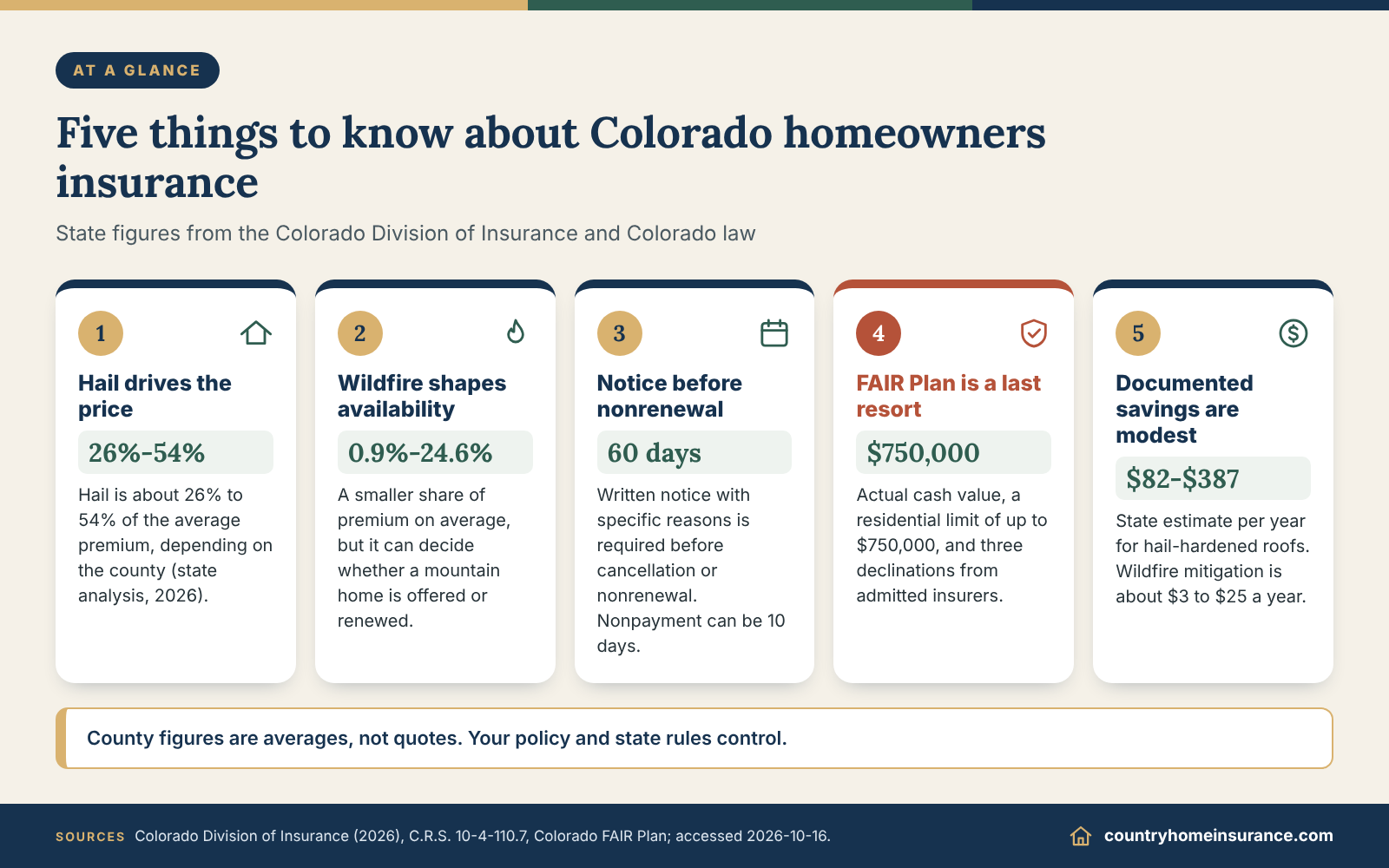
Colorado homeowners insurance is priced mostly around hail, while wildfire shapes availability in foothill and mountain areas. Published averages vary widely: Insurify’s September 2026 page lists roughly $3,240 a year for a $300,000 dwelling with a $1,000 deductible, and the state Division of Insurance attributes about 26% to 54% of premiums in the counties it studied to hail. Before you compare prices, check the wind/hail deductible, roof settlement terms, extended replacement cost and your wildfire-score notice. The Colorado FAIR Plan is a last resort, not a bargain.
Key takeaways
- Hail, not wildfire, is the largest average cost driver in the Division of Insurance’s 2026 county analysis, but wildfire pricing is far higher in places such as La Plata County and decides whether some mountain homes can get standard coverage at all.
- Colorado requires insurers to give at least 60 days’ written notice, with specific reasons, before canceling or not renewing a homeowner’s policy (nonpayment can be as short as 10 days).
- Under HB23-1174 (signed 2023), insurers must offer extended replacement cost of at least 50% and law and ordinance coverage of at least 20% of the dwelling limit, and since January 1, 2025 the declarations page must show what you accepted or rejected.
- HB25-1182 gives applicants and policyholders written wildfire-risk notices, an appeal path and mitigation credits for admitted insurers and the FAIR Plan, with disclosure notices starting October 2026.
- The Colorado FAIR Plan opened to residential applicants on April 10, 2025, pays actual cash value, caps coverage at $750,000 and requires three declinations from admitted insurers.
- Documented savings are modest and specific: the state estimates $82 to $387 a year for hail-hardened roofs and $3 to $25 for wildfire mitigation, so treat larger discount promises as claims to verify.
Colorado homeowners insurance at a glance: what a policy covers and where the state differs
This guide is the Colorado state page for the site. It stays on what is distinctive about the state: its regulator and its laws, the way hail and wildfire shape prices, the FAIR Plan, rural and mountain issues, and the discounts that are actually documented. For the general mechanics of hail claims, wind coverage or roof pricing, it links to the related guides instead of repeating them.
What a standard Colorado policy typically covers
Coverage A through F in plain English
A typical homeowners form (often an HO-3 or similar) has six parts. Coverage A (dwelling) insures the house itself. Coverage B (other structures) covers detached buildings such as garages, sheds and fences under a separate limit. Coverage C (personal property) insures your belongings. Coverage D (loss of use, also called additional living expense or ALE) pays extra living costs when the home can’t be lived in after a covered loss. Coverage E (personal liability) responds when you are legally responsible for injury or damage to others. Coverage F (medical payments to others) pays small medical bills for guests hurt on your property.
What the Division of Insurance’s summary form adds
The Division publishes a plain-language summary of coverage for Colorado homeowners policies. It lists the same coverage parts, warns that a dwelling limit is only an estimate and may not cover a total loss, and recommends an annual coverage review with your agent. It also lists key exclusions, including flooding and surface water, earth movement and settling, mold, wear and tear, and damage from birds, vermin or pets. The summary doesn’t replace the policy: if the two conflict, the policy controls.
How Colorado’s risk profile differs from other states
Hail drives the price
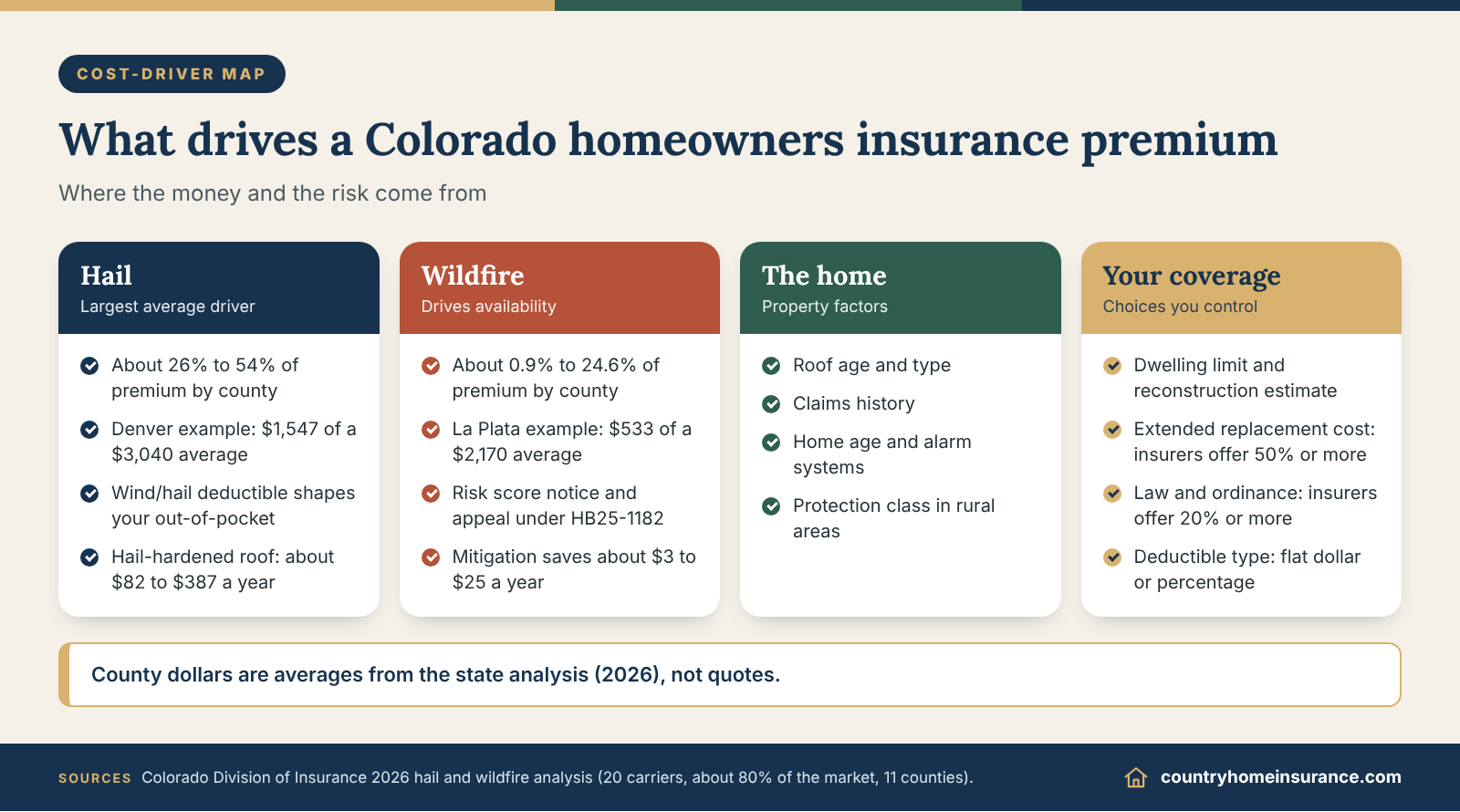
The Division’s 2026 analysis of data from 20 carriers, which together hold roughly 80% of the market, found hail to be the largest driver of homeowners premiums across the 11 counties it examined, at about 26% to 54% of the average premium depending on the county. The Division also notes that hail costs are spread statewide, while wildfire pricing targets the highest-risk areas. That is why a Denver homeowner can pay about $1,547 of an average $3,040 premium for hail risk and only about $30 for wildfire, according to the Division’s county table below.
Wildfire drives availability
Wildfire is a smaller slice of the average premium (about 0.9% to 24.6% by county) but a bigger factor in whether a policy is offered or renewed. The Colorado State Forest Service says just under half of Coloradans live in the wildland-urban interface, the zone where homes meet natural vegetation. Insurers use wildfire risk scores and may ask owners for mitigation work, and some homes have trouble finding standard coverage at all. The Marshall Fire of December 2021, a wind-driven grass fire in Boulder County suburbs, showed that serious wildfire losses are not limited to forested mountain lots.
| Situation | Typical status | What decides it |
|---|---|---|
| Sudden hail damage to roof, siding or windows | Typically covered, subject to the deductible | Separate wind/hail deductible, roof age or surfacing endorsement, cosmetic-damage wording |
| Fire damage, including wildfire | Typically covered, subject to limits | Dwelling limit adequacy, extended replacement cost, whether the insurer renews you |
| Matching undamaged siding or paint after a hail repair | Depends | Policy wording; the Division says no Colorado law requires matching undamaged sides |
| Smoke, ash and soot after a nearby fire | Depends | Cause of loss, policy wording and the insurer’s remediation scope |
| Flood, surface water and mudflow after a burn | Typically not covered by homeowners insurance | Separate NFIP or private flood policy; NFIP may cover mudflow but generally not landslides |
| Earth movement, settling and structural shifting | Typically not covered | Listed as an exclusion in the Division’s summary form; ask your agent whether any endorsement is available |
| Wear and tear, age-related roof deterioration | Typically not covered | Maintenance exclusions; roof condition drives underwriting |
| Detached garage, shed or fence | Typically covered under Coverage B, up to its limit | Separate other-structures limit; business use may change the answer |
| Rebuild costs above the dwelling limit | Depends | Whether you bought extended replacement cost (insurers must offer at least 50% of the dwelling limit) |
| Code upgrades when rebuilding | Depends | Law and ordinance coverage (insurers must offer at least 20% of the dwelling limit) |
| Extra living costs while the home is unlivable | Typically covered, within time and dollar limits | ALE limit; Colorado requires at least 12 months on replacement cost dwelling policies and an offer of 24 |
Colorado homeowners insurance cost: what the rate data shows in 2026
Every published average answers a slightly different question. Before the numbers, one rule: don’t blend one publisher’s average with another’s. Each uses its own sample, home profile and date, and the gaps between them can be larger than the differences you are trying to measure.
Three published snapshots and why they differ
Insurify’s Colorado page, updated September 30, 2026
Insurify, an online insurance marketplace, says its analysts reviewed rates from more than 180 insurers, drawing on partner and Quadrant Information Services data. Its Colorado page lists an average of about $270 a month ($3,240 a year) for a $300,000 dwelling, $1,000 deductible, $25,000 personal property and $300,000 liability, with a home built in 1980, good credit and no claims. The same page puts the national figure for that profile at about $234 a month. The page says rates are refreshed monthly, so figures move.
Insurify’s annual report as relayed in March 2026
A March 27, 2026 article by The Center Square, summarizing an Insurify report, said the average Colorado cost rose 33% in 2025 to $3,996, with a projected 4% rise to $4,164 by the end of 2026, and that Colorado was projected to rank sixth-highest nationally. The article doesn’t explain the report’s methodology, so treat these as directional. The 2025 annual figure and the September monthly figure come from different Insurify analyses, so don’t compare them line by line.
NerdWallet’s national baseline
NerdWallet’s 2026 pricing report analyzed more than 840 million rate estimates from Q1 2023 to Q1 2026 and reports a typical U.S. premium of $2,564 a year, up 24% over that period, for a homeowner with good credit, no claims and a 1984 home. The report is national, so use it as a yardstick for how fast prices have moved, not as a Colorado price.
What the Division of Insurance found by county
Hail versus wildfire shares of the premium
In a February 11, 2026 announcement with the Governor’s office, the Division reported that hail accounts for about 26% to 54% of the average homeowners premium by county and wildfire for about 0.9% to 24.6%. In Summit County hail was about 35.6% and wildfire about 7.9%. Along the Front Range and Eastern Plains, hail was about half. The Division requested data from 20 carriers holding about 80% of the market; Boulder County was excluded, according to CPR News, because of persistent insurance problems there.
Average premium dollars in five counties
The Division’s one-page summary lists average annual premium dollars attributed to each risk. These are averages across the carriers that supplied data, not quotes, and they show how different two Colorado homes can look.
| County | Hail share ($) | Wildfire share ($) | Total average premium ($) |
|---|---|---|---|
| Denver | $1,547 | $30 | $3,040 |
| Summit | $1,233 | $274 | $3,463 |
| La Plata | $562 | $533 | $2,170 |
| Alamosa | $639 | $78 | $1,590 |
| Mesa | $353 | $138 | $1,369 |
Reading rate numbers responsibly
Match coverage assumptions before you compare
A $300,000 dwelling limit with a $1,000 deductible produces a different premium than a $500,000 limit with a percentage wind/hail deductible. Insurify’s own page shows about $392 a month, or $4,704 a year, for $500,000 of dwelling coverage. When you gather quotes, hold the dwelling limit, personal property limit, liability limit, deductibles and endorsements constant, as covered in our guide to how to compare homeowners insurance quotes.
Your address matters more than the statewide average
The county table shows total premiums ranging from about $1,369 to $3,463 even before you account for roof age, claims history or distance to a fire station. Premium also varies inside a county, so a neighbor’s quote can mislead you. Our guide to homeowners insurance cost by ZIP code explains why street-level differences exist, and the how roof age affects homeowners insurance cost guide covers the roof variable that matters most in hail country.
Hail in Colorado: wind/hail deductibles, roof settlement terms and hardened roofs
If you remember one Colorado fact from this guide, make it this one: the largest share of the average premium is hail, and the part of the policy that determines what hail costs you out of pocket is the wind/hail deductible plus the roof settlement terms. For the generic logic of whether hail is a covered peril, see our guide on how hail damage coverage works. This section covers what is particular to Colorado.
Why hail dominates Colorado premiums
The big storms behind the numbers
Reporting by KOAA, drawing on Rocky Mountain Insurance Information Association catastrophe statistics, identifies a May 2017 Denver-area hailstorm as the state’s costliest event, at about $3.3 billion in 2025 dollars, ahead of the 2021 Marshall Fire at about $2.1 billion. CPR News reported that a May 2024 Denver-area storm with baseball-sized hail caused more than $2 billion in damage within a few hours. Insurify describes the Front Range as part of “Hail Alley.” Insurers price for the possibility of events like these, not only for the average year.
Why even low-hail areas pay for hail
The Division’s analysis found hail to be a substantial share of premiums even in places with less storm activity. Summit County, for example, showed hail at about 35.6% of the average premium, even though the county sees little hail itself. State officials attribute that to hail costs being spread across the state, while wildfire pricing targets the highest-risk areas. How your own insurer allocates hail cost to your address is a question to put to the insurer or agent.
Wind/hail deductibles and what Colorado does and doesn’t regulate
Flat-dollar versus percentage deductibles
A deductible is the amount you absorb before the insurer pays on a covered loss. Many policies apply one flat dollar deductible to most perils and a separate wind/hail deductible that may be a larger flat amount or a percentage of the dwelling limit. The percentage is calculated on the Coverage A limit, not on the size of the repair, so a small roof claim can fall entirely inside the deductible. Your declarations page should show which deductible applies to wind and hail.
Hypothetical example: A home has a $500,000 dwelling limit, a $1,000 deductible for most perils and a 1% wind/hail deductible. The wind/hail deductible would be $5,000. If a hailstorm leads to a $14,000 roof repair estimate and no depreciation applies, the insurer’s payment would be about $9,000, before any other policy terms. At 2%, the deductible would be $10,000 and the payment about $4,000. These figures are illustrations only, not quotes or promised payments.
What the Division says about hail claims
The Division’s hail FAQ doesn’t set a standard for wind/hail deductibles or roof payment schedules, so treat those terms as specific to your insurer and read your policy form and declarations page. What the FAQ does say is that no Colorado law requires an insurer to match siding or paint on undamaged sides, that the insurer must repair or replace only the damage from the covered event, and that no law addresses nonrenewal after a hail storm, although an insurer may consider nonrenewing after multiple losses. The Division’s summary form adds that premiums can rise after a paid claim.
Roof settlement terms and hail-resistant roofs
Roof age schedules and cosmetic damage wording
Some policies pay less for a roof depending on its age, material and condition, and actual cash value means replacement cost minus depreciation. The Texas Department of Insurance describes this general pattern in its roof guidance, noting that wind and hail deductibles are often higher than deductibles for other damage. Texas isn’t Colorado, so use it only as an illustration of what to ask about. Ask whether your policy has a roof payment schedule or a roof surfacing endorsement, and whether it limits payment for cosmetic-only hail damage. Once a claim is open, the hail damage roof insurance claim guide walks through the workflow.
Impact-resistant roofs and the state’s savings estimate
The Governor’s office reported that Colorado holds about 10% of the national impact-resistant shingle market even though it has the second-most hail claims in the country. IBHS says Fort Collins is the only U.S. community with a hail provision in its building code. IBHS has also renamed its FORTIFIED Bronze designation FORTIFIED Roof, describing the roof as a home’s first line of defense against severe weather. The Division estimates that hail mitigation such as a fortified roof saves about $82 to $387 a year across the counties studied. Material choice affects both durability and pricing, as covered in our guide to how roof material affects rates. Because insurers set their own credits, ask in writing whether a specific roof product earns a discount before you pay for it.
Wildfire and the wildland-urban interface: exposure, scoring and underwriting
Wildfire in Colorado is not a mountain-only issue, but its effect on insurance is uneven. In some counties it is a small line in the premium. In others it is a quarter of the premium and a reason an admitted insurer may say no.
How much of Colorado is exposed
The wildland-urban interface
The Colorado State Forest Service defines the wildland-urban interface (WUI) in practical terms: if your home is in or near natural vegetation, you are in it, because grasses, shrubs and trees are fuel. The agency says just under half of Coloradans live in the WUI and describes a destructive wildfire as a matter of when, not whether. The Division of Insurance’s own summary form warns of potential for large and even total losses from fire and other disasters, which is a reason to treat the dwelling limit as a serious decision.
Counting homes at extreme risk
The Insurance Information Institute, citing property-data firm Cotality, lists 318,783 Colorado housing units at extreme wildfire risk in 2025, second only to California. That figure is a modeled estimate, not a count of uninsurable homes, but it shows the scale of the underwriting problem. The Marshall Fire reminded insurers and homeowners alike that wind-driven grass fires can reach suburbs. For another state facing a similar squeeze, compare how the California homeowners insurance guide describes its residual market.
How insurers score and underwrite wildfire risk
Risk models, scores and what HB25-1182 now exposes
Insurers use computerized models that score a property or neighborhood for wildfire likelihood, and the models themselves are proprietary. Under HB25-1182, admitted insurers and the FAIR Plan must give a written notice that includes the property’s score or classification, a plain-language explanation, the range of possible scores and the property or area features that influenced it. The notice must also explain how mitigation affects the score and how to appeal. The law is covered in detail in a later section of this guide.
Inspections, conditions and consistent rules
Insurers may ask for brush clearance or other hardening steps as a condition of coverage. United Policyholders notes that Colorado requires insurers to apply their own rules consistently across customers (3 CCR 702-5, section 7(A)). If the insurer applies a condition to your house but not to similar houses, that is a fair question for the Division. Separately, C.R.S. 10-4-110.9 bars an insurer from declining to renew an existing fire policy on property in a federally designated wildfire-related disaster area, although the insurer may require reasonable risk-reduction steps. The practical side of a wildfire-driven drop is covered in our wildfire insurance nonrenewal guide.
What mitigation does and doesn’t do for your price
The state’s estimate of wildfire savings
The Division estimates that wildfire mitigation saves about $3 to $25 a year on average in the counties it studied; CPR reported about $25 in Summit County. That is small next to the potential hail savings, though CPR notes that mitigation still helps protect homes from burning. State officials have also floated a state wildfire reinsurance program as another affordability tool, and SB26-155 commissions a study of insurance risk in high-risk wildfire areas.
Designations insurers have named
The Division’s HB25-1182 bulletin cites IBHS Wildfire Prepared Home designations (Enhanced or Essential) as an example of the third-party verification that can support a mitigation credit, and it advises policyholders to ask which standards their insurer recognizes. Programs differ by carrier and county, so ask each insurer for its mitigation requirements and credits in writing. Seasonal preparation tips are collected in our fall wildfire and wind insurance checklist.
Colorado laws that protect homeowners: underinsurance, notice and claim handling
Colorado has built up a set of homeowner-specific insurance rules, many of them aimed at wildfire losses. Several of those rules are easy to miss because they work through what an insurer must offer, disclose or pay on a deadline, not through a price cap. The statutes below are summarized in plain English; the text and your policy control.
Underinsurance rules from HB23-1174
Extended replacement cost and law and ordinance offers
HB23-1174, signed May 12, 2023, was titled as a homeowner’s underinsurance bill. It raised the extended replacement cost coverage that insurers must offer from 20% to at least 50% of the dwelling limit and the law and ordinance (building code) coverage from 10% to at least 20%. Extended replacement cost pays above your dwelling limit if rebuilding costs more than expected, and law and ordinance pays increased costs required by current codes. Under C.R.S. 10-4-110.8(6), beginning January 1, 2025, the declarations page must show, in bold 12-point type, whether you bought or rejected each coverage.
Reconstruction estimates and the annual cost report
For policies issued or renewed on or after January 1, 2025, insurers must give a reconstruction estimate, explain how it was calculated and point to the Commissioner’s annual reconstruction-cost report, unless an exemption applies. The Division’s reconstruction-cost tool uses April 2025 cost data and excludes land value, site development and features such as decks. It describes its results as informational only, not an appraisal or guarantee, and encourages homeowners to gather estimates from several sources, so allow for cost changes since then and get a builder’s estimate as well.
Cancellation and nonrenewal rules
The 60-day notice rule and why older pages say 30
Under C.R.S. 10-4-110.7(3), an insurer can’t cancel or refuse to renew a homeowner’s policy unless it mails notice by first-class mail at least 60 days before the action takes effect and states the specific reasons. HB23-1174 raised that period from 30 days to 60. If you see a Division consumer advisory from 2022 that says 30 days, it predates the change. For nonpayment of premium, the notice period is 10 days. If you receive a nonrenewal, ask the insurer to reconsider and tell it about hardening or brush clearing you have done, and see the wildfire nonrenewal guide linked earlier for next steps.
New policies, coverage questions and disaster areas
For a binder or conditional policy issued while the insurer is still assessing the risk, the statute gives the insurer 30 business days from the effective date to decide whether to issue or cancel, with notice to you; the window can be extended if the insurer has a reasonable basis to investigate further. The Division’s 2026 wildfire page also says that Colorado law generally prohibits canceling or nonrenewing solely because you asked a general coverage question unrelated to a claim. Where a property sits in a federally designated wildfire-related disaster area, C.R.S. 10-4-110.9 bars refusing to renew an existing fire policy, although the insurer may require reasonable risk-reduction steps. The Division has also issued emergency regulations for specific events; its wildfire page cites Emergency Regulation 26-E-04, a moratorium on certain cancellations and nonrenewals in areas affected by the Aspen Acres Fire.
Claim-handling rights
Contents, living expenses and deadlines after a loss
For a total loss of an owner-occupied primary residence, insurers must offer at least 30% of the contents limit without a written inventory (higher amounts need an inventory), and you have at least 365 days to submit one. For a wildfire total loss in a governor-declared disaster, the minimum no-inventory offer is 65%, ALE lasts at least 24 months with two optional six-month extensions, and you have at least 36 months to submit receipts for replacement cost (also with two optional six-month extensions). Insurers must pay documented ALE within 20 days. You can also ask for a copy of your policy, including the declarations page and endorsements, and the insurer must provide an electronic or paper copy within three business days (a certified copy within 30 days).
Unreasonable delay or denial
Colorado law says an insurer must not unreasonably delay or deny payment of a covered first-party claim, and defines unreasonable as lacking a reasonable basis (C.R.S. 10-3-1115). A policyholder whose claim was unreasonably delayed or denied can sue for reasonable attorney fees, court costs and two times the covered benefit (C.R.S. 10-3-1116). That remedy isn’t automatic and depends on the facts, so it is a topic for a licensed Colorado attorney. The simpler first step for many disputes is a written request for the decision and the policy language, followed by a Division complaint.
| Item | What Colorado rules or sources say | What to ask your insurer or agent |
|---|---|---|
| Wind/hail deductible | The Division’s hail FAQ sets no standard; the policy decides, and wind/hail deductibles are often higher than the deductible for other damage | Is it flat or a percentage, and what is the dollar amount for my dwelling limit? |
| Roof settlement terms | Insurer-specific; roof age and type are listed by the Division as premium factors | Is the roof paid at replacement cost, actual cash value or a payment schedule? Is cosmetic damage excluded? |
| Dwelling limit | Reconstruction estimate must be explained for policies issued or renewed on or after January 1, 2025 | How was my reconstruction cost calculated, and what inflation protection applies? |
| Extended replacement cost | Must be offered at at least 50% of dwelling limit; acceptance or rejection shown on declarations | Did I accept it, what does it cost and what is the maximum payout? |
| Law and ordinance | Must be offered at at least 20% of dwelling limit | Does it cover code upgrades after a hail or fire loss in my jurisdiction? |
| Additional living expense | At least 12 months on replacement cost dwelling policies; insurers must offer 24; at least 24 months after a qualifying wildfire total loss | What are the time and dollar limits, and does a mandatory evacuation trigger ALE? |
| Contents without an inventory | At least 30% offer after a total loss of a primary residence; at least 65% after a qualifying wildfire total loss | Is there a home inventory stored away from the house? |
| Wildfire score and mitigation credit | HB25-1182 notice, appeal and credit rules apply to admitted insurers and the FAIR Plan | What is my score, what drives it and what credit does mitigation earn? |
| Claims history and credit-based scoring | The Division’s summary says premiums can rise after a paid claim or with a credit-based insurance score where used | Which prior claims is the insurer counting, and can I see the report? |
| Protection class (rural areas) | Assigned through ISO’s evaluation of community fire protection; see the rural section below | What protection class is my address in, and what would change it? |
New Colorado homeowners insurance rules for 2025 and 2026: HB25-1182 and SB26-155
Two recent laws change what you can see and, eventually, what a hail-hardened roof may cost. One is in force now for risk-model disclosures. The other creates a roof-hardening grant enterprise that will be funded starting in 2027.
HB25-1182: risk-model transparency, appeals and mitigation credits
The notice and appeal timeline
Signed May 28, 2025, HB25-1182 (“Risk Model Use in Property Insurance Policies”) applies to admitted insurers and the Colorado FAIR Plan, not to non-admitted (surplus lines) insurers. The legislature’s bill page lists July 1, 2026 as the act’s effective date, and the Division’s fall 2026 bulletin says disclosure notices begin October 1, 2026: applicants receive them with an application and existing policyholders at renewal. In practice, expect notices from October 1, 2026 forward and ask your insurer when yours is due. The notice and appeal clock, per the bulletin, is summarized below. If the appeal outlasts your policy term, coverage continues at least 10 calendar days after the decision notice.
Mitigation credits and website postings
Insurers using risk models must either factor property-level and community-level mitigation into pricing or offer discounts to policyholders who document qualified mitigation work, which requires verification such as an IBHS designation. They must also post potential premium adjustments, incentives or discounts for mitigation, plus appeal instructions, on their websites; insurers that offer no mitigation discounts must say so. If you believe a notice deadline was missed, your mitigation evidence wasn’t reviewed or a discount was denied without explanation, you can raise it with the insurer first and then file a complaint with the Division.
| Step | Deadline or rule | Who acts |
|---|---|---|
| Notice to a new applicant | Within 15 days of a completed application | Insurer or FAIR Plan |
| Notice to an existing policyholder | With the renewal offer, or with the nonrenewal notice | Insurer or FAIR Plan |
| Appeal acknowledged | Within 10 calendar days of a formal appeal | Insurer or FAIR Plan |
| Evidence reviewed and score updated | Within 30 days, if applicable | Insurer or FAIR Plan |
| Final written decision | Within 30 calendar days | Insurer or FAIR Plan |
| Coverage if appeal outlasts the policy | Continues at least 10 calendar days after the decision notice | Insurer or FAIR Plan |
SB26-155 and the new roof-hardening grant enterprise
What the law creates and how it is funded
SB26-155 (“Increase Access Homeowner’s Insurance Enterprise”) was signed in June 2026, as Insurance Journal reported on June 5, 2026, and creates a state enterprise to fund roof-hardening grants. It imposes an annual fee of 0.5% of multiperil homeowner’s premiums collected in the prior calendar year on admitted insurers (the FAIR Plan is excluded), capped so that revenue doesn’t exceed $100 million over the first five years. The law says insurers can’t pass the fee on to policyholders. At least 85% of revenue must go to grants for Colorado homeowners to retrofit homes against hail and windstorms, with priority for primary residences. Contractors who receive grant money may not waive homeowner’s insurance deductibles. The law also funds hail-loss data analysis, resilient roof standards, contractor codes of conduct and a study of wildfire-area insurance risk.
What happens next
Fee collection begins with calendar year 2027, and insurer filings are due no sooner than January 1, 2027 and only after the Commissioner adopts rules. The bill page says the enterprise board will adopt the rules and the resilient roof standards, and that it will weigh factors such as applicant income, roof age, home size, local hail-resistant building codes and exposure to extreme weather. Application steps, eligible roof products and grant amounts will come from the board’s rules, so check with the Division for when applications open and don’t pay for a new roof in the expectation of a grant. For wildfire, the law commissions a study of insurance risk in high-risk areas rather than creating a reinsurance program. Ask your insurer about any resulting credit before assuming your premium will change.
The Colorado FAIR Plan and other last-resort property insurance options
A FAIR Plan (Fair Access to Insurance Requirements) is a residual-market program: a pool run by the state’s admitted property insurers for owners who can’t get coverage in the regular market. Colorado’s plan is new, small and deliberately bare-bones. The facts below come from the Division, the plan’s own website, the Division of Real Estate and a July 2025 presentation to state legislators, and they may change as the plan matures.
What the plan is and how to get in
Creation, launch and who administers it
HB23-1288, signed May 12, 2023, created the plan as a public entity that provides property insurance when admitted companies don’t offer it. The Division approved the Plan of Operation on July 26, 2024. Residential applications opened on April 10, 2025, and commercial applications followed in July 2025. The plan’s executive director has described it as designed to address insurance availability, not affordability.
Who is eligible
Applicants need three declinations from admitted insurers and a property that the standard market treats as uninsurable because of factors such as wildfire exposure, hail risk, location, claim history or age. The plan’s eligibility page doesn’t say how it treats an expensive private offer, so ask an agent or the plan’s Customer Care Team before assuming you qualify. CPR News and the Colorado Sun reported that the first applicants rejected were homes under construction or major renovation. The Division of Real Estate’s HOA Center advisory says a covered location is a single building at least 100 feet from any other insured building, which matters mainly for condo and townhome associations. You can’t apply directly: you must go through a licensed agent who is registered with the plan.
What a FAIR Plan policy covers and what it doesn’t
Perils, valuation and the $750,000 cap
The Division describes the plan as offering up to $750,000 in property insurance for individuals. The Division of Real Estate’s advisory describes that homeowner limit as combined for property and contents, notes that coinsurance may apply, and says payment is at actual cash value, not replacement cost, a point the plan’s own site repeats. In plain terms, the plan pays the home’s depreciated value, not the cost to rebuild. According to the July 2025 presentation, the base policy covers fire and lightning only, and extended coverage, which you must request, adds perils such as windstorm and hail, riot and others listed in the policy. United Policyholders reports that the policy excludes personal liability, medical payments and loss of use (additional living expense), and the presentation lists water damage, theft and law and ordinance among common exclusions. For deductible options and premiums, ask a registered agent for the filed forms and rates in writing, or call the plan’s Customer Care Team at (833) 554-5425.
Pairing with a DIC policy and the demand picture
Because the plan is limited, owners often pair it with a difference-in-conditions (DIC) policy, sometimes called a wrap-around, from a standard or non-standard carrier to fill gaps such as liability. The combined cost can exceed a standard policy with similar protection, according to United Policyholders, which advises buying a DIC policy only if you can afford it and continuing to shop for a standard policy. Early uptake was small: CPR News reported 31 properties covered when it wrote in July 2025, and the plan’s executive director told CPR it should be a last resort because of its “high cost and bare-bones coverage.”
Surplus lines, force-placed coverage and other fallbacks
The non-admitted market
United Policyholders suggests looking into “surplus” or non-admitted insurers if no familiar brand will cover your home. A key difference for Colorado readers: the HB25-1182 notice, appeal and mitigation-credit rules apply to admitted insurers and the FAIR Plan, not to surplus lines. Before you buy a surplus lines policy, ask the agent how it differs from an admitted policy, including what happens if the insurer cannot pay claims, and check the insurer’s financial strength rating with AM Best.
Lender-placed coverage as a last backstop
United Policyholders warns that if you can’t get coverage, your mortgage lender may buy a bare-bones, expensive force-placed policy and add the cost to your loan; it covers only the mortgage amount. Treat that as a signal to keep shopping, not a solution. The same source advises locking in a higher-priced policy if it is your only option and continuing to look, since new options appear over time.
| Feature | Standard admitted homeowners policy | Colorado FAIR Plan dwelling policy | Surplus lines (non-admitted) |
|---|---|---|---|
| Eligibility | Insurer underwriting standards | Three declinations from admitted insurers; agent-only access | Insurer underwriting; ask your agent how to access this market |
| Loss settlement | Often replacement cost on the dwelling; roof terms vary | Actual cash value | Varies by policy |
| Limits | Dwelling limit per policy | Up to $750,000 residential limit, property and contents combined; coinsurance may apply | Varies by policy |
| Liability and ALE | Typically included | Not included in the basic policy | Varies by policy |
| HB25-1182 notice and appeal rules | Apply | Apply | Do not apply |
| Best use | Primary coverage when available | Last resort, often paired with a DIC policy | Homes the admitted market declines; compare terms and insurer rating carefully |
Rural and mountain Colorado: protection class, wells, outbuildings and access
A country home in Colorado isn’t simply a suburban house with more land. Distance to fire service, private water systems, detached buildings and long driveways all show up in underwriting. Protection class comes from ISO’s public protection program, and most of the other items depend on policy forms and endorsements, so the points below pair what the programs say with questions you can put to your insurer. For acreage in general, see our guide to country home insurance with acreage.
Protection class and fire service
What the 1-to-10 class measures
ISO’s Public Protection Classification (PPC) program evaluates community fire protection and assigns a class from 1 to 10 that insurers can use in pricing fire risk; Class 1 generally indicates strong protection, and Class 10 means the area’s fire-suppression program doesn’t meet ISO’s minimum criteria. ISO’s Fire Suppression Rating Schedule has four parts: emergency communications (10 points), fire department (50), water supply (40) and community risk reduction (5.5), out of 105.5. Hydrants count if within 1,000 feet of the representative locations evaluated.
Volunteer districts, water supply and what to ask
Because water supply is the second-largest part of the schedule, a rural address without hydrants may rely on how the local fire district gets and carries water. Some rural fire protection districts are staffed by volunteers; whether yours has been evaluated, and at what class, is a question for the district and your insurer. Ask your agent for the class assigned to your address, how your insurer uses it, and whether a re-evaluation could change it.
Wells, septic systems, outbuildings and long driveways
Outbuildings and the other-structures limit
The Division’s summary of coverage describes Coverage B as covering detached buildings such as fences, sheds and detached garages under a separate limit. A barn, workshop or hay shed can quickly exceed that limit, and business or farm use may change the answer entirely. Review each building’s value and use with your agent, and read our guide on small farm insurance compared with homeowners coverage if animals or sales are involved.
Private water, septic and access
How a policy treats pumps, septic systems and buried lines depends on its wording and endorsements; the Division’s toolkit lists service line and water backup coverage among the endorsements to consider. Narrow private roads, long driveways and limited turnarounds can influence both fire response and an insurer’s inspection findings, so photograph and document your access and any improvements. For a total loss from a governor-declared wildfire disaster, the statute’s wildfire provisions call for payment of debris removal costs to be paid within 60 days after an invoice and for tree, shrub and landscaping losses to be paid within 30 days after documentation.
Mountain weather beyond fire
Post-fire flooding and mudflow
The Division’s wildfire guidance says most homeowners policies exclude flood and that flood coverage through the National Flood Insurance Program (NFIP) or private carriers is a separate purchase. NFIP generally has a 30-day waiting period, with a limited exception after a wildfire that depends on the fire’s containment date, and FEMA advises that elevated flood risk may last up to five years after a fire. NFIP may cover mudflow but generally not landslides. See our guide on whether homeowners insurance covers flood damage for the general rules.
Seasonal use and second homes
Many mountain homes sit empty part of the year, and unoccupied-home clauses, freeze precautions and heating requirements vary by policy. Vacancy terms differ from insurer to insurer, so tell yours how the property is used and ask what the policy requires when no one is home, a topic expanded in our guide on whether homeowners insurance covers frozen pipes.
Colorado homeowners insurance discounts: what is actually documented
Discount lists on insurance marketing pages are often longer than what an insurer will actually apply, and the devil is in the details of eligibility. The sources below are limited to the Division, the national regulators’ association and the state’s own mitigation estimates, and they describe categories, not guaranteed percentages.
What regulator sources list
The Division’s shopping tips and premium factors
The Division’s homeowner toolkit tells shoppers to ask about discounts such as multi-policy bundles and home hardening, and about how the deductible they choose affects the premium. Its summary of coverage lists factors that can move your premium: deductibles, multi-policy discounts, claim history, home age, roof age or type and alarm systems. The NAIC adds that a higher deductible lowers the premium, so choose one you could comfortably pay after a claim. Those are categories to ask about, not entitlements.
The NAIC’s national list
The National Association of Insurance Commissioners lists discounts commonly available in the U.S., including insuring home and auto with the same company, deadbolt locks, burglar alarms and other security devices, and replacing the roof. It adds that new homes may qualify for discounts, older homes may not qualify for preferred programs, and a new wood-burning fireplace or wooden deck can raise a premium. The NAIC’s advice is to ask your agent which discounts apply in your state. This is a national list, not a statement of what each Colorado insurer files.
Hail and wildfire mitigation credits
Documenting a hail credit
The Division estimates hail mitigation could save about $82 to $387 a year on average, the largest documented discount potential in the state. To claim a roof-related credit, gather the installation invoice, product name and impact rating, any FORTIFIED Roof or other third-party certificate, and photographs, and then send them to the insurer and ask for a written statement of the credit and effective date. SB26-155 grants may eventually help fund such roofs once the enterprise board adopts its rules.
Documenting a wildfire credit
Under HB25-1182, an insurer that does not already build property-level and community-level mitigation into its model must offer discounts for qualified, verified mitigation, and insurers that use risk models must publish their mitigation credits and appeal steps on their websites. Keep dated photos of defensible-space work, receipts for ember-resistant vents or noncombustible roofing and any designation paperwork. If the insurer scores your property higher than your hardening supports, use the appeal process in Table 4 and send evidence.
Keeping discount claims in perspective
Fixed percentage discounts
Insurers set their own mitigation credits, and the Division’s estimates are averages by county, not guaranteed savings. Be cautious with any quote or advertisement that promises a specific saving before you provide your address, roof details and prior claims.
Insurer-by-insurer rankings
Marketplace pages sometimes name an insurer as best for affordability or for wildfire coverage. Those labels come from each publisher’s own methodology, change monthly and don’t reflect your address, so this guide doesn’t rank insurers. Use the Division’s premium comparison tool, request quotes with identical coverage, and look at complaint data and financial ratings, as outlined in the quote-comparison guide linked earlier.
Using the Colorado Division of Insurance: resources, complaints and scam protection
Insurance in Colorado is regulated by the Division of Insurance, part of the Department of Regulatory Agencies (DORA). The Division licenses insurers, agents and public adjusters, reviews certain filings and handles consumer questions and complaints. It can’t act as your attorney, and it can’t promise an outcome, but it is a free resource that many homeowners overlook.
Resources worth bookmarking
Consumer Services and required documents
The Division’s Consumer Services team can be reached at 303-894-7490 (800-930-3745 toll-free outside the Denver metro area) or by email at [email protected]; the mailing address is 1560 Broadway, Suite 1300, Denver, CO 80202. The Division’s homeowners page links to an online form for certified policy requests, a Buyer’s Guide to Homeowners Insurance and a premium comparison tool, and it also publishes a homeowners and HOA insurance toolkit.
Studies and public events
The Division’s affordability and availability page lists studies tied to HB24-1108 (a market study of HOAs and lodging facilities), HB24-1315 (fire-damage remediation, including smoke, soot and ash, with a contractor draft that the Division says has not been validated for reliance) and HB25-1182 stakeholder meetings. Its wildfire page lists town halls on insurance during and after wildfires on July 15 and September 16, 2026. Following these pages is a practical way to see rules before they appear in a renewal notice.
Filing a complaint
How the portal process works
The Division asks you to create a Consumer Portal account, complete the complaint pages and submit them. The portal doesn’t auto-save, and unsubmitted entries are lost after two hours of inactivity, so gather your documents first. After submission you receive a complaint ID and confirmation email, can upload supporting documents and communicate through portal comments. A paper complaint form is available as an alternative.
When a complaint fits
The Division’s consumer advisories point to nonrenewal as a typical reason: the reason seems improper, the notice was too short or you can’t find other coverage. For wildfire scoring, a missed notice deadline, a refusal to review your mitigation evidence or a discount denied without a written explanation are reasonable topics to raise with the insurer and then, if unresolved, with the Division. Disputes about whether a loss is covered can start with a written request for the decision and policy language. For legal remedies, consult a Colorado attorney.
Contractors, public adjusters and scams
After a hail or fire event
After hail storms many contractors go door to door. The Division’s wildfire guidance advises getting bids from several companies, asking for references, checking complaint history and licensing, confirming liability and workers’ compensation insurance, avoiding cash payments and large up-front deposits, never signing a contract with blank spaces and being wary of pressure to decide immediately. Under SB26-155, contractors receiving grant money may not waive homeowner’s insurance deductibles, and that is a reminder to be wary of any contractor who offers to “cover” yours.
Public adjusters
You aren’t required to hire a public adjuster. After a catastrophic disaster, the Division says a public adjuster can’t charge more than 10% of the settlement or require payment before the claim is settled, and Colorado law lets you rescind the agreement in writing within 72 hours of signing. Check the adjuster’s license with the Division, and compare the fee with the likely benefit before you sign.
How to shop for Colorado homeowners insurance: a step-by-step plan
Shopping in Colorado is less about finding a single cheapest quote and more about finding a policy whose hail and wildfire terms you understand. The steps below put the state-specific items first, and the table that follows turns them into a checklist you can print.
Before you request quotes
Gather property facts
Collect the roof’s age, material and installation date, the age of your wiring, plumbing and heating, any hardening work, and your address’s protection class if you know it. Run the Division’s reconstruction-cost tool and get at least one contractor estimate to set the dwelling limit. Start a home inventory with photos and serial numbers, and keep a copy away from the house, as the Division’s preparedness guidance suggests.
Review your reports
The Division’s toolkit points shoppers to their free annual consumer reports and urges checking them for accuracy. Ask each insurer whether a credit-based insurance score or a claims history report affects your quote, and request a copy of any claims report so you can correct errors that could be raising your price.
Comparing offers
Hold the specifications constant
Request quotes with the same dwelling limit, contents limit, liability limit, deductible structure and endorsements, so you are comparing apples to apples. A policy with a lower base premium and a 2% wind/hail deductible isn’t cheaper than one with a flat deductible if you have a hail claim. Compare the wind/hail deductible in dollars for your dwelling limit, not just as a percentage.
Questions that surface Colorado-specific terms
- What is the wind/hail deductible in dollars, and does it apply to the roof?
- Is the roof paid at replacement cost, actual cash value or a payment schedule, and is cosmetic hail damage excluded?
- Were extended replacement cost and law and ordinance coverage accepted or rejected on my policy, and what do they cost?
- How long does additional living expense last, and does a mandatory evacuation trigger it?
- What is my wildfire score or classification, what drives it and what mitigation credit applies?
- What events would lead you to nonrenew this home, and what notice will I receive?
When no admitted insurer will write the home
The order of steps
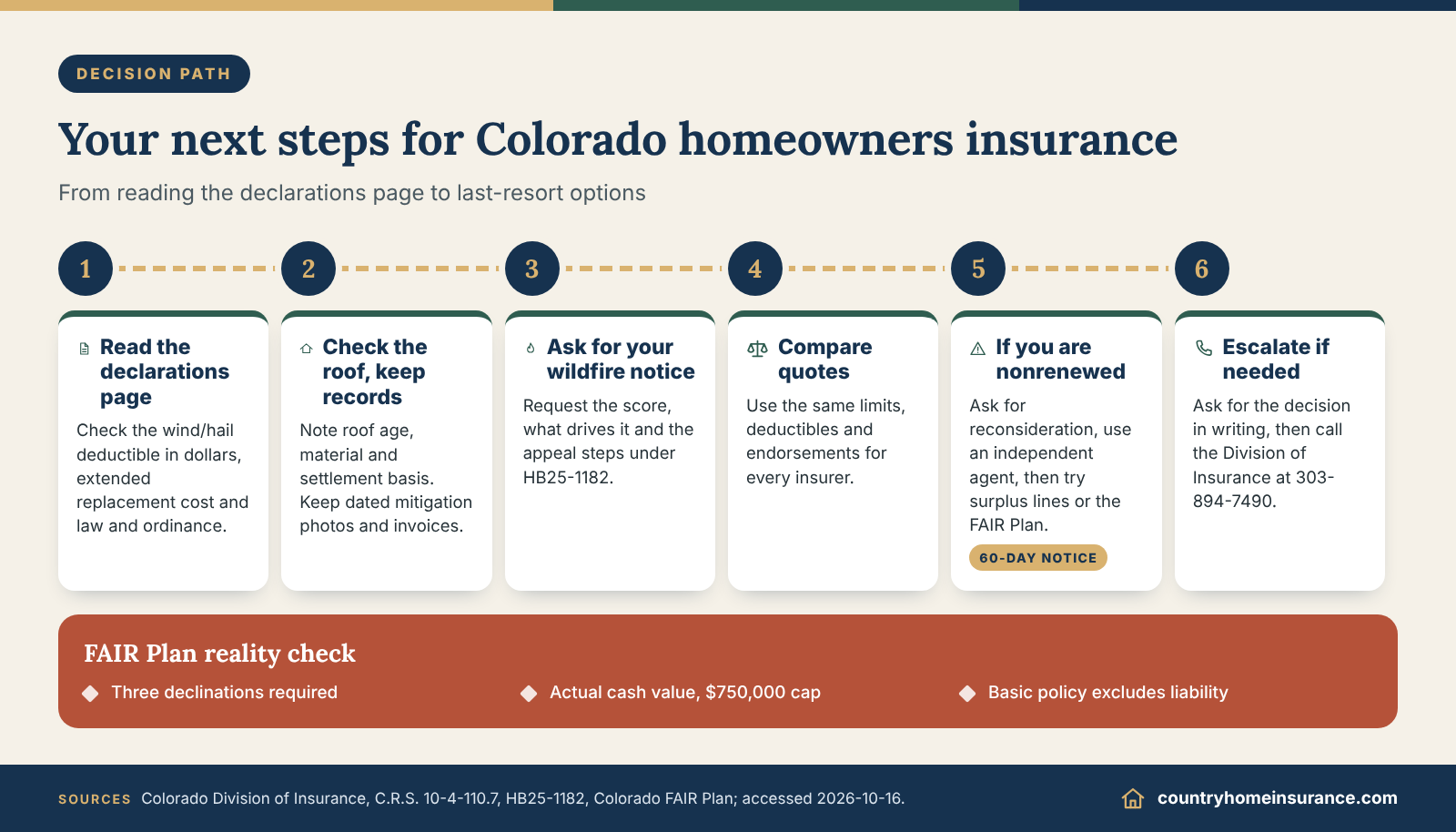
Start by asking the insurer to reconsider and send it your hardening documentation. Work with an independent agent who can approach multiple carriers, then look at surplus lines options and finally the FAIR Plan, which requires three declinations. United Policyholders advises checking the financial rating of any unfamiliar insurer with AM Best and correcting errors in your claims history before you apply.
Keeping coverage continuous
Don’t let a policy lapse while you search; a gap may cause problems with a mortgage lender and may complicate future applications. If you have 60 days’ notice, use the time to shop early. If you receive a shorter notice, or you think the reason is wrong, contact the Division the same day.
| Step | What to verify or document | Who to ask or where to look |
|---|---|---|
| 1. Read the declarations page | Dwelling limit, wind/hail deductible in dollars, accepted or rejected extended replacement cost and law and ordinance | Your agent; the declarations page |
| 2. Check the roof terms | Roof age, material, settlement basis (replacement cost, actual cash value or schedule), cosmetic damage wording | Policy form and endorsements |
| 3. Confirm the rebuild estimate | Insurer’s reconstruction estimate, a contractor estimate and the Division’s tool | Insurer; licensed contractor; Division reconstruction-cost page |
| 4. Request your wildfire notice | Score or classification, drivers, mitigation effect, appeal rights | Insurer; HB25-1182 notice |
| 5. Document mitigation | Dated photos, invoices, certificates, impact ratings | Keep in a folder stored away from the house |
| 6. Build a home inventory | Photos, serial numbers, receipts; copy stored off-site | NAIC and Division home-inventory guidance |
| 7. Review separate coverage needs | Flood (NFIP or private), endorsements for water backup, service lines and valuables | Agent; FloodSmart provider search |
| 8. Calendar renewal and notice dates | 60-day notice window; wildfire notice with renewal offer | Your calendar; renewal documents |
| 9. Know your escalation path | Written decision and policy language; claim number; adjuster contacts | Division Consumer Services at 303-894-7490 |
Frequently asked questions
Costs and rates
How much is homeowners insurance in Colorado?
It depends on the source and the home profile. Insurify’s September 2026 page lists about $3,240 a year for a $300,000 dwelling and $1,000 deductible; the Division’s 2026 county averages range from about $1,369 in Mesa County to $3,463 in Summit County. These are averages, not quotes, and your address, roof and claims history can move the price substantially.
Why is Colorado homeowners insurance so expensive?
The Division’s analysis points to hail as the leading driver, at about 26% to 54% of premiums depending on the county, with wildfire a smaller average share but a much larger one in places such as La Plata County. The Division’s toolkit also cites more frequent severe disasters, a tighter reinsurance market and higher rebuilding costs as reasons premiums are rising.
Hail and roofs
Does Colorado have a separate hail deductible?
It depends on your policy. The Division’s hail guidance doesn’t set a standard hail deductible, so insurers may use flat or percentage amounts. Check your declarations page, and see the hail claim guide linked earlier when you have a loss.
Is an impact-resistant roof worth it for insurance?
The Division estimates hail mitigation could save $82 to $387 a year on average, but credits vary by insurer. Ask for the credit in writing before you pay for the roof, and compare the lifetime benefit, including fewer repairs, not only the premium.
Wildfire and non-renewal
Can my insurer drop me because of wildfire risk?
It can generally decline to renew with at least 60 days’ written notice and specific reasons, unless the property is in a federally designated wildfire-related disaster area, in which case C.R.S. 10-4-110.9 bars non-renewal of an existing fire policy (the insurer may require reasonable risk-reduction steps). Ask for reconsideration and file a Division complaint if the notice looks improper.
How do I appeal a wildfire risk score?
Under HB25-1182, you can appeal a score or classification directly to your insurer or the FAIR Plan and submit evidence of mitigation. The insurer must acknowledge the appeal within 10 calendar days and issue a written decision within 30 calendar days. Keep your documentation and a dated copy of your appeal.
FAIR Plan and last-resort coverage
Who can get a Colorado FAIR Plan policy?
Owners who have received three declinations from admitted insurers on a property the standard market treats as uninsurable, applying through a registered agent, and subject to the plan’s underwriting standards. Coverage is actual cash value with a $750,000 residential limit, and United Policyholders reports no liability coverage in the basic policy.
Is the FAIR Plan cheaper than a regular policy?
Not necessarily. The plan’s own executive director describes it as high cost with bare-bones coverage, and United Policyholders notes that a FAIR Plan policy plus a DIC policy may cost more than a standard policy with similar protection.
Rights and help
Where do I complain about my insurer in Colorado?
The Colorado Division of Insurance accepts complaints through its Consumer Portal, and you can call Consumer Services at 303-894-7490. Gather your policy, notices and correspondence first.
Does Colorado homeowners insurance cover flood or mudflow?
Typically not. Flood and surface water are excluded from standard policies, and the Division points homeowners to NFIP or private flood coverage. NFIP may cover mudflow but generally not landslides, and it has a waiting period that is usually 30 days.
Sources
- Colorado Division of Insurance — Consumer Advisory: When Your Homeowners’ Insurance Doesn’t Renew Your Policy (published August 31, 2022; accessed 2026-10-16)
- Colorado Division of Insurance — New Homeowners Insurance Protections and Transparency Rights Under HB25-1182 (bulletin, fall 2026; accessed 2026-10-16)
- Colorado Division of Insurance — Hail and wildfire premium analysis one-pager (2026, undated PDF; county table and mitigation savings; accessed 2026-10-16)
- Colorado Governor’s Office — Governor Polis and Division of Insurance announcement on hail and wildfire premium drivers (February 11, 2026; accessed 2026-10-16)
- Colorado Division of Insurance — Homeowners’ Insurance: Consumer Highlights (accessed 2026-10-16)
- Colorado Division of Insurance — Homeowners’ Insurance Summary of Coverage Form (accessed 2026-10-16)
- Colorado Division of Insurance — After a Hail Storm: Insurance FAQs (accessed 2026-10-16)
- Colorado Division of Insurance — Homeowners After a Colorado Wildfire (2026 wildfire information) (2026; accessed 2026-10-16)
- Colorado Division of Insurance — Toolkit on Insurance for Homeowners and HOAs (accessed 2026-10-16)
- Colorado Division of Insurance — Homeowners annual reconstruction cost report and valuation tool (April 2025 cost data; accessed 2026-10-16)
- Colorado Division of Insurance — Homeowners insurance affordability and accessibility (accessed 2026-10-16)
- Colorado Division of Insurance — File a complaint (accessed 2026-10-16)
- Colorado Division of Insurance — FAIR Plan (Fair Access to Insurance Requirements) (accessed 2026-10-16)
- Colorado Division of Real Estate — HOA Center Advisory: The FAIR Plan (February 13, 2025; limits, covered perils and building definition; accessed 2026-10-16)
- Colorado FAIR Plan — Official site (accessed 2026-10-16)
- Colorado FAIR Plan — Eligibility (three declinations, agent-only access, actual cash value; accessed 2026-10-16)
- NCOIL — Colorado FAIR Plan presentation by Executive Director Kelly Campbell (July 2025; accessed 2026-10-16)
- Colorado General Assembly — HB23-1288, creating the FAIR Plan (signed May 12, 2023; accessed 2026-10-16)
- Colorado General Assembly — HB23-1174, Homeowner’s Insurance Underinsurance (signed May 12, 2023; accessed 2026-10-16)
- Colorado General Assembly — HB25-1182, Risk Model Use in Property Insurance Policies (signed May 28, 2025; accessed 2026-10-16)
- Colorado General Assembly — SB26-155, Increase Access Homeowner’s Insurance Enterprise (2026; accessed 2026-10-16)
- Public.Law — C.R.S. 10-4-110.7, cancellation and nonrenewal of homeowner’s insurance (statute text current through fall 2025; accessed 2026-10-16)
- Public.Law — C.R.S. 10-4-110.8, homeowner’s insurance requirements (accessed 2026-10-16)
- Public.Law — C.R.S. 10-4-110.9, nonrenewal in wildfire disaster areas (accessed 2026-10-16)
- Public.Law — C.R.S. 10-3-1115, unreasonable delay or denial of first-party claims (accessed 2026-10-16)
- Public.Law — C.R.S. 10-3-1116, remedies for unreasonable delay or denial of first-party claims (accessed 2026-10-16)
- United Policyholders — Dropped by Your Home/Condo Insurer? Information for Colorado Residents (modified April 7, 2026; accessed 2026-10-16)
- United Policyholders — The Colorado FAIR Plan: A Last Resort Option (modified April 29, 2026; accessed 2026-10-16)
- CPR News — Hail is driving up homeowners insurance premiums in Colorado (February 11, 2026; accessed 2026-10-16)
- CPR News and Colorado Sun — Colorado’s FAIR Plan launch (July 14, 2025; accessed 2026-10-16)
- KOAA News5 — Hail risk biggest driver for homeowner insurance costs in Colorado (February 2026; accessed 2026-10-16)
- Insurify — Colorado homeowners insurance (updated September 30, 2026; accessed 2026-10-16)
- The Center Square via Kiowa County Press — Report: Home insurance rates go through the roof in Colorado (March 27, 2026; accessed 2026-10-16)
- NerdWallet — Home Insurance Rates Report 2026 (2026; accessed 2026-10-16)
- Insurance Information Institute — Facts + Statistics: Wildfires (Cotality data, 2025) (accessed 2026-10-16)
- Colorado State Forest Service — Wildfire Mitigation (accessed 2026-10-16)
- Insurance Institute for Business & Home Safety — Strategy 2026 (accessed 2026-10-16)
- Insurance Institute for Business & Home Safety — FORTIFIED Roof (accessed 2026-10-16)
- ISO Mitigation — Public Protection Classification (PPC) and Fire Suppression Rating Schedule (accessed 2026-10-16)
- NAIC — Homeowners Insurance consumer guide (accessed 2026-10-16)
- Texas Department of Insurance — What to know about insurance and your roof (used only as a general illustration of roof-term practices; accessed 2026-10-16)
- Insurance Journal — Colorado Governor Signs Law Aimed at Lowering Homeowners Insurance Costs (June 5, 2026; accessed 2026-10-16)
Important coverage note
Coverage depends on the actual policy, endorsements, exclusions, limits, deductible and cause of loss. Colorado laws, regulations and insurance programs, including the FAIR Plan and the 2025 and 2026 statutes described here, can change and may apply differently to your situation. Verify case-specific questions with your insurer or agent and with the Colorado Division of Insurance, and consult a licensed Colorado attorney for legal questions. This article is educational information, not legal advice, a quote or a promise of coverage or claim payment.
About the editorial team
This guide was prepared by the countryhomeinsurance.com editorial team as general, educational information for homeowners. We research and summarize publicly available material, including state insurance departments, the NAIC, federal agencies, regulators’ consumer guides and published insurer and industry resources. We draw only on the sources that were available to us when we wrote this guide, and we list them in the Sources section with dates where we could find them.
Insurance rules, rates, products and program terms change, differ by state and by insurer, and can apply differently to your situation. We cannot guarantee that this content is complete, current or free of errors. It is not legal, financial, tax or insurance advice, it is not an offer to sell insurance or a recommendation of any insurer, agent or product, and reading it does not create a professional relationship of any kind.
To the fullest extent permitted by law, countryhomeinsurance.com and its editorial team, authors and contributors exclude all liability for any loss, damage or decision arising from the use of, or reliance on, this content. For questions about your own policy or claim, contact your insurer, a licensed agent or broker, your state Department of Insurance or another qualified professional.
Content created: October 16, 2026