Roof age homeowners insurance cost is less about a single birthday and more about what age signals: wear, leak risk and how much an insurer expects to pay after a storm. An older roof may raise your premium, narrow your options, or shift roof claims to actual cash value or a payment schedule. A newer, well-documented roof often helps, but no discount is guaranteed. Your policy, your insurer and your state rules decide what actually applies.
Key takeaways
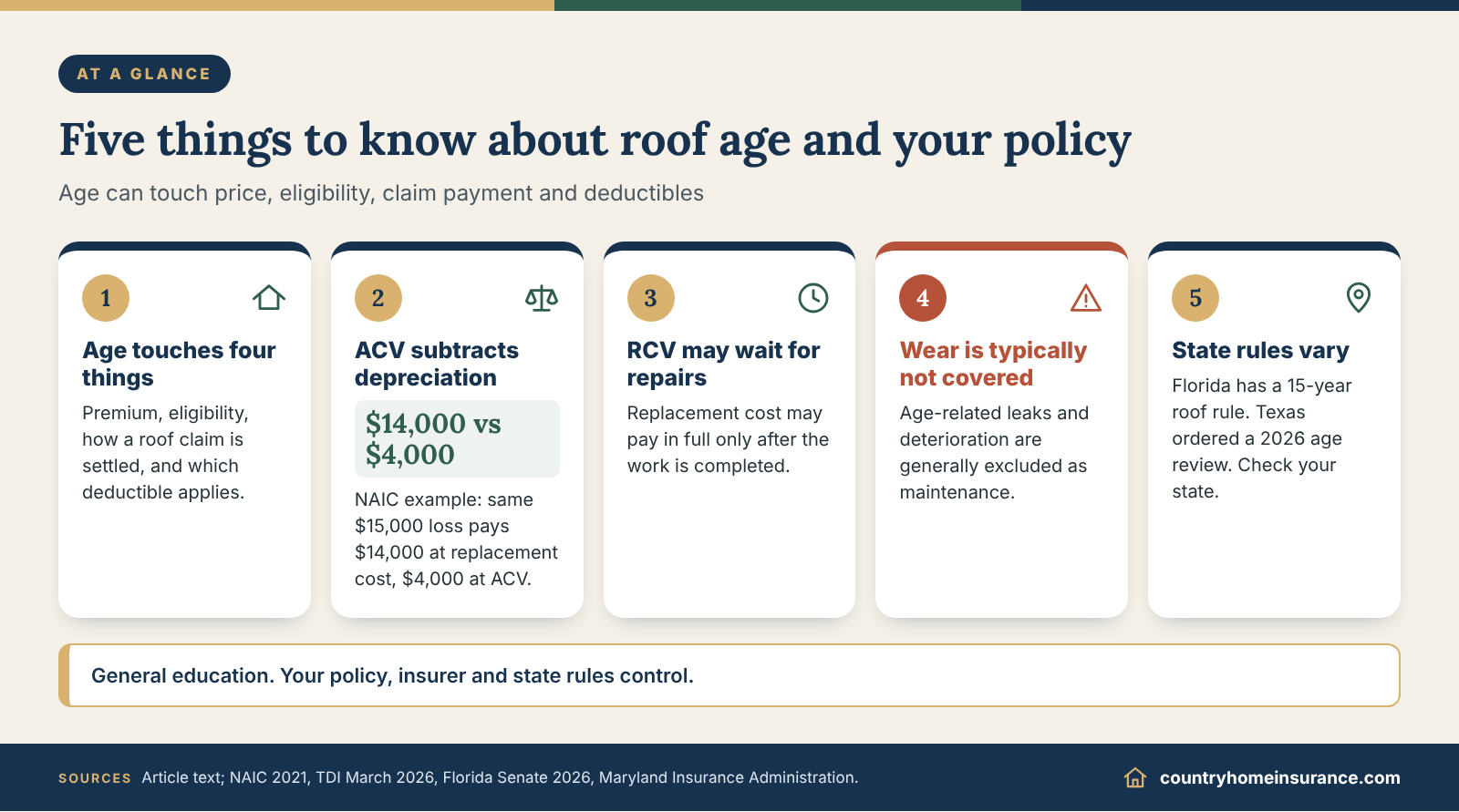
- Roof age can touch four things at once: your premium, whether an insurer will write or renew the policy, how a roof claim is settled, and which deductible applies.
- The biggest dollar effect often shows up at claim time, when an older roof is paid at actual cash value (replacement cost minus depreciation) or under a roof surfacing payment schedule instead of full replacement cost.
- State rules differ. Florida has a statutory rule limiting age-only refusals tied to a 15-year roof age, and in August 2026 the Texas governor directed regulators to bar insurers from refusing coverage based on age alone. Check your own state Department of Insurance site, because where no rule exists, the insurer’s own guidelines control.
- FORTIFIED Roof and similar upgrades may earn credits, but the size of any discount depends on the insurer, state and documentation. This article does not promise a number.
- Correct roof age on your application, keep invoices and permits, and ask in writing how your policy pays for a roof before storm season, not after.
How roof age shapes cost, eligibility and roof claims
Your roof is the part of the house that takes the first hit from hail, wind-driven rain, falling limbs and sun, and insurers know it. That is why roof age homeowners insurance cost questions rarely have a one-line answer. Age is a shortcut insurers use to guess condition and future claims, and the shortcut can touch your price, your eligibility and your payout all at once.
What insurers mean by roof age
How the age is counted
Most applications ask for the year the roof was installed or last fully replaced. Rules differ on what counts. Florida’s statute, for example, measures roof age from the last date that 100 percent of the roof surface was built or replaced under the applicable building code, so a patch or a single repaired slope does not restart the clock, and a series of partial replacements that eventually covers the whole surface is dated from when the first partial work began (Florida Senate, s. 627.7011, 2026 statutes page). Some carrier forms instead subtract the installation year from the policy’s effective year, a method described by the trade publication Rough Notes in January 2026. Ask which method your insurer uses.
Age versus condition
Age and condition are related but not the same. A 12-year-old roof under shade trees in a hail corridor may look worse than a 20-year-old roof in a mild climate. Some officials have started to push insurers toward condition: the Texas Department of Insurance (TDI) advises that if a policy dropped roof coverage because the roof was in poor condition, you can ask whether coverage can be added back after repair or replacement (TDI, March 2026). Expect underwriters to use age as a screen and condition as the tiebreaker.
Four places roof age shows up in your policy
In the premium
New roofs often earn lower rates than older ones, according to TDI’s March 2026 consumer page. How much lower, and whether the effect is a separate line or buried in a bigger rating formula, varies by insurer and filing. Rating plans are filed state by state and combine many inputs, so this guide does not publish a percentage; ask each insurer how roof age enters your quote.
In eligibility and renewal
Some insurers decline or restrict roofs past a certain age, require an inspection, or ask for repairs as a renewal condition. The National Association of Insurance Commissioners (NAIC) notes that insurers may require older homes to have updated roofing (NAIC consumer page, 2026 copyright). We cover the practical steps in the eligibility section below.
In how a roof claim is paid
This is where many owners are surprised. Replacement cost pays to repair or replace without subtracting depreciation, while actual cash value subtracts it. The NAIC’s 2021 consumer example shows the gap plainly: with the same $15,000 roof loss and $1,000 deductible, a replacement-cost policy pays $14,000 and an actual-cash-value policy with $10,000 of depreciation pays $4,000 (NAIC, July 2021).
In the deductible you meet first
TDI notes that a wind and hail deductible is often higher than the deductible for other damage (TDI, March 2026). A percentage deductible combined with an age-reduced payout can leave little or nothing payable. The deductible section below walks through the arithmetic.
What this article does not repeat
Roof material is its own topic
Shingle, metal, tile and slate age and price differently, and insurers treat them differently. We keep that discussion short here and send you to how roof material affects homeowners insurance cost and eligibility.
Coverage logic and claim steps have their own guides
Whether hail, wind or a leak is a covered cause of loss is covered in our hail damage coverage guide, and the step-by-step claim workflow lives in the roof hail damage claim guide. This page stays on what age changes.
| Roof-related topic | How it is typically treated | What to check |
|---|---|---|
| Sudden storm damage to a roof of any age | Typically covered when the cause of loss is a covered peril such as wind or hail, subject to limits, exclusions and the deductible. | Declarations page, named perils, wind/hail deductible |
| Payment amount on an older roof | Depends on whether the roof is settled at replacement cost, actual cash value or a payment schedule. | Loss settlement section and any roof endorsement |
| Wear, tear, deterioration and age-related leaks | Typically not covered. Wear is generally excluded as a maintenance item. | Exclusions for wear, deterioration and neglect |
| Premium effect of roof age | Depends on the insurer, filed rating plan and state. A newer roof often helps, but the amount is not fixed. | Ask what age and condition inputs the quote uses |
| Eligibility or renewal for an older roof | Depends on insurer guidelines and state law. Some states limit denials based on age alone. | State Department of Insurance rules and your renewal notice |
| Cost of replacing a roof you chose to replace | Typically not covered. Voluntary replacement for age is a maintenance cost, not a loss. | Whether any damage actually occurred from a covered event |
| Resistant-roof discounts | Depends on insurer and state. Some insurers offer them, and documentation is usually required. | Evaluator certificate, invoices, insurer discount list |
Roof age and homeowners insurance cost: what moves the premium
Price is the question most readers start with, and it is also the one where honest answers are the least tidy. Premiums come from filed rating plans, and those plans combine many inputs. Roof age is one input, sometimes a large one for wind and hail exposure, but it never stands alone.
How age enters the rating
Age as a proxy for condition
Insurers generally cannot send an inspector to every roof at quote time, so age stands in for the likelihood that shingles are brittle, flashing is tired or sealant has failed. That is why two identical-looking houses can get different quotes when one roof was installed in 2008 and the other in 2022. A roof past its expected service life can be more prone to leaks or lost material in a moderate storm, and a claim on it is more likely to raise questions about wear.
Age interacting with material, location and storm exposure
An age penalty rarely applies evenly. In hail-prone or hurricane-prone counties, the same age may count for more than it does in a quiet region, because the roof is expected to be tested more often. Material changes the picture too, as the roof material guide explains. Location effects are broader than the roof, and the ZIP code guide explains why a neighbor a few miles away can see a very different price.
Why this article gives no age-to-price table
Some websites publish a table showing a percentage increase by roof age. We do not, because published averages come from different datasets, coverage assumptions and geographies, and blending them would mislead. If you see a number, look for the publisher, the year, the methodology and the coverage amount behind it. Without those four items, treat the number as marketing.
Why a new roof does not always lower the bill
A discount is not guaranteed
TDI says new roofs often earn lower rates, and the word “often” matters. Some insurers apply a roof-age credit automatically, some require proof of installation date, and some fold the effect into other factors. Always tell your insurer when you replace the roof. TDI explicitly advises owners to do this so the policy can show the new age (TDI, March 2026).
Other rating factors keep working
A new roof does not cancel the effect of prior claims or other factors. Claims history and, where allowed, credit-based insurance score are separate rating inputs with their own guides. A strong roof helps with the physical risk part of the quote and may not offset a loss-heavy record.
Deductible and coverage choices that offset roof age
Higher deductibles lower premium, with a catch
The NAIC notes that a higher deductible generally lowers the premium. That trade works best when you can afford the deductible out of savings on the day a storm hits. With an older roof, a large percentage wind and hail deductible plus a depreciated payout can stack the out-of-pocket cost, so run the arithmetic before picking the highest option.
Roof replacement cost as an optional coverage
The NAIC describes full roof replacement cost coverage, with no deduction for depreciation, as an important optional coverage to consider. If your insurer will still offer it on your roof, ask for the price difference in writing. If it will not, ask what age or condition change would make it available.
| Factor | How it may affect price or eligibility | Question to ask the insurer |
|---|---|---|
| Installation or replacement year | Depends on rating plan. Often the main age input, sometimes verified by invoice or permit. | What date do you show, and how did you get it? |
| Roof condition at inspection | May override age. Curling, cracking, missing shingles and active leaks can trigger repairs or nonrenewal. | What condition findings would cause a problem? |
| Loss settlement basis for the roof | Depends on form: replacement cost, actual cash value or schedule. Changes payout rather than premium. | How is a roof loss paid at my roof’s age? |
| Wind and hail deductible | Often higher than the all-other-perils deductible and sometimes a percentage of the dwelling limit. | Is my wind/hail deductible flat or a percentage? |
| Roof material | Depends on insurer. Material can change both rate and the schedule that applies. | Does my roof material change how age is treated? |
| Resistant-roof features | Depends on insurer and state. Some offer credits with documentation. | Which designations or certificates earn a credit? |
| State law and filings | Depends on state. Some limit non-renewal based on roof age alone. | Is any state rule limiting age-based decisions here? |
Eligibility: when an older roof becomes an underwriting problem
Eligibility is the point where roof age stops being a price tag and becomes a gate. An insurer may decline to quote, quote with conditions, or renew only after repairs. The details are set by each company’s underwriting guidelines and, in some states, limited by law.
How underwriters screen roofs
Age thresholds are company-specific
There is no national cutoff. The NAIC says only that insurers may require older homes to have updated roofing, along with heating, plumbing and wiring. One company may become cautious at a certain age for asphalt shingles and tolerate far longer for other materials. Because thresholds are internal guidelines rather than public rules, the practical move is to ask directly: at what roof age and condition would you quote, restrict or decline?
Condition findings that trigger action
Condition language is more concrete than age language. The Texas Voluntary Inspection Program, discussed below, lists a roof with curled, cracked or significantly deteriorated coverings, or missing shingles, as failing its roof standard (TDI, voluntary inspection program page). Those same visible signs are the kind of thing an inspector, adjuster or underwriter notices. Fix them before the quote, not after the decline.
What you may be asked to provide
Expect questions about installation year, material, number of layers, and past repairs. Some applications ask for photographs or a contractor statement. A dated invoice, a building permit and photos taken from the ground and from a safe vantage point make your answers easy to accept. Never guess the year; a wrong age can create trouble later, which the misstated-age section addresses.
Options when a roof blocks coverage
Repair, replace, then reapply
If the problem is a localized defect, a licensed roofer’s repair and a written report may be enough. If the roof is near the end of its life, replacement may be the cleaner route. Keep the contract, final invoice, permit and photographs, and send them to your agent. TDI also suggests asking whether the company can restore roof coverage after you repair or replace a roof in poor shape.
Shop beyond your current insurer
Underwriting appetite differs. A roof that one company restricts may be acceptable to another, which is why side-by-side shopping matters. Our guide to comparing home insurance quotes explains how to hold coverage constant so quotes are fair to compare, including how each company treats roof settlement.
Residual and surplus-lines markets
When standard insurers decline, some states offer a residual-market plan, and surplus-lines carriers write some risks that admitted carriers will not. These options can carry different forms, higher prices and fewer consumer protections, so read the roof provisions in particular. Which options exist varies by state, and this article does not assume one is available in yours.
Rural and outbuilding roofs
Barns, sheds and detached garages
On country property the main house is often not the only roof. Detached structures are usually covered under Coverage B, other structures, and an old metal barn roof or a sagging shop roof may be subject to the same wear exclusions and, depending on the form, the same age-based settlement terms. Ask whether outbuildings are paid at replacement cost or actual cash value, because the answer may differ from the house. The broader rural picture is in what standard policies miss on rural homes.
Additions, porches and mixed-age roofs
Farmhouses are often a patchwork: an original section, a 1990s addition and a newer porch. Insurers may ask for the age of the oldest or the largest section, or may ask for each separately. If one section is much newer, document it. Florida’s statutory method, which measures from when the entire roof surface was built or replaced, shows why a partial replacement may not restart the clock in the way owners expect.
ACV versus RCV roof settlement and roof surfacing payment schedules
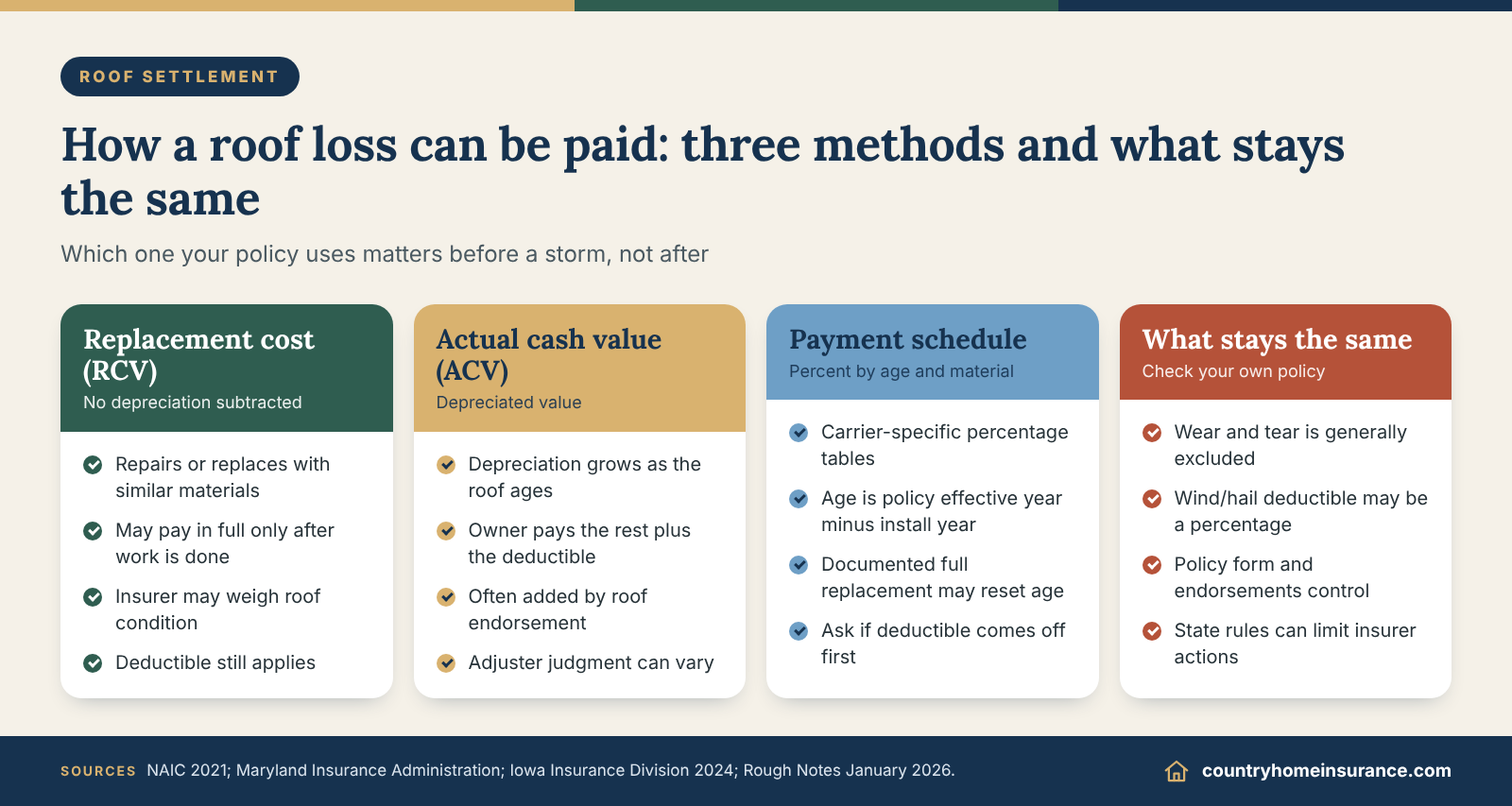
This is the part of roof age homeowners insurance cost that reaches your wallet after a storm. Replacement cost value (RCV) and actual cash value (ACV) are two ways to settle a loss, and a roof surfacing payment schedule is a third. Understanding which one your policy uses matters more than most premium differences.
Two basic settlement methods
Actual cash value
Actual cash value pays the depreciated value of the damage. The NAIC explains that insurers typically set depreciation using the item’s condition when damaged, the cost of a new item and its normal lifespan. The Iowa Insurance Division adds that, under ACV, depreciation grows as the roof ages, so the homeowner pays the remaining cost plus the deductible (Iowa Insurance Division, July 2024). The Tennessee Department of Commerce and Insurance gives a simple version: a $10,000 roof, five years old, at an assumed $500 depreciation per year, would be paid at $7,500 before the deductible (TDCI consumer page, updated March 2026).
Replacement cost value
Replacement cost pays to repair or replace with similar materials without subtracting depreciation. The Maryland Insurance Administration points out that replacement cost coverage usually pays the full amount only after the work is completed; until then you typically receive the amount minus depreciation. Treat the held-back part as money you recover by finishing the repair and sending proof, and ask your insurer for the deadline and documents.
Why age matters in both
Even under replacement cost, an insurer may decide case by case whether property qualifies for full replacement benefits based on condition and underwriting guidelines, as the Tennessee page notes. So a roof in poor shape can lose replacement-cost treatment, not only gain depreciation. The NAIC also points to full roof replacement cost as an optional coverage worth asking about.
Age-based roof endorsements
ACV roof endorsements
The Iowa Insurance Division notes that many policies include an endorsement, a policy amendment, that replaces replacement cost with actual cash value for the roof or applies a set depreciation based on age and material. In trade coverage of the ISO standard form, Rough Notes (January 2026) identifies the Insurance Services Office endorsement HO 04 93, an actual cash value loss settlement for windstorm or hail losses to roof surfacing, and says it pays on an ACV basis without an age schedule. The edition and wording your insurer uses may differ, so read the form attached to your policy.
Roof surfacing payment schedules
A payment schedule works differently. Instead of calculating depreciation claim by claim, it applies a percentage by roof age and material to the covered cost. Rough Notes describes carrier forms in which roof age is the effective year minus the installation year, the insurer finds the row for age and the column for material, and the percentage applies to the repair or replacement cost. It also notes the percentage tables are carrier-proprietary rather than ISO tables, and that a documented full replacement by a licensed contractor can reset the age in at least one carrier’s form.
One insurer’s published example
As an illustration of the idea, Kin Insurance’s public FAQ (modified July 2026) says that its schedule reduces wind and hail payouts on roof surfaces by a set percentage per year, with different rates and caps for shingle, tile and metal, and that other causes such as fire are not subject to it. It is one company’s product in the states where it applies, not a standard, so use it only to understand the mechanics and never to predict your own policy.
Worked examples
ACV claim on an aging roof
Hypothetical example: A roof would cost $18,000 to replace. The insurer’s depreciation method treats a 14-year-old roof as 56 percent depreciated, which is $10,080. The deductible is $2,000. Under ACV the payment is $18,000 minus $10,080 minus $2,000, or $5,920, leaving the owner to cover the rest. Under replacement cost the payment, after work is completed, would be $16,000. These numbers are invented to show the mechanics; actual depreciation methods vary by insurer and state.
Payment schedule claim
Hypothetical example: A schedule pays 60 percent of a $15,000 covered roof cost for a roof of a certain age and material. The covered amount is $9,000 before the deductible. The owner covers the remaining $6,000 plus whatever deductible applies. Forms differ on whether the deductible comes off before or after the percentage, so ask which order your form uses. The 60 percent figure is illustrative and not a market rate.
Why a schedule can differ from ACV
A schedule is predictable: you can calculate the percentage before a storm. ACV is claim-specific and can vary with adjuster judgment about depreciation. Neither is automatically better for you. The better question is which one produces a payout you can live with, given your savings and your roof’s real expected life.
Wind and hail deductibles when your roof is older
Settlement method and deductible interact. A separate wind and hail deductible, a depreciated payout and a modest roof loss can combine so that a covered claim pays little. That does not mean the claim was wrongly handled. It means the policy was built that way, and you can find out before a storm.
Percentage versus flat deductibles
How a percentage deductible works
Some policies set a wind, hail or storm deductible as a percentage of the dwelling limit (Coverage A, the amount insured on the house itself). The Maryland Insurance Administration’s illustration shows a 2 percent hurricane deductible on a $100,000 dwelling reducing a $3,000 loss payment to $1,000, and a 5 percent deductible leaving nothing payable. Your declarations page shows whether yours is flat or a percentage.
Where to find it
Look at the declarations page and any wind or hail endorsement, not only the summary on your insurer’s website. TDI also warns that the wind and hail deductible is often higher than the deductible for other damage. If you are comparing quotes, a lower premium with a 5 percent deductible is not the same product as a slightly higher premium with a flat $2,500 deductible.
Combined effect with an older roof
Stacking the two reductions
Hypothetical example: A home insured for $300,000 has a 2 percent wind and hail deductible, which is $6,000. A hailstorm causes $9,000 of covered roof damage. With replacement cost, the payment is $3,000. If the roof is paid at actual cash value and the depreciation brings the payable amount to $4,500 before the deductible, the deductible exceeds the payable amount and nothing is paid on the roof. This is an illustration, not a prediction. Real forms vary in how they apply deductibles.
When a small claim is not worth filing
With a high deductible and ACV settlement, minor roof damage may fall below the threshold. Weigh that against the claim-record effect described in the claims history guide, and talk to your agent before filing something that may not pay. If damage is serious, file anyway; the claim steps and documentation are in the wind-damaged roof claim guide.
Florida’s roof deductible approach
What the statute says about roof payment
Florida’s s. 627.7011 lets an insurer that applies a separate roof deductible limit its payment for the roof to actual cash value until it receives reasonable proof that the policyholder paid that deductible. Acceptable proof includes a canceled check, a receipt, a credit card statement or an executed financing agreement (Florida Senate, 2026 statutes page). The same section requires replacement cost for a total loss of a dwelling without holdback of depreciation. It is a good example of how a state can set rules at the margins of roof settlement.
The separate roof deductible
Florida s. 627.701(10) allows insurers to use a separate roof deductible that may not exceed the lesser of 2 percent of the Coverage A limit or 50 percent of the cost to replace the roof, and the premium must include an actuarially sound credit for it. It applies only to claims adjusted on a replacement cost basis, and the statute carves out total losses, hurricane roof losses, tree falls that puncture the roof deck and roof losses needing repair of less than 50 percent of the roof. Insurers must offer an opt-out by signed form (Florida Senate, s. 627.701, 2026 statutes page). Confirm how your own policy applies it.
State rules on roof age, inspections and age-based denials
State insurance law decides how far an insurer can go in using roof age. Rules change, regulators issue clarifications, and consumer pages describe practice rather than law. Treat every state statement below as a starting point to check against your Department of Insurance.
Texas
The 2026 age-based underwriting directive
On August 24, 2026, Governor Greg Abbott directed the Texas Department of Insurance to prohibit insurers from refusing to write or renew residential property policies based on a home’s age, including the age of specific components such as the roof. The same directive told TDI to require insurers to factor a home’s FORTIFIED roof status into their rate-setting (Office of the Texas Governor, August 24, 2026). Trade coverage dated September 30, 2026 reported that TDI followed with a clarification that insurers may not deny or nonrenew a homeowners policy solely because of the age of the house, roof or another component, while remaining free to consider the property’s actual physical condition (Beinsure, September 30, 2026).
The practical meaning for a Texas homeowner is that condition evidence, not age alone, is what an insurer should be able to point to. The directive and the clarification are recent, so check TDI’s newsroom and consumer pages for the current wording, and if you receive a nonrenewal or denial that cites only age, ask the insurer for the stated reason in writing and consider contacting TDI.
The Voluntary Inspection Program
TDI runs a Voluntary Inspection Program for homeowners who have trouble getting coverage, often because of a home’s age or location, if the home is in good condition. According to TDI’s page, the inspection fee was capped at $150.87 in 2024, with a $75.42 follow-up inspection to verify corrections. A resulting certificate of insurability lasts three years if there are not many changes to the property, and an insurer cannot refuse to sell or renew because of the home’s condition unless it re-inspects and describes the problems in writing. The roof must not show curled, cracked or significantly deteriorated coverings or missing shingles. TDI’s page lists 2024 fee limits, so check the page for the current amounts before you apply.
Everyday roof guidance from TDI
TDI’s March 2026 consumer page adds practical guidance: confirm the policy lists the correct roof age and material, notify the insurer when you replace the roof, expect that many policies reduce coverage by roof age and materials, and know that partial damage may not lead to replacing the whole roof even when new shingles do not match old ones.
Florida
The 15-year rule
Florida Statutes s. 627.7011(5), as shown on the Florida Senate’s 2026 statutes page, says an insurer may not refuse to issue or renew a homeowner’s policy solely because of the age of the roof when the roof is under 15 years old. The rule is stated for policies issued or renewed on or after July 1, 2022. Insurance Journal reported in January 2025 that before the law took effect, several Florida insurers had stopped covering some homes with shingle roofs more than 10 years old.
Inspection for roofs 15 years and older
For a roof at least 15 years old, the statute lets the homeowner have the roof inspected, at the homeowner’s expense, by an authorized inspector before the insurer can require replacement as a condition of issuing or renewing. Authorized inspectors include licensed home inspectors, certified building code inspectors, licensed roofing or general contractors, and engineers or architects. If the inspection shows at least five years of useful life remaining, the insurer may not refuse coverage solely because of roof age. This works as a pathway rather than a guarantee, since insurers can still look at other underwriting factors.
What Florida shows other states
Florida’s approach is a statutory age line plus an inspection safety valve. Texas, by contrast, is moving toward a condition-over-age principle through regulatory action. In a state with neither kind of rule, the insurer’s own underwriting guidelines control.
Other states and how to check yours
What consumer regulators say
Iowa, Maryland and Tennessee regulators publish consumer guidance that explains ACV and replacement cost for roofs, but those pages describe options and examples and do not impose roof-age underwriting limits. The Maryland Insurance Administration also warns about unsolicited “free roof” inspection offers, which can be used to fabricate storm damage claims.
A short checklist for your own state
Search your Department of Insurance site for roof age, nonrenewal notice and wind/hail deductible rules. Read your policy’s nonrenewal conditions. Ask your agent whether any state law limits age-based denials. If the answers are unclear, call the department’s consumer line. Most can tell you whether a rule exists even if they cannot interpret your specific policy.
Discounts: new roofs, FORTIFIED Roof and impact-resistant features
Discounts are where marketing runs far ahead of evidence, so we separate what is documented from what is not. The strongest documentation we found concerns IBHS FORTIFIED programs and state incentives. Discounts for other roof features vary widely and are mostly set insurer by insurer.
New-roof credits
What regulators say
TDI says new roofs often earn lower rates than older ones, and that some insurers offer discounts when you choose roofing materials that resist wind, hail or fire. It does not give amounts, and we do not either.
How to claim one
Report the replacement date and material, send the final invoice and any permit, and ask in writing what the new roof changes: premium, loss settlement basis, or both. Ask whether a better settlement basis, such as replacement cost, is now available on the roof. A new roof can change the claim terms even when the premium barely moves.
FORTIFIED Roof
What the designation is
IBHS, the Insurance Institute for Business & Home Safety, describes FORTIFIED Roof, formerly called FORTIFIED Bronze, as a program that strengthens the roof, which it calls the home’s first line of defense against severe weather. Stateline’s 2024 reporting describes a FORTIFIED roof as using specialized fasteners, tougher shingles, reinforced edges and a waterproofed roof deck. IBHS maintains a network of trained evaluators, and state programs tie benefits to a designation: Kentucky’s 2024 law, for example, ties insurer discounts to a certificate of compliance with the standard.
Where discounts are documented
The FORTIFIED program’s incentives page (last modified July 2024) reports that Oklahoma insurers offer discounts of up to 42 percent on the wind and hail portion of premiums, Mississippi insurers offer discounts on the wind portion, some as high as 55 percent, and that a 2016 South Carolina survey found insurers offering discounts above 50 percent on the wind portion. These are program-reported figures about a portion of the premium, not total premium, and they may not apply to your insurer. Alabama is the clearest example of a mandate: under Act 2015-313, the Alabama Department of Insurance said in 2016, insurers must give discounts once a structure is built or retrofitted to the FORTIFIED standard, and its bulletin set county benchmarks of 35 to 60 percent on the hurricane portion of the premium and 20 to 35 percent on the other wind portion (Alabama Department of Insurance, December 2016). Kentucky’s Strengthen Kentucky Homes Act (2024 Acts ch. 102, HB 256) requires insurers that write wind or hail coverage to provide a premium discount or rate reduction for certified properties when it is actuarially justified, and it requires insurers to offer an optional rider that pays for FORTIFIED upgrades when a covered claim requires a roof replacement. Those sections apply to policies issued or renewed on or after March 1, 2026 (Kentucky General Assembly, 2024). Percentages and eligibility are filed insurer by insurer, so confirm what applies in your state.
Grants and evidence of effectiveness
Brookings (March 2026) describes state grant programs for roof upgrades, including Strengthen Alabama Homes, Louisiana’s Fortify Homes Program and Kentucky’s new program, with grants of up to $10,000 in each. Two studies point to the same direction on effectiveness. A May 2025 study led by the University of Alabama’s Center for Risk and Insurance Research with the Alabama Department of Insurance, covering Hurricane Sally claims in Mobile and Baldwin counties, estimated that insurer payouts could have been about 75 percent lower if all affected homes had met the FORTIFIED standard, and it noted that nearly half the claims involved fallen trees, which the standard does not address (Insurance Journal, May 28, 2025). North Carolina’s insurance commissioner cited North Carolina State University research finding about 35 percent fewer claims on homes with a FORTIFIED roof after four named hurricanes, with damage about 23 percent less severe when claims were filed (North Carolina Department of Insurance, July 17, 2025). Those findings are about specific storms in specific states, not guarantees for your roof.
Features with thinner documentation
Impact-resistant shingles
Credits for impact-resistant shingles are set insurer by insurer and, in some states, by rule, so this guide does not state a standard percentage. The material question is covered in the roof material guide. Ask your insurer for its written credit list and the certification it requires.
Upgrades that do not help the premium
Some upgrades improve resilience but earn no discount from your company. That is not a reason to skip them. Separate the question of lowering risk from the question of lowering premium, and judge each on its own terms.
Inspections, nonrenewal notices and fixing a wrong roof age
Even with a good application, a roof can come up again at renewal. Knowing how inspections and notices work lets you respond calmly instead of scrambling for a replacement policy.
Insurer inspections and what they look for
What an inspector or underwriter may check
Reviews can include a drive-by or in-person inspection, photographs, or a request for your contractor’s documentation. Findings that can matter include missing or curling shingles, exposed nails, damaged flashing, moss or debris buildup, sagging, and signs of past leaks. Ask your insurer in writing what it reviewed and how it reached its conclusion about your roof.
Keeping your roof inspection-ready
A seasonal check lowers the odds of an unwelcome surprise. Our fall roof and gutter inspection guide gives a maintenance routine, and the roof leak coverage guide explains why a slow leak from neglect is treated differently from storm damage.
Nonrenewal and cancellation notices
Notice periods vary
Notice periods and permitted reasons for nonrenewal are set by state law and by the policy, and they differ from state to state. Look up the rule on your Department of Insurance site, and read the notice itself for the stated reason and any deadline for correcting a condition.
Responding to a roof-related notice
If the reason is condition, ask what must be fixed, by when, and who will verify it. Get a licensed roofer’s written assessment, complete repairs, and send proof. If the reason is age alone, ask whether your state limits that, and consider a complaint to the Department of Insurance. For wildfire-exposed homes, nonrenewal reasons may involve more than the roof, as covered in the wildfire nonrenewal guide.
When the roof age on file is wrong
Why accuracy matters
TDI advises asking your agent to confirm the policy lists the correct roof age and material. A policy built on a wrong age may produce the wrong price, the wrong settlement terms, or a dispute after a claim. Whether a misstatement affects coverage depends on state law and the facts, so correct it promptly and in writing rather than hoping it never comes up.
Documents that establish the date
Useful records include the roofer’s invoice, a permit or final inspection record, manufacturer warranty registration, closing-file inspection reports, and dated photos. If you bought the house and do not know the roof’s age, ask the seller or a roofer for a written estimate of age, and tell your agent that it is an estimate. Homes with older roofs are often older homes too, which has its own rating effects in the home age guide.
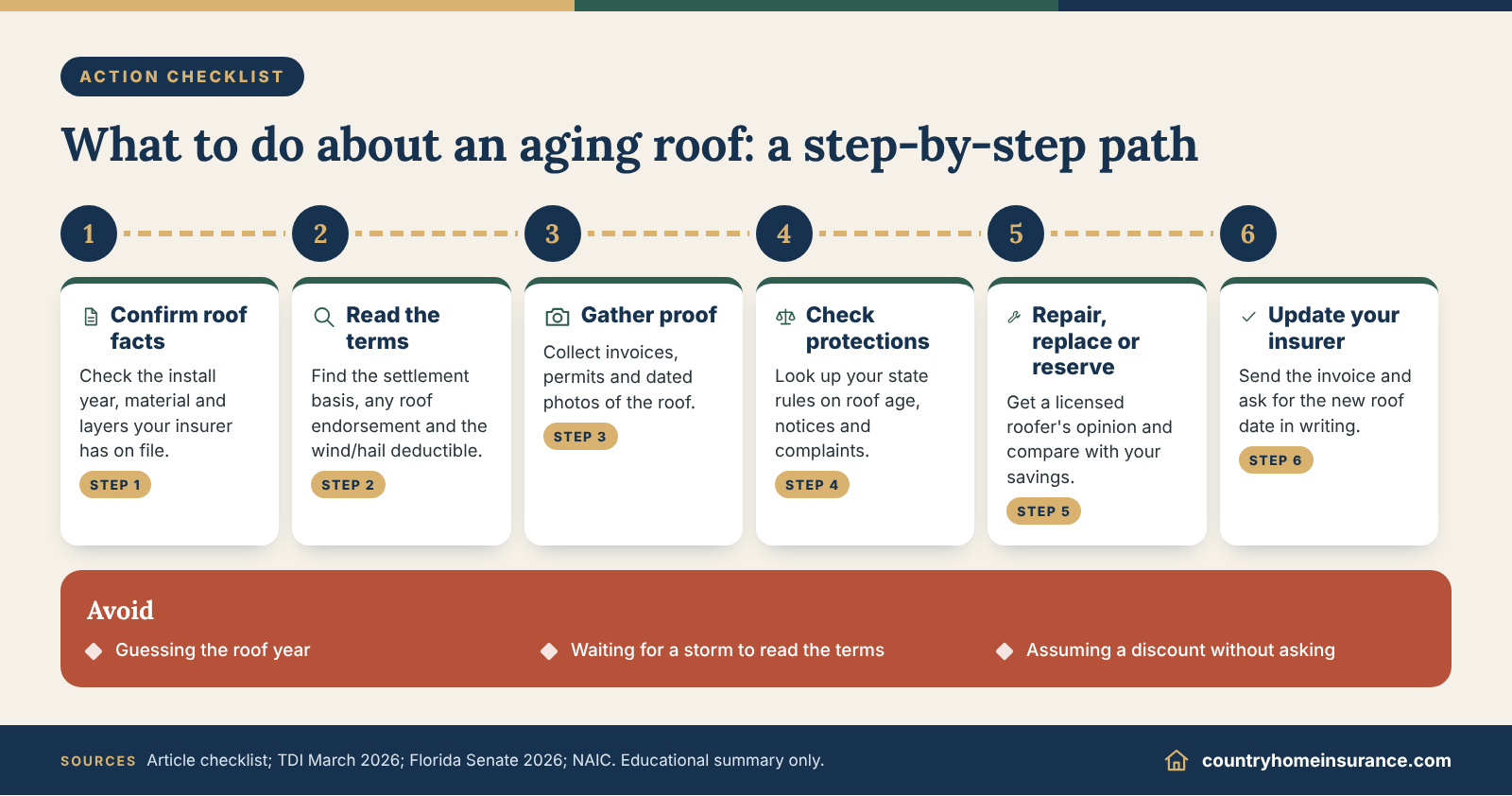
| Step | What to verify or document | What to ask the insurer or agent |
|---|---|---|
| 1. Confirm the roof facts on file | Installation or replacement year, material, number of layers, dates of any partial repairs. | What roof age and material do you show, and where did you get them? |
| 2. Read the roof settlement terms | Loss settlement section, roof endorsements, payment schedule or ACV wording. | How would a hail claim on my roof be paid today? |
| 3. Read the deductible | Flat or percentage wind/hail deductible, and whether it differs by peril or region. | What would I pay out of pocket on a $10,000 roof loss? |
| 4. Gather proof of work | Invoices, permits, photographs before and after, licensed contractor details, any evaluator certificate. | What documents earn a lower age or a discount? |
| 5. Check eligibility triggers | Visible condition issues, leak history, tarp or temporary repairs. | What would cause restriction, repair demands or nonrenewal? |
| 6. Check state protections | Department of Insurance pages on roof age, notices and complaints. | Does state law limit age-based decisions or require notice? |
| 7. After any roof work | Final invoice, new material and date. | Please confirm in writing the new roof date and any change in terms. |
Repair, replace or ride it out: a decision framework
Knowing the rules is half the work. The other half is deciding what to do with your particular roof, savings and insurer. No single answer fits every home, so use the scenarios below to structure the conversation with your roofer and agent.
Scenarios by age and condition
Younger roof in good condition
Priorities are keeping records and making sure the policy shows the right age. Check that the roof is paid at replacement cost if that is what you expected, and confirm the wind/hail deductible you can afford. There is usually little to gain from replacing early for insurance reasons.
Middle-aged roof with minor wear
This is the stage where settlement terms start to matter. Ask when your insurer’s treatment of the roof changes, and whether a payment schedule or ACV endorsement applies at a given age. Plan a reserve fund, because depreciation can make a mid-life claim pay much less than a new roof costs.
Older roof near end of service life
Consider an independent roofer’s opinion on remaining life. If the policy would pay at ACV or on a steep schedule, replacement on your timeline may protect you better than waiting for a storm to decide. If your state is Florida, the statutory inspection pathway for roofs 15 years and older is worth using before a renewal dispute begins.
Timing and paperwork
Order of operations
Before hiring, get two or three written quotes, confirm the contractor is licensed and insured where your state requires it, and ask your agent how the policy will treat the new roof. Tell the insurer after completion with the invoice. If you are mid-claim, do not start replacement before the adjuster has inspected unless emergency repairs are needed to prevent further damage, and keep receipts.
Mortgage lenders, closing and rural logistics
Mortgage documents generally require you to keep homeowners coverage in force, so check your loan terms about what happens if a policy is nonrenewed. If you are buying, ask for the roof age and condition before closing and get quotes early, since an older roof can delay a binder. On acreage, remember outbuildings: schedule inspections across every structure so no roof is a surprise.
Budgeting for the gap
The roof reserve
Hypothetical example: A homeowner expects a roof to need replacement in about eight years and estimates $20,000 in current dollars. Setting aside a fixed amount monthly gives a target to compare with the premium savings from a higher deductible. The point is the comparison between reserve, deductible and likely payout, not the specific numbers, which are invented for illustration.
When insurance is not the right tool
Insurance is meant for sudden, accidental loss, not routine replacement. Wear, tear and deterioration are generally excluded, as the Maryland Insurance Administration explains. If a roof is simply old, plan to pay for replacement yourself and treat insurance as protection for the storm that happens before then.
Frequently asked questions
Cost and discounts
Does a new roof always lower my homeowners insurance?
No. TDI says new roofs often earn lower rates, but the effect depends on the insurer, its filings and your other rating factors. Report the replacement and ask in writing what changed.
How much more does an older roof cost to insure?
There is no single figure, because rating plans differ by insurer and state, so this guide does not give one. Get quotes with identical coverage and ask each insurer how roof age enters the price.
Can FORTIFIED Roof lower my premium?
It may, where an insurer or state program offers a credit and the designation is documented. Program-reported discounts apply to the wind portion of premium in several states, not the whole policy. Confirm with your company.
Eligibility and nonrenewal
Can my insurer drop me because of my roof’s age?
It depends on the state and the insurer’s guidelines. Florida limits refusals based solely on roof age for roofs under 15 years, and in August 2026 the Texas governor directed regulators to bar refusals based on age alone. Condition-based action may still be allowed. Check your state’s rules.
What if my roof is 20 years old?
Age alone is not the end of the story. Ask what condition evidence the insurer needs, consider a licensed roofer’s inspection, and in Florida use the statutory inspection pathway for roofs 15 years and older.
Should I tell my insurer when I replace my roof?
Yes. TDI advises telling your insurer so the policy can show the correct age, which can affect both price and how a roof loss is settled.
Claims and payments
What is the difference between ACV and RCV for a roof?
ACV pays replacement cost minus depreciation. RCV pays without subtracting depreciation, though payment may be held back until the work is complete. Your policy and endorsements decide which applies.
What is a roof surfacing payment schedule?
It is an endorsement that pays a percentage of the roof loss based on roof age and material, instead of full replacement cost. The percentages are insurer-specific, so read your form.
Will insurance pay to replace an old roof that is simply worn out?
Typically not. Wear, tear and deterioration are generally excluded. Coverage generally responds to sudden, accidental damage from a covered cause, subject to your terms.
Sources
- Texas Department of Insurance — What to know about insurance and your roof (March 2026; accessed 2026-10-16)
- Office of the Texas Governor — Governor Abbott directs TDI to take action to make property insurance more affordable (August 24, 2026; accessed 2026-10-16)
- Beinsure — Texas bars insurers from denying home coverage based only on roof age (September 30, 2026; trade coverage; accessed 2026-10-16)
- Texas Department of Insurance — Voluntary Inspection Program (page shows 2024 fee limits; accessed 2026-10-16)
- Florida Senate — Florida Statutes s. 627.7011 (2026 statutes page; accessed 2026-10-16)
- Florida Senate — Florida Statutes s. 627.701 (2026 statutes page; accessed 2026-10-16)
- Insurance Journal — Does Florida’s 15-year roof age rule discourage more wind-resistant products? (January 23, 2025; accessed 2026-10-16)
- NAIC — Know the difference between replacement cost and actual cash value (July 22, 2021; accessed 2026-10-16)
- NAIC — Consumer homeowners insurance (page shows 2026 copyright; accessed 2026-10-16)
- Iowa Insurance Division — Consumer Connection: Roof coverage options (July 8, 2024; accessed 2026-10-16)
- Maryland Insurance Administration — Consumer advisory: Roof replacement (undated page; accessed 2026-10-16)
- Tennessee Department of Commerce and Insurance — Actual cash value versus replacement cost (updated March 30, 2026; accessed 2026-10-16)
- Rough Notes — Homeowners roof surfacing coverage considerations (January 30, 2026; accessed 2026-10-16)
- Kin Insurance — Roof surface payment schedule FAQ (published October 2024, modified July 2026; one insurer’s example; accessed 2026-10-16)
- IBHS — FORTIFIED Roof (page dated 2019; accessed 2026-10-16)
- FORTIFIED Home — Financial incentives (last modified July 1, 2024; accessed 2026-10-16)
- Alabama Department of Insurance — New mitigation discounts for IBHS FORTIFIED structures (December 2016; accessed 2026-10-16)
- Kentucky General Assembly — 2024 Acts ch. 102 (HB 256), Strengthen Kentucky Homes Act (signed April 5, 2024; accessed 2026-10-16)
- Insurance Journal — Alabama study on FORTIFIED homes and Hurricane Sally (May 28, 2025; accessed 2026-10-16)
- North Carolina Department of Insurance — $20 million grant program to strengthen coastal roofs (July 17, 2025; accessed 2026-10-16)
- Stateline — A red state pioneers paying for roof upgrades as storms boost insurance costs (June 25, 2024; accessed 2026-10-16)
- Brookings Institution — What incentives are states offering to make houses less vulnerable to extreme weather damage? (March 3, 2026; accessed 2026-10-16)
Important coverage note
Coverage depends on the actual policy, endorsements, exclusions, limits, deductible and cause of loss. Roof settlement terms, payment schedules, discounts and underwriting rules differ by insurer and state, and regulatory guidance changes. Verify case-specific questions with your insurer or agent and your state Department of Insurance. This article is educational, not legal advice, and none of its hypothetical examples predicts what any policy will pay.
About the editorial team
This guide was prepared by the countryhomeinsurance.com editorial team as general, educational information for homeowners. We research and summarize publicly available material, including state insurance departments, the NAIC, federal agencies, regulators’ consumer guides and published insurer and industry resources. We draw only on the sources that were available to us when we wrote this guide, and we list them in the Sources section with dates where we could find them.
Insurance rules, rates, products and program terms change, differ by state and by insurer, and can apply differently to your situation. We cannot guarantee that this content is complete, current or free of errors. It is not legal, financial, tax or insurance advice, it is not an offer to sell insurance or a recommendation of any insurer, agent or product, and reading it does not create a professional relationship of any kind.
To the fullest extent permitted by law, countryhomeinsurance.com and its editorial team, authors and contributors exclude all liability for any loss, damage or decision arising from the use of, or reliance on, this content. For questions about your own policy or claim, contact your insurer, a licensed agent or broker, your state Department of Insurance or another qualified professional.
Content created: October 16, 2026