Country estate insurance is not a single, standardized product. It is a label some carriers use for rural homeowners programs that combine a residence, acreage, outbuildings and sometimes small-scale farm property. What a policy actually covers depends on its form, endorsements, limits and exclusions. On a large rural property, the key checks are replacement cost, other-structures limits, scheduled valuables, liability, fire protection and farm-use rules.
Key takeaways
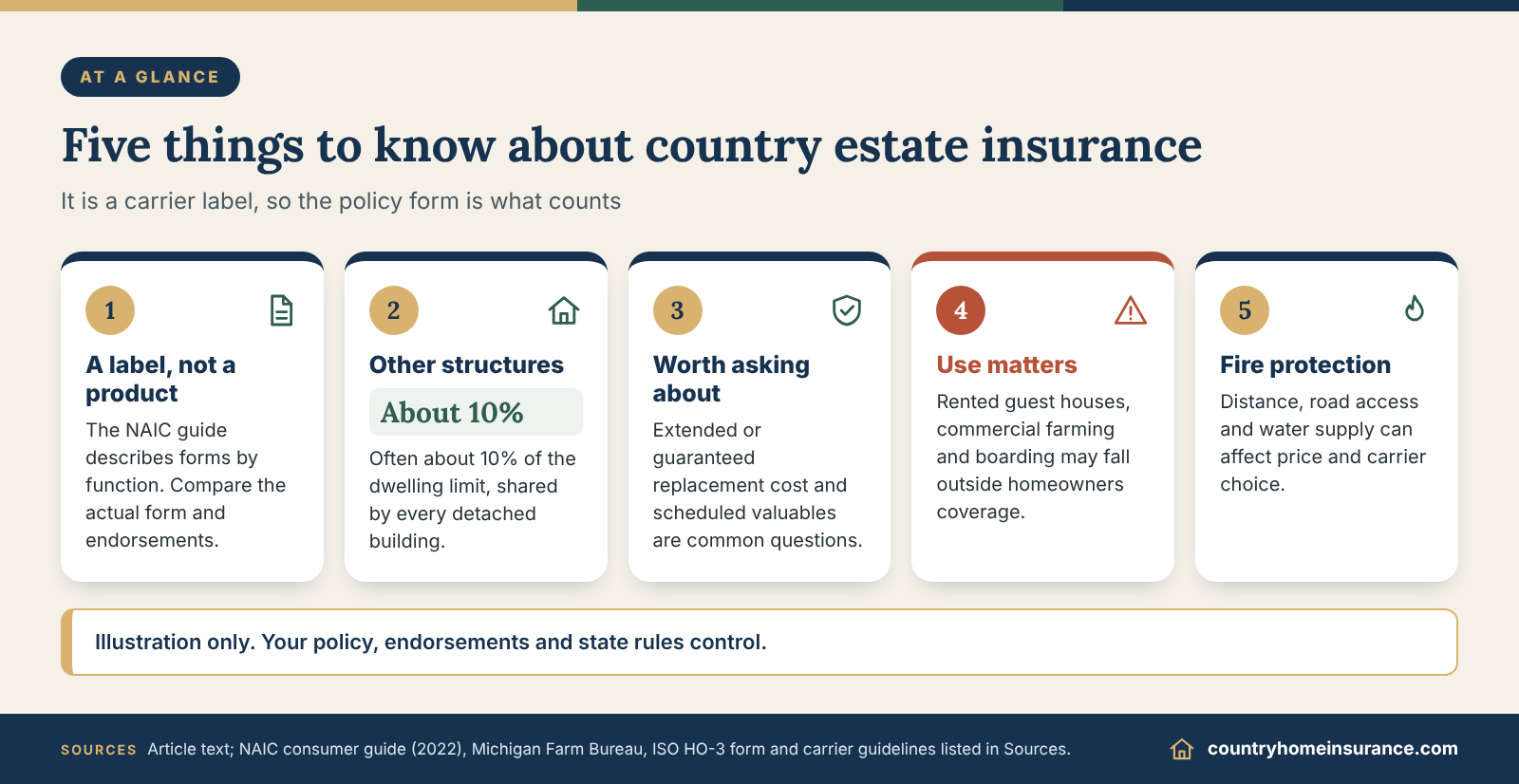
- “Country estate” is a carrier marketing and underwriting label, not a regulator-defined policy type. The NAIC consumer guide describes homeowners forms by function, so read the actual form rather than the name.
- A standard homeowners policy usually sets other-structures coverage at about 10% of the dwelling limit, which can fall short for a barn, guest house or workshop with real replacement cost.
- Extended or guaranteed replacement cost, scheduled valuables and an umbrella policy are three upgrades worth asking about on an estate-scale property.
- Insurers decide eligibility partly on use: rented guest houses, commercial farming and horse boarding can push a property outside a personal-lines policy.
- Replacement cost for a custom or older estate should come from a detailed estimate or appraisal, not from purchase price or tax value.
- Fire protection class, road access and water supply can change both price and whether a carrier will write the home at all.
What country estate insurance actually means
Search for country estate insurance and you will find a mix of carrier product pages, agency blog posts and high-value-home guides. They do not all describe the same thing. Before comparing anything, it helps to know what the phrase can and cannot tell you about a policy.
Is “country estate” a standardized insurance product?
The NAIC guide describes forms by function
The National Association of Insurance Commissioners (NAIC) consumer guide to home insurance describes the common forms by function: a special form that covers the dwelling and belongings against all perils except those excluded, plus coverage for other structures, personal property, loss of use and liability. Its categories are built around what a policy covers, not around a property type such as “country estate.” Treat the phrase as a marketing and underwriting label rather than a legal category, and look at the declarations page, form number and endorsements to see what you would actually own.
Why the label still shows up
Some carriers do use it. Michigan Farm Bureau, for example, markets a “Country Estate” home policy for people who live in rural areas, own acreage and may make part of their living from the land, with dwelling coverage, outbuilding coverage, farm personal property such as tractors and implements, and personal liability. Its page lists related Homeowners, Lake Estate, Farmowners and Umbrella policies as separate products. The takeaway is that the same words can describe a different mix of features from one insurer to the next.
How insurers and regulators describe related programs
High-value home programs
Many large estates are written through a carrier’s high-value or private-client program. Each carrier sets its own cut-off for what counts as high value, so there is no universal threshold. One mainstream carrier’s filed Maine guideline, for example, adds requirements when the dwelling or contents amount exceeds $4,000,000: a central station fire and burglar alarm, a deadbolt lock and a fire extinguisher (State Farm, Maine underwriting guidelines, effective 2023). Ask any carrier you are considering how it defines a high-value home, whether it measures that by rebuild cost or by market value, and what extra requirements apply.
Rural, acreage and limited-farming programs
A second family of products targets rural homeowners rather than expensive ones. Michigan Farm Bureau’s Country Estate page, for instance, describes a program for people who live in rural areas and own acreage, with farm personal property such as tractors and implements, and it lists Farmowners separately among its other products. The NAIC guide recommends a farmowners policy when the home is on land used for farming or raising livestock. A country estate may sit in either family, or in both, depending on the carrier.
Why the form matters more than the name
Two policies that both say “estate” can differ on whether they cover the dwelling for named perils or for all perils except exclusions, whether replacement cost is built in or optional, and how farm property is treated. The contract is the declarations page, the policy form and the endorsements. The marketing name is just a starting point for questions. We cover the broader rural picture in our guide to rural home insurance; this article stays focused on the estate-scale features.
Who this kind of coverage is for
Properties that outgrow a basic policy
A house on a few acres with a detached garage may fit a standard homeowners policy comfortably. The picture changes when the property adds a guest house, a large barn or riding arena, a workshop, valuable collections, household staff and long private roads. At that point the standard 10% other-structures limit, the standard sublimits on valuables and a modest liability limit are all likely to be tested at once.
Owners who sit between homeowners and farm coverage
Many estate owners are not farmers, but they keep horses, hay fields, a pond or a small orchard. The NAIC guide notes that a home on land used for farming or raising livestock may need a separate farmowners policy. If that sounds like your situation, our guides to small farm insurance versus homeowners coverage and hobby farm insurance cover the farm side in more depth.
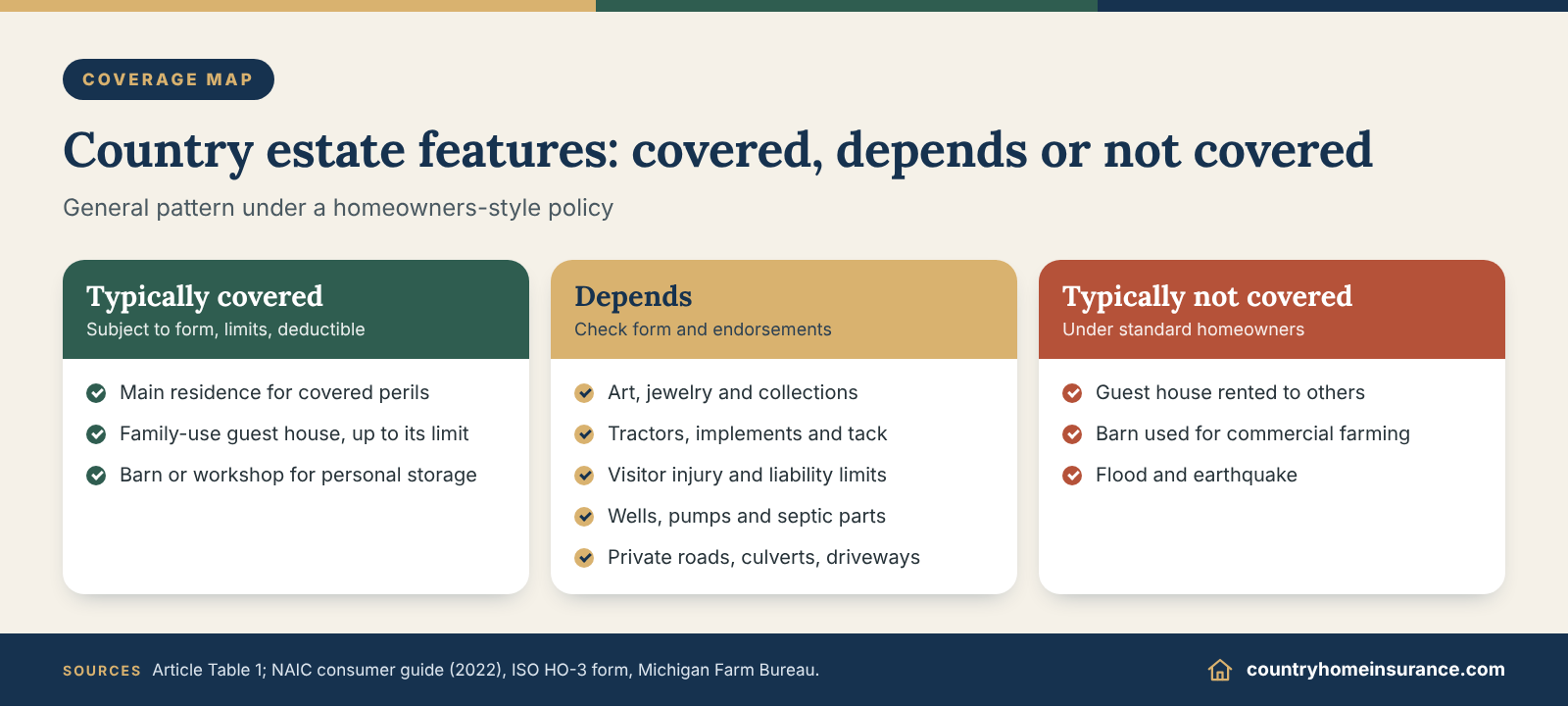
| Estate feature or loss | How it is usually treated | What decides it |
|---|---|---|
| Main residence, fire and wind damage | Typically covered, subject to the form, limits and deductible | Dwelling limit versus true rebuild cost; named-perils or all-perils form |
| Detached guest house used by family | Typically covered as an other structure, up to that coverage limit | The other-structures limit, often 10% of the dwelling limit |
| Guest house rented to others | Typically not covered under a homeowners policy | Rental or business-use exclusions; landlord or short-term-rental coverage may be needed |
| Barn or workshop used for personal storage | Typically covered as an other structure, subject to perils and limit | Condition, use, contents and value of the building |
| Barn used for commercial farming or boarding | Typically not covered under a homeowners policy | Farm or ranch policy, or a farm endorsement if the carrier offers one |
| Art, jewelry, collections | Depends on sublimits; scheduling raises the amount insured | Appraisal, scheduled personal property endorsement |
| Tractors, implements and tack | Depends on whether the policy includes farm personal property | The carrier’s program and any scheduling; some estate programs list tractors and implements as farm personal property, so ask whether yours does |
| Flood and earthquake | Typically not covered under a homeowners policy | Separate flood or earthquake coverage |
| Private roads, culverts and driveways | Depends on how the form defines covered property; land itself is excluded from other-structures coverage in the ISO HO-3 form | Policy wording; ask whether drives, culverts, bridges and fences count as covered property |
| Injury to a visitor on the property | Depends on liability limit, exclusions and the activity involved | Personal liability limit; umbrella coverage; business or farm activity |
How country estate coverage differs from an HO-3 and a farm policy
The HO-3 (the “special form” in the NAIC guide) is the most common homeowners form. A farm policy is built for a working agricultural operation. A country estate program, where a carrier offers one, usually tries to sit between the two. Knowing the edges of each helps you see what an estate program is supposed to fix.
Where a standard homeowners policy runs out on a large rural property
The 10% other-structures limit
Coverage B, other structures, usually protects detached buildings such as fences, sheds, freestanding garages and guest cottages. The NAIC guide gives a typical limit of 10% of the dwelling limit, and the ISO HO-3 form states the same cap as 10% of the Coverage A limit (ISO HO 00 03 05 11, as posted by the Maine Bureau of Insurance). Whether a higher other-structures limit is available, and at what price, is a question for the insurer. On a $600,000 dwelling limit, that is roughly $60,000 for every detached building combined, which one good barn or guest house can consume.
Business, rental and farming limits
Homeowners forms are written for ordinary residential use. The NAIC guide says they generally aren’t designed for business use of the home and that a farm or livestock property may need a separate farmowners policy. The standard ISO HO-3 form excludes from other-structures coverage any structure rented or held for rent to someone who is not a tenant of the dwelling (with an exception for a structure used solely as a private garage), and any structure used to conduct a business. A property that mixes residence, rental and commercial activity is exactly where policy labels and actual use can drift apart.
Named perils, open perils and exclusions
The special form covers the dwelling against all perils except those listed as excluded, and the NAIC guide names flood and earthquake as common exclusions, along with limits on mold and sewer or drain backup. Some rural-focused programs work differently. The Michigan Farm Bureau page describes named-perils protection such as fire, smoke, wind, hail, vandalism and theft. Neither approach is better by default, but they pay differently when a loss does not fit a listed peril, so confirm which one you are buying.
Where a farm policy runs out on an estate
Farm forms are built around the operation
A farmowners or ranch policy is designed for an operation that works the land, which is why the NAIC points to it for land used for farming or livestock. That does not make it the broader choice for an estate. A farm form is built around the operation, so the residence, fencing, outbuilding contents and personal belongings may be treated differently than under a homeowners policy. Ask for the specific form and compare how it treats each item you own.
Gaps that estates tend to hit
Questions worth asking about any farm-style or estate form: Are tractors and implements covered, and must they be scheduled? Are saddles, tack and stable contents covered, and to what amount? Is equipment covered away from the premises? How is livestock valued? These matter on a property with a few horses and a barn even if no one farms for income.
A simple sorting test for your property
Questions that point toward a homeowners-style estate policy
Is the property primarily a residence? Is farm income absent or incidental? Is any guest house used only by family? Are animals kept for personal use? If so, a homeowners-style program with higher other-structures limits, scheduled valuables and an umbrella may be the right neighborhood. Our guide to country home insurance for acreage explains how acreage by itself changes a quote.
Questions that point toward a farm or ranch policy
Does the property sell products, board horses, lease land for grazing or run equipment for income? Those uses tend to point toward farm coverage, or at least a written endorsement from the carrier. Do not assume a homeowners policy will respond to a business activity that was never disclosed. The underwriting question is not how large the property is. It is what happens there.
Guest houses, barns, equestrian buildings and pools: features that change the policy
Each added structure or amenity does two things to a policy. It adds property to insure, and it adds a way for someone to get hurt. Underwriters look at both, so it pays to describe each one accurately before the policy is issued.
Guest houses and secondary dwellings
When a guest house is covered as an other structure
A detached guest house used by family and friends generally falls under other-structures coverage, with the same perils as the main home and the same limit that applies to every detached building. As a simple example, $400,000 in dwelling coverage produces a $40,000 other-structures limit at the typical 10%. For a well-finished guest cottage, that figure may not rebuild the building alone, and any garage or barn shares it.
When renting it changes everything
Policies commonly exclude structures rented to others or used for business. Renting a guest house, even occasionally through a home-sharing platform, may therefore remove it from other-structures coverage. The ISO HO-3 business exclusion carves out certain occasional or partial residential rentals, but the wording is specific, so ask the insurer in writing whether your kind of rental, such as a home-sharing booking, is covered, needs an endorsement or calls for landlord insurance. Tell the insurer before the first guest pays you. Our guide to the information needed for a home insurance quote lists the other facts underwriters ask about.
Barns, workshops and equestrian structures
How insurers assess individual outbuildings
Insurers can assess outbuildings one by one, and one mainstream carrier’s filed guideline shows how specific that can get. State Farm’s Maine homeowners guideline (effective January 1, 2023) treats outbuildings not kept in sound condition as unacceptable, and it allows an attached barn only if it holds typical domestic garage items rather than animals, hay or heavy storage, measures 1,000 square feet or less and has updated utilities. That is one insurer in one state, not a rule, but it illustrates how carriers think. Use, condition, heating and electrical systems, fuel or chemical storage and livestock are worth describing accurately for each building, because a structure that is misdescribed or left off the application can lead to underinsurance or a disputed claim.
Horses, tack and arenas
Keeping more than a couple of personal horses, boarding other people’s horses or giving riding lessons changes the risk. The ISO HO-3 business exclusion removes liability coverage for injury or property damage arising from a business conducted by an insured, so boarding or instruction may need a farm or business policy or a written endorsement. Stable contents and equipment are worth listing as well. Riding arenas, stalls and fencing are structures with real replacement cost, so they belong on the building inventory, not just in the conversation with the agent.
Pools, ponds and recreational features
Why recreation raises liability questions
Ponds, trails, pools and event space add ways for a guest to be hurt, and each one is a question an underwriter may ask. Pools are a common example: ask the insurer what it requires, such as fencing or gates, before the policy is issued. The same logic applies to anything that draws more guests or more activity.
What to disclose and document
Describe each feature plainly: size, enclosure or fencing, who uses it and whether anyone outside the household does so for a fee or an event. A short photo set with dates helps if a question comes up later. Disclosure is not an invitation to be declined; it is what allows the policy to match the property.
Dwelling limits, extended replacement cost and a larger Coverage B
A homeowners policy is organized into coverage parts, commonly labeled Coverage A through F: A is the dwelling, B is other structures, C is personal property, D is loss of use, E is personal liability and F is medical payments to others. The ISO HO-3 form uses these letters, and the NAIC guide gives the usual percentages, so these are the ones to examine closely on an estate.
Insuring the main house to full replacement cost
Replacement cost versus actual cash value
Replacement cost is the cost to rebuild or repair using materials of similar kind and quality. Actual cash value subtracts depreciation for age and wear and often does not pay enough to fully repair or replace, according to the NAIC. On an older estate with plaster walls, slate roofing or custom millwork, the gap between the two can be large. Ask which basis your dwelling and your contents settle on, and whether any building part, such as a roof, settles differently.
The 80% rule and why underinsurance bites
The NAIC guide advises insuring the dwelling for its full replacement cost and warns that if coverage falls below 80% of that cost, the insurer may reduce claim payments. Underinsurance can reduce what is paid even on a partial loss. The Alaska Division of Insurance adds that replacement cost may not match the assessed value recorded when the home was purchased, so tax or sale values are poor proxies.
Extended and guaranteed replacement cost
What the terms usually mean
The Alaska Division of Insurance describes extended replacement cost as coverage that increases the amount available to rebuild after a disaster when labor and material costs rise sharply. The North Carolina Department of Insurance describes guaranteed replacement cost as paying the difference when the dwelling limit is not enough, up to a stated maximum, and tells consumers to ask about premium and exclusions. The NAIC guide describes guaranteed replacement cost as paying to completely rebuild. The three descriptions differ, which tells you to read the actual wording for a stated cap.
How an extended cap can look
Triple-I describes extended replacement cost as paying a set percentage above the dwelling limit, commonly 20% or more depending on the insurer. It describes guaranteed replacement cost as paying to rebuild even above the limit, while generally excluding code-upgrade costs and sometimes being unavailable for older homes (Triple-I). Ask for the exact percentage, whether it applies after any loss or only a catastrophe, and whether you must insure to a specified level to qualify.
Inflation guard and ordinance or law
Two related endorsements deserve a look. An inflation guard raises the dwelling limit on a set schedule, and the Alaska Division of Insurance still recommends reviewing limits during periods of fast cost growth; it cites an industry survey reporting construction materials up 44 percent from December 2019 to December 2021. Ordinance or law coverage pays toward the added cost of rebuilding to current codes, which standard homeowners policies generally do not, and that matters on an older or historic estate (Triple-I). Our guide to how cost changes with dwelling coverage shows how limit choices flow into price.
Making Coverage B large enough
The arithmetic of 10%
Hypothetical example: A rural homeowner carries a $700,000 dwelling limit, giving a standard other-structures limit of about $70,000. The property has a guest house that would cost roughly $180,000 to rebuild, a barn at $120,000 and a workshop at $60,000. The combined $360,000 is far above the $70,000 available. The figures are illustrative only, not a quote or a claim result, and real rebuild costs vary by region and design.
Ways to close the gap
Options usually include buying a higher other-structures limit for added premium, listing high-value buildings individually if the carrier allows it, or moving a heavily used building to a farm or specialty policy. Ask whether the limit is a single combined amount or applies per structure, and whether contents in the outbuildings are included in personal property coverage or covered separately.
| Item | Typical starting point reported | Why it matters on an estate |
|---|---|---|
| Other structures (Coverage B) | About 10% of the dwelling limit (NAIC consumer guide) | Guest house, barn and workshop share one pool unless the limit is raised |
| Personal property (Coverage C) | About 50% of the dwelling limit (NAIC consumer guide) | Art, tack, tools and collections may exceed the default or hit sublimits |
| Loss of use (Coverage D) | About 20% of the dwelling limit (NAIC consumer guide) | Rebuilding a large custom house can take longer than a typical repair |
| Dwelling replacement cost | Insure to full replacement cost; below 80% the insurer may reduce payments (NAIC) | Custom features make estimates harder; purchase price is not a guide |
| High-value home program | Set by each carrier; one filed guideline adds alarm and lock requirements above $4,000,000 in dwelling or contents (State Farm, Maine) | Determines whether a high-value program is even available |
| Theft sublimit on jewelry | $1,500 for theft of jewelry, watches and furs in the ISO HO-3 form; $2,500 for firearms and silverware | Scheduling at appraised value may be needed for fine jewelry and silver |
| Personal liability | Chosen with the insurer and shown on the declarations page; the ISO HO-3 form sets no standard amount | Acreage, guests and animals raise exposure; an umbrella adds capacity |
| Umbrella liability | Typically $1 million or more (New York DFS consumer guide) | Insurers may require minimum underlying home and auto liability limits |
| Fire protection | Under the ISO scheme described by Texas, areas more than five road miles from a station are Class 10; one carrier guideline treats more than ten road miles as unprotected | Protection class and access may affect price and carrier choice |
| Deductible | Shown on the declarations page; ask the insurer for each peril’s deductible | Ask whether any peril carries a percentage or separate deductible |
Appraisals and replacement-cost estimates for custom and older estates
Everything above rests on one number: the cost to rebuild. For an ordinary tract house, insurers use software and a handful of inputs. For a custom or older estate, the inputs matter far more, and errors are more expensive.
Why estates are hard to price
Custom materials and unusual construction
Stone masonry, timber framing, reclaimed lumber, specialty roofing, custom cabinetry, radiant floors and elevated mechanical systems are all costlier and more labor-intensive than standard construction. A generic estimate that assumes builder-grade finishes can be well below the true figure. Ask whether the carrier inspects or appraises the home itself or relies on the application, because paperwork alone may not capture custom features.
Older homes and code upgrades
Older homes bring a second problem: replicating craftsmanship that is no longer standard, plus the added cost of rebuilding to today’s codes. That is the job ordinance or law coverage is meant to address, and it is a coverage to price rather than assume. Our guide to older home insurance cost goes deeper on age-related pricing factors.
Getting a defensible number
What to give the estimator
Provide exact square footage including finished basements and attics, ceiling heights, foundation type, framing, exterior and roof materials, window and door quality, kitchens and baths, heating and cooling systems, and any additions. Include photos. The more specific the inputs, the less the estimate depends on assumptions. Ask the carrier to share the inputs it used, and correct any that are wrong. Our guide on which square footage counts toward your estimate covers living area, finished space and how estimators use size.
Replacement-cost estimate versus market appraisal
A real estate appraisal estimates what the property would sell for, including land and location. Insurance replacement cost excludes land and counts only the cost to rebuild the structure. The Alaska Division of Insurance cautions that replacement cost may not match assessed value, and the NAIC advises insuring for replacement cost rather than market value. For a major estate, some owners ask a licensed contractor or a specialist in insurance valuation for a detailed estimate. Ask the carrier how it set the figure, and compare it with a contractor’s detailed estimate.
Keeping the estimate current
Improvements and renovations
The Alaska Division of Insurance notes that policyholders are responsible for carrying enough coverage and should tell their insurer about upgrades or additions. A new wing, a finished barn apartment or a kitchen remodel changes the rebuild cost. Notify the insurer when the work is completed, not at the next renewal.
Annual review at renewal
Use each renewal to compare the dwelling limit against current construction costs and ask for an updated estimate. Prices move, and a limit that was adequate three years ago may not be today. Our guide to how much homeowners insurance you need gives a framework for checking each limit. Keep earlier estimates; the history helps if a dispute arises.
Valuable articles, scheduled property and contents
Contents are where estate policies and basic policies diverge in quiet ways. The default personal property limit is a percentage of the dwelling limit, but the real constraint is often a sublimit on specific categories of items.
Sublimits versus scheduling
How sublimits work in a basic policy
Standard homeowners policies usually cap coverage for certain categories, such as jewelry, furs, silverware, firearms and money, at amounts well below their value. In the ISO HO-3 form, for example, theft of jewelry, watches, furs and precious stones is capped at $1,500, theft of firearms at $2,500, theft of silverware and similar items at $2,500, and money at $200 (ISO HO 00 03 05 11, as posted by the Maine Bureau of Insurance). Your own policy’s figures may differ. A sublimit does not stop the item from being covered; it caps what is paid.
What scheduled personal property adds
Scheduled personal property, also called a personal article floater, is an endorsement that lists items individually with an agreed value. The NAIC guide and the North Carolina Department of Insurance both describe it as covering high-value portable items such as jewelry, furs, coins, guns, computers and antiques that exceed normal limits. Ask whether a scheduled item is covered for breakage, loss and mysterious disappearance, because the answer varies by form.
Contents in barns, stables and outbuildings
Tractors, implements and equipment
Whether a tractor is covered at all depends on the form. The Michigan Farm Bureau Country Estate page lists farm personal property, including tractors and implements, as part of its coverage; a standard homeowners form may not work that way. If you own a mower, loader or implement worth real money, find out where it belongs on paper and how it is valued.
Tack, tools and stored collections
Tack, blankets, saddles, shop tools and stored collections are easy to forget because they sit in outbuildings, not in the house. Stable contents can add up quickly. Ask whether personal property coverage applies to items kept in detached buildings and whether there is a lower limit for property stored away from the main residence.
Documenting what you own
A home inventory that supports a claim
The NAIC guide recommends going room by room with a list, photos or video, keeping receipts, storing the inventory off-site and updating it annually. For an estate, add serial numbers for equipment, appraisal dates for art and jewelry, and storage locations. Keep a copy off the property in case of a total loss.
Appraisal frequency for valuables
Values of art, jewelry and antiques change. A scheduled item insured on a ten-year-old appraisal may be underinsured or overinsured. Ask the insurer how often it wants updated appraisals and who is acceptable as an appraiser. Without that information, a claim discussion can turn on documents you could have updated earlier.
Liability, umbrella coverage and household staff
A larger property means more visitors, more activities and more people working on it. Personal liability coverage responds to those exposures, but the standard limit is often smaller than the assets it is supposed to protect.
Personal liability and medical payments
What the base limits do
Personal liability coverage (Coverage E) responds when you are legally responsible for injury to others or damage to their property, and medical payments coverage (Coverage F) pays medical expenses of people hurt on the property regardless of fault. In the ISO HO-3 form the limits for both are shown in the declarations rather than fixed by the form, so you choose them with the insurer. A property with equipment, slopes, trails and contractors is a reason to ask which higher limits are offered.
Estate-specific exposure sources
Estate liability exposure can come from farm equipment, falls on slopes or trails, contractors or hunters on the land, fallen trees and escaped livestock. Add events, a pool, riding guests and short-term renters, and the picture widens. Our piece on homeowners liability when guests visit shows how ordinary hosting creates exposure.
Umbrella policies for estate owners
How an umbrella sits on top
A personal umbrella policy adds liability coverage above the limits of your auto, homeowners or renters policies, typically $1 million or more, and insurers may require minimum liability limits on the underlying policies (New York Department of Financial Services consumer guide). Check the required underlying limits with the umbrella carrier, because the figures differ by insurer.
Sizing and cost
A common way to think about size is to add up savings, investments, home equity and other assets that a judgment could reach, then ask the agent what limits and prices are available for your situation. An estate with animals, a pool or rentals may price differently from a simple home. Ask the carrier whether activities such as boarding horses, hosting paid events or renting a guest house are excluded.
Questions to ask about exclusions
Read the umbrella form itself. Ask whether it follows the same exclusions as the underlying policy, whether business or farm activity is excluded and whether watercraft, recreational vehicles or horses are treated differently.
Household employees: gardeners, housekeepers and caretakers
Who counts as a household employee
The IRS says a worker is your household employee if you control not only what work is done but how it is done, and its examples of household workers include housekeepers, cooks, nannies, drivers and yard workers. A lawn care business owner who hires their own helpers, supplies their own tools and serves the public is an example of an independent contractor rather than your employee (IRS Publication 926). This is a tax definition, so the insurance treatment may differ, but it gives a useful way to think about who works for you.
Payroll tax and insurance are separate questions
IRS Publication 926 for 2026 says you must pay Social Security and Medicare taxes if you pay a household employee cash wages of $3,000 or more in 2026, with a separate federal unemployment tax test of $1,000 or more in any calendar quarter of 2025 or 2026. Those are tax rules and not insurance rules. How insurance treats an injured household worker depends on the policy and on state law. The standard ISO HO-3 form refers to “residence employees” in several liability provisions, and its medical payments coverage excludes bodily injury to people eligible for workers’ compensation benefits, so which policy responds can turn on the worker’s status. States differ: New York’s consumer guide, for example, says a policy providing personal injury liability for an owner-occupied one-to-four family dwelling must also include workers’ compensation coverage for employees working fewer than 40 hours a week, with some employee classes exempt (New York Department of Financial Services). Ask the insurer how its policy treats residence employees, and ask your state workers’ compensation agency whether a separate policy is required.
Protection class, rural fire protection, wells and septic systems
Estate property is often far from a hydrant and sometimes far from a station. Insurers use that distance, plus the quality of local fire service, when pricing and accepting a risk.
Protection class and distance to the fire department
What protection class represents
Public protection classification (PPC) is a rating of a community’s ability to suppress first-alarm structure fires. ISO, a Verisk business, assigns it through community surveys, and insurers apply it at their own discretion in rating (Texas Department of Insurance, 2023). Under the scheme the Texas Department of Insurance describes, properties within five road miles of a fire station are considered for protection, properties within 1,000 feet of a creditable water supply such as a hydrant are rated differently from those beyond it, and areas more than five road miles from a station fall in Class 10. Hauled water can count as a creditable supply for some properties. Ask your agent how your address is classified and what it means for your policy; a better class does not guarantee a lower premium, because other underwriting factors also count.
When a property counts as unprotected
A State Farm underwriting guideline filed in Maine, effective January 1, 2023, treats a risk as unprotected if it is more than ten road miles from a servicing fire department, lacks year-round water for firefighting or cannot be reached by fire equipment year-round. The same guideline says subscription-based fire departments may be acceptable if the applicant subscribes and payments are current. Another insurer in another state may draw the lines differently.
Access, water supply and mitigation
Driveways, turnarounds and address markers
Consider wider driveways, turnarounds and visible address markers as ways to reduce response problems. For a long private drive, also think about gate codes, bridge weight limits and winter plowing. Share the details with the local fire department and ask whether they can visit.
Ponds, dry hydrants and tanks
If you rely on a pond, dry hydrant or storage tank for firefighting water, ask the underwriter what documentation or features the carrier needs before you count on it for a credit. Under the Texas description of PPC, a creditable water supply, which can include hauled water, changes how a property is rated.
Private wells and septic systems
Why they matter to an estate policy
A private well and septic system are often the property’s only utilities, and they sit across the dwelling and the land. Whether a well house, pump, pressure tank, septic tank or drain field is treated as part of the dwelling, as another structure or as land, and which perils apply, depends on the form and the cause of loss, so get the treatment in writing.
Questions to ask the insurer
Ask whether a well house, pump and pressure tank are covered, whether damage from a sewer or drain backup is limited or excluded (the NAIC guide says most policies offer limited or no coverage, with an endorsement sometimes available) and whether septic components are excluded as underground property. Our guide to home insurance on large acreage covers utilities across big parcels in more detail.
Cost drivers, eligibility and what underwriters look at
Premium depends on the property, the limits you choose and the carrier’s program, so this article does not quote average rates. What can be said is which factors move a quote and how insurers screen properties.
What moves the premium
Property factors
Replacement cost of the dwelling, the number and value of outbuildings, construction type, roof and systems age, fire protection, distance to services and the surrounding hazards all influence rating. An old-farmhouse-turned-estate with a slate roof and two barns presents a different risk than a newer house on the same acreage.
Policy choices and credits
Higher limits, extended replacement cost, scheduled items and an umbrella add premium; a higher deductible may reduce it, though the trade is yours to weigh. Michigan Farm Bureau lists credits for protective devices, non-smoker households, insureds age 30 or older, homes 15 years old or newer, multiple policies and certified farms. Treat these as one carrier’s program features, not general discounts. Our guide to comparing homeowners insurance quotes explains how to compare offers without mixing different coverage levels.
How eligibility is screened
Examples from a filed underwriting guideline
The State Farm Maine guideline offers a window into how a mainstream carrier screens. Farming on the premises is unacceptable, liability exposures not limited to the owner, tenant and guests are unacceptable, and business activity that makes the residence resemble a business is unacceptable. For new business with dwelling or contents amounts above $4,000,000, the guideline requires a central station fire and burglar alarm, a deadbolt and a fire extinguisher. This is a single carrier in a single state and may have changed; use it to anticipate questions, not as a rule.
What to do if a carrier will not write it
If a mainstream insurer declines because of use, condition or location, ask an independent agent which farm, high-value or specialty programs are available for your state, and check your state insurance department’s website for any residual-market options where you live.
Perils that sit outside the policy
Flood and earthquake
Homeowners policies do not cover flood, and earthquake coverage is typically a separate policy or endorsement, according to the NAIC. Lenders usually require flood insurance for homes in a flood plain. On an estate, the house may be out of the floodplain while a barn, arena or long driveway is not. See our explanation of whether homeowners insurance covers flood damage.
Wildfire, wind and other acreage hazards
Larger parcels can face more exposure to wildfire, wind, lightning, flooding and ice, and the ISO HO-3 form excludes earth movement and water damage from flood, surface water and sewer or drain backup under its dwelling coverage. Ask whether private roads, culverts, bridges and long driveways count as covered property at all. If your area has wildfire pressure, read our guide on wildfire insurance nonrenewal before a notice arrives.
Buying and reviewing a country estate policy: questions, documents and comparisons
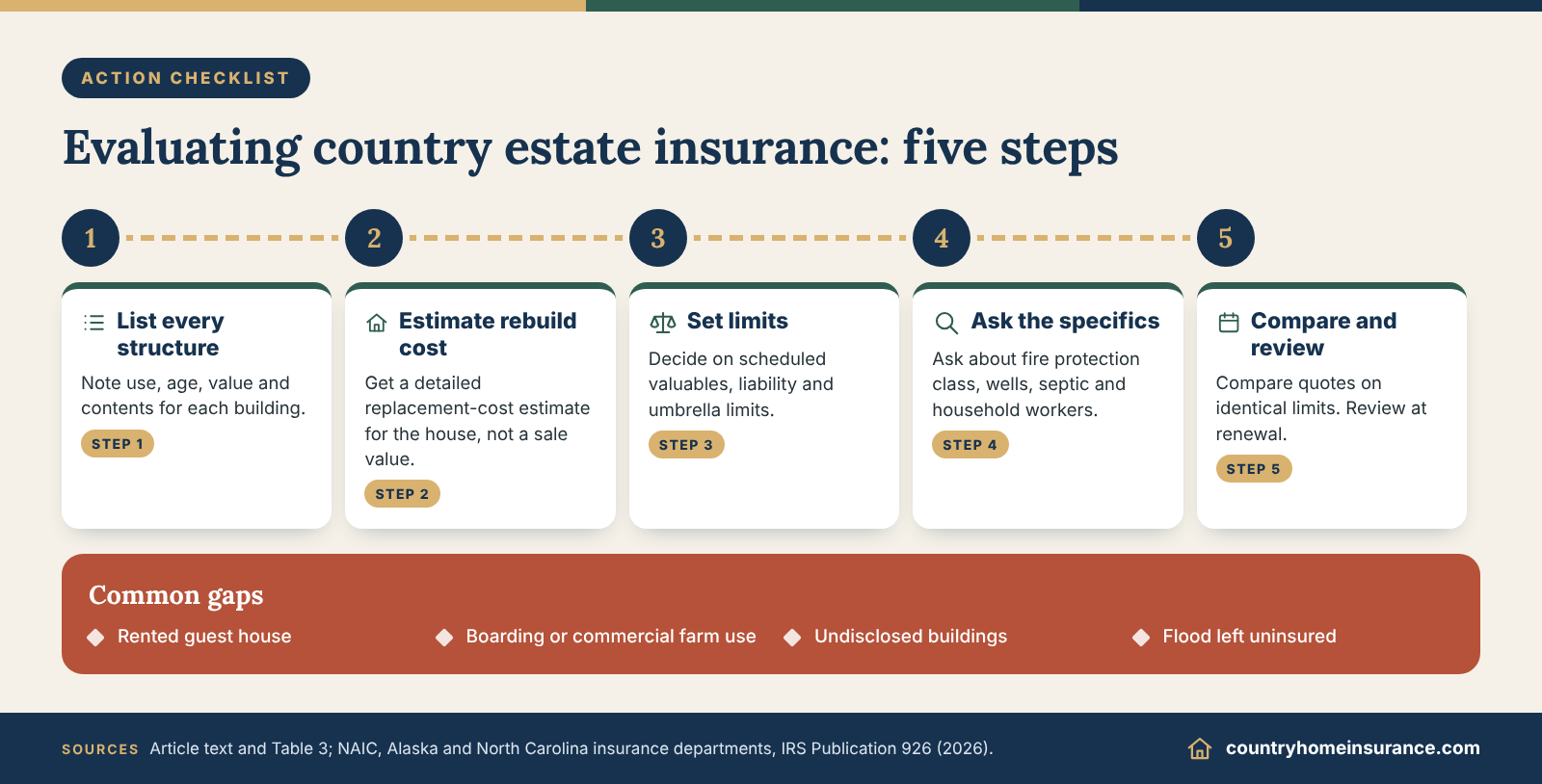
The most useful thing an estate owner can bring to an agent is a clear description of the property and a list of specific questions. The checklist table below turns the earlier sections into steps you can work through before a quote or at renewal.
Questions to put to the insurer
About the form and the structures
Ask which policy form applies and whether it is named-perils or all-perils for the dwelling and other structures. Ask how each outbuilding is classified, whether any are excluded because of condition, use or value, and whether the other-structures limit is combined or per building. Get the answers in writing, and read the fine print for any structure-specific exclusion.
About limits and valuables
Ask how the dwelling limit was calculated, whether extended or guaranteed replacement cost is available and at what cap, whether inflation guard is included and whether ordinance or law coverage applies. Ask what sublimits apply to jewelry, art, firearms and collectibles, and whether scheduling is available.
About liability and use
Ask what liability limit is available on the home policy, what the umbrella requires underneath, and which uses are excluded: rental, boarding, events, farming, home business. Ask whether animals have breed or number limits.
Documents to gather
An inventory of structures
List every building with its use, size, age, construction, utilities, heating source, condition and contents. Include fences, gates, arenas, sheds and well houses. Note whether any building is rented, shared or used for income. An accurate list helps prevent misclassification.
Photos, appraisals and records
Collect dated photos, recent replacement cost estimates, contractor invoices for renovations, appraisals for valuables, and records of safety systems such as alarms, sprinklers and generators. These support underwriting and, if a loss occurs, the claim. Keep digital copies somewhere other than the property.
Comparing quotes and revisiting coverage
Comparing apples to apples
Make sure each quote uses the same dwelling limit, the same replacement cost basis, the same other-structures limit, the same scheduled items and the same liability and deductible structure. A lower price that comes with a lower limit or a missing endorsement is not a lower price for the same coverage.
When to revisit
Revisit the policy at each renewal and after any major change: a new building, a renovation, an acquisition of valuables, a hired employee, a change in animals or a rental arrangement. The best time to find a gap is before a loss.
| Topic | What to verify or document | What to ask the insurer or agent |
|---|---|---|
| Dwelling value | Square footage, materials, systems, additions; recent estimate | Depends on the carrier: how was the dwelling limit calculated, and is extended replacement cost available at what cap? |
| Outbuildings | List of every structure with use, age, value and contents | Is the other-structures limit combined or per building, and are any structures excluded? |
| Guest house or rental | Who stays, how often, and whether anyone pays | Will rental use be excluded, and which landlord or short-term-rental option applies? |
| Animals and equipment | Number and use of horses and livestock; list of tractors and tack with values | Is farm personal property included, scheduled or excluded, and are boarding and lessons covered? |
| Valuables | Appraisals, photos and serial numbers for art, jewelry, silver and collections | What are the sublimits, and can items be scheduled at agreed or appraised value? |
| Liability | Visitors, contractors, trails, ponds, pools and events | What is the base limit, what does the umbrella require underneath, and which activities are excluded? |
| Household workers | Who works for you, on what terms and for how many hours; payroll tax status | How does the policy treat residence employees, and is workers’ compensation required in your state? |
| Fire protection | Fire department name, distance, hydrant or water source, driveway access | What is the property’s protection class and does a subscription or dry hydrant change it? |
| Wells and septic | Location, age and any recent repairs | Depends on the form: are pumps, tanks and fields covered, and is backup excluded? |
| Flood and other perils | Flood zone for the house and each outbuilding; wildfire or wind exposure | What separate flood or earthquake coverage should be considered, and are there peril-specific deductibles? |
Frequently asked questions
Definitions and eligibility
Is country estate insurance the same as high-value home insurance?
Not necessarily. High-value programs rest on each carrier’s own cut-off for home value or rebuild cost, while country estate programs, where they exist, are described by rural setting, acreage and outbuildings. An estate can qualify for both kinds of program, and some carriers combine features. Compare the actual forms and endorsements, not the labels.
Do I need a farm policy for a country estate?
It depends on use. If farming, boarding or sales generate income, a farm or ranch policy, or a written endorsement, is often the safer path. If the property is residential with personal-use animals and buildings, a homeowners-style estate program may fit. Ask the insurer to confirm in writing how it classifies your use.
Will my homeowners policy cover a detached guest house?
A detached guest house used by family typically falls under other-structures coverage, subject to that limit and the policy perils. Rental use may be excluded. Confirm both the limit and the rental rule with your insurer.
Limits and valuables
How much other-structures coverage does an estate need?
The 10% default is a starting point. Add up the replacement cost of every detached building and compare it to the limit. If the total exceeds the limit, ask for a higher limit or a different arrangement for the largest buildings.
Is extended replacement cost worth asking about?
On a custom or older home where rebuilding costs are uncertain, it is a reasonable question. Ask for the exact cap, conditions and any extra premium, and compare it with guaranteed replacement cost if offered.
Do I need to schedule jewelry, art or collections?
If the value exceeds the policy’s sublimits, scheduling at appraised value may be needed to insure the item fully. Ask what perils the schedule covers and whether appraisals must be updated.
Liability, staff and fire protection
Do I need an umbrella policy on an estate?
Many owners consider one because acreage, guests, contractors and animals raise liability exposure. Sizing depends on your assets and risk, and carriers generally require high underlying limits. Review the umbrella’s exclusions before relying on it.
Does insurance cover injuries to my gardener or housekeeper?
It depends on the policy and on state law. Homeowners forms and workers’ compensation are different things, and the standard ISO HO-3 form refers to residence employees in several provisions. Ask the insurer how it treats household workers, and ask your state workers’ compensation agency whether a separate policy is required.
Can a rural fire department affect my insurance?
Yes. Distance, water supply and access can influence protection class, price and whether a carrier will write the property. Find out your classification and ask about any subscription or access improvements that might help.
Sources
- Michigan Farm Bureau — Country Estate Insurance (product page, copyright 2026; accessed 2026-10-16)
- National Association of Insurance Commissioners — A Consumer’s Guide to Home Insurance (2022 edition; accessed 2026-10-16)
- Insurance Services Office form HO 00 03 05 11, Homeowners 3 Special Form (as posted by the Maine Bureau of Insurance) (2011 edition; accessed 2026-10-16)
- Texas Department of Insurance — Public Protection Classification (March 23, 2023; accessed 2026-10-16)
- New York State Department of Financial Services — Homeowners and Tenants Insurance: What Consumers Need to Know (consumer guide, undated; accessed 2026-10-16)
- Triple-I — Insurance for your house and personal possessions (copyright 2026; accessed 2026-10-16)
- North Carolina Department of Insurance — Optional Coverage (undated page; accessed 2026-10-16)
- Alaska Division of Insurance — Homeowners Insurance and Inflation (undated, references December 2021 survey data; accessed 2026-10-16)
- State Farm Mutual Automobile Insurance Company (filed with Maine Bureau of Insurance) — Maine Homeowners Underwriting Guidelines (effective January 1, 2023; accessed 2026-10-16)
- Internal Revenue Service — Publication 926, Household Employer’s Tax Guide (2026; accessed 2026-10-16)
Important coverage note
Coverage depends on the actual policy, endorsements, exclusions, limits, deductible and cause of loss. “Country estate” is a carrier label rather than a standardized policy, so the same name can describe different coverage from one insurer to the next. State laws and programs vary. For case-specific questions, check your declarations page and policy form, and contact your insurer, a licensed agent and your state Department of Insurance. This article is educational and is not legal, tax or insurance advice, and it does not guarantee that any claim will be paid.
About the editorial team
This guide was prepared by the countryhomeinsurance.com editorial team as general, educational information for homeowners. We research and summarize publicly available material, including state insurance departments, the NAIC, federal agencies, regulators’ consumer guides and published insurer and industry resources. We draw only on the sources that were available to us when we wrote this guide, and we list them in the Sources section with dates where we could find them.
Insurance rules, rates, products and program terms change, differ by state and by insurer, and can apply differently to your situation. We cannot guarantee that this content is complete, current or free of errors. It is not legal, financial, tax or insurance advice, it is not an offer to sell insurance or a recommendation of any insurer, agent or product, and reading it does not create a professional relationship of any kind.
To the fullest extent permitted by law, countryhomeinsurance.com and its editorial team, authors and contributors exclude all liability for any loss, damage or decision arising from the use of, or reliance on, this content. For questions about your own policy or claim, contact your insurer, a licensed agent or broker, your state Department of Insurance or another qualified professional.
Content created: October 16, 2026