
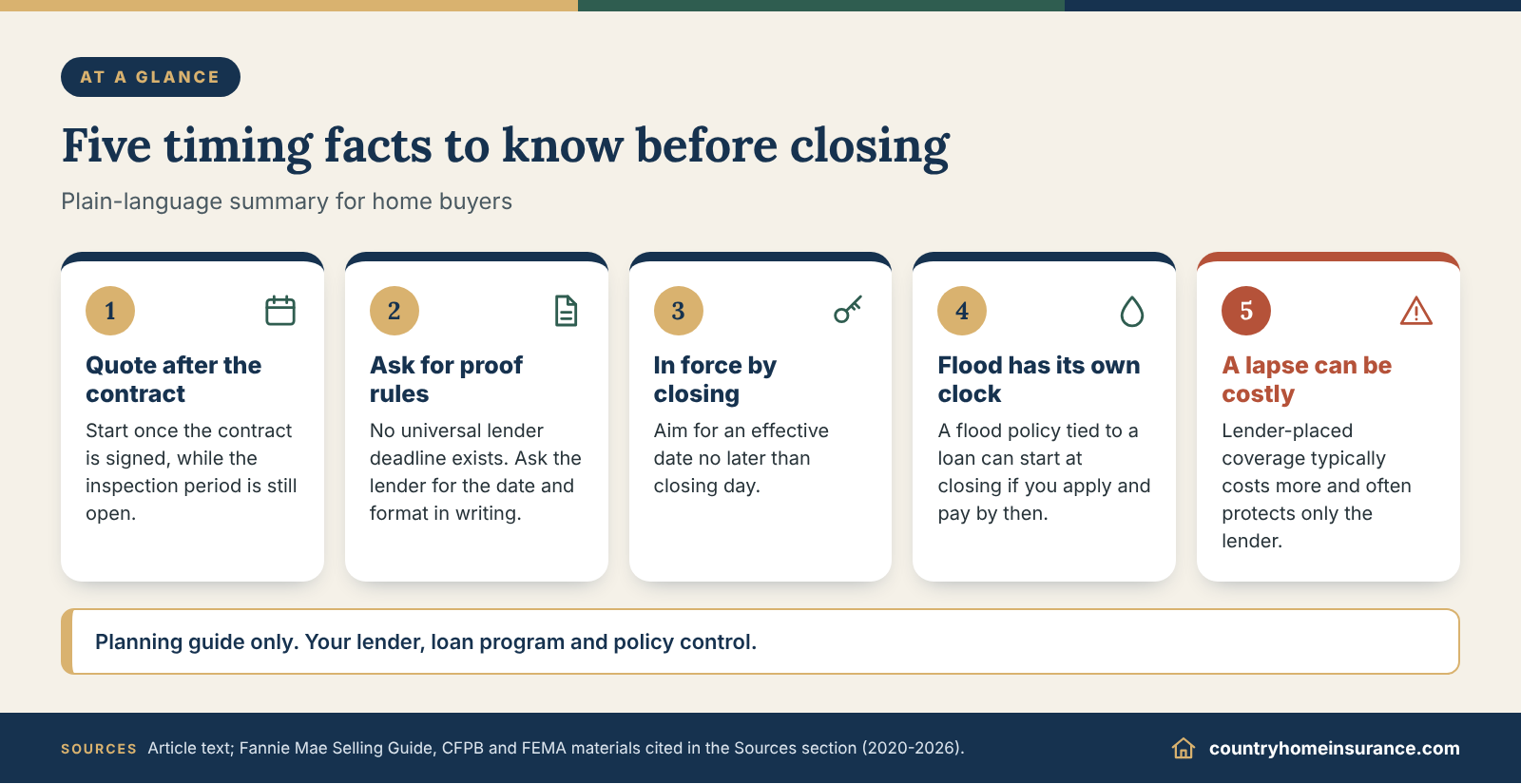
The best time to buy homeowners insurance before closing is usually right after the purchase contract is signed: start collecting quotes while the inspection period is still open, then bind (purchase) the policy so it is in force no later than the day you close. Lenders and loan programs set their own proof deadlines, so no single day applies to everyone. Older, rural, roof-worn or flood-zone homes can take longer to place, so give them extra runway.
Key takeaways
- Treat “before closing” as a window, not a date: begin quoting soon after the contract is signed, and confirm the policy is bound before the final days.
- No universal lender deadline exists. Your lender, loan program and title company decide what proof they need and when, so ask for their requirements in writing.
- A federally required flood policy tied to your loan can take effect at closing, but only if you apply and pay on or before that day; otherwise a 30-day waiting period may apply.
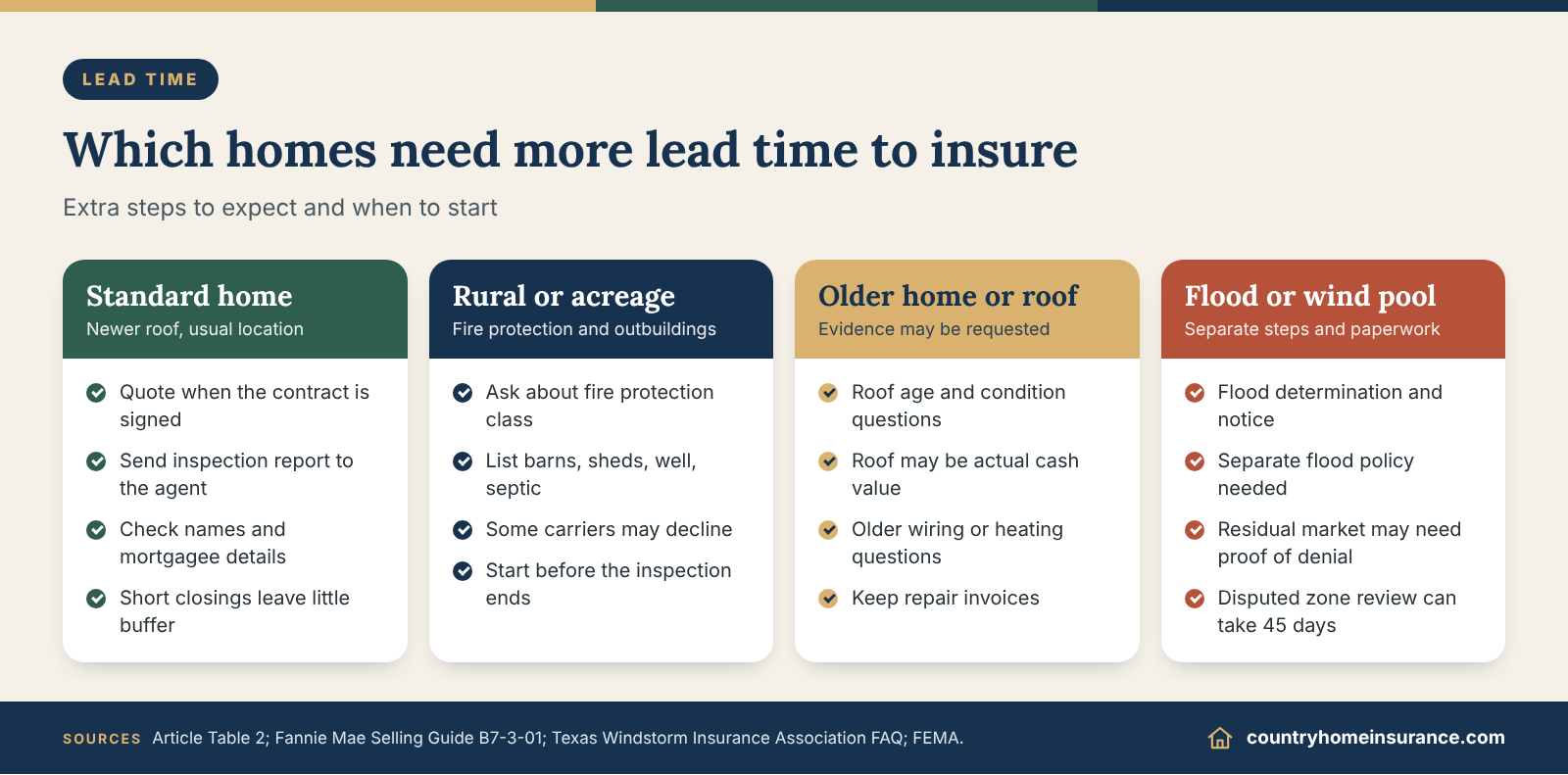
- Rural properties, older roofs, wood-burning heat and wind or flood exposure can add days or weeks to placement, so inspection findings should reach your insurance agent quickly.
- If coverage is missing or lapses, a lender or servicer may buy force-placed insurance at your expense, which typically costs more and, in many cases, protects only the lender.
When to buy homeowners insurance before closing: the short version
Home buyers tend to ask about insurance in the last week, when the lender suddenly wants proof. That is late. The cleaner approach is to treat insurance as a parallel track that starts as soon as the contract is signed and finishes before the money moves. This guide focuses on timing only: when to start, when proof is usually requested, how the effective date relates to your closing, which properties need more lead time, and what happens when coverage is not in place. For the coverage logic itself, the step-by-step guide to buying homeowners insurance is the better companion.
The window that works for most buyers
Start quoting once the contract is signed
Quotes need a specific address, so serious shopping typically begins when you have an accepted offer. A quote is an estimate; it is not coverage. At this point the goal is to learn whether the home is insurable at a price your lender and budget can live with, while you can still use the contract’s inspection or financing deadlines to negotiate or walk away. This is a planning suggestion rather than a rule, and it applies whether you use an independent agent, a captive agent or a direct insurer.
Bind the policy before the final stretch
Binding means the insurer agrees to cover the home starting on a stated date, subject to underwriting. Binding a few days to two weeks ahead, for example, leaves time to correct a misspelled name, an incorrect mortgagee address or a missing inspection report. Your lender and title company may ask for the evidence earlier, so confirm their date first. A binder is a short-term proof of coverage, covered in what an insurance binder for a mortgage is.
Why “before closing” is a range, not one day
What moves the date earlier or later
Three things move the deadline: how fast your closing is scheduled, how complicated the property is to insure, and what the lender requires. A 21-day closing on a standard suburban home leaves little room, so quoting immediately matters. A 60-day closing on a farmhouse gives more room but may need more underwriting. A flood-zone property adds the flood determination and a separate policy. The timeline in the next section is built around those variables.
Why no single nationwide proof deadline exists
Investor guidelines such as Fannie Mae’s evidence-of-insurance rules require the lender or servicer to verify that a compliant policy exists and to keep acceptable evidence, but they do not tie that task to a number of days before closing. The calendar is therefore set at the level of the individual lender, loan program and closing company. Treat any “X days before closing” claim as one lender’s practice, not a law, and ask your own loan officer for the exact date.
| Situation | Coverage outlook | What to confirm |
|---|---|---|
| Damage occurs while the seller still owns the home | Typically not covered under your policy, because it is not yet in force. Who bears the loss depends on the purchase contract and state law. | Ask your real estate attorney or agent how the contract allocates risk of loss before closing. |
| Damage after your policy’s effective date and after you own the home | Typically covered if the cause of loss is covered, subject to the deductible, limits and exclusions. | Read the declarations page for the effective date and the named insureds. |
| Damage after closing but before your policy takes effect | Typically not covered. There is no policy in force to respond. | Make sure the effective date is no later than closing day. |
| Damage while only a binder is in force | Depends on the binder’s terms and the underwriting that follows. | Ask what the binder covers and when the full policy is issued. |
| Flood damage under a standard homeowners policy | Typically not covered. Flood is usually a separate policy. | Ask the lender and agent about flood zone status and a flood quote. |
| Flood damage during the first weeks of a new NFIP policy | Depends on whether the policy was bought in connection with a loan closing or falls under the 30-day waiting period. | Apply and pay on or before closing if the loan exception is expected to apply. |
| Home covered only by lender-placed insurance after a lapse | Depends on the force-placed policy; it typically protects the lender, and the NAIC says lender-placed coverage usually insures only the structure. | Send proof of your own policy to the servicer as soon as it exists. |
A buyer timeline from accepted offer to closing day
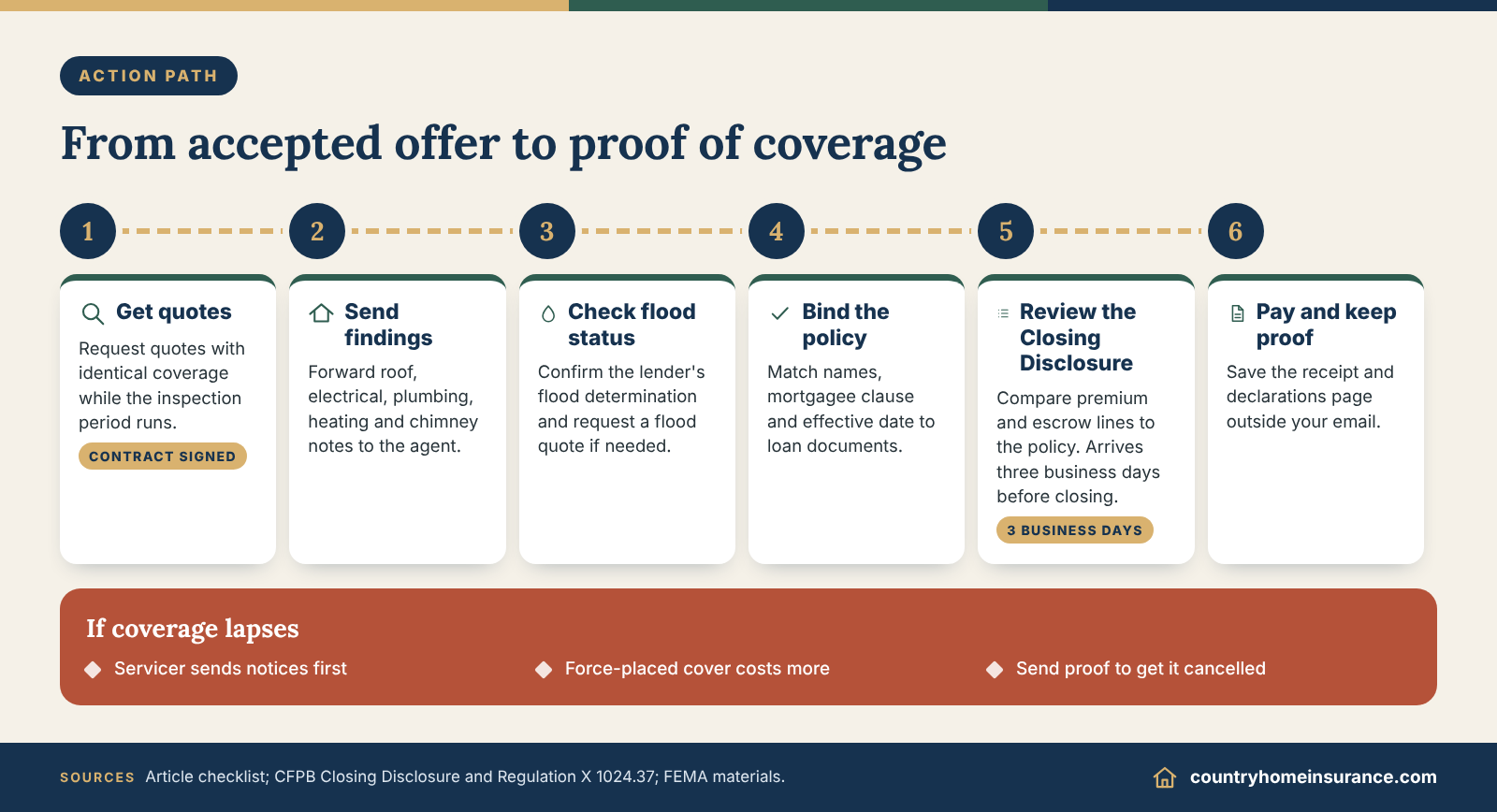
The sequence below is a planning model, not a regulatory schedule. Real transactions overlap these steps, and a fast closing compresses them. Use it to see which tasks depend on others, especially the points where an inspection finding, a flood determination or a lender request can change what the insurer needs.
Before and during the offer
Ask about insurability before you fall in love with a property
The cheapest time to learn a home is hard to insure is before you make an offer. A short call to an agent with the address can reveal whether insurers in the area are writing new policies, whether the roof age is a concern, and whether a flood or wind-pool policy may be needed. An agent cannot promise a quote without underwriting, but the early read helps you decide how much contingency time to ask for.
Request the seller’s disclosures that affect underwriting
Seller disclosures, listing details and prior inspection reports often mention roof replacement years, electrical updates, heating systems and past water or storm damage. Insurers ask many of these same questions on applications, so having the answers ready speeds quoting. If a property disclosure is vague, ask for the roof invoice, permit records or a contractor letter. The list of information a home insurance quote needs shows what to gather.
Contract signed to inspection
Collect two or three quotes while the inspection period runs
Quotes are most useful when they arrive before the inspection contingency expires, because that is when you still have leverage to renegotiate, request repairs or exit if insurance is unavailable or unaffordable. Comparing a small number of quotes with the same coverage amounts keeps the work manageable; how many home insurance quotes to get covers that balance, and how to compare home insurance quotes covers apples-to-apples comparison.
Send inspection findings to the agent right away
When the inspection report arrives, forward the roof, electrical, plumbing, heating and chimney sections to the agent. An insurer may ask for repairs, a roof certification or a new quote based on the real condition. A finding that looks minor to a buyer, such as an aging water heater or a wood stove, can be an underwriting question. Learning that during the inspection window beats learning it a week before closing.
Loan approval through the final two weeks
Choose the insurer and send the lender its details
As underwriting on your loan advances, the lender typically asks which insurer you chose so it can be listed correctly. Many lenders use a processor or title company to collect the policy information. The policy must name the right people and the lender as mortgagee, which is the lender’s protected interest in the property. A small error here can delay closing, so verify spelling and addresses character by character.
Use the Closing Disclosure window as a deadline
The CFPB says lenders must provide your Closing Disclosure three business days before your scheduled closing. That form shows the escrow account and often the first year’s homeowners insurance premium as a prepaid cost. If your insurance premium on the form does not match the policy you chose, the three-day window is the time to fix it. Practically, that means the policy should be selected well before the document is prepared.
| Factor | Why it can add time | Planning suggestion |
|---|---|---|
| Short closing (about three weeks or less) | Quotes, underwriting and lender proof all overlap with little buffer. | Start quoting the day the contract is signed. |
| Rural location with limited fire protection | Distance to a fire station or water source and the quality of local fire protection can affect price; eligibility varies by insurer. | Ask the agent early about protection class and carriers that write the area. |
| Older roof | Insurers may ask for age or condition evidence, may require an inspection for older roofs, or may limit roof settlement to actual cash value. | Send the roof section of the inspection promptly and ask about settlement options. |
| Older electrical, plumbing or heating systems | Insurers may ask about updates and condition before binding. | Ask which items need documentation and whether repairs can be finished before closing. |
| Wood stove, fireplace insert or similar heat source | Heating-source details may come up on the application or in underwriting questions. | Gather any installer paperwork or chimney inspection records you can get from the seller. |
| Mapped flood hazard area | Lender flood determination and a separate flood policy add steps. | Request a flood quote at the same time as the home quote. |
| Wind pool or FAIR Plan placement | Some residual markets, such as the Texas Windstorm Insurance Association, require a private-market denial and a building-code certificate; Fannie Mae accepts such plans only as the only available coverage. | Start as soon as the contract is signed and expect extra paperwork. |
| Vacant or renovation-stage home | Standard policies may limit coverage once a home sits empty, and renovation can raise separate questions. | Tell the agent your move-in date and renovation plans before binding. |
What lenders ask for and when they usually ask
Lenders care because the home secures the loan. The CFPB explains that lenders generally require proof of insurance because they want the property protected, and the NAIC’s consumer page adds that you generally do not have to buy from the company your lender recommends. Beyond that general rule, the specifics come from the lender, the loan program and the investor that may buy the loan.
What the lender is checking on the policy
Names, mortgagee clause and policy details
For loans it purchases, Fannie Mae says an individual property policy should name all persons holding title and carry a standard mortgagee clause. The mortgagee clause tells the insurer to protect the lender’s interest and send it notices. Because the lender compares the policy against the closing documents, your name should match the purchase contract and the closing documents exactly. If a spouse or co-buyer will be on the title, they typically belong on the policy as well.
Coverage form, perils and deductible limits
The same investor’s guide says one-to-four-unit policies should use a special coverage form or an equivalent, include a list of required perils such as fire, windstorm and hail, and keep deductibles at or below 5% of the coverage amount. It also requires replacement cost coverage on the building, though the roof must be insured without necessarily being on a replacement cost basis. These are one investor’s rules; your lender may be stricter, and other programs differ.
Why there is no single universal deadline
Lenders, loan programs and investors differ
A conventional loan, an FHA loan, a VA loan, a USDA loan and a portfolio loan can each carry different documentation requirements, and individual lenders add their own internal calendars. Closing attorneys and title companies sometimes add steps. Because of this layering, the safest question to ask is, “By what date and in what form do you need proof of coverage?” Ask for the answer in writing and put the date on your own calendar.
Where the Closing Disclosure fits in
Since the Closing Disclosure must arrive three business days before closing, the insurance information used to fill in the premium and escrow lines often has to exist before then. This does not make three days the insurance deadline. It means your premium estimate may be revised if you pick a different policy after the form is issued, and your lender can tell you whether a change requires reissuing the document.
Which documents count as proof
Binder, declarations page, certificate or full policy
Lenders vary in what they accept, and Fannie Mae’s evidence page, for one, does not list binders or declarations pages. Common formats are an insurer’s binder, a declarations page (the summary page listing insureds, property, limits, deductibles and the mortgagee), an insurer-signed certificate or the full policy. Fannie Mae’s guide says certificates of insurance may replace a full policy when they carry all information needed to determine compliance and are signed by the insurer. Ask what format your lender wants. For more on this point, read the guide to insurance binders for mortgages.
Receipt of premium and the escrow account
Many borrowers pay insurance through escrow, an account the servicer funds from your monthly payment and uses to pay insurance and taxes. The first year’s premium is commonly paid at closing as a prepaid item. Under Regulation X, the servicer provides an initial escrow statement at settlement or within 45 days afterward, itemizing the expected insurance payments. See what buyers need to know about insurance at closing for the closing-day mechanics.
Choosing the policy effective date relative to closing
The effective date is the moment your coverage begins. It appears on the declarations page and is the single most important date on the document for timing purposes. Choose it deliberately, and compare it to the date your lender and attorney expect the transfer of ownership to occur.
The effective date and the closing date
Aim for coverage in force no later than closing
Because the lender’s interest attaches when the loan funds and you take ownership, the usual target is a policy effective on or before the closing date. Some buyers set the effective date a day or two earlier to avoid a gap if closing happens early. An earlier start generally does not give you coverage for a home you do not yet own, since insurance depends on an insurable interest, so confirm with the agent what an early effective date does and does not accomplish.
What if closing moves
Closings slip and sometimes accelerate. When the date changes, tell the agent and the lender right away so the effective date, the mortgagee information and the proof delivered to the title company still line up. Ask whether moving the date costs anything and whether the quote remains valid. A binder issued for one date may need to be reissued if closing slides by weeks instead of days.
Paying the premium
First-year premium as a prepaid cost
According to the CFPB’s Closing Disclosure guide, prepaids often include the first year’s homeowner’s insurance premium, which you pay up front. The policy is usually purchased through your agent or insurer, and the title company or closing agent may pay the premium from funds you bring to closing. Confirm whether the insurer expects payment before the effective date or accepts payment at closing.
Escrow accounts and monthly payments
If the loan has an escrow account, the monthly payment typically includes a share of the annual premium. Regulation X requires the servicer to run an escrow analysis and deliver an initial escrow statement at settlement or within 45 calendar days. Check that the statement lists the right insurer and the expected premium date. If you switch insurers later, the servicer needs the new policy information to avoid a payment to the wrong company.
Possession gaps and early access
Early move-in or pre-closing renovations
If the contract allows you to occupy the home or begin work before closing, the seller’s insurer and the contract terms determine who is protected, and a buyer’s policy may not respond because you are not yet the owner. The answer varies by contract, state and insurer, so no general rule applies. Raise it with your attorney and agent before taking keys early or hiring a crew.
The days between closing and move-in
If you close and then renovate, the home may be vacant or unoccupied for weeks. Triple-I explains that most standard homeowners policies have a vacancy clause that can limit or exclude some coverage once a home has been empty for roughly 30 to 60 consecutive days, and that vacant-home policies or vacancy endorsements exist for homes between owners or under renovation. Tell the agent your move-in date. The first freeze insurance checklist shows why vacant homes carry extra winter risks. A policy that was bound for owner-occupied use may need a different endorsement or form if the house will sit empty.
Hard-to-insure, rural and older properties need a longer runway
A standard suburban house with a newer roof can often be quoted and bound in a day or two. Properties with unusual features take longer because insurers may need more information, more photos or an inspection, and some carriers will decline altogether. The right response is lead time, not panic.
Rural and country factors
Fire protection and distance
The NAIC consumer guide to home insurance says premiums are affected by the distance from the home to a water source or fire department and by the quality of community fire protection. In the country, that distance and the type of department can matter more than they do in town. Ask the agent which carriers write the area and whether they need the fire district name. Our rural home insurance guide explains what standard policies often miss on country properties.
Outbuildings, wells, septic systems and acreage
Barns, sheds, shops, wells, septic tanks and fencing raise separate questions about coverage and eligibility, and some insurers limit what they will write on larger parcels or with livestock. Gather photos and approximate values for outbuildings early. If the land is large, country home insurance for homes with acreage helps you prepare questions for the agent before time pressure sets in.
Older homes and roof age
Roof age, condition and settlement terms
An aging roof is among the most common underwriting issues during a purchase. Triple-I says insurers may require an inspection for roofs more than 20 years old, may limit payment to actual cash value (replacement cost less depreciation) and may refuse some homes with older roofs. Fannie Mae’s guide notes a roof must be insured but need not be on a replacement cost basis for its loans, which shows lenders may accept some roof limits. Read how roof age affects cost and eligibility before making an offer.
Electrical, plumbing and heating systems
Older wiring, galvanized or polybutylene plumbing and aging heating equipment can prompt additional underwriting questions. Which systems an insurer restricts is company-specific, so ask each agent rather than assume. Triple-I’s home buyer’s guide notes that aging plumbing and electrical systems can be unsafe without good maintenance and suggests budgeting for updates, which is also what an underwriter tends to weigh. Report them early, and how home age affects insurance cost and eligibility explains the pattern.
Residual markets and wind pools
FAIR Plans as a last resort
When private insurers will not write a property, a state residual market such as a FAIR Plan may be the fallback. Fannie Mae’s guide says state plans and state-mandated windstorm pools are accepted only when they are the only coverage available at closing or renewal. In practice, that makes documentation of unavailability important and suggests starting sooner, since you may need to be turned down before applying.
Example: Texas Windstorm Insurance Association
The TWIA is a Texas-specific example. Its FAQ says applicants need to have been denied by at least one private insurer, the property must be in the designated catastrophe area, a Texas-licensed agent submits the application and eligible properties need a building-code certificate such as a WPI-8. The page also shows that an application can be placed under a 60-day binder while missing information is gathered. Other states differ, so use your state Department of Insurance for local rules.
When the inspection changes the insurance plan
Home inspections are for the buyer, but insurers are quiet readers of them. Understanding how findings flow into underwriting turns a surprise into a manageable to-do list.
Findings that tend to move the timeline
Roof, chimney and fireplace issues
Worn shingles, flashing problems, a cracked chimney crown or a wood-burning insert can prompt follow-up questions or a requirement for repairs or documentation. If the inspector recommends a specialist evaluation, schedule it quickly, since the specialist report might be what the insurer wants to see. Keep copies of all repair invoices; they often count as proof when the policy is issued.
Water, mold and prior damage signals
Evidence of past leaks, staining or moisture can trigger questions about earlier claims and repairs. The NAIC consumer guide says most insurers report homeowners claims to nationwide databases such as CLUE, and that claims history for a home can affect its premium. The buyer’s own history matters too, as described in how claims history affects homeowners insurance cost and eligibility. Ask the seller for documentation of repairs and whether claims were filed.
Using the contract to protect yourself
Insurability and financing contingencies
Some purchase contracts include a contingency that lets the buyer cancel or renegotiate if insurance cannot be obtained at reasonable terms, and others fold it into the financing contingency. Whether your contract has one, and how long it lasts, is a legal question for your attorney or agent. The practical point is that contingency dates are fixed, so getting insurer feedback before they expire is far better than afterward.
Negotiating repairs and credits
If an insurer asks for a repair as a condition of coverage, you can often raise it with the seller as part of the inspection response. Ask the agent to put the requirement in writing and tell you whether finished work must be re-inspected. A repair not finished by closing may need an escrow holdback or written insurer acceptance of the plan, which your lender and attorney should approve.
Flood zone determination and flood insurance timing
Flood is the one timing issue that can bite even when the homeowners policy is perfect. Standard homeowners policies typically do not cover flood damage, as both the NAIC’s consumer page and the CFPB note, so flood insurance is a separate purchase with its own waiting-period rules.
How the lender handles flood zones
The determination and the borrower notice
Lenders check whether the building is in a special flood hazard area, a mapped high-risk zone. For national banks and federal savings associations, 12 CFR 22.9 requires written notice to the borrower within a reasonable time before the transaction is completed, covering the flood hazard warning, the purchase requirement, the option to buy from private insurers or the NFIP, and whether federal disaster relief may be available. Lenders overseen by other regulators work under their own agencies’ rules, so ask your lender when and how it will deliver the notice.
The purchase requirement itself
Under 42 U.S.C. 4012a, regulated lenders generally cannot make, increase, extend or renew a loan secured by improved property in a special flood hazard area unless the property is covered for the loan term, to at least the lesser of the outstanding principal or the maximum available. The related 12 CFR 22.3 says the coverage protects the building and any personal property securing the loan, not the land. Lenders must accept private flood policies that meet the statute’s standards, which include at least as broad coverage as a standard NFIP policy and 45 days’ notice of cancellation or nonrenewal. If a lender finds a flood-zone loan uninsured or underinsured, the statute has the borrower buy coverage within 45 days of notice, after which the lender or servicer must purchase it and may charge the borrower.
The 30-day waiting period and the loan-closing exception
What FEMA says about the exception
FEMA’s Myths and Facts About Flood Insurance page (released November 18, 2020) states that a flood policy generally takes effect 30 days after you apply and pay. It adds that if the purchase is tied to making, increasing, extending or renewing a mortgage, there is no waiting period, and coverage starts at loan closing as long as you apply and pay the premium on or before that date. A one-day wait applies when purchasing within a year after a community adopts a revised flood map.
Why to pay at or before closing anyway
FEMA’s materials describe short windows after closing in which the insurer must receive the application and premium: 10 days in general, or 30 days when the premium comes through an escrow account, title company or settlement attorney. The documents in the table below, from 2009 to 2024, describe the same two windows. They govern how an insurer issues the policy; they are not an invitation to wait. Apply and pay on or before closing day, and ask your agent to confirm how the current Flood Insurance Manual applies to your policy.
| Source and date | What it describes | Practical takeaway |
|---|---|---|
| FEMA Myths and Facts (November 2020) | No waiting period for a purchase tied to a loan; coverage starts at loan closing if you apply and pay on or before that date. | Aim to complete both steps by closing day. |
| FEMA Q&A on the 30-day waiting period (May 2011) | Application and premium should reach the insurer within 10 days of closing, or 30 days if paid through escrow, a title company or a settlement attorney; later receipt moves the effective date. Without an application at or before closing, the 30-day wait applies. | The application date matters; do not apply after closing and expect the exception. |
| FEMA bulletin W-09065 (October 2009, archived) | Introduced the revised loan-closing rule for closings on or after January 1, 2010: receipt within 10 days of closing, or 30 days through escrow, a title company or a settlement attorney, counted as the closing date plus 9 or 29 days. | The same two windows appear in later documents; the counting is just expressed differently. |
| FEMA bulletin W-22021 (December 2022) | Repeats the 10-day and 30-day payment windows in the context of a possible lapse in the program’s authority. | Special program conditions can change the details, so ask the agent. |
| FEMA memorandum W-24020 (December 2024) | Again states that a loan-closing policy is dated at closing if the application and full amount due arrive within 30 days when paid through escrow, a title company or a settlement attorney, or within 10 days otherwise. | The windows were unchanged at the end of 2024; confirm anything newer with the agent. |
Outside the mapped high-risk area
Not required is not the same as not exposed
If the lender’s determination shows the home outside the special flood hazard area, federal law does not require a flood policy for the loan, but a standard homeowners policy still typically excludes flood. Whether to buy one is a risk decision informed by the home’s elevation, local drainage and past water events. For what typically is and is not paid, read does homeowners insurance cover flood damage.
Disputing a determination takes time
If the borrower and lender think a determination is wrong, 42 U.S.C. 4012a(e)(5) lets them jointly ask FEMA to review it, and the FEMA Administrator has 45 days to respond. A letter saying the property is outside the zone relieves the purchase obligation for the period the letter states. A 45-day review rarely fits inside a short closing, so a disputed zone is another reason to start early.
What happens if coverage is not in place
This section describes the consequences of missing coverage, based on federal consumer rules. Individual lenders, states and insurers can add details, so treat it as a map of the risks rather than a prediction.
Missing coverage before closing
The lender may not fund or may delay
Lenders verify coverage because the loan is secured by the home. Fannie Mae’s evidence-of-insurance section says that if a lender cannot determine whether a policy meets the requirements, the associated loan is not eligible for purchase by Fannie Mae. A lender with that concern may hold the closing until proof is corrected. Enforcement varies by lender, so ask your loan officer what happens if proof arrives late.
Cash purchases have no lender checkpoint
A cash buyer has no mortgagee asking for evidence, which can make insurance feel optional. It is not safe to skip, since the buyer carries the entire risk of loss from the day ownership transfers. Cash buyers should still bind coverage to take effect at closing, and they may find placement easier to schedule because no lender documentation must be satisfied.
Lapse after closing and force-placed insurance
What force-placed insurance is
The CFPB describes force-placed insurance as coverage a mortgage servicer buys when you do not have adequate coverage of your own. It says that in many instances it protects only the lender, you pay for it, and it is usually pricier than a policy you buy yourself. The NAIC adds that lender-placed coverage usually insures only the structure, and that you may be required to keep paying for it until you buy your own policy.
The notice sequence servicers must follow
Under Regulation X section 1024.37, a servicer may charge only if it has a reasonable basis to believe you failed to keep required coverage, and only after a sequence of notices. The table below summarizes the steps. State rules and your loan documents may add details.
| Step | Timing described by the rule | What you can do |
|---|---|---|
| Initial written notice | Sent at least 45 days before any charge. Says the servicer lacks proof of coverage and may buy coverage at your expense. | Send the declarations page or other proof right away. |
| Reminder notice | Sent at least 30 days after the initial notice and at least 15 days before any charge. | Respond again if the servicer still has no proof or only part of it. |
| Charge may begin | Only if the servicer has not received proof of continuous, compliant coverage within 15 days after the reminder was sent. | Ask the servicer exactly which period it will charge for; where state law allows, a charge can reach back to the first day without coverage. |
| Proof arrives later | The servicer must cancel the force-placed policy within 15 days of receiving proof and refund premiums and fees for the overlapping period. | Keep dated copies of what you sent and when. |
When an escrow account was supposed to pay
If your hazard insurance premium is paid from escrow, Regulation X section 1024.17(k)(5) generally limits a servicer’s ability to force-place coverage when it is able to pay the premium on time, and a low escrow balance alone does not make the servicer unable to pay. If a lapse happened even though the premium was supposed to come from escrow, ask the servicer in writing why coverage lapsed and keep every reply.
If a loss happens during a gap
The uninsured stretch is your risk
A loss that occurs when no policy is in force is typically not covered by homeowners insurance, and force-placed coverage that begins later is not retroactive protection for an earlier loss. The financial exposure includes the home, belongings and liability. This is why the effective date, binding confirmation and lender proof deserve a final check in the last week.
Document continuous coverage
If a servicer says you lacked coverage, a dated declarations page, binder or insurer letter showing continuous coverage is your best evidence. Keep every email and receipt from the purchase period, and store copies outside your email account in case of delays. Claims workflow after a loss is a separate topic that this guide leaves to the claim articles.
Three hypothetical buyer timelines
These scenarios are illustrations, not predictions. Figures and dates are invented to show sequencing, and your actual quotes, closing schedule and lender requirements will differ.
A standard home with a 30-day closing
How the days might line up
Hypothetical example: A buyer signs a contract on day 1 for a suburban house with a roof about eight years old. Quotes are requested on day 2, the inspection happens on day 7, and the inspection report goes to the agent on day 9. The buyer picks an insurer on day 12, sends details to the lender on day 13, receives the Closing Disclosure on day 24 and closes on day 30 with coverage effective that morning. The numbers are illustrative only.
What could still go wrong
A misspelled mortgagee name or a missing co-buyer on the policy can force corrections late in the process. Because the Closing Disclosure shows an insurance estimate, a late switch to a more expensive policy might change the closing figures. Checking the declarations page against the loan documents on day 14 would catch most of those issues.
A rural farmhouse with an aging roof
Why the schedule stretches
Hypothetical example: A buyer under contract on a 1950s farmhouse with 12 acres, a detached barn, a well and a roof of uncertain age asks three agents for quotes. One carrier declines because of fire protection distance, another wants a roof inspection and a third quotes with an actual cash value roof. The process takes about three weeks of a 45-day closing, with a roof inspection scheduled in week two. The dates are hypothetical.
How early action helps
Because the buyer contacted agents before the inspection period ended, the roof finding arrived with time to negotiate a credit instead of an emergency repair. The buyer also learned the barn needed separate consideration, as discussed in the rural coverage-gaps guide above. Waiting until week five would have left no room to compare.
A home near a mapped flood zone
Sequencing the home and flood policies
Hypothetical example: A lender’s determination places a riverside home in a special flood hazard area. The buyer asks the agent for a flood quote the same day, applies for the flood policy before closing and pays at closing through the title company so the loan-closing exception may apply. The homeowners policy and flood policy both show the lender as mortgagee. Specific premiums and waiting-period details depend on the policy, zone and current FEMA rules.
When the determination is disputed
If the buyer believes the map is wrong, the 45-day FEMA review under federal law will not fit a 30-day closing. The buyer may buy the required flood coverage to close on time and pursue a later change, though that is a question to settle with the lender and a flood-zone professional before relying on it.
Making the quoting window efficient
A short quoting window rewards preparation. The goal is to give each agent the same facts so quotes can be compared and so underwriting questions arrive early.
What to have ready on day one
Property facts
Have the address, year built, square footage, roof age and material, heating type, electrical and plumbing updates, and a list of outbuildings. If the seller’s disclosure is incomplete, say so to the agent rather than guessing. Insurers can price or decline based on corrected information, and a wrong answer on an application can create problems later.
Buyer facts and coverage choices
Agents also need your name, current address, mortgage details, preferred deductible and how you plan to use the home. Decide in advance whether you want replacement cost on belongings, extended coverage on the dwelling or special endorsements, because comparing different coverage amounts is not a fair comparison. The step-by-step buying guide linked in the first section covers those choices.
Timing mistakes that cost buyers
Waiting for the lender to ask
Waiting until the loan officer sends a request leaves very little time for a decline, a roof inspection or a flood policy. Buyers who start quoting after the contract is signed keep their options open. A decline is much easier to manage when the contingency period is still running.
Binding too early or ignoring the cancellation terms
If the deal is uncertain, binding a policy too far ahead can create paperwork and possible fees if the purchase falls through. Ask the agent before binding whether the policy can be cancelled before the effective date without charge, and what happens to any premium you paid. Cancellation rules vary by insurer and state, so get the terms in writing before you pay.
Action checklist and questions to ask
Use the table to track what to verify, what to keep and who to ask. It is organized around when each task usually belongs in the process, not around a legal deadline.
| Task | What to verify or document | Who to ask |
|---|---|---|
| Contract signed: ask for proof requirements | The date, form and recipient for proof of coverage, in writing. | Loan officer and title or closing company |
| Request quotes with identical coverage | Dwelling amount, deductibles, roof settlement terms and any wind or hail deductible. | Independent agent or insurer |
| Send inspection findings | Roof, electrical, plumbing, heating and chimney sections of the report. | Agent, then insurer underwriter |
| Check flood determination | Whether the home is in a special flood hazard area and the borrower notice received. | Lender and agent |
| Bind the policy | Effective date, named insureds, mortgagee clause and loan number match the loan documents. | Agent and loan processor |
| Review the Closing Disclosure | Insurance premium, escrow lines and prepaid amounts against the policy you chose. | Lender |
| Pay and receive proof | Premium paid, receipt kept, declarations page saved outside email. | Closing agent and agent |
| After closing: confirm servicer records | Servicer shows the correct insurer and no force-placed notice arrives. | Mortgage servicer |
Questions for your lender and agent
Questions for the lender
Ask which documents they accept as proof, what date they need them, who receives them, and whether they require a specific deductible limit or roof condition. Ask whether a flood determination is complete and how a flood policy purchase is verified. Ask what happens if the closing date moves. Written answers prevent misunderstandings among the loan officer, processor and title company.
Questions for the insurance agent
Ask whether the home is eligible, what underwriting information is still needed, what the binder covers, when the full policy arrives, and what happens if closing moves. Ask whether the roof is on replacement cost or actual cash value, whether outbuildings are included and whether any vacancy or renovation rule applies. Ask for the declarations page as soon as it is available.
What to keep in your closing file
Documents that prove timing
Keep the quote comparison, binder, declarations page, payment receipt, lender email about proof requirements and the Closing Disclosure. If a servicer later asks for evidence of continuous coverage, these documents show dates. Store them in a folder that does not depend on one email account.
Notes for the first year of ownership
Calendar the renewal date, confirm that the servicer pays the premium from escrow and review coverage when you make changes such as a new roof or an outbuilding. Timing does not end at closing; the first renewal is a second chance to compare coverage and fix gaps.
Frequently asked questions
Timing basics
How early can I buy homeowners insurance before closing?
Quotes are available once you have an address, and a policy can be bound with a future effective date, but the practical start is after your offer is accepted. Insurers can set their own limits on how far ahead of the effective date they will bind, so ask the agent.
Can I buy the policy on closing day?
It may be possible, but it leaves no time to fix errors or react to an underwriting question, and your lender may require proof earlier. Because proof dates are set lender by lender, ask what it needs and by when.
Does my lender pick my insurer?
Generally no. The NAIC’s consumer page says you do not have to buy from the company your lender recommends. The lender can set coverage requirements the policy must meet.
Lenders and proof
What proof of insurance does a lender want?
Commonly a binder, declarations page or insurer-signed certificate, depending on the lender, that names the correct insureds and lists the lender as mortgagee. The exact format and date are set by the lender, so ask. The binder guide linked earlier explains the document types in more detail.
What if I switch insurers after sending proof?
Send the new proof to the lender and title company right away, and ask the agent to cancel the old policy only after the new one is in force. Your Closing Disclosure may need to reflect the new premium, so tell the lender.
Does my escrow account pay the insurance?
If your loan has an escrow account, the servicer typically collects part of the premium monthly and pays the insurer. The CFPB notes that many borrowers pay premiums this way, and the first year is often paid at closing.
Special situations
Do I need flood insurance when buying?
If a regulated lender’s determination puts the home in a special flood hazard area, federal law generally requires coverage for the loan. Outside those areas it is not required by that law, but standard homeowners policies typically exclude flood, so it may still be worth quoting.
What if no insurer will write the house?
Talk to an independent agent about residual-market options such as a state FAIR Plan or wind pool, and to your lender about what it accepts. Fannie Mae’s guide, for example, accepts such plans when they are the only coverage available. Check your state Department of Insurance for local options.
Does insurance start when I make an offer?
No. A policy covers the buyer once it is in force and you have an insurable interest, which the NAIC glossary describes as a stake in the property such that damage would cause you a financial loss. Before closing, the seller’s coverage and the purchase contract, not your homeowners policy, usually control who bears risk of loss.
Sources
- Fannie Mae — Selling Guide B7-3-07, Evidence of Property Insurance (page dated 08/05/2026; accessed 2026-10-16)
- Fannie Mae — Selling Guide B7-3-02, Property Insurance Requirements for One-to-Four-Unit Properties (topic date 08/05/2026; accessed 2026-10-16)
- Fannie Mae — Selling Guide B7-3-01, General Property Insurance Requirements for All Property Types (12/14/2022; accessed 2026-10-16)
- Fannie Mae — Selling Guide B7-3-08, Mortgagee Clause, Named Insured, and Notice of Cancellation Requirements (12/14/2022; accessed 2026-10-16)
- Consumer Financial Protection Bureau — Regulation X, 12 CFR 1024.37, Force-placed insurance (version dated 2023-04-19; accessed 2026-10-16)
- Consumer Financial Protection Bureau — Regulation X, 12 CFR 1024.17, Escrow accounts (accessed 2026-10-16)
- Consumer Financial Protection Bureau — What is force-placed insurance? (last reviewed 2020, modified March 12, 2025; accessed 2026-10-16)
- Consumer Financial Protection Bureau — What is homeowner’s insurance? Why is it required? (last reviewed August 8, 2024; accessed 2026-10-16)
- Consumer Financial Protection Bureau — Closing Disclosure (accessed 2026-10-16)
- FEMA — Myths and Facts About Flood Insurance (released November 18, 2020; accessed 2026-10-16)
- FEMA — Q&A on the 30-day waiting period (May 2011, copy hosted by the Louisiana Bankers Association; accessed 2026-10-16)
- FEMA NFIP — Bulletin W-09065, loan closing rules (October 19, 2009, archived; accessed 2026-10-16)
- FEMA NFIP — Bulletin W-22021, implementation guidance (December 2, 2022; accessed 2026-10-16)
- Legal Information Institute, Cornell Law School — 42 U.S.C. 4012a, Flood insurance purchase and compliance (current text; accessed 2026-10-16)
- Legal Information Institute, Cornell Law School — 12 CFR 22.9, Notice of special flood hazards (current text; accessed 2026-10-16)
- Legal Information Institute, Cornell Law School — 12 CFR 22.3, Requirement to purchase flood insurance (current text; accessed 2026-10-16)
- National Association of Insurance Commissioners — Homeowners Insurance consumer page (no page date shown; accessed 2026-10-16)
- FEMA NFIP — Memorandum W-24020, guidance if authority to enter new contracts expires (December 20, 2024; accessed 2026-10-16)
- National Association of Insurance Commissioners — A Consumer’s Guide to Home Insurance (no page date shown; accessed 2026-10-16)
- National Association of Insurance Commissioners — Glossary of Insurance Terms (accessed 2026-10-16)
- Triple-I — When no one’s home: understanding the role of vacancy insurance (accessed 2026-10-16)
- Triple-I — How your roof influences your home and business insurance (accessed 2026-10-16)
- Triple-I — Home buyer’s insurance guide (accessed 2026-10-16)
- Texas Windstorm Insurance Association — Frequently asked questions (accessed 2026-10-16)
Important coverage note
Coverage depends on the actual policy, endorsements, exclusions, limits, deductible and cause of loss. Lender, loan-program, state and flood-program rules vary and change, and the timelines in this article are planning examples rather than deadlines. Confirm your own requirements with your lender, your insurance agent or insurer, and your state Department of Insurance. This article is educational and is not legal advice.
About the editorial team
This guide was prepared by the countryhomeinsurance.com editorial team as general, educational information for homeowners. We research and summarize publicly available material, including state insurance departments, the NAIC, federal agencies, regulators’ consumer guides and published insurer and industry resources. We draw only on the sources that were available to us when we wrote this guide, and we list them in the Sources section with dates where we could find them.
Insurance rules, rates, products and program terms change, differ by state and by insurer, and can apply differently to your situation. We cannot guarantee that this content is complete, current or free of errors. It is not legal, financial, tax or insurance advice, it is not an offer to sell insurance or a recommendation of any insurer, agent or product, and reading it does not create a professional relationship of any kind.
To the fullest extent permitted by law, countryhomeinsurance.com and its editorial team, authors and contributors exclude all liability for any loss, damage or decision arising from the use of, or reliance on, this content. For questions about your own policy or claim, contact your insurer, a licensed agent or broker, your state Department of Insurance or another qualified professional.
Content created: October 16, 2026
