
Quick answer
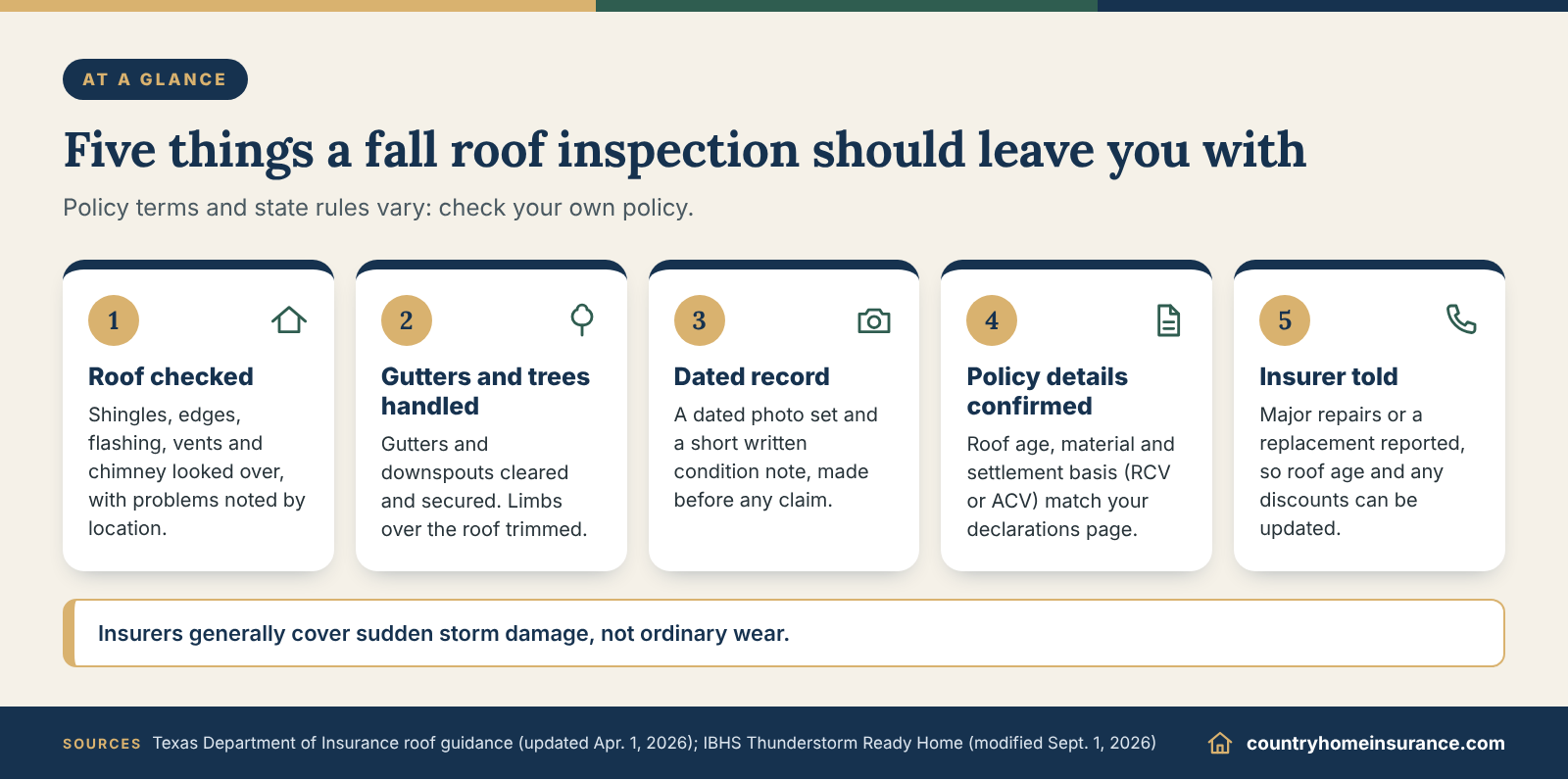
A fall roof inspection insurance routine does two jobs at once: it finds small roof and gutter problems before winter weather makes them bigger, and it creates a dated record of your roof’s condition. Insurers generally cover sudden storm damage but not ordinary wear, and some switch older roofs to actual cash value or decline them. Inspect, photograph, fix what you find, and tell your insurer about major work. Policy terms and state rules vary.
Key takeaways
- Most policies do not cover wear and tear, so a roof that fails from age or neglect is treated differently from one damaged by a covered storm.
- Insurers may inspect a roof at application and may charge more or refuse coverage based on what they see. Some also move aging roofs from replacement cost to actual cash value, so check at every renewal.
- A dated set of photos and a written report from a roofer is the cheapest evidence you can create. Take it before a storm, not after.
- Clear gutters and downspouts, trim overhanging limbs, and check flashing, vents and the chimney. These are low-cost jobs that match what state regulators and IBHS recommend.
- After a roof repair or replacement, tell your insurer so the roof age on your policy is corrected, and ask what discounts or coverage changes may follow.
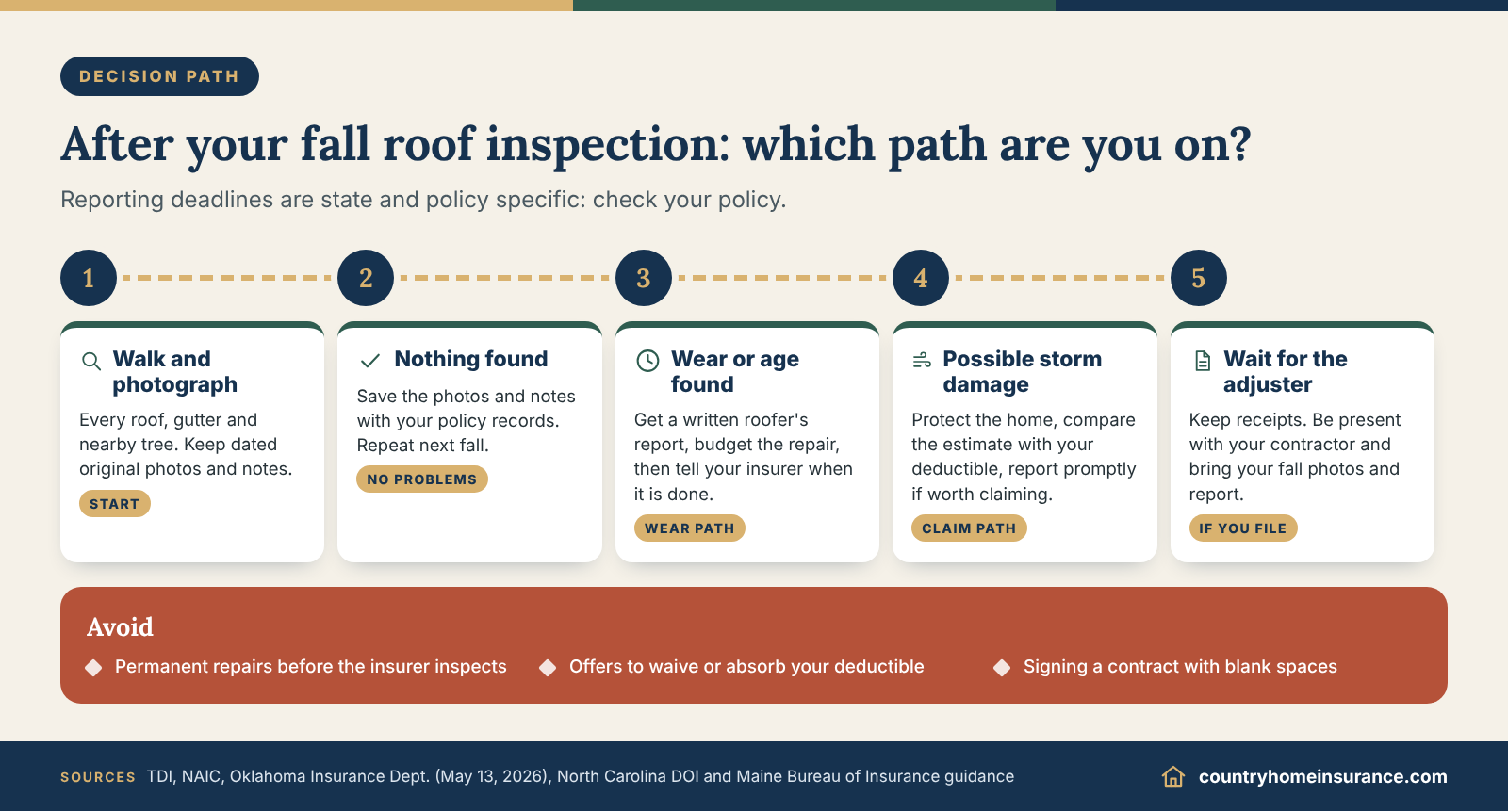
- If you find storm damage, compare the repair estimate with your deductible before filing, and do not let a contractor offer to absorb the deductible.
| What you find | How it is typically viewed | Sensible next step |
|---|---|---|
| Missing or torn shingles after a recent storm | Possible covered storm damage to the dwelling, subject to the policy and deductible | Photograph, protect the roof, compare repair cost with the deductible, and report promptly if it is worth claiming |
| Curling, cracking or worn shingles with no storm event | Typically age and wear, which most policies do not cover | Budget for repair or replacement and ask how age affects your roof coverage at renewal |
| Clogged gutters or downspouts discharging at the foundation | A maintenance issue; resulting damage may be disputed if neglect is the cause | Clear and secure them now, and keep dated photos |
| Overhanging or dead tree limbs | A hazard the insurer may care about; falling limbs are a separate claim question | Trim or have an arborist remove them before winter wind and ice |
| Active leak or stained ceiling | Depends on the cause: sudden storm opening versus long-running seepage | Limit further damage, document it, and read your policy before deciding how to describe it |
| Roof near the end of its service life | May affect eligibility, price, or whether the roof is settled at actual cash value | Get a professional condition report and ask the insurer or agent what they require |
How fall roof inspection insurance questions differ from a roofer’s checklist
A roofer’s checklist asks whether the roof will keep water out. An insurance-minded checklist asks that, and then adds a second question: if something goes wrong this winter, what will the paper trail say about the condition of the roof? This guide covers both, because on a country home with long rooflines, outbuildings and tall trees, the cost of getting either one wrong adds up quickly. It is educational, it does not replace your policy, and it stays on the narrow topic of fall roof and gutter inspections. Hail claims and wind claims are covered in separate guides.
What a fall inspection is actually for
Fall is the last practical window before freezing temperatures, snow and shorter days make roof work harder and more dangerous. It is also the stretch when leaves and seed pods fill gutters and when any summer storm damage is still easy to tell apart from newer wear. The goal is not a perfect roof. It is a short list of known conditions and what you did about them.
Catching small problems before winter makes them bigger
The Texas Department of Insurance, in guidance last updated April 1, 2026, tells homeowners to check for missing or damaged shingles after storms, trim limbs that hang over or near the roof, check the chimney for loose bricks that could fall onto the roof, and keep gutters clear so water does not damage the roof. None of those jobs is expensive when done in October. Each becomes more expensive if it is left until a leak shows up on a ceiling in January, because by then the repair involves interior drywall, insulation and a roofer working in the cold.
Creating a dated record you can point to later
If you ever file a roof claim, one of the first questions is whether the damage came from a recent covered event or from long-running deterioration. A set of dated photos and a short written condition note, made before any claim, helps answer that. It also protects you at renewal, when an insurer may ask about roof age and condition. Think of it as the insurance equivalent of a vehicle service record: unglamorous, but worth far more when you need it than it cost to make.
How insurers look at roofs
Roofs are one of the biggest drivers of both claim cost and underwriting decisions on a homeowners policy. That is why a fall inspection has an insurance side at all. Understanding what insurers can see, and when, helps you avoid surprises.
Inspections at application and at renewal
TDI says insurers inspect the roof when you apply for a policy and that, based on what they find, an insurer may charge a higher premium or refuse coverage. TDI separately notes that a company may require repairs to a home in bad condition before renewing. The NAIC consumer page adds that insurers may require owners of older homes to update systems such as heating, plumbing, wiring and roofing. The details vary by company and by state, so a fall inspection of your own gives you a chance to find and fix what an underwriter would flag, on your schedule instead of theirs.
Roof age and material on your declarations page
Your declarations page, the summary page of your policy, and the underwriting file behind it may record the roof’s age and material. TDI advises checking that the policy lists the correct roof age and material and says your agent can confirm this. If the recorded age is wrong, you could be priced or settled as though the roof were older than it is. If the roof really is old, the recorded age is a clue about how a future claim might be settled, which the next sections explain.
What to check on the roof, gutters and everything that touches them
This is the working part of the inspection. It is organized from the roof surface down to the ground, so you can walk the property once and keep notes as you go. Wherever a step involves climbing, the safest answer is usually to look from the ground or hire a professional, which the next section covers.
The roof surface and its weak points
Asphalt shingles are the most common roof covering in the country. IBHS says they are on nearly three-quarters of single-family homes, and it adds that failures continue to occur at wind speeds well below the supposed design level, with performance getting worse as shingles age. That is a good reason to look closely at an older roof rather than assume the warranty tells the whole story.
Shingles: curling, cracking, bruising and missing pieces
IBHS lists damaged, curling, loose or missing shingles as the things a licensed roofing company should look for, and says a roof in poor condition is more vulnerable to high winds. From the ground or a window, you can often see missing tabs, lifted corners, bare patches where the granule surface has worn away, and shingles that no longer lie flat. Write down where each one is, by slope and by the room underneath it. Location matters later, because a pattern concentrated on one side can point to a storm, while uniform wear across every slope points to age.
Edges, ridges and hips
A forensic engineering article in the journal of the roof consultants’ association, dated January 2018 and written by engineers at a firm that is often retained by insurers, says eaves, hips and ridges are exposed to higher wind forces and that shingle failure tends to begin at those exposed points. Treat that as one expert perspective rather than settled fact for every roof, but it fits common sense: the perimeter takes the most punishment. Spend extra time on ridge caps and rake edges, and photograph them even when they look fine.
Flashing, vents, skylights and the chimney
IBHS also points to vents, skylights, chimneys, and valleys or seams as places where leaks can start. These are the junctions where two materials meet and where sealant and metal flashing do the work. Look for exposed nail heads, cracked sealant, lifted or rusted flashing, and loose masonry. TDI specifically suggests checking the chimney for loose bricks that could fall onto the roof. A small gap at a vent boot is easy to seal now and expensive to chase once water has run down a wall cavity.
Gutters, downspouts and drainage
Gutters are not usually thought of as an insurance topic, but they sit at the edge where roof water, ice and debris all meet. They are also the item most often neglected on large country homes with several rooflines.
Clearing debris and checking the fasteners
IBHS recommends that gutters be secured with straps and that debris and vegetation be cleared from gutters, downspouts and drains. TDI makes the same basic point from the roof side: keep gutters clear so water does not damage the roof. In practice that means removing leaves and seed pods, looking for sagging runs and loose hangers, and confirming that joints are not separating. If you hire the work, ask for a dated photo of each run before and after. If you do it yourself, take your own.
Where the downspouts send the water
IBHS suggests directing downspout water roughly three to four feet away from the foundation. On a rural lot, also notice where that water goes after it leaves the extension: toward a well casing, a septic field, a barn doorway, or a low spot that already stays wet. Water that pools where it should not is a maintenance problem first, and a later loss that traces back to a neglected condition can raise questions under the policy’s wear and maintenance language.
Gutters and winter water
IBHS lists ice dams, frozen pipes and heavy snow loads on roofs among the winter risks that it plans to address through education. Gutters that are full of debris before the first freeze are more likely to hold water that turns to ice. The regulator sources reviewed for this guide did not say how policies treat ice-related roof damage, so ask your agent how your policy handles it rather than assuming.
Trees, the attic and outbuildings
The roof is only part of the system. What hangs over it, what sits under it, and what is attached to it all feed into how a fall inspection should go.
Limbs over the roof and dead trees nearby
IBHS recommends trimming limbs away from the house, especially those overhanging the roof, and having an arborist remove overhanging branches and any dead, dying or diseased trees, because high winds can turn them into damaging debris. On acreage, that includes the trees along the lane and around the barn, not just the ones by the front door. A tree that falls is a covered-cause question for another day, but a documented trimming job shows that you took reasonable care.
Signs from inside the attic
A quick look in the attic on a bright day can show daylight where it should not be, dark stains on the underside of the roof deck, damp insulation, or a musty smell. IBHS recommends sealing exterior gaps and cracks and checking weather stripping because wind-driven rain can enter through any opening. Take photos of anything you see, and note the date. If you find active moisture, treat it as a repair priority and avoid describing the cause until you actually know it.
Barns, sheds and other roofs on the property
Detached garages, barns, workshops and sheds have roofs too, and they are usually older and less maintained than the house. The NAIC consumer page lists other structures such as detached garages and fencing among the things a typical homeowners policy addresses, but how an outbuilding roof is settled, and whether farm or business use limits coverage, depends on the policy. Include every roof on the property in your walk-through, and photograph each one.
Should you inspect the roof yourself or hire a professional?
The honest answer is both, in different ways. You can do a useful ground-level look in an hour. A professional adds access, trained eyes and a written report that carries more weight with an insurer than your own notes. Nothing in the sources reviewed for this guide recommends that an ordinary homeowner walk a steep or wet roof, and a fall off a roof is a far bigger risk than a missed shingle.
What you can safely do from the ground and the attic
A careful homeowner can gather most of the useful facts without leaving the ground. The aim is to record what you can see, not to diagnose it.
Binoculars, a phone camera and a sketch map
Walk the whole perimeter in good light, ideally in the morning or late afternoon when low sun makes raised or missing shingles easier to spot. Use binoculars or the zoom on a phone to look at ridges, valleys and flashing. Draw a rough sketch of each roof and mark anything you see with a number that matches a photo. Take wide shots first, then close-ups, and keep the original files rather than screenshots so the date information stays attached. Photograph gutters from the ground as well, including any sagging runs or visible debris.
Clues inside the house
Look at ceilings and the tops of exterior walls for stains, bubbling paint or fresh patches. Check around windows, chimney chases and bathroom exhaust vents. A stain that appears after a particular storm tells a different story from one that has slowly spread over years, and neither is something to guess at. If you see one, record the date and the weather in your notes, put a bucket or plastic where it helps, and move on to getting it diagnosed. The NAIC homeowners page notes that water damage from a roof leak is typically covered, while groundwater, rain runoff and snowmelt flooding are not, so the cause matters a great deal.
When and how to bring in a roofing professional
TDI recommends hiring a roof inspector every few years to catch problems early. Many homeowners wait until a storm sends them looking for one, which is the worst time to find a trustworthy contractor.
What a good inspection report should contain
Ask for a written report that you can keep, not just a verbal assessment. At a minimum it should describe the roof covering and approximate age, list each problem found by location, include dated photos, say which items are repairs and which are signs of general aging, and give a rough remaining-life opinion. Ask the inspector to state plainly whether anything looks like recent storm damage, wear, or a past repair. That distinction is the one that matters later, and a professional who is willing to put it in writing is worth more than one who simply hands you an estimate.
Sales pressure, free inspections and deductible offers
After storms especially, door-to-door contractors may offer a free inspection. The NAIC advises that you should not agree to repair terms you are uncomfortable with and should not be rushed. The Oklahoma Insurance Department, in a May 13, 2026 release, advises getting more than one bid, checking references, verifying the contractor’s state license and liability insurance, not paying upfront, not making the final payment until the job is finished, and never signing a contract with blank spaces. Both Oklahoma and Texas regulators warn about offers to waive or rebate a deductible. TDI says it is illegal in Texas for a contractor to offer to waive, rebate or absorb a policyholder’s deductible, and Texas also bars a roofer from acting as a public adjuster on a claim for work that roofer will perform. Rules in your state may differ, so check with your Department of Insurance.
Keeping the inspector independent of the repair
An inspection is most useful when the person writing it has no stake in selling you a full replacement. Some homeowners hire an inspector or roofer who only reports, and then collect separate bids for any work. Others use the same company for both. Either approach can be sound, but if the report will be used to support an insurance question, an independent condition report is easier to rely on. Ask directly whether the inspection fee is credited toward work, and be cautious if an inspection report arrives with a contract attached.
Roof age, ACV versus replacement cost, and the maintenance exclusion
This is the core of the insurance side. Three ideas work together: how old the roof is, how the policy settles a roof loss (at actual cash value or replacement cost), and what the policy says about wear, deterioration and maintenance. A fall inspection gives you facts for all three.
How roof age changes what a policy may pay
Replacement cost value, or RCV, is the cost to repair or replace with similar materials of like kind and quality at today’s prices. Actual cash value, or ACV, is that cost minus depreciation, which is an allowance for age and wear. The NAIC explains that ACV factors in age and wear and often falls short of fully replacing the property, while RCV is not the same as market value, which includes land. Roofs are where the two settlement bases differ most in dollars.
Insurers may move an aging roof to actual cash value
TDI says that as a roof ages, some insurers switch its coverage from replacement cost to actual cash value, and it advises checking for this at each renewal. TDI also says insurers should notify you when they change your roof coverage. United Policyholders, an advocacy group, wrote in April 2026 that some carriers now limit older roofs, in the range of 15 to 20 years old, to ACV, and treats that as a Texas-focused observation rather than regulatory data. The practical lesson is the same everywhere: read the renewal notice and the declarations page for a roof-related change, because it can arrive as a short line item.
A worked example of the difference
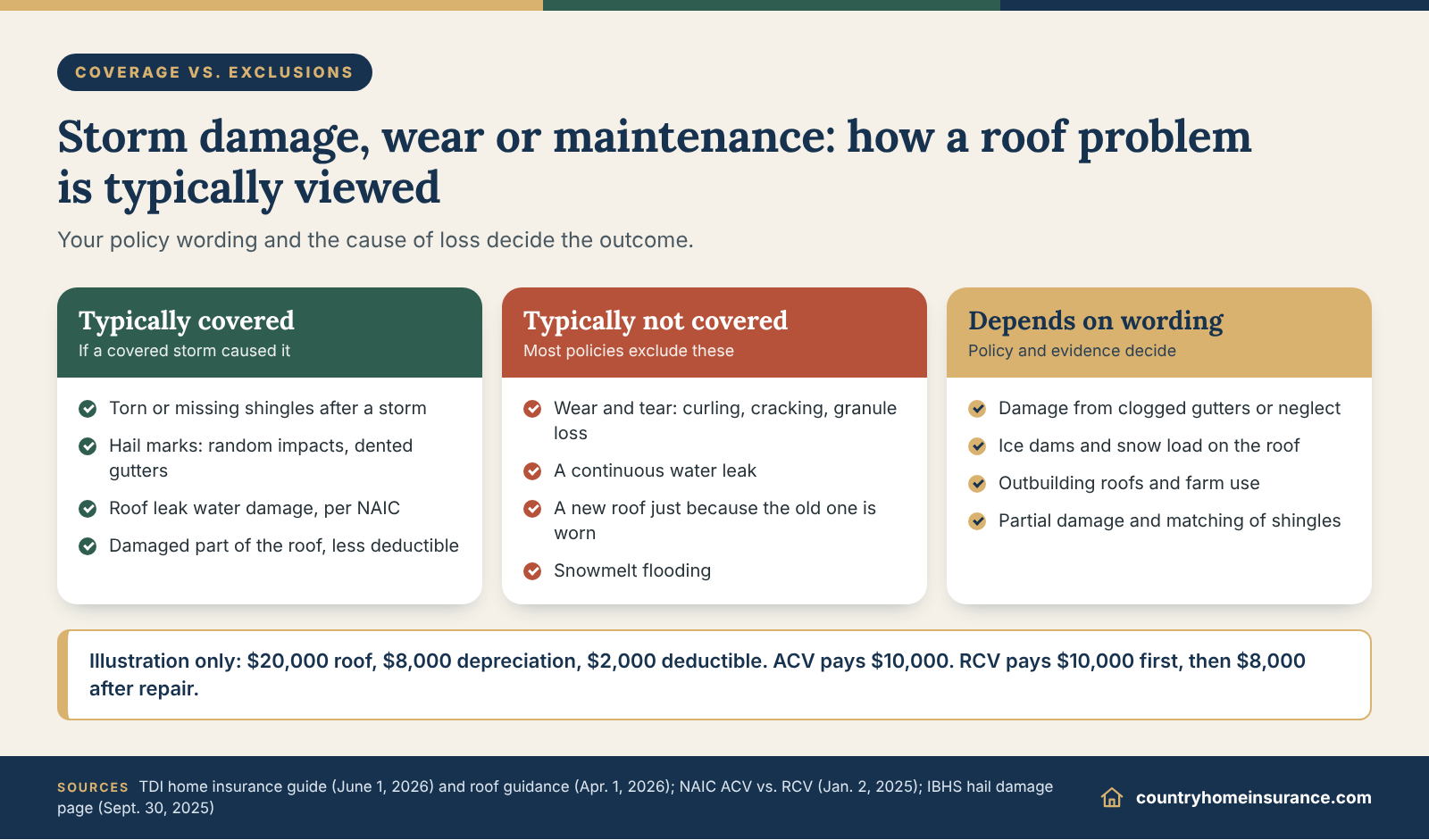
TDI’s home insurance guide, last updated June 1, 2026, uses a $10,000 roof replaced after a storm as an example. In its illustration the homeowner is left with about $2,000 out of pocket under a replacement cost policy and about $5,000 under an actual cash value policy. Here is a second, round-number example. Hypothetical example, not a quote or a promise of payment: a roof costs $20,000 to replace, the insurer estimates $8,000 of depreciation, and the deductible is $2,000. Under an ACV settlement the insurer pays $20,000 minus $8,000 minus $2,000, or $10,000, and you cover the other $10,000. Under an RCV settlement the first payment is $10,000, with the $8,000 of withheld depreciation released after the work is done, leaving you responsible for the $2,000 deductible.
Why replacement cost payments often come in two checks
TDI says many companies pay replacement cost claims in two checks: an initial payment based on actual cash value, then the depreciation after the work is finished. Maine’s Bureau of Insurance describes the same pattern, with the remaining difference usually paid after you show the property was repaired or replaced. The Oklahoma Insurance Department says replacement cost policies generally require the work to be completed within six months of the date of loss to obtain the withheld payments, and it recommends checking your own policy for the actual deadline. That is why an old roof that you plan to replace anyway is a poor candidate for postponing, and why timing should be part of any conversation with a contractor.
| Factor | How it can matter | Where to check |
|---|---|---|
| Roof age | Some insurers move aging roofs from replacement cost to actual cash value, and the recorded age on the policy should be correct (TDI, April and March 2026) | Declarations page, renewal notice, agent |
| Roof condition | A roof in poor condition may be declined or may draw a repair requirement before renewal (TDI, 2026) | Insurer inspection letter, your own condition report |
| Settlement basis | RCV pays to replace at current cost; ACV deducts depreciation, which can leave a large gap on an old roof (NAIC, January 2025; TDI, 2026) | Loss settlement section of the policy and any roof endorsement |
| Wind or hail deductible | Often higher than the standard deductible and may be a flat amount or a percentage of the dwelling limit (TDI, Maine Bureau of Insurance) | Declarations page deductible section |
| Roof material | Wind-, hail- or fire-resistant materials, including impact-resistant roofs, may qualify for a discount (TDI, 2026) | Ask the insurer what documentation it accepts |
| Recent replacement | Newer roofs often earn better rates, and TDI advises telling the insurer so the age can be updated (March 2026) | Tell the insurer after work is finished |
| Dwelling limit | Many insurers require coverage of at least 80% of replacement cost, and some require 100% (TDI home insurance guide, June 2026) | Declarations page, Coverage A amount |
What wear, deterioration and maintenance exclusions mean for a roof
Homeowners policies are built to respond to sudden, accidental loss from covered causes. They are not maintenance contracts. The specific words differ by policy form, and the sources reviewed for this guide differ in how far they go, so treat what follows as a framework and confirm it against your own policy wording.
What “wear and tear” typically refers to
TDI says most policies do not cover wear and tear, termites or insects, earthquakes or flooding. In roof terms, wear usually means the gradual loss of granules, the slow curling and cracking of aged shingles, and sealant that has dried out with years of sun. The NAIC homeowners page does not list wear and tear explicitly, so rely on the policy language and on your state regulator rather than any one consumer summary. TDI adds that an insurer will not pay for a new roof just because the existing one is old or worn out.
Sudden storm damage versus gradual deterioration
The same roof can have both. A ten-year-old roof with normal wear can still lose shingles in a covered windstorm, and the damaged portion may then be a covered loss even though the rest of the roof is simply old. IBHS and the roof-consultant article both treat the cause as something to be read from the pattern: hail leaves random impact marks, soft spots and collateral dents on gutters, metal flashing and downspouts, while granule loss along edges, uniform wear and discoloration are not hail damage. The consultant article describes unsealing that follows an installation or thermal-cycling pattern as inconsistent with wind. This is a contested area, so if an adjuster calls something wear and you disagree, ask what evidence the conclusion rests on.
The duty to protect the property and the neglect question
The Iowa Insurance Division notes that homeowners policies contain a clause requiring the insured to do what is necessary to prevent further damage. TDI’s home insurance guide says that a continuous water leak is not covered, and it says the guide does not specifically address maintenance or neglect, telling readers to check their policy for those terms. That caution is worth repeating: do not assume the exact exclusions. A known leak that you leave alone for months, followed by interior damage, is the kind of situation where insurers may argue the loss was gradual or that you failed to protect the property. A dated repair record helps you show you acted.
Deductibles and the decision to claim
Even a covered roof loss is reduced by the deductible, and on roofs the deductible is often not the number on the front page of your mental policy summary.
Percentage deductibles on wind and hail
TDI and the Maine Bureau of Insurance both say wind and hail deductibles are often larger than other deductibles, and Maine adds that they may be a flat amount or a percentage of the dwelling limit and appear on the declarations page. United Policyholders cites a typical range of 1% to 5% of insured dwelling value in Texas. Hypothetical example: a $300,000 dwelling limit with a 1% deductible means the first $3,000 is yours; at 2% it is $6,000. Fall is the right time to check which one you have, because the number should shape how you decide about small repairs.
When a small repair is cheaper than a claim
The NAIC says to know your deductible before reporting damage and to compare it with the expected repair cost, because minor damage may be cheaper to cover yourself. The Oklahoma Insurance Department says that if damage is at or slightly above the deductible you may choose to pay for repairs yourself, and that you should file if the cost is substantially above it. Claims can also affect future pricing and availability, but how much varies by insurer and state, so ask your agent before filing for a modest loss.
Documenting the inspection and talking to your insurer
An inspection that nobody can prove happened helps very little at claim time. This section turns your walk-through into a record, then covers what to tell the insurer, and when.
Building a record that holds up
You do not need special software or professional gear. You need consistency, dates and a safe place to keep the files.
Dated photos and notes, kept off the property
Take the same set of photos each fall: each roof slope, each corner of the house, ridges and valleys, flashing and vents, gutters and downspouts, and the trees closest to the structures. Keep the original files and add short notes about weather and condition. The NAIC advises storing an inventory copy away from home, and the same logic applies here. A cloud folder or a drive kept at a relative’s house means a fire or storm cannot take both the roof and the proof of what it looked like.
Receipts, invoices and condition reports
Keep every roofer’s report, repair invoice and gutter-cleaning receipt in one folder, along with the manufacturer’s shingle information if you have it. The NAIC says to keep receipts for repairs, and TDI’s home insurance guide says the same about repair materials. If a contractor does the work, ask that the invoice state the date, the location on the roof, the materials used and whether the work was a repair or a replacement. Those details are what make a record usable later.
A home inventory belongs in the same folder
Roof records and contents records are two halves of the same preparedness habit. The NAIC offers a free Home Inventory app that lets you photograph items by room, scan barcodes and export the result, and it notes that an accurate inventory gives the insurer the information it needs to help settle claims. Adding your annual roof photos to the same cloud folder makes the fall check part of a once-a-year ritual instead of a separate chore.
What to tell the insurer and when
Most homeowners never contact their insurer about the roof until a claim. A short, well-timed message after major work is one of the few free things you can do to keep the policy accurate.
After a repair or replacement, update the roof age
TDI advises that if you replace your roof you should tell your insurance company so it can update the age, and it suggests asking your agent whether the roof age and material on the policy are correct. TDI also says newer roofs often earn better rates. Send the invoice or a completion letter from the roofer, and ask the insurer to confirm in writing what was changed. Do the same after a partial replacement, such as a new section over an addition.
Asking about discounts and restoring roof coverage
If your roof coverage was limited because of age or condition, TDI says you can ask whether roof coverage can be added back after repair or replacement. TDI and the NAIC both mention discounts, including for wind-, hail- or fire-resistant roofing and for a new roof. Because discounts and eligibility vary by insurer and state, ask what documentation is required and do not assume a discount will appear automatically. Do not buy an impact-rated shingle only for an expected discount before you have heard what your insurer will actually credit.
Renewal, nonrenewal and what regulators say
The roof is one of the things insurers look at when deciding whether to renew, and rules on how and when they may act differ widely by state. Be wary of generalizations, including the ones in this section.
Inspections, repair requirements and letters you should not ignore
TDI says an insurer may refuse coverage or charge more after an inspection, and that a company may require repairs to a home in bad condition before renewal. If you receive a letter listing roof or gutter conditions, treat it as a deadline, even if it is not labeled as one. Respond in writing, complete the work, and send proof. A fall inspection that has already fixed the same items is your best preparation for a letter like that.
Fixing issues before the renewal date, not after
Renewal notices often arrive weeks before a policy date, and replacing a roof takes scheduling time that can stretch into winter. If your own inspection suggests the roof is near the end of its service life, start collecting bids early and ask your agent what the insurer will require. Finishing work this fall, and sending proof to the insurer, gives you the best chance of having the updated roof information on file before the policy renews.
State rules differ, and some are silent on roofs
Florida’s statute on cancellation and nonrenewal, section 627.4133 in the 2026 online statutes, does not address roof age, roof condition or roof inspections as a basis for limiting nonrenewal, though it does say a claim from an act of God cannot by itself cause cancellation or nonrenewal unless the insurer shows the insured failed to take reasonably necessary action to prevent a recurrence. The Florida Division of Consumer Services also describes a bar on nonrenewal after hurricane or windstorm damage once an emergency order is issued, until 90 days after repairs are complete, with exceptions. These are state examples, not a national rule. If you cannot find coverage in the regular market, many states have a residual-market option such as a FAIR Plan, which California describes as a private association created by its Governor and Legislature that serves residents who cannot get insurance from regular insurers.
Winter, late-season storms and the rural property
The point of doing this in October or November is that the next several months can be hard on a roof. Winter adds ice and snow, late-season storms do not respect the calendar, and country properties have a few quirks of their own.
What winter does to a roof
Winter risk is mostly about water in different forms: ice, snow and meltwater, sometimes combined with wind. The sources for this guide are thin on winter roof claims, so this section stays at the level of what is documented.
Ice dams and snow loads
IBHS names ice dams, frozen pipes and heavy snow loads on roofs among the winter risks it plans to educate homeowners about. An ice dam is a ridge of ice that forms along the roof edge and can hold melting water behind it. Clean gutters and sound flashing give meltwater fewer places to get in. Whether your policy covers resulting interior water damage depends on the policy wording, and the regulator sources reviewed here did not settle it, so ask your agent before winter rather than after the first leak.
Chimneys, heating and the roof penetrations
TDI specifically mentions loose chimney bricks. The National Weather Service adds, in its winter preparation guidance, that if you use a fireplace, wood stove or space heater as an emergency heat source it should be properly ventilated, that a carbon monoxide detector’s outside vent should be kept clear of snow, and that a generator should never be run in an enclosed space. Those are safety points, not coverage points, but a flue or vent that is cracked or blocked is also a roof-penetration problem, so have it checked as part of the same visit.
Frozen pipes are a different guide
Burst pipes are one of the classic winter claims, but they are not a roof topic, and coverage for them turns on other policy features, such as heating requirements and vacancy language. They have their own treatment elsewhere on this site.
Storms don’t stop when the leaves fall
It would be convenient if storm risk ended in September. It does not, and your fall inspection works best when it also happens after any late storm.
Hurricane season runs through November 30
The National Weather Service gives June 1 through November 30 as the Atlantic hurricane season, and says loose objects, including roofing material, can become flying missiles. If you live where a late-season tropical system is possible, finish gutter and tree work now and know whether your policy uses a separate hurricane or named-storm deductible. Arrangements vary by state: TDI notes, for example, that wind and hail are often excluded on the Texas Gulf Coast, where a separate Texas Windstorm Insurance Association policy may be needed.
Wind and hail keep coming
The National Weather Service says sustained winds of 40 to 50 miles per hour can cause isolated wind damage and that straight-line thunderstorm winds can exceed 100 miles per hour. A Carrier Management summary of a Triple-I brief reports that U.S. insured losses from tornadoes, hail, straight-line winds and severe thunderstorms were about $51 billion in 2025, the third straight year above $50 billion. The brief itself is members-only and was not reviewed, so treat the figure as secondary reporting. For homeowners the message is simple: a roof that looked fine in September may not be after an October storm.
Re-check after every significant storm
TDI recommends inspecting for missing or damaged shingles after storms. A short, repeatable post-storm walk-around, with photos taken the same way as your fall set, gives you a before-and-after comparison that helps separate new damage from old.
Country-property specifics
Rural properties have more roofs, longer distances and more variation in how buildings are used. Each of those affects both the inspection and the insurance conversation.
Scheduling and access on acreage
Roofers can be hard to book right after storms and as winter approaches. If your property sits at the end of a private lane or a long gravel drive, tell contractors in advance about the access, gates and any livestock so they can plan equipment and time. Book the inspection early in the fall, and keep a short list of qualified roofers, because getting a reliable one in the middle of a storm cleanup is hard.
Seasonal, unoccupied and secondary buildings
TDI’s home insurance guide says that losses from a house left vacant longer than the number of days stated in the policy may not be covered. If you own a cabin, a seasonal cottage or a guest house that sits empty through winter, find the vacancy or unoccupancy language in your policy and ask whether winterizing, periodic checks or a different policy are needed. A fall roof and gutter inspection is also the moment to arrange someone to look at the building after heavy weather.
Farm, shop and business use
The NAIC homeowners page lists unreported home businesses among exclusions it describes, and it notes that coverage for detached structures can differ. If a barn or shop holds equipment, animals, inventory or income-producing activity, the roof over it may be treated differently from the house roof. Read the other structures coverage and any farm-use language, and ask your agent whether the building needs a different type of policy.
If the inspection finds damage: repair, claim or both
Sooner or later a fall inspection turns up something real. What you do in the next few days affects both the repair and any claim.
Deciding between paying yourself and filing
Not every roof problem is an insurance claim, and not every storm-damaged roof should be left out of one. The decision rests on the cause, the cost and your deductible.
Was it a storm, or was it age?
Begin with cause. IBHS says collateral damage, such as spatter marks or dents on air conditioners, gutters, metal flashing and downspouts, can confirm a hail event, and that look-alikes include granule loss along shingle edges, uniform wear, manufacturing defects, installation marks and granules washed off by heavy rain. Ask your inspector what they see, in writing. If the answer is age, plan the repair or replacement as a budget item and use the inspection report to tell the insurer when it is done.
Cost against deductible, and what a record is worth
Take the written estimate and compare it with the deductible shown on your declarations page, using the percentage if it is one. If the repair is near or below the deductible, the NAIC and the Oklahoma Insurance Department both say paying yourself may make sense. Even so, a record of the damage is worth keeping whether or not you file, because a later storm can make an earlier problem relevant. Ask your agent how a small claim, or an inquiry, may be handled before you decide.
Reporting deadlines and prompt notice
The NAIC says to notify your insurer promptly and that reporting deadlines vary by state. TDI’s home insurance guide says some Texas policies have a one-year deadline unless you can show good cause for the delay. Do not wait to see whether the problem gets worse. If you suspect a covered storm caused the damage, report it and let the insurer decide, rather than letting a deadline pass while you think about it.
If you do file: protecting the home and the claim
The steps below follow what state regulators describe for storm damage generally. They are not a substitute for your policy’s duties after a loss.
Temporary repairs, photos first, receipts always
The North Carolina Department of Insurance advises photographing and listing damage before temporary repairs, making temporary repairs such as tarping a roof so that further damage does not occur, holding permanent repairs until your insurer has inspected and you have agreed on the cost, and keeping receipts because reasonable costs may be reimbursed. Maine’s Bureau of Insurance says permanent repairs should wait for the adjuster or the claim may be denied. Iowa suggests asking your insurer about temporary repairs when you report the loss.
Meeting the adjuster with your contractor
TDI’s home insurance guide says to be present for the adjuster’s inspection, ideally with your contractor, and the NAIC says to consider having your contractor meet you and the adjuster. Bring your fall photos, the inspection report and your list of what was repaired and when. Give the adjuster the full picture of the roof’s history, including old repairs, because a record you volunteer builds credibility.
Partial damage and matching
TDI notes that an insurer might not pay to replace an entire roof if only part of it is damaged, even where new shingles do not match perfectly. Rules on matching and uniform appearance vary by state, and this guide did not verify any particular state’s rule. Ask the adjuster how the insurer approaches partial repairs, and ask your state Department of Insurance whether your state has a rule on matching.
| Task | What to document | Who to ask or what to read |
|---|---|---|
| Walk the roof lines from the ground | Dated wide and close photos of each slope, ridge, valley, flashing and vent | Your own notes; a roofer if anything looks wrong |
| Clear and secure gutters and downspouts | Before and after photos; receipt if hired | Gutter or roofing contractor; IBHS Thunderstorm Ready guidance |
| Trim limbs and remove dead trees near structures | Photos before and after; arborist invoice | A qualified arborist |
| Get a professional roof condition report | Written report with age, material, findings and photos | An independent roofer or inspector; TDI recommends inspections every few years |
| Confirm roof age, material and settlement basis | Copy of declarations page and any roof endorsement | Your agent or insurer; read the loss settlement section |
| Check your wind, hail and named-storm deductible | The percentage or dollar amount, and the dollar figure it equals | Declarations page; agent |
| Tell the insurer about major work | Invoice, completion letter, new roof material and date | Agent or insurer; ask about discounts and restoring roof coverage |
| Review vacancy, farm-use and other-structure terms | Notes on which buildings are used for what | Policy wording; agent; your state Department of Insurance for case-specific questions |
Frequently asked questions
Roof age, coverage and your insurer
Will my insurance pay for a new roof just because mine is old?
Generally not. TDI states that an insurer will not pay for a new roof just because the existing one is old or worn out. A covered event, such as a windstorm, can lead to a payment for the damaged part, and how much you receive depends on the deductible and on whether the roof is settled at replacement cost or actual cash value. Planned replacement due to age is typically a homeowner expense, so it is worth saving toward and timing around your insurer’s requirements.
Can an insurer decline or nonrenew a policy because of my roof?
It may be possible, depending on your state and policy. TDI says insurers inspect roofs at application and may charge more or refuse coverage, and that a company may require repairs on a home in bad condition before it renews. Some states restrict nonrenewal in specific circumstances, as the Florida examples above show, but those rules are narrow. If you receive a nonrenewal or a repair demand, ask for the reason in writing and contact your state Department of Insurance for case-specific help.
Does doing a fall roof inspection lower my premium?
An inspection by itself is not a documented discount. What may affect price is the roof’s age, its condition and its material. TDI says newer roofs often earn better rates and that wind-, hail- or fire-resistant materials may qualify for a discount, so documentation of a new or upgraded roof is worth sending to your insurer. Ask which documents the company accepts, and do not count on a specific reduction until you have it in writing.
Doing the work and handling winter
How often should the roof and gutters be inspected?
There is no single regulator-set schedule. TDI recommends a roof inspector every few years and an inspection after storms, and IBHS suggests a licensed roofing company inspect the roof as part of storm preparation. A reasonable pattern for most country homes is a homeowner walk-through every fall, a professional report every few years or whenever you buy or insure a property, and a quick check after each significant storm. Older roofs and heavily wooded lots justify more frequent attention.
Is it safe to clean gutters and check the roof myself?
Work from the ground or a stable position wherever you can, and hire a professional for steep, high or wet roofs. This guide did not review a ladder-safety standard, so use manufacturer instructions and local safety guidance for any ladder work. For anything that involves walking on the roof, a licensed roofer or gutter service is the safer choice, and the invoice doubles as a record for your insurance file.
Will insurance cover gutter or roof damage caused by ice and snow?
It depends on the cause of loss and the wording of your policy, and the regulator pages reviewed for this guide did not give a general answer. Interior water damage, damaged gutters and collapsed roof sections can be treated differently. Ask your agent before winter, using the specific words “ice dam,” “snow load” and “gutter damage,” and ask for the answer in writing. Also keep in mind that the NAIC says snowmelt flooding is not covered by a typical homeowners policy.
Next steps for this month
You do not need to do everything at once. A realistic plan for a busy household fits into two weekends and one phone call.
This weekend: look, photograph and clear
Walk the property and build the photo set
Pick a clear morning, walk every roof line, and take the photo set described above. Clear what you can reach safely, note what you cannot, and write the date on the first page of your notes. Include every outbuilding, and take a few shots of the trees nearest the structures. When you finish, put the files in the same folder as your home inventory.
Book the jobs you cannot do yourself
Call two or three reputable roofers or gutter services for the work and ask each for a written estimate. Use the contractor checks from the Oklahoma Insurance Department: references, state license where required, liability insurance, no upfront payment and nothing signed with blanks. Schedule an arborist if limbs overhang the roof.
This month: check the policy and make the call
Read the declarations page and the roof terms
Find the roof age and material, the settlement basis for the roof, the wind and hail deductible and any named-storm deductible. If anything looks unfamiliar, circle it for your agent. Confirm your Coverage A limit also looks reasonable in light of rebuilding cost.
Call your agent or insurer with specific questions
Ask whether your roof is settled at replacement cost or actual cash value, whether an age-based change is planned at renewal, what documentation earns any roof-related discount, how ice and snow damage are handled, and whether work you have just finished should be reported. Write down the name, date and answers. For case-specific questions you cannot resolve, contact your state Department of Insurance.
Sources
- Texas Department of Insurance: roof guidance on age, ACV and replacement cost, inspections and maintenance (last updated April 1, 2026; retrieved 2026-10-11)
- Texas Department of Insurance: what to know about replacing your roof with insurance (March 2026; retrieved 2026-10-11)
- Texas Department of Insurance: home insurance guide (last updated June 1, 2026; retrieved 2026-10-11)
- Texas Department of Insurance: roofing and insurance, know the law (last updated March 24, 2025; retrieved 2026-10-11)
- Oklahoma Insurance Department: storm damage and roofing guidance release (May 13, 2026; retrieved 2026-10-11)
- NAIC: the difference between actual cash value and replacement cost coverage (January 2, 2025; retrieved 2026-10-11)
- NAIC: consumer guide to homeowners insurance (undated page; retrieved 2026-10-11)
- NAIC: what you need to know when filing a homeowners claim (April 20, 2022; retrieved 2026-10-11)
- NAIC: Home Inventory app (undated page; retrieved 2026-10-11)
- Maine Bureau of Insurance: wind and storm damage coverage questions (undated page; retrieved 2026-10-11)
- North Carolina Department of Insurance: dealing with the aftermath of a disaster (undated page; retrieved 2026-10-11)
- Iowa Insurance Division: storms and homeowners insurance consumer bulletin (undated page; retrieved 2026-10-11)
- Florida Statutes section 627.4133: notice of cancellation, nonrenewal or renewal premium (2026 online statutes; retrieved 2026-10-11)
- Florida Department of Financial Services: homeowners insurance FAQ (undated page; retrieved 2026-10-11)
- California Department of Insurance: California FAIR Plan (undated page; retrieved 2026-10-11)
- IBHS: Thunderstorm Ready Home guidance (page last modified September 1, 2026; retrieved 2026-10-11)
- IBHS: is it hail damage? (page last modified September 30, 2025; retrieved 2026-10-11)
- IBHS: Strategy 2026 (page last modified January 20, 2026; retrieved 2026-10-11)
- IIBEC / RCI Interface: misconceptions of wind damage to asphalt composition shingles (January 2018; forensic engineering perspective; retrieved 2026-10-11)
- National Weather Service: hurricane safety and season dates (undated page; retrieved 2026-10-11)
- National Weather Service: wind safety (undated page; retrieved 2026-10-11)
- National Weather Service: winter storm preparation (page created 2019; retrieved 2026-10-11)
- United Policyholders: Texas peak hail season and percentage deductibles (advocacy source; published April 4, 2026; retrieved 2026-10-11)
- Carrier Management: summary of Triple-I severe convective storm brief (April 16, 2026; secondary reporting; retrieved 2026-10-11)
Important coverage note
Coverage depends on your actual policy, endorsements, exclusions, limits, deductible and the cause of loss. Read your declarations page and policy form. State laws and insurance programs vary, and several of the regulator examples above come from Texas, Oklahoma, Florida and other single states. Verify case-specific questions with your insurer or agent and with your state Department of Insurance. This article is educational information, not legal advice, and it does not promise that any claim will be paid.
About the editorial team
This guide was prepared by the countryhomeinsurance.com editorial team as general, educational information for homeowners. We research and summarize publicly available material, including state insurance departments, the NAIC, federal agencies, regulators’ consumer guides and published insurer and industry resources. We draw only on the sources that were available to us when we wrote this guide, and we list them in the Sources section with dates where we could find them.
Insurance rules, rates, products and program terms change, differ by state and by insurer, and can apply differently to your situation. We cannot guarantee that this content is complete, current or free of errors. It is not legal, financial, tax or insurance advice, it is not an offer to sell insurance or a recommendation of any insurer, agent or product, and reading it does not create a professional relationship of any kind.
To the fullest extent permitted by law, countryhomeinsurance.com and its editorial team, authors and contributors exclude all liability for any loss, damage or decision arising from the use of, or reliance on, this content. For questions about your own policy or claim, contact your insurer, a licensed agent or broker, your state Department of Insurance or another qualified professional.
Content created: October 12, 2026

