Quick answer
Country home insurance acreage coverage usually starts with an ordinary homeowners policy. It insures the house, detached buildings (typically at about 10% of the dwelling limit), belongings and personal liability, but not the land itself. Wells, septic systems, ponds, farm activity, livestock, equipment and some motorized vehicles often need an endorsement, a separate policy or a closer read of the exclusions. Details vary by insurer and state, so confirm everything against your declarations page and ask for answers in writing.
Key takeaways
- A homeowners policy insures structures and liability, not dirt. The land under and around your house is not what gets replaced after a covered loss, so rebuild cost, not acreage value, drives the limits.
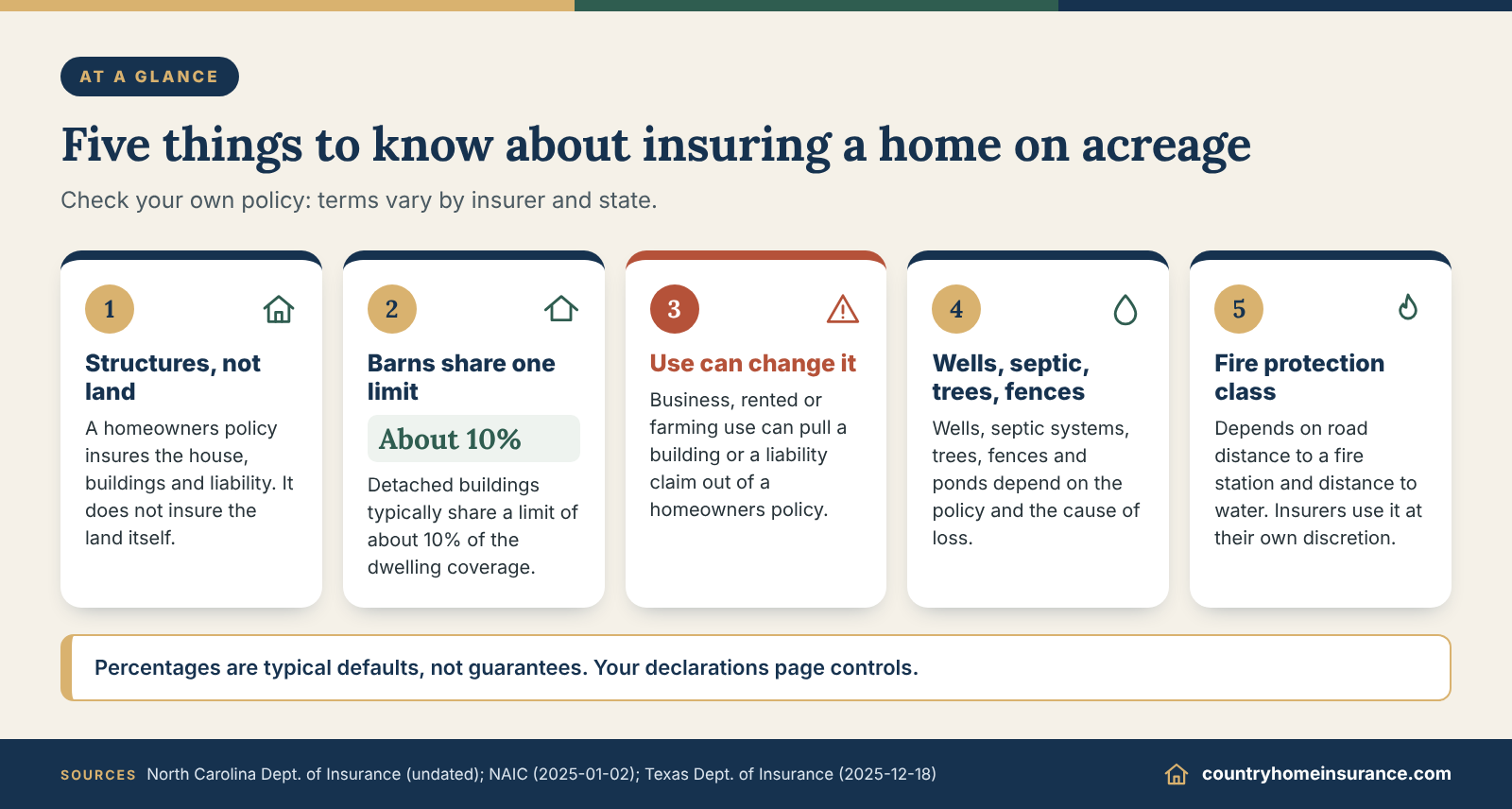
- Detached buildings such as barns, sheds and workshops typically share a limit of about 10% of the dwelling coverage, and that limit may be too small once you add up everything on the property.
- Business use, rented space and farming activity can remove a building or a liability claim from a homeowners policy. A 2024 Mississippi appeals decision turned on exactly this kind of exclusion.
- Wells, septic systems, fences, trees and driveways are handled inconsistently across policies. Sudden physical damage is treated very differently from wear, neglect or flood.
- Fire protection class depends on road distance to a fire station and distance to a water supply, and insurers use it at their own discretion, so confirm your class rather than assuming it.
- More land often means more liability exposure. Ask what your liability limit is, which vehicles and animals are excluded, and whether an umbrella policy makes sense.
| Feature on the property | Where it typically falls | What it usually depends on |
|---|---|---|
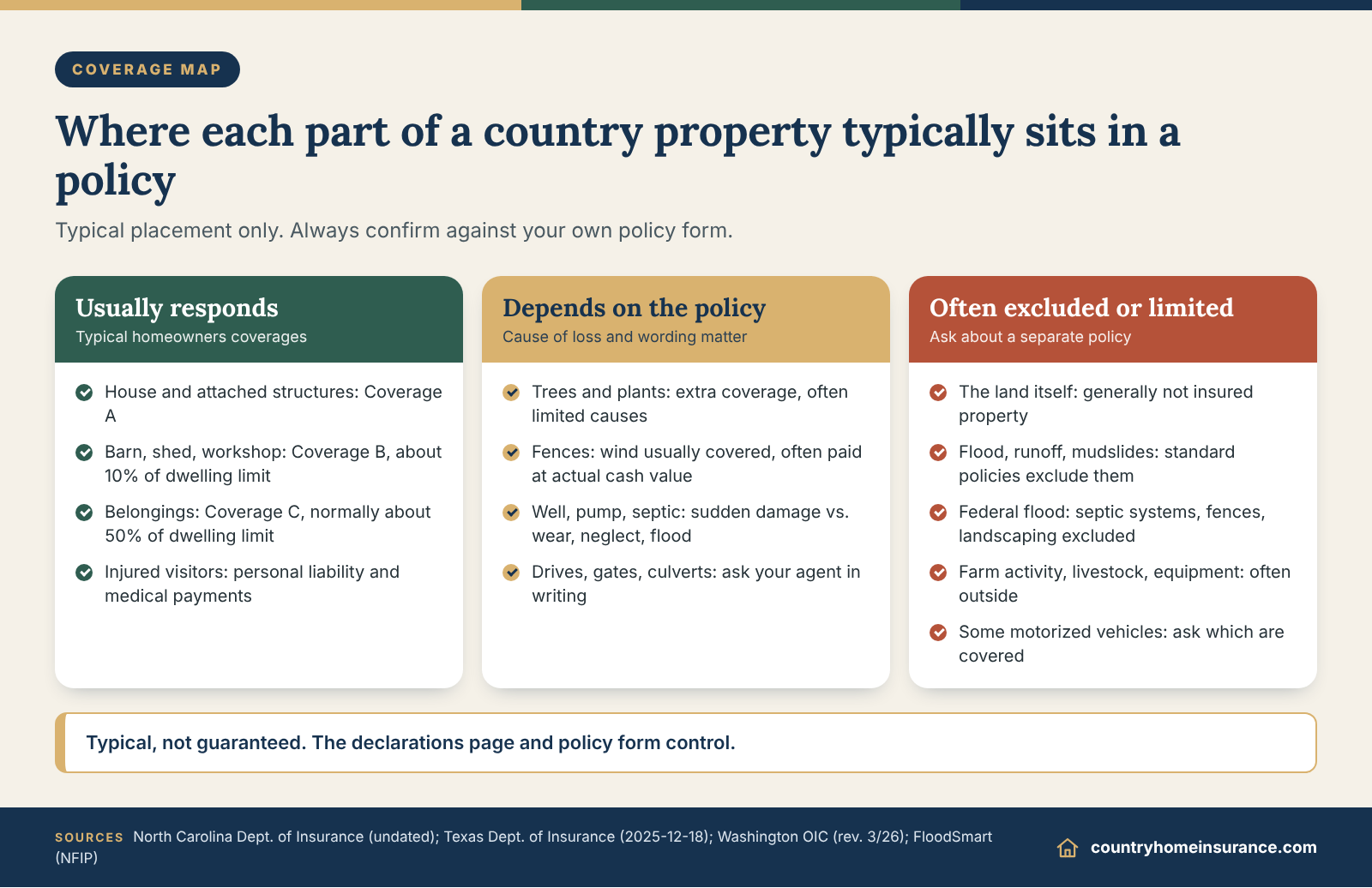
| House and attached structures | Dwelling coverage (Coverage A) | Cause of loss, deductible, replacement cost versus actual cash value, and whether the limit matches rebuild cost |
| Detached barn, shed, workshop, guest house | Other structures (Coverage B), commonly about 10% of the dwelling limit | Whether it is used for business, rented to others or used for farming; whether the combined value exceeds the limit |
| The land itself | Generally not insured property | Land is not rebuilt after a loss; the policy may add limited coverage for some items on it |
| Trees, shrubs and plants | Often an additional coverage with its own limits and named perils | The cause of loss, any per-item caps and whether a separate deductible applies |
| Fences | Usually other structures | Wind versus ice or snow damage; many fences are paid at actual cash value |
| Well, pump and septic system | Varies by form and endorsement | Sudden damage from a covered cause versus wear, neglect or flood; service-line endorsements differ |
| Flood on the land or to outdoor items | Excluded from standard policies | Separate flood insurance; the federal program excludes items such as septic systems, fences and landscaping |
| Farm activity, livestock, farm equipment | Often outside a homeowners policy | Farming or business exclusions, incidental-farming endorsements, or a farm policy |
| Visitors injured on the land | Personal liability and medical payments (Coverages E and F) | Limits, excluded vehicles and animals, business activity, and any umbrella policy |
Country home insurance acreage basics: what changes when the lot gets big
People looking into this topic are usually trying to figure out one thing: how much of what they own on that land is actually protected. The house is only one piece. There may be a barn, a shop, a pole building, a well house, a pond, a long gravel drive and a few hundred feet of fence. A standard homeowners policy was built around a house on a lot, and the further your property drifts from that picture, the more the fine print matters.
This guide stays on that one question: what the dwelling policy does and does not do when a home sits on acreage. For the broader rural picture, see our guide to rural home insurance and what standard policies miss. If you are already past a certain size, our pages on 5-plus-acre properties and 10-plus-acre properties go deeper on how insurers treat larger parcels.
What a dwelling policy insures, and what it leaves out
Before you can judge a gap, you need a clear picture of the standard building blocks. Insurance regulators describe homeowners coverage in roughly the same pieces, even if the labels differ from one policy to the next.
The six coverages in one pass
Most homeowners policies are organized into lettered coverages. Dwelling (Coverage A) protects the house and attached structures. Other structures (Coverage B) protects detached buildings. Personal property (Coverage C) protects belongings. Loss of use, also called additional living expense (Coverage D), pays certain extra costs if you can’t live in the home after a covered loss. Personal liability (Coverage E) responds when you are legally responsible for injuring someone or damaging their property. Medical payments to others (Coverage F) pays limited medical bills for guests hurt on your property.
The North Carolina Department of Insurance explains that other structures coverage is normally limited to 10 percent of the dwelling limit, personal property is normally 50 percent, and loss of use is normally 20 percent, with more available for an added premium. Those percentages are typical defaults, not guarantees. Your declarations page shows the numbers that actually apply to you.
Why the land itself is not what you are insuring
The most common misunderstanding on acreage is the idea that a bigger, more valuable property means a bigger policy. It doesn’t work that way. The NAIC, the association of state insurance regulators, notes that replacement cost covers only the cost to repair or replace the property, while market value includes the land and the real estate market. A hundred acres of timber doesn’t change what it costs to rebuild a farmhouse.
That has a practical consequence. Your dwelling limit should track the cost to rebuild the house on your site, including local labor and material costs, and the land value should stay out of the calculation entirely. If you base your limit on a county appraisal that includes acreage, you may overinsure the house and still leave the barn short.
How country home insurance acreage differs from a town-lot policy
Underwriters, the people who decide whether and how to insure a property, ask different questions when the lot is large. Some of those questions help you and some raise your price or narrow your options, but all of them show up in the application.
More buildings, more exposure, more questions
On a town lot, the exposure is a house, maybe a garage and a shed. On acreage, an insurer may see a house, several outbuildings, equipment, animals, a pond, fuel tanks, a well and a septic field. Each of those can change what the insurer is willing to cover and on what terms. Kiplinger reported in 2024 that some insurers say a property above a certain number of acres no longer qualifies for a traditional homeowners policy, which means the cutoff is an insurer decision rather than a single industry rule. We cover how size changes eligibility in the size-specific guides linked above.
The takeaway for an application is simple: describe the property as it is. If you keep chickens, rent the apartment over the shop, or let a neighbor graze cattle on your back forty, say so. An insurer who learns about it after a loss is in a far stronger position than one who was told up front.
Distance, access and response time
Acreage usually means distance: from the road to the house, from the house to the nearest fire station and from the station to a reliable water supply. The Washington Office of the Insurance Commissioner’s homeowner guide says that underwriting considers how far the home is from the nearest fire department and hydrant, and how quickly responders can arrive. We unpack how that works in the fire-protection section below, because it is one of the few rate and eligibility factors you can partly verify and sometimes improve.
Access matters for another reason. A long private drive, a narrow bridge or a locked farm gate can slow a fire engine or an ambulance. That is a safety issue before it is an insurance issue, and it is worth thinking about now rather than during an emergency.
Barns, sheds and detached buildings: how other-structures coverage really works
For most acreage owners, the biggest dollar gap sits in Coverage B. The house gets a limit that is based on rebuild cost, and everything detached shares a much smaller pot. Understanding how that pot is calculated, what it pays for and where it stops is the single most useful thing you can do before you shop.
How the other-structures limit is set and what it responds to
Coverage B is the part of the policy for buildings that are not attached to the house. The Texas Department of Insurance says these generally include detached garages, storage sheds, pools, guest houses, outdoor kitchens, and barns or chicken coops. That page was last updated in December 2025 and reflects Texas practice, but the structure of the coverage is similar elsewhere.
The typical 10% limit, with a worked example
The usual default is 10% of the dwelling limit. Texas gives the example that a $300,000 dwelling limit would provide $30,000 for other structures. Maine’s Bureau of Insurance, in its homeowner guide updated in 2021, also describes a typical limit of 10% of dwelling coverage that many insurers let you raise for an added premium.
Hypothetical example: Suppose a house carries a $350,000 dwelling limit, so the other-structures limit is about $35,000. On the property sit a 30-by-40 pole barn, a shop with a concrete floor, a machine shed and 900 feet of board fence. If the combined cost to rebuild those items is $110,000, one bad hailstorm or fire could exhaust the $35,000 limit long before the damage is repaired. These figures are illustrative only and are not a quote or a prediction of any claim outcome.
Which causes of loss apply and how the deductible works
Detached buildings are generally covered for the same causes of loss as the house. Texas lists fire, hail, theft and sudden and accidental water damage as examples. The same page notes that you pay your deductible on an other-structures claim as well, so a small loss to a shed may fall entirely within the deductible.
The key phrase to look for in your own policy is the cause-of-loss language. Policy forms differ on which causes of loss are listed and which are excluded, and endorsements can change the list. Read the perils section for other structures in your own form and ask your agent to confirm that wind, hail, fire, theft and sudden water damage apply to your barn the same way they apply to your house.
When a building falls outside the dwelling policy
The more useful a building is, the more likely it is to run into an exclusion. A barn that stores hay for sale, a shop where you repair neighbors’ trucks and a cabin you rent by the weekend all share one trait: they are used for more than your household.
Business use and rented space
Several state regulators describe the same pattern. Washington’s guide says other-structures coverage usually excludes buildings that renters occupy or that are used for business. Maine’s Bureau of Insurance warns that most homeowner policies exclude business use of the home, and that a separate building used for business, such as a workshop or a rented garage apartment, may no longer count as a covered structure.
The practical lesson is that a few weekend jobs and a steady side business can look very different to an insurer. If any income flows from a building, tell your agent and ask whether the building, its contents and the liability from customers are covered, need an endorsement or need a separate policy.
Equipment, tools and stored property
Even when the building is covered, what is inside it is a different question. Equipment and tools often fall under personal property coverage, which is typically a smaller percentage of the dwelling limit and may have sublimits for certain items. The NAIC’s consumer page lists business inventory kept at home among the items that may need separate coverage. Farm equipment is a bigger gap still, which we take up in the farm-boundary section.
A good habit is a room-by-room, building-by-building inventory with photos, so that your barn’s contents are documented before you need to prove them.
Making the limit fit the buildings you actually have
Once you know the default, the next step is deciding whether it is enough and how to adjust it. There are three levers: the limit itself, the amount you insure each building for, and the way fences and similar items get paid.
Insuring each building to value
North Carolina’s explanation of Coverage B adds an important detail: the limit should be at least 80 percent of the replacement cost of the other structures, or the payout may be reduced. In other words, the same underinsurance penalty that applies to the house can apply to the barn. A rough rebuild estimate for each structure, using a local contractor’s price per square foot, is worth the afternoon it takes.
Why fences are often paid differently
Fences deserve their own line because acreage owners have so many feet of them. Texas says wind damage to a fence is usually covered when you have wind coverage, but fences are typically paid at actual cash value, which subtracts depreciation, and ice or snow damage to a fence is usually not covered unless a collapsing house falls on it. Other states and forms differ, so check yours. If a fallen tree takes out a fence, our guide to what happens when a tree falls on a fence walks through the claim.
Raising the limit or insuring a building separately
If the math doesn’t work, there are two common fixes. You can ask the insurer to raise Coverage B, which Maine and North Carolina both describe as available for additional premium. Or, if a building really belongs to a different use, it may be better insured under a different policy altogether. Our category page on outbuildings and other structures covers those options in more detail.
Wells, septic systems, trees, roads and ponds: the land-based items
Some of the most expensive things on a country property aren’t buildings in the usual sense. They’re buried, drilled, planted or graded. A well, a septic field, a mature windbreak and a half-mile of driveway can each cost real money to replace, and policy forms treat them inconsistently. The honest answer for most of these items is “it depends on the cause of loss and the exact wording,” so this section focuses on how to ask the right question.
Wells and septic systems
Wells and septic systems are the two utilities you personally own and maintain. That ownership shapes how both insurers and regulators talk about them.
The private well
If you draw household water from a well, you are the water utility. The EPA states that private well owners are responsible for making sure their household water is safe, that private well water is not regulated by the federal government under the Safe Drinking Water Act, and that most states do not regulate it either. The same page cites a USGS study of 2,100 private wells in which about one in five contained at least one contaminant above a human-health benchmark. The page was updated in August 2026.
From an insurance standpoint, that means a few separate questions. Is the pump or pressure tank damaged by a sudden covered event such as fire or lightning? Is a pump house treated as an other structure? And if the water becomes unsafe, is there any coverage for testing, treatment or an alternate supply? We did not find a regulator source that answers those three questions generally, so ask your insurer and get the answer on paper.
The septic tank and drain field
The EPA recommends that an average household septic system be inspected by a professional at least every three years, with yearly inspections for systems that have pumps or float switches, and that the tank typically be pumped every three to five years. It also tells owners not to drive or park on the drain field. Maintenance records can matter if a claim is ever disputed.
On the insurance side, one consumer publisher notes that a septic tank may be treated as part of the home’s structure, so sudden damage from a covered cause such as fire, a vehicle or freezing may be covered while wear and tear, neglect and pests are not. That is a general consumer description from 2022, not a statement about your policy, but the pattern is consistent: sudden physical damage is treated very differently from slow failure.
Service-line endorsements and what they do not fix
A service-line endorsement is an optional add-on that covers certain underground utility lines. A 2023 discussion among insurance-education faculty published by the Independent Insurance Agents & Brokers of America looked at whether such an endorsement pays when a drain field fails. Most panelists concluded that a drain field failure is not itself a service-line failure, and the one claim example involved a drain field clogged by biological buildup that the carrier denied. The panelists did suggest that direct physical damage to underground pipes, for instance a line crushed by construction equipment, might support partial coverage.
That discussion concerned one type of endorsement form, so don’t treat it as a rule. The lesson is to read the endorsement’s definition of covered property and its list of covered events, then ask your agent whether it applies to the septic components and the well lines you actually have. Our guide to water backup coverage explains the neighboring endorsement for sewer and drain backups.
Trees, fences, driveways and private roads
The outdoor items that make a place feel like a home are the ones policies are most likely to limit. They are also the items you notice only after a storm.
Trees, shrubs and plants
Washington’s homeowner guide lists trees, plants and shrubs as an additional coverage that may be limited to specific causes of loss and may carry its own deductible, alongside tree debris removal. Details vary. Some policies cap the amount per tree, some list only fire, lightning or vandalism as covered causes, and wind damage may be treated differently from the cost of clearing a downed tree off the house.
Maintenance counts, too. A consumer publisher notes that a known rotted tree that falls on a garage may not be covered, which fits the general principle that policies pay for sudden accidents, not for neglected hazards. For the full claim process, see our guide to a tree falling on a house.
Private roads, bridges, culverts and gates
This is a real gray area. Long drives, small bridges, culverts and entrance gates can be expensive to repair, and the regulator pages we reviewed did not address them directly. Depending on the policy, a gate or a stone pillar may be treated as an other structure, a driveway may be treated as landscaping or simply left out, and flood or washout damage is likely to run into the same exclusions that apply to everything else on the land.
Don’t guess. Make a short list of the improvements you would need to replace if a storm washed them out, then ask your agent for a written answer on each. If the answer is “not covered,” at least you can budget for it.
Water on the land: flood, runoff and ground movement
Land gives water somewhere to go, and sometimes somewhere to collect. That is where standard policy exclusions and the real world collide.
Flood, and what the federal program leaves out
FloodSmart, the National Flood Insurance Program’s consumer site, states that most homeowners insurance does not cover flood damage. Flood insurance has its own rules. Coverage generally starts 30 days after purchase, with limited exceptions such as a purchase made in connection with a mortgage, and the program offers up to $250,000 of building coverage for a home. Detached garages fall under building coverage, but items outside an insured building, including fences, decks, patios, septic systems, landscaping and swimming pools, are not covered.
For an acreage owner, that last list is exactly the stuff scattered around the property. Flood coverage on the house does not mean flood coverage on the septic field or the fence line. Our guide to whether homeowners insurance covers flood damage goes deeper on the federal and private options.
Ponds, runoff, mudslides and moving ground
The NAIC says standard homeowners policies exclude damage from ground water, runoff and snowmelt, and the North Carolina Department of Insurance notes that most policies do not cover floods, earthquakes, mudslides, mudflows or landslides. A pond overflow, a washed-out hillside and a slope that slides onto a shop all sit close to those exclusions.
We did not find a regulator source on pond dams or retention structures. If you have one, ask the insurer in writing how a dam failure, a spillway washout and erosion of a bank would be treated, and keep the reply with your policy.
| Item | Typical setting or rule described by regulators | What to verify with your insurer |
|---|---|---|
| Other structures (Coverage B) | Normally about 10% of the dwelling limit; more available for added premium; should be at least 80% of the replacement cost of the structures (10% default described by North Carolina, Maine, Washington and Texas; 80% guideline described by North Carolina) | Dollar limit on the declarations page, and total rebuild cost of every detached building |
| Personal property (Coverage C) | Normally about 50% of the dwelling limit, with limits on some categories (North Carolina) | Whether tools, farm items or business property are limited or excluded |
| Loss of use (Coverage D) | Normally about 20% of the dwelling limit; pays extra living costs only; receipts required (North Carolina) | Whether a remote location makes a temporary-housing search harder or costlier than the limit allows |
| Personal liability (Coverage E) | Most policies include at least $100,000 (Washington); you choose the limit | Limit chosen, excluded vehicles and animals, and any umbrella above it |
| Fences | Wind usually covered; often paid at actual cash value; ice or snow damage usually excluded (Texas) | Valuation method and cause-of-loss list for fences |
| Trees, shrubs, plants | Additional coverage that may be limited to specific causes of loss and may have its own deductible (Washington) | Per-item cap, covered causes and deductible |
| Federal flood building coverage | Up to $250,000 for a home; 30-day waiting period with exceptions; septic systems, fences and landscaping excluded (FloodSmart) | Whether private flood coverage offers different terms for outbuildings |
Liability on open land: what your policy pays when someone gets hurt
Property damage is expensive, but liability is what can threaten a family’s finances. A guest stumbles on a loose board in the barn, a neighbor’s child wanders to the pond, a delivery driver is bitten by a dog. On a large property, the number of ways a visitor can get hurt multiplies, and so does the question of whether the policy responds.
What personal liability and medical payments cover
Two of the six coverages deal with other people. They are easy to overlook because they don’t depend on damage to your property.
Personal liability and medical payments in plain terms
The North Carolina Department of Insurance describes personal liability coverage as protection for legal responsibility for injury to others, including a defense and damages the insurer deems appropriate, and notes it does not cover intentional acts. Medical payments coverage pays reasonable medical expenses for people accidentally hurt on your property, does not cover you or your household, and excludes business activities. The Maine guide adds that medical payments can also apply to injuries caused by your pets.
Choosing limits and understanding umbrella coverage
Washington’s guide says most policies include at least $100,000 of personal liability, and that coverage generally follows you away from home. Maine’s guide notes that you choose both limits and that an umbrella policy can raise liability coverage above the homeowners level.
An umbrella is extra liability coverage that sits above your underlying policies and pays only after those limits are used up. One insurer’s farm and ranch umbrella page illustrates the idea: with $1 million of primary liability and a $1 million umbrella, the primary policy pays the first $1 million of a claim and the umbrella pays the next $1 million. That page is one insurer’s marketing material and its limits are not an industry standard, but the layering concept is general. Whether you need an umbrella depends on your assets, your exposures and the underwriting rules of the carrier you choose.
Hazards that come with open space
The features that make land enjoyable are the same features that create claims. Three categories come up repeatedly.
Attractive nuisances: pools, trampolines, ponds and abandoned equipment
An attractive nuisance is a feature that can draw children onto your property. AAA Oregon/Idaho, an insurer and club, explains in a 2026 article that under this doctrine a homeowner can be held liable if a child trespasses and is hurt, and that a “they were trespassing” defense usually fails. It lists pools, hot tubs, trampolines, treehouses, construction materials and abandoned items such as old refrigerators or cars. It does not mention ponds.
Whether a pond or an old stock tank counts is a question of state law, and we did not retrieve a source on it. A local attorney or your agent can tell you how your state treats open water and what fencing or signage is expected. Meanwhile, fencing, gates and removing abandoned equipment are inexpensive steps with an obvious safety benefit. We keep the broader liability picture in our liability and umbrella hub.
ATVs, utility vehicles, tractors and mowers
Motorized vehicles are one of the biggest points of confusion for country homeowners. The Washington guide says autos are excluded from homeowner coverage. A 2022 Virginia Supreme Court decision, summarized by trade publication Rough Notes, shows how detailed the wording can be: the court held that a homeowners policy excluded a passenger’s injuries in an off-property ATV accident because the ATV was a multi-use vehicle rather than a “lawn or farm type vehicle” under that policy’s language.
An insurance-education module describes a typical pattern, in which liability coverage for owned off-road recreational vehicles may apply only at an insured location, while registered or road-licensed vehicles are excluded. The module is undated and describes a generic form, so treat it as an illustration rather than as your policy. Ask which vehicles you own are covered on the property, off it and when a guest is driving.
Guests, gatherings and animals
Hospitality is part of country living, and so are dogs, horses, goats and the occasional escaped steer. The University of Missouri Extension notes that in the farm context, visitor injuries are a typical liability concern and agritourism is a common exclusion. For a homeowner, the lesson is that casual guests and paid or organized visitors are different categories.
Insurers may also decline certain dog breeds or dogs with aggressive histories, according to the Maine guide, and the NAIC lists certain dog breeds and exotic pets among the things that may need separate arrangements. Tell your agent about every animal on the property, not just the household pets.
Where homeowners coverage ends and farm coverage begins
Acreage invites projects. A few laying hens become an egg stand, a pasture gets leased for hay, a barn turns into a place to board a neighbor’s horse. Each step is natural and each one can move you from the world of the homeowners policy into the world of farm coverage. This section is about the boundary, not a full guide to farm insurance. If you already run a working farm, you’ll want a farm-specific resource and a conversation with an agent who writes agricultural policies.
Farming and business exclusions in homeowners policies
Homeowners policies are written for households. Two exclusions do most of the work of keeping commercial and agricultural activity out of them: the business exclusion and, in many forms, a separate farming exclusion.
A real-world example of a farming exclusion
In 2024 the Mississippi Court of Appeals decided Clark v. Alfa Insurance Co., a case discussed in the publication Coverage Opinions. A man who owned 600 acres bought ten heifers; the animals escaped on their first night, and one or more collided with a vehicle on a highway. His homeowner policy excluded bodily injury arising from a business or farming activity, and it defined farming as the operation of an agricultural enterprise. The court sided with the insurer, reasoning that the farming exclusion applied to any agricultural enterprise whether or not it was profitable or run as a business.
This is one court, one policy and one state, so it doesn’t prove how your claim would go. It does illustrate a point that surprises many landowners: buying livestock can change the coverage analysis even if the animals are a hobby and no one is selling anything. Policy definitions of “farming” and “business” vary, so ask your insurer how your form defines them.
Hobby versus business: where insurers draw the line
Many people assume a small operation counts as a hobby and therefore stays inside the homeowners policy. Insurers don’t necessarily see it that way. A 2012 Insurance Journal article, which is old but still describes a common structure, says standard homeowners forms typically exclude business and farming activities, that limited hobby activity may be covered, and that some insurers want a farm policy once a property produces and sells goods. Farm Bureau Financial Services, an insurer, offers a 2026 example: selling eggs could raise a foodborne-illness liability question, and storm damage to equipment or theft of beehives may not be covered under a homeowners policy.
Maine’s Bureau of Insurance lists activities insurers may treat as business, including making or selling items, teaching lessons, pet grooming, child care and renting storage or an apartment. A farm stand fits that list in spirit even though farming isn’t named. The safe approach is to describe each activity, its scale and any income to your agent and ask for the answer in writing.
Incidental-farming endorsements and their limits
Some insurers offer an endorsement that stretches a homeowners policy to cover limited farming. An article in IA Magazine, the publication of the Independent Insurance Agents & Brokers of America (2023, sponsored by an insurer), says carriers cap the number of animals they will cover, a homeowners policy won’t cover commercial use of animals, and hired help is typically difficult to cover under personal lines. It cites one endorsement providing up to $10,000 for farm personal property, an example and not a market standard.
The Insurance Journal piece names two standard endorsement forms, one for incidental farming and one for farmers personal liability, and notes that both require listing every farming activity, because an unlisted activity may be left uncovered. Form numbers change over time, so confirm current forms with your carrier. The idea to hold onto is disclosure: an endorsement helps only for what it describes.
What farm-oriented policies add
If farming moves beyond occasional and personal, the next step is usually a farm package or a farm-liability policy. Understanding what they add can help you decide whether you need one now or can wait.
The farmowners policy structure
Maine’s Bureau of Insurance describes the Farmowners policy as a ready-made bundle that covers both the farm operation and the residence. The residential side includes the dwelling, private structures like garages, household belongings and loss of use. The farm side includes barns, hay, machinery, livestock and farm workers. The guide, which is undated, adds that coinsurance applies, that most insurers require coverage of 80% to 100% of replacement cost, that each building and item may carry its own deductible and that farm policies typically list covered items on schedules.
Not every state publication draws the lines the same way. The Wisconsin Office of the Commissioner of Insurance, in a fact sheet revised in October 2024, says that crops, livestock and farm equipment are usually insured under separate policies. Ohio State University Extension adds that vehicles are typically absent from a farm policy and may need their own policy. The practical lesson is to ask what a specific farm policy schedules and what it leaves for another policy. Don’t assume a “farm policy” covers everything on the farm.
Farm liability, exclusions and the umbrella above it
Farm liability is built for exposures homeowners policies aren’t. The University of Missouri Extension lists exclusions that often appear even in farm liability forms: farmers market sales, agritourism, boarding dogs or horses, non-farm work such as snow removal, custom farm work and spraying chemicals. It also warns that negligence, fraud or illegal activity can void a claim and recommends an annual review of the policy.
A farm umbrella works like a personal umbrella. IRMI, the risk-management information provider, describes it as a policy with high limits that sits on top of the farmowners policy, the personal auto policy and other scheduled liability policies. If you have hired help, livestock on public roads or visitors who pay to come, ask about underlying requirements before assuming an umbrella will fill every gap.
Fire protection, distance and access on a rural property
Few things separate a rural policy from a town policy as sharply as fire protection. The same house can look like a different risk to an insurer depending on how far away the nearest station is and where the water would come from. Insurers don’t publish their formulas, but the structure of the fire protection class system is public, and it’s worth understanding before you shop.
How fire protection classes work
Fire protection class, also called public protection classification or PPC, is a rating of how well a community is set up to fight structure fires. It is based on a survey, not on your house. The following explanation comes from a Texas Department of Insurance document, so the details of who administers the program are Texas-specific, while the rating concept is used more widely.
Reading the numbers: miles, water and the X suffix
According to the Texas Department of Insurance (document dated March 23, 2023), surveys are conducted by the Insurance Services Office, a Verisk brand, under a Fire Suppression Rating Schedule that weighs the fire department, the water supply, emergency communications and community risk reduction. The properties that get a numbered class are those within five road miles of a fire station. A property within 1,000 feet of a creditable water supply receives the standard class; one farther away gets an X suffix, such as 4X. Beyond five road miles, a property falls into Class 10, and some properties five to seven road miles out that have a creditable water supply can qualify as 10W.
The same document says hauled water can count as a creditable water supply, which can help rural areas. If your area has few or no hydrants, ask the fire department whether it uses hauled water and whether that was counted in its last survey.
What insurers do with the class
The Texas document says homeowners insurers use the class at their own discretion and combine it with other underwriting factors, and that a better score does not guarantee a lower premium. A Verisk interview from 2014 adds that adopting newer class designations is optional for each insurer. The NAIC lists fire protection class, based on distance to a hydrant and quality of the fire department, among the factors in homeowners premiums.
That gives you a useful way to frame your shopping. Two insurers can read the same address differently. One may price heavily on class, another more on roof age or claims history. It is a reason to compare multiple quotes, not a reason to assume a rural address always costs more.
What an acreage owner can do about fire protection
You can’t move the fire station, but you can make sure the facts attached to your address are right and take reasonable steps on the ground.
Confirm your class and your water supply
The Texas explanation notes that a fire department or an insurer is the most direct way to confirm a property’s class. Ask your agent which class the insurer used for your address, and ask the fire chief what the department’s current rating is and when it was last surveyed. If the insurer’s information looks older than the department’s, politely say so. A pond, a drafting site or a dry hydrant on your land may matter to how responders reach water, but whether it changes your insurance class is a question for the department and the rating organization.
Make the property easy to protect
Even when the class is out of your hands, access and spacing are in them. Keep drives wide enough and clear enough for emergency vehicles, mark the address clearly from the road, and keep brush, woodpiles and fuel storage away from structures. If you live in an area with a wildfire season, our guide to wildfire nonrenewal risk and home-hardening documentation explains what to keep on file. These are general safety practices, not insurance guarantees, and your local fire department can give property-specific advice.
| Where the property sits | Classification described | Why it matters on acreage |
|---|---|---|
| Within five road miles of a station and within 1,000 feet of a creditable water supply | Standard numbered class (for example, 4) | The standard class applies when both the distance test and the water test are met |
| Within five road miles of a station but beyond 1,000 feet from a creditable water supply | Numbered class with an X suffix (for example, 4X) | Common for large lots set back from hydrants or water points |
| Five to seven road miles from a station with a creditable water supply | Class 10W may apply | A distinction within the unprotected range for some rural addresses |
| Beyond five road miles of a station | Class 10 | Falls outside the numbered classes described; insurers use the class at their own discretion alongside other factors |
Setting limits that fit: valuation, code upgrades and a worked example
Once you know what a policy covers, the next question is how much it pays and on what basis. Two properties with identical buildings can have very different outcomes after a loss because of valuation method, code-related costs and how limits were chosen. This section walks through the mechanics and then through a hypothetical example.
How valuation changes what you are paid
Valuation is the rule the policy uses to put a dollar figure on a loss. It matters more on acreage than in town because older barns, fences and equipment are common and depreciation can be large.
Replacement cost versus actual cash value on older buildings
The NAIC explains that actual cash value reduces the payment for age and wear and tear, while replacement cost pays to repair or replace with comparable materials without an age-based reduction, and that the deductible applies either way. For a forty-year-old barn, that difference can be large. The Texas Department of Insurance notes that fences are typically paid at actual cash value, and Washington’s guide says personal property is initially paid at depreciated value until you replace the item and submit receipts.
Check how your policy values each category: the house, other structures, fences and personal property. They aren’t always the same, and an endorsement can change one without changing the others. Ask whether an older outbuilding is eligible for replacement cost at all. The sources we reviewed did not spell out insurer rules for older or deteriorated buildings, so get the answer for your specific barn from your carrier in writing.
Ordinance or law coverage when codes have changed
Rebuilding an old structure often means meeting current building codes. The Insurance Information Institute (Triple-I) says that building codes may require different design or materials when rebuilding, that the extra cost may not be covered, and that an endorsement can pay a set amount toward it. Maine describes ordinance or law as an optional endorsement as well.
This matters most for a farmhouse built decades ago. If it burns, the replacement may need updated wiring, insulation and fire-resistance features that the original didn’t have. Ask your local building department whether permits and approvals for the well and septic system might also be triggered by a rebuild, and ask your agent how the endorsement would treat those costs. Don’t assume either way.
A hypothetical example, step by step
Numbers help, so here is a simple scenario. It is illustrative only. It is not a quote, a prediction or a promise that any claim would be paid.
Adding up the property and spotting the gap
Hypothetical example: A family insures a farmhouse with a $400,000 dwelling limit. If the policy follows the typical 10% pattern, other structures carry $40,000. The property has a hay barn with a $60,000 estimated rebuild cost, a two-bay shop at $45,000 and 1,200 feet of fence at $18,000. Together that is $123,000, more than three times the $40,000 limit. Even a total loss to only the barn would exceed the limit by $20,000, and a hailstorm damaging all three could leave a much larger gap.
The family has three options: raise Coverage B for additional premium, which Maine and North Carolina both describe as available; insure the barn separately if its use doesn’t fit the homeowners policy; or accept the gap and budget for it. Any of those is a legitimate choice. The mistake is not knowing the gap exists.
How the 80% rule and the deductible interact
Now add the underinsurance rule. The North Carolina Department of Insurance says other-structures coverage should be at least 80 percent of the replacement cost of those structures, or the payout may be reduced. Maine’s guide illustrates the arithmetic with a house: a home insured at 60% of its $100,000 replacement cost, under an 80% requirement, would receive 75% of a $25,000 loss.
Hypothetical example, continued: Suppose the hay barn, with a $60,000 rebuild cost, was insured for only $40,000 under an 80% requirement. The required amount is $48,000, so the insured amount is about 83% of what was required. If a $12,000 partial loss occurred and the policy used a Maine-style proportional formula, the payment before the deductible would be about $10,000. With a $2,500 deductible, the family would collect around $7,500 of a $12,000 loss. Not every policy works this way, and many states and forms differ, so this is a way to see the risk, not to predict a check.
Shopping for acreage coverage and documenting what you own
Shopping for a policy on a country property is less about hunting for the lowest number and more about making sure the policies you compare are describing the same property. A cheap quote that quietly leaves out the barn isn’t a bargain. This section covers the questions that tend to get useful answers and the documentation that helps if you ever file a claim.
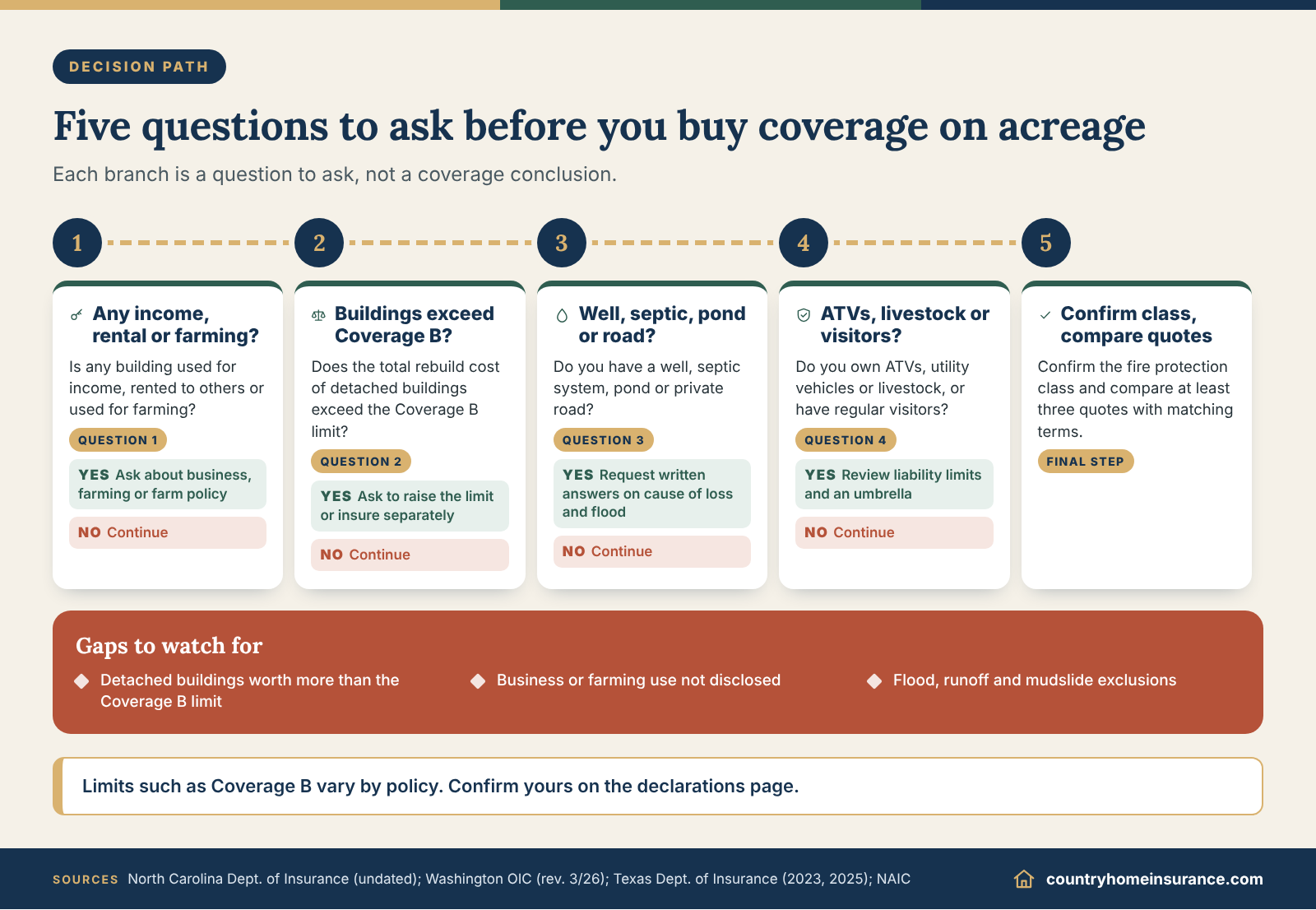
Questions that get useful answers from an agent
Agents and underwriters respond to the facts you provide. The better the description, the better the answer, and the less room there is for a surprise later.
What to disclose up front
The IA Magazine farm-exposure article, written for agents, frames the questions underwriters tend to ask: how many acres, whether the land is farmed or used for business, how large any hobby operation is and whether it earns revenue, what animals are kept and how many, whether there is high-value equipment or buildings, and whether any hired help works or lives on site. Answer those questions the way an underwriter would want them answered, including seasonal workers, boarded animals and equipment that you share with a neighbor.
Disclosure feels risky because a truthful answer might raise the price or limit your options. In practice it’s protective. The University of Missouri Extension reminds farm policyholders to be honest on applications and claims, because misstatements can jeopardize coverage.
Comparing apples to apples
When quotes arrive, line them up on the same terms before you compare price. The dimensions that matter most on acreage are the other-structures limit, the valuation method for outbuildings and fences, the cause-of-loss list, the liability and medical payments limits, any farming or business endorsements, the treatment of trees and landscaping, and any separate deductibles. Our guide to how to compare home insurance quotes explains a step-by-step method.
Also ask about financial strength and complaint history for each insurer. The NAIC says you don’t have to buy from the insurer your lender suggests and encourages comparing quotes through your state insurance department and other resources. Many state Departments of Insurance publish consumer resources, so check what yours offers for researching a company before you buy.
Documentation that makes a claim easier
Good records don’t change what a policy covers, but they can shorten the conversation about what you lost and what it was worth.
Build a building-by-building inventory
The NAIC’s home inventory guidance recommends organizing belongings by room or category, including valuables and rarely used items, gathering receipts or appraisals, recording model and serial numbers, photographing or videotaping each item and storing the inventory securely, online or in a fireproof box. For acreage, extend that approach outdoors: photograph each building from four sides and inside, note construction type and year, list tools and equipment by serial number, and keep receipts for upgrades such as a new roof on the barn or a new pump.
Review annually and after every change
The NAIC advises reviewing coverage annually, especially after renovations. On a country property, the triggers are usually more frequent: a new building, a new animal, a pond built, a side business, a change in who lives or works there. After a loss, the Wisconsin Office of the Commissioner of Insurance recommends reporting it as soon as possible, making temporary repairs to prevent further damage, keeping receipts, photographing damage before repairs and waiting for the adjuster before permanent repairs. It also suggests documenting damage to outbuildings such as a garage or tool shed.
If you have a claim dispute, your state Department of Insurance is the place to ask about complaint options.
| Area | What to verify or document | Question to ask your insurer or agent |
|---|---|---|
| Detached buildings | Rebuild cost for each building; photos inside and out; year built and construction type | What is my Coverage B limit, and does the 80% guideline apply to each building? |
| Use of each building | Any income, rental, boarding, storage for others or farm production | Does this use remove the building or the liability from my policy, and what endorsement fixes it? |
| Well, pump and septic | Inspection and pumping records; location and age; photos of components | Which causes of loss apply, and does a service-line endorsement include these components? |
| Trees, fences, drives, gates | Linear feet and replacement estimates; photos; recent tree work | Are they covered as other structures or landscaping, and what are the caps and valuation method? |
| Liability exposures | List of vehicles, animals, ponds, pools, play equipment and regular visitors | Which vehicles and animals are excluded, and what limit do you recommend with an umbrella? |
| Fire protection | Station name, road distance, water source and the class your insurer used | Which fire protection class is on my quote, and how was it determined? |
| Flood and ground movement | Flood zone information, drainage paths, history of standing water | What flood options exist for the house and for outdoor items, and how do the exclusions apply to slides and runoff? |
Frequently asked questions
Questions about what is covered
Does homeowners insurance cover the land itself?
Generally, no. Policies insure structures, belongings and liability, and the NAIC points out that replacement cost covers only the cost to repair or replace property, while market value includes land. Some policies add limited coverage for certain items on the land, such as trees and plants, often with caps and limited causes of loss. Check the additional coverages section of your own policy and the declarations page for the actual limits.
Is a barn covered under a homeowners policy?
It can be, as an other structure, if it is used for household purposes and is not rented or used for business. Regulators in several states describe other-structures coverage as typically 10% of the dwelling limit, which may not be enough for a large barn. If the barn stores hay for sale, houses boarded horses or shelters farm equipment, the policy may treat it differently. Ask your insurer in writing how your form handles that specific use.
Will my policy cover a damaged well or septic system?
It depends on the cause of loss and the form. Sudden physical damage from a covered cause may be treated differently from wear, neglect or a failing drain field, and a service-line endorsement may or may not include the components you own. Flood damage to septic systems is not covered by the federal flood program, according to FloodSmart. Ask for the answer for your own components, in writing.
Questions about liability, farming and shopping
Do I need farm insurance if I keep a few animals?
Possibly, and the answer depends on the animals, the purpose and the policy language. The Mississippi decision discussed above involved a landowner whose homeowner policy excluded bodily injury arising from farming activity, and the court applied that exclusion to a newly bought group of cattle. Other policies differ. Tell your agent what you keep and why, and ask whether an incidental-farming endorsement, a farm policy or neither fits.
Is an umbrella policy worth considering on acreage?
For many landowners it is worth a conversation. An umbrella adds liability limits above your underlying policies, and Maine’s Bureau of Insurance notes it can raise coverage above the homeowners level. Whether you need one depends on your assets, exposures such as ponds, vehicles and animals, and the insurer’s underwriting rules, which may include required underlying limits. An agent can show you the underlying requirements and the price before you decide.
Does my fire department’s rating change my premium?
It can, but not in a uniform way. The Texas Department of Insurance says insurers use fire protection class at their own discretion alongside other factors and that a better score does not guarantee a lower premium. Confirm the class the insurer is using for your address, and compare quotes from more than one company, because two insurers can weigh the same class differently.
Next steps for an acreage owner
Insurance decisions get easier when they are broken into small jobs. Here is a sequence that fits a busy week and a renewal calendar.
Do these before you call an agent
Gather the facts about your buildings and land
Walk the property with your phone. Photograph every building inside and out, note what each is used for, estimate rebuild costs with a local contractor’s price per square foot and write down the age and condition of the roof, well pump and septic components. Pull your declarations page and highlight the limits for Coverages A through F.
Write down your questions in order of importance
Start with the questions that could cost the most if answered wrong: use of buildings, farming and animals, liability limits and vehicles. Then move to wells, septic, trees, fences, drives and flood. Ask for answers in an email so you have a record you can find later.
Do these when you talk to the agent or insurer
Match quotes on the same terms
Tell every insurer the same facts and request the same limits, deductibles and valuation methods. Compare the other-structures limit and the endorsements before the premium. If one quote looks far cheaper, look for the building, activity or animal it may have left out.
Schedule your next review
Put a calendar reminder for renewal and another for any major change on the property. For related topics such as hobby-farm coverage and outbuildings, browse our rural and country home insurance guides.
Sources
- Texas Department of Insurance: Home insurance, what structures are covered (page last updated 2025-12-18; retrieved 2026-10-11)
- North Carolina Department of Insurance: Basic homeowners insurance (undated; retrieved 2026-10-11)
- Washington Office of the Insurance Commissioner: Homeowner insurance guide (revision marked 3/26; retrieved 2026-10-11)
- Maine Bureau of Insurance: Business use of home (copyright 2022; retrieved 2026-10-11)
- Maine Bureau of Insurance: Consumer’s guide to homeowner insurance (updated 2021-09-28; retrieved 2026-10-11)
- Maine Bureau of Insurance: Insuring your farm (undated; retrieved 2026-10-11)
- Wisconsin Office of the Commissioner of Insurance: Insurance tips for farm owners (PI-239) (revised October 2024; retrieved 2026-10-11)
- NAIC: Homeowners insurance consumer page (undated; retrieved 2026-10-11)
- NAIC: Actual cash value versus replacement cost coverage (2025-01-02; retrieved 2026-10-11)
- FloodSmart (NFIP): Buy a flood insurance policy (undated; retrieved 2026-10-11)
- FloodSmart (NFIP): Flood insurance basics (undated; retrieved 2026-10-11)
- Texas Department of Insurance: Public protection classification (2023-03-23; retrieved 2026-10-11)
- Verisk: New PPC fire protection classes interview (published 2014-04-01; dated; retrieved 2026-10-11)
- U.S. EPA: How to care for your septic system (updated 2026-08-17; retrieved 2026-10-11)
- U.S. EPA: Private drinking water wells (updated 2026-08-25; retrieved 2026-10-11)
- Insurance Information Institute: Insurance for your house and personal possessions (undated; retrieved 2026-10-11)
- Ohio State University Extension: Farm insurance policies, understanding the policy (2023-02-02; retrieved 2026-10-11)
- University of Missouri Extension: What your farm liability insurance covers (undated; retrieved 2026-10-11)
- Coverage Opinions: Clark v. Alfa Insurance Co. commentary (2024-08-12; retrieved 2026-10-11)
- Rough Notes: Homeowners policy and ATV injuries, Erie Insurance Exchange v. Jones digest (2022-11-30; retrieved 2026-10-11)
- IA Magazine: Questions to ask personal lines clients with farm exposures (2023-06-05; sponsored content; retrieved 2026-10-11)
- IA Magazine: Service line endorsement and septic drain field coverage (2023-10-20; retrieved 2026-10-11)
- Insurance Journal: What to know about hobby farm insurance (2012-02-20; older source; retrieved 2026-10-11)
- Kiplinger: Does a farm need a different homeowners insurance policy? (2024-11-15; retrieved 2026-10-11)
- IRMI: Farm umbrella policy definition (undated; retrieved 2026-10-11)
- American Family Insurance: Farm and ranch liability umbrella (insurer product page) (undated; retrieved 2026-10-11)
- AAA Oregon/Idaho: Understanding attractive nuisances (2026-04-24; insurer publisher; retrieved 2026-10-11)
- Farm Bureau Financial Services: Hobby farm insurance (2026-02-04; insurer publisher; retrieved 2026-10-11)
- ValuePenguin: Does homeowners insurance cover other structures? (updated 2026-06-30; consumer publisher; retrieved 2026-10-11)
- Policygenius: Does home insurance cover septic tanks? (updated 2022-10-06; consumer publisher; retrieved 2026-10-11)
- Insurance education module: Homeowners Section II exclusions (undated, publisher not shown; generic form illustration; retrieved 2026-10-11)
Important coverage note
Coverage depends on the actual policy, endorsements, exclusions, limits, deductible and cause of loss. State laws and insurance programs vary, and insurers apply their own underwriting rules. Percentages, limits and examples in this article are typical or illustrative, not promises about your policy. For case-specific questions, review your declarations page and policy form, then confirm the answers with your insurer or agent and your state Department of Insurance. This article is educational information, not legal advice, and it does not replace the insurance contract.
About the editorial team
This guide was prepared by the countryhomeinsurance.com editorial team as general, educational information for homeowners. We research and summarize publicly available material, including state insurance departments, the NAIC, federal agencies, regulators’ consumer guides and published insurer and industry resources. We draw only on the sources that were available to us when we wrote this guide, and we list them in the Sources section with dates where we could find them.
Insurance rules, rates, products and program terms change, differ by state and by insurer, and can apply differently to your situation. We cannot guarantee that this content is complete, current or free of errors. It is not legal, financial, tax or insurance advice, it is not an offer to sell insurance or a recommendation of any insurer, agent or product, and reading it does not create a professional relationship of any kind.
To the fullest extent permitted by law, countryhomeinsurance.com and its editorial team, authors and contributors exclude all liability for any loss, damage or decision arising from the use of, or reliance on, this content. For questions about your own policy or claim, contact your insurer, a licensed agent or broker, your state Department of Insurance or another qualified professional.
Content created: October 11, 2026