Quick answer
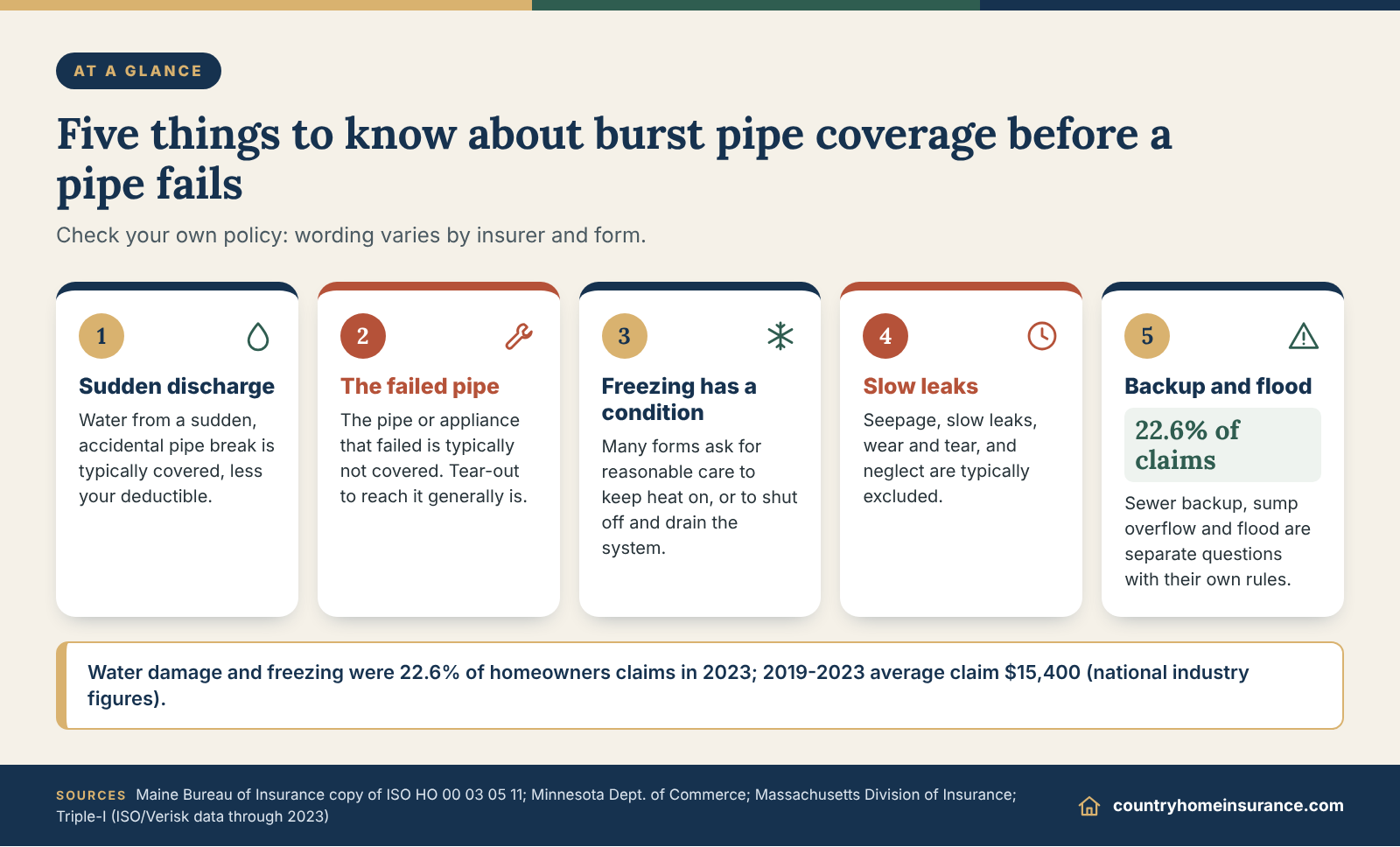
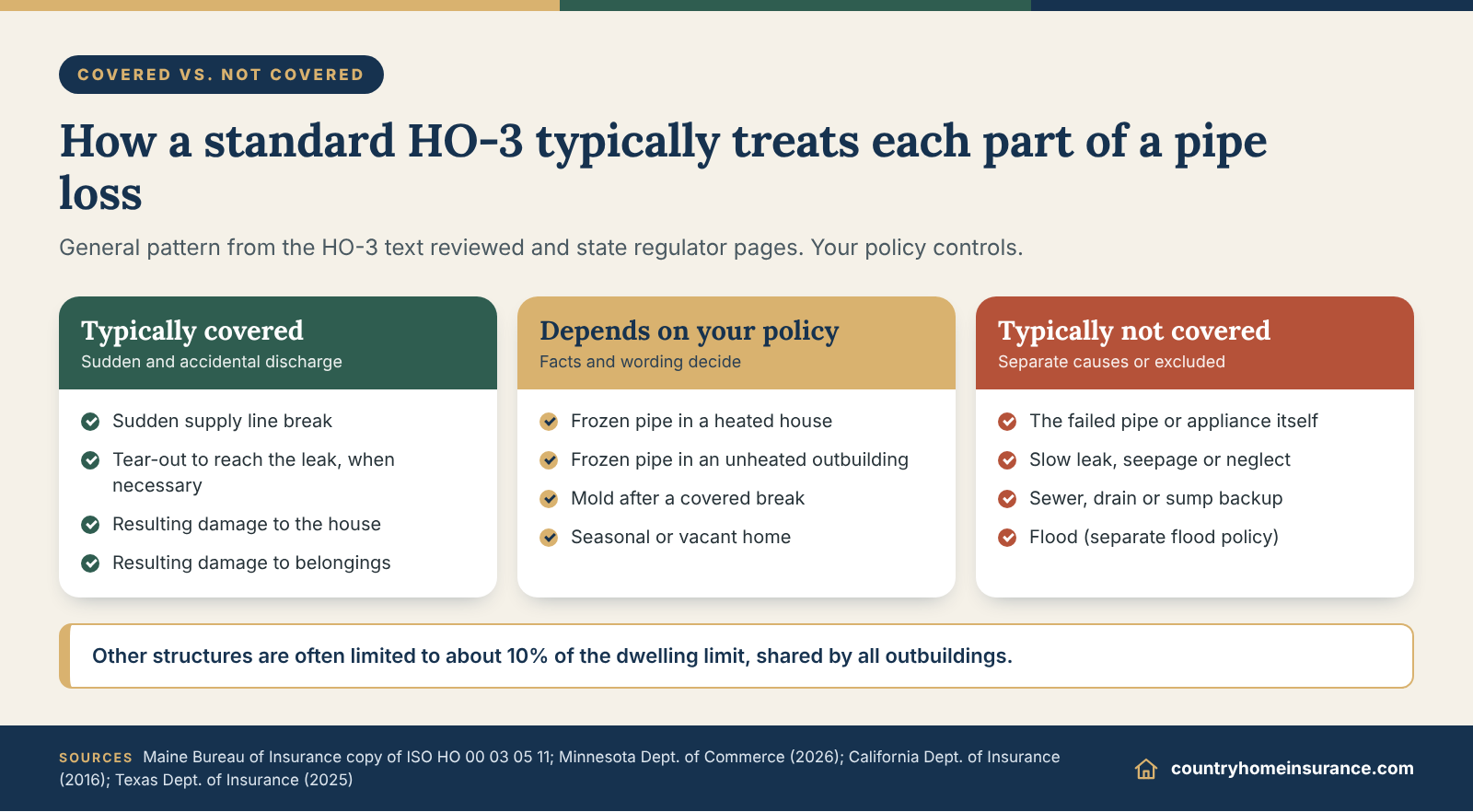
Does homeowners insurance cover burst pipes? Often yes, when the water escapes suddenly and accidentally, subject to your deductible. Typically the policy pays for resulting damage to the house and belongings, and for tearing into walls to reach the break, but not for the broken pipe itself. Frozen pipes add a condition: many forms require reasonable care to keep the heat on or to shut off and drain the system. Slow leaks, neglect, sewer backup and flood are usually treated differently, so read your own policy.
Key takeaways
- State regulators describe water damage from a sudden and accidental pipe break as typically covered, while seepage, slow leaks, wear and tear, and neglect are typically not.
- In the standard HO-3 text reviewed for this article, the pipe or appliance that failed is not covered, but the cost of tearing out and replacing part of the building to reach it generally is.
- For freezing, the form reviewed requires reasonable care to maintain heat, or to shut off the water and drain the system. That condition is where many winter claims are won or lost.
- Well houses, barns, and other detached buildings are usually handled as other structures, often with a lower limit, and a vacant or seasonal home may sit under different rules than a primary residence.
- Act fast: stop the water, photograph the damage, keep receipts for emergency repairs, and call your insurer before you throw damaged materials away.
- Sewer backup, sump overflow and flood are separate questions with their own exclusions and endorsements. A burst pipe claim does not turn on any of them.
| Scenario | Typical treatment under a standard HO-3 | What usually decides the outcome |
|---|---|---|
| A supply line inside the house splits and floods a room | Typically covered as sudden and accidental discharge, less the deductible | Cause of the failure, whether it was gradual, and the exact water-damage wording in your form |
| The pipe, fitting or appliance that failed | Typically not covered; the repair or replacement of the failed part is usually yours | Possible equipment breakdown or home warranty coverage if you carry it |
| Walls or floors opened to find and fix the break | Typically covered as tear-out and replacement, when necessary to repair the system | Whether the leak itself is a covered loss, and your Coverage A limit |
| Pipe freezes and bursts in a heated house during a cold snap | Depends; often covered if you used reasonable care to maintain heat | Thermostat setting, working heat source, power outage, and your insurer’s freeze wording |
| Pipe freezes in an unheated well house, barn or vacant home | Depends; may be excluded if heat was not maintained and the system was not drained | Whether heat was reasonably maintained or water shut off and drained, and how the building is classified |
| Slow drip or hidden leak behind a wall for months | Typically not covered; wear and tear, deterioration, seepage and neglect are common exclusions | Whether the discharge was sudden, how long it ran, and any ensuing-loss language |
| Mold after a pipe break | Depends; often limited or excluded unless hidden and caused by a covered discharge | Mold wording, any sublimit, and how quickly drying began |
| Water that comes up through drains or from a sump | Typically excluded; a separate endorsement may help | Water backup endorsement and its limit, covered in our companion articles |
Does homeowners insurance cover burst pipes? How the policy sorts water losses
Homeowners insurance doesn’t have a coverage line labeled “burst pipes.” Instead, the loss is sorted by cause, and the cause decides whether the policy responds. This section explains how insurers and regulators draw that line, and how the common HO-3 and HO-5 forms differ when a pipe lets go.
How does a standard policy treat sudden water discharge from plumbing?
Most consumer guidance from state regulators sorts water losses into two piles: water that escapes suddenly from a system inside the house, and water that arrives from somewhere else or builds up slowly. The first pile is where burst pipes live.
Sudden and accidental discharge is the core idea
The Massachusetts Division of Insurance explains that standard home policies usually cover water damage that is “sudden and accidental”, and that the insurer will investigate the cause. The Minnesota Department of Commerce says water damage from a broken pipe in the house would be covered. The NAIC, the association of state insurance regulators, likewise says water damage from a home’s plumbing or a roof leak is typically covered.
The phrase to hold onto is “sudden and accidental.” A supply line that ruptures on a Tuesday night fits it. A fitting that has dripped quietly for a year usually does not, which we cover in the exclusions section below.
What the policy pays for, and what it leaves out
The ISO HO 00 03 05 11 form, the standard HO-3 text that many insurers use as a starting point, shows how the pieces fit together. In that edition, accidental discharge or overflow of water from a plumbing, heating, air conditioning or sprinkler system, or from a household appliance, is an exception to several exclusions. The same exception pays the reasonable cost to tear out and replace part of the building when that is necessary to repair the system. It does not cover loss to the system or appliance the water escaped from. You can read the full text in the copy of the HO-3 form posted by the Maine Bureau of Insurance.
In plain terms, the policy usually helps with the ruined drywall, flooring and cabinets, plus the access work to reach the break. The plumber’s bill for the failed pipe itself generally stays with you. Treat that as a pattern, not a promise, because newer editions and insurer-specific forms can word these points differently.
How do HO-3 and HO-5 policies differ for a burst pipe?
The two forms people ask about most are the HO-3 and the HO-5. The names are shorthand from the insurance forms industry, and what you actually own is described on your declarations page, the summary page that lists your coverages, limits and deductibles.
HO-3: the house is open-peril, belongings are named-peril
The Colorado Division of Insurance buyer’s guide, which reproduces NAIC consumer text from 2014, describes the HO-3 as covering the home against all perils except those excluded, while personal property is covered only for the perils listed in the policy. An “open-peril” (also called “all-risk”) form covers any cause of loss that is not excluded. A “named-peril” form covers only the causes it lists.
For a pipe break this rarely changes the result for belongings, because accidental discharge of water from plumbing is a standard named peril for personal property in the HO-3 text reviewed. It matters more for odd causes. If water damage to your furniture came from something the form doesn’t name, the HO-3 may not respond.
HO-5: broader belongings coverage and different valuation
The same Colorado guide describes the HO-5 as covering both the home and personal property for all perils except those excluded, with both typically settled at replacement cost. The guide also notes it can cost more. For a burst pipe, the HO-5 advantage tends to show up in contents: carpets, furniture, electronics and clothing may be paid on a replacement cost basis rather than depreciated.
The NAIC explains the gap well. Actual cash value (ACV) reflects age and wear, while replacement cost value (RCV) pays to repair or replace with comparable materials. Ask your agent which basis applies to your belongings, because a ten-year-old couch is a very different claim at ACV than at RCV.
Frozen pipes and the heat-maintenance condition
A pipe that bursts because of ice is the same physical event as any other burst pipe, yet policies treat it with an extra condition. Understanding that condition is the most practical thing a rural or part-time homeowner can do before the first hard freeze.
What does “reasonable care to maintain heat” actually require?
In the HO-3 text reviewed, the exclusion for freezing of a plumbing, heating, air conditioning, sprinkler system or household appliance does not apply if you used reasonable care to maintain heat in the building, or to shut off the water supply and drain the system and appliances. The Coverage C (personal property) freezing peril carries the same reasonable-care wording. A building with an automatic sprinkler system has to keep the water supply on and the heat maintained.
Two ways to satisfy the condition: heat or drain
The form gives two routes. You can keep the building warm enough that pipes don’t freeze, or you can take the water out of the pipes by shutting off the supply and draining the lines and appliances. Either route, done with reasonable care, keeps the freezing exclusion from applying. Which route fits depends on how the building is used. A lived-in farmhouse normally relies on heat. A cabin closed for the winter is the classic candidate for shutting off and draining.
What reasonable care tends to look like in a claim file
“Reasonable care” is not defined with a thermostat number in the form text reviewed, so an adjuster will look at the facts. Typical questions include what the thermostat was set to, whether the heating system was working, whether anyone was home, how long the building sat cold, and whether the water was actually drained. Records help: a plumber’s winterizing invoice, a smart-thermostat history, or a caretaker’s visit log can show what you did and when. This is general claim practice, not a rule from any regulator, so ask your insurer what it expects.
Power outages and backup heat
Rural winter storms often knock out power for days. The Wisconsin Office of the Commissioner of Insurance notes in its consumer guide to homeowners insurance that homeowners policies exclude damage from neglect and from power failure, and observes that the power failure exclusion could matter if loss of heat leads to damage. How a policy treats a storm-caused outage that leaves a house cold is a question for your own form and your insurer. If you rely on an electric furnace or heat tape, ask in writing how an outage is handled, and consider whether a generator or a wood stove would count as maintaining heat in your insurer’s eyes.
How do older and named-peril forms treat freezing?
Not every home is insured on an HO-3. Older homes, dwelling-fire policies and farm policies often use named-peril forms, where freezing is a listed cause only if the form says so.
Broad form versus basic form
The Maine Bureau of Insurance consumer guide explains that the Broad Form covers named perils that include freezing, while freezing is not listed under the Basic Form. The Wisconsin guide similarly describes its HO-2 Broad Form as covering freezing of plumbing, heating and air-conditioning systems and domestic appliances. If your policy is a basic or dwelling-fire form, a frozen pipe may not be a covered cause at all, even if you did everything right. That is worth confirming now rather than after a freeze.
Why unheated outbuildings are a trap
Ohio State University Extension, in its explanation of farm insurance, warns that freezing of plumbing may not be covered in a building which does not maintain heat. That sentence describes exactly the problem with a barn hydrant, a shop sink or a well house with no heat source. We return to those buildings in the rural section below. The takeaway here is simple: the more a building depends on pipes and the less it is heated, the more closely you should read the freeze wording.
Exclusions and gray areas that can turn a pipe claim into a dispute
Most disputed water claims aren’t about whether water damaged the house. They’re about why the water got there, how long it had been escaping, and what the homeowner did before and after. The next sections walk through the exclusions that matter most.
Why is a sudden burst treated differently from a slow leak?
Insurers price a homeowners policy for unexpected events, not for the gradual decline of plumbing. That distinction shows up repeatedly in regulator guidance.
Wear and tear, deterioration and seepage
The HO-3 text reviewed excludes wear and tear and deterioration, and the California Department of Insurance residential brochure (a 2016 document specific to California) states that sudden and accidental water damage is typically covered, while damage from seepage or leaks typically is not. The Alaska Division of Insurance puts the principle plainly in its homeowners guide: a loss that relates to lack of maintenance, or that could be predicted, is not likely to be covered. A pinhole in an old copper line that weeps into a wall cavity for months fits that description far better than a ruptured hose.
The wording of continuous or repeated seepage exclusions differs by form. The HO-3 edition reviewed did not contain a stand-alone clause using the familiar “weeks, months or years” language, but other editions and insurer-specific forms may. Check your own form for the words “seepage,” “continuous” and “repeated.”
Neglect and faulty maintenance
Two different exclusions tend to get confused. In the HO-3 text reviewed, “neglect” means failing to use all reasonable means to save and preserve property at and after the time of a loss. Separately, loss to the dwelling and other structures caused by faulty, inadequate or defective maintenance is excluded, with an exception that lets covered ensuing loss through.
The practical lesson: once water is escaping, stopping it and drying out is your job, and the policy expects it. And before anything fails, the Maine Bureau of Insurance reminds consumers that a homeowners policy is not a maintenance contract. The NAIC adds that insurers may require owners of older homes to update heating, plumbing, wiring and roofing. If your insurer sends a request, treat it as a coverage matter and not just a paperwork annoyance.
What happens with mold, rot and other secondary damage?
Water rarely does only one kind of harm. The damage that follows a burst pipe, such as swollen floors, ruined insulation and mold, is where limits and exclusions get tested.
Mold after a pipe break
The NAIC notes that policies often exclude mold. In the HO-3 text reviewed, mold is excluded as a cause of loss, with an exception: loss is covered when the mold is hidden within walls, ceilings or floors and results from the accidental discharge of water from a plumbing or similar system on the premises. Other forms cap mold at a sublimit, which is a smaller limit that applies inside the larger one. Your declarations page or an endorsement may list it.
Speed matters here. Mold that grows because a wet wall sat for weeks can raise “neglect” questions, even when the original pipe failure was covered. Drying quickly, and documenting that you did, protects both your house and your claim.
Ensuing loss and the system that failed
An ensuing loss is a further loss that follows from an excluded cause and is not itself excluded. The HO-3 text reviewed lets ensuing loss to the dwelling through, which is one reason a claim for water damage can still go forward even when the failed part itself isn’t covered. The California brochure offers a helpful picture: if a water heater bursts and ruins a wall, insurance pays to fix the wall and floor damage, while a home protection contract is what would repair the heater itself.
That example generalizes. The pipe, the heater, the dishwasher hose, the pressure tank: the failed equipment is usually separate from the water damage it caused. Some homeowners add equipment breakdown coverage for that gap. The Colorado buyer’s guide notes such coverage can pay to repair or replace systems like a water well pump or hot water heater, so it is worth asking about, especially on a rural property.
When is water damage not a burst pipe claim at all?
Two other water causes get mixed up with burst pipes, mostly because the result looks the same on the floor. They are decided under different parts of the policy.
Sewer, drain and sump backup
Water that comes back up through sewers or drains, or overflows from a sump or sump pump, is excluded by the standard HO-3 text. The Minnesota Department of Commerce says such coverage requires a separate sewer backup or sump pump endorsement. This article stays focused on pipes inside your plumbing system. For the backup side, see our guides on sewer backup and on water backup and sump pump claims.
Flood and rising groundwater
Flood is excluded from standard homeowners policies, and FloodSmart, the National Flood Insurance Program’s consumer site, states that most homeowners insurance does not cover flood damage. The Massachusetts Division of Insurance adds a useful pointer for claims: non-flood water damage, such as a burst pipe, goes to your home insurer, while flood losses go to the NFIP or private flood insurer. If a storm both floods your basement and bursts a pipe, expect the two causes to be sorted separately, and document each.
Limits, deductibles and how a burst pipe claim gets paid
Coverage in principle is only half the story. What lands in your bank account depends on which coverage part pays, what your deductible is, and whether the settlement is at replacement cost or actual cash value.
Which part of the policy pays for each piece of the loss?
A single burst pipe can touch four different coverages at once. Knowing which is which helps you read the adjuster’s estimate.
Coverage A (dwelling) and Coverage C (personal property)
Coverage A pays for the house itself: drywall, flooring, cabinets, insulation, and the tear-out needed to reach the break. Coverage C pays for belongings, such as furniture, clothing and electronics. Each has its own limit shown on your declarations page. A big loss, such as a second-floor line that runs unnoticed while you’re away for a weekend, can reach several rooms and both limits at once.
Coverage B (other structures)
Other structures are buildings not attached to the house, such as detached garages, sheds, barns and guest houses. The Texas Department of Insurance explains that most policies cover them at about 10% of the dwelling limit, so $300,000 of house coverage would mean roughly $30,000 for all of them combined. The same page confirms that other structures are covered for the same types of damage as the house, including sudden and accidental water damage. Two cautions: the limit is shared across every outbuilding, and in the HO-3 text reviewed the tear-out piece applies to other structures only if the water damages a building on the residence premises. The Maryland Insurance Administration also notes that outbuildings are not automatically covered under a farm policy and may need an endorsement.
Coverage D (loss of use)
If a burst pipe makes the house unlivable for a time, Coverage D (also called additional living expenses, or ALE) may help with the extra cost of staying somewhere else. The Washington Office of the Insurance Commissioner gives a broken pipe that floods the home as an example of what can trigger it, and recommends keeping receipts. Coverage D has its own limit and time rules, so ask how it works on your policy before you need it.
How do deductibles and valuation change the check?
Two mechanics decide whether a covered claim feels covered: the deductible and the loss settlement basis.
The deductible comes off every claim
A deductible is the amount you pay out of pocket on a claim before the policy pays. The Wisconsin guide says standard deductibles are $250, $500 or $1,000 per loss on dwelling and personal property coverage. Your own amount may be different, and your declarations page is where it appears. The NAIC advises checking your deductible before you file, because minor damage may be cheaper to pay out of pocket. A single burst pipe is one occurrence, so you typically pay one deductible for the whole event.
ACV, RCV and the 80% rule
In the HO-3 text reviewed, buildings are paid at replacement cost, subject to an 80% insurance-to-value requirement, while personal property is paid at actual cash value unless you have a replacement cost endorsement. The form also says the insurer pays no more than ACV until repairs are complete, and that you must notify the insurer within 180 days to claim the replacement cost. Many policies pay in two steps, with depreciation held back until the work is done, which the Colorado guide describes as paying only ACV until repairs begin or finish. The 80% rule means an underinsured dwelling can lead to a reduced payment, so see our guide on how much coverage you need.
Hypothetical example: how the numbers might work
Hypothetical example, not a quote or a promise of payment. Suppose a frozen supply line splits in a heated farmhouse while the family is away, and the cleanup and repair estimate comes to $18,000 for drywall, flooring and labor, including $2,500 to open and close walls. Assume a $1,000 deductible. If the loss is covered and settled at replacement cost, the insurer might pay roughly $17,000 once repairs are complete, with the $1,000 deductible subtracted. Under an ACV-first approach, the first check could be smaller, with depreciation recovered later if the policy allows it. The plumber’s invoice for the new pipe section, say $400, would typically be yours. Real outcomes depend on the policy and the facts.
| Item | What the sources say | What to verify on your policy |
|---|---|---|
| Dwelling limit (Coverage A) | Pays for the house, including tear-out to reach the break; the failed system is not covered in the HO-3 text reviewed | Limit, 80% insurance-to-value condition, replacement cost wording |
| Personal property (Coverage C) | HO-3 contents are named-peril; HO-5 contents are open-peril; settlement is often ACV on HO-3 (Colorado guide) | Whether a replacement cost endorsement applies to belongings |
| Other structures (Coverage B) | Often about 10% of the dwelling limit, shared across all outbuildings (Texas DOI) | Whether the well house, barn or shop fits under the limit, and any farm-use exclusions |
| Loss of use (Coverage D) | May pay extra living costs if a pipe break makes the home unlivable (Washington OIC) | Limit, time cap, and what receipts your insurer requires |
| Deductible | Paid per claim; $250, $500 or $1,000 are standard examples in Wisconsin guidance | Flat or percentage deductible, and whether any water-specific deductible exists |
| Mold | Often excluded or limited; HO-3 text covers hidden mold from accidental discharge | Any mold sublimit or endorsement |
| Equipment breakdown | May pay to repair or replace systems such as a well pump or hot water heater (Colorado guide) | Whether it is included, optional, or unavailable with your insurer |
How common are water and freezing claims, and what do they cost?
Industry data help put a burst pipe in proportion. They can also show why insurers are strict about maintenance, though they say nothing about your individual claim.
What the ISO data show
The Insurance Information Institute (Triple-I) publishes ISO/Verisk statistics on homeowners claims. Its homeowners and renters facts page lists water damage and freezing as 22.6% of claims in 2023, within a range of 19.8% to 28.7% between 2019 and 2023. For 2019 through 2023 combined, it reports a frequency of 1.50 claims per 100 house-years and an average severity of $15,400 for that cause group. For comparison, the all-cause average severity was $20,062 in 2023. These are national industry figures grouped together, so they don’t tell you what a burst pipe in your county would cost, and the page does not date itself, so confirm the latest edition.
How claim history can echo at renewal
A NAIC consumer guide lists water damage claims among the factors that can affect premiums, and suggests asking your agent what types of water damage are not covered. That’s a reason to weigh small claims against the deductible, as the NAIC does, though state rules on how claims affect pricing vary, so ask your agent and see our article on claims history.
Private wells, well houses and other rural plumbing
Country homes tend to have more plumbing spread across more buildings than a town lot does. A pressure tank in the basement, a pump house at the edge of the yard, a yard hydrant by the barn and a heated livestock waterer all depend on pipes, and several of them sit in buildings that aren’t part of the house. Regulators say very little about these exact items, so this section sticks to what the policy forms and official pages support and flags the questions to ask.
Where does a well house or pump house fit in a homeowners policy?
A small building over the wellhead is easy to forget when you picture your insurance, but it is exactly where a freeze usually hits first.
Detached buildings and the other-structures limit
The Texas Department of Insurance describes other structures as buildings not attached to the house, and its examples include sheds, guest houses and barns. A detached well house or pump house would generally be evaluated the same way, although the TDI page doesn’t mention wells or pump houses specifically, so confirm with your insurer. If it counts as an other structure, three things follow from what we’ve covered: the structure shares the Coverage B limit with every other outbuilding, sudden and accidental water damage is covered like it is for the house, and a freeze there is subject to the same heat or drain condition.
The HO-3 text reviewed adds a wrinkle. The tear-out cost for other structures applies only when the escaping water causes actual damage to a building on the residence premises. A small well house with a split pipe and no resulting damage to any building might produce very little payable loss, since the failed pipe itself is not covered. Ask your agent to walk through that scenario rather than assuming.
Heat tape, heat lamps and the outage problem
Many well houses are “heated” with a heat lamp, a small space heater or electric heat tape wrapped on the pipe. That counts as an effort to maintain heat, but it depends on power. Because the HO-3 text reviewed asks for reasonable care to maintain heat, or to shut off and drain, a heat source that fails when the lights go out leaves you relying on what else you did. The Wisconsin guide’s observation that the power failure exclusion could matter if heat is lost applies here too.
Practical steps that strengthen your position include a thermostat-controlled heat source, a visible temperature or alarm device, and a written note of when you checked it. If a storm takes out power for several days, a record of what you tried can matter as much as the equipment. None of this guarantees a payment, and your insurer’s own wording controls.
What about the pump, the pressure tank and buried water lines?
This is where homeowners are most often surprised. The question usually isn’t whether water damage is covered; it’s whether the equipment itself is.
The equipment that failed
The HO-3 text reviewed does not cover loss to the system or appliance the water escaped from, so a split pressure tank or a cracked pump housing is generally a repair you pay for. Two other routes exist. The Colorado buyer’s guide notes that equipment breakdown coverage can pay to repair or replace systems such as a water well pump or hot water heater. A home warranty or service plan may also address equipment, but those are separate contracts with their own terms. Ask your agent whether equipment breakdown is built into your policy, optional, or not offered, and whether a freeze-damaged pump counts.
Yard lines, hydrants and livestock waterers
Water lines buried between the well and the house, hydrants at the barn and heated waterers raise questions of classification: are they part of the dwelling, an other structure, or farm property? The sources reviewed do not answer that for all insurers. The Maryland Insurance Administration warns that outbuildings are not automatically covered under a farm policy, and Ohio State University Extension notes that freezing of plumbing may not be covered in a building that does not maintain heat. A barn with a frost-free hydrant and no heat is therefore a question to ask in writing.
If you keep livestock, also ask how the policy treats buildings used for farm purposes, since the line between a homeowners policy and a farm policy is something to settle before a loss. We cover those boundaries in more detail in our rural guides.
After a pipe break, what happens to your water supply?
Once the leak is stopped, rural owners have two follow-on issues that town owners rarely face: the well water itself, and the septic system downstream.
Testing and treating private well water
The U.S. Environmental Protection Agency states that private well owners are responsible for making sure their water is safe, and that federal law and most state laws do not regulate private domestic well water. It also cites a U.S. Geological Survey study in which about one in five of 2,100 private wells had at least one contaminant above a human-health benchmark. That is background on private wells in general, not a statement about pipe breaks. If a break opened your plumbing or well equipment, a licensed well contractor or your local health department can advise whether testing makes sense. Ask your insurer whether any testing cost is part of the claim, and don’t assume it is.
Septic systems and sudden water volume
The EPA’s septic system care page notes that all the water a household sends down its drains ends up in the septic system, that a leaking toilet can add as much as 200 gallons a day, and that running all the laundry in one day can flood a drainfield. A large escape of water that is pumped or drained into your system, or a repair crew running water for days, adds load. If you rely on septic, mention it to the contractor, and let your insurer know about any septic damage separately. Whether a septic tank is part of the dwelling for coverage purposes varies, and our separate article on sewer and septic backup covers that boundary.
Vacation, seasonal and unoccupied homes
A pipe that bursts in an occupied house is usually noticed within hours. In a cabin, a second home or a farmhouse between tenants, it can run for days or weeks. That time gap is the reason insurers pay attention to occupancy, and the reason a part-time owner needs to read the policy more carefully than someone who lives in the house year-round.
How does being away change the coverage picture?
The policy’s general structure doesn’t change just because you’re gone, but several provisions get more relevant, and some policies add conditions of their own.
Vacant, unoccupied and the words that go undefined
In the HO-3 text reviewed, vandalism and glass breakage are excluded when the dwelling has been vacant for more than 60 consecutive days, and the word “vacant” is used without being defined. A dwelling under construction is not considered vacant for these purposes. The word “unoccupied” does not appear in that edition at all, and its freezing provisions contain no vacancy or occupancy condition. The California brochure and the Ohio State article describe a 30-day vacancy limit for vandalism instead of 60, which shows how much the number can vary between forms.
Other insurer forms may add vacancy or unoccupancy conditions that do apply to water damage or freezing. Since the sources reviewed don’t show that, treat it as a question: how does my insurer define “vacant” and “unoccupied,” and does either word change coverage for freezing or water damage? Ask for the answer in writing, as the California Department of Insurance suggests for conversations with your agent.
Cancellation and nonrenewal for empty homes
The Maine Bureau of Insurance guide says an insurer may cancel for a property being vacant without custodial care after the initial underwriting period, and may nonrenew if the home is no longer owner-occupied. That is a Maine-specific statement, and other states differ, so use your state Department of Insurance for local rules. The Washington Office of the Insurance Commissioner notes that insurers may inspect a home when issuing a policy and may re-inspect before renewal, which is one way a vacant or neglected property can come to an underwriter’s attention.
Which kind of policy fits a second or seasonal home?
A standard homeowners policy is designed around an owner-occupied primary residence. Part-time use often leads to a different product.
Dwelling policies and secondary residence endorsements
The Wisconsin guide says dwelling policies are commonly used for seasonal homes that sit unoccupied for part of the year, that a seasonal home isn’t automatically covered under a primary residence policy, and that a Secondary Residence Premises Endorsement covers a secondary residence such as a summer home. The Washington guide similarly describes a secondary residence endorsement as adding liability protection for a second home. The New Hampshire Insurance Department’s guide points to a Dwelling Fire Form for vacation homes, and Maine’s guide says a dwelling property policy can cover a seasonal home.
The important detail for burst pipes: dwelling-fire and basic forms are often named-peril, as the Maine and Wisconsin guides describe, so ask whether freezing and accidental water discharge are named causes of loss on your seasonal-home policy.
Winterizing and caretaker routines that support a claim
If the plan is to leave a house without heat, the HO-3 route is to shut off the water supply and drain the system and appliances. Draining a whole system involves more than closing one valve, so many owners ask a plumber what a full shutdown requires for their setup, and the invoice then becomes evidence. If the plan is to keep the heat on, a caretaker or neighbor who checks the house on a schedule, with a written log, shortens the time a failure can run. Ask your insurer whether it expects specific visits or shut-off steps, because the sources reviewed don’t set a universal requirement.
| Building and use | Common policy type | How the freeze condition may apply | Ask your insurer |
|---|---|---|---|
| Primary residence, heated, lived in | HO-3 or HO-5 | Reasonable care to maintain heat; keep records of thermostat and heat source | What counts as reasonable care during a long outage |
| Seasonal cabin closed for winter | Dwelling policy or secondary residence endorsement (Wisconsin, Washington, Maine guides) | Shut off water and drain the system; keep proof | Whether freezing is a named peril and how “vacant” is defined |
| Vacant house between occupants | Depends; the HO-3 is built for owner-occupied homes | Heat or drain; vacancy terms may add conditions in some forms | Whether a vacancy clause or a different policy is required |
| Detached well house or pump house | Typically other structures under the homeowners policy | Same heat-or-drain condition; unheated buildings carry more risk (Ohio State Extension) | Coverage B limit, tear-out rule and equipment breakdown |
| Barn, shop or farm outbuilding with plumbing | Homeowners endorsement or farm policy | Freezing of plumbing may not be covered where heat is not maintained | Whether farm-use buildings are included at all (Maryland farm guide) |
What to do when a pipe bursts: the claim workflow
The first hours after a pipe fails shape both the damage and the claim. The steps below combine what state regulators and the standard HO-3 text describe, in the order most people will need them.
What should you do in the first few hours?
Speed matters, but so does order. Stop the damage, stay safe, then record what happened before cleanup changes the scene.
Stop the water and make the area safe
The Minnesota Department of Commerce tells policyholders to take reasonable, safe steps to prevent further damage, and the HO-3 text reviewed makes protecting the property a duty after loss. In practice that begins with shutting off the water at the main valve or at the well system’s pressure switch and valve. As general safety practice, not something drawn from the policy sources, keep away from standing water near outlets, appliances or the electrical panel, and let a licensed electrician or your utility decide when it is safe to restore power. If you don’t know where the main shutoff is, that tells you what to learn before the next winter.
Document the damage before cleanup
The North Carolina Department of Insurance advises making a list of the damage and photographing it before temporary repairs, and checking with the insurer before discarding damaged materials. The NAIC adds to take photos and video, list damaged property, and keep the inventory somewhere other than your home. Photograph the broken pipe or fitting from several angles, the water line on walls, wet ceilings and floors, and each damaged item. Keep the failed part if you can, because an adjuster or a plumber may want to examine it.
The NAIC’s free Home Inventory app lets you record belongings by room with photos and exports them, and the NAIC says an accurate inventory gives your insurer the information it needs to help settle claims.
How do you work the claim with your insurer?
Once the house is stable, the claim becomes a paperwork and communication project. A little discipline here pays off.
Notice, temporary repairs and receipts
The HO-3 text reviewed calls for prompt notice and for protecting the property from further damage, making reasonable repairs and keeping records of what you spend. It also includes an additional coverage for the reasonable cost of measures needed to protect covered property from further damage after a covered peril. The NAIC notes that the time to report a claim varies by state, so don’t wait. The Wisconsin and Washington guides agree on the sequence: make necessary temporary repairs, keep receipts, and hold off on permanent repairs until the insurer has inspected.
If you can’t live in the house, keep receipts for hotel, meals beyond your normal food costs and similar extras, and ask the insurer which living expenses it will reimburse, as the North Carolina guidance suggests.
The adjuster visit and the scope of repairs
An adjuster is the insurer’s representative who inspects the loss and estimates the cost. The NAIC suggests having your damaged-property list ready, considering having your contractor meet with you and the adjuster, and not feeling pressured to accept repair terms you’re uncomfortable with. The Alaska Division of Insurance reminds readers that only the claims adjuster or claims department decides whether a loss is covered, so use your agent for help, not for a verdict.
Ask the adjuster how the tear-out and the repair of the system are separated in the estimate, because the failed pipe and the building repair are treated differently. Ask for written estimates of everything, as the Minnesota page advises, and make sure all damaged areas are included.
If you disagree with the estimate or decision
Start by trying to resolve it with the insurer, as the Maine Bureau of Insurance recommends, and keep notes with dates of every conversation. If the disagreement is about the dollar value, the policy may have an appraisal clause; in the HO-3 text reviewed, each side names an appraiser within 20 days and the two choose an umpire. The Wisconsin guide also lists a complaint to the state insurance regulator or hiring an attorney as options.
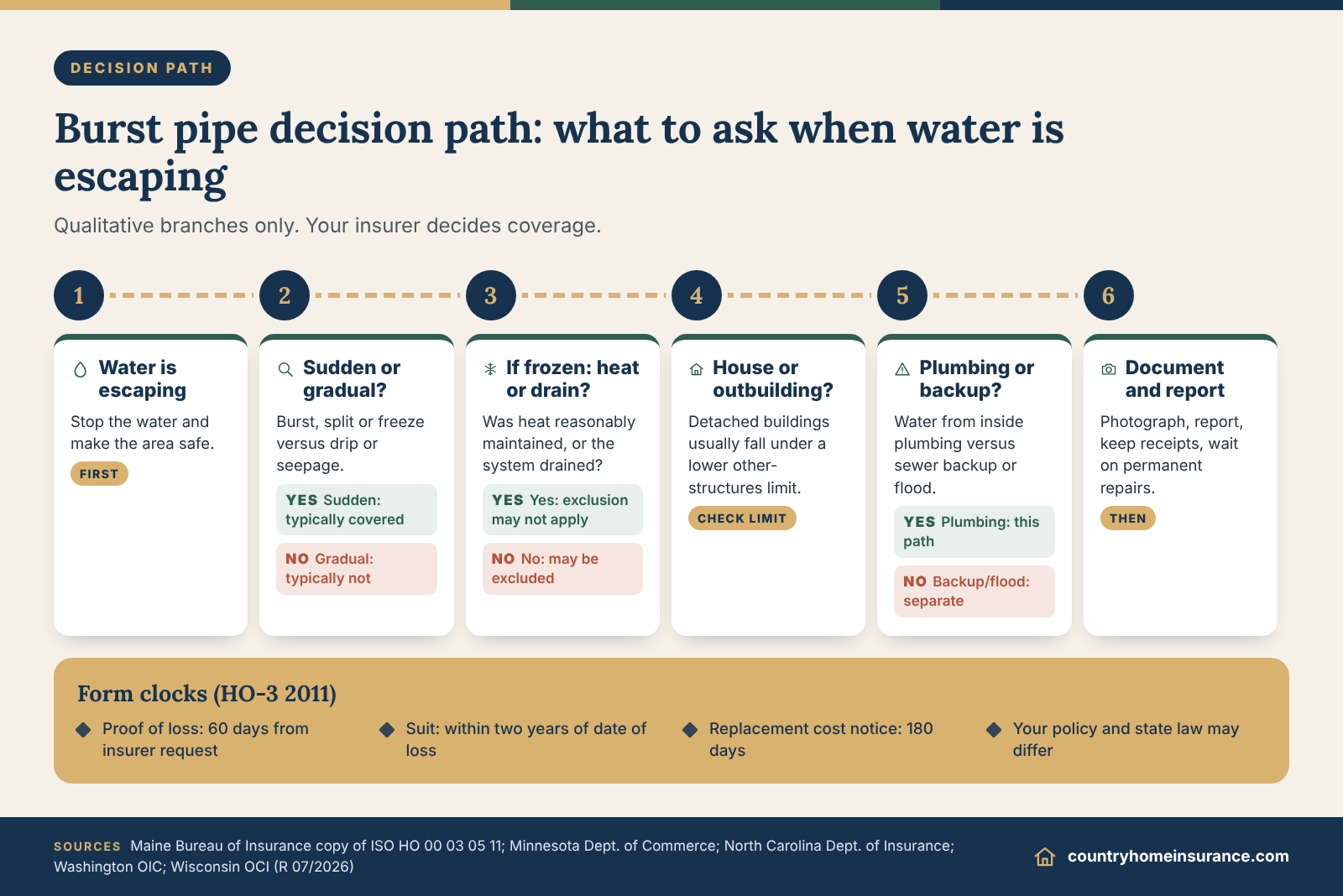
Know the clocks as well. The form text reviewed requires a sworn proof of loss within 60 days of the insurer’s request, and says suit must be started within two years after the date of loss. Those are features of that ISO edition, and your policy and state law may set different periods, so check your own documents and your state Department of Insurance. The Washington guide stresses submitting any required proof of loss accurately and on time.
| Stage | What to do | What to keep or ask |
|---|---|---|
| Immediately | Shut off water; make the area safe; call a plumber for emergency repair | Time you noticed the leak; the failed part; plumber’s invoice |
| Before cleanup | Photograph and video all damage; list damaged items | Home inventory records; ask the insurer before discarding materials |
| Within the first day or two | Report the claim; ask what forms and documents are needed | Claim number, adjuster name, date and time of every call |
| Mitigation | Begin drying and temporary repairs; avoid permanent work until inspected | Receipts for fans, dehumidifiers, tarps, boarding and similar costs |
| Estimate review | Compare adjuster and contractor scopes; ask about tear-out, mold and ACV versus RCV | Written estimates; depreciation breakdown; settlement basis |
| If displaced | Ask which living expenses are reimbursed under Coverage D | Receipts, lease or hotel records, the Coverage D limit and time cap |
| If you disagree | Raise it with the insurer in writing; consider appraisal; contact the state Department of Insurance | Policy deadlines for proof of loss, appraisal and suit |
Getting ready before the next freeze
You can’t prevent every pipe failure, but you can shape how a failure plays out. This final body section covers the steps that reduce the odds of a loss, and the questions that make a claim easier if one happens.
Which preparations also protect your coverage position?
Some preparation reduces damage, and some creates evidence. The best steps do both.
Know your shutoffs and your heat plan
Write down, and show every adult in the household, where the main water shutoff is and, on a well system, how to isolate the pump. Decide in advance whether each building will be heated or drained for winter, and what you’ll do if the power fails. The HO-3 text reviewed ties freeze coverage to reasonable care to maintain heat or to shut off and drain, so a written plan, even a short one, shows what reasonable care meant at your property. Seasonal timing matters too: check outbuildings and the roof-and-gutter picture before the first hard freeze, not after it.
Keep records you can hand to an adjuster
Keep a dated file with photos of plumbing, shutoff valves and heat sources, invoices for plumbing work or winterizing, and an up-to-date home inventory. The NAIC suggests reviewing and updating the inventory yearly and when you buy new items. For a rural property, add photos of the well house interior, the pressure tank and any barn plumbing. These records support the claim, and they also help if an underwriter asks about the age or condition of your plumbing, a factor the Washington and NAIC guidance notes insurers may consider.
What should you ask your agent before you need to file?
A fifteen-minute conversation before winter is cheaper than a dispute afterward. Bring the declarations page and the full policy, not just the summary.
Questions about the form and endorsements
Ask which form you have (HO-3, HO-5, dwelling policy or a farm package) and whether it is open-peril or named-peril for the house and for belongings. Ask for the exact freezing wording and whether it requires heat or shutting off and draining. Ask how the policy defines vacant and unoccupied, what the limit is for other structures, whether equipment breakdown, a mold sublimit or a water backup endorsement applies, and whether belongings are settled at ACV or replacement cost. Request answers in writing, as the California Department of Insurance advises.
Questions about premium, claims history and underwriting
Ask how a water damage claim might affect your renewal, since the NAIC consumer guide lists water damage claims among premium factors and the answer varies by insurer and state. Ask whether the insurer requires updates to older plumbing or heating, and whether a mitigation step, such as upgrading plumbing, is recognized. Don’t assume a discount exists for any device or upgrade; the sources reviewed did not verify one.
If your answers reveal gaps, such as no equipment breakdown coverage, a small other-structures limit or an unclear vacancy rule, you can often close them with an endorsement or a different policy type. Compare options on the same terms, and see our guide to comparing quotes.
Frequently asked questions
Coverage questions
Does homeowners insurance cover burst pipes if I was away when it happened?
It can, because a sudden and accidental discharge is typically covered whether or not anyone is home. What changes is the conditions. A freeze while you’re away raises the heat or shut-off-and-drain question, and a long absence can raise neglect, vacancy or mold questions if the water ran for a long time. The standard text reviewed does not set a vacancy condition on freezing, but your insurer’s form may differ, so ask. Keep thermostat records, caretaker logs or a plumber’s winterizing invoice.
Will my policy pay for the plumber to fix the broken pipe?
Typically not for the pipe itself. In the HO-3 text reviewed, the policy doesn’t cover loss to the system or appliance the water escaped from, though it does cover the cost to tear out and replace part of the building to repair it. Equipment breakdown coverage or a home warranty may fill part of the gap if you have one. Confirm what your own policy and any add-ons say, and ask the adjuster to show the tear-out and the repair as separate lines.
What if I have a basic or dwelling-fire policy?
Then check carefully. The Maine guide explains that freezing is listed under the Broad Form but not the Basic Form, and dwelling-fire forms cover a limited list of perils. If freezing or accidental water discharge isn’t a named cause on your form, a burst pipe may not be covered even when you did everything right. Ask your agent for a plain answer and whether a broader form or endorsement is available for the property.
Does flood insurance cover a burst pipe?
Not as a rule. The Massachusetts Division of Insurance directs non-flood water damage such as a burst pipe to your home insurer, and flood policies are tied to flood events. A burst pipe in a house during a flood is a mixed situation, so tell both insurers and document each cause separately.
Claim and cost questions
Should I file a claim for a small pipe leak?
It depends on the size of the loss compared with your deductible, and on how your insurer treats claim history. The NAIC suggests checking your deductible before reporting, since minor damage may be cheaper to pay yourself, and the Maine guide says the same. Still, report anything that could grow, and ask your agent whether a call is itself recorded as a claim. Also remember you have duties after a loss, including protecting the property from further damage.
How long do I have to report a burst pipe claim?
The NAIC says the time to report varies by state, and the HO-3 text reviewed asks for prompt notice. Policies and state laws may set specific periods for proof of loss, for the replacement cost notice (180 days in the form reviewed) and for bringing suit (two years in that form). Don’t count on a loose deadline. Call quickly, then ask your insurer and your state Department of Insurance for the exact periods that apply to you.
Will a burst pipe claim raise my premium?
Possibly. A NAIC consumer guide lists water damage claims as a factor in premiums, but how much, if at all, depends on your insurer, your state and your claim history. Ask your agent how claims are counted at renewal. Our companion article on claims history explains the general mechanics.
Sources
- ISO HO 00 03 05 11 homeowners 3 special form, as posted by the Maine Bureau of Insurance (2011 edition; retrieved 2026-10-11)
- Minnesota Department of Commerce: sewer backup and claim steps (page modified 2026-07-30; retrieved 2026-10-11)
- Wisconsin Office of the Commissioner of Insurance: homeowners insurance guide PI-015 (revised 07/2026; retrieved 2026-10-11)
- Washington Office of the Insurance Commissioner: homeowner insurance guide (revision marked 3/26; retrieved 2026-10-11)
- Maine Bureau of Insurance: consumer guide to homeowners insurance (updated 2021-09-28)
- Massachusetts Division of Insurance: flood assistance and insurance information (undated; retrieved 2026-10-11)
- Texas Department of Insurance: what home insurance covers for other structures (updated 2025-12-18)
- California Department of Insurance: residential insurance brochure (dated January 2016; California-specific and older)
- Colorado Division of Insurance: homeowners insurance buyer’s guide (NAIC text, copyright 2014)
- Alaska Division of Insurance: homeowners insurance guide (revised October 2021)
- North Carolina Department of Insurance: dealing with the aftermath of a disaster (undated; retrieved 2026-10-11)
- Maryland Insurance Administration: farm insurance guide (publication code 1/22)
- NAIC: homeowners insurance consumer page (undated; retrieved 2026-10-11)
- NAIC: what you need to know when filing a homeowners claim (2022-04-20)
- NAIC: actual cash value versus replacement cost (2025-01-02)
- NAIC: home inventory app (undated; retrieved 2026-10-11)
- Triple-I: facts and statistics on homeowners and renters insurance (ISO/Verisk data through 2023; page undated)
- Ohio State University Extension: understanding a farm insurance policy (2023-02-02)
- FloodSmart (NFIP): flood insurance basics (undated; retrieved 2026-10-11)
- U.S. EPA: private drinking water wells (updated 2026-08-25)
- U.S. EPA: how to care for your septic system (updated 2026-08-17)
Important coverage note
Coverage depends on your actual policy, endorsements, exclusions, limits, deductible and the cause of loss. This article describes typical patterns drawn from state regulator guidance and one standard policy form edition, and it can’t tell you how your claim would be handled. State laws, claim deadlines and insurance programs vary, and insurers use their own forms. Read your declarations page and full policy, and verify case-specific questions with your insurer or agent and with your state Department of Insurance. This content is educational, is not legal advice, and does not promise that any claim will be paid.
About the editorial team
This guide was prepared by the countryhomeinsurance.com editorial team as general, educational information for homeowners. We research and summarize publicly available material, including state insurance departments, the NAIC, federal agencies, regulators’ consumer guides and published insurer and industry resources. We draw only on the sources that were available to us when we wrote this guide, and we list them in the Sources section with dates where we could find them.
Insurance rules, rates, products and program terms change, differ by state and by insurer, and can apply differently to your situation. We cannot guarantee that this content is complete, current or free of errors. It is not legal, financial, tax or insurance advice, it is not an offer to sell insurance or a recommendation of any insurer, agent or product, and reading it does not create a professional relationship of any kind.
To the fullest extent permitted by law, countryhomeinsurance.com and its editorial team, authors and contributors exclude all liability for any loss, damage or decision arising from the use of, or reliance on, this content. For questions about your own policy or claim, contact your insurer, a licensed agent or broker, your state Department of Insurance or another qualified professional.
Content created: October 11, 2026