Quick answer
In most tree fell on house insurance claim situations, repairs to the structure are typically handled under dwelling coverage, but the tree itself is a separate question with its own limits. Removal is often capped at a few hundred to about a thousand dollars, your deductible applies, and living costs may be covered if the home is unlivable. Policy wording and state rules vary, so check your declarations page and call your insurer before permanent work begins.
Key takeaways
- The house, the tree and your belongings are usually three separate coverage questions, each with its own limit or condition.
- Take photos before anything is moved or cut, then report the loss promptly and ask what your insurer wants you to keep.
- Temporary repairs such as tarps are generally expected and often reimbursable if the loss is covered. Keep every receipt and hold off on permanent work until the adjuster has inspected.
- Tree removal payments in sample policy language are small compared with repair costs, and the conditions (damage to a structure, a blocked driveway or ramp) matter.
- If the house is unlivable, additional living expense coverage may help, usually up to a dollar and time limit shown in your policy.
- Whether a neighbor owes you anything is a legal question that varies by state. Your own policy is normally the first place to look.
| Item | Typical treatment | What it depends on |
|---|---|---|
| Repairing the roof, walls or structure the tree hit | Typically covered under dwelling coverage (Coverage A) when the cause is a covered event such as wind | Cause of loss, exclusions, deductible, replacement cost versus actual cash value settlement |
| Water that enters through the opening | Often treated as part of the same covered loss when the opening was created by the covered event | Policy wording, how quickly temporary repairs were made |
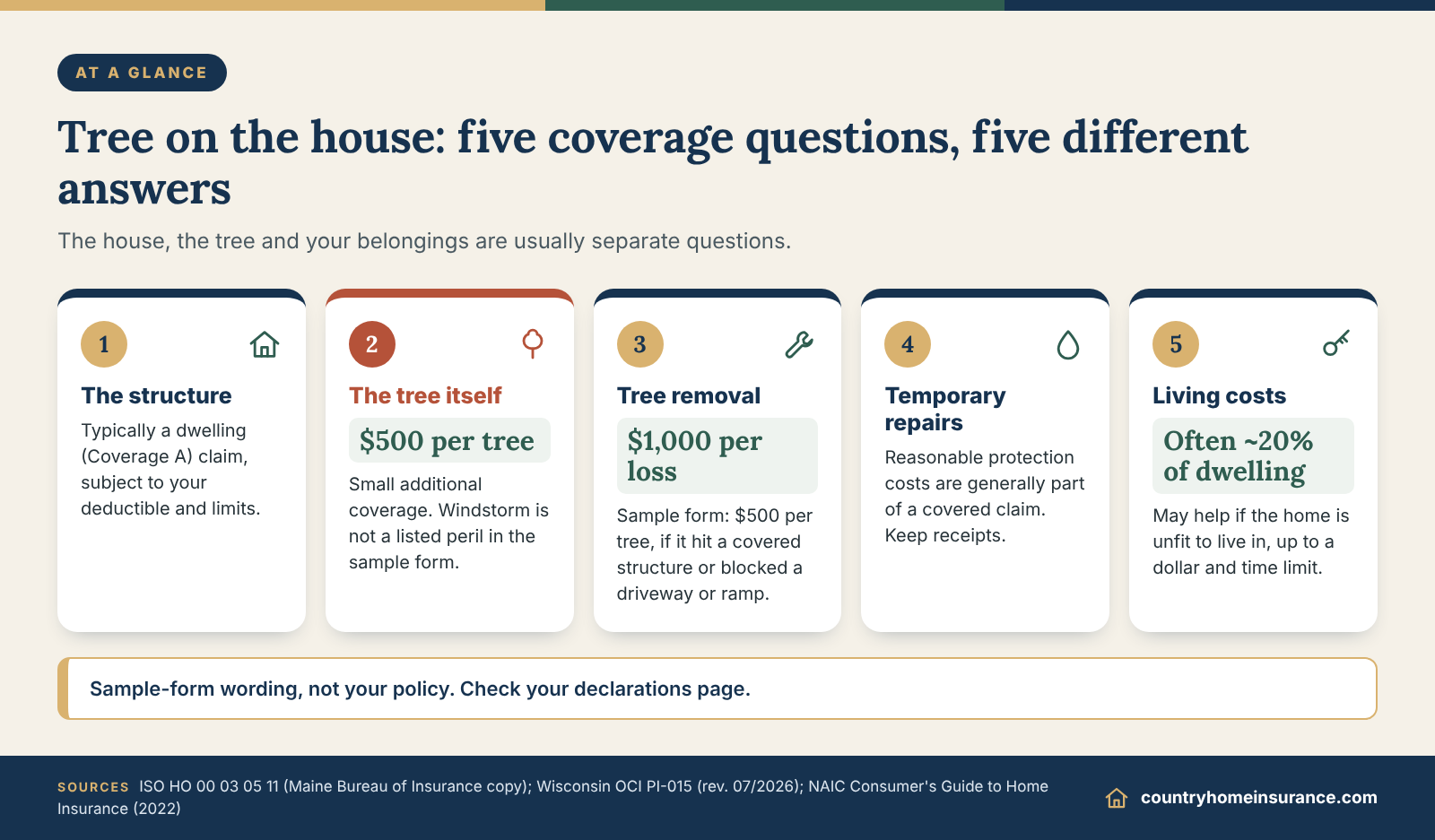
| Removing the fallen tree | A limited additional coverage; sample-form language caps it at $1,000 per loss and $500 per tree | Whether the tree damaged a covered structure or blocked a driveway or ramp; state and insurer wording |
| The tree itself (replanting, value) | Wind damage to the tree is typically not covered in the sample form and a Wisconsin state guide | Named-peril list in your policy, per-tree and total limits |
| Tarps, boarding up, emergency drying | Reasonable costs to protect the damaged property are generally part of the claim | Whether the underlying loss is covered; receipts; policy duties after loss |
| Hotel and extra living costs | May be covered as additional living expense (loss of use) if the home is unfit to live in | Dollar and time limits, which commonly are tied to a percentage of dwelling coverage |
| Damage caused by a dead or neglected tree | Uncertain; wear, deterioration and neglect exclusions may come into play | Policy wording, the facts of the loss, and state law |
| Flood or ground movement after the storm | Typically excluded from a standard policy | Separate flood or earth movement coverage, if any |
What a tree fell on house insurance claim covers and what it does not
A tree on the roof is one of the more dramatic homeowner claims, but it is not mysterious. Most of the confusion comes from treating it as a single event with a single answer. In reality your policy slices the event into pieces: the structure that was hit, the tree that did the hitting, the belongings inside and the cost of living somewhere else while repairs happen. Each slice can have a different limit, a different condition and sometimes a different deductible.
This guide stays focused on trees that fall onto the dwelling itself. If your problem is a tree that flattened a fence, the separate guide on that topic covers it in detail.
Why the house, the tree and your belongings are three different questions
Homeowners policies divide property into coverages. Coverage A is the dwelling, Coverage B is other structures such as a detached garage, and Coverage C is personal property. Trees, shrubs and plants are usually handled elsewhere, as an additional coverage with a small cap. Keeping those lines straight will make every later conversation with an adjuster easier.
The house is a dwelling claim
In the standard-style form we reviewed, the ISO HO 00 03 05 11 homeowners special form as posted by the Maine Bureau of Insurance, the dwelling is insured against direct physical loss unless an exclusion applies. Nothing in that form singles out trees as an excluded cause of loss to the building. So when a tree punches through a roof, the repair is typically evaluated as a dwelling claim, subject to your deductible and limits.
That is a sample form, not your contract. Insurers use their own versions and endorsements, and the declarations page lists the limits that actually apply to you. The practical point is that you should expect the structure to be adjusted as ordinary property damage rather than as a special “tree” claim.
The tree itself is a separate, smaller question
The same sample form treats trees, shrubs and plants as an additional coverage for a short list of perils: fire or lightning, explosion, riot, aircraft, certain vehicles, vandalism and theft. Windstorm is not on that list, so the tree that fell in a windstorm is typically not itself covered for its value or replacement. The form limits that tree coverage to 5 percent of the dwelling limit overall and $500 for any one tree, shrub or plant.
The Wisconsin Office of the Commissioner of Insurance reaches the same place in its consumer guide to homeowners insurance (revised July 2026), noting that landscaping is typically insured for a small percentage of dwelling coverage and that windstorm is excluded for trees. The Washington Insurance Commissioner’s guide adds that tree coverage may apply only to specific perils and may carry a different deductible. Read your own list of perils, because a few policies are written differently.
Which cause-of-loss details matter most
Once you accept that the house is a dwelling claim, the next question is why the tree came down. Cause of loss does not usually decide whether the roof repair is covered, but it can affect the tree-removal benefit, the deductible that applies and how an adjuster characterizes the loss.
Wind, ice and snow versus rot and neglect
The sample form’s tree-removal benefit refers to trees felled by windstorm, hail, or the weight of ice, snow or sleet. A healthy tree toppled by a storm fits comfortably within that description. A tree that was visibly dead, hollow or leaning for years raises a different set of questions, because policies exclude wear and tear, deterioration and rot, and they exclude loss from failing to use reasonable means to save and preserve property.
These exclusions are narrower than many people fear, and they are applied to the facts of the loss rather than to the species of tree. If the tree’s condition might be part of the story, take photographs of the trunk, roots and break point before cleanup, because the evidence helps whoever is deciding the claim.
Interior damage and rain through the opening
When a trunk opens a hole in the roof, the next problem is weather coming in. The sample form’s personal property coverage includes a specific condition for this: rain, snow, sleet, sand or dust damage to belongings inside a building is excluded unless wind or hail first creates an opening in the roof or wall. A falling-object peril has a similar structure, where property inside a building is covered only if the falling object first damages the roof or an outside wall.
Because the tree is the thing that creates the opening, interior damage that follows is usually analyzed together with the roof damage. The sample form also pays reasonable costs for necessary measures taken solely to protect already-damaged covered property from further damage, which is why tarping quickly matters, and we return to it below.
The first 24 hours: safety, evidence and reporting the claim
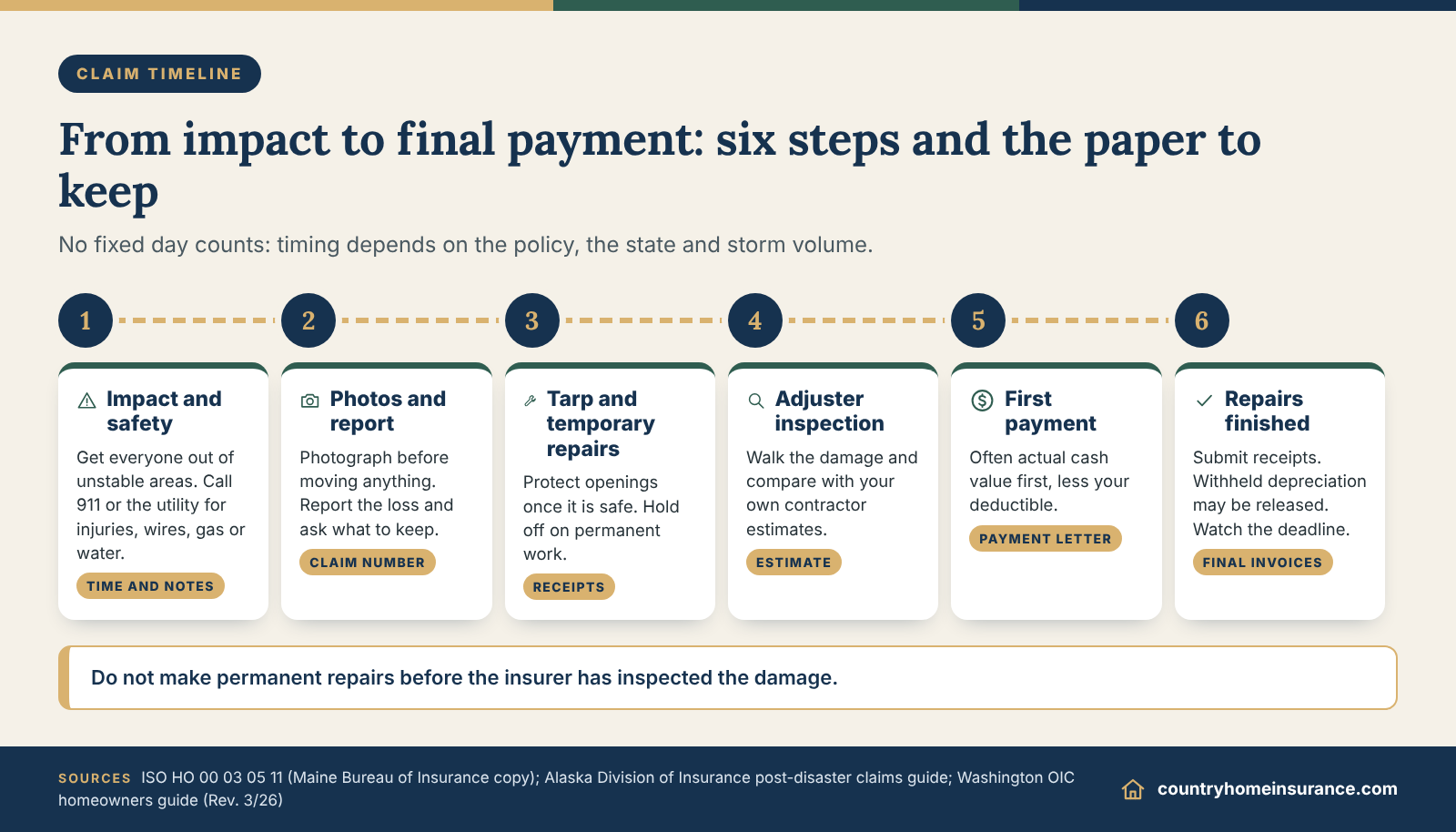
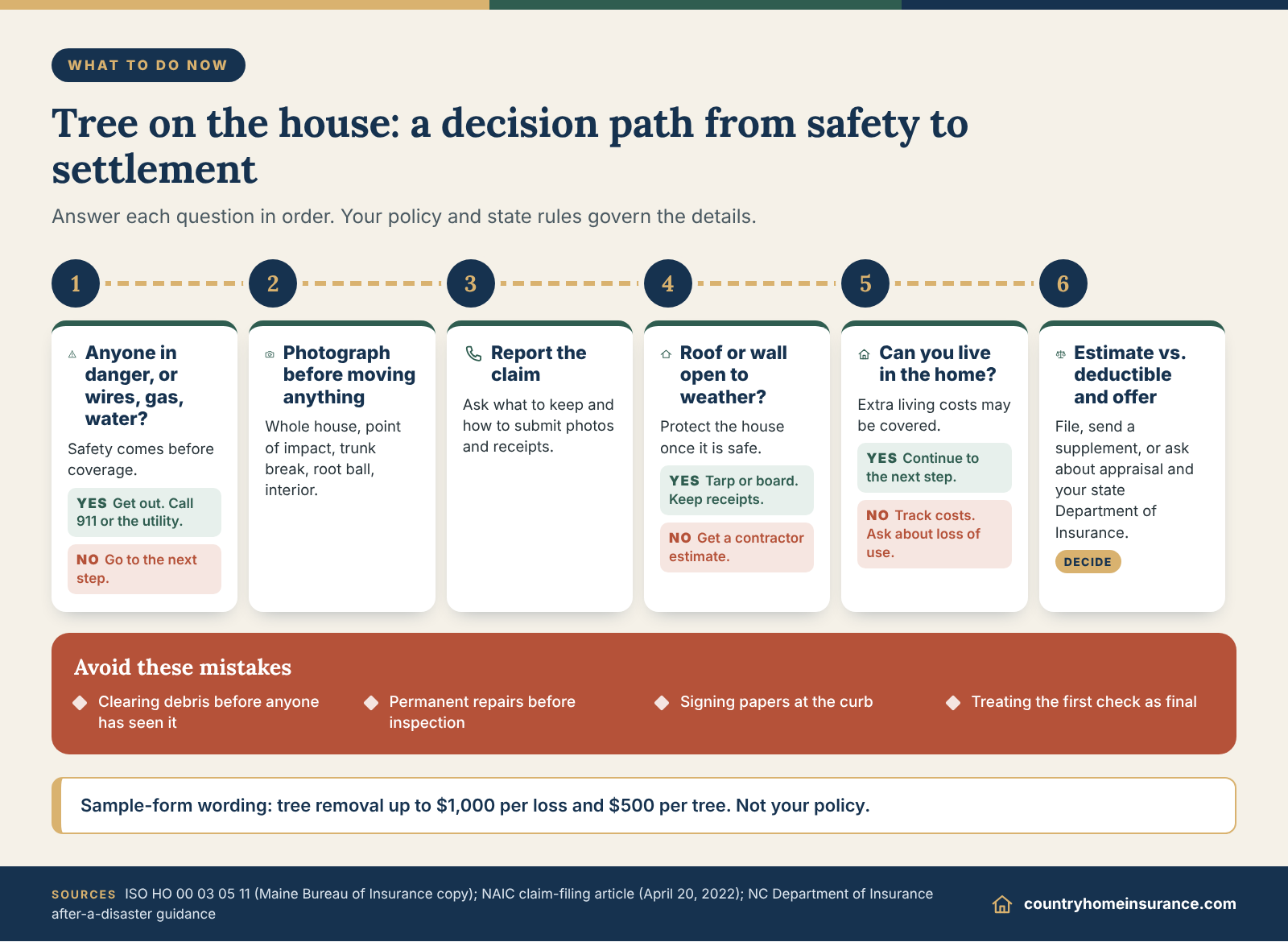
The order you do things in matters more than the speed. Safety comes first, evidence second and the phone call to your insurer third, with temporary protection of the house woven in as soon as it is safe. Insurance guidance from regulators is remarkably consistent on this sequence.
Safety and utilities come before paperwork
Nothing in this section replaces instructions from emergency responders or your utility. Those sources know your local conditions, and we did not retrieve official utility or electrical-safety pages for this article, so treat the points below as common-sense framing and follow local officials where they differ.
People and pets come first
If anyone is hurt, trapped or at risk, call 911 before you think about coverage. A tree strike can compromise rafters, ceiling joists and wall framing in ways that are not obvious from the yard. If the damaged part of the house feels unstable, sags or creaks, stay out of it and wait for a professional to say it is safe. Insurance can replace a ceiling, but it cannot replace you.
Keep children and animals away from the damaged area, and out of the yard if branches are still hung up in neighboring trees. A tree can shift again as weight changes, and loose limbs can fall long after the trunk has settled.
Power, gas and water can add hazards
A tree on the roof can pull service wires off the house, snap a gas line or break a water pipe. If you see wires down, smell gas, hear hissing or see water spraying, get yourself and others outside and call the utility or the fire department from a safe distance. Do not touch a tree, a fence or a vehicle that might be in contact with a line.
In rural areas the nearest responder may be a volunteer fire department with a longer response time, so call early rather than waiting to see whether things settle. After a widespread storm, expect delays and be patient with dispatchers. Never run a generator inside a garage or near a window, and ask your utility or fire department for current safety guidance.
Document before you move anything
The NAIC’s claims guidance (published June 2021) tells consumers to document losses before removing debris or belongings, and to save damaged items for inspection if possible. The North Carolina Department of Insurance says the same thing in different words: list the damage and photograph it before temporary repairs.
A photo and video sequence that works
Start wide, then go close. Photograph the whole house from each side so the tree’s position relative to the structure is clear, then the point of impact, then the trunk where it broke or uprooted, then the damage inside. A slow video walk-through narrated with the date and what you are looking at often captures things you forget to photograph.
Include the root ball if the tree uprooted, the stump if it snapped, and any visible hollow or rot at the break. Shoot the ceiling, attic access and any water stains. If you can do it safely from outside, include the roof edge. If you cannot do it safely, skip it, because a roofer or the adjuster can document the roof later.
Keep evidence until the adjuster says otherwise
Several state regulators say not to dispose of damaged materials before the insurer has had a chance to look. The Alabama Department of Insurance’s disaster guide recommends having an adjuster or agent see damage before damaged property is removed, and the North Carolina Department of Insurance advises checking with your insurer before disposing of damaged materials.
That does not mean leaving a trunk across a doorway. It means asking first, taking thorough photographs, and keeping representative pieces such as a section of the break, damaged shingles or a ruined appliance if your insurer wants them. When in doubt, a quick call or email that says “I plan to cut the tree off the roof tomorrow, anything you need me to keep?” creates a useful record.
Reporting the claim to your insurer
Almost every consumer guide tells you to report promptly. The NAIC’s consumer article on filing a homeowners claim (published April 20, 2022) says to notify your insurer right away and notes that reporting deadlines vary by state.
What to say on the first call
Have your policy number, address and a phone number where you can be reached. Describe what happened in plain facts: a tree fell on the roof during last night’s storm, there is a hole over the kitchen, water is coming in, and you have tarped it or plan to. Ask how to submit photos, whether the insurer has a preferred way to handle emergency tarping and removal, and what they want you to keep.
Write down the claim number, the name of the person you spoke with and the date and time. The NAIC’s consumer guide to home insurance suggests keeping notes of conversations with agents and adjusters, and that habit pays off if the claim stretches over months.
Deadlines, written notice and “just asking” calls
The sample form requires prompt notice and lets the insurer deny a claim over a failure to comply only if that failure prejudices the insurer. Your actual policy, and your state’s rules, may be stricter or looser. The Alaska Division of Insurance’s disaster guide advises reporting as soon as possible and asking the insurer how long you have, which is a sensible habit everywhere.
If you are on the fence about whether to file, you can ask a general question first. Ask your agent how general questions are recorded, because practices differ. We discuss the claim-or-not decision later. For the first 24 hours, the safer default is to report any significant structural damage.
| Step | What to do | What to ask or record |
|---|---|---|
| 1. Safety | Get everyone out of unstable areas; call 911 or the utility for injuries, wires, gas or water hazards | Record the time, who responded and any instructions given |
| 2. Photos and video | Wide shots, point of impact, trunk break or root ball, interior damage, water stains | Date-stamped files saved in two places |
| 3. Report the loss | Call or use the insurer’s app or portal; provide policy number and a reachable phone | Claim number, adjuster name, what to keep, how to submit receipts |
| 4. Protect the house | Tarp or board openings once it is safe; remove standing water if you can do so safely | Ask whether the insurer prefers a particular emergency vendor; keep receipts |
| 5. Keep evidence | Hold damaged materials and representative tree pieces until released | Ask in writing before disposal if the insurer has not responded |
| 6. Track costs | Start a folder for receipts, hotel stays, meals and mileage | Ask what living-expense documentation the insurer wants |
Temporary repairs, tarping and tree removal
Once people are safe and the damage is photographed, the house still needs protection. A tarp over a roof opening costs far less than a ceiling, insulation and flooring that have soaked through, and the policy generally expects you to act like a person who would take reasonable care of the property even without insurance.
What counts as a reasonable temporary repair
Temporary repairs are measures that stop damage from getting worse without finishing the job. Think tarps, plywood, plastic sheeting and emergency drying. Permanent repairs, such as reframing a roof or replacing shingles, belong after the insurer has had a chance to inspect.
What is typically reimbursable
The sample form pays the reasonable cost of necessary measures taken solely to protect covered property that has already been damaged by an insured cause, and it says this does not increase the policy limit. State regulators describe the same idea in plain language. The North Carolina Department of Insurance says reasonable protection costs may be reimbursed and to keep receipts, and the Alaska Division of Insurance suggests covering roofs or windows with tarps or plywood and keeping every receipt.
The Texas Windstorm Insurance Association’s temporary repairs page (last modified August 8, 2024) lists examples that include covering openings with tarp or plastic, removing trees that damaged a covered structure, and boarding up broken windows and doors. Notice that the list includes removing the tree from the structure. That is a different thing from clearing a tree out of the yard.
What should wait for the adjuster
Regulators consistently say not to make permanent repairs until the insurer has inspected. The Washington Insurance Commissioner’s guide says you should not make permanent repairs until the insurance company has inspected the damaged property, and the Alaska guide warns that an insurer may not pay for repairs it did not authorize.
The practical dividing line is whether the work can be undone or inspected later. A tarp can be lifted and the damage beneath it examined. A new roof deck cannot. If you are unsure which side a task falls on, ask the adjuster or the claims representative and ask them to put the answer in an email. Waiting a few extra days for an inspection is irritating, but it is usually safer than discovering that the insurer never saw the original damage.
Tree removal limits and why the documents differ
Tree removal is where many homeowners feel surprised. A crew can charge far more than the policy’s tree-removal benefit, particularly for a large hardwood on a roof or one that must be lifted off by crane. Understanding the structure of that benefit helps you plan.
What the sample form says about fallen trees
Under the debris-removal additional coverage in the sample form, the insurer pays up to $1,000 per loss to remove trees felled by windstorm, hail or the weight of ice, snow or sleet. The same provision includes a neighbor’s trees felled by a covered cause of loss to personal property. The cap is $500 for any one tree, and the benefit is available only if the tree damages a covered structure or blocks a driveway so that a registered motor vehicle cannot enter or leave, or blocks a handicap ramp or fixture serving the dwelling. The form describes this benefit as additional insurance, meaning it sits outside the dwelling limit.
That language describes one sample form. Actual forms vary, and some insurers cap tree removal differently or include it inside other limits. Look at the debris-removal and “trees, shrubs and other plants” provisions in your own policy, or ask your agent to point them out.
Two Alabama documents, two descriptions
The Alabama Department of Insurance offers a useful illustration of how consumer descriptions can differ. Its storm damage FAQ says tree removal is typically paid only if the tree damaged covered property or blocked a driveway or a handicapped ramp, usually capped at $500 per tree and $1,000 total. Its natural disasters guide describes a general cap of up to $500 for tree removal per event, rather than per tree, and says that when a tree damages the dwelling or another insured structure, removal from the structure is paid under the dwelling coverage.
Both documents are undated, and neither is your contract. The lesson is not that the regulator is wrong. It is that policy forms differ, and the way removal is classified (as debris removal, as part of repairing the structure, or as a capped tree benefit) can change how much of a large bill is paid. Ask your insurer which provision it applies and how.
Driveways, ramps and the “blocked access” rule
The blocked-access condition is easy to overlook until it applies to you. A tree that falls across a long private lane, or across the only drive to a house, may qualify for the removal benefit even when it never touched a roof, as long as the policy contains the same condition as the sample form. The sample form frames it around a driveway that stops a registered motor vehicle from entering or leaving, and a ramp or fixture that serves the dwelling.
A tree that falls in a back pasture, or across a trail that nobody needs, generally falls outside those conditions. That is one reason acreage owners sometimes pay for large amounts of tree cleanup themselves after a storm even when a policy is working as written.
| Document | What it says about fallen trees | Date or edition |
|---|---|---|
| ISO HO 00 03 sample form (Maine Bureau of Insurance copy) | Up to $1,000 per loss and $500 per tree for removal when the tree damages a covered structure or blocks a driveway or ramp; tree and plant coverage excludes windstorm | Form edition 05 11; hosting date unknown |
| Alabama DOI storm damage FAQ | Typically $500 per tree and $1,000 total, with similar conditions | Undated |
| Alabama DOI natural disasters guide | Typically up to $500 per event for general removal; removal from an insured structure paid under dwelling coverage | Undated |
| Wisconsin OCI PI-015 homeowners guide | Landscaping typically 5 percent of dwelling coverage, $500 per item, windstorm excluded; debris removal is an additional coverage | Revised 07/2026 |
| Washington OIC homeowners guide | Tree debris removal and damage to trees are additional coverages that may have limits, specific perils and a different deductible | Rev. 3/26 |
Hiring the right crew without signing away your rights
Storm cleanup attracts good local professionals and some less scrupulous operators. A few ground rules from regulators will protect you either way.
Tree service, roofer or general contractor
A tree service removes the tree. A roofer or general contractor repairs the structure. For a tree resting on a roof, you may need the two to coordinate, because removing the tree can reveal additional damage or cause some. The Alabama guide notes that debris removal for an insured loss is often handled by the general contractor under the repair contract, which is one more reason to talk to the insurer before you hire.
The Alaska Division of Insurance’s guide recommends asking contractors for identification, a current license, proof of workers’ compensation and liability insurance, and building permits where required, and getting more than one estimate that covers the same work. For tree work, ask for proof of insurance in particular, since a crew working over your roof is a liability exposure if it is not insured. Your state may license tree services or contractors differently, so check with the state licensing agency.
Deductible waivers and assignment of benefits
Be cautious if a contractor offers to cover your deductible. The Texas Department of Insurance explains in its guidance on contractor deductible waivers (last updated December 9, 2025) that contractors may not waive it, that inflating an estimate to absorb the deductible is fraud, and that insurers may ask for proof you paid it. Rules differ by state, but the principle that your deductible is your share of the loss is widely applied.
The NAIC’s consumer insight on signing documents after a storm (published September 1, 2018) explains that an assignment of benefits lets a contractor seek payment directly from your insurer, which gives it your policy rights for that work. You do not have to sign one to get repairs done. Read any document before you sign it, and never feel pressured to sign at the curb with a chainsaw running.
Deductibles, limits and how the money is actually paid
Even a covered claim is paid through a sequence of subtractions and conditions. Knowing the order lets you estimate your own check before the adjuster arrives, with the caveat that your policy governs.
How the deductible works on a tree claim
The NAIC explains that a deductible is the amount you pay out of pocket on a claim before the policy pays the loss, and that it applies to each claim. The sample form says the insurer pays only the portion of the covered loss that exceeds the deductible, and that if two or more deductibles apply to one loss, only the highest applies.
Flat-dollar and percentage deductibles
Many policies use a flat dollar deductible, but some, especially where wind is a major risk, use a percentage of the insured value for wind or hurricane losses. The Triple-I’s background on windstorm deductibles says percentages typically range from 1 to 5 percent, and gives the example of a home insured for $300,000 with a 5 percent deductible, where the policyholder pays the first $15,000 of a storm claim. The page does not state a content date, so confirm current rules for your state.
Whether your tree claim triggers a wind deductible rather than the all-other-perils deductible can depend on how the policy defines the wind peril and the triggers for named storms. That is a declarations-page question. If you are in a state with hurricane deductibles, ask the adjuster which deductible they applied and why.
One state example: Florida and falling trees
State law can change the math. Florida’s statute on deductibles, as published in the 2026 Florida Statutes, allows insurers to apply a separate roof deductible in some circumstances, capped at the lesser of 2 percent of the dwelling limit or 50 percent of the roof replacement cost. The statute lists exceptions, including a roof loss resulting from a tree fall or other hazard that damages the roof and punctures the roof deck.
That is specific to Florida and to insurers who use a separate roof deductible, so do not assume it applies elsewhere. Its value for readers in other states is to show why you should ask whether a roof-specific or wind-specific deductible exists, and whether it applies when a tree is the cause.
Actual cash value, replacement cost and staged payments
Dwelling claims are paid on either a replacement cost or an actual cash value basis, and the difference can be thousands of dollars on a roof. In general terms, replacement cost settlement pays to repair or rebuild with comparable materials without subtracting for age, while actual cash value subtracts depreciation for age and wear. Your loss settlement section spells out which applies to the dwelling and to roof surfacing.
The 80 percent rule and holdbacks
In the sample form, if the dwelling is insured to at least 80 percent of its full replacement cost, the insurer pays replacement cost without depreciation up to the lowest of the policy limit, the like-kind replacement cost, or the amount actually spent. If the dwelling is insured to less than 80 percent, the settlement formula is less generous. The form also provides that only actual cash value is paid until the repair or replacement is complete, with a narrow exception for small losses under 5 percent of the building’s insurance and under $2,500.
The practical effect is a staged payment. Expect a first payment based on actual cash value, with the remainder (often called recoverable depreciation) released after you prove the work was done. The Texas Department of Insurance describes this two-part payment for replacement cost roof claims in its roof replacement guidance, updated January 30, 2024.
How long you have to claim the holdback
The sample form allows you to claim on an actual cash value basis first and later claim the additional amount if you notify the insurer within 180 days of your intent to repair or replace. The Alaska Division of Insurance’s guide says time limits for recoverable depreciation usually run from six months to a year depending on state law and the policy, and that insurers may grant more time after large disasters if you ask.
These are different numbers from different documents, and your policy may say something else again. Put the deadline on a calendar the day you receive the first payment letter. If contractors are booked for months, tell the insurer early and ask for an extension in writing.
Additional coverages that sit beside the dwelling limit
A few provisions behave differently from the main dwelling limit, which is why they are worth identifying on your declarations page and in your policy.
Debris removal beyond the tree
Besides the tree-removal benefit, the sample form pays reasonable costs to remove debris of covered property when an insured cause damages it. That cost normally sits within the limit of the damaged property, with an additional 5 percent of that limit available if the debris cost exceeds it. Think of drywall, insulation, roofing and ruined flooring that must be hauled away.
Wisconsin’s guide describes debris removal as an additional coverage that pays to remove debris left by a covered loss. The Alabama guide notes that for an insured loss, debris removal should be part of the property settlement and often handled through the general contractor. In practice, ask your adjuster whether the estimate includes haul-away and dumpster costs, because they are easy to leave out.
Ordinance or law and code upgrades
If repairs trigger building-code upgrades, such as new roof deck fastening or electrical updates, the extra cost may not be part of a standard dwelling payment. The sample form includes an ordinance-or-law additional coverage of up to 10 percent of the dwelling limit, and the Alabama guide says standard policies generally do not cover code-upgrade costs unless you buy an endorsement. Those two statements can both be true, because forms and endorsements differ.
Ask the adjuster and your contractor early whether a permit inspector might require upgrades. Having that conversation before the estimate is finalized is easier than adding it after.
Hypothetical example: putting the pieces together
Hypothetical example, with non-promissory figures: a policy has a $1,000 deductible and a $300,000 dwelling limit. A storm drops an oak on a back corner of the roof. The adjuster’s estimate for the structure and interior is $14,000, a tree service charges $2,400 to cut and lift the tree, and an emergency tarp costs $450. Under a policy shaped like the sample form, the removal benefit might be limited to $1,000 per loss, the tarp may be reimbursed as a reasonable temporary repair if the loss is covered, and the deductible would be subtracted once from the total of covered amounts.
Under those assumptions the covered portion might be roughly $14,000 plus $1,000 plus $450, less the $1,000 deductible, or $14,450, and the homeowner would pay the rest of the tree bill. Another policy could classify removal differently and pay more or less. The example is only meant to show the order of operations, not to predict your outcome.
| Item | Sample or typical wording (not your policy) | Where to look |
|---|---|---|
| Deductible | Applies per loss; only the highest deductible applies if more than one fits the loss | Declarations page; wind or hurricane deductible endorsement |
| Percentage deductible | Often 1 to 5 percent of insured value where used; a 5 percent deductible on $300,000 is $15,000 (Triple-I example) | Declarations page; state rules |
| Tree removal | $1,000 per loss, $500 per tree, with structure-damage or blocked-access conditions | Debris removal and additional coverages sections |
| Trees, shrubs and plants | 5 percent of dwelling coverage, $500 per item; windstorm not listed | Additional coverages; named-peril list |
| Other debris removal | Within the damaged property’s limit, plus an extra 5 percent if exceeded | Debris removal provision |
| Reasonable repairs | Pays reasonable protective measures; does not raise the limit | Additional coverages; duties after loss |
| Ordinance or law | Up to 10 percent of dwelling coverage in the sample form | Additional coverages; endorsements |
| Loss of use | One combined limit for living costs and rental value; often about 20 percent of dwelling coverage in consumer guides | Declarations page, Coverage D |
| Replacement cost holdback | Actual cash value first; difference after repairs; sample form allows 180 days to notify intent | Loss settlement condition |
If you can’t stay home: additional living expense coverage
A tree through the bedroom ceiling may be fixable in weeks, but rebuilding a roof, replacing drywall and drying out a house can take months once contractors, permits and materials are scheduled. During that time you may need to live somewhere else, and that is what loss of use coverage, often called Coverage D or additional living expense (ALE), is designed to address.
What additional living expense coverage pays
ALE is not a vacation allowance. It is meant to keep your household’s finances roughly where they would have been, by paying the extra costs you incur because a covered loss made the home unfit to live in.
Extra costs, not normal costs
The sample form describes ALE as the necessary increase in living costs needed to maintain your household’s normal standard of living when a covered loss makes the residence unfit to live in. The Washington Insurance Commissioner’s guide gives familiar examples such as hotel costs, increased mileage and increased food costs, and says normal costs of living like a mortgage payment and utilities are not covered. The Alaska Division of Insurance adds that ALE does not pay your mortgage, and that restaurant meals may be reimbursed when the hotel room has no kitchen.
The key phrase in all of these is “additional.” If you already spend $700 a month on groceries and now spend $1,000 because you cannot cook at home, the extra $300 is the type of cost an insurer would typically consider. Your regular mortgage or utility bills continue, and the insurer does not take them over.
Dollar limits and time limits
ALE typically has both a dollar limit and a time limit. The NAIC consumer guide to home insurance (2022 edition) says loss of use is typically 20 percent of the dwelling limit, though policies may differ, and the North Carolina Department of Insurance says Coverage D is normally limited to 20 percent of Coverage A. For a $300,000 dwelling limit, that would be roughly $60,000, which is a hypothetical example of the arithmetic and not a promise.
Time limits vary more. The Alabama Department of Insurance says policies that include ALE must provide at least 12 months of coverage in that state, though a monetary limit may apply and a claim might not qualify for the full period. Because other states may not follow the same rule, read the loss of use section of your policy and ask the adjuster for the current end date.
Making the claim work in practice
ALE claims are mostly bookkeeping. Documentation is not complicated, but it must be consistent and prompt.
Receipts, relatives and what to ask first
Keep itemized receipts for hotels, rentals, meals above your normal food budget, laundry, extra mileage and storage. The Alaska guide stresses keeping all receipts and saving hotel bills because the insurer needs them for reimbursement. Ask at the start whether the insurer will pay the hotel directly, whether a rental house is acceptable, and what daily meal rate it considers reasonable.
Wisconsin’s guide notes that if you stay with a friend or relative at no extra cost, no ALE is paid, since you have not incurred additional expense. That does not stop you from documenting extra mileage or the costs of storing furniture, which may be extra costs even when the bed is free.
Civil authority and neighboring damage
The sample form includes a civil authority provision that applies when a government order prohibits use of your residence because of direct damage to neighboring premises by an insured cause of loss. In the sample, living-expense coverage under that provision applies for no more than two weeks.
That matters after a storm that downs trees across a street, or when a neighbor’s collapsed structure endangers yours and officials block access. It is a narrow benefit, so the form’s wording about what the order must be based on is important. If officials tell you to stay out, ask for the order in writing and send it to your insurer.
Working with the adjuster, estimates and disagreements
The adjuster’s report becomes the backbone of your settlement. The NAIC’s claims guidance says the adjuster assesses the damage and estimates its cost, and that the adjuster’s documentation helps determine the settlement amount. You are not powerless in that process, but your side is stronger when it is organized.
Preparing for the inspection
The Alabama Department of Insurance notes that after major storms adjusters inspect the most extensively damaged properties first and delays of days or weeks are possible. When your turn comes, showing up prepared means fewer overlooked items.
What to have ready for the visit
The NAIC’s claim-filing article recommends bringing your list of damaged property to the adjuster meeting, and the Alabama guide recommends being present at the inspection so you can point out all damaged areas. Prepare a short written list in the order you want to walk it: roof, attic, ceilings, walls, floors, contents, and anything you tarped or cut.
Have your photos accessible, your temporary repair receipts, and any estimate you have already received. If the tree has been removed, bring photographs of the break and the root ball. Mention anything you noticed about the house before the storm, such as a recent roof replacement, because it affects how age and condition are treated.
Getting your own estimates
The Alabama Department of Insurance’s storm FAQ suggests getting your own estimates from the contractors who will do the work rather than relying only on the adjuster’s, and notes that getting at least two is often recommended. It also says reputable contractor estimates are your main documentation for negotiating.
The NAIC adds that you should not feel rushed or pushed into agreeing with something you are not comfortable with, and suggests considering having your contractor meet you and the adjuster at the property. A joint walkthrough lets the contractor explain why a repair needs a certain scope, and the adjuster can raise concerns while everyone is looking at the same damage.
When the numbers do not match
Differences between the adjuster’s estimate and your contractor’s bid are common and are not necessarily a sign of bad faith on anyone’s part. Hidden damage, differing assumptions and unit prices all play a role.
Supplements and discovered damage
Once the tree is lifted off and the roof deck is exposed, a roofer may find broken rafters, cracked ceiling joists or soaked insulation that was invisible during the first inspection. A supplement is a request to add that newly found damage to the claim. The Alabama guide says to report damage you discover later to your insurer, and the Wisconsin farm owner fact sheet advises contacting the adjuster again if you find additional damage or have more information during rebuilding.
Document the discovery with photos before covering it up, send the contractor’s written explanation, and ask the insurer for a reinspection if needed. Do not simply have the work done and send a bill afterward. The insurer may feel it never had a chance to evaluate the cost.
Appraisal, complaints and public adjusters
If you still disagree on the amount, check your policy for an appraisal clause. The NAIC’s consumer guide says to try resolving a disagreement first, then look to an appraisal clause, or consider an attorney or a public adjuster, and notes that your state insurance department can help resolve disputes. In the sample form, either side can demand appraisal when they disagree on the amount of loss, each picks an appraiser, and the two choose an umpire.
A public adjuster is hired by you and paid by you. The NAIC’s article on contracts after a storm notes that company adjusters assess damage at no cost to you, while a public adjuster you hire is paid by you, and the Alaska guide adds that fees may be flat or a percentage and that some states cap them. The insurer does not have to accept a public adjuster’s estimate.
The Alabama Department of Insurance says it can step in when there are significant differences between an industry-standard repair rate and the insurer’s offer, but it typically does not negotiate detailed settlement amounts. To file a complaint with your state, the NAIC explains that you begin at its consumer page, choose your state, and include policy details, photographs, correspondence and a log of calls in a detailed account. See the NAIC’s guidance on filing and researching complaints (published September 1, 2022).
The clocks that govern claim handling
People often ask how long the insurer has to respond. There is no single national answer, because claim-handling timelines are set state by state.
What the NAIC model regulation suggests
The NAIC’s Unfair Property/Casualty Claims Settlement Practices Model Regulation (document MO-902, July 1997) is a model that states may adopt in whole, in part or not at all. In its text, an insurer should acknowledge a claim within 15 days of notice, accept or deny a first-party claim within 21 days after receiving properly executed proofs of loss, tell the claimant if more time is needed, and send written updates every 45 days while the investigation continues. It also calls for paying an undisputed amount within 30 days of affirming liability and for written denials that cite the specific policy provision relied on.
Think of these as a benchmark for conversation, not a legal claim about your state. They explain what to ask when a claim goes quiet.
Your state’s rules may differ
The NAIC also publishes a claims settlement provisions chart (Spring 2024) listing each state’s statutes or regulations, and it shows that deadlines differ: for example, the chart lists 10 working days to acknowledge a claim in Alaska and Arizona and 15 days in California. The NAIC cautions that the chart is not a legal opinion and that readers should check the cited law and any later changes.
Use your state’s insurance department website to find the current rule, and write down the date you gave notice and the date of each communication. If deadlines pass without a response, a polite written follow-up that references the claim number is a good first step, and a complaint to the department can follow.
Neighbor’s trees, neglected trees and rural situations
The straightforward case is a healthy tree on your own land that a storm knocks onto your roof. Real life is messier. The trunk may come from next door, the tree may have been in poor shape for years, or your property may be an acreage where the usual assumptions about driveways and neighbors do not hold.
When the tree came from a neighbor’s yard
This is the question most readers ask, and it deserves a careful answer. The honest answer is that your own policy is usually the first place to look, and the neighbor’s responsibility is a separate legal question.
Your policy responds first
In the sample form, the dwelling coverage responds to direct physical loss from a covered event regardless of whose property the tree grew on. The tree-removal benefit even refers expressly to a neighbor’s trees felled by a covered peril. So a storm that sends a neighbor’s tree onto your roof is typically evaluated under your policy, with your deductible, rather than waiting on the neighbor.
The reason is practical. The sample form’s dwelling coverage is written around the cause of loss, not around proving who was at fault, and waiting for a neighbor or the neighbor’s insurer can leave the roof open for weeks. If your insurer pays, it may then pursue recovery from someone else.
Could the neighbor or their insurer owe something?
Whether a neighbor can be held responsible for a tree that falls is a question of state law and the facts, and we did not retrieve a state-by-state source for that rule, so this article does not state one. What we can say from the sample form is that insurers may require you to assign your recovery rights to the extent they have paid, and that you must cooperate. The form also lets an insured waive recovery rights in writing before a loss.
If your insurer pursues the neighbor, it will usually handle the correspondence. If you suspect the tree was dead or obviously dangerous and the neighbor was warned, tell your adjuster and keep copies of any written notices you sent. For advice on a specific dispute, speak with a licensed attorney and your state’s Department of Insurance, because this article is educational information and not legal advice. For the other side of this issue, where your tree harms a neighbor, see the companion guide on fences and consider your liability coverage.
Trees that were dead, rotten or ignored
A tree that falls in a hurricane-force wind is one thing. A tree that tips over on a calm day because the trunk was hollow is another. Insurers may look closely at the second.
Wear, deterioration and neglect exclusions
The sample form excludes wear and tear and deterioration, rust and dry rot, and mold or wet rot, with exceptions for ensuing losses that are not otherwise excluded. It separately excludes neglect, meaning failure to use reasonable means to save and preserve property at and after a loss. It also excludes faulty or inadequate maintenance for dwelling and other structures, again with an ensuing-loss exception.
These exclusions deal with the cause of the loss to the property, and a trunk that fails because of rot is not the same as the roof being worn out. Whether an insurer would apply them to a tree strike is fact-specific and policy-specific, and we found no regulator guidance that answers it. If you receive a denial, ask for it in writing with the specific provision cited. The NAIC model regulation would have the insurer do so, and the Alabama guide recommends keeping written denials.
Maintenance habits that help a claim and the roof
The Texas Department of Insurance advises homeowners to remove limbs hanging over or near the roof, and says that if a tree damages your roof you can file a claim. Pruning overhanging limbs and removing trees that are clearly dying is basic housekeeping, and keeping dated receipts and photos from tree service visits shows that you maintain the property.
Do not remove healthy trees out of fear. The point is to deal with trees that have visible warning signs, and a qualified arborist can evaluate them. Ask about training and insurance before you hire anyone to work near the house.
Rural and acreage properties
Rural homes face the same policy language, but the conditions around a claim are different. Long drives, private lanes, wells and limited contractor supply change how the advice plays out.
Long private drives and access ramps
The blocked-driveway condition in the sample form can matter more on a country property, where a single lane may be the only access for a family, a school bus or an ambulance. If a tree blocks it and policy language resembles the sample, the removal benefit may apply even when the house is intact. Photograph the lane, the trunk and any equipment that cannot pass, and tell the insurer why the blockage is a problem.
If you rely on a private road shared with neighbors, check your road maintenance agreement. A fallen tree on a shared lane can raise a question of who handles removal, and the answer is usually contractual rather than an insurance issue.
Remote locations, outbuildings and crew availability
After a widespread storm, tree crews and roofers can be booked for weeks, and country addresses may sit at the end of their lists. Ask your insurer about emergency services it can arrange, keep tarps on the roof in good condition, and document the dates you tried to schedule work, because a written record helps explain the timeline if questions come up later.
If the same storm hit a barn, workshop or other outbuilding, those are Coverage B claims with their own limit, often around 10 percent of dwelling coverage according to the Texas Department of Insurance’s other structures page (last updated December 18, 2025). Fences and similar structures are covered in their own guide.
Common mistakes, the claim-or-not decision and next steps
Most claim problems after a tree strike are not exotic. They come from doing sensible things in the wrong order, or from assuming that the first payment is the last. The patterns below show up in regulator guidance again and again.
Mistakes that complicate an otherwise covered claim
None of these is fatal by itself, and a good adjuster will work with you. They do, however, make the claim slower and sometimes smaller than it needed to be.
Clearing everything before anyone has seen it
The urge to clean up is strong. Neighbors arrive with chainsaws, a tree crew offers a same-day slot, and the yard is a mess. But once the trunk is cut up, the debris hauled and the wet insulation tossed, the adjuster has less to examine. Several regulators say to document first and to check with the insurer before disposing of damaged materials.
You can keep both the house and the claim in good shape by photographing thoroughly, keeping a few representative pieces and asking the insurer for permission in writing. If something must be moved for safety, move it and record why.
Starting permanent repairs or signing papers too early
Temporary repairs are expected. Permanent ones before inspection are risky, because the insurer may say it never had the chance to verify the damage or the price. The same goes for documents. Contractors may present a contract, an authorization or an assignment of benefits at the first visit, and the NAIC’s consumer guidance says you do not need to sign an assignment of benefits to get repairs done.
Take the paperwork home. Compare at least two bids that describe the same scope of work. If a contractor tells you the offer expires today, treat that as a reason for more caution and not less.
Treating the first check as the final answer
The first payment is often an actual cash value payment, with the remainder tied to completed repairs. The Alabama Department of Insurance says cashing an initial claim payment generally does not prevent further negotiation, but signing a settlement release closes the claim. Read any release carefully, and do not sign one while repairs are still being scoped or before you know whether hidden damage exists.
Also watch the calendar for the holdback deadline described earlier. A missed window can turn a recoverable amount into a permanent loss, which is the sort of avoidable outcome that makes the early paperwork worthwhile.
Deciding whether to file at all
Not every tree incident justifies a claim. A branch that dented a gutter or a limb that scraped a few shingles may cost less to fix than your deductible, and the decision involves more than the immediate payout.
Comparing repair cost with the deductible
The NAIC advises that you confirm your deductible before reporting, and notes that minor damage may cost less to fix out of pocket than the deductible plus the effect of a claim. A claim makes more sense when repairs will exceed the deductible or the damage is extensive.
Get at least one contractor estimate before deciding on borderline damage. A small hole in the roof can hide wet insulation and decking, so an inspection is worth doing even if you end up paying yourself. If a roof-specific, wind or percentage deductible applies, run the numbers with that figure and not the base deductible. For a bigger picture of how wind and hail dominate homeowners claims, Triple-I data from ISO show that wind and hail accounted for about 42.5 percent of homeowners losses in 2023 and averaged roughly $14,700 per claim over 2019 to 2023. That is a measure of wind and hail overall and does not isolate fallen trees.
Questions to ask before you decide
Ask your agent how the insurer treats claims at renewal, whether a claim under the deductible would still be recorded, and whether the roof or other components are insured at replacement cost or actual cash value. The Colorado Division of Insurance’s copy of the NAIC shopping tool for homeowners insurance (copyright 2014, so older) includes useful questions about tree coverage, living-expense coverage and wind and hail deductibles.
Your answers help you see the cost of filing versus not filing. If the damage is large or structural, the cost of not filing can be higher than any effect on your premium, but the decision is yours, and your agent can help you think it through. For how claims history can affect pricing, see our guide on that subject.
After the claim: closing out and lowering the odds of a repeat
Once the tree is gone and the roof is whole, the claim can feel finished. A few follow-up steps protect you for the next storm.
Closing the file and keeping the records
Keep the full claim folder: photographs, estimates, invoices, correspondence, payment letters, and your call log. The sample form says suits against the insurer must begin within two years of the date of loss, although state law and your own policy may differ, so do not discard records just because the check cleared.
If you replaced significant parts of the roof or structure, give your insurer or agent the updated information. Insurers rate homes based on features such as roof condition, and accurate records can matter at renewal. Ask what documentation they want from the contractor.
Reducing the risk next time
The Texas Department of Insurance recommends removing limbs hanging over or near the roof and hiring a roof inspector every few years to catch problems early. Beyond that, consider having a qualified arborist look at large trees near the house, especially those with dead limbs, root damage from construction or visible decay.
The NAIC also encourages a home inventory, updated at least annually and stored somewhere other than the home. If a tree has taught you how long it takes to rebuild a list from memory, this is the moment to make one, and the NAIC’s homeowners insurance page explains why. Review your dwelling limit, loss of use limit and deductible at the next renewal.
Frequently asked questions
Coverage and payment questions
Does homeowners insurance pay to remove a tree that fell on my house?
It may, within limits. In the sample form the benefit is up to $1,000 per loss and $500 per tree when the tree damages a covered structure or blocks a driveway or ramp. Some policies and state descriptions differ, including Alabama documents that describe $500 per event or $500 per tree with a $1,000 total. Removal as part of repairing the structure may be handled differently. Ask your insurer which provision applies and whether the crew’s invoice will be adjusted.
Is the tree itself covered if wind knocks it over?
Typically not for wind. The sample form and the Wisconsin guide both indicate that trees, shrubs and plants have named-peril coverage that does not include windstorm, and that coverage is small, around $500 per item and 5 percent of dwelling coverage overall. If a tree is hit by a covered cause such as fire or vandalism, the answer may be different. Check the list of perils in your policy.
What if the tree fell but did not hit anything?
If a tree falls in a yard or field without damaging a covered structure or blocking a driveway or ramp, tree removal is typically not covered under the sample wording. The Alabama Department of Insurance says that in this situation payment is usually limited to a small general tree removal amount, and not every policy provides even that. Many homeowners pay for this kind of cleanup out of pocket.
Claim process questions
Should I call my insurer or a tree service first?
If anyone is in danger, call emergency services first. Otherwise, photograph the damage and report the claim as soon as is practical, then ask about emergency tarping and removal before hiring. In many cases it is reasonable to start protecting the house right away and call the insurer shortly after, as long as you keep records and receipts. Your policy and state rules govern timing, so ask the insurer how long you have to report.
Can I stay in my house while it is being repaired?
That depends on safety, weather protection and whether essential systems work. If the home is not fit to live in because of a covered loss, additional living expense coverage may pay for extra costs, subject to its dollar and time limits. If you are unsure whether it is livable, ask a contractor or local building official, and tell your insurer where you can be reached. Keep receipts for extra costs from the first night.
What can I do if the insurer denies or underpays the claim?
Ask for the decision in writing with the policy provision cited. Compare it with your estimates and photographs, submit supplements for any newly found damage, and check whether your policy has an appraisal clause. You can also contact your state Department of Insurance, which can help with disputes though it typically does not negotiate detailed settlement amounts. A public adjuster or attorney is another option, with costs you should understand in advance.
Sources
All pages below were reviewed on 2026-10-11. Several state consumer pages are undated; where a revision or publication date appears, it is noted.
- ISO Homeowners 3 Special Form (HO 00 03 05 11), copy posted by the Maine Bureau of Insurance (sample form, 2011 edition)
- Alabama Department of Insurance: Storm Damage FAQs (undated)
- Alabama Department of Insurance: Natural Disasters consumer guide (undated)
- Wisconsin Office of the Commissioner of Insurance: Consumer’s Guide to Homeowners Insurance (PI-015) (revised 07/2026)
- Wisconsin Office of the Commissioner of Insurance: Insurance Tips for Farm Owners (PI-239) (revised October 2024)
- Washington Office of the Insurance Commissioner: Homeowners insurance guide (Rev. 3/26)
- North Carolina Department of Insurance: How to deal with the aftermath of a disaster (undated)
- North Carolina Department of Insurance: Basic homeowners insurance (undated)
- Alaska Division of Insurance: Post-Disaster Claims Guide (undated)
- Texas Department of Insurance: Replacing your roof (updated January 30, 2024)
- Texas Department of Insurance: Can a contractor waive my deductible? (updated December 9, 2025)
- Texas Department of Insurance: Home insurance, structures covered (updated December 18, 2025)
- Texas Windstorm Insurance Association: Temporary repairs (last modified August 8, 2024)
- Florida Statutes, section 627.701 (2026)
- NAIC: What you need to know when filing a homeowners claim (April 20, 2022)
- NAIC: Navigating the claims process to recover and rebuild (June 23, 2021)
- NAIC Consumer Insight: After a storm, read the fine print (September 1, 2018)
- NAIC: How to file a complaint and research complaints against insurance carriers (September 1, 2022)
- NAIC Unfair Property/Casualty Claims Settlement Practices Model Regulation (MO-902) (July 1997 model text)
- NAIC: Claims settlement provisions chart (Spring 2024)
- NAIC: A Consumer’s Guide to Home Insurance (2022 edition)
- NAIC: Homeowners insurance consumer page (undated)
- Colorado Division of Insurance: A Shopping Tool for Homeowners Insurance (NAIC) (copyright 2014)
- Triple-I: Background on hurricane and windstorm deductibles (undated)
- Triple-I: Facts and statistics, homeowners and renters insurance (ISO data, 2019 to 2023)
Important coverage note
Coverage depends on your actual policy, its endorsements, exclusions, limits, deductible and the cause of loss. Sample policy language in this article illustrates how forms commonly read and is not your contract. State laws and insurance programs vary, and the facts of your loss may change the outcome.
Check your declarations page and policy form, and verify case-specific questions with your insurer or agent and your state Department of Insurance. This article is educational information, not legal advice, and it does not promise that any claim will be paid.
About the editorial team
This guide was prepared by the countryhomeinsurance.com editorial team as general, educational information for homeowners. We research and summarize publicly available material, including state insurance departments, the NAIC, federal agencies, regulators’ consumer guides and published insurer and industry resources. We draw only on the sources that were available to us when we wrote this guide, and we list them in the Sources section with dates where we could find them.
Insurance rules, rates, products and program terms change, differ by state and by insurer, and can apply differently to your situation. We cannot guarantee that this content is complete, current or free of errors. It is not legal, financial, tax or insurance advice, it is not an offer to sell insurance or a recommendation of any insurer, agent or product, and reading it does not create a professional relationship of any kind.
To the fullest extent permitted by law, countryhomeinsurance.com and its editorial team, authors and contributors exclude all liability for any loss, damage or decision arising from the use of, or reliance on, this content. For questions about your own policy or claim, contact your insurer, a licensed agent or broker, your state Department of Insurance or another qualified professional.
Content created: October 11, 2026