
Quick answer
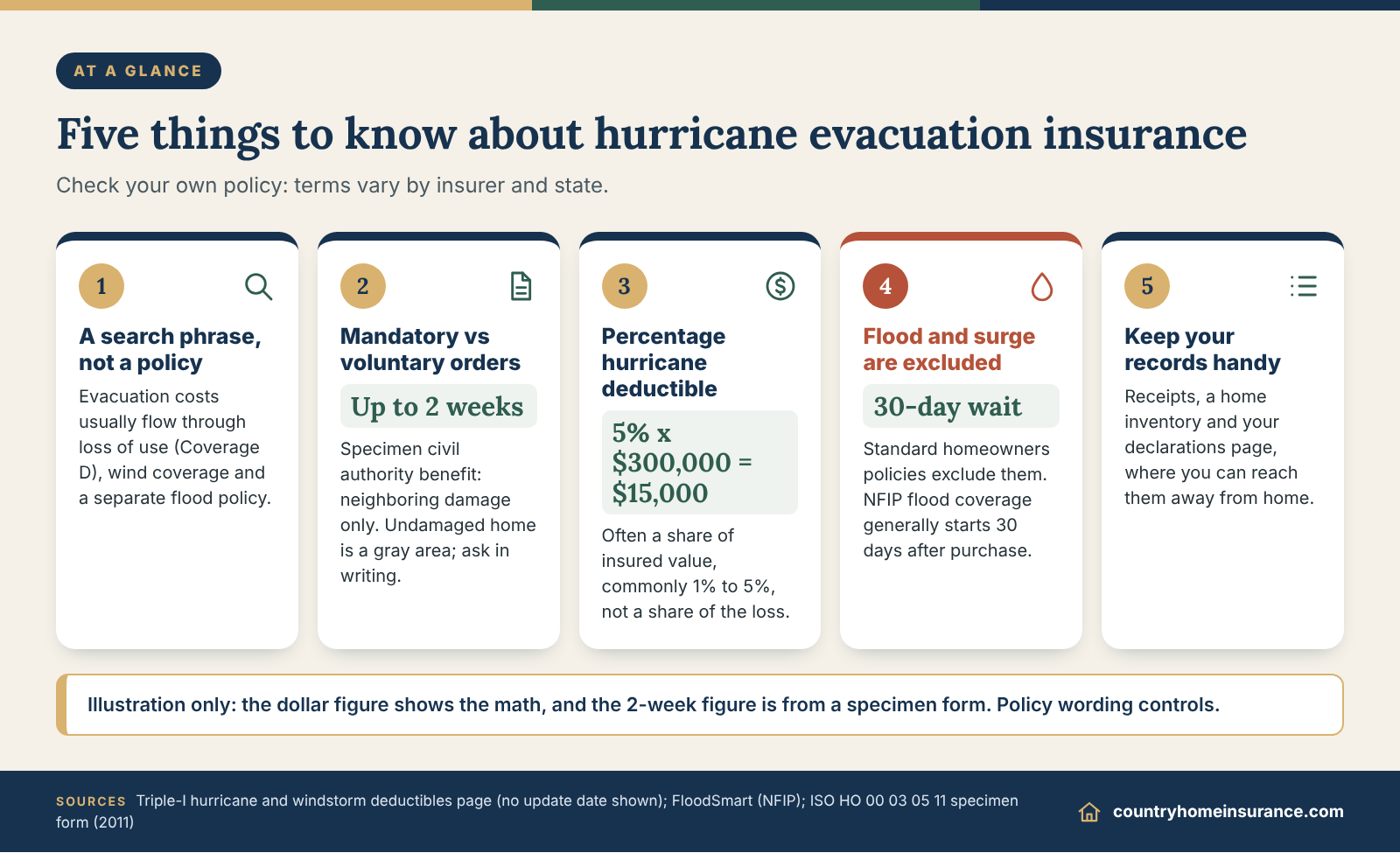
“Hurricane evacuation insurance” is a search phrase, not a standard policy. Evacuation costs usually come from three separate places: loss-of-use (additional living expense) coverage in a homeowners policy, wind coverage that carries its own hurricane deductible, and a separate flood policy. Whether a hotel bill is paid depends on the evacuation order, whether your home was damaged by a covered cause, your policy’s wording and its limits.
Key takeaways
- No source we retrieved describes a standalone product called hurricane evacuation insurance. The money usually flows through Coverage D (loss of use), so read that section of your policy first.
- A mandatory evacuation with no damage to your home is the gray area. Some policy wording covers government-ordered evacuations only in narrow situations, so ask your insurer in writing before the next storm.
- Hurricane and named-storm deductibles are often a percentage of the insured value of the home, commonly 1% to 5% according to Triple-I, so a 5% deductible on a $300,000 dwelling limit means $15,000 before the insurer pays.
- Storm surge and flooding are excluded from standard homeowners policies. The National Flood Insurance Program (NFIP) generally has a 30-day waiting period and does not pay temporary housing or living expenses.
- Keep receipts, a home inventory and a copy of your declarations page where you can reach them away from home.
| Situation | Typical treatment | What it depends on |
|---|---|---|
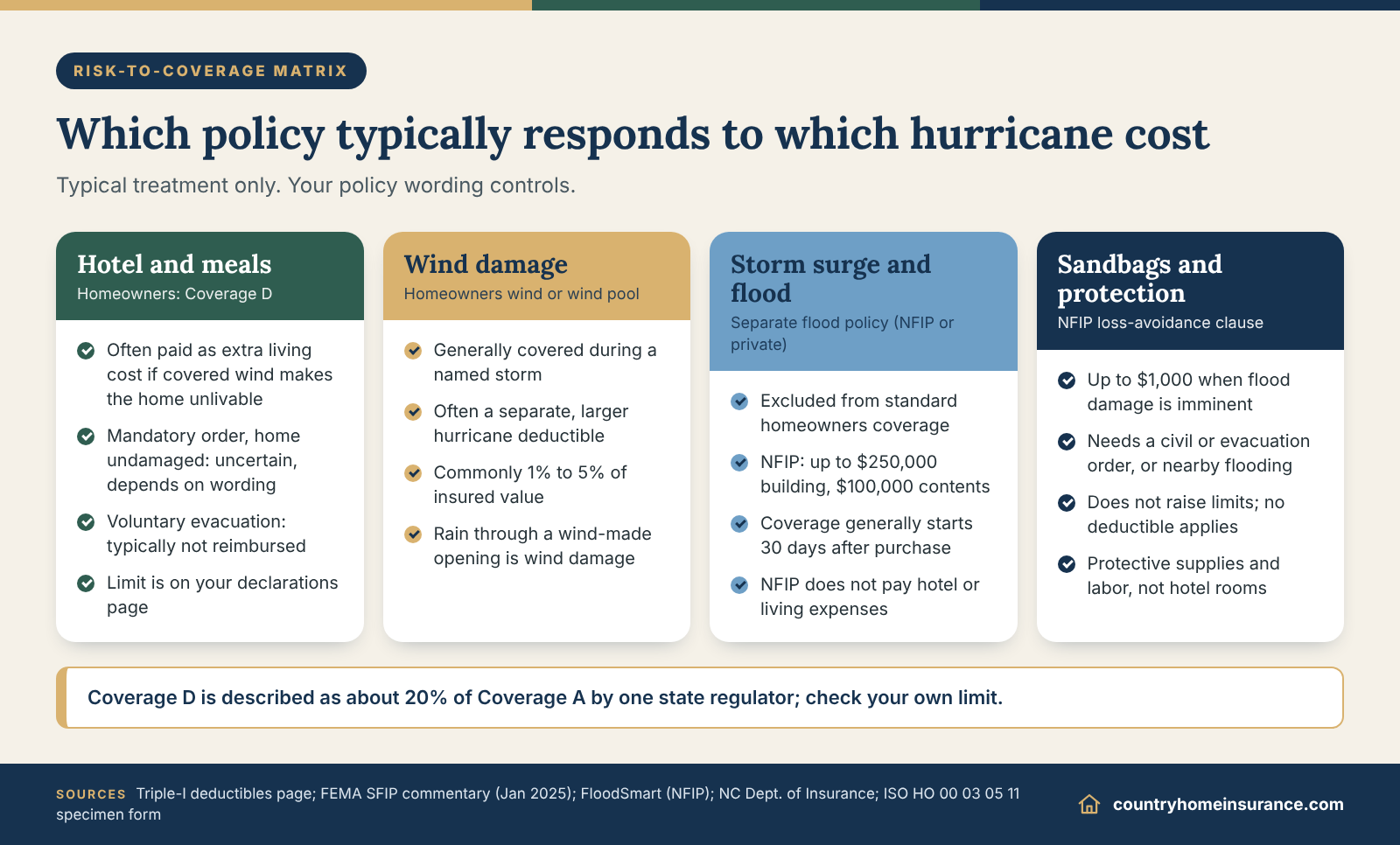
| Home damaged by covered wind and unlivable | Often paid as additional living expense under Coverage D, for extra costs above your normal budget. | Dollar or percentage limit, time limit, receipts, and whether the cause of loss is covered. |
| Mandatory evacuation, home undamaged | Uncertain. A common specimen form pays only when an order bars use of your home because a covered peril damaged neighboring property, and then for up to two weeks. | Exact civil authority wording, what “neighboring” means in your form, and any insurer or state guidance. |
| Voluntary evacuation | Typically not reimbursed as a loss-of-use item. | Policy wording; an insurer may treat some situations differently. |
| Storm surge or rising water inside the home | Excluded from standard homeowners coverage; may be covered by a separate flood policy. | Having NFIP or private flood coverage in force, and its waiting period, limits and deductible. |
| Hotel bills after flood damage only | NFIP does not pay temporary housing or living expenses. | Whether a covered wind or other covered cause independently made the home unlivable. |
| Wind damage during a named storm | Generally covered, but often subject to a separate and larger hurricane or windstorm deductible. | State rules, trigger definitions, and whether coverage comes from a wind pool. |
What hurricane evacuation insurance actually means
If you’ve typed “hurricane evacuation insurance” into a search box, you were probably asking one of two things: will my insurer pay for a hotel if officials tell me to leave, and what happens to my house while I’m gone? The honest answer is that the first question has no single answer, and the second depends on three different kinds of coverage. This guide sorts those pieces out so you know what to read in your own policy this season, which officially runs through November 30 according to NOAA’s Climate Prediction Center.
Is hurricane evacuation insurance a real, standalone product?
Not in anything we could verify. The next three sections explain why the phrase is slippery and where the money for evacuation costs normally originates.
A search phrase, not a policy type
None of the regulator, trade and federal sources reviewed for this article describe a stand-alone policy by this name. Regulators talk about loss-of-use coverage, additional living expenses, hurricane deductibles and flood policies instead. That doesn’t mean no insurer anywhere sells an evacuation-expense add-on, and some travel, renters or specialty products may market something similar. We simply could not verify any, so we won’t describe one. If an agent or insurer offers you a product labeled “evacuation coverage,” ask for the form number, the trigger, the dollar limit, the waiting time and what it excludes, then compare it with the loss-of-use section you already have.
Where evacuation costs normally live in a homeowners policy
In the standard homeowners structure, the relevant part is Coverage D, usually called loss of use. The National Association of Insurance Commissioners (NAIC) describes additional living expenses as the necessary living costs, up to the stated limit, while a home is uninhabitable because of a covered loss. A widely used specimen form, ISO HO 00 03 05 11, puts additional living expense, fair rental value and a civil authority benefit under one shared limit. Your actual policy may use a different edition or carrier-specific wording, so treat the specimen as a map rather than your contract.
What we could not confirm and why it matters
We found no regulator page or insurer form in our research that creates a separate evacuation benefit. That matters because evacuation payment disputes tend to turn on wording. Reimbursement after a government order can differ by insurer, by state guidance and by the facts. Your best evidence is your own policy language plus anything your insurer or state Department of Insurance will put in writing. Check your declarations page, the summary page listing your limits and deductibles, for the loss-of-use limit before you need it.
Which three policies get lumped together under this phrase?
When people say they have “hurricane insurance,” they may mean one policy or three. Sorting them out is the single most useful step in storm preparation.
The homeowners policy: wind, loss of use and liability
The homeowners policy is the contract that typically responds to wind damage to the dwelling (Coverage A), detached structures (Coverage B) and belongings (Coverage C), and that carries the loss-of-use coverage discussed above. In many hurricane-prone states it also carries a separate hurricane or named-storm deductible. The Texas Department of Insurance describes the basic split in a consumer chart: a homeowners policy protects house and belongings from perils such as wind and hail, while flood needs its own policy.
The flood policy: surge and rising water
Flood insurance is a different contract, sold through the NFIP or by private insurers. FloodSmart, the NFIP’s consumer site, states that most homeowners insurance does not cover flood damage. The NAIC makes the same point and notes that private flood insurance may offer higher limits or broader coverage. Because these policies are separate, you have two deductibles, two claim files and, often, two adjusters.
The wind pool or residual-market policy
In some coastal areas the regular market won’t write wind coverage, so homeowners turn to a state-backed insurer of last resort. The Texas Windstorm Insurance Association (TWIA), for example, describes itself as a not-for-profit insurer providing windstorm and hail coverage to people who can’t obtain it in the regular market because of catastrophic hurricane risk. The Texas Department of Insurance notes that most home policies on the coast don’t cover wind and hail. If you have a wind pool policy, you may carry a regular policy for everything except wind, plus a flood policy, for three contracts in total.
When does insurance pay for an evacuation: mandatory versus voluntary?
This is the question most readers actually have. The answer rests on three things: how your policy words the civil authority clause, whether your home was damaged, and what your state regulator or insurer says about government-ordered evacuations.
How does the civil authority clause work?
Civil authority is a loss-of-use benefit that applies when a government order, not damage to your own home, keeps you out. The clause is narrower than most people expect.
The “neighboring premises” trigger
In the ISO HO 00 03 05 11 specimen form, the civil authority benefit applies when a civil authority prohibits you from using your residence because a peril insured against has damaged neighboring premises. That is not the same as an evacuation order issued because a hurricane is approaching. A pre-landfall order often rests on forecast surge and wind, not on damage that has already happened next door. An agent writing in a Los Alamos newspaper column about wildfire evacuations made a related point: policies often don’t define “neighboring premises,” which leaves room for disagreement. That is a wildfire example, so use it only as a reminder that wording varies and should be read, not assumed.
The two-week limit in the specimen form
The same specimen form limits the civil authority benefit to up to two weeks. The Florida Chief Financial Officer’s consumer storm page likewise says that when a civil authority bars use of a home because of direct damage to neighboring homes, most policies provide additional living expense without a deductible for up to two weeks. Two weeks can pass quickly after a major hurricane, when roads, power and water may be out. If your home is later damaged by a covered cause and becomes unlivable, the ordinary additional living expense provision, not the two-week civil authority clause, generally becomes the relevant benefit.
Whether your deductible applies
The Florida page describes civil authority additional living expense as available without a deductible in most policies, but that is one state’s regulator describing the typical case. A Los Alamos insurance agent, writing about a different peril, said insurers usually apply the standard deductible to such claims. The two statements can both be true, because policies and carriers differ. Ask your insurer directly whether any deductible applies to loss-of-use payments, and get the answer in a form you can save.
How do evacuation orders differ, and does it matter to a claim?
Officials use several kinds of orders and recommendations. Insurers and regulators generally draw a line between required and optional departures.
Mandatory versus voluntary orders
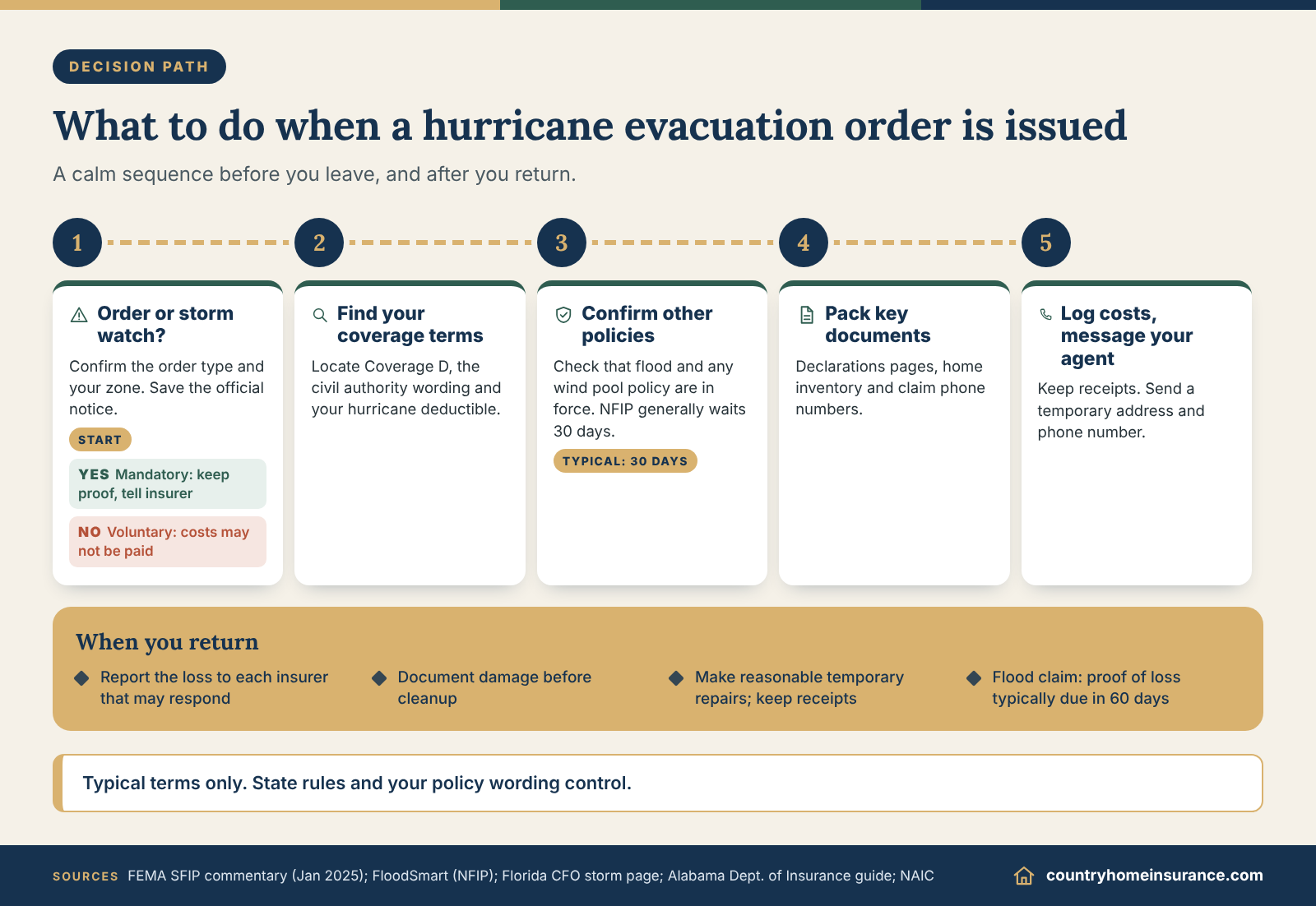
In a 2021 interview about condo evacuations in Surfside, Florida, Mark Friedlander of the Insurance Information Institute (Triple-I) said mandatory evacuations are covered while voluntary evacuations typically are not, and added that policy details vary. Treat that as a general industry view from a news article, not a rule. It is useful for one reason: if your community issues a mandatory order, keep proof of it (the official notice, the date and the zone) and tell your insurer where you went. If the order is only voluntary, assume your costs may not be reimbursed unless your policy or insurer says otherwise.
Zone-based orders and how counties issue them
Many coastal counties issue evacuation orders by zone. Miami-Dade County’s emergency pages explain that its storm surge planning zones are lettered A through E, and that orders are made by zone based on the storm’s track and projected surge, not on category alone. The county also stresses that being in or out of a zone does not by itself tell you whether your home is safe. For insurance purposes, the practical point is documentation: note your zone, the date and time of the order and the authority that issued it.
Residents who should leave regardless of zone
The same Miami-Dade page says mobile home residents and people who depend on electrically powered, life-sustaining medical equipment should evacuate when any hurricane evacuation order is issued, whatever their zone. Those are safety instructions, not insurance rules, and safety comes first. If you fall into either group, plan your departure and your lodging around that guidance, then sort out reimbursement afterward with receipts in hand.
What do state regulators say about evacuation costs?
State insurance regulators don’t uniformly address evacuation, but the ones that do give useful prompts.
Florida: check lodging, meals, deductibles and limits
The Florida CFO’s consumer storm page notes that civil authorities sometimes issue mandatory evacuation orders and advises consumers to check whether lodging and meals are covered if they evacuate and the property is not damaged, and whether any deductible or limit applies. It also encourages a written plan with two evacuation locations and a contact person out of state. The page does not give a dollar figure, which tells you the answer lives in your policy rather than in a statewide rule.
Alabama: tell your insurer where you are
The Alabama Department of Insurance natural disasters guide advises that if you relocate temporarily, you should give your insurer or agent your temporary address and phone number, and that if you evacuate you should take your policies and personal property inventory with you if it is safe, or keep copies outside the home. The same guide says Alabama homeowners policies that include additional living expense must provide at least twelve months of coverage, though a monetary limit may also apply. It does not address civil authority coverage.
Questions to put in writing before the next storm
A short email to your agent can settle most of the gray area. Ask whether a mandatory evacuation order with no damage to your home triggers any payment, how your form defines the civil authority benefit, whether the benefit shares the Coverage D limit, whether a deductible applies and what proof the insurer wants. Save the reply with your policy documents. If the answer is unclear, your state Department of Insurance consumer line can explain how it views the wording, though it can’t rewrite your contract.
Additional living expense after hurricane damage: what it pays and where claims stall
Once a covered storm loss makes your home unlivable, the evacuation question turns into a repair-period question. Additional living expense (ALE), the loss-of-use benefit, is the part of the policy designed for that. It is also where small wording differences produce big differences in what you can recover.
What does additional living expense actually pay?
ALE is a reimbursement benefit. It pays extra costs you incur because you can’t live at home, not your whole household budget.
Extra cost above your normal spending
The North Carolina Department of Insurance explains that Coverage D helps pay additional living expenses when a covered peril damages your home so you can’t live there, and that eligible costs include housing, meals and storage. It adds that the insurer pays only the expenses above your normal living costs. The ISO specimen form uses similar logic, describing any necessary increase in living costs needed to maintain your household’s usual standard of living. Hypothetical example: if your family normally spends $900 a month on groceries and, while displaced, spends $2,100 on restaurant and hotel-kitchenette meals, the reimbursable amount would typically be the difference, $1,200, not the full $2,100. This is an illustration, not a promise of payment.
How limits are written: dollar amount, percentage or time
Policies express the loss-of-use limit in different ways. The North Carolina Department of Insurance says Coverage D is normally limited to 20 percent of Coverage A in its description, while Alabama’s regulator says a monetary limit may apply alongside a minimum time period. In a 2021 news interview, a Triple-I spokesperson described ALE as typically either a percentage of dwelling coverage or subject to a time limit. These descriptions come from different regulators and publishers and aren’t interchangeable. Your declarations page shows your own number; if it isn’t there, ask your agent where the Coverage D limit appears.
How long benefits may last
Alabama’s guide states that homeowners policies in that state that include ALE must provide at least twelve months of coverage, subject to any monetary limit. The ISO specimen form pays for the shortest time required to repair or replace the damage or, if you permanently relocate, the shortest time to settle elsewhere. It also provides that these time limits aren’t cut short merely because the policy expires. After a major regional storm, contractors and materials can be slow, so ask early how your insurer handles a repair period that runs longer than expected.
Where does ALE get stuck?
Three recurring friction points are cause of loss, paperwork and housing arrangements.
When flood, not wind, made the home uninhabitable
This is the biggest trap. The NAIC says a standard homeowners policy generally would pay additional living expenses if your home became uninhabitable from wind or other perils tied to a flood, but not for flood damage itself. FEMA’s Standard Flood Insurance Policy commentary (January 2025) states that the NFIP policy doesn’t pay temporary housing, mileage, meals or increased utility expenses. If surge or rising water is the only cause of your displacement, you may find neither policy pays your hotel bill. Causation analysis can be technical, which is why separate wind and flood adjusters are common and why you shouldn’t assume how a split will come out.
Receipts, temporary address and communication
Regulators repeat the same instructions. Florida and Alabama tell consumers to keep all receipts, and Alabama adds that you should give your insurer a temporary address and phone number. The Mississippi Insurance Department suggests asking whether your policy covers additional living expenses whenever your home is uninhabitable, and keeping records of conversations with insurers. Create one folder, paper or digital, for lodging, meals, laundry, storage and mileage, and note each date. A simple spreadsheet makes the reimbursement request easier to audit.
Mortgage, rent and utilities during displacement
Because ALE reimburses the increase over normal costs, you generally keep paying the mortgage, and the insurer pays the extra costs of the temporary home. The specimen form does not pay losses caused by cancelling a lease or other agreement. If you own a rural property with a rented cabin or apartment, the fair rental value part of Coverage D may come into play when a covered loss makes that portion unusable. Ask your agent how it applies to your layout.
Wind coverage and the hurricane deductible: the number that surprises people
Evacuation decisions are made before a claim exists, but the hurricane deductible determines how much of any wind damage you’ll carry yourself afterward. It’s worth knowing before the order comes.
How does a percentage hurricane deductible work?
A hurricane deductible is typically written as a percentage of an insured value, which is quite different from the flat deductible most people associate with a fender-bender or a stolen bike.
A percentage of insured value, not of the loss
Triple-I defines a hurricane or windstorm deductible as a percentage-based deductible calculated on the home’s insured value rather than a flat dollar amount, and notes that percentage deductibles typically range from 1 percent to 5 percent. Alabama’s regulator makes the same distinction: these deductibles are often a flat amount or a percentage of the home’s insured value, not a percentage of the loss. A hurricane deductible applies only to hurricane damage, while a windstorm or wind/hail deductible applies to any wind damage, and the declarations page spells out which one you have.
A worked example
Hypothetical example: a home has a dwelling limit of $300,000, a 2 percent hurricane deductible and a wind-damaged roof and siding totaling $40,000 in covered repair costs. The deductible is $6,000 (2 percent of $300,000), so the policy would typically pay up to $34,000, subject to the policy’s loss settlement terms. At 5 percent, the deductible would be $15,000, and the same loss would leave about $25,000. Triple-I’s own example uses a $300,000 home with a 5 percent deductible and a $15,000 owner share. These figures are illustrative; your limits, your depreciation and your policy terms will change the result.
How often it applies
Triple-I says Florida’s hurricane deductible is set by state law and applies once per hurricane season, so a second storm in the same season does not trigger a second hurricane deductible in that state. Other states and carriers handle repeat storms differently, and the page does not describe a universal rule. If your area has seen back-to-back storms, ask your insurer how the deductible applies to a second event and whether any carried-over amount is credited.
When does the hurricane deductible switch on?
Each state and insurer defines the trigger. The trigger controls whether a storm that never made landfall near you still activates the higher deductible.
Florida: watches and warnings with a tail
According to Triple-I, Florida’s trigger is a hurricane watch or warning for any part of the state, and the deductible applies for up to 72 hours after the watch or warning ends. Triple-I also notes that Florida law requires insurers to offer $500, 2 percent, 5 percent and 10 percent deductible options. The Florida CFO consumer page adds that most Florida homeowners policies have a larger hurricane deductible and a smaller one for other damage, and refers to its hurricane deductible guide for details.
Louisiana, Mississippi and New Jersey
Triple-I’s summary says Louisiana’s named storm deductible triggers at tropical storm strength (39 mph) and the hurricane deductible at hurricane strength (74 mph). Mississippi uses a named storm or hurricane watch or warning anywhere in the state, lasting until 24 hours after the last one. New Jersey uses sustained winds of 74 mph measured in the state, applying from 12 hours before to 12 hours after. Notice how different those are. A tropical storm that never becomes a hurricane could still trigger a named-storm deductible in some places.
Texas, New York and states with insurer-set rules
Triple-I reports that Texas’s windstorm deductible applies to any windstorm, not only named storms or hurricanes, and that in New York the rule varies by insurer, with some using Category 1 and others Category 2. Maryland, according to the same summary, can apply a hurricane warning anywhere in the state statewide. The page also lists about twenty jurisdictions with hurricane deductibles: Alabama, Connecticut, Delaware, Florida, Georgia, Hawaii, Louisiana, Maine, Maryland, Massachusetts, Mississippi, New Jersey, New York, North Carolina, Pennsylvania, Rhode Island, South Carolina, Texas, Virginia and the District of Columbia. State rules change, so verify yours.
What if my wind coverage comes from a wind pool?
In parts of the Gulf and Atlantic coasts, wind and hail coverage is sold separately by a state-created or state-backed association.
TWIA in Texas
TWIA describes itself as a not-for-profit insurer offering windstorm and hail coverage to home and commercial property owners who can’t get it in the regular market because of catastrophic hurricane risk. The page we retrieved (last modified October 8, 2026) didn’t list counties, deductible options or flood terms, so for those details use TWIA’s “Get Windstorm Insurance” and policy pages. Its next board meeting is listed for November 10, 2026.
AIUA in Alabama and similar associations
A Triple-I fact file on Alabama describes the Alabama Insurance Underwriting Association as a market of last resort for property and windstorm-and-hail coverage in coastal areas, with a hurricane deductible that applies only during a hurricane. That page’s header is dated June 2020 and mixes older and newer data, so treat the description as background and confirm current terms with the association. Triple-I also reports that Delaware’s FAIR Plan uses a flat $2,000 hurricane deductible, a reminder that residual-market deductibles can look nothing like private-market percentages.
Questions for a split-coverage home
If wind comes from a pool and everything else from a regular insurer, ask each company who handles ALE, whether the regular policy excludes wind completely, and how the two claims coordinate when the same storm causes wind and water damage. Also ask whether your mortgage lender requires evidence of every policy. Get the answers on paper before the season’s peak, not after the order.
| Item | What the source says | Source and note |
|---|---|---|
| Coverage D size | Normally limited to 20 percent of Coverage A, as described for North Carolina. | North Carolina Department of Insurance consumer page; undated. |
| ALE minimum duration, Alabama | At least twelve months where the policy includes ALE, plus any monetary limit. | Alabama Department of Insurance natural disasters guide; undated. |
| Civil authority period | Up to two weeks when an order bars use because of damage to neighboring premises. | ISO HO 00 03 05 11 specimen form; Florida CFO page also says two weeks for most policies. |
| Hurricane deductible range | Commonly 1 percent to 5 percent of insured value. | Triple-I background page; no last-updated date shown. |
| Florida options and timing | Insurers must offer $500, 2%, 5% and 10%; triggered by a hurricane watch or warning; once per season. | Triple-I summary of Florida law; verify with Florida regulators. |
| Louisiana triggers | Named storm deductible at 39 mph; hurricane deductible at 74 mph. | Triple-I summary. |
| NFIP limits and wait | Up to $250,000 building and $100,000 contents; coverage generally starts 30 days after purchase. | FloodSmart buy-a-policy page; exceptions apply. |
| NFIP loss avoidance | Up to $1,000 for protective items when damage is imminent and an official evacuation or civil order is issued, or flooding is nearby. | FEMA SFIP commentary, January 2025. |
Flood and storm surge: the gap that evacuation orders expose
Many evacuation orders are issued because of surge, the wall of ocean water pushed ashore by a storm, not because of wind. That is exactly the hazard a homeowners policy is written to exclude, which is why flood insurance belongs in any conversation about hurricane evacuation costs.
Why do homeowners policies exclude flood and surge?
The exclusion is old, broad and worded to apply no matter how the water arrives. It’s one of the most important lines in the contract.
What the water exclusion names
The ISO HO 00 03 05 11 specimen form excludes flood, surface water, waves including tsunamis, tides, overflow of a body of water, and storm surge, whether or not driven by wind. It also excludes water that backs up through sewers or drains or escapes from a sump, water seeping through foundations, and waterborne material carried by any of those. The exclusion applies regardless of cause, with a narrow exception for fire, explosion or theft that results from the water event. That wording is why wind-driven ocean water is generally treated as flood, not wind. Check your form, since carrier-specific language varies.
Wind-driven rain is a different question
Rain that enters because wind has torn an opening in a roof or wall is usually analyzed differently from rising water. Alabama’s natural disasters guide says rain entering through wind-created openings is treated as windstorm damage, not flood damage. The specimen form likewise pays for interior rain damage to personal property only if wind or hail first creates an opening in the roof or wall. That distinction matters for the roof-coverage questions many readers have: a torn shingle layer, a missing section of decking or a broken window is a wind-damage claim, with the hurricane deductible, while water that rose into the house through the door is a flood claim.
Separate adjusters and separate claims
A 2016 newsletter from the Louisiana Department of Insurance, an older source, noted that wind and flood damage are often handled separately and that if both occurred you will likely have separate adjusters. That is consistent with how the policies are structured. In practice you may need to document which damage came from which cause, keep the two claim files distinct, and ask each insurer in writing what it considers its share. Don’t let one company’s denial of a flood item stop you from filing the wind items with the other.
What should you know about flood insurance before you evacuate?
If you don’t have flood coverage and a storm is already nearing, the options are limited. This section is mainly for planning the next season or the rest of this one.
Limits and separate deductibles
FloodSmart states that homeowners can buy NFIP building coverage up to $250,000 and contents coverage up to $100,000, that the two are typically bought separately, and that they carry separate deductibles. Premiums depend on where the property is built, how it is built and its replacement cost, and NFIP policies sold through partner companies and agents use the same pricing. The NAIC adds that private insurers may offer higher limits or broader coverage than the NFIP, and that you should compare premiums and ask about waiting periods. For a rural home on acreage, the building limit may not stretch across a house plus several outbuildings, which is a good reason to ask about private options.
The 30-day waiting period and its exceptions
FloodSmart says flood coverage generally starts 30 days after the purchase date. There is no wait if you buy while making, increasing, extending or renewing a mortgage, and none when you change coverage while renewing. There is a one-day wait if your property is in a newly designated high-risk zone and you buy within 12 months of the update. Damage that occurs before the policy takes effect isn’t covered. A policy bought in mid-October would generally not begin until mid-November, so for this season the practical use is protection for the final weeks and for a flood that does not require a named storm.
No living expenses and other items NFIP does not cover
FloodSmart’s list of items not covered includes temporary housing and additional living expenses, currency and valuable papers, most vehicles, personal property kept in basements, and property outside the insured building such as landscaping, septic systems, decks, fences and pools. For rural homeowners, the septic and fence lines are not small things. They may be uninsured against flood unless another policy picks them up. Read the flood policy’s list before assuming that “flood insurance” means everything on the property.
Does a flood policy help with pre-storm protection costs?
One clause in the NFIP policy speaks directly to evacuation orders, and few homeowners have heard of it.
The $1,000 loss-avoidance clause
FEMA’s January 2025 commentary on the Standard Flood Insurance Policy explains that the policy will pay up to $1,000 for costs you incur to protect the insured building, such as sandbags and sand, temporary levee fill, pumps, and plastic sheeting and lumber used with them. Your own labor is valued at the federal minimum wage. Two conditions apply: flood damage must be imminent and apparent to a person of common prudence, and either a general temporary flooding condition exists nearby or a legally authorized official has issued an evacuation or other civil order for the community. The amount doesn’t increase your policy limits and the deductible does not apply.
Property removed to safety
The same commentary describes coverage for property removed to safety, which applies for 45 consecutive days and up to $1,000 in costs. Removed items need to be placed above ground or outside the special flood hazard area, and coverage ends when the imminent threat passes. The commentary describes the coverage as limited to the policyholder’s removal, storage and return of insured building and personal property. Keep receipts for moving help or storage. This clause pays for protection, not for hotel rooms, so it doesn’t replace the living-expense question discussed earlier.
Rural and country properties: what changes when you evacuate from acreage
Leaving a house on a half-acre lot is different from leaving a farmhouse with a barn, a well, a septic field and a half-mile of gravel drive. The policy structures are the same, but the exposures and the paperwork multiply.
How do outbuildings, fences and animals fit into the claim?
Standard coverage for structures other than the house comes from Coverage B, and animals often fall outside the standard form.
Other structures under Coverage B
The NAIC describes standard homeowners coverage as including other structures such as a detached garage or fence, and notes that items like in-ground pools or garages holding classic cars may need added coverage. In the ISO specimen form, buildings insured under Coverages A and B are settled on a replacement cost basis if you carry at least 80 percent of full replacement cost, while some non-building structures are settled at actual cash value. That means a damaged fence or a small shed may be paid differently than the barn. Look at your Coverage B limit and decide whether it can reasonably cover every outbuilding together after a single storm.
Livestock, feed and farm use
The sources we retrieved for this article did not address livestock or farm operations in hurricanes, so we can’t say how any particular policy treats them. What can be said is that farm animals, equipment and farm-type business activity are commonly addressed through farm or ranch coverage rather than a standard homeowners form, so a hobby-farm owner should ask the agent exactly what is and isn’t included before the season, and get that answer in writing. Evacuation plans for animals are a safety question your county emergency management office can help with.
Debris, trees and cleanup limits
Alabama’s storm damage FAQ notes that tree removal coverage is typically limited, with figures such as up to $500 per tree and $1,000 aggregate, and that the policy controls. Those figures come from a regulator-hosted document that is undated, and your limits may differ. On acreage, a single storm can drop dozens of trees. Ask what counts as covered damage, such as a tree striking a structure, and what falls outside it.
What about wells, septic systems and private roads?
These are the quiet infrastructure items that can turn a manageable storm into a long displacement.
Septic systems and flood
As noted above, FloodSmart lists septic systems among property outside the insured building that the NFIP does not cover. Whether a homeowners policy covers septic damage depends on the cause of loss and the wording, and the water exclusion in the specimen form also removes sewer and drain backup unless an endorsement adds it back. The specimen form describes the exclusion as covering water that backs up through sewers or drains. Ask your agent how a flooded drain field would be handled and whether a sewer or drain backup endorsement exists for your form.
Wells, power and the habitability test
Additional living expense generally depends on the home being uninhabitable because of a covered loss, as the NAIC describes. A home that has no power or water for days after a storm may feel uninhabitable to you, but whether it meets your policy’s standard is a wording and facts question. The sources we reviewed did not address utility outages as a separate trigger. Ask your insurer how it treats extended outages without structural damage, and whether food spoilage coverage exists on your policy.
Private roads, gates and getting back in
Rural evacuation planning often turns on logistics. A private road may be blocked by trees, a low-water crossing may be impassable, and a locked gate may delay emergency crews. These aren’t insurance terms, but they affect timing and cost. Walk your route in good weather, identify two ways out, tell a neighbor your plan, and keep a note of mileage and extra transportation costs. Then ask whether the insurer treats unavoidable extra transportation as part of additional living expense.
Before the storm: documents, timing and what to put in the go-bag
Insurance preparation is dull, which is exactly why it’s valuable. The best claim files start before anyone knows a storm is coming.
Which documents should travel with you?
If you evacuate, you’ll want proof of coverage and proof of what you own.
A home inventory with photos and receipts
The Florida CFO storm page recommends an itemized inventory of belongings with receipts, purchase dates and photos or video. Alabama’s guide adds that photos or video can substitute if you lack receipts and suggests including model and serial numbers. The Mississippi Insurance Department points to the NAIC Home Inventory App as a tool. Walk every room, open closets and cabinets, and record outbuildings, tools and equipment. Store the files in a cloud folder and on a phone so you aren’t relying on the house to hold the evidence.
Policy copies and contact numbers
Take or save your declarations page, the full policy forms and endorsements, your agent’s number and the insurer’s claim line. The Mississippi release suggests keeping policy information in a safe waterproof place and making a digital copy. Include your flood policy and any wind pool policy, which usually has a separate number. Write down the claim phone numbers on paper, since cell service may be limited right after a storm.
A temporary address and an out-of-state contact
Alabama’s regulator tells evacuees to give the insurer or agent a temporary address and phone number, and Florida’s page suggests an out-of-state contact person and two evacuation locations. Send a short message to your agent once you’ve settled, stating where you are and how to reach you. It creates a dated record that you notified the insurer, and it keeps adjusters from chasing a mailing address that no longer works.
When is the last practical moment to change coverage?
Timing is the trap. Some changes are impossible once a storm is close, and others take effect only after a delay.
Binding restrictions as a storm approaches
The Florida CFO’s page notes that insurers generally stop accepting new applications or coverage increases once a hurricane nears Florida. Practices elsewhere may differ, so ask your insurer about its rules. The practical lesson is to make changes, such as raising a Coverage B limit or adding an endorsement, in a quiet month, not in the three days before landfall.
The flood waiting period
As described above, NFIP coverage generally starts 30 days after purchase, with exceptions. If you have no flood coverage and want it before the next season, mark a date on your calendar well ahead of June 1 to buy. Because FloodSmart also says that 29 percent of NFIP claims come from outside high-risk flood areas (an undated statement on its home page), a low-risk flood map designation is not a reason to skip the question.
What the season’s end date does and doesn’t change
NOAA’s Climate Prediction Center says the Atlantic hurricane season officially runs from June 1 through November 30. Its August 6, 2026 update gave a 75 percent chance of a below-normal season, partly because of a strong El Niño. Yet a quiet forecast doesn’t remove coverage gaps, since a single landfalling storm can matter to the people it hits, and flooding isn’t limited to hurricane season. Use the lull to review coverage now, before renewal.
| Item to check | Where to find it | Question or document to keep |
|---|---|---|
| Loss-of-use (Coverage D) limit | Declarations page and the policy’s loss of use section | Is the limit a dollar amount, a percentage of Coverage A or a time limit? Save the page. |
| Civil authority wording | Loss of use section of the policy form | Does a mandatory order with no home damage trigger any payment? Ask in writing. |
| Hurricane or named-storm deductible | Declarations page and any wind or hurricane endorsement | Percentage or dollar amount, what triggers it, and what that means in dollars. |
| Flood coverage in force and start date | Flood policy declarations (NFIP or private) | Building and contents limits, deductibles, effective date, and waiting period. |
| Wind pool or separate wind policy | Second declarations page and carrier or association website | Who handles loss of use, and how do the two claims coordinate? |
| Home inventory and receipts | Phone, cloud folder, NAIC Home Inventory App if you choose to use it | Photos or video of every room, outbuildings, serial numbers, and purchase records. |
| Evacuation proof and expense log | County or city emergency notices; your own receipts | Order date, zone, issuing authority, hotel and meal receipts, and mileage notes. |
After the storm: the claim workflow when you’ve been away
Returning home after an evacuation, you’ll face damage, paperwork and a long list of strangers offering help. A calm sequence protects both your safety and your claim.
What are the first steps once it’s safe to return?
Safety comes first, and officials decide when an area is open. These steps assume that you are cleared to return and the structure is safe to enter.
Report the loss promptly and read the notice requirement
The NAIC advises reporting a claim as soon as possible because most insurers have deadlines for reporting. The Mississippi Insurance Department tells consumers to check whether their policy sets a deadline for notifying the insurer. The ISO specimen form lists prompt notice among the duties after a loss. If you evacuated and aren’t sure whether your home flooded, the Louisiana Department of Insurance’s older flood newsletter says to start the claim process anyway by reporting the loss to your agent or carrier. File with each policy that might respond: homeowners, flood and any separate wind policy.
Document first, then make temporary repairs
The NAIC’s post-storm guidance tells consumers to document all damage before cleaning up or removing debris, save damaged items for the adjuster where possible, and make reasonable temporary repairs such as covering a roof opening or boarding windows, keeping every receipt. Alabama’s guide adds that you should not remove damaged property until an adjuster or your agent has seen it, unless local officials require disposal, and that unauthorized permanent repairs may not be reimbursed. Take wide shots and close-ups, and include water lines on walls if flooding occurred.
Why protecting the property still matters
The specimen form excludes loss resulting from the insured’s failure to use all reasonable means to save and protect property during and after a loss, and it also provides a reasonable-repairs coverage for necessary steps to prevent further damage. In other words, the policy generally expects you to act sensibly to prevent more damage, and it may reimburse reasonable costs when the underlying loss is covered. The same form says coverage can be denied for failing a duty after loss only if the failure harms the insurer, though state law and your own policy control that point.
How do payments arrive, and who else gets a say?
The first check is rarely the last, and not every dollar goes only to you.
Actual cash value now, replacement cost later
Alabama’s storm damage FAQ says that under a replacement cost policy the initial payment is typically made on an actual cash value basis, and the remaining replacement amount is settled once you are repairing, rebuilding or buying. The ISO specimen form works similarly: until repairs are complete, payment is generally limited to actual cash value, with a small-loss exception, and you can claim actual cash value first and then request the difference by giving notice within 180 days of the loss that you intend to repair or replace. Time limits like that vary by state and form, so ask the adjuster for your deadlines in writing.
When a mortgage lender is on the check
The NAIC explains that if you have a mortgage, payment for structural damage may be made out to you and your lender, who may hold the funds in escrow and release them as repairs are completed. Alabama’s FAQ says the lender may release payments in portions as repairs are documented. Call the servicer early and ask for its insurance-loss draft procedure, since releasing funds can take longer than the insurer’s own processing.
Contractors, assignments and signing anything
The Florida CFO’s storm page carries a blunt warning to consumers to not sign anything before calling the state helpline. The NAIC likewise cautions about assignment of benefits, a document that lets a contractor deal directly with your insurer and take over your policy benefits, and says you aren’t required to sign one to get repairs done. The NAIC and a state regulator’s storm-recovery materials suggest getting multiple written bids, checking licenses and references, and avoiding paying in full before work is complete. Be patient with door-knockers, especially out-of-area crews.
Claim timing rules differ by state
Florida’s regulator says insurers must pay or deny a property claim, or part of it, within 60 days after receiving notice of a new, reopened or supplemental claim unless factors beyond the insurer’s control cause delay. That’s a Florida rule, and the page we reviewed does not state a deadline for giving notice of a claim. Other states set their own timelines, and the ISO specimen form’s suit-limitation period is two years from the date of loss, though many state endorsements change it. Treat any single number you hear as a starting point for a question to your state Department of Insurance.
How do FEMA assistance and the flood claim fit in?
Federal disaster aid and the NFIP are separate from your homeowners claim, and each has its own paperwork clock.
Insurance first, then federal aid
A consumer advocacy group’s guide to FEMA assistance, which dates from 2018 and was last reviewed in 2020, explains that FEMA cannot duplicate benefits an insurer provides, that insured applicants generally file the insurance claim first, and that FEMA may help with uninsured or underinsured needs after the claim is settled or denied. The same guide says registering is recommended even with flood insurance because NFIP policies don’t pay temporary housing. The dollar amounts in that older guide are out of date and we do not repeat them. For current programs and amounts, use FEMA’s official disaster assistance pages.
The 60-day flood proof of loss
FEMA’s SFIP commentary says the policy requires prompt written notice and a proof of loss within 60 days after the loss, even if the adjuster does not provide the form, and that the proof of loss is not itself the claim. FEMA’s claim guidance and Alabama’s guide describe the proof of loss as a sworn statement, prepared with your adjuster, that must be signed and returned within 60 days. Alabama’s guide also lists a 60-day window for a written FEMA appeal after a final decision and a 90-day FEMA response after all claim information is received. Mark the 60-day date on a calendar the day you file.
Where to turn if the insurer stops responding
The NAIC says that if your insurer isn’t responding promptly or conducting a reasonable investigation, you should contact your state insurance department. Florida’s consumer helpline is listed as 1-877-693-5236 (8 a.m. to 5 p.m. Eastern, Monday through Friday), and Alabama’s Consumer Services Division is listed at (334) 269-3550. Confirm the number for your state on its department website, since contact details can change. Get any denial in writing, keep a log of calls, and ask for an itemized explanation of any settlement offer.
Next steps: bringing these questions to your agent or insurer
The best time to settle the gray areas is during a quiet stretch, not when a cone of uncertainty is pointed at your county. Use these as an agenda for a renewal call or an email.
What should you ask about evacuation and loss of use?
These questions tie directly to the language discussed above.
Four questions about Coverage D
Ask where the loss-of-use limit appears and whether it is a dollar amount, percentage or time period. Ask whether a mandatory evacuation with no property damage triggers anything, and if so, for how long. Ask whether the civil authority benefit shares the same limit. Finally, ask whether any deductible applies. Write down the person’s name and the date, and request that the answer be sent by email if the policy language itself is unclear.
Who coordinates wind, flood and living expenses
If you have more than one policy, ask each company how it expects the claims to work together. Specifically, ask who pays temporary lodging when both wind and water contributed, what proof of causation each wants, and whether the same adjuster handles both. This is a short list, but it prevents the most common gap: each insurer pointing to the other’s coverage.
How should you compare options before renewal?
Comparison shopping on price alone can hide the differences that matter most after a storm.
Compare deductibles in dollars, not percentages
Convert every percentage deductible to dollars using the dwelling limit on each quote. A 2 percent deductible on a $400,000 limit is $8,000, while 1 percent on the same limit would be $4,000. Then compare the premium difference to the gap. The right choice depends on your emergency savings and risk tolerance, and neither this guide nor any quote promises what a future claim will pay.
Compare the loss-of-use and flood details side by side
Line up the Coverage D limit, any time limit, the civil authority wording and whether the flood policy offers higher limits than the NFIP maximums. The NAIC suggests asking private flood insurers about waiting periods and checking with your state department of insurance about which private flood insurers write in your state. An apples-to-apples comparison needs the same dwelling limit, the same deductible type and the same endorsements on every quote.
Frequently asked questions
Questions about evacuation costs
Will my insurer pay for a hotel if I evacuate and my house is fine?
Possibly, but you can’t assume it. Coverage for living expenses is generally tied to a covered loss that makes your home unusable, and the civil authority benefit in the specimen form is tied to damage to neighboring property. Florida’s regulator tells consumers to check whether lodging and meals are covered when they evacuate and their property is not damaged. A voluntary departure is typically less likely to be reimbursed than a mandatory one. The safest approach is to ask in writing before a storm, and to keep receipts either way.
Does flood insurance pay for evacuation or hotel costs?
No. FEMA’s SFIP commentary says the policy does not pay temporary housing, mileage, meals or increased utility expenses, and FloodSmart lists temporary housing and additional living expenses among items not covered. The only evacuation-related money in the NFIP policy is the loss-avoidance provision for protective supplies and labor, which is capped at $1,000 and tied to imminent flood damage.
Can I claim gas, food on the road or pet boarding?
We could not verify how insurers treat these, so the answer is “ask.” Additional living expense generally reimburses necessary extra costs above your normal spending, according to state regulators, and your insurer will decide whether a given cost qualifies under your policy. Keep every receipt, separate the items by category, and note the date and reason for each. Pet boarding is not addressed in the sources we reviewed.
Questions about wind, roofs and deductibles
Does my hurricane deductible apply to a tropical storm?
It depends on your state and policy. Triple-I’s summary says Louisiana’s named storm deductible triggers at tropical storm strength, 39 mph, while Connecticut and New Jersey use hurricane-strength wind of 74 mph. Texas applies its windstorm deductible to any windstorm. Your declarations page and any wind or hurricane endorsement define the trigger, and the definition can include a period before and after the storm.
Is roof damage from hurricane wind covered?
Wind damage to a roof is generally an insured peril in a standard homeowners policy, subject to exclusions, the hurricane or windstorm deductible and the policy’s loss settlement terms. Whether the roof is paid at replacement cost or actual cash value depends on your policy and endorsements, so look at the loss settlement section. In coastal areas where wind is excluded, a wind pool such as TWIA may be the responding policy.
I’m outside a flood zone. Do I still need to think about flood coverage?
It’s worth asking. FloodSmart’s home page states that almost one-third of NFIP claims come from outside high-risk flood areas, though it does not date that statistic. Flood coverage may also be inexpensive or expensive depending on your property, and the NFIP offers building and contents coverage separately. Your agent or the FloodSmart quote tool can give you a personalized price.
Questions about claims and timing
How soon should I file after returning home?
As soon as it is safe and practical. The NAIC notes that most insurers have reporting deadlines, and the exact one is in your policy. Report to each insurer that may be involved, even if you aren’t sure which peril caused which damage. Documentation and a prompt notice don’t commit you to a settlement; they keep options open.
Should I sign a contractor’s assignment of benefits or work authorization?
Read it closely before signing, and consider talking with your insurer first. The NAIC says you aren’t required to sign an assignment of benefits to get repairs done, and Florida’s regulator urges consumers not to sign anything before calling its helpline. Ask for licensing information, references and itemized written estimates. If a contractor pressures you to sign immediately, that’s a reason to slow down.
Can I still buy flood insurance when a storm is already forecast?
You can generally buy a policy, but it typically won’t take effect right away. FloodSmart says coverage generally starts 30 days after purchase, with exceptions such as buying alongside a mortgage transaction. Damage that happens before the policy takes effect isn’t covered. Insurers may also restrict new coverage or increases as a storm nears, as Florida’s regulator notes, so shop in a calm month.
Sources
All pages below were retrieved on 2026-10-11 unless noted. Several are undated; the notes explain how we treated them.
- NOAA Climate Prediction Center: 2026 Atlantic hurricane season outlook (update issued 2026-08-06)
- Florida Chief Financial Officer: storm and hurricane consumer information (undated)
- Florida Division of Consumer Services: homeowners insurance FAQ (undated)
- Alabama Department of Insurance: natural disasters consumer guide (undated)
- Alabama Department of Insurance: storm damage FAQs (undated)
- Triple-I: background on hurricane and windstorm deductibles (no last-updated date shown)
- Triple-I: fact file on Alabama hurricane insurance (header dated June 2020; mixed data years)
- FloodSmart (NFIP): buy a flood insurance policy (undated)
- FloodSmart (NFIP): home page statistics (undated statements)
- FEMA: Standard Flood Insurance Policy commentary (January 2025)
- FEMA: filing a flood insurance claim (undated)
- NAIC: flood insurance consumer page (undated)
- NAIC: homeowners insurance consumer page (undated)
- NAIC: after the storm, read the fine print (published 2018-09-01; older source)
- NAIC: navigating the claims process (published 2021-06-23; older source)
- North Carolina Department of Insurance: basic homeowners insurance (undated)
- Mississippi Insurance Department: storm claims tips press release (2026-01-27)
- Texas Department of Insurance: home, flood and wind policy chart (undated)
- Texas Windstorm Insurance Association (page modified 2026-10-08)
- Miami-Dade County: storm surge planning zones (undated)
- ISO HO 00 03 05 11 specimen homeowners special form text (2011 edition; specimen only, not any insurer’s policy)
- Louisiana Department of Insurance: flood tips newsletter (2016-08-16; older source)
- NBC Miami: insurance coverage and evacuees (2021-07-13; news report, context only)
- Los Alamos Daily Post: agent column on evacuation orders and homeowners insurance (undated; wildfire context, illustration only)
- Consumer Action: FEMA assistance overview (published 2018, last reviewed 2020; older source, dollar figures not used)
Important coverage note
Coverage depends on your actual policy, endorsements, exclusions, limits, deductible and the cause of loss. State laws and insurance programs vary, and the examples in this article are illustrations rather than promises of payment. Check your declarations page and policy forms, and verify case-specific questions with your insurer or agent and your state Department of Insurance. This article is educational information, not legal advice or an insurance contract.
About the editorial team
This guide was prepared by the countryhomeinsurance.com editorial team as general, educational information for homeowners. We research and summarize publicly available material, including state insurance departments, the NAIC, federal agencies, regulators’ consumer guides and published insurer and industry resources. We draw only on the sources that were available to us when we wrote this guide, and we list them in the Sources section with dates where we could find them.
Insurance rules, rates, products and program terms change, differ by state and by insurer, and can apply differently to your situation. We cannot guarantee that this content is complete, current or free of errors. It is not legal, financial, tax or insurance advice, it is not an offer to sell insurance or a recommendation of any insurer, agent or product, and reading it does not create a professional relationship of any kind.
To the fullest extent permitted by law, countryhomeinsurance.com and its editorial team, authors and contributors exclude all liability for any loss, damage or decision arising from the use of, or reliance on, this content. For questions about your own policy or claim, contact your insurer, a licensed agent or broker, your state Department of Insurance or another qualified professional.
Content created: October 11, 2026
