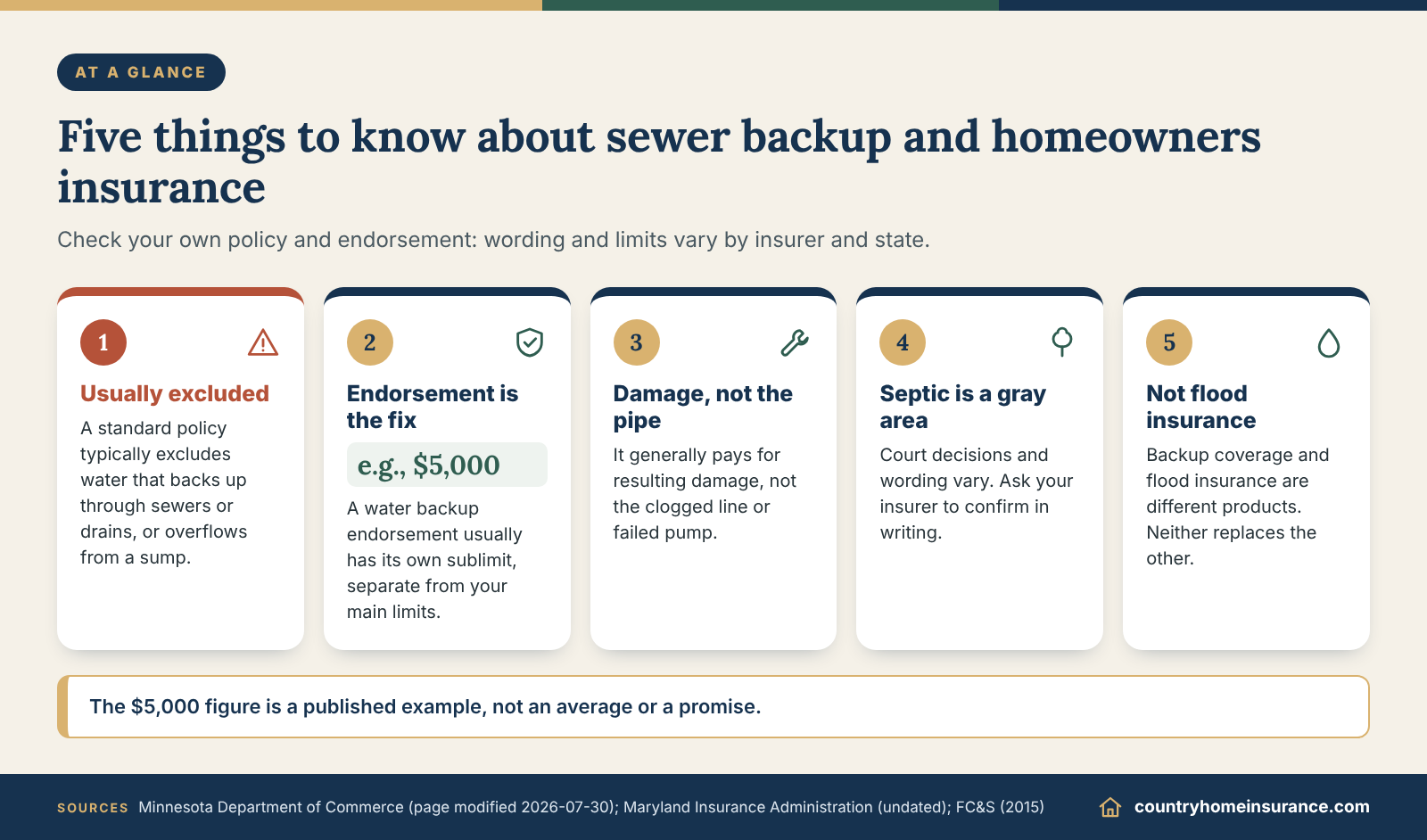
Does homeowners insurance cover sewer backup? Usually not by default. A standard homeowners policy typically excludes water that backs up through sewers or drains, or overflows from a sump pump, so you generally need a water backup endorsement to be protected. That add-on usually carries its own limit and deductible, and it typically pays for the resulting damage, not for fixing the clogged line or the failed pump. Septic systems, city mains and storms create extra gray areas, so read your own policy form.
Key takeaways
- State insurance regulators, including those in Minnesota and Maryland, describe sewer and drain backup as excluded from a typical homeowners policy unless you add coverage.
- The optional endorsement usually has a separate sublimit, often in the low thousands of dollars, and it does not raise your dwelling or contents limits.
- Even with the endorsement, the clogged pipe, failed sump pump or broken septic component is generally not paid for. The coverage is aimed at the water and sewage damage that follows.
- If you live on a septic system, do not assume the word “sewer” in a policy includes your tank and drainfield. Court decisions and policy wording vary, so ask for written confirmation.
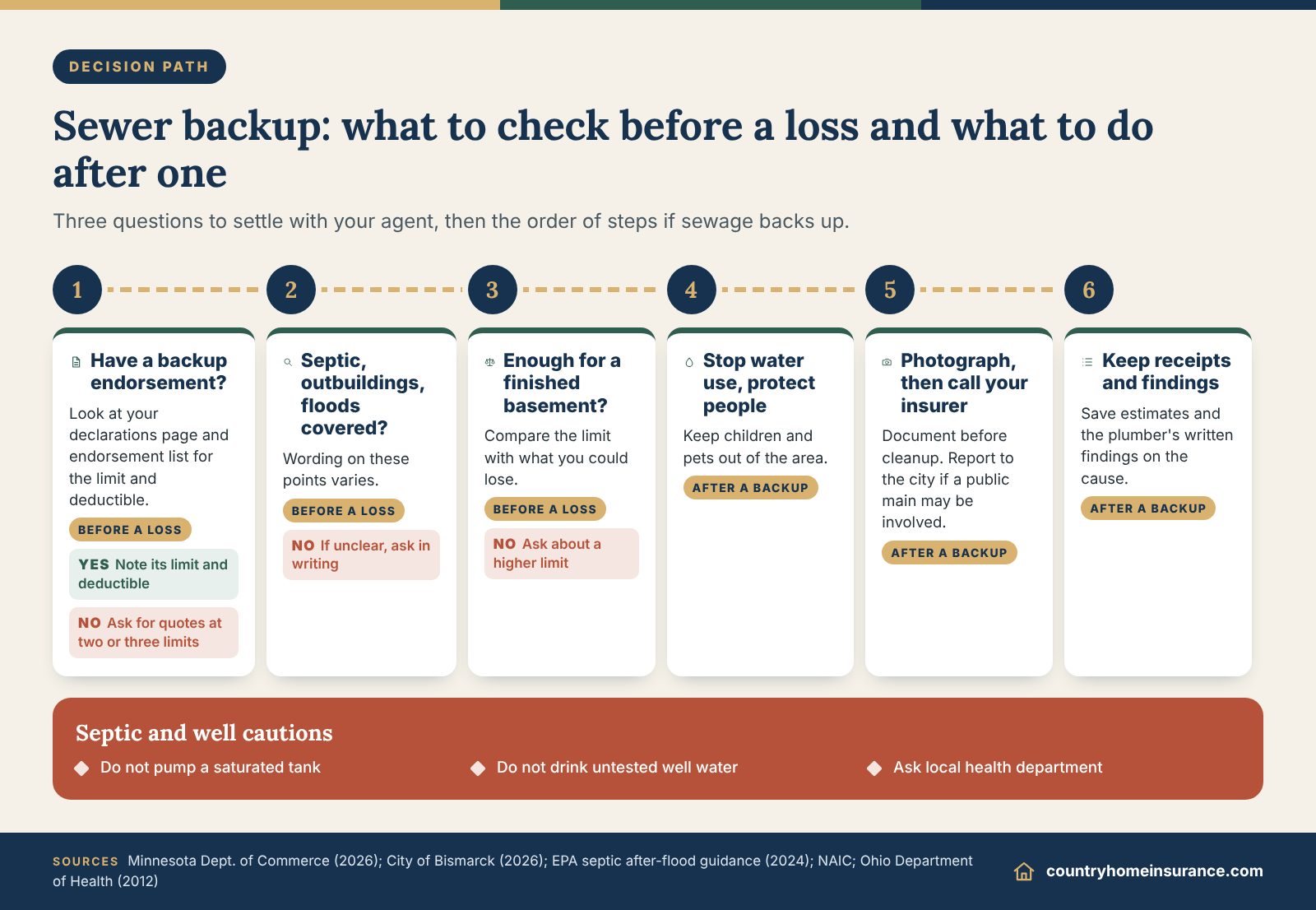
- Sewage cleanup is a health issue first. Stop using water, keep people and pets out, photograph the damage and call your insurer before anything is thrown away.
- Flood insurance and a sewer backup endorsement are different products. Neither one replaces the other, and some endorsements treat backup that happens alongside a flood differently.
| Scenario | Standard policy without a backup endorsement | With a water backup endorsement | What decides the outcome |
|---|---|---|---|
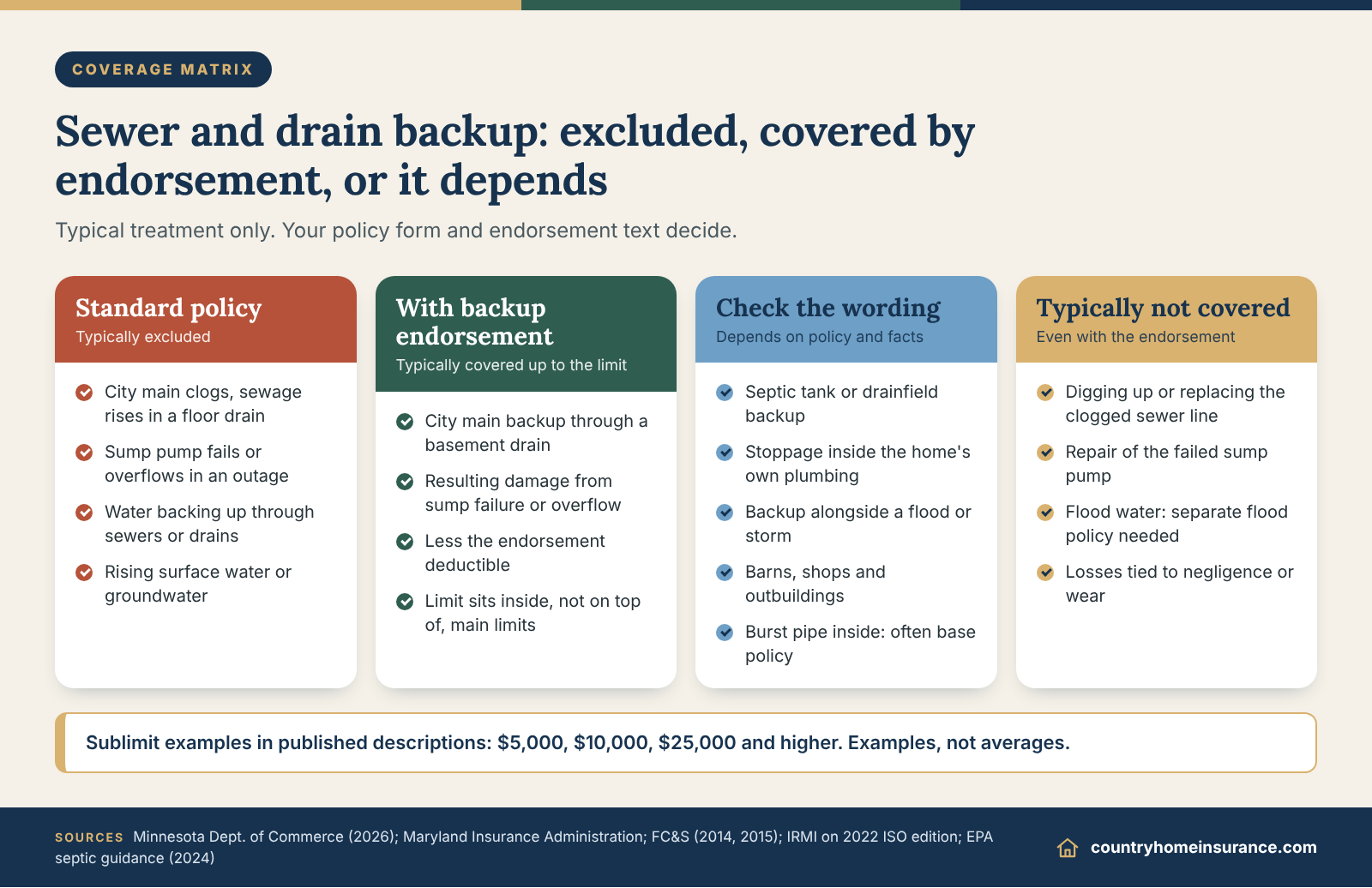
| Sewage rises through a basement floor drain after a city main clogs | Typically excluded | Typically covered up to the endorsement limit, less the deductible | Exact exclusion wording, endorsement limit, and whether the loss was linked to negligence or a flood |
| Sump pump fails or overflows during a power outage | Typically excluded | Typically covered for resulting damage; the pump itself usually is not | Whether your endorsement lists sump discharge or overflow |
| A pipe inside the house bursts and floods a room | Often covered as a sudden discharge of water, subject to the policy | Usually handled under the base policy, not the backup endorsement | Cause of the leak, maintenance, and the base policy’s water-damage wording |
| Septic tank or drainfield backs up into the home | Depends; many insurers treat it like a sewer backup, but wording and court decisions vary | Depends on whether the endorsement names septic systems | Policy definitions, state law, and written confirmation from your insurer |
| Rising surface water or groundwater seeps into a basement | Excluded as flood or surface water | Not covered by a backup endorsement; flood policy needed | Separate flood insurance, such as an NFIP or private flood policy |
| Cost to dig up and replace the clogged sewer line | Typically not covered | Typically not covered by the backup endorsement | Possible separate service-line or equipment coverage, if your insurer offers it |
Why a standard policy usually stops at the drain
Most people discover this exclusion at the worst possible moment: standing in a basement with an inch of dirty water and a policy they assumed would handle it. The reasoning behind the gap is easier to accept once you see how insurers divide water losses. A homeowners policy is built around sudden events inside the house, such as a supply line that splits or a water heater that leaks. Water that arrives from the outside, through a pipe the homeowner does not control, is treated as a different risk.
This guide stays focused on sewer, drain and septic backup. If you want the broader picture of water backup and sump pump claims, our companion article covers it in depth.
What does the standard policy say about water that backs up?
The standard homeowners form used across much of the country (the ISO HO-3, often just called the HO-3) lists specific water exclusions. The wording is technical, but regulators and insurance educators describe it in consistent terms. The core rule is that water coming back up through sewers or drains, or overflowing from a sump or sump pump, is not part of the base coverage.
The exclusion in plain English
The Minnesota Department of Commerce explains that homeowners policies exclude water that backs up from sewers, drains or sump pumps, along with surface water and water seeping through basement walls or floors. It adds that neither flood insurance nor a typical homeowners policy covers sewer backup or sump pump failure from heavy rain. The Maryland Insurance Administration frames it as an optional coverage you buy for an additional premium, which is the same idea seen from the other direction: if it is optional, the base policy is not providing it.
Trade analyses of the ISO form add some nuance. One insurance-industry coverage publication, writing about the 2011 edition, said the form broadened the exclusion to reach water-borne material and water that overflows or is discharged, and brought sump pumps and related equipment into the wording. It also noted that the exclusion is written to apply even when another cause contributes to the loss. That article dates from 2015, and your policy may use a different edition, so treat it as a description of how the exclusion was built rather than a quotation of your contract.
A common follow-up is whether upgrading to an HO-5 changes this. The HO-5 is a broader form that typically covers personal property on an open-perils basis too, not just the dwelling. None of the sources reviewed for this article says the HO-5 restores sewer or drain backup coverage, so read the water exclusions in your own form and ask for the backup endorsement by name instead of assuming a better form closes the gap.
What often stays covered inside the house
It would be a mistake to read the exclusion as a ban on all water claims. A sudden break in a supply line, a failed appliance hose or a ruptured water heater is a different cause of loss, and the base policy typically responds to the resulting damage, subject to its terms. The Minnesota page says a burst pipe inside the house is generally covered. Our article on burst pipes walks through that distinction in detail.
There is also a limited carve-back in the standard form. An analysis of the 2022 edition published by the risk-management publisher IRMI describes an exception for accidental discharge or overflow from an off-premises storm drain or sewer pipe, using a neighbor’s storm drain backing up into a detached garage as its example. The same analysis says backups from drains on the insured’s own property fall under the water-damage exclusion. Because editions and insurer manuscripts differ, whether your loss sits on the covered side of that line is a policy-reading question, not something a general article can settle.
How do backup, overflow, discharge and flood differ?
Adjusters sort water losses by how the water moved, because the policy language does the same. Two events that look identical on a basement floor can land on opposite sides of the coverage line, and the vocabulary explains why.
Four words that carry the claim
An insurance-industry explainer from Claims Magazine, republished by the FC&S coverage service in 2014, defines a backup as water forced to reverse direction by a stoppage, such as a collapsed or blocked drain. An overflow is water spilling past the limits of its container, like a tub left running. A discharge is water escaping from a pipe at the wrong spot. The article observes that the cause of the backup or overflow can determine whether coverage applies. So the first question in any claim conversation is not “how much water?” but “where did it come from, and which way was it moving?”
Flood is a fourth category. It generally means surface water, tidal water or overflow of a body of water, and it is excluded from standard policies regardless of how the water got in.
Why a sewer endorsement is not flood insurance
Several state and insurer sources make the same point. FEMA’s flood program site says most homeowners insurance does not cover flood damage, which is why a separate policy exists. The Minnesota Department of Commerce adds that a sewer or sump endorsement is not flood insurance, that some insurers exclude backup that occurs alongside a flood, and that others pay for backup even when flooding is involved. Because endorsements differ on this point, a storm that overwhelms both the municipal sewer and surface drainage is exactly when you need to know which version you bought. Our flood-damage article covers the flood side of that divide.
Does homeowners insurance cover sewer backup once you add the endorsement?
With the right add-on, the answer usually becomes “yes, up to a limit.” The endorsement goes by several names, including water backup, backup of sewers and drains, and water backup and sump discharge or overflow, and the ISO version is numbered HO 04 95 in recent editions. The mechanics matter more than the label, because three features of the endorsement decide how much help it gives you: what it grants, what limit it carries and what deductible applies.
What does the water backup endorsement actually add?
Think of it as a narrow patch over the exclusion. It does not rewrite your policy. It restores coverage for one specific cause of loss, usually with its own cap.
The coverage grant
A reference description of the ISO form HO 24 73 says it covers direct physical loss from water that backs up through sewers or drains, or that overflows or discharges from a sump, sump pump or similar system, as long as an insured’s negligence did not cause it. The Maryland Insurance Administration describes the same idea: it applies when a sump pump overflows or sewage enters the home through pipes meant to carry it away, again unless the insured was negligent. An insurer-published endorsement (form CO 04 95 11 03) adds that the coverage applies even if the overflow results from a sump pump breakdown. The Amica site lists structural repairs, damaged belongings and cleanup, drying and mold-prevention work among the covered items for its version.
Notice the repeated negligence condition. If a pipe was clearly neglected, or a sump pump was never switched on, an insurer may argue the loss falls outside the grant. We return to that in the exclusions below.
A separate limit that does not raise anything else
The endorsement normally comes with its own limit, often described as a sublimit because it sits inside, not on top of, the main coverages. The reference description of HO 24 73 says that limit is often a smaller figure such as $5,000, $10,000 or $25,000, and that it does not increase Coverages A through D. Coverage A is your dwelling, B other structures, C personal property and D loss of use. One insurer-published endorsement caps the benefit at $5,000, and a 2015 FC&S article said most endorsements cap coverage at $5,000, though some apply the full policy limit instead, citing Maryland’s form as an example.
Limits are not the same everywhere. A regional insurer’s 2023 article says its homeowners endorsement starts at $5,000 and can be raised up to $100,000, subject to eligibility, and another insurer’s underwriting guideline for Iowa lists limits up to $50,000. The point is not that you will find those numbers; it is that the default $5,000 is often far below the real cost of a finished basement, which is why you should choose a limit on purpose.
How the deductible works
Endorsements often carry a special deductible, which is a deductible that applies only to this coverage. The insurer-published form CO 04 95 11 03 applies a special $500 deductible and states that no other deductible applies to the coverage. The 2015 FC&S article called $250 the norm, and the IRMI analysis of the 2022 ISO edition describes a $250 special deductible. A different insurer’s guideline applies the other-perils deductible or $1,000, whichever is greater. Policygenius, a consumer publisher, notes that some insurers use the standard deductible while others offer a separate, lower one.
These are examples from different documents and different years, not a market average. Your declarations page and the endorsement itself show the figure that applies to you. If you are comparing two quotes, make sure both show the backup deductible, because a policy with a lower premium and a $1,000 deductible is not an apples-to-apples match for one with a $250 deductible.
What does the endorsement still leave out?
Buyers often assume the endorsement is a broad “sewer problems” policy. It is narrower than that. Understanding what it leaves out helps you decide whether you need anything else.
The failed pipe, pump or septic component
Across the sources reviewed, the repair of the thing that failed is consistently outside the coverage. The Maryland Insurance Administration says most policies with this coverage do not pay to repair or replace the pipe itself. The insurer-published form states that the coverage does not apply to loss of the sump pump. The reference description of HO 24 73 says the cost of repairing the failed sump pump, sewer pipe or drain is not covered, only the resulting water damage. Progressive adds that homeowners generally pay for repairs to the pipe between the house and the main sewer line, and notes that equipment breakdown coverage might help with a pump.
In plain terms, you may get help cleaning and rebuilding the basement but still pay a plumber, an excavation crew or a septic contractor out of pocket. That is one reason the shopping questions later in this guide ask about service-line and equipment coverage separately.
Negligence, wear and maintenance
The grant excludes losses caused by an insured’s negligence, and several consumer sources also list wear and tear and maintenance problems among exclusions. Amica says wear or aging of plumbing, pipes or sump systems is excluded, while the resulting water damage may be covered. The distinction between “the old pipe” and “the damage the old pipe caused” shows up again and again, and it is one of the more useful mental models for reading any water exclusion.
Flood, groundwater and mold
The endorsement does not turn into flood insurance. Encova’s article says its backup coverage excludes surface water, storm surge and groundwater seepage through the building, and Amica excludes groundwater seepage through foundations, driveways and patios. The National Association of Insurance Commissioners (NAIC), the organization of state insurance regulators, also notes that mold damage is often excluded from homeowners policies. Whether mold that follows a covered sewage backup is paid for, limited or excluded is something to ask about specifically, because mold treatment can add significantly to a basement claim.
Where the wording gets contested: city mains, your own plumbing and storms
Most sewer backup claims are not decided by the endorsement’s dollar limit. They are decided by facts: where the blockage was, what else was happening that day and who might share responsibility. Insurers and policyholders sometimes read the same paragraph differently, so it helps to know where the friction points are before a loss.
Does it matter which side of the property line the problem is on?
It can. The location of the blockage affects both how the exclusion is read and who else might be involved, and the sources reviewed do not all describe it the same way.
Water from outside your plumbing versus water from inside it
The 2015 FC&S analysis draws a line between a blockage outside the insured’s own plumbing, such as a clogged municipal sewer, and one inside it, such as a clogged sink drain. Water from the first is generally excluded under the base form. Water that overflows from a blockage inside the home’s own system may be covered as an accidental discharge. The same article reports that one Florida court said a sewer or drain begins at the property line, which would make a stoppage on the house side something other than a “sewer or drain” backup.
The practical message is not that you can pick whichever reading you prefer. It is that the cause-of-loss finding, usually made by a plumber or the adjuster’s contractor, can become the center of the claim. Ask the plumber to write down where the stoppage was found and what caused it.
Why courts have not spoken with one voice
The FC&S article says courts are split on whether the exclusion covers only water arriving from outside or also water that backs up from the home’s own plumbing. Some treat a clogged in-house drain as an excluded overflow. Others treat it as a covered accidental discharge. For a homeowner, a split like that means the answer may depend on the state, the exact edition of the form and the facts, and a general article cannot predict it.
It also helps explain why an insurer’s initial decision is not always the end of the conversation. If you believe the wording supports coverage, you can ask the insurer to identify the exact provision it relied on, and you can contact your state insurance department. We cover that process in the claim workflow below.
What happens when a storm is part of the story?
Backups cluster in wet weather. Municipal systems fill, sump pumps run hard and power fails, which means sewage backup and flooding often arrive together. That overlap is where wording matters most.
The concurrent-cause problem
Standard property policies often include language saying an exclusion applies no matter what other cause or event contributed to the loss, in any sequence. The FC&S article describes the sewer and drain exclusion as built this way, in part to avoid arguments about concurrent causation. Concurrent causation simply means two causes working together: for example, rain (a covered or neutral event) combined with a backed-up drain (an excluded event). With that lead-in, the excluded cause may defeat coverage even when a covered cause also played a role.
Your state may have its own rules about how such clauses are enforced, so outcomes can differ. We are describing the drafting approach here, not predicting an outcome.
Backup that follows a flood or heavy rain
The Minnesota Department of Commerce draws the key distinction for buyers: some endorsements pay for backup damage even when flooding is involved, while others exclude backup that occurs alongside a flood, and some exclude all damage if flooding directly or indirectly causes the failure. Experian adds that flood insurance covers a backup only if the flood directly caused it.
If you live in a low-lying area, near a creek or on land that holds water, this is the clause to read slowly before you buy. Ask the agent a plain question: “If a storm floods the yard and the sewer backs up in the same event, how does this endorsement respond?” Then ask for the answer in writing or point to the endorsement text.
Can the city or sewer authority be responsible for the loss?
Sometimes a public system is involved, and homeowners naturally ask whether the municipality should pay. The answer is usually more limited than people expect, and the insurance claim often has to start first.
Municipal liability is not automatic
The City of Bismarck, North Dakota publishes useful guidance on this. It says the property owner maintains the private service line from the property to the municipal main, while the city maintains the public wastewater mains. It also says the city is not automatically liable for backups: under North Dakota law, liability depends on proof that city negligence directly caused the damage and that no immunity applies. Other states have different rules, and this is one city’s explanation of one state’s approach, not a national standard.
Still, the page is a good model of the process. It tells residents to report the backup to the city so it can determine whether the public main is involved, and it describes a claim form and individual review of each incident.
Your own insurer is usually the first call
The same Bismarck page says to contact your homeowner’s or property insurer first because it is the primary coverage, and that the city’s risk-pool endorsement sits in excess of it. The city’s endorsement excludes service-line backups, extreme rainfall above set thresholds, presidentially declared disasters and certain power outages or cyber events. Again, that is one city’s program, but it illustrates a general pattern: public programs, where they exist, tend to be secondary, narrow and discretionary.
That is a good reason not to wait on the city before notifying your insurer. Report to both, keep your own records and let each decide on its own terms. If the city later pays something, your insurer’s rights and your policy terms determine how that interacts with your claim, so ask the adjuster before signing any release.
Rural properties: septic systems, wells and private service lines
Much of the online advice about sewer backup assumes a house connected to a city main. Country homes often work differently. A septic tank and drainfield may sit in the yard, a well may sit nearby, a barn or shop may have a floor drain, and the line to wherever the waste goes may be long and entirely private. The EPA reported in a 2015 SepticSmart release that nearly 21.5 million U.S. households rely on septic or other onsite wastewater systems, so this is not a niche case, even though most insurer pages never mention septic systems.
What changes when the waste goes to a septic tank instead of a sewer?
The physical problem is different, and so is the insurance question. There is no city main to blame and no public utility to call, and the policy wording written with municipal sewers in mind may not map neatly onto your system.
A different failure chain
A city sewer backup typically starts off the property. A septic backup starts on it. EPA’s post-flood septic guidance lists several ways an onsite system can send wastewater back toward the house: a saturated drainfield that cannot absorb more water, a scum blockage at the tank outlet, silt or debris filling tanks and pump chambers, and a high water table. It states that when the water table is high or flooding threatens the system, using the system less is the main way to prevent sewage backing up into the home.
Because every component is yours, the claim question usually becomes whether the policy’s “sewers or drains” wording, or any endorsement, reaches an onsite system. Nobody else’s pipe is involved, and that is exactly what makes the language matter.
How insurers and courts have treated septic backups
The honest answer is that the sources are thin and mixed. Experian lists septic tank backups both among events a standard policy typically excludes and among events that water backup insurance covers. The insurer-published endorsement text reviewed for this article, and the other insurer pages, did not mention septic systems at all. One insurer guideline describes its coverage as applying to water that backs up from off the insured premises through sewers or drains, and where wording is tied to off-premises sewers, an on-site septic system may fall outside it. That is a reading to test with your insurer, not a conclusion.
In court, a Florida-focused legal blog from 2019 reviewed cases in which exclusions for water backing up through sewers or drains were held not to bar coverage for a drain backup or an entirely on-site septic overflow, because the water came from a system wholly contained on the property. The author limited the analysis to Florida and did not research other states. Treat it as an example of the kind of argument that gets made, not as a rule you can rely on elsewhere.
Keeping the system out of trouble
Prevention is cheaper than any claim. EPA’s SepticSmart materials suggest having a licensed contractor inspect the system about every three years and pumping the tank as needed, typically every three to five years, while following your state or local health department’s guidance. They also recommend keeping non-flushable items such as wipes, diapers, cat litter and dental floss out of the system, spreading laundry and dishwasher loads across the day, fixing leaks, and keeping vehicles off the drainfield because their weight can crush buried pipes. These tips come from a 2015 EPA release and have been republished since, so check current guidance from your local health department.
What should you do when a flooded drainfield or a private well is involved?
Storms that cause septic backups often threaten the well, too. The order of operations matters, and some well-meaning steps can make the problem worse.
Rest the system while the soil is saturated
EPA’s guidance says not to use the system while the soil around the drainfield is saturated or flooded, because untreated wastewater can pollute the area. It advises conserving water and plugging basement drains while the system recovers. It also says not to pump the tank while the drainfield is saturated: pumping is at best a temporary fix, and in bad conditions the tank can float out of the ground and damage its pipes. If sewage has already backed up into the house, EPA suggests checking the tank outlet for a scum blockage first and not pumping floodwater through the system, since the added flow can carry solids into the drainfield.
Once conditions allow, EPA says to pump both the tank and any lift station to remove silt and debris, and to have the tank professionally inspected if you suspect damage such as settling or an inability to accept water. Only trained specialists should open or clean a tank because it can contain dangerous gases.
Test the well before anyone drinks from it
EPA’s one-line instruction for wells is direct: do not drink well water until it has been tested, and your local health department can advise. The same page raises a practical point for insurance conversations. If the drainfield is clogged with silt, a replacement system may be needed. That is a repair of the failed component, which, as discussed above, typically sits outside a water backup endorsement.
Whether any costs connected to testing, hauled drinking water or temporary housing would be paid depends on the policy. Loss of use (Coverage D) may respond if the home becomes unfit to live in because of a covered loss, and the Minnesota Department of Commerce suggests checking whether your policy includes it. Ask the adjuster rather than assuming.
Barns, shops and outbuildings with floor drains
Country properties often have buildings beyond the house: a workshop with a floor drain, a milk room, a pole barn with a utility sink. Backup coverage is typically described in terms of the dwelling and personal property, and the reference description of HO 24 73 mentions exactly those. Whether a given endorsement extends to other structures (Coverage B) or to business or farm contents is not something the sources reviewed answer, and it varies by form.
If you keep tools, feed, equipment or a home-business inventory in an outbuilding, ask your agent directly whether the endorsement applies there. If the answer is no, you at least know where the gap sits.
Who owns the line between your house and the sewer main or tank?
Ownership of the line is not just a plumbing detail. It decides who pays for the repair, who calls the contractor and whether a public agency has any role at all.
The private service line is generally the owner’s responsibility
Bismarck’s guidance says the property owner maintains the private service line from the property to the municipal main, including the tap, and that the city repairs and maintains the public mains. Progressive likewise says homeowners generally pay for repairs to the pipe between the house and the main sewer line. If your home has a septic system, the equivalent point is simpler still: the whole system from house to drainfield is typically yours.
If you have recently bought a property, ask the seller or county health office whether the septic permit and last pumping records exist, and keep them with your insurance file. They can help an adjuster understand the system’s condition.
Long runs, roots and shared easements
Bismarck’s handout lists fats, oils and grease, non-toilet paper products, tree roots, improper connections and missing backwater prevention valves as common causes of backups. Rural properties add their own variations: long private lines that run under pasture or driveways, older clay or iron pipe, mature trees along a lateral, and sometimes an easement shared with a neighbor. Those are general observations from how rural lines are laid out, not findings from the sources above.
Some insurers sell separate coverage for underground utility or service lines. This article did not verify any specific product, and availability and terms vary, so treat this as a question to ask, not a feature to expect. A line that fails from age or root intrusion is typically a maintenance repair, and no endorsement should be assumed to pay for it.
Limits, deductibles and cost: how much sewer backup coverage to carry
Buying the endorsement is the easy part. Choosing the right limit is where people either overpay for protection they do not need or find out too late that the default was far too low. The figures below come from published examples, not from a market survey, and they differ in year, publisher and method, so they are best read as ranges to question, not numbers to expect.
How high should the backup limit be?
The limit is a ceiling on what the endorsement can pay for one backup event. Everything above it comes out of your pocket, and the dwelling limit does not step in to cover the difference.
What published examples show
Table 2 collects limit and deductible examples from the documents reviewed for this article. The rows are not directly comparable: some describe an ISO form, some an individual insurer’s program, and one is a consumer publisher’s general statement.
| Source and date | Limit described | Deductible described | Note |
|---|---|---|---|
| Insurer-published form CO 04 95 11 03 (undated) | Up to $5,000 | Special $500; no other deductible applies; not applied to loss of use | Does not raise Coverages A through D; insurer is not named on the page |
| FC&S analysis of HO 04 95 05 11 (2015) | Most endorsements cap at $5,000; some apply the full policy limit, such as Maryland’s form | $250 described as the norm; $100 option in Virginia | Dated; edition-specific; state forms differ |
| IRMI analysis of HO 04 95 03 22 (2022 edition) | $5,000 | $250 special deductible | Describes the ISO form’s stated amounts; an insurer may schedule other figures |
| Reference description of HO 24 73 05 11 (undated) | Often $5,000, $10,000 or $25,000 | Not described | Own limit, separate from Coverages A through D |
| Homeowners of America Iowa guideline (undated) | Up to $50,000 for added premium | Other-perils deductible or $1,000, whichever is greater | On existing policies, added only at renewal |
| Encova article (March 2023) | Starts at $5,000 and can rise to $100,000 on one product, subject to eligibility | Not described | Insurer marketing content; other products have lower caps |
| Policygenius (page dated March 2022) | Generally $5,000 to $25,000 | Standard deductible (for example, $1,000) or a separate one as low as $250 | Consumer publisher summary; no method given |
The spread is the lesson. Between a $5,000 default and a $50,000 or $100,000 option sits a gap large enough to decide whether a finished basement is made whole or left half-repaired. If the default limit is all your agent mentions, ask what the higher options are and what each one adds in annual premium.
Hypothetical example: a finished basement and three limit choices
Hypothetical example: A sewage backup damages a finished basement. Cleanup and disinfecting, flooring, drywall and trim come to $14,000, and ruined furniture and electronics come to $6,000, for a total of $20,000. The endorsement carries a special $500 deductible. Real policies vary in how limits and deductibles interact, so the figures are for arithmetic only, and nothing here promises a payment.
| Endorsement limit | Loss after $500 deductible | Hypothetical maximum payment | Hypothetical amount you absorb |
|---|---|---|---|
| $5,000 | $19,500 | $5,000 | $15,000 |
| $10,000 | $19,500 | $10,000 | $10,000 |
| $25,000 | $19,500 | $19,500 | $500 |
The arithmetic is simple, but it shows why the limit deserves attention before a loss. In this example the homeowner who carried the default pays three-quarters of the loss, while the one who carried $25,000 pays only the deductible. The annual premium difference between those options varies by insurer and state and is not stated here.
How do special deductibles and loss of use interact?
The deductible is the portion of a covered loss you pay before the insurer pays. For backup claims, it often differs from the deductible on your main policy.
A separate deductible can be smaller or larger than your main one
As Table 2 shows, published examples range from $250 and $500 special deductibles to an approach that uses the greater of your other-perils deductible or $1,000. The Zebra, a consumer publisher, says sewer backup claims often carry a separate deductible that can differ from your main policy’s deductible and gives no typical dollar amount. That is a good reminder to look at the endorsement’s own deductible line rather than your wind or all-other-perils figure.
If your base policy has a percentage deductible for wind and hail, remember that it is usually a different mechanism and does not normally apply to a sewer backup. Your declarations page and endorsement show which deductible attaches to which cause of loss.
Loss of use is usually treated differently
Two of the documents reviewed note that the special deductible does not apply to loss of use. The insurer-published form says its deductible does not apply to Coverage D, and the 2015 FC&S article says the deductible does not apply to loss of use. Coverage D, also called additional living expense (ALE), generally helps with housing and related extra costs when a covered loss makes the home unlivable. A sewage backup that makes a house unlivable for weeks is one reason to confirm whether Coverage D applies to this endorsement’s losses, since some policies may limit it.
What does sewer backup coverage cost?
Prices are the least reliable numbers in this topic. Publishers do not share methodologies, years differ, and the endorsement is priced inside a larger policy. Still, the ranges give you a sense of scale.
Published price ranges, and why they should not be blended
Policygenius (2022) and Experian (2022) both give about $30 to $70 per year for $5,000 of coverage, and about $25 to $35 for each additional $5,000. Experian gives no source for those averages, and Policygenius attributes them to a former team lead without describing a method. The Zebra (page updated January 2026) says the endorsement typically adds about $50 to $250 per year depending on local factors and the limit, and its table shows averages for several insurers without explaining how they were calculated.
| Publisher and date | What it states | Method disclosed? | How to use it |
|---|---|---|---|
| Policygenius (page dated March 2022) | About $30 to $70 per year for $5,000; about $25 to $35 for each extra $5,000 | No; attributed to a former team lead | Rough scale only; four years old |
| Experian (March 2022) | The same per-limit ranges | No source given for the averages | Rough scale only; the two pages may share a source |
| The Zebra (updated January 2026) | Typically about $50 to $250 per year, depending on local factors and limit | Not explained for the insurer table | More recent, but still a consumer-publisher estimate |
| Your own quote | The only price that applies to your home | Based on your insurer’s rating rules | Ask for quotes at two or three limits with the deductible shown |
Do not average these together. The sensible use is to treat the endorsement as typically costing tens to low hundreds of dollars a year on top of a policy, and then get a real quote. Compared with a five-figure restoration bill, that is a meaningful trade, though the right answer depends on your basement, your risk and your budget.
What can move the price
The sources reviewed do not publish rating formulas, so this is general reasoning, not sourced fact. Insurers commonly consider the limit chosen, the home’s location and age, and loss history, and some may require underwriting review before adding the coverage. Progressive notes that risk rises with an aging municipal sewer system, an older home and a basement foundation, which suggests those traits matter. Eligibility rules can also apply: one insurer’s guideline says existing policyholders can add the coverage only at renewal.
If an insurer declines to add the endorsement or restricts it, ask whether a different insurer or product can fill the gap, and read the shopping questions near the end of this guide.
What to do when sewage backs up: a claim workflow
A sewage backup is urgent in two ways. It is a health problem that needs quick, careful action, and it is a claim that needs documentation before cleanup erases the evidence. The steps below combine regulator and public-agency guidance with ordinary claim practice, and the order matters.
What should you do in the first hours?
The first priority is to stop making it worse. The second is to make sure your insurer hears from you early and that you have proof of what happened.
Protect people and stop the flow
The City of Bismarck’s guidance says to stop using water in the building, including toilets, sinks, washers and dishwashers, to prevent more backup, and to avoid contact with the wastewater. Keep children and pets out of the area. If water has reached outlets, appliances or the electrical panel, stay out of the space and have a qualified electrician look at it first; that is common safety practice rather than a point drawn from the sources above.
If you have a septic system, EPA’s advice to limit water use and avoid pumping a saturated tank applies here, and you should call a septic professional rather than guess at the cause.
Notify the insurer and take reasonable steps to limit damage
The Minnesota Department of Commerce advises contacting your insurer promptly and making sure your agent has current contact information. It also says to take reasonable steps to limit further damage without putting yourself at risk. Policies commonly require this kind of mitigation, and the cost of reasonable emergency measures, such as water extraction or temporary protection, is something to ask the adjuster about before you spend, then keep receipts.
When you call, describe what you know without guessing at the cause. Say where the water appeared, when you noticed it and what you have done. Ask whether the claim will be handled under a water backup endorsement and request the claim number and the adjuster’s contact details.
Document before anything is thrown away
Photograph and video the affected rooms, the standing water, the drains, the damaged contents and any visible source, and record the date and time. Bismarck’s guidance tells residents to photograph damage and keep receipts for equipment and services. A home inventory is the fastest way to support a contents claim, and the Minnesota page recommends giving your agent one; the NAIC likewise recommends preparing an inventory with photos or video, receipts and model and serial numbers before a loss.
Some contaminated items will have to be removed for health reasons. Photograph them first and ask the adjuster whether samples, measurements or inspection are needed before disposal. Keep any plumber’s written findings about where the stoppage was and what caused it.
How do cleanup and health precautions fit into the claim?
Sewage can carry bacteria, viruses and other germs. The health guidance below comes from older public-agency documents, so it is a baseline to confirm with your local health department or a restoration professional.
Protective gear and who should do the work
A 2012 Ohio Department of Health fact sheet advises waterproof boots, gloves and eye protection, washable or disposable clothing and an N95 mask, plus good ventilation, and says to wash cleanup clothes separately. A 2005 CDC fact sheet on flood cleanup gives similar advice on boots, gloves and goggles. Bismarck’s guidance goes further and recommends hiring a professional cleaning service to clean and disinfect everything after a sewage backup.
Professional cleanup is not required by every policy, but it is often the practical choice for anything beyond a small, contained spill. Ask the insurer whether it has preferred vendors, whether you may choose your own, and how the invoice is handled.
Porous materials and what usually has to go
Both agencies say porous or absorbent items that touched sewage and cannot be washed and disinfected generally need to be discarded. The Ohio sheet lists items such as cardboard, books, mattresses, pillows, upholstered furniture, drywall and unfinished wood, and says carpet padding must be replaced even if the carpet is cleaned. CDC lists similar items and says contaminated drywall and insulation should be removed. For hard surfaces, both call for cleaning with detergent and hot water first. Ohio adds that disinfection does not work on dirty surfaces and that a bleach solution of about half a cup per gallon of water or a labeled household disinfectant can follow the cleaning. It also warns never to mix ammonia-based cleaners with bleach.
For insurance, this is where photos and an itemized list pay off. A list that names each discarded item, its age and its approximate replacement cost makes it easier to discuss replacement cost value (what it costs to replace an item new) versus actual cash value (replacement cost minus depreciation), whichever your policy uses for personal property.
Drying quickly to limit mold
The Ohio fact sheet says areas left wet for more than 24 to 48 hours are at high risk for mold, and recommends removing moisture, running fans or dehumidifiers and keeping closet and cabinet doors open until everything is fully dry. It also suggests consulting a water restoration professional about whether carpet and upholstered furniture can be steam cleaned and disinfected. Because the NAIC notes that mold is often excluded from homeowners policies, drying fast is both a health step and a way to avoid a second, separate dispute.
If the basement has finished walls or flooring, ask the adjuster in writing how the policy treats mold that develops after a covered backup.
How do you work the claim once the emergency is over?
After the immediate steps, the claim becomes a paperwork and negotiation process. A calm, organized approach tends to help.
Scope, estimates and the full list of losses
The Minnesota Department of Commerce advises including every loss in the claim and supporting it with written estimates. For backup claims that usually means three buckets: structural repair (flooring, drywall, trim, cabinets), cleanup and mitigation (extraction, disinfecting, drying), and contents. Add the cost of temporary housing if the home is unlivable and your policy provides loss of use. Ask the adjuster which of these buckets fall under the endorsement limit and which, if any, fall under other coverages, because the answer determines how quickly a limit is used up.
Keep a log of calls, dates and names. If an estimate from your contractor differs from the insurer’s, ask for a line-by-line explanation of the differences before you dispute the total.
Running a municipal claim alongside your own
If the backup may have come from the public main, report it to the city or sewer authority promptly. Bismarck’s guidance says the city reviews each incident individually and that its coverage can pay certain damages even when the city is not liable, subject to the program’s terms. That is one city’s approach. Other municipalities may offer no payment or have notice deadlines, so ask how to file and by when.
Notify your own insurer regardless. As noted above, the city’s page treats the homeowner’s insurer as primary. Before you sign any release from the city or its administrator, ask your insurer whether it affects your claim.
If you disagree with the decision
Start by asking the insurer for the specific policy provisions behind a denial or a low payment, and send any new evidence in writing. If the disagreement continues, your state’s insurance department is the next step. The NAIC homeowners page points consumers to its Insurance Departments tool to find the right state regulator and to a File a Complaint page for problems with an insurer or agent. What a regulator can do varies by state, but a complaint is the usual route when you question whether an insurer followed the law and its own contract.
For high-dollar or complicated disputes, some homeowners consult an attorney or other licensed professional. This article is educational and does not provide legal advice.
Prevention, state rules and what to ask before you buy
Insurance pays after the damage is done. The cheaper outcome is the backup that never happens, and the second-best outcome is knowing, before a loss, exactly how your policy will respond. This section covers both, plus the way state rules shape what insurers must offer.
What can reduce the chance of a backup?
No device or habit eliminates the risk, and an insurer is not obliged to give a discount for any of them, so treat these as risk-reduction steps, not premium strategies. Ask your agent before assuming a credit exists.
Backwater valves and accessible cleanouts
City of Bismarck handout material lists missing backwater prevention valves among the common causes of backups, alongside grease, tree roots and improper connections. A backwater valve is a device installed in the building drain that is designed to let wastewater flow out but not return. Whether one is appropriate, permitted or required depends on your plumbing layout and local code, so have a licensed plumber assess it. Ask the plumber too about cleanouts, which are the access points that make it easier to clear a line before it fails.
Installation can involve work in the floor slab and local permits. Get a written estimate and keep the invoice and any permit paperwork, because documentation of improvements can be useful to an insurer or a future buyer.
Sump pump power, testing and backup
Amica recommends maintaining and testing the sump pump, clearing drains when appropriate and considering a battery backup where outages are common, and lists power outages stopping a pump during a storm among common causes of water backup claims. Encova’s article names a power outage as a typical claim scenario, too. If you rely on a pump, test it by pouring water into the pit a few times a year, keep the discharge line clear and plan for what happens when the power goes out. Our companion article on water backup covers sump systems in more detail.
Everyday habits that protect the line and the tank
Bismarck’s handout names fats, oils and grease and paper products other than toilet paper as leading causes of blockages. Those habits matter on a municipal line and matter even more on a septic system, where EPA’s SepticSmart tips add coffee grounds, dental floss, diapers, wipes, feminine hygiene products, cigarette butts and cat litter to the list of things that can clog or damage the system. Spreading out laundry and dishwasher loads protects a tank that has not been pumped recently, and keeping vehicles off the drainfield protects the buried pipes.
For trees, the practical step is to know where your lateral runs before you plant, since roots are a recognized cause of line failures.
How do state rules change what you can buy?
Insurance is regulated state by state, and sewer backup is a good example of the variation. The sources reviewed show at least two different approaches, and your state may have a third.
Maryland requires insurers to offer the coverage
The Maryland Insurance Administration states that Maryland law requires insurers to offer water backup coverage. A Garrett County government page adds details: the offer must be made in writing by certified mail, within seven days of initial policy placement or at each renewal, under legislation (HB 72) that took effect October 1, 2008 and cites Insurance Article section 19-202. The county page is a secondary summary of the statute, so Maryland readers should confirm current requirements with the state agency.
A required offer is not a required purchase. It means the insurer must put the option in front of you, and you decide whether to buy it. Keep a copy of whatever notice you receive, and ask the insurer how a decision to decline is documented.
Elsewhere, check the rules and the insurer’s practice
The Minnesota Department of Commerce page cites no Minnesota statute requiring sewer backup coverage, and it describes the protection as a separate product or endorsement you must add. Other states may have their own rules about offers, forms or wording, and this article did not survey all 50. Insurers also set their own eligibility rules, such as adding the coverage only at renewal.
The simplest check is to ask your agent whether the offer is required in your state and then read your state insurance department’s consumer pages. The NAIC’s Insurance Departments tool will take you to the right regulator.
What should you ask before adding or renewing the endorsement?
The best questions are specific and answerable in writing. Good agents will welcome them, and you will learn more from the answers than from the quote.
Questions about the wording
Start with the cause of loss: does the endorsement cover water that backs up through sewers or drains, overflow from a sump, and discharge from a sump pump, including after a mechanical failure or power outage? Ask whether the backup must come from off the premises, which matters for septic systems. Ask whether the endorsement mentions septic tanks, drainfields or onsite systems, and whether it applies to outbuildings and their contents. Ask how it treats a backup that occurs during a flood or storm, using the Minnesota Department of Commerce’s three variations as a script.
Finally, ask what the negligence condition means in practice, and whether cleanup, drying and mold remediation fall inside the limit.
Questions about limits, deductible and price
Ask for quotes at two or three limits, with the special deductible shown, and ask whether Coverage D (loss of use) responds to this cause of loss. Ask whether the limit is per occurrence or has other restrictions. Ask what happens if the sewer main and your service line are both involved. If your insurer will not add the coverage, ask whether another carrier or an optional equipment or service-line product could fill the hole.
Request the endorsement form number so you can read the text yourself. The form number appears on the declarations page or in the endorsement list.
Comparing quotes apples to apples
Two quotes with the same dwelling limit but different backup limits, deductibles or wording are not equal. Line them up on the same terms before you compare price. Table 5 turns the points in this guide into a checklist you can take to your agent or use after a loss.
| When | Action | Why it matters | Who to ask or what to keep |
|---|---|---|---|
| Before a loss | Find your declarations page and endorsement list; look for a water backup form and its limit and deductible | The sewer backup exclusion is the default; the endorsement is the exception | Agent or insurer; copy of declarations and endorsement |
| Before a loss | Ask whether septic systems, outbuildings and storm-related backups are addressed in writing | Wording on these points varies and sources are mixed | Agent; written reply or endorsement text |
| Before a loss | Make a home inventory with photos or video, receipts and serial numbers | Supports contents claims; recommended by the NAIC and the Minnesota Department of Commerce | Store a copy off site or in the cloud |
| Before a loss | Learn where your service line or septic system runs, and keep pumping and inspection records | Ownership and maintenance affect repair responsibility and the claim story | Plumber, county health office, septic contractor |
| During a backup | Stop using water; keep people and pets out; photograph everything before cleanup | Limits damage and preserves evidence | Phone photos and video; dated notes |
| During a backup | Call the insurer promptly and ask which coverage applies; report to the city if a public main may be involved | Early notice and mitigation are advised by regulators | Claim number, adjuster name, city contact |
| After cleanup | Keep receipts, a plumber’s written findings and written estimates for every category of loss | Supports the full claim and any later dispute | Contractors, restoration firm, plumber |
| If disputed | Request the specific provisions cited; contact the state insurance department if unresolved | Creates a record and starts the regulator route | Insurer; state department of insurance; NAIC tools |
Frequently asked questions
Coverage questions
Is an overflowing toilet the same thing as a sewer backup?
Not necessarily. A toilet that overflows because of a clog inside the home’s own plumbing may be treated as an accidental overflow of a plumbing system, which a standard policy can cover, subject to its terms. The 2015 FC&S analysis says courts are split on whether the sewer and drain exclusion reaches water that backs up from inside plumbing, so the outcome can depend on the policy edition, the facts and your state. Ask for the provision the insurer relied on if a claim is denied.
Will flood insurance pay for a sewer backup?
Usually only in narrow circumstances. Experian says flood insurance covers a backup only if the flood directly caused it, and the Minnesota Department of Commerce says neither flood insurance nor a typical homeowners policy covers sewer backup from heavy rain by default. Because flood policies have their own definitions, waiting periods and exclusions, check the policy rather than assuming. FEMA’s flood program site is the place to start for basic flood insurance questions.
Does the endorsement pay to fix the sewer line or sump pump?
Typically not. The Maryland Insurance Administration says most policies with this coverage do not pay to repair or replace the pipe itself, and the insurer-published form excludes loss of the sump pump. The endorsement is aimed at the damage the water and sewage cause. Equipment breakdown or service-line coverage, where an insurer offers it, is a separate question.
Cost and buying questions
Is sewer backup coverage worth the money?
That depends on your home, your risk and your finances. Published price estimates, which differ by publisher and year, put the endorsement in the range of tens to a couple hundred dollars a year, while a finished basement can cost far more than that to restore. Homes with basements, older plumbing, mature trees near the line or a history of wet weather may have more to gain. A home with no lower level may face less exposure, though drains on the lowest floor can still back up. That last point is general reasoning, not a sourced finding.
Can I add the endorsement at any time?
It depends on the insurer. One insurer’s Iowa guideline says that on existing policies the coverage can be added only at renewal. Other insurers may allow mid-term changes. Timing rules vary, so ask your agent, and do not count on being able to buy coverage after a problem appears.
How do I choose between a $5,000 and a higher limit?
Estimate what you would lose if sewage reached everything on your lowest floor: flooring, drywall, cabinets, furniture, electronics and cleanup. Table 3 shows how a $5,000 limit can leave most of a $20,000 hypothetical loss uncovered. Then ask for quotes at several limits and compare the added premium with the money you could afford to lose.
Rural and claim questions
My septic tank backed up after heavy rain. What should I do first?
Stop adding water to the system, keep people and pets away from the contaminated area and call a septic professional. EPA says not to use the system while the drainfield soil is saturated, and not to pump a tank while the field is flooded. Photograph the damage, notify your insurer and ask whether your policy treats septic backup like sewer backup. Use gloves, boots and eye protection if you must enter the area, and have trained specialists handle the tank itself.
Do I need to test my well after a sewage backup or septic failure?
If the backup came with flooding or a failed drainfield, EPA says not to drink well water until it has been tested and recommends asking your local health department for advice. If a sewage backup is limited to the house and the well was not affected, a health department can still tell you whether testing makes sense. Whether the testing cost is reimbursed depends on the policy and cause of loss, so ask the adjuster.
What if the city says it is not responsible?
That is a common outcome, and it does not end your options. Bismarck’s guidance notes that liability depends on proof of municipal negligence and the absence of immunity, and that the homeowner’s insurer is primary. File your own insurance claim promptly, keep the plumber’s findings, and ask the city how to submit a claim and what deadlines apply. For a dispute with the insurer, your state insurance department is the next step.
Sources
- Minnesota Department of Commerce: Sewer backup coverage (page modified July 30, 2026)
- Maryland Insurance Administration: Coverage for water that backs up through sewers or drains (undated; reviewed 2026-10-11)
- Garrett County, Maryland: Homeowner insurers must offer sewer backup coverage (undated county summary; confirm against the statute)
- U.S. EPA: Septic systems, what to do after a flood (archived snapshot of January 19, 2025; page updated September 20, 2024)
- U.S. EPA: SepticSmart release on septic maintenance (September 21, 2015; older guidance)
- City of Bismarck, North Dakota: Sewer backup next steps (program effective April 1, 2026)
- NAIC: Homeowners insurance consumer page (undated; reviewed 2026-10-11)
- FloodSmart (NFIP): Flood insurance basics (undated; reviewed 2026-10-11)
- FC&S: Coverage for backup of sewers and drains (May 19, 2015; dated)
- FC&S: Water back-up explained (February 11, 2014; dated)
- IRMI analysis of the HO 00 03 03 22 overflow-of-water exception (hosted file uploaded November 2024)
- Merlin Law Group: Back up from a septic system, is it covered? (May 4, 2019; Florida cases only)
- Insurance forms reference: ISO form HO 24 73, Water Back Up and Sump Discharge or Overflow (undated reference description)
- Insurer-published Water Back Up and Sump Overflow endorsement, form CO 04 95 11 03 (undated; insurer not named on the page)
- Homeowners of America Insurance Company: Iowa water backup and sump discharge or overflow guideline (undated)
- Encova: Why offer water backup coverage (March 2023; insurer content)
- Amica: Water backup coverage (undated; insurer content)
- Progressive: Does home insurance include water back-up coverage? (updated October 16, 2025; insurer content)
- Policygenius: What is water backup coverage? (page dated March 2022; consumer publisher)
- Experian: What is water backup insurance? (March 16, 2022; consumer publisher)
- The Zebra: Sewer backup insurance (updated January 15, 2026; consumer publisher)
- Ohio Department of Health: Cleaning up after a sewage backup (July 2012; dated; hosted by a local health district)
- CDC: After a hurricane or flood, cleanup of flood water (July 11, 2005; dated)
Important coverage note
Coverage depends on the actual policy, endorsements, exclusions, limits, deductible and cause of loss. State laws and insurance programs vary, and insurers apply their own underwriting rules and policy wording within them. Examples, price ranges and limits in this article are illustrations drawn from published sources of different dates, not quotes, and nothing here promises that any claim will be paid. For questions about your own situation, review your declarations page and policy forms, then verify with your insurer or agent and your state Department of Insurance. This article is educational and is not legal advice.
About the editorial team
This guide was prepared by the countryhomeinsurance.com editorial team as general, educational information for homeowners. We research and summarize publicly available material, including state insurance departments, the NAIC, federal agencies, regulators’ consumer guides and published insurer and industry resources. We draw only on the sources that were available to us when we wrote this guide, and we list them in the Sources section with dates where we could find them.
Insurance rules, rates, products and program terms change, differ by state and by insurer, and can apply differently to your situation. We cannot guarantee that this content is complete, current or free of errors. It is not legal, financial, tax or insurance advice, it is not an offer to sell insurance or a recommendation of any insurer, agent or product, and reading it does not create a professional relationship of any kind.
To the fullest extent permitted by law, countryhomeinsurance.com and its editorial team, authors and contributors exclude all liability for any loss, damage or decision arising from the use of, or reliance on, this content. For questions about your own policy or claim, contact your insurer, a licensed agent or broker, your state Department of Insurance or another qualified professional.
Content created: October 11, 2026