Quick answer
California homeowners insurance is a rate-regulated market where wildfire risk, rebuilding costs and slow rate approvals shape both price and availability. One 2026 sample-rate study puts a typical California premium near $1,820 a year for a $400,000 dwelling limit, but your own price depends heavily on ZIP code, wildfire exposure and home hardening. If standard insurers decline you, the FAIR Plan offers limited fire-focused coverage that is usually paired with a separate Difference in Conditions policy. Verify current rules with the California Department of Insurance.
Key takeaways
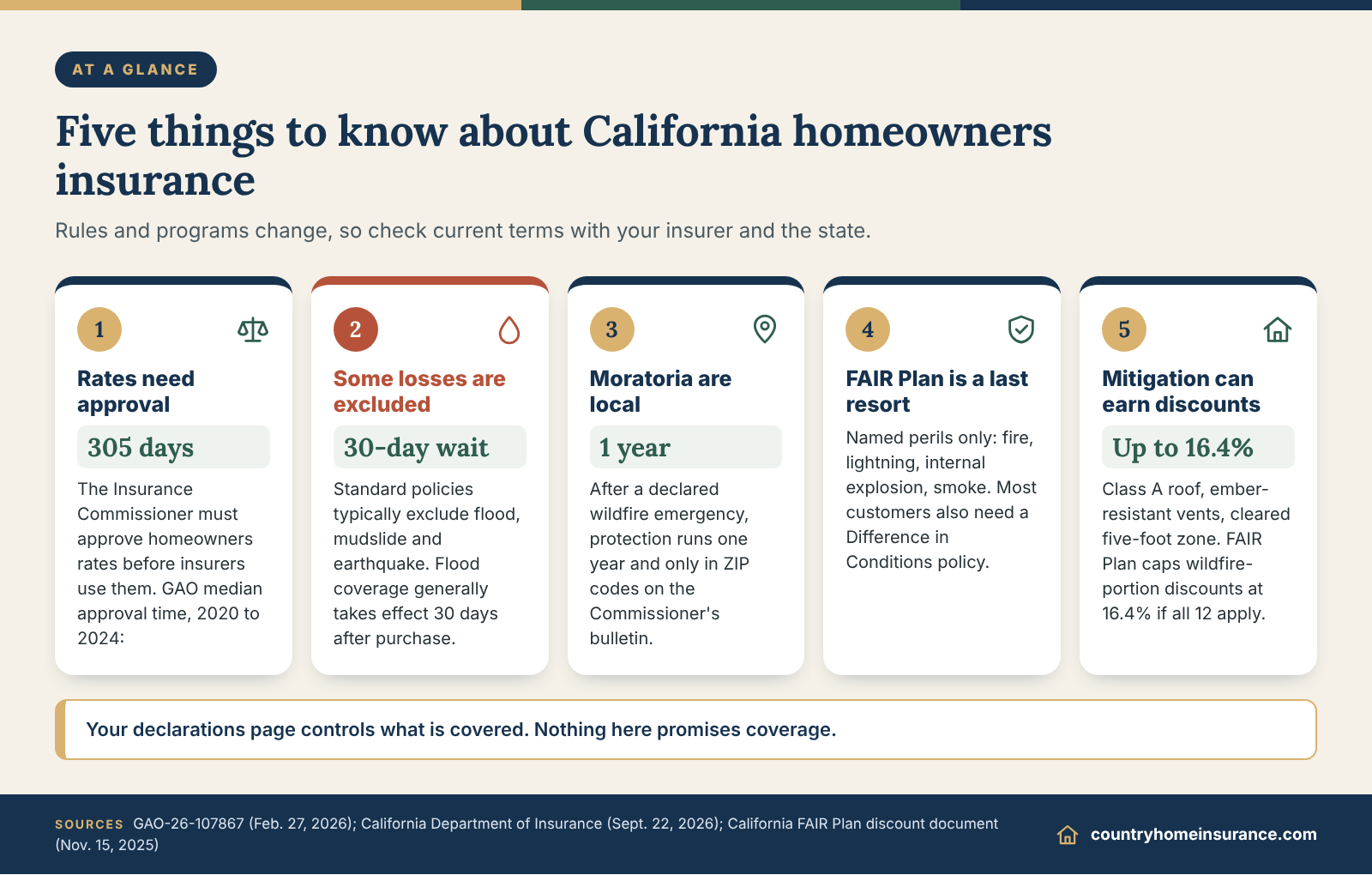
- The California Department of Insurance (CDI) must approve homeowners rates before insurers use them, and the Government Accountability Office (GAO) reported a median approval time of 305 days for 2020 to 2024.
- Standard policies typically exclude flood, mudslide and earthquake damage; those gaps matter more after a wildfire burns the slopes above a home.
- After a governor-declared wildfire emergency, insurers generally cannot cancel or nonrenew residential policies in affected ZIP codes for one year because of wildfire risk, but the protection is limited to specific areas.
- The California FAIR Plan is an insurer of last resort that covers named perils only (fire, lightning, internal explosion and smoke, with optional extended coverage), so most FAIR Plan customers also need a Difference in Conditions policy.
- Wildfire mitigation steps such as a Class A roof, ember-resistant vents and a cleared five-foot zone can earn discounts that regulations require insurers to recognize in their rating plans.
- Several consumer protections change on January 1, 2027, so check the dates before you rely on any single rule.
| Situation | Typical standard homeowners policy | FAIR Plan dwelling policy (sample form) | What to check |
|---|---|---|---|
| Wildfire flames, smoke, ash | Fire is typically covered, subject to limits, deductible and policy terms | Fire, lightning, internal explosion and smoke are named perils | Dwelling limit, smoke-damage handling, loss-of-use terms |
| Flood, mudslide, debris flow | Typically excluded, unless a recent wildfire or another covered peril directly or indirectly causes the damage (CDI, September 22, 2026) | Flood, surface water and earth movement are excluded in the sample form | Cause-of-loss wording; separate flood policy; 30-day flood waiting period |
| Earthquake | Typically excluded; endorsement or separate policy available | Earthquake excluded; a separate California Earthquake Authority policy is available only with an in-force FAIR Plan policy | Earthquake deductible, participating insurer, contents options |
| Fallen tree from a storm | Generally covered under standard policies, per CDI | Depends on whether extended coverage such as windstorm applies to your policy | Whether extended coverage is on your declarations page |
| Theft and personal liability | Typically included in a standard policy, with sublimits on some items | Not covered; CDI suggests a Difference in Conditions policy | Liability limit, theft sublimits, scheduled items |
| Water damage from a burst pipe | Depends on cause and policy terms | The FAIR Plan says a Difference in Conditions policy covers water damage that the FAIR Plan does not | Water-damage wording and any Difference in Conditions policy |
How California homeowners insurance works and what a standard policy covers
California homeowners insurance sits inside a regulatory system that differs from most states in one important way: insurers need approval for rates before they can use them. That single feature, combined with heavy wildfire exposure and high rebuilding costs, explains much of what homeowners experience at renewal. This guide walks through how the system works, what the policy typically does and does not cover, what drives cost, and what to do if you are dropped. Facts about rules, programs and prices come from sources retrieved in October 2026, and each is dated so you can judge how fresh it is.
Who regulates California homeowners insurance, and how much control do they have?
Insurance in the United States is regulated mostly by the states, and in California the regulator is the Department of Insurance, led by the Insurance Commissioner. The department reviews rates, handles consumer complaints and publishes consumer tools. Understanding what it can and cannot do will keep your expectations realistic when you shop or when you receive a nonrenewal notice.
The Department of Insurance and the consumer tools it publishes
CDI’s residential insurance page points shoppers to several free tools: a Home Insurance Finder that shows agents and the insurers they represent, a homeowners premium comparison tool, a coverage comparison tool, a list of carriers that sell Difference in Conditions policies, and a company contact list with toll-free numbers for more than 50 insurers licensed to sell homeowners coverage. The Consumer Hotline is 1-800-927-4357. These pages are undated, so treat the tools as starting points and confirm each insurer’s current appetite directly.
Prior approval of rates under Proposition 103
Proposition 103, a 1988 measure, is the reason California is called a prior-approval state. The Insurance Code section implementing it says rates must be approved by the Commissioner before they are used. In practice, that means an insurer that wants a rate increase files a request and waits. The GAO’s 2026 report on homeowners premiums found that California’s median time to approve premium increase requests from 2020 through 2024 was 305 days, the second-longest of the states it examined after Colorado at 331 days. The report also links longer approval times with greater difficulty obtaining insurance in some states, though it does not say that any single factor explains California’s market.
Rate review, intervenors and recent reforms
Because California allows consumer groups called intervenors to participate in rate cases, major filings can be contested. CDI said in a news release dated August 11, 2026 that new rules governing intervenor participation and compensation were in effect. The same release describes a settlement supporting an average 17% rate increase for State Farm General homeowners policyholders and reports that a Farmers homeowners request was reduced from 6.9% to about 1.5% during review. Those figures are the Department’s own account of specific filings, not a statewide average, and they are not a prediction of what any one household will pay.
What does a standard California homeowners policy cover?
A standard homeowners policy bundles several coverages into one contract. The National Association of Insurance Commissioners (NAIC), the organization of state insurance regulators, describes the usual parts, and the lettering below follows the common policy structure. Your actual limits and wording are on the declarations page, which is the summary page of your policy.
Dwelling and other structures (Coverage A and Coverage B)
Coverage A pays for damage to the house itself up to the policy limit. Coverage B applies to detached structures such as a garage, shed or fencing. For country properties this second line matters because barns, workshops and guest cottages usually fall under Coverage B or need separate treatment, and use for business or rental can change the answer. The NAIC recommends insuring a home for at least 80% of its replacement value, and some policies reduce replacement-cost payments if the limit falls below a similar threshold. Because rebuilding costs and contractor availability may tighten after a regional disaster, treat that threshold as a floor rather than a target.
Personal property and loss of use (Coverage C and Coverage D)
Coverage C pays for belongings, and the NAIC notes that contents coverage is typically set at about half the dwelling amount, with the option to raise it. Theft of furs and jewelry is commonly limited to about $500 and firearms and computers to about $1,000 unless you schedule them on an endorsement, which is an add-on that changes the base policy. Coverage D, often called additional living expense (ALE) or loss of use, pays necessary extra costs such as temporary housing when a covered loss makes the home unlivable. After a California wildfire, ALE can become the largest cash-flow issue for a family, so read its time limits closely.
Liability and medical payments (Coverage E and Coverage F)
Coverage E protects you if someone sues you for injury or property damage they claim you caused, and Coverage F pays small medical bills for injured guests regardless of fault. For homes with ponds, horses, trampolines or a long private driveway used by visitors, the liability limit deserves a deliberate decision. Ask whether an umbrella policy, which adds liability limits above the base policy, makes sense and whether any animals or attractions are excluded.
What does a standard policy typically leave out in California?
Every standard policy excludes certain causes of loss. In California the three that surprise people most are flood and mud, earthquake, and gradual damage. Exclusions are not a sign of a bad policy; they are how the product is priced, and the question is whether you have a plan for each gap.
Flood, mudslide and debris flow
On September 22, 2026, CDI urged Californians to review coverage ahead of a forecast El Niño season after the Governor’s emergency declaration. The Department reminded the public that standard homeowners, renters and commercial policies typically exclude flooding, mudslides and debris flows, with an exception when a recent wildfire or another covered peril directly or indirectly causes the damage. Flood insurance generally takes effect 30 days after purchase unless a lender requires it at a home purchase, and the National Flood Insurance Program (NFIP) writes most California flood coverage while private flood policies are also available. Because of the 30-day wait, buying after a storm is forecast is usually too late.
Earthquake and the California Earthquake Authority
The NAIC states that a standard homeowners policy does not cover earthquake damage, though an endorsement can often be added. In California, residential earthquake policies are sold through participating insurers by the California Earthquake Authority (CEA), a not-for-profit organization established in 1996. The CEA’s homepage did not list coverage terms, deductibles or exclusions, so ask your insurer for the specific earthquake policy, deductible and limits before deciding. CDI also publishes a 2026 list of companies offering earthquake coverage.
Wear, mold, infestations and business use
The NAIC says that mold, termite and rodent infestations, business use of the home and certain detached structures may be excluded or require added coverage. Ordinary wear and tear and neglect are typically excluded as well. If you run a home-based business, board horses or store inventory in an outbuilding, tell the insurer; a business exclusion can leave a claim unpaid even when the cause of loss is otherwise covered.
California homeowners insurance cost: what drives rates and deductibles
People searching for California home insurance rates usually want one number. A single number is not honest, because published averages differ by publisher, year, dwelling limit, house age and what the study counts. This section shows what one transparent study reported, why it cannot stand in for your quote, and which California-specific factors move prices.
What do published studies say about California premiums?
Published premium figures are sample rates generated under assumptions that rarely match a real home. Use them for direction, not budgeting.
One 2026 sample-rate study for California
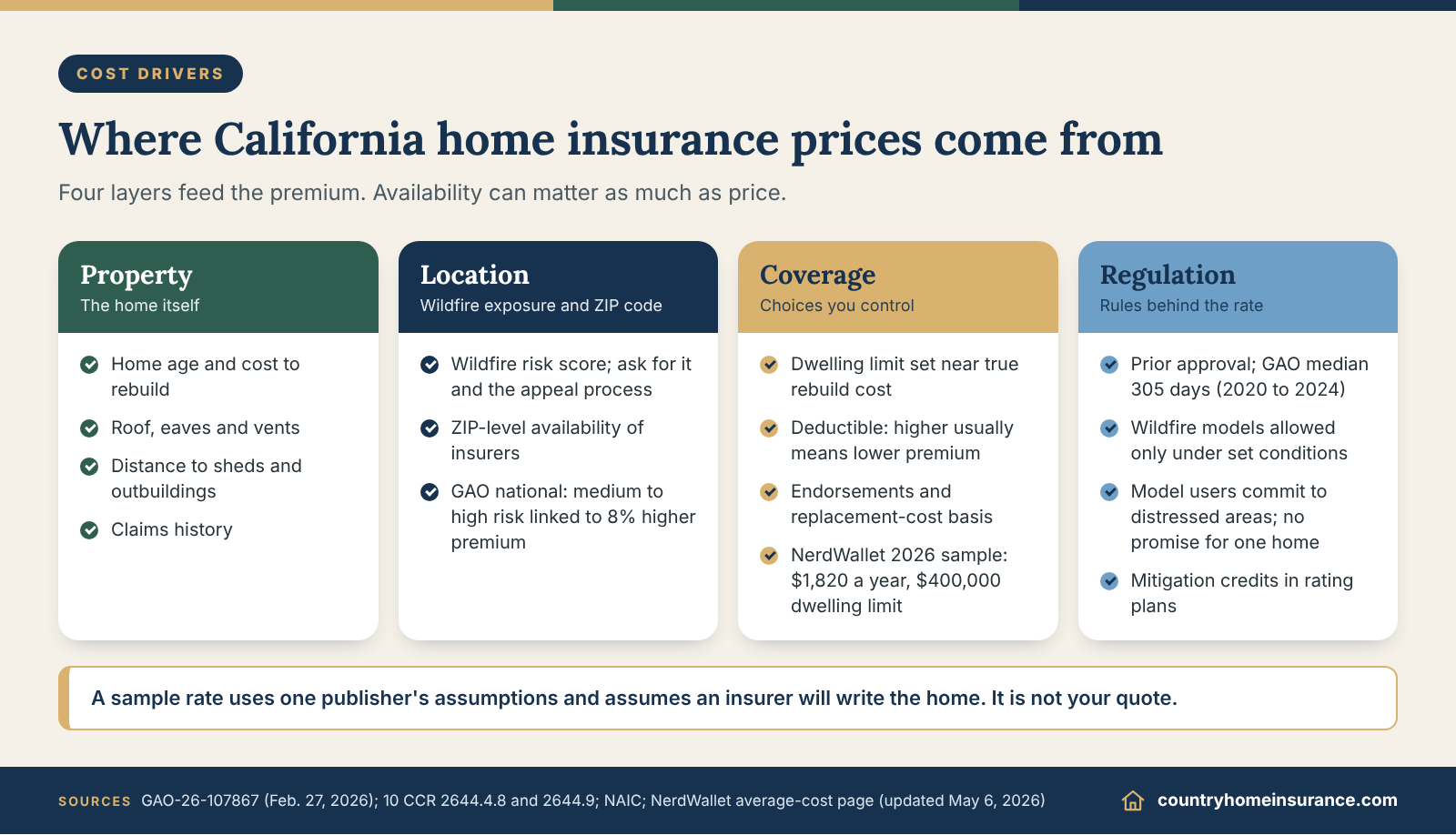
NerdWallet’s average-cost page, updated May 6, 2026 and using sample rates from Quadrant Information Services, reported a California average of $1,820 a year, or $152 a month, compared with $2,490 for the nation under the same profile. The profile was a single-family, two-story home built in 1984 with a $400,000 dwelling limit, $300,000 liability, a $1,000 deductible, no claims and good credit. The page also lists $40,000 for other structures, $200,000 for personal property and $80,000 for loss of use. Its city examples were Los Angeles at $2,265, San Diego at $1,770, San Francisco at $1,715 and San Jose at $1,475. The page notes that credit-based pricing is not allowed for home insurance in California, so the good-credit rate applies; confirm that point with CDI before relying on it.
Why a lower average is not the same as a cheap policy
A sample rate assumes the insurer is willing to write the home. In wildfire-exposed ZIP codes, the practical question is often availability rather than price. The same low statewide median can sit beside much higher quotes, surplus lines premiums, or no standard offer at all for a rural property in a high-risk area. If you receive only a FAIR Plan offer, comparing it with the study above would be misleading because the FAIR Plan covers fewer perils.
Why you should not mix publishers’ averages
A separate NerdWallet pricing report dated October 2, 2026 describes a national typical premium of $2,564 as of the first quarter of 2026, up 24% since the first quarter of 2023, and a 16.4% rise in the West. That study uses a different methodology from the $2,490 national figure above and gives no California-specific premium, so the two should not be compared. When you read any California average, ask for the publisher, the data year, the dwelling limit, the deductible and the home’s age.
| Location | Annual sample premium | Same-profile national figure | Key assumptions |
|---|---|---|---|
| California statewide | $1,820 | $2,490 | $400,000 dwelling, $300,000 liability, $1,000 deductible, 1984 home, good credit |
| Los Angeles | $2,265 | Not stated for city | Same profile |
| San Diego | $1,770 | Not stated for city | Same profile |
| San Francisco | $1,715 | Not stated for city | Same profile |
| San Jose | $1,475 | Not stated for city | Same profile |
Which California-specific factors move the price?
Insurers price from the characteristics of the property and its surroundings, then regulators decide whether the resulting rates are acceptable. Three families of factors stand out in California.
Wildfire risk scores and modeled losses
California’s regulation on wildfire risk in rating plans (title 10, California Code of Regulations, section 2644.9, operative October 14, 2022) requires that any wildfire risk model an insurer uses in a rating plan be provided to the Commissioner with the rate application. It also requires insurers to adopt a written procedure for giving policyholders their wildfire risk score or classification and allowing them to appeal it. If you were surprised by a renewal price or a nonrenewal notice, ask your insurer or agent for the wildfire score assigned to your address and the process to challenge it. The GAO’s national analysis found that moving from medium to high wildfire risk was associated with an 8% higher premium, which gives a sense of scale but is not a California quote.
Rebuilding cost, dwelling limit and home age
The most controllable price factor is the dwelling limit, and the most dangerous mistake is setting it too low. A limit based on market value or an old estimate can fall well short of today’s cost to rebuild, especially for custom homes, log construction, steep or remote lots and homes with hard-to-find finishes. Senate Bill 876, signed on September 28, 2026 and effective January 1, 2027 according to CDI, requires insurers to provide regularly updated replacement cost estimates for new business and renewals, so you may soon receive better data from your insurer. Age also matters: NerdWallet’s October 2, 2026 national report found that insuring a 1984-built home cost 81.2% more than insuring a new build nationally, a nationwide number that is not specific to California.
Claims history and reinsurance costs
NerdWallet’s national study found that a single weather claim raised rates by a median of 10.2%, with larger increases in some states. California insurers also buy reinsurance, which is insurance for insurance companies, and a regulation operative January 13, 2025 (section 2644.27(f)(11)) lets an insurer request a variance when the standard reinsurance cost assumption does not reflect its actual costs, provided it documents executed agreements. The rule excludes reinsurance between affiliated entities. Whether any given rate increase includes such a variance is something you can learn only by reading the specific filing, which CDI makes public.
How should you think about your deductible?
The deductible is the amount you pay out of pocket on a covered loss before the insurer pays. It is the lever most within your control, and it works differently from the way many homeowners imagine.
How a deductible works in a claim
Hypothetical example: Suppose a storm drops a limb through a section of roof and the covered repair estimate is $9,500. With a $2,500 deductible, the insurer would typically pay $7,000 and you would pay $2,500, subject to the policy terms. With a $1,000 deductible, the insurer would typically pay $8,500. The figures are illustrative only and do not predict any real claim. If the loss is also below your deductible, the claim may not be worth filing.
The trade-off between premium and out-of-pocket cost
The NAIC notes that higher deductibles usually lower premiums and advises choosing one you can afford to pay. Pick the deductible you could pay from savings tomorrow without borrowing. Because a claim can also affect renewal pricing, a very low deductible that encourages small claims may not save money in the long run. California law does bar an insurer from refusing to renew a covered residential policy solely because a claim is pending, but that is different from the insurer pricing in claims history over time.
Special deductibles and what to find on the declarations page
Some policies use separate deductibles for particular perils such as wind or hail, and earthquake policies carry their own deductible structures. This guide could not verify California insurer-specific wildfire or wind deductible practices from the official sources retrieved, so check your declarations page and endorsements for any peril-specific deductible, whether it is a flat amount or a percentage, and what it applies to. The FAIR Plan sample dwelling form says the deductible shown on the declarations page applies per occurrence to covered property, with exceptions that include fair rental value and fire department service charges.
Wildfire risk, the Sustainable Insurance Strategy and mitigation discounts
California homeowners insurance cannot be understood without wildfire. It affects who writes policies, how rates are built, and which homeowners end up at the FAIR Plan. This section describes the exposure, the regulations that govern how wildfire is priced, and the home-hardening steps tied to discounts.
How large is California’s wildfire exposure?
The scale is best understood through destroyed structures, which relate directly to insured losses.
The most destructive fires on record
CAL FIRE’s list of the most destructive California wildfires, with a stated as-of date of August 4, 2026, ranks the 2018 Camp Fire first at 18,804 structures destroyed. The January 2025 Eaton Fire is second at 9,413 and the Palisades Fire is third at 6,833, followed by the 2017 Tubbs Fire at 5,636. The list is a reminder that a single event can destroy thousands of homes. Owners in the wildland-urban interface (WUI), where homes meet wildland vegetation, are central to this guide because their properties often sit closest to fuel.
Where the 2026 season stands
CAL FIRE’s statistics page, updated September 28, 2026 and described as preliminary, reports 5,701 wildland fires and 328,950 acres burned so far in 2026. The same interval in 2025 had 7,227 fires and 521,770 acres, and the five-year average for that interval was 7,355 fires and 928,524 acres. A below-average year so far does not mean fire risk has ended, so check local alerts and your own readiness instead of relying on a calendar date.
What insurers have paid since January 2025
In a February 2, 2026 release, CDI said insurers, including the FAIR Plan, had distributed $22.4 billion in wildfire claims since January 2025. The FAIR Plan’s news archive reported about 3,621 Palisades Fire claims in an update dated February 21, 2025. These numbers show the scale of claims handling and help explain why regulators are focused on claim timelines, smoke damage and FAIR Plan finances.
How do California’s catastrophe-model rules work?
California’s ratemaking rules generally base projected losses on historic experience unless a regulation permits catastrophe models, which are computer simulations of future disaster losses. Regulations operative December 12, 2024 allow wildfire modeling in specific, conditional ways. The Department’s own February 2026 release uses the phrase “Sustainable Insurance Strategy” in describing efforts to help people leave the FAIR Plan, but this guide could not retrieve a Department page that defines the strategy, so confirm how CDI describes the regulations below before quoting a program name.
When insurers may use wildfire catastrophe models
Section 2644.4.5 allows a wildfire catastrophe adjustment for qualifying residential property to be based on models if the insurer complies with section 2644.4.8. It requires that a model use the best available scientific information and incorporate the best available information about risk mitigation at property, community and landscape scales. The regulation addresses renters and condominium unit-owner (HO-6) policies separately.
The distressed-area commitments
To use modeling, an insurer must make a documented commitment to write in distressed areas. The standard commitment is to write at least the insurer’s statewide market share multiplied by 0.85 times the statewide distressed-area exposures within 730 days of approval, or, as an alternative, to add policies equal to at least 5% of its recent 12-month distressed-area exposures. An undermarketed ZIP code that at least partly overlaps a high or very high fire hazard zone can qualify as distressed if FAIR Plan policies make up at least 15% of its residential policies, or if its average premium is at least $4.00 per $1,000 of dwelling coverage and median income is at or below the 50th percentile. Counties also qualify when their share of structures at high or very high wildfire risk is at or above the median county.
What the rules do not promise you
A commitment is measured across the insurer’s book, not at your address. If an insurer fails to meet its commitment or make reasonable progress within two years, it must file a new application renouncing the commitment, and that application cannot use catastrophe modeling. CDI’s own consumer guidance adds that the Department does not have legal authority to dictate what risks insurers must write or where. So a commitment can increase the number of policies offered in a distressed area without guaranteeing that any particular home will be accepted.
Which wildfire mitigation steps may earn insurance discounts?
California is unusual in requiring insurers to recognize certain mitigation steps in their rating plans. The Department’s Safer from Wildfires framework and the rating-plan regulation list roughly the same measures, and the FAIR Plan has its own discount schedule.
The Safer from Wildfires steps and what the rating-plan rule requires
CDI’s Safer from Wildfires page lists ten actions and states that every action qualifies for an insurance discount, but it does not explain how to request one. Section 2644.9 requires rating plans to credit community-level programs and a list of property-level steps. Table 3 puts the framework, the rule and the FAIR Plan categories side by side so you can see where one action appears in all three.
| Action | Safer from Wildfires (CDI) | Rating-plan rule (10 CCR 2644.9) | FAIR Plan discount category (effective November 15, 2025 and later) |
|---|---|---|---|
| Class A fire-rated roof | Yes; wood shake does not qualify | Hardening credit | Structure |
| Enclosed eaves | Yes | Hardening credit | Structure |
| Ember-resistant vents with metal mesh | Yes | Hardening credit (fire-resistant vents) | Structure |
| Multi-pane windows or functional shutters | Yes | Hardening credit | Structure |
| Six inches of noncombustible material at the base of exterior walls | Yes | Hardening credit | Structure |
| Cleared five-foot zone and noncombustible materials within it | Yes | Surroundings credit | Immediate surroundings (two discounts) |
| Cleared area under decks | Yes | Surroundings credit | Immediate surroundings |
| Combustible sheds and outbuildings at least 30 feet away | Yes | Surroundings credit where the owner controls the area | Immediate surroundings |
| State and local defensible-space compliance | Yes | Surroundings credit (Public Resources Code section 4291) | Immediate surroundings |
| Firewise USA site or Fire Risk Reduction Community | Yes | Community credit | Community |
FAIR Plan wildfire-hardening discounts
The FAIR Plan’s discount document, dated November 15, 2025, applies to dwelling fire and commercial policies with effective dates on or after that day. It describes up to 12 discounts on the wildfire portion of the premium and a maximum of 16.4% for dwelling fire policies if all 12 apply. The document does not list a percentage for each discount, does not explain how the Plan verifies compliance, and says discounts are subject to change. Ask your broker which items the Plan has already credited at your address.
Documenting your work so it counts
Keep dated photos of each upgrade, contractor invoices and product specifications, such as the roof’s fire classification and the vent mesh type. For country properties, record the distance from the house to any wooden barn, shed or woodpile, since the 30-foot standard is measured to combustible outbuildings. The Insurance Institute for Business & Home Safety (IBHS) also lists a Wildfire Prepared Home designation for residents of California, New Mexico, Nevada and Oregon who complete its Critical Home Prep, but its page did not state whether California insurers recognize it, so ask your insurer before paying for an assessment.
Cancellation, nonrenewal and one-year wildfire moratoria in California
For many rural and foothill homeowners, the biggest California insurance event is not a claim but a letter. Understanding the difference between a cancellation and a nonrenewal, what notice you are owed and when a moratorium applies can buy you time and options. The statute text below comes from a FindLaw edition of the California Insurance Code described as current as of January 1, 2026; FindLaw advises verifying against the Legislature’s official site, which this guide could not retrieve.
What rules govern cancellation and nonrenewal notices?
A cancellation ends a policy during its term. A nonrenewal means the insurer declines to offer a new term when the current one expires. California treats the two differently.
When can an insurer cancel a policy mid-term?
Under Insurance Code section 676 as retrieved, once a covered residential policy has been in effect for 60 days, and immediately on a renewal, a cancellation notice is effective only if it rests on one of five grounds: nonpayment of premium; conviction of a crime that increases an insured hazard; fraud or material misrepresentation; grossly negligent acts that substantially increase an insured hazard; or physical changes to the property that make it uninsurable. The page did not state the notice period for cancellation, so check your policy and the statute for the number of days.
How much notice does a nonrenewal require?
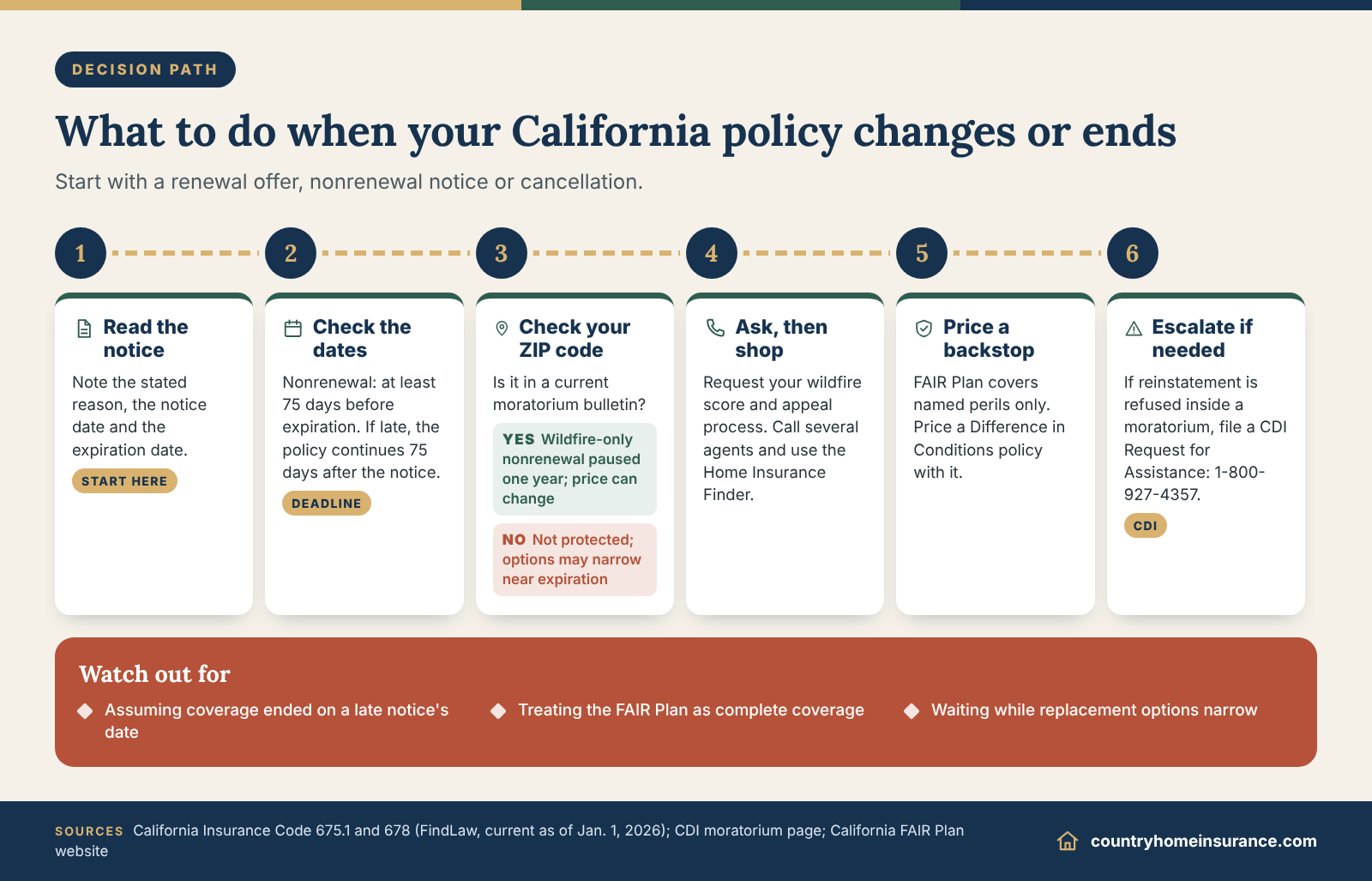
Section 678 sets two clocks. An insurer must give a renewal offer or a nonrenewal notice at least 45 days before expiration. For a nonrenewal on policies expiring on or after July 1, 2020, the notice must be given at least 75 days before expiration. If the insurer is late, the existing policy continues on the same terms for 75 days after the notice is delivered or mailed, and the notice must say so. Section 675 adds that an insurer may not refuse to renew solely because a claim is pending, except for earthquake claims. Do not assume your coverage has ended on the date printed on a late notice.
What must the notice say?
A nonrenewal notice must state the specific reasons, display a consumer-inquiry telephone number and tell you that you may have the matter reviewed by CDI, including the website, the toll-free number (800) 927-HELP and the Consumer Services Division address. For residential policies expiring on or after July 1, 2021, the notice must also describe the California Home Insurance Finder, explain that the FAIR Plan is the insurer of last resort with limited coverage, describe how agents and brokers must help with a FAIR Plan application, and encourage you to consider a Difference in Conditions policy. A renewal offer must identify any reduction in limits or elimination of coverage and be contingent on payment of the stated premium.
| Rule | What it says | Where it comes from | What to do |
|---|---|---|---|
| Mid-term cancellation grounds | After 60 days, only five listed grounds, such as nonpayment or fraud | Section 676 | Ask the insurer to identify the ground in writing |
| Nonrenewal notice | At least 75 days before expiration for policies expiring on or after July 1, 2020 | Section 678 | Calendar the expiration date and the date you received the notice |
| Late notice | Policy continues on the same terms for 75 days after the late notice | Section 678 | Keep the envelope or email timestamp |
| Pending claim | No nonrenewal solely because a claim is pending (not for earthquake claims) | Section 675 | Ask whether the reason cited is the pending claim |
| Wildfire moratorium | One year after a declared emergency, no cancellation or nonrenewal solely because wildfire occurred, in ZIP codes within or adjacent to the fire perimeter | Section 675.1; CDI moratorium page | Check the Commissioner’s Bulletin for your ZIP code |
| Complaint route | Notice must explain CDI review; CDI hotline is 1-800-927-4357 | Section 678; CDI | File a Request for Assistance if the insurer refuses reinstatement |
How do one-year wildfire moratoria work?
Senate Bill 824 of 2018, implemented in Insurance Code section 675.1, creates a protected period after wildfire disasters. The moratorium is automatic when its conditions are met, but it is tied to specific places and dates.
What the moratorium does
After a governor declares a state of emergency, an insurer may not cancel or refuse to renew a residential property policy for a property in a ZIP code within or adjacent to the fire perimeter solely because the structure is in an area where a wildfire occurred. The protection runs for one year from the Governor’s declaration. CAL FIRE determines the perimeter with the Office of Emergency Services, and the Commissioner then issues a bulletin listing the covered ZIP codes. CDI’s page says the protection extends to residential policyholders who have less than a total loss, including those with no loss at all.
Which areas have been covered recently
CDI’s moratorium page lists bulletins by declaration date, including the Gifford Fire (bulletin listed at December 23, 2025), the Pack Fire in Mono County (December 9, 2025) and the Gann Fire (August 6, 2026). On August 14, 2026, the Commissioner announced a moratorium for more than 64,000 Californians in Calaveras, San Joaquin, Amador, Tuolumne and Stanislaus counties after the Gann Fire, covering the fire perimeter and 22 adjoining ZIP codes, under Commissioner’s Bulletin 2026-6. For the first time, certain commercial policies for residential-habitational property such as homeowners associations and apartment complexes were included, following Senate Bill 547. CDI’s January 9, 2026 release, by its title, said nearly 150,000 Californians in four Southern California counties were protected after the Gifford Fire. Because each moratorium runs one year from its own declaration date, earlier ones will expire on different dates, so confirm your ZIP code’s dates in the bulletin.
What the moratorium does not do
CDI states that the moratorium does not apply outside the listed ZIP codes, does not address reasons for cancellation or nonrenewal other than wildfire risk, and does not address premium changes. The statute also lists exceptions, including willful or grossly negligent acts that materially increase risk, unrelated losses that together make the risk ineligible, and physical or risk changes that make the property uninsurable. A moratorium delays a wildfire-based nonrenewal; it does not freeze your price. Use the time to document mitigation and shop for replacement coverage.
What should you do after a nonrenewal notice?
Speed matters because replacement options may narrow as the expiration date approaches. A practical sequence follows.
The first steps in the first week
Read the stated reason, confirm the notice date and expiration date, and check whether your ZIP code appears in a current moratorium bulletin. Then call the insurer or agent and ask what specific steps would reduce the risk and help you keep coverage, as CDI’s tip sheet suggests. Request your wildfire risk score and the appeal procedure that section 2644.9 requires insurers to maintain. If you believe the nonrenewal is unfair or the insurer refuses reinstatement inside a moratorium, file a complaint or Request for Assistance with CDI.
Building a replacement plan before the deadline
Contact more than one agent or broker, since each represents different insurers, and use the Home Insurance Finder to locate agents beyond your immediate area. CDI says that if your agent can only place you with the FAIR Plan, ask other agents or brokers who represent other insurers, and that surplus lines, a market of non-admitted insurers that operate under different rules than licensed ones, is the last resort after other options fail. Treat the FAIR Plan as a backstop rather than a first choice, and compare it carefully against what you are losing.
The California FAIR Plan and Difference in Conditions coverage
When a California homeowner cannot find standard coverage, the usual fallback is the California FAIR Plan. Many people call it California’s insurer of last resort, and the Plan uses that description itself. It is useful and sometimes essential, but it is narrower than a standard policy, and understanding the differences prevents costly surprises.
What is the FAIR Plan, and what does it cover?
The NAIC explains that FAIR (Fair Access to Insurance Requirements) plans are state-mandated property insurance plans for people who cannot get coverage in the regular market, and describes them as typically more expensive and more limited than standard policies.
How the Plan is organized
According to the Plan’s own website, the California FAIR Plan is a syndicated fire insurance pool of insurers licensed for property and casualty business in the state, created by statute in August 1968. It issues policies on behalf of member companies, and members share profits, losses and expenses in proportion to their share of the state market. It says it is not a state agency, receives no taxpayer funding, and has not been rated or evaluated by A.M. Best. The Plan describes its goal as a temporary safety net.
Named perils, optional extensions and the $3 million cap
The Plan’s dwelling policy is a named-peril policy, which covers only the causes of loss listed in it: fire and lightning, internal explosion and smoke. Vandalism and malicious mischief can be added for an additional premium, according to the Plan. CDI says extended coverage, such as windstorm and hail, can also be added for extra premium, that the Plan does not cover theft or liability, and that the Plan caps coverage at $3,000,000 for all coverages combined on a residential property; that CDI page is undated, so verify the current limit with a registered broker. The Plan’s dwelling page does not itself list limits or deductibles.
What the sample dwelling form shows
The Plan posts a sample Dwelling Fire Policy form (CFP 00 01 05/2026, effective March 17, 2026). Your actual policy is controlled by your declarations page and any endorsements, but the sample illustrates several points. Coverage B applies to scheduled detached structures with listed limits. Land is excluded, ordinance or law coverage is excluded unless shown on the declarations, and flood, surface water, sewer backup and earth movement are excluded. The form has no separate additional living expense coverage and instead describes fair rental value. By default, a total loss to a structure is settled at actual cash value, and replacement cost is available only if checked on the declarations, with an 80% insurance-to-value requirement. The sample form also requires suit to be started within one year of the date of loss, a deadline you should discuss with a broker or attorney because other rules may affect it.
How do you apply, and what covers the gaps?
A FAIR Plan policy is rarely complete on its own. Plan for the pieces it leaves out before you need them.
Applying through a registered broker
You apply through a licensed broker or agent registered with the Plan, not directly. The Plan says your broker first searches the traditional market, and that the FAIR Plan is not the right option if comprehensive coverage is available there. Brokers charge no extra fee, and the Plan’s customer service cannot advise on coverages or limits. You and your broker must determine your home’s rebuilding cost; the Plan does not estimate it. The website lists no processing times, so ask your broker when coverage can be bound.
Difference in Conditions and surplus lines
A Difference in Conditions (DIC) policy is a separate policy meant to supply coverage the FAIR Plan does not, such as water damage, theft and liability. The Plan states that it does not sell DIC, and CDI maintains a list of carriers that do. A DIC policy pairs with the FAIR Plan policy to approximate a comprehensive homeowners policy, but the page gave no limits, deductibles or exclusions, so request the actual DIC form and compare it line by line with a standard policy. If you use surplus lines, ask whether the insurer is non-admitted and what protections apply if it fails, because the answer may differ from licensed insurers.
Payment plans, the clearinghouse and returning to the standard market
The Plan offers full pay, a three-installment plan at 40%, 30% and 30%, and an eleven-installment monthly plan, with a $4.50 fee per installment on dwelling fire policies for the installment plans, a $25 returned-payment fee and a 3.5% third-party fee on card payments (page modified August 25, 2026). The Plan also shares policyholder information with clearinghouse member insurers who may offer to move the policy to the standard market, and a link allows you to opt out. Ask whether you want to receive such offers, since they may be your path off the Plan.
| Feature | Typical standard homeowners policy | FAIR Plan dwelling policy | Difference in Conditions policy |
|---|---|---|---|
| Perils covered | Broad coverage with listed exclusions | Named perils: fire, lightning, internal explosion, smoke; optional extras | Designed to add coverage the FAIR Plan lacks, per the FAIR Plan |
| Liability and theft | Typically included | Not covered, per CDI | May cover, per the FAIR Plan; confirm in the form |
| Water damage | Depends on cause and policy terms | Water damage not covered, per the FAIR Plan; flood and sewer backup excluded in the sample form | May cover, per the FAIR Plan; confirm in the form |
| Who sells it | Licensed insurers and their agents | Registered brokers or agents only | Separate carriers; CDI keeps a list |
| Intended duration | Ongoing market coverage | Described as temporary, with a goal of moving customers back to the standard market | Depends on the carrier |
How large is the FAIR Plan, and what reform is pending?
The Plan has grown sharply, and that growth is the main reason it features in policy debates.
Size and growth through June 2026
The Plan’s key statistics page, last modified July 28, 2026 and covering data through June 2026, reports total exposure of $768 billion, up 11% since September 2025 and 250% since September 2022. Policies in force, dwelling and commercial combined, were 696,562, up 8% and 157% over the same periods. Written premium was $2.04 billion, up 6% and 212%. New business for the first nine months of the Plan’s fiscal 2026 was 151,061 policies, and the average monthly new business was down 25% from fiscal 2025. The page does not define the terms, so treat them as the Plan’s own measures.
The Department’s examination and AB 1680
A February 2, 2026 CDI release described a Report of Examination finding that the Plan had not complied with 17 critical recommendations, and announced Assembly Bill 1680, the Make It FAIR Act, a proposal to require a more comprehensive homeowners policy, additional staffing, better clearinghouse programs, open governing committee meetings and a capital and liquidity plan. As of that release the bill was proposed, not enacted. This guide could not confirm its final status, so check the Legislature’s site before assuming any of those changes apply.
What this means for you today
Until a reform takes effect, buy the policy as it exists. Ask your broker for the current policy form, the extended coverage options and the available wildfire-hardening discounts. Keep records of your mitigation work so you can claim the discounts, and revisit the standard market annually, since the Plan describes itself as temporary.
California homeowners insurance claims: deadlines and disaster protections
California has detailed claims-handling regulations and additional statutes for losses tied to a declared state of emergency. The numbers below come from regulations on Cornell’s Legal Information Institute and the FindLaw edition of the Insurance Code, both subject to verification against official sources.
What timelines do insurers follow after you report a loss?
The regulations set clocks that begin when the insurer receives notice or proof of claim, so documenting when you reported matters.
Acknowledgment and investigation
Under title 10 of the California Code of Regulations, section 2695.5, an insurer must, within 15 calendar days of notice of a claim, acknowledge receipt, provide forms, instructions and reasonable assistance including what you must provide as proof of claim, and begin any necessary investigation. It must respond to claimant communications that reasonably suggest a response is expected within 15 calendar days, and to a CDI inquiry within 21 calendar days.
Decisions, payment and status letters
Section 2695.7 requires an insurer to accept or deny a claim within 40 calendar days after receiving proof of claim and to pay within 30 calendar days after acceptance, subject to any required release. If it needs more time, it must say so in writing before the 40-day deadline and then every 30 calendar days until a determination is made. The section lists exceptions for certain policy types, none of which are standard homeowners policies.
What a denial must contain
A first-party denial must be in writing, list each basis with its factual and legal grounds, cite the policy provision or statute relied on and tell you that you may have the matter reviewed by CDI. Keep the letter and all claim correspondence. If an adjuster’s assessment looks incomplete, ask for the estimate in writing and compare it against your contractor’s bid before accepting a final number.
What extra protections apply after a state-of-emergency loss?
California layers additional rules onto claims for losses covered by a Government Code section 8558 state of emergency, such as a declared wildfire disaster.
Time to collect replacement cost
Under Insurance Code section 2051.5, where a policy pays actual cash value until repairs are done and the remaining replacement cost afterward, the insured must have no less than 12 months from the first actual cash value payment, and no less than 36 months for state-of-emergency losses. Insurers must grant six-month extensions for good cause such as permit delays, material shortages or contractor unavailability. For these losses, an insurer cannot require proof of loss sooner than 100 days after the loss, and must grant three-month extensions for good cause. Insurers may allow more time than the minimums.
Additional living expense
Section 2060 provides that additional living expense for a state-of-emergency loss must run no less than 24 months from the inception of the loss, with up to 12 more months if good-faith reconstruction is delayed by factors beyond the insured’s control, and further six-month extensions for good cause. Under section 2061, a total-loss ALE claimant may request an advance payment of no less than four months of living expenses. A policy’s own stated ALE limit and time period are set on the declarations page, so ask how the statute interacts with your limits.
Rebuilding elsewhere, inventories and renewal after a total loss
After a total loss, section 2051.5(c) provides that a policy cannot deny or limit building code upgrade or replacement cost coverage solely because you rebuild or buy at a different location, though recovery is capped at the cost to rebuild at the original location. For a state-of-emergency total loss of a primary residence, section 2061 does not allow the insurer to insist on its own inventory form if yours contains substantially the same information, and it must accept inventories grouped by category where itemizing is impractical. Section 675.1(a) requires an insurer to offer renewal for at least the next two annual periods, and no less than 24 months from the loss, after a disaster-caused total loss not due to the insured’s negligence, unless later changes make the property uninsurable.
| Item | Time limit | Source | Applies to |
|---|---|---|---|
| Insurer acknowledges claim and begins investigation | 15 calendar days after notice of claim | 10 CCR 2695.5 | Residential claims generally |
| Insurer accepts or denies after proof of claim | 40 calendar days | 10 CCR 2695.7 | Residential claims generally |
| Insurer pays after acceptance | 30 calendar days | 10 CCR 2695.7 | Residential claims generally |
| Collect remaining replacement cost | At least 12 months from first ACV payment; at least 36 months for state-of-emergency losses | Insurance Code 2051.5 | Policies that pay ACV first |
| ALE for state-of-emergency loss | At least 24 months, plus up to 12 months for delays | Insurance Code 2060 | State-of-emergency losses |
| ALE advance on total loss | At least four months on request | Insurance Code 2061 | Total-loss ALE claims |
| Proof of loss, state of emergency | Not sooner than 100 days after the loss | Insurance Code 2051.5 | State-of-emergency losses |
Which new California laws change claims, and when?
Several laws were signed in September 2026, and effective dates differ, so verify what applies to your loss date.
Senate Bill 876, the Disaster Recovery Reform Act
CDI reported on September 28, 2026 that the Governor signed Senate Bill 876, effective January 1, 2027. Among other provisions, it requires insurers to maintain Department-reviewed disaster recovery plans, doubles penalties for fair claims practice violations during a declared emergency, requires restitution paid directly to policyholders for unfair settlement practices, requires a status report within 15 days when a new adjuster is assigned, requires insurers to offer extended replacement cost and ALE coverage when a policy is written, and applies building code upgrade coverage at the time of rebuild rather than the time of loss. According to CDI, the law takes effect on that date, so check which rules apply to a loss that happens or is reported before it.
Assembly Bill 1795, the Smoke Damage Recovery Act
CDI’s September 15, 2026 release says the Governor signed AB 1795. It presumes that smoke damage within a wildfire impact zone was caused by the wildfire, requires insurers to pay for necessary testing and sampling, bars ending ALE until qualifying homes are restored and safe to occupy, and preserves your right to choose restoration contractors. The release did not state an effective date, so ask your insurer whether it applies to your claim.
Other changes to watch
LegiScan’s record shows that Senate Bill 495 was chaptered on October 10, 2025 and amends Insurance Code section 2051.5, section 10103.7 and adds a new article beginning at section 937, but this guide could not retrieve the substance of those changes. Section 2051.5 also states that policy forms issued or renewed on and after July 1, 2026 must comply with it. If you have an open claim, ask your insurer which version of each rule it applied, and call the CDI hotline if the answer is unclear.
Rural properties, burn scars and earthquake: California risks beyond the standard policy
A country home in California is rarely just a standard house on a bigger lot. Acreage brings outbuildings, animals, long driveways and distance from fire protection, and the state’s geography adds mudslides and earthquakes on top of wildfire. This section turns the general rules above into questions a rural owner can ask.
How do acreage and outbuildings change the insurance picture?
Detached buildings and land use are where rural coverage most often departs from a suburban template.
Barns, shops and other detached structures
The NAIC describes Coverage B as protection for detached structures such as garages, sheds and fencing, and notes that business use and some detached structures may be excluded or need added coverage. The FAIR Plan’s sample dwelling form covers only scheduled detached structures with listed limits and excludes structures used commercially or rented to people other than tenants, apart from a private garage. A barn used to store hay for sale, a workshop that serves customers or a rented cabin may therefore need a different policy. The FAIR Plan’s commercial policies list farm and winery buildings among the properties it can cover, which is a reminder that farm use is often written separately. Tell your agent exactly how each building is used.
Distance, fuel and the 30-foot standard
Both CDI’s Safer from Wildfires framework and the FAIR Plan’s discount schedule point to combustible sheds, gazebos and similar structures being at least 30 feet from the house. The FAIR Plan version says “or as far away as possible” within the owner’s control. On a small lot that may be impossible, but on acreage it can often be done. The FAIR Plan’s discount schedule counts fences and gates within five feet of the house among the items that should be noncombustible, and CDI’s framework suggests replacing wood fencing attached to the home with metal.
Animals, ponds and private roads
The NAIC notes that liability coverage may exclude certain dog breeds or exotic pets. Horses, livestock, ponds, ATVs and guests on a private road are not addressed in the sources retrieved for this guide, so ask the insurer in writing which animals and activities are covered under Coverage E and what the medical payments limit is. If your home is far from a staffed fire station, ask how the insurer classifies your fire protection and whether your volunteer department affects eligibility; the sources retrieved did not give California-specific answers.
What do burn scars and El Niño storms mean for coverage?
Fire and flood are linked in California. Hillsides stripped of vegetation can shed mud and debris in heavy rain, and the insurance rules differ depending on what caused the damage.
Mudslides and debris flows after a wildfire
CDI’s September 22, 2026 release says flooding, mudslides and debris flows are typically excluded from standard homeowners policies unless a recent wildfire or another covered peril directly or indirectly causes the damage. The release adds that the Commissioner previously reminded insurers of their obligation to cover mudslide or debris-flow damage caused by wildfires that weakened hillsides. Whether a specific loss qualifies depends on the facts and the policy wording, so document the timeline of the fire and the storm.
Buying flood insurance in time
CDI states that flood insurance generally takes effect 30 days after purchase, with an exception when a lender requires flood insurance for a home purchase, and that the NFIP writes most California flood coverage while private flood insurance is also available. The FloodSmart basics page reports that average NFIP claim payments were $68,000 from 2016 to 2021 and that most homeowners policies do not cover flood. That page is undated and has no California-specific content, so ask an NFIP or private flood agent about limits and any waiting-period exceptions for your address.
Preparing the property before heavy rain
CDI recommends reviewing policies, creating a home inventory, following local alerts and evacuation instructions, securing outdoor items and clearing gutters and drains. For hillside and rural properties, also walk your drainage paths and culverts, keep photographs of the property’s condition before the storm, and avoid assuming that a creek, ditch or spring-fed pond is outside your risk.
How does earthquake insurance work in California?
Earthquake coverage is sold separately, and the FAIR Plan adds a layer of rules for its customers.
The California Earthquake Authority and participating insurers
The CEA describes itself as a not-for-profit organization that has offered residential earthquake insurance since 1996 and sells policies exclusively through participating residential insurance companies. That means you buy earthquake coverage from your homeowners insurer if it participates, not from the CEA directly. CDI publishes a 2026 list of companies offering earthquake coverage on its residential insurance page.
Earthquake coverage with a FAIR Plan policy
The FAIR Plan states that it offers earthquake coverage through the CEA as a separate policy for FAIR Plan dwelling customers, that an in-force FAIR Plan policy is required, and that a stand-alone earthquake policy is not available from the Plan. The program covers one-to-four-unit residential buildings, condominium unit interiors, renters’ belongings and mobile or manufactured homes. Limits, deductibles and premiums are not listed on the Plan’s page, so confirm them with a registered broker.
Questions to ask about an earthquake policy
Ask what deductible applies and whether it is a percentage of the dwelling limit, whether contents and additional living expense are included or optional, whether outbuildings, chimneys, pools and detached garages are covered, and how fire following an earthquake is handled. The FAIR Plan sample form excludes earthquake and landslide but states that an ensuing fire or explosion is covered, so a fire following a quake may be handled under the fire policy rather than the earthquake policy. Ask your broker to explain the interaction in writing.
A shopping and action plan for California homeowners
With the market rules, cost drivers and risks in view, the practical question is what to do this month. The steps below put CDI’s tools first and treat price as only one dimension.
How do you compare California homeowners insurance quotes?
A good comparison is built from the same limits, the same deductible and the same endorsements in every quote.
Start with the Department’s comparison tools
CDI’s residential page links a homeowners premium comparison tool, a coverage comparison tool, company profiles and a homeowners insurance complaint study. Use the premium tool to see sample premiums, then ask for quotes tailored to your home. Treat any figure from a comparison tool as a sample, not an offer.
Compare apples to apples
Write down the dwelling limit, replacement cost or actual cash value basis, deductible, Coverage B amount, personal property basis, loss-of-use limit and endorsements for each quote, and compare them in a single table. A quote that is $400 cheaper because it settles roofs at actual cash value, excludes ordinance or law, or carries a larger peril-specific deductible is not the same product. Ask each insurer for a sample policy form and read the exclusions section before you sign on the dotted line.
Check complaint history and availability
CDI publishes a complaint study and company profiles, and the Home Insurance Finder shows which insurers each agent represents. Read each page’s methodology and date before drawing conclusions. Availability changes quickly in wildfire-exposed ZIP codes, so confirm that a quote is a binding offer and not an indication.
What should you ask an agent or insurer?
Prepare questions before the call so that you get answers in writing.
Questions about limits and replacement cost
Ask how the insurer estimated the cost to rebuild, whether extended replacement cost is available, what the ordinance or law coverage limit is, and whether the dwelling limit adjusts automatically. Senate Bill 876, effective January 1, 2027, will require insurers to offer extended replacement cost and additional living expense coverage when a policy is written and to provide regularly updated replacement cost estimates, so ask what your insurer does today. The FAIR Plan sample form includes an optional inflation guard that increases limits at renewal only if selected, within the insurer’s maximums.
Questions about wildfire and renewal
Ask for your wildfire risk score or classification and the appeal process, which mitigation steps your insurer recognizes, how you can document them, and whether your ZIP code is in a current moratorium bulletin. Ask what the insurer’s plan is for renewing in your area, understanding that the answer is not a guarantee. Ask the agent whether your property would be eligible to move off the FAIR Plan if you improve it.
Questions about claims and living expenses
Ask what the additional living expense limit and time period are, how smoke damage is handled, whether you can choose your own contractor, and how the insurer plans to communicate after a disaster. Ask for the claims phone number and the policy’s proof of loss and suit deadlines, and write down the answers with the date.
What records should you keep before you need them?
Records turn a stressful claim into a manageable one. Start now, and store copies away from the house.
Home inventory and receipts
The NAIC recommends grouping belongings by category or room, photographing or recording each item with its age, price and estimated value, noting model and serial numbers, and storing the inventory securely, including with the insurer. The FAIR Plan cautions that a video alone will not be enough in a claim, though it can be a useful reference alongside an itemized list and receipts. CDI offers a Home Inventory Guide. After a state-of-emergency total loss, California law requires insurers to accept inventories grouped by category where itemizing each item is impractical, but a good inventory still speeds the claim.
Mitigation and property records
Keep dated photos of the roof, vents, eaves, windows, five-foot zone and outbuilding distances, along with invoices and product specifications. If you receive a nonrenewal notice, these records support a reinstatement request, an appeal of your wildfire score and discount applications.
Policy documents and contacts
Keep a digital and paper copy of the declarations page, endorsements, your agent’s contact information and the insurer’s claims number. If you lose track of your insurer after a disaster, CDI offers a Residential Insurance Policy Locator, and its hotline is 1-800-927-4357.
| Action | Why it matters | Where to verify | Timing |
|---|---|---|---|
| Read the declarations page and endorsements | Limits, deductibles and exclusions control your coverage | Your policy documents and agent | At every renewal |
| Ask for your wildfire risk score and appeal process | Insurers must have a procedure to provide the score and allow appeals | 10 CCR 2644.9; your insurer | Before renewal or after a notice |
| Complete and document hardening steps | Rating plans and the FAIR Plan recognize listed measures | CDI Safer from Wildfires; FAIR Plan discount document | Ongoing; keep photos |
| Check moratorium bulletins for your ZIP code | A one-year protection may apply after a declared wildfire | CDI moratorium page; hotline 1-800-927-4357 | After any nearby wildfire emergency |
| Price flood coverage | Flood generally takes 30 days to take effect | NFIP or private flood agent; FloodSmart | Well before storm season |
| Review the earthquake option | Standard policies exclude earthquake | Participating insurer or broker; CEA | Annually |
| Build or update your home inventory | Speeds claims and supports contents values | NAIC and CDI home inventory guides | Annually and after major purchases |
| If using the FAIR Plan, price a DIC policy | The FAIR Plan does not cover liability, theft or water damage | CDI’s list of DIC carriers; registered broker | At application |
Frequently asked questions about California homeowners insurance
Coverage and cost questions
Does homeowners insurance cover wildfire damage in California?
Standard homeowners policies typically cover fire, subject to the limits, deductible and terms of the policy, and the FAIR Plan’s named perils include fire, lightning and smoke. The harder questions are smoke damage details, additional living expense time limits and whether the dwelling limit is enough to rebuild. Check the declarations page and ask the insurer in writing how smoke damage and living expenses are handled.
Is California homeowners insurance cheaper or more expensive than average?
One publisher’s 2026 sample rates put California at $1,820 a year compared with $2,490 nationally for the same home profile, but that comparison assumes the insurer is willing to write the home. Availability, wildfire exposure and the FAIR Plan’s narrower coverage can make an actual outcome very different. Do not compare that figure with other publishers’ averages.
Do California insurers use credit scores to set homeowners rates?
NerdWallet’s page states that credit-based pricing is not allowed for home insurance in California, so it applies its good-credit rate there. This guide did not retrieve a CDI or statutory source on that point, so confirm it with CDI or your agent before relying on it.
Nonrenewal and FAIR Plan questions
Can my insurer drop me because a wildfire burned nearby?
Not necessarily right away. After a governor-declared wildfire emergency, an insurer may not cancel or nonrenew a residential policy solely because a wildfire occurred in the area, for properties in ZIP codes within or adjacent to the fire perimeter, for one year. The protection has exceptions and is tied to the Commissioner’s bulletin, so check whether your ZIP code is listed.
Is the FAIR Plan enough by itself?
Usually it is not. The FAIR Plan covers named perils such as fire and smoke, with optional additions, and CDI says it does not cover theft or liability. Most customers also need a Difference in Conditions policy and may need separate flood and earthquake policies. Ask a registered broker to put the combined coverage and total cost on one page.
How do I leave the FAIR Plan?
The Plan describes itself as temporary and says that if traditional coverage is available, the FAIR Plan is not the right fit. You can ask agents to quote the standard market again each year, document your mitigation work and watch for clearinghouse offers from member insurers. Keep your FAIR Plan policy in force until a replacement policy is bound.
Claims and complaints questions
How long does my insurer have to respond to a claim?
Under the regulations retrieved, an insurer must acknowledge a claim, provide forms and begin investigating within 15 calendar days, accept or deny within 40 calendar days after proof of claim, and pay within 30 calendar days after acceptance. If it needs more time, it must tell you in writing and update you every 30 calendar days. Special rules apply to state-of-emergency losses.
What if I disagree with the settlement?
Start by asking for the estimate and the basis in writing and compare it with a contractor’s bid. Your policy may include an appraisal clause for amount-of-loss disputes; the FAIR Plan sample form describes one with each side naming an appraiser. You can also contact CDI, which lists a claims mediation program guide and a Consumer Hotline at 1-800-927-4357. For legal questions, consult a licensed attorney.
Where can I file a complaint about an insurer?
CDI accepts questions and complaints through its Request for Assistance process and its Consumer Hotline, and a written denial or nonrenewal notice must tell you that CDI can review the matter. Include copies of your policy, the notice or letter in question and your timeline of communications.
Sources
- California Department of Insurance: Residential insurance consumer page (undated; retrieved October 11, 2026)
- California Department of Insurance: Top 10 tips for finding residential insurance (undated; retrieved October 11, 2026)
- California Department of Insurance: Mandatory one-year moratorium on nonrenewals (retrieved October 11, 2026)
- California Department of Insurance: Safer from Wildfires (undated; retrieved October 11, 2026)
- California Department of Insurance: Wildfire resources and claims tips (retrieved October 11, 2026)
- California Department of Insurance press release, February 2, 2026: FAIR Plan legislation (AB 1680)
- California Department of Insurance press release, August 11, 2026: rate review transparency reforms
- California Department of Insurance press release, August 14, 2026: Gann Fire moratorium
- California Department of Insurance press release, September 15, 2026: Smoke Damage Recovery Act (AB 1795)
- California Department of Insurance press release, September 22, 2026: review coverage before El Niño storms
- California Department of Insurance press release, September 28, 2026: Disaster Recovery Reform Act (SB 876)
- California FAIR Plan: official website, including its dwelling policy page, how to apply, key statistics (data through June 2026) and payment plans
- California FAIR Plan: wildfire-hardening discounts document (November 15, 2025)
- California FAIR Plan: sample Dwelling Fire Policy (effective March 17, 2026)
- California Insurance Code section 678 (FindLaw edition current as of January 1, 2026)
- California Insurance Code section 675.1 (FindLaw edition current as of January 1, 2026)
- California Insurance Code section 2051.5 (FindLaw edition current as of January 1, 2026)
- 10 CCR section 2644.9: wildfire risk in rating plans (Cornell Legal Information Institute)
- 10 CCR section 2644.4.8: catastrophe modeling commitments (Cornell Legal Information Institute)
- 10 CCR section 2695.7: claims-handling standards (Cornell Legal Information Institute)
- U.S. Government Accountability Office, GAO-26-107867: Homeowners insurance premiums (published February 27, 2026)
- NerdWallet: average homeowners insurance cost (updated May 6, 2026; Quadrant Information Services sample rates)
- NAIC: consumer homeowners insurance guide (undated)
- NAIC: Fair Access to Insurance Requirements plans (updated December 13, 2024)
- CAL FIRE: wildfire statistics (updated September 28, 2026; preliminary)
- CAL FIRE: top 20 most destructive California wildfires (as of August 4, 2026)
- FloodSmart (NFIP): flood insurance basics (undated)
- California Earthquake Authority
- Insurance Institute for Business & Home Safety: Wildfire Prepared Home
Important coverage note
Coverage depends on your actual policy, endorsements, exclusions, limits, deductible and cause of loss. Your declarations page, policy form and endorsements control what is covered. State laws and insurance programs vary and change, and several California rules discussed here change on or after January 1, 2027. Statute and regulation text in this guide was read from secondary publishers of the law, so verify any case-specific question with your insurer or agent, with the California Department of Insurance at 1-800-927-4357, and, for legal questions, with a licensed attorney. This guide is educational information and not legal advice, and it does not promise that any claim will be paid or that any insurer will offer you coverage.
About the editorial team
This guide was prepared by the countryhomeinsurance.com editorial team as general, educational information for homeowners. We research and summarize publicly available material, including state insurance departments, the NAIC, federal agencies, regulators’ consumer guides and published insurer and industry resources. We draw only on the sources that were available to us when we wrote this guide, and we list them in the Sources section with dates where we could find them.
Insurance rules, rates, products and program terms change, differ by state and by insurer, and can apply differently to your situation. We cannot guarantee that this content is complete, current or free of errors. It is not legal, financial, tax or insurance advice, it is not an offer to sell insurance or a recommendation of any insurer, agent or product, and reading it does not create a professional relationship of any kind.
To the fullest extent permitted by law, countryhomeinsurance.com and its editorial team, authors and contributors exclude all liability for any loss, damage or decision arising from the use of, or reliance on, this content. For questions about your own policy or claim, contact your insurer, a licensed agent or broker, your state Department of Insurance or another qualified professional.
Content created: October 11, 2026