
Wildfire insurance nonrenewal means your insurer has decided not to offer another policy term because of wildfire exposure. It is different from a mid-term cancellation, and the notice period, the explanation you’re owed and any post-fire protection depend on your state. You can’t force a company to renew, but dated proof of defensible space and home hardening, corrected risk data and a prepared backup plan improve your odds. If a notice arrives, read its dates, ask for the specific reason in writing and call your state Department of Insurance.
Key takeaways
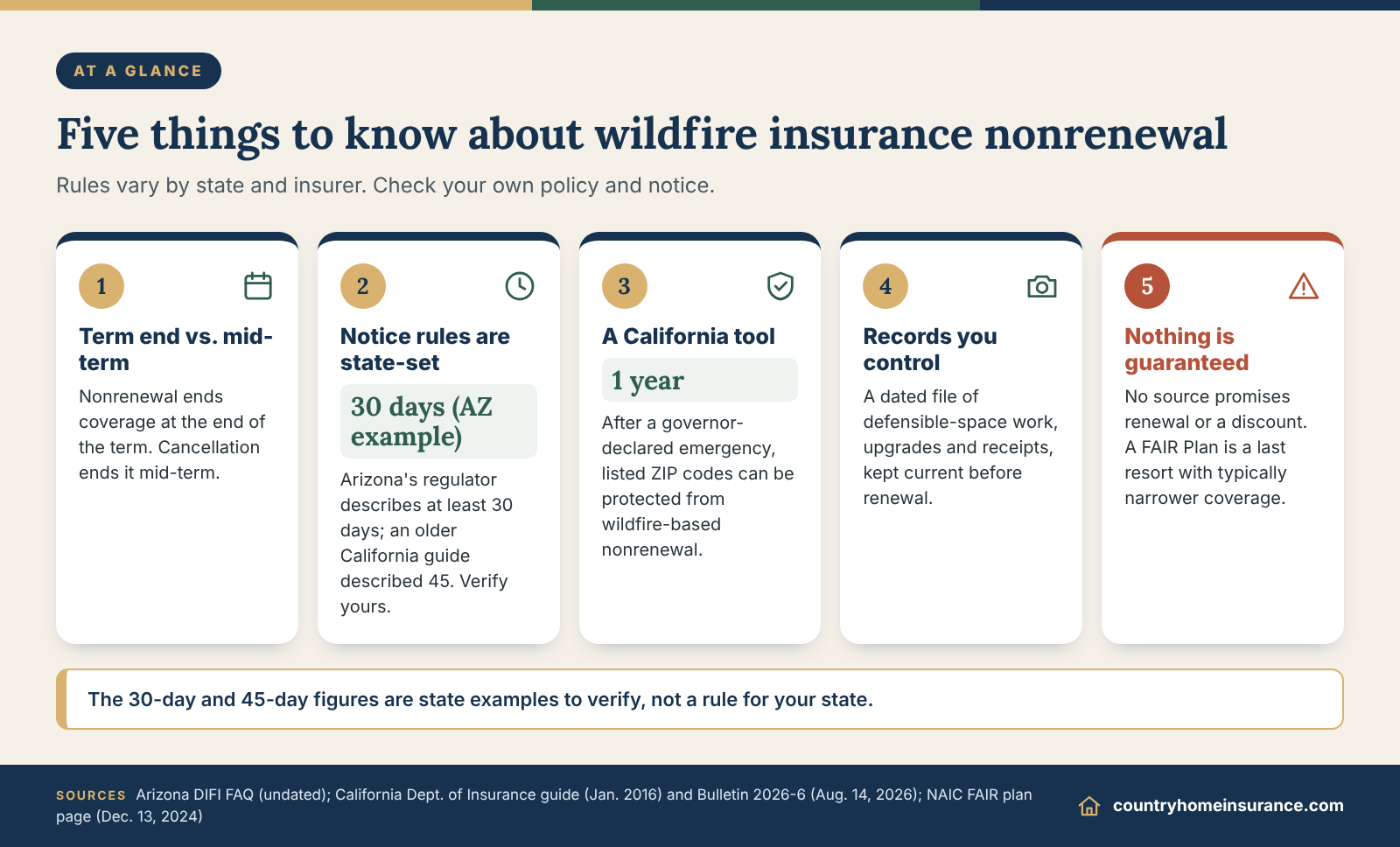
- Nonrenewal ends coverage at the end of the term; cancellation ends it mid-term. Wildfire exposure tends to surface at renewal, and state notice rules differ (Arizona’s regulator describes at least 30 days; an older California guide described 45).
- California can bar wildfire-based cancellations and nonrenewals for one year after a governor-declared emergency in listed ZIP codes. That is a California tool, not a national rule.
- Insurers decide what to write. They use property-level scores, protection-class data and local conditions, and regulators have reported that mitigation can change a score.
- The record you control is a dated, organized file of defensible-space work, hardening upgrades, receipts and verification. Keep it current before the renewal packet arrives, not after a notice.
- A FAIR Plan is a last-resort option with typically narrower coverage, so plan for gaps such as liability, loss of use, rebuild-cost limits and post-fire flood.
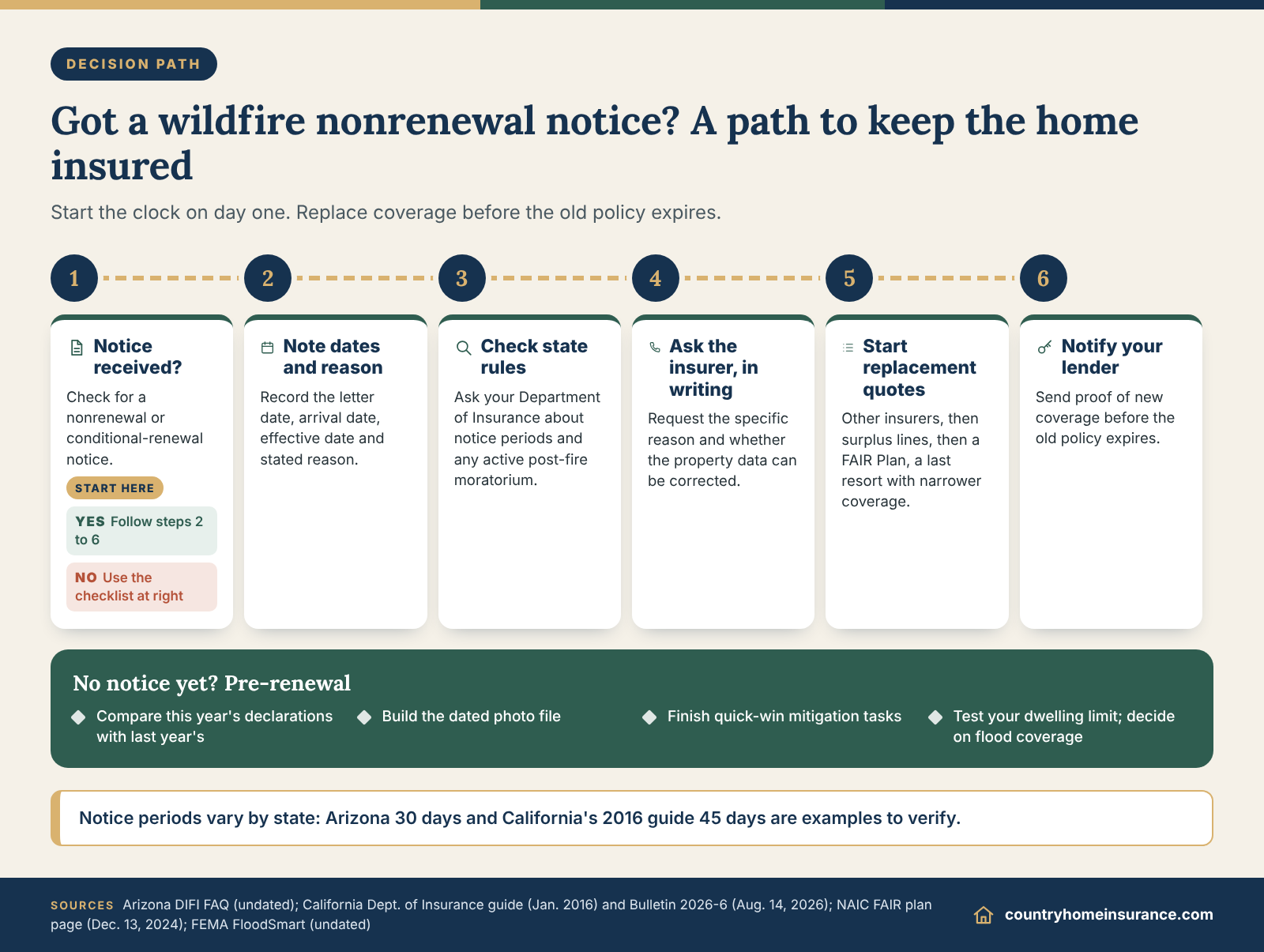
- Fire, smoke and ash damage is typically covered subject to your policy. Underinsurance is a separate problem that surfaces in claims, so check your limits while your policy is in force.
| Situation | Typical treatment | What to check |
|---|---|---|
| Fire, smoke, soot and ash damage to the house and belongings | Typically covered, subject to policy terms, limits and deductible (NAIC wildfire guidance, 2020) | Declarations page, dwelling limit, deductible, any wildfire-specific conditions |
| Your car, truck or trailer | Typically not covered by a homeowners policy; vehicle fire damage falls under comprehensive auto coverage | Your auto policy and its comprehensive deductible |
| Flooding, runoff or debris flow after a burn | Standard homeowners policies typically exclude flood; separate flood coverage is needed (NAIC; FloodSmart) | NFIP or private flood policy, plus its waiting period |
| Hotel, rental and extra food costs while the home is unlivable | Varies: additional living expense (ALE) coverage is subject to its own dollar and time limits | Coverage D or loss-of-use limit and time cap |
| Extra cost to rebuild to current code | Varies: standard policies usually don’t pay it unless ordinance or law coverage applies | Ordinance or law endorsement or limit |
| Rebuild cost above your dwelling limit | Not paid beyond the limit; some policies offer extended or guaranteed replacement cost | Replacement cost terms, extended-limit options, annual limit review |
| Protection from being dropped at renewal | Not a coverage at all: set by state law, insurer underwriting and, in some states, post-fire moratoria | State Department of Insurance consumer pages and your renewal notice |
What wildfire insurance nonrenewal means and how it differs from cancellation
Most homeowners policies run for a set term, usually a year, and the insurer chooses at the end of each term whether to offer another. A notice that says your policy won’t renew is stressful because it lands on a decision you didn’t make. This section sorts out the vocabulary so you can tell exactly what you’ve been handed.
How do nonrenewal, cancellation and conditional renewal differ?
Three notices can look alike at the kitchen table but have very different legal weight. The difference decides how much time you have and which rules apply.
Nonrenewal: the insurer declines the next term
In a nonrenewal, your current policy stays in force until its expiration date, and the company simply doesn’t offer a new term. The Arizona Department of Insurance and Financial Institutions (DIFI) explains on its consumer FAQ page that insurers must give at least 30 days’ notice of a nonrenewal before the end of the policy period, and that the grounds can be any reason, not just the cancellation grounds. The reason may have more to do with your surroundings than with anything you did. A report from Arizona’s Resiliency and Mitigation Council noted that insurers may use any underwriting factor that is not unfairly discriminatory and may limit writing or nonrenew policies in areas of high exposure.
Cancellation: ending coverage mid-term
Cancellation cuts a term short, and regulators generally restrict the reasons. DIFI lists nonpayment of premium, certain crimes, fraud or misrepresentation, negligent acts that increase the hazard, a substantial change in risk, and failure to correct hazardous premises conditions as grounds, and says an insurer need only give five days’ notice for a cancellation. California’s consumer guide for residential insurance, dated 2016, describes a similar short list after a policy has been in force 60 days: nonpayment, fraud, material misrepresentation or physical changes that increase a hazard. Neither list says “the neighborhood is high risk,” which is one reason wildfire exposure so often shows up at renewal rather than mid-term. Details change, so treat both descriptions as examples and confirm your own state’s rules.
Conditional renewal and quieter changes
Not every adverse renewal is a nonrenewal. DIFI notes that an insurer which offers renewal only with reduced limits or removed coverages must also give at least 30 days’ notice. In practice, this is the version many people miss because the policy “renewed.” Compare this year’s declarations page with last year’s line by line: dwelling limit, other structures limit, deductibles, endorsements and any new conditions. A silent reduction can hurt as much as a dropped policy when a claim arrives, and the dollar impact on price can compound it. GAO’s 2026 analysis of premium data associated a move from medium to high wildfire risk with roughly an 8 percent higher premium, though that figure is an association across the data GAO studied, not a quote you should expect.
Where is wildfire insurance nonrenewal showing up?
The reporting is strongest in the western states, but the underlying question, how much wildfire exposure an insurer will carry, travels with the risk.
What regulators in the West say openly
DIFI’s spring 2025 homeowners handout states that consumers in wildfire-prone areas may be nonrenewed by their insurer and that some insurers have added underwriting restrictions that limit which properties and locations they will cover. The California Department of Insurance reported in January 2026 that its post-wildfire moratorium law protected more than 1.2 million homeowners during 2025. That figure measures how many policyholders sat in or next to declared fire areas, not how many would otherwise have been dropped, so don’t read it as a nonrenewal count.
Wildfire exposure beyond the headline states
The Alaska Division of Insurance publishes wildfire guidance for homeowners that stresses mitigation, adequate coverage and documentation, which shows the concern isn’t limited to California and Arizona. That page does not discuss nonrenewal, so it can’t tell you what an Alaska insurer will do at renewal. The practical point is simple: if your property sits near grass, brush or forest, a local fire district or state forestry office can tell you how your area is regarded, and your agent can tell you how your insurer treats it.
State notice rules and post-fire moratoria: what protection you may have
Insurance is regulated state by state, so two neighbors on opposite sides of a state line can have different rights on the same day. What follows uses California and Arizona as worked examples because their regulators publish the most detail. Use them to learn what questions to ask, not to assume your own state works the same way.
How much notice does wildfire insurance nonrenewal require?
The honest answer is that it varies, and the number printed on your policy or in a general guide may not match current law.
Notice periods differ by state
Arizona’s regulator describes at least 30 days’ notice before the end of the policy period. California’s consumer guide for residential insurance, a 2016 publication, describes written notice at least 45 days before expiration. Because that guide is old, confirm the current California period with the Department of Insurance before relying on it. A National Conference of State Legislatures summary of 2025 homeowners bills, updated in July 2025, lists a Georgia law that increases the number of days of notice before a homeowners nonrenewal; the summary doesn’t give the number, so check Georgia’s own regulator if that’s your state. The pattern across the examples is the same: notice periods are measured from a specific date, so write down the date on the notice, the date it arrived and the stated effective date.
Reasons, and how specific they have to be
The California guide says both cancellation and nonrenewal notices must state the reason. United Policyholders, a consumer advocacy nonprofit, notes in an undated explainer that a reason given in California can be general, such as “wildfire risk.” The same organization reports that insurers generally aren’t required to disclose a property’s score, although many agents will share it on request. Colorado’s picture is shifting: the NCSL summary describes an enacted Colorado law requiring insurers that use wildfire, catastrophe or scoring models to share information with regulators and the public and to notify policyholders. Ask in writing what specific factor drove your decision, and whether the property-level data it relied on can be reviewed.
When the notice is late or defective
California’s older guide says that when an insurer doesn’t give proper nonrenewal notice, the existing policy continues on the same terms for 45 days after the notice is sent. Other states have their own consequences, so don’t assume yours matches. The safe habit is to treat every notice as real while you check it. Start replacement shopping on day one, tell your agent in writing that you’re disputing a defective notice if you believe it is one, and call the Department of Insurance. Letting a policy lapse over a technicality can leave you uninsured and, if you have a mortgage, invite lender-placed coverage; the NAIC says a lender will likely insure the home itself if your coverage lapses and may charge a higher premium.
How do post-wildfire moratoria work?
California is the best-documented example of a state that pauses wildfire-based cancellations and nonrenewals after a disaster declaration.
California’s one-year rule in practice
According to California Department of Insurance Bulletin 2026-6, dated August 14, 2026, insurers may not cancel or nonrenew property policies because the insured property is in an area where a wildfire occurred, for one year after a governor-declared state of emergency. The residential rule sits in Insurance Code section 675.1(b)(1). It reaches individually owned homes of up to four units, condominium units, mobile homes, their contents and tenant policies for contents. The bulletin tells insurers not to issue wildfire-based notices in the listed ZIP codes, to offer to rescind any such notices issued on or after the emergency date, and to offer to reinstate or renew policies that were in effect when the emergency was declared.
Two recent examples, with dates
The bulletin applies to the Calaveras County emergency declared August 6, 2026, covering 22 listed ZIP codes within or adjacent to the fire perimeter. The Department’s January 9, 2026, release describes a similar order after the Gifford Fire: an emergency declared December 23, 2025, in Santa Barbara and San Luis Obispo counties, protecting more than 147,000 policyholders inside the perimeter and in 29 adjoining ZIP codes, whether or not they filed a claim. A one-year window from those dates would run into late December 2026 and early August 2027, but the Department can add ZIP codes or issue new bulletins, so check the current list. The release also says that homeowners with a total loss receive up to 24 months of protection.
What moratoria don’t do
A moratorium is narrow by design. It follows a declared emergency, applies to listed areas, and addresses wildfire-based cancellation and nonrenewal. The documents we reviewed describe protection from losing coverage, not a limit on what renewal costs or on coverage terms, so ask your agent separately about price and conditions. The Department also advises people who were nonrenewed before a declaration, and can’t find coverage or are unhappy with what they have, to contact it for guidance. And a moratorium buys time rather than certainty. Use that year to harden, document and shop.
Where can you confirm your own state’s rules?
You don’t need a lawyer to get a reliable first answer. You need the right official page and the right document.
Start with your state Department of Insurance
The National Association of Insurance Commissioners (NAIC) runs a directory of state insurance departments where you can pick your state, find its contact information and begin a complaint against an insurer or agent. When you call, ask for the specific statute or regulation covering homeowners nonrenewal notice, whether wildfire-based nonrenewal is treated differently, and whether any moratorium is active in your ZIP code. Ask them to send it in writing or point you to the consumer page. California’s Department publishes a consumer hotline, 800-927-4357, as an example of the kind of line most regulators maintain.
Read the notice and the policy conditions together
Your policy’s cancellation and nonrenewal conditions may promise more than the law minimum. California’s guide notes that when a policy gives a longer cancellation notice than the legal minimum, the policy language controls. Pull out the full policy, not only the declarations page, and mark the section on cancellation and nonrenewal. Put it in the same folder as the notice. That way, when you talk to your agent or regulator, you can cite the page rather than paraphrase from memory.
How insurers judge wildfire risk: scores, fire protection and what you can verify
An underwriter reviewing your renewal typically isn’t looking at your house the way you do. The decision is more likely built from a score, a map, a fire-protection rating and the company’s own appetite for that part of the state. Knowing which inputs exist lets you check the ones you can check.
What is a wildfire risk score and who sets the cutoff?
A wildfire risk score is a number a vendor attaches to an address to estimate how likely a structure there is to be affected by a wildfire. It doesn’t predict when or where a fire will start.
The best-known scoring systems
United Policyholders, a consumer advocacy nonprofit, describes two widely used products in an undated explainer. Verisk FireLine scores run from 0 to 30 in 13 Western states, with vegetation, slope and emergency-vehicle road access as key inputs. The CoreLogic Wildfire Risk Score runs from 1 to 100 and covers 15 Western states plus Florida, weighing vegetation, terrain, past fires and proximity to areas where wind-blown embers are a threat. Arizona’s Resiliency and Mitigation Council report, released in late 2025, agrees that FireLine places the most weight on vegetation, then slope and road access. Treat vendor coverage areas as background, because products and territories change, and ask your agent which model, if any, your insurer uses.
Insurers set their own cutoffs
According to United Policyholders, some insurers decline properties above a given FireLine threshold, while others weigh the score among many factors. Some use scores for pricing as well as underwriting, others only for new policies, and State Farm has said it doesn’t use them. The group also notes that reinsurers look at an insurer’s exposure to high-risk properties, which can push companies to reduce it. That is why two neighbors with identical roofs can receive different treatment: they may be insured by different companies with different tolerances. It also explains why a nonrenewal from one company doesn’t mean every company will decline you.
A score isn’t a verdict on your house
Scores describe relative likelihood, not certain outcomes. The Arizona council report cites one vendor, ZestyAI, as finding that of about 2.7 million Arizona residences, 85 percent were low risk and 2 percent high risk, with another 13 percent having a high chance of wildfire involvement but low risk of structural damage. That is a vendor-reported figure for one state, so don’t generalize it. What it illustrates is that the same score label can bundle very different properties. A location score may not know about your metal roof, your gravel apron or the pasture your neighbor mows, which is the gap your documentation is meant to fill.
Why do fire protection class and rural fire service matter?
Wildfire scores capture the landscape. Protection class captures who will show up, how fast and with what water. For country homes, that second question can matter just as much.
Protection class in plain English
A public protection classification (PPC) is a rating of a community’s fire-fighting capability that property insurers use at sale and renewal, according to Verisk, which publishes the ratings. A 2018 Verisk article says the survey draws on emergency communications, the fire department and water supply, and that mileage or travel time alone is a pitfall. United Policyholders describes the scale as 1 (best) to 10. The NAIC’s homeowners guide adds that your fire protection class depends on distance to a hydrant and the quality of your local fire department. Because the Verisk article is from 2018, treat the details as background and ask your agent for the class currently on your policy.
Volunteer departments and long response routes
The National Volunteer Fire Council’s fact sheet, which draws its department counts from a 2020 National Fire Protection Association profile, reports 29,452 U.S. fire departments and says about 82 percent are all-volunteer or mostly volunteer. It adds that small communities of under 10,000 people are typically protected by all-volunteer departments and that volunteer departments are struggling to meet staffing needs. If you’re on acreage served by a volunteer company, ask your agent what class your address carries, and ask the fire chief whether anything has changed since the last survey, such as a new station or tanker. Verisk’s article says communities can request a survey when changes occur, and that is a conversation to have with local officials, not the insurer.
Roads, driveways and access
FireLine uses road access for emergency vehicles as an input, and the Alaska Division of Commerce’s wildfire-ready guidance, which points to IBHS research, spells out access details: a driveway clearance at least 12 feet wide and 13.5 feet tall, gates that open inward and sit at least 30 feet from the road, and address numbers about 4 inches tall that can be read from both directions of the street. Those details cost little compared with a re-roof and matter on a private lane at night. Photograph them and measure them once, then keep the numbers in your file.
Which discounts or mitigation signals might insurers recognize?
Homeowners understandably want to know whether the work pays off in the policy. The retrieved evidence says it might, and it also says not to count on it.
What regulators say exists
An NAIC document on state mitigation programs, stamped 2023, lists California as the only state in that document with wildfire-specific discounts, and says most are based on the Firewise program. The California Department of Insurance said in March 2025 that residential and commercial FAIR Plan policyholders can receive up to a 20 percent discount on the wildfire portion of the FAIR Plan premium for hardening their properties under its Safer from Wildfires framework. The Arizona council report notes a premium-discount partnership between the NFPA and USAA for members of Firewise sites in western states. The NAIC also tells consumers that their state insurance department may run a mitigation grant program and that agents can explain available discounts.
What isn’t promised
No retrieved source guarantees a discount or a renewal. The IBHS strategy page, last modified in January 2026, says IBHS will help members and insurers use its Wildfire Prepared Home program in modeling, but it doesn’t describe formal insurer recognition. The Arizona report relays a panelist’s statement that designated homeowners in participating states kept their policies and some received discounts, and adds that underwriting remains each company’s decision. It also describes one homeowner who negotiated a $1,000 premium reduction after documenting mitigation. Those are individual accounts, not rules. The sensible reading is that documented mitigation may improve your standing and your options, and that you should ask each insurer, in writing, what it recognizes.
| Factor | What the retrieved sources say | What you can verify or influence |
|---|---|---|
| Vegetation near the home | Weighted most heavily in Verisk FireLine according to the Arizona council report (late 2025); also an input to CoreLogic’s score per United Policyholders (undated) | Clear and maintain the first 30 feet; photograph before and after |
| Slope and terrain | Second in weight for FireLine; terrain is a CoreLogic input | Mostly fixed; document terrain-related mitigation such as hardscape and spacing |
| Road access for emergency vehicles | A FireLine input; Alaska guidance describes a 12-foot by 13.5-foot driveway clearance | Measure and photograph lane width, overhead clearance, gate position and address numbers |
| Fire protection class | Depends on hydrant distance and fire department quality per NAIC; Verisk (2018) describes PPC surveys of communications, department and water supply | Ask your agent for the class on your policy; ask local officials about re-survey if service changed |
| Insurer appetite and reinsurance | Insurers may limit writing in high-exposure areas (Arizona council report); reinsurers may push for lower exposure (United Policyholders) | Shop several carriers; ask each what it recognizes |
| Data accuracy | About 4,000 requests to update FireLine scores in 2024; a small share were amended, usually for geolocation errors or changed vegetation (Arizona council report) | Ask what data your insurer holds on your structure, location and score, and submit corrections with photos |
| Recognized mitigation programs | Firewise cited in California regulation per the Arizona report; Wildfire Prepared Home launched in California in 2022 (IBHS); no guaranteed insurer recognition | Ask each insurer in writing whether it credits the program; keep the designation record |
Home hardening and defensible space: what published guidance actually asks for
Home hardening means upgrading materials and construction details so embers and flames are less likely to ignite the house. Defensible space is the managed buffer of vegetation and combustibles around the structure. The two work together, and most published checklists treat them as one system. Because this is safety guidance as well as insurance guidance, the details below come from agencies and research bodies, not from insurers.
Which parts of the house matter most?
The published lists tend to start with the places where windblown embers can lodge: openings, roofs, gutters and the junction where walls meet ground or deck.
Vents, roof and gutters
The Alaska Division of Commerce’s wildfire-ready upgrades guide, which refers readers to IBHS material and isn’t dated or credited, recommends ember-resistant vents or 1/8-inch metal mesh over existing vents, a louver or flap instead of mesh on dryer vents, and spark arrestors with 1/2-inch mesh on chimneys. It calls for Class A roof covers such as asphalt shingles, tile, slate or metal in place of wood shake or shingle roofs, flat multipane tempered glass instead of domed plastic skylights, metal gutters instead of plastic and, as a further step, noncombustible gutter guards. The NAIC’s 2020 consumer article adds that roof and gutter debris can be ignited by embers, so regular clearing is part of the job.
Walls, windows, doors and eaves
The Alaska guide recommends keeping at least 6 vertical inches of noncombustible siding, such as fiber cement, brick, stone, stucco or exposed concrete, between the ground or any attached horizontal surface and combustible wall material. Further upgrades include enclosing the underside of eaves with noncombustible soffits or lumber at least 2 inches thick, replacing exterior windows with tempered, multipane or fire-resistant glass block, using solid exterior doors with metal thresholds and replacing wood, wood-fiber or vinyl siding with noncombustible materials. The NAIC adds that multi-pane tempered glass windows are worth considering and that windows should be closed when a fire threatens.
Decks, porches and fences
Decks are a classic ember trap. The Alaska guide advises removing combustible furniture, large rugs and planters from the surface, clearing all storage and vegetation beneath, and enclosing the underside of decks 4 feet or lower with 1/8-inch mesh or noncombustible wall covering. Its further steps include building or retrofitting decks with metal joists, fire-rated walking surfaces and noncombustible railings, replacing wood or plastic fencing and gates within 5 feet of the house with metal, and removing back-to-back fences less than 5 feet apart in coordination with neighbors. If you have a wood privacy fence that runs right into the siding, that is often the easiest ignition path to break.
How do the defensible-space zones work?
Instead of a single “clear 100 feet” instruction, newer guidance divides the yard into zones with different rules.
Zone 0 to 5 feet: the noncombustible buffer
For the first five feet, the Alaska guide says to remove all vegetation, mulch and pine straw, trim branches that overhang the area, keep vines off structures and fences, and use hardscape such as gravel, pavers or concrete, including around decks and stairs. It says to keep vehicles, boats, RVs and ATVs in a closed garage or at least 30 feet away, and to keep firewood and large propane tanks at least 30 feet from structures. On a country property, that often means relocating a woodpile that has sat against the back wall for years.
Zone 5 to 30 feet: managed, spaced and low
In the extended zone, the guide says to keep grass at 4 inches or less and watered, clear leaves, pine needles and dead plant material, remove tree branches below 6 feet and keep at least 10 feet between neighboring canopies. It recommends low-growing, fire-resistant shrubs, spaced out or grouped in clusters of no more than three, and no hedge rows. Small structures such as sheds, pergolas and playsets should sit at least 10 feet from the home or attached decks within this zone, with a noncombustible zone around each. As a further step, the same guide says to move outbuildings at least 30 feet from the home.
Beyond 30 feet, and why the numbers differ
The NAIC’s 2020 article, citing Ready.gov, describes a buffer of up to 200 feet cleared of wildland vegetation, including trailers, RVs and storage sheds. The Alaska guide’s zones stop at 30 feet. These are different frameworks from different dates, and local rules may set their own distances. Ask your fire district or state forestry office what applies. The Arizona council report notes that fire districts offer ignition-zone surveys but that their recommendations are generally not enforceable unless they involve a fire-code violation, so a survey is an expert opinion rather than a legal clearance.
Which programs verify or recognize the work?
Third-party verification turns “I did the work” into “someone else saw the work.” Three routes show up in the sources.
IBHS Wildfire Prepared Home
IBHS says its Wildfire Prepared Home program launched in California in 2022. The Arizona council report states that the standard requires defensible space, fire-resistant building features and a Class A roof, among other items, and that a Plus level adds items such as upgraded windows and doors, enclosed eaves and outbuildings moved at least 30 feet away. Homeowners apply online with photos, and an IBHS-contracted inspector verifies the work. The report lists California and Oregon as program states, later expanded to Nevada and New Mexico, and relays an IBHS estimate of $5,000 to $7,000 for a full retrofit depending on home size, landscape changes and location. That list dates from late 2025, so check IBHS for your state before you plan around it.
Firewise USA
Firewise USA is a community program run by the NFPA. Per the Arizona report, a site needs between 8 and 2,500 residences, a risk assessment, a multi-year action plan, outreach events, a minimum investment and annual renewal. The report adds that NFPA has a premium-discount partnership with USAA for members in western states and that California regulations cite Firewise as a factor in underwriting. It also observes that participation often plateaus within 5 to 10 years and that mitigation may be concentrated in common areas rather than private lots. If your neighbors already have a Firewise site, ask about joining it. If they don’t, a rural road association or volunteer fire company is a natural place to start one.
Local fire district assessments
The cheapest verification may be a visit from the fire district. Per the Arizona report, fire districts offer ignition-zone surveys of individual properties. Ask for the findings in writing and keep them with your records. A written assessment from the agency that would fight the fire may carry more weight with an underwriter than your own photos, even if the insurer doesn’t formally credit it. For documentation purposes, the date and the author matter as much as the content.
| Measure | What the guidance says | Proof to keep |
|---|---|---|
| Vents and openings | Ember-resistant vents or 1/8-inch metal mesh; louvered dryer vents; 1/2-inch chimney spark arrestors (Alaska guide, undated) | Dated photos of each vent type, product name on invoice or packaging |
| Roof covering | Class A covers such as asphalt shingles, tile, slate or metal; replace wood shake (Alaska guide; NAIC 2020) | Contractor invoice naming the roofing product and its fire rating, plus finished-roof photos |
| Gutters and roof debris | Metal gutters, noncombustible gutter guards, regular debris clearing | Photos before and after each seasonal cleaning with the date |
| Wall base and siding | At least 6 vertical inches of noncombustible siding above ground and attached decks | Close-up photo with a tape measure against the wall base |
| Windows, doors and eaves | Tempered or multipane glass; solid doors with metal thresholds; enclosed noncombustible eaves | Invoices, window labels or specifications, photos of finished work |
| Decks and fences | Clear beneath, enclose with 1/8-inch mesh when 4 feet or lower, metal fencing within 5 feet of the house | Photos of the underdeck, the fence-to-wall connection and the materials used |
| 0 to 5 foot zone | No vegetation, mulch or pine straw; hardscape; firewood and large propane tanks 30 feet away | Wide and close photos from all four sides, with a tape or reference object |
| 5 to 30 foot zone | Grass at or below 4 inches; trees limbed to 6 feet; 10 feet between canopies; clustered low shrubs | Seasonal photos, a simple maintenance log, any hired crew’s invoice |
| Outbuildings and access | Barns, sheds and playsets spaced from the home; driveway 12 by 13.5 feet; gates open inward; visible address numbers | Site sketch with distances, lane measurements and photographs of the gate and the address sign |
Building a home-hardening documentation file insurers can actually use
Doing the work and being able to prove the work are two different jobs. After a nonrenewal notice, or a claim, memory fades and details blur. A well-organized file, built in a quiet season, is the one asset here that costs almost nothing and can be assembled at your own pace.
What belongs in the file?
Think of three layers: what the property looked like, what you changed and what you keep doing.
Dated photos and video
The Alaska Division of Insurance’s wildfire page recommends photos and video of the house and contents, stored somewhere safe away from the home, and emailing documents to yourself so you can reach them from anywhere. For mitigation, build on that: photograph each side of the house and the full 30-foot perimeter from the same standing spots, then repeat each season. Add close-ups of vents, the wall-to-ground junction, the underdeck and gutters. Include wide shots of outbuildings, woodpiles, propane tanks and the driveway entrance. Date stamps matter, so turn on your phone’s date metadata, and name the files by date and location, such as “2026-10-12 north wall base.”
Receipts, product details and contractor paperwork
A photo shows that a roof is there; an invoice can show what it is. Ask contractors to write the product name and, where the product has a published fire classification, the classification on the invoice, and keep the label, spec sheet or warranty page. Where a permit was required for the work, file the permit and the final inspection. This is practical advice rather than a rule from any single source, though the Alaska Division of Commerce’s claims guide does stress getting written bids and using licensed or registered contractors and permits when repairing or rebuilding. If you do the work yourself, keep receipts for materials and a note of the date and your hours.
A maintenance log for recurring tasks
Defensible space is not a one-time project. Grass grows back, needles fall, and gutters refill. A simple log with the date, task, zone, who did it and a photo reference shows an underwriter or fire official that the property is maintained and not just cleared once for a photo shoot. If you join a Firewise USA site, the program’s annual renewal and minimum-investment requirements, described in the Arizona council report, will generate parallel records that you can attach.
How should you deliver the file, and how do you fix errors?
The file does nothing in a drawer. The aim is to get accurate information to the people deciding about your policy while there is still time for them to use it.
When to send it
Send it before the renewal decision, not in response to it. Ask your agent how the insurer prefers to receive mitigation information, whether through an underwriting portal, email or a re-inspection request, and keep proof of what you sent and when. The Alaska Division of Insurance warns that insurers may not add or amend coverage once a disaster is impending, which is a useful reminder that timing is part of the plan. Also include a one-page summary: address, date of each upgrade, what was done, what proof is attached and a contact number. Underwriters read quickly.
Correcting a risk score or property record
Ask what data the insurer holds on your structure and location. DIFI’s handout encourages homeowners to confirm their insurer has accurate details about their structure. The Arizona council report says Verisk received about 4,000 requests to update FireLine scores in 2024, that a small percentage were amended and that the changes were usually for geolocation errors or for vegetation that mitigation had changed. United Policyholders cites a 2018 California Department of Insurance report that found no formal consumer appeal process for model scores; the explainer doesn’t say whether one has since been adopted, so ask your regulator what exists today. Typical errors worth checking are the wrong building footprint, a missing outbuilding or an outdated roof description. Send photos that show the correction.
Keeping a second copy off the property
If the worst happens, the original files may burn with the house. Store a copy off site: in cloud storage, with a relative or on a drive in a safe deposit box. The NAIC’s April 2022 claims article suggests the same for inventories, and notes that records can be rebuilt from phone photos and family photos if they’re lost. The NAIC Home Inventory app lets you export your inventory at any time. Your mitigation file and your inventory can live in the same off-site folder.
Why does accuracy matter more than volume?
A thick file full of inflated claims is worse than a thin file that is correct. Insurance is a contract of good faith, and statements to insurers carry consequences.
Describe only what you’ve actually done
DIFI lists fraud or misrepresentation when obtaining a policy or filing a claim among the grounds for cancellation, and California’s guide lists material misrepresentation. Neither guidance is aimed at an honest mistake, but it is a reason to be careful with words. Write “replaced attic vents on the north and east sides, 2026-09” instead of “fully ember-proofed.” If a measure is partial, say so. Accurate, modest claims are easier for an underwriter to credit and for you to defend.
Update the file when the property changes
DIFI also lists a substantial change in risk and failure to correct hazardous premises conditions among cancellation grounds. A new barn, a hay shed, a fuel tank or a removed tree changes the picture, so tell your agent about material changes and update your records. On a working property, the picture changes more often than on a suburban lot. A season’s worth of stacked hay near the house, for example, is something to document honestly, move away from the structure and discuss with the agent rather than leave unmentioned.
If you’re nonrenewed: a practical path to keep the home insured
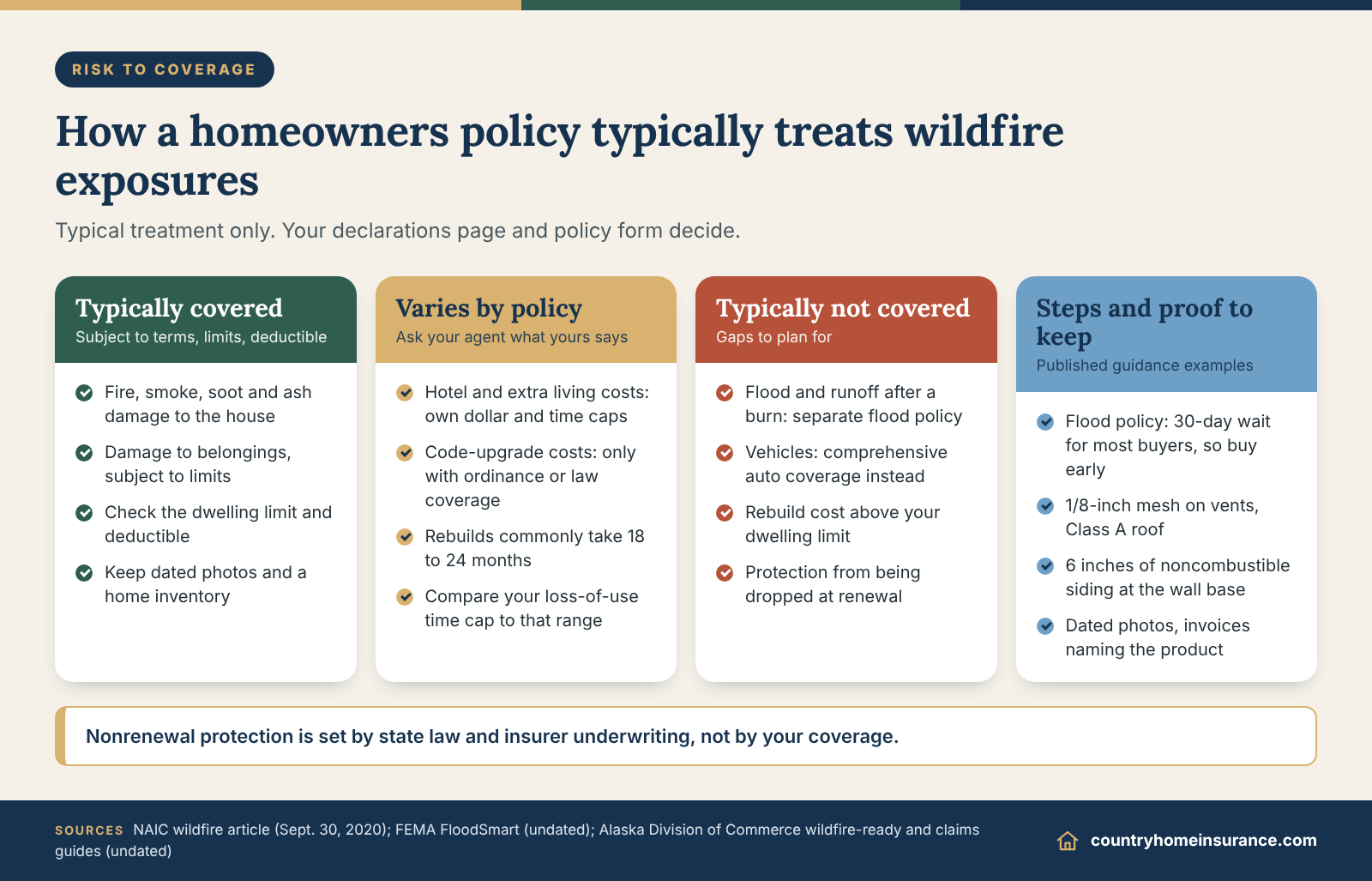
A nonrenewal notice starts a clock. Most people lose time in the first week to anger and in the second week to phone tag. The sequence below is meant to move you from the notice to a bound replacement policy before the old one expires.
What should you do in the first two weeks?
The first goal is information: the facts in the notice, the facts behind it and what you can still change.
Read the notice and pin down the dates
Write down the effective date of nonrenewal, the date on the letter, the date you received it, the stated reason and how it was delivered. Check whether your ZIP code is covered by an active post-fire moratorium, which in California you can do on the Department of Insurance website according to its January 2026 release. If you believe the notice is defective or the reason isn’t specific enough, ask the insurer to clarify in writing and contact your state Department of Insurance. The California Department of Insurance says on its consumer guide that you should contact your agent, broker or company in writing for clarification, and the same habit works in any state.
Ask your current insurer what could change the outcome
Before you walk away, ask three questions. Is the decision based on a property-level score, and can the data behind it be corrected? Would the company reconsider if documented mitigation work is completed or already complete? Does it have a related company or a different product that would still write the home? The answers may be no, but the Arizona council report describes score amendments after mitigation and one homeowner who negotiated a premium reduction with documentation, so it can be worth asking. Keep the tone factual and the request in writing.
Protect your mortgage position
If your coverage lapses, the NAIC says the lender will likely insure the home and may charge a higher premium until you buy your own policy. The Alaska Division of Commerce claims guide notes that a lender is typically named on the policy and often appears on repair checks. Tell your servicer you’ve received a nonrenewal notice and plan to replace the policy, and send proof of the new coverage before the old one expires. Also confirm your new policy lists the lender correctly so the lender doesn’t buy duplicate coverage.
Where can replacement coverage come from?
The market has layers. The first is the voluntary (admitted) market, then surplus lines, then the residual market.
The voluntary market, one insurer at a time
Different companies take different views of the same address. DIFI’s forested-areas list, updated February 6, 2025, names roughly 100 licensed insurers that may offer homeowners policies in forested parts of Arizona, and the Department states that the list is not an endorsement and that eligibility, cost and coverage vary. Other states may have similar tools, and your regulator can tell you. An independent agent can submit your file to several carriers at once. The NAIC advises comparing quotes with the same coverages, so you’re comparing apples to apples, and asking whether each deductible is a flat dollar amount or a percentage of the home’s insured value.
The surplus lines market
Surplus lines, also called excess and surplus (E&S) or non-admitted coverage, is typically written by insurers that are not subject to the same rate and form filing rules as standard carriers, and it is placed through licensed surplus lines brokers. For a high-risk home, it may be the only private offer. The policy wording and price can differ markedly from a standard homeowners policy, so read every exclusion, and ask your broker how the policy treats wildfire, water damage, liability and your outbuildings. DIFI’s list points homeowners who can’t find an insurer to the Arizona Independent Agent and Brokers Association and the Arizona Surplus Lines Association. Ask whether state guaranty-fund protection applies to the policy, because that can differ from a standard policy.
Documentation-driven underwriting
Some newer approaches lean on the type of record you’ve been building. The Arizona council report describes FireBreak Risk, a self-inspection tool that works with two surplus lines carriers; the report says no admitted carriers use it for underwriting, though some offer discounts. It also records a disagreement among panelists about whether partial mitigation is enough. Tools and carriers will change, but the principle is stable: the better the evidence, the less an underwriter has to assume.
How do FAIR Plans and difference-in-conditions coverage fit together?
If the private market says no, most states have a residual-market backstop. It works, but it isn’t a like-for-like replacement for a standard policy.
What a FAIR Plan is and isn’t
The NAIC describes FAIR plans as state-mandated property insurance for people who can’t get coverage in the regular market, typically used as a last resort. As of October 2024, 33 states had some form of residual-market plan. The NAIC says these plans are typically more expensive and offer more limited protection than regular-market insurance, that dwelling coverage is usually included at minimum, that personal property and other structures are usually optional add-ons, and that loss of use and personal liability coverage generally aren’t offered. Triple-I’s tabulation counted 2,684,925 FAIR policies in force in fiscal year 2024, with Florida at 1,335,517 and California at 431,300; those exposure counts cover twelve months ending between September and December and exclude Arkansas.
California as a worked example
California’s 2016 consumer guide describes the FAIR Plan as an association of all property insurers licensed in the state, offering a basic fire policy for structure and contents, with no liability and no coverage for perils such as burglary. The Department’s March 2025 release says residential limits were raised to $3 million in 2019, that monthly payments without a fee are allowed and that farm buildings can now receive FAIR Plan coverage. It adds a Safer from Wildfires discount of up to 20 percent on the wildfire portion of the FAIR Plan premium for hardening. A 2024 Department FAQ describes a reform framework under which insurers would take FAIR Plan policies back into the regular market; its implementation status wasn’t verified here. Your state’s plan, if it has one, will have its own limits, forms and eligibility.
Layering liability and a difference-in-conditions policy
A difference-in-conditions (DIC) policy is a separate supplemental policy designed to fill gaps in a more limited primary policy. California’s guide suggests considering supplemental coverage such as an excess policy or a DIC policy alongside a FAIR Plan policy, but it doesn’t explain how those policies work, so terms vary. When you shop a DIC, ask what perils it covers, whether it provides liability, loss of use or theft coverage, how it coordinates with the FAIR Plan, and what the exclusions are. If your base policy has no personal liability coverage, make sure Coverage E, or a stand-alone personal liability policy, exists somewhere in the stack. A rural homeowner with horses or visitors on a private drive shouldn’t assume it does.
| Option | Typical features in the sources | What to verify before you rely on it |
|---|---|---|
| Ask the current insurer to reconsider | Scores can be amended for errors or changed vegetation (Arizona council report); outcome is the insurer’s decision | Deadline for reconsideration, what documentation it will accept, and whether the answer is in writing |
| Another admitted insurer | Appetite varies by company; Arizona lists about 100 licensed insurers that may write in forested areas (February 2025) | Quoted coverages, deductible type, replacement cost terms, ordinance or law and loss-of-use limits |
| Surplus lines (E&S) | Non-admitted market placed through specially licensed brokers; wording and price can differ from standard forms | Exclusions, wildfire and water terms, liability, outbuilding coverage, guaranty-fund status, broker license |
| FAIR Plan | Last-resort plan; usually dwelling coverage at minimum, with other structures and contents often optional; liability and loss of use generally not offered (NAIC) | Eligibility, limits, premium, mitigation discounts and which supplemental coverage you still need |
| FAIR Plan plus supplemental policy | California’s guide suggests excess or DIC coverage alongside the FAIR Plan; terms are not explained there | Perils covered, coordination between policies, total annual cost and any overlapping or missing coverage |
| Post-fire moratorium (California) | One year from a declared emergency for listed ZIP codes; up to 24 months after a total loss (Department release, January 2026) | Whether your ZIP code is listed, the emergency date and whether the Department has added areas |
Coverage gaps to close while you still have a policy, and how to prepare for a claim
Nonrenewal pressure and underinsurance often travel together. If your insurer is pulling back from an area, it may also be quietly shifting risk to you through limits and conditions. Review the policy you have now, while you can still ask for changes, because the Alaska Division of Insurance cautions that insurers may not add or amend coverage once a disaster is impending.
Is your dwelling limit enough to rebuild?
Dwelling coverage (Coverage A) is the amount available to repair or rebuild the house. After a total loss, it is the number that matters most.
Why underinsurance shows up after wildfires
The Colorado Division of Insurance studied claims from 61 insurers covering about 97 percent of the state’s homeowners market after the 2021 Marshall Fire. It identified 951 total-loss homes with $1.02 billion in claims paid or incurred at the time of its April 2022 release, and it estimated underinsurance of $34 million at an assumed $250 per square foot, $86 million at $300 and $155 million at $350. Of the 951 homes, 76 had guaranteed replacement coverage. Those per-square-foot figures were analytical assumptions, not rebuild quotes. A January 2026 Insurance Journal reprint of a Bloomberg report adds that the Insurance Information Institute estimates about two-thirds of U.S. homeowners are underinsured for wildfire, usually by about 20 percent and sometimes up to 60 percent. That is a news report of an estimate, so treat it as a signal and not a statistic about your home.
Replacement cost, extended limits and what “replacement” means
The NAIC explains that actual cash value (ACV) pays the current value of damaged property reduced for age and wear, while replacement cost value (RCV) pays to repair or replace with similar kind and quality without subtracting depreciation. Even RCV has a ceiling: the policy limit. The Bloomberg reprint reports that guaranteed replacement cost, a promise to rebuild regardless of cost, largely gave way to capped replacement-cost coverage in the 1990s, that critics say third-party estimating tools can underestimate rebuilding costs, and that Verisk says its estimates match claims data. Ask your agent whether extended or guaranteed replacement options exist for your home, what they cost and what conditions apply.
How to pressure-test your number
The NAIC’s homeowners guide suggests insuring at least 80 percent of replacement value, but after a wildfire, 80 percent of the cost may leave a large gap. Ask your agent how the dwelling limit was set and what inputs the estimator used: square footage, finishes, roof type, outbuildings. Then check it against a local builder’s current rebuild estimate per square foot. Rural rebuilds can involve long hauls, limited contractors and well or septic work, so a figure built for a suburban tract may be light. Revisit it every year at renewal, and again after any remodel.
Which other coverages decide how a total loss plays out?
A policy can pay a fair dwelling number and still leave you stranded if the supporting coverages are thin.
Ordinance or law coverage
The Alaska Division of Commerce’s post-disaster claims guide explains that standard policies usually don’t pay the extra cost of meeting current local building codes, and that ordinance or law coverage can pay part or all of those costs, for example for wiring, plumbing, windows and roofing. The Alaska Division of Insurance’s wildfire page similarly suggests considering increased cost of construction or building ordinance coverage. A rebuild in a wildfire-prone area may be subject to stricter requirements than the original house. Look for the endorsement or limit on your declarations page, and ask how much it provides.
Additional living expense and rebuild timelines
The Alaska claims guide says additional living expense (ALE) pays costs above your normal expenses when a covered loss makes your home unlivable, subject to dollar or time limits that are separate from dwelling and contents coverage. The same guide says complete rebuilds commonly take 18 to 24 months. Compare your loss-of-use limit and time cap to that range. If your policy caps ALE at 12 months, you could be paying for housing out of pocket for the second year, so ask whether extensions are available and how an insurer handles a long rebuild.
Outbuildings, fences and contents
The Alaska guide tells claimants to prepare a list of structural damage that includes garages, sheds and pools, and notes that contents are typically replaced with property of like kind and quality, with special limits for items such as jewelry, firearms and collectibles. On acreage, ask where barns, shops, fences and equipment fall. Other-structures coverage (Coverage B) has its own limit, and farm-type exposures may need different coverage than a homeowners form provides. The California Department of Insurance noted in 2025 that farm buildings can now receive FAIR Plan coverage, which shows how plan rules for rural structures can change. Put the answers on paper.
What about flooding and mudslides after a burn?
The fire isn’t always the end of the story. Burned slopes shed water differently.
Why flood risk rises after a wildfire
FloodSmart, the NFIP’s consumer site, says wildfires can be followed by rain, mudflow and flood damage and that flood risk remains significantly higher until vegetation is restored, up to five years after a fire. It reports that in 2024 only 1.5 percent of homes in states that experienced wildfires had an NFIP policy. The NAIC notes that floods aren’t covered by a standard homeowners policy and require separate coverage. Arizona’s DIFI handout also lists increased flood risk after wildfire. If your land sits below a burned watershed, ask a local floodplain manager or emergency management office about runoff, not only your insurer.
Timing: the flood-policy waiting period
FloodSmart states that NFIP coverage takes effect 30 days after purchase, with exceptions that include buying while making or renewing a mortgage and a one-day wait when flooding is caused or worsened by a wildfire on federal land and the policy is bought within 60 days of the fire’s containment date. The page lists building coverage up to $250,000 and contents up to $100,000 for homeowners. Because of that waiting period, buy before you need it, not after the burn. Private flood insurance may also be available, so compare terms.
How should you prepare to file a wildfire claim?
You hope not to use this section, but it is easier to read it now than to learn it in a motel room.
Before a loss: inventory, limits and contacts
The NAIC wildfire article says an insurer may ask for an inventory of belongings as they stood at the time of the loss, and the NAIC’s claims article recommends doing the inventory before a disaster, updating it yearly and storing it off site. Keep your policy number, agent contact and a copy of your declarations page where you can reach them from a phone. The Alaska Division of Insurance suggests including your insurer’s and agent’s contact details with your stored records.
After a loss: the order of operations
The Alaska wildfire page lists the sequence: report the loss immediately; take reasonable steps to prevent further damage but don’t start repairs or rebuilding until the adjuster gives instructions; don’t discard damaged property until the adjuster says to; photograph or video damage before cleanup; keep a record of every conversation with the adjuster; and save receipts for hotels, reasonable meals and necessities. The Alaska claims guide says insurers using replacement cost may first pay actual cash value and release the withheld depreciation after you show the work is done, typically within six months to a year, though insurers may extend this after large disasters. The NAIC warns about aggressive contractors who arrive after disasters. Don’t sign under pressure or pay in full upfront. For a large fire loss, the deductible question the NAIC and DIFI raise for small claims, whether the damage is worth filing, is rarely the issue. For smaller incidents, DIFI says to use discretion when filing claims, so ask your agent about renewal effects before you file.
A wildfire-season action plan: what to do now and over the off-season
Wildfire season doesn’t end on the same date everywhere; it shifts with region, weather and drought, and local burn-ban or fire-danger notices change week to week. Check your state forestry agency or local fire district for current conditions. Whatever date the season ends where you live, the quieter months afterward are the best time to do the work that is hard to do under smoke.
What can you do in the next 30 days?
Think in two tracks: paper and dirt. Paper is cheap and fast; dirt takes weekends.
Paper: verify, ask and file
Pull your declarations page and renewal documents and mark the dwelling limit, other structures limit, loss-of-use limit, deductibles and endorsements. Find the cancellation and nonrenewal conditions in the policy. Write to your agent and ask what wildfire data your insurer holds for your address, whether it credits mitigation and how it wants to receive proof. Check your state’s Department of Insurance consumer page for notice rules and any active moratorium. Start the dated photo file now, so you don’t get caught flat-footed by a notice with a short fuse.
Dirt: the quick wins
The Arizona council report observes that some measures, such as ember-resistant attic vents, cost little and can be done with retailer materials. Clear gutters and roof valleys, rake the first five feet, move firewood and large propane tanks to the distance published guidance recommends, and mow and water grass in the near zone. Check that your address number is readable from the road and that overhead branches haven’t narrowed the lane. Photograph each task as you finish it.
What belongs on the off-season project list?
Bigger projects take quotes, scheduling and money. Sort them by what published guidance lists first.
Prioritize openings and the first five feet
The Arizona council report’s list of core measures puts the 0 to 5 foot zone, ember-resistant vents, enclosed underdecks, debris-free yards and a 6-inch noncombustible clearance at the base of walls first. Roof covering and eaves appear in both the Alaska list and the Wildfire Prepared Home descriptions. The IBHS retrofit estimate of $5,000 to $7,000 for the Wildfire Prepared Home standard is a useful reference range, though cost depends on your home. Get at least two written quotes. Before you spend a large sum, ask your insurer whether the project changes anything it will do, because credit practices vary and no source promises a result.
Neighbors, lanes and shared risk
One panelist quoted in the Arizona report argued that a mitigated home next to an unmitigated one remains at significant risk. For country homes, that points to shared work: coordinating tree trimming and back-to-back fence removal with neighbors, as the Alaska guide suggests, marking private lanes and address signs, and asking whether your road association or volunteer fire company would sponsor a Firewise USA site. Community records also help individual files, because a site’s assessments and action plans carry dates and signatures that no single homeowner can produce alone.
| Task | What to do | Question to ask or record to keep |
|---|---|---|
| Read the declarations and renewal packet | Compare this year’s limits, deductibles and endorsements with last year’s | Keep both pages; note any reduction and the date it was sent |
| Confirm your state’s notice rule | Check your state Department of Insurance for nonrenewal and conditional-renewal notice periods | Record the statute or guidance cited and the name of the person you spoke to |
| Ask what wildfire data your insurer holds | Request the score or risk tier, if shared, and the property details used | Record any errors and send corrections with photos |
| Build the dated photo set | Photograph all sides, the 0 to 5 and 5 to 30 foot zones, outbuildings and the lane | Name files by date and location; store a copy off site |
| Keep invoices and product details | File receipts, spec sheets, permits and warranties for each upgrade | Ask each contractor to name the product and its fire rating on the invoice |
| Request a local fire-district assessment | Ask the district whether it does ignition-zone surveys | Keep the written findings and the visit date |
| Test your dwelling limit | Compare it with a local builder’s per-square-foot rebuild estimate | Ask about extended or guaranteed replacement options and ordinance or law limits |
| Review loss-of-use and outbuilding limits | Match the ALE time cap to a realistic rebuild timeline; list barns, sheds and fences | Ask where each structure falls and what the limits are |
| Decide on flood coverage | Check runoff risk below burned slopes and buy early because of the waiting period | Record the policy start date and limits |
| Prepare a backup plan | Know the FAIR Plan, surplus lines and agent options for your state | Save agent contacts and your state’s residual-market information |
Frequently asked questions
Notices, rights and timing
Can an insurer nonrenew a policy only because of wildfire risk?
Possibly, depending on the state. The Arizona council report says insurers may use any underwriting factor that isn’t unfairly discriminatory and may limit writing or nonrenew in high-exposure areas, and DIFI says any reason may be used to nonrenew. Some states add notice, reason-statement or moratorium rules on top of that. Your state Department of Insurance can tell you what applies to you. If the reason is wildfire exposure, ask whether property-level data drove it and whether that data can be corrected.
Does filing a claim cause nonrenewal?
The sources we reviewed don’t give a universal answer. The NAIC’s claims article does not address renewal effects, and DIFI tells homeowners to use discretion in filing claims and suggests insurance is best reserved for major losses. Practices differ by insurer and state. Before filing a small claim, ask your agent how a claim could affect renewal and weigh that against the deductible. Never delay reporting a significant loss, because reporting deadlines vary and prompt notice protects you.
Does a post-fire moratorium freeze my premium?
The California documents reviewed describe a bar on wildfire-based cancellation and nonrenewal, not a price freeze, and none says that premiums can’t change. Ask your agent and the Department of Insurance whether anything limits a rate change or coverage reduction at your renewal. Keep in mind that a moratorium applies only to listed ZIP codes after a declared emergency, and that someone who was nonrenewed before the declaration should contact the Department for guidance.
Hardening, coverage and costs
Will hardening my home guarantee renewal or a discount?
No. No retrieved source makes that promise. The Arizona report says underwriting remains each company’s decision, and IBHS describes its role as helping insurers incorporate the program into their modeling. Hardening reduces the chance of ignition and can improve your documentation, your risk score if the model credits it and your options when you shop. It is the best lever you control, but it is not a contract.
Do I need Wildfire Prepared Home designation, or is documentation enough?
It depends on what your insurers recognize, so ask them. The designation adds third-party verification through an online application with photos and an IBHS-contracted inspector, and the Arizona report lists California, Oregon, Nevada and New Mexico as program states as of late 2025. Where it isn’t available, a combination of your own dated records, contractor invoices and a local fire-district assessment is a reasonable substitute for starting the conversation. Check IBHS for current availability in your state.
Does homeowners insurance cover smoke and ash damage from a fire that didn’t reach my house?
The NAIC says homeowners policies generally cover repair or replacement of a home’s structure and belongings damaged by fire, smoke, soot and ash. Whether a particular smoke or ash loss is covered, and what the deductible is, depends on your policy language, the cause of loss and the facts. Photograph the damage, report it promptly, and ask your adjuster what documentation they need, which may include cleaning estimates or testing.
Sources
- California Department of Insurance, Bulletin 2026-6, one-year moratorium (August 14, 2026)
- California Department of Insurance, Gifford Fire moratorium release (January 9, 2026)
- California Department of Insurance, FAIR Plan expansion release (March 28, 2025)
- California Department of Insurance, FAQ on commitments in wildfire distressed areas (October 3, 2024)
- California Department of Insurance, residential insurance consumer guide (January 2016; older)
- Arizona DIFI, FAQ on cancellation and nonrenewal notice (undated)
- Arizona DIFI, State of Homeowners Insurance handout (Spring 2025)
- Arizona DIFI, insurers that may offer homeowners policies in forested areas (updated February 6, 2025)
- Arizona Resiliency and Mitigation Council, 2025 final report (hosted by Coconino County)
- Alaska Division of Insurance, wildfire consumer guidance (undated)
- Alaska Division of Commerce, wildfire-ready home preparation and upgrades (undated)
- Alaska Division of Insurance, post-disaster claims guide (undated)
- NAIC, FAIR access to insurance requirements plans (updated December 13, 2024)
- NAIC, protect your home from wildfires (September 30, 2020; older)
- NAIC, state mitigation programs (2023)
- NAIC, why are my insurance premiums increasing (November 19, 2024)
- NAIC, actual cash value versus replacement cost (January 2, 2025)
- NAIC, what you need to know when filing a homeowners claim (April 20, 2022)
- NAIC, navigating the claims process (June 23, 2021)
- NAIC, homeowners insurance consumer page (undated)
- NAIC, home inventory app page (undated)
- NAIC, state insurance departments directory
- FEMA FloodSmart, flood risk after wildfires (undated)
- FEMA FloodSmart, buy a flood insurance policy (undated)
- IBHS, Strategy 2026 (page last modified January 20, 2026)
- U.S. GAO, GAO-26-107867 on homeowners insurance premiums (published February 27, 2026)
- Triple-I, homeowners and renters insurance facts and statistics (FAIR plan data for fiscal year 2024)
- Colorado Division of Insurance, Marshall Fire underinsurance estimates (April 26, 2022)
- NCSL, homeowners and renters insurance 2025 legislation (updated July 28, 2025)
- United Policyholders, wildfire risk scores (undated; consumer advocacy source)
- Insurance Journal, reprint of Bloomberg report on underinsurance after the Los Angeles fires (January 20, 2026; news source)
- National Volunteer Fire Council, volunteer fire service fact sheet (undated)
- Verisk, public protection classification article (September 7, 2018; older)
Important coverage note
Coverage depends on your actual policy, endorsements, exclusions, limits, deductible and cause of loss. Cancellation, nonrenewal, notice, moratorium and FAIR Plan rules are set by each state, and insurers make their own underwriting decisions, so state laws and insurance programs vary and the examples here may not apply to your property. For case-specific questions, verify the answer with your insurer or agent and your state Department of Insurance, and read the declarations page and full policy. This article is educational information and not legal advice, and it does not guarantee that any claim will be paid, that any policy will renew or that any discount will apply.
About the editorial team
This guide was prepared by the countryhomeinsurance.com editorial team as general, educational information for homeowners. We research and summarize publicly available material, including state insurance departments, the NAIC, federal agencies, regulators’ consumer guides and published insurer and industry resources. We draw only on the sources that were available to us when we wrote this guide, and we list them in the Sources section with dates where we could find them.
Insurance rules, rates, products and program terms change, differ by state and by insurer, and can apply differently to your situation. We cannot guarantee that this content is complete, current or free of errors. It is not legal, financial, tax or insurance advice, it is not an offer to sell insurance or a recommendation of any insurer, agent or product, and reading it does not create a professional relationship of any kind.
To the fullest extent permitted by law, countryhomeinsurance.com and its editorial team, authors and contributors exclude all liability for any loss, damage or decision arising from the use of, or reliance on, this content. For questions about your own policy or claim, contact your insurer, a licensed agent or broker, your state Department of Insurance or another qualified professional.
Content created: October 12, 2026
