Homeowners insurance cost by ZIP code varies because insurers price the hazards, fire protection, rebuilding costs and loss history tied to where a property sits. Two ZIP codes in the same state can produce very different premiums, and in higher-risk areas the ZIP code can also decide whether a standard insurer will write or renew a policy. Published ZIP-level averages are context only. Your quote depends on the house, the coverage, the deductible and the insurer.
Key takeaways
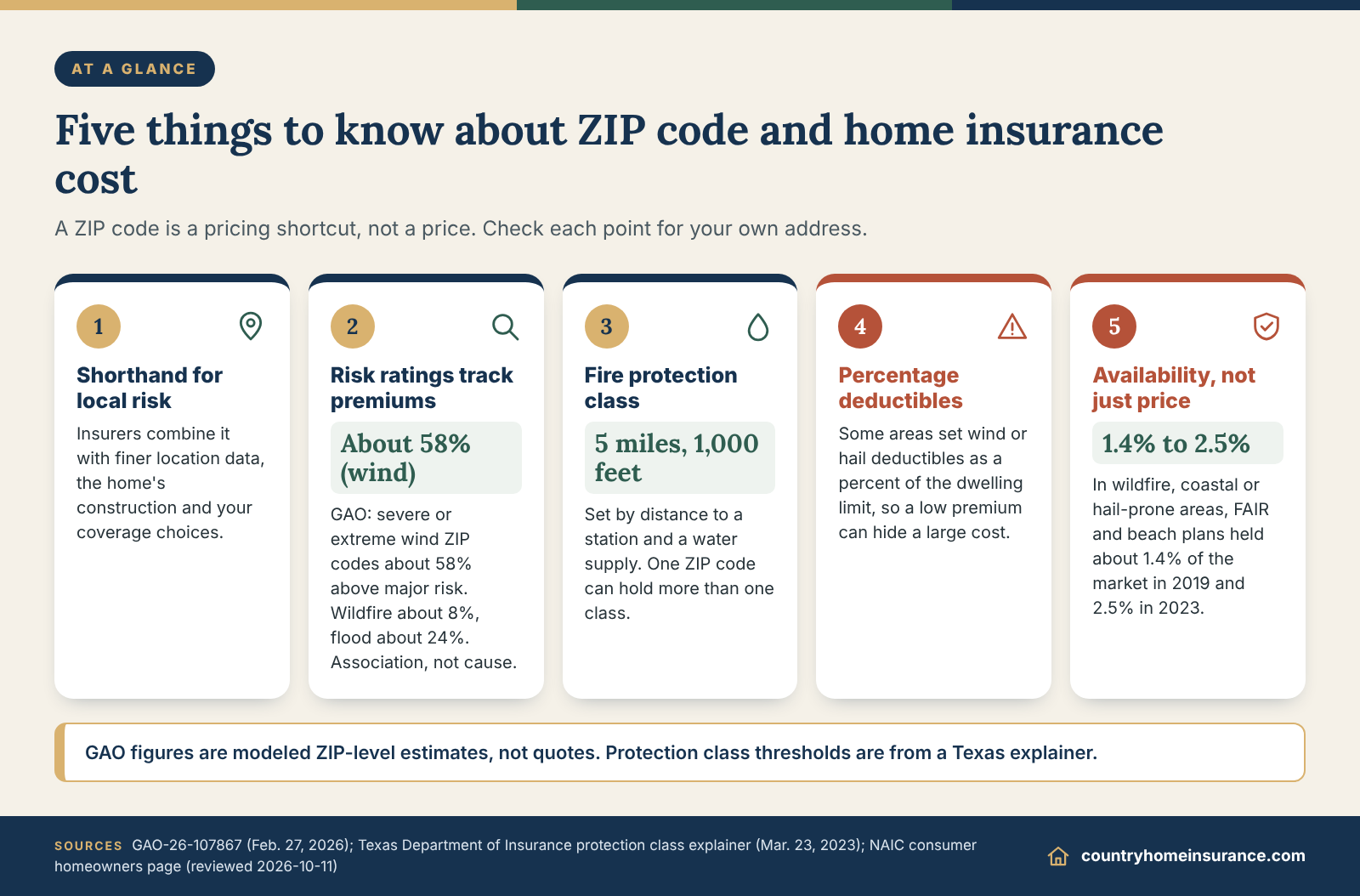
- A ZIP code is a shorthand for local risk, not a price. Insurers combine it with finer location data, the home’s construction and your coverage choices.
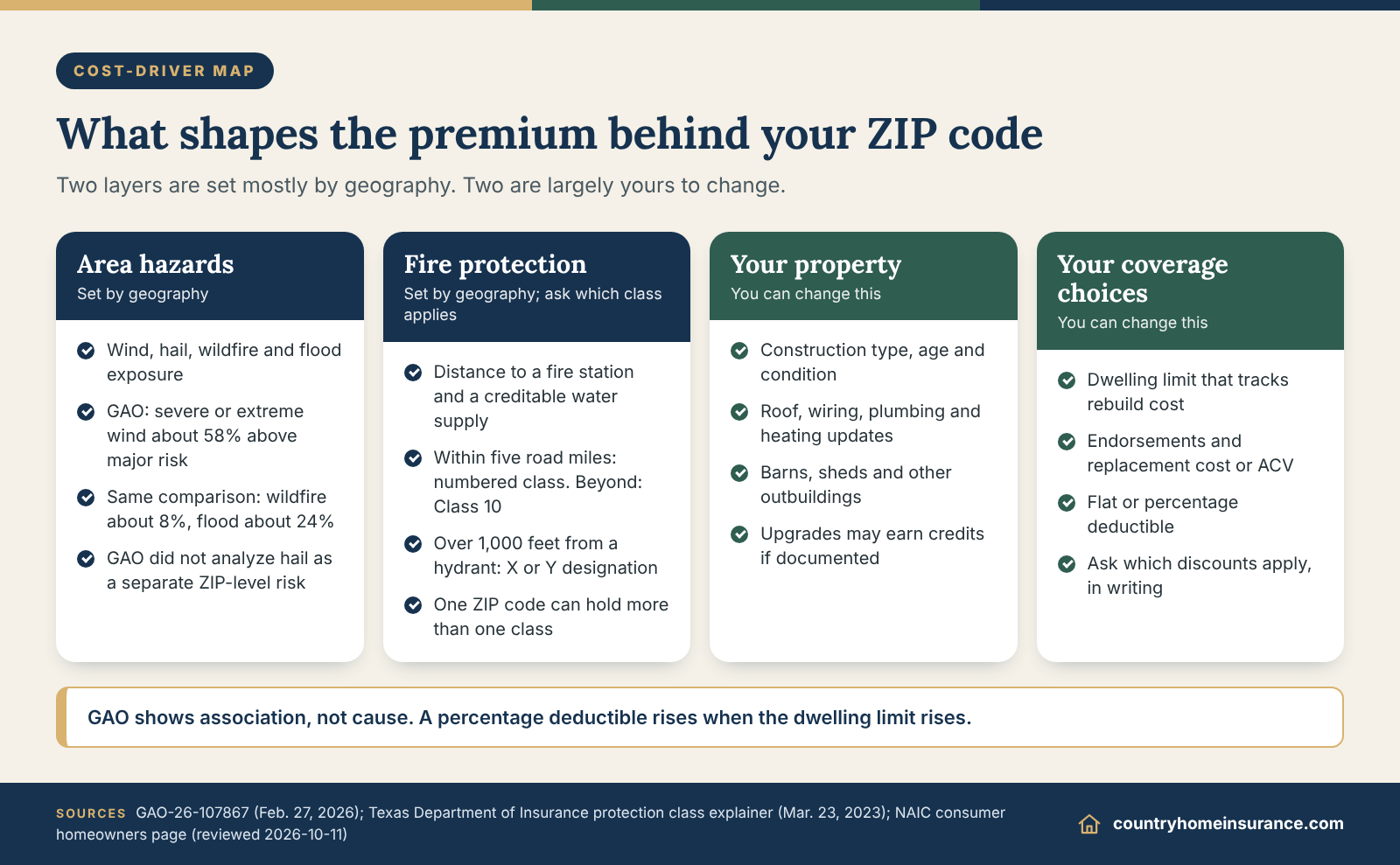
- A U.S. Government Accountability Office (GAO) analysis of ZIP-level estimates found premiums were higher where wind, wildfire and flood risk were rated higher, but it stressed these are associations, not proof of cause.
- In rural areas, distance to a fire station and to a water supply can matter more than the ZIP code itself, and one ZIP code can hold several fire protection classes.
- Some locations carry percentage deductibles for wind, hail or named storms, so a “cheap” premium can hide a large out-of-pocket amount.
- In wildfire, coastal or hail-prone areas, the practical question may be availability, not price. Residual-market plans exist, but terms and costs differ.
- Compare quotes with matching limits, deductibles and endorsements, and ask each insurer which location factors it used.
| Location-linked factor | How it can affect price or eligibility | What to verify |
|---|---|---|
| Weather and catastrophe exposure | Higher modeled wind, hail, wildfire or flood risk is associated with higher premiums and sometimes tighter underwriting | Whether your policy has percentage or separate wind/hail deductibles, and whether flood is covered at all |
| Fire protection | Distance to a fire station and to a creditable water supply feeds a community protection class that many insurers use at their discretion | Your protection class, and whether your address sits in a split class |
| Local rebuilding costs | Construction and repair costs are generally higher in some areas and where supplies are limited, which raises the cost to rebuild | Whether your dwelling limit tracks a current rebuild estimate for your address |
| Insurer appetite and availability | Insurers limit exposure by geography and peril, and some decline or non-renew in areas they consider too risky | Which insurers are actively writing new business at your address, and what the residual plan offers |
| Local crime and claims patterns | Regulators list local crime rates and area claims history among the location-related factors in play | Which theft, liability or water-claim factors your insurer discloses |
| State rules | Rate approval, mitigation credits and nonrenewal protections differ by state, so the same ZIP-level hazard can price differently across state lines | Your state Department of Insurance consumer pages |
What a ZIP code tells an insurer, and what it doesn’t
If you’ve ever typed your ZIP code into a quote form and watched the number jump, you’ve seen a location factor at work. This section explains why ZIP codes show up in pricing so often, and where they stop being useful, so you can tell the difference between a cost you can’t change and one you can.
Why do insurers lean on ZIP codes at all?
A ZIP code is a postal delivery area, not a risk boundary. Insurers use it anyway because it is a convenient, widely available label that can be matched to hazard maps, claims records and loss data. The GAO said in 2026 that it built its analysis at the ZIP level precisely because insurers often use ZIP codes in pricing decisions.
A postal label doubles as a pricing shortcut
Think of the ZIP code as the first filter, not the last word. It lets an insurer’s system group properties that share weather patterns, road networks and fire district boundaries. The GAO report, dated February 27, 2026, describes insurers setting a statewide total premium and then spreading it across policyholders according to the risk each property presents. The ZIP code is one of the inputs that places your property in that spread, alongside building material and other rating factors.
Rating territories can be finer or coarser than a ZIP code
Not every insurer slices the map the same way. A rating bureau circular from North Carolina in 2014, for example, described territories defined mostly by county, with separate codes for beach areas and with ZIP codes used only for certain coastal counties. That document is old and was describing a proposal, so it doesn’t tell you how North Carolina rates today. What it does show is that “location” in a rating plan can mean a county, a beach zone or a ZIP code depending on the state and the insurer. Ask your agent which unit your quote uses.
What is actually being priced behind the ZIP code?
The label matters less than what it stands for. Regulators consistently describe a bundle of location effects: how often and how severely the area experiences losses, how expensive it is to rebuild there, and how well the community can fight a fire.
Hazard and loss costs shape the base rate
Catastrophe losses hit some regions repeatedly. The Congressional Budget Office (CBO) explained in August 2024 that insurers weigh the size and location of structures and the hazards in the area, and that they may recognize steps that reduce damage, such as fire-resistant materials or cleared vegetation. The same report notes that wildfire models are less established than those for hurricanes and earthquakes, which is one reason wildfire pricing and underwriting can feel inconsistent from one insurer to the next. Insurers also buy reinsurance, which is insurance for insurance companies, and the National Association of Insurance Commissioners (NAIC) says those costs have risen significantly and feed into what homeowners pay.
Rebuild cost and material supply vary by place
Your dwelling limit is meant to reflect the cost to rebuild, and that cost has a geography. The NAIC notes in a November 2024 consumer article that construction and repair costs are generally higher in more populated areas and in places where supply is limited. For a country property, “limited supply” can mean long hauls for materials, fewer available contractors and slower repair timelines after a widespread storm. None of that appears in a ZIP code, but all of it can show up in a replacement-cost estimate. For the mechanics of choosing the number itself, see our article on how home value and rebuild cost drive premiums.
Fire protection links your address to the nearest station
The NAIC consumer page on homeowners insurance says location effects include local crime rates and access to fire, police and water services, which together help set a protection class. In a city, that usually means a hydrant down the block. In the country, it can mean the distance to a volunteer fire department and the nearest water source. The rural sections later in this article go deeper on how that classification works.
Weather and wildfire exposure: the ZIP-level pattern
For most readers, the single biggest location effect is the local catastrophe profile. A national study released in 2026 gives a useful, carefully caveated look at how that plays out across tens of thousands of ZIP codes.
What did GAO’s ZIP-level analysis find?
The GAO’s report, titled Homeowners Insurance: Premiums Generally Tracked Inflation but Rose More in Disaster-Prone Areas, is the most useful public look at ZIP-level pricing patterns because it states its method in detail. Read it as a map of associations rather than a pricing manual.
How the analysis was built
GAO used annual average estimated premiums at the ZIP-code level for 2019 through 2024, supplied by First Street Technology, covering 29,882 ZIP codes across the 50 states and the District of Columbia. Premiums were converted to 2024 dollars with the consumer price index, and coverage levels and deductibles were held equal, so the comparisons are not distorted by people simply buying more or less insurance. GAO checked the data against several other sources and reported a correlation of 0.66 with 2018 through 2022 NAIC premiums, which suggests the estimates are informative but not identical to what policyholders actually paid. These are modeled estimates, not filed rates or quotes.
How much higher were premiums in higher-risk ZIP codes?
On average, ZIP codes with severe or extreme wind risk had premiums about 58 percent higher, roughly $1,294 a year, than ZIP codes rated at major wind risk. Major wind risk itself was about 15 percent above minor-to-moderate. For wildfire, severe or extreme ZIP codes were about 8 percent higher, about $181, than major-risk ZIP codes, and major was about 11 percent above minor-to-moderate. For flood, severe or extreme risk was about 24 percent higher, about $550, than major risk. Hail was not analyzed as a separate ZIP-level risk, which matters for readers in the Plains and Mountain West where hail drives many claims.
Growth rates and the caveat that matters
Since 2021, premiums in severe or extreme wind or wildfire ZIP codes grew about 6 to 10 percent a year on average, while major-risk ZIP codes grew about 1 to 4 percent. At least ten ZIP codes in North Carolina, Texas, Utah, Florida and California rose more than 25 percent after inflation between 2019 and 2024, and many coastal areas of North Carolina and Texas rose more than 50 percent. GAO states plainly that its regression does not show these factors caused the increases. Treat the figures as a description of where costs concentrated, not as a forecast for your address.
How does each peril show up in a real policy?
A premium is only part of the story. The same hazard that raises your price may also change how your deductible works or whether a peril is covered at all.
Wind and hail: priced in, then often deducted separately
In areas with frequent storms, insurers commonly apply a separate wind and hail deductible, sometimes expressed as a percentage of the dwelling limit instead of a flat dollar amount. The NAIC’s 2022 consumer guide notes that some areas use catastrophe deductibles set as a percentage. Insurance Information Institute (Triple-I) data from Verisk’s ISO for 2019 through 2023 show wind and hail claims occurring about 2.8 times per 100 house-years with an average paid severity near $14,747, which helps explain why insurers pay attention to storm geography. Those are national figures, so your local experience may differ.
Wildfire: scored by property and surroundings
Wildfire pricing and eligibility often use property-specific scores that consider vegetation, slope and road access for emergency vehicles. United Policyholders, a consumer advocacy group, reports that providers such as Verisk and CoreLogic produce these scores on different scales, that insurers set their own thresholds, and that a homeowner can ask an agent for the score even though insurers are not required to disclose it. Because the score depends heavily on the surrounding landscape, a homeowner may have limited ability to change it.
Flood: a separate policy with its own location pricing
Standard homeowners policies typically exclude flood, and FloodSmart, the National Flood Insurance Program (NFIP) consumer site, says most homeowners insurance does not cover flood damage. Under the NFIP’s Risk Rating 2.0 method, which applies to policies effective on or after October 1, 2021, FEMA considers each property’s flood frequency, flood types, distance to flood sources, first-floor height and rebuild cost, rather than leaning mainly on broad flood zones. Increases for existing policyholders are generally capped at 18 percent a year until they reach the full-risk rate, according to FEMA’s July 2025 fact sheet. If your ZIP code looks “dry” on a map, check the property-level flood picture before deciding.
Fire protection and the rural ZIP code
City buyers rarely think about how far the nearest fire station is. Country buyers should, because it can change both the price and the quote you receive. A ZIP code can cover many square miles of farmland and a small town at the same time, and the two can be treated very differently.
How does public protection classification work?
Public protection classification, often shortened to PPC, is a grade given to a community’s ability to fight structure fires. Many insurers use it as one input when they rate a home. The most detailed public explanation we retrieved comes from the Texas Department of Insurance, which describes how the Insurance Services Office (ISO), a Verisk business, surveys communities. Texas adds a few state-specific scoring items, so details can differ elsewhere, but the core logic is widely recognized.
A 1-to-10 scale built from four main building blocks
Communities receive a class from 1 to 10, with Class 1 the best. The Texas explainer, dated March 23, 2023, says grading follows a schedule that gives the most weight to the fire department itself (about 50 points), followed by water supply and distribution (about 40), emergency communications (about 10) and community risk reduction (about 5.5). In plain English, the grade reflects how many trained people and trucks can arrive, whether there is enough water to work with, and how quickly a call turns into a dispatch. A higher grade does not guarantee a lower premium, because insurers use the information at their own discretion alongside many other underwriting factors.
The five-road-mile and 1,000-foot thresholds
Two distances do much of the work for rural properties. Homes within five road miles of a fire station are scored under the community’s numbered class, while homes beyond that distance fall into Class 10. A property within five road miles but more than 1,000 feet from a creditable water supply, such as a hydrant, receives an “X” or “Y” designation instead of the main class. Homes five to seven road miles from a station may qualify for a 10W class when a creditable water supply is available, and hauled water can count toward that. These are Texas-published descriptions of the ISO method, so confirm how your own state and insurer apply them.
Split classes can place neighbors in different tiers
A single community can have more than one class. The Texas document gives the example of a community that is mostly Class 4 but has rural areas beyond 1,000 feet of a hydrant that are classed 4X, and it notes that rural or large-lot areas surrounded by a single-class community are the ones that typically split. This is why two houses with the same ZIP code can receive different protection credits. The documents we reviewed did not describe a public lookup tool. The explainer says communities can publish their score through a website, social media or a letter, and that fire chiefs can request a survey. Your agent or local fire chief may be able to tell you the class that applies to your address.
What country-property questions does a ZIP code hide?
A ZIP code summarizes the neighborhood. It says nothing about your driveway, your pond, your barn or the way your property is actually used. Those details often influence underwriting even when they never appear in a rate table.
Volunteer departments, water sources and access
Many rural communities are served by volunteer fire departments, and many rural homes rely on wells rather than hydrants. Neither fact is bad in itself, but both bear on the protection class rules described above, particularly the water-supply and distance thresholds. Ask your agent whether the quote reflects a verified class for your exact address or a default for the ZIP code. If your lane is long, gated or unpaved, mention that when asking about response times; this is a reason to ask questions, not a rating rule we can cite.
Outbuildings, acreage and how the insurer sees them
Barns, workshops, sheds and detached garages are usually handled as separate structures, and acreage can raise questions about farming, livestock or commercial use that a standard homeowners form may not cover. The ZIP code does not tell an insurer any of this, so the application does. If you keep animals, run equipment or earn income from the land, tell the insurer early, because a mismatch between the application and reality is a far bigger problem than a modest premium difference. Our rural guides cover those exposures in more depth.
Distance to services after a loss
Remote location can also affect the practical side of recovery. Construction and repair costs tend to be higher where supply is limited, as the NAIC observes, and contractors may be scarce after a widespread storm. That does not change your policy language, but it is a good reason to review whether your dwelling limit and your extended replacement cost option, if offered, reflect rebuilding in your area rather than the national average.
Reading published ZIP-code and state averages without being fooled
Search for your ZIP code and you will find averages from rate publishers, regulators and trade groups. Some are useful. Almost none are comparable with each other, and none is a quote.
What does homeowners insurance cost by ZIP code look like in published data?
Every average is built on a particular sample, a particular year and a particular house. Change the assumptions and the number moves, sometimes by thousands of dollars. Before you use a figure, find the publisher, the data year and the coverage assumptions.
Methodology decides what the number means
Compare how three well-known sources describe themselves. The NAIC data reported by Triple-I are average premiums for a standard HO-3 homeowners form for 2022, published in a May 2025 NAIC study. Insurify says it averaged rates from more than 180 insurers, using partner and Quadrant Information Services data, with defaults of a 1980 home, no claims, good credit, $300,000 of dwelling coverage and a $1,000 deductible, updated September 30, 2026. Policygenius analyzed Quadrant sample quotes gathered in March 2022 for a $300,000 dwelling with a $1,000 deductible across 34,587 ZIP codes. Table 2 sets these side by side.
ZIP-to-ZIP spread within one state can be wide
The Policygenius ZIP study, whose page was updated in January 2024 although the quotes date to March 2022, shows how far apart nearby places can sit. Its examples included El Paso, Texas (ZIP 79925) at $1,626 a year compared with Mineral Wells, Texas (ZIP 76067) at $4,192, against a Texas average of $2,919. Ann Arbor, Michigan (48109) was $1,242 while Detroit (48213) was $4,109. Because those are sample quotes from 2022 under one set of assumptions, use them to understand the pattern of dispersion, not to estimate what a current policy costs.
Why you should not mix averages from different publishers
It is tempting to line up a 2022 regulator average against a 2026 rate-publisher average and conclude that prices have exploded. Don’t. The samples, house characteristics, deductibles and years differ, so the gap is partly methodology. The same caution applies to Insurify’s own page: the deductible table and the headline national average on that page do not appear to line up, which is a reminder to treat even a current number as an approximation. The GAO’s inflation-adjusted trend for its own modeled data is a more defensible way to talk about change over time than comparing across publishers.
| Publisher and data year | Geography and method | Key assumptions | Headline figures |
|---|---|---|---|
| NAIC via Triple-I, 2022 premiums (study published May 2025) | State averages of the HO-3 homeowners form | Reported premiums for that form; not tied to one house profile | National $1,569; Florida $2,677 (highest); Oregon $893 (lowest) |
| GAO using First Street Technology estimates, 2019 to 2024 (report dated Feb. 27, 2026) | 29,882 ZIP codes, modeled average premiums | Coverage and deductibles held equal; adjusted to 2024 dollars | National average $2,829 in 2024, up about 3 percent in real terms since 2019 |
| Insurify, updated Sept. 30, 2026 | States and cities; 180-plus insurers; monthly updates | 1980 home, no claims, good credit, $300,000 dwelling, $1,000 deductible | National $2,808; Florida $6,408; Vermont $984 |
| Policygenius with Quadrant quotes, gathered March 2022 (page updated Jan. 2024) | 34,587 ZIP codes; sample quotes | $300,000 dwelling, $1,000 deductible, no claims, good credit | National $1,754; El Paso, TX ZIP $1,626 vs. Mineral Wells, TX ZIP $4,192 |
Why do two neighbors in one ZIP code get different quotes?
Even inside a single ZIP code, your quote and your neighbor’s can diverge by hundreds or thousands of dollars. The ZIP code sets the stage; the rest of the application writes the script.
Insurers weigh the same factors differently
The GAO explains that rating factors, including location and building material, are weighted differently by each insurer, so premiums vary by company and state. One state regulator told GAO that premiums largely reflect projections of future claims across the whole state, which may not capture property-level mitigation. In practical terms, one insurer may see a hillside lot as a wildfire concern while another puts more weight on roof age. Shopping several companies is the only way to learn which weighting works in your favor.
The house still matters at the address level
The NAIC consumer guide lists construction type, age and condition, and the home’s rebuilding cost among the characteristics that affect premium. It adds that frame houses generally cost more to insure than brick, that newer homes may qualify for discounts, and that older homes may need updated heating, plumbing, wiring or roofing to qualify for preferred programs. A new wood-burning fireplace or wooden deck can push costs up. Two neighbors with different roofs and systems are really two different risks.
Coverage choices can swamp location effects
Limits, endorsements and the deductible all feed the premium, and the NAIC reminds shoppers that a higher deductible generally lowers it. A neighbor with a $500 flat deductible and a neighbor with a 2 percent wind and hail deductible are buying very different products, even if the premiums look close. This is why the comparison step later in this article spends so much time on matching coverages. For the credit and claims-history pieces of the puzzle, see our dedicated guides.
When the ZIP code decides eligibility, not just price
In many parts of the country, location affects how much you pay. In some, it affects whether a standard insurer will take the risk at all. The distinction matters because the right response to a high price is shopping, while the right response to unavailability may be a residual-market plan, a surplus-lines policy or a mitigation project.
How do residual-market plans tie coverage to location?
Residual-market plans, often called FAIR Plans or beach and windstorm plans, are state-created or state-authorized programs meant to offer property coverage when the private market will not. Many are defined by geography, which makes your ZIP code or county a direct eligibility input.
The share of homeowners in residual plans has been rising
The GAO reported that FAIR and beach plans held about 1.4 percent of the U.S. homeowners market in 2019 and about 2.5 percent in 2023. In California, ZIP codes with severe or extreme wildfire risk had a FAIR Plan share roughly 12 percentage points higher than ZIP codes with minor-to-moderate risk, using 2020 through 2023 data, and the plan’s residential policy count grew from about 200,000 in 2020 to about 450,000 in 2024. The CBO noted in 2024 that limits on price increases can push high-risk policies into residual plans, where premiums may be set above private-market rates. A residual plan is a safety net, not a bargain, and the coverage it offers can be narrower than a standard homeowners policy.
Texas Windstorm Insurance Association: a plan defined by county
The Texas Windstorm Insurance Association (TWIA) is a clear example of eligibility drawn on a map. It was created by the Texas Legislature in 1971 and is described on its own site as an insurer of last resort for wind and hail coverage. Its designated catastrophe area includes 14 first-tier coastal counties (Aransas, Brazoria, Calhoun, Cameron, Chambers, Galveston, Jefferson, Kenedy, Kleberg, Matagorda, Nueces, Refugio, San Patricio and Willacy) plus part of Harris County east of Highway 146. TWIA covers wind and hail only, so other perils such as fire or theft must be insured elsewhere. A homeowner in those counties may therefore carry two policies, and the comparison should include both.
California’s wildfire “distressed area” commitments
California illustrates a more complex arrangement. According to a California Department of Insurance FAQ dated October 2024, a wildfire distressed area is defined by a hybrid of ZIP codes (those with a FAIR Plan concentration of at least 15 percent that also have high or very high wildfire hazard on state maps, plus certain lower-income ZIP codes), counties and FAIR Plan pockets. Insurers that want to use forward-looking catastrophe models must increase their writing in those areas, and the FAQ describes an 85 percent commitment for distressed areas, plus a minimum 5 percent expansion for smaller insurers and new entrants. How that target is measured is a detail to confirm in the Department’s own materials. The FAQ describes the area map as a draft based on preliminary data and subject to annual updates, so check the Department’s current map and your insurer’s actual appetite before assuming either.
| Program or rule | Location trigger | What it does, in brief | What to verify |
|---|---|---|---|
| Texas Windstorm Insurance Association | 14 first-tier coastal counties plus part of Harris County | Last-resort wind and hail coverage only | Whether your address is in the designated area and how you cover other perils |
| California wildfire distressed-area commitments | Hybrid of ZIP codes, counties and FAIR Plan pockets | Insurers using catastrophe models agree to expand writing in those areas | The current map, status of commitments and which insurers are writing |
| California one-year nonrenewal moratorium after a declared wildfire | Fire perimeters and listed adjoining ZIP codes in the Department’s bulletin | Insurers may not issue wildfire-risk cancellation or nonrenewal notices in the listed ZIP codes for the period | Whether your ZIP code is on the current bulletin and the exact end date |
| NFIP Risk Rating 2.0 | Property-level flood frequency, distance to flood sources, first-floor height and rebuild cost | Prices flood coverage by individual property, with increases generally capped at 18 percent a year for existing policies | Your property-level premium and whether your lender requires flood coverage |
What about nonrenewals, moratoriums and wildfire risk scores?
Few moments in a homeowner’s life are as stressful as an unexpected nonrenewal notice. Location is often the reason, and the rules about what insurers may do vary a great deal by state.
California’s ZIP-based moratoriums after declared wildfires
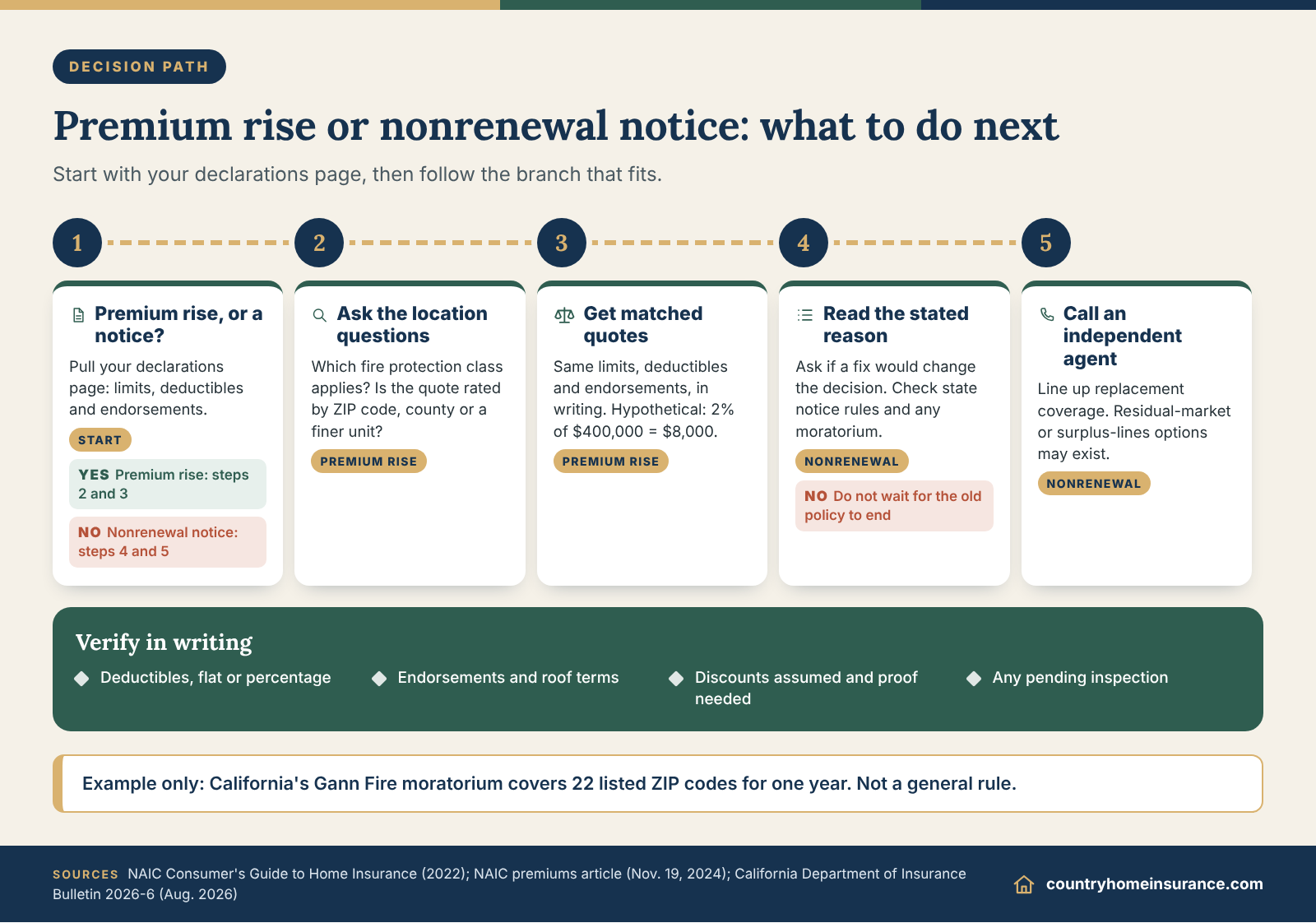
California offers the clearest documented example of location-based nonrenewal protection. After the Gifford Fire, the Insurance Commissioner announced on January 9, 2026 a one-year moratorium, running from the governor’s December 23, 2025 emergency declaration, protecting people inside the fire perimeters and in 29 adjoining ZIP codes, with up to 24 months of protection for homeowners with a total loss. For the Gann Fire in Calaveras County, Bulletin 2026-6 says insurers may not issue wildfire-risk cancellation or nonrenewal notices in 22 listed ZIP codes for one year starting August 6, 2026, and must offer to rescind such notices issued on or after that date. These protections attach to a declared emergency and a specific list of ZIP codes, not to a whole state. Consumers who think an insurer is violating the moratorium can contact the Department, which lists 800-927-4357 in its release.
How other states handle post-disaster nonrenewals
Rules differ widely. The Florida Chief Financial Officer’s consumer FAQ states that after a declared emergency and a Commissioner order, insurers generally cannot cancel or nonrenew a residential policy with hurricane or wind damage until 90 days after repairs, with some exceptions. That is a damage-based rule rather than a ZIP-code list. We did not verify equivalent rules for other states for this article, so if you live elsewhere, check your own Department of Insurance for nonrenewal notice periods and storm-related protections.
What to ask when a notice arrives
If you receive a cancellation or nonrenewal notice, read the stated reason carefully and note the date. Ask the insurer whether the cause is the location, the roof, a claim, a score or something else, and whether any fix would change the decision. United Policyholders reports that insurers must give a reason for a refusal, though it can be general, and that insurers are not required to disclose a wildfire risk score; some say they do not use third-party scores at all. Contact an independent agent right away so replacement coverage is in place before the old policy ends, and call your state Department of Insurance if the notice doesn’t make sense. Our nonrenewal article covers the process step by step.
Deductibles and roof terms that change with location
When you compare premiums across locations, the premium is the visible number and the deductible is the hidden one. In storm country, it can be the more important of the two.
How do percentage deductibles work?
A deductible is the amount you pay toward a covered loss before the insurer pays. Most people think of it as a flat dollar figure, but in areas with frequent storms, insurers often attach a percentage deductible to wind, hail or named-storm losses.
The mechanics: a percentage of the dwelling limit
The NAIC tells shoppers to ask whether a deductible is a fixed dollar amount or a percentage of the home’s insured value, and its 2022 consumer guide notes that some areas use catastrophe deductibles set as a percentage rather than a dollar amount. A percentage deductible is typically applied to the Coverage A dwelling limit, so raising your dwelling limit to match rebuilding costs also raises the dollar deductible. The policy form and declarations page state which perils are subject to it, so look for the exact wording rather than assuming.
A hypothetical example of the dollar impact
Hypothetical example: Suppose a homeowner carries $400,000 of dwelling coverage, with a 1 percent wind and hail deductible on one quote and a 2 percent deductible on another. The first quote implies $4,000 out of pocket before the insurer pays on a covered wind loss, and the second implies $8,000. The second quote may carry a lower premium, but the homeowner would need to be comfortable paying twice as much after a storm. Table 4 shows how the same percentages scale at other limits. These figures illustrate arithmetic only; they are not quotes or predictions about any insurer.
| Dwelling limit | 1 percent deductible | 2 percent deductible | 5 percent deductible |
|---|---|---|---|
| $250,000 | $2,500 | $5,000 | $12,500 |
| $300,000 | $3,000 | $6,000 | $15,000 |
| $400,000 | $4,000 | $8,000 | $20,000 |
| $500,000 | $5,000 | $10,000 | $25,000 |
Split deductibles and a Texas FAIR Plan example
Some insurers and plans use split deductibles, with one amount for wind and hail and another for all other perils. The Texas FAIR Plan Association announced on its site, in a notice published April 27, 2026, that beginning July 1, 2026 it eliminated its 1 percent wind and hail option, leaving choices of 2 to 5 percent for wind and hail and 1 to 5 percent for other perils, and that separate deductibles are allowed. Existing policies with a 1 percent wind and hail deductible move to 2 percent at renewal, and deductibles can’t be changed on a policy already in force. This is one program’s rule, not a national standard, but it shows how a location-linked deductible can change midstream.
Why do roof terms vary by location?
Roofs take the brunt of hail and wind, so insurers in storm-exposed areas have been rewriting how roof losses are paid. The GAO’s 2026 report documents several of those moves.
Depreciated roof value instead of full replacement cost
GAO found that some insurers cover the depreciated value of older roofs instead of full replacement cost. In practice, that means the payment on an older roof may be reduced for age and wear, and the homeowner covers the difference. This is how actual cash value works in general, and the NAIC advises shoppers to ask whether coverage pays actual cash value or replacement cost value because replacement cost gives more protection but usually costs more. Ask whether the roof is settled on a different basis than the rest of the dwelling, and get the answer in writing.
Separate roof deductibles and discounts for accepting lower payments
GAO also reported that some insurers require a separate “split” deductible for roof damage, and one insurer described offering a discount to policyholders who accept lower roof claim payments, saying this was needed in high-hail areas such as Oklahoma. A lower premium bought by giving up roof payments can look attractive on a quote comparison, but it shifts a large, common loss back to the homeowner. Make sure comparison quotes treat the roof the same way, or the cheapest option may simply be the one that covers the least.
What to ask about roof terms before you buy
Before you sign on the dotted line, ask how the policy treats roofs of your age and material, whether a separate wind and hail or roof deductible applies, whether cosmetic damage is excluded, and whether any inspection or replacement requirement could affect renewal. Because state rules differ on roofs, check with your Department of Insurance for current guidance in your state. For the dwelling limit that sits underneath all of this, our cost article on coverage amounts explains how to size it.
Discounts that can offset a high-cost ZIP code
You can’t move your property to a cheaper ZIP code, but you can change much of what sits inside it. Discounts and mitigation are where homeowners have the most control, with one important caution: amounts and eligibility are set by each insurer and each state, so none of the examples below is a promise.
Which discounts are common across insurers?
The NAIC’s consumer materials group home insurance discounts into a few predictable families. Whether you qualify, and how much each is worth, depends on the insurer and often on your state.
Bundling and protective devices
The NAIC says insuring home and auto with the same company can reduce premiums, and that protective devices such as smoke detectors, burglar alarms, sprinklers, deadbolts and window security devices may earn discounts. Insurers may define a qualifying system differently, so ask what the insurer actually requires and what proof it wants. In rural areas where response times are longer, a monitored smoke or heat alarm may be worth considering for safety reasons alone, whether or not it moves the price.
Home hardening and upgrades
The NAIC consumer guide also lists storm shutters, updated electrical or plumbing systems, a new roof and home security systems among the upgrades that may earn credits. Older homes may miss out on preferred programs until key systems are updated, according to the NAIC consumer page. If you have recently replaced a roof or rewired a farmhouse, collect receipts, permits and contractor documentation, because an insurer will usually want proof before applying a credit.
Ask for the discount list in writing
The NAIC suggests asking your agent which discounts apply because you may qualify for some you wouldn’t expect. Make the request concrete: ask for a list of discounts applied to each quote, the condition for each, and whether any was assumed rather than verified. A quote that quietly assumes a discount you can’t document can jump at renewal or when the insurer inspects. If you receive two quotes with different assumptions, ask both insurers to re-run them on the same inputs.
Do any mitigation incentives depend on where you live?
Yes, but they vary so much that general statements are risky. State programs, insurer filings and local building standards all play a part.
An example from Alabama: FORTIFIED discounts
The FORTIFIED Home program’s Alabama page says most Alabama insurers offer discounts of up to 55 percent on the wind portion of the premium, ranging from about 25 to 35 percent for a FORTIFIED Roof to 45 to 55 percent for FORTIFIED Gold, and that a state grant program offered up to $10,000 for qualifying primary residences when funded. The page itself says the grant applies only when funded, and its metadata shows a last-modified date of December 10, 2021, so confirm current discounts, grant status and tax treatment with the program and your insurer. This is a program example, not an Alabama rule, and the same discounts will not apply in other states.
State grant and consumer programs
The NAIC suggests checking with your state insurance department for mitigation grant programs, such as roof upgrades, as well as for discounts or rebates. The CBO adds that insurers may account for mitigation such as fire-resistant materials, vegetation clearing or elevating structures, though the report does not give credit amounts. Treat that as a reason to ask, not as a reason to expect a particular dollar saving. A project that costs several thousand dollars should be evaluated with a written statement from your insurer of what credit, if any, it will earn.
Credit-based insurance scores and claims history, briefly
Two personal factors ride along with location. The NAIC says many states let insurers use credit history, often called an insurance score, to decide whether to sell a policy and what to charge, and it advises asking how your credit affects your rate. The NAIC also warns that if a repair costs little more than the deductible, paying yourself may be better than filing, since claims can affect future premiums. Rules about both vary by state. We cover each in its own article so this one can stay focused on location.
A practical plan to compare coverage for your ZIP code
Understanding the pattern only helps if it changes what you do. This plan turns the earlier sections into a sequence you can follow before your next renewal, whether you are shopping because of a price jump, a nonrenewal or a move.
What should you gather before asking for quotes?
Quotes are only as good as the inputs. Spend an hour collecting facts now and you’ll save yourself repeated phone calls later.
Your declarations page and current terms
Start with the declarations page of your existing policy, which lists limits, deductibles and endorsements. Note the dwelling limit, the type of each deductible (flat dollar or percentage, wind and hail or all other perils), whether the roof has special terms and which endorsements you carry. Without this baseline you can’t tell whether a lower quote is a better deal or just a thinner policy. Keep a copy of your home inventory with photos, receipts and serial numbers too; the NAIC recommends building one and storing it somewhere safe.
Location facts to request from your agent
Ask your agent which location unit the quote uses (ZIP code, county or a finer territory), what fire protection class is assigned to your address, whether the insurer uses a wildfire score and what it is, and whether the address sits in a split class or an area with special deductibles. The wildfire-score point comes from United Policyholders, which reports that agents will often share a score on request even though insurers aren’t required to disclose it. If the answers differ between insurers, that is useful information, not a nuisance.
Flood and other separate coverage
A home insurance quote does not include flood. FloodSmart says most homeowners insurance does not cover flood damage, and its basics page adds that 99 percent of counties have had a flood event in the past 20 years. Ask for a property-level flood estimate under the NFIP’s Risk Rating 2.0 method or from a private flood insurer, even if your ZIP code looks dry on a map. If you live in a wind-only plan area like the TWIA territory, add that policy to your comparison as well.
How do you compare quotes fairly?
A fair comparison is more work than it sounds, mostly because insurers present quotes in different formats. The NAIC guide recommends requesting quotes with identical coverages, limits and information, and getting them in writing.
Match the coverage before you compare the price
Line up the dwelling limit, personal property limit, liability limit, loss-settlement basis (replacement cost versus actual cash value), each deductible and each endorsement. Treat any difference as a variable to be explained. If one quote has a 5 percent wind and hail deductible and another has a flat $1,000, use Table 4 to translate the percentage into dollars before you decide which is cheaper. For a fuller walk-through of the comparison itself, see our guide to comparing quotes.
Check more than price
The NAIC advises confirming that the agent and insurer are licensed with your state, then checking the insurer’s complaint index and financial strength ratings from agencies such as A.M. Best, Moody’s and Standard & Poor’s. It also suggests asking whether a claim will affect your renewal premium. In high-risk areas, the insurer’s willingness to renew matters at least as much as the first-year price, so ask how it has handled renewals in your area. Avoid any source that ranks “best” or “cheapest” insurers without disclosing methodology and data year.
Use your state regulator as a cross-check
State Departments of Insurance are the official place to check licensing, complaint information and local consumer rules. The NAIC consumer materials point shoppers to their state insurance department, among other sources, for comparison information. For wildfire, hurricane and hail areas, also look for any state notices about moratoriums, residual-market changes or deductible rules, because those can change quickly. Our guide to getting several quotes explains how many are usually enough.
What if you are buying or moving to a new ZIP code?
A home purchase is the best moment to apply what you’ve learned, because the insurance cost of a location can differ sharply from the listing price and the mortgage payment.
Price the address before you commit
Two homes in different ZIP codes with similar listing prices can have very different insurance costs, as the published ZIP-level spreads show. Ask your agent for a quote on the specific address during your inspection or option period, not at the last minute, and include the deductible type and any separate flood or wind policy in your monthly budget. Our home-buying article walks through the sequence of binders, escrow and closing.
Ask about the property’s own history
Request the roof’s age and any documentation of recent repairs, upgrades and prior losses that the seller can share, and ask the insurer whether any of it affects eligibility or price. A roof near the end of its life, a prior water loss or a lack of recent system updates can matter more at the address level than the ZIP code. If an insurer declines or offers only a narrow policy, you want to learn that while you still have negotiating room.
| Item | Why it matters | Where to get it | Question to ask |
|---|---|---|---|
| Declarations page | Shows current limits, deductibles and endorsements, which anchor every comparison | Your current policy or insurer portal | Which perils carry a percentage or separate deductible? |
| Fire protection class | Distance and water-supply thresholds can change rating credits | Agent, insurer or local fire chief | Is my address in a split class, and what class did you use? |
| Wildfire score, if used | May affect eligibility and price in wildfire-prone areas | Agent, on request | Do you use a third-party score, and how do you treat defensible space and roofing? |
| Flood and wind-only options | Standard policies typically exclude flood, and some areas use wind-only plans | FloodSmart, private flood insurers, TWIA or the local plan | What is my property-level flood premium, and what wind coverage is available? |
| Roof terms | Roof losses may be paid on depreciated value or subject to a separate deductible | Policy form and endorsements | How is a roof of my age and material settled, and is cosmetic damage covered? |
| Discount conditions | Credits may require proof, such as receipts, certificates or monitored devices | Quote worksheet and contractor records | Which discounts are assumed, and what documentation do you need? |
What should you do in the next few weeks?
If renewal is coming up, work backward from the renewal date so you have time to gather answers, collect quotes and, if needed, replace coverage without a gap.
This week: collect the facts
Pull your declarations page, write down the location questions from Table 5, and photograph the roof, outbuildings and major systems. Call your current agent and ask for the fire protection class, the location unit used for rating and any score. Save the answers in one place so you can repeat the same questions with other insurers.
Before renewal: shop, decide and confirm in writing
Request quotes on identical terms, compare them using the checklist, and ask each finalist to confirm in writing the deductibles, endorsements, discounts and any pending inspection requirements. Keep your current policy in force until the new one is bound, and note that state notice rules and policy terms control timing. If an insurer’s answer conflicts with your policy language, the policy and your state Department of Insurance are the final word.
Frequently asked questions
Pricing and published averages
Is there one correct average cost for my ZIP code?
No. Different publishers use different samples, years and house profiles, and even a ZIP-level study can only estimate what an average home might pay under stated assumptions. Use any average to understand the range, then get written quotes for your own home. Check the publisher, data year and assumptions before you rely on a number, and never compare one publisher’s average with another’s as if they were measuring the same thing.
Will moving to a neighboring ZIP code lower my premium?
It might, or it might do nothing. Neighboring ZIP codes can differ in hazard exposure, fire protection and local loss experience, but many insurers rate using units larger or smaller than a ZIP code, and the house itself matters. If you are considering a move, get a quote for the specific address in each place. A cheaper ZIP code with a percentage wind deductible or no flood coverage may cost more in total than a pricier one with simpler terms.
Why did my premium rise when I had no claims?
Premiums reflect more than your own history. The NAIC says insurers’ reinsurance costs have risen significantly, and GAO explains that insurers allocate a statewide premium across policyholders by risk, so area-wide conditions can lift your rate even when you filed nothing. Rising replacement costs and a higher dwelling limit can also push the number up. Ask your insurer for the specific reasons on your renewal, and compare quotes from other companies.
Eligibility and shopping
Can an insurer decline me because of where I live?
Insurers may limit coverage or withdraw from areas they consider too risky, according to GAO, but the rules about notice periods, permitted reasons and temporary protections vary by state. Some states have moratoriums tied to declared emergencies, as California’s ZIP-based examples show. If you receive a notice, read the stated reason, ask what could change the decision, and contact your state Department of Insurance if the notice doesn’t make sense or you need help finding coverage.
Is a FAIR Plan or state wind pool cheaper than a regular policy?
Not necessarily. The CBO notes that residual-plan premiums may be set above private-market rates in some states, and plans can be narrower. TWIA, for example, covers wind and hail only. Residual plans exist to provide a path to coverage when the standard market won’t, so they are best treated as a bridge or a backstop, with a plan to improve the property and return to the admitted market if you can.
How many quotes should I get?
The NAIC recommends comparing several insurers, and in a market with changing appetite, an independent agent who can quote multiple companies may save time. The right number is the one that shows you a meaningful spread on matched terms. Stop when additional quotes no longer teach you anything new about price, coverage differences or renewal practices.
Sources
- U.S. Government Accountability Office: Homeowners Insurance, Premiums Generally Tracked Inflation but Rose More in Disaster-Prone Areas (GAO-26-107867) (dated February 27, 2026)
- Congressional Budget Office: Climate Change, Disaster Risk, and Homeowner’s Insurance (August 2024)
- NAIC: Homeowners insurance consumer page (undated; reviewed 2026-10-11)
- NAIC: Why are my insurance premiums increasing? (November 19, 2024)
- NAIC: A Consumer’s Guide to Home Insurance (2022 edition)
- Triple-I: Facts and statistics, homeowners and renters insurance (NAIC 2022 premium data, study published May 2025)
- Texas Department of Insurance: Public protection classification (March 23, 2023)
- North Carolina Rate Bureau: Circular P-14-6 on homeowners territory definitions (August 13, 2014; historical example only)
- Insurify: Average cost of homeowners insurance (updated September 30, 2026)
- Policygenius: Average home insurance costs by ZIP code (page updated January 9, 2024; quotes gathered March 2022)
- California Department of Insurance: Gifford Fire nonrenewal moratorium release (January 2026)
- California Department of Insurance: Bulletin 2026-6, one-year moratorium (Gann Fire) (August 2026)
- California Department of Insurance: FAQ on insurance commitments in wildfire distressed areas (October 2024)
- Texas Windstorm Insurance Association: Overview (page last modified May 27, 2026)
- Texas FAIR Plan Association: Deductible changes effective July 1, 2026 (published April 27, 2026)
- FEMA / NFIP: Understanding Risk Rating 2.0 fact sheet (July 2025)
- FloodSmart (NFIP): Flood insurance basics (undated; reviewed 2026-10-11)
- FORTIFIED Home: Alabama incentives (page last modified December 10, 2021; may be outdated)
- Florida Chief Financial Officer: Homeowners insurance consumer FAQ (undated; reviewed 2026-10-11)
- United Policyholders: Do you know your home’s wildfire risk score? (advocacy group; original date unclear; reviewed 2026-10-11)
Important coverage note
Coverage depends on the actual policy, endorsements, exclusions, limits, deductible and cause of loss. State laws and insurance programs vary, and insurers apply their own underwriting and rating rules within them. Averages, examples and percentages in this article are illustrations, not quotes, and nothing here promises that any claim will be paid or that any discount will apply. For questions about your own situation, check your declarations page and policy forms, then verify with your insurer or agent and your state Department of Insurance. This article is educational and is not legal advice.
About the editorial team
This guide was prepared by the countryhomeinsurance.com editorial team as general, educational information for homeowners. We research and summarize publicly available material, including state insurance departments, the NAIC, federal agencies, regulators’ consumer guides and published insurer and industry resources. We draw only on the sources that were available to us when we wrote this guide, and we list them in the Sources section with dates where we could find them.
Insurance rules, rates, products and program terms change, differ by state and by insurer, and can apply differently to your situation. We cannot guarantee that this content is complete, current or free of errors. It is not legal, financial, tax or insurance advice, it is not an offer to sell insurance or a recommendation of any insurer, agent or product, and reading it does not create a professional relationship of any kind.
To the fullest extent permitted by law, countryhomeinsurance.com and its editorial team, authors and contributors exclude all liability for any loss, damage or decision arising from the use of, or reliance on, this content. For questions about your own policy or claim, contact your insurer, a licensed agent or broker, your state Department of Insurance or another qualified professional.
Content created: October 11, 2026