
Arkansas homeowners insurance typically covers fire, wind, hail and other weather damage to your house, outbuildings and belongings, but flood and earthquake are usually separate coverages. Tornadoes, hail, ice storms and flash flooding all hit the state, and a new state program now supports FORTIFIED roof upgrades. The NAIC put the 2022 average premium at $1,740, yet your price depends on your own home. Confirm limits and deductibles on your declarations page, and call the Arkansas Insurance Department with case-specific questions.
Key takeaways
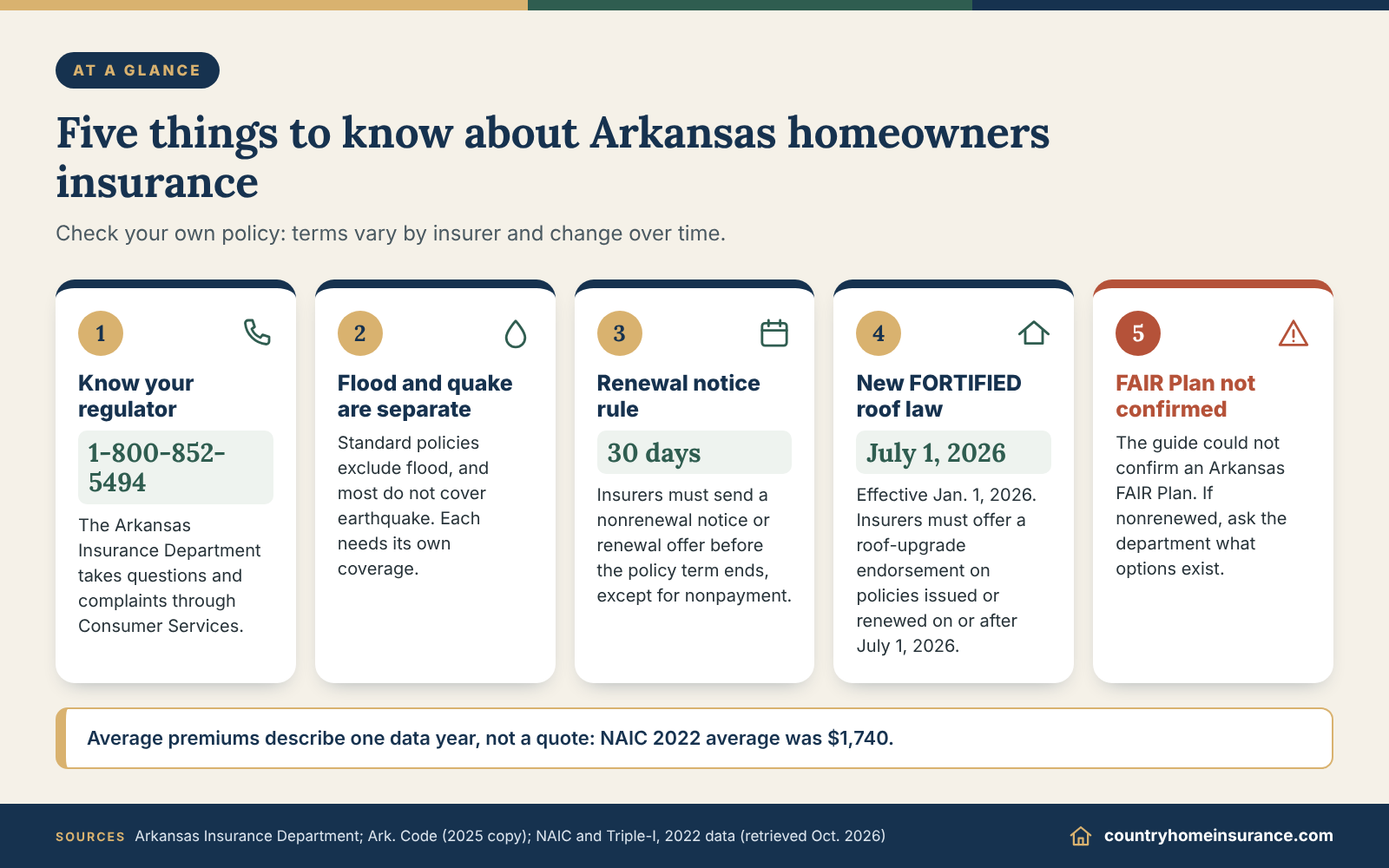
- The Arkansas Insurance Department says standard homeowners policies exclude flood and most do not cover earthquake. Both need separate coverage, and the earthquake route runs through a state Market Assistance Program.
- The NAIC reported a 2022 average homeowners premium of $1,740 for Arkansas against $1,569 nationally. That figure describes one data set and one year, not what you will pay.
- Arkansas statute, as published in the 2025 code, requires a nonrenewal notice or renewal offer at least 30 days before a property policy expires, with the new premium and any deductible change spelled out.
- A law effective January 1, 2026, the Strengthen Arkansas Homes Program Act, created FORTIFIED roof grants and requires insurers to offer a premium discount where actuarially justified and a roof-upgrade endorsement on policies issued or renewed on or after July 1, 2026.
- Rural owners face extra Arkansas rules about volunteer fire department charges and fire-district dues, plus a statutory rural risk plan. We could not verify that plan’s coverage terms, so ask before relying on it.
- We could not confirm an Arkansas FAIR Plan. If a company nonrenews you, ask the department what options exist before assuming none do.
| Scenario | Typical treatment under a standard homeowners policy | What decides the outcome |
|---|---|---|
| Tornado, straight-line wind or hail damage to the house | Generally covered as weather damage, subject to the deductible | Cause of loss, any separate wind/hail deductible, roof age and whether the roof is settled at actual cash value or replacement cost |
| Detached barn, shop, garage or shed | Falls under Other Structures (Coverage B), usually a fraction of the dwelling limit | The Coverage B limit, business or rental use, whether the structure is named or excluded in the policy |
| Fallen tree or debris removal | The department’s storm brochure lists debris and tree removal among items to check for limits or exclusions | Whether the tree hit a covered structure, the removal sublimit and the policy wording |
| Rising water from a creek, river or flash flood | Excluded from standard homeowners policies; needs NFIP or private flood coverage | Separate flood policy, 30-day waiting period, building and contents limits |
| Earthquake damage | Most standard policies do not cover it; endorsement or separate policy needed | Percentage-based deductible, limits, whether your insurer offers it or routes you to the Market Assistance Program |
| Sewer backup caused by flooding | Listed by the department as commonly excluded | Water-backup endorsement, if any, and what caused the backup |
| Vehicles | Not covered by the homeowners policy; auto comprehensive handles storm damage to a car | Your auto policy; belongings inside the car may fall under the homeowners policy |
| Damage while the home sits empty | Some coverage may be suspended automatically if the home is vacant or unoccupied | The policy’s vacancy wording; ask before a long trip, move or extended vacancy |
How Arkansas homeowners insurance is regulated and who sells it
Insurance in the United States is regulated state by state, so the first practical question is who answers the phone when something goes wrong. In Arkansas, that is the Arkansas Insurance Department, and it publishes more consumer material than most homeowners realize. This section covers the regulator, the rules on rates, renewals and credit, and the shape of the market that sells you coverage.
What does the Arkansas Insurance Department do for homeowners?
The department licenses agents and adjusters, reviews filings and runs a Consumer Services Division that takes questions and complaints. Homeowners are most likely to meet it in two moments: shopping or renewing, and after a loss.
Consumer Services contacts and hours
The Consumer Services Division is at 1 Commerce Way, Suite 102, Little Rock, AR 72202-2087. Callers can reach it at 501-371-2640 or, toll free, at 1-800-852-5494, and its fax number is 501-371-2749. The department’s homeowners claims guide and storm brochure (revision dated November 2025) both give weekday hours of 8:00 a.m. to 4:30 p.m. and list [email protected] as the email address. The department’s Consumer Services page adds that after significant storm damage, staff travel to affected areas to help homeowners file claims and obtain emergency living expenses.
Filing a complaint and what to include
The department accepts complaints through an online form hosted by the NAIC, or by a printed form sent by email, fax or mail. Its complaint page asks you to submit the complaint only once. Have these details ready: your name, address and phone number, the insurance company, the insured person, the policy and claim numbers, the agent or adjuster, the date of the loss, and a short description of the problem. The page also warns that complaints are subject to public disclosure as public records. It does not state a response deadline, so keep your own dated notes.
What the department says it cannot do
The department’s claims guide is candid about limits. Consumer Services can investigate complaints, give clear answers and help untangle misunderstandings. It cannot force an outcome that facts or law do not support, provide legal services, decide differences of opinion or file a lawsuit for you. The guide says courts make final determinations. That is a useful expectation to set early: the department is a free referee for process and rule violations, not an advocate who argues your case.
How are Arkansas rates, renewals and credit use regulated?
Three rules shape what happens at renewal time. The statute text below comes from a published copy of the 2025 Arkansas Code, so confirm current wording with the department before relying on a specific number.
Rate filings and the public search tool
Arkansas Code § 23-67-211 requires insurers to file their rates with the Insurance Commissioner. In a competitive market, filings are due 20 days before the effective date, and in a noncompetitive market 60 days. For homeowners multi-peril and dwelling fire policies, an overall rate increase must be published on the department’s website, and an increase of 20 percent or more must also run in a statewide newspaper on three consecutive business days. You can search these filings yourself. The department’s rate change filings portal lists date filed, company, coverage type, rate change, rate type and SERFF tracking number, and lets you filter by coverage type, including Homeowners. When we checked on October 11, 2026, it showed 2,365 items.
Renewal and nonrenewal notice periods
Under § 23-88-105, an insurer must send either a written notice of nonrenewal or an offer of renewal at least 30 days before a property policy’s term ends, except for nonpayment of premium. The renewal offer has to state the new premium and describe any change in the deductible or other policy provisions, and the agent must receive written or electronic notice too. Separately, § 23-67-211(d) says that when a rate revision raises a renewal premium for reasons other than a change in the insured risk, the insurer must send notice to you and your agent at least 30 calendar days before renewal. Read every renewal packet for deductible changes, because a quiet shift from a flat deductible to a percentage can matter more than a modest premium bump.
Limits on credit-based underwriting
Insurers may use credit information in Arkansas, but the Use of Credit Information in Personal Insurance Act sets guardrails. Under § 23-67-405, an insurer may not cancel, deny or nonrenew a personal policy solely because of credit information, may not base a renewal rate solely on it, and may not take adverse action for the lack of a credit card account. Credit information used for adverse action must have been obtained within 90 days of writing or renewing the policy, and the insurer must refresh it if the last pull is more than 36 months old. When an insurer takes adverse action, § 23-67-408 requires a notice that names up to four main factors in clear language. The department’s credit brochure adds that you can dispute errors with the credit bureaus, which must respond within 30 days.
What does the Arkansas homeowners market look like?
Market structure matters because it decides how many alternatives you have if your insurer walks away. We could not retrieve a state market-share table for Arkansas, so this article names no top insurers. What I can show is the policy mix, what the residual-market picture looks like and how often federal disaster declarations have touched the state.
Which policy forms Arkansas homeowners actually hold
The NAIC’s report on 2023 data, published in July 2026, counts exposure in house-years, where one house-year is a full year of coverage on one dwelling. For Arkansas it shows about 695,300 house-years in total: roughly 558,400 owner-occupied homeowners policies (80.3 percent), about 123,200 tenant and condo policies (17.7 percent) and about 13,600 dwelling fire policies (2.0 percent). The HO-3 form, the common package that insures the dwelling against all perils not excluded, made up 66.1 percent of Arkansas exposures against 55.1 percent countrywide. The older HO-2 form, which names the perils it covers, still accounted for 7.1 percent of Arkansas exposures. Policy form matters because a named-perils form can leave out a loss an open-perils form would cover.
Is there an Arkansas FAIR Plan?
We could not confirm one. A FAIR Plan, short for Fair Access to Insurance Requirements, is a state-backed residual market that sells basic property coverage when the regular market will not. The NAIC’s FAIR plan page (last updated December 13, 2024) names California, Florida, Hawaii, New York and North Carolina in its text and does not discuss Arkansas. The NAIC’s 2023 homeowners report also does not list Arkansas among the residual-market providers whose data it includes. What Arkansas law does contain is a general risk-sharing statute, § 23-95-104, which lets the Insurance Commissioner order insurers to build a plan when a line of insurance is not reasonably available in the voluntary market, and a specific rural property plan discussed later in this guide. Ask the department directly what residual options exist today.
How often disasters reach a federal declaration
The same NAIC report lists Arkansas federal disaster declarations by year: one in 2021, none in 2022, three in 2023, one in 2024 and two in 2025. The report does not break those down by peril, and a declaration is a federal decision about public assistance, not an insurance measure. Still, the pattern fits the weather history covered later: Arkansas does not have a single dominant catastrophe season, so insurers price for several perils at once.
What an Arkansas homeowners policy covers and where the gaps are
A homeowners policy is a package of coverages, each with its own limit, and the details sit in your policy form and declarations page. The general structure is the same nationwide, but a few Arkansas statutes and department materials change how the pieces behave. This section walks through the pieces and then the gaps that catch Arkansas homeowners most often.
How do the core coverages and loss settlement work?
The NAIC describes the usual package: damage to the house, other structures, personal property, additional living expense and personal liability, plus medical payments to others. Letters help you find them on the declarations page. Coverage A is the dwelling, B is other structures, C is personal property, D is loss of use, E is personal liability and F is medical payments.
Dwelling, other structures and contents
The face amount of the dwelling coverage is the most the policy pays for a total loss to the house. The NAIC notes that contents coverage is typically a percentage of the dwelling amount, using 50 percent of a $100,000 home as its example, and that theft sublimits on items such as jewelry, furs, firearms and computers are often low until you schedule the items. For Arkansas properties, Coverage B deserves a hard look. Detached garages, workshops, barns and sheds are common on country lots, and the default limit is typically a share of the dwelling amount rather than a value set building by building. If the shop holds a tractor, welders and a few thousand dollars of tools, compare that limit with what the building and its contents are worth.
Actual cash value versus replacement cost
Replacement cost value pays to repair or replace damaged property with materials of like kind and quality. Actual cash value subtracts depreciation for age and wear. The NAIC example is a $10,000 loss, which pays $10,000 less the deductible under replacement cost and less than that under actual cash value. The department’s claims guide shows how this plays out on contents: a $1,000 sofa with a 20-year life, destroyed at age 10, pays $500 at actual cash value, and a replacement cost endorsement pays the other $500 once you replace it and submit receipts. If you choose actual cash value instead of replacing, the department says you have six months from the payment or final judgment, whichever is later, to file a replacement cost claim. The guide says that six-month limit applies when you elect actual cash value, not when the insurer does.
Labor depreciation and the written explanation
Arkansas has a specific rule about depreciating repair costs. Under § 23-88-106, a policy may allow “expense depreciation,” which covers not only materials but also the labor and services needed to repair or rebuild. If a policy allows it, the policy must carry a notice, in a form approved by the Insurance Commissioner, that expense depreciation may be deducted. When an insurer applies it to your loss, it must give you a written explanation of how it calculated the deduction. If your roof payment looks low, ask for that explanation in writing and compare it with your policy wording.
What does Arkansas’ valued policy law do after a total loss?
Arkansas has a valued policy statute. It deserves plain-English treatment because it applies only to a narrow, painful scenario.
How § 23-88-101 treats a total loss
Under § 23-88-101, after a total loss of insured property caused by fire or a natural disaster, the policy is treated as a liquidated demand, meaning a fixed amount, for the full amount stated in the policy or the amount on which the insurer charged a premium. The statute carves out flood and earthquake insurance. For commercial property, the payment is reduced by any deductible or retention.
Exceptions and why you still need an accurate limit
The statute lists several exceptions. It does not apply where the loss was caused by the insured’s fraud or criminal act, where two or more policies cover the same property (the insured then recovers the lesser of the highest policy limit or the insured’s interest, shared among insurers), to builder’s risk policies, to certain blanket policies, or to personal property and detached or appurtenant structures. That last exception matters on country property: the rule speaks to the insured dwelling, not to the barn. Whether it changes the result of your claim is a legal question for an attorney. For planning, the practical lesson is that your declared limit still drives everything, so set Coverage A from a realistic rebuild estimate. The department’s shopping tips advise a dwelling limit of at least 80 percent of replacement cost and suggest asking about an inflation guard endorsement.
Which gaps surprise Arkansas homeowners most?
The department’s own storm brochure and claims guide point to the same handful of gaps. They are worth reading before the first warning siren.
Flood is separate, and the wait is 30 days
Standard homeowners policies exclude flood, and the department says to consider federal flood insurance wherever rising water is possible. FEMA’s FloodSmart site says National Flood Insurance Program coverage generally takes effect 30 days after purchase. There is no wait when you buy during a mortgage origination, increase, extension or renewal, and a one-day wait applies for property newly designated as high risk if you buy within 12 months of the update. For a single-family home, building coverage goes up to $250,000 and contents up to $100,000, with separate deductibles typically applying to each. FloodSmart also reports an average NFIP claim payment of $68,000 for 2016 to 2021. In Arkansas, the 2017 floods covered later in this guide show why waiting for a forecast is a poor plan.
Earthquake and the Market Assistance Program
Arkansas has a state-law route to earthquake coverage. The department’s earthquake resources page explains that the Market Assistance Program was created under the Arkansas Earthquake Authority Act of 1999 to help consumers who cannot buy residential earthquake coverage through regular channels. Start with the agent who sold your homeowners policy. If that agent will not participate, the page lists Argenia, LLC at 1-800-482-5968 to find a willing agent nearby, and 1-800-852-5494 for program information. Under § 23-102-114, insurers writing homeowner, farmowner and fire lines must notify policyholders who lack full earthquake coverage about the program at least three times over four years, and an applicant who declines earthquake coverage must reject it in writing. The department’s claims guide says an earthquake deductible is a percentage of each coverage amount, for example 2 percent turning a $100,000 dwelling into a $2,000 deductible.
Trees, debris, sewer backup and living expenses
The department’s storm brochure tells homeowners to check limits on four items that often cause disputes after weather: water damage, debris or tree removal, sewer backup caused by flooding and additional living expenses if a disaster forces you out. The claims guide defines additional living expense as the cost above your normal living expenses, using the example of $1,500 a month rising to $2,000 for a $500 reimbursement. Ask now whether your policy has a water-backup endorsement and what it limits.
Vacancy and the unoccupied-home clause
The department’s shopping tips warn that if a home is left vacant or unoccupied, some part of the coverage may be suspended automatically. If you are splitting time between a town house and a country place, or settling an estate, ask your agent in writing which coverages would be suspended and after how long.
| Item | What the source says | Where to verify |
|---|---|---|
| Claim acknowledgment | Insurers must acknowledge a claim within 15 working days and supply claim forms, according to the department’s guide | Arkansas Insurance Department claims guide, “When a Disaster Strikes” |
| Nonrenewal notice or renewal offer | At least 30 days before expiration, except nonpayment; renewal offer must state premium and deductible or provision changes | Ark. Code § 23-88-105 |
| Renewal increase notice | At least 30 calendar days before renewal when a rate revision raises the premium for reasons other than a change in the insured risk | Ark. Code § 23-67-211(d) |
| Election of actual cash value | Six months from the payment or final judgment to claim replacement cost when you elect actual cash value | Department claims guide |
| Flood waiting period | Generally 30 days after purchase, with listed exceptions | FloodSmart buy-a-policy page |
| Insolvent insurer, covered claim | Up to $300,000 per covered claim and up to $25,000 of unearned premium per policy, with conditions and exclusions | Ark. Code § 23-90-103 |
| Nonmember fire department charge | Fair market value of services; claim limited to $500 if only personal property is involved; notice by certified mail within 30 days | Ark. Code § 23-88-102 |
| Earthquake deductible | A percentage of each coverage amount, not a flat fee, with 2 percent used as the example | Department claims guide |
How Arkansas weather shapes risk, deductibles and timing
Arkansas sits where several kinds of severe weather overlap. The National Weather Service office in North Little Rock keeps a public record of tornadoes, hail, ice and floods, and that record is the best local evidence of what your policy has to survive. The points below are drawn from the NWS Little Rock pages, with the dates and counts exactly as the office reports them. Nationally, Triple-I reports, using Aon data, that severe convective storms (the family that includes tornadoes, hail and straight-line wind) caused about $52.3 billion of the roughly $103.1 billion in U.S. insured natural-catastrophe losses in 2025, so the perils below are not a local quirk. Pair the local record with your own policy.
How do tornadoes and straight-line winds affect an Arkansas policy?
Wind is the peril most likely to test both your dwelling limit and your deductible, because it can destroy a roof or an entire house in seconds. Wind losses come in two forms that sometimes get treated differently on the declarations page: tornadoes and non-tornadic straight-line wind.
What the National Weather Service record shows
NWS Little Rock says Arkansas averages about 37 tornadoes a year (1991 to 2020 normals), and its climate page lists 107 as the record count, set in 1999. Its 2026 storm summary counted 25 tornadoes so far this year, including two rated EF2, and cautioned that counts may change as damage surveys finish. The same summary lists straight-line wind gusts of 80 to 90 mph on March 7 and an 80 mph downburst on June 1 in Pulaski County. Historic entries are harsher. The April 27, 2014 Mayflower and Vilonia tornado was rated EF4, tracked about 41 miles, killed 16 people and destroyed an estimated 400 to 500 homes across a 12-county federal disaster area.
Why the strongest storms decide your limits
NWS Little Rock notes that since 2000, EF3 and stronger tornadoes make up only 3 to 4 percent of Arkansas tornadoes but almost 80 percent of tornado deaths. For homeowners, the insurance lesson is a different one: a rare strong tornado is the event that tests whether your Coverage A limit would rebuild the house, whether your additional living expense coverage lasts long enough, and whether your contents inventory exists. A weak tornado or a downburst may only test the roof and the deductible. Plan for both ends.
Outbreaks are not only a spring story
NWS Little Rock reports that half of Arkansas’ largest tornado outbreaks happen from September through February. Its page on the December 10 and 11, 2021 outbreak describes an EF4 tornado in Mississippi County that traveled about 80 miles into Missouri and Tennessee, with two deaths in Arkansas, in a warm-air event that set or tied temperature records at Pine Bluff and Little Rock. So a policy review in October or November is not late for tornado season. It is the right time to check the dwelling limit, the roof settlement terms and your emergency plan before winter outbreaks.
What about hail, ice storms and flooding?
The other three perils work differently from wind, and each hits a different part of your policy.
Hail and roof settlement terms
NWS Little Rock’s 2026 summary lists hail up to 4.50 inches at Amity in Clark County on April 25, with 3.00-inch stones at Cave Springs in Benton County and many reports of 2.00-inch hail in late April. Hail is a roof story, so the questions that matter are whether your roof is paid at replacement cost or actual cash value, whether your policy has a separate wind or hail deductible, and whether cosmetic damage is treated differently from functional damage. We could not verify how common percentage-based wind and hail deductibles are in Arkansas, so read the deductible section of your own declarations page rather than assuming the flat amount you remember.
Ice storms and falling trees
The NWS history page calls the December 2000 ice storm the costliest natural disaster in recorded state history. Its pages say more than 500,000 customers lost power, up to three inches of ice built up in some areas and falling limbs mostly caused roof damage to houses. The January 26 to 28, 2009 ice storm brought one to two inches of ice to northern counties, downed or snapped at least 30,000 utility poles and left about 350,000 customers without power at the peak. Ice damage is usually a tree-and-roof claim, so the questions are the same as in the storm brochure: what the policy says about debris and tree removal, and whether living expenses are available if the house is uninhabitable.
Flash floods and river floods
On April 29 and 30, 2017, parts of Arkansas received more than six inches of rain, including 9.73 inches near Rogers in 24 hours, according to NWS Little Rock. The Black River at Pocahontas reached a record crest of 29.0 feet on May 2 and levees failed on May 3. The office reports at least seven deaths, water in homes and more than 950,000 acres of cropland under water. Standard homeowners policies exclude flood, so water that rises from a creek or river belongs under an NFIP or private flood policy that had to be in force 30 days earlier.
What should you watch this fall and winter?
Seasonal timing changes which risk is closest at hand. Two items are worth checking right now, with the caveat that conditions change quickly and the weather office is the right source for today’s forecast.
Dry ground, burn bans and wildfire danger
When we retrieved the NWS Little Rock home page on October 11, 2026, it carried a statement that all of Arkansas remained under a high risk of wildfire danger, with burn bans across much of central and south Arkansas. That is a snapshot, not a forecast, and it will change with the next rain. The practical point does not change: fire is among the perils a standard policy is built to cover, so use the dry spell to confirm your dwelling and outbuilding limits and update your home inventory. The weather office links to the Arkansas Forestry Commission for current fire danger and burn bans, which is the place to check before you light anything.
First frost, first freeze and the pipe-claim window
At Little Rock, the 1991 to 2020 normals put the average first frost on October 31 and the average first freeze on November 10, and the NWS says snow falls mostly from December through March. Northwest Arkansas averages more snow than the southeast. Frozen pipes are a common cold-weather claim, and some policies attach conditions about keeping the home heated, so check yours. If you are leaving a country place for the winter, ask your agent how the vacancy clause and freeze protections work before the cold snap, not after.
| Event | What the National Weather Service reports | Coverage question it raises |
|---|---|---|
| Mayflower and Vilonia tornado, April 27, 2014 | EF4, about 41 miles, 16 deaths, an estimated 400 to 500 homes destroyed | Is the dwelling limit enough to rebuild, and how long would living expenses last? |
| Northeast Arkansas tornadoes, December 10 and 11, 2021 | EF4 in Mississippi County, about 80 miles, in a December warm spell | Have you reviewed coverage outside the spring season? |
| Little Rock-to-Cabot tornado, March 31, 2023 | EF3, just over 34 miles, at least 2,700 structures affected, about 60,000 without power | How are tree removal, roof settlement and contents handled in a dense neighborhood? |
| Ice storms, December 2000 and January 2009 | Over 500,000 customers without power in 2000; about 350,000 at peak in 2009; thousands of poles down | Debris removal limits, roof damage from limbs, living expenses during long outages |
| Flooding, April 29 to 30, 2017 | Record Black River crest at Pocahontas, floodwater in homes, over 950,000 acres of cropland affected | Do you hold a separate flood policy, and did it start 30 days earlier? |
| 2026 hail and wind reports | Hail up to 4.50 inches at Amity; 80 mph downburst in Pulaski County on June 1 | Roof age, replacement cost versus actual cash value and any wind or hail deductible |
What Arkansas homeowners insurance costs and what moves the price
People searching for cost want a number, and an honest guide has to explain why a single number is risky. Averages describe a mix of homes, not yours. We are using the NAIC and Triple-I figures because they are published by organizations that disclose their method. I am not quoting consumer rate sites for Arkansas, because we did not retrieve any with a methodology I could verify.
What do published averages say about Arkansas?
Two datasets help, and they answer different questions. One is a premium average, and the other is a snapshot of how much insurance Arkansas homeowners buy.
The NAIC average premium for 2022
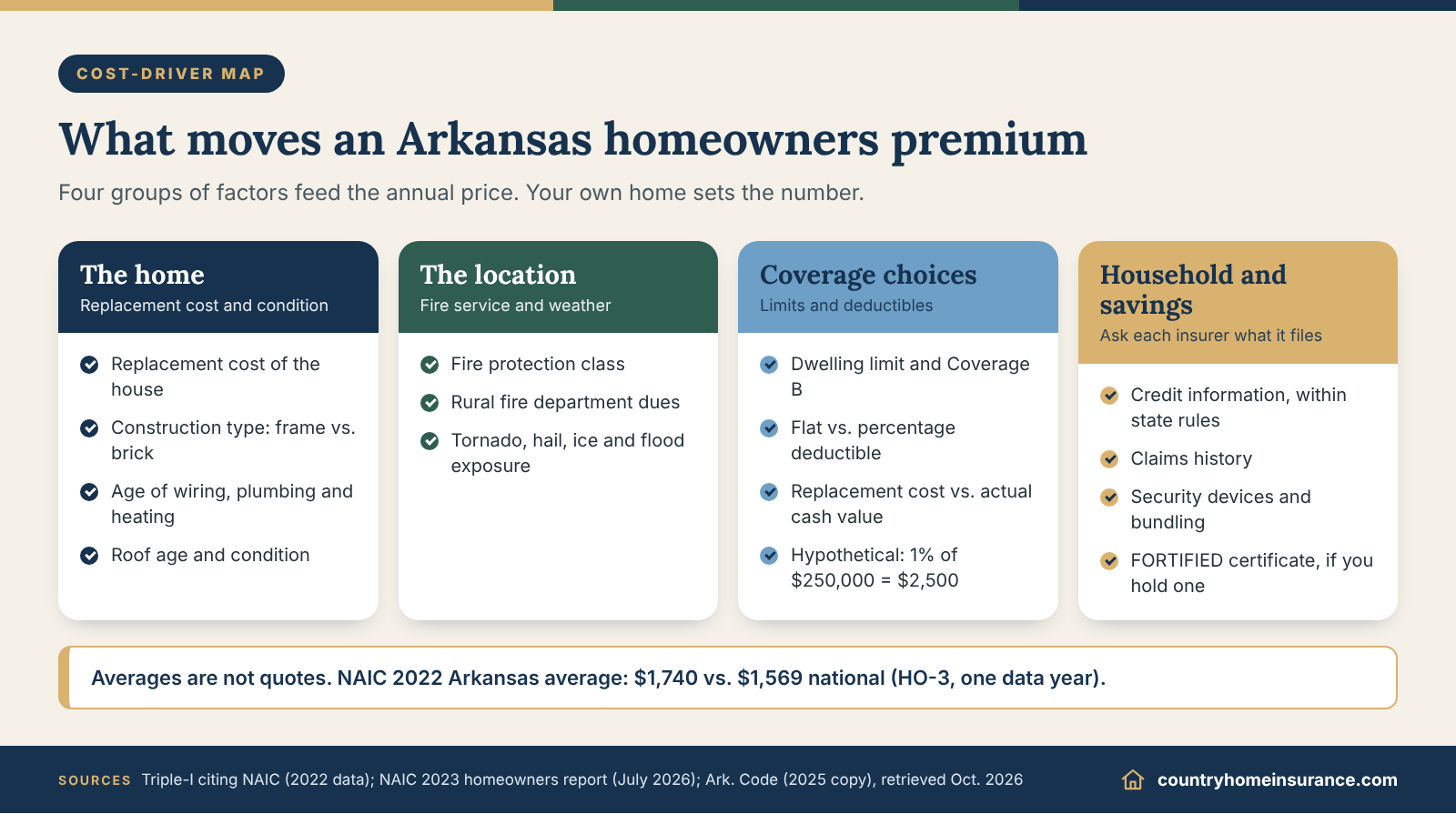
The Triple-I’s homeowners and renters insurance statistics page, citing the NAIC, shows an Arkansas average homeowners premium of $1,740 for 2022, ranked 14th highest among the states listed. The national average was $1,569, up 11.2 percent from $1,411 in 2021. The figures are based on HO-3 policies for owner-occupied one-to-four-family dwellings and are premiums divided by house-years, including state funds, residual markets and some wind pools. The NAIC itself says it does not rank state average premiums and does not endorse conclusions drawn from the data. The numbers are four years old by the time you read this, so they show a relationship, not today’s market.
What the 2023 exposure data adds
The NAIC’s 2023 report, published July 2026, breaks Arkansas owner-occupied and dwelling fire exposure into dwelling-limit bands. About 12.9 percent of those house-years were at $149,999 or less, 14.6 percent were between $150,000 and $199,999, 9.4 percent between $200,000 and $224,999, and 9.2 percent between $225,000 and $249,999. We could not retrieve the 2023 average premium table, so this guide does not report one. The takeaway is simple: a large share of Arkansas policies carries dwelling limits in the low hundreds of thousands of dollars, which makes an accurate replacement cost estimate more important than a quote from a stranger.
Why this guide gives no personal quote range
The NAIC cautions that average premium is an imperfect measure of price because hazards, economic conditions and property values vary widely. A cabin on 20 acres in the Ozarks, a brick home in Little Rock and a manufactured home in the Delta share a state, not a price. Use the department’s rate-filing portal to see whether your insurer has filed an increase, and get written quotes with identical limits before comparing anything.
What drives the price of an Arkansas home policy?
The NAIC lists location, construction, age, coverage amounts, deductible and discounts as the main cost factors. Arkansas adds a few features of its own.
Replacement cost, age and construction
The department’s credit brochure says homeowners premiums depend largely on location and replacement cost, and the NAIC adds construction type and the age of wiring, plumbing, heating and roofing. Frame homes generally cost more to insure than brick, and older homes can cost more if systems are outdated. A roof that is 18 or 20 years old may also change how your insurer settles a hail claim, which is why the roof is worth a close look during a policy review rather than only after a storm. See the hail section above and the fall roof inspection guide for what inspectors typically check.
Fire protection class and the deductible you choose
The NAIC explains that the fire protection class, which reflects hydrant distance and the quality of the responding fire department, affects the rate. Arkansas law adds a rural twist covered in its own section below. On deductibles, the NAIC advises choosing one you could pay comfortably after a claim. Hypothetical example: suppose a home carries $250,000 of dwelling coverage and a policy has a 1 percent separate deductible for wind or hail. That would be $2,500 out of pocket on a covered roof claim, compared with $1,000 on a flat deductible. The figures are illustrative only, since we could not verify what Arkansas insurers offer, so find the actual wording on your declarations page.
Credit information and claims history
Insurers can use credit information under the Arkansas rules described earlier, and prior claims can raise prices or affect eligibility. The Arkansas-specific part is the guardrails: no cancellation or nonrenewal solely on credit, and a refreshed pull at least every 36 months. Ask your agent whether your company uses credit and request a re-rating if your credit has improved.
Which discounts can you ask about in Arkansas?
Discounts are filed by each insurer, so the useful move is to ask, not to assume. Here is what the sources name and what they leave out.
Discounts named by the department and the NAIC
The department’s shopping tips suggest asking about discounts for safety and security devices, multi-policy bundling, a new home, multi-car and good student. The NAIC adds bundling home and auto, deadbolts and alarm systems, and warns that wood-burning fireplaces or wooden decks can raise a premium. None of these sources states a percentage, and we did not find any Arkansas-wide mandated amounts, so treat each as a question for your agent.
The FORTIFIED discount under the new law
Section 23-88-607 requires insurers that write wind or hail coverage in Arkansas to provide a premium discount or rate reduction for property with a FORTIFIED certificate of compliance, if the discount is actuarially justified, and allows the Insurance Commissioner to set standard benchmarks by rule. The statute sets no dollar or percentage amount, and any discount must go through the rate-filing process. The next sections explain the program, but the quick lesson is this: if you hold a FORTIFIED designation, send the certificate to your insurer and ask what discount is filed.
Rural and country property in Arkansas: fire dues, outbuildings and the rural risk plan
Much of Arkansas is rural, and Arkansas statute treats rural property as its own subject in several places. If you live outside a city fire district, three questions matter more than the paint color on the barn: who answers a fire call, what you owe them and what happens if the regular market declines you.
How do rural fire dues and volunteer fire department charges work?
Many Arkansas rural fire departments are funded wholly or partly by member dues or subscriptions. Two Arkansas statutes tie that funding to your insurance, and both are worth knowing before a fire.
Rate credits tied to paid dues
Under § 23-88-103, an insurer that gives a rate credit or reduced rate for property in a rural fire protection district, or in an area served by a rural fire department funded by assessments, dues or subscriptions, may give it only on risks insured by owners who pay those charges. An agent or company may not knowingly write an initial fire policy at the reduced rate unless it first has evidence that the current dues were paid, such as a receipt or a cancelled check. The statute sets administrative penalties for agents who violate it. The practical meaning is simple: if your premium reflects a fire-district credit, keep proof that you paid the dues, and ask your agent which fire department your policy assumes.
What a volunteer department can charge a nonmember
Section 23-88-102 lets a volunteer fire department charge a nonmember in its district no more than the fair market value of the service rendered for a fire or emergency call involving the nonmember’s property. If the fire involves only personal property, the charge is limited to $500. Where the property is insured against fire damage, the insurer must pay the department the fair market value of the services out of the insurance proceeds. The department must notify the insurer and the nonmember by certified mail within 30 days. A nonmember who objects can notify the fire board, which must sue in the nearest district court within 10 days, and the insurer is not liable beyond the policy’s face amount unless the policy provides otherwise.
Practical steps for country owners
Write the name of your responding department on your inventory sheet. Pay the dues before they lapse, and keep the receipt with your policy. Ask your agent whether your protection class assumes a subscription department and what happens to the rating if you stop paying. The statute also requires insurers that file property rates to include an impact statement on fire protection unless they use a public protection classification from a licensed advisory organization, which hints at how seriously the state treats fire service as a rating issue (§ 23-88-104).
What is the Arkansas Rural Risk Underwriting Association?
This is the part of Arkansas law that most resembles a residual market, and it is easy to misread. Read this section as what the statute establishes, not as a promise about what the plan sells today.
What the statute establishes
Arkansas Code §§ 23-88-301 to 23-88-309 create the Arkansas Rural Risk Underwriting Association. The legislature found that property insurance in rural Arkansas is important to the state’s economy and that demand was growing while the market was not meeting it. Every insurer licensed to write property insurance must be a member, and the association must offer a plan of property insurance to insurable rural risks in areas the governing board designates as rural, with the Insurance Commissioner’s approval. The plan must set deductibles, risk classifications and coverage limits, and it works with underwriting standards the commissioner approves. Members share expenses and losses in proportion to premiums, with assessments capped at 2 percent of net direct written premium.
What we could not verify
The statute text we retrieved does not list the plan’s perils, limits or exclusions, and the department’s page for the association does not describe its coverage either. We could not confirm which areas are designated rural today, whether the association currently writes dwelling coverage for homeowners, or how to apply. The department’s property and casualty page lists association phone numbers: 1-800-272-6588 within Arkansas and 1-800-233-2398 from outside the state. Call before assuming it will fit your situation, and ask an agent licensed in Arkansas whether the plan accepts a home like yours.
How this differs from a FAIR Plan
A FAIR Plan, in NAIC terms, is a residual market that sells basic coverage to properties the regular market declines. The association covers rural property and is established in statute, but we could not verify that it operates as a general FAIR Plan, and the NAIC’s FAIR plan page does not mention Arkansas. Treat the association as a lead to investigate, and compare any residual offer against what a surplus-lines broker can place, with attention to deductibles, valuation and what is excluded.
What should country homeowners ask about outbuildings, land and animals?
Standard homeowners policies are built around a house on a lot, not a working property. The NAIC and the department give a good checklist of the places where country owners should ask more questions.
Barns, shops and detached structures
The NAIC lists detached garages, sheds and fencing under Other Structures and says an in-ground pool, or a detached garage holding classic cars, may need additional coverage. It also says business inventory stored at home is usually not covered, and that failing to disclose a home business can lead to cancellation. If you run a welding shop or sell hay from the barn, say so. Ask for the Coverage B limit in dollars, ask whether the barn is covered for the same perils as the house and ask whether wind damage to an older outbuilding is settled at actual cash value.
Farmowner policies and hobby farms
Arkansas statute itself recognizes different policy types. The earthquake Market Assistance Program statute refers to applicants with underlying homeowner, farmowner or dwelling fire coverage, and § 23-102-114 treats homeowner, farmowner and fire lines together while excluding commercial and crop hail. A farmowner policy is a different product from a homeowners policy, so a hobby farm with livestock, equipment or a roadside stand may need a conversation about which form fits. We did not retrieve Arkansas-specific rules on livestock or farm liability, so get the form in writing and read the exclusions.
Wells, septic systems and private roads
We did not find Arkansas-specific sources on well pumps, septic systems or private-drive liability, and policy forms differ by company. These are questions for your agent: Is a well house or pump covered, and for which perils? Is a septic system covered for sudden damage, and is it treated as part of the dwelling? How does liability work for guests on a private road or a pond? Get answers by email, and file them with your declarations page.
Strengthen Arkansas Homes and FORTIFIED roofs
Arkansas took a notable step in 2025 by writing a mitigation program into law. The Strengthen Arkansas Homes Program Act is in Title 23, Chapter 88, Subchapter 6 of the Arkansas Code, and it took effect January 1, 2026. This section summarizes the statute as published in the 2025 code. We could not retrieve the department’s program pages, so we cannot confirm grant amounts, participating counties or application dates today.
What did the law create?
The statute sets up a grant program inside the Arkansas Insurance Department and ties it to a national roofing and construction standard.
A grant program, not an entitlement
Section 23-88-603 establishes the program within the State Insurance Department to help property owners and nonprofits reduce losses to insurable dwellings from catastrophic wind events, including hail, by funding mitigation to FORTIFIED Home standards. The program makes financial grants to real property owners and nonprofit organizations, and the department may apply for outside grants and place the money in a dedicated fund. The statute does not set a grant amount. It also says it creates no entitlement and does not obligate the state to fund inspection, construction or retrofitting. All projects are subject to local permits, inspections and random reinspection.
What FORTIFIED means
FORTIFIED is a set of construction standards published by the Insurance Institute for Business and Home Safety (IBHS), the research organization whose standards the statute names. Its FORTIFIED Roof page says FORTIFIED Roof is the new name for the former FORTIFIED Bronze designation and is limited to work roofers routinely perform. The Arkansas statute allows grants for FORTIFIED Roof or FORTIFIED Silver, including a hail supplement. We could not retrieve a source that lays out the Silver requirements, so ask an IBHS-certified evaluator what each level involves for your house.
Why a roof program fits Arkansas
The weather record above is mostly a wind and hail story. Hail up to 4.50 inches in 2026, 80 to 90 mph straight-line winds and tornadoes of every rating all end at the roof first. A stronger roof will not stop an EF4 tornado, and nothing in the statute claims it will. What it can do is reduce damage in the far more common hail and wind events and, where an insurer files a discount, reduce the premium.
Who may qualify, and what does it take?
Section 23-88-604 lists the baseline requirements. The department may add its own rules for each grant type, so treat this as a floor.
Eligibility requirements in the statute
The dwelling must have a homestead exemption and be an owner-occupied, single-family primary residence in a county where grants are being approved. It must be in good repair unless the damage came from a catastrophic wind event or hail, and any repair cannot be part of an insurance claim. The owner must provide proof of an in-force wind insurance policy, or within 30 days after IBHS certification if none exists at application. If the home is in a Special Flood Hazard Area, the owner must also prove an in-force flood policy from the National Flood Insurance Program or a private carrier. The statute’s definition of an insurable dwelling is a detached single-family house, and it excludes manufactured homes, mobile homes and condominiums.
Evaluators, bids and who pays what
An IBHS-certified evaluator must confirm the home is suitable and identify the upgrades needed, and the owner picks the evaluator from a department list and pays the fee personally. The owner must obtain bids from at least three IBHS-certified, program-approved contractors, or as many as are available if fewer than three. Contractors must hold a valid Arkansas license, be registered with the Secretary of State, carry at least $500,000 in general liability coverage and hold active IBHS FORTIFIED certification, among other requirements (§ 23-88-605). The owner is responsible for any amount above the awarded grant, which must be disclosed and approved before work begins. The department may not endorse a contractor.
Questions to ask before you apply
Ask the department which counties are approving grants, what the current grant amount is, how long awards take and whether your roof’s condition leaves you better served by a repair first. Ask your insurer whether it has a filed FORTIFIED discount and what documentation it wants. Keep every certificate and bid in the same folder as your declarations page.
What must insurers offer under the law?
Two provisions reach into the policy itself, and both apply to policies issued or renewed on or after July 1, 2026, under § 23-88-609.
The premium discount
Under § 23-88-607, an insurer writing wind or hail coverage on Arkansas property must provide a premium discount or rate reduction for a dwelling with a FORTIFIED certificate of compliance, if it is actuarially justified. Once the insurer has a copy of the certificate, it must apply the discount to that dwelling. The commissioner may adopt rules setting standard benchmarks, mainly for insurers that lack the data to justify their own. The discount is still subject to rate-filing requirements, and the statute states no amount.
The optional roof-upgrade endorsement
Under § 23-88-608, an insurer writing personal-risk property insurance must offer an optional rider, endorsement or supplemental provision on a policy covering a single-family, non-FORTIFIED dwelling. It gives the insured the right to receive payment for the cost of upgrading the dwelling when a covered claim requires roof replacement. The statute does not set a price or a calculation method, so ask whether your insurer has filed the endorsement, what it costs and how upgrade costs are measured. If your roof is near the end of its life, that answer may matter more than a small premium difference.
How to use the law at renewal
Put three questions in writing to your agent at the next renewal: Has the company filed the FORTIFIED discount and the roof-upgrade endorsement? What do they cost or save? What proof does the company need? The answers show whether the 2026 changes have reached your policy yet.
Claims, disputes and insurer insolvency in Arkansas
The Arkansas Insurance Department’s claims guide, “When a Disaster Strikes,” is the best single Arkansas-specific resource on what happens after a loss. This section follows its sequence and adds the statutes that matter when a claim stalls or an insurer fails.
What should you do in the first days after a loss?
Your first priority is safety. Then protect the property, tell the insurer and document everything.
Report the claim and prevent further damage
The guide says to contact your agent first and, if you cannot reach the agent or no company representative is on scene, to call the insurer’s claims department. It also says you should not wait for permission to protect the property. Board windows, patch roofs and walls, move belongings to safety and start drying water-damaged items. Most policies cover reasonable emergency clean-up and temporary repairs, and those costs count against the coverage limit. Photograph the damage before you clean or repair, keep every receipt and do not discard items that may be a total loss until the adjuster has examined them.
Build the inventory you may not have
If you have no inventory, the guide says to reconstruct each room from memory, including furniture, appliances, electronics, tools and seasonal items, and to note purchase date and place, price paid, replacement cost, brand and model where possible. Do this before you submit your claim report, and submit corrections promptly if you forget items. The department publishes a homeowners inventory checklist, and the NAIC’s free Home Inventory app lets you photograph items, scan barcodes and export the list. Store a copy away from the house.
Living expenses while you are displaced
Additional living expense covers costs above your normal expenses because of the loss. Ask the insurer about limits on location, length of stay and hotel rates. The guide says a relative or friend who hosts you may be reimbursed only with proof of actual payment, that storage costs for personal property may be claimed until the home is ready and that any advance for living expenses or clothing is deducted from the final settlement. Keep receipts for everything.
How are adjusters, contractors and payments handled?
The department’s guidance on this stage is unusually practical, and it is where many homeowners lose money by moving too fast.
Adjusters and estimates
An adjuster must show identification, and you do not pay the adjuster, because the insurer does. The adjuster may inspect damaged items and prepare a written estimate, and you may ask for a copy and ask questions about it. The guide says the claimant bears the burden of proving the claim, though the adjuster is there to help conclude it. The department’s storm brochure warns about “public adjusters” who offer to appraise damage for a percentage of the claim and states that public adjusters are illegal in Arkansas. We did not verify that statement against the statute, so confirm with the department before hiring anyone to help with a claim.
Contractors and contracts
The guide advises hiring established firms that provide references, proof of insurance and a signed contract, getting written estimates and not signing a major repair contract until the adjuster has determined the damage and the insurer’s payment. It cautions against paying a contractor in full in advance and says payments commonly follow completed work in thirds. If the mortgage lender is named on the check, confirm the money goes toward repairs and not toward loan principal. The Arkansas State Contractors Licensing Board is listed at 501-372-4661. If the contractor and adjuster disagree about cost or hidden damage, the guide recommends bringing them together on site first.
How a payment is structured
A claim is split into four parts: dwelling, other structures, personal property and additional living expense. Contents payments go to you, while dwelling and other-structure payments may include your mortgage holder. With a replacement cost policy, the insurer usually pays in stages, an initial partial payment and then the remainder after repairs. The guide also warns that policies generally do not pay for code upgrades, including flood plain requirements, unless you have a building code or ordinance endorsement, so ask about it before the next storm.
What if you and the insurer disagree?
Disputes are normal, and the sequence you use matters. Start with the people who can fix it fastest and escalate with a paper trail.
Escalate in writing, then call the department
The department’s guide recommends complaining first to the agent or insurer, preferably by letter with a copy kept. For phone complaints, record the date, time, the person’s name and what was said. Next, contact the Insurance Department’s Consumer Services Division through the online form or the toll-free line. The guide says that Arkansas insurers must acknowledge a claim within 15 working days, and that you should contact the department if the insurer does not respond or you face other unreasonable delays. Keep your complaint tight: dates, claim number, the specific request and the policy provision you rely on.
Statutes on late payment and suit deadlines
Two statutes sit in the background, and neither is a do-it-yourself tool. Section 23-79-202 says a policy provision requiring suit in a shorter time than the period Arkansas law sets for actions on written promises is void. The page we retrieved does not state that period, so ask an attorney. Section 23-79-208 provides for 12 percent damages and reasonable attorney’s fees when an insurer fails to pay a covered loss within the time stated in the policy after demand, with recovery thresholds, and it lists cyclone and tornado losses among the policy types it reaches. Whether it applies to your homeowners claim is a legal question, so talk with a licensed Arkansas attorney if a significant claim is denied or delayed.
What happens if your insurer becomes insolvent?
Insolvency is rare, but Arkansas has a recent example tied to severe weather, and the guaranty protections have limits worth knowing.
The United Home Insurance example
According to the department’s FAQ, United Home Insurance Company was placed in receivership on September 6, 2023, and the Pulaski County Circuit Court ordered it into liquidation on November 14, 2023. The department said the company was overwhelmed by claims from tornadoes, hailstorms and wind events and could not buy enough reinsurance for the catastrophic losses. Its policies were to cancel no later than 30 days after the liquidation order, and an affiliate, Farm and Home Mutual, proposed assuming about 9,300 policies that met its underwriting requirements. Policyholders were not required to accept the assumption. The lesson is general: an insurer’s financial condition affects your claim, not only your premium.
What the guaranty act covers
Under § 23-90-103, a covered claim is generally capped at $300,000, and 100 percent of unearned premium is covered up to $25,000 per policy. The claimant or insured must be an Arkansas resident at the time of the insured event, or the property must be permanently located in Arkansas. Claims by insureds with a net worth above $50 million are excluded, and so are punitive damages. Farmers’ mutual aid associations are outside the chapter. For a homeowner with a large loss, $300,000 may be less than a full rebuild, which is another reason to ask about an insurer’s financial strength before you buy.
Surplus lines and guaranty protection
Section 23-90-104 applies the guaranty chapter to direct insurance written by insurers licensed to transact insurance in Arkansas. The pages we retrieved do not say how that treats surplus-lines policies, which are written by non-admitted insurers. If a broker offers you a surplus-lines policy, ask directly whether Arkansas guaranty protection applies, and get the answer in writing.
How to shop, compare and renew in Arkansas
Everything above turns into action at one of two moments: when you buy and when you renew. The Arkansas Insurance Department’s shopping tips and the NAIC’s homeowners guidance give a solid framework. This section organizes it into questions you can send to an agent, a routine you can repeat every year and a checklist.
Which questions should you put to every agent and insurer?
Quotes only compare when the limits, deductibles and endorsements match. Ask for the same structure from each company and put the answers in writing.
Verify the license, the company and the paperwork
The department advises confirming with the Arkansas Insurance Department that both the company and the agent are licensed in Arkansas. It also says to answer every application question completely and truthfully, never to sign a blank application, to check the copy of the application included with your policy for errors and to pay the insurance company by check rather than in cash. If you are denied coverage, ask for the specific reason. Those basics protect you from the problems that are hardest to fix after a loss.
Coverage terms to line up side by side
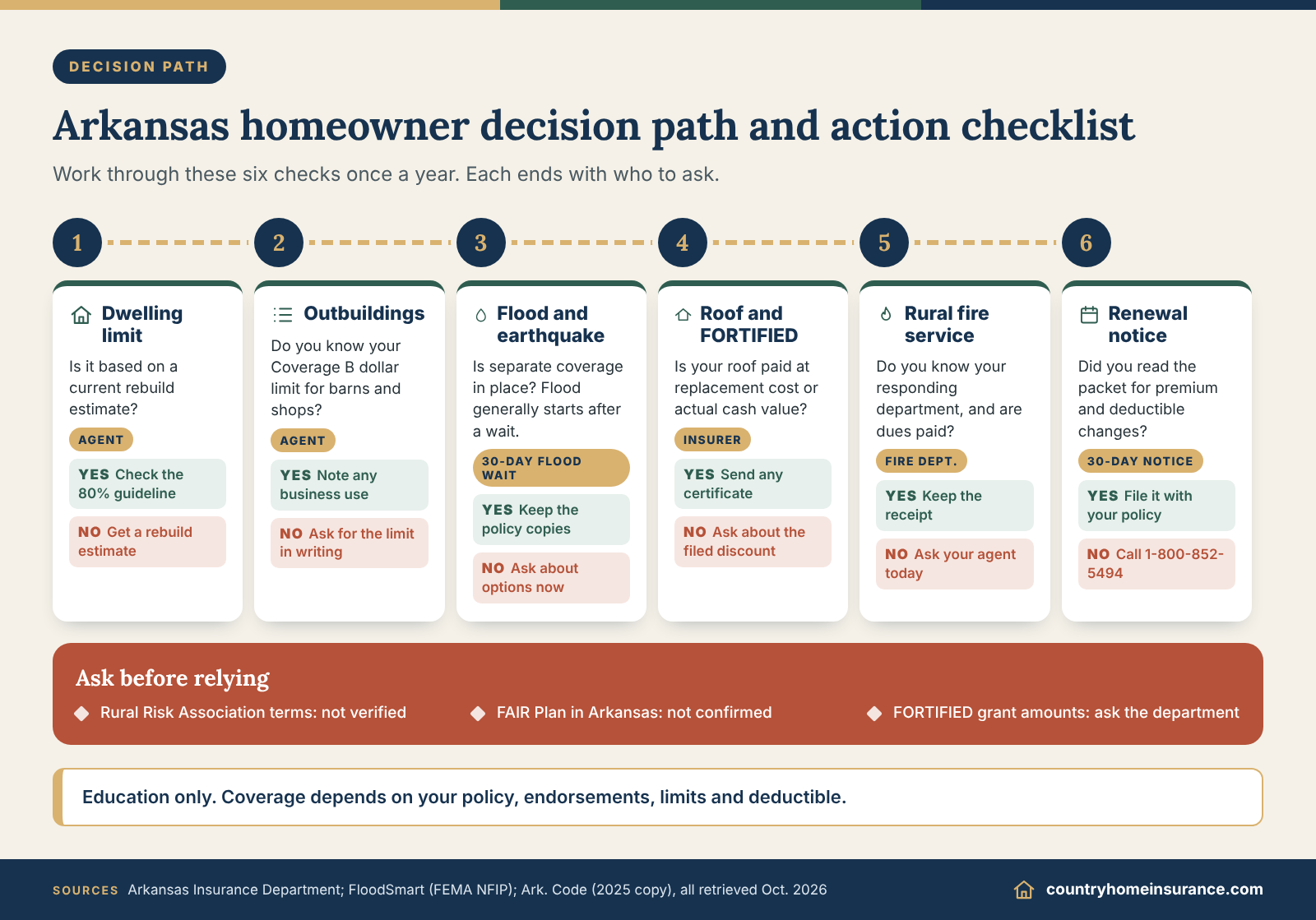
The department suggests setting the dwelling limit at no less than 80 percent of replacement cost, asking whether an inflation guard endorsement is available, asking about the price difference between named-peril and open-perils policies, and asking about scheduling valuable items and about full replacement cost on belongings. Add the items this guide has raised: Coverage B in dollars, the roof settlement basis, any wind or hail deductible, ordinance or law coverage, water backup, and how earthquake would be handled. For flood, remember that coverage is a separate purchase with a waiting period.
Financial strength and who is behind the policy
The United Home case shows that a policy is only as reliable as the company behind it. Ask your agent for the insurer’s legal name, the name that appears on the declarations page and its financial strength rating from an independent rating agency. We did not retrieve rating data for Arkansas insurers, so this guide does not rank companies. If a company is new to you, check it with the department’s licensing resources and read the department’s consumer alerts before you pay.
How should you handle renewal, nonrenewal and lender requirements?
The renewal packet is the most underread document in personal finance. It often contains the changes that matter most.
Read the renewal offer for deductible and form changes
Under the statutes described earlier, a renewal offer must state the new premium and describe any change in the deductible or other policy provision, and a premium increase for reasons unrelated to your risk requires at least 30 calendar days’ notice. Compare the new declarations page with the old one line by line: dwelling limit, Coverage B, deductibles, roof settlement language and endorsements. If a form or deductible changed, ask the agent to point to it, and shop before the renewal date, not after it.
If you receive a nonrenewal notice
A nonrenewal notice for a property policy is due at least 30 days before expiration, except for nonpayment. Use that time. Ask the agent for the specific reason. If credit information was a factor, the insurer must send an adverse action notice naming up to four main factors. Have the agent shop other admitted companies, ask a surplus-lines broker for an option and call the department at 1-800-852-5494 to ask what residual options exist. Also look at the rural association described earlier if your property qualifies. Do not let coverage lapse while you search, because a lapse can complicate the next application and may trigger lender action.
What your mortgage lender can and cannot require
The NAIC says most lenders require homeowners coverage and list themselves as mortgagee, that a lapse can lead the lender to buy coverage at a higher premium that protects only the structure, and that you are not required to buy from the lender’s recommended insurer. The department’s consumer tips add a simple rule: check with your mortgage company before changing a policy so you know what coverage the lender requires.
What does a sensible annual review look like?
Treat the policy as a document that goes stale. A repeatable routine takes about an hour once a year.
Refresh the rebuild estimate and the inventory
The NAIC recommends reviewing coverage annually, especially after renovations or additions, which raise replacement cost. Update your rebuild estimate, ask whether the limit still meets the 80 percent guideline and refresh your home inventory with photos or video of each room and the outside. Keep a copy away from the house. The department’s storm brochure suggests recording model and serial numbers and attaching sales receipts.
Walk the property for risks and savings
This is a good season to inspect the roof, gutters, tree limbs over the house and anything that could freeze before winter. Confirm that your fire-department dues are current and that you know which department responds. If your roof is nearing replacement, consider whether a FORTIFIED roof makes sense, and ask about the grant program and the discount before signing a roofing contract. Get your insurer’s preferences in writing before the work starts, because documentation after the fact is harder.
Know who to call before you need them
Put the insurer’s claim number, your agent’s direct line, the department’s 1-800-852-5494 and 501-371-2640 numbers, and the NWS Little Rock office phone (501-834-0308) in the same place as your inventory. The department’s storm brochure also suggests keeping an emergency kit and copies of key records off site.
| Task | What to verify or document | Who to ask |
|---|---|---|
| Confirm the dwelling limit | A current rebuild estimate and the 80 percent guideline; whether an inflation guard endorsement is offered | Agent; insurer; the department’s shopping tips |
| Check Coverage B and outbuildings | Dollar limit, perils, business or rental use of any shop or barn | Agent; read the policy form |
| Read the deductibles | Flat versus percentage, any separate wind or hail deductible, earthquake percentage if bought | Declarations page; agent |
| Review roof settlement terms | Actual cash value or replacement cost, labor depreciation language, roof age and condition photos | Agent; insurer; roofer |
| Decide on flood and earthquake | Separate flood policy and 30-day wait; whether your insurer offers earthquake or refers you to the Market Assistance Program | Agent; FloodSmart; department (1-800-852-5494) |
| Rural fire service | Name of the responding fire department, proof that dues are paid, any rate credit tied to dues | Fire department; agent |
| FORTIFIED and renewal questions | Whether the insurer has filed the FORTIFIED discount and roof-upgrade endorsement; certificate copies | Agent; department’s program staff |
| Prepare claim documents | Photos or video, inventory with receipts, policy copy, insurer and agent numbers stored off site | NAIC Home Inventory app; department’s checklist |
Frequently asked questions
Coverage and cost questions
Does Arkansas homeowners insurance cover tornado damage?
A standard homeowners policy typically covers wind-related damage, including tornado damage, to the house, other structures and belongings, subject to the deductible, limits and exclusions in your policy. The NAIC describes the policy as paying for losses from fire, weather, theft and other disasters. What varies is the details: whether there is a separate wind or hail deductible, how the roof is valued and how much Coverage B provides for outbuildings. Check your declarations page, and do not assume that a flood or earthquake that accompanies a storm is part of the same coverage.
Do I need flood insurance if I am not in a mapped flood zone?
FloodSmart says most homeowners policies do not cover flood and that 99 percent of counties have experienced a flood event in the past 20 years. Arkansas’ 2017 floods reached homes and cropland across a broad area. Whether you need a policy is a personal risk decision, and your lender may have its own requirement, so ask. If you buy, remember the generally 30-day waiting period. Homes in a Special Flood Hazard Area that apply for a Strengthen Arkansas Homes grant must also prove an in-force flood policy.
How much does homeowners insurance cost in Arkansas?
The NAIC reported a 2022 average homeowners premium of $1,740 in Arkansas, based on HO-3 policies and house-years. That is an average across many homes, and the NAIC cautions that average premium is an imperfect measure of price. Your cost depends on your dwelling limit, location, roof, construction, deductible, discounts and the insurer. Get written quotes with identical limits and use the department’s rate filings portal to check whether your insurer has filed an increase.
Should I consider earthquake coverage in Arkansas?
That is your decision, informed by your risk tolerance and budget. What the department confirms is that most standard policies do not cover earthquake, that insurers writing homeowner, farmowner and fire lines must tell you about the Market Assistance Program, and that earthquake deductibles are percentages of each coverage amount. Ask your agent for a quote that shows the deductible in dollars, and call 1-800-852-5494 if your agent will not participate in the program.
Claims, notice and consumer-rights questions
How much notice must my insurer give before nonrenewing my policy?
Arkansas Code § 23-88-105 requires a written nonrenewal notice or a renewal offer at least 30 days before the policy expires, except for nonpayment of premium. A renewal offer must state the new premium and any change in the deductible or other provisions. Because this summary comes from a published copy of the 2025 code, confirm with the department if your notice looks late or incomplete.
Can my insurer drop me because of my credit?
Arkansas law lets insurers use credit information but, under § 23-67-405, an insurer may not cancel, deny or nonrenew a personal policy solely on the basis of credit information, without considering other underwriting factors. If an insurer takes adverse action based on credit, it must send a notice that explains up to four main factors. You can dispute credit errors with the bureaus, which must respond within 30 days, and ask your insurer to re-rate your policy.
Who do I call if my claim is delayed or denied?
Start with your agent or the insurer, in writing, and keep notes of every call. If the problem is not solved, contact the Arkansas Insurance Department’s Consumer Services Division at 1-800-852-5494 or file the online complaint form. The department’s guide says insurers must acknowledge a claim within 15 working days. The department can investigate complaints and explain rules, but it cannot provide legal services or decide differences of opinion. For a large denial, consider speaking with a licensed Arkansas attorney.
What if my insurer goes out of business?
If a licensed insurer is declared insolvent, the Arkansas Property and Casualty Insurance Guaranty Act may pay covered claims up to $300,000 per claim and return unearned premium up to $25,000 per policy, with conditions, for Arkansas residents or property permanently located in the state. The department’s 2023 United Home FAQ shows how a liquidation can play out, including a 30-day cancellation timeline and an offer to transfer some policies. Keep filing claims as usual and follow the department’s notices.
Sources
- Arkansas Insurance Department, Consumer Services (retrieved October 2026)
- Arkansas Insurance Department, File a Complaint (retrieved October 2026)
- Arkansas Insurance Department, Disaster Resources (retrieved October 2026)
- Arkansas Insurance Department, Earthquake Resources and Market Assistance Program (retrieved October 2026)
- Arkansas Insurance Department, Flood Insurance Resources (retrieved October 2026)
- Arkansas Insurance Department, Consumer brochures index (retrieved October 2026)
- Arkansas Insurance Department, When a Disaster Strikes: what to do after an insured homeowners loss (PDF dated 2025, posted January 2026; retrieved October 2026)
- Arkansas Insurance Department, Helpful Tips for Before and After the Storm (revision 11/25; retrieved October 2026)
- Arkansas Insurance Department, Basic Shopping Tips for Insurance Consumers (undated; retrieved October 2026)
- Arkansas Insurance Department, Understanding How Insurers Use Credit Information (undated; retrieved October 2026)
- Arkansas Insurance Department, Property and Casualty rate change filings portal (live data; retrieved October 2026)
- Arkansas Insurance Department, Property and Casualty Insurers page (retrieved October 2026)
- Arkansas Insurance Department, United Home Insurance Company receivership and liquidation FAQs (November 15, 2023)
- Ark. Code § 23-88-101, valued policy law (Justia copy of the 2025 code; verify against the official code)
- Ark. Code § 23-88-105, notice before policy expiration (Justia copy of the 2025 code)
- Ark. Code § 23-88-106, expense depreciation (Justia copy of the 2025 code)
- Ark. Code § 23-88-102, volunteer fire department charges and § 23-88-103, rural fire district rate credits (Justia copy of the 2025 code)
- Ark. Code Title 23, Chapter 88, Subchapter 3, Arkansas Rural Risk Underwriting Association (Justia copy of the 2025 code)
- Ark. Code Title 23, Chapter 88, Subchapter 6, Strengthen Arkansas Homes Program Act (effective January 1, 2026; Justia copy of the 2025 code)
- Ark. Code § 23-67-211, filing of rates and § 23-67-405, use of credit information (Justia copy of the 2025 code)
- Ark. Code § 23-95-104, plan for coverage requirement (Justia copy of the 2025 code)
- Ark. Code § 23-102-114, earthquake notice and declination (Justia copy of the 2025 code)
- Ark. Code § 23-90-103, covered claims under the guaranty act (Justia copy of the 2025 code)
- Ark. Code § 23-79-208, damages and attorney’s fees on loss claims and § 23-79-202, limitation of actions (Justia copy of the 2025 code)
- National Weather Service Little Rock (home page retrieved October 11, 2026)
- NWS Little Rock, Storms of 2026 in Arkansas (counts subject to revision)
- NWS Little Rock, Historic Arkansas weather events, including its pages on the 2014 Mayflower and Vilonia tornado, the December 2021 tornadoes, the March 2023 tornadoes, the December 2000 ice storms, the January 2009 ice storm and the April 2017 flooding
- NWS Little Rock, Arkansas climate summary (1991 to 2020 normals)
- NAIC, Homeowners insurance consumer guidance (undated; retrieved October 2026)
- NAIC, Actual cash value versus replacement cost (retrieved October 2026)
- NAIC, FAIR access to insurance requirements plans (last updated December 13, 2024)
- NAIC, Home Inventory app (retrieved October 2026)
- NAIC, Dwelling Fire, Homeowners Owner-Occupied, and Tenant and Condominium Data for 2023 (published July 2026)
- Triple-I, Facts and statistics: homeowners and renters insurance, citing NAIC 2022 data (retrieved October 2026)
- Triple-I, Facts and statistics: U.S. catastrophes, citing Aon data as of January 2026
- FloodSmart (FEMA NFIP), Buy a flood insurance policy and Flood insurance basics (undated; retrieved October 2026)
- IBHS, FORTIFIED Roof (undated; retrieved October 2026)
Important coverage note
Coverage depends on your actual policy, endorsements, exclusions, limits, deductible and cause of loss. State laws and insurance programs vary, change over time and may differ from the summaries in this guide, which draws on a published copy of the 2025 Arkansas Code and on agency pages retrieved in October 2026. Please verify case-specific questions with your insurer or agent and with the Arkansas Insurance Department, which is the state Department of Insurance, and review your declarations page and policy form. This article is educational information, not legal advice, and it does not promise that any claim will be paid.
About the editorial team
This guide was prepared by the countryhomeinsurance.com editorial team as general, educational information for homeowners. We research and summarize publicly available material, including state insurance departments, the NAIC, federal agencies, regulators’ consumer guides and published insurer and industry resources. We draw only on the sources that were available to us when we wrote this guide, and we list them in the Sources section with dates where we could find them.
Insurance rules, rates, products and program terms change, differ by state and by insurer, and can apply differently to your situation. We cannot guarantee that this content is complete, current or free of errors. It is not legal, financial, tax or insurance advice, it is not an offer to sell insurance or a recommendation of any insurer, agent or product, and reading it does not create a professional relationship of any kind.
To the fullest extent permitted by law, countryhomeinsurance.com and its editorial team, authors and contributors exclude all liability for any loss, damage or decision arising from the use of, or reliance on, this content. For questions about your own policy or claim, contact your insurer, a licensed agent or broker, your state Department of Insurance or another qualified professional.
Content created: October 11, 2026