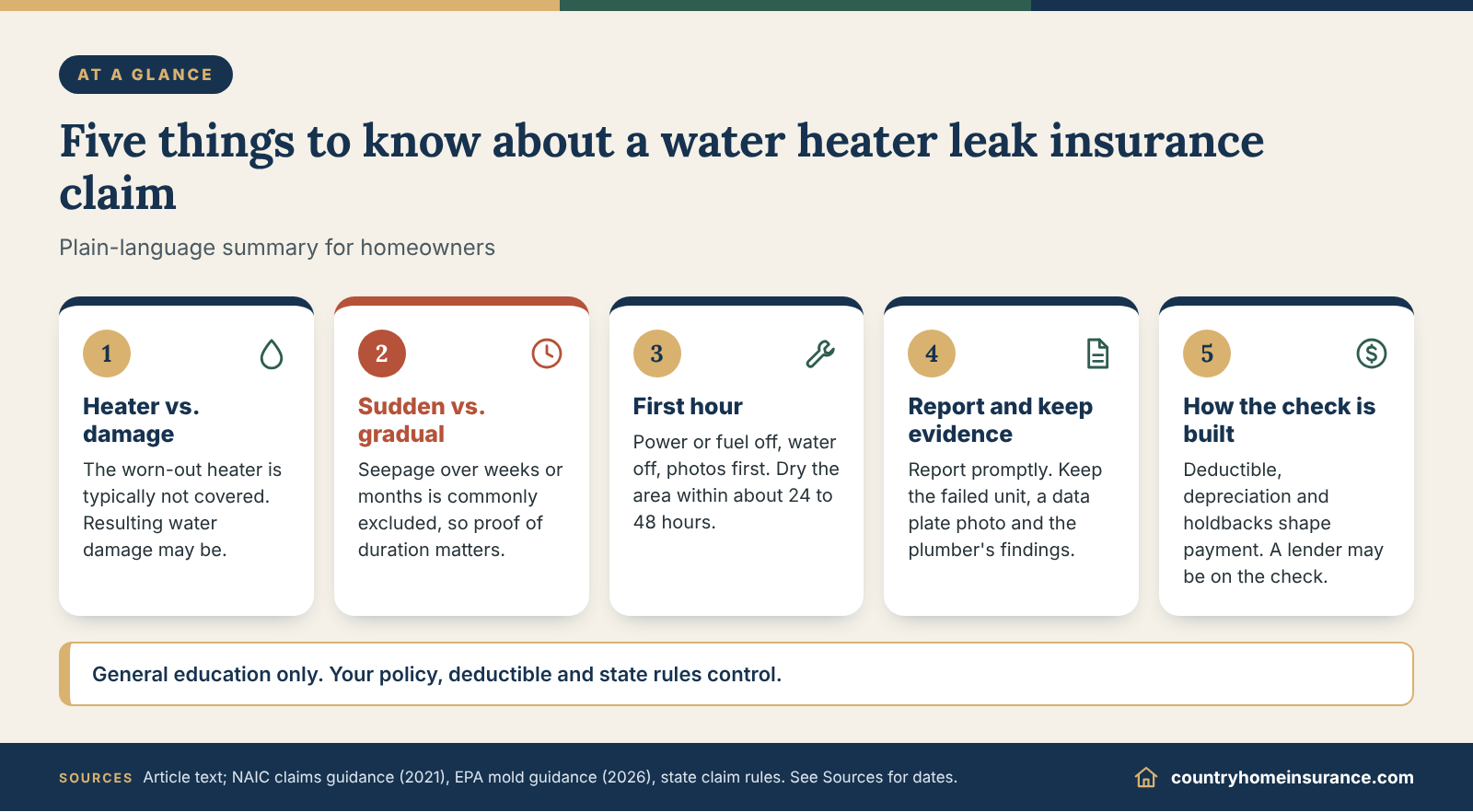
A water heater leak insurance claim usually turns on two questions: did the water escape suddenly or accidentally rather than seep out over weeks or months, and are you claiming the failed heater or the damage it caused? Homeowners policies typically do not pay to repair or replace a worn-out water heater, but they may pay for resulting water damage and the cost of opening walls or floors, minus your deductible. Shut off power or fuel and water, document, dry the area, report promptly, and keep the failed unit.
Key takeaways
- Two different things get claimed: the water heater itself (typically treated as wear and tear and typically not covered) and the water damage around it (may be covered when the discharge is accidental and not excluded).
- Whether the leak was sudden or gradual often decides the claim. Many policies exclude continuous or repeated seepage over weeks, months or years, so evidence of how long the water ran matters.
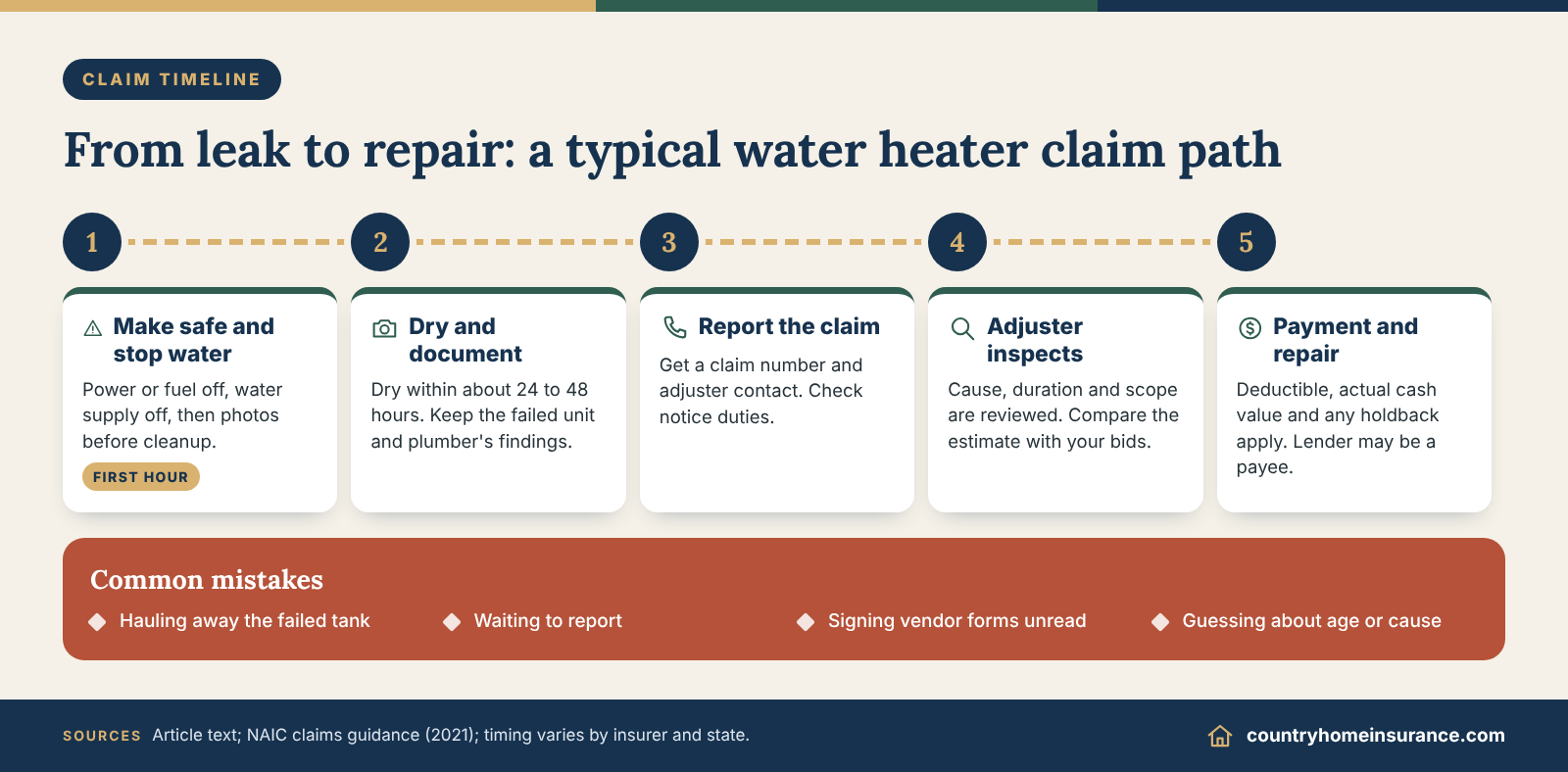
- The first hour is about safety and stopping the water: power or fuel off, water supply off, photos before cleanup, then drying within about 24 to 48 hours.
- Report promptly. Policies set notice duties, and some states set outside limits, such as Florida’s one-year notice rule for property claims.
- Payment depends on your deductible, replacement cost versus actual cash value, holdbacks for depreciation, and whether a mortgage lender is named on the check.
- Maintenance records, the heater’s data plate, and a plumber’s written findings are the most useful documents in a disputed claim.
How a water heater leak insurance claim works
A water heater leak can look like a small puddle at the base of a tank or like a flooded utility room, a soaked finished basement and a ceiling that sags in the room below. The insurance question is the same in both cases, and it is narrower than most homeowners expect. Your policy does not insure the appliance against getting old. It responds, if at all, to the water damage the failure causes, and only when the cause and the circumstances fit the policy’s terms. This guide walks through the claim in the order it happens: stopping the loss, understanding what is and is not covered, documenting, reporting, working with an adjuster, getting paid and resolving disagreements.
The short version of what is and is not paid
The heater versus the damage
Most homeowners policies are written to pay for physical loss caused by covered events, and they separate the failed equipment from the damage it does to the rest of the house. The Texas Department of Insurance says home and renters policies generally cover sudden, accidental water damage, such as a burst pipe or a broken washer hose, and usually do not cover damage from slow leaks or seepage (Texas Department of Insurance, water damage and mold coverage, updated Apr. 2024). The common homeowners structure treats a water heater discharge in terms of the resulting damage, not the heater: the wet drywall, flooring and belongings may be paid for, while the appliance that failed is not. The Texas FAIR Plan’s optional sudden-and-accidental-discharge endorsement shows the pattern in writing. It covers discharge from household appliances but states that its tear-out coverage does not include loss to the system or appliance the water escaped from (Texas FAIR Plan Association, Endorsement HO-400, edition Feb. 1, 2017). Trade guidance on the standard homeowners form says the cost of tearing out and replacing parts of the building to reach a failed pipe is covered, while repairing the pipe is not (FC&S via PropertyCasualty360, 2019). The same logic applies to a tank.
That split explains a common surprise: a $1,800 water heater replacement and a $14,000 water damage claim are handled under different rules, even though they come from one leak.
Why the cause of the leak matters more than the size of the puddle
Insurers do not pay based on how much water you see. They look at why the water escaped. A tank that splits open overnight is an accidental discharge. A pinhole at a fitting that weeps for months is a maintenance and seepage question. Two leaks that soak the same square footage can lead to different outcomes because one fits the policy’s “accidental discharge” language and the other fits an exclusion for continuous or repeated leakage. Later sections cover how adjusters and courts treat that line, and what evidence helps you.
Where this guide fits among related water-damage guides
Water heater leaks versus burst pipes and other appliances
This article focuses on one appliance and its claim workflow. If the water came from a pipe that froze or failed, the burst pipe insurance claim guide covers that workflow, and the question of whether the policy covers burst pipes at all is covered in does homeowners insurance cover burst pipes. If the leak came from a dishwasher, washing machine, refrigerator line or similar, the appliance leak claim guide covers the general appliance case. A water heater has a few features of its own: it holds tens of gallons under pressure, it is often tucked in a basement, closet or attic, it is a fuel or electrical appliance, and it has a limited service life that adjusters often ask about.
Water heater leaks versus backups, sewer problems and flood
Water that comes up through a floor drain, sump or sewer line is a different cause of loss with different coverage. See water backup coverage and the sewer backup claim guide for those losses. Rising surface water from a storm or overflowing creek is flood, which standard homeowners policies typically exclude (NAIC, homeowners insurance consumer page); see whether homeowners insurance covers flood damage. A basement with an inch of water can have more than one source at once, such as a failed heater and a high water table, and the claim file should separate them.
Reading the summary table before the details
How to read Table 1
The table below sorts the common pieces of a water heater loss into three groups: typically covered, typically not covered, and depends. These are patterns across common policy forms, not promises. Your declarations page, policy form and endorsements control, and a few insurers write water damage limits, age-based restrictions or leak-specific exclusions that change the picture. Where a cell says “Depends,” the sections that follow explain what it depends on.
| Item in the loss | Typical outcome | What drives the answer |
|---|---|---|
| Wet drywall, flooring, insulation and trim after a sudden tank failure | Typically covered, subject to your deductible | Accidental discharge of water from a household appliance; no applicable exclusion; policy in force |
| Cost to open walls, ceilings or floors to reach the leak | Typically covered when the water loss itself is covered | Tear-out wording in the policy; access to the failed part, not the part itself |
| Damaged furniture, clothing and stored belongings | Typically covered when the water event is covered | Personal property (Coverage C) perils, sublimits and whether settlement is replacement cost or actual cash value |
| The water heater itself (tank, elements, burner, valves) | Typically not covered | Wear and tear, corrosion and deterioration exclusions; some policies add optional equipment-breakdown or similar endorsements |
| Weeks or months of slow leakage from a fitting or tank seam | Typically not covered | Continuous or repeated seepage or leakage exclusion; proof of how long the leak ran |
| Hotel, meals and extra costs while the home is unlivable | Depends | Loss of use (Coverage D) applies only if the underlying damage is covered and the home is not fit to live in |
| Mold that grows after the leak | Depends | Mold exclusions, hidden-mold exceptions, sublimits and how fast the area was dried |
| Upgrades required by current code when the heater is replaced | Depends | The heater replacement is usually not covered; ordinance or law coverage applies to covered building repairs and has its own limit |
| Water that backs up from a drain or sump | Typically not covered without an endorsement | Water-backup endorsement and its limit |
What the table cannot tell you
It cannot tell you whether your insurer will accept your account of the cause, how an adjuster will value the damage, or whether your policy has a state-specific or insurer-specific twist. One example: a published product overview from Homeowners of America describes sudden or accidental discharge from plumbing, heating or air conditioning as covered, limits water damage coverage to $10,000 for homes over 20 years old unless the limit is endorsed higher, and describes continuous or repeated seepage as covered only if it lasted less than 14 days (Homeowners of America, Indiana homeowners product overview, Oct. 2024 edition). That is one insurer’s product, cited only to show how much wording can differ. Treat any general table, including this one, as a map for asking better questions.
What to do in the first hour after a water heater leak
The first hour sets the size of the loss and the quality of the evidence. The aim is to make the house safe, stop the water, and record what happened before cleanup changes the scene. Insurance comes second, though not by much. The NAIC advises documenting losses before removing debris or belongings, and making temporary repairs after that to prevent further damage (NAIC, Navigating the Claims Process, 2021).
Making the area safe before anything else
Power: wet electrical equipment and the breaker
Water and electricity are the biggest immediate risks. Federal emergency-preparedness guidance says not to touch electrical equipment if it is wet or if you are standing in water, and to shut off electricity if it is safe to do so (Ready.gov, floods guidance). In practice, turn off the breaker for an electric water heater if the panel is dry and reachable without stepping into water. If the panel sits in the wet area, do not wade to it. Stay out and call an electrician or your electric utility. Flood guidance is written for larger events, but the electrical principle applies to a flooded utility room as well.
Gas, propane and the smell test
For a gas or propane heater, the leak may involve more than water. This is general safety practice rather than insurance guidance, and your heater’s manual and gas supplier take priority: if you smell gas, leave the building and call your gas utility, propane supplier or 911 from outside, and do not operate switches or phones near the smell. If there is no gas odor, the manual will describe how to turn the control to its off or pilot position and how to close the gas supply valve to the appliance. Rural homes on propane should know where the tank shutoff is before an emergency.
Hot water, steam and slippery floors
Water escaping from a water heater can be hot enough to scald, and a leaking relief valve discharge pipe can release steam or very hot water. Keep children and pets away, avoid standing near the tank, and wear shoes with traction. Heater manuals generally explain that a relief valve discharge is a safety function, not a normal leak, which is why a plumber should look at any heater that is discharging from that valve. If a tank is bulging, rumbling loudly or venting steam, leave the area and call for professional help.
Stopping the water at the source
The heater’s cold-water shutoff versus the main shutoff
Most tank water heaters have a shutoff valve on the cold-water supply pipe above the unit. Closing it stops new water from refilling the tank. If that valve is stuck, corroded or inaccessible, close the main shutoff for the house. Knowing where both valves are, and checking that they actually turn, is one of the cheapest preparations a homeowner can make. A valve that has not moved in a decade may not close fully, and that fact belongs in the claim file if it extended the loss.
Draining the tank only when it is safe to do so
Once the heater is off and the supply is closed, a tank that is still leaking may need draining through its drain valve with a hose to a floor drain or outdoors. Check the manual first: heater manufacturers instruct owners to disconnect power before draining, because electric heating elements can be damaged if energized without water. Do not drain a hot tank onto a surface where people or pets can be scalded. If draining is not practical, a plumber can do it, and the invoice becomes part of your mitigation records.
Well homes: the pump breaker and the pressure tank
On a private well, closing the heater’s valve may not stop everything. The pressure tank can keep feeding water for a while, and a pump that restarts will refill lines. Shutting off the well pump breaker, once it is safe to reach, stops the supply. A well home may then be without running water at all, which affects living arrangements and may matter later for loss-of-use claims. Note the time the pump went off.
Calling people in the right order
Emergency help first, then the insurer
If there is gas, electrical danger or structural concern, call the utility, fire department or 911 first. Then call a licensed plumber for the immediate repair or disconnect, and call your insurer or agent soon after. Most carriers run 24-hour claim lines, and calling early lets the insurer advise on emergency services and approved vendors. The NAIC notes that insurance will typically reimburse the cost of temporary repairs if the policy covers the loss, so ask what the policy covers before signing for large work (NAIC, 2021).
Photos and video before you move anything
Before mopping or hauling out soaked items, take wide photos of each affected room, then close-ups of the heater, its data plate, the source of the leak, the water line on walls and cabinets, and damaged belongings. A short video narrated with the date and time helps, too. Cleanup is necessary and expected; the point is to keep a record of what was there before it goes to the curb. The NAIC and the Alabama Department of Insurance both advise saving damaged items for inspection where possible (Alabama Department of Insurance, 2024).
Mitigation and drying: what your policy expects you to do
Homeowners policies generally expect the insured to protect the property from further damage after a loss. That duty is not a trap, but it is the part of a claim most within your control. Water that sits in carpet pad, insulation and wall cavities for a few days becomes a larger and more disputed loss than the same water removed quickly. The Texas Department of Insurance warns that an insurer may deny a claim if the homeowner does not protect the property after a sudden leak (Texas Department of Insurance, water damage and mold coverage, updated Apr. 2024), and the NAIC says insurance will typically reimburse temporary repairs when the underlying loss is covered (NAIC, 2021).
Your duty to protect the property
What “reasonable steps” usually means
Reasonable generally means what a prudent owner would do with no insurance at all: stop the water, remove standing water, pull up saturated pad, open wall cavities when advised, run fans and dehumidifiers, and move contents out of the wet zone. It does not mean doing a contractor’s full repair before the adjuster sees the damage. Keep the emergency work separate in your records from permanent repairs so the insurer can see what was urgent. Ask your insurer for guidance if you are unsure how far to go, and write down who said what and when.
What can happen if mitigation is skipped
If a homeowner leaves a wet structure alone for days, the insurer may argue that part of the damage, such as spreading mold or rot, came from neglect rather than from the original leak. Policies commonly exclude neglect, and an adjuster may reduce the payment accordingly. The practical lesson is simple: time-stamped evidence of fast action, such as an invoice for water extraction on the day of the loss, protects the claim.
Drying the structure inside the mold window
The 24-to-48-hour guideline
The EPA says it is important to dry water-damaged areas and items within 24 to 48 hours to prevent mold growth, and that materials dried within that window will usually not grow mold (EPA, A Brief Guide to Mold, Moisture and Your Home, updated Feb. 2026). The CDC gives the same 24-to-48-hour guideline for drying flooded areas (CDC, mold basics, reviewed Sept. 2024). A water heater leak in a closed utility room, a basement corner or a hall closet can be slow to dry because air does not move, so start drying right away and measure progress rather than assuming.
Fans and dehumidifiers versus professional drying
Small, clearly surface-level wetness may dry with household fans and a dehumidifier. Water that has reached insulation, wall cavities, subfloor or finished basement walls usually calls for professional equipment and moisture readings. Professionals document moisture levels daily until materials reach normal ranges, and those logs become strong evidence of the extent of the loss and the reasonableness of the drying charges. Ask any drying vendor for a written scope, equipment list and daily logs before the work begins.
Materials that usually cannot be saved
The EPA notes that absorbent materials such as ceiling tiles and carpet may need to be thrown away if they become moldy, because mold can settle into their crevices and may be impossible to remove completely (EPA, Mold Cleanup in Your Home). Photograph and measure such materials before disposal, and keep a small sample if the adjuster has not yet visited. Discarding everything and describing it from memory leads to disputes about quantity and quality.
Choosing vendors without hurting the claim
Emergency service contracts and what to read before signing
Mitigation companies often arrive with a work authorization on a clipboard. Read it. Look for who is responsible for payment if the insurer pays less, whether it assigns your claim rights or directs insurer payments to the vendor, and how pricing is set. State rules on such assignments vary, so ask your insurer and, if the document confuses you, your state Department of Insurance before signing. Your insurer may also have preferred vendors, though you are generally free to choose a qualified company.
Repair fraud and pressure tactics
The NAIC warns that repair fraud is common after loss events and advises homeowners not to sign a contract under pressure, never to pay cash or write a check before services are complete, to check references, and to get more than one bid (NAIC, 2021). The Alabama Department of Insurance similarly suggests paying contractors in installments with final payment after the work is done, and notes the adjuster may want to review estimates (Alabama Department of Insurance, 2024). Those cautions apply to a single-appliance loss as much as to a storm.
Is the water heater itself covered? Wear and tear, tear-out and the damage around it
This is the question behind most searches on this topic, and the honest answer is mixed. The failed appliance is usually excluded as wear and tear, deterioration or corrosion. The water damage it causes may be covered. And the cost of getting to the failed part may be covered even though the part is not. Holding those three ideas apart makes the rest of the claim easier to read.
Why the failed heater is typically not paid for
Wear and tear, rust and deterioration
Policy forms that follow the common homeowners structure exclude wear and tear, marring and deterioration, and similar language about rust and corrosion. A tank water heater is a consumable appliance. The U.S. Department of Energy says storage water heaters last 10 to 15 years and suggests researching a replacement as a unit nears that range (U.S. Department of Energy, Which Water Heater Is Right for You?). The U.S. Geological Survey adds that heating hard water can form scale, which shortens equipment life (USGS Water Science School, Hardness of Water). When a heater fails at the end of its service life, an insurer is likely to see age and corrosion, not a covered peril, as the reason the appliance needs replacing.
The accidental-discharge coverage stops at the appliance
The coverage that responds to appliance leaks typically covers water damage to the property while carving out the system or appliance from which the water escaped. Trade guidance describes that carve-out for plumbing (FC&S via PropertyCasualty360, 2019), and the Texas FAIR Plan’s optional HO-400 endorsement, which adds up to $5,000 of sudden and accidental discharge coverage for above-ground plumbing and household appliances, says plainly that it does not cover the leaking system or appliance itself (Texas FAIR Plan Association, Endorsement HO-400, edition Feb. 1, 2017).
What the policy may pay around the heater
Resulting water damage to the house and belongings
If the discharge is covered, the insurer typically pays to repair or replace damaged parts of the dwelling (Coverage A) and damaged personal property (Coverage C), less the deductible. For a basement or utility-room loss, that often means drywall, baseboard, flooring, cabinets, insulation, and stored items. Outbuildings such as a detached garage or a workshop with its own heater fall under Coverage B, other structures, with a separate limit that is usually a percentage of Coverage A.
Tear-out and access costs
Many policies state that if the water loss is covered, the insurer will pay to tear out and replace the part of the building necessary to repair the system or appliance from which the water escaped, though not the system or appliance itself. The Texas FAIR Plan endorsement follows that structure: it pays the reasonable cost of tearing out and replacing the part of the dwelling needed to repair the system or appliance, but not the slab, foundation or the appliance itself (Texas FAIR Plan Association, Endorsement HO-400, edition Feb. 1, 2017). How far tear-out reaches depends on exact policy wording and state law, so ask your insurer how it handles access costs before the work starts. For a water heater, tear-out may involve cutting a closet wall or floor to move or replace a tank that is installed in a tight space.
Ensuing loss language
Some policy forms include “ensuing loss” wording that addresses damage that follows an excluded cause such as wear and tear. Whether it applies to a given heater failure depends on the exact wording, the state and the facts, so ask your insurer whether your form contains it and how the insurer applies it to a worn-out tank. If a denial turns on this wording, a coverage attorney can explain how courts in your state have read it.
Other ways a failed heater might be paid for
The manufacturer’s limited warranty
The tank may be under warranty even when insurance does not pay for it. Bradford White’s warranty page, for example, says its warranty covers the glass-lined tank and parts against leakage or malfunction from defects in materials or workmanship, that warranty length depends on the serial number, that it strongly recommends installation and service by qualified licensed professionals, that it applies when the heater is used, installed and maintained according to the instructions, and that claims are submitted through the contractor who services the unit (Bradford White Warranty Center, 2026). The ENERGY STAR criteria for certified models set minimum warranty periods, such as at least six years on gas storage heaters (ENERGY STAR, residential water heater criteria). A warranty usually concerns the unit, not the damage around it; read your own warranty for how it treats labor, removal costs and incidental damage, and for the actions that can void it.
Optional endorsements, service plans and home warranties
Some insurers offer endorsements for equipment or systems breakdown, and separate home warranty or service contracts exist as stand-alone products. Their terms differ in what counts as a covered failure, the age limits, the dollar caps and whether water damage is included, so ask for the written form before relying on one. If you have one, read its definition of a covered failure and its exclusions for pre-existing conditions and lack of maintenance, and keep it separate from your homeowners claim.
When the heater is replaced as part of a covered repair
A heater can sometimes be damaged by a different covered event, such as a fire, a falling tree or a covered flood of the room, and then it is part of that loss. That differs from a heater that fails on its own. If a separate covered event damaged the heater, tell the adjuster, and document the heater’s age and condition before the event. See the tree-on-house claim guide for an example of a claim in which interior systems are part of a larger covered loss.
Sudden leak or gradual seepage: how insurers decide
If one issue decides more water heater claims than any other, it is duration. A policy that covers an accidental discharge can still exclude water that leaks continuously or repeatedly over a period of time. The difference between a failure that happened overnight and a seep that has been going on for months is often the difference between payment and denial, and it is also where evidence matters most.
How the seepage exclusion is worded
Weeks, months or years versus a fixed number of days
Homeowners forms often exclude loss caused by continuous or repeated seepage or leakage of water that occurs over a period of weeks, months or years (IA Magazine, Independent Insurance Agents & Brokers of America, Feb. 2022). Some forms use a fixed threshold instead. The Homeowners of America overview, for example, describes continuous or repeated seepage as covered if it lasted less than 14 days (Homeowners of America, Oct. 2024 edition). In Hicks v. American Integrity Insurance Co. of Florida, a Florida appeals court reversed summary judgment for an insurer whose exclusion referred to leakage over 14 or more days, holding that the wording did not unambiguously exclude a loss from a leak lasting 13 days or less (Hicks, Fla. 5th DCA, Feb. 23, 2018). A later Florida appellate decision discussed below distinguished wording that referred to “fourteen days or more” from wording that said “weeks, months or years.” The practical point: read the exact words in your policy. The same leak can be analyzed differently under different wording.
“Sudden and accidental” versus “accidental”
Policy forms also differ in how they describe the discharge they cover. Some use “sudden and accidental,” as the Texas FAIR Plan endorsement does, and the Homeowners of America overview lists “sudden / accidental discharge” as covered; others say only “accidental.” Whether that difference helps a particular claim depends on your form, the state and the facts, so ask your agent for the exact wording of both the discharge coverage and the seepage exclusion, and read the exclusion for any language that addresses gradual events.
What evidence shows how long a leak ran
Physical clues adjusters and engineers look for
Insurers may send an engineer or other expert when duration is in doubt. Typical clues include corrosion or rust trails on the tank and fittings, mineral deposits at a weeping joint, staining rings that show repeated wetting, rotted framing or subfloor, widespread mold, and swollen or delaminated materials. A burst seam may leave a different pattern from a slow drip. In one California case involving a hot-water pipe under a kitchen rather than a water heater, the insurer’s engineer concluded that a pinhole leak developed “over time,” and the insurer denied the claim under its continuous-leakage exclusion (Nargizyan v. State Farm, Cal. Ct. App., filed Apr. 15, 2026, certified for publication May 14, 2026).
Records that point toward a sudden event
Evidence that supports suddenness includes dated photos showing a dry, undamaged area shortly before the leak; a plumber’s written statement of what he or she found; a water bill or meter comparison; a smart leak-sensor alert log; and your own timeline of when you discovered the water. The EPA suggests a simple meter test for hidden leaks: read the meter, avoid using water for two hours, and read it again, since any change likely means a leak (EPA WaterSense, Fix a Leak Week). Municipal water bills from before and after the event can also show a sudden jump rather than a slow creep.
Why early signs belong in the story
Honesty about early signs helps more than hiding them. If you noticed a damp spot, a metallic odor or a slow drip and had it checked, that shows reasonable care. If you noticed it and ignored it for months, an adjuster may treat later damage as foreseeable and gradual. Having a damp spot, musty odor or pressure drop checked promptly leaves a clearer record that the failure, when it came, was sudden.
What courts have said when duration is disputed
A water heater case from Florida
In a 2018 Florida appellate decision involving a leaking water heater, a jury awarded the homeowners $22,000 after the insurer denied the claim under its constant or repeated seepage exclusion. The appeals court reversed and sent the breach of contract claim back for a new trial. It reasoned that jury instructions about the adjuster’s duties had improperly turned the trial into a review of the adjuster’s performance, that interpreting the policy was the judge’s job, and that the seepage exclusion and a separate exclusion for property vacant more than 30 days did not conflict (Citizens Property Insurance Corp. v. Mendoza, 250 So. 3d 716). The lesson is not that either side wins; it is that the outcome turns on the exact policy language and facts, and that duration disputes can end up before a jury.
Cases where the insurer could not say how long the leak lasted
In the California case above, the appeals court reversed summary judgment for the insurer in 2026, reasoning that a jury could find the leak sudden rather than continuous, and noting that the insurer’s engineer could not estimate how long the leak lasted (Nargizyan v. State Farm, 2026). In a Florida case over a collapsed ceiling, the appellate court reversed a verdict for the insurer and ordered a new trial on whether the long-term leakage exclusion applied, while upholding the trial court’s refusal to read the policy’s “weeks, months or years” wording as a 13-day rule (Clausen Miller summary of Feldman v. Citizens, Sept. 2023). Court decisions turn on their facts and policy wording, they are not legal advice, and results in other states can differ.
How to use these examples
If your claim is denied on seepage grounds and you disagree, the examples show the questions worth asking: what exactly does the exclusion say, what evidence supports the insurer’s timeline, did the insurer investigate the duration or assume it, and is there a written basis for the conclusion? Ask for the denial in writing and for the report the insurer relied on. The dispute section later in this guide covers the formal options.
| Scenario | How an insurer may view it | Evidence that helps |
|---|---|---|
| Tank seam splits and floods the room overnight | Depends on policy wording, but a sudden, accidental discharge is the pattern most policies are written to cover for the resulting damage | Plumber’s report, photos of the split, water-line marks, a dry-area photo from days before, the failed tank kept for inspection |
| Drain-valve or fitting drips for an unknown period | Depends; the insurer may treat it as continuous leakage if staining, corrosion or rot points to weeks or more | Moisture mapping, meter or bill history, dated photos, evidence of when the area was last seen dry |
| Relief-valve discharge line drips for weeks into a drain pan | Typically a maintenance and seepage question; damage the pan contained may be small | Plumber’s diagnosis, maintenance records, proof the discharge started recently |
| Slow leak behind a closet wall found by a musty smell | Often questioned as gradual, especially with rot or heavy mold | Last-inspection records, engineer or hygienist findings, comparison of damage to the timeline you can document |
| Early sign noticed, ignored, then the tank fails | Depends; the earlier warning may be raised as neglect or foreseeability | Evidence you acted reasonably on the early sign, such as a plumber’s visit or repair estimate |
| Leak in a seasonal or unoccupied property | Depends; vacancy and unoccupancy provisions, and the length of time unattended, may apply | Visit logs, utility records, occupancy history, and a clear account of when the home was last checked |
Documentation: proving what failed, how old it was and what it cost
A claim file is built from three kinds of evidence: what the heater was, what happened to it, and what the water did. Most of it costs nothing to collect, and much of it can only be collected in the first few days. The NAIC suggests keeping a home inventory with receipts, model and serial numbers, and photos in a safe, accessible place (NAIC, homeowners insurance consumer page). A water heater loss shows why.
The heater’s own paper trail
Data plate: model, serial number and manufacture date
Every tank heater carries a data plate, usually a sticker on the side of the jacket, with the manufacturer, model number, serial number, capacity and ratings. Photograph it before the unit is moved. The serial number usually encodes the manufacture date in a format that differs by brand, so check the manufacturer’s guidance instead of guessing. Bradford White’s warranty site, for example, says warranty length depends on the serial number and offers a lookup that returns the length and expiration date (Bradford White Warranty Center, 2026). Age is the first thing many adjusters ask about, so having it on record protects you from guesses.
Installation date, permit and receipts
Look for the installation invoice, the plumber’s or retailer’s receipt, a building permit record if your jurisdiction requires one for water heater replacement, and any home inspection report from your purchase. If the heater came with the house, the inspection report may list its age or condition. A professionally installed unit with a permit and receipt tells the insurer that the equipment was installed to code, which may matter for warranty and for liability questions.
Maintenance and service history
Records of flushing, valve testing, anode inspection or replacement, and repairs show that the appliance was maintained. They also help rebut an argument that the leak resulted from neglect. If you have no records, start a log now for the replacement unit. Manufacturer warranties often tie coverage to installation and use according to the instructions, so the same records can matter for both a warranty claim and an insurance claim.
Evidence of the failure
A plumber’s written report or invoice
Ask the plumber who stops the leak or replaces the heater to write down what he or she found: where the water escaped (tank seam, fitting, drain valve, relief valve, supply line), what condition the parts were in, any signs of long-term corrosion or mineral buildup, and whether the failure appeared sudden. A plain invoice that says “replaced water heater” is far less useful than one describing the failure. You are not asking the plumber to decide coverage, only to describe the facts. Some plumbers are unfamiliar with insurance writing, so ask politely and explain why.
Keep the failed unit and parts
The NAIC and the Alabama Department of Insurance both advise saving damaged items for the insurer’s inspection when possible (NAIC, 2021; Alabama Department of Insurance, 2024). A failed tank is evidence: the location of the breach, the interior corrosion, the condition of the anode rod, and the failed fitting all tell a story about how long the leak ran. Ask the installer to set the old unit aside outdoors, not haul it away, until the adjuster says it is no longer needed. If it must be removed, photograph the breach and the data plate and keep any failed fitting.
Photos, video and the timeline log
Create a simple dated log: when you noticed the water, what you did, who you called, when the plumber arrived, when the water was shut off, when the insurer was notified. Add time-stamped photos. If you used a smart leak sensor, screenshot the alert history. The log should read as a plain list of facts, not interpretation, because adjusters compare it with the physical evidence.
Documenting the damage and the money
Room-by-room inventory of the damage
List each affected room with the surfaces and contents damaged: flooring type and approximate area, wall length and height, cabinets, baseboard, insulation, appliances, stored items. For belongings, note the item, age, approximate cost and condition. The NAIC offers a Home Inventory app that lets users photograph items, scan barcodes, group them by room and export the list (NAIC, Home Inventory). If you do not have a prior inventory, create one room by room from memory and photos; the Alabama Department of Insurance suggests the same fallback (Alabama Department of Insurance, 2024).
Receipts for emergency costs
Keep every receipt for plumbers, extraction, drying equipment, hotel stays, meals above normal, storage, and supplies. The NAIC advises keeping a record of all receipts (NAIC, 2021). Pay by a method that creates a record. For ordinary living costs that continue, such as groceries, keep records of the extra cost beyond normal, not the whole bill.
A communication log
Record each call and email with date, time, name and a one-line summary, and save written messages. The NAIC’s complaint guidance recommends keeping a log of all communication with the insurer, including emails, letters and phone calls (NAIC, Consumer Insight, Mar. 2026). The log costs little and becomes valuable if there is ever a dispute about what was promised or requested.
Reporting the claim: whether to file, what to say and notice deadlines
Reporting a water heater loss is simple. Deciding whether to file a claim is more of a judgment call, particularly when the likely payment is close to the deductible or the damage seems small. The reporting rules are contract rules and, in some states, statutory ones, so the sections below mix what is general with what depends on your policy and state.
Deciding whether to file
Comparing the deductible with the likely loss
A deductible is the part of a covered loss you pay yourself, and the NAIC notes it applies per claim for the house and personal property coverage (NAIC, homeowners insurance consumer page). If you expect $2,000 of covered damage and have a $2,500 deductible, filing pays nothing. Water damage often grows once walls are opened, though, so get a plumber’s and a drying contractor’s early estimate before deciding. For how deductibles are chosen and what they cost in premium, see homeowners insurance cost by home value.
Claims history and future premiums
Claims may be recorded in industry databases and can influence future underwriting and pricing, which is a reason some owners hesitate to file small claims. How much depends on the insurer, the state and the history. The guide on how claims history affects homeowners insurance rates covers that trade-off. Rules on surcharging and nonrenewal vary by state, so ask your agent how your insurer treats a first water loss and how it records an inquiry that does not become a claim.
Notice duties apply even when you are unsure
The NAIC notes that most insurance companies have deadlines for reporting claims (NAIC, 2021), and the Texas Department of Insurance says hidden water damage generally should be reported within days of when you first see it (TDI). A policy usually requires prompt notice of a loss. If you are weighing whether to file, talk to your agent early and ask about your notice duty, since waiting while the damage grows can cause problems later.
Making the report
What to have ready
The NAIC suggests having your insurance information, current contact details and a list of damaged and lost property ready when you call (NAIC, 2021). For a water heater loss add the heater’s age, the plumber’s name, the time of discovery, and what mitigation has begun. If your home and auto policies are with different insurers and a vehicle was in the garage, report to both.
What to say, and what not to guess
Describe what you saw and when, in plain terms. Avoid guessing about cause or duration. Say that water was on the floor at 6:30 a.m. and the tank was leaking at the seam, rather than saying the tank has probably been leaking for a while. If you do not know, say so. If the insurer asks for a recorded statement, you can ask for time to gather your notes and ask why a recording is needed. Be accurate and complete; accuracy matters more than speed, and a misstatement can later be treated as a misrepresentation.
Claim number, adjuster contact and written confirmation
Ask for the claim number, the name and direct contact for the adjuster, what the insurer will do next, and the expected time to inspect. Follow up by email so there is a written record. In California, for example, the insurer must acknowledge a claim notice, provide forms and reasonable assistance, and begin any necessary investigation within 15 calendar days (Cal. Code Regs. tit. 10, § 2695.5). Other states have their own acknowledgment deadlines, shown in the table later in this section.
Notice deadlines and time limits
Policy conditions: prompt notice, proof of loss and suit limitations
Policies typically contain duties after loss: give prompt notice, protect the property, show the damage, provide records, and submit a sworn proof of loss if requested. Separately, a policy usually states how long you have to sue the insurer. The exact periods are in your policy and may be modified by state law. Check the section titled something like “Duties After Loss” and the one on legal action against the insurer, and put the dates on your calendar. In New York, a rejection letter must identify any policy provision that limits the claimant’s right to sue (11 NYCRR § 216.6), and California requires insurers to give written notice of an applicable limitation period at least 60 days before it expires in many situations (Cal. Code Regs. tit. 10, § 2695.7(f)).
A state-law example: Florida’s one-year notice rule
Some states place outside limits on late notice. Florida’s statute bars a property claim unless notice is given within the policy’s time and no later than one year after the date of loss for initial and reopened claims, and no later than 18 months for supplemental claims (Fla. Stat. § 627.70132). The statute applies to property insurance claims generally, not only hurricanes. Its date-of-loss language addresses hurricanes and other weather events and says nothing specific about an appliance failure, which makes it important to document when you discovered the leak. Other states differ, and some policies set shorter periods than a statute would allow, so check yours.
Supplemental claims for hidden damage
Damage found after the first payment, such as mold behind a wall or a rotted subfloor revealed during repairs, is normally raised as a supplement or reopened claim. Tell the adjuster promptly and in writing, with photos taken as the hidden damage is exposed, and ask the contractor to pause the affected work for inspection if practical. Deadlines for supplemental and reopened claims are set separately from the first notice, as the Florida example shows.
The adjuster process: inspection, scope and response timelines
After you report, the insurer assigns someone to investigate. The NAIC says the adjuster’s documentation determines the claim settlement amount (NAIC, 2021), so the inspection is where a claim is effectively built. Understanding who is who, and what the clock looks like, reduces friction.
Who may be involved in the investigation
Staff, independent and desk adjusters
The insurer sends an adjuster at no cost to the policyholder, according to the Alabama Department of Insurance (Alabama Department of Insurance, 2024). Some are employees; others are independent adjusters, freelance contractors paid a fee to adjust losses on behalf of companies (NAIC glossary). Small water losses may be handled by phone, photos or a desk review. Larger or disputed ones usually bring someone to the property. Either way, the adjuster works for the insurer, though state claim-practice rules require fair dealing.
Engineers, plumbers and moisture specialists
When cause or duration is in question, the insurer may retain a forensic engineer, a plumber to examine the failed parts, or a moisture specialist. You can ask for a copy of any report the insurer relies on, especially if it supports a denial. Having your own plumber’s findings ready, and offering to make the failed unit available, helps these reviews go faster and more accurately.
Public adjusters
A public adjuster is a licensed professional who represents the policyholder and usually charges a fee; the Alabama Department of Insurance notes that public adjusters also assess damage but charge fees (Alabama Department of Insurance, 2024). Licensing, fee limits and contract rules vary by state. For a modest, clear-cut claim, many owners work directly with the insurer first. For a complicated or disputed loss, check your state Department of Insurance for licensing and fee rules before signing anything.
What happens at the inspection
Cause and origin first
The adjuster will want to see the heater, the source of the leak, and the path of the water. Expect questions about age, maintenance, when you found the leak, whether you noticed earlier signs, and what mitigation has been done. Answer factually. Show the plumber’s report, the data plate photo and the failed parts.
Scope of damage and measurements
The adjuster measures affected rooms, notes materials and takes photos, often using moisture meters or thermal imaging. Many insurers use estimating software that applies regional unit prices, which is why your contractor’s estimate may differ from the insurer’s. Point out damage that is not obvious, such as water that tracked under cabinets, into a finished ceiling below or into the heater closet’s framing.
What to ask for before the adjuster leaves
Ask when you will receive the estimate, what is still needed from you, and whether any items need additional review. Ask how the insurer treats the heater itself, tear-out, debris removal and code upgrades so that nothing surprises you. Florida law, as one example, requires that a copy of the detailed loss estimate be sent to the policyholder within seven days of the adjuster generating it (Fla. Stat. § 627.70131). Elsewhere, ask for a copy regardless and keep it with your records.
How long insurers have to respond
The NAIC model and why states differ
The NAIC’s Unfair Property/Casualty Claims Settlement Practices Model Regulation calls for acknowledging a claim within 15 days and accepting or denying within 21 days after proof of loss, with written denials that cite the specific policy provision and a notice of the right to have a denial reviewed by the state insurance department (NAIC Model Regulation 902). States adopt their own versions, so actual deadlines vary, as Table 3 shows.
| Source | Acknowledge or start | Accept or deny | Pay |
|---|---|---|---|
| NAIC Model Regulation 902 | 15 days after notice of claim | 21 days after proof of loss, or notice of why more time is needed | Undisputed amounts within 30 days of affirming liability |
| California, 10 CCR §§ 2695.5 and 2695.7 | 15 calendar days after notice of claim | 40 calendar days after proof of claim; written updates every 30 days if more time is needed | 30 calendar days after acceptance |
| Texas Insurance Code ch. 542, subchapter B | 15 days to acknowledge, begin investigation and request items | 15 business days after receiving all requested items; up to 45 more days if reasons given | 5 business days after acceptance notice; interest and attorney’s fees if late under § 542.060 |
| Florida Stat. § 627.70131 | 7 calendar days to acknowledge a claim communication; investigation starts within 7 days after proof of loss | Inspection within 30 days of proof of loss; pay or deny within 60 days of notice of claim | Within the 60-day period unless factors beyond the insurer’s control apply |
| New York, 11 NYCRR §§ 216.4 and 216.6 | 15 business days to acknowledge notice of claim | 15 business days after proof of loss and requested items; 30 for suspected arson | 5 business days after the settlement agreement or any required condition is met |
| Washington, WAC 284-30-360 and 284-30-380 | 10 working days to acknowledge notice of claim on individual policies (10 business days from Oct. 18, 2026) | Until Oct. 18, 2026: 15 working days after proof of loss. From Oct. 18, 2026: 30 calendar days after notification of claim | These rules set no separate payment deadline |
Reading the table with care
These are examples drawn from the cited statutes and rules (California, Texas, Florida, New York, Washington, plus New York § 216.4 and Washington WAC 284-30-360 for acknowledgment), not a complete list, and rules for extensions, catastrophes, suspected fraud and pending disputes can change the clock. Texas, for example, extends its deadlines by 15 days after a weather-related catastrophe or major natural disaster as defined by the insurance commissioner (Tex. Ins. Code § 542.059), and Florida tolls deadlines during mediation. Your state Department of Insurance can tell you the rule that applies to you.
What to do if the clock runs out
If an insurer misses a deadline, write a polite follow-up referencing the claim number and the date of your last communication, and ask for a written status. If it still does not respond, the next step is a complaint to your state Department of Insurance, covered in the dispute section below. Keep your log current, because it is the best evidence of when each party did what.
What gets paid in a covered water heater loss, line by line
When the cause of loss is covered, payment is built from line items, not a lump sum. Understanding which coverage part each item falls under, and which items are usually left out, helps you read the insurer’s estimate and spot gaps. The names below follow the common homeowners structure: Coverage A for the dwelling, Coverage B for other structures, Coverage C for personal property and Coverage D for loss of use.
Dwelling, other structures and belongings
Coverage A: the building
Coverage A is the dwelling and attached structures. For a water heater leak, typical line items include water extraction, drying, removal of wet drywall and insulation, replacement drywall, texture and paint, baseboard and trim, flooring and underlayment, and affected cabinets. Finished basements and utility rooms often contain more materials than owners expect. Ask the adjuster to walk through each room and confirm every affected surface is in the estimate, including the ceiling below if water traveled through a floor.
Coverage B: detached garages, barns and workshops
Many rural properties have a water heater in a detached garage, shop, guest cabin or barn apartment. Those buildings fall under Coverage B, other structures, whose limit is typically a percentage of the Coverage A limit and which can have different rules, such as exclusions for buildings used for business or farming. See the guides on rural home insurance and small farm insurance versus homeowners insurance if the building has a farm or business use that may change which policy responds.
Coverage C: belongings and how they are valued
Furniture, rugs, clothing, tools, boxes in storage and electronics stored on the wet floor are personal property. The policy may value them at actual cash value or at replacement cost depending on how it is written, and some categories carry sublimits. The NAIC explains that most policies cap certain items, such as jewelry, furs, firearms and computers, at lower sublimits (NAIC, homeowners insurance consumer page). Photograph wet belongings before disposing of them, list them room by room, and keep any item the adjuster may want to see.
Items that surprise homeowners
The heater itself and its installation
Expect the estimate to leave out the new water heater, its parts and the plumber’s labor to install it, because those fall on the excluded appliance. If the insurer’s estimate includes drying, tear-out and repairs but not the heater, that is the pattern described earlier, not a mistake. Budget for the replacement separately, and check whether the old unit’s warranty can offset some of that cost. If the heater was damaged by a different covered event, tell the adjuster, because the rules differ.
Code upgrades and ordinance or law coverage
Replacing a heater and repairing the surrounding space may trigger local building code requirements, such as venting, relief-valve piping, drain pans, permits or seismic bracing, depending on jurisdiction. Ordinance or law coverage pays extra costs to comply with current building codes when repairing covered damage, and typically has its own limit. Whether it helps with a plumbing appliance replacement depends on the policy wording and on whether the code work is tied to covered repairs. Ask your plumber what code work will be required, and ask your insurer how ordinance or law is handled in your policy.
Debris removal, cleaning and contents handling
Hauling away ruined materials, cleaning and sanitizing, and moving or storing contents while repairs happen are normal parts of water damage work. Most are included in a covered estimate if documented. Contents pack-out and storage can be a separate line in the estimate. Make sure they appear, because contractors sometimes bill them separately and the insurer may question charges that were never scoped.
Limits, deductibles and cost drivers to check
The deductible
The deductible is a per-claim amount subtracted from a covered loss, as the NAIC explains in describing it as the portion of an insured loss paid by the policyholder (NAIC glossary). Some policies use a flat dollar deductible for all non-weather perils, while others use a percentage of the Coverage A limit for specific perils such as wind or hail. Check the declarations page to see which applies to a non-weather water loss. For help choosing a deductible, see how much homeowners insurance you need.
Water-damage caps and age-based restrictions
Some policies limit non-weather water damage regardless of the overall dwelling limit. The Homeowners of America overview describes a $10,000 water damage limit for homes over 20 years old unless endorsed higher (Homeowners of America, Oct. 2024 edition), and the Texas FAIR Plan’s optional HO-400 endorsement caps sudden and accidental discharge coverage at $5,000 per policy period while excluding long-term leakage from appliances (Texas FAIR Plan Association, 2017). Older homes and residual-market policies are good places to look for such caps. If your home is older, read the older-home guide at older home insurance cost and ask your agent directly.
Other cost drivers
The size of the payment is driven by square footage affected, materials (hardwood versus laminate), finish level, local labor prices, how quickly drying began, and whether hidden damage is found. Table 4 summarizes the main drivers and what to verify.
| Factor | Why it matters | What to verify |
|---|---|---|
| Deductible | Subtracted from a covered loss; if damage is near the deductible, filing may pay little | Flat or percentage; whether a separate deductible applies to water losses |
| Water damage limits or sublimits | Some policies cap non-weather water damage, sometimes based on home age | Declarations page and endorsements; ask for the dollar figure |
| Seepage wording | Determines whether a slow leak is excluded and how duration is measured | Exact exclusion language, such as weeks, months or years, or a number of days |
| ACV versus replacement cost | Controls whether depreciation is withheld and whether it can be recovered | Loss settlement section for dwelling and for personal property |
| Coverage D (loss of use) | Pays added living costs only if the home is unfit to live in and the cause is covered | Limit as a percentage or dollar amount; time limits |
| Mold wording | Mold can be excluded, limited or covered when hidden and caused by a covered discharge | Mold exclusion, exceptions and any sublimit |
| Speed of drying | Drying within about 24 to 48 hours reduces mold risk and the size of the repair scope | Vendor logs, dates and moisture readings |
| Mortgage lender requirements | The lender may be named on repair checks and may control disbursement | Lender’s loss draft process and timing |
Estimates, depreciation and payment: how the check is calculated
Two homeowners with the same flooded utility room can receive very different checks because of how the policy values the loss and when it pays. The math is not complicated once you see the steps: estimate the cost, subtract depreciation if the policy pays actual cash value first, subtract the deductible, and pay what is left, with a possible later payment of withheld depreciation.
Actual cash value versus replacement cost
What the terms mean
The NAIC glossary defines actual cash value as the repayment value for indemnification after a loss, which in most cases is replacement cost minus depreciation (NAIC glossary). Replacement cost is the cost to repair or replace with similar materials without a deduction for depreciation, as the NAIC consumer page describes (NAIC, homeowners insurance consumer page). Depreciation is the loss in value from age and wear; it is why a ten-year-old carpet is worth less on paper than a new one.
How holdbacks usually work
Under many replacement cost policies, the insurer first pays actual cash value and releases the withheld depreciation, often called recoverable depreciation, after repairs are done and documented. Florida’s statute is one example of the structure: for a dwelling the insurer must first pay at least the actual cash value of the loss minus the deductible, then pay the remaining amounts needed for repair progressively as work proceeds and costs are incurred (Fla. Stat. § 627.7011). Other states and policies vary, including on whether labor is depreciated and how long you have to complete repairs and claim the holdback. Ask for the deadline in writing to claim recoverable depreciation.
Contents settlement can differ from dwelling settlement
A policy may pay dwelling losses at replacement cost but contents at actual cash value, unless a replacement cost endorsement for personal property is in place. In that case, a ten-year-old couch is valued with depreciation. If you have the choice, ask what contents settlement your policy uses before a loss, not after it.
A worked example with non-promissory numbers
How the arithmetic can look
Hypothetical example: A tank splits open in a finished basement utility room. The insurer accepts the loss as a sudden, accidental discharge. Its estimate for drying, tear-out and repair of drywall, flooring, trim and cabinets is $9,600 at replacement cost. The adjuster applies $1,900 of depreciation to the flooring and finishes. The deductible is $1,500. The new water heater and installation cost $1,900, which the policy does not cover. These numbers are invented to show the mechanics; they are not a quote, a typical claim or a promise of payment.
| Step | Amount | Explanation |
|---|---|---|
| Repair estimate at replacement cost | $9,600 | Drying, tear-out, drywall, flooring, trim, cabinets |
| Less depreciation withheld | ($1,900) | Applied to aged flooring and finishes |
| Actual cash value of the loss | $7,700 | Replacement cost minus depreciation |
| Less deductible | ($1,500) | Policy deductible for the loss |
| First payment | $6,200 | Actual cash value minus deductible |
| Recoverable depreciation, paid after repairs are documented | $1,900 | Released if the policy and the work satisfy the terms |
| Total from insurer if all conditions are met | $8,100 | Replacement cost minus deductible |
| New water heater and installation | $1,900 out of pocket | The appliance is typically not covered |
What changes the math
The result shifts if the policy pays only actual cash value (the withheld $1,900 never returns), if the insurer disputes some of the scope, if a water damage cap applies, or if the duration question reduces or defeats the claim. It shifts the other way if hidden damage is found and added through a supplement. Treat the estimate as a starting point you can compare line by line against your contractor’s bid.
Receiving and managing the money
Mortgage lender and joint payees
If you have a mortgage, the lender may be named on structural payments. The Alabama Department of Insurance notes that structural payments may be issued to the homeowner and the lender, who may place funds in escrow and pay contractors as work is completed (Alabama Department of Insurance, 2024). Ask your lender about its loss draft procedure early, since it can add weeks to the process for larger claims.
Multiple payments and advances
The same Alabama guidance says homeowners may receive multiple payments, typically an emergency advance first and then payments for contents and other property. For a water heater loss, a first payment may cover the undisputed portion, with later payments for supplements and recoverable depreciation. Keep a ledger of each payment, what it covered, and what is outstanding. For the wider Alabama market, see our guide to homeowners insurance in Alabama.
When your contractor’s estimate and the insurer’s differ
It is common for a contractor’s bid to exceed the insurer’s estimate. Ask for the insurer’s line-item estimate and compare it with the bid: missing rooms, lower unit prices, omitted tear-out or drying, different materials. Provide documentation for the differences. The Alabama guidance notes the adjuster may want to review estimates (Alabama Department of Insurance, 2024). If you cannot resolve the difference, the dispute options later in this guide apply.
Living expenses and loss of use when the home is hard to live in
Most water heater leaks do not force anyone out of the house. A few do: a flooded finished basement that holds the only bathroom, a leak that soaks an apartment unit over a garage, or a loss that requires extensive drying with loud equipment and open walls. Coverage D, loss of use, exists for those cases and is one of the least understood parts of a claim.
When additional living expense applies
A covered cause and a home that is not fit to live in
Standard policies typically include additional living expense, often shortened to ALE, to cover added costs if you must leave a covered home (NAIC, homeowners insurance consumer page). Two conditions are normally required: the underlying damage must be a covered loss, and the home must be unfit to live in. If the leak is excluded as long-term seepage, loss of use generally does not apply. Having no hot water for a week may be an inconvenience an insurer does not treat as making the home uninhabitable, so ask before assuming.
Limits and time
ALE is usually limited by a dollar amount, a percentage of the dwelling limit, or a time period. One insurer’s product overview describes ALE as limited to 20% of the dwelling limit (Homeowners of America, Oct. 2024 edition), and the Texas FAIR Plan’s HO-400 water endorsement states that extended loss of use does not apply to that limited water coverage (Texas FAIR Plan Association, 2017). Your declarations page shows your limit.
What ALE may reimburse and how to document it
Increased costs, not all costs
ALE generally pays the increase over your normal living costs: lodging beyond your usual housing cost, restaurant meals beyond your normal grocery spending, extra mileage, laundry or pet boarding where applicable. It does not pay for expenses you would have had anyway. Keep receipts and note your normal monthly costs to show the difference.
Getting approval and keeping records
Call the adjuster before booking long stays and ask what the insurer will reimburse, and whether it prefers a particular arrangement. Keep a written log of the nights you were out, the reason, and the receipts. If you stay with family, ask whether any reimbursable costs exist before assuming none do.
Living arrangements on rural properties
Distance and availability
In rural areas, the nearest hotel may be many miles away, short-term rentals may be scarce, and commuting to work or school may add mileage. Document the distance and the alternatives you checked. Reasonable mileage and a longer-than-usual stay may be justified, but ask the adjuster before assuming.
Water-dependent households
On a well system, shutting off the pump to stop a leak can leave the home without water until repairs are done. Whether the insurer treats that as making the home unfit to live in depends on the circumstances and the policy. Ask early, record the date the water went off and when it was restored, and keep receipts for bottled water, showers or laundry costs while you wait.
Mold and hidden moisture after a water heater leak
Mold is the long tail of many water losses. It can show up days or weeks after the visible water is gone, especially in closets, wall cavities and finished basements where air does not move. It is also one of the places where policy wording differs most from insurer to insurer.
How policies treat mold
Exclusions, exceptions and sublimits
The NAIC says mold damage is often excluded from homeowners policies (NAIC, homeowners insurance consumer page). That is the starting point, not the end of the analysis. The Texas Department of Insurance says mold that develops on an item damaged by a covered sudden leak is covered, mold from gradual leaks is not, and mold cleanup and testing usually are not included in a base policy, although coverage may be available through your insurer or agent (Texas Department of Insurance, water damage and mold coverage, updated Apr. 2024). The Texas FAIR Plan’s sudden-and-accidental-discharge endorsement goes further and excludes mold, fungi and rot along with related testing and remediation (Texas FAIR Plan Association, Endorsement HO-400, edition Feb. 1, 2017). Whether your policy has a mold exception, a sublimit, an add-on or a flat exclusion is a question for the form itself.
Why speed matters for health and for coverage
Fast drying reduces both the physical problem and the paperwork problem. Materials dried within the EPA’s 24-to-48-hour window will usually not grow mold (EPA, 2026). If mold does appear, an insurer reviewing a limited mold benefit may ask whether drying was timely. Your drying invoices and moisture logs answer that question before it is asked.
Handling mold safely and on the record
Small areas versus professional remediation
The EPA says homeowners can often clean mold areas of about 10 square feet or less themselves, while significant water damage, larger areas, sewage or contaminated water, a possibly contaminated HVAC system or health concerns call for professional help (EPA, Mold Cleanup in Your Home). The CDC adds that people with asthma, allergies or weakened immune systems can have more severe reactions to mold, and that you need to fix the moisture problem as well as clean up the mold (CDC, reviewed Sept. 2024). If anyone in the household has respiratory issues, consult a health professional before doing the work yourself.
Testing, assessments and who pays
The CDC advises against routine mold testing because there are no set standards for acceptable amounts of mold and health effects vary between people. An insurer or remediation contractor may still want an assessment to define the scope of work, and some claim files rely on a hygienist’s report. Ask the adjuster in advance whether the insurer requires or will pay for an assessment, and who chooses the assessor. Photograph the affected area before remediation begins and keep the contractor’s scope and clearance documentation.
Keeping records of what was removed
Remediation removes materials, often drywall, baseboard and insulation. Document the measurements and photographs before demolition, and ask the contractor for a written scope listing what was removed and why. That record supports the estimate and protects against later disagreements about what was damaged by the leak and what was already there.
Hidden damage and supplemental claims
When damage appears after the first payment
Rotted framing, damp insulation and mold behind a wall often show up after demolition. Notify the adjuster in writing as soon as it is found, with photos, and ask how the insurer wants supplements submitted. Pausing work for an inspection can feel inconvenient, but it avoids a dispute over whether the damage was part of the covered loss.
Odors and symptoms weeks later
A musty smell weeks after a repair may indicate moisture that was never fully dried. Report it promptly rather than waiting for the next season. Deadlines for supplemental or reopened claims can be shorter than owners expect; Florida’s statute, for instance, gives 18 months from the date of loss for supplemental claims and one year for reopened ones (Fla. Stat. § 627.70132). Check your policy and state rule.
Common mistakes that complicate a water heater leak insurance claim
Most claim problems are avoidable and have little to do with the insurer being unreasonable. They come from small decisions made under stress, such as throwing away the old tank or signing the first form a vendor hands over. The mistakes cluster in three stages: before reporting, during the claim and after payment.
Mistakes before the claim is filed
Ignoring early warning signs
A damp patch at the base of a tank, rust streaks, a metallic smell, a dripping relief valve line or an unexplained rise in the water bill are all signs worth checking. Letting them go makes a later claim look like a gradual leak. A quick plumber visit that results in a note, even if the plumber says to monitor, is worth keeping.
Throwing out the failed heater
Installers often haul away old units the same day. That removes the best physical evidence of where and how the tank failed. Ask them to leave it, or photograph the breach and data plate first and keep failed parts.
Cleaning up before taking photos
The urge to mop first and think later is natural. Take photos first, then clean. It takes ten minutes and prevents arguments about what was wet.
Mistakes during the claim
Signing paperwork you have not read
Work authorizations, assignment-of-benefits forms and direction-to-pay documents can change who controls your claim. State rules on these documents vary. Read before signing, ask your insurer what it requires, and take a day if you need it. The NAIC advises not signing a contract under pressure (NAIC, 2021).
Accepting the first estimate without comparing it
The first estimate is a starting point. Compare it with a contractor’s bid and ask about differences. Check that every affected room, tear-out, drying and debris removal are included.
Guessing about age, cause or duration
Saying a heater is “about five years old” when it is eleven, or that a leak “just started” when you saw drips last month, creates credibility problems. Use records, say what you know and say what you do not.
Letting deadlines slip
Notice periods, proof of loss dates, repair completion deadlines for holdbacks and suit limitation periods all matter. Put them on a calendar the day you read them. State and policy time limits are not forgiving, and Florida’s one-year notice rule shows how a statute can bar a late claim.
Mistakes after payment
Missing the window for recoverable depreciation
If the policy withholds depreciation until repairs are complete, there is usually a deadline and a documentation requirement. Ask for both in writing, and send final invoices as soon as the work is done.
Not updating your policy and records after replacement
After a replacement, record the new heater’s model, serial number, installation date and warranty registration, and send the plumber’s invoice to your file. At renewal, tell your agent if you have made plumbing upgrades, and review whether your coverage and deductible still fit. Comparing homeowners insurance quotes is easier when you have a clean file.
| Mistake | Why it hurts | Better move |
|---|---|---|
| Letting the installer haul away the old tank | Removes evidence of the breach and the corrosion pattern | Photograph the breach and data plate; keep the unit and failed parts until the adjuster releases them |
| Cleaning before photographing | Makes the extent of the water hard to prove | Photos and video first, then extraction and drying |
| Waiting to report | Policies and some state laws set notice limits; damage may grow | Report promptly and get a claim number |
| Guessing about duration | An inaccurate statement can be treated as a misstatement | Describe what you saw and when; say what you do not know |
| Signing vendor forms on the spot | May assign claim rights or direct payment | Read, ask the insurer, take time if needed |
| Accepting the first estimate unchecked | Missing rooms or scope can leave you short | Compare line by line with a contractor’s bid |
| Missing the holdback deadline | Withheld depreciation may never be paid | Ask for the deadline and documentation in writing |
If the water heater claim is denied, underpaid or delayed
Disagreements are common enough that the process for resolving them is well established, even though the details vary by state and policy. The goal at each step is to narrow the disagreement to specific facts, policy language and dollar amounts. The sections below move from the least formal to the most formal options.
Understanding the decision
Get the decision in writing
The NAIC model regulation calls for denials to be in writing and to cite the specific policy provision, condition or exclusion relied on (NAIC Model Regulation 902). California requires a written denial to state the factual and legal grounds for each basis and to tell the claimant they may have the matter reviewed by the California Department of Insurance (Cal. Code Regs. tit. 10, § 2695.7), and Washington’s rule forbids denying on a specific provision without referencing it (WAC 284-30-380). If you only received a phone call, ask for a letter.
Match the reasons to the policy language
Read the cited provision and the definitions it uses. Ask whether the insurer’s reasoning fits the exclusion’s words, what facts it relied on, and whether any report supports the conclusion. Compare that with the plumber’s report, your photos and your timeline. A mismatch you can point to in writing is more persuasive than frustration.
Ask for the file materials
Request copies of the adjuster’s estimate, photos, and any engineer or consultant report. Some states entitle policyholders to certain claim file materials and others do not, so check with your state Department of Insurance. Ask anyway, politely, and note the date of the request.
Ways to resolve the disagreement
Reinspection and a second estimate
If the dispute is about scope or price, request a reinspection and bring your contractor to walk through the differences. Provide a written estimate and photos for each disputed item. Many scope disputes end here, because the insurer sees evidence it had not seen before.
Appraisal and mediation
Many policies include an appraisal clause, a process in which each side names an appraiser to resolve disagreements about the amount of loss. Appraisal typically addresses value and scope, not whether the policy covers the cause, but check your policy wording. Some states run mediation programs. Florida, for example, requires insurers to notify policyholders of the right to mediate certain disputed residential property claims, and the insurer generally pays the mediation costs (Fla. Stat. § 627.7015). Mediation is nonbinding unless a written settlement is reached.
A complaint to the state Department of Insurance
The NAIC explains that most state departments expect you to try to resolve the problem with the insurer first, then accept complaints online, by mail or by phone. The department can investigate unfair claim delays or denials, forward the complaint to the insurer for a response, and determine whether the insurer acted fairly under the policy (NAIC, Consumer Insight, Mar. 2026). Bring your policy number, claim paperwork, bills and your communication log, and write a factual timeline of events.
Professional help and legal time limits
Public adjusters and attorneys
For a large or complex loss, a licensed public adjuster or an attorney who handles property insurance disputes may be worth considering. Both usually charge for their work, so ask about fees and written agreements first, and check licensing with your state. This guide cannot say whether either is right for your situation.
Penalties for late payment and bad-faith claims
Some states attach consequences to missed deadlines. Texas law, for instance, provides for interest and attorney’s fees when an insurer is late paying a covered claim, subject to its own rules (Tex. Ins. Code § 542.060). In the 2026 California appellate decision discussed earlier, claims that the insurer failed to adequately investigate the leak’s duration survived summary judgment (Nargizyan v. State Farm, 2026). Those results are specific to their facts and states.
Time limits for suing
Policies state how long you have to bring a lawsuit, and state law may adjust that period. Insurers in some states must warn you in writing of a limitation period before it expires, as California’s regulation requires in many situations. Do not assume that a pending dispute pauses the time limit. Check the date in your policy, calendar it, and ask a licensed attorney or your state Department of Insurance about how it applies.
Rural and country-home considerations for water heater leaks
A water heater in a farmhouse, a hunting cabin or a shop on forty acres is the same appliance, but the surrounding conditions change the risk and the claim. Wells, propane, outbuildings, seasonal occupancy and distance all show up in the file.
Well water, propane and power
Mineral content and heater life
The U.S. Geological Survey says that heating hard water can form scale that shortens equipment life, and that well water can be hard where the surrounding rock and soil carry the minerals (USGS Water Science School, Hardness of Water). A rural tank on well water may therefore age differently than the Department of Energy’s general 10-to-15-year range suggests. USGS advises getting hardness information for a specific home from a local health agency, a water utility or a water-softener vendor, so test your water instead of guessing, and ask a plumber whether a softener or sediment filter fits your system. Mineral buildup is also a clue an adjuster may read as long-term wear.
Propane, shutoffs and outages
Know where the propane tank shutoff is and how to turn off the appliance’s gas control, as covered in the first-hour section. After a leak, ask the propane supplier or a licensed technician to check the unit before it is relit. During power outages, owners sometimes run generators or restart equipment unsafely; the Ready.gov flood guidance says to run generators only outdoors and away from windows (Ready.gov).
Outbuildings, vacancy and seasonal use
Water heaters in barns, shops and guest cabins
A heater in a detached building raises the Coverage B questions described earlier: the limit, whether business or farm use changes coverage, and whether the building is insured on the same policy. For larger properties, see country home insurance for acreage and hobby farm insurance for how outbuildings and farm activity are treated.
Vacant and seasonal homes
Long gaps between visits make duration disputes harder. In the Florida water heater case discussed earlier, one issue was an exclusion that applied to property vacant for more than 30 days (Citizens v. Mendoza). Policies differ in how they define vacancy or unoccupancy and what they limit. If a property sits empty for weeks, ask your insurer what the rules are, and keep visit logs, utility records and any remote sensor data.
Rental or guest use
Renting a cabin or guest house, even occasionally, can change coverage. Tell your agent before the next season, not after a leak.
Distance and logistics
Contractor and parts lead times
In remote areas, a plumber may be hours away and a specific tank may take days to arrive. Document delays and the steps you took, such as renting temporary heating or drying equipment, because the insurer may ask why work took long.
Adjuster visits and communication
Adjusters may use photos and video inspections for rural losses. Offer a clear, well-lit walkthrough video with narration, and send the plumber’s report ahead. If cell service is spotty, confirm email addresses and send documents by email in batches.
Prevention and maintenance records that protect your next claim
Prevention reduces the odds of a loss and strengthens a claim if one happens. The records are the part insurers care about, because they show a careful owner and a sudden event.
A maintenance routine and the records it creates
Follow the manual and keep a log
Manufacturers set maintenance steps in their installation and operation instructions, and warranty terms often require use and maintenance in line with them. Bradford White’s warranty page, for instance, says the product must be used, installed and maintained according to those instructions (Bradford White Warranty Center, 2026). Follow your manual for flushing, valve checks and inspections, and write down the date and who did the work. Maintenance intervals vary by model, water quality and fuel type, so use the schedule in your manual. The U.S. Consumer Product Safety Commission recommends a thermostat setting of 120 degrees Fahrenheit to reduce scald risk, which is worth confirming against the manual (CPSC, Avoiding Tap Water Scalds).
Tracking age and planning replacement
With the Department of Energy putting storage water heater life at 10 to 15 years (U.S. Department of Energy, Which Water Heater Is Right for You?), a heater approaching ten years deserves a plan. Replacing a tank on your schedule is usually cheaper and less disruptive than replacing it after it fails at 2 a.m. and soaks the floor.
Watching for early signs
Check around the base of the tank for moisture, rust streaks or mineral crust at fittings. Check your water meter using the EPA’s two-hour test for hidden leaks (EPA WaterSense), and keep indoor humidity in the EPA’s suggested 30 to 50 percent range where practical (EPA, 2026).
Devices and installation choices that limit damage
Drain pans, leak sensors and automatic shutoffs
A drain pan piped to a drain or the outdoors, a leak sensor that alerts your phone, and an automatic shutoff valve can limit a leak. Their value is practical: they shorten the time water runs, which also helps with the sudden-versus-gradual question. Ask your agent whether your insurer offers any discount or credit for such devices, and get the answer in writing. Have a licensed plumber install anything tied to the water supply or the relief-valve piping.
Exercising the shutoff valves
Turn the heater’s cold-water shutoff and the main shutoff gently once or twice a year so they do not seize, and label them. A valve that works is part of what lets you stop a loss quickly.
Placement and clearances
Heaters in tight closets or low-lying basements can be hard to reach in an emergency and slow to dry afterward. If you are replacing a unit, ask the installer about placement, access and code requirements, and keep the permit record.
Insurance housekeeping
Review coverage each year
The NAIC recommends reviewing coverage annually, because remodeling or additions can raise replacement cost (NAIC, homeowners insurance consumer page). Check the deductible, water-damage limits, mold wording and whether you have a water-backup endorsement if you have a basement.
Update your home inventory and seasonal checklists
Add the new heater’s model, serial number and warranty to your inventory. Seasonal home checklists such as the October home insurance checklist and the freeze insurance checklist are good times to look at the heater, pipes and shutoffs.
Know how related claims differ
If a pipe near the heater freezes in winter, see the frozen pipe claim guide; if the issue is whether frozen lines are covered at all, read whether homeowners insurance covers frozen pipes.
Questions to ask your insurer and a homeowner action checklist
The best claim conversations start before there is a claim. These questions work for a policy review, a quote comparison or a call to the adjuster. The checklist table that follows ties them to the documents you will need.
Questions to ask before a loss
About the policy form
Ask what the policy says about accidental discharge from appliances, what wording the seepage exclusion uses, whether there is a water damage limit or age restriction, how tear-out is handled, how mold is treated, what the loss settlement basis is for the dwelling and for contents, and what the deductible is for non-weather water losses.
About endorsements and extra coverage
Ask whether a water-backup endorsement is available, what its limit is, and whether any equipment breakdown or similar endorsement exists and what it covers. If you are shopping, see how to buy homeowners insurance.
Questions to ask after a leak
To the adjuster
Ask what the insurer needs from you, when the inspection will happen, whether the old heater should be kept, how the estimate will be shared, what will be paid first and what will be held back, and how to submit supplements.
To your lender and your contractors
Ask your lender about its loss draft process. Ask contractors for written scopes, unit prices, timelines and lien waivers on completion, and tell them the insurer may review the estimate.
The action checklist
How to use Table 7
Use the table as a working list. Print it or copy it into your claim notes and tick items off as you go.
Keeping the list current as the claim moves
Claims rarely run in a straight line. A supplement, a new estimate or a lender requirement can send you back a stage, so add dates beside each item and keep the checklist with your communication log. When a step is waiting on someone else, write down who and since when.
| Stage | Verify | Document | Ask your insurer |
|---|---|---|---|
| First hour | Power or fuel off, water off, area safe | Wide and close-up photos, video, data plate, time of discovery | Claim line number and emergency vendor guidance |
| First 48 hours | Water removed, drying started, wet materials identified | Plumber’s written findings, drying logs, receipts, failed unit saved | What emergency costs are reimbursable and who must approve vendors |
| Reporting | Notice duties, proof of loss and deadlines in the policy | Claim number, adjuster contact, communication log | Timeline for inspection, estimate and next steps |
| Inspection | Cause, duration and scope explained | Plumber’s report, maintenance records, moisture readings | How the heater, tear-out, mold and code work are treated |
| Estimate and payment | Every room and line item; ACV versus replacement cost; deductible | Contractor bids, insurer estimate, payment ledger | Holdback amount, deadline and what proof releases it |
| Living arrangements | Whether the home is fit to live in | Receipts and a log of nights away | ALE limit, time limit and what is reimbursable |
| After repairs | New heater registered and installed to code | Final invoices, permits, warranty paperwork, updated inventory | Whether renewal or coverage terms change |
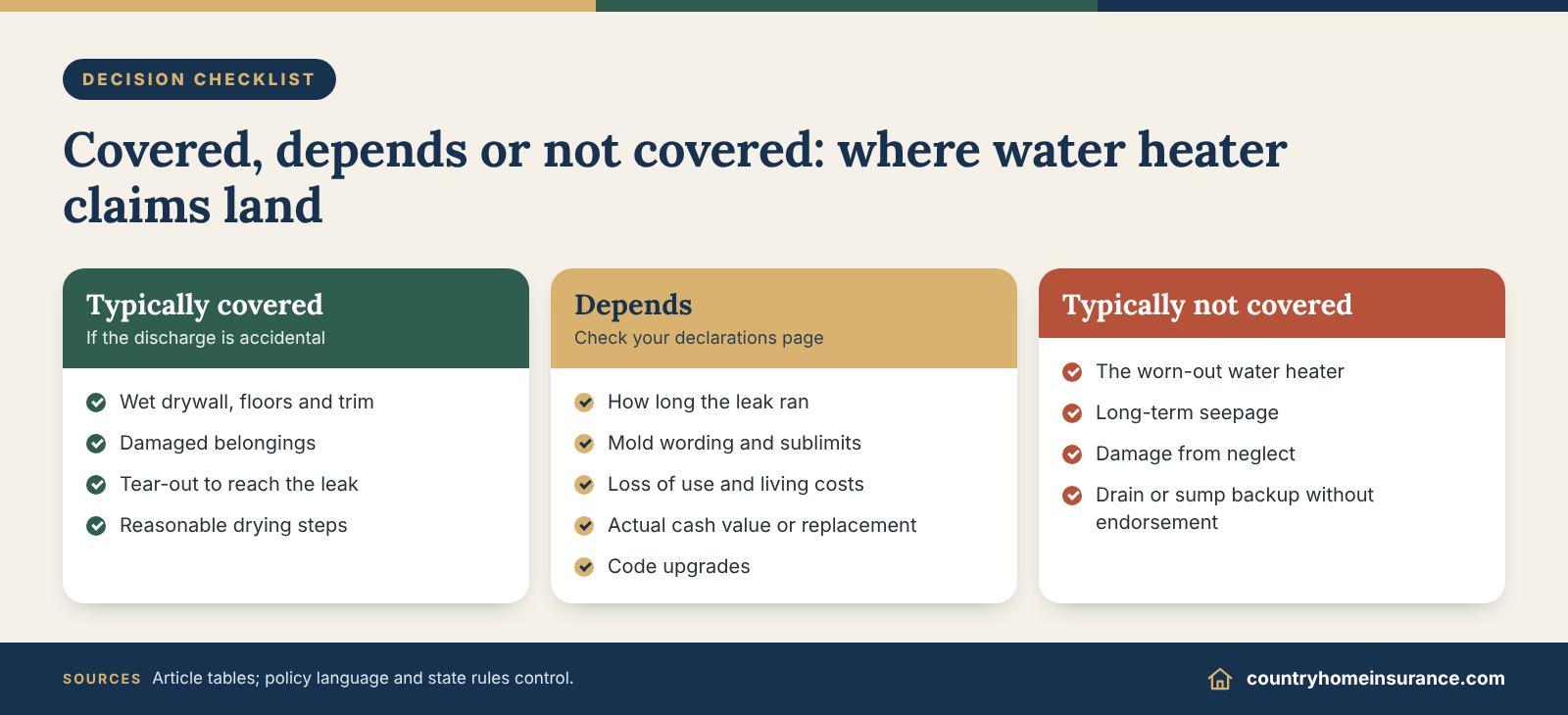
Frequently asked questions
Coverage questions
Does homeowners insurance cover a leaking water heater?
It typically does not pay to repair or replace the heater itself, which is treated as wear and tear, but it may cover resulting water damage when the discharge is accidental and not excluded, less your deductible. Policy wording and state rules control.
Will my insurer pay for a new water heater?
Usually not, unless a separate covered event damaged it or you have an endorsement that covers equipment failure. Check the manufacturer’s warranty, which may cover a defective tank for a set period.
Is a slow leak ever covered?
Many policies exclude continuous or repeated seepage over weeks, months or years, though wording differs, including fixed day counts in some forms. Evidence that the leak began recently can matter.
What if water from the heater damages the unit below me or my neighbor’s home?
That involves liability coverage and the other party’s policy, which this guide does not cover in detail. Report it to your insurer promptly and ask how it will be handled.
Claim process questions
Should I file a claim for a small leak?
Compare likely covered damage with your deductible and ask your agent how claims are recorded and how they may affect renewal. Get early estimates, because hidden damage can enlarge the loss.
How long do homeowners have to report a water heater leak?
Policies require prompt notice, and some states set outside limits, such as Florida’s one-year rule for initial property claims. Report as soon as you reasonably can.
Should I keep the old water heater?
Yes, until the adjuster says it is no longer needed, or at least photograph the breach and data plate and keep failed parts. The NAIC and state regulators advise saving damaged items for inspection.
Can a plumber’s report help?
It can. A written description of where the water escaped, the condition of the parts and whether the failure looked sudden is useful evidence for the adjuster.
Payment and dispute questions
Who gets the check when the home has a mortgage?
Structural payments may be issued to you and the lender, who may hold funds and release them as work is completed, according to the Alabama Department of Insurance. Ask your lender about its process.
What if the insurer’s estimate is lower than my contractor’s?
Request the line-item estimate, compare it with the bid, and send documentation for the differences. Reinspection, appraisal or mediation may be options depending on your policy and state.
Do I need a public adjuster?
Not always. They charge fees and rules vary by state. For complex or disputed losses, consider checking your state’s licensing and fee rules first.
Rural property questions
What if the water heater is in a barn, shop or guest cabin?
Detached buildings generally fall under Coverage B or another policy, and business or farm use may change coverage. Confirm with your insurer before a loss.
Does a well pump shutoff count as loss of use?
It depends on the policy and whether the home is unfit to live in. Document when water was off and when it returned, keep receipts, and ask the adjuster early.
Sources
- NAIC — Navigating the Claims Process: Recover and Rebuild (June 23, 2021; accessed 2026-10-16)
- NAIC — Homeowners Insurance (consumer page) (undated; accessed 2026-10-16)
- NAIC — Home Inventory (undated; accessed 2026-10-16)
- NAIC — How Do I File a Complaint Against My Insurance Company? (Consumer Insight, March 10, 2026; accessed 2026-10-16)
- NAIC — Glossary of Insurance Terms (undated; accessed 2026-10-16)
- NAIC — Unfair Property/Casualty Claims Settlement Practices Model Regulation (#902) (model; accessed 2026-10-16)
- Alabama Department of Insurance — How to navigate the claims process after a storm (Sept. 12, 2024; accessed 2026-10-16)
- U.S. EPA — A Brief Guide to Mold, Moisture and Your Home (updated Feb. 18, 2026; accessed 2026-10-16)
- U.S. EPA — Mold Cleanup in Your Home (updated June 4, 2026; accessed 2026-10-16)
- U.S. EPA WaterSense — Fix a Leak Week (undated; accessed 2026-10-16)
- CDC — About Mold and Your Health (last reviewed Sept. 26, 2024; accessed 2026-10-16)
- Ready.gov (FEMA) — Floods (updated Oct. 17, 2024; accessed 2026-10-16)
- Cornell LII — Cal. Code Regs. tit. 10, § 2695.5 (accessed 2026-10-16)
- Cornell LII — Cal. Code Regs. tit. 10, § 2695.7 (accessed 2026-10-16)
- Texas Legislature — Insurance Code Chapter 542, Processing and Settlement of Claims (current statute; accessed 2026-10-16)
- Florida Legislature — Fla. Stat. § 627.70131 (current statute, last amended 2022; accessed 2026-10-16)
- Florida Legislature — Fla. Stat. § 627.70132 (current statute, last amended 2024; accessed 2026-10-16)
- Florida Legislature — Fla. Stat. § 627.7011 (current statute, last amended 2024; accessed 2026-10-16)
- Florida Legislature — Fla. Stat. § 627.7015 (current statute, last amended 2023; accessed 2026-10-16)
- Cornell LII — 11 NYCRR § 216.6 (New York claim settlement regulation) (accessed 2026-10-16)
- Cornell LII — 11 NYCRR § 216.4 (acknowledgment of claim) (accessed 2026-10-16)
- Washington State Legislature — WAC 284-30-360 (acknowledgment of communications) (current version and version effective Oct. 18, 2026; accessed 2026-10-16)
- Washington State Legislature — WAC 284-30-380 (current version and version effective Oct. 18, 2026; accessed 2026-10-16)
- Texas FAIR Plan Association — Endorsement HO-400 (edition Feb. 1, 2017; accessed 2026-10-16)
- Homeowners of America — Indiana homeowners product overview (IN HOMEOWNERS 1024) (October 2024 edition; accessed 2026-10-16)
- FC&S via PropertyCasualty360 — Repairs to Pipe Not Covered (March 25, 2019; accessed 2026-10-16)
- IA Magazine (Big “I”) — When Does the Continuous Seepage Exclusion Start in a Homeowners Policy? (Feb. 11, 2022; accessed 2026-10-16)
- Clausen Miller — Fourth DCA reverses verdict regarding constant and repeated seepage exclusion (Feldman v. Citizens) (Sept. 1, 2023; accessed 2026-10-16)
- California Court of Appeal — Nargizyan v. State Farm General Insurance Co., No. B342340 (via Property Insurance Coverage Law) (filed Apr. 15, 2026, modified and certified for publication May 14, 2026; accessed 2026-10-16)
- Bradford White — Warranty Center (2026; accessed 2026-10-16)
- Texas Department of Insurance — When are water damage and mold covered by insurance? (updated Apr. 11, 2024; accessed 2026-10-16)
- U.S. Department of Energy — Which Water Heater Is Right for You? (undated; accessed 2026-10-16)
- USGS Water Science School — Hardness of Water (undated; accessed 2026-10-16)
- U.S. Consumer Product Safety Commission — Avoiding Tap Water Scalds (publication 5098) (2012 edition; accessed 2026-10-16)
- Citizens Property Insurance Corp. v. Mendoza, 250 So. 3d 716 (Fla. appellate decision, 2018) (court opinion text; accessed 2026-10-16)
- Hicks v. American Integrity Insurance Co. of Florida, No. 5D17-1282 (Fla. 5th DCA) (Feb. 23, 2018; accessed 2026-10-16)
- ENERGY STAR — Residential Water Heaters Key Product Criteria (accessed 2026-10-16)
Important coverage note
Coverage depends on the actual policy, endorsements, exclusions, limits, deductible and cause of loss. State laws and insurance programs vary, and the examples in this guide, including the claim-handling deadlines and the court decisions, illustrate how rules work in a few places and are not a complete or current statement of the law everywhere. Verify case-specific questions with your insurer or agent and your state Department of Insurance. This article is educational and is not legal advice or a substitute for your policy.
About the editorial team
This guide was prepared by the countryhomeinsurance.com editorial team as general, educational information for homeowners. We research and summarize publicly available material, including state insurance departments, the NAIC, federal agencies, regulators’ consumer guides and published insurer and industry resources. We draw only on the sources that were available to us when we wrote this guide, and we list them in the Sources section with dates where we could find them.
Insurance rules, rates, products and program terms change, differ by state and by insurer, and can apply differently to your situation. We cannot guarantee that this content is complete, current or free of errors. It is not legal, financial, tax or insurance advice, it is not an offer to sell insurance or a recommendation of any insurer, agent or product, and reading it does not create a professional relationship of any kind.
To the fullest extent permitted by law, countryhomeinsurance.com and its editorial team, authors and contributors exclude all liability for any loss, damage or decision arising from the use of, or reliance on, this content. For questions about your own policy or claim, contact your insurer, a licensed agent or broker, your state Department of Insurance or another qualified professional.
Content created: October 16, 2026