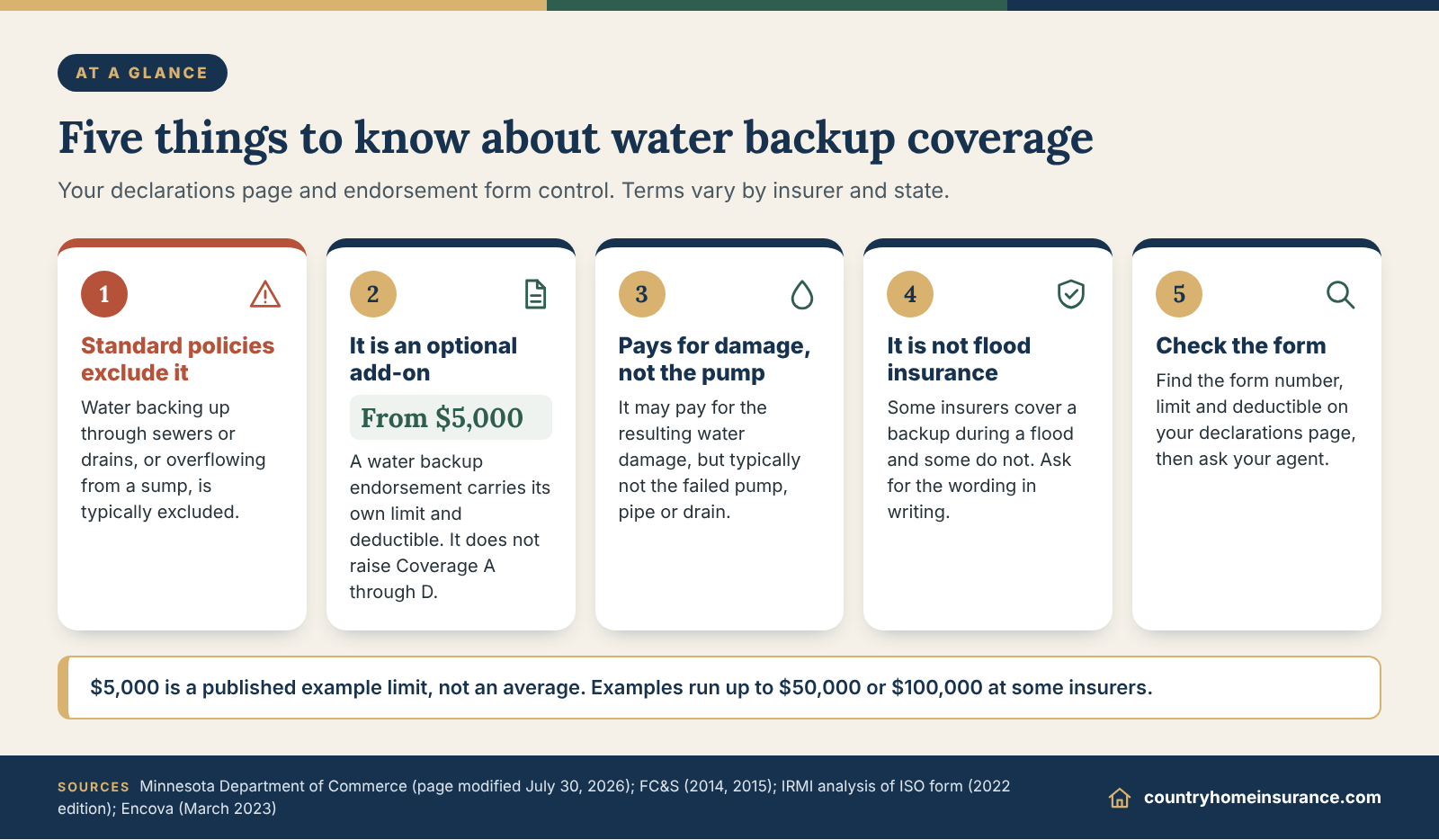
Water backup coverage homeowners insurance carriers sell is usually an optional endorsement, not a built-in feature. A standard homeowners policy typically excludes water that backs up through sewers or drains or overflows from a sump pump. The add-on may pay for the resulting damage, usually up to its own limit and subject to its own deductible, but it generally does not pay for the failed pump or clogged line itself. It also is not flood insurance. Your policy form controls.
Key takeaways
- The Minnesota Department of Commerce lists water backing up from sewers, drains or sump pumps among the losses a typical homeowners policy excludes, so you generally need an endorsement or separate product.
- Published endorsement examples carry a separate sublimit, from $5,000 in the forms we reviewed up to $50,000 or $100,000 at some insurers, and the endorsement does not raise your Coverage A through D limits.
- When a sump pump fails, the endorsement may pay for the water damage but not the pump. Equipment breakdown coverage, where offered, is a different question.
- Many endorsements exclude damage caused by an insured’s negligence, so testing and maintaining the pump is part of keeping the coverage useful.
- A backup endorsement and a flood policy are different products. Some insurers cover backup that happens during a flood and some do not, so ask for the wording in writing.
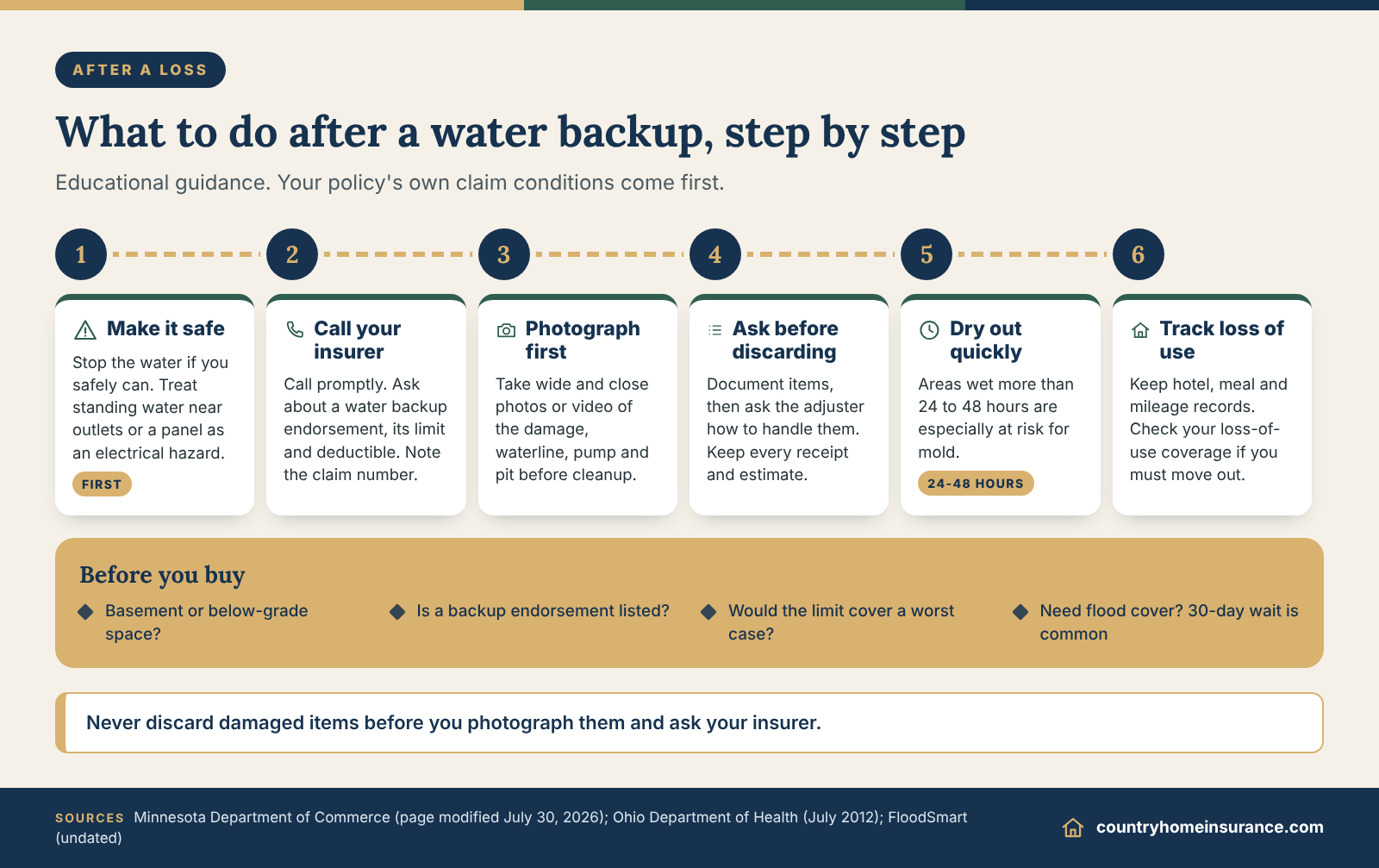
- After a loss, stop the water if you can do so safely, photograph everything, call your insurer promptly and ask before you discard damaged items.
| Scenario | Standard policy without a backup endorsement | With a water backup endorsement | What decides the outcome |
|---|---|---|---|
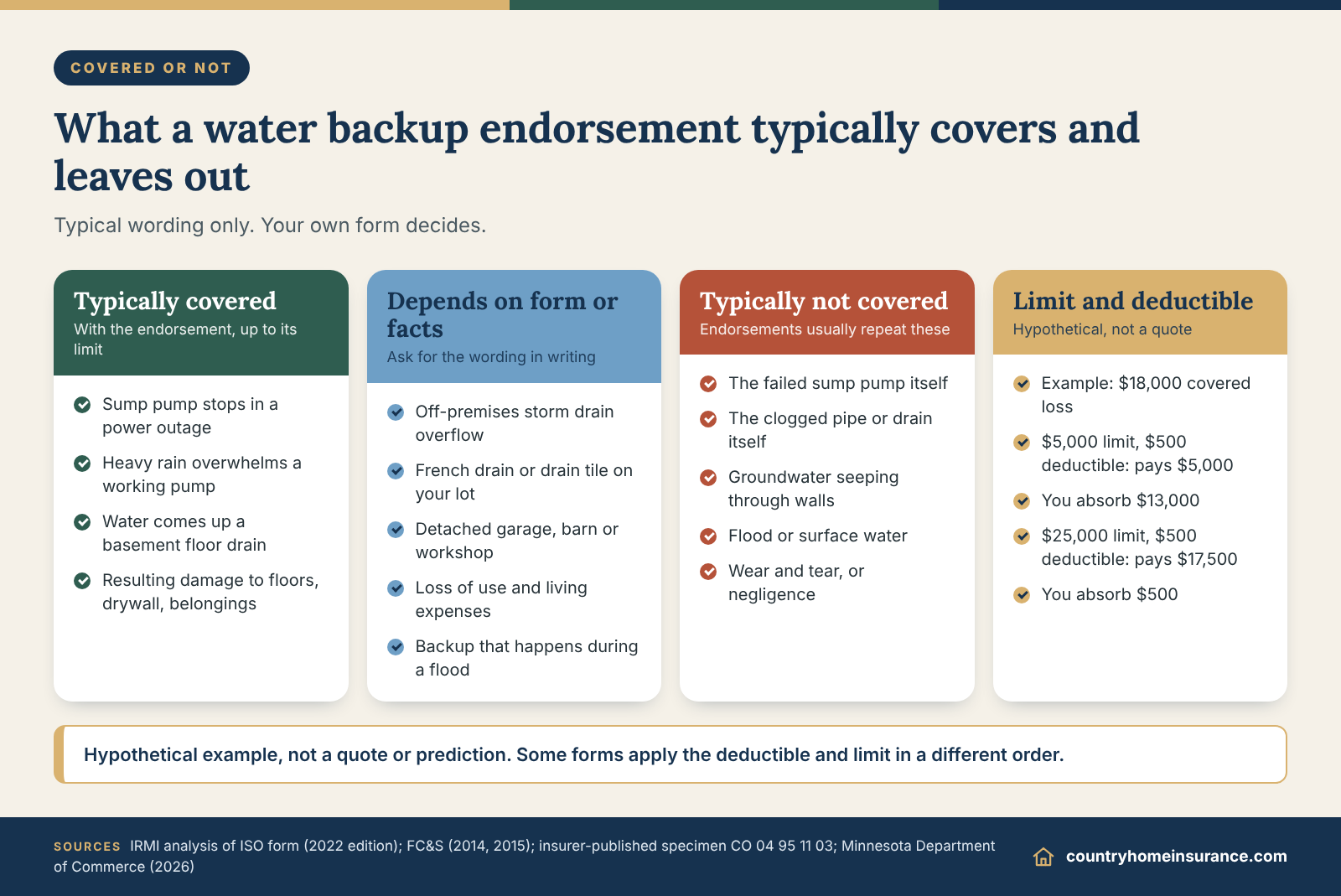
| Sump pump stops during a power outage and the basement floods | Typically excluded | Typically covered for the resulting damage, up to the endorsement limit | Whether the form names sump discharge or overflow, and whether the pump had been maintained |
| Heavy rain overwhelms a working sump pump | Typically excluded | Often covered as sump overflow, subject to the limit and deductible | How the form defines overflow, and whether the water was surface water or rising groundwater |
| Water comes up through a basement floor drain | Typically excluded | Typically covered when the drain or sewer backed up | The source of the water, the exclusion wording and any negligence condition |
| A neighbor’s or a public storm drain overflows into your detached garage | Depends; some forms cover accidental overflow from off-premises drains and pipes | May be covered either way, depending on form edition | Whether the drain is off your premises and how your edition words the exception |
| A supply line inside the house bursts | Generally covered as sudden water damage, subject to the policy | Handled by the base policy, not the endorsement | Cause, maintenance history and the policy’s water-damage terms |
| Groundwater seeps through the basement wall or floor | Excluded | Generally excluded; endorsements usually repeat the seepage exclusion | A flood policy, if you have one, and its own rules |
| The sump pump itself burns out and needs replacing | Not covered as a backup loss | Typically not covered; the water damage may be | Equipment breakdown coverage or a home warranty, if you have either |
Why a standard policy stops short of backup and sump overflow
Most people meet this exclusion in a basement, standing in an inch of water with a policy they assumed would handle it. The gap makes more sense once you see how insurers sort water losses. A homeowners policy is built around sudden events inside the house, such as a supply line that splits or a water heater that fails. Water that arrives from outside the plumbing system, or that a drain or pump was supposed to carry away, is treated as a separate risk and is usually carved out.
This guide covers the water backup endorsement as a concept: what it adds, what it leaves out, how sump pump failures are treated, how limits and deductibles work, and how to handle a claim. It does not go deep on city sewer mains, private sewer laterals or septic tanks, which have their own wrinkles. For those, see our companion guide on sewer backup.
Where the standard form draws the line
Start with the base contract, because every endorsement is a modification of it. Everything below describes typical wording and published commentary, and your own policy may differ.
The exclusion in plain English
Regulators describe the pattern consistently. The Minnesota Department of Commerce lists flood, surface water, waves, tidal water, overflow from bodies of water, water backing up from sewers, drains or sump pumps, and seepage through basement walls and floors as typical homeowners exclusions. Trade commentary from FC&S, a long-running insurance coverage publication, explains that the standard form excludes loss caused directly or indirectly by water that backs up through sewers or drains or overflows from a sump. The 2011 edition of the common ISO homeowners form, according to that commentary, widened the language to cover water-borne material and sump pumps and related equipment.
The practical translation is simple. If the water came up through a drain, or spilled out of the sump, the base policy typically will not pay for what it ruined. The exact edition, state amendments and insurer-specific forms can change that, which is why the declarations page and the form list matter more than any general rule.
What stays covered under the base policy
Not every water loss in a basement is excluded. The NAIC, the National Association of Insurance Commissioners, notes on its consumer homeowners page that water damage from a home’s plumbing or from a roof leak is typically covered, while flood damage from groundwater, rain runoff or snowmelt is not. Minnesota’s page likewise says damage from a broken pipe inside the home is generally covered.
That split is why the cause of the water drives everything. A failed washing machine hose is usually a base-policy question. A backed-up floor drain is usually an endorsement question. A flooded yard that pushes groundwater through a foundation crack is usually a flood-policy question. Sorting your loss into the right bucket is the first job of any adjuster, and understanding the buckets ahead of time puts you in a better position. If your concern is a burst or leaking pipe rather than backup, our guide on burst pipes walks through that side.
Backup, overflow and discharge are different events
Insurance forms are picky about verbs. Three words that sound interchangeable to a homeowner have distinct meanings to an adjuster, and the difference can decide whether a claim fits an exclusion or an exception.
Three words that sound alike
FC&S, in a 2014 explainer, defined the terms this way. A back-up happens when a blockage or collapsed drain stops water from taking its normal path and forces it to reverse direction. An overflow happens when water spills over the edges of a container that has reached capacity, like a bathtub left running. A discharge is water escaping from a pipe at an unintended spot, which is what a leak is. The base policy generally speaks to sudden discharge or overflow from plumbing, heating, cooling and household appliances on the premises, while the water-damage exclusion picks up backup through sewers and drains and sump overflow.
Why does the vocabulary matter to you? Because your loss will be described in one of those words by the adjuster, and the word chosen can route the claim to a different part of the policy. Describe what you saw factually, in plain terms: where the water entered, what it looked like, whether the sump was running, whether the power was out. Let the insurer apply the labels.
Why a sump is not treated as plumbing
One detail surprises many homeowners. The 2014 FC&S piece and a more recent IRMI analysis of the March 2022 ISO homeowners form both say that a sump, a sump pump and related equipment are not considered part of the plumbing system for these purposes, and neither are roof drains, gutters or downspouts. That means an overflowing sump is not treated like an overflowing bathtub, even though it sits inside your house.
IRMI adds a caution worth remembering: some insurers’ forms do not include that limitation and may treat a sump overflow like any other plumbing overflow. The point is not that you should expect coverage. The point is that the exact wording of your own form decides, and two homes on the same street can be insured on different language.
Water backup coverage homeowners insurance endorsements: how they work
An endorsement, sometimes called a rider, is a document that changes the base policy. It can add coverage, remove it or modify it. A water backup endorsement adds back some of what the base form excludes, but it does so on narrow terms. Knowing those terms before you need them beats discovering them in the middle of a claim.
What the endorsement adds to the base policy
The details differ by insurer, but the core grant is consistent across the published examples we reviewed. Think of it as a short list of triggers, a separate pot of money and a few conditions.
The covered triggers
A common reference description of ISO endorsement HO 24 73 says it covers direct physical loss to the dwelling and personal property from water that backs up through sewers or drains, or that overflows or is discharged from a sump, sump pump or similar system. Amica, an insurer, describes its version as helping pay for direct physical damage when water backs up through sewer or drain lines located off your property or when a sump pump overflows or discharges. Another insurer’s published Iowa guideline likewise says its coverage applies to water backing up from off the insured premises through sewers or drains, or overflowing from a sump.
Notice the phrase “off the insured premises” in two of those descriptions. Some forms are written around backups from lines outside your property, which raises the question of what happens with a clogged line that sits on your own lot. That is a wording issue to confirm with your insurer, and it is one of the gray areas covered in our sewer backup guide.
Forms, names and the HO-3 and HO-5 policies
The endorsement shows up under different names: water backup, water backup and sump overflow, sewer and drain backup, or a similar label. ISO, the Insurance Services Office, publishes standard forms that many insurers adapt, and the numbers HO 04 95 and HO 24 73 appear in trade commentary and reference sites. Many insurers file their own versions, so a form number on a quote or declarations page is worth writing down.
The reference description of HO 24 73 says the standard HO 00 03 (the HO-3 special form) and HO 00 05 (the HO-5 comprehensive form) typically exclude this kind of water damage, so the endorsement adds it back. In plain terms, moving from an HO-3 to an HO-5 does not by itself solve the problem. Both are base forms, and a backup gap generally has to be filled by an endorsement or a separate product regardless of which base form you hold.
The negligence condition
Several published forms add a condition: the coverage applies to loss not caused by the negligence of an insured. The Maryland Insurance Administration says its water backup coverage applies only when the backup is not caused by the insured’s negligence, and notes that its page does not define the term. The HO 24 73 reference gives an example of ignoring a severely clogged drain.
What does that mean for you? Negligence is a loose word until an adjuster applies it. A pump that was never plugged in, a drain you knew was slow for months, or a sump pit full of debris may invite the question. Reasonable upkeep and a written record of it are the cheapest protection against a negligence dispute.
What the endorsement still leaves out
Even a well-written endorsement has edges. Reading the exclusions section of the form takes ten minutes and prevents most unpleasant surprises, so here are the recurring ones.
The pump, pipe and drain themselves
The Maryland Insurance Administration says most policies will not pay to repair or replace the pipe. The HO 24 73 reference says the same about a failed sump pump, sewer pipe or drain, with the resulting water damage covered up to the limit. Progressive’s educational page lists replacing a broken sump pump among things the add-on typically does not cover and suggests equipment breakdown coverage may address the pump. An insurer-published specimen, form CO 04 95 11 03, states that the pump and related equipment are not covered when their own damage results from breakdown.
The logic is consistent: the endorsement insures what the water did, not the machinery that failed to move it. If you want the pump itself protected, ask whether your insurer sells equipment breakdown coverage and whether it applies to a sump pump, rather than assuming it does.
Flood, surface water and seepage
The same specimen form keeps the water-damage exclusion for flood, surface water, waves, tidal water and overflow of a body of water. It also excludes subsurface water that seeps, leaks or pressurizes through a building, foundation, driveway, pool or similar structure. Encova, another insurer, states plainly that water backup coverage is not flood insurance. Amica’s page also lists groundwater seepage through foundations, driveways and patios as excluded.
This is the exclusion that most often decides sump pump claims in wet weather, because rain-driven groundwater and a failing pump arrive together. We come back to it in the section on flood and groundwater below.
Wear, slow leaks and maintenance problems
Amica lists wear and tear or aging of plumbing, pipes and sump pump systems among exclusions, while noting that resulting water damage may still be covered. It also lists slow leaks and maintenance issues. Policygenius, a consumer publisher, says that if a pump breaks or was never switched on, an insurer may deny the claim as a maintenance or negligence issue.
Treat those statements as a map of where disputes tend to start, not as predictions. The same facts can be handled differently by different insurers and under different forms. The takeaway is to keep the pump working, keep records, and keep the policy language handy.
Sump pump failure and overflow: how the claim usually plays out
A sump pump sits in a pit, called a sump basin, usually in the lowest part of a basement or crawl space. It collects water that drains toward the foundation and pushes it away from the house. When it works, nobody thinks about it. When it doesn’t, the water has nowhere to go but up and across the floor, which is why sump pump failure is the loss most people picture when they ask about water backup.
How sump systems fail
Failure comes in a few recognizable forms, and each interacts differently with the policy language. Knowing which one you are most exposed to also tells you where to spend prevention money.
Power loss at the worst moment
The Minnesota Department of Commerce notes that pumps can fail when power stops. Progressive makes the same point, adding that outages can disable a pump and raise backup risk. Storms are the usual reason the lights go out, and storms are also the reason the pit is filling fastest, so the two problems tend to arrive together. Amica’s list of example scenarios begins with exactly this: a power outage stops the pump and floods the basement.
If you own a house where outages are routine, whether from a long rural feeder line, ice on branches or a transformer that has seen better days, the pump’s electrical supply is the weak link regardless of how good the pump is. A battery backup or generator transfer setup addresses the cause, while the endorsement addresses some of the financial effect.
Inflow that exceeds the pump’s capacity
Minnesota’s page also says pumps can fail when the volume of water entering the system exceeds what it can remove. A working pump can still lose a race against a prolonged downpour, a rapid snowmelt or a high water table. FC&S, explaining the logic of the exclusion, says sump overflow is carved out in part because sumps so often fail when the volume of water exceeds their capacity, which makes it a frequent source of losses.
This is the scenario with the thinnest line between sump overflow and groundwater flooding. If the water overflowed the pit, it looks like sump overflow. If water instead seeped through the wall or floor, it looks like seepage, which endorsements usually exclude. An adjuster will want to know which it was, and photographs taken before cleanup help answer that.
Mechanical breakdown and neglect
Pumps are machines, and they wear out. Switches stick, floats jam against the side of the pit, check valves fail and motors burn out. The 2014 FC&S explainer uses a burned-out motor as its example of a covered sump loss under the common ISO endorsement: the flooding would be covered up to the endorsement amount even though a mechanical breakdown caused it.
That is the generous reading. Policygenius adds the other side, noting that a pump that is broken or never switched on may lead to a maintenance or negligence denial. Both can be true under different forms, which is why you should read the exclusions for your own endorsement rather than relying on a general description.
How coverage treats the pump and the water
The most useful distinction in sump claims is between the equipment and the damage the equipment failed to prevent. Almost every published description draws that line in the same place.
The resulting damage versus the pump
Encova’s March 2023 blog describes covered water backup as including water that overflows or is discharged from a sump, sump pump or related equipment, even if a mechanical breakdown or power failure caused it, while stating that the coverage does not pay to repair or replace the pump when breakdown or power failure damages it. The HO 24 73 reference gives the same illustration: if the motor fails, the new pump isn’t covered, but the water damage from the overflow is, up to the limit.
So a typical outcome, when the facts line up, is a payment for ruined flooring, drywall, belongings and cleanup, and a bill you pay yourself for the new pump. The pump is usually the cheapest part of the whole event, which is part of why the endorsement is aimed where it is.
Where equipment breakdown coverage fits
Progressive’s page says equipment breakdown coverage might address a broken sump pump. Policygenius says equipment breakdown coverage, rather than the backup endorsement, is the route for a broken pump. Neither page promises that your policy has it, and availability varies by insurer, so treat it as a question rather than a given.
A home warranty contract, if you have one, is a different kind of product altogether and not an insurance policy. Whether it covers a sump pump depends on its own terms, and we haven’t verified any particular warranty’s wording here.
The maintenance and negligence question
The negligence condition and the wear-and-tear exclusion are where a pump claim can get complicated. Neither is a reason to avoid the endorsement, but both are reasons to keep evidence. A dated note that you tested the pump in the spring, a receipt for a new battery, or a photo of a clean pit and a working float are all easy to create and hard to recreate after a loss.
Amica recommends keeping the plumbing and sump pump well maintained, testing the pump periodically and clearing debris from drains when appropriate. Experian suggests checking the pump yearly before the rainy season. Those are routine habits, not heroics, and they double as documentation.
French drains, drain tile and water on your own property
Many rural and older homes have perimeter drainage that feeds the sump: a French drain, which is a gravel-filled trench with a perforated pipe, or drain tile around the footing. These systems create a boundary question that the policy wording has to answer.
On-premises versus off-premises drains
The IRMI analysis of the March 2022 ISO homeowners form describes an exception that, unless otherwise excluded, covers accidental discharge or overflow from a storm drain, or from a water, steam or sewer pipe, located off the residence premises. Its example is a neighbor’s storm drain backing up and damaging the insured’s detached garage. The same analysis says overflows from drains on the residence premises, such as French drains, are not within that exception.
The result is an odd asymmetry. An overflow from a drain under the neighbor’s lot may fit an exception in the base form, while an overflow from the drain on your own lot may fall into the water-damage exclusion and need the endorsement. Edition and insurer matter, so use this as a prompt to ask, not as a prediction.
Blocked drain tile and the endorsement
Progressive lists blocked drain tile among the things its description of the add-on may cover, alongside sewer and drain backups and sump failure or overflow. Amica’s examples include heavy rain entering through a malfunctioning sump pump or French drain. If your home depends on perimeter drainage, ask whether the endorsement names drain tile or French drains specifically, or whether it speaks only of sewers, drains and sumps.
Written confirmation from your insurer or agent is better than a verbal answer. If the confirmation isn’t available, treat the coverage as uncertain and plan accordingly.
Limits, deductibles and cost: what the numbers look like
A water backup endorsement is usually sold as a separate sublimit, which is a cap on what the policy will pay for that specific type of loss. The sublimit is typically much lower than your dwelling limit, and it does not raise Coverage A (Dwelling), B (Other Structures), C (Personal Property) or D (Loss of Use). Both the ISO-style specimen and the HO 24 73 reference say so explicitly. That makes the limit you choose the most consequential decision on the page.
Choosing a limit
Published limits vary widely, and no source we found provides a market-wide average. What follows is a set of examples, each with its publisher and date, not a benchmark.
What published limits actually look like
The common ISO-style endorsement is described in the IRMI analysis (March 2022 edition) as providing $5,000. An insurer-published specimen, form CO 04 95 11 03, says up to $5,000. The HO 24 73 reference describes a separate, often lower limit, with $5,000, $10,000 or $25,000 as examples. Policygenius, in a page last updated in March 2022, says insurers generally offer about $5,000 to $25,000. The Zebra, in a page updated in January 2026, says endorsements typically carry limits between $5,000 and $25,000. Higher ceilings exist: one Iowa insurer’s guideline says up to $50,000, and Encova’s 2023 blog says one of its products runs from $5,000 up to $100,000 subject to eligibility.
The spread is the lesson. The same word, “water backup,” can mean $5,000 at one company and $100,000 at another, and a basement that has been finished with flooring, drywall, a bathroom and a media room can lose far more than the low end.
Full-limit variants and state differences
FC&S, in a 2015 piece, said many states cap coverage at $5,000 while some, with Maryland as its example, apply the full policy limit, and that a different ISO version covers losses up to the policy limit in all states. That commentary is dated and edition-specific, so don’t assume it reflects today’s filings, but it shows that “the endorsement has a $5,000 cap” is a common pattern and not a rule.
If your insurer offers several limit choices, the question is not which is cheapest but which matches what you could lose. Policygenius suggests adding up the cost of replacing flooring, belongings and anything else at risk in a worst-case backup, which is a sensible way to size the number.
A hypothetical limit example
Hypothetical example, not a quote or a prediction: suppose a heavy storm and a power outage stop a sump pump, and the resulting water ruins flooring, drywall, a sofa and stored items. The adjuster totals the covered damage at $18,000. The table below shows how different limits and deductibles would change the outcome if the deductible is subtracted first and the limit then caps the payment. Some forms may apply these steps in a different order, so the form’s own wording governs.
| Endorsement limit | Deductible | Illustrative insurer payment | Illustrative amount the homeowner absorbs |
|---|---|---|---|
| $5,000 | $500 | $5,000 | $13,000 |
| $10,000 | $500 | $10,000 | $8,000 |
| $25,000 | $500 | $17,500 | $500 |
| $25,000 | $1,000 | $17,000 | $1,000 |
The example uses round numbers on purpose. Real losses are messier, depreciation may reduce personal property payments, and some items may not be covered at all.
Deductibles on backup claims
The deductible is the part of a covered loss you pay before the insurer pays. For backup claims, it may be unlike the one on the rest of your policy.
Special deductibles and published examples
The IRMI analysis describes a $250 special deductible on the March 2022 ISO endorsement. The insurer specimen uses a $500 special deductible and says no other deductible applies to this coverage. FC&S in 2015 said $250 was the usual figure, with a $100 option allowed in Virginia. Policygenius says the deductible may match your standard one, with a $1,000 example, or be a separate deductible as low as $250. The Iowa insurer guideline sets the deductible at the greater of the other-perils deductible or $1,000.
These differences can matter more than the premium. Compare the table below, and notice that no single figure is typical across all sources.
| Source and date | What it describes | Limit | Deductible |
|---|---|---|---|
| IRMI analysis of ISO HO 04 95 03 22 (2024 upload of a March 2022 edition) | Standard ISO water backup and sump endorsement | $5,000 | $250 special deductible |
| Insurer-published specimen CO 04 95 11 03 (undated) | Water Back Up and Sump Overflow endorsement | Up to $5,000 | $500 special deductible; no other deductible applies |
| HO 24 73 reference description (undated) | Endorsement with a separate limit | Often $5,000, $10,000 or $25,000 | Not stated in the description reviewed |
| Policygenius (updated March 2022) | Consumer publisher overview | Generally about $5,000 to $25,000 | May equal standard deductible (example $1,000) or a separate one as low as $250 |
| The Zebra (updated January 2026) | Consumer publisher overview | Typically $5,000 to $25,000 | Often a separate deductible, varying by policy and carrier |
| One Iowa insurer’s underwriting guideline (undated) | Optional endorsement on Iowa homeowners policies | Up to $50,000 | Greater of the other-perils deductible or $1,000 |
| Encova blog (March 2023) | Insurer overview of its products | From $5,000 up to $100,000 depending on product and eligibility | Not stated on the page reviewed |
Loss of use and living expenses
If a backup makes part of the house unusable, you may face hotel bills or other extra living costs. Loss of use coverage, Coverage D, is the part of a homeowners policy that addresses that. The insurer specimen says the special deductible does not apply to Coverage D, and FC&S in 2015 said the same about the ISO deductible. Experian says water backup insurance may pay alternative living expenses if repairs make the home uninhabitable, while the HO 24 73 reference says some policies may include additional living expenses.
The takeaway is to ask a precise question: if a covered backup forces us out for two weeks, does the loss of use come from Coverage D, from the endorsement limit, or from neither? The Minnesota Department of Commerce also tells claimants to check loss-of-use coverage in their policy if temporary housing is needed.
What it costs and what changes the price
Price is the question every reader wants answered first and the one with the least reliable public data. Publishers use different methods, and the numbers should never be blended into one average.
Published price ranges and why they aren’t comparable
Policygenius and Experian, both in 2022, attribute a cost of roughly $30 to $70 a year for $5,000 of coverage and about $25 to $35 more for each additional $5,000, without a stated methodology. The Zebra, updated in January 2026, says the add-on typically runs around $50 to $250 a year, depending on local factors such as weather and the chosen limit. Its table of average home policy premiums by insurer, for a policy with $20,000 added, shows differences between the no-backup figure and the $20,000 figure that range from about $16 to about $156 a year across the eleven insurers listed, but the page does not describe how those home figures were produced, so treat them as illustrations only.
Those are different publishers, different years and different assumptions. Use them to get a rough sense that the add-on is often modest next to the whole premium, then get quotes for your own address, limit and deductible. Progressive’s page says price depends on state, insurer and chosen limit, and gives no dollar figures.
What tends to move the price
The sources we reviewed name a few drivers: the state, the insurer, the limit you choose and local factors such as weather. The HO 24 73 reference adds that backwater valves or sump pump alarms are not always required but are often recommended, and underwriters may consider them. That suggests mitigation devices could matter to some insurers, though no source we reviewed promised a discount for them.
It is reasonable to ask your agent whether a battery backup, alarm or backwater valve changes eligibility or price. It would not be reasonable to assume a discount exists. Some insurers also limit when the endorsement can be added. The Iowa insurer guideline, for instance, says it can be added to an existing policy only at renewal.
Where backup, flood and groundwater collide
The hardest water backup claims are the ones where several kinds of water show up together: a storm, a power outage, a saturated yard and a pump that gave up. Insurers sort those facts into categories, and each category can sit under a different policy or none. A little vocabulary helps you follow the conversation with the adjuster.
A flood policy and a backup endorsement do different jobs
Homeowners often assume that carrying flood insurance and a backup endorsement closes every water gap. It narrows the gaps, but the two products have different triggers, and neither is a substitute for the other.
What a flood policy is built to cover
FloodSmart, the National Flood Insurance Program’s consumer site, says most homeowners insurance does not cover flood damage. For homeowners, it describes building coverage of up to $250,000 and contents coverage of up to $100,000, with building and contents usually bought separately and carrying separate deductibles. Coverage generally takes effect 30 days after purchase, with exceptions such as buying in connection with a mortgage, and policies run for one year. Flood insurance can also be purchased from private insurers, and the NAIC’s consumer page says flood coverage is available through the NFIP or private companies.
We did not verify here how an NFIP policy treats basement equipment or a sump pump, and the FloodSmart pages we reviewed do not address it. If you live where a flood policy is realistic, read the policy summary for what it says about basements and the items stored in them, and treat the endorsement as a complement rather than a replacement. Our flood coverage guide covers the broader picture.
When a flood and a backup arrive together
The Minnesota Department of Commerce says coverage varies by insurer: some cover backups that occur during a flood, while others exclude them, and some insurers deny all damage if a flood indirectly causes the failure. It also says a sewer or sump endorsement does not provide flood coverage. Progressive’s page adds that even with a separate flood policy, backup damage may not be covered. Experian says flood insurance covers backup only when a flood directly caused it.
Ask your insurer in writing whether the endorsement applies when a flood or storm causes the backup. It is a short question with a very large consequence, and the answer is not the same from one company to the next.
Wording that decides close calls
When facts overlap, the policy’s wording decides which cause governs. Three pieces of vocabulary come up repeatedly.
Directly or indirectly
FC&S’s 2015 commentary says the standard form excludes loss caused directly or indirectly by water that backs up through sewers or drains or overflows from a sump. The words “directly or indirectly” are doing heavy lifting. They suggest that if backup water is part of the chain of events, the exclusion can reach the whole loss, even when something else also contributed.
That is part of why an endorsement that modifies the exclusion matters so much. The insurer specimen replaces the base water-damage exclusion and restates the flood and seepage exclusions in its own words, so the exact text that replaces the exclusion is the text to read. A summary on a website is not that text.
Where courts have disagreed
The same FC&S commentary summarized court decisions that came out differently on whether sewage counts as excluded water, and on whether a blockage inside a home’s own drain is treated differently from a blockage in a sewer line. It also noted that some courts have treated a sewer as beginning at the property line. That commentary was published in 2015, so it is a snapshot of how courts had ruled by then and not a current legal survey.
What a homeowner can take from that is modest but practical. The same event can be handled differently depending on the form, the state and the facts, and a denial is not always the end of the conversation. We aren’t giving legal advice, and if a large claim is denied, the state Department of Insurance and a licensed professional are the people to ask.
State rules and required offers
Insurance is regulated state by state, so some of what applies to you depends on where the house is. The research we could verify for this article turned up one clear example of a state that requires insurers to offer the coverage, and it is not a complete survey.
Maryland’s required offer
The Maryland Insurance Administration says Maryland law requires insurers to offer water backup coverage, which is available for an additional premium and applies when the backup is not caused by the insured’s negligence. A Garrett County government page summarizing the rule says the offer is made under Insurance Article section 19-202, must be made in writing by certified mail within seven days of initial placement or at each renewal, and has applied since October 1, 2008. Because the county page is a secondary summary, check the statute itself or the Maryland Insurance Administration if you rely on the details.
The Maryland example shows what a required offer does and doesn’t do. It makes sure the option is put in front of you. It doesn’t make the coverage free, and it doesn’t change the limit, deductible or exclusions you choose.
Checking your own state
The Minnesota page we reviewed describes backup protection as a separate product or endorsement and doesn’t cite a requirement to offer it. We did not survey every state, and offer requirements, form filings and available limits can change. The most reliable way to learn what applies is to ask your insurer or agent whether your state has an offer requirement and to check your state Department of Insurance website.
A practical sign is whether your renewal packet or quote lists the endorsement as an option. If you never remember seeing it, ask directly. A silent absence does not mean you’re protected.
What to do after a water backup: a claim workflow
A backup is stressful, and the first few hours influence both the damage and the paperwork. The steps below combine regulator guidance with common-sense practice. They are not a substitute for your policy’s own notice and claim conditions, which you should read when you can.
The first hours
Your goals in the first hours are safety, limiting additional damage and creating a record. The order matters because it keeps you out of danger while still preserving evidence.
Make it safe and limit further damage
The Minnesota Department of Commerce advises taking reasonable precautions to prevent further damage without putting yourself at risk. If standing water is near outlets, a panel, a furnace or appliances, treat it as an electrical hazard and get a qualified electrician or your utility involved before wading in. That is a general safety caution rather than a point drawn from our sources, but it’s the sort of thing worth saying plainly.
If the source is a plumbing line you can control, stop using water in the building so you don’t add to the problem. A city of Bismarck, North Dakota guidance sheet for sewer backups gives the same instruction. If the source is a sump that has stopped, restoring power or moving the water out may be possible only after the electrical situation is safe.
Notify the insurer promptly
Minnesota’s guidance is to contact your insurer promptly and make sure your agent can reach you. Your policy may have conditions about prompt notice, so don’t wait to see how bad the damage looks. A short initial call is enough: say what happened, when you noticed it, what you’ve done so far and ask what the insurer wants before cleanup begins.
Ask specifically whether your policy includes a water backup endorsement, what its limit and deductible are, and whether a mitigation company is expected to start work right away. Write down the claim number, the name of the person you spoke with and the date.
Document before you clean
Minnesota’s page says to inspect and photograph the damage, and the Bismarck sheet says to photograph the damage and keep receipts for cleanup equipment and services. Take wide shots of each room, close-ups of the waterline, the source of the water, the pump and the sump pit, and any visible debris. Take video if you can, and walk the space slowly, narrating what you see.
Then photograph the contents that you’re about to move or discard. If a health hazard makes it unsafe to keep an item, document it thoroughly and ask the adjuster how they want it handled before it goes in the dumpster. The sections below on cleanup explain why speed matters for health as well.
Cleanup and health
Backup water can carry contamination, and a basement that stays wet can begin to grow mold. Neither point makes cleanup a casual project.
Protective gear and what to discard
Two public health documents, both dated and so worth treating cautiously, give consistent advice for sewage-contaminated water. The Ohio Department of Health’s July 2012 fact sheet recommends waterproof boots, gloves, eye protection and an N95 mask, and says porous items that touched sewage, such as books, mattresses, pillows, upholstered furniture, drywall and unfinished wood, should be discarded unless they can be thoroughly cleaned and disinfected. Carpet padding should always be discarded, and carpet may be saved only if it can be steam cleaned and disinfected, after consulting a water restoration professional. A 2005 CDC fact sheet on flood-water cleanup similarly lists bedding, floor coverings, upholstered furniture, books and most paper products, and recommends removing contaminated drywall and insulation.
Sump overflow water isn’t always sewage, but you may not know what’s in it, so treat unknown water cautiously. If the water was truly clean rainwater or groundwater, a professional can tell you what can be saved. Our sewer backup guide discusses contaminated water in more depth.
Drying quickly and mold
The Ohio fact sheet says areas that stay wet for more than 24 to 48 hours are especially at risk for mold, recommends removing standing water first and drying with fans or dehumidifiers, and says to clean hard surfaces with detergent and hot water before disinfecting. It also warns never to mix ammonia-based cleaners with chlorine. Follow product labels and ventilate the space.
Mold is where coverage can get thin. The NAIC notes that policies often exclude mold damage costs. Amica describes its endorsement as covering cleanup and mitigation, including water removal, drying, mold prevention and removal of damaged material. Those two statements can coexist: prompt drying that prevents mold may be treated differently from remediation after mold has already spread. Ask how your policy handles each.
Receipts, estimates and professionals
Minnesota’s page recommends including written estimates to document all claimed losses, and the Bismarck sheet advises keeping receipts. Keep everything: invoices from a water restoration company, equipment rental receipts, hotel bills, grocery receipts if you couldn’t use the kitchen, and mileage if travel was required.
Before you sign a contract with a restoration company or contractor, ask the insurer what it expects and whether it wants to see the scope first. Minnesota’s guidance to take reasonable precautions against further damage is a good starting principle, but what your policy treats as a reimbursable emergency measure is a question for your own policy wording and your adjuster.
Working the claim to completion
The first days are about safety, and the following weeks are about numbers. The adjuster’s scope of work and your own records meet in the middle.
Scope of loss, inventory and depreciation
The NAIC’s consumer pages emphasize a home inventory, with items grouped by room or category and photographed, including age, price and value. A home inventory can make a contents claim faster and more complete. If you never made one, reconstruct it from photographs, receipts, credit card statements and online order history while the memory is fresh.
Know whether your contents are insured at replacement cost value (RCV) or actual cash value (ACV). The NAIC explains that ACV payments are reduced for age and wear, including for personal property, and often do not fully replace what was lost, while RCV pays to repair or replace with like kind and quality. The deductible is subtracted under either method. Ask whether your endorsement follows the same settlement basis as your base policy.
When the limit runs short
Because the endorsement has its own cap, a large loss can exhaust it. The HO 24 73 reference offers a simple example: a $12,000 backup with a $10,000 limit pays up to $10,000, less any deductible. Our hypothetical in Table 2 showed the same effect with larger numbers.
If the cap looks likely to bind, ask the adjuster how the limit applies across structure, contents and cleanup, and whether any part of the loss falls under the base policy instead. We haven’t verified a standard rule for how a single sublimit is allocated among those categories, so rely on your form and the adjuster’s written explanation.
Disagreements and where to take them
If you disagree with a scope, a payment or a denial, start by asking for the specific policy language relied on, in writing. Provide additional documentation that addresses the stated reason, such as maintenance records for a negligence concern or photographs showing the water’s source for a seepage concern.
If the dispute continues, your state Department of Insurance is the regulator to ask about consumer questions and complaints in your state. For large losses or legal questions, speak with a licensed professional. This article is educational and not legal advice.
| Item to capture | What to record | Why it helps | Basis |
|---|---|---|---|
| The scene before cleanup | Wide and close photos or video of each affected room, the waterline and any debris | Shows the extent of damage and the likely source of the water | Minnesota Department of Commerce advises photographing damage |
| The sump pit, pump and switch | Pump model, float position, power status, whether the pit overflowed, any alarm or battery | Helps distinguish sump overflow from seepage and shows condition | General practice; ask your adjuster what they want |
| Damaged contents | Item list by room with age, purchase price, estimated value and photos | Supports the personal property portion of the claim | NAIC home inventory guidance |
| Written estimates and invoices | Restoration company scope, repair quotes, equipment rentals | Documents the amount of the claimed loss | Minnesota advises written estimates; Bismarck advises keeping receipts |
| Temporary housing and extra costs | Hotel stays, meals above normal, mileage, dates the space was unusable | Supports a loss of use claim if your policy provides it | Minnesota advises checking loss-of-use coverage |
| Maintenance history | Dated test notes, battery receipts, service invoices, photos of a clean pit | Addresses wear, maintenance and negligence questions | Amica and Experian recommend routine testing; records are our suggestion |
| Policy documents | Declarations page, endorsement form number, limit and deductible | Lets you check the adjuster’s explanation against the contract | Amica advises checking the declarations for limits and deductibles |
Rural and country homes: sumps, outbuildings, wells and long outages
A country home isn’t just a suburban house with more land. Longer power lines, private water systems, detached buildings and drainage that runs across your own acreage change where backup risk comes from and what the endorsement may reach. Few insurer pages address those features directly, so this section combines what the sources say with plain reasoning, and flags where you need to ask.
Rural features that raise backup questions
Three features come up more often on country properties than in town, and each is worth a specific question to your insurer.
Outages that last longer than a battery
Both Minnesota and Progressive tie sump pump failure to power loss. On a rural line, an outage after an ice storm or a wind event can last longer than in a town grid, and that is general reasoning rather than a sourced statistic. A pump with a small battery may bridge a short outage but not a multi-day one in wet weather.
Encova’s suggested safeguards include a battery backup, a whole-house generator as an alternate power source, and a backup plan for the backup system. If you rely on a generator, the practical question is whether the pump is on the circuits it feeds and whether anyone is home to start it.
Detached garages, barns and workshops
Many country properties have outbuildings with floor drains, sumps or finished space, such as a workshop or a garage apartment. Where the endorsement stands on those buildings is not something our sources settle. The IRMI analysis of the March 2022 ISO base form says its off-premises drain exception applies to Coverage A or B property and uses a detached garage as its example, which shows that other structures can be part of a water loss discussion. The reference description of HO 24 73 speaks of the dwelling and personal property.
The prudent step is to ask whether your endorsement reaches Coverage B other structures, and if so on what terms. If you store valuable equipment, tools or inventory in a detached building below grade or near a drain, ask by name. Farm and ranch use may also fall under different policies altogether, as our guide to rural home insurance explains.
Private wells and well-house equipment
A private well pump is not a sump pump, and the two shouldn’t be confused in a claim conversation. A well pump supplies water, while a sump pump removes it. After flooding, the EPA’s septic and flood guidance, last updated in August 2026 according to the page we retrieved, says not to drink well water until it has been tested and to contact the local health department for guidance.
That is a health instruction and not a coverage statement. We did not find a source saying whether a backup endorsement pays for well testing, a well-house pump or the water supply system, so ask your insurer rather than assuming. For septic systems and private service lines, which have their own coverage questions, see our sewer backup guide.
Prevention that supports the coverage
Prevention is the part you control. It also happens to be the part that makes a negligence or maintenance dispute less likely.
Test, clean and record
Amica recommends keeping plumbing and the sump pump well maintained, getting routine inspections to catch problems early, and testing the pump periodically. Experian suggests checking it yearly before the rainy season, and Encova suggests testing especially before rainy seasons. A simple test is to pour water into the pit and watch the float lift, the pump start and the water leave through the discharge line. Note the date and take a quick photo.
Clear debris from the pit and make sure the discharge line outside is not frozen, buried or pointed back toward the foundation. Those are common-sense checks, not points drawn from our sources.
Backup power and alarms
Battery backups, generators and high-water alarms address the causes of the loss that an endorsement only partly pays for. The HO 24 73 reference notes that backwater valves or sump pump alarms are often recommended and that underwriters may consider them. That doesn’t mean installing one earns a discount, but it may help a conversation with your agent about eligibility or terms.
If you are away for days at a time, an alarm that sends a notification to your phone does more than one that only beeps in an empty basement. Ask a licensed electrician or plumber about options suited to your home.
Seasonal, remote and second homes
A house that sits empty for stretches is a different risk, because nobody is there to notice the water. We reviewed no source that spells out how backup endorsements treat vacancy, so treat this subsection as a list of questions.
Who notices when you’re away
A pump that fails on a Tuesday is a small problem if you’re home Tuesday evening and a large one if you return the following month. The longer water sits, the more the Ohio Department of Health’s 24 to 48 hour mold warning matters. Consider asking a neighbor, caretaker or family member to check the basement after major storms and outages.
Document those checks. If a claim follows, a record that someone looked in on the property regularly can help address any question about maintenance or negligence.
Vacancy and occupancy conditions
Many homeowners policies contain conditions about vacancy or unoccupancy, and the details vary by insurer and form. We haven’t verified any particular form’s rules, so we can’t say how they interact with a backup claim. Read the policy sections on vacancy, occupancy and seasonal use, and ask your agent how long the home can be unoccupied before coverage is affected.
If the property is a second or vacation home, the same questions apply to the endorsement itself. Ask whether it is available on that policy type, what limit is offered, and whether any additional conditions apply.
Deciding whether to add it, and what to ask before you do
Choosing a water backup endorsement is a risk-and-budget decision. The premium is usually modest next to the whole policy, but the value depends on what you could lose and how much of it the limit would reach. This section helps you think through your own house instead of following a generic rule.
Whose exposure is highest
No source we reviewed ranks homes by risk with data, so these are the factors the sources point to rather than a scoring system.
Finished basements and heavy-rain areas
Amica says the coverage may benefit homes with finished basements, areas with frequent heavy rain or power outages, and communities with aging pipes. Progressive says basements are more vulnerable than homes built on a concrete slab, and mentions older homes and aging municipal sewers as risk factors. The more flooring, drywall, electronics and furniture sit below ground, the more there is to lose.
A basement that’s mostly bare concrete and storage shelves has a different loss profile. Amica notes it may still be worth considering, because stored items, appliances, flooring and cleanup costs add up. The decision turns on honest inventory more than on any rule.
Slab homes and crawl spaces
A slab home with no sump has fewer places for backup to occur, though a floor drain, laundry connection or sewer line can still be a path. Crawl spaces with sumps raise their own questions about access and cleanup, and we haven’t verified how insurers rate them.
If you aren’t sure whether your house has a sump, a perimeter drain or a backwater valve, a plumber or home inspector can tell you in a short visit. Knowing what you have is the first step to knowing what you are insuring.
Questions to ask your agent or insurer
The devil is in the details with this endorsement, and details are exactly what a quote summary leaves out. Ask for the form number and the actual wording, then work through the questions in the checklist table.
Triggers, exclusions and conditions
Start with what sets the coverage off. Does it name sump discharge and overflow, sump pump breakdown and power failure, sewer and drain backup, and drain tile or French drains? Does it say backup from off the premises only, or does it also reach lines on your property? Does it exclude damage when a flood or storm is involved? Which parts of the loss count as negligence?
Ask also about what is replaced. The insurer specimen replaced the base water-damage exclusion with its own, so the endorsement’s text may differ from your base form on flood and seepage.
Limits, deductibles and settlement
Next, the money. What are the limit options, and is there a ceiling in your state? Is the deductible special, equal to your standard deductible, or the greater of two numbers? Does the deductible apply to loss of use? Does one limit apply across structure, contents and cleanup? Does it pay replacement cost or actual cash value on contents?
Finally, ask about timing. One Iowa insurer’s guideline allows the endorsement on an existing policy only at renewal, and other insurers may have their own rules, so ask when it can be added and when it takes effect.
Putting answers in writing and comparing apples to apples
When you compare quotes, don’t compare only the price. A $5,000 limit with a $250 deductible and a $25,000 limit with a $1,000 deductible are different products. Line up the form number, limit, deductible, covered triggers, exclusions and whether it applies to detached buildings, and compare apples to apples. Our guide to comparing quotes explains the process more broadly.
| Topic | Question to ask | Why it matters | Where the answer should appear |
|---|---|---|---|
| Triggers | Does it cover sump discharge, overflow, mechanical breakdown and power failure, as well as sewer and drain backup? | Published forms differ on what sets coverage off | Coverage grant in the endorsement |
| Source of water | Is it limited to lines off the premises, or does it reach drains and drain tile on my lot? | Some descriptions refer to off-premises lines only | Endorsement wording and definitions |
| Flood interaction | What happens if a storm or flood contributes to the backup? | Insurers differ on backups during a flood, per Minnesota | Exclusions and conditions, confirmed in writing |
| Limit | What limits are offered, and does the limit cover structure, contents and cleanup together? | Published limits range from $5,000 up to $50,000 or more | Declarations page and endorsement |
| Deductible | Is the deductible special or standard, and does it apply to loss of use? | Examples range from $250 to $1,000 or more | Declarations page and endorsement |
| Equipment | Is the pump itself covered, or is there equipment breakdown coverage? | Endorsements typically exclude the failed equipment | Equipment exclusion and any separate endorsement |
| Other structures | Does it apply to a detached garage, barn or workshop? | Rural properties often have drains outside the main house | Endorsement wording and agent confirmation |
| Timing | When can it be added, and when does it take effect? | One Iowa guideline allows addition at renewal only | Agent or underwriting confirmation |
Next steps: what to do this week and at renewal
You don’t need to solve everything at once. A few small actions turn a vague worry into a plan, and they can be done in an evening.
This week
Start with information you already have or can get in a phone call. These steps cost little and make every later decision easier.
Find your declarations page and endorsements
Locate your declarations page and the list of forms and endorsements attached to your policy. Look for any form with “water backup,” “sump” or “sewer” in the title, or a form number such as HO 04 95 or HO 24 73. If you find one, write down the limit and deductible. If you don’t, you probably don’t have the coverage.
Then call your agent and ask one question: do I have coverage for sump pump overflow and drain backup, and if so, on what terms? Ask for the answer in an email so you have a record.
Test the pump and photograph your basement
Test the sump pump, clean the pit, check the discharge line and note the date. Then photograph or video the basement and any outbuildings with below-grade space, including contents. That one set of pictures serves as maintenance proof and as a home inventory starting point, which the NAIC encourages.
If you’ve been meaning to build a home inventory, a short walk-through with your phone is a fine place to begin. You can refine it room by room later.
At your next renewal
Renewal is the natural moment to change coverage, and some insurers add the endorsement only at that time, so plan ahead for it.
Decide on a limit with real numbers
Estimate what a bad backup would cost in your house: flooring, drywall, baseboards, furniture, electronics, stored items, cleanup and drying. Compare that to the limits on offer. If the cheapest option would leave you thousands of dollars short, ask for a quote at the next step up and see what the difference in premium is.
Our guide on how much coverage you need puts these choices in a wider context, and our guide to buying homeowners insurance walks through the process from start to finish.
Pair the endorsement with prevention and a flood decision
If your home sits where flooding is a realistic risk, discuss a flood policy at the same time, remembering the 30-day wait that FloodSmart describes for many new policies. If your risk is mostly power outages and a single sump, the stronger first move may be backup power for the pump.
Whichever way you lean, revisit the decision after any renovation. Finishing a basement changes what a backup would cost, and your limit should follow.
Frequently asked questions
These answers are general and based on the sources listed below. Your policy language and your state’s rules control.
Coverage questions
Does a standard homeowners policy include water backup coverage?
Typically not. The Minnesota Department of Commerce lists water backing up from sewers, drains or sump pumps among typical exclusions and says you need a separate product or endorsement. Check the forms listed on your declarations page rather than assuming either way.
Will the endorsement pay to replace a sump pump that failed?
Usually not. The published descriptions we reviewed say the endorsement covers the water damage that results but not the failed pump itself. Progressive and Policygenius both point to equipment breakdown coverage as a possible route for the pump, though availability depends on your insurer.
Does it cover groundwater seeping through basement walls?
Generally no. The insurer specimen and Amica both list subsurface or groundwater seepage through foundations and similar structures among exclusions, and the NAIC says flood damage from groundwater or rain runoff is not covered by a standard homeowners policy. A flood policy has its own rules, so read it if you have one.
Cost and limits
How much does water backup coverage cost?
It depends on your state, insurer and limit. Policygenius and Experian, in 2022, cited roughly $30 to $70 a year for $5,000 of coverage. The Zebra, in January 2026, said the add-on typically runs around $50 to $250 a year. These come from different publishers using different methods, so get quotes for your own home instead of treating either range as a price.
How high should I set the limit?
Match it to a realistic worst case in your house rather than to the cheapest option. Policygenius suggests adding up what it would cost to replace flooring, belongings and anything else at risk. Table 2 shows how a low limit can leave most of a large loss uncovered. Ask your agent for quotes at two or three limits so you can see the price steps.
Does the regular deductible apply to a backup claim?
It depends on the form. Some endorsements carry a special deductible, with $250 and $500 appearing in the published examples. Other insurers apply the standard deductible or the greater of two amounts, as one Iowa guideline does. The declarations page or the endorsement itself should state which applies.
Claims and special situations
What if the power goes out and the sump pump stops?
Several published descriptions, including Encova’s and the ISO-style specimen, treat sump overflow as covered even when a mechanical breakdown or power failure causes it, with the pump itself excluded. That is a description of typical wording, not a promise, so confirm with your own form. Document the outage date and your pump’s condition.
What can I do if my insurer denies the claim?
Ask for the specific policy language relied on, in writing, and respond with documentation that addresses the stated reason. If you still disagree, contact your state Department of Insurance and consider speaking with a licensed professional about your options. Court decisions on backup wording have varied, so denials are not always the final word.
Can I buy the endorsement when a storm is forecast?
Don’t count on it. We didn’t find a general rule, but one Iowa insurer’s guideline says the endorsement can be added to an existing policy only at renewal, and other insurers may have their own timing rules. A flood policy also commonly has a waiting period. Ask your agent about timing well before storm season.
Sources
- Minnesota Department of Commerce: Sewer backup and sump pump failure (page modified July 30, 2026)
- Maryland Insurance Administration: Water backup coverage (undated)
- Garrett County, Maryland: Homeowner insurers must offer sewer backup coverage (undated secondary summary of Insurance Article section 19-202)
- NAIC: Homeowners insurance consumer page (undated)
- NAIC: Actual cash value versus replacement cost coverage (January 2, 2025)
- NAIC: Home inventory (undated)
- FloodSmart (NFIP): Buy a flood insurance policy (undated)
- FloodSmart (NFIP): Flood insurance basics (undated)
- U.S. EPA: Septic systems, what to do after a flood (page updated August 24, 2026)
- FC&S: Water back-up explained (February 11, 2014; dated trade commentary)
- FC&S: Coverage for backup of sewers and drains (May 19, 2015; dated trade commentary)
- IRMI analysis of the ISO HO 00 03 03 22 overflow-of-water exception (2022 form edition; file uploaded November 2024)
- Reference description of ISO endorsement HO 24 73 (undated reference site)
- Insurer-published Water Back Up and Sump Overflow endorsement, form CO 04 95 11 03 (undated specimen; insurer not named on the page)
- Homeowners of America: Iowa water backup and sump discharge or overflow guideline (undated insurer guideline)
- Encova: Why offer water backup coverage (March 2023; insurer content)
- Amica: Water backup coverage (undated; insurer content)
- Progressive: Water back-up and sump pump overflow coverage (updated October 16, 2025; insurer content)
- The Zebra: Sewer backup insurance (updated January 15, 2026; consumer publisher; methodology for home figures not described)
- Policygenius: What is water backup coverage? (updated March 28, 2022; consumer publisher)
- Experian: What is water backup insurance? (March 16, 2022; consumer publisher)
- Ohio Department of Health: Cleaning up after a sewage backup (July 2012; dated; hosted by a local health district)
- CDC: After a hurricane or flood, cleanup of flood water (July 11, 2005; dated)
- City of Bismarck, North Dakota: Sewer backup next steps (municipal guidance; related endorsement effective April 1, 2026)
Important coverage note
Coverage depends on the actual policy, endorsements, exclusions, limits, deductible and cause of loss. State laws and insurance programs vary, and insurers apply their own underwriting rules and policy wording within them. Examples, price ranges and limits in this article are illustrations drawn from published sources of different dates, not quotes, and nothing here promises that any claim will be paid. For questions about your own situation, review your declarations page and policy forms, then verify with your insurer or agent and your state Department of Insurance. This article is educational and is not legal advice.
About the editorial team
This guide was prepared by the countryhomeinsurance.com editorial team as general, educational information for homeowners. We research and summarize publicly available material, including state insurance departments, the NAIC, federal agencies, regulators’ consumer guides and published insurer and industry resources. We draw only on the sources that were available to us when we wrote this guide, and we list them in the Sources section with dates where we could find them.
Insurance rules, rates, products and program terms change, differ by state and by insurer, and can apply differently to your situation. We cannot guarantee that this content is complete, current or free of errors. It is not legal, financial, tax or insurance advice, it is not an offer to sell insurance or a recommendation of any insurer, agent or product, and reading it does not create a professional relationship of any kind.
To the fullest extent permitted by law, countryhomeinsurance.com and its editorial team, authors and contributors exclude all liability for any loss, damage or decision arising from the use of, or reliance on, this content. For questions about your own policy or claim, contact your insurer, a licensed agent or broker, your state Department of Insurance or another qualified professional.
Content created: October 11, 2026