
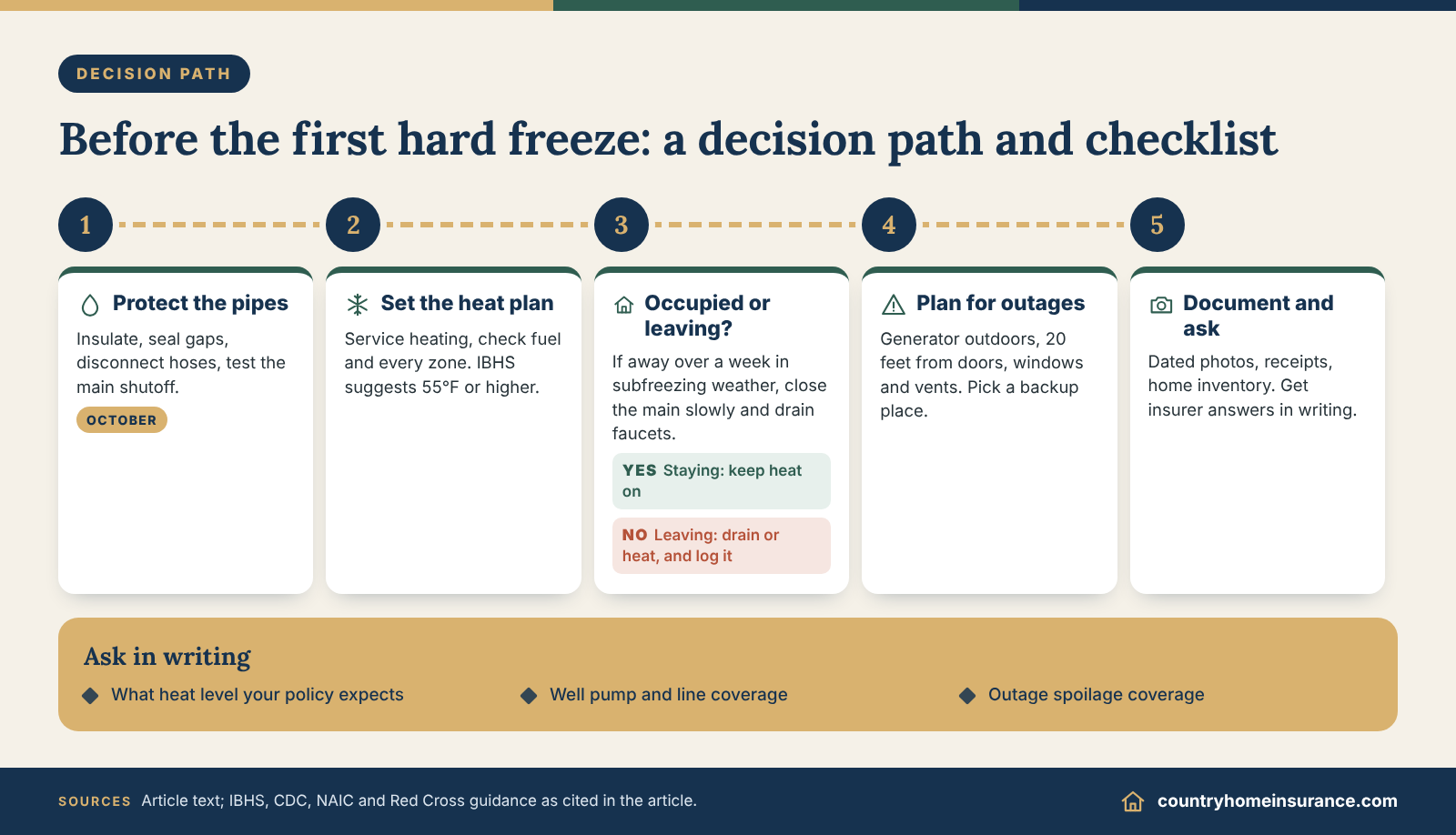
A freeze insurance checklist is the short list of things you finish before the first hard freeze so a burst pipe becomes a claim your policy can reasonably respond to. In practice that means insulating and draining vulnerable plumbing, keeping the heat on (IBHS suggests at least 55°F, even when the house is empty), shutting off and draining water if the home will sit vacant, planning for outages, and documenting it all. Policy wording varies, so confirm your own conditions.
Key takeaways
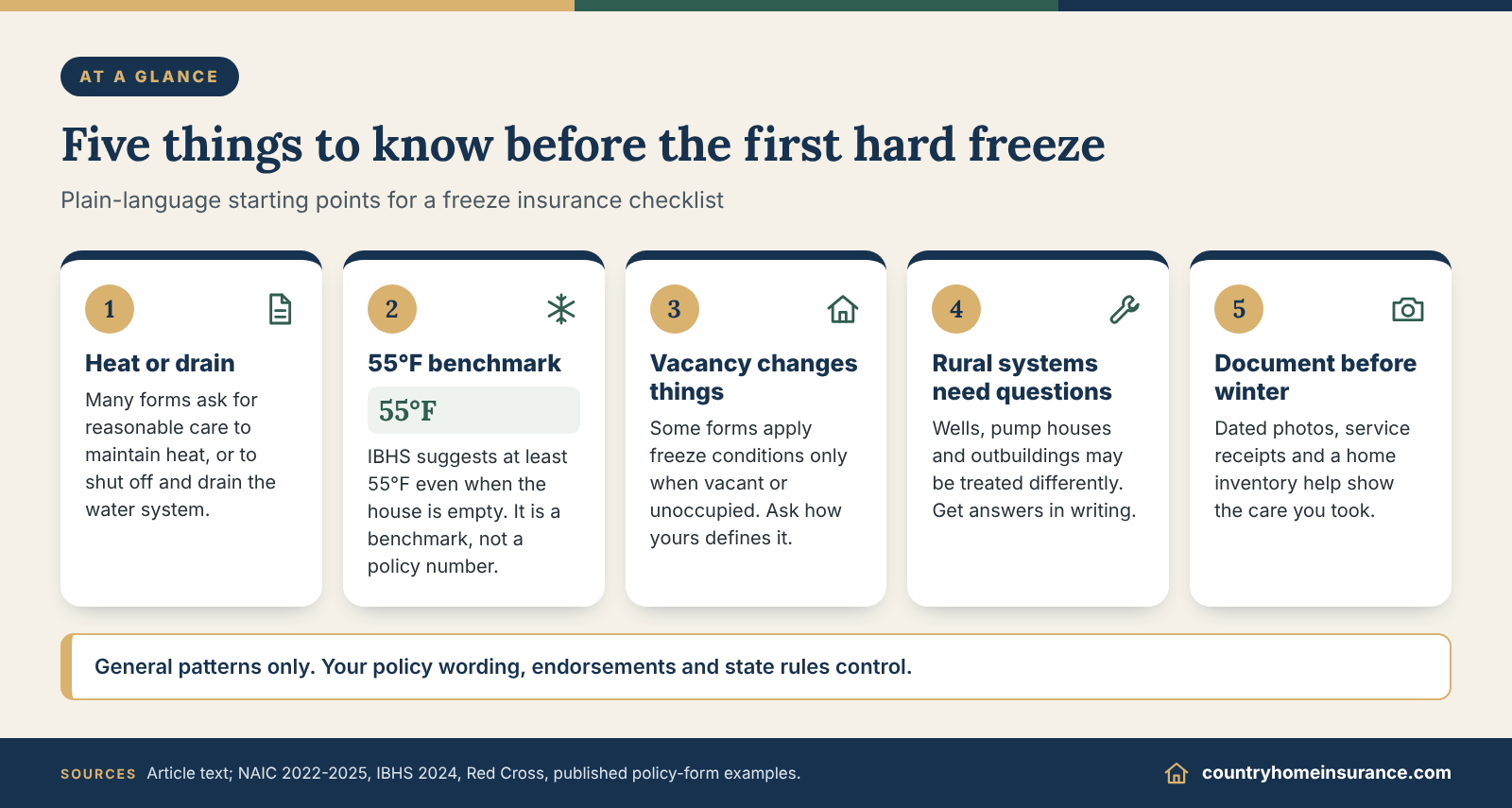
- Many homeowners forms cover freeze-related water damage only if you used reasonable care to maintain heat or shut off and drain the water system, so your preparation is part of the coverage conversation.
- The published form excerpts reviewed here say “reasonable care” rather than naming a temperature; 55°F is an IBHS safety benchmark, not a number printed in those policies.
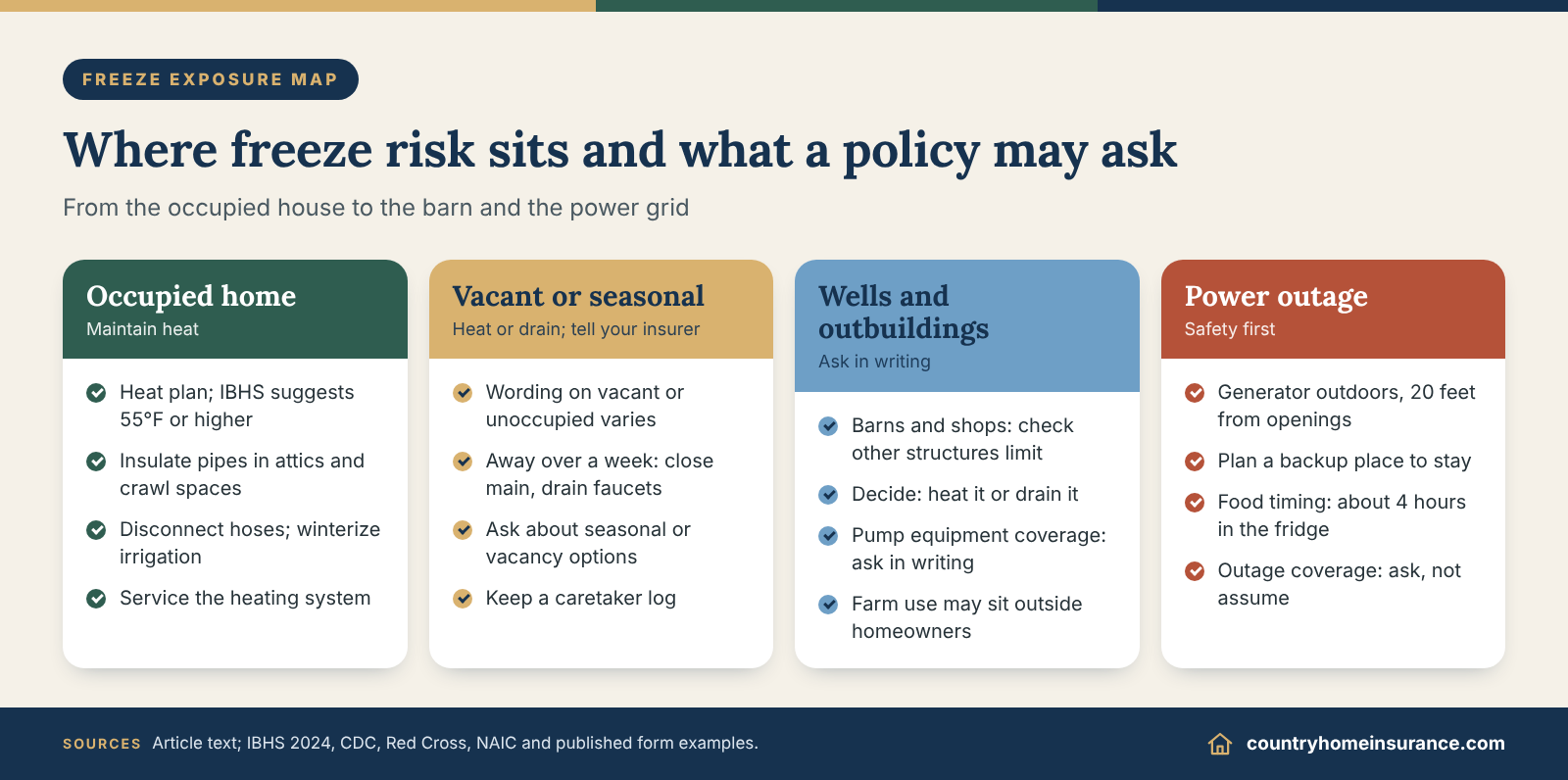
- Vacant, unoccupied and seasonal homes get stricter treatment. Some forms apply the freeze condition only when the home is vacant or unoccupied, while others apply it either way.
- Wells, pump houses, barns and shops add freeze exposure that standard forms may treat differently. Ask about each one by name.
- Generators, space heaters and heat sources solve one problem and create others: carbon monoxide and fire. Follow siting rules and ask what your policy says about outage-related loss.
- Dated photos, service receipts and a written list of insurer answers are the cheapest insurance paperwork you can create in October.
What a freeze insurance checklist is for, and what it is not
Winter losses rarely come from one dramatic failure. They come from a cold snap arriving a week earlier than expected, a thermostat left low to save money, a hose still attached to an outdoor faucet, or a second home no one visited. A freeze insurance checklist works backward from those moments. It asks what your insurer will probably want to know happened before the pipe burst, and it makes sure the honest answer is “we did the reasonable things.”
This guide is about preparation: pipes, heat, vacancy and seasonal use, rural systems, outages and paperwork. It deliberately skips two topics that have their own articles. For the coverage logic itself, see does homeowners insurance cover frozen pipes. For the steps after water is already moving through your ceiling, see the frozen pipe insurance claim guide.
Why the first hard freeze is the right deadline
What the weather service calls a freeze
The National Weather Service issues a Freeze Warning when temperatures are forecast to drop below 32°F for a long period (NWS cold-weather safety page, accessed 2026-10-16). That is the point where exposed water lines, hoses and irrigation fittings start to be at risk. It also isn’t a precise pipe-failure threshold, because wind, insulation, wall exposure and how long the cold lasts all matter. Treat the first warning in your area as the deadline, not as the start of the project.
Why warmer regions are not exempt
The National Association of Insurance Commissioners (NAIC), the group of state insurance regulators, points out that homes in typically warm climates can have poorly insulated interior pipes that struggle with a rare below-freezing night (NAIC Consumer Insight, February 2025). If you live where freezes are infrequent, the risk per night is lower, but the preparation habit is weaker, and the plumbing was often not designed for it.
How this checklist differs from the coverage, claim and October guides
Where the coverage questions live
Whether a burst pipe is “sudden and accidental,” how freezing exclusions and their exceptions read, and what the deductible does are coverage questions. We touch on them only where they change what you should do this month. The companion pieces on burst pipes and coverage and frozen pipes cover them in depth.
Where the claim workflow and the wider October list live
Reporting a loss, mitigating damage and negotiating scope belong to the claim article. If you want a broader autumn list that also covers fire and roof preparation, the October home insurance checklist is the better fit. Think of this page as the deep dive on one slice of that list, with the vacancy, rural and outage detail that a general checklist can’t hold.
| Situation | How policies typically treat it | What drives the answer |
|---|---|---|
| Sudden pipe burst in an occupied, heated home | Typically covered, subject to your deductible, when you used reasonable care and no other exclusion applies. | Cause of loss, heat maintained, no gradual leak, deductible. |
| Burst pipe after the heat failed or was set very low | Depends on whether the policy treats your heating steps as reasonable care and on what caused the heat to fail. | Thermostat setting, fuel or equipment failure, wording of the freezing condition. |
| Vacant or unoccupied home, water on, heat off | Typically not covered under forms that condition freeze coverage on heat or a drained system and neither was done. | Vacancy or occupancy wording, whether water was shut off and drained. |
| Vacant home, water shut off and system drained | Depends. Many forms recognize shutting off and draining as one way to meet the freeze condition, but other terms still apply. | Documentation, completeness of drain-down, other vacancy clauses. |
| Repairing or replacing the frozen pipe itself | Typically not covered under at least some forms, which cover resulting water damage and tear-out but not the failed system. | Form wording on the system or appliance that leaked. |
| Hose bib, irrigation line or outdoor plumbing | Depends. Winterizing steps and form wording on exterior plumbing matter. | Whether lines were detached or drained, location of the pipe. |
| Ice dam leak into ceilings | Depends on the cause-of-loss language and on maintenance and prior-damage questions. | Roof condition, attic ventilation, policy wording on water entering through the roof. |
| Spoiled food or generator damage during an outage | Depends on the policy’s power-interruption wording, any endorsement and any sublimit, so ask your insurer. | Off-premises power failure language, endorsements, sublimits. |
Pipes: the plumbing walk-through to finish before the freeze
Plumbing prep is the part of the checklist most homeowners already half-know. The value of doing it deliberately is that each step also becomes evidence. If a line ever fails, “the pipes in the crawl space were insulated in October and the receipt is in the folder” is a better opening than a vague memory that someone wrapped them years ago.
Finding and protecting the pipes most likely to freeze
Attics, crawl spaces and exterior walls
IBHS recommends insulating pipes in attics, crawl spaces and along exterior-facing walls, using pipe insulation tubes or wrap in unheated or minimally heated areas (IBHS Winter Weather Ready guidance, November 2024). Add the same attention to any pipe that runs through a garage, a mudroom wall or a cabinet on an outside wall. The NAIC adds sealing exterior cracks and gaps with caulk, weatherstripping doors and windows, and covering ventilated crawl space openings for the season (NAIC Consumer Insight, February 2024).
Outdoor faucets, hoses and irrigation
Disconnect garden hoses before freezing weather and winterize irrigation systems, as the NAIC and IBHS both advise. IBHS notes that homes built before 2010 typically lack frost-proof outdoor faucets, so shut off and insulate those valves if yours isn’t frost-proof. Ask a pool or irrigation professional what winterizing your pool lines and sprinkler zones requires. These are the fittings that fail first and are easiest to forget, because they sit outside your daily routine.
Knowing your shutoff and drain-down options
Locate and exercise the main shutoff
IBHS tells homeowners to know where the main water shutoff valve is and how to operate it. Test it in October, not during a leak. A valve that hasn’t moved in ten years may not close fully, and a stuck valve is a problem you want to meet when the plumber can fix it on a dry floor. Label it, photograph it and make sure everyone in the household can find it.
When a short trip becomes a drain-down trip
IBHS suggests that if you will be away for more than a week during subfreezing weather, you close the main valve slowly and let a couple of faucets on the lowest floor drain. That guidance connects directly to policy language, because many forms offer two ways to meet the freeze condition: keep heat on, or shut off the water supply and drain the system and appliances. Choose one deliberately and write down which you chose and when.
Hoses, appliances and the pipes you forget
Washer and dishwasher supply hoses
IBHS recommends replacing washing machine and dishwasher supply hoses older than 10 years. They aren’t freeze components, but they fail under pressure and are a classic source of the water losses covered in appliance leak claims. A fall walk-through that checks them costs little and tidies two risks at once.
Water heaters, boilers and well-fed systems
Water heaters and any hydronic (hot-water) heating system sit between your plumbing and your heat plan. The exposures are different for each home, so this article doesn’t prescribe a drain procedure. Ask a licensed plumber or heating technician what a safe shutdown looks like for your equipment, and see the water heater leak claim guide for the loss side of that equipment.
Heat: thermostat settings, heating systems and “reasonable care”
If one phrase connects freeze preparation to freeze coverage, it is “reasonable care to maintain heat.” The wording shows up in published homeowners and condominium forms as an exception to a freezing exclusion, and it’s the reason a thermostat setting can matter after a loss. Keep in mind that the examples below come from forms that insurers have filed or posted publicly. Your policy’s wording, edition and endorsements control.
What “reasonable care to maintain heat” means in policy language
The usual two-path wording
Several published forms follow the same pattern. A Travelers condominium form posted by the Maine insurance regulator (form HQ-P06 CW, 02-19, which includes material copyrighted by Insurance Services Office) excludes loss from freezing of plumbing, heating, air conditioning, sprinkler and appliance systems, but not if you used reasonable care to maintain heat in the building or to shut off the water supply and drain the systems. A Safeco homeowners form posted by the Oklahoma Insurance Department (HOM-7030/EP 1/09) uses the same two paths. If a building has an automatic sprinkler system, the Travelers form also asks you to keep the water supply on and maintain heat. Treat the exact wording in your declarations and policy jacket as the only authority.
Why 55°F appears everywhere but not in the contract
IBHS advises setting the thermostat to at least 55°F even when no one is home. The forms cited above ask for “reasonable care” and do not name a temperature, and the Maryland Insurance Administration says only that policies generally require keeping the home heated to a minimum temperature. The practical takeaway: 55°F is a defensible floor, not a guarantee, and a higher setting during a deep freeze costs little compared with a deductible and a month of repairs.
Making heat reliable in a real house
Cold spots, cabinets and slow drips
The NAIC and the Maryland Insurance Administration suggest leaving a faucet with a slight drip during extreme cold and opening cabinet doors under sinks so warm air reaches the plumbing. Those habits work on the pipes that sit on exterior walls, which are the ones a thermostat reading in the hallway doesn’t represent. If a room has a history of cold complaints, put a cheap indoor thermometer there, because a thermometer is how you learn the house is colder than the thermostat suggests. The Red Cross also recommends using an indoor thermometer to monitor temperatures during cold events.
Heating system service and fuel supply
IBHS recommends preventive heating-system maintenance once a year, and the Maryland Insurance Administration lists filter changes and a check that exhaust gases vent properly. Fuel is part of that. A missed oil or propane delivery can leave a house without heat, so fuel contracts, tank levels and delivery confirmations belong in your records, because they show the heat plan was real and not just a thermostat setting.
Zones, basements and the “one system” question
Know every heated zone, including finished basements, additions, garages and workshops, and confirm each is actually on and thermostat-controlled. A single thermostat in the hallway does not tell you whether a basement bathroom on a separate system is warm. If a loss occurs, an insurer may ask what heat was running in the area where the pipe failed.
Hypothetical example: A couple leaves for a five-day trip in January and sets the main thermostat to 60°F, but a finished basement bathroom runs on a separate heating zone that was switched off in spring. If a supply line there freezes, the insurer may ask whether heat was reasonably maintained in that area. The outcome would depend on the policy wording, the evidence of what was running, and state rules. The point of the example is that “the thermostat was on” and “the building was reasonably heated” aren’t always the same fact. Figures are illustrative only.
Space heaters, alternative heat and fire risk
Keeping heat safe
The Red Cross advises keeping anything that could catch fire at least 3 feet from space heaters and fireplaces, never heating the home with a cooking oven or stove, and installing carbon monoxide detectors with battery backup. The U.S. Fire Administration likewise warns against using the kitchen range to heat a home because of fire and fume hazards. IBHS notes that heating equipment is involved in 1 out of every 6 house fires, citing NFPA. A freeze loss avoided by a heater that starts a fire is no bargain.
Fireplaces, chimneys and wood stoves
If a wood stove or fireplace is part of your winter heat plan, schedule the chimney cleaning before the cold arrives, and close the damper when the fireplace is not in use, as IBHS advises. For the coverage side of those systems, see chimney and fireplace homeowners insurance.
Vacancy and seasonal homes: when the policy’s assumptions change
A home that nobody lives in all winter is where the heat-or-drain condition does its heaviest work. It is also where the vocabulary is slippery. “Vacant,” “unoccupied,” “seasonal” and “temporarily away” sound interchangeable, but policies can define them differently, and whether you spent three weeks in Florida or the house sits empty until April may change what you owe the insurer in notice and care.
Vacant, unoccupied and seasonal: terms that change the answer
What the words may mean
Policies define these words differently, and many leave “vacant” and “unoccupied” to ordinary meaning or to a short definition. Ask your insurer in writing how your policy defines each term, and whether a home with furniture but no one living in it is treated as vacant, unoccupied or neither. A temporary absence is not necessarily the same as vacancy, but the policy and your state’s law decide.
How form wording differs on the freeze condition
The Travelers condominium form described above states its freezing exception without any vacancy or occupancy trigger, so the exclusion applies in every case unless the reasonable-care exception is met. Other published forms limit the freezing exclusion to certain periods. The Safeco homeowners form applies it while the dwelling is vacant, unoccupied or under construction. A USAA Maine special-provisions endorsement hosted by the Maine insurance regulator says its freezing peril does not cover loss on the residence premises while the dwelling is unoccupied unless you used reasonable care to maintain heat or shut off and drain the system. An AAA condominium form posted by an AAA club applies a similar condition while the unit is vacant, unoccupied or under construction. Same idea, different triggers.
Day counts, notice and seasonal-use endorsements
The 60-day and 30-day clocks
Published forms also contain day-count clocks. The Safeco homeowners form excludes vandalism, malicious mischief and glass breakage if the dwelling has been vacant for more than 60 consecutive days immediately before the loss, and treats a dwelling under construction, remodeling or repair as not vacant. The Travelers condominium form uses 60 consecutive days for vandalism. The AAA condominium form uses 30 consecutive days for vandalism. These clocks concern vandalism and glass, not freezing, but a winter-long vacancy can cross them, and your own form may use a different number.
Seasonal homes and vacancy permits
Ask your agent in September or October how long the home will sit empty and whether the insurer offers a vacancy permit, a seasonal-use endorsement or another written arrangement for a home left empty for months. If your insurer does not, ask what other options exist in your state. Get the answer in writing.
One published form illustrates a related notice issue. The USAA Maine endorsement refers to a secondary residence “expected to be continuously unoccupied for 3 or more months in an annual period” in its cancellation conditions, where it changes the time windows that apply and requires the insurer to give at least 20 days’ notice for cancellation on those grounds. That’s a single insurer’s endorsement in a single state, so use it as a prompt to ask, not as a rule.
A drain-down sequence for a home you’re leaving
Before you leave
If you choose the shut-off-and-drain path, follow the IBHS sequence as a baseline: close the main valve slowly and let a couple of faucets on the lowest floor drain. Then ask a licensed plumber what else your home needs, such as water heaters, hydronic loops, sprinkler lines, toilets, traps and any well equipment, because requirements depend on the system. Have the plumber write down what was drained and the date. A one-page invoice can do more for you than a paragraph of memory.
While you’re away
If you rely on heat instead, someone should be able to verify it. A caretaker, neighbor or property manager who checks the thermostat and signs a simple log gives you contemporaneous evidence. Remote thermostats and monitors can add a data trail. Whether your insurer offers a discount for them, or treats them as meeting policy conditions, is a question for your agent. If your property is in a remote, cold-weather region, our Alaska homeowners insurance guide covers that state’s weather risk and coverage.
Disclosure when a home was already vacant
Telling the truth at application and renewal
Answer occupancy questions precisely at application and renewal, especially on a purchased second home or an inherited property that is still being settled. An inaccurate answer can create problems with the policy, so ask your insurer how it treats a home that was already vacant when the policy began.
Unoccupied during repairs or after a sale agreement
Homes between owners, under renovation or listed for sale raise their own questions. The Safeco form treats a dwelling under construction, remodeling or repair as not vacant for its vandalism clock, but your insurer’s definition is the one that counts. Ask about it before the crew starts, and see the rural home insurance overview if the property is a remote or inherited country home you haven’t yet insured on a vacant basis.
Rural properties: wells, pump houses, outbuildings and acreage
A country home isn’t a suburban house with a bigger lawn. The water often comes from a private well, the heat may be propane or wood, the barn may have its own line, and the nearest plumber could be an hour away on a road the county doesn’t plow first. Standard forms were not written with those details in mind, so the freeze checklist for acreage has more “ask your insurer” steps than the town version.
Private wells, pressure tanks and pump houses
Who is responsible for the well
The U.S. Environmental Protection Agency states that private well owners are responsible for delivering safe drinking water to their households, and that private domestic wells aren’t regulated federally under the Safe Drinking Water Act, with most states also leaving them unregulated (EPA private wells page, accessed 2026-10-16). In practice, nobody inspects your pump house for you. That makes your own pre-freeze walk-through the only inspection it gets.
What to ask about well equipment coverage
How a policy treats a frozen well pump, pressure tank or buried service line depends on whether the equipment is part of the dwelling or an other structure, on any service-line endorsement, and on the freezing condition in your form. Ask your agent three plain questions in writing: is the pump and tank covered if freezing damages them, does the freeze condition apply, and is there a sublimit? Then ask a licensed well contractor how to protect the pump house and exposed lines for your equipment and climate.
Barns, shops, garages and other structures
Other structures coverage and heat conditions
Homeowners policies typically insure detached buildings under Coverage B (Other Structures), which is a separate limit from the dwelling; IRMI’s analysis of the ISO HO 00 03 form describes it as 10% of the dwelling limit, shared by all detached structures. Whether the freeze condition reads the same for a barn with a hydrant or a shop with a utility sink depends on the form, so ask. If an outbuilding has plumbing, treat it as a second small house for this checklist: decide whether you will heat it or drain it, and write down which.
Business, livestock and farm exposures
Heated waterers, barn heaters and stock tank de-icers add electrical load and fire risk, and farming activity can sit outside a homeowners policy altogether. If animals, equipment or income are involved, read the hobby farm insurance guide and the comparison of small farm insurance versus homeowners coverage before you assume a freeze loss in the barn is a homeowners question. Follow manufacturer instructions for any heating device, and remember IBHS’s point that heating equipment is involved in 1 out of every 6 house fires.
Distance, access and supply logistics
Fuel, propane and delivery gaps
Rural heat depends on deliveries. A low tank may not last a long cold stretch, and a delivery truck may not reach a snowed-in private drive. Schedule fills, keep delivery confirmations, and consider a second heat source that does not depend on the same supplier. Delivery records matter if heat fails despite your plans.
Private roads and the caretaker problem
If a frozen line goes unnoticed for days at a second home, damage multiplies. Agree on who will visit, how they will get in when the road is drifted, and what they should do if they find water: the location of the main shutoff, a plumber’s number and the insurer’s claim line. The country home insurance for acreage guide covers the broader insurance questions for properties like this.
Power outages and generators: keeping heat and pipes safe when the grid fails
An outage in a freeze is where the “reasonable care to maintain heat” idea meets reality. You can set the thermostat correctly and still lose heat for reasons outside your control. Good preparation here is partly about the house and partly about safety, because the most common backup measures can themselves be dangerous.
Planning for the outage itself
A heat plan and a backup location
The Red Cross advises having a backup location, such as a friend’s home, library or warming center, if your home gets too cold, and keeping a battery-powered radio and a way to charge phones. It also suggests a three-day go-kit and a two-week stay-at-home kit, with at least one gallon of drinking water per person per day. For pipes, a plan to leave early, with the main valve closed and faucets drained as in IBHS’s guidance, can beat a plan to wait it out.
Food, medicine and what spoils when
The Red Cross says an unopened refrigerator keeps food cold for about four hours, a full freezer holds temperature about 48 hours (about 24 if half full) when the door stays closed, and food that has reached 40°F or warmer should be discarded. It also recommends listing the electrical needs in your home, such as medical devices, and asking your health care provider what to do about refrigerated medicine. If you rely on powered medical equipment, or your home becomes too hot or too cold, it advises leaving. Whether your policy pays for spoiled food depends on its terms, so ask your insurer.
Generators: siting, carbon monoxide and upkeep
Where a generator can safely run
Run generators only outdoors. The CDC says to keep portable generators at least 20 feet from doors, windows and vents while they run, and the Red Cross gives a similar 20-foot distance from windows, plus carbon monoxide alarms on each level of the home. The Red Cross also says to use grills and camp stoves only outdoors. Carbon monoxide poisoning is a recognized danger during outages when people turn to other ways of heating and cooking, and no insurance conversation outranks that.
Maintenance and testing
IBHS recommends servicing a generator by the owner’s manual (oil, spark plug, air filter and spark arrestor screen) and test-running it about every couple of months. A generator that has sat untouched since last winter is a poor bet on the coldest night. Also ask the generator manufacturer and your fuel supplier about safe fuel storage, because stored fuel is its own hazard.
Insurance questions to ask about outages and generators
Power failure and service interruption
Policies differ on an outage that starts off your premises versus one that starts on it, and on whether spoilage is covered at all. Ask three things: does the policy address loss from power interruption, is there any food spoilage coverage or endorsement, and is any limit applied?
Whole-house generators and transfer switches
A permanently installed generator may be treated as part of the dwelling or an other structure, and the electrician’s work should meet local code. Tell your agent when you install one, keep the invoice, and ask whether it changes anything on the policy. A portable unit is more likely to be treated as personal property, which falls under different limits. Neither point replaces reading the form.
Roof, gutters, ice dams and snow load before the first storm
Freeze season is also roof season. The first freeze often arrives with the first heavy snow, and the roof is where a winter claim can begin quietly. This section covers the preparation; the coverage questions for leaks are in does homeowners insurance cover roof leaks, and the fall inspection guide is a good companion.
Ice dams: causes and prevention
How an ice dam forms
The NAIC explains that ice dams form when melting snow refreezes, often because attic insulation is inadequate; the refrozen ice can work under shingles and then melt from warm attic air, causing interior water damage (NAIC Consumer Insight, January 2022). The NAIC’s 2025 piece adds that ice dams can damage roofs and cause indoor leaks once the ice melts.
What to do in October
Clear gutters and downspouts so meltwater drains freely, consider gutter guards, and have a professional evaluate attic insulation and ventilation (NAIC, February 2025). IBHS also recommends securing loose shingles, checking flashing around roof edges, vent stacks, skylights and chimneys, and directing downspouts at least 3 to 4 feet from the foundation. The fall roof inspection and insurance guide details what an inspection can document.
Snow load, trees and roof collapse
Heavy snow and unseen structural stress
IBHS notes that heavy snow can cause roof collapse, and the NAIC suggests a long-handled roof rake and a professional roof inspection (NAIC, February 2025). Safe snow depth for a given roof depends on construction and local codes, so ask a qualified roofer or structural professional if you have a flat roof, a large outbuilding or an older barn.
Limbs, lines and cleanup
Snow and ice can snap tree limbs onto houses or power lines, so the NAIC advises trimming dead, dying, diseased or broken branches. IBHS adds that an arborist can remove branches overhanging the roof. The Red Cross advises avoiding damaged or fallen power lines, because they can electrocute you.
What to ask your insurer: deductibles, limits and conditions in writing
Preparation without a policy review leaves a gap. You can do everything on a checklist and still be surprised by a condition you never read. The goal of this section is a short call or email to your agent in October, with answers you can file next to your declarations page (the summary page listing your coverages, limits, deductibles and endorsements).
Deductibles, limits and cost drivers
How the deductible works on a water loss
The deductible is the amount subtracted from a covered loss before the insurer pays. The Maryland Insurance Administration advises policyholders to contact their insurer to determine coverage and the deductible that applies after a pipe freezes. Ask whether water losses carry the standard all-other-perils deductible or a different one, because some policies set separate deductibles for specific perils.
Hypothetical example: Suppose a covered burst-pipe loss is estimated at $14,000 and the applicable deductible is $2,500. Before depreciation, sublimits or other adjustments, the insurer’s payment could be roughly $11,500 and you would bear the remaining $2,500. These figures are illustrative only and aren’t a prediction of any claim result.
Tear-out, the failed pipe and resulting damage
The AAA condominium form discussed earlier says that where water damage from a frozen system isn’t otherwise excluded, it covers resulting water damage including the cost of tearing out and replacing building parts needed to reach the pipe, but not the system or appliance that leaked. Other forms differ. Ask whether your policy pays for access and tear-out, and whether any limit applies to that line.
Why premium discounts are not part of this checklist
Premium discounts for winterizing, water-shutoff devices or leak sensors vary by insurer and state. Install protective devices because they reduce risk, and then ask your agent separately whether a discount exists.
| Policy feature | What to look for | Why it matters |
|---|---|---|
| Freezing condition wording | Whether coverage depends on reasonable care to maintain heat, or shutting off and draining. | It is the exception that can restore coverage, and it varies by form and edition. |
| Vacancy or unoccupancy trigger | Whether the freeze condition applies only when vacant, unoccupied or under construction, or applies in every case. | Published forms differ, so the same absence can be treated differently. |
| Day-count clocks | Any 30- or 60-consecutive-day vacancy limits, such as on vandalism or glass breakage. | A long winter absence can cross a clock even if freeze language is satisfied. |
| Seasonal-use options | Vacancy permit, seasonal endorsement or other written treatment for a home left empty for months. | Avoids relying on an assumption when you notify the insurer. |
| Other structures (Coverage B) | Limit amount, and how freeze language treats barns, shops and garages with plumbing. | Outbuildings may have different limits and conditions than the dwelling. |
| Well, pump and service-line equipment | Whether pumps, tanks and buried lines are covered, endorsed or sublimited. | Treatment varies by form and endorsement, so get the answer in writing. |
| Water-loss deductible | Dollar or percentage amount, and whether it differs from other perils. | It decides how much of a repair bill you carry. |
| Power-failure and spoilage language | Any wording on off-premises outages, food spoilage or generator equipment. | Outage-related loss is where homeowners are most likely to assume coverage. |
Questions to put in writing
Freeze conditions and definitions
Ask: what exactly counts as reasonable care to maintain heat, is there a minimum temperature or inspection frequency, and how does the policy define vacant and unoccupied? An email that restates the answers and asks the agent to confirm creates a record. The answers aren’t a contract change, but they show what you asked and when.
Seasonal use, outbuildings and outages
Ask about seasonal occupancy, about wells, pump houses and outbuildings by name, about generators and about spoilage. If the agent can’t answer, ask who at the insurer can. The state department of insurance is the next stop for questions the insurer and agent cannot resolve, and the NAIC publishes a map and directory of those offices.
Documentation and the pre-freeze action checklist
Documentation is the cheapest part of the freeze insurance checklist and the part people skip. It does two jobs: it helps you prove what you owned and what condition the house was in, and it reminds you to do the things you intended to do.
Baseline records before winter
A home inventory in the cloud
IBHS recommends creating a home inventory by taking geo-tagged video of your belongings and storing it in the cloud, and it notes that after a winter loss you must itemize losses for your insurer. Walk each room, open closets and cabinets, and say model names aloud. Ten minutes per floor is a realistic target.
Photos of pipes, insulation, shutoffs and heat sources
Photograph insulated pipes, the main shutoff and its label, the thermostat and any separate heating zones, outdoor faucets with hoses removed, the generator and the roof edge and gutters. Your policy may not require date-stamped photos, but they are the simplest evidence of condition.
Records of the care you took
Logs, receipts and service invoices
Keep the HVAC service invoice, the insulation receipt, the fuel delivery confirmation, a plumber’s drain-down note and a caretaker’s visit log in one folder. After a loss, an insurer may ask what you did before the freeze, and clear records of your steps help at the point where the freezing condition’s exception is in question. State rules on who must prove what vary.
Your insurer’s answers and your policy pages
Save a copy of the declarations page, the policy form, the endorsements and your agent’s written answers. Save the claim phone number somewhere that works when the power is out.
| Task | What to document | Ask the insurer or a professional |
|---|---|---|
| Insulate pipes; seal gaps; cover crawl-space vents | Before and after photos, receipts | Does anything in the policy address insulation or maintenance? |
| Disconnect hoses; drain or shut off irrigation and pool lines | Date and photo of outdoor faucets | How are exterior pipes treated? |
| Test and label the main shutoff | Photo of valve and label | Plumber: is the valve reliable? |
| Service the heating system; confirm fuel supply | Service invoice, delivery confirmations | Do heating-failure losses change the freeze condition? |
| Set a heat plan (IBHS suggests at least 55°F) | Thermostat photos; log of zones and settings | What counts as reasonable care? |
| Decide: heat or drain for any vacant stretch | Plumber drain-down note; caretaker log | Do vacancy or seasonal terms apply? |
| Walk well house, barn, shop and other structures | Photos of lines, heaters, pump house | Coverage B limit and well equipment treatment |
| Service generator; place it 20 feet from openings | Service record, location photo | Is a permanent generator reported to the insurer? |
| Clear gutters; check attic insulation; trim limbs | Photos, roofer or arborist invoices | Ice dam and snow load wording |
| Update the home inventory | Cloud video and date | Are coverage limits on contents adequate? |
If a loss happens anyway
The first moves
If a pipe fails, closing the main valve limits the water, and a loss should be reported promptly. Protecting the property from further damage is typically expected, and receipts should be kept. The sequence, evidence handling and scope negotiation are detailed in the frozen pipe claim walk-through, so this article stops here.
Avoiding winter claim surprises
Two assumptions are worth avoiding: that a thermostat setting that was merely “on” satisfies a condition, and that a vacant property is treated like an occupied one. Both are avoidable with the phone call described above.
Frequently asked questions
Preparation basics
When should you complete a freeze insurance checklist?
Before the first Freeze Warning in your area. The National Weather Service issues one when temperatures are forecast below 32°F for a long period. A fall date such as October gives you time to hire help and gather records.
What thermostat setting do insurers expect?
The form excerpts cited here ask for “reasonable care to maintain heat” rather than naming a temperature, so ask your insurer what it expects. IBHS recommends at least 55°F, and the policy language is what controls. A higher setting during extreme cold is a cheap margin.
Should you let faucets drip?
The NAIC and the Maryland Insurance Administration both suggest a slight drip from faucets during extreme cold, along with opening cabinet doors under sinks. It’s a supplement to heat and insulation, not a replacement for them.
Vacancy, seasonal and rural homes
Do you have to tell your insurer if the house will be empty all winter?
You should ask. Some policies and endorsements address seasonal or extended occupancy, and one published endorsement refers to a residence expected to be unoccupied for three or more months. Answer occupancy questions accurately at application and renewal.
Is shutting off the water enough for a week-long trip?
IBHS suggests that for absences over a week in subfreezing weather you close the main valve slowly and drain a couple of faucets on the lowest floor. Many policy forms recognize shutting off and draining as one way to meet the freeze condition, but other terms and your specific system’s needs still apply, so confirm with your insurer and a plumber.
Does homeowners insurance cover a frozen well pump or barn line?
It depends on whether the equipment is part of the dwelling or an other structure, on the freeze wording and on endorsements. Ask your agent in writing.
Coverage and money
Will a policy pay for a burst pipe if you took reasonable care?
The NAIC says policies often cover resulting water damage from a burst frozen pipe when the homeowner took reasonable steps to maintain the pipes and prevent freezing, and homeowners policies cover sudden and accidental discharge from a plumbing system. It isn’t a guarantee, and your policy, cause of loss and deductible decide.
Is a generator covered if it’s stolen or damaged?
It depends on the policy. A portable generator is more likely to be treated as personal property, while a permanent installation may be treated as part of the dwelling or an other structure, so check the form and ask your agent.
Where can you get help if you and your insurer disagree?
Contact your state department of insurance. The NAIC publishes a directory of state offices and points consumers to them for policy questions.
Sources
- NAIC — Will My Homeowners Insurance Policy Cover Water Damage From a Burst Pipe? (Consumer Insight, February 8, 2024; accessed 2026-10-16)
- NAIC — How Can I Protect My Home From Winter Weather? (Consumer Insight, February 6, 2025; accessed 2026-10-16)
- NAIC — Protect Your Home From Damaging Winter Weather (Consumer Insight, January 24, 2022; accessed 2026-10-16)
- Maryland Insurance Administration — Protect Your Pipes (consumer page; accessed 2026-10-16)
- IBHS — Winter Weather Ready guide news release (November 14, 2024; accessed 2026-10-16)
- IBHS — Winter Ready guidance (accessed 2026-10-16)
- American Red Cross — Winter Storm Safety (accessed 2026-10-16)
- American Red Cross — Power Outage Safety (accessed 2026-10-16)
- CDC — Prevent Carbon Monoxide Poisoning (accessed 2026-10-16)
- National Weather Service — Cold Weather Safety and Alerts (accessed 2026-10-16)
- U.S. Fire Administration — Winter Fire Safety (accessed 2026-10-16)
- U.S. EPA — Private Drinking Water Wells (accessed 2026-10-16)
- Maine Bureau of Insurance (posted form) — USAA Maine Special Provisions, form HO-ME (08-16) (2016 form; accessed 2026-10-16)
- Auto Club — Form CO 17 32 07 05, Special Coverage for the Premier Condominium Owners Policy (2005 form; accessed 2026-10-16)
- Oklahoma Insurance Department (posted form) — Safeco Homeowners Policy, form HOM-7030/EP 1/09 (2009 form; accessed 2026-10-16)
- Maine Bureau of Insurance (posted form) — Travelers condominium policy, form HQ-P06 CW (02-19) (2019 form; accessed 2026-10-16)
- IRMI Online — Homeowners Coverage B: Other Structures (analysis of ISO HO 00 03 03 22) (2025; accessed 2026-10-16)
- NAIC — State Insurance Departments (map and directory) (accessed 2026-10-16)
Important coverage note
Coverage depends on the actual policy, endorsements, exclusions, limits, deductible and cause of loss. Form wording, vacancy definitions and freeze conditions differ by insurer, edition and state, and the examples here come from published insurer form excerpts rather than your contract. This article is educational, not legal or insurance advice. Verify case-specific questions with your insurer or agent and your state Department of Insurance.
About the editorial team
This guide was prepared by the countryhomeinsurance.com editorial team as general, educational information for homeowners. We research and summarize publicly available material, including state insurance departments, the NAIC, federal agencies, regulators’ consumer guides and published insurer and industry resources. We draw only on the sources that were available to us when we wrote this guide, and we list them in the Sources section with dates where we could find them.
Insurance rules, rates, products and program terms change, differ by state and by insurer, and can apply differently to your situation. We cannot guarantee that this content is complete, current or free of errors. It is not legal, financial, tax or insurance advice, it is not an offer to sell insurance or a recommendation of any insurer, agent or product, and reading it does not create a professional relationship of any kind.
To the fullest extent permitted by law, countryhomeinsurance.com and its editorial team, authors and contributors exclude all liability for any loss, damage or decision arising from the use of, or reliance on, this content. For questions about your own policy or claim, contact your insurer, a licensed agent or broker, your state Department of Insurance or another qualified professional.
Content created: October 16, 2026
