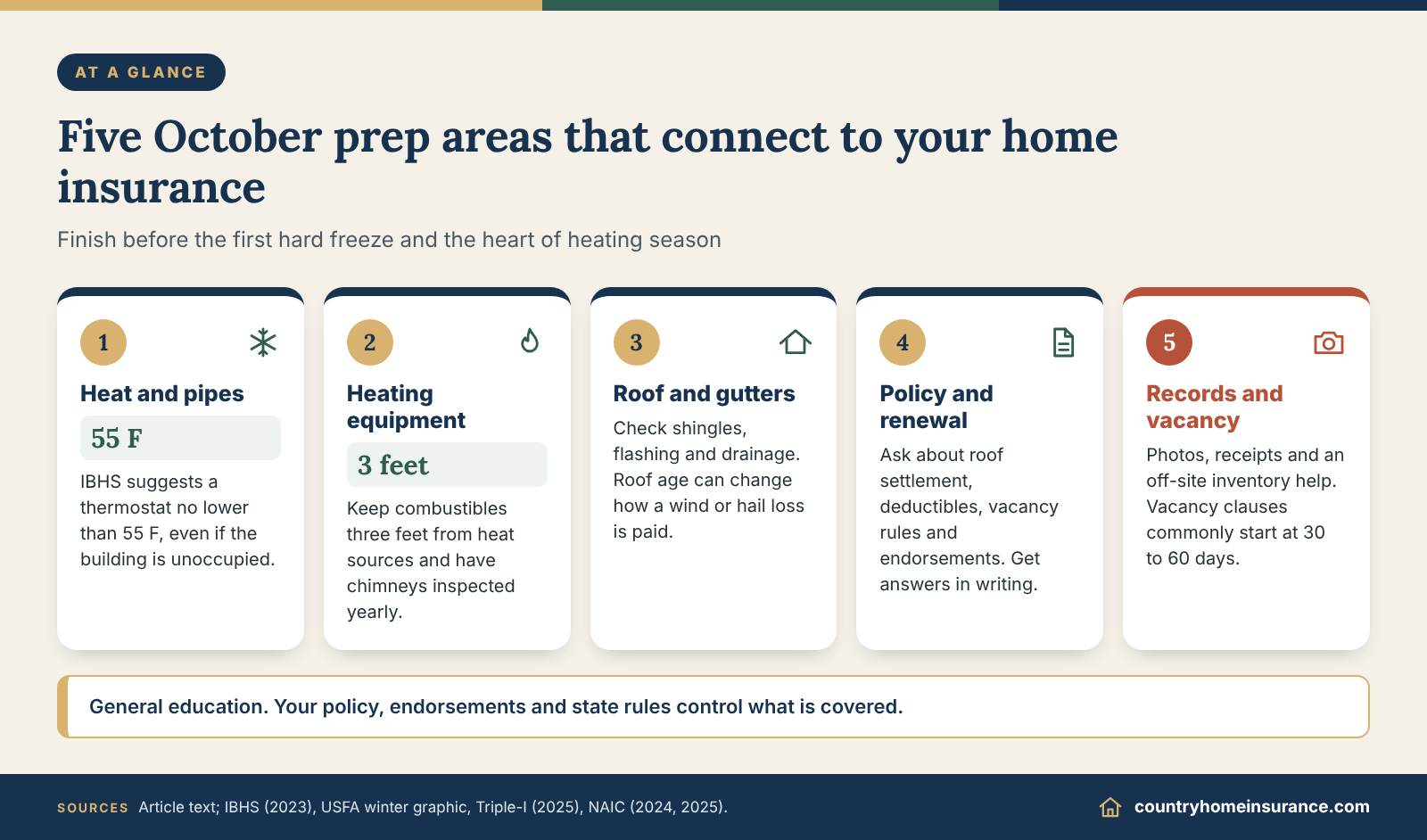
An October home insurance checklist is a short list of jobs to finish before the first hard freeze and the heart of heating season: protect plumbing and keep the heat on, service chimneys and heat sources, check the roof and gutters, document the home, and read your renewal paperwork. Preparation matters because many policies tie freeze, fire and maintenance-related losses to what you did beforehand. Your declarations page, policy form and state rules control what is actually covered.
Key takeaways
- Standard homeowners forms generally treat sudden freeze damage differently from damage that follows neglect, so the steps you take in October can affect a November claim.
- Heating equipment is a leading cause of home fires, and USFA says half of home heating fires happen in December, January and February, so October is the practical window for servicing and clearance.
- Routine maintenance and wear and tear are typically your responsibility, not the insurer’s, so a roof inspection and gutter cleaning are both safety jobs and paperwork jobs.
- Roof age can change how a wind or hail loss is paid, because some policies use actual cash value or a payment schedule once a roof passes an age cutoff.
- Vacancy and long absences can limit coverage, so tell your agent before you close up a cabin, second home or inherited house.
- Photos, receipts and a home inventory stored off site cost almost nothing in October and are hard to recreate after a loss.
Why an October home insurance checklist matters before winter
October sits in a narrow gap. The worst of summer storms has passed in most regions, but the first hard freeze, the first fires in the woodstove and the first snow load on the roof are all still ahead. It is the last month when you can climb a ladder in daylight, call a chimney sweep without a long wait and reread your policy without a claim looming over the conversation.
This guide is about preparation actions and policy-review questions. It does not try to explain every coverage rule from scratch. When a topic deserves its own deep dive, such as how a frozen-pipe claim is paid or how roof age changes pricing, we point you to a dedicated guide and keep this page practical.
What changes between now and the first freeze?
Temperature swings and the pipe problem
Pipes rarely freeze on the first cold morning. They freeze when a cold snap lasts long enough, or the wind is strong enough, to pull heat out of unheated spaces such as crawl spaces, exterior walls, garages, well houses and attics. October is when you find the weak spots while the weather is still forgiving.
The heating system wakes up
Furnaces, wood stoves, fireplaces and space heaters go from idle to daily use within a few weeks. Dust, soot, a cracked flue liner or a loose connection that did no harm in July becomes a real issue when the equipment runs for hours at a time. The U.S. Fire Administration (USFA) says about half of home heating fires happen in December, January and February, so October preparation lands ahead of the risk.
Roofs meet their first cold-weather test
Asphalt shingles soften in heat and stiffen in cold, and the Insurance Institute for Business & Home Safety (IBHS) notes that the sealant strip that holds shingle tabs down weakens with age. A roof that shed summer rain without trouble can still leak when ice, wind-driven snow or a clogged gutter pushes water where it normally does not go.
How is a seasonal checklist different from a coverage guide?
A checklist is about what you control
Coverage guides explain what a policy might pay after a loss. A seasonal checklist focuses on the part you can influence beforehand: maintenance, heat, documentation, disclosure and timing. That distinction matters because most homeowners forms contain conditions that depend on your actions, such as maintaining heat or protecting property from further damage.
Where to go for the claim side
If you already have a loss, a checklist is the wrong tool. Our guides on frozen pipe insurance claims and roof leak coverage walk through the claim workflow, and our companion first freeze insurance checklist goes deeper on the freeze-specific details so this page does not repeat them.
What does the October checklist cover at a glance?
Five preparation areas
The sections below move through five areas: plumbing and heat, fire risk from heating equipment, the roof and drainage, your policy and renewal paperwork, and records. A sixth area, vacant and seasonal homes, applies only if you will be away for long stretches. A rural section follows for wells, propane, outbuildings and long driveways.
How to use the tables
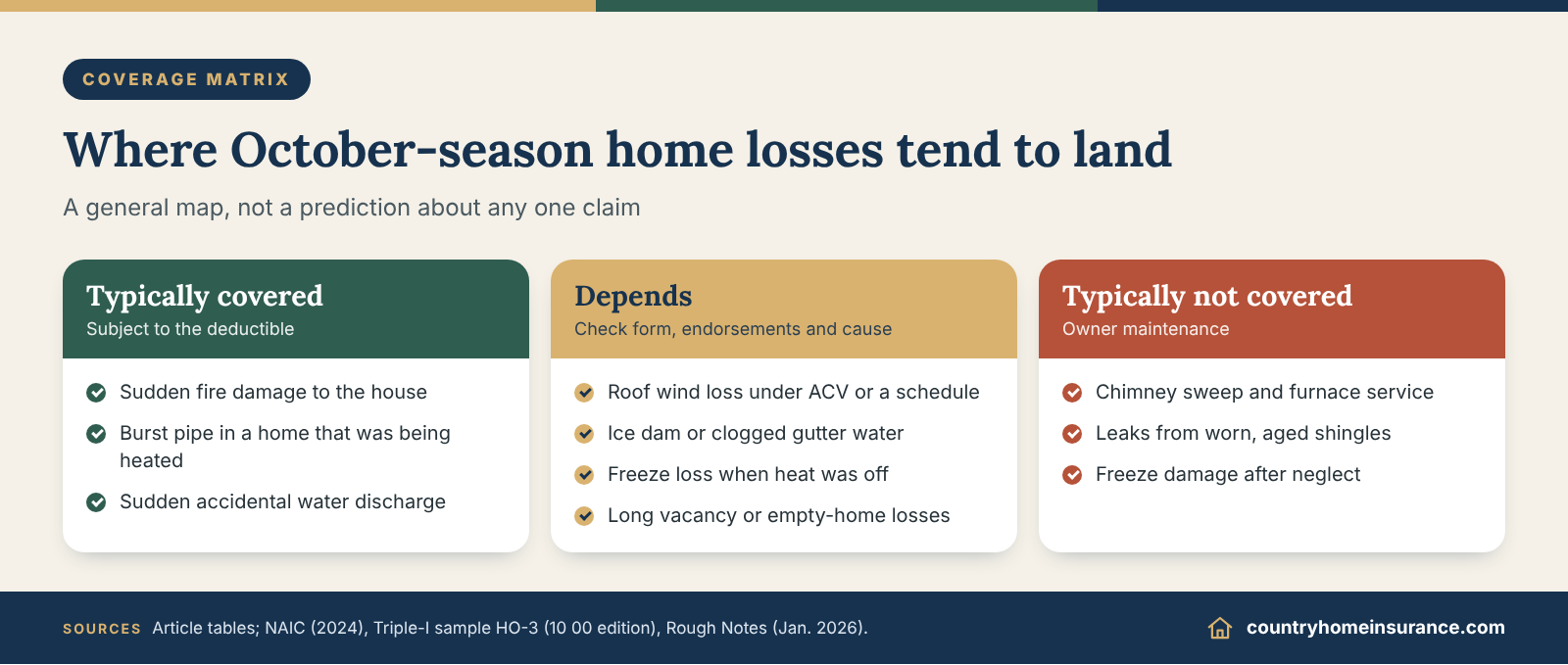
The first table below sorts common October-season situations into typically covered, typically not covered and depends. It is a general map, not a prediction about any particular claim, because cause of loss, exclusions, endorsements, deductibles and state rules all matter.
| Situation | General outlook | What usually decides it |
|---|---|---|
| Pipe bursts after a hard freeze in a home that was being heated | Typically covered, subject to the deductible | Sudden and accidental discharge, plus evidence you used reasonable care to keep the home heated |
| Pipe bursts in a home with heat off and water not shut off or drained | Depends, and often limited | Freezing conditions in the form; many forms require heat or a drained system |
| Fire from a fireplace, stove or heater that damages the house | Typically covered, subject to the deductible | Fire is a standard covered peril, though cause, neglect and vacancy facts can still matter |
| Cost of cleaning the chimney or servicing the furnace | Typically not covered | Routine maintenance is generally the owner’s responsibility |
| Roof leak after wind removes shingles | Depends | Cause of loss, roof settlement terms (replacement cost, actual cash value or schedule) and wind or hail deductible |
| Roof leak from worn, aged shingles | Typically not covered | Wear and tear, deterioration and faulty maintenance exclusions |
| Interior damage from a clogged gutter or ice dam | Depends | How the water entered, ensuing-loss wording and whether the policy treats the cause as maintenance |
| Vandalism or water damage in a home empty for a long stretch | Depends, and often limited | Vacancy clause length (commonly 30 to 60 days), vacancy endorsement and whether the home counts as vacant or only unoccupied |
Freeze prep: protect plumbing and the coverage conditions attached to it
Most standard homeowners policies cover water damage from a sudden and accidental discharge of a plumbing system, and the NAIC notes that burst frozen pipes are often covered when the homeowner took reasonable steps to keep them from freezing. The same guidance warns that damage may not be covered if an insurer finds the plumbing was neglected. Your October job is to be able to show you did the reasonable things. For the coverage logic behind this, see our guide on whether homeowners insurance covers frozen pipes.
Which plumbing steps are worth doing in October?
Disconnect and drain the outside
Disconnect garden hoses, shut off and drain exterior spigots if your home has interior shutoffs for them, and winterize irrigation systems. The NAIC, citing IBHS, lists disconnecting garden hoses among its first freeze-prevention steps, and IBHS advises draining exterior sprinkler lines. It takes a few minutes and costs nothing.
Insulate what runs through cold spaces
IBHS recommends insulating outdoor faucets, exposed pipes and indoor pipes that run along exterior walls, and the NAIC adds attics and crawl spaces. Pipe sleeves are inexpensive, and a short afternoon in the crawl space is often enough. If you find a pipe that is already wrapped in brittle old insulation or one with signs of past leaks, note it for a plumber rather than guessing.
Seal drafts that reach the plumbing
The Maryland Insurance Administration suggests caulking exterior cracks and gaps and weatherstripping doors and operable windows so no daylight shows from inside. Look especially near the spot where a water line, a dryer vent or a cable enters the house, because those small openings can aim cold air straight at a pipe.
What do policies mean by “maintain heat”?
The language in a sample homeowners form
The Triple-I (Insurance Information Institute) hosts a sample ISO HO-3 form, edition 10 00, that excludes freezing damage to plumbing, heating, air conditioning, sprinkler systems and appliances unless you used reasonable care to maintain heat in the building or shut off the water and drained the systems. Newer editions and insurer-specific forms differ. Read your own form; do not assume a sample applies.
A practical thermostat floor
IBHS recommends keeping the thermostat at no lower than 55 degrees Fahrenheit even when a building is unoccupied. That is a safety guideline, not a policy requirement, and your policy may state its own minimum or none at all. Setting a number you can defend, and writing down that you did, is better than setting the heat low to save money and hoping the pipes cope.
Open cabinets and let faucets drip in a cold snap
The NAIC, citing IBHS, advises letting faucets drip slightly and opening cabinet doors under sinks during very cold weather so warm room air reaches the pipes. These are cold-snap actions rather than October actions, but it helps to put the reminder on your fridge now.
How do you find and test the shutoffs before you need them?
Locate the main water shutoff
Every adult in the household should know where the main shutoff is and how to close it. In many homes it sits near the water meter, the pressure tank or where the line enters the foundation. Try the valve once in October; a valve that has not moved in years can stick at the worst moment.
Tag secondary shutoffs and note the drain-down order
Label the shutoffs for the water heater, outdoor spigots and any outbuilding lines. If you plan to winterize a seasonal property by draining it, write the order of steps once and keep it with your policy documents. A written sequence also becomes a record that you took the “shut off and drain” route some forms describe.
Heating-season fire prep: equipment, alarms and what insurers expect
Heating is one of the leading causes of home fires. USFA material republished by Michigan’s emergency management site ranks heating second after cooking among residential building fires, and a USFA winter graphic says heating equipment is involved in about one in seven home fires and roughly one in five home fire deaths. The good news is that most of the useful steps are cheap and fit comfortably into an October weekend. For the fireplace and chimney detail, our dedicated guide on chimney and fireplace safety and home insurance goes further than this page.
Which heat sources need attention before the first cold week?
Fireplaces and chimneys
The Chimney Safety Institute of America (CSIA), following NFPA 211, says chimneys, fireplaces and vents should be inspected at least once a year, even with light use, because animals and deterioration can make a flue unsafe without any obvious sign. CSIA says a masonry chimney should be swept when soot buildup reaches about one-eighth of an inch, sooner if glazed creosote is present. A sweep that cleans only the firebox is not a complete job; the flue and smoke chamber matter too.
Wood stoves and similar appliances
USFA guidance, as republished by Michigan, says to follow the manufacturer’s installation and maintenance instructions, choose a unit approved by a recognized testing lab, and keep the stove at least three feet from combustible surfaces. Store cooled ashes in a tightly sealed metal container kept outdoors, and USFA’s winter graphic puts that container at least 10 feet from the home and nearby buildings.
Portable and electric space heaters
The same guidance recommends a UL-listed heater with a thermostat and an automatic tip-over shutoff, three feet of clearance from anything combustible, and unplugging the heater when it is not in use. USFA also advises plugging only one heat-producing appliance into an outlet at a time. Do not dry clothing on a heater or place objects on it.
| Heat source | October preparation | Question for your agent or insurer |
|---|---|---|
| Masonry or factory-built fireplace | Annual professional inspection and sweep; keep a metal screen in place | Does the application or renewal ask about solid-fuel heating, and is an inspection record helpful? |
| Wood stove or pellet stove | Check installation against the manufacturer instructions; keep three feet of clearance | Was the stove professionally installed, and does the insurer need a permit or inspection on file? |
| Portable electric space heater | UL listing, tip-over shutoff, direct outlet use, nothing nearby that can burn | Are there any limits on heater use in an unoccupied or rented portion of the home? |
| Furnace or boiler (gas, oil, propane) | Annual service by a qualified technician; replace filters; check venting | Are fuel tanks and lines on the property covered as part of the dwelling or other structures? |
| Portable generator | Outdoors only, well away from the house, never in a garage | Does the policy or local fire code say anything about storing generator fuel on the property? |
What about smoke alarms, carbon monoxide alarms and generators?
Smoke alarms
The American Red Cross says smoke alarms can cut the risk of dying in a fire by nearly half. It advises pressing the test button monthly, replacing batteries at least once a year and replacing the alarms themselves every 10 years, with an alarm on every level of the home and in and outside sleeping areas. Check the date the manufacturer printed on each unit. The Triple-I’s 2023 handbook says many insurers discount policies for smoke detectors, burglar and fire alarms and deadbolt locks, but not every policy qualifies, so ask before you buy equipment.
Carbon monoxide alarms
The Consumer Product Safety Commission (CPSC) recommends battery-operated or battery-backup carbon monoxide alarms on every level of the home and outside sleeping areas, with interconnected alarms preferred. USFA advises testing them monthly. Carbon monoxide can injure people even when there is no fire, and USFA advises a yearly professional cleaning and inspection of chimneys and vents. The annual furnace service in Table 2 fits the same routine.
Portable generators
CPSC says never to run a portable generator inside a home or garage, even with doors and windows open, and to place it outdoors at least 20 feet from the home with the exhaust pointed away. The agency also reports more than 200 U.S. deaths a year from non-fire carbon monoxide linked to consumer products, with more than 100 of those tied to portable generators. If you plan to rely on a generator during winter outages, set up the outdoor location and the extension cord plan now.
What do insurers typically expect on the fire side?
Fire is usually covered; neglect is the question
Fire and smoke are standard covered perils on a typical HO-3 form, but cleaning, servicing and repairing heating equipment are maintenance. The Triple-I’s 2023 homeowners handbook states that routine maintenance is the owner’s responsibility and that losses from failing to properly care for a home are not covered under standard policies. In practice, a fire that starts from a sudden failure is a different conversation from damage that follows years of ignored warning signs.
Disclosure and installation questions
Applications and renewals may ask about the primary and secondary heat sources, wood stove installation and the age of electrical, plumbing and heating systems. Answer them accurately and update your insurer when you add a stove or a fireplace insert. An undisclosed change can complicate a later claim or renewal, so a short call in October is cheaper than a dispute in January.
Fire department access and response time
Whether a home is served by a paid or volunteer department, and how far it is from a station or water source, may affect how an insurer rates the property. That classification is handled in underwriting, not by a checklist, but it is worth confirming that your address is correct and that fire trucks can reach it. The rural section below covers driveways and access.
Roof and gutter checks before winter, and what roof age means for payment
A roof does two jobs in October: it keeps water out, and it quietly carries the biggest claim-settlement question in a homeowners policy. Our broader guide on a fall roof and gutter inspection covers the inspection itself in depth. Here the focus is how the October checks connect to your policy.
What can you check from the ground and a ladder?
Shingles and surfaces
IBHS lists the signs of aging on asphalt shingles as granule loss and blistering, curling or unsealing tab edges, exposed or backed-out nails, buckling and staining. You can often see these with binoculars from the yard. Stay off steep or wet roofs; a professional inspection is safer, and it creates a dated record.
Flashing, vents and penetrations
Include the flashing and the areas around vents and pipes in your check, and ask a roofer to look at them if you are unsure. IBHS notes that walking on a tile roof can crack tiles, so inspect with caution, and that the rubber gaskets around exposed fasteners on metal roofs can deteriorate and the fasteners can back out.
Trees near the roof and siding
IBHS recommends trimming limbs so they do not strike the roof, siding or windows. A tree that is dead, leaning or cracked deserves an arborist’s opinion, since a fallen tree is a larger problem than the pruning bill. Our guide on a tree falling on a house covers the claim side.
Why do gutters and snow load matter to a claim?
Clear debris so water leaves the roof edge
IBHS says clearing gutters and downspouts helps water drain away from the building and reduces the risk of ice dams and leaks. Do this after most leaves have dropped, which in many regions means late October or early November, and plan a second pass if you have oaks or maples overhead.
Watch for ice dams and snow load after storms
After heavy snow, IBHS says to watch for signs of stress such as a sagging roof line or new cracks in ceilings. Ice dams form when melting snow refreezes at the eave; a roof that looked sound in summer can still leak inside when water backs up under the shingles. Whether resulting interior damage is covered depends on the policy wording and the cause of loss, which is why the photographs described later in this article are valuable.
Keep a record of what you cleaned and when
A dated photo of a clean gutter, a contractor receipt or a calendar note is simple evidence that you maintained the roof drainage. It will not guarantee coverage, but it answers the question an adjuster is likely to ask.
How does roof age change how a wind or hail loss is paid?
Replacement cost versus actual cash value on the roof
The NAIC describes replacement cost as the cost to rebuild and actual cash value (ACV) as market value. Some policies cover the structure at replacement cost but handle the roof differently once it is old. The Triple-I’s 2023 handbook gives the example of a $20,000 roof loss on a $300,000 policy and shows the payment falling considerably as the roof ages; in its comparison, actual cash value applies depreciation.
Payment schedules and age cutoffs
A February 2026 Rough Notes article, written for insurance agents, describes carriers increasingly paying wind or hail roof claims at ACV, or as a percentage of cost based on roof age and material, sometimes through an endorsement or built-in policy language. It uses an illustration in which a roof replaced six years earlier would be paid about 82 percent of the loss, and it notes that the percentage tables step down by roof age and differ by carrier. These are examples of how forms vary, not rules for every insurer or state, which is why you should read your own wording. Our guide on how roof age affects homeowners insurance cost compares eligibility and pricing effects.
Record the real age and any replacement
Rough Notes also describes one carrier that fixes roof age from the year on its own roof-age notice even if that year is wrong, and another that uses the declarations year by default but accepts evidence of a full replacement by a licensed contractor. If you replaced a roof, send the invoice and permit to your agent and ask for written confirmation that the record changed. If the year shown for your roof is wrong, ask how it can be corrected.
Hypothetical example: Suppose a 15-year-old asphalt roof is damaged by wind, the repair is estimated at $12,000, and the policy has a wind and hail deductible of 1 percent of a $300,000 dwelling limit, which is $3,000. If the policy pays an assumed 60 percent roof schedule, the order in which the insurer applies the percentage and the deductible changes the result, but the homeowner could plausibly receive well under the full $12,000. These figures are invented for illustration only; actual schedules, deductibles and calculations vary by policy and state.
Policy review before renewal: questions to ask while you have time
Renewal documents arrive ahead of the policy date, and notice periods and content vary by state and insurer. Reading them in October, rather than the week the premium is due, leaves time to fix an error, ask about options or compare other quotes. Our guides on how much homeowners insurance you need and how to compare home insurance quotes cover the bigger decisions; this section stays with the review itself.
Which parts of the declarations page deserve a second look?
Dwelling limit and the inflation guard
The Triple-I suggests comparing your dwelling limit with current rebuilding costs, telling your agent about improvements or additions and checking whether the policy has an inflation guard clause that adjusts the limit at renewal. A limit set years ago may no longer reflect labor and material costs, and the NAIC emphasizes that dwelling coverage should be enough to fully rebuild.
Deductibles, including percentage deductibles
The NAIC notes that a lower deductible generally means a higher premium. The Maryland Insurance Administration explains that some policies carry a special deductible for wind, hail or other storm losses, and that a percentage deductible is calculated from the dwelling coverage amount. Confirm which deductible applies to freeze, fire, wind and hail so you know the cash you would need in a loss.
Personal property and other structures
The Triple-I says personal property limits typically run 50 to 70 percent of the dwelling amount, so compare that to your inventory total. For rural homes, check the other structures limit against what a barn, shop or detached garage would cost to rebuild.
What roof and wear-related terms might have changed?
Loss settlement language for the roof
Look for words such as roof surfacing, actual cash value, payment schedule, cosmetic damage exclusion or roof age limitation, and check whether those terms appear in the base policy or in an endorsement. If you see one you did not have last year, ask the insurer to point to the change in writing.
Matching and ordinance-or-law provisions
Ask how the policy handles matching when only part of a roof or siding is repaired, and whether a matching endorsement is available. Ordinance or law coverage, which helps pay the added cost of rebuilding to current building codes, is another question to raise if your home is older; in the ISO HO 00 03 05 11 form it is an additional coverage of up to 10% of the dwelling limit, and insurers can change that figure.
Roof surcharge, nonrenewal and inspection notices
Roof condition may come up at underwriting and renewal, so ask whether your insurer applies any roof-related surcharge, condition or inspection requirement. Rules on notice and appeal are set by each state, so check your state Department of Insurance if you receive a notice. If a roof repair would resolve a stated concern, ask what documentation the insurer needs.
How do you prepare questions for your agent?
Bring the declarations page and an honest home profile
Collect the declarations page, endorsements list, roof age and replacement invoice, heating system details and a list of improvements. A prepared homeowner gets better answers in a 20-minute call than one asking general questions.
Ask for answers in writing
Ask the agent to send answers by email, especially for roof terms, vacancy rules and endorsement changes. The goal is not to catch anyone out; it is to avoid relying on a half-remembered phone conversation after a loss.
| Item to check | Where to find it | Why it matters this season |
|---|---|---|
| Dwelling (Coverage A) limit and inflation guard | Declarations page and policy form | A limit below current rebuilding cost can leave a gap after a major fire |
| All-peril and wind or hail deductible | Declarations page and any deductible endorsement | A percentage deductible on a large dwelling limit can mean a four-figure cash need on a roof claim |
| Roof loss settlement (RCV, ACV or schedule) | Loss settlement section and roof endorsements | An old roof may be paid after depreciation or by percentage rather than at full replacement cost |
| Other structures and personal property limits | Declarations page | Barns, sheds, tools and winter equipment may exceed default sublimits or percentage limits |
| Endorsements for water backup, ordinance or law and matching | Endorsement list and optional coverage section | Optional coverages are added by endorsement and may not appear unless you ask |
| Vacancy and occupancy conditions | Policy conditions and definitions | Time limits before coverage narrows can start at 30 to 60 days and vary by insurer |
| Mailing address, mortgagee and contact details | Declarations page and your lender’s records | Notices about renewal, nonrenewal or premium changes go to the address on file |
Documentation: what to photograph, save and store before winter
Paperwork is the least glamorous part of an October checklist, but it is the part that costs nothing and helps the most when a loss is stressful. A claim is easier to explain when you can show what the home looked like, what it contained and what you did to maintain it.
What should a home inventory include?
Contents, room by room
The Triple-I advises listing everything you own in the home and other buildings, with descriptions, purchase dates and places, brand and model numbers for appliances and electronics, and receipts where you have them. Photograph or video each room, including closets and cabinet interiors. The NAIC homeowners page also describes a home inventory app for recording belongings.
The structure and recent improvements
Photograph the roof from several angles, the furnace and water heater data plates, the chimney exterior, the electrical panel and any improvements such as a new roof, windows or flooring. Save invoices and permits. Improvements may change your dwelling limit, and your insurer can only price what it knows about.
Where to keep it
The Triple-I recommends storing the inventory somewhere safe off the premises, such as a bank deposit box or with a relative or neighbor; a secured cloud folder serves the same purpose. A photo folder on a phone that burns with the house is not much help. Update the inventory when you buy something major, and revisit it when you check your personal property limit at renewal.
Which maintenance records help most?
Service and inspection invoices
Keep invoices for the chimney sweep, furnace or boiler service, roof inspection, gutter cleaning and any plumbing repair. They show that you handled routine care that policies expect the owner to handle. They also help a future buyer, a home inspector or an underwriter who asks about the age and condition of major systems.
Before-winter baseline photos
Take dated photos in October of the roof surface, gutters, crawl-space pipes, attic and ceilings. If a ceiling stain appears in February, you can show whether it was already there. A baseline also helps you separate old, long-term damage from a sudden new event, a distinction adjusters often look at.
Roof age and material documentation
Because roof age can change settlement terms, keep the installation invoice, permit, warranty and photos of the roof material. If you bought the home without those records, ask the seller or the roofer, or ask a contractor for a written estimate of age based on the roof’s condition. Do not guess the year in an application; accuracy protects you.
What does a policy typically require after a loss?
Prompt notice
The sample ISO HO-3 form hosted by the Triple-I lists prompt notice to the insurer or agent as the first duty after a loss. The exact timeframe, if any, and whether late notice defeats a claim differ by form and state. The sample says the insurer has no duty to provide coverage if a failure to comply is prejudicial to it, but your policy and your state’s rules control.
Protecting the property from further damage
The same sample requires you to protect the property from further damage, make reasonable and necessary repairs, and keep accurate records of repair expenses. Think of it as a duty to stop the water or board the opening, not to complete permanent repairs before the adjuster sees them. Save receipts for tarps, pumps and emergency work.
An inventory of damaged property
The sample also asks for an inventory of damaged personal property with quantity, description, actual cash value and amount of loss, supported by bills and receipts. A pre-loss inventory means you are copying information, not reconstructing it from memory.
Vacant, seasonal and second homes: October is the time to settle the rules
Hunting cabins, lake houses, inherited homes and houses between occupants often go dark in late fall. Standard homeowners forms assume someone lives in the home, and several conditions change when that assumption stops being true. This section describes general patterns; your own form defines the terms and the time periods.
What do vacancy clauses usually limit?
Vacant versus unoccupied
Policy wording may treat the terms vacant and unoccupied differently, and the definitions and consequences depend on the form. In the sample ISO HO-3 hosted by the Triple-I, vandalism and malicious mischief is excluded when the dwelling has been vacant for more than 60 consecutive days immediately before the loss, and a dwelling under construction is not treated as vacant. Ask your insurer how your form defines each word and what changes after the vacancy period.
The 30 to 60 day pattern
A June 2025 Triple-I article says standard policies usually include a vacancy clause that limits or excludes coverage after a home is unoccupied for typically 30 to 60 consecutive days. The article lists theft and vandalism as commonly affected, says liability coverage can be denied if a home is classified vacant, and describes a burst-pipe denial triggered by a vacancy clause.
Heat remains an expectation
The Triple-I notes that insurers expect reasonable upkeep even under vacant-home policies, and that not heating a home in winter could void coverage. That lines up with the NAIC guidance that policies generally require a minimum temperature, or that the water be shut off if the home is vacant.
How do you close up a seasonal home for winter?
Choose between heat and drain-down
The sample HO-3 freezing language offers two paths: maintain heat, or shut off the water and drain the plumbing and appliances. A full drain-down needs a plumber’s judgment for water heaters, traps and any radiant lines. A heat-on plan needs reliable power, a thermostat set to a defensible number and someone who will notice if the heat fails.
Set up checks and a log
If you keep the heat on, arrange for a person to visit regularly, and ask whether a remote temperature or power sensor is worthwhile. Keep a dated log with the thermostat reading and anything unusual. If you drain the system, photograph the open drains and keep the plumber’s invoice.
Tell the insurer before the absence, not after
Call before you leave, describe the plan and ask what the policy needs. The Triple-I says insurers offer standalone vacant-home policies or vacancy endorsements that cost more than standard coverage and may cover water damage, fire, windstorm and liability, though details vary. If you are told the home is not eligible for a vacancy permit, ask for that in writing and shop for a policy designed for vacant property.
How does the absence length change the risk?
Short trips versus winter-long absence
A one-week holiday trip is different from a three-month stay in a warmer state. For short trips, the key actions are the thermostat setting, someone checking the house and the water shutoff. For a longer absence, the insurer’s vacancy and occupancy conditions become more relevant.
Snowbird and rental situations
If you rent the home out part of the year, ask the insurer how that use is treated. The ISO HO 00 03 05 11 liability section excludes business activity but carves out occasional rental of the residence when it is used only as a residence, and insurers may modify that wording. Get the answer in writing, and do not assume that a vacant stretch between guests or tenants is treated the same as a stretch with a resident owner.
Hypothetical example: A couple plans to leave their country home from late November through mid-February, about 80 days, with the thermostat at 55 degrees Fahrenheit and a neighbor checking weekly. They call the agent in October and learn their form has a vacancy provision that begins after 60 days and a heat requirement for freezing coverage. They add a vacancy endorsement for an added premium and keep a written log of the neighbor’s visits. These facts and any premium are invented to show the process; a real policy and a real insurer may handle it differently.
Rural and country-home extras for October
Country properties add systems that town homes do not have: wells, septic fields, propane or fuel-oil tanks, outbuildings, long driveways and distance from a hydrant. Our guide to rural home insurance explains what standard policies miss; this section lists the October tasks tied to those differences.
Which country systems need winter prep?
Wells, pumps and pressure tanks
A well house or pump room can freeze even when the main house is warm. Inspect insulation and any heating device in the well house, and ask a well contractor what protection suits your climate. Then ask your insurer whether equipment in a well house or outbuilding is treated as part of the dwelling, as another structure or as something needing an endorsement. The ISO HO 00 03 05 11 form does not mention wells or well pumps by name, so the answer rests on how your insurer’s form treats them.
Propane and heating-oil tanks
Schedule fuel delivery before the first heavy snow, keep a safe path for the driver and look for rust, leaks and clearances around regulators and lines. Ask the insurer whether the tank and fuel lines are covered, and what happens to coverage if fuel runs out and a house freezes during an outage.
Septic and backup questions
Septic problems and sewer or water backup are usually a separate coverage question from freeze damage. If you want that protection, it is typically added by endorsement; our burst pipes coverage guide separates the common water-loss categories.
How do outbuildings, equipment and animals fit into the picture?
Barns, sheds and detached garages
The NAIC describes other structures coverage as protection for detached items such as fences and sheds. Compare that limit with the cost to rebuild a barn or shop, and photograph the structures and their contents now. Check the roofs of outbuildings as you do the house roof; they are often older and receive less attention.
Farm or business activity versus a homeowners policy
Livestock, farm equipment and business use are often handled by farm or commercial coverage rather than a standard homeowners policy, though the details vary by insurer. If you keep animals, run a roadside stand or store equipment for a business, ask exactly what is and is not covered under your current policy before winter begins.
Heat lamps and heated waterers
Heating devices in barns and coops deserve the same care as house heaters. Use equipment rated for the purpose, secure it against knocks, keep cords protected from animals and keep bedding and dust away from it. Ask the insurer whether coverage for the structure has conditions tied to heating devices.
What about access, power outages and response time?
Driveways, signage and snow
Make sure your address number is visible from the road, branches are trimmed back from the driveway and a plan exists to clear snow so emergency vehicles can reach the house. A volunteer department can only respond if it can find and reach you.
An outage plan that does not create a new hazard
The American Red Cross suggests being ready to live without power, gas or water, keeping at least a gallon of water per person per day and a two-week stay-at-home kit, and never heating a home with a cooking oven or stove. Combine that with the CPSC generator guidance above, and check on neighbors who may struggle in a cold snap.
October action plan: a practical order of operations
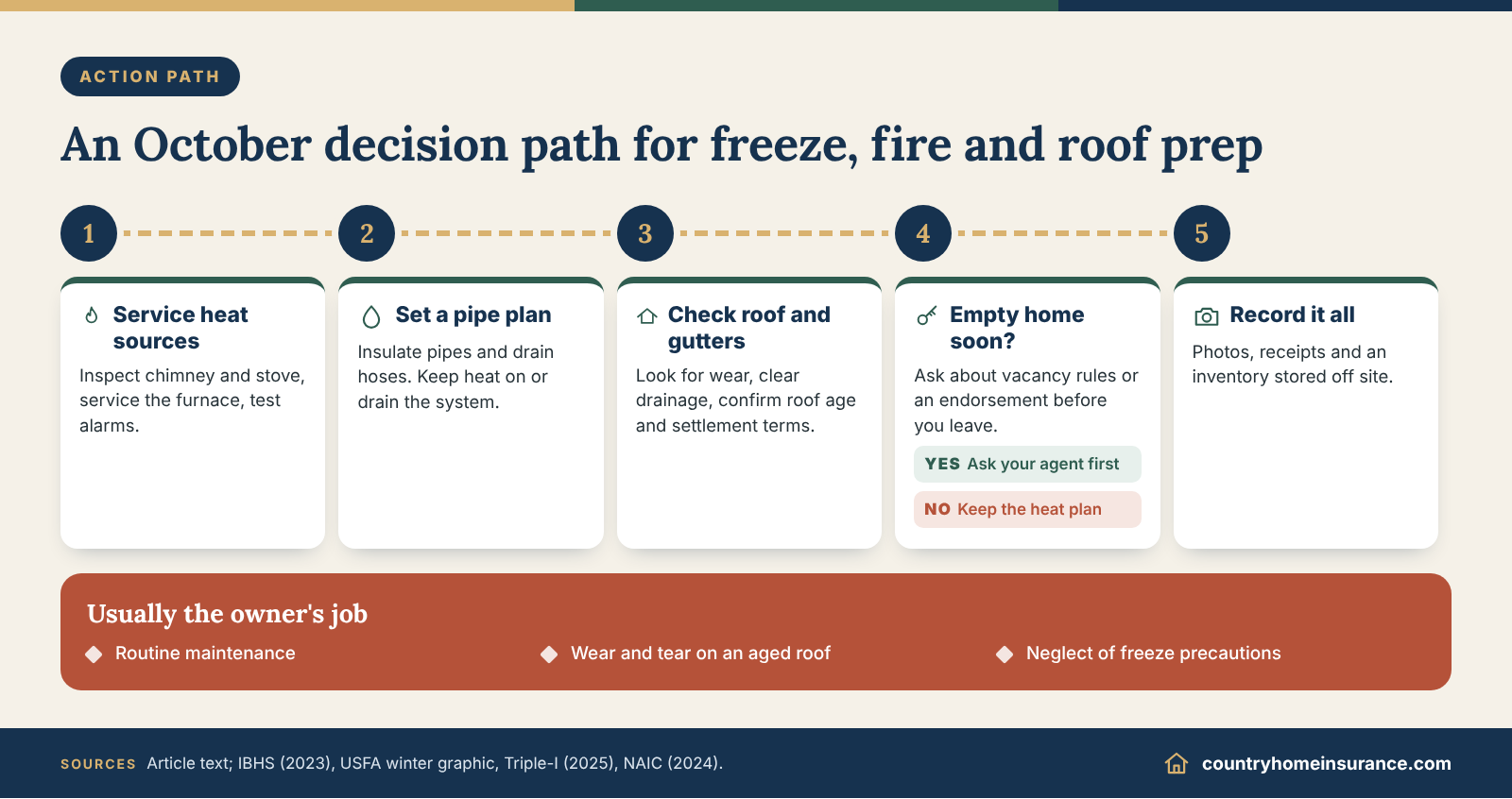
Tasks fall into three groups: calls to professionals that need lead time, work you can do yourself in a weekend, and the paperwork that ties everything to your policy. The table below combines them into a checklist you can print.
What should you schedule first?
Professionals with seasonal waiting lists
Call the chimney sweep, the HVAC technician and, if your roof is old or you saw warning signs, a roofer. These trades get busy as soon as the weather turns. Ask each to leave an invoice describing what was inspected and any recommended repairs.
Questions for your agent
Book a call to cover roof settlement terms, deductibles, vacancy rules, endorsements and any changes in your renewal notice. Also look at our guide to the September home insurance checklist if you want a refresher on storm-season items you may have skipped.
What can you do yourself in a weekend?
Outdoor tasks
Disconnect hoses, clear gutters, trim low branches, inspect the roof from the ground, test outdoor lighting and clear space around any outdoor heating fuel or generator location. If your region faces autumn wind and wildfire weather, our guide to fall wildfire and wind coverage gaps has additional items.
Indoor tasks
Insulate pipes, seal drafts, test smoke and carbon monoxide alarms, clear dryer vents, check the attic for damp or stained insulation and clear a path around the furnace. Photograph each task as you finish it.
What should you finish before Halloween and the clock change?
Guests, decorations and the liability side
Late October brings visitors, decorations and cords on porches. Our guide to Halloween homeowners liability covers guests, decorations and dog bites, so this checklist leaves that topic there.
Daylight saving time as a reminder date
A recurring date such as the November clock change can serve as a reminder to replace alarm batteries. Make it your deadline for finishing the checklist and for moving your October photos into the off-site folder.
What if something goes wrong anyway?
Safety and shutoffs first
If a pipe bursts, shut off the main water valve, turn off electricity to wet areas if you can do so safely and call a professional. If you suspect carbon monoxide poisoning, get to fresh air right away and call 911, which is the CPSC advice. If you smell gas, follow your gas utility’s emergency instructions.
Notify the insurer, then decide about a claim
Contact your insurer or agent promptly and ask how a small loss may affect your record before you decide to file. Claims history can influence renewal and pricing, a topic covered in our guide on how claims history affects homeowners insurance cost. Ordinary maintenance costs are typically out of pocket, and a loss that falls under a high deductible may not be worth filing.
Document before cleanup
Photograph damage before removing materials, keep damaged items if the adjuster may need to inspect them and save every receipt for emergency work.
| Task | What to document | What to ask your insurer or agent |
|---|---|---|
| Chimney, stove and furnace service | Dated invoice describing what was inspected and any repairs | Do solid-fuel appliances need a disclosed installation or inspection? |
| Insulate pipes, drain hoses and exterior lines | Photos of insulation and disconnected hoses | What does my form require to preserve freezing coverage? |
| Roof and gutter inspection | Photos, contractor report, gutter cleaning date | Is my roof paid at replacement cost, actual cash value or by schedule? |
| Smoke and carbon monoxide alarm check | Dated note of each alarm test and battery change | Are there alarm-related discounts or requirements? |
| Home inventory and structure photos | Video walk-through and receipts stored off site | Is my personal property limit enough, and is it replacement cost? |
| Renewal review | Declarations page, endorsement list, written agent answers | What changed since last year and why? |
| Vacancy or seasonal absence plan | Thermostat log, visit log or drain-down invoice | When does vacancy limit coverage and is an endorsement available? |
| Rural systems and outbuildings | Photos of well house, tanks and outbuildings | Which structures and equipment fall under other structures coverage? |
Frequently asked questions
Freeze and plumbing
What thermostat setting should you use while away in winter?
IBHS recommends keeping the thermostat no lower than 55 degrees Fahrenheit even when a building is unoccupied. Your policy may name its own minimum, so check the wording, and ask your agent if you plan to leave the house for weeks. Heat alone is not a plan if the power can fail, so combine it with a visitor or a monitor.
Will insurance pay if a pipe bursts after the heat was turned down to save money?
It depends on the form and the facts. Many policies require reasonable care to maintain heat or to shut off and drain the water, and the NAIC says damage may not be covered if the insurer finds the plumbing was neglected. Ask your insurer how it defines reasonable care before you rely on a low setting.
Should you drain the pipes in a home used only in summer?
Draining the system is one of the two routes the sample ISO form describes. It is often a plumber’s job because water heaters, traps and appliances need attention. Keep the invoice and photos, and tell your agent which approach you used.
Fire and heating
Do you need to tell your insurer about a new wood stove?
Usually it is wise to. Wood stove installation and heat-source questions often appear on applications and renewals, and an undisclosed change can complicate a claim or renewal. Ask whether the insurer requires a professional installation, a permit or an inspection.
Is chimney cleaning or furnace service covered by homeowners insurance?
No, in general. Routine maintenance is typically the owner’s responsibility. A sudden fire that damages the house may be covered subject to the policy, but the cost of sweeping a chimney or servicing a furnace is not usually reimbursed.
Are space heaters a problem for coverage?
The sample ISO HO-3 form does not name space heaters, but an application or your insurer’s own form may ask about heat sources. USFA guidance emphasizes UL listing, a thermostat, tip-over shutoff, three feet of clearance and one heating appliance per outlet. If you rent rooms or run a business from the home, ask whether special conditions apply.
Roof and renewal
How old is too old for roof replacement-cost coverage?
There is no universal age. IBHS says that after about 7 to 10 years shingle sealant weakens enough to reduce a shingle’s wind resistance significantly, and Rough Notes shows loss-percentage tables that step down by roof age, but each insurer sets its own rules. Ask for the roof terms in writing for your policy.
Should you replace the roof before renewal?
It depends on the roof’s condition, your budget and what the insurer says. Ask whether a replacement would change eligibility or settlement terms and what documentation the insurer will accept. A new roof can change your premium and your claim payment, but results vary by insurer and state.
Can an insurer decline to renew because of roof or gutter condition?
Insurers may consider roof condition at underwriting and renewal, and nonrenewal rules differ by state. If you receive a notice, read the stated reason, ask what repair or documentation would resolve it and contact your state Department of Insurance if you need help understanding your rights.
Vacancy, records and weather
How long can a home sit empty before coverage changes?
It varies. The sample ISO form uses a 60-day vacancy period for vandalism, and the Triple-I describes typical clauses of 30 to 60 days. Your form and any endorsements decide the real number, so ask before you leave.
How do you know how cold the winter will be?
The NOAA Climate Prediction Center issues official 90-day outlooks once a month, near mid-month. They are outlooks, not guarantees of a mild or harsh season, so treat them as a planning input rather than a reason to skip preparation.
Where should the home inventory be kept?
The Triple-I advises storing it off the premises, for example in a bank deposit box or with a relative or neighbor, and updating it when you buy major items. Keep receipts with it where possible.
Sources
- NAIC — Will My Homeowners Insurance Policy Cover Water Damage From a Burst Pipe? (Feb. 8, 2024; accessed 2026-10-16)
- NAIC — Homeowners Insurance topic page (page updated Oct. 25, 2025; accessed 2026-10-16)
- Maryland Insurance Administration — Protect Your Pipes (accessed 2026-10-16)
- Alabama Department of Insurance — Will a homeowners policy cover damage from a pipe that bursts? (Feb. 8, 2024; accessed 2026-10-16)
- IBHS — Winter Weather Ready checklists for residential and commercial properties (Jan. 10, 2023; accessed 2026-10-16)
- IBHS — Natural Weathering and Hazard Exposure (roofs) (accessed 2026-10-16)
- U.S. Fire Administration — Put a Freeze on Winter Fires (undated graphic; accessed 2026-10-16)
- State of Michigan MiREADY — Heating Sources Safety (citing USFA) (accessed 2026-10-16)
- American Red Cross — Smoke Alarms Basics: Answers to Common Questions (2026-10-07; accessed 2026-10-16)
- Maryland Insurance Administration — Roof Replacement Insurance Advisory (2019; accessed 2026-10-16)
- Insurance Services Office, hosted by Maine Bureau of Insurance — Homeowners 3 Special Form (HO 00 03 05 11) (edition 05 11; accessed 2026-10-16)
- U.S. Consumer Product Safety Commission — Carbon Monoxide Information Center (accessed 2026-10-16)
- Chimney Safety Institute of America — Homeowner resources (accessed 2026-10-16)
- American Red Cross — Winter storm preparedness (accessed 2026-10-16)
- Triple-I (Insurance Information Institute) — Sample Homeowners 3 Special Form, HO 00 03 10 00 (ISO form, 1999 copyright; accessed 2026-10-16)
- Triple-I — When No One’s Home: Understanding the Role of Vacancy Insurance (June 3, 2025; accessed 2026-10-16)
- Triple-I — Insurance for Your House and Personal Possessions (2026 site copyright; accessed 2026-10-16)
- Triple-I — 2023 Homeowners Insurance Handbook (2023; accessed 2026-10-16)
- Rough Notes — Mind the Gap (roof ACV and payment schedules) (Jan. 27, 2026; Feb. 2026 issue; accessed 2026-10-16)
- NOAA Climate Prediction Center — Seasonal outlooks (accessed 2026-10-16)
Important coverage note
Coverage depends on the actual policy, endorsements, exclusions, limits, deductible and cause of loss. This article is educational information, not legal or insurance advice, and it does not describe any particular policy. Sample forms and examples are illustrations; the figures in hypothetical examples are invented. State laws, filed forms and insurer rules vary and change. Verify case-specific questions with your insurer or agent and your state Department of Insurance, and consult a licensed professional or attorney for advice about a specific loss.
About the editorial team
This guide was prepared by the countryhomeinsurance.com editorial team as general, educational information for homeowners. We research and summarize publicly available material, including state insurance departments, the NAIC, federal agencies, regulators’ consumer guides and published insurer and industry resources. We draw only on the sources that were available to us when we wrote this guide, and we list them in the Sources section with dates where we could find them.
Insurance rules, rates, products and program terms change, differ by state and by insurer, and can apply differently to your situation. We cannot guarantee that this content is complete, current or free of errors. It is not legal, financial, tax or insurance advice, it is not an offer to sell insurance or a recommendation of any insurer, agent or product, and reading it does not create a professional relationship of any kind.
To the fullest extent permitted by law, countryhomeinsurance.com and its editorial team, authors and contributors exclude all liability for any loss, damage or decision arising from the use of, or reliance on, this content. For questions about your own policy or claim, contact your insurer, a licensed agent or broker, your state Department of Insurance or another qualified professional.
Content created: October 16, 2026