Quick answer
Homeowners insurance cost by home value is really cost by rebuild value. Insurers generally price the expense of rebuilding the house, not the market price that includes land and location, so a higher dwelling limit typically raises the premium. Deductibles, construction, roof age, fire protection, claims history and local catastrophe risk also move the price, and eligibility rules can tighten for very high-value or very old homes. Discounts vary by insurer and state, so confirm each one. Treat published averages as context, not a quote.
Key takeaways
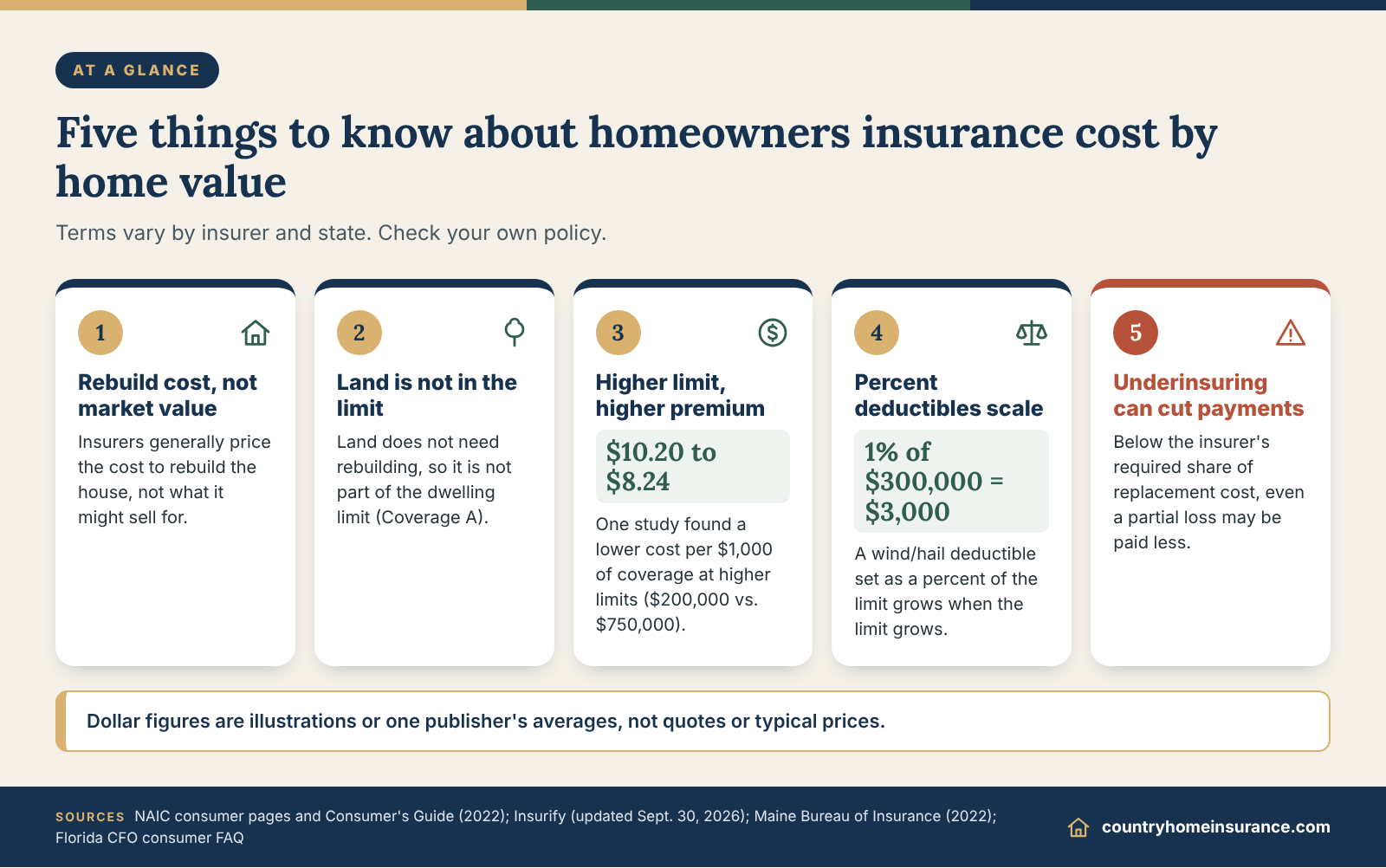
- Your policy’s dwelling limit should track the estimated cost to rebuild, not the purchase price, tax assessment or sale value, because land does not need rebuilding.
- In one September 2026 rate study, average premiums rose with the dwelling limit, but the premium per $1,000 of coverage fell as the limit climbed.
- Percentage-based wind, hail and hurricane deductibles are a share of the dwelling limit, so a bigger limit can mean a bigger out-of-pocket dollar amount on the same storm.
- Insuring below the insurer’s required percentage of replacement cost can trigger a reduced payment even on a partial loss, as state regulator examples show.
- Very high-value, very old or hard-to-replace homes may face stricter underwriting, different policy forms or limited availability; ask about this before you need to.
- Discounts exist in many forms, but amounts and rules are set by each insurer and state, so get them in writing and compare quotes with matching limits and deductibles.
| Measure | What it generally reflects | Includes land? | Role in a homeowners policy |
|---|---|---|---|
| Market value | What a buyer might pay in today’s real estate market, shaped by location and demand | Yes | Not the basis for the dwelling limit; may differ widely from rebuild cost |
| Purchase price | What you actually paid on one day, which may be higher or lower than rebuild cost | Yes | A poor stand-in for the dwelling limit |
| Assessed (tax) value | A local government figure used for property tax | Usually yes | Not designed to measure rebuild cost |
| Replacement cost | Cost to repair or rebuild with similar materials and quality | No | The number the dwelling limit (Coverage A) is meant to approximate |
| Actual cash value (ACV) | Replacement cost minus depreciation for age and wear | No | A loss-settlement method that can pay less than full repair or replacement |
What “home value” means to an insurer
When people search for homeowners insurance cost by home value, they usually picture a simple rule: the more the house is worth, the more the policy costs. There’s some truth in that, but the details matter, and they matter most for country properties, where the gap between what a place would sell for and what the house would cost to rebuild can be enormous. This section sorts out which “value” the insurance world actually uses, so the rest of the article makes sense.
Market value, assessed value and replacement cost: which one drives the price?
Think of a single property and ask three different people what it’s worth. A real estate agent will talk about market value. The county will point to an assessed value for taxes. An insurer will talk about the cost to rebuild. Those three numbers can be far apart, and only the third one is the foundation of your dwelling limit.
Market value reflects the land, the neighborhood and the market
Market value is what the property might fetch from a willing buyer. It rises and falls with interest rates, school districts, views, road access, nearby employers and a dozen other things that have nothing to do with lumber and labor. The National Association of Insurance Commissioners (NAIC), the organization of state insurance regulators, explains that market value includes the land and depends on the real estate market, while replacement cost is the cost of rebuilding with like kind and quality. That distinction is the single most important idea in this entire article.
Assessed and purchase values are snapshots, not rebuild estimates
A tax assessment is built for a different job: spreading the property tax burden. Many assessments combine land and improvements. A purchase price is a single transaction at a single moment. Neither was designed to answer the question an insurer cares about, which is how much it would cost, today, to put the house back if it were destroyed. The Triple-I (Insurance Information Institute) makes the same point from the consumer side: rebuilding cost can be higher or lower than what you paid or what you could sell the house for.
Replacement cost is what the dwelling limit tries to match
Replacement cost is the estimated expense of repairing or rebuilding with materials of similar kind and quality, without subtracting depreciation. Your dwelling limit, called Coverage A on a standard homeowners form, is the most the policy will typically pay to repair or rebuild the main structure. If you pick that limit by looking at an online home-value estimate or a tax bill, you may end up with a number that has little to do with construction reality. We’ll go deeper into estimating it in a later section.
Why land and location don’t belong in the dwelling limit
If replacement cost excludes land, it follows that the most valuable thing you own may not be what the dwelling coverage is protecting. The Florida Chief Financial Officer’s consumer FAQ states plainly that replacement cost value does not include the land value. That has real consequences in both directions: it keeps you from paying for coverage on dirt, and it warns you off using a high sale price to guess at a rebuild number.
Land doesn’t need rebuilding, so it isn’t part of Coverage A
A standard homeowners policy insures structures and belongings against listed or covered causes of loss. After a fire, the lot remains. What you’d have to pay for is demolition of what’s left, debris handling, design, permits, labor and materials. Your policy language controls which of those costs are covered and how much, so read the declarations page and the loss-settlement provisions rather than assuming. The point for pricing is simple: premium is built around the risk to the buildings, not the acreage.
A hypothetical rural example: big view, modest house
Hypothetical example, not a quote or a promise of any payment. Suppose a buyer pays $700,000 for a 20-acre hillside property with a 1,800-square-foot farmhouse. The land, the views and the location account for most of that price. A rebuild estimate for the house might come in far below $700,000. If the buyer sets the dwelling limit at the purchase price, they’d be paying to insure value that the policy isn’t designed to restore. The reverse can happen too: a modest-priced home in a low-demand rural county can be expensive to rebuild if labor and materials must be hauled a long way, so a limit tied to sale price might be too low. Both errors cost money, one in premium and one in a shortfall after a loss.
Homeowners insurance cost by home value: where value moves the premium and where it doesn’t
With the vocabulary straight, we can look at what the numbers say. Two cautions up front. First, published averages come from different publishers using different assumptions, and they are not interchangeable. Second, an average is a description of a pool of quotes, not a prediction for your house. Use the figures below the way a mechanic uses a compression gauge: to learn something about the engine, not to price the car.
What the rate data shows about dwelling limits and price
The cleanest way to see the link between value and price is to hold everything else constant and change only the dwelling limit. Rate-comparison publishers do exactly that when they publish a table of average premiums by coverage level.
One 2026 study: average premium by dwelling limit
Insurify, a quote-comparison company, updated its national averages on September 30, 2026. It reports analyzing rates from more than 180 insurers in all 50 states and Washington, D.C., drawn from partner companies and Quadrant Information Services, and it averages the price for each coverage level and area. Its default assumptions are a $1,000 deductible, $25,000 of personal property coverage, $300,000 of liability, no prior claims, good credit and a home built in 1980. Under those assumptions, the average annual premium was $2,040 at a $200,000 dwelling limit, $2,808 at $300,000, $3,552 at $400,000, $4,320 at $500,000 and $6,180 at $750,000. Table 2 lays these out, along with a simple calculation we added.
| Dwelling limit | Average annual premium | Premium per $1,000 of limit (calculated) | What it suggests |
|---|---|---|---|
| $200,000 | $2,040 | $10.20 | Highest rate per $1,000 of coverage in the table |
| $300,000 | $2,808 | $9.36 | The publisher’s default coverage level |
| $400,000 | $3,552 | $8.88 | Premium rises, but not in lockstep with the limit |
| $500,000 | $4,320 | $8.64 | Rate per $1,000 keeps drifting lower |
| $750,000 | $6,180 | $8.24 | Lowest rate per $1,000 in the table |
Why the price per $1,000 of coverage tends to fall as limits rise
The source doesn’t explain the pattern, so what follows is our reading, not a sourced finding. Some costs of insuring a home don’t scale with its size, such as policy administration, underwriting and the baseline chance of certain claims. Spread across a larger limit, those fixed pieces look smaller per dollar of coverage. Also, a very large home isn’t simply a bigger version of a small one, so the pattern may not hold for every insurer, state or house. The practical takeaway is modest: don’t expect to cut your premium in half by cutting your dwelling limit in half, and don’t expect to double it by doubling the limit.
How to read averages without being misled
Averages hide the spread. A mean of $2,808 can sit on top of quotes that run far lower in one county and far higher in another. The same publisher’s separate high-value page, last updated October 15, 2025, shows $5,556 for a $750,000 limit, while the September 2026 table shows $6,180 for the same limit. The two pages carry different dates and may be built on different data, so we don’t treat them as a trend or blend them. It’s a good reminder to name the publisher, the date, the assumptions and the geography every time a rate appears, which is the habit we follow on this site.
The other factors that sit alongside value
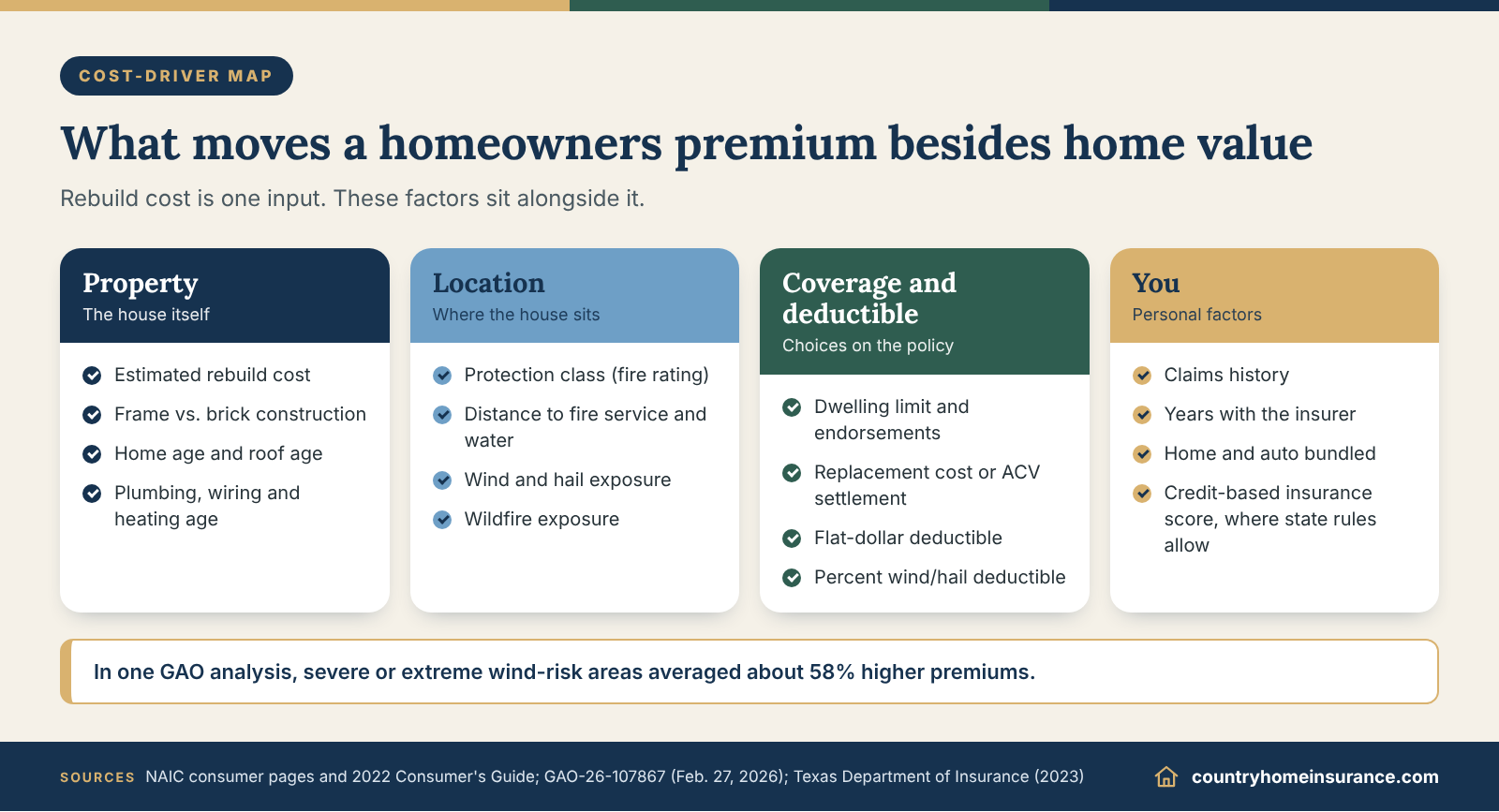
Home value in the rebuild-cost sense is only one input. The NAIC lists several others, and state regulators repeat them in their consumer guides. Where a factor matters a lot to country homeowners, we’ll say so.
Location, protection class and distance from fire service
The NAIC says location affects price through crime rates and through access to fire, police and water supply, which together feed what the industry calls the protection class. Protection class is a community fire-protection rating. The Texas Department of Insurance explains that Insurance Services Office (a Verisk business) assigns Public Protection Classifications based on a community’s ability to suppress first-alarm structure fires. Under that explainer, properties within five road miles of a fire station are scored, and those beyond that distance fall into Class 10. Properties within five road miles but more than 1,000 feet from a creditable water supply can receive a split class, and hauled water may count as a creditable supply in some cases. The same explainer notes that insurers use these ratings at their own discretion, so a better rating doesn’t guarantee a lower price. For a rural home served by a volunteer fire department, ask the insurer which class it is using for your address, because the answer can differ from a neighbor’s.
Construction, age, roof and systems
The NAIC says frame houses usually cost more to insure than brick, and that newer homes may qualify for discounts while older ones may need updated systems. A Mississippi Insurance Department shopping guide, which carries a 2014 NAIC copyright and so may be dated, adds that insurers may consider square footage, roof type and age, and the age of plumbing, electrical and heating systems. This is where a high-value home and a low-value one can switch places. A 1920 farmhouse with original wiring may be cheap in the market and still be costly to insure.
Claims history, credit-based insurance score and other personal factors
The NAIC’s consumer guide says an insurer’s pricing can reflect your own claims history, how long you’ve been with the company, whether you insure home and auto together and, in many states, credit history. A credit-based insurance score is a number built from credit information that insurers use to predict loss likelihood; whether and how insurers may use it is regulated state by state, so check your state Department of Insurance. The same guide mentions pools, trampolines, certain dog breeds and a business run from the home as other things insurers may ask about. None of these has anything to do with market value, yet each can swing a quote by more than a modest change in the dwelling limit.
What national studies say about price trends
Beyond the single-house view, regulators and researchers have looked at premiums across the country. The findings help explain why two similar houses in different places can have very different bills, and why your own premium may jump even if your home’s value hasn’t changed.
The GAO’s 2019-2024 findings on premiums
The U.S. Government Accountability Office (GAO) published report GAO-26-107867 on February 27, 2026, with public release on March 30, 2026. It found that the national average premium rose about 3 percent after adjusting for inflation between 2019 and 2024, from $2,743 to $2,829 in 2024 dollars; unadjusted, the increase was about 27 percent. Premium estimates came from First Street Technology, based on insurer rate filings and adjusted for replacement cost and year built. GAO also reported that some areas, especially high-wind southern coastal areas, saw real increases of 25 percent or more, and that many coastal areas of North Carolina and Texas rose by over 50 percent in real terms.
Wind and wildfire risk tiers matter more than many owners expect
In the same report, homes in severe or extreme wind-risk areas had premiums about 58 percent higher, roughly $1,294 per year, than homes in major-risk areas. The comparable wildfire gap was about 8 percent, or roughly $181. Since 2021, premiums in severe or extreme risk ZIP codes grew about 6 to 10 percent a year, against 1 to 4 percent in major-risk ZIP codes. GAO cautions that its regression models show associations, not causes. For you, the lesson is that where the house sits can overwhelm what the house is worth.
Why a national average is not your price
Triple-I reports that the NAIC’s average HO-3 premium (the most common homeowners form) was $1,569 in 2022, up 11.2 percent from $1,411 in 2021, in data published in May 2025. That’s regulator-collected data on a different basis from the Insurify table above, and it’s older, so the two shouldn’t be set side by side as if one corrected the other. Both are descriptions of pools of policies with their own mixes of states, coverage levels and years. Your premium depends on your address, your limit, your deductible and your insurer’s filed rates.
How much dwelling coverage a home of your value really needs
Since the dwelling limit is where value turns into premium, getting that number right is the highest-leverage decision on the policy. Too high and you pay for coverage you can’t use. Too low and you may find out after a loss that the policy pays less than a rebuild costs. Most owners lean on the insurer’s own estimate, which is a reasonable starting point, but it deserves a sanity check.
How rebuild cost is estimated
No one can know a rebuild cost for certain until the bids come in. What you can do is triangulate: a rough do-it-yourself figure, the insurer’s valuation tool, and, if the house is unusual, a professional opinion.
The square-foot method and where it falls short
The Triple-I describes a rough method: multiply the home’s square footage by a local per-square-foot building cost. Its illustration, a 2,000-square-foot home at $80 per square foot, comes to about $160,000, though that sample rate is only an illustration of the arithmetic and not a current cost for any place. The shortcut is useful for catching an estimate that’s wildly off. It struggles with anything that isn’t a plain box: vaulted ceilings, stone, custom millwork, radiant floors, a well house or a long driveway-fed utility run. A single average rate can’t see those features.
Insurer and professional valuation tools
Insurers commonly use software to estimate rebuild cost from a list of home characteristics. A 2019 Verisk blog post about its 360Value platform describes a warning that fires when a calculated replacement cost falls below the average or lowest reasonable cost per square foot for the area, using a study of more than 200,000 valuations. The post also says insurers can use such comparisons to decide whether to order an underwriter review or a third-party inspection. That’s one vendor’s tool described in a dated post, so it’s an example of how checks work and not a description of every insurer’s process. What it shows is that the number on your declarations page may be a software output built from the answers you gave, which makes the accuracy of those answers your responsibility.
Features that quietly raise rebuild cost
The Mississippi Insurance Department has urged owners to consider whether a home meets current building codes, whether older or custom-built homes have hard-to-replace features, and whether replacement coverage would keep pace if material prices rise. For country homes the list often grows: a metal roof, a wraparound porch, a basement dug into rock, a fireplace built of local stone, an on-site septic system or well that must be reconnected. Tell the insurer or agent about each upgrade and renovation, and ask whether the valuation reflects it.
Insurance to value: what happens when the limit is too low
Insurance to value is the relationship between the limit you carry and the full replacement cost of the home. Many policies require a minimum percentage, and falling short can change how a claim is paid, including smaller claims that never come near the limit.
The 80 percent rule in plain English
The NAIC says it’s important to insure a home for at least 80 percent of its replacement value, and its consumer guide warns that if the limit slips below 80 percent of replacement cost, the insurer may reduce claim payments. The Florida CFO’s consumer FAQ says insurers may require 80, 90 or even 100 percent. The Maine Bureau of Insurance describes the same idea as coinsurance on homeowners and condo policies. The required percentage is a policy term, so find it in your own contract.
Worked examples from state regulators
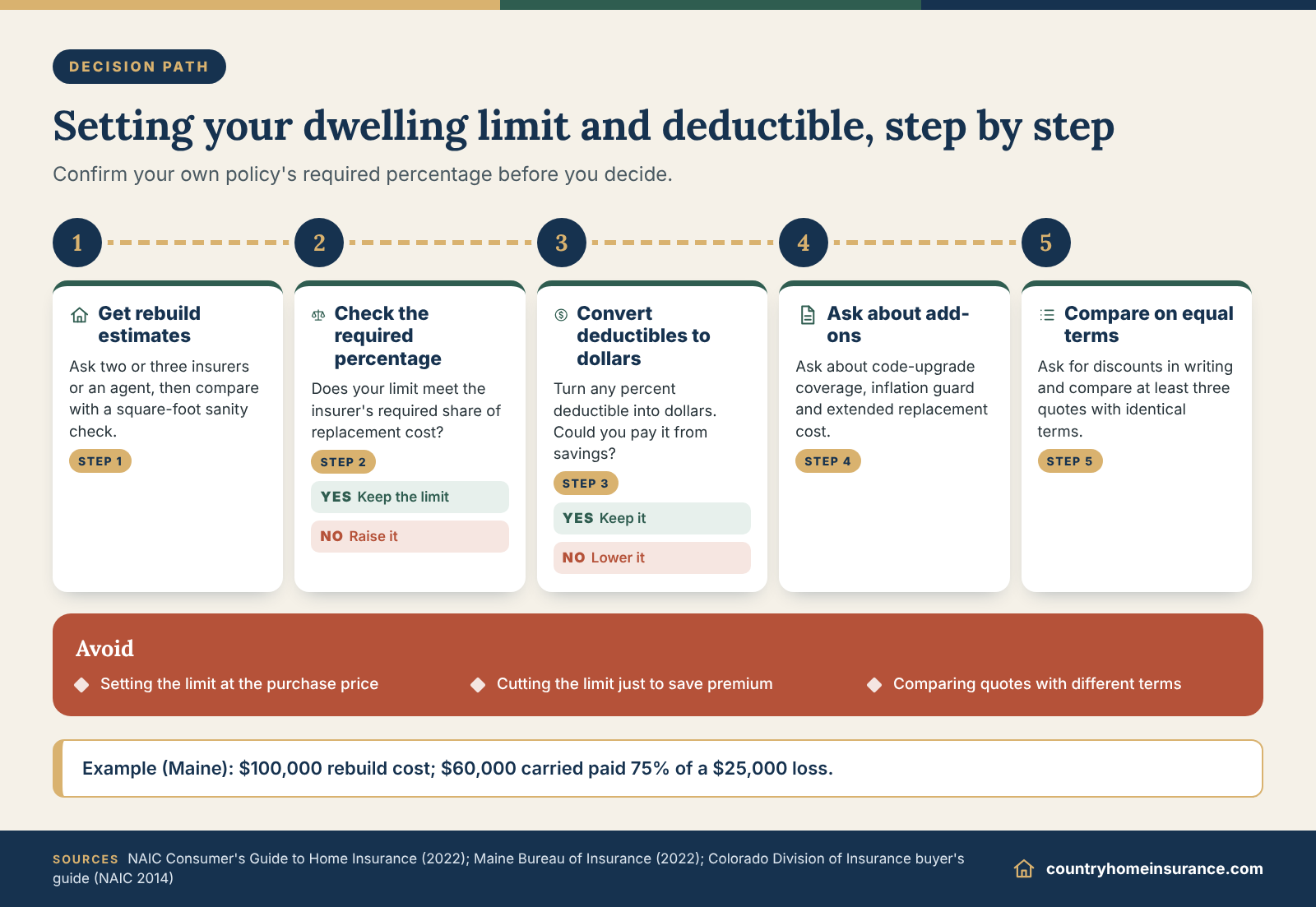
Maine’s page gives an example: a home that would cost $100,000 to rebuild, a $500 deductible and a $25,000 fire loss. With $80,000 of coverage, which meets an 80 percent requirement, the policy pays the loss less the deductible, $24,500. With $60,000 of coverage, which is below it, the policy pays 75 percent of the loss, or $18,750, and the owner absorbs the $6,250 difference; how the deductible is layered into that arithmetic depends on the policy wording. Florida’s FAQ uses a formula of insurance carried divided by insurance needed, times the loss. In its example, $100,000 carried against $200,000 needed on a $50,000 loss yields a $25,000 payment. Table 3 summarizes the cases.
| Source | Scenario | Result | Lesson for the dwelling limit |
|---|---|---|---|
| Maine Bureau of Insurance (copyright 2022) | $100,000 rebuild cost; $80,000 carried; $25,000 loss; $500 deductible | Policy pays $24,500 (loss less deductible) | Meeting an 80% requirement avoids the proportional reduction |
| Maine Bureau of Insurance (copyright 2022) | Same home; $60,000 carried | Policy pays 75% of the loss, $18,750; owner bears the $6,250 gap | Falling below the requirement can shrink payment on a partial loss |
| Florida CFO consumer FAQ (undated) | $100,000 carried against $200,000 needed; $50,000 loss | Formula result: $25,000 | Payment scales with the ratio of carried to needed |
| Colorado Division of Insurance (April 26, 2022) | Marshall Fire total losses, tested at $250, $300 and $350 per square foot | About 36%, 55% and 67% of 951 homes fell short | Rebuild assumptions after a disaster can be well above older estimates |
What the Marshall Fire analysis showed about being short
After the Marshall Fire in Colorado, the Colorado Division of Insurance analyzed claims data from 61 insurers covering about 97 percent of the state’s homeowners market. It looked at 951 total-loss homes, considered dwelling coverage only, excluded homes with guaranteed replacement coverage, and tested three rebuild costs. At $250 per square foot about 36 percent of policies fell short, with an average shortfall near $98,967. At $300 it was 55 percent and about $164,855. At $350 it was 67 percent and about $242,670. These are estimates under chosen assumptions after one extraordinary event, so they’re no forecast for your county. They do illustrate how a limit that looked adequate on paper can fall behind real construction costs.
Keeping the limit current after you buy
Rebuild costs move. Materials get more expensive, labor tightens, codes change and you add a deck or finish a basement. A limit that was right at closing can drift.
Inflation guard and automatic adjustments
The NAIC’s consumer guide describes an inflation guard as an optional endorsement that raises the dwelling limit each year in line with inflation. The Triple-I adds that many policies include a clause that adjusts the dwelling limit to current local construction costs at renewal, and that you may be able to add one if yours lacks it. Ask your agent whether your policy has such a provision and how it is calculated, because an automatic increase based on a general index may not match what builders in your area are charging.
Extended and guaranteed replacement cost
An extended replacement cost provision pays a set additional percentage or dollar amount above the dwelling limit if rebuilding costs more than expected. The Triple-I says the add-on is typically 20 percent or more depending on the insurer, and a consumer-publisher source describes buffers from 10 to 50 percent, so there’s no standard figure. Guaranteed replacement cost goes further and may pay to rebuild even above the limit, but the Triple-I notes that it generally doesn’t cover code-upgrade costs and may not be offered on older homes, and the NAIC-based state guides say very few insurers offer it and suggest asking whether it has a cap. Functional replacement cost, also described in those guides, uses less expensive materials and costs less than full replacement cost coverage. Availability and wording vary by insurer and state.
Ordinance or law coverage for code upgrades
Ordinance or law coverage addresses the cost of bringing a damaged home up to current building codes when it’s repaired or rebuilt. United Policyholders, a consumer advocacy group, says that without it insurers often decline to pay those costs, that it may be built into a policy or added by endorsement, and that limits are commonly 10, 25 or 30 percent of the dwelling limit. For an older farmhouse, code upgrades can be a meaningful part of a rebuild, so look for this provision in the declarations or additional coverages before you need it.
What else in the policy scales with your home’s value
Raise the dwelling limit and several other parts of the policy rise with it, because they’re set as a percentage of Coverage A. That’s convenient when the percentages fit your property, and a trap when they don’t. Country homes with outbuildings and tools are the usual place the formulas pinch.
The percentage coverages: B, C and D
The NAIC’s consumer guide says other structures, personal property and loss of use are usually set as percentages of the dwelling limit, at 10, 50 and 20 percent respectively, while you choose the liability and medical payments limits. Actual percentages vary by form and insurer, and some can be changed for a charge.
Coverage B: barns, shops and detached garages
Coverage B, other structures, typically applies to buildings separate from the house, such as a detached garage, shed or fence. On a $300,000 dwelling limit, a 10 percent figure would mean $30,000 for all of them combined. That’s plenty for a small shed and not much for a machine shop, a hay barn and a pole building together. The GAO noted that adding coverage for detached structures raises premiums, so the fix isn’t free, but the question is worth asking. Many farm-like buildings, and any building used for business, may be limited or excluded under a homeowners form, so ask how your insurer treats each one.
Coverage C: belongings and special limits
The Triple-I says most companies set contents coverage at 50 to 70 percent of the dwelling limit, and that it can be insured at replacement cost or actual cash value. The NAIC notes that special limits often apply, with theft limits of about $500 for items like furs and jewelry and about $1,000 for firearms and computers, and that a Scheduled Personal Property Endorsement can raise them. A bigger house doesn’t automatically mean you own more jewelry or more firearms, so the percentage may overshoot in some categories and undershoot in others. A home inventory is how you find out.
Coverage D: living elsewhere after a covered loss
Loss of use, also called additional living expense (ALE), generally helps pay for extra living costs if a covered loss makes the home unlivable. At the NAIC’s typical 20 percent, a $300,000 dwelling would carry about $60,000. In a remote area where the nearest rental might be a long drive away, or where a rebuild takes longer because contractors are scarce, ask whether the limit and any time limit fit your reality.
| Coverage | Typical basis | Illustration at $300,000 dwelling | Country-property question to ask |
|---|---|---|---|
| A: Dwelling | You choose, ideally near rebuild cost | $300,000 | Does the estimate include custom features and code upgrades? |
| B: Other structures | Often about 10% of A | About $30,000 for all detached buildings combined | Are barns, shops and fences enough in total, and are any excluded or limited? |
| C: Personal property | Often 50% of A, with companies commonly using 50-70% | About $150,000 at 50% | Do special limits on jewelry, firearms or tools fit what you own? |
| D: Loss of use | Often about 20% of A | About $60,000 | Would the limit last through a slow rural rebuild? |
| E and F: Liability and medical payments | You choose the limits | Not tied to dwelling limit | Do your limits reflect acreage, guests, animals or equipment? |
Liability limits don’t follow home value automatically
Personal liability (Coverage E) and medical payments to others (Coverage F) protect against injury or property damage you might be legally responsible for. The NAIC says you choose these limits, which means they won’t rise just because your dwelling limit did.
Why Coverage E is a separate decision
A lawsuit over a guest’s fall doesn’t care what your house is worth. Liability exposure follows your activities, visitors, animals and property features. The Insurify defaults used in the rate table assume $300,000 of liability, which is a modeling choice for the study and not a recommendation for you. An agent can walk through the options and the cost of raising the limit; ask for actual quotes at several limits rather than assuming what the difference costs.
Where an umbrella policy comes into the conversation
If you have acreage, livestock, ponds, trails or frequent visitors, a personal umbrella policy may be worth pricing. It generally sits on top of the liability limits in homeowners and auto policies, and it typically requires underlying limits at a level the umbrella insurer sets. Because those requirements and prices vary by insurer, we leave the specifics to a dedicated guide and to your agent.
Mortgage lenders and the minimum they require
If you have a mortgage, the lender will set a minimum amount of insurance. That minimum protects the lender’s collateral and may bear little relation to the amount that protects you.
A lender minimum is a floor, not a recommendation
The NAIC says lenders may set a minimum, often at least the mortgage amount, and the Mississippi shopping guide says the lender will likely require at least enough coverage to pay off the loan. Suppose your loan balance is far below rebuild cost, which is common after years of payments or with a large down payment. A policy sized to the loan could leave you well short. Ask the lender for the requirement in writing.
You choose the insurer, not the lender
The NAIC states that you aren’t required to buy from the insurer your lender recommends. That matters for pricing, since a lender-suggested policy is one quote, not the market. Shopping at least three quotes, as the NAIC-based state guides suggest, is how you learn what a particular limit and deductible actually cost for your address.
Deductibles: how home value changes what you pay out of pocket
A deductible is the amount you pay toward a covered loss before the policy pays. It applies to coverage on the house and personal property, according to the NAIC. Choosing it is the other big lever on price, and it interacts with home value in a way many owners miss: percentage deductibles are calculated from the dwelling limit, so a more valuable rebuild number can mean a bigger bill on the same storm.
Flat-dollar deductibles and the premium trade
Most policies use a flat deductible such as $500 or $1,000, according to the Maine Bureau of Insurance, which also notes that higher deductibles lower premiums but should be an amount you can afford. The NAIC says the same. The open question is how much a higher deductible saves, and the answer depends heavily on where you live and which insurer you use.
What one 2026 dataset shows
The Insurify page updated September 30, 2026 publishes average annual premiums by deductible for a $300,000 dwelling limit: $2,659 at $500, $2,417 at $1,000, $2,055 at $5,000 and $1,934 at $10,000. The page has an unexplained inconsistency worth knowing about: it also lists $2,808 as the national average at a $1,000 deductible, which doesn’t match the $2,417 in its deductible table. Because we can’t tell which is right, treat the ratios between rows as rough direction and not as a price list. Table 5 shows the table with a simple difference column that we calculated.
| Deductible | Average annual premium | Difference from the $1,000 row (calculated) | Decision value |
|---|---|---|---|
| $500 | $2,659 | +$242 per year | Pay more each year to keep the out-of-pocket bill small |
| $1,000 | $2,417 | Baseline | A common middle setting |
| $5,000 | $2,055 | -$362 per year | Saves premium but needs a real savings cushion |
| $10,000 | $1,934 | -$483 per year | Largest saving in the table, largest exposure per claim |
A simple affordability test before you raise the deductible
Using the table, moving from $1,000 to $5,000 saves about $362 a year and adds $4,000 to what you’d pay on any covered claim. Dividing the extra $4,000 by the yearly saving gives roughly 11 years to break even, ignoring everything else. Triple-I, citing Verisk data, reports 5.33 claims per 100 house-years in 2023, which works out on average to about one claim every 19 years per insured home. Averages can’t tell you whether your own roof, trees or creek are riskier than most. The honest test is whether you could write the larger check from savings next month without borrowing. If not, the premium saving isn’t a saving.
Percentage deductibles scale with the dwelling limit
Some policies set a separate deductible as a percentage of the dwelling limit, usually for wind, hail or named storms. The NAIC’s consumer guide notes that some areas use catastrophe deductibles expressed as a percentage, and the Maine Bureau of Insurance gives a 1 percent windstorm deductible on $150,000 of dwelling coverage as $1,500.
How the math works as your rebuild number rises
Because the percentage applies to the limit, the dollar amount climbs when the limit does. Hypothetical example, not a quote. A 1 percent wind/hail deductible on a $300,000 dwelling limit is $3,000, a 2 percent deductible is $6,000 and a 5 percent deductible is $15,000. If a storm causes $12,000 of roof damage, the 1 percent setting leaves the owner with $3,000 of it, while the 5 percent setting would leave the owner with the entire $12,000 and no payment from the policy. Raising the limit to keep pace with rebuild costs is wise, but it also raises that dollar exposure, so read the declarations page for the dollar figure, not only the percentage.
An example from a residual market plan: Texas FAIR Plan
The Texas FAIR Plan Association announced deductible changes effective on and after July 1, 2026. The 1 percent wind and hail option was eliminated, and policies with it switch to 2 percent at renewal. Wind and hail deductible choices are 2, 3, 4 or 5 percent, other perils may carry 1 to 5 percent, and split deductibles are allowed. A FAIR Plan is a residual-market program that offers coverage when the regular market doesn’t, and terms differ from plan to plan and from standard policies. This is a Texas example only, and your state’s plan, if you need one, will have its own rules.
Roof-specific deductibles and settlements
The GAO reported that some insurers have reduced coverage in response to risk, giving examples such as paying the depreciated value of older roofs instead of full replacement cost, requiring split deductibles for roof damage, and offering discounts to policyholders who accept lower roof claim payments (the last example was an Oklahoma insurer citing hail risk). For owners of older roofs in hail country, these changes can matter as much as the dwelling limit. Ask directly whether your roof is settled at replacement cost or actual cash value, and whether a separate roof or wind/hail deductible applies.
| Dwelling limit | Wind/hail deductible percentage | Dollar deductible | Source of the percentage range |
|---|---|---|---|
| $150,000 | 1% | $1,500 | Maine Bureau of Insurance example |
| $300,000 | 1% | $3,000 | Arithmetic; 1% no longer offered by Texas FAIR Plan after July 1, 2026 |
| $300,000 | 2% | $6,000 | Within the Texas FAIR Plan range of 2% to 5% |
| $500,000 | 5% | $25,000 | Arithmetic at the top of the Texas FAIR Plan range |
Eligibility: when a home’s value, age or features limit your options
Price isn’t the only place home value shows up. At the extremes, very expensive homes, very old homes and homes that are hard to value can face different forms, different deductibles, extra inspections or fewer insurers willing to quote. Eligibility rules are set by each insurer within state law, so what follows describes patterns, not guarantees.
High-value homes
There’s no single legal definition of a high-value home. Insurers draw their own lines, and the lines move with the market and the insurer’s appetite.
Where “high value” tends to begin
Insurify’s high-value page, last updated October 15, 2025, says standard policies often carry dwelling limits between $100,000 and $500,000, and that insurers generally treat homes needing more than $500,000 of dwelling coverage as high value, although some set the line at $750,000, $1 million, $1.5 million or higher. Note the date and the single publisher; we’d treat this as a rough range. The takeaway for a rural buyer is that a rebuild estimate crossing a threshold might change which insurers or forms are available, even though nothing about the house changed.
What changes: forms, deductibles and cost
The same page describes high-value coverage as often written on a comprehensive HO-5 form with higher limits, replacement cost and open-peril protection for both the structure and belongings, with guaranteed replacement cost or service-line coverage sometimes included. It says deductibles are generally higher. On cost, it reports average annual premiums of $5,556 at a $750,000 limit, $6,947 at $1 million and $10,172 at $1.5 million, under the publisher’s default assumptions including a 1980 build year. It also reports ranges of $2,104 to $16,467 for high-value policies, which shows how wide the spread can be. These figures are from a different date than the Table 2 data, so don’t line them up as a trend.
When the standard market says no
Some owners, high-value or not, find themselves unable to buy a standard policy. The GAO found that the share of homeowners in state FAIR or beach plans, the insurers of last resort, rose from about 1.4 percent in 2019 to about 2.5 percent in 2023, and that higher disaster costs, longer rate-approval times and higher wildfire risk were each associated with larger shares. If you land in a residual market, compare its covered perils, limits and deductibles with your needs, and ask whether supplemental coverage is available to fill gaps.
Older and lower-value homes
At the other end, a modest or older home isn’t always cheap or easy to insure. Age affects eligibility for certain loss-settlement options regardless of market price.
Replacement cost options on older homes
The Triple-I says older homes may be offered a “modified” replacement cost policy that uses today’s standard materials, and that guaranteed replacement cost may be unavailable for older homes. The NAIC-based guides describe functional replacement cost as a cheaper option that uses less expensive materials. If your 1930s farmhouse has plaster walls and old-growth timber, ask exactly what “replacement” means in your policy, because rebuilding it with standard modern materials is a different product than restoring what you have.
Low market value, high rebuild cost: the rural mismatch
In some small-town and rural markets, homes sell for less than it would cost to build them new. A buyer who anchors on the purchase price may set a dwelling limit below the rebuild cost and fall below the insurer’s required percentage. The Triple-I and state regulators warn that the two numbers can differ in either direction. If the limit is too low to meet the policy’s requirement, the penalty examples in Table 3 are the risk. Some owners choose actual cash value coverage to lower the premium. The NAIC says ACV often doesn’t pay enough to fully replace or repair, so that is a choice to make with open eyes, ideally after seeing both quotes.
What underwriters may ask for before they quote or renew
Underwriting is the insurer’s process of deciding whether and on what terms to cover a risk. Value-related checks are part of it.
Valuations, photos and inspections
As the Verisk post noted, insurers can compare a replacement cost estimate with benchmark cost per square foot and decide whether to order underwriter review or a third-party inspection. Don’t be alarmed if an inspector visits or asks for photos of the roof, electrical panel or heating system. The Mississippi guide lists roof type and age and the age of major systems among items insurers may consider. Answer questions accurately, and keep records of upgrades, because an inaccurate application can create problems at claim time.
Telling the insurer about renovations and additions
A finished basement, a new kitchen, a detached workshop or a second story changes rebuild cost. The Triple-I advises updating the dwelling limit after renovations or additions. Let your agent know in writing, ask for the revised declarations page, and confirm that any new outbuilding has coverage under Coverage B or an endorsement.
Discounts and mitigation: offsetting the cost of a higher-value home
Once the dwelling limit and deductible are set, discounts and home improvements are the legitimate way to bring the premium down without thinning the coverage. The catch is that discounts are insurer-specific and state-regulated. We can describe categories regulators mention; we can’t promise any particular percentage will apply to your policy.
Discount categories regulators commonly mention
Both the NAIC’s consumer page and its consumer guide list discount types. Think of them as questions to ask, not entitlements.
Protective devices and bundling
The NAIC lists burglar alarms, deadbolts and window security devices, and insuring home and car with the same company. Its consumer guide adds smoke detectors and sprinklers, and the Mississippi shopping guide notes that insurers may ask about carbon monoxide detectors and security systems. On a rural property where a response can take a while, monitored smoke and heat alarms are as much about protecting the structure as about the discount, so ask whether the insurer credits monitoring and what proof it wants.
Updated roofs, wiring and plumbing
The NAIC page lists replacing the roof as a possible discount in some states, and the consumer guide mentions updated electrical or plumbing and a new roof. These are the same age-related factors that can raise prices when they are neglected. If you’ve replaced a roof, ask whether the insurer wants a receipt, a contractor invoice or a photo, and whether the credit applies to the whole premium or just the wind and hail portion.
Features that can push the price up
The NAIC warns that a new wood-burning fireplace or a wooden deck can have the opposite effect. Its consumer guide also mentions wood stoves or furnaces, pools, trampolines, certain dog breeds and running a business from home as items insurers may weigh. If you’re planning an addition, a quick call to the agent before construction costs nothing and can avoid a surprise at renewal.
Storm hardening and FORTIFIED discounts
FORTIFIED is a voluntary construction standard from the Insurance Institute for Business & Home Safety (IBHS) designed to strengthen homes against severe weather. The Congressional Budget Office notes that insurers may credit mitigation such as fire-resistant materials, vegetation trimming or elevated structures when pricing risk. Whether and how much depends on state and insurer.
What the Alabama example shows
A FORTIFIED program page for Alabama says most Alabama insurers offer discounts of up to 55 percent on the wind portion of the premium, with ranges of 25 to 35 percent for a FORTIFIED Roof, 35 to 45 percent for Silver and 45 to 55 percent for Gold, and it describes these as insurer-offered, not required by law. That page was last modified in December 2021, so the numbers may be out of date, and they apply only to the wind portion of the premium, not the whole policy. Treat it as an example of how large a mitigation credit can be in one state, not as something to expect elsewhere.
Grants, endorsements and tax rules
The same page mentions Strengthen Alabama Homes grants of up to $10,000 when funded, FORTIFIED endorsements that may help pay for a FORTIFIED roof upgrade after a covered loss with significant roof damage, and a state tax deduction for some retrofits, with advice to consult a tax professional. Programs open and close, and funding changes. Check the current rules with the state agency that runs any grant before you plan around it.
How to find out what your state and insurer recognize
Start with your state Department of Insurance consumer pages and ask your agent which resilience features each insurer credits. Ask for the credit in writing, including what documentation or certification is required and whether it applies to the wind or hail deductible, the wind premium or the whole policy. Because the GAO found some insurers tightening roof terms, also ask how each insurer treats roof age and roof type.
Saving money without under-insuring
The cheapest policy and the best-value policy are rarely the same thing. There are sensible ways to trim cost, and a few tempting ones that cost more in the end.
Why shaving the dwelling limit is the wrong trim
Table 2 might tempt you to drop the limit to lower the bill. But the Table 3 examples show how a limit below the required percentage can reduce payments, and the Colorado analysis shows how quickly rebuild costs can outrun a limit. Lowering Coverage A to save a few hundred dollars a year can expose you to a shortfall of tens of thousands. If you want to economize, adjust the deductible (within what you can afford), shop the market or earn credits, not the core limit.
Questions that surface savings
The state guides based on NAIC material suggest asking, “How much can I save by increasing my deductible?” “What discounts are available?” and “Is there anything I can repair or improve in my home to lower my premium?” Those three questions, asked of each insurer, will usually surface more than a general web search will. Write down the answers so you can compare them.
Quote count and comparison discipline
The Colorado Division of Insurance guide recommends getting at least three quotes and contacting more than one agent or insurer. The point isn’t volume. It’s comparing quotes built on identical dwelling limits, deductibles and endorsements, which is the only way to see the true price difference between insurers.
A practical process for setting and checking your coverage
Everything above comes down to a sequence: establish the right rebuild number, pick limits and deductibles you can live with, then compare like with like. The sequence matters, because quoting before you have a defensible rebuild number just compares insurers’ guesses.
Before you request quotes
Prep takes an evening and pays back at every step afterward.
Gather the facts insurers will ask for
The Mississippi guide suggests gathering what you can about the home, your insurance history and your claims history, and says an agent can help fill gaps. Practically, that means year built, square footage, construction type, roof material and installation year, updates to wiring, plumbing and heating, outbuildings with their uses, distance to the nearest fire station and hydrant (or water source), and any prior claims. The NAIC also offers a Shopping Tool for Homeowners Insurance that explains where to look, what to ask and what to gather.
Settle the rebuild number first
Ask two or three insurers or an independent agent for their replacement cost estimates, and compare them with your own square-foot sanity check. If they disagree materially, find out why, usually it is a difference in assumed finishes or features. For an unusual house, a local builder or a professional appraiser can give an opinion that you can share with the insurer. Document the basis for whatever number you settle on.
A checklist you can reuse
Table 7 turns this into a checklist of what to verify, what to document and what to ask.
| Item | What to verify | What to document | What to ask the insurer or agent |
|---|---|---|---|
| Dwelling limit (Coverage A) | Is it close to current rebuild cost, not market value? | Rebuild estimate, square footage, features and upgrades | What assumptions produced this estimate, and what percentage of replacement cost does the policy require? |
| Loss settlement | Replacement cost or actual cash value for the dwelling, roof and contents | Roof age and installation date | Does any part of the roof settle at depreciated value? |
| Deductibles | Flat versus percentage, and separate wind/hail, hurricane or roof deductibles | Dollar amount each deductible produces on your limit | What is the dollar deductible for wind or hail, and how much would I save by raising it? |
| Other structures and contents | Whether 10% and 50% type formulas fit what you own | Photo or video home inventory, outbuilding list | Can Coverage B or C be raised, and are any buildings excluded or limited? |
| Code upgrades and cost growth | Ordinance or law coverage, inflation guard, extended replacement cost | Declarations page and endorsement list | What limits apply to each, and is guaranteed replacement cost available for this home? |
| Discounts and mitigation | Which credits are applied and what proof is needed | Receipts, certificates, alarm monitoring contracts | Which credits can I qualify for, and how much do they change the premium? |
Comparing quotes on equal footing
The most common shopping mistake is comparing a $2,100 quote with a $2,600 quote that differ in more than price.
Match limits, deductibles and endorsements
Put the quotes side by side with the same dwelling limit, the same percentage or dollar deductibles, and the same endorsements. If one carries a 2 percent wind/hail deductible and another a flat $1,000, the lower premium may simply be the policy that leaves you carrying more of a storm loss. Convert every percentage deductible to dollars before you compare.
Compare how losses are settled
Look for roof settlement terms, replacement-cost or ACV language for contents, and any limits on cosmetic damage or older roofs. These terms can decide a claim and rarely appear on the first page of a quote summary. Ask for the actual policy form and endorsements, not just the declarations summary, and compare the pages that matter.
Check complaint records and financial strength
The state guides suggest checking insurer complaint records through the NAIC Consumer Information Source, and your state Department of Insurance may publish complaint data of its own. A low price from an insurer with a poor claims-service record may not be a bargain. Rate-comparison tools and averages, including the ones quoted in this article, don’t measure that.
After you buy and at each renewal
Coverage isn’t a set-it-and-forget-it purchase. A short annual review keeps the value connection intact.
Read the declarations page the day it arrives
The declarations page lists your limits, deductibles, forms and endorsements. The Mississippi guide recommends keeping the policy somewhere safe and reviewing the declarations to confirm you got what you wanted. Check that the dwelling limit, deductible dollar amounts and any endorsements match the quote. Errors are much easier to fix in the first weeks than after a loss.
When your premium jumps without a claim
Premiums can rise for reasons that have nothing to do with your house. The CBO identifies reinsurance costs as a major driver of higher premiums in high-risk areas, and the GAO links higher premiums to higher recent disaster costs in a state. A rise is also a prompt to check whether your limit auto-adjusted for inflation, whether a roof credit expired and whether a competing quote offers the same coverage for less. If something looks wrong, your state Department of Insurance can explain the rate-review process and take consumer complaints.
Keep a home inventory and update records
The Triple-I advises making an inventory and comparing contents coverage with the value of your possessions. A video walk-through that includes outbuildings, equipment and the contents of the barn takes less than an hour and makes both coverage decisions and claims easier. Store a copy off the property.
Frequently asked questions
Questions about price and value
Does a more expensive house always cost more to insure?
Not always. What matters most is the estimated cost to rebuild, along with construction type, age, roof, location and fire protection. A pricey home on a hilltop with a high land value and a modest house may cost less to insure than a cheaper house that’s costly to rebuild or sits in a high-wind area. Averages by dwelling limit, such as Insurify’s September 2026 table, show a tendency, not a rule for any one address.
Should I set my dwelling limit at what I paid for the house?
Generally no. Regulators including the NAIC, the Florida CFO and the Mississippi Insurance Department say to base the limit on rebuild cost, because market value includes land and the real estate market. Ask your insurer or agent for a replacement cost estimate and compare it with your own check.
If my home’s market value drops, will my premium go down?
It may not. Because the dwelling limit is based on rebuild cost, a softer real estate market doesn’t make lumber, labor or code compliance cheaper. Premiums can still move for other reasons, such as filed rate changes, claims in your area or catastrophe costs. If you think your limit is too high, ask the insurer to show its rebuild estimate and the inputs.
Does a bigger down payment or paid-off mortgage change my coverage need?
It changes the lender’s requirement, not your exposure. The NAIC says a lender’s minimum is often at least the mortgage amount, so a small loan may lower that floor. The cost to rebuild is unchanged, and you’d still face it without a mortgage. Keep the limit tied to rebuild cost.
Questions about coverage and eligibility
Is the land covered by my homeowners policy?
Replacement cost value does not include the land, per the Florida CFO and the NAIC. Some policies add limited provisions for items such as trees or debris removal, but those terms vary, so look at the actual policy sections and endorsements for what applies to trees, lawns and land. Flood and earthquake are typically separate coverages; FloodSmart, the NFIP’s consumer site, says most homeowners insurance does not cover flood damage, and the CBO notes that standard policies exclude flood and generally earthquake, and that NFIP building coverage was capped at $250,000 at the time of that 2024 report.
Can I be turned down because my home is too valuable, too old or too remote?
Insurers set their own appetite within state law, and some homes face fewer options. The GAO found residual-market participation rising from about 1.4 percent in 2019 to about 2.5 percent in 2023. If you’re declined, ask for the reason in writing, ask another agent about other insurers and then look at your state’s FAIR Plan or equivalent. Your state Department of Insurance can explain the rules for nonrenewal and residual markets where you live.
What is the difference between extended and guaranteed replacement cost?
Extended replacement cost adds a stated cushion above the dwelling limit, with the percentage set by the insurer. Guaranteed replacement cost may pay to rebuild even above the limit, but the Triple-I says it generally doesn’t cover code upgrades and may not be available for older homes. Terms differ, so ask for the endorsement text.
Are the discount percentages I see online what I will get?
Not necessarily. Discounts are filed by each insurer and vary by state. The Alabama FORTIFIED example in this article is from a page last modified in 2021, and it describes a share of the wind portion of the premium, not the whole bill. Always request the actual quote with the discount applied.
Sources
- NAIC: Homeowners Insurance consumer page (undated; reviewed 2026-10-11)
- NAIC: A Consumer’s Guide to Home Insurance (2022 edition; reviewed 2026-10-11)
- NAIC: Actual cash value versus replacement cost coverage (dated January 2, 2025)
- Triple-I: Insurance for your house and personal possessions (undated; reviewed 2026-10-11)
- Triple-I: Facts and statistics, homeowners and renters insurance (NAIC premium data published May 2025; reviewed 2026-10-11)
- U.S. GAO: Homeowners Insurance, GAO-26-107867 (published February 27, 2026)
- Congressional Budget Office: Climate Change, Disaster Risk, and Homeowner’s Insurance (August 2024)
- Insurify: Average cost of homeowners insurance (updated September 30, 2026)
- Insurify: High-value home insurance (updated October 15, 2025)
- Colorado Division of Insurance: Initial estimates of underinsurance for Marshall Fire homes (April 26, 2022)
- Colorado Division of Insurance: Homeowners insurance buyer’s guide (NAIC copyright 2014)
- Mississippi Insurance Department: Shopping for homeowners insurance (NAIC copyright 2014)
- Mississippi Insurance Department: Replacement cost and actual cash value release (February 5, 2025)
- Florida CFO: Homeowners insurance consumer FAQ (undated; reviewed 2026-10-11)
- Maine Bureau of Insurance: Out-of-pocket costs (copyright 2022)
- Texas Department of Insurance: Public protection classification (March 23, 2023)
- Texas FAIR Plan Association: Deductible changes effective July 1, 2026
- FORTIFIED Home: Alabama incentives (page last modified December 10, 2021)
- Verisk: Ensuring coverage measures up by cost per square foot (October 24, 2019)
- United Policyholders: Building code, ordinance or law compliance (page modified March 25, 2026)
- FloodSmart (NFIP): Flood insurance basics (reviewed 2026-10-11)
Important coverage note
Coverage depends on the actual policy, endorsements, exclusions, limits, deductible and cause of loss. State laws and insurance programs vary, and insurers apply their own underwriting and rating rules within them. Averages, examples and percentages in this article are illustrations, not quotes, and nothing here promises that any claim will be paid. For questions about your own situation, check your declarations page and policy forms, then verify with your insurer or agent and your state Department of Insurance. This article is educational and is not legal advice.
About the editorial team
This guide was prepared by the countryhomeinsurance.com editorial team as general, educational information for homeowners. We research and summarize publicly available material, including state insurance departments, the NAIC, federal agencies, regulators’ consumer guides and published insurer and industry resources. We draw only on the sources that were available to us when we wrote this guide, and we list them in the Sources section with dates where we could find them.
Insurance rules, rates, products and program terms change, differ by state and by insurer, and can apply differently to your situation. We cannot guarantee that this content is complete, current or free of errors. It is not legal, financial, tax or insurance advice, it is not an offer to sell insurance or a recommendation of any insurer, agent or product, and reading it does not create a professional relationship of any kind.
To the fullest extent permitted by law, countryhomeinsurance.com and its editorial team, authors and contributors exclude all liability for any loss, damage or decision arising from the use of, or reliance on, this content. For questions about your own policy or claim, contact your insurer, a licensed agent or broker, your state Department of Insurance or another qualified professional.
Content created: October 11, 2026