Home insurance for 10 acres usually starts with a homeowners policy, but the acreage rarely decides the outcome; what happens on the land does. A quiet homestead with a few personal-use animals may fit a homeowners policy with the right endorsements. Sales, boarders, visitors, hired help or serious equipment typically push the property toward a farm-owners or commercial farm policy. No law sets a single acreage cutoff, so get the carrier’s rules in writing.
Key takeaways
- Ten acres is an underwriting conversation starter, not a legal line. The sources we reviewed give different acreage guideposts, and the regulator guides we read do not set one.
- Land use matters more than land size: selling products, boarding animals, hosting visitors or hiring help can move a loss outside a homeowners policy.
- You generally have three routes: a homeowners policy with farm-related endorsements, a farm-owners policy, or a commercial package, often with an umbrella layered on top.
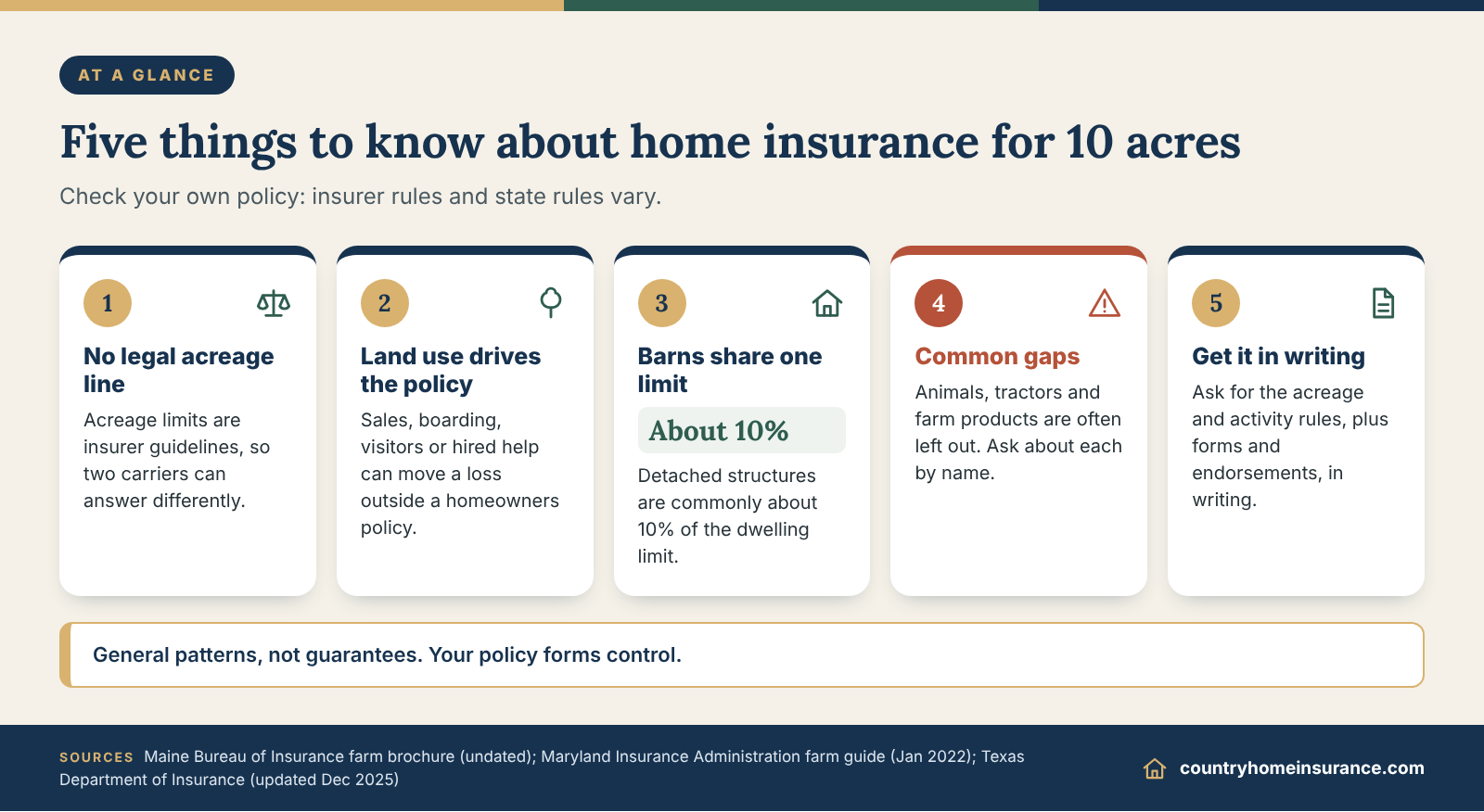
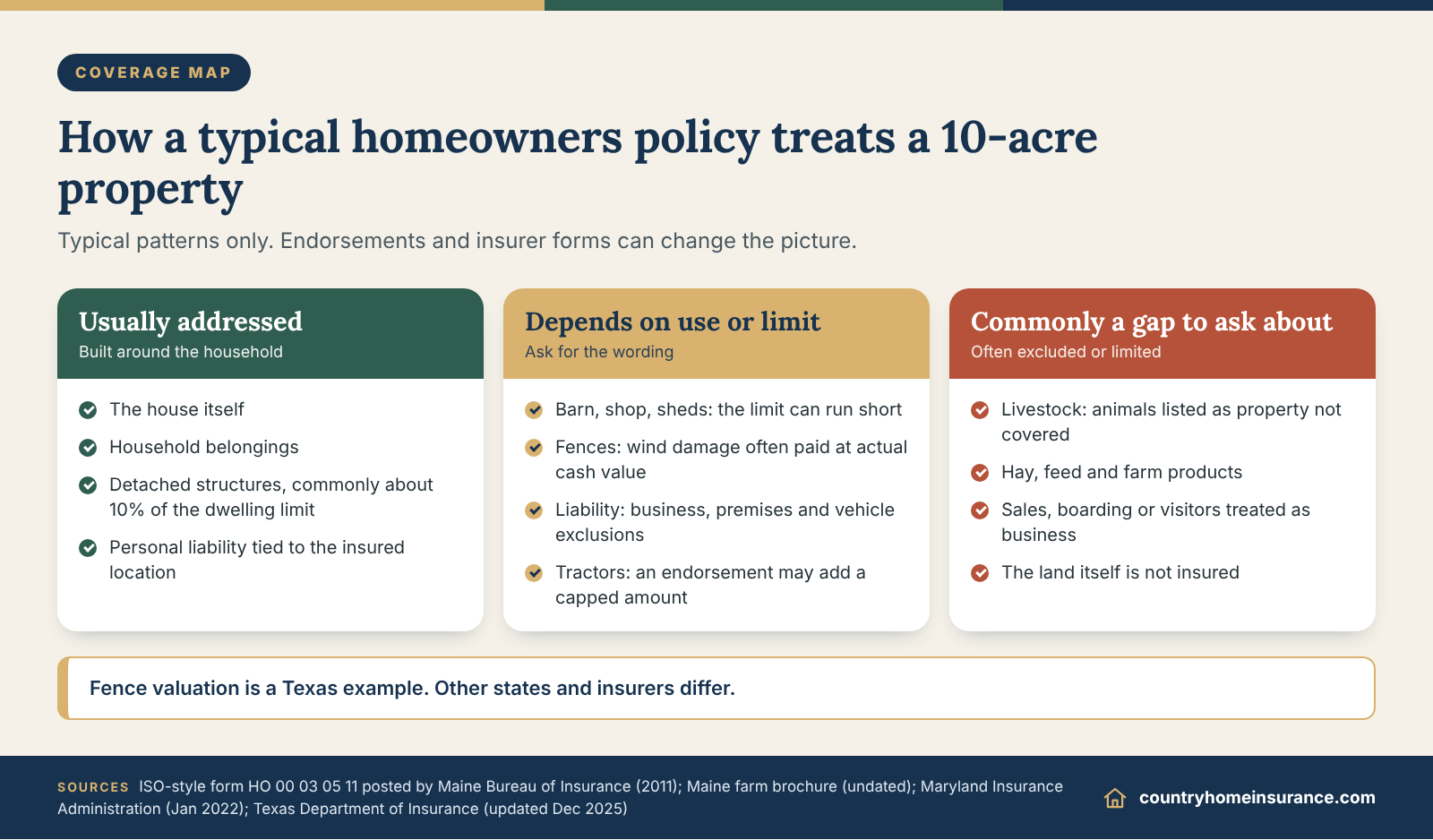
- Detached-structure coverage in a homeowners policy is commonly about 10% of the dwelling limit, which a barn, shop and sheds can use up quickly.
- Animals, tractors, hay, chemicals and farm visitors are the exposures most likely to fall into gaps, so ask about each one by name.
- Wells, septic systems, fences and the land itself are limited or excluded in many policies; verify each against your own forms before you need them.
| How you use the land | Typical policy path | What to confirm first |
|---|---|---|
| Privacy acreage, no farming | Homeowners policy usually remains the starting point, subject to the carrier’s acreage guidelines. | The carrier’s written acreage rule and whether your outbuildings fit the other-structures limit. |
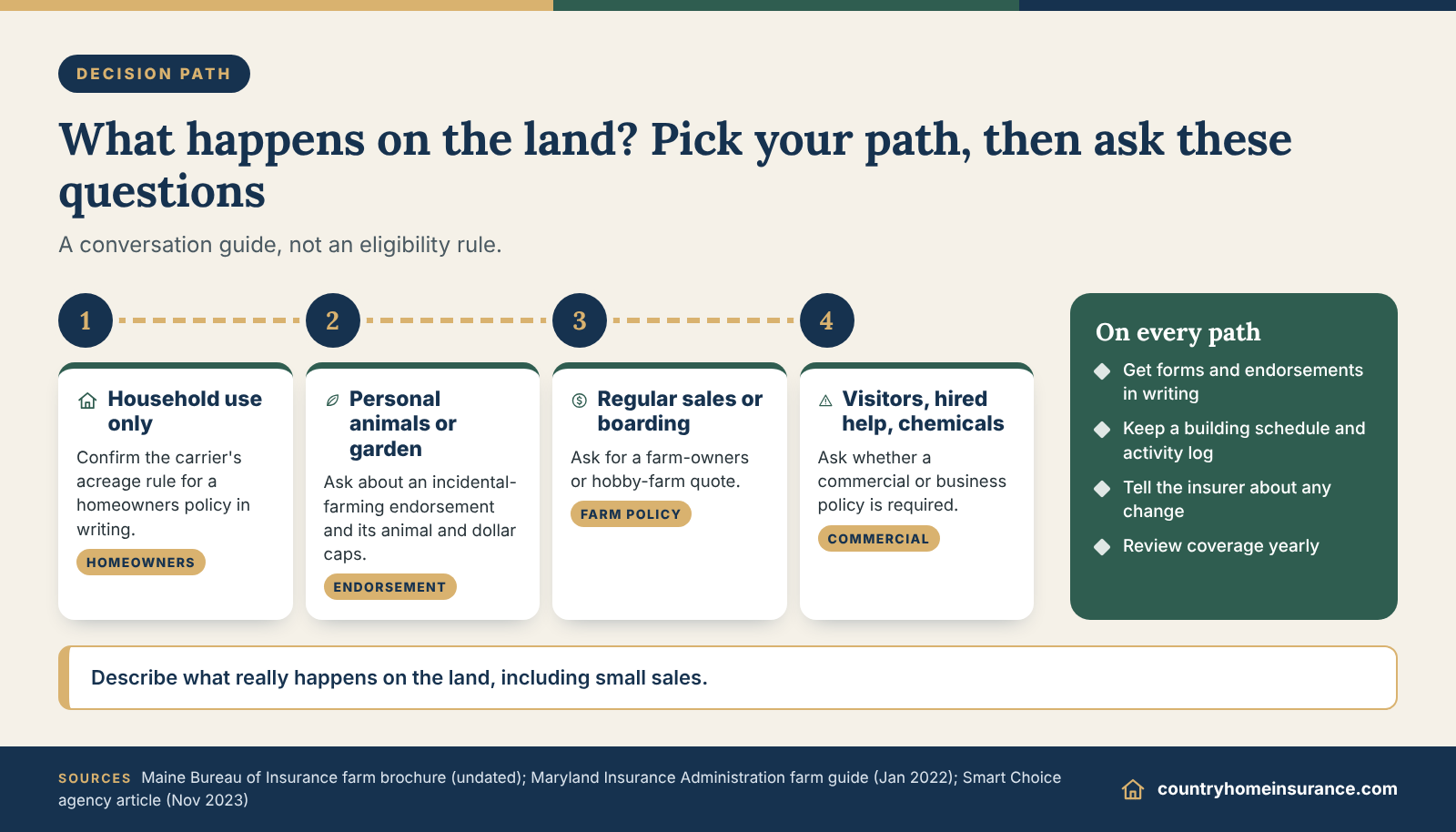
| A few personal-use animals, a garden, hay for your own use | Homeowners with an incidental-farming endorsement, or a hobby-farm or small-farm policy. | Animal-count limits, the dollar cap on farm personal property, and whether liability extends to the animals. |
| Regular sales of eggs, produce, hay or livestock | Often a farm-owners or hobby-farm policy rather than a homeowners policy. | Product liability, whether sales count as a “business,” and how income is treated. |
| Boarding, lessons or renting barn or pasture space | Commonly treated as a business exposure; farm or commercial coverage is typical. | Whether fee-based animal care is excluded from your current policy. |
| Visitors, events or agritourism | May require a business policy rather than a farm-owners policy. | Premises liability, waivers, proof of insurance from event groups and vendors. |
| Hired help, heavy chemical use or farm income you depend on | A commercial farm policy is commonly considered. | Workers’ compensation, pollutant exclusions and employee coverage. |
Why home insurance for 10 acres gets an insurer’s attention
Ten acres is big enough to change how an underwriter reads a property, yet small enough that many owners assume nothing about their insurance needs to change. Neither assumption holds up well. This guide is about home insurance for 10 acres and more: where the homeowners policy stops, what a farm-type policy adds, and what you can verify before a loss rather than after one. For the broader picture of how a dwelling policy treats land, see our companion pieces on acreage and rural homes.
Is there an official 10-acre rule for home insurance?
No statute or standard form draws the line
The widely used ISO-style homeowners form, in the 2011 edition posted by the Maine Bureau of Insurance, describes the “residence premises” as the dwelling shown in the declarations plus the other structures and grounds at that location. It gives no acreage figure. Farm land appears in only one place that we found: the definition of “insured location” covers vacant land an insured owns or rents, other than farm land. Individual insurers file their own forms, and those can differ, so treat the ISO language as a reference point rather than your contract.
The state farm-insurance guides we reviewed from Maryland and Maine do not define a “farm” by acreage either. In practice, any acreage limit you run into is an insurer’s underwriting guideline, which is why two carriers can answer the same question differently.
What the sources we reviewed say about acreage
The guideposts are informal and they do not agree. An Oklahoma farm-bureau insurer’s 2025 blog suggests considering farm and ranch coverage if you operate, lease or inherit more than 2 acres with active farming exposure, and says there is no strict acreage or income cutoff. A 2023 agency article says homes on 10, 50 or even 100 acres are usually eligible for a homeowners policy, subject to carrier acreage guidelines, when the land is not farmed commercially. A 2024 Kiplinger column by an insurance adviser notes that some insurers may decline traditional homeowners coverage above a certain number of acres but gives no number.
The sensible reading is that 10 acres is a prompt for questions, not an answer. Ask your agent or insurer what acreage the carrier accepts on a homeowners form, in writing, and then ask what activities it allows on that land.
Why does land use matter more than land size?
What stays the same when the lot gets bigger
The core of the policy works the way it does on a town lot. The dwelling is insured to the cost of rebuilding it, not to the market value of the property, and the land itself is not insured. The Maine brochure on insuring a farm says land is never included in coverage, and the ISO-style form lists the land itself among the things the other-structures coverage does not pay for. Personal property, loss of use and the liability coverages are still tied to the home and to the “insured location” named in the policy.
That means a larger parcel does not, by itself, increase what the policy pays for the house. It can, however, increase the number of things the policy was never built to hold.
Where ten acres begins to strain the policy
More acreage tends to mean more buildings, more equipment, more animals, longer driveways and a longer wait for a fire truck. Each of those pulls on a different part of the policy. Barns and shops compete for the same detached-structure limit. A tractor may sit outside the personal-property coverage altogether. Livestock is typically excluded from the contents coverage. Visitors to a roadside stand create liability that a personal policy may treat as business activity.
The rest of this guide takes those strains one at a time. If you want a general survey of what a standard policy misses in the country, start with our rural overview and come back here for the farm-use boundary.
Where a homeowners policy ends and farm coverage begins
The most important boundary on a 10-acre property is not the property line. It is the line between household use and farm or business use, and it runs through the middle of the policy language. Understanding it is the difference between a covered loss and an unpleasant surprise.
How do homeowners forms treat business and farming?
The “business” definition is broader than most owners expect
In the ISO-style form, a “business” is any trade, profession or occupation, whether full-time, part-time or occasional, and also any other activity engaged in for money or other compensation. The form carves out small amounts: in the version we reviewed, activities where no insured’s total compensation exceeds $2,000 in the 12 months before the policy takes effect are excepted, along with certain volunteer and day-care situations. Farming is not named, but selling hay, calves or eggs for money can plausibly fall inside the definition.
The consequences run through both halves of the policy. The other-structures coverage excludes structures from which any business is conducted and structures used to store business property. The personal liability coverage excludes injury or damage arising out of a business conducted from an insured location or engaged in by an insured. Your own form may use different words, so read the “business” definition and the exclusions before assuming a modest side income is safe.
Farm land and the “insured location” wording
Liability coverage is anchored to the insured location, and the ISO-style definition of that term lists vacant land an insured owns or rents “other than farm land.” A separate exclusion removes liability for injury arising out of premises an insured owns or rents that are not an insured location. Put those two provisions side by side and a reasonable reader should ask whether a second parcel, or a leased field, is covered for liability at all.
That reading is a question to put to your insurer, not a conclusion. Whether your home parcel counts as the residence premises, and how a neighboring or rented field is treated, depends on what the declarations list and on the exact wording of your form.
A court example: when a hobby still counts as farming
A 2024 Mississippi appellate decision, summarized in the Coverage Opinions newsletter, shows how this can play out. A man who owned 600 acres but had no cattle bought ten heifers, and they escaped the same night. After a highway collision, his homeowners insurer denied coverage under an exclusion for injury arising out of business or farming engaged in by an insured, which that policy defined as operating an agricultural or aquacultural enterprise. The Court of Appeals upheld the denial and reasoned that intent to profit matters under a business exclusion but not under a farming exclusion.
This is one court interpreting one policy’s words, so it is not a nationwide rule. It does illustrate why calling an operation a “hobby” may not save a claim if the policy excludes farming itself.
What counts as a hobby farm, incidental farming or a working farm?
The hobby-farm label has no universal definition
Insurers use the words loosely. One farm-bureau insurer’s 2026 page says hobby farms generally are not a primary source of income, so that if the farm does not supply the income your household depends on it is likely a hobby farm. A large national insurer’s small-farm page describes hobby farms as smaller than commercial farms and often not generating income for the family. Neither page gives an acreage or income test, and the Maine brochure does not define “farm” at all.
How the tax system classifies your activity is a separate question from how an insurer classifies it. One of the insurer pages points readers to IRS guidance on hobbies versus businesses, which we did not review for this article, so ask a tax professional about the tax side and your insurer about the coverage side.
Incidental-farming endorsements and their ceilings
Many carriers sell an endorsement that stretches a homeowners policy to cover limited, low-exposure farming. A 2012 trade article by an insurance agribusiness manager described such endorsements as aimed at farming mainly for personal consumption, and said they require you to disclose every farming activity. That source is old, so use it only as an illustration of the concept.
The practical limit is often a dollar cap. A 2023 agency article cited one carrier’s incidental-farming endorsement that provided up to $10,000 for farm personal property and noted that a small tractor can exceed that alone. Endorsement names, caps and animal-count limits vary by insurer, so ask for the actual endorsement and read its limits.
Why full disclosure matters more than the label
The NAIC consumer page warns that failing to disclose a home business could lead to a cancelled policy. A University of Missouri Extension article on farm liability coverage advises reviewing policies annually, telling the insurer about operational changes and avoiding misrepresentation, because fraud or misstatements can void claims. The 2012 trade article gives a concrete example: egg sales at a farmers market that were never declared could leave a food-illness claim exposed.
The takeaway is simple. Describe what actually happens on the land, including small sales, and get the insurer’s acceptance in writing before you rely on it.
Which signals push a 10-acre property toward a farm policy?
Income, sales and commercial use of animals or equipment
The 2023 agency article lists several triggers for moving from a homeowners policy to a commercial farm policy: farm activity that produces significant secondary income, liability exposure that falls outside homeowners coverage, and animals or equipment used commercially. An Oklahoma farm-bureau insurer’s blog makes a parallel point about structures and equipment, saying a homeowners policy does not cover barns, livestock loss or farm operation liability, while a farm and ranch policy is built for those.
Neither source gives a bright line, and an insurer’s own underwriting rules control. But if two or three of those triggers describe your place, assume the conversation will involve a farm product.
Workers, chemicals and visitors
The same agency article flags heavy pesticide use and temporary workers, such as harvest or equipment-repair help, as reasons to consider a commercial farm policy, and observes that covering workers under a personal-lines policy is generally difficult. University of Missouri Extension lists spraying chemicals, custom farm work and agritourism among the activities commonly excluded even from farm liability policies, which means those need specific attention wherever you buy coverage.
Visitors deserve the same scrutiny. The Maryland Insurance Administration notes that hayrides, petting zoos, pick-your-own, corn mazes and similar activities may require a business policy rather than a farm-owners policy.
Three ways to insure a 10-acre property
Once you know where your activities sit, the next question is which kind of policy fits. The labels vary by company, but the routes tend to fall into three groups, and the differences are mostly about how each one is built rather than how much it costs.
A homeowners policy with farm-related endorsements
What this route does well
A homeowners policy is designed around the household: the dwelling, personal property, loss of use, personal liability and medical payments to others. When the land is mostly privacy and a modest garden, that design fits. The 2023 agency article we reviewed says a hobby farm may stay on a homeowners policy if its size, equipment, outbuildings and revenue remain modest and it creates no liability beyond what homeowners coverage contemplates. Keeping everything on one policy also keeps the paperwork, deductibles and renewal dates simple.
The key to making this route work is that the endorsement has to match what you actually do. Ask the carrier which farm activities its endorsement allows and which it refuses.
Where the route runs out
The same agency article points to the common ceilings. Carriers cap the number of animals they will include, they do not cover animals used commercially, and horses are especially hard to place. A dollar cap on farm personal property can be reached by a single piece of equipment, and farm structures are valued differently from houses, which may call for a separate reconstruction estimate. Covering hired workers on a personal policy is generally difficult.
When two or three of those ceilings describe your property, the cheaper-looking homeowners route can turn out to be the more fragile one.
A farm-owners policy
What a packaged farm-owners policy contains
The Maine Bureau of Insurance describes a farmowners policy as a prepackaged form covering both the farm operation and the residence. Per that brochure, it covers the dwelling, detached structures such as garages, household contents and loss of use, plus barns, hay, machinery, livestock and farm help. A notable difference from homeowners is that contents and structures are set by you rather than by a fixed percentage of the dwelling limit: you choose the contents limit and list detached structures separately.
The brochure also says farmowners policies are generally written on a special form, which covers everything except listed exclusions, rather than on a basic named-peril form that covers only the perils it lists. Liability under a farmowners policy covers both personal and farm exposures, including damage tied to selling produce or owning animals.
Trade-offs to check before you switch
A farm-owners policy is not simply a bigger homeowners policy. The Maryland Insurance Administration warns that items homeowners policies usually cover, such as fences and swimming pools, may not be covered under a farm policy unless you add an endorsement. Ohio State University Extension adds that vehicles are not part of a typical farm policy’s coverage areas and may need their own policy, and the Maine brochure notes that each building or item generally carries its own deductible.
On the plus side, Ohio State Extension says combining farm and household coverage under one policy is usually less expensive than buying them separately. Compare both versions for your own property rather than assuming either wins.
A commercial package, a hobby-farm product or an umbrella on top
Commercial packages and hobby-farm products
The Maine brochure describes a commercial package policy as one where you and the agent select each coverage individually, which suits operations whose exposures do not fit a prepackaged form. At the other end of the spectrum, a 2026 farm-bureau insurer page describes hobby-farm insurance as standard farm insurance tailored to a smaller operation, typically including property and liability coverage that can be expanded for visitors, with optional add-ons such as loss of income. It also notes that hobby-farm insurance does not add auto coverage.
Product names and availability are insurer-specific. Treat these descriptions as categories to ask about, not as a menu you can count on in every state.
Farm umbrella liability
The IRMI glossary describes a farm umbrella as a policy with high liability limits that stacks on top of the farm-owners liability, the personal auto policy and other scheduled underlying liability. One large insurer’s farm and ranch umbrella page lists limits from $1,000,000 to $5,000,000, with higher limits on request subject to eligibility, and says personal-injury claims are covered only if the underlying policy covers them. That page is insurer marketing and undated, so use it as an example of structure rather than a benchmark.
The point of an umbrella is added limit, not added scope. If the underlying policy excludes an activity, the umbrella may not cure that, so the underlying coverage comes first.
| Path | Built around | Typically stronger on | Watch for |
|---|---|---|---|
| Homeowners plus farm-related endorsement | The household and dwelling, with limited farming added by endorsement | Simplicity; one policy for home, contents and personal liability | Dollar caps on farm property, animal-count limits, commercial animals, hired help |
| Farm-owners policy | The farm operation and the residence in one prepackaged form (Maine Bureau of Insurance description) | Barns, hay, machinery, livestock and farm liability; you set contents and list structures | Fences, pools or other items may need endorsements (Maryland guide); vehicles may need their own policy; per-building deductibles |
| Commercial package or hobby-farm product | Coverages selected individually, or an insurer’s smaller-scale farm product | Unusual or business-type exposures; optional loss of income and visitor liability | Insurer-specific definitions and availability; no auto coverage in the hobby-farm example cited |
| Umbrella layered on any of the above | Extra liability limit above the underlying policies | Large liability judgments or settlements | Depends on what the underlying policies cover; eligibility and limits vary |
Barns, shops and fences: structures on a larger parcel
On ten acres the buildings often add up to more value than the house’s ordinary outbuildings ever did. A barn, a workshop, a hay shed and a few pens can easily exceed what a standard policy sets aside for detached structures, and the way each one is valued matters as much as the limit.
How does other-structures coverage work on a large parcel?
The 10% rule of thumb and what it means for a barn
The Texas Department of Insurance, on a page updated December 18, 2025, says most home policies cover other structures at 10% of the house’s insured value, so $300,000 of house coverage yields $30,000 for structures not attached to the house. It lists detached garages, storage sheds, guest houses, outdoor kitchens, barns and chicken coops as examples, and notes the deductible applies. The Washington Office of the Insurance Commissioner gives the same typical figure of about 10% and cautions that owners with several outbuildings may need to buy additional coverage.
Those are descriptions of common policy designs, not guarantees. Check the declarations page for the actual figure, and ask whether the limit can be raised.
Hypothetical example: when the buildings outgrow the limit
Hypothetical example, for illustration only: suppose a homeowner carries $400,000 of dwelling coverage and the policy sets other-structures coverage at 10%, or $40,000. The property has a barn that would cost $60,000 to rebuild, a workshop at $35,000 and a hay shed at $10,000, for $105,000 of buildings in total. A covered loss to the barn alone could be limited to the $40,000 structure limit, less the deductible, leaving a gap of roughly $20,000 on the barn even before the other buildings are considered. If a single event damaged several buildings, they would share the same limit.
The numbers are invented to show the mechanics; the actual limit, deductible, valuation and covered perils come from your policy. The fix is usually a higher structure limit or a separately scheduled building, if the insurer offers one.
Business use and stored property
In the ISO-style form, other-structures coverage does not apply to structures from which any business is conducted, or to structures used to store business property, with an exception for property owned by an insured or a tenant of the dwelling that does not include gaseous or liquid fuel. That detail matters in a farm shop: a shed that holds feed for animals you sell, or fuel for equipment, could be treated differently from one that holds your own lawn tools.
The Texas page also advises owners who run a business from a structure to ask the insurer whether separate coverage is needed. If any building does double duty, tell the insurer and ask how it will be classified.
How are barns and farm buildings valued?
Replacement cost, functional replacement cost and actual cash value
The Maine brochure defines replacement cost as the cost to rebuild with like kind and quality without subtracting depreciation, and actual cash value as replacement cost minus depreciation, so older buildings pay less. It also describes functional replacement cost, which pays for an equivalent building or repair using less expensive materials, and notes that market value, appraised value and assessed value are different from both measures.
For an old timber-frame barn, the difference can be large. Ask which valuation applies to each building, and whether an older structure is written on a different loss-settlement basis. The Texas Department of Insurance checklist for farm and ranch filings notes that roofs may be insured at actual cash value when the covered cause of loss is limited to wind and hail, which shows how roof terms can differ from building terms.
Coinsurance: the penalty for insuring too little
Many property forms contain a coinsurance condition, which reduces a claim payment if the amount of insurance is below a required percentage of the property’s replacement cost. The Maine brochure says insurers typically require 80% and sometimes 90% or 100%, and gives the formula as the amount you carry divided by the amount required, multiplied by the loss, minus the deductible. Table 3 reproduces its worked examples.
The takeaway for farm buildings is that underinsuring a barn can reduce every claim payment, not just a total loss. Coinsurance rules differ by form and by state, so confirm how yours works before relying on any example.
Deductibles, building by building
The Maine brochure says each building or item generally has its own deductible under a farm policy. On a property with six or seven structures, ask what applies to each and whether a different deductible, such as a percentage for wind or hail, is attached to specific perils or to the roof. Do not assume the deductible you know from the house policy applies to the barn.
If you are comparing quotes, compare the deductible structure along with the premium, because a lower price can simply reflect a higher out-of-pocket share.
What about fences, corrals and everything outside the buildings?
Fences, corrals and pens
The NAIC consumer page lists fencing alongside detached garages and work sheds as an other-structures item. The Texas Department of Insurance says wind damage to fences is usually covered at actual cash value and that ice or snow damage usually is not covered. The Maryland farm guide, for its part, says fences are not covered under a farm policy unless added by endorsement.
On a pasture property the fence may be your longest and most costly structure. Ask whether fences are covered, for which perils, at what valuation and with what sublimit, and do not assume the answer is the same across policy types.
Trees, landscaping and other things outside the walls
The additional coverage for trees, shrubs and plants in the ISO-style form is limited, and it excludes plants grown for business purposes, which matters if you raise nursery stock or Christmas trees. Driveways, culverts, private bridges and ponds are not named in the sources we reviewed, so treat them as open questions to put to the insurer rather than as covered or excluded.
When your answer is “I don’t know,” the safest course is to ask for the policy’s wording on that item, not a verbal reassurance.
| Scenario | Amount carried | Share of required amount | Approximate payment |
|---|---|---|---|
| Adequately insured | $200,000 (80% of $250,000) | 100% | $39,500 |
| Underinsured | $100,000 | 50% of the $200,000 required | $19,500; owner bears about $20,500 |
| Over-insured | More than $200,000 | Above 100% | Still the loss less the deductible; extra insurance does not raise the payment |
Equipment, animals and farm products
If structures are where acreage pushes against the limits, equipment and animals are where it pushes against the definitions. These are also the items most likely to be mentioned by name in an exclusion, which makes them the best place to read your forms line by line.
Where does a homeowners policy stop on tractors and implements?
Equipment and the personal property coverage
An Oklahoma farm-bureau insurer’s comparison says a homeowners policy covers personal property such as furniture, clothing and electronics, while a farm and ranch policy covers farm equipment and machinery such as tractors or combines. A 2026 farm-bureau hobby-farm page gives examples of items that may be left to the owner under a homeowners policy: storm-damaged farm equipment, stolen beehives, and barns or grain silos. In the ISO-style form, the personal property coverage also lists motor vehicles among the property it does not cover, and that form has its own exceptions to read.
A homeowners policy with an incidental-farming endorsement may pick up some equipment, but as the earlier $10,000 example shows, the cap can be small relative to a tractor. Ask how the policy defines covered equipment and what it does when a tractor is stolen from an unlocked shed.
How farm equipment coverage is typically structured
The Maryland guide describes tractor and farm equipment insurance as a standalone plan or an endorsement, with commonly covered perils including fire, lightning, windstorm, hail, smoke, theft, vandalism and collision. It says replacement cost is generally available for equipment under ten years old, and that other endorsements cover breakdown, equipment you rent or borrow, and location-specific perils. The Maine brochure defines farm machinery as motorized land vehicles and their implements or wagons used exclusively for farming and designed mainly for off-road use, and lists inland marine coverage for equipment that travels off the premises.
The Texas regulator’s farm filing checklist also shows how definitions matter: when a policy redefines mobile equipment to take in certain self-propelled vehicles, the checklist says the policy must state that it intends to cover vehicles not designated for highway use. When you shop, ask how “farm machinery” or “mobile equipment” is defined and whether your riding mower, ATV or skid steer qualifies.
How are livestock and other animals treated?
Animals as property
The ISO-style form lists animals, birds and fish among the property not covered under the personal property coverage. A farm and ranch policy is where livestock coverage typically appears: the Oklahoma comparison says farm and ranch policies include livestock coverage, including animal collision, and an American Family small-farm page says livestock coverage, if added, may include electrocution and loading or unloading accidents, with an optional winter-perils coverage for freezing or falling through ice.
The Maryland guide adds that endorsements can cover particular animals that the base policy excludes. In every case the loss triggers are specific, so ask which causes of death or injury are covered and which are not.
Animals as liability
The liability side is often the bigger worry. A 2024 Kiplinger column describes exposure from a rider being kicked or thrown by a horse or a goose biting a visitor, and says that keeping any non-domesticated animal can trigger many exclusions. The agency article says carriers limit how many animals they will include on a homeowners policy, exclude animals used commercially and find horses especially hard to cover. The NAIC consumer page adds that some policies exclude liability for certain dog breeds or exotic pets.
Boarding is a special case. The 2012 trade article treats fee-based horse boarding as a business pursuit that may be excluded, and University of Missouri Extension lists boarding dogs or horses among the activities commonly excluded under farm liability policies. If other people’s animals ever stay on your land, treat that as a separate question for the insurer.
What about hay, feed, crops and lost income?
Farm personal property and the way it is categorized
Farm policies sort property into categories. The Maine brochure separates farm products (items raised or produced for sale), farm supplies (such as fertilizer, hay, feed, oils and fuels), farm tools (wheelbarrows, saws, shovels, irrigation equipment) and farm machinery, and uses schedules to list livestock, machinery and similar items. The categories matter because limits, valuation and perils can differ among them.
Kiplinger notes that hay and manure are fire risks on a farm. If you store a season’s hay in a barn, ask how it is covered, where it must be stored to qualify, and whether the hay and the building are treated as one loss or two.
Crops and income
The Maryland guide explains that crops are generally covered through federally subsidized crop insurance sold by private companies, which is separate from a farm property policy. For income, the Oklahoma comparison says a homeowners policy covers personal belongings rather than income-producing property, and the hobby-farm page notes that some small-farm providers offer loss-of-income coverage for lost sales after property damage. The Maine brochure lists business interruption and extra expense as optional coverages to discuss with an agent.
If your land produces meaningful income, ask what happens to that income after a covered loss, because a homeowners policy is not designed to replace it.
Liability on a 10-acre property
Property losses are limited by what you own. Liability losses are limited only by what a court or settlement decides, which is why liability is the part of a rural policy most worth reading carefully. Land, animals, vehicles and visitors all create ways for someone else to get hurt.
What does personal liability cover on a larger property?
Personal liability and medical payments in plain terms
Personal liability coverage responds when you are legally responsible for injury to another person or damage to their property, and the policy often includes a defense for claims it covers. The NAIC describes it as protection against claims arising from accidents to others. Medical payments coverage is different: it pays modest medical bills for people hurt on your property regardless of fault, and it does not apply to you or your household. The Washington insurance commissioner’s guide says most policies start personal liability at $100,000 and include at least $1,000 of medical payments.
A Farmers Insurance consumer page adds that this coverage generally does not apply when you are in your vehicle or at work, and says most home insurers offer up to $500,000 of personal liability on a home policy. Those are descriptions of typical designs, not a promise about any particular policy.
The premises and business exclusions that matter on acreage
As covered earlier, the ISO-style form excludes liability arising from a business conducted from an insured location and from premises that are not an insured location. In practice, that means the questions to ask are not “Do I have liability coverage?” but “Which activities on which parcels does it respond to?” A customer who slips at an egg stand, a neighbor’s child who is bitten by a farm animal, and a delivery driver hurt in the barn can each land on a different side of those lines.
Write down the places and activities on your property where someone other than your household might be present, and ask the insurer to confirm, one by one, whether the policy responds.
How do visitors, sales and events change liability?
Selling what you grow or raise
Product liability is the exposure that arises when something you sold harms someone. The Maryland Insurance Administration suggests considering it if you sell items such as jams, pies, fruits or vegetables, and a 2026 farm-bureau insurer page gives the example of illness from eggs you sold. University of Missouri Extension lists farmers market sales among the activities commonly excluded even from farm liability policies.
That combination is a reminder to ask the question twice. Ask whether the policy covers product liability at all and, separately, whether sales away from the farm are covered.
Agritourism, events and rentals
The Maryland guide says activities such as hayrides, petting zoos, pick-your-own, corn mazes, haunted barns, pumpkin patches and farm stands may require a business policy rather than a farm-owners policy, and suggests a safety plan that addresses hazards like uneven paths, animal bites and bacterial illness. An Oregon State University Extension question list for agritourism operators asks whether guests must sign waivers, whether groups using the property should show proof of insurance, when to request additional-insured status, and whether the policy is written on a claims-made or occurrence basis.
Even a one-time wedding or a family reunion with hired vendors raises those questions. If you rent space to others, ask before the event, not after an incident.
Children, abandoned equipment and other attractive hazards
The attractive-nuisance doctrine, as described in a 2026 AAA article, can hold a property owner liable when a trespassing child is hurt by a condition likely to draw children, because children are presumed unable to grasp certain hazards. Its examples include pools, hot tubs, trampolines, construction sites with lumber piles or open pits, play structures and abandoned items such as old appliances, vehicles or large dirt piles. The article does not mention ponds, but the same reasoning is why it is worth asking how your insurer views open water and idle machinery.
Fencing, covers and removing abandoned items are the mitigation steps the article suggests, and they cost far less than a lawsuit. An old implement graveyard behind the barn is a hazard in this sense, however picturesque.
What about ATVs, chemicals and hired help?
ATVs, UTVs and farm vehicles
In the ISO-style form, liability coverage generally does not apply to a registered motor vehicle, or one that is rented, used to carry cargo for a charge or used for business, with exceptions that include off-road recreational vehicles owned by an insured while on an insured location. A Virginia Supreme Court decision from 2022, summarized by Rough Notes, shows why the wording matters. A passenger was hurt on an ATV away from the insured property, the policy excluded land motor vehicles with listed exceptions, and the court held the exclusion applied because the injury happened off the insured location. It also found that a utility ATV that could be fitted with farm attachments was not a “farm type” vehicle where the owners never used it that way.
Policies differ, and this is a single decision on one policy. The practical lesson is to ask where your coverage applies, whether on your land only or beyond it, and how the policy defines the vehicles you actually use.
Chemicals, fuel and pollutants
The ISO-style property form excludes the discharge or release of pollutants, with narrow exceptions, and defines pollutants broadly to include irritants and contaminants such as smoke, fumes and chemicals. University of Missouri Extension says many farm liability policies exclude pollutants, and that spraying chemicals on your own farm or under contract for others and off-target chemical movement are commonly excluded. It suggests asking how the policy defines a pollutant.
If you store fertilizer, herbicides, diesel or other chemicals, ask what happens when they spill, drift or contaminate someone else’s property or a water source. Do not assume a liability policy picks up a cleanup bill.
Hired help, seasonal workers and contractors
The agency article we cited says covering workers, including temporary help, is generally difficult under a personal policy, though some carriers allow hired help who do not live on the premises. The Maryland guide asks owners to consider workers’ compensation and to be ready with employee titles, duties, hours, wages and payroll, and University of Missouri Extension recommends asking how seasonal workers and independent contractors such as custom farmers or sprayers are handled.
Workers’ compensation is a separate coverage governed by state law. Ask your agent and your state insurance department what applies to your situation.
How much liability coverage is enough?
Matching the limit to what you could lose
Farmers Insurance suggests basing the amount on your net worth rather than just the home’s value. That logic applies with force to a landowner whose acreage, equipment and savings are all exposed to a judgment. The 2026 AAA article describes an umbrella as usually starting around $1 million, while the Farmers page describes umbrellas as adding $1 million to $10 million.
No source can tell you a single right number. A licensed insurance professional can help you compare the cost of higher limits against the assets you want to protect.
Coordinating the umbrella with farm exposures
An umbrella usually sits above several underlying policies, such as home or farm, auto and watercraft, so each underlying limit has to be kept at the level the umbrella insurer expects. The American Family farm and ranch umbrella page does not state a minimum underlying limit and says to check your primary limits and discuss increases with your agent. Oregon State University Extension asks the same question from the buyer’s side: what umbrella size is adequate, and what level of coverage do you need for each type of liability, and why?
Ask whether the umbrella covers the farm activities you actually conduct, and give the agent the same full description of those activities that you gave the primary insurer.
| Feature | Homeowners policy (ISO-style form and regulator descriptions) | Farm-owners or farm policy (as described by cited sources) | Ask the insurer |
|---|---|---|---|
| Land itself | Not covered under other-structures coverage | Land is never included (Maine brochure) | Nothing to ask, but do not count land value in your limit |
| Barn, shop, sheds | Other structures, commonly about 10% of the dwelling limit; business use or business storage can be excluded | Listed and valued separately; per-building deductibles | Limit, valuation basis, business-use wording |
| Fences and corrals | Treated as other structures; wind damage usually at actual cash value in the Texas example | May need an endorsement (Maryland guide) | Perils, valuation, sublimit |
| Tractors and implements | Motor vehicles are listed as property not covered; incidental-farming endorsements may add a capped amount | Farm personal property or equipment coverage, often by endorsement | Definition of farm machinery, replacement cost age limits |
| Livestock | Animals, birds and fish are listed as property not covered | Optional and scheduled; may include collision and other listed causes | Which causes of loss and which animals |
| Hay, feed, supplies | Not designed for farm products; property used in a business has special limits in the ISO-style form | Farm products and supplies are named categories | Where stored, limits per category |
| Roadside sales, agritourism, events | Business exclusions may apply | Farm liability may cover some sales; agritourism may need a business policy | Product liability, waivers, proof of insurance |
| Hired workers | Generally difficult under personal lines | Farm help covered in some forms; workers’ compensation is separate | Seasonal workers, contractors, payroll reporting |
Wells, septic systems, fire protection and weather
The remaining pieces of a country property are not farm exposures at all. They are the systems and conditions that come with living away from town services, and they shape both the coverage you can get and the claims you may face.
How do wells and septic systems fit into home insurance on 10 acres?
Private wells
EPA says more than 23 million U.S. households, about 15% of the population, rely on private wells, and that private well owners are responsible for delivering safe drinking water to their households. Federal law does not regulate private domestic wells under the Safe Drinking Water Act, and EPA notes that most state governments and laws do not either (EPA page updated August 25, 2026). That puts testing and maintenance squarely on the owner.
On the insurance side, the FEMA flood insurance program lists well water tanks and pumps among items covered as part of the building under its policy, but the homeowners-policy treatment of wells is not something the regulator guides we reviewed address directly. Ask how your policy treats the well house, pump and pressure tank, and whether contamination of a well would run into a pollutant exclusion.
Septic systems
EPA says to inspect a septic tank every one to three years and pump it every three to five, estimates routine maintenance at $250 to $500 every three to five years, and puts repair or replacement of a malfunctioning conventional system at roughly $5,000 to $15,000, with alternative systems potentially costing more. Failure signs include ponding in the drainfield, wastewater surfacing on the ground and backups into the house (EPA page updated March 11, 2026).
FEMA’s flood program lists septic systems among property outside the insured building that it does not cover. For ordinary homeowners coverage, ask what the policy says about sudden damage to the tank or lines versus wear, and whether a water-backup endorsement is offered. Keep pumping and inspection records, because they show maintenance if a claim is questioned.
How does distance to the fire department affect coverage and price?
What protection class is and how it is assigned
A Texas Department of Insurance explainer from March 2023 describes the Public Protection Classification system, run by the Insurance Services Office, a Verisk product, which rates a community’s ability to suppress first-alarm structure fires. A class has two numbers. Properties within five road miles of a fire station and within 1,000 feet of a creditable water supply get the first number. Those within five road miles but beyond 1,000 feet get the second, which carries an X, and the explainer describes such areas as typically rural or large plots. Properties beyond five road miles fall in Class 10, with a 10W possibility for those five to seven road miles away that have a creditable water supply, and hauled water can count as a creditable supply.
The system is described in a Texas publication, but it reflects a national rating approach, and details may differ by state and date. A 10-acre homesite with a long private drive is a good candidate for a closer look at how the class was determined.
Questions to ask about protection class
TDI notes that insurers use the classification at their own discretion and that a better class does not guarantee a lower premium, and it recommends comparing providers at renewal. The Maryland guide lists fire protection rating, given the distance to the fire department and water source, among the questions to raise with an insurance producer.
Ask which class your insurer assigned, how it was determined, and whether you can submit information if you think it is wrong. For more on rural fire response and volunteer departments, see our rural overview.
What do weather and flood add on open land?
Flood and surface water
The NAIC consumer page says standard homeowners policies do not cover flood damage from ground water, rain runoff or snowmelt, and that flood coverage must be bought separately through the National Flood Insurance Program or a private insurer. FloodSmart’s coverage page lists residential building coverage up to $250,000 and contents up to $100,000, describes a general 30-day waiting period with listed exceptions, and says the program does not cover property outside the insured building such as landscaping, septic systems, decks, patios, fences and pools. The page is undated, so confirm current limits.
On open land, low fields, creek crossings and drainage ways can matter more than the house site. Look at flood risk for each building site and for the access road, not only for the dwelling.
Earthquake, mold, pests and other excluded events
The NAIC page also lists earthquake and other earth movement, mold (often excluded) and infestations such as termites or rats as events a standard policy typically does not cover. If any of these concerns you, ask whether an endorsement or a separate policy is available where you live.
Because state rules and product availability vary, this is a good place to call your state department of insurance if the agent’s answer is unclear.
What you can verify, document and ask before you buy
Insurance for a larger rural property is mostly a documentation exercise. You are trying to turn a general description, such as “we have 12 acres with a barn and some animals,” into written terms you can compare. This section explains how to do that and what to do if a carrier says no.
What can you verify about the carrier and the policy forms?
Ask for the forms, endorsements and declarations in writing
The Maryland Insurance Administration suggests comparing coverages, limits and deductibles on each quote side by side, and asking whether you need endorsements for outbuildings, fences, pools, livestock or equipment. To make that comparison meaningful, ask each insurer for the actual policy form, every endorsement you would receive and a sample declarations page, not just a summary or a premium figure. The declarations page lists the limits and deductibles that apply to you.
Then read three things closely: the definition of “business” or “farming,” the other-structures limit and its exclusions, and the endorsement’s list of allowed and disallowed activities.
Check the insurer, the regulator and the timing
The Maryland guide also tells shoppers to ask about the insurer’s financial rating, citing examples such as A.M. Best or Demotech, and to pay premiums on time and never cancel an existing policy until the new one is confirmed in writing. The NAIC publishes a directory where you can reach your state insurance department, find an agent and start a complaint, which is the place to take a question your agent cannot answer or a dispute you cannot resolve.
If you are changing carriers because of how your land is used, make the switch at a time when you are not exposed to a gap between policies.
What should you document about the property and its use?
A building-by-building schedule
List every structure with its approximate age, size, construction, current use and a realistic rebuilding estimate. The agency article we cited notes that farm structures are valued differently than houses, and the Maine brochure recommends reviewing coverage yearly and whenever property is added or improved, and asking about inflation-adjustment endorsements that raise limits automatically. A current schedule helps you set limits and avoid the coinsurance problem shown in Table 3.
Take dated photos of each building, including interiors where equipment or hay is stored.
An activity log insurers will actually ask about
The farm-bureau hobby-farm page says agents will ask about your activities and income, and the Maryland guide suggests having an insurance producer inspect the farm and discuss operations. Prepare a one-page summary: types and numbers of animals, whether any belong to others, what you sell and roughly how much, whether visitors come and how often, whether anyone works for you, and what chemicals and fuels you store.
Update that summary each year and send changes to your insurer, as University of Missouri Extension advises.
Condition and maintenance records
Keep records of septic inspections and pumping, roof and electrical updates, and well testing. EPA’s septic guidance of inspection every one to three years and pumping every three to five gives a useful benchmark, and the records can help show routine care if a claim is questioned. The same applies to any hay-storage, fencing or equipment-safety improvements you make.
None of these records guarantees a claim will be paid, but they make the conversation with an adjuster much easier.
What if the carrier declines, cancels or does not renew?
Cancellation and nonrenewal rules vary by state
State rules differ, so use the following as examples rather than a national rule. The Maine brochure says a farm policy there can be cancelled mid-term for reasons including nonpayment, fraud or material misrepresentation, a substantial increase in risk or failure to follow reasonable loss-control recommendations, and that nonrenewal requires at least 30 days’ notice, can occur for any reason and carries no hearing right. The Maryland guide notes that nonpayment cancellation requires 10 days’ notice, and the Texas Department of Insurance’s farm and ranch filing checklist says residences on farm and ranch properties fall under the state’s cancellation rules for one- or two-unit dwellings.
Your protections, notice periods and appeal rights depend on your state and policy type. Call your state department of insurance if you receive a notice you do not understand.
FAIR plans and other last-resort options
The NAIC says 33 states have some form of FAIR plan, which provides basic coverage for high-risk properties that cannot get coverage in the regular market. Plans typically include dwelling coverage at minimum, offer personal belongings and additional structures as optional add-ons, and generally do not offer loss of use or personal liability coverage. They tend to be more expensive and more limited than regular-market insurance (NAIC page last updated December 13, 2024).
For a 10-acre property that matters. A residual plan may not solve a barn, equipment or liability gap, and whether a given plan will write a property with farm activity is something to ask the plan directly. We did not verify any state plan’s treatment of acreage.
| Item | What to verify | Whom to ask | What to keep |
|---|---|---|---|
| Acreage and activity rules | The carrier’s written acreage guideline and the activities it allows on a homeowners form | Agent or underwriter | Email or letter confirming the rules |
| Farm endorsement | Animal-count limit, farm personal property cap, liability scope | Agent | The endorsement form itself |
| Other-structures limit | Percentage of dwelling limit, valuation basis, business-use wording | Agent; declarations page | Building schedule and photos |
| Equipment and livestock | Definitions of machinery and animals; causes of loss; replacement cost conditions | Agent | Equipment list with serial numbers and purchase dates |
| Liability | Business, premises, vehicle and pollutant exclusions; visitor and sales coverage; umbrella eligibility | Agent | Written activity summary given to the insurer |
| Wells, septic, fire protection | How each is treated; assigned protection class and how it was determined | Agent; local fire department; county or state health agency | Pumping, inspection and test records |
| Switching policies | New policy confirmed in writing before the old one ends | Agent and current insurer | Binder or confirmation of coverage |
Frequently asked questions
Coverage and eligibility questions
Can I keep a homeowners policy on 10 or more acres?
Often, yes, if the land is used mainly as a home site and the carrier’s guidelines allow it. A 2023 agency article says properties of 10, 50 or even 100 acres are usually eligible for a homeowners policy when not farmed commercially, subject to carrier acreage guidelines, while a 2024 Kiplinger column says some insurers may decline traditional homeowners coverage above a certain acreage. Ask your carrier for its written rule.
Does keeping a horse or a few animals change my coverage?
It can. Carriers may cap the number of animals they will include, they typically do not cover animals used commercially, and horses are described as especially hard to cover. Ask how many animals are allowed, whether you must declare breeds or uses, and whether liability for the animals is included, then ask for the answer in writing.
Is my barn covered by my homeowners policy?
Many homeowners policies cover detached structures, commonly at about 10% of the dwelling limit, but business use or business storage can be excluded and the limit may be small relative to the building’s value. A farm policy is built to cover barns more directly. Check the declarations page for the actual limit and the form for the exclusions.
Does selling eggs, hay or produce count as running a business?
It may. The ISO-style form defines a business to include any activity engaged in for money, with a small-compensation exception of $2,000 or less in the prior 12 months in the version we reviewed. Other insurers use their own wording, and the trade article we cited gives an example of undeclared egg sales endangering a claim. Tell your insurer about any regular sales.
Cost, shopping and process questions
Will insurance cost more on 10 acres?
We did not find a reputable rate study that isolates 10-acre properties, so we do not give a price or an average here. The Texas Department of Insurance notes that insurers consider multiple underwriting factors, and the Maryland guide lists fire protection rating among the questions to raise. Premiums can differ widely between carriers, so compare quotes with the same limits, deductibles and endorsements.
Should I tell my insurer about a small farm stand or a few paying guests?
Yes. The NAIC warns that failing to disclose a home business could lead to a cancelled policy, and University of Missouri Extension advises notifying the insurer of operational changes. Disclosing the activity lets the insurer say yes, no or “yes with an endorsement” before a loss, which is far better than finding out afterward.
Can I switch policies in the middle of the term?
You can usually shop at any time, but the Maryland guide’s advice is to avoid canceling your existing policy until the new one is confirmed in writing. Ask whether your current insurer charges a fee for canceling mid-term and whether a new carrier will start coverage on the date you need it.
Who can answer questions this article cannot?
Your insurance agent or insurer can explain your specific forms, and your state department of insurance can answer consumer questions about state rules and complaints. For tax treatment of hobby income, contact a tax professional; we did not review tax rules for this article.
Sources
All pages below were retrieved on 2026-10-11. Several are undated; those are flagged so they can be re-checked.
- Maine Bureau of Insurance: Insuring Your Farm, the basics of property and liability coverage (undated brochure)
- Maryland Insurance Administration: A Consumer Guide to Farm Insurance (edition MIA-FI-1, January 2022)
- Maine Bureau of Insurance: posted copy of ISO HO 00 03 05 11 homeowners special form (2011 edition; individual insurers’ forms differ)
- Texas Department of Insurance: other structures coverage (updated 2025-12-18)
- Texas Department of Insurance: farm and ranch filing checklist (page updated 2026-01-21)
- Texas Department of Insurance: Public Protection Classification explainer (March 2023)
- Washington Office of the Insurance Commissioner: consumer guide to homeowner insurance (Rev. 3/26)
- NAIC: homeowners insurance consumer page (undated)
- NAIC: Fair Access to Insurance Requirements (FAIR) plans (updated 2024-12-13)
- NAIC: state insurance department directory (undated)
- FloodSmart (NFIP): buy a flood insurance policy (undated; re-verify limits)
- EPA: private drinking water wells (updated 2026-08-25)
- EPA: why maintain your septic system (updated 2026-03-11)
- Ohio State University Extension: farm insurance policies, part 1 (2023-02-02)
- University of Missouri Extension: what your farm liability insurance covers (undated)
- Oregon State University Extension Small Farms: questions to ask an insurance agent about agritourism (undated)
- Coverage Opinions: summary of Clark v. Alfa Insurance Co. (Mississippi Court of Appeals, 2024) (2024-08-12)
- Rough Notes: summary of Erie Insurance Exchange v. Jones (Virginia Supreme Court, 2022) (2022-11-30)
- Farm Bureau Financial Services: hobby farm insurance (insurer page, 2026-02-04)
- Oklahoma Farm Bureau Insurance: farm and ranch insurance versus homeowners insurance (insurer blog, 2025-07-17)
- Smart Choice: when a homeowner needs a commercial farm policy (agency blog, 2023-11-17)
- Kiplinger: does a farm need a different homeowners insurance policy (adviser column, 2024-11-15)
- Insurance Journal: hobby farm coverage, “Keeping up With the Greens” (2012-02-20; older source, used as illustration only)
- AAA Oregon/Idaho: understanding attractive nuisances (2026-04-24)
- Farmers Insurance: how much homeowners liability coverage to consider (undated insurer page)
- American Family Insurance: farm and ranch umbrella (undated insurer page)
- IRMI: farm umbrella policy definition (undated glossary entry)
Important coverage note
Coverage depends on your actual policy, endorsements, exclusions, limits, deductible and the cause of loss. The declarations page shows the limits and deductibles that apply to you, and the policy form and endorsements control what is covered. State laws and insurance programs vary, and insurers apply their own underwriting guidelines, including acreage and farm-use rules.
This article is educational and is not legal advice, tax advice or an offer of insurance. Verify case-specific questions with your insurer or agent and with your state Department of Insurance before you rely on any statement here.
About the editorial team
This guide was prepared by the countryhomeinsurance.com editorial team as general, educational information for homeowners. We research and summarize publicly available material, including state insurance departments, the NAIC, federal agencies, regulators’ consumer guides and published insurer and industry resources. We draw only on the sources that were available to us when we wrote this guide, and we list them in the Sources section with dates where we could find them.
Insurance rules, rates, products and program terms change, differ by state and by insurer, and can apply differently to your situation. We cannot guarantee that this content is complete, current or free of errors. It is not legal, financial, tax or insurance advice, it is not an offer to sell insurance or a recommendation of any insurer, agent or product, and reading it does not create a professional relationship of any kind.
To the fullest extent permitted by law, countryhomeinsurance.com and its editorial team, authors and contributors exclude all liability for any loss, damage or decision arising from the use of, or reliance on, this content. For questions about your own policy or claim, contact your insurer, a licensed agent or broker, your state Department of Insurance or another qualified professional.
Content created: October 11, 2026