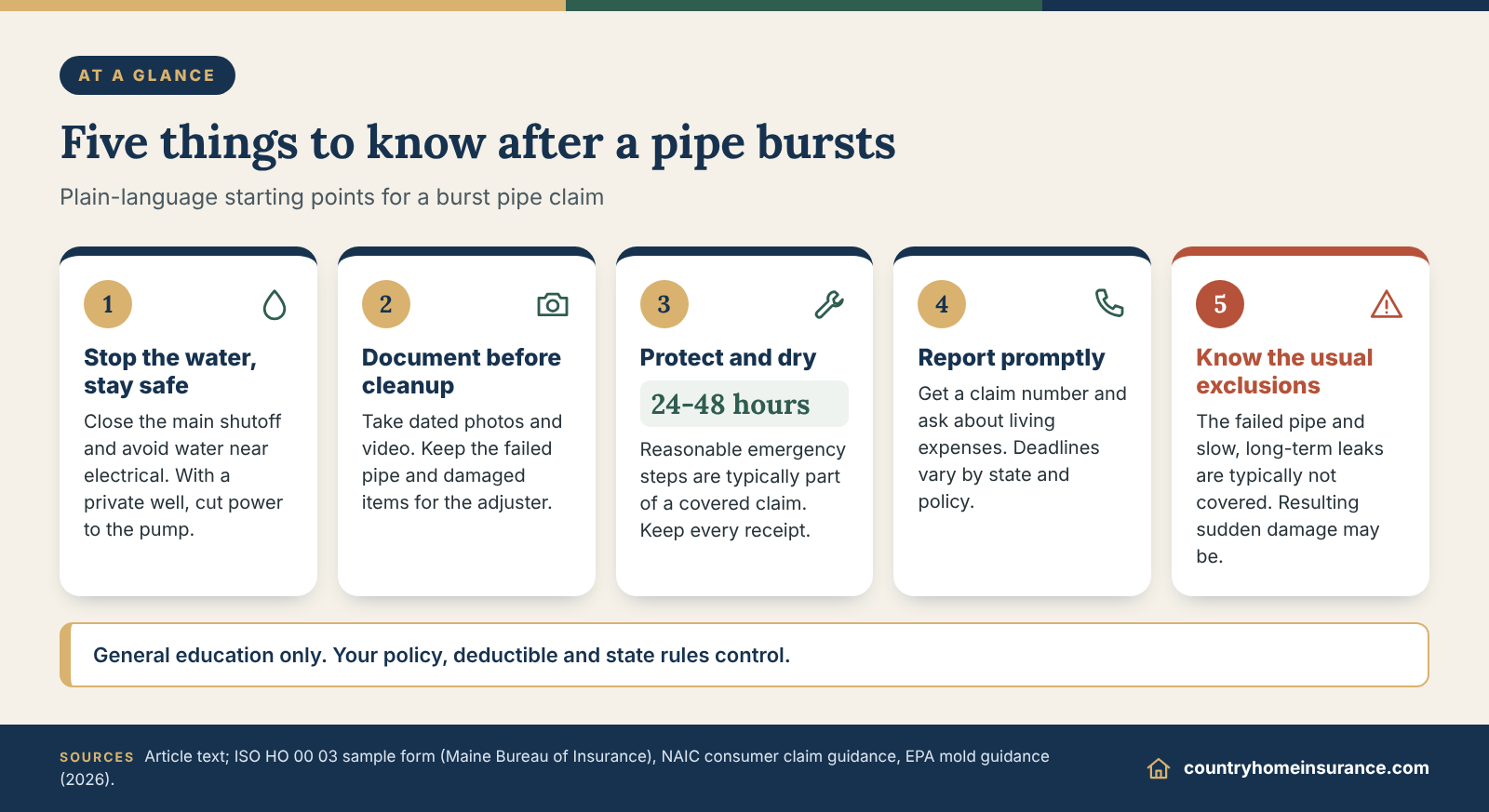
In a burst pipe homeowners insurance claim, the order of operations matters: shut off the water, make the home safe, photograph the damage, dry things out, then report the loss and keep every receipt. Sudden, accidental water damage is typically covered under a standard homeowners policy, but the pipe itself, long-term leaks, flood and sewer backup usually are not. Your deductible, loss settlement terms and state claim rules control what gets paid and when.
Key takeaways
- Stop the water first, then document. Most policies expect you to protect the property from further damage, and reasonable emergency costs are typically part of the claim.
- Report the loss promptly. Reporting deadlines vary by state and policy, and delay can make it harder to show what happened.
- Expect payment in stages: often an actual cash value payment first, with depreciation released after repairs are finished if your policy pays replacement cost.
- Keep a written log of every call, estimate, receipt and temporary living expense; these records usually decide disputed amounts.
- You have options if you disagree with the estimate, including a supplement, reinspection, appraisal, state mediation where offered, and a complaint to your state Department of Insurance.
- Do not sign releases, contractor assignments or “final” paperwork until you understand what they give up.
What should you do in the first hour after a pipe bursts?
How do you stop the water and stay safe?
Where is the main shutoff, and what if it won’t turn?
Close the main water shutoff valve for the house. In many homes it sits where the supply line enters, often in a basement, utility room, crawl space or an exterior meter box; homes on a private well have a different setup, covered below. If a fixture-level valve is closer to the break, such as a toilet or sink stop, use it to buy time. If the main valve is stuck or leaking, call the water utility or an emergency plumber to close the street-side valve; it is often the utility’s equipment, so ask before operating it yourself. Do not force a corroded valve so hard that it breaks and leaves you with a second leak. Then open a low faucet and a high faucet to drain the lines and reduce pressure on the break.
When should you cut power before touching anything?
Water and electricity are a real hazard. If water is pooling around outlets, coming through light fixtures, or standing near the electrical panel, do not wade in or touch switches. If the panel is in a dry spot you can reach safely, turn off the breakers for the affected areas. If you can’t reach it dry, call your electric utility or an electrician before going further. Stay out from under a ceiling that is sagging or bulging with trapped water; it can fail without much warning. A plumber or water-mitigation crew can relieve it safely, and that call is part of protecting the home.
What if the home runs on a private well?
Country homes add one more step. If the supply comes from a private well, turn off the pump breaker or the pressure-tank shutoff so the pump stops feeding the broken line. A well pump can keep refilling a burst pipe for as long as it has power, which is why a small rupture in a bedroom wall can turn into a flooded floor overnight. Also check any outbuilding, barn hydrant or detached garage fed by the same system. We cover rural wrinkles in more detail later in this guide, and the broader picture of rural coverage gaps is in our rural home insurance guide.
What can you do to limit damage before anyone arrives?
Which water should you remove first?
Once the supply is off and the area is safe, remove standing water with towels, mops or a wet-vacuum rated for water. Lift wet rugs off hardwood and lay them over chairs or racks. Open cabinet doors under sinks and along affected walls so air can reach wet drywall and trim. Run fans and, if the weather allows, open windows; run a dehumidifier if you own one. The EPA says wet areas and items should be dried within 24 to 48 hours to prevent mold growth, so the clock starts running well before an adjuster calls back (EPA, updated 2026).
What should you move, and what should you leave?
Move electronics, papers, medications, photos and small valuables out of the wet zone. Put aluminum foil or plastic under furniture legs so stain and moisture don’t transfer to carpet. Leave large damaged items such as soaked carpet padding, wet drywall and saturated mattresses in place or set them aside, do not throw them away yet. NAIC claims guidance says to keep damaged items for the adjuster to inspect if you can (NAIC, 2021). If something is a health hazard, take clear photos first and tell the insurer you are disposing of it.
What should you record before cleanup begins?
How do you photograph the scene in a useful order?
Take wide shots of each affected room from the doorway, then medium shots of each wall, floor and ceiling, then close-ups of the worst spots and of the broken pipe. Add a short video where you walk through the house and say the date and what you see out loud. Photograph the water meter or main shutoff, the time on a clock if you can, and any water lines on the walls. Include things that show the scale of the loss, such as a tape measure against the water line. Do not worry about perfect photography; a sharp, dated, complete set beats a few artistic ones.
Why save the broken pipe section?
The failed pipe, fitting or supply line is physical evidence of what happened. If a plumber cuts it out, ask to keep the piece and bag it, and ask for a written note on what failed and where. A split from freezing, a loose compression fitting, a corroded section and a faulty braided hose each point to a different cause of loss, and the cause of loss is what the insurer uses to decide which policy provisions apply. That is why the plumber’s invoice and notes belong in your claim file. If you want to understand how those causes line up with coverage, see our guide on whether homeowners insurance covers burst pipes.
What does a burst pipe claim typically pay, and what usually isn’t paid?
How do the main cost categories compare at a glance?
Covered, not covered and “it depends” in one table
This guide is about the claim workflow, so the table below is a quick orientation rather than a coverage analysis. It reflects the standard ISO HO-3 (the common “special form” homeowners policy) language published by a state regulator, and your own policy may differ. For the full coverage logic, including endorsements and sublimits, see our coverage guide for burst pipes.
| Item in the loss | Typical treatment | What decides it |
|---|---|---|
| Water damage to drywall, flooring, cabinets and ceilings from a sudden pipe break | Typically covered | Cause of loss is sudden and accidental; deductible applies |
| Damage to furniture, clothing and electronics | Typically covered, often at actual cash value | Personal property (Coverage C) settlement terms; replacement cost endorsement if purchased |
| Reasonable emergency steps: water extraction, drying, tarping, shutoff costs | Typically covered if the loss is covered | Policy’s reasonable repairs provision; keep receipts and drying logs |
| Hotel, extra meals and other increased living costs while the home is unlivable | Typically covered as additional living expense | Loss of Use (Coverage D) limit and time; must be a covered loss |
| Tearing out walls or floors to reach a leaking pipe | Depends | Policy wording on access and tear-out; whether the underlying leak is covered |
| Pipe frozen and burst while the house was unheated or empty | Depends | Whether heat was maintained or water shut off and drained; vacancy terms |
| Mold after a covered pipe break | Depends | Mold limits or exclusions; speed and quality of drying |
| Repairing or replacing the failed pipe or fitting itself | Typically not covered | Wear, deterioration and corrosion exclusions |
| Slow or repeated leaks over weeks or months | Typically not covered | Continuous seepage, rot and deterioration exclusions |
| Flood, surface water, sewer or drain backup | Typically not covered under a standard policy | Separate flood or water-backup coverage may apply; see our water backup guide |
Why does the pipe itself usually fall outside the claim?
Homeowners insurance is built to pay for sudden damage that results from a failure, not for the maintenance cost of the part that failed. In the ISO sample form, the named-peril language for personal property that covers accidental discharge of water excludes the cost of the system itself, and the dwelling exclusions list wear and tear, deterioration and corrosion while keeping ensuing losses covered unless another provision precludes them (ISO HO 00 03 05 11, hosted by Maine Bureau of Insurance). In plain terms, the resulting water damage may be a claim, while the new pipe may be a maintenance bill. The details vary by form, so check yours.
How common are water and freezing claims, and what do they cost?
What does industry data say about frequency and severity?
Triple-I data show that water damage and freezing accounted for 22.6% of homeowners property-damage losses in 2023, behind wind and hail at 42.5% and just ahead of fire and lightning at 21.6%. For 2019 through 2023, the average water damage or freezing claim was $15,400, with a frequency of 1.50 claims per 100 house-years (Triple-I, Facts + Statistics: Homeowners and renters insurance). That category covers water damage and freezing losses generally, not only burst pipes, so it is a useful backdrop, not a forecast for your house.
Why averages shouldn’t anchor your expectations
An average blends a small supply-line failure caught in ten minutes with a rupture found after a long weekend away. Your claim depends on how much water escaped, which materials got wet, how fast drying started, local labor costs, and your own deductible and settlement terms. Use the figure above as context for why insurers have well-worn procedures for these claims, and don’t treat it as an estimate of what your claim will pay.
Should you file a burst pipe claim, and how fast do you have to report it?
How do you decide whether to file?
Where does your deductible fit in?
Your deductible is the part of a covered loss you pay before the insurer pays anything. In the ISO sample form, the insurer pays only the portion of a covered loss that exceeds the deductible shown on the declarations page, and if two deductibles apply to one loss, only the highest applies. NAIC consumer guidance puts the decision simply: find your deductible before reporting, remember that minor damage can be cheaper to pay yourself, and consider filing when repair costs will exceed the deductible or the damage is extensive (NAIC, 2022). Water losses often fall under the policy’s standard all-other-perils deductible rather than a wind/hail percentage, but the declarations page is where you confirm that.
What does a claim do to your record?
Many insurers consider claim history when they renew or price a policy, and some consumers weigh that before filing a small claim. That is a legitimate factor, not a reason to skip reporting a large loss. Rules about how claims and inquiries are treated differ by state and insurer, so ask your agent a direct question before you call: “If I describe what happened and ask whether it’s covered, does that count as a claim?” For the longer view of how a claim can ripple into renewal and pricing, see our guide to how claims history affects homeowners insurance rates.
When is it sensible to wait for an estimate?
If the break was caught in minutes and a few square feet of floor got wet, a mitigation or flooring estimate may show the repair is near your deductible. Getting that number before you file is reasonable. What you should not wait on is the drying work itself or the cleanup of standing water; those protect the home regardless. And keep in mind that water often travels: wet insulation, subfloor and the room below can raise the real cost well past what the visible damage suggests. When in doubt, get a second set of eyes with a moisture meter before concluding it’s small.
How soon do you have to report?
What does “prompt notice” mean in the policy?
The ISO sample form lists prompt notice as the first duty after a covered loss, along with protecting the property, keeping repair records, preparing an inventory, showing the damaged property, providing requested records and, within 60 days of the insurer’s request, sending a signed, sworn proof of loss. It does not set a number of days for the first report. NAIC guidance says most insurers have deadlines for reporting claims and that the deadlines vary (NAIC, 2021). Treat “prompt” as meaning days, not weeks.
What do state notice deadlines look like?
Some states set outside limits in statute. Florida, for example, bars an initial or reopened property insurance claim unless notice is given within one year of the date of loss, and a supplemental claim within 18 months, with weather-event dates fixed by the statute (Fla. Stat. 627.70132, 2026). Separately, the ISO sample form requires any lawsuit to be filed within two years of the loss, though states modify that. Reporting and suit deadlines differ by state and by policy, so check your policy’s “Suit Against Us” wording and ask your state Department of Insurance for the current rule where you live. A one-year statutory outer limit is not a goal to aim for; it is a backstop.
Why report early even if the amount is unclear?
Reporting does not obligate you to accept a payment or to proceed with a claim you later decide is too small, but it does preserve your position, put the insurer on notice, and let the adjuster see conditions before they change. Evidence of a burst pipe fades quickly: wet materials dry, mold can start, repairs happen and the failed section of pipe may be discarded. Late reporting can also give an insurer an argument that its investigation was prejudiced. That is a legal question that depends on the state, so it is another reason to report early rather than test it.
Which numbers on your policy shape the payout?
Which limits and deductibles matter most?
Before the adjuster arrives, pull your declarations page and find the numbers in the table below. Terms in the third column come from the ISO sample form; your policy may use different wording, limits or sublimits.
| Policy term | What it does in a water claim | Where to check or what to ask |
|---|---|---|
| Section I deductible | Subtracted from the covered loss before payment; if two deductibles apply, the highest applies (ISO sample form) | Declarations page; ask whether a separate water or special-peril deductible exists |
| Coverage A (dwelling) limit | Caps payment for the house structure and attached structures; also drives the replacement-cost 80% test | Declarations page; ask whether the limit is current with rebuilding costs |
| Coverage C (personal property) basis and limit | Contents are paid at actual cash value in the ISO sample unless a replacement cost endorsement applies | Declarations and endorsements list; ask about special limits for jewelry or electronics |
| Coverage D (loss of use) | Pays increased living costs for the shortest time needed to repair or relocate; limit stated in the policy | Declarations page; ask for limit, time rules and what documentation is required |
| Reasonable repairs provision | Pays reasonable cost of necessary measures solely to protect covered property from further damage | Policy form; ask what proof the insurer wants for emergency work |
| Ordinance or law | In the ISO sample, up to 10% of Coverage A for increased costs from enforcing building laws on covered damage | Declarations or endorsements; ask whether code upgrades apply and the limit |
| Mold, fungus, wet rot terms | Excluded in the ISO sample unless hidden within walls, ceilings or floors and caused by accidental discharge; many policies add limits | Policy form and any mold endorsement; ask for the dollar sublimit |
| Loss settlement (RCV vs ACV) | Controls whether depreciation is held back and later released | Declarations and loss settlement clause; ask how recoverable depreciation is claimed |
| Mortgagee on the policy | Dwelling payments may include the lender as a payee | Declarations page; ask the lender about its insurance-proceeds procedure |
Which cost drivers sit outside the policy?
Several factors shape the repair estimate regardless of how the policy reads: how much water escaped and for how long, how many floors it traveled, whether insulation and subfloor got wet, the finish level of floors, cabinets and trim, local labor and materials costs, whether walls must be opened for drying, and whether the lowest-cost reasonable repair would leave rooms that don’t match. A burst pipe in a finished basement with custom millwork can cost multiples of the same burst in a utility room. This is why the scope of the estimate, covered in the estimates section, usually matters more than the first headline number.
How do you protect the home without hurting the claim?
What counts as reasonable emergency repairs?
What does the policy expect from you?
Most homeowners policies require you to protect the property from further damage after a covered loss. In the ISO sample form, that means making reasonable repairs and keeping records of what you spend. The same form separately provides that the insurer pays the reasonable cost of necessary measures taken solely to protect covered property damaged by a covered peril, and that this coverage does not increase any limit. NAIC says temporary repair costs are typically reimbursed through the claim if the policy covers the loss, and that you should keep every receipt (NAIC, 2021). The practical lesson: you generally are not waiting for permission to stop active water damage, but you should be able to show what you did and why.
Which costs usually belong in the emergency bucket?
Typical entries include water extraction, rented fans and dehumidifiers, a mitigation crew’s labor, plastic sheeting, board-up if a break damaged a wall or window, temporary heat to keep the rest of the plumbing from freezing, and the cost to move or store contents so they can dry. The plumber’s time is more nuanced. The call to stop the leak is part of limiting loss, but replacing the pipe itself is often treated as maintenance, so ask how the insurer will treat each line on the plumbing invoice rather than assuming. Keeping those lines separate on the invoice helps.
What should you hold off on before the insurer weighs in?
Hold off on permanent repairs, on discarding everything that got wet, and on signing a large rebuild contract. Take photos and measurements, remove the water, remove only what is plainly ruined and unsafe, and let the adjuster see the rest or give written approval first. If the insurer is slow to respond and you need to tear out wet drywall to stop mold, photograph and describe it, tell the claim representative in writing what you removed and why, and keep samples or clear photos of each material.
How fast does drying need to happen?
What does the 24-to-48-hour guidance mean in practice?
The EPA says that if wet or damp areas are dried within 24 to 48 hours after a leak or spill, mold will usually not grow (EPA, updated 2026-02-18). That is a working deadline for your mitigation, not the insurer’s. Waiting several days for an adjuster visit while materials stay wet can create a mold problem that a policy may exclude or limit, which turns a covered water loss into a partially uncovered one. Starting extraction and airflow right away is usually the single most valuable thing within your control.
When is a professional drying crew worth calling?
The EPA suggests professional help when mold covers more than roughly 10 square feet, when there is a lot of water damage, when the water or mold came from sewage or other contaminated water, when the HVAC system may be contaminated, or when you suspect hidden mold; it also recommends consulting a health professional first if you have health concerns. A sudden supply-line break that soaked a bathroom floor is a different problem from a pipe that ran inside a wall for a weekend. If drywall, insulation or subfloor stayed wet, a crew with moisture meters and drying equipment is typically worth the call. If water from a sewer line or backed-up drain is involved, see our sewer backup claim guide because the coverage path is different.
What do drying logs and moisture readings prove?
A drying log shows the moisture readings of affected materials on day one and day by day afterward, along with equipment placement and when readings reached a dry standard. It documents that you mitigated, supports the length of the drying period, and gives the adjuster and your contractor a shared factual baseline for what needs to be torn out and what can be saved. Ask any mitigation company for its logs and photos before they leave, and keep them in your claim file.
How should you handle a mitigation company’s paperwork?
What should the work authorization say?
Read it before signing, even in an emergency. It should describe the work, the pricing method (itemized or time-and-materials), who is responsible for payment, whether the company will bill your insurer directly, and what happens if the insurer pays less than the invoice. Avoid anything that gives the company control of your claim or your insurance check. NAIC consumer guidance advises against agreeing to repairs you are unsure about or letting anyone pressure you (NAIC, 2022). The same caution applies to paperwork: do not sign a document you do not understand. Get a signed copy.
What is an assignment of benefits, and why do states treat it differently?
An assignment of benefits (AOB) lets a vendor stand in your place to collect insurance money for its work. States have responded to AOB disputes in different ways. In Florida, for residential property policies issued on or after January 1, 2023, a post-loss assignment is generally void and unenforceable, while for earlier policies the statute allowed assignments only with detailed requirements, such as a cancellation window and notice to the insurer, and a cap on emergency-service assignments of the greater of $3,000 or 1% of the Coverage A limit (Fla. Stat. 627.7152, 2026). Other states handle assignments differently, so read any document that transfers your claim rights before signing and ask your state Department of Insurance what rules apply where you live.
Should the insurer approve the vendor first?
Your insurer may suggest vendors, and NAIC notes that insurers sometimes keep lists of suggested contractors. Using a recommended vendor can be convenient, but you typically retain the right to choose, and you should still check references, compare scope and read the contract. Ask the claim representative three things in writing: whether the insurer will pay the vendor directly, whether it requires a specific drying standard, and whether it needs to inspect before demolition.
What documentation makes a burst pipe claim easier to settle?
What proof of the damage and its cause should you keep?
Which records build the cause-of-loss story?
The insurer needs to understand what happened, and the strongest evidence is simple. Keep the plumber’s written findings on what failed and where, the failed pipe or fitting itself, photos of the break location before repair, and the time you first noticed water. A recent water bill or a pair of water-meter readings can show a sudden spike. If cold weather was involved, note the outdoor temperature and whether the heat was on. Maintenance receipts, past plumbing repairs and the age of the plumbing also matter because they speak to whether the failure looks sudden or the result of long-term deterioration.
What belongs in the damage file?
The damage file is the factual record of what water touched and what you did about it. The table below organizes the main pieces so nothing gets lost in a stack of papers or a phone gallery. Store a copy somewhere other than the house, such as cloud storage or a relative’s email.
| Evidence | Why it matters | When to gather it |
|---|---|---|
| Dated photos and walk-through video | Shows the extent and condition before cleanup and tear-out | Before anything is moved or discarded |
| Failed pipe or fitting and plumber’s note | Supports the cause of loss and separates sudden failure from deterioration | At the time of repair |
| Water bill or meter readings | Helps show when water ran and whether a leak was sudden or ongoing | Within the first days |
| Mitigation work authorization, drying logs and invoices | Supports the reasonable-repairs portion and the length of drying | Daily while equipment runs; final copies at pickup |
| Contents inventory with photos | Supports personal property payment amounts | Start within the first week; add as you find more |
| Receipts for hotel, meals, laundry, mileage and storage | Supports additional living expense reimbursement | As each expense happens |
| Two or more repair estimates | Lets you compare scope and price against the insurer’s estimate | After drying shows what must be replaced |
| Claim log of calls, emails and promises | Resolves later disagreements about who said what and when | Immediately after every contact |
| Policy, declarations page and endorsements | Controls what the claim can pay | On day one; request copies if you do not have them |
How do you build a contents inventory that holds up?
How do you list items without a pre-loss inventory?
Most people don’t have a room-by-room inventory when a pipe bursts. NAIC says to rebuild one from phone photos, pictures from family and friends, and online retailers that can help estimate replacement costs, and its free Home Inventory App can organize the list by room and category (NAIC, 2022). Start with the affected rooms and work outward. Open closets and cabinets, since belongings in lower shelves, boxes and bottom drawers get wet more than people expect.
What details should each line include?
For each item, record what it is, brand and model if known, approximate age, where you bought it, what you paid, what it would cost to replace today and its condition after the water. Under the ISO sample form, personal property is paid at actual cash value unless a replacement cost endorsement applies, so an age and condition entry is not paperwork for its own sake; it affects the number. Photograph labels and serial numbers. Group low-value items, like kitchen utensils, into a single line with a realistic total instead of listing every spoon.
How do you handle items you want to throw away?
Keep damaged items until the adjuster has had the chance to inspect them, if they are safe to keep. If an item is a health risk or in the way of drying, photograph it, note its condition and, where possible, send the photos to the claim representative before disposal. Keep a note of what was discarded and when. Items that can be restored, such as photographs, books and some electronics, are worth a professional’s opinion before you decide they’re a total loss.
How should you keep a running claim log?
What should every entry include?
Write down the date and time, who you spoke to, their title, the claim number, what was said, what was promised and what happens next. After a phone call, send a short email that restates the key points: “Thanks for speaking with me today. To confirm, you said the adjuster will inspect Thursday and the estimate will follow within seven days.” An email creates a record, and a mismatch in recollection is easier to fix right away than three weeks later.
How do you track expenses and payments?
Create four buckets: emergency mitigation, repairs, contents and living expenses. Put every receipt and invoice into the right bucket, along with payment proof. Note each payment you receive from the insurer, what it was for and whether any portion is depreciation held back. At the end, the totals in those buckets should reconcile with what you were paid and what you paid out of pocket, which is how you spot a missing supplement.
How do you start a burst pipe homeowners insurance claim with your insurer?
What should the first call cover?
Which facts should you state, and what should you avoid guessing?
Give the insurer a plain, accurate account: when you discovered the water, where it came from, what you did to stop it, which rooms are affected, whether the house is livable, and what temporary measures are in progress. Describe what you saw rather than speculating about the cause. If you say “it froze because the heat went out” and that turns out not to be the case, you have created a confusing file. Accuracy matters for another reason: the ISO sample form provides no property coverage if an insured intentionally conceals or misrepresents a material fact or engages in fraud. Honest uncertainty is fine, as in “I don’t know yet; the plumber is looking at it.”
What should you have before you hang up?
Get the claim number, the name and direct contact for the assigned representative or adjuster, the expected timing for the first inspection, how to submit photos and receipts, whether the insurer has an emergency-services vendor, and what it needs for additional living expenses. Ask what forms are coming and whether any are due by a date. NAIC’s model claims regulation expects an insurer to acknowledge a claim notice and provide forms and instructions within 15 days, though states set their own periods, as the state claim clocks table shows. Write the answers in your log.
Should you call the agent, the claims line or use an app?
Any of them can open a claim, but the claim is handled by the insurer’s claims department, not the agent. An agent can help you understand the policy, locate forms and push a stalled file, and many insurers let you upload photos in an app. Whichever route you use, get the claim number in writing and follow up by email so there is a record of the date you reported. If you are still shopping for or reconsidering coverage after a loss, our guide to how to buy homeowners insurance covers the questions to ask.
Who else needs to know about the loss?
Do you need to tell your mortgage lender?
If you have a mortgage, the lender is usually named on the policy’s dwelling coverage. The ISO sample’s mortgage clause says dwelling losses are paid to the named mortgagee and you according to each party’s interest, and a mortgage servicer will often have its own procedure for releasing repair funds. Call the servicer early to learn what it requires, such as endorsement of the check, an inspection or staged disbursement. This avoids a stall after the money has arrived.
What if water reached a neighbor, a tenant or a shared wall?
If water from your pipe damaged a neighbor’s property, a rental unit or a shared wall, tell the insurer. Homeowners policies typically include personal liability coverage, which may respond to a neighbor’s claim, though that depends on fault, the policy and the facts. Do not promise to pay a neighbor yourself before talking to the insurer, and keep your communications factual. Owners of rental properties, farm buildings or home businesses may be in a different policy structure, which we discuss in our hobby farm insurance guide.
Could another policy or plan also apply?
If the pipe was part of an appliance, a water heater or a covered system, check whether a manufacturer warranty, service contract or home warranty plan may handle the failed part while your homeowners policy handles resulting damage. Those plans are separate from your homeowners policy and have their own terms and exclusions, so read them before relying on one. Our guides on water heater leak claims and appliance leak claims go through those cases.
What are proof of loss, recorded statements and document requests?
What is a sworn proof of loss?
A proof of loss is a signed, sworn statement of the amount you claim and how you arrived at it. Under the ISO sample form, you must send one within 60 days of the insurer’s request. Not every insurer asks for one on every claim, and many states have rules for how it is used. If a request arrives, mark the deadline, read what you are swearing to, make sure the numbers match your estimates and inventory, and ask for an extension in writing if you need more time. Do not sign a figure you cannot support.
What if the insurer asks for a recorded statement or an examination under oath?
Recorded statements are common in water claims, mainly to confirm the timeline. The ISO sample lists submitting to examination under oath among a policyholder’s cooperation duties. Answer truthfully, stick to what you know and ask for a break or a clarification if a question isn’t clear. If the request seems out of proportion to a straightforward loss, ask the claim representative to explain in writing why it is needed. For case-specific advice, talk with a licensed professional.
How should you respond to requests for more documents?
Respond in writing, send what you have, and say plainly what you cannot provide and why. Keep copies. Statutes often tie insurer deadlines to receiving requested information. Florida’s statute, for example, pauses certain insurer deadlines if the policyholder does not provide requested claim information within 10 days, for requests sent at least 15 days before the pay-or-deny deadline (Fla. Stat. 627.70131, 2026). Sitting on a request can slow your own claim.
What happens when the insurance adjuster inspects the damage?
Who might actually inspect the home?
What is the difference between staff, independent and virtual adjusters?
A staff adjuster is an employee of the insurer. An independent adjuster is a contractor the insurer hires, often when claims volume is high. Some insurers also start with a virtual inspection in which you upload photos or take a guided video. NAIC explains that after you report a loss, the insurer sends an adjuster to assess damage, estimate it and document the loss, which determines the settlement amount (NAIC, 2021). In Florida, the adjuster must give the policyholder a document with the adjuster’s name and license number (Fla. Stat. 627.70131). Write down the name and license information wherever your state requires it.
Do plumbers, engineers or cause-and-origin experts get involved?
On larger or disputed losses, the insurer may bring in a plumber, an engineer or a water-damage specialist to decide what failed and when. That is more common if the cause is unclear, if the break is in a wall or slab, or if the question is whether the leak was sudden or long-running. Ask whether an expert has been retained, and ask for a copy of any report. If you have your own plumber’s findings, make sure the adjuster has them before the expert arrives.
Whose interests does the adjuster represent?
An insurer’s adjuster works for the insurer, but the insurer is bound by the policy and by the state’s fair claims practices rules. Treat the adjuster as a professional who is gathering facts, and feel free to disagree with a scope or number in writing. If you want an advocate on your side, public adjusters and attorneys exist, with distinct rules covered in the disputes section.
How do you prepare for the inspection?
What should be in your hands when the adjuster arrives?
Have your claim number, the declarations page, photos and video, the plumber’s note, drying logs and invoices, your inventory, any repair estimates and your running list of questions. Walk the loss in the order water traveled, from the break to the farthest wet area, since that sequence helps the adjuster see the scope. If rooms are unsafe or off limits, say so before the visit.
Should your contractor be there?
NAIC suggests considering having your contractor meet with you and the adjuster (NAIC, 2022). A contractor who has already seen the opened walls can explain what must be replaced and why, which reduces back-and-forth later. The contractor is not a substitute for you; the claim is yours. If you have a preferred contractor, share the estimate before the visit, and ask the adjuster to note any scope differences on site.
What if hidden damage hasn’t been opened up yet?
Moisture can sit behind baseboards, inside wall cavities and under flooring. Show the adjuster the moisture readings and ask how the insurer wants to confirm hidden damage, for example by opening a section of ceiling. Agree on how any additional damage found during drying or demolition will be reported, and make clear that you will submit a supplement for it. A supplement is a request to add scope or cost to the original estimate after new information appears.
What should you ask before the adjuster leaves?
Which questions clarify scope and coverage?
Ask which items the adjuster considers part of the claim, how depreciation will be calculated and shown, how the adjuster is treating the pipe or fitting itself, whether code upgrades are included, how matching of flooring or cabinets will be handled, and whether the estimate will list each room and line item separately. If the adjuster says an item is not covered, ask which policy provision they are relying on, and ask for that in writing.
Which questions clarify timing and next steps?
Ask when you will receive the written estimate and photos, when a first payment is expected, how to submit supplements, what documentation the insurer needs for living expenses and who to contact if you do not hear back. Confirm whether a reinspection is needed after demolition. Jot down the answers and send a short confirming email, then check your state timelines in the state claim clocks table to see what the insurer owes you and by when.
How long does a burst pipe claim take, and what deadlines apply to the insurer?
What does a typical burst pipe claim timeline look like?
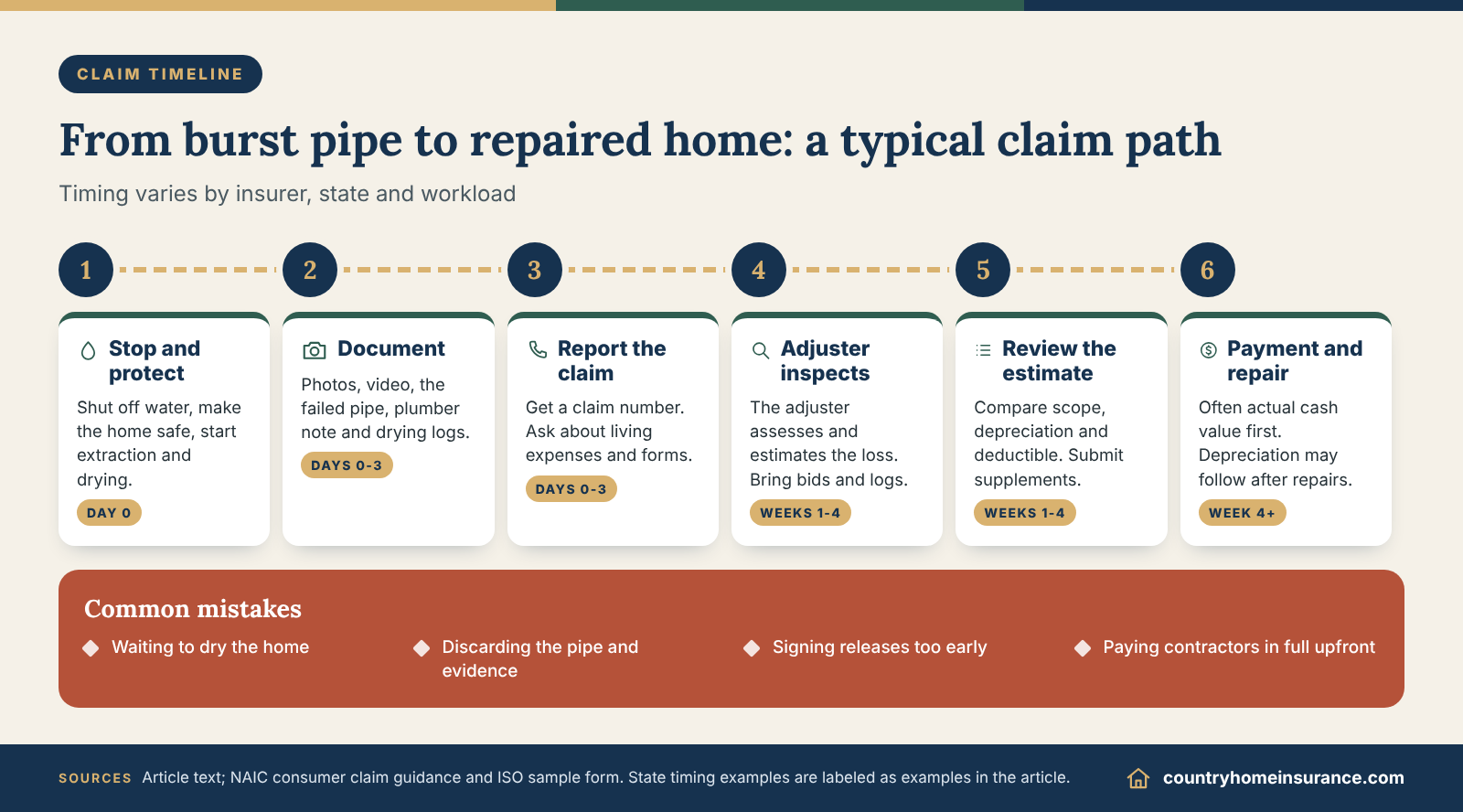
Days 0 to 3: stop the water, protect the home and report
The first days are about you, not the insurer. You shut off the water, make the home safe, start extraction and drying, photograph, and report the loss. A claim representative may call the same day or the next, and an adjuster visit, virtual or in person, often follows within days, though timing varies with workload and weather events. If many claims arrive after a cold snap, expect slower contact and plan accordingly by keeping your mitigation moving.
Weeks 1 to 4: inspection, estimate and first payment
After the inspection, the insurer prepares a written estimate and a coverage position. The estimate may reach you in days or weeks. If the policy pays replacement cost on the building but holds back depreciation until work is done, the first payment is often the actual cash value less your deductible. Personal property and living expense reimbursements may be paid on a separate track. All of this depends on the insurer, the state rules shown below and how complete your documentation is.
Week 4 onward: repairs, supplements and final payment
Once drying is finished and demolition shows the real scope, contractors price repairs and you submit supplements for anything the first estimate missed. Rebuilding can take weeks to months depending on materials and labor availability, and final payments often follow proof that the work is complete. Claim mechanics are similar for other causes of loss, though each has its own coverage questions; if you want a side-by-side feel, our guides to hail damage roof claims, wind-damaged roof claims and tree-on-house claims walk through similar workflows.
What claim-handling clocks do states set for insurers?
What does the NAIC model regulation say?
The NAIC’s Unfair Property/Casualty Claims Settlement Practices Model Regulation, which states adapt in their own rules, suggests these benchmarks: acknowledge a claim notice within 15 days, tell a first-party claimant whether a claim is accepted or denied within 21 days after receiving properly executed proofs of loss, send follow-up letters at 45-day intervals if the investigation is incomplete, and tender undisputed payment within 30 days after affirming liability. A denial must reference the specific policy provision it relies on, and the insurer must tell the claimant in writing about Department of Insurance review after a rejection (NAIC Model 902, July 1997 text). Treat it as a model, because enacted rules differ.
How do California, Florida, Texas, New York and Washington compare?
The table shows what each state’s official text we reviewed says about timing. These are five examples, not a national survey, and the rules change; check your own state’s current statute or regulation on the Department of Insurance website.
| Jurisdiction | Acknowledge or begin | Decision and payment | Other notable points |
|---|---|---|---|
| NAIC model (July 1997 text) | Acknowledge notice within 15 days | Accept or deny within 21 days after proofs of loss; tender undisputed payment within 30 days after affirming liability | Follow-up letters every 45 days; denial must cite the policy provision |
| California (10 CCR 2695.7) | Not covered in the section reviewed here | Accept or deny within 40 calendar days of proof of claim; pay within 30 calendar days of acceptance | Written notice of need for more time, repeated every 30 days; written denial must cite the basis and explain Department of Insurance review |
| Florida (Fla. Stat. 627.70131, 2026) | Acknowledge communications within 7 days; begin investigation within 7 days of proof-of-loss statements | Pay or deny within 60 days after notice of the claim, unless factors beyond the insurer’s control prevent it | Inspection within 30 days after proof-of-loss statements; estimate copy within 7 days; interest on late payments |
| Texas (Insurance Code ch. 542, subch. B) | Acknowledge, begin investigation and request items within 15 days | Accept or reject within 15 business days after receiving all requested items; pay within 5 business days of notice of acceptance | 15 extra days after a declared weather-related catastrophe; statutory interest and attorney’s fees for late payment |
| New York (11 NYCRR 216.6) | No acknowledgment deadline in the section reviewed | Written acceptance or rejection within 15 business days after proof of loss and requested items; payment within 5 business days of agreement | Status letters every 90 days if unsettled; undisputed parts must be paid |
| Washington (WAC 284-30-370) | Complete investigation within 30 days of notice unless it cannot reasonably be done | Not set in the section reviewed | An updated version takes effect October 18, 2026: the 30 days become calendar days, and the insurer must give written reasons if more time is needed, with further written updates every 30 days |
Sources for the table: California Code of Regulations, title 10, section 2695.7; Florida Statutes section 627.70131; Texas Insurance Code chapter 542; 11 NYCRR 216.6; WAC 284-30-370. Our state guides for California and Florida place these rules in a wider market context.
What do these clocks not guarantee?
A deadline to accept or deny a claim is not a promise that it will be paid, and the clocks start at different triggers: some run from notice of the claim, others from a signed proof of loss or from receipt of all requested documents. They also include exceptions for investigations, suspected fraud and large-scale weather events. Use the table to know what to expect and what to ask about if you hear nothing, not to predict an outcome. If the insurer misses a deadline, document it and contact your state Department of Insurance.
What can pause or extend the insurer’s clock?
What happens when you haven’t provided requested information?
Clocks usually assume the insurer has what it needs. In Florida’s statute, deadlines are paused if the policyholder does not provide requested claim information within 10 days, subject to timing conditions, and during mediation or contractual alternative dispute resolution. Practically, if you owe the insurer a document, sending it quickly is the way to keep everything on schedule.
How do catastrophe declarations and emergencies extend deadlines?
After large regional events, some states lengthen insurer deadlines. In Texas, a commissioner-declared weather-related catastrophe or major natural disaster adds 15 days to the subchapter’s claim-handling deadlines (Tex. Ins. Code ch. 542). Florida’s statute lets the state insurance office grant up to 30 additional days for specified events. A widespread winter storm that bursts pipes across a region can have this effect, which is another reason to check for a state notice if your claim seems slow.
Can an insurer extend time to investigate?
Yes, usually by telling you in writing why it needs more time. California requires written notice within the 40-day window, repeated every 30 days; New York requires a written explanation within 15 business days and status letters every 90 days after that. If you receive an extension letter, calendar the next expected update and respond promptly to any request for information.
What are additional living expenses, and how do you claim them after a burst pipe?
What does loss of use coverage pay?
What counts as an additional living expense?
Additional living expense (ALE) coverage, part of Coverage D or “loss of use,” pays the necessary increase in your living costs so your household keeps its normal standard of living while a covered loss makes the home unfit to live in. In the ISO sample, it applies for the shortest time needed to repair or replace the home or, if you permanently relocate, to settle elsewhere (ISO HO 00 03 05 11). Typical eligible costs include a hotel or short-term rental, higher meal costs because the kitchen is unusable, laundry, extra mileage, pet boarding and storage. The test is the increase, not the whole bill: groceries you would have bought anyway are not an additional cost.
What is fair rental value?
Fair rental value is the related coverage for a portion of the home you rent to others or hold for rent, such as a basement apartment, that becomes unfit to live in. It pays the fair rental value of that portion, less expenses that don’t continue. If you use part of the home for a business or rent a room, tell the insurer so the right coverage is evaluated. Rental and business use can change which policy provisions apply.
What if only part of the house is unusable?
Many burst pipe losses leave some rooms usable. The policy language ties ALE to a home that is unfit to live in, and insurers may disagree about whether a house without a working kitchen or bathroom, or with mold risk, qualifies. If you move out, tell the insurer immediately, explain why in writing, and keep the evidence: photos, the mitigation firm’s notes and a note from a health professional if someone in the household is medically vulnerable. Do not assume an arrangement is approved until it is confirmed in writing.
How long does loss of use last, and what limits apply?
What time and dollar limits should you look for?
The ISO sample form pays for the shortest time needed to repair, replace or settle elsewhere, and says the period is not cut short by expiration of the policy. Policies also state a limit for loss of use on the declarations page, and some add a time cap; read the declarations page rather than relying on an average. Ask whether living expenses and fair rental value draw from the same limit, and ask the insurer to tell you the remaining balance in writing as the claim goes on.
Why does the repair schedule matter for ALE?
ALE lasts as long as it reasonably takes to restore the home, so a good repair plan is also a good ALE strategy. Get a realistic schedule from your contractor, share it with the insurer, and report delays that are outside your control, such as back-ordered materials or permit waits. An unexplained gap in work can prompt the insurer to question the length of your stay.
What if the insurer says the home is livable?
Ask for the basis in writing. If you disagree because of safety or health concerns, such as no running water, no heat, active mold or damaged wiring, respond with documentation and ask for a supervisor review. If the dispute continues, the options in the disputes section apply to ALE as well as to repair payments. Keep your receipts for any expense you incur while the question is open, since reimbursement may depend on the final determination.
How do you document and collect living expense reimbursement?
What records do insurers usually want?
Receipts for hotels, rentals, meals, laundry, mileage and storage, a short note explaining why each expense was necessary, and a baseline of your normal costs, such as a typical month of groceries, are the essentials. Keep a simple spreadsheet. If you lease an apartment, keep the lease; if you stay with family, ask the insurer how it treats that, since policies and states differ on payments to relatives.
Can you ask for an advance?
Some insurers may issue an advance toward living expenses so you are not floating costs for weeks. Whether yours will depends on the insurer and the claim, and you should not count on it. Ask the claim representative directly, and ask what receipts are needed for later reimbursement so the advance can be reconciled cleanly.
How do rural distances change living expense records?
If the nearest lodging is far from a rural home, mileage and extended stays can add up, and school or livestock-care logistics may add costs. Record the mileage and the reason for each trip, and report livestock boarding or care costs separately, since those may fall outside living expense coverage and should be discussed with the insurer. For more on how rural properties differ, see our guide to country home insurance for acreage.
How do you read the insurer’s estimate and compare it with contractor bids?
What is inside the insurer’s estimate?
Line items, quantities and unit pricing
An insurer’s estimate normally breaks the repair into rooms and line items such as drywall removal, drywall replacement, texture, paint, baseboard, flooring and drying equipment, each with a quantity, a unit price and a total. Ask for the complete estimate, the photos and any measurements. Compare each line with your contractor’s bid for quantity, material grade and labor. Differences often come from scope: the insurer may have priced patching a section of flooring where the contractor priced replacing the entire room to match.
Overhead, profit, taxes and fees
Check whether the estimate includes general-contractor overhead and profit, sales tax on materials, permit fees and debris removal. Whether and when these are included depends on the policy, the insurer’s practices and your state’s rules, so ask for the treatment in writing, especially if you will hire a general contractor to coordinate multiple trades. Missing items are a common reason for supplements.
Depreciation columns and holdbacks
If the estimate shows replacement cost value, depreciation and actual cash value as separate columns, the difference is what could be held back until repairs are done. Make sure each depreciated line is reasonable for the age and condition of the item, and note which lines the insurer treats as non-recoverable. The next section explains how payments are staged.
How do you get bids you can compare?
How many bids should you collect?
NAIC advises getting more than one bid and checking references even if your state doesn’t require contractor licensing (NAIC, 2021). For a burst pipe affecting several rooms, two or three bids is a reasonable standard. Give each bidder the same documentation, including the plumber’s findings, moisture readings and the insurer’s estimate, so they price the same job.
How do you compare apples to apples?
Put the bids and the insurer’s estimate in side-by-side columns by room. Check that each bid has the same finish level, the same demolition scope, the same drying plan and the same exclusions. A low bid that excludes paint or trim isn’t cheaper. Ask each contractor to flag the items they believe the insurer’s estimate missed, then send those flagged items to the insurer as a supplement request with the bid attached.
What payment schedule is safe?
NAIC says never pay cash or write a check before work is complete, and don’t pay upfront or in full until you’re satisfied with the repairs. In practice, a modest deposit, milestone payments tied to finished work and a final payment after walk-through are common. Make sure your lender’s disbursement process, if any, fits the contractor’s payment schedule, and get lien waivers as the work is paid for.
How do code upgrades, matching and hidden damage affect the estimate?
When does ordinance or law coverage matter?
If opening walls or floors triggers requirements to bring parts of the repair up to current building code, ordinance or law coverage may help. In the ISO sample, it provides up to 10% of the Coverage A limit for increased costs from enforcement of laws regulating repair or construction of the covered damage, but it excludes loss in value from the requirement and pollutant costs. Many policies and endorsements differ. Ask whether your policy has it and what the limit is before the contractor starts demolition. Our guide to how much homeowners insurance you need covers why such limits matter.
What about matching flooring, cabinets and paint?
If part of a floor or run of cabinets must be replaced, the new material may not match the old. State law and the policy language decide how far the insurer must go. The NAIC model regulation speaks to this: where replacement items do not match in quality, color or size, it calls for replacing items in the affected area to achieve a reasonably uniform appearance, with the insured paying only the deductible (NAIC Model 902, section 9). A model is not law, and each state adopts its own version, so ask your insurer how it handles matching under your policy and state rules, and raise the issue with your Department of Insurance if the repair would leave visibly mismatched adjoining areas.
How do you handle hidden damage found during demolition?
Stop, photograph, measure and notify the claim representative before the area is closed. Ask for a reinspection or written authorization. Then submit a supplement with the contractor’s written explanation, photos and pricing. Supplements are normal in water claims, so there is no reason to treat the first estimate as final. Keep the timeline of requests and responses in your claim log.
How do depreciation, replacement cost and payment stages work on a burst pipe claim?
How do actual cash value and replacement cost differ?
What do ACV and RCV mean?
Replacement cost value (RCV) is the cost to repair or replace damaged property with similar materials, without subtracting for age or wear. Actual cash value (ACV) is replacement cost less depreciation; the NAIC model regulation describes it that way and requires insurers to provide claim worksheets on request. Depreciation is the reduction in value that the insurer assigns for the age and condition of the damaged item. Both numbers should be on your estimate, and your deductible comes out of the payment either way.
How does the ISO sample form stage payment for the building?
Under the ISO sample, buildings are paid at replacement cost if the insurance carried is at least 80% of the full replacement cost of the building. Until repairs are complete, payment is limited to actual cash value, unless the cost to repair is less than both 5% of the building’s insurance and $2,500. You may make a claim for the actual cash value first and then, if you notify the insurer within 180 days that you intend to repair or replace, collect the rest after the work is done (ISO HO 00 03 05 11). Your policy may use different thresholds and windows, so confirm yours.
How does personal property differ?
In the ISO sample, personal property, carpeting, appliances and several other items are paid at actual cash value, capped at the cost to repair or replace, unless the policy has a replacement cost endorsement for contents. That is why a soaked five-year-old sofa produces a smaller check than a new sofa costs. If you have an endorsement for contents replacement cost, ask how and when the holdback is released, whether you need to buy the replacement first, and what proof the insurer wants.
What does a staged payment look like in numbers?
How does a hypothetical dwelling payment unfold?
Hypothetical example: A supply-line failure soaks a kitchen and adjoining hallway. The insurer’s estimate puts replacement cost at $20,000, depreciation at $5,000, and the policy deductible is $1,500. The figures are illustrative and not a prediction of any payout. The table traces the payments if the policy pays replacement cost on the dwelling and holds back depreciation until repairs are finished.
| Step | Calculation | Amount |
|---|---|---|
| Replacement cost estimate | Cost to repair with similar materials | $20,000 |
| Less depreciation | Held back until repairs are complete | $5,000 |
| Actual cash value | $20,000 minus $5,000 | $15,000 |
| First payment | Actual cash value minus deductible | $13,500 |
| Second payment after repairs and proof | Recoverable depreciation released | $5,000 |
| Total from the insurer | Replacement cost minus deductible | $18,500 |
| Out-of-pocket (if actual repair cost equals estimate) | The deductible | $1,500 |
Why the final cost can differ from the estimate
The second payment is typically tied to the amount you actually spend, up to the replacement cost. If hidden damage adds cost, a supplement may increase the total. If you spend less, the insurer may pay less than the estimate. This is why contractor invoices and proof of completion are part of the claim file, and why you should ask before you start work how and when the insurer wants to see them.
How can the 80% rule change the math?
Hypothetical example: Suppose the full replacement cost of the home is $400,000 and 80% of that is $320,000. If the policy carries $240,000 of dwelling coverage, the ratio is 0.75. Under the ISO sample’s approach, the insurer pays the greater of actual cash value or a proportional share of the repair cost. On a $20,000 repair, 75% is $15,000, before the deductible, assuming actual cash value is lower than that. The shortfall of $5,000 is not caused by the water loss; it is caused by having less coverage than the policy required for full replacement cost. Our guide on how dwelling coverage affects cost explains why insuring to value matters.
Not every policy uses the 80% test or the same thresholds. A USAA Maine endorsement published by Maine’s Bureau of Insurance, for example, pays claims of $5,000 or less at full replacement cost and holds back depreciation above that until repairs are complete, with defined time limits to finish the work (USAA HO-ME 08-16, Maine PFR). That is a reminder to read your own contract.
Who is paid, and how should you handle the checks?
How does a mortgage lender affect dwelling payments?
The ISO sample’s mortgage clause provides that dwelling losses are payable to the mortgagee and you according to interest. Servicers have their own procedures, which can include endorsing the check, holding the funds and releasing them in stages after progress inspections. Fannie Mae’s Servicing Guide, for example, describes staged release of dwelling proceeds after inspections for loans it owns, with different rules depending on whether the loan is current (Fannie Mae Servicing Guide B-5-01, 2023). Ask the servicer for the written procedure, the inspection requirements, the timeline for each draw and the contact who handles insurance proceeds. This is one of the most common reasons repair funds arrive later than homeowners expect.
What should you know before cashing a check marked “final”?
Read the check, the cover letter and any release. Regulators restrict some wording. The NAIC model regulation limits insurers from describing a payment as final or as a release unless specific conditions are met, and New York’s regulation says an insurer may not issue a check stating that cashing it is a final settlement of future obligations or require a release broader than the settlement. If a payment says “final” but you still have supplements, depreciation or living expenses pending, ask for clarification in writing before cashing it. Partial payments are normal and should be labeled as such.
Can you get the undisputed portion while a dispute continues?
Often, yes. New York’s regulation says undisputed parts of a claim must be paid even if other parts are disputed, as long as that does not prejudice either party, and the NAIC model includes a 30-day tender requirement for undisputed amounts after liability is affirmed. Ask the insurer to issue the undisputed amount now and put the disputed items in writing for further review. Taking the payment does not necessarily waive your right to dispute the rest, but check that no paperwork says otherwise.
What can you do if you disagree with the estimate or the payment?
What should you try first?
Ask for a written explanation
Start by asking the adjuster or claim representative to explain, in writing, how each disputed number was determined and which policy provision applies. Many disagreements dissolve at this stage because of a missing measurement, an overlooked room or an unsupported depreciation figure. Be specific: list the item, the amount you believe is correct and the document that supports it.
Submit a supplement or request a reinspection
If new information exists, such as a contractor’s explanation, additional photos, moisture readings or a plumber’s letter, submit it with a clearly labeled request to supplement the estimate. If the dispute is about what the adjuster saw, ask for a reinspection with your contractor present. Keep the request concise and dated, and copy it by email so there is a record.
Escalate within the insurer
If the representative will not move, ask for a supervisor or claims manager review. Some insurers have a formal internal appeal or reconsideration process. State your request in one paragraph, attach your supporting evidence and ask for a response date. If the answer is silence, note the dates in your log; they are useful if you later contact the Department of Insurance.
What formal dispute tools exist?
How does appraisal work?
Appraisal is a policy process for resolving disagreements over the amount of loss. In the ISO sample, either party can demand appraisal in writing; each side picks a competent, impartial appraiser within 20 days; the two appraisers choose an umpire, or a court may be asked to choose if they cannot agree within 15 days; and an agreement by any two sets the amount. Each party pays its own appraiser and the umpire’s costs are shared. Appraisal typically decides the price of the loss, not whether the policy covers it, and details vary by policy and state. Ask your agent or a licensed professional before invoking it.
What are state mediation programs?
Some states run mediation programs for residential property disputes. Florida’s program is non-binding, available for disputes of $500 or more after the deductible about the cause of damage or the amount offered, with the insurer paying the $350 cost and the conference to occur within 21 calendar days of mediator assignment (Florida Department of Financial Services). Other states offer different dispute programs or none, so ask your Department of Insurance what is available where you live.
How do you file a complaint with your Department of Insurance?
Every state has a regulator that accepts consumer complaints. NAIC’s complaint guidance tells consumers to try to resolve the problem with the insurer first and then contact the state department of insurance, and its state insurance departments directory helps you find yours (NAIC, 2026). A regulator may not be able to change a coverage decision, but it can review whether the insurer followed the state’s claim-handling rules, and the NAIC model regulation expects insurers to answer department inquiries within 21 days. In California, a written denial must tell the claimant about the department’s review, and New York requires rejections of personal property claims to explain how to file a complaint with its Department of Financial Services. Attach your key documents and a one-page timeline.
| Option | Best for | Key trade-offs |
|---|---|---|
| Written explanation and supplement | Missing scope, measurement errors, hidden damage | Free and fast; depends on the insurer’s response |
| Reinspection | Disagreement about what damage exists | May delay payment briefly; bring your contractor |
| Internal escalation | Stalled or inconsistent handling | No formal ruling; creates a record |
| Appraisal | Disagreement over the dollar amount of loss | Binding on the amount in many policies; each side pays its own appraiser; usually does not decide coverage |
| State mediation (where offered) | Cause or amount disputes before litigation | Typically non-binding; availability and cost vary by state |
| Department of Insurance complaint | Delay, unclear denial, procedural problems | Regulator oversight; not a substitute for legal representation |
| Public adjuster or attorney | Complex or high-value disputes | Fees and state rules apply; discussed below |
When should you consider outside help?
What do public adjusters do, and what do they cost?
A public adjuster is licensed to represent policyholders in presenting and negotiating a claim, for a fee. Rules differ by state. Florida’s statute, for example, caps public adjuster fees at 20% for most claims and 10% for claims from a declared state of emergency in the first year, excludes the deductible from the fee base, makes fees 0% on payments made before the contract, and gives the insured a right to cancel without penalty within 10 days of executing the contract (Fla. Stat. 626.854, 2026). Check that any adjuster is licensed in your state, read the fee structure, and be wary of anyone who solicits you with promises. A public adjuster may be less useful on a small, simple claim.
When does an attorney make sense?
Consider a licensed attorney when the insurer has denied a large part of the claim, when you suspect bad-faith handling, when a deadline is approaching or when a dispute involves interpretation of policy language. This article is educational and not legal advice. State law governs suit deadlines, penalties for late payment and the availability of fee-shifting. Texas, for example, provides statutory interest and attorney’s fees for certain late payments under its prompt payment chapter, while Florida’s statute notes that deadline violations are not by themselves a basis for a private lawsuit. A lawyer in your state can tell you how those rules apply to you.
Is a second expert opinion worth it?
When the dispute is about cause, such as whether a pipe split from sudden freezing or failed from long-term corrosion, an independent plumber or engineer’s written opinion can be decisive and is often less costly than a prolonged dispute. Ask for a report that states observations, methods and conclusions, and share it with the insurer promptly.
What if the insurer denies all or part of the burst pipe claim?
Why do burst pipe claims get partly or fully denied?
Is it a sudden break or a long-term leak?
The line between a sudden discharge and a slow leak is the single most common fault line. The ISO sample excludes wear and tear, deterioration and corrosion, and some forms add specific seepage language. The USAA Maine endorsement, for instance, excludes constant or repeated seepage or leakage lasting 14 days or more, with an exception for leakage that was unknown and hidden within walls, floors or ceilings. A pipe that has dripped inside a wall for months looks different to an adjuster than a fitting that let go yesterday. Your photos, plumber’s note and meter data help show which one you have.
Was the house heated or occupied?
The ISO sample covers freezing of plumbing only if you used reasonable care to maintain heat or shut off the water and drain the system. The USAA Maine endorsement adds a condition that freezing coverage does not apply while the dwelling is unoccupied unless heat was maintained or the water was shut off and drained. If the house was empty during a cold spell, expect questions about thermostat settings, heating fuel, power outages and who checked on it. Our guides on frozen pipe coverage and frozen pipe claims go deeper on this branch of the problem.
Is the dispute about the pipe, the mold or the water source?
Other common friction points include whether the failed pipe or fitting is part of the claim, whether mold falls under an exclusion or sublimit, and whether the water came from a pipe or from groundwater, surface water or a drain, which are excluded in the ISO sample’s water exclusion. If the source was a backed-up drain, the path leads to our sewer backup coverage guide, and if surface water entered the home, see our guide on flood damage and homeowners insurance.
What should a denial or partial denial letter contain?
Which policy language and facts should it cite?
A written denial should say what the insurer found and which policy provision it relies on. The NAIC model regulation requires a denial to reference the specific policy provision, and California requires a denial to cite the factual and legal grounds and explain how any exclusion applies. If the letter only states a general conclusion, ask for the specific section and the facts the insurer relied upon.
What review rights should it explain?
Regulations in several states require insurers to tell you that the Department of Insurance can review the decision, with contact details. If the letter does not mention it, you can still contact your state regulator. New York also requires a prominent complaint statement in rejections of personal property claims.
What is a reservation of rights letter?
A reservation of rights letter says the insurer is continuing to investigate or handle the claim while reserving the ability to deny coverage later based on certain provisions. It is not a denial, but it is a signal to document the cause carefully and to keep communications precise. Read it, note the provisions it names and respond to requests for information on time.
How should you respond to a denial?
Compare the letter to the actual policy
Request a complete copy of the policy and all endorsements, then compare the cited language with your facts. Look for definitions, exceptions and exceptions to exceptions. In the ISO sample, for example, the mold exclusion has an exception for mold hidden within walls, ceilings or floors and caused by accidental discharge, and the freezing exclusion turns on reasonable care to maintain heat. Policy language can be the difference between a denial and a covered claim.
Build the evidence on cause
Gather the plumber’s report, the failed pipe, photos, water-bill history, maintenance records, thermostat or smart-device logs and, where useful, an independent expert opinion. If the home was unoccupied, document who checked it, when, and what the temperature was. Present a clear timeline with supporting documents rather than long narrative letters.
Escalate, and calendar every deadline
Send a written request for reconsideration, use the internal escalation path, and if needed file a regulator complaint or consider appraisal, mediation or legal advice as described above. Put suit-limitation dates, appraisal windows, proof-of-loss deadlines and any recoverable-depreciation deadlines on a calendar, since missing one can undercut an otherwise valid claim.
What are the most common burst pipe claim mistakes, and how do you avoid them?
Which mistakes happen in the first 48 hours?
Waiting for permission to stop the damage
Policies expect you to protect the property. Extraction and drying generally cannot wait for an adjuster, and the reasonable cost of necessary protective measures is typically part of a covered claim. Moving fast on drying and keeping receipts is the right call even if the adjuster hasn’t called yet.
Throwing away evidence
The failed pipe, wet materials and damaged items are evidence. Photograph, label and keep them until the insurer has had the chance to inspect, or until it gives written permission to dispose of them. Cleanup that destroys evidence gives an insurer a reason to question the cause or the extent of loss.
Assuming a dry surface is a dry wall
Wet insulation, subfloor and the inside of wall cavities can stay damp long after the surface looks fine. Rely on moisture readings, not appearance, and ask for the final readings in writing. Skipping this step can produce mold months later, which may be excluded or limited, and an insurer may argue it was avoidable.
Which paperwork mistakes cause the most trouble?
Signing releases, assignments and “final” forms too early
Do not sign a general release, an assignment of your claim rights or a form labeled final settlement until you are sure every part of the loss has been paid or accounted for. Contractors and mitigation firms may bring forms to sign on the spot. You can take a copy to review. If you’re not sure what it does, ask your agent, insurer or a licensed professional before you sign.
Submitting vague or inflated inventories
An inventory that says “electronics, $4,000” invites questions, while one that lists each item with brand, age and cost makes the claim easier. Do not pad it. Under the ISO sample, intentional concealment or misrepresentation of a material fact can eliminate coverage for the loss. Be honest about what you can and cannot document, and note estimates as estimates.
Missing deadlines for proof of loss and recoverable depreciation
Deadlines hide in the policy: proof of loss within 60 days of request, notice of intent to repair within 180 days to claim holdbacks, and suit within two years in the ISO sample. Read the fine print for your own timelines and put each on a calendar the day you receive the claim letter. Do not get caught flat-footed by a date you never saw.
Which negotiation mistakes can cost real money?
Accepting the first estimate without a line-by-line review
First estimates often omit hidden damage, room-by-room details, code upgrades or paint and trim. Compare against contractor bids and the drying logs, list the gaps and send a supplement. An estimate is a starting point, not a verdict.
Paying contractors too much, too soon
NAIC cautions against paying upfront or in full until you are satisfied with the work. Tie payments to completed milestones, get a written contract and lien waivers, and make sure the contractor is licensed or insured where your state requires. If a contractor insists on cash today, treat it as a red flag.
Forgetting living expenses and supplements
Homeowners who focus on the repair estimate often forget to submit hotel, meal and storage receipts, or to ask for a supplement after demolition. Review your four buckets at each stage and ask the representative what is outstanding. If the insurer misses a status update that your state requires, say so in writing.
How do three realistic burst pipe scenarios play out as claims?
Scenario one: a supply line fails while someone is home
What happens in the first day?
Hypothetical example: A braided washing-machine supply hose splits on a Saturday afternoon and the homeowner is in the next room. Water is shut off within minutes, a few square feet of laminate flooring and the bottom of a wall are wet, and the homeowner photographs the damage, runs fans, calls a mitigation company and reports the claim that evening. The insurer opens the claim, asks for photos and a repair estimate, and asks that the failed hose be kept. This is the straightforward end of the spectrum, where the cause is sudden and visible and the question is mostly scope, deductible and depreciation. For appliance-specific details, the appliance leak guide linked earlier picks up the thread.
What does the claim file need?
Dated photos, the failed hose, the mitigation company’s drying log and invoice, a plumber or appliance technician’s note if a part was replaced, a repair estimate for the flooring and wall, and a short inventory of anything damaged. Because the amount may be close to the deductible, the homeowner compares the estimate against the deductible and the effect on claim history before deciding to proceed. Even if the decision is to absorb the cost, the documentation is worth keeping.
Scenario two: a pipe splits in a house left empty during a cold spell
Which coverage questions will the insurer raise?
Hypothetical example: A seasonal cabin is left for three weeks in winter. A neighbor notices water at the door and calls the owner. The ISO sample form covers freezing of plumbing only if reasonable care was used to maintain heat or to shut off and drain the water, and some insurers add occupancy or vacancy conditions. Expect questions about the thermostat setting, the heat source, whether power was out, when the owner last visited and whether the water was shut off. These questions are not accusations; they are the framework through which the insurer evaluates the freeze provision.
What evidence helps in this case?
Thermostat or smart-device logs, fuel delivery records, power-outage reports from the utility, notes about who checked the property, photos of the plumbing and the damage, the plumber’s findings on the split location, and the date the water was discovered. If the owner winterized the property by draining the system, keep the winterization receipt. Our guides on first-freeze preparation and frozen pipe claims go deeper on this scenario.
Scenario three: a slow leak is discovered behind a wall
Why might the claim be split?
Hypothetical example: A homeowner notices a musty smell and a stain on a baseboard. A plumber opens the wall and finds a corroded section of pipe that has been weeping for an unknown period. The insurer may treat sudden damage differently from long-term seepage and may classify the pipe, rot and mold under wear, deterioration, mold or continuous-leak provisions, while evaluating whether any recent sudden damage is covered. Some forms contain an exception for hidden leakage. The result can be a partly covered, partly denied claim.
What documentation helps most?
Date the discovery, photograph the opened wall and the pipe before repair, keep the corroded section, ask the plumber to state in writing what they observed about age and duration, and collect water bills that might indicate when usage rose. Report promptly, since a late report can make a cause-of-loss analysis harder. If the insurer denies part of the claim, ask for the specific provisions, and consider the steps in the denials section.
How do rural and country homes change the burst pipe claim?
How do wells, pumps and outbuildings change the picture?
Why do well systems matter after a pipe break?
A well pump, pressure tank and treatment equipment keep pressure on the plumbing even when the utility is not involved. Cutting power to the pump stops the flow, which is why the first-hour steps differ for a rural home. After the break, ask the plumber whether the pump, pressure switch or tank were damaged by running dry or by freezing; whether those components are part of the claim depends on the cause and the policy. Keep water-test and service records, because a water-quality issue after a flood of the crawl space can matter for both safety and the claim.
What about barns, shops and detached garages with water lines?
In the ISO sample, detached structures fall under Coverage B (other structures), with its own limit, and a water line to a workshop or barn hydrant may fail from freezing before anyone is nearby. Coverage can depend on whether the structure is used for business or farm purposes, so tell the insurer how the building is used. Our guide to home insurance for acreage explains how outbuildings are typically treated and how that differs from a farm policy.
What about livestock watering lines and farm equipment?
Water systems that serve livestock, irrigation or farm equipment may fall outside a homeowners policy altogether, depending on how the property is used and how the policy is written. If the line that burst feeds a stock tank rather than the house, ask the agent whether the loss belongs on a farm policy or an endorsement instead. This question is easier before a loss than after one.
How do distance and seasonal use affect response?
How do long drives slow mitigation and inspection?
Rural properties can have fewer mitigation firms, longer travel for adjusters and slower deliveries of materials. Plan on providing more of the evidence yourself, with strong photos, a clear explanation of the property layout and access route, and a local plumber’s note. Ask the insurer whether a virtual inspection is acceptable, and keep mileage and time records for trips you make for the claim.
What if it is a seasonal or secondary home?
Second homes and cabins face the occupancy and heat conditions described above. Ask your agent in advance what the policy requires when the home is unoccupied for a period, whether remote monitoring or a caretaker visit schedule matters, and whether water needs to be shut off and drained for the season. Our rural home insurance guide, linked at the start of this article, covers many of these gaps.
What if you have a hobby farm or business use?
Where does the residence end and the farm begin?
A homeowners policy is designed for a residence, and farm or business activity can change what is covered. A burst pipe in a farmhouse kitchen is a residence claim, while one in a milking parlor or a commercial shop may belong to a different policy. When the property mixes uses, the claim can involve more than one policy and more than one adjuster, so keep invoices and photos separated by building.
What should you ask before a loss?
Ask which buildings are on the homeowners policy, which are excluded, whether business property or farm property needs a separate policy, and what the loss of use coverage means for a working property. The hobby farm guide linked earlier lists questions to bring to an agent who writes farm business.
What should you do once the claim is paid?
How do you close out repairs and paperwork?
How do you collect the recoverable depreciation?
If depreciation was held back, send the insurer proof that the work is complete: final invoices, photos of the repaired areas, proof of payment and any permits or inspection sign-offs. Check the policy’s deadline to notify the insurer and to finish repairs; in the ISO sample you must notify within 180 days of your intent to repair to claim the remainder, and other forms use different windows. Ask in writing how the insurer will treat items you decided not to replace.
What should you keep in the file?
Keep the policy, claim letters, estimates, invoices, payment records, photos before and after, the drying logs and any lien waivers. Store a digital copy off-site. These documents help with a later sale, with an insurer asking about prior losses, and with a future claim if hidden damage appears.
How might the claim affect your policy?
What can happen at renewal?
Insurers vary in how they weigh a paid water claim at renewal, and state rules differ on nonrenewal and surcharges. NAIC’s consumer guide says how often you file, and what kinds of claims you file, can affect your premium and whether the insurer renews your policy, and that most insurers report homeowners claims to nationwide claim databases such as CLUE (NAIC, 2022). It suggests asking your agent how a claim would affect your premium at renewal; see also our explanation of claims history and rates.
Should you shop for a new policy after a claim?
You may, but quotes from other insurers will usually ask about recent claims, and the repairs should be finished and documented first. If you shop, compare coverage terms as well as price, including water damage deductibles, loss settlement, ALE and any water-leak or mold sublimits; our guide to comparing home insurance quotes walks through that process.
How do you lower the odds of another burst pipe?
Do you know where the shutoff is, and does it work?
Locate the main shutoff, label it, and make sure everyone in the household can operate it. Test it once a year so it does not seize. Identify the well pump breaker if you have one, and consider installing an automatic shutoff or leak sensors, but ask your insurer whether any discount exists before assuming one does.
How do you check for hidden leaks?
The EPA suggests reading your water meter before and after a two-hour period when no water is used; if the reading changes, you probably have a leak. It also reports that the average household’s leaks can waste more than 9,300 gallons per year, and that about 9% of homes have leaks that waste 50 gallons or more per day (EPA WaterSense, updated 2026-03-13). A quiet leak inside a wall is the type of loss that policies are least likely to treat as sudden, so catching it early protects both the house and the claim.
What should you do before freezing weather and long absences?
As heating season begins, keep heat on, open cabinet doors on exterior walls during cold snaps, insulate exposed lines and drain outdoor lines. If you travel, ask someone to check the house. The ISO sample ties freeze coverage to reasonable care to maintain heat or drain the system, so those steps support both the home and the claim. Our October home insurance checklist covers seasonal preparation in more detail.
What is your burst pipe claim checklist, and which questions should you ask?
What do you do in each phase?
In the first 24 hours
- Shut off the water, make the area electrically safe and call a plumber.
- Extract standing water, start fans and a dehumidifier and open cabinets.
- Photograph and video the damage; keep the failed pipe and damaged items.
- Report the claim, get the claim number and ask about living expenses.
- Start the claim log and a folder for receipts.
In the first two weeks
- Meet the adjuster and share documentation; ask for the estimate and photos in writing.
- Keep drying logs, finish drying and get moisture readings recorded.
- Build the contents inventory and the living expense ledger.
- Collect two or three repair bids and compare them to the insurer’s estimate.
- Call your mortgage servicer about its insurance-proceeds procedure.
Until the claim is closed
- Submit supplements for hidden damage and missing items.
- Track each payment, what it covers and any depreciation held back.
- Calendar deadlines for proof of loss, depreciation recovery and suit.
- Pay contractors by milestone, collect lien waivers and send proof of completion.
- Escalate with the insurer, the regulator or a licensed professional if needed.
What should you verify, document and ask?
Which items belong on your action list?
| Topic | Verify | Document | Ask the insurer |
|---|---|---|---|
| Cause of loss | What failed and whether it was sudden | Plumber note, failed part, photos | Which provisions apply to this cause? |
| Deductible and limits | Deductible, Coverage A, C and D limits, endorsements | Declarations page and endorsements list | Is there a separate water or special-peril deductible? |
| Emergency work | Reasonable repairs and who pays the vendor | Work authorization, drying logs, invoices | Will you pay the vendor directly, and what proof do you need? |
| Estimate and scope | Rooms, quantities, overhead and profit, taxes, code items | Insurer estimate, two or more bids | Can you walk me through depreciation and any exclusions line by line? |
| Payment stages | ACV, RCV, holdbacks, deadlines | Payment ledger | How and by when do I claim recoverable depreciation? |
| Living expenses | Limit, time rules, what is eligible | Receipts, baseline costs | Can you issue an advance, and what documents are required? |
| Mortgage lender | Whether the lender is on the payment | Servicer instructions | What is the lender’s process, and will it affect the timing of payment? |
| Deadlines | Proof of loss, repair completion, suit | Calendar entries | What deadlines apply to this claim, in writing? |
| Disputes | Written explanation, supplement route, appraisal and complaint options | Log of requests and responses | What is the internal escalation process? |
Which questions should you ask your agent now, before any loss?
Ask about the water deductible, the loss settlement basis for the dwelling and contents, any mold sublimit, the Coverage D limit and time, what the policy requires when the home is unoccupied, whether an endorsement covers water backup or equipment breakdown and what a typical claim timeline looks like with that insurer. The answers form your personal map, and they’re easier to collect on a quiet afternoon than during a loss.
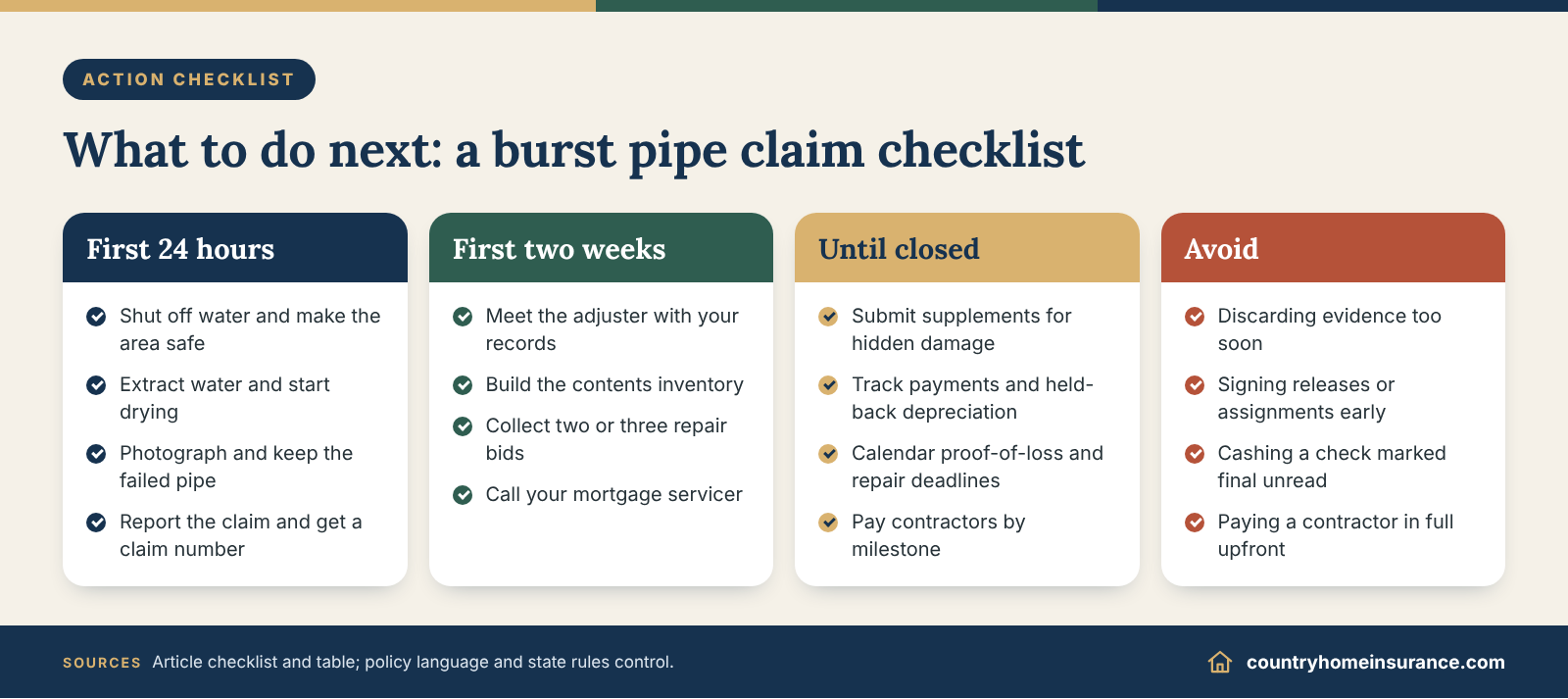
Frequently asked questions
Reporting and first steps
Do you have to file a burst pipe claim right away?
Policies expect prompt notice, and some states set outer limits, such as one year for an initial property insurance claim in Florida. The practical answer is to report within days, once the water is stopped and the area is safe. You can still decide later whether to proceed with the claim after you see the estimate.
Should you call the plumber or the insurer first?
Stop the water first, then call a plumber if you cannot make the repair safely, and report the loss the same day if you can. The two calls are not mutually exclusive. Ask the plumber for a written note on what failed and keep the broken part.
Can you throw away wet items?
Keep damaged items until the adjuster has seen them, if they are safe to keep. If you must dispose of something, photograph it first and tell the insurer. Do not discard the failed pipe.
What if you can’t find or operate the main shutoff?
Try fixture shutoffs near the break, call the water utility or an emergency plumber and, for a well, turn off the pump breaker. Record what happened, since reasonable emergency costs are typically part of the claim if the loss is covered.
Coverage and payment
Will homeowners insurance pay to replace the burst pipe?
Typically the resulting water damage may be covered while the failed pipe itself is treated as maintenance, because standard forms exclude wear, deterioration and corrosion. Details vary by form. See our coverage guide on burst pipe coverage for the logic.
Why is the first check smaller than the estimate?
Because the first payment is often the actual cash value of the loss minus your deductible, with depreciation held back until repairs are complete if you have replacement cost coverage. Ask for the breakdown and the steps to recover the holdback.
How long do you have to collect recoverable depreciation?
It depends on the policy. The ISO sample asks you to notify the insurer within 180 days of your intent to repair or replace to claim the remainder, and one insurer’s Maine endorsement sets other time limits. Read your own loss settlement clause.
Will a burst pipe claim raise your premium?
It can. NAIC’s consumer guide says the frequency and type of claims can affect premiums and renewal, and insurers differ in how they weigh a single paid claim. Ask your agent and review the claims history discussion above before deciding on a small claim.
Disputes, mold and living expenses
What if the adjuster’s estimate is too low?
Request the full estimate, compare it with your contractor’s bid, and send a written supplement or request a reinspection. If you still disagree, consider appraisal, state mediation where offered and a Department of Insurance complaint.
Do you need a public adjuster?
Not always. They can help on complex, high-value or stalled claims, but they charge a fee and rules vary by state. Check licensing, fee caps and cancellation rights before signing.
Is mold covered after a burst pipe?
It depends. The ISO sample excludes mold unless it is hidden within walls, ceilings or floors and caused by accidental discharge, and many policies add limits. Fast drying is the best protection. The EPA says drying within 24 to 48 hours usually prevents mold growth.
What if you can’t live in the house?
Ask the insurer about additional living expense coverage, document why the home is unfit, keep receipts and tell the insurer in writing before or as soon as you move out. Limits and time rules appear on your declarations page.
Sources
- NAIC — What You Need to Know When Filing a Homeowners Claim (published 2022-04-20; accessed 2026-10-16)
- NAIC — Navigating the Claims Process: Recover and Rebuild (published 2021-06-23; accessed 2026-10-16)
- NAIC — Unfair Property/Casualty Claims Settlement Practices Model Regulation (Model 902) (July 1997 text; accessed 2026-10-16)
- NAIC — A Consumer’s Guide to Home Insurance (2022; accessed 2026-10-16)
- NAIC — How Do I File a Complaint Against My Insurance Company? (2026-03-10; accessed 2026-10-16)
- Fannie Mae — Single-Family Servicing Guide, B-5-01: Insured Loss Events (topic dated 2023-07-12; accessed 2026-10-16)
- Triple-I — Facts + Statistics: Homeowners and renters insurance (2019–2023 data; accessed 2026-10-16)
- Maine Bureau of Insurance — ISO HO 00 03 05 11 Homeowners 3 Special Form (sample policy form) (2011 edition; accessed 2026-10-16)
- Maine Bureau of Insurance — USAA Maine Special Provisions HO-ME (08-16) (2016 edition; accessed 2026-10-16)
- U.S. Environmental Protection Agency — A Brief Guide to Mold, Moisture and Your Home (updated 2026-02-18; accessed 2026-10-16)
- U.S. EPA WaterSense — Fix a Leak Week (updated 2026-03-13; accessed 2026-10-16)
- Cornell Legal Information Institute — California Code of Regulations, title 10, section 2695.7 (accessed 2026-10-16)
- Florida Legislature — Florida Statutes section 627.70131 (2026) (accessed 2026-10-16)
- Florida Legislature — Florida Statutes section 627.70132 (2026) (accessed 2026-10-16)
- Florida Legislature — Florida Statutes section 626.854, public adjusters (2026) (accessed 2026-10-16)
- Florida Legislature — Florida Statutes section 627.7152, assignment agreements (2026) (accessed 2026-10-16)
- Florida Department of Financial Services — Residential Property Mediation (accessed 2026-10-16)
- Texas Legislature — Insurance Code chapter 542, Processing and Settlement of Claims (accessed 2026-10-16)
- Cornell Legal Information Institute — 11 NYCRR 216.6, Insurance Regulation 64 (accessed 2026-10-16)
- Washington State Legislature — WAC 284-30-370, Standards for prompt investigation of claims (current and updated versions shown; accessed 2026-10-16)
Important coverage note
Coverage depends on the actual policy, endorsements, exclusions, limits, deductible and cause of loss. State laws and insurance programs vary, and claim-handling rules, deadlines and fees change. Policy forms quoted here are samples; your contract controls. Verify case-specific questions with your insurer or agent and your state Department of Insurance. This article is educational information, not legal advice, and it does not promise that any claim will be paid.
About the editorial team
This guide was prepared by the countryhomeinsurance.com editorial team as general, educational information for homeowners. We research and summarize publicly available material, including state insurance departments, the NAIC, federal agencies, regulators’ consumer guides and published insurer and industry resources. We draw only on the sources that were available to us when we wrote this guide, and we list them in the Sources section with dates where we could find them.
Insurance rules, rates, products and program terms change, differ by state and by insurer, and can apply differently to your situation. We cannot guarantee that this content is complete, current or free of errors. It is not legal, financial, tax or insurance advice, it is not an offer to sell insurance or a recommendation of any insurer, agent or product, and reading it does not create a professional relationship of any kind.
To the fullest extent permitted by law, countryhomeinsurance.com and its editorial team, authors and contributors exclude all liability for any loss, damage or decision arising from the use of, or reliance on, this content. For questions about your own policy or claim, contact your insurer, a licensed agent or broker, your state Department of Insurance or another qualified professional.
Content created: October 16, 2026