
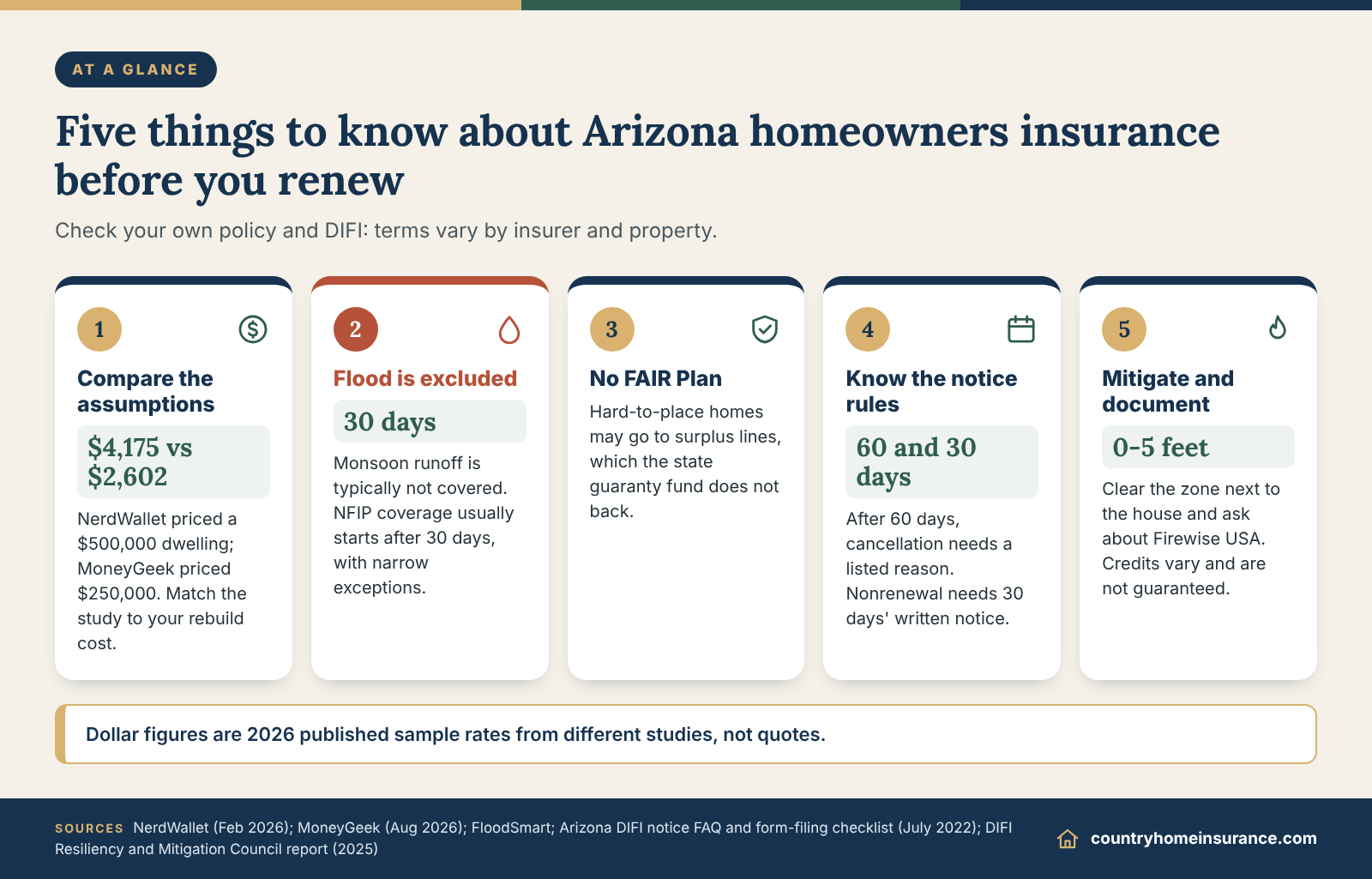
Arizona homeowners insurance costs more than the national figure in some 2026 rate studies and less in others, because each publisher prices a different sample home. NerdWallet puts a $500,000-dwelling policy near $4,175 a year; MoneyGeek puts a $250,000-dwelling policy near $2,602. Wildfire risk now drives availability in forested and wildland-edge areas, standard policies typically exclude flood (including monsoon flash flooding), and Arizona has no FAIR Plan, so hard-to-place homes often land in the surplus lines market. Check your policy and the Arizona Department of Insurance and Financial Institutions for specifics.
Key takeaways
- Published 2026 averages for Arizona range from about $2,600 to about $4,200 a year, but they price different dwelling limits. Compare the assumptions before you compare the dollar figures.
- Arizona is a “use and file” state: insurers can put a new rate into use right away and file it with the Department of Insurance and Financial Institutions (DIFI) within 30 days.
- Flood, including runoff from monsoon storms and debris flows after a wildfire, is not covered by a standard homeowners policy. NFIP coverage usually takes 30 days to start, with narrow exceptions.
- After a policy has been in force 60 days, an Arizona insurer can cancel only for listed reasons. Nonrenewal requires at least 30 days’ written notice with specific facts.
- Arizona doesn’t operate a FAIR Plan. If admitted insurers won’t write your home, an agent may be able to find surplus lines coverage, which the state guaranty fund does not back.
- Wildfire mitigation, from the 0–5 foot zone around the house to Firewise USA participation, is the main lever DIFI and its Resiliency and Mitigation Council point homeowners toward.
| Loss or exposure | Typical treatment in a standard HO-3 policy | Arizona-specific note |
|---|---|---|
| Wildfire, smoke and soot damage to the house | Typically covered as fire, up to the dwelling limit | Availability, not coverage, is the main problem in forested and wildland-urban interface areas |
| Monsoon wind damage to roof or fence | Typically covered as windstorm, subject to the deductible | Check whether a separate wind/hail deductible applies |
| Flash flood or surface runoff entering the home | Not covered | Requires NFIP or private flood coverage; risk rises for years after a nearby wildfire |
| Rain entering through a storm-damaged roof | Often covered when wind first opens the roof | Wording on interior water damage varies by policy form |
| Earthquake | Not covered | Available by endorsement or separate policy from some insurers |
| Barns, workshops, fences, detached garages | Covered under Coverage B up to its limit when not used for business or farming | Ranching or commercial use may require a farm or business policy |
| Wear, tear, sun-baked roofing, gradual leaks | Not covered | Desert UV and heat age materials; maintenance gaps are the owner’s cost |
| Vehicle burned in a wildfire | Not covered by the homeowners policy | Comprehensive auto coverage is the usual source |
How the Arizona home insurance market is set up
Arizona homeowners insurance works like coverage in most states on paper: you buy a package policy that protects the house, other structures, belongings and your liability, and the insurer agrees to pay for covered losses minus your deductible. What makes Arizona different is how rates are regulated, the absence of a state-run insurer of last resort and the way wildfire risk has reshaped which companies will write which properties. Those three facts shape every quote you’ll see, so they’re worth understanding before you start shopping.
Who regulates homeowners insurance in Arizona?
The Arizona Department of Insurance and Financial Institutions (DIFI) licenses insurers, agents and adjusters, receives rate and form filings, and handles consumer questions and complaints. It’s the state’s insurance regulator, and its consumer pages are the first stop when a policy decision, notice or claim doesn’t make sense.
What “use and file” means for your premium
According to DIFI’s spring 2025 handout on the state of homeowners insurance, Arizona uses a “use and file” system. An insurer can start charging a new rate immediately and must file it with DIFI within 30 days. DIFI reviews filed rates against three standards: they can’t be excessive, inadequate (too low to keep the insurer solvent) or unfairly discriminatory, meaning similar risks can’t be charged differently without a valid reason.
Arizona law also presumes rates aren’t excessive when the market is competitive. In practice, that puts more weight on competition than on prior approval to hold prices down. The Resiliency and Mitigation Council’s 2025 final report noted that, at the time of the report, DIFI had not rejected a homeowners rate filing. For you, the practical takeaway is simple: shopping between insurers matters more in Arizona than in states where every rate needs advance approval.
Consumer tools DIFI points homeowners to
DIFI keeps a homeowners insurance resources page with plain-language guides on fire-related losses, repairs after a disaster, disaster fraud, why premiums are going up, flood insurance and general insurance tips. The same page links to a list of licensed insurers that may offer policies in forested areas, wildfire mitigation grant information, data and charts, and the Resiliency and Mitigation Council’s work.
Two lookup tools matter most after a loss. DIFI’s license search lets you confirm that an agent or independent adjuster is licensed, and the Arizona Registrar of Contractors lets you check a contractor’s license. DIFI specifically recommends checking license, insurance and complaint history before you sign anything with a contractor or adjuster who wasn’t invited. The handout lists DIFI’s main phone number as (602) 364-3100.
The council, task force and data call shaping the market
DIFI formed a Resiliency and Mitigation Council in December 2024 to study the availability and affordability of homeowners insurance in forested and wildland-urban interface (WUI) areas. Its final report, released in December 2025, reviewed wildfire science, insurer risk models, building codes, mitigation and what other states such as Alabama, California, Colorado, Idaho, Hawaii and Nevada have tried. The council deliberately did not endorse specific measures; it presented a toolkit instead.
In 2025 the legislature passed HB 2054, which created a fire insurance review task force and called for better reporting on wildfire risk and fire losses. To feed that work, DIFI ordered insurers to report transaction-level data on homeowners and dwelling policies, including surplus lines policies, in areas the Department of Forestry and Fire Management designates as heightened wildfire risk, covering calendar years 2025 and 2026. The data is to be used only in aggregated, anonymized form. If you live in one of those areas, the results may shape future rules on nonrenewals and mitigation credit.
Where Arizona homeowners get coverage
Most Arizona homes are insured in the regular, or admitted, market. When that market says no, the path looks different from many neighboring states because there’s no FAIR Plan to fall back on.
Admitted insurers and the forested-areas list
An admitted insurer is licensed by DIFI, files its rates and forms with the state and participates in the state guaranty fund. DIFI’s spring 2025 handout counted 103 licensed companies that may offer homeowners policies in wildfire risk areas, and the department publishes a list of insurers that may write homes in forested parts of Arizona (the version reviewed was updated February 6, 2025).
That list is a starting point, not a promise. DIFI says the list isn’t an endorsement and that eligibility, cost and coverage vary by insurer, applicant and property. If you can’t find coverage from a listed company, DIFI suggests contacting the Arizona Independent Agent & Brokers Association or the Arizona Surplus Lines Association.
No FAIR Plan, so surplus lines fills the gap
A FAIR Plan (Fair Access to Insurance Requirements) is a state-mandated pool that provides basic property coverage when the private market won’t. The NAIC’s overview of FAIR plans says 33 states have some form of FAIR plan or residual market mechanism; Arizona isn’t among the states it names, and a Coconino County briefing on the wildfire insurance crisis recommended developing one for Arizona. As of this review, Arizona doesn’t operate a FAIR Plan for homeowners, so verify with DIFI before relying on that, because legislation could change it.
Without a residual market, hard-to-place homes usually go to the surplus lines market, also called excess and surplus (E&S). Surplus lines insurers aren’t admitted carriers, so they generally have more freedom on price and policy wording. DIFI points consumers who can’t find admitted coverage to the Arizona Surplus Lines Association, and your agent can explain how a placement would work.
What the guaranty fund does, and doesn’t, back
If an admitted insurer becomes insolvent, the Arizona Property & Casualty Insurance Guaranty Fund pays covered homeowners claims up to the lesser of the policy limit or $300,000, after a $100 deductible, and only after other available insurance has been used. That cap can matter if your dwelling limit is well above $300,000.
The guaranty fund doesn’t cover surplus lines policies, according to the National Conference of Insurance Guaranty Funds’ 2024 Arizona summary. That’s one of the trade-offs to weigh when an agent offers a surplus lines placement; ask about the insurer’s financial strength rating before you buy.
What Arizona homeowners insurance costs in 2026
There’s no single “Arizona price.” What you’ll find are sample-rate studies, each built on a specific house, coverage limit and deductible. They’re useful for seeing direction and relative cost, but your quote depends on your home’s rebuild cost, location, roof, claims history and the insurer’s own risk model.
What do the published 2026 averages say?
Two consumer publishers updated Arizona figures in 2026. Their numbers look far apart until you read the fine print on what they priced.
NerdWallet’s Arizona figures
NerdWallet’s Arizona page, updated February 20, 2026, lists an average of $4,175 a year for a policy with $500,000 in dwelling coverage, $300,000 in liability coverage and a $1,000 deductible, assuming good credit and no recent claims. On that same profile, it puts the national average at $3,005, so Arizona comes out about 39% higher. The same page shows how much the dwelling limit moves the price: about $2,690 at $300,000 of dwelling coverage, $3,415 at $400,000 and $5,490 at $700,000.
NerdWallet’s broader national report, updated May 6, 2026, uses a $400,000 dwelling profile and puts Arizona at $3,415 against a national figure of $2,490. Its rates come from public filings compiled by Quadrant Information Services and represent sample rates, not quotes.
MoneyGeek’s Arizona figures
MoneyGeek’s Arizona cost page, updated August 13, 2026, uses a $250,000 dwelling limit, $125,000 in personal property, $200,000 in liability and a $1,000 deductible on a frame home built in 2000. On that profile it shows Arizona at $2,602 a year against a national $3,467, roughly 25% below. At a $500,000 dwelling limit, its Arizona figure rises to $4,181. MoneyGeek doesn’t name its rate-data provider on the page, which makes its figures harder to audit.
Why the studies disagree, and how to use them
The gap mostly comes down to the dwelling limit and the national comparison set. A $250,000 policy and a $500,000 policy aren’t the same product, and each publisher’s “national average” uses its own sample. Don’t compare one publisher’s Arizona figure against another publisher’s national figure. Use each study on its own terms: find the row closest to your rebuild cost, then treat it as a rough range.
NerdWallet also cites a First Street estimate of a $482,748 median rebuilding cost in Arizona. If your home is near that figure, the $500,000 rows are the more relevant benchmark, but your own replacement-cost estimate should drive your limit, not the median.
| Publisher and update date | Sample coverage | Arizona annual average | Same publisher’s national figure |
|---|---|---|---|
| NerdWallet Arizona page (Feb 20, 2026) | $500,000 dwelling, $300,000 liability, $1,000 deductible, good credit | $4,175 | $3,005 |
| NerdWallet national report (May 6, 2026) | $400,000 dwelling, $300,000 liability, $1,000 deductible, 1984 two-story home | $3,415 | $2,490 |
| MoneyGeek Arizona page (Aug 13, 2026) | $250,000 dwelling, $125,000 contents, $200,000 liability, $1,000 deductible | $2,602 | $3,467 |
| MoneyGeek higher tier (Aug 13, 2026) | $500,000 dwelling, $250,000 contents, $300,000 liability | $4,181 | Not stated for this tier |
| NerdWallet, poor credit (Feb 20, 2026) | $500,000 dwelling profile with poor credit | $6,695 | Not compared |
How fast have Arizona premiums been rising?
Rate studies show the level; trend data shows the direction. Several sources look back over different periods, and they’re best read together rather than averaged.
What the state’s own review found
The Resiliency and Mitigation Council’s 2025 report found that Arizona’s average HO-3 premium rose about 20% cumulatively from 2018 to 2022, less than the roughly 25% national increase over the same period. It also noted underwriting losses in Arizona homeowners insurance in 2021, 2022 and 2023, which helps explain why insurers kept filing increases afterward. DIFI’s spring 2025 handout adds that national construction costs rose more than 30% over five years and that average Arizona residential reconstruction costs rose 6% between September 2022 and September 2023, according to Verisk.
What federal and consumer-group studies add
The U.S. Government Accountability Office’s 2026 report found that the average U.S. premium rose only about 3% after inflation between 2019 and 2024, but that some disaster-prone areas saw increases of 25% or more. It also found that moving from medium to high wildfire risk was associated with about an 8% higher premium, while high wind risk carried a much larger premium gap. A Consumer Federation of America report covered by Arizona public radio in April 2025 found the typical Arizona premium rose by more than $700 between 2021 and 2024.
These studies use different methods and periods, so treat them as context. Together they point the same way: costs have climbed, and wildfire areas have felt more pressure on availability than the statewide averages suggest.
How much does location inside Arizona change the price?
Where you live inside the state can swing the price as much as your coverage choices. Both publishers break out cities, and they disagree on the order, which is a useful reminder about sample rates.
City figures from the 2026 studies
On its $500,000 profile, NerdWallet lists Maricopa and Phoenix at about $5,125 a year, Casa Grande at $4,825 and Scottsdale at $4,680, with Yuma ($3,655), Tucson ($3,780) and Prescott Valley ($3,790) at the lower end. On its $250,000 profile, MoneyGeek shows Phoenix at $2,792, Tempe at $2,776, Scottsdale at $2,721, Mesa at $2,597, Tucson at $2,405 and Prescott Valley at $2,322. Both put metro Phoenix above Tucson, but neither study prices individual high-wildfire-risk rural properties, where availability is often the bigger issue.
Rim Country, the high country and the desert floor
State data shows why statewide averages hide so much. In a December 2024 presentation to the council, DIFI cited Verisk data estimating that about 5% of Arizona structures face high to extreme wildfire risk, with much higher shares in Gila (41%), Navajo (33%), Greenlee (27%), Apache (25%) and Coconino (22%) counties. Homeowners in those counties are the most likely to face nonrenewal or surplus lines pricing, even when a Phoenix or Tucson neighbor sees only an ordinary renewal increase.
Desert-floor homes have their own drivers: monsoon wind, roof wear from heat and sun, and flash flooding in washes. They’re less likely to be declined for wildfire, though homes on the edges of fast-growing metro areas can still sit in a wildland-urban interface. The council’s report found that Pinal County had the largest growth in WUI housing between 1990 and 2020, at 223%.
What drives your Arizona home insurance rate
Insurers price each home with a long list of rating factors. Some you can change, some you can only document better, and a few you can’t touch at all. DIFI’s handout groups the basics this way: the coverage you select, the property’s location, its building materials and your deductible. Below is how those play out in Arizona.
How does location shape the price?
Location carries the hazards that insurers model: wildfire exposure, wind and hail history, distance to a fire station and water supply, and local construction costs.
Wildfire risk scores and aerial imagery
Many insurers now rely on third-party wildfire scores. The council’s report describes several used in Arizona. Verisk’s FireLine score runs from 0 (best) to 30 (worst) and draws on high-resolution aerial imagery; Verisk received about 4,000 requests to update scores in 2024, and only a small share were amended. ZestyAI’s model classifies about 85% of Arizona’s 2.7 million residences as low risk and about 2% as high risk. Different insurers use different models, which is one reason two companies can treat the same house very differently.
If you’ve cleared brush, replaced a roof or hardened vents since the last imagery flight, ask your agent which score the insurer uses and how to request a review. A proposed 2026 Senate bill would have barred insurers from using aerial images more than 180 days old and required them to share the images on request, but that was an introduced bill, not current law. Check its status before relying on it.
Fire protection and the “protection class”
The NAIC lists the local fire protection class among standard rating factors. A protection class reflects how well a fire department, its water supply and its response distance could fight a house fire. DIFI’s handout lists the adequacy of local fire departments or districts as one of the factors in wildfire risk. In rural Arizona, a home miles from the nearest station or without hydrants may rate worse than a similar house in town, even when the wildfire score is moderate.
Which features of the house matter most?
The building itself sets the size of the potential claim and how likely damage is in the first place.
Rebuild cost, not market value
Your dwelling limit should reflect the cost to rebuild the home, not its sale price or land value. That distinction is sharp in Arizona. A modest cabin on a valuable lot near Prescott may cost less to rebuild than its sale price suggests, while a custom home in a remote area can cost far more to rebuild than buyers would pay. A Coconino County briefing on the wildfire insurance crisis reported local contractors building at roughly $500 to $550 per square foot, and noted that most homeowners affected by the 2022 Tunnel Fire were underinsured.
Higher limits raise premiums, but an inadequate limit can leave you short at the worst possible moment. The NAIC recommends insuring for at least 80% of replacement value, and many policies require that to receive full replacement-cost payment on partial losses.
Roof, siding and other ignition-resistant materials
Construction type, home age and updated systems all feed the rate, per the NAIC. In Arizona, the wildfire lens adds detail: a Class A fire-rated roof, ember-resistant vents and noncombustible siding near ground level reduce the chance that embers ignite the house. The council’s report notes that some insurers offer discounts for homes with fiber cement siding, according to a siding manufacturer, and that documented mitigation has occasionally led to premium reductions. Those are examples, not guaranteed discounts, so ask each insurer what it actually credits.
Which personal and coverage choices change the quote?
Your profile and your coverage selections can move the price as much as the house does.
Credit-based insurance scores and claims history
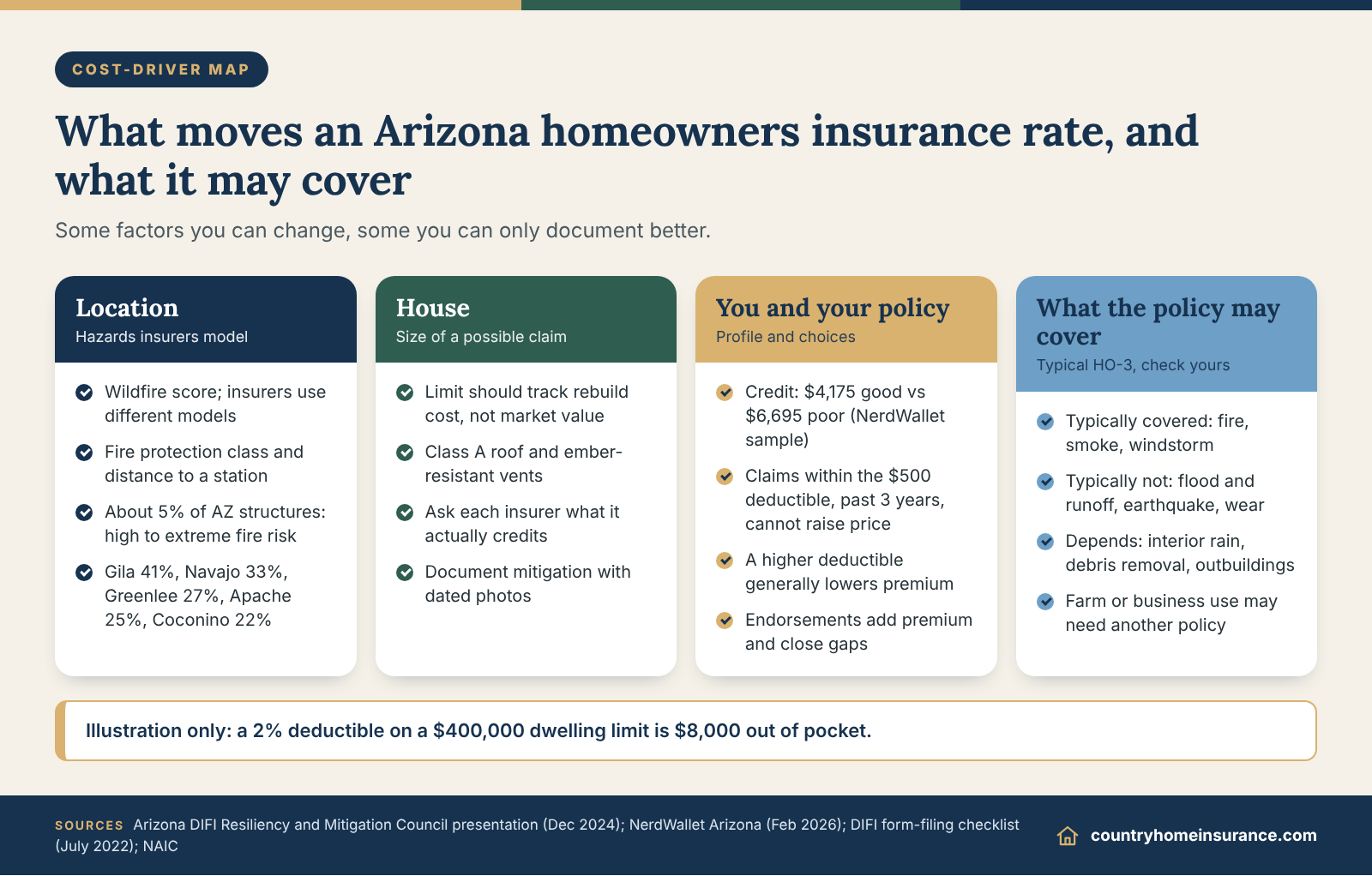
Arizona insurers can use credit-based insurance scores within limits set by state law. NerdWallet’s Arizona sample rose from $4,175 to $6,695 a year when it switched from good to poor credit, which shows how heavy that factor can be. DIFI’s handout suggests confirming that your insurer has accurate information about your structure and credit, because errors cost money.
Claims history matters too. DIFI warns that filing a claim for a loss near your deductible may raise your premium at renewal. Arizona’s homeowners form-filing checklist includes one protective rule: under A.R.S. § 20-270, an insurer can’t charge more for residential property insurance because of claims that didn’t exceed the $500 deductible in the previous three years. Ask how your insurer applies that rule if you have small claims on file.
Deductible, limits and add-ons
A higher deductible generally lowers the premium, and DIFI lists it as one of the ways to reduce cost. Endorsements such as extended replacement cost, scheduled personal property or water backup add premium but close specific gaps. The right mix depends on how much cash you can comfortably absorb after a loss and which gaps would hurt you most.
| Factor | Why insurers care | Arizona angle | What you can do |
|---|---|---|---|
| Wildfire risk score | Predicts fire loss likelihood and severity | Models vary; high-risk shares are concentrated in Gila, Navajo, Greenlee, Apache and Coconino counties | Mitigate, document and ask which model the insurer uses |
| Fire protection class | Reflects firefighting capacity and water supply | Rural homes far from stations may rate worse | Document nearby hydrants, water storage and district coverage |
| Dwelling limit | Sets the maximum payout and the premium base | Remote and custom homes can cost more to rebuild than market value suggests | Get a current replacement-cost estimate |
| Roof and exterior materials | Affect ignition and wind damage | Class A roofs and ember-resistant vents matter in the WUI | Ask what each insurer credits before you remodel |
| Credit-based insurance score | Statistically linked to claim frequency | Can change a sample premium by thousands of dollars | Check for errors and ask how it’s used |
| Claims history | Past claims predict future claims | Claims within the $500 deductible in the prior three years can’t raise the premium under A.R.S. § 20-270 | Reserve claims for larger losses |
| Deductible | Shifts small losses to you | Higher deductibles are one of DIFI’s suggested savings | Pick an amount you could pay tomorrow |
What a standard Arizona homeowners policy covers
Most Arizona homeowners carry an HO-3 policy, often called a special form policy. The DIFI council presentation from December 2024 found HO-3 policies made up about 75.8% of homeowners exposure and 73.6% of homeowners premium written in the state. Understanding its structure helps you spot gaps before a loss rather than after.
What are the six parts of a homeowners policy?
The NAIC describes the standard package as dwelling, other structures, personal property, additional living expense, personal liability and medical payments. Each has its own limit on your declarations page, the summary page that lists your coverages, limits and deductibles.
Coverage A and Coverage B: the house and other structures
Coverage A (Dwelling) protects the house and attached structures such as an attached garage or covered patio. Coverage B (Other Structures) protects detached structures such as fences, sheds, detached garages and workshops, usually at a default of a percentage of Coverage A. For rural Arizona properties with a barn, ramada, pump house or long fence line, that default may not be enough, so check it against what you’d actually need to rebuild.
Coverage C: belongings and their sublimits
Coverage C (Personal Property) covers furniture, clothing, tools and other belongings, whether at home or temporarily elsewhere. The NAIC notes that categories such as jewelry, furs, firearms and computers often carry sublimits, frequently $500 to $1,000, unless you schedule them on an endorsement. Home-business inventory is also commonly excluded.
Coverage D: loss of use and additional living expense
Coverage D pays necessary added living costs, such as a rental, meals and mileage above normal, while a covered loss makes the home unlivable. After a wildfire evacuation or a large fire loss, this coverage keeps your household afloat. Policies set limits by dollar amount, time or both, so check yours. The 2026 Senate bill mentioned above would also have barred insurers from requiring an itemized list of lost belongings before paying living expenses after a total loss; that was a proposal, not current law.
Coverage E and Coverage F: liability and medical payments
Coverage E (Personal Liability) pays for injuries or property damage you’re legally responsible for, along with defense costs, up to the limit. Coverage F (Medical Payments to Others) pays modest medical bills for guests hurt on your property regardless of fault. On acreage with horses, a pool, a trail or ATVs, liability limits deserve a hard look; some exposures need an umbrella or a farm policy.
Which policy forms do Arizona insurers use?
Not every policy is an HO-3. Arizona law also sets a baseline for how fire coverage must be written.
HO-3, HO-5 and dwelling fire forms
An HO-3 typically covers the house against all risks of direct physical loss except those excluded, while covering belongings only for named perils. An HO-5 usually extends open-perils protection to belongings as well. Dwelling fire (DP) forms are often used for rentals, vacant properties and some hard-to-insure homes and may cover fewer perils and pay on an actual cash value basis. Surplus lines policies can use their own wording entirely, so read them closely.
The Arizona Standard Fire Policy baseline
Arizona requires fire policies to conform to the 1943 New York Standard Fire Policy, which the state calls the Arizona Standard Fire Policy, with other perils added by endorsement. DIFI’s homeowners form-filing checklist lists several protections that flow from that baseline. Insurers can’t apply a “sudden and accidental” limitation to fire or lightning, must cover arson and unintentional fire caused by vandalism, and must cover property removed from endangered premises for at least five days. Exclusions based on an increased hazard apply only when the hazard was within the insured’s control or knowledge, and they can’t be applied against an innocent co-insured.
The checklist also says a building is considered vacant only after 60 consecutive days. If you own a seasonal cabin in the high country or plan an extended trip, ask how your policy defines vacancy and occupancy, because vacancy can limit coverage for some perils.
How will a claim be valued?
The valuation method on your declarations page decides whether you’re paid enough to rebuild or only the depreciated value of what was damaged.
Replacement cost versus actual cash value
The NAIC’s explanation of ACV and replacement cost puts it plainly: replacement cost value (RCV) pays to repair or replace with comparable materials, while actual cash value (ACV) deducts for age and wear first. Many RCV policies pay the ACV portion first and release the withheld amount, called recoverable depreciation, after repairs are completed. Arizona’s desert sun shortens the life of many roofing materials, so ACV settlement on an older roof can leave a sizable gap.
Arizona rules on how ACV is calculated
DIFI’s checklist includes protections that affect ACV payments. Policies using the term must define actual cash value. Sales tax may not be excluded, is part of an ACV estimate and isn’t depreciable. Profit and overhead must be included in an ACV payment when you’d reasonably be likely to incur that cost in repairing or replacing the loss. If an ACV estimate leaves out sales tax or general-contractor overhead on a job that needs a general contractor, ask the adjuster why.
Extended and guaranteed replacement cost
Because rebuild costs can spike after a disaster, some insurers offer extended replacement cost, which adds a percentage cushion above Coverage A, or guaranteed replacement cost, which the NAIC says may be available for an added premium. Full roof replacement cost without depreciation may also be offered. Ask whether ordinance or law coverage, which pays for code-required upgrades during a rebuild, is included and at what limit.
| Item | Replacement cost value (RCV) policy | Actual cash value (ACV) policy | Arizona rule to check |
|---|---|---|---|
| Hypothetical example: $20,000 roof repair, 15-year-old shingles | Up to $20,000 minus deductible, often paid in two stages | $20,000 minus depreciation minus deductible | Sales tax in the estimate can’t be depreciated |
| General contractor overhead and profit | Included when a general contractor is reasonably needed | Must be included if you’d reasonably incur it | DIFI form-filing checklist (07/2022) |
| Recoverable depreciation | Usually released after repairs are completed | Not applicable | Check the policy’s deadline to complete repairs |
| Claim payment timing | Within 30 days after an acceptable proof of loss | Within 30 days after an acceptable proof of loss | R20-6-801, as summarized in DIFI’s checklist |
| Underinsurance | May reduce partial-loss payments if limit is below the required share of replacement cost | Less affected but pays less overall | NAIC suggests at least 80% of replacement value |
Coverage gaps Arizona homeowners run into
The biggest surprises after an Arizona loss usually come from three places: water that counts as flood, perils that are excluded outright and limits that are lower than people assumed. Here’s where to look before a storm or fire rather than after.
Is monsoon flooding covered?
Generally not under a homeowners policy. This is the gap that catches the most desert homeowners off guard, because they don’t think of themselves as living in flood country.
Why flash floods fall outside the homeowners policy
FloodSmart, the NFIP’s consumer site, says most homeowners insurance doesn’t cover flood damage. The NAIC lists ground water, runoff and snow-melt damage among typical flood exclusions. The Standard Flood Insurance Policy definition of flood includes unusual and rapid runoff of surface waters, which is the kind of event a heavy monsoon cell can produce in a wash or low street. If muddy water flows into your home from outside, expect your homeowners policy to exclude it unless you have separate flood coverage.
FloodSmart also notes that one in three flood insurance claims comes from low- and moderate-risk zones, so being outside a mapped high-risk area doesn’t mean you’re safe from flooding.
NFIP limits and the 30-day wait
The NFIP’s buying guide lists homeowner limits of up to $250,000 for the building and $100,000 for contents. Coverage generally starts 30 days after purchase. Exceptions include buying in connection with making, increasing, extending or renewing a mortgage; a one-day wait if your property is newly mapped into a high-risk zone and you buy within 12 months; and a one-day wait for flooding caused or worsened by a wildfire on federal land when you buy within 60 days of the fire’s containment date. Flood policies don’t renew automatically, so set a reminder.
If your rebuild cost exceeds the NFIP building limit, ask about private flood or excess flood coverage. In communities that participate in the NFIP, flood insurance is mandatory for government-backed mortgages on homes in high-risk zones.
Flood risk after a wildfire
Burned slopes shed water fast. FloodSmart says flood risk remains significantly higher until vegetation is restored, up to five years after a wildfire, and DIFI’s handout lists increased flood risk after wildfires as an issue facing Arizona homeowners. If a fire has burned upslope from your home, even a home that didn’t burn, look at flood coverage right away, and pay attention to the federal-land exception above.
What does monsoon wind and dust damage look like on a claim?
Wind is generally a covered peril on an HO-3, but how the damage happened shapes the answer.
Roofs, fences and fallen trees
Wind that lifts shingles, flattens a block or wood fence, or drops a tree onto the house is typically covered, subject to your deductible and the policy’s terms. Tree removal often carries its own limit, and debris removal limits vary. If your policy has a separate wind/hail deductible, it can apply instead of the all-other-perils deductible for these losses. Fences and detached structures fall under Coverage B, so make sure that limit fits your property.
Rain and dust that get inside
Many policies cover interior rain damage only when wind first creates an opening in the roof or wall. Rain seeping through worn flashing, or dust drifting in through gaps, often falls under maintenance or wear exclusions. Photograph the opening and any wind damage before temporary repairs, and keep receipts for tarps and emergency work; reasonable steps to prevent further damage are usually expected under the policy.
What else is typically excluded or limited?
A few more exclusions matter in Arizona, some because of geography and some because of the way people use their property.
Earthquake, mold and wear
The NAIC notes that standard policies don’t cover earthquake, though an endorsement is often available. Mold, infestations such as termites and rats, and gradual deterioration are commonly excluded or tightly limited. Desert heat and UV exposure wear down roofing, sealants and plumbing over time; damage from that wear is usually your cost, while sudden damage that results from a covered peril may be covered.
Vehicles, home businesses and pets
The NAIC’s wildfire guidance is direct: homeowners insurance isn’t designed to cover your car; comprehensive auto coverage typically handles fire damage to vehicles. Home-business property and liability usually need separate coverage, and some policies exclude liability for certain dog breeds or exotic animals, which matters if you keep livestock-guardian dogs or unusual animals on acreage.
Wildfire and your Arizona homeowners policy
For most Arizona homeowners, wildfire isn’t a coverage problem so much as an availability and adequacy problem. Fire is a core covered peril on virtually every homeowners policy. The harder questions are whether an insurer will write or renew your home, and whether your limits would actually rebuild it.
What does fire coverage typically pay for?
The NAIC’s wildfire consumer guidance says homeowners policies usually cover repair or replacement of the structure and belongings damaged by flames, smoke, soot and ash. How much you’re paid still depends on your limits, valuation method and deductible.
Structure, belongings and smoke damage
A total loss draws on Coverage A up to the dwelling limit, plus Coverage B for detached structures and Coverage C for belongings. Partial losses, especially smoke and soot that infiltrate a house several streets from the fire line, may involve cleaning, sealing and replacing materials. Arizona’s form-filing rules say extremes of temperature that result from fire and lightning can’t be excluded, which matters for heat-damaged windows, wiring or appliances near a burn.
Evacuation, living expenses and debris removal
If a civil authority orders an evacuation because of a covered peril nearby, many policies pay some additional living expense for a limited period, though wording varies widely. After a loss, Coverage D pays the added cost of living elsewhere. Debris removal is usually included up to a sublimit or a percentage of the dwelling limit, and on a burned rural lot with outbuildings, cleanup can be expensive. Arizona’s standard fire baseline also requires coverage for property removed from endangered premises for at least five days, so moving valuables to safety can stay within coverage.
Are you insured for enough to rebuild?
Underinsurance is the quiet wildfire risk. When a fire takes a whole neighborhood, labor and material costs can climb just as everyone starts rebuilding at once.
Lessons from northern Arizona fires
A Coconino County briefing found that most homeowners affected by the 2022 Tunnel Fire near Flagstaff were underinsured, and that many insurers set coverage using formulas tied to home value. It reported local building costs around $500 to $550 per square foot. The council’s report also cites industry data that 90% of homes that ignite in a wildfire are total losses, which means the dwelling limit, not a partial-repair estimate, is often the number that matters.
How to test your dwelling limit
Ask your agent for the replacement-cost estimate behind your limit and check its square footage, finishes, garage size and outbuildings against reality. Ask a local builder what custom construction costs in your area today. Then look at extended replacement cost and ordinance or law coverage, because post-fire rebuilding may trigger current code requirements. If the gap is large, it’s usually cheaper to raise the limit before a fire season than to discover it after.
Why insurers are pulling back in wildfire areas
Understanding the insurer’s view helps you respond in ways that can actually change a decision.
Losses, reinsurance and the growing WUI
The council found Arizona homeowners insurance posted underwriting losses in 2021, 2022 and 2023. Its report also documents how fast exposure has grown: wildland-urban interface housing units rose from 653,144 in 1990 to 1,461,103 in 2020, a 124% increase. Over the five years reviewed, Arizona averaged about 1,860 fires and 442,000 acres burned per year. A Coconino County briefing added that insurers struggle to obtain reinsurance for policies in high-risk wildfire areas.
Fast fires and structure losses
The council’s report highlights research finding that fast-moving fires were only 2.7% of wildfires from 2001 to 2020 but caused 89% of the structures damaged or destroyed. That’s why insurers focus on ember resistance and the immediate zone around a house: they’re trying to predict whether a home survives a fast, wind-driven fire, not whether a fire starts nearby.
How deductibles work on Arizona home policies
Your deductible is the part of a covered loss you pay before the insurer pays the rest. DIFI notes that raising it can lower your premium. The catch is that some policies carry more than one deductible, and the one that applies depends on the cause of loss.
What deductible structures will you see?
Look for every deductible on your declarations page, not just the headline number.
Flat-dollar all-perils deductibles
The most common structure is a flat-dollar deductible, such as $1,000 or $2,500, that applies to all covered perils. The rate studies cited earlier use a $1,000 deductible. It’s predictable, which makes it easy to plan for.
Percentage and peril-specific deductibles
Some policies apply a separate deductible to wind and hail, and some surplus lines or wildfire-exposed policies use a percentage deductible tied to the dwelling limit. A 2% deductible on a $400,000 dwelling limit means you’d carry the first $8,000 of a qualifying loss. Percentage deductibles grow with your dwelling limit, so they rise each time your limit is raised for inflation. Ask exactly which perils trigger any special deductible and whether it applies per occurrence or per claim.
How do you choose the right deductible?
The best deductible is one you could pay without borrowing, set high enough that you’d only file for losses that genuinely need insurance.
Matching the deductible to your claim threshold
DIFI’s handout says that in a hardening market, homeowners insurance may be best reserved for catastrophic events, and it suggests using discretion when filing claims. If you wouldn’t file for a $1,500 fence repair anyway, a $500 deductible buys protection you’ll never use. Compare the annual premium savings of a higher deductible against how many years it would take for those savings to cover the extra out-of-pocket cost.
Keeping cash ready
Whatever you choose, keep the deductible amount in an accessible account. After a wildfire evacuation, you may also face hotel costs before living-expense payments begin and a deductible due before repairs start. Rural owners should also plan for costs that the policy may cap, such as tree removal or extra debris hauling.
| Deductible type | Deductible amount | Out of pocket on a $6,000 covered roof loss | Out of pocket on a $60,000 covered fire loss |
|---|---|---|---|
| Flat $1,000 all perils | $1,000 | $1,000 | $1,000 |
| Flat $2,500 all perils | $2,500 | $2,500 | $2,500 |
| 1% of dwelling limit | $4,000 | $4,000 | $4,000 |
| 2% of dwelling limit | $8,000 | $6,000 (whole loss; no claim payment) | $8,000 |
| 5% of dwelling limit | $20,000 | $6,000 (whole loss; no claim payment) | $20,000 |
Hypothetical example: on a $400,000 dwelling limit with a 2% deductible, a $6,000 wind repair is entirely yours. The same policy would pay $52,000 on a $60,000 covered fire loss, subject to all other policy terms. These figures illustrate the math only; actual payments depend on the policy, valuation method and cause of loss.
Arizona cancellation and nonrenewal rules
If you live in a wildfire-prone area, there’s a real chance you’ll get a nonrenewal notice at some point. Arizona law sets specific rules for when and how an insurer can end your coverage. Knowing them helps you tell the difference between a valid notice and one you can challenge.
When can an insurer cancel mid-term?
Cancellation ends a policy before its term is over. Arizona limits it sharply once a policy has been in force for a while.
The 60-day rule and permitted reasons
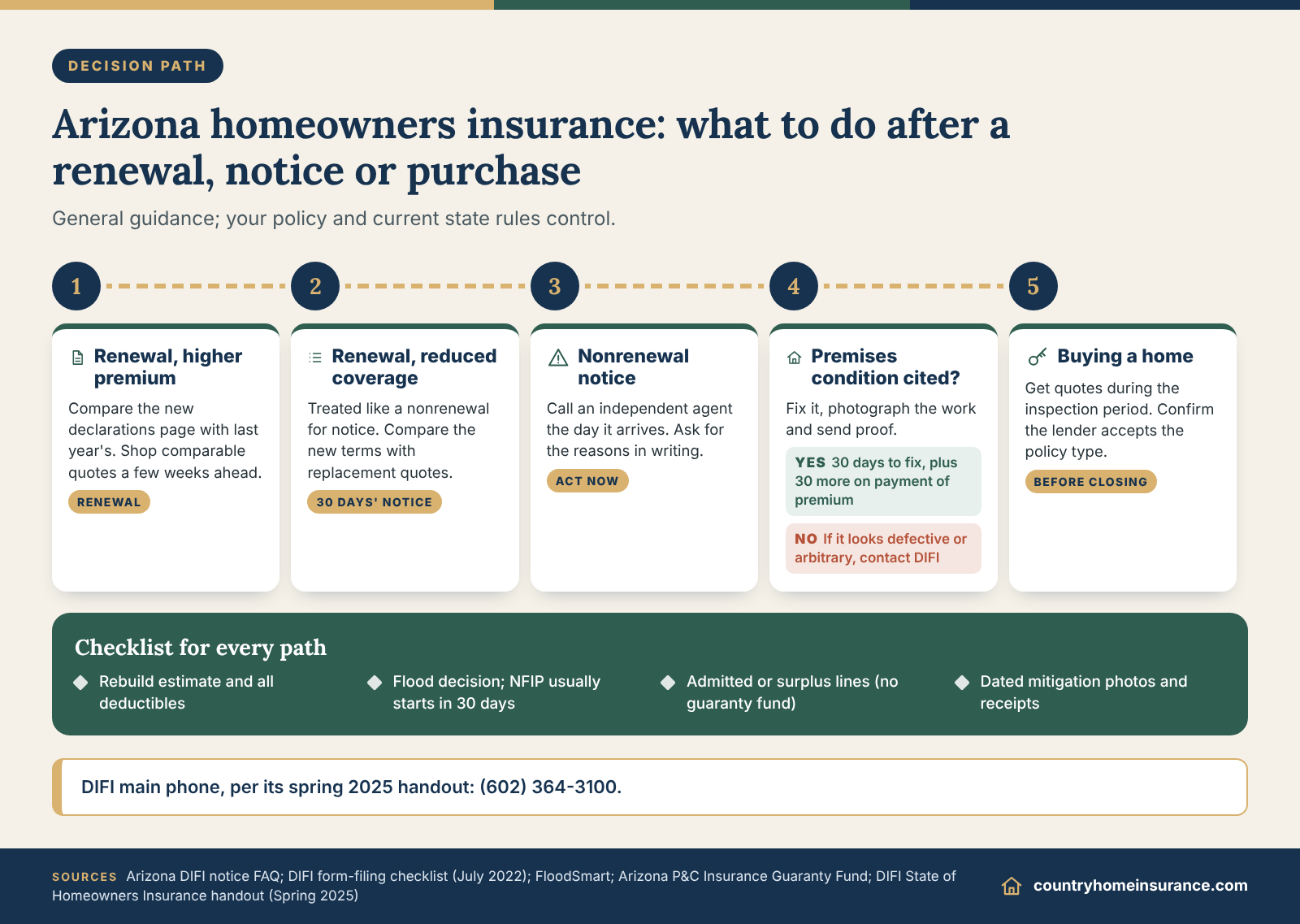
DIFI’s homeowners form-filing checklist summarizes A.R.S. § 20-1652(A): during the first 59 days a new policy may be canceled for any reason, but after 60 days, or immediately on a renewal, cancellation is allowed only for listed grounds. Those include nonpayment of premium, conviction of a crime that increases the insured hazard, fraud or material misrepresentation in obtaining the policy or presenting a claim, discovery of grossly negligent acts that substantially increase the hazard, a substantial change in the risk, a determination by the director that continuing the policy would violate state insurance law, and failure to correct conditions on the premises that contributed to past losses or make future losses more likely. A 1990 DIFI circular letter adds that these rules apply to homeowners policies and residential property of up to four units.
How much notice you’ll get
DIFI’s consumer FAQ says insurers are required to give only five days’ notice before canceling a policy, and that cancellations are uncommon in Arizona. Notices must be in writing, mailed to you and state the specific facts behind the ground relied on. A 1990 DIFI circular letter said vague phrases such as “loss history” don’t meet that standard. If a cancellation notice doesn’t state specific facts tied to a permitted reason, ask the insurer and DIFI whether it’s valid.
What notice is required for a nonrenewal?
Nonrenewal means the insurer won’t offer a new policy term. It’s far more common than cancellation, and it’s where wildfire decisions usually show up.
The 30-day notice and conditional renewals
According to DIFI’s notice FAQ, an insurer must give at least 30 days’ notice of nonrenewal before the end of the policy period, and the same 30 days applies if it offers renewal only with reduced limits or dropped coverages. Nonrenewal can rest on the cancellation grounds or on other reasons. DIFI’s checklist adds that if the insurer doesn’t give the required notice, it must renew the policy on payment of premium, and that it can’t reduce limits when you’ve paid premium for a specific limit.
Thirty days is not much time to replace coverage in a wildfire area, so start shopping the day the notice arrives. If a mortgage is involved, your lender will also want proof of new coverage before the old policy ends.
Nonrenewal for conditions on the premises
When a nonrenewal is based on conditions on your property, such as overgrown vegetation or a damaged roof, Arizona gives you a chance to fix them. Under A.R.S. § 20-1652(B), as summarized in DIFI’s checklist, you get 30 days to remedy the conditions, and if they’re not satisfactorily fixed, an additional 30 days to cure them on payment of premium. If you believe a premises-based nonrenewal is arbitrary or capricious, the 1990 circular letter says you can appeal to the director. Ask the insurer to put the specific conditions in writing, fix them, photograph the work and send proof promptly.
What changes have lawmakers proposed?
Arizona’s notice rules have drawn attention as wildfire nonrenewals grew. Several bills have been introduced; check current status before relying on any of them.
The 2026 Senate proposal
The introduced version of SB 1788 in the 2026 session would have moved the nonrenewal notice from 30 to 60 days, required 60 days’ written notice with an explanation before coverage reductions or premium increases of more than 10%, and barred nonrenewals for 12 months in areas covered by a governor’s emergency declaration after a natural disaster or wildfire. It also would have required insurers to disclose mitigation discounts and premium factors such as risk scores. This article treats it as a proposal only; verify with DIFI or the Arizona Legislature whether any version became law.
Bills that didn’t pass in 2025
The National Conference of State Legislatures’ 2025 tracker lists several Arizona homeowners insurance bills that failed when the session adjourned, including one that would have barred cancellation or nonrenewal for 60 days near a declared disaster and another on wildfire risk modeling. HB 2054, which created the fire insurance review task force, did pass, according to an April 2026 Arizona House release. The direction of travel is toward more data and transparency, but the core notice rules described above are the ones to plan around today.
| Situation | Rule | Notice | Your best move |
|---|---|---|---|
| New policy, first 59 days | May be canceled for any reason | Written notice | Answer underwriting requests quickly and accurately |
| Policy in force 60+ days or a renewal | Cancellation only for listed grounds | DIFI FAQ: 5 days; written, with specific facts | Check that the stated reason is a permitted ground |
| Nonrenewal | Permitted for listed grounds or other reasons | At least 30 days before term ends | Start shopping immediately; ask for the reason in writing |
| Renewal with reduced limits or dropped coverage | Treated like a nonrenewal for notice purposes | At least 30 days | Compare the new terms against replacement quotes |
| Nonrenewal based on premises conditions | 30 days to remedy plus 30 more on payment of premium | Written, specific conditions | Fix, document and send proof; appeal if arbitrary |
| Insurer fails to give required notice | Policy must be renewed on payment of premium | Not applicable | Contact DIFI with copies of the notice and envelope |
Options when your Arizona home is hard to insure
If you’ve been nonrenewed or declined, you still have options. They just take more legwork in Arizona than in a state with a FAIR Plan, and the order you try them in matters.
How do you find admitted coverage first?
Admitted coverage usually offers broader policy wording and guaranty fund backing, so it’s worth exhausting before you move on.
Work the DIFI forested-areas list with an independent agent
An independent agent can quote several insurers at once. Bring DIFI’s list of insurers that may write in forested areas and ask the agent which of them actually have appetite in your ZIP code today. DIFI’s FAQ suggests working with your agent to identify insurers willing to cover your property and then comparing costs, and it cautions against choosing on price alone.
Show your mitigation, not just your address
Underwriters can only credit what they know. Prepare a short packet with photos of your 0–5 foot zone, roof type, vents, defensible space and any Firewise USA community membership, plus your fire district and water source information. Some insurers and risk modelers accept mitigation documentation; the council’s report noted that FireBreak Risk’s self-inspection data was being used by two surplus lines carriers, though no admitted carrier was using it at the time.
What should you know about surplus lines?
Surplus lines coverage can keep a home insured when admitted carriers won’t, but it isn’t the same product.
How surplus lines policies differ
Surplus lines insurers have more freedom over pricing and policy wording. Expect a closer read of exclusions, possible limits on personal property or liability, higher or percentage-based deductibles and, in some cases, specific wildfire terms. Compare the declarations page and the full form side by side with your old policy. If loss of use, other structures or liability is missing or limited, ask whether it can be added or bought separately.
Guaranty fund and financial strength
Because surplus lines policies aren’t covered by the Arizona Property & Casualty Insurance Guaranty Fund, an insurer’s financial strength matters more. Ask your agent for the insurer’s rating from an independent rating agency and how long it has written homes in Arizona. Plan to re-shop each year: as you add mitigation or the admitted market changes, you may be able to move back to an admitted policy.
Mitigation and discounts for Arizona homeowners
DIFI’s spring 2025 handout calls mitigation the key factor homeowners control. It won’t guarantee a lower premium, and Arizona doesn’t have a statewide mandated wildfire discount, but it can improve how underwriters see your home, reduce the odds of a loss and, with some insurers, earn a credit.
What home-hardening steps matter most?
The council’s toolkit and NAIC guidance agree on where to start: the area right next to the house, then the structure itself, then the wider defensible space.
The 0–5 foot zone and the base of the walls
The Resiliency and Mitigation Council’s report lists clearing combustible material from the 0–5 foot home ignition zone, keeping a 6-inch noncombustible clearance at the base of exterior walls, replacing combustible fencing within 5 feet of the house, clearing and enclosing the space under decks, and keeping the yard free of debris. Many of these are weekend jobs with hardware-store materials. Pine needles on roofs and in gutters are a common ember target in Rim Country and around Prescott and Flagstaff, so clear them regularly, especially before dry, windy stretches.
Roof, vents, windows and the wider defensible space
The NAIC recommends a Class A fire-rated roof, 1/8-inch metal mesh over vents, boxed-in eaves, multi-pane tempered glass, noncombustible gutter covers and deck materials suited to wildfire-prone construction. For the wider yard, NAIC guidance cites Ready.gov’s suggestion of a buffer extending up to 200 feet from the structure, applied also to sheds, RVs and trailers. DIFI’s handout specifically mentions creating defensible space around your home and outbuildings, which is a reminder for acreage owners that a hay shed or workshop can carry fire to the house.
Which programs can strengthen your case with insurers?
Community and certification programs give underwriters something more verifiable than a homeowner’s word.
Firewise USA communities
Firewise USA, run by the National Fire Protection Association, recognizes neighborhoods that organize and maintain wildfire risk reduction. The council’s report counted 177 Arizona sites in good standing and noted that a site needs at least eight residences. It also reported that USAA offers a premium discount to members living in Firewise USA sites in western states. Ask your own insurer whether it gives any credit for Firewise participation; if it doesn’t, membership can still help when an underwriter is weighing whether to renew.
Wildfire Prepared Home and fire district surveys
The Insurance Institute for Business & Home Safety’s Wildfire Prepared Home program certifies homes that meet a set of hardening standards. The council’s report estimated that a full retrofit costs roughly $5,000 to $7,000 and noted that designation holders in Nevada and New Mexico kept their coverage, with some receiving discounts. Check with IBHS whether the designation is available for Arizona properties before you plan around it. The report also suggests requesting a hazard or home ignition zone survey from your fire district, which can give you a written checklist to share with insurers.
What other discounts should you ask about?
Discounts vary by insurer, and none is guaranteed. The point is to ask every company the same questions so you can compare apples to apples.
Bundling, security and protective devices
DIFI recommends asking your insurer or agent about all available discounts, such as bundling home and auto. The NAIC lists bundling, deadbolts and alarm systems as common discount sources. DIFI’s FAQ also suggests a leak detector to reduce the chance of interior water damage, and some insurers credit water-shutoff devices or monitored alarms.
Grants and keeping records
DIFI’s homeowners resources page links to information on grants for wildfire mitigation. Grant programs open and close, so check what’s available in your county and through the Department of Forestry and Fire Management. Whatever you do, keep dated photos, receipts and contractor invoices in one file. That record helps with discounts now and with any claim or nonrenewal dispute later.
Rural Arizona properties: acreage, outbuildings and remote homes
Country homes in Arizona carry exposures a suburban policy wasn’t built for: long fence lines, barns and hay storage, wells and septic systems, livestock, private dirt roads and fire protection that may be a volunteer department miles away. A standard homeowners policy may cover much of this, but the details deserve a closer look.
How are acreage and outbuildings covered?
The land itself isn’t insured property under a homeowners policy, but the structures on it usually are, within limits.
Coverage B limits for barns, ramadas and fences
Barns, workshops, ramadas, corrals, well houses and fencing usually fall under Coverage B. If the default limit is a percentage of Coverage A, total up the replacement cost of every detached structure and compare. A big steel barn alone can exceed the default. Ask whether the policy limits coverage for fences or other structures on large parcels, and whether it insures structures on a separate parcel you own.
When farm or ranch use needs a different policy
Homeowners policies typically exclude structures used for business or farming. Boarding horses for pay, selling hay, running cattle commercially or operating a farm stand can push you toward a farm, ranch or hobby-farm policy. Personal horses and a few backyard animals may be fine under a homeowners policy, but tell your agent exactly what you keep and how you use the land. A misdescribed use can create a claim problem later.
How does fire protection affect rural homes?
Fire protection is where rural Arizona homes often rate worst, and where documentation can help most.
Volunteer and district fire coverage
Find out which fire district covers your property, whether it’s staffed or volunteer, and how far away the nearest station is. Some homes sit outside any fire district, and that can affect both price and eligibility. The NAIC lists fire protection class among rating factors, and DIFI names fire protection services as one influence on wildfire risk. Ask the district for any letter or map describing your coverage and share it with your agent.
Water supply, access roads and gates
Firefighters need water and access. If you have a storage tank, a pond or a pool that could supply water, note it. Keep a long private road clear and wide enough for a fire engine, mark your address at the road, and avoid locked gates that would delay crews. These steps aren’t standard rating factors at every insurer, but they matter for how well your home survives a fire and they’re the sort of detail an underwriter may ask about.
Which rural systems and home types need special attention?
Several features common on Arizona rural properties fall into gray areas in a standard policy.
Wells, septic systems and pumps
Well pumps, pressure tanks and septic systems can be damaged by lightning, fire or freezing in the high country. Coverage depends on the cause of loss and policy wording; gradual failure and wear are usually excluded, while sudden damage from a covered peril may be covered. Some insurers sell equipment breakdown or service-line endorsements. Ask whether a lightning-damaged well pump would fall under Coverage A, Coverage B or an endorsement.
Manufactured homes and cabins
DIFI’s form-filing checklist covers homeowners, mobile homeowners and renters forms, which reflects how common manufactured homes are in rural Arizona. Manufactured and mobile homes often use a separate policy form with different valuation and eligibility rules, and seasonal cabins can run into vacancy or occupancy conditions. Confirm the form type, the valuation basis and how the policy treats months when nobody’s living there.
Filing a homeowners claim in Arizona
A claim goes more smoothly when you know your duties under the policy, the protections Arizona rules give you and where to turn if the process stalls. This section is general guidance; your policy’s conditions section controls the specifics.
What should you do in the first days after a loss?
Safety first, then protect the property, then document and report.
Protect the property and document everything
Once it’s safe, take reasonable steps to prevent further damage, such as tarping a roof or boarding a broken window, and keep receipts. Photograph and video the damage before cleanup. Make a list of damaged belongings, and if you already have a home inventory, the job gets much easier. The NAIC offers a free home inventory app for building that list in advance, and it notes that insurers may ask for an inventory after a fire.
Report promptly and watch for storm chasers
Notify your insurer as soon as you can and write down the claim number, adjuster name and every conversation. DIFI warns that after storm and wildfire damage, uninvited workers may offer inspections or repairs, do poor work, send costly bills to the insurer or ask you to pay for costs the insurer declined. Contact your insurer before you hire anyone who knocks on your door, and check licenses through the Registrar of Contractors for contractors and DIFI’s license search for independent adjusters.
What do Arizona rules say about claim handling?
Arizona sets claim-handling standards through statute and regulation. DIFI’s form-filing checklist summarizes several that affect what you’re paid.
Payment timing and estimate contents
Under the regulation cited in DIFI’s checklist, R20-6-801, any first-party claim must be payable within 30 days after the insurer receives an acceptable proof of loss. A proof of loss is a formal statement of the amount you’re claiming; ask your adjuster whether the insurer requires one and in what form. As covered earlier, sales tax can’t be excluded or depreciated in an ACV estimate, and profit and overhead must be included when you’d reasonably incur them.
Appraisal for disagreements over amount
Because Arizona fire policies follow the Standard Fire Policy, they typically include an appraisal clause for disputes over the amount of loss. DIFI’s checklist notes that appraisers and the umpire must be “competent and disinterested.” Appraisal settles how much the loss is worth, not whether it’s covered. It also carries costs for your appraiser and a share of the umpire, so weigh it against the size of the gap.
Where can you turn if the claim stalls?
Most claims resolve directly with the insurer, but you have escalation options.
Escalating inside the company and to DIFI
Ask for a written explanation of any denial or reduced payment, including the policy language relied on. Request a supervisor or a re-inspection if the estimate misses damage. If you’re still stuck, contact DIFI. Bring your policy, declarations page, claim number, estimates, photos and a timeline of contacts. DIFI’s handout lists (602) 364-3100 as its main number.
Public adjusters, attorneys and contractors
A public adjuster is licensed to represent policyholders in a claim, usually for a percentage of the settlement. An attorney may be appropriate for coverage denials or bad-faith concerns. Verify any adjuster’s license with DIFI and any contractor’s with the Registrar of Contractors, and read fee agreements before you sign. Don’t sign over your claim rights to a contractor without understanding what you’re giving up.
| Stage | Who acts | What happens | What to keep |
|---|---|---|---|
| Day 0–2: safety and protection | Homeowner | Prevent further damage, photograph everything, report the claim | Photos, video, receipts for emergency repairs |
| First week: contact and inspection | Insurer and adjuster | Adjuster assigned, inspection scheduled, living expense discussed if needed | Claim number, adjuster contact, notes of every call |
| Estimate and proof of loss | Homeowner and adjuster | Estimate prepared; proof of loss submitted if required | Contractor estimates, inventory, proof of loss copy |
| Payment | Insurer | Claim payable within 30 days after an acceptable proof of loss under R20-6-801 | Payment letters, depreciation breakdown |
| Repairs and recoverable depreciation | Homeowner and contractor | Repairs completed; withheld depreciation requested if RCV policy | Final invoices, completion photos |
| Dispute | Homeowner, insurer, DIFI | Re-inspection, appraisal for amount disputes, DIFI complaint | Written denial, policy language cited, full timeline |
Buying a home in Arizona: insurance before you close
In parts of Arizona, insurance has become a due-diligence item rather than a closing-week formality. DIFI’s handout lists mortgage affordability and availability among the issues facing homeowners, and a Coconino County briefing warned that losing insurance could ripple into mortgages and home sales. If you’re buying in a forested or wildland-edge area, check insurability early.
When should a buyer start shopping for coverage?
Earlier than most people do. Lenders generally require proof of homeowners insurance before closing, and in wildfire areas finding a willing insurer can take time.
Quote during the inspection period
Ask for quotes as soon as you’re under contract, while you still have inspection or due-diligence contingencies. Give the agent the address, year built, roof age and material, square footage, outbuildings and any known updates. If two or three insurers decline because of wildfire exposure, that’s important information about the property’s future cost, not just a paperwork hurdle.
Ask the seller for history and mitigation records
Ask the seller for the current insurer, recent renewal premium and any nonrenewal notices, plus records of roof replacement, vent upgrades or defensible-space work. A home with documented mitigation may be easier to place. Also ask whether the home is in a Firewise USA community and which fire district serves it.
What do lenders and escrow look for?
Your lender’s job is to protect its collateral, which shapes what it will accept.
Proof of coverage and lender requirements
Lenders set their own requirements, which commonly cover the dwelling limit, the mortgagee listed on the policy and what kind of insurer is acceptable, so get the lender’s written requirements early. The NAIC notes that a lender can’t require you to buy from a specific insurer. If the only offer is a surplus lines policy, ask the lender early whether it’s acceptable and whether any deductible limits apply.
Flood requirements and force-placed coverage
If the home sits in a high-risk flood zone in a community that participates in the NFIP and you’re using a government-backed mortgage, flood insurance is mandatory, according to FloodSmart. Buying flood coverage in connection with a new mortgage avoids the usual 30-day wait. After closing, if your homeowners coverage lapses, the lender can place its own coverage, often called force-placed insurance, which usually costs more and protects the lender’s interest rather than yours.
How to shop for Arizona homeowners insurance
DIFI’s advice comes down to three words: shop, compare and verify. The steps below turn that into a repeatable process you can run at every renewal, not just when a premium jumps.
What should you gather before requesting quotes?
Good quotes need good inputs. If agents work from guesses, you’ll get prices for a house you don’t own.
Property details and a rebuild estimate
Have your current declarations page, square footage, year built, roof age and material, construction type, updates to plumbing, electrical and HVAC, and a list of detached structures with rough replacement costs. Bring a current replacement-cost estimate so each insurer quotes a realistic Coverage A. DIFI’s handout specifically advises carrying adequate coverage, neither too much nor too little.
Risk and mitigation documentation
Add photos of your roof, vents, 0–5 foot zone and defensible space, any Firewise USA certificate, fire district information and your water source if rural. Include your claims history for the last several years. If an insurer’s wildfire score seems wrong for your property, this packet is what you’ll use to ask for a review.
How do you compare quotes fairly?
Two quotes with different deductibles, valuation methods and limits aren’t comparable, no matter how close the prices look.
Line up the same coverages, limits and deductibles
Set the same Coverage A, Coverage B, Coverage C and liability limits on every quote, and the same deductible structure. Confirm RCV or ACV for the dwelling, belongings and roof. Check for special wind/hail or wildfire deductibles. Note endorsements such as extended replacement cost, ordinance or law, water backup and scheduled property. Only then compare price.
Look past price: service, stability and policy type
DIFI cautions against choosing on cost alone. Ask whether the policy is admitted or surplus lines, check financial strength ratings and look at DIFI’s complaint information where available. Ask how the insurer handles wildfire-season renewals and whether it offers mitigation credits. A policy that’s slightly cheaper but likely to nonrenew next year may cost more in the long run.
| Item to verify | Where to find it | Question to ask the insurer or agent |
|---|---|---|
| Dwelling limit vs rebuild cost | Declarations page and replacement-cost estimate | What square footage and finish level is this limit based on? |
| Valuation method | Declarations page and loss settlement section | Is the dwelling, roof and contents paid at RCV or ACV? |
| All deductibles | Declarations page and endorsements | Is there a separate wind/hail, wildfire or percentage deductible? |
| Flood protection | Separate NFIP or private flood policy | Is my property in a mapped zone, and what would coverage cost? |
| Outbuildings and fences | Coverage B limit and exclusions | Does Coverage B cover all my structures and any farm use? |
| Admitted or surplus lines | Policy jacket and agent disclosure | Is this policy backed by the Arizona guaranty fund? |
| Mitigation credits | Insurer underwriting guidelines | What wildfire mitigation or Firewise credit do you offer? |
| License check | DIFI license search | Is the agent or adjuster currently licensed in Arizona? |
What should you ask before you sign?
Before you sign on the dotted line, a short list of questions can surface the issues that cause the most claim disputes.
Questions about coverage and claims
Ask how the policy handles interior water damage after wind, whether debris and tree removal have separate limits, how long living expense coverage lasts, whether the roof is subject to an ACV schedule, and what happens to recoverable depreciation if you rebuild somewhere else. Ask how much time you’d have to complete repairs and how the insurer handles a total loss in a wildfire.
Questions about renewal and price stability
Ask what would lead the insurer to nonrenew a home like yours, whether it’s currently writing new business in your area, and how much notice it typically gives. Ask whether any wildfire score or aerial inspection affected your price and how to request a review. If you’re in a wildfire-exposed county, ask your agent to remind you of renewal dates well ahead so you’re not caught flat-footed by a 30-day notice.
Frequently asked questions
These are the questions Arizona homeowners ask most often about cost, coverage and keeping a policy in force. Answers are general; your policy and current state rules control.
Cost and coverage questions
Is Arizona homeowners insurance more expensive than the national average?
It depends on whose study you read. NerdWallet’s 2026 figures put Arizona above its national average on both its $400,000 and $500,000 dwelling profiles, while MoneyGeek’s $250,000 profile puts Arizona about 25% below its national figure. The state’s own council found Arizona’s average HO-3 premium rose a bit less than the national average from 2018 to 2022. Your quote depends far more on your home’s rebuild cost, location and wildfire exposure than on any statewide average.
Does homeowners insurance in Arizona cover monsoon damage?
Partly. Wind damage to the roof, fences or siding is typically covered, subject to your deductible. Rain that enters through a wind-created opening is often covered. Flooding from runoff, flash floods or rising water is generally excluded and needs a separate flood policy. Dust and rain seeping through worn materials may fall under maintenance exclusions.
Do I need earthquake coverage in Arizona?
Standard homeowners policies don’t cover earthquake damage, according to the NAIC, and an endorsement is often available. Whether it’s worth buying depends on your location, construction and how much risk you can absorb. Ask your agent for a price and exactly how the earthquake deductible is calculated, since it may differ from your regular deductible.
Wildfire and availability questions
Can my insurer drop me because of wildfire risk?
An insurer can choose not to renew a policy, with at least 30 days’ written notice that states specific facts, according to DIFI. Mid-term cancellation after the first 60 days is limited to listed grounds such as nonpayment, fraud or a substantial change in risk. If a nonrenewal is based on conditions on your property, you get time to fix them. A Coconino County briefing reported that DIFI can regulate unfair discrimination but not risk-based nonrenewal decisions themselves.
Does Arizona have a FAIR Plan?
No. Arizona doesn’t currently operate a FAIR Plan for homeowners, based on the NAIC’s FAIR plan overview and Arizona county briefings recommending that one be created. If admitted insurers decline your home, an agent may place coverage in the surplus lines market. Check with DIFI for any new program, since lawmakers and the fire insurance review task force continue to study the issue.
Will clearing defensible space lower my premium?
It might, but there’s no guarantee. Arizona doesn’t have a statewide mandated wildfire mitigation discount, and credits vary by insurer. Mitigation can still help you keep coverage, improve your risk score or qualify with more insurers. Document the work with dated photos and receipts and ask each insurer what it credits.
Claims and regulator questions
How long does an Arizona insurer have to pay a claim?
DIFI’s form-filing checklist cites regulation R20-6-801 as requiring first-party claims to be payable within 30 days after the insurer receives an acceptable proof of loss. That clock starts with an acceptable proof of loss, not the day you report the claim, so respond promptly to requests for documentation.
Will a small claim raise my Arizona premium?
It can, which is why DIFI suggests using discretion when filing. Arizona’s form-filing checklist does say that under A.R.S. § 20-270, insurers can’t charge more because of claims that didn’t exceed the $500 deductible in the previous three years. Losses above that threshold can affect pricing and renewal decisions, so weigh small claims carefully.
How do I contact the Arizona Department of Insurance and Financial Institutions?
DIFI’s website at difi.az.gov has consumer guides, FAQs and license search tools, and its spring 2025 handout lists the main phone number as (602) 364-3100. When you contact DIFI about a problem, have your policy number, insurer name, claim number if any and copies of notices or letters ready.
Next steps for Arizona homeowners
Arizona homeowners insurance rewards owners who prepare early. The steps below match where you are right now.
If you’re renewing this year
Review the renewal package line by line
Compare the new declarations page with last year’s: dwelling limit, deductibles, endorsements and premium. If coverage was reduced, that should have come with at least 30 days’ notice. Ask your agent to explain every change in plain English.
Shop at least a few weeks ahead
Request comparable quotes well before your renewal date, especially in a wildfire-exposed county. Use the checklist above so every quote matches your current coverage, then decide whether to stay, switch or adjust.
If you’ve received a nonrenewal or are buying
Act the day the notice arrives
Call an independent agent, gather your mitigation records and ask for the specific reasons in writing. If the reason is a fixable condition, fix it and send proof. If you think the notice is defective or arbitrary, contact DIFI.
Line up coverage before closing
Buyers should request quotes during the inspection period, confirm the lender will accept the policy type and decide on flood coverage before closing. If coverage is hard to find, factor that cost into your offer before you’re committed.
Sources
- Arizona DIFI: Homeowners insurance resources page (undated; retrieved 2026-10-11)
- Arizona DIFI: State of Homeowners Insurance handout (Spring 2025; retrieved 2026-10-11)
- Arizona DIFI FAQ: Purchasing and using homeowners insurance (undated; retrieved 2026-10-11)
- Arizona DIFI FAQ: Notice of cancellation or nonrenewal (undated; retrieved 2026-10-11)
- Arizona DIFI: Homeowners, mobile homeowners and renters form filing checklist (updated July 2022; retrieved 2026-10-11)
- Arizona DIFI: Homeowners insurance companies that may write in forested areas (updated February 6, 2025)
- Arizona DIFI: Resiliency and Mitigation Council presentation (December 11, 2024)
- Resiliency and Mitigation Council 2025 Final Report (Coconino County copy) (2025; retrieved 2026-10-11)
- Arizona Department of Insurance Circular Letter 90-1A on homeowners cancellation and nonrenewal (January 29, 1990)
- Arizona Legislature: SB 1788, introduced version (2026 session)
- Arizona House news release on wildfire town hall and HB 2054 (April 17, 2026)
- NCSL: Homeowners and renters insurance 2025 legislation (retrieved 2026-10-11)
- Arizona Property & Casualty Insurance Guaranty Fund (undated; retrieved 2026-10-11)
- NCIGF: Arizona guaranty fund summary (current through December 31, 2024)
- ResourcePro: Arizona homeowners wildfire data call bulletin (February 13, 2026)
- NAIC: Consumer guide to homeowners insurance (retrieved 2026-10-11)
- NAIC: Actual cash value vs replacement cost (January 2, 2025)
- NAIC: FAIR plans overview (updated December 13, 2024)
- NAIC: Protect your home from wildfires (September 30, 2020)
- NAIC: Home inventory app (retrieved 2026-10-11)
- FloodSmart: Flood insurance basics (retrieved 2026-10-11)
- FloodSmart: Buy a flood insurance policy (retrieved 2026-10-11)
- FloodSmart: Flooding after wildfires (retrieved 2026-10-11)
- FloodSmart: What is my flood zone? (retrieved 2026-10-11)
- U.S. GAO: Homeowners insurance premiums report GAO-26-107867 (published February 27, 2026)
- NerdWallet: Arizona home insurance rates (updated February 20, 2026)
- NerdWallet: Average homeowners insurance cost by state (updated May 6, 2026)
- MoneyGeek: Average cost of home insurance in Arizona (updated August 13, 2026)
- KAWC: Consumer Federation of America report on Arizona premiums (April 3, 2025)
- Coconino County: Wildfire insurance crisis briefing (undated, circa late 2024)
Important coverage note
Coverage depends on the actual policy, its endorsements, exclusions, limits, deductible and the cause of loss. State laws, rules and insurance programs vary and change, and several Arizona proposals described here may or may not become law. Verify case-specific questions with your insurer or agent and with the Arizona Department of Insurance and Financial Institutions. Review your declarations page and full policy form before making coverage decisions. This article is educational only and is not legal advice, and it doesn’t create or change any insurance contract. Sample premiums are third-party estimates, not quotes.
About the editorial team
This guide was prepared by the countryhomeinsurance.com editorial team as general, educational information for homeowners. We research and summarize publicly available material, including state insurance departments, the NAIC, federal agencies, regulators’ consumer guides and published insurer and industry resources. We draw only on the sources that were available to us when we wrote this guide, and we list them in the Sources section with dates where we could find them.
Insurance rules, rates, products and program terms change, differ by state and by insurer, and can apply differently to your situation. We cannot guarantee that this content is complete, current or free of errors. It is not legal, financial, tax or insurance advice, it is not an offer to sell insurance or a recommendation of any insurer, agent or product, and reading it does not create a professional relationship of any kind.
To the fullest extent permitted by law, countryhomeinsurance.com and its editorial team, authors and contributors exclude all liability for any loss, damage or decision arising from the use of, or reliance on, this content. For questions about your own policy or claim, contact your insurer, a licensed agent or broker, your state Department of Insurance or another qualified professional.
Content created: October 11, 2026