
Quick answer
A September home insurance checklist is a short review you do while hurricane season and fall storms are still active. Read your declarations page, confirm your dwelling limit and any percentage wind or hurricane deductible, close gaps such as flood, update your home inventory and photos, check renewal notices, and learn your first claim steps. Some protections take time to start, so finish the review before a storm is on the map. Policy wording and state rules vary.
Key takeaways
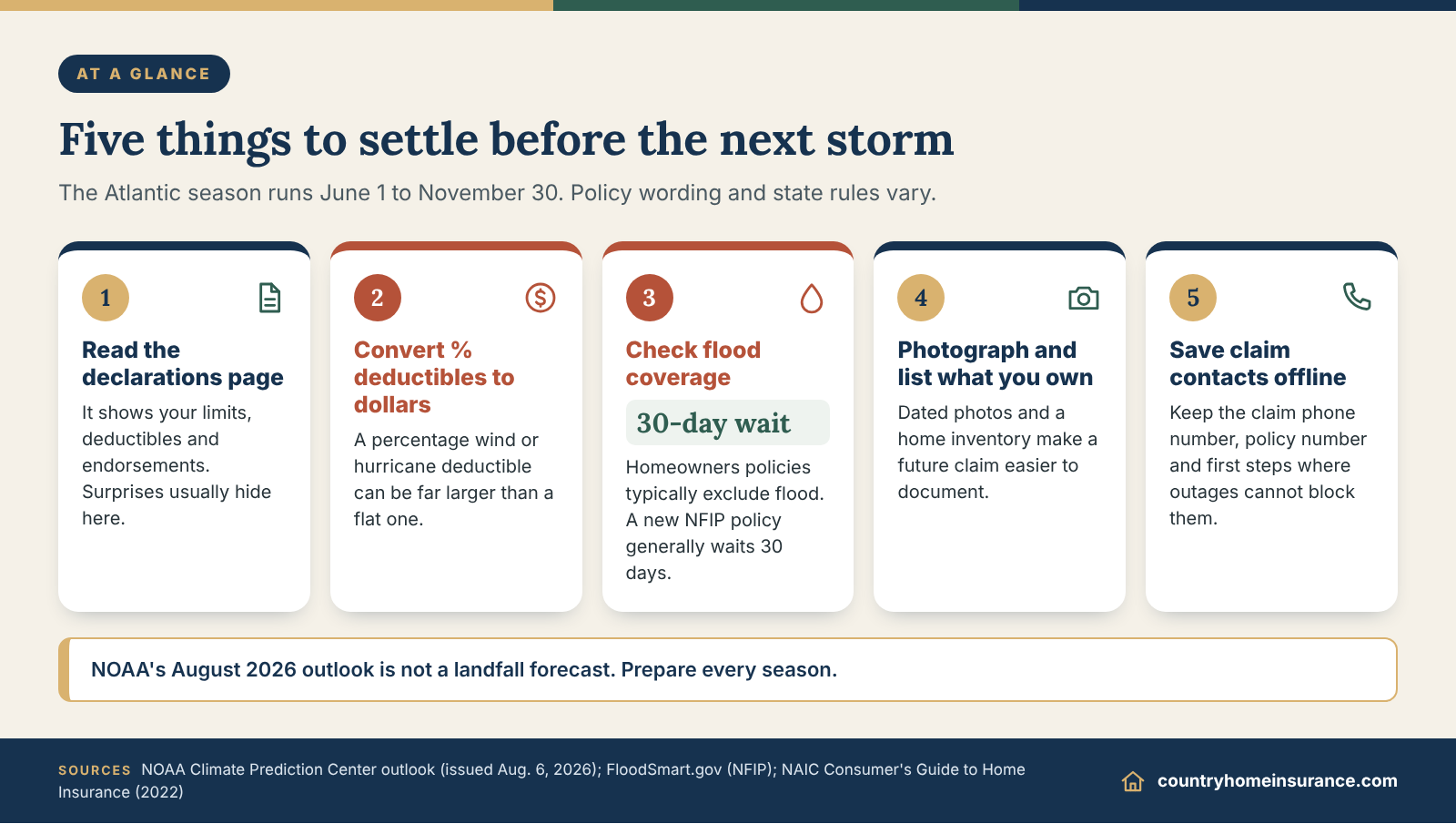
- The Atlantic season officially runs through November 30, so a checklist started in September or October is still useful, even when NOAA’s outlook is quiet.
- Your declarations page is the working document: it shows your limits, deductibles and endorsements, and it is where surprises usually hide.
- A percentage deductible can be several times larger than the flat deductible most people remember, so convert it to dollars now.
- Standard homeowners policies typically exclude flood, and a new NFIP flood policy generally takes effect 30 days after purchase.
- Photos, a home inventory and basic records are the cheapest way to make a future claim easier to document.
- Renewal notices, nonrenewal rules and residual-market plans differ by state, so read mailings from your insurer and know where your state regulator posts consumer help.
| Checklist item | What to confirm | Why it matters in fall | Where to look |
|---|---|---|---|
| Dwelling limit | Limit still tracks the cost to rebuild, not the sale price | Rebuilding costs and local labor can shift between renewals | Declarations page, insurer or agent |
| Wind, hail or hurricane deductible | Whether it is a flat dollar amount or a percentage, and what triggers it | A percentage can turn a modest-looking claim into a large out-of-pocket cost | Declarations page and policy deductible clauses |
| Flood coverage | Whether you have a separate NFIP or private flood policy | Homeowners policies typically exclude flood, and new NFIP policies generally wait 30 days | FloodSmart.gov, agent |
| Renewal and nonrenewal notices | Any change in terms, premium or eligibility | Notice periods vary by state, so mailed or emailed notices need prompt attention | Insurer mailings, state Department of Insurance |
| Inventory and photos | Dated photos of the house, outbuildings and contents | Records made before a loss are easier to trust than memory afterward | NAIC home inventory guidance and app |
| Claim plan | Claim phone number, policy number and your first steps | Outages and evacuations make it harder to find papers later | Insurer app, printed copy, cloud folder |
What a September home insurance checklist is for, and what the storm season looks like
Most homeowners only think hard about their policy at two moments: when the bill arrives and when something breaks. A September home insurance checklist adds a third, calmer moment. It sits in the middle of the Atlantic hurricane season, near the start of the fall severe-weather and early-freeze period in many regions, and a few weeks before many households face year-end renewals and holiday spending. That timing is useful because the choices that matter most, such as deductibles, flood coverage and records, are cheapest to fix before a loss.
This guide is about the review itself. It points to separate articles on evacuation costs, roof inspection, wildfire nonrenewal and individual claim types where those topics deserve their own space. If you are reading in October or November, nothing here expires: the season runs to the end of November, and the same questions apply to winter storms, freezes and the next renewal.
Where the 2026 Atlantic season stands according to NOAA
Before building a checklist, it helps to know what forecasters actually said, and just as importantly what they did not say.
What NOAA’s August 2026 update says
NOAA’s Climate Prediction Center issued an updated Atlantic outlook on August 6, 2026. It gave a 75 percent chance of a below-normal season, 20 percent near-normal and 5 percent above-normal. For the whole season, it gave a 70 percent likelihood range of 7 to 13 named storms (counting the two already recorded at that point), 2 to 6 hurricanes and 0 to 2 major hurricanes. Its May outlook had called for 8 to 14 named storms, 3 to 6 hurricanes and 1 to 3 major hurricanes, so the update shifted toward a quieter season. The official season runs June 1 through November 30. See the NOAA Climate Prediction Center hurricane outlook page for the current text, because the National Hurricane Center posts live storm information separately.
Why a quiet outlook does not change the checklist
NOAA is explicit that a seasonal outlook is not a landfall forecast and does not predict activity for any particular place, and it tells coastal residents to prepare every season regardless of the outlook. That caution matters for insurance as much as for safety. A below-normal season can still include a single damaging storm for the county you live in, and one storm is all a deductible or a coverage gap needs. A seasonal number is a statement about averages across the whole basin; your policy is a contract that responds to one house.
Storm risk that has nothing to do with hurricanes
Many country homes sit hundreds of miles from the Atlantic or Gulf coast and still face fall risks. Remnants of tropical systems can bring heavy rain and wind inland, and cooler-season thunderstorms, hail, wind events and early freezes can arrive with little warning. The checklist below is built around causes of loss rather than around coastlines for that reason. Where a step is specific to hurricanes, such as a named-storm deductible, the text says so, and you can skip it if your policy has no such term.
What the checklist does, and what it cannot do
A checklist cannot make your insurer pay a claim, and it cannot change the wording of your policy. What it can do is shrink the gap between what you assume you have and what the contract actually provides.
Four jobs: review, document, close gaps, prepare to claim
Think of the work in four jobs. First, review the contract you already own, starting with the declarations page. Second, document the property as it stands today with photos, an inventory and records of upgrades. Third, close gaps you can close, such as flood coverage, a water-backup endorsement or a deductible that is too large for your savings. Fourth, prepare to claim by keeping contact information and first steps where you can reach them without power or internet. Each job is covered in a section below, and the final section turns them into a four-week plan.
Why timing matters: waiting periods, restrictions and renewals
Insurance is sold in advance of the loss, and several rules punish last-minute action. A new NFIP flood policy generally takes effect 30 days after purchase, with limited exceptions. Some residual-market plans pause new or increased coverage when a hurricane threatens, as one Texas example later in this guide shows. And policy changes at renewal, such as a new roof payment schedule or a higher deductible, are easiest to catch when you read the renewal packet instead of filing it. The best time to act is before a storm is named, and the second best time is now.
How to read your declarations page before storm season
The declarations page, often called the “dec page,” is the one- or two-page summary at the front of your policy. It lists the insured property, the policy period, the coverage limits, the deductibles and the endorsements that modify the standard form. It is not the full contract, but it is the fastest route to the numbers that drive a claim. If you cannot find yours, ask your agent or insurer for a current copy and for the list of endorsements that apply.
Which coverage parts and limits are listed on it
Homeowners forms are usually organized into lettered coverages. The NAIC consumer materials describe the same parts in plain language: the house, other structures, personal property, loss of use and liability. Reading them as a set shows how one loss can touch several limits at once.
Dwelling and other structures
Coverage A (Dwelling) pays, subject to the policy, for the house and attached structures. Coverage B (Other Structures) addresses detached items such as fences, sheds and garages. The NAIC’s 2022 consumer guide notes that the limit for other structures is typically about 10 percent of the dwelling limit. For a country property, that figure deserves a second look. A hay barn, a workshop, a machine shed and several hundred feet of fence can easily exceed a limit sized for a detached garage, and a policy may also treat farm-style or business-use buildings differently. Ask how your outbuildings are classified and whether any are excluded or limited.
Personal property and loss of use
Coverage C (Personal Property) pays for belongings and is typically set at around 50 percent of the dwelling limit, according to the same NAIC guide. Coverage D (Loss of Use, including additional living expense, or ALE) helps with extra costs such as temporary housing if a covered loss makes the home unlivable, and is typically around 20 percent of the dwelling limit. Those percentages are typical starting points, not rules, so use the numbers on your declarations page. Also look for whether personal property is paid at replacement cost or actual cash value (ACV), a distinction explained in a later section.
Liability and medical payments
Coverage E (Personal Liability) and Coverage F (Medical Payments to Others) are limits you generally choose. Storm season brings a liability angle that people forget: a neighbor’s car damaged by your falling tree, a visitor injured on a damaged porch, or a contractor hurt during cleanup. Whether and how those situations are covered depends on the facts and the policy language. A review is a good moment to ask whether your liability limit still matches your assets and whether a separate umbrella policy, which the NAIC describes as its own policy rather than an endorsement, makes sense.
Is your dwelling limit still enough to rebuild?
The most expensive mistake on a declarations page is a dwelling limit that has drifted below the cost to rebuild. It tends not to show up until a large loss, which is the worst time to learn about it.
Replacement cost is not market value
NAIC explains that replacement cost value (RCV) is the cost to repair or replace damaged property with materials of similar kind and quality, and that it is different from market value, which includes the land and moves with the real estate market. The Mississippi Insurance Department’s February 2025 consumer release makes the same point and suggests asking whether your coverage reflects building-code upgrades, hard-to-replace features and rising material prices. A rural home can be hard to price both ways: land may be worth far more than the house, or a remote location may add hauling and labor costs to a rebuild. Neither number tells you the right dwelling limit.
The 80 percent rule and what a shortfall can do
NAIC advises insuring the home for at least 80 percent of its replacement value because if the dwelling limit falls below that threshold, the insurer may reduce what it pays on a claim, even a partial one. Maine’s Bureau of Insurance gives a worked example: a home that would cost $100,000 to rebuild, insured for $60,000, would be paid at 75 percent of a $25,000 loss, or $18,750. How deductibles are applied in that calculation depends on policy wording, so ask your insurer to show you the formula in your own contract. Hypothetical example: a house that would cost $400,000 to rebuild and carries $240,000 in coverage sits at 60 percent. Under a clause like Maine’s illustration, a partial loss could be paid at roughly three quarters of its amount before other policy terms apply.
Endorsements that help limits keep up
The NAIC consumer guide lists several endorsements (policy add-ons) that affect how well a limit holds up: inflation guard, which raises the dwelling limit annually; guaranteed replacement cost; ordinance or law coverage, which helps with the added cost of meeting current building codes during a rebuild; and replacement cost on personal property. Availability, wording and caps differ by insurer and state, so the only reliable answer is what appears on your declarations page. Colorado’s Division of Insurance analysis after the Marshall Fire is a reminder of the stakes. Using three rebuild-cost assumptions, it estimated that between 36 and 67 percent of the 951 homes studied were underinsured on the dwelling coverage alone, a 2022 result tied to one event and not a national average.
| Item on the declarations page | Typical reference point (where sourced) | What to ask your insurer or agent |
|---|---|---|
| Coverage A, Dwelling | Should reflect rebuild cost; NAIC advises at least 80 percent of replacement value | How was the rebuild estimate made, and when was it last updated? |
| Coverage B, Other Structures | Typically about 10 percent of the dwelling limit (NAIC 2022 guide) | Are my barn, shop and fences covered at replacement cost, and are any excluded? |
| Coverage C, Personal Property | Typically about 50 percent of the dwelling limit (NAIC 2022 guide) | Is it replacement cost or ACV, and what are the sublimits for jewelry, tools or firearms? |
| Coverage D, Loss of Use | Typically about 20 percent of the dwelling limit (NAIC 2022 guide) | Is there a time limit or dollar cap on additional living expense? |
| Coverages E and F, Liability and Medical Payments | You choose the limits (NAIC) | Do my limits still match my assets, and should I price an umbrella policy? |
| Deductibles | Flat dollar amounts or a percentage for some perils (NAIC, Maine) | Which perils use a percentage, and what does it equal in dollars today? |
| Endorsements | Inflation guard, ordinance or law, guaranteed replacement cost and others may be listed (NAIC) | Which endorsements are on my policy, and what are their caps? |
Deductibles: wind, hail and hurricane terms to convert into dollars
A deductible is the amount you pay out of pocket on a covered claim before the policy pays. In ordinary losses it is a flat dollar figure. In storm-prone areas it is often a percentage, and the difference changes how a claim feels. This section helps you translate each deductible on your declarations page into the number you would actually have to find.
Flat dollar deductibles versus percentage deductibles
The NAIC’s consumer guide notes that some locations use catastrophe deductibles expressed as a percentage rather than a dollar amount, and Maine’s Bureau of Insurance says the same of windstorm. The guide does not tell you which perils or storms trigger yours, so the policy itself is the authority.
How a percentage deductible is calculated
Most percentage deductibles are applied to a coverage limit, commonly the dwelling limit, though your policy’s wording controls the base. Maine offers a simple example: a 1 percent windstorm deductible on $150,000 of dwelling coverage equals $1,500. The same percentage on a larger house is a larger dollar amount, and a 2 percent or 5 percent deductible multiplies it. Many homeowners remember the flat $1,000 or $2,500 figure from an earlier policy and do not notice that wind is handled differently. Write the dollar equivalent beside the percentage on your declarations page.
A hypothetical comparison
The table below uses a made-up $300,000 dwelling limit to show how the percentages translate. The percentages are examples only. Your insurer may offer other options, and the Texas FAIR Plan Association, for instance, lists wind and hail deductible choices of 2, 3, 4 and 5 percent for its policies as of its 2026 deductible notice.
| Deductible type | Calculation | Out-of-pocket amount | What it means for a $20,000 covered wind loss |
|---|---|---|---|
| Flat dollar | Fixed amount, for example $2,500 | $2,500 | Insurer pays up to $17,500, subject to other policy terms |
| 1 percent | 1% of $300,000 | $3,000 | Insurer pays up to $17,000, subject to other policy terms |
| 2 percent | 2% of $300,000 | $6,000 | Insurer pays up to $14,000, subject to other policy terms |
| 5 percent | 5% of $300,000 | $15,000 | Insurer pays up to $5,000, subject to other policy terms |
What triggers a hurricane or named-storm deductible
Some policies apply a separate hurricane or named-storm deductible only when a storm meets a specific definition, such as a National Weather Service declaration or a watch or warning in your county, and only for a stated period. Others apply a wind or hail deductible to all wind losses. No single definition applies across states and insurers, so the practical advice is to ask for the exact trigger language and the time window, and to ask whether the deductible applies once per storm, once per policy year or once per claim.
Roof-related terms and changes that show up at renewal
Wind and hail claims often center on the roof, and insurers have been changing how they handle roofs. Those changes typically arrive in the renewal packet rather than as a separate announcement.
Actual cash value roof schedules and split deductibles
The Government Accountability Office reported in February 2026 that some insurers now pay only the depreciated value of older roofs rather than full replacement cost, and some use a separate deductible for roof damage, often called a split deductible. GAO also described one insurer offering a discount in hail-prone Oklahoma to customers who accepted lower roof claim payments. In practice, an older roof can leave you with a larger share of a storm repair than the rest of the house. If your declarations page or a roof endorsement mentions a payment schedule, an age cutoff or a cosmetic damage exclusion, ask for an example of how a $15,000 roof claim would be paid on your roof’s actual age.
Read the renewal packet for changed terms
State rules about what an insurer must tell you at renewal vary, so the safest habit is to read every page of the renewal documents the week they arrive. CBO noted that a 2024 Louisiana law lets insurers raise deductibles on renewed policies, which a prior law had restricted. That is one state’s rule and it is now a couple of years old, but it illustrates why the packet matters: terms can change without you shopping for a new policy. Compare the new declarations page with last year’s, line by line, and ask about any difference you cannot explain.
Why a lower premium can hide a bigger share of the risk
Raising a deductible usually lowers the premium, a trade-off the NAIC states plainly. That can be a sound choice if you have cash set aside and can handle a small loss yourself. It becomes a problem when the savings are small and the added exposure is large. When a quote looks unusually cheap, check the wind deductible, the roof terms and the personal property valuation before you celebrate. The devil is in the details, and the details are on the declarations page.
Choosing a deductible you can actually fund
The right deductible is the one you could pay within days of a loss without borrowing at a high rate or skipping repairs.
A simple affordability test
Take the dollar amount of your largest deductible, not your smallest. If a hurricane or wind deductible would be $6,000, ask whether you could pay it from savings within a week. If not, consider whether a smaller percentage or a flat option is available and what it costs. Because a premium saving is certain and a loss is not, people often under-weight the downside. A written comparison, with premium on one line and out-of-pocket cost on the next, makes the trade-off visible.
Questions to put to your agent
Useful questions include: Which perils have their own deductible? Is any deductible a percentage, and of which limit? Is there a separate roof deductible? Does the hurricane deductible reset each year or apply per storm? Can I choose a different option at renewal, and what would the premium change be? Ask for the answers in writing or by email so you have a record. A plain list of answers is worth more than a vague reassurance when a storm arrives.
Flood and other coverage gaps to close before the next storm
Storm damage rarely arrives as a single cause of loss. Wind lifts shingles, rain gets in, a creek rises, a sewer line backs up. Homeowners policies sort those events into covered perils, excluded perils and conditional ones, and the lines are not always where people expect. This section focuses on the gaps you can still close.
Flood: what standard homeowners policies leave out
Flood is the clearest example of a gap, and it is the one most likely to catch a rural household flat-footed because rising water does not need a coastline.
What the official sources say
FloodSmart, the NFIP’s consumer site, states that most homeowners insurance does not cover flood damage, so flood protection usually means a separate policy. NAIC’s homeowners page similarly lists ground water, rain runoff and snow melt among typical exclusions. CBO’s 2024 report also notes that standard policies exclude flood and, generally, earthquake. The practical consequence is that a house can be insured against wind and still have no coverage for the water that follows. Check for a separate flood declarations page, which would come from the NFIP or a private flood insurer, not your homeowners insurer.
Flood risk is not limited to mapped high-risk zones
FloodSmart says 99 percent of U.S. counties had a flood event in the past 20 years and that flooding can happen even if you do not live near an ocean, lake or river. Its maps and tools show whether a property is considered high, moderate or low risk, and the site cautions that floods can happen anywhere. Whether your lender requires flood coverage is a separate question to put to the lender. For a country home, creek crossings, low pastures, field drainage and a long driveway that floods can all matter even when a map shows moderate or low risk.
NFIP limits and private flood options
For homeowners, NFIP building coverage is available up to $250,000 and contents coverage up to $100,000, with a $2,500 limit on valuable items such as original artwork and furs, according to FloodSmart. Building and contents are usually purchased separately and carry separate deductibles. Private flood insurance also exists; CBO reported the number of private flood insurers grew from about 50 in 2016 to nearly 200 in 2022. Limits, waiting periods and exclusions differ between private policies and the NFIP, so compare actual quotes and policy forms rather than assuming the products match. FloodSmart says NFIP rates are the same regardless of which participating company or agent sells the policy.
The 30-day wait and other timing traps
Coverage you buy today does not necessarily protect you tomorrow. Waiting periods and restrictions are some of the least understood parts of storm-season shopping.
How the NFIP waiting period works
FloodSmart states that a new NFIP policy generally goes into effect 30 days after the date of purchase. There are exceptions: no wait when the policy is bought in connection with making, increasing, extending or renewing a mortgage, no wait when you change coverage while renewing, and a one-day wait in two narrow situations (a newly designated high-risk flood zone within 12 months of the map change, and flooding caused or worsened by a wildfire on federal land when you buy within 60 days of containment). Private flood policies may have different waiting periods, which is one reason to ask before you buy.
Why buying after a storm forms is usually too late
If a policy takes 30 days to start, one bought after a storm is already threatening will typically not respond to that storm. Some residual-market plans may also pause new or increased coverage while a storm is approaching. As a state-specific example, the Texas FAIR Plan Association’s April 2026 page says that a hurricane within a defined geographic area triggers a moratorium and states that it was not accepting applications for new or increased coverage at that time, with no date attached. Whether that restriction applies today is something to confirm with the plan directly. Other states and carriers have their own rules.
What you can still do this late in the season
The season does not end until November 30, but a policy bought in mid-October with a 30-day wait would start in mid-November, still inside the season. Beyond hurricanes, flood risk continues through winter snowmelt and spring rains. If you are on the fence, a quote costs nothing, and a policy bought now begins protecting you through the rest of this season and into the spring thaw.
Other gaps worth checking, including rural ones
Flood is not the only line that people discover at claim time. Several other items on the NAIC’s exclusion and endorsement lists matter for fall storms.
Sewer and drain backup, sump overflow and mold
The NAIC consumer guide says mold, sewer or drain backup and sump pump overflow carry limited or no coverage in a standard policy, though endorsements may be available. Heavy rain can overload municipal sewers or a private line, and a basement can fill without any river rising. If you have a finished basement or a sump pump, ask whether a water-backup endorsement is available, what its limit is and whether it covers your sump system. A related question, how it differs from flood, is covered in the sewer-backup article.
Outbuildings, fences and detached structures
NAIC notes that detached structures such as in-ground pools or garages holding classic cars may need extra coverage, and the typical Coverage B figure of about 10 percent of the dwelling limit can be thin on a property with several buildings. Before storm season, walk the property with your declarations page and ask yourself whether the combined replacement cost of everything detached is close to that Coverage B number. If not, ask about raising the limit or scheduling the most valuable buildings individually. Policies often treat farm use, business use or livestock-related buildings differently, so describe each building’s actual use to your agent.
Wells, septic systems and private lines
Wells, pumps, septic systems and long private water or power lines are common on country property. No general source says how every homeowners form treats them, and treatment varies by policy, so this is a list of questions rather than an answer. Ask whether a well pump or septic damaged by a covered storm is part of the dwelling or other structures coverage, whether underground lines are covered, and whether a service-line endorsement is available. Then write the answer on your checklist and compare it with the actual policy language.
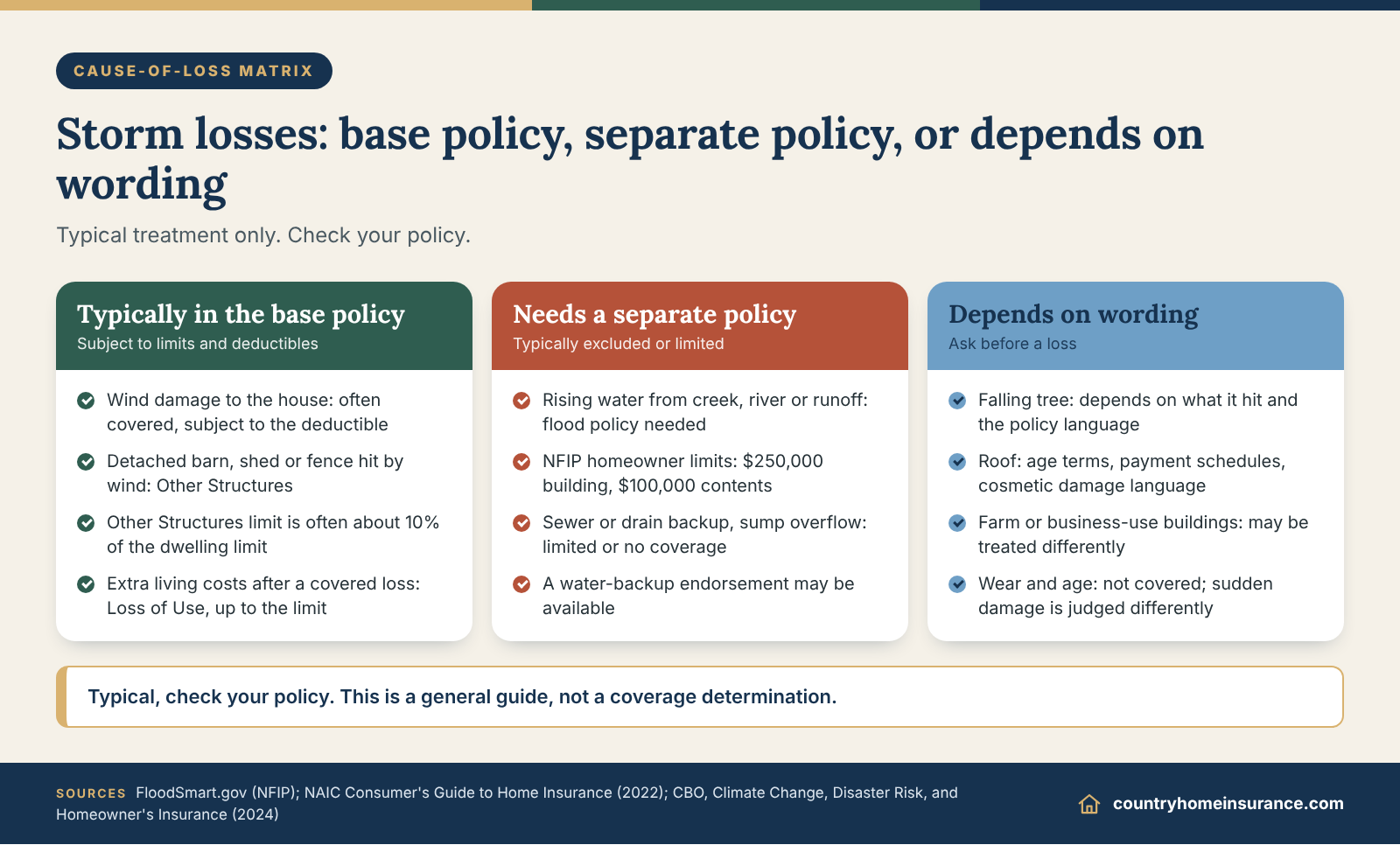
| Situation | Typical treatment under a standard homeowners policy | Depends on |
|---|---|---|
| Wind damage to the house | Often covered as a weather loss, subject to the deductible | Wind or hurricane deductible, roof age terms, cosmetic damage language |
| Rising water from a creek, river or overland runoff | Typically excluded as flood; separate NFIP or private flood policy needed | Whether you bought flood coverage and when it took effect |
| Sewer or drain backup, sump overflow | Limited or no coverage in a standard policy (NAIC) | Water-backup endorsement and its limit |
| Detached barn, shed or fence damaged by wind | Addressed under Other Structures, often about 10 percent of the dwelling limit | Building use, valuation basis and any exclusions for farm or business structures |
| Extra living costs after a covered loss makes the house unlivable | Loss of Use / ALE coverage, up to the stated limit | Dollar and time limits, and whether the underlying loss is covered |
| Wear, age or lack of maintenance | Not covered; the policy is not a maintenance contract (NAIC) | Whether a sudden covered event, not gradual wear, caused the damage |
Renewal, nonrenewal and availability: what to know before a storm changes the market
Insurance availability tends to move with disaster losses, and homeowners feel it as higher premiums, changed terms or a letter saying a policy will not be renewed. A September review is a good time to understand your rights and options while you still have time and a policy in force.
Cancellation, nonrenewal and notice basics
These two terms are often confused, and the difference affects what you should do next.
Cancellation versus nonrenewal
The NAIC consumer guide separates the two. Cancellation ends coverage before the normal expiration date, usually 12 months after the start. Nonrenewal means the insurer declines to renew when the term ends. The guide says that a new policy can typically be cancelled for any reason during a limited early period, often about 60 days, and that after that insurers can cancel only for reasons such as nonpayment, misrepresentation on the application or a substantial change in risk. Insurers must give notice in either case, and the number of days varies by state. NAIC also says nonrenewal notice is typically 30 days before renewal, again varying by state, and that you can ask the insurer for its reason.
A state example: Florida after a declared emergency
State law can add protections around storms, and the details are state-specific. Florida’s Chief Financial Officer’s consumer FAQ states that an insurer generally cannot cancel or nonrenew a residential property policy because of hurricane or wind damage after an emergency declaration and related order from the Commissioner of Insurance Regulation, and that this restriction lasts until 90 days after repairs are made. The same page lists exceptions, including a 45-day notice if the insured unreasonably delays repairs, a material misstatement or fraud related to a claim, or payment of the policy limits. It also says an insurer must pay or deny a property claim within 60 days of notice, unless factors beyond its control cause delay. Do not assume your state has the same rules; look for your own state’s Department of Insurance consumer page.
What to do the day a nonrenewal notice arrives
Do not wait for the last week. Read the notice for the stated reason and the effective date, then call the insurer to ask whether the issue can be corrected, such as a roof repair or a removed hazard. Start quote requests with other carriers and your state’s residual market in parallel. Keep the notice, because a lender or a new insurer may ask for it. If the reason seems unfair or the notice period looks too short for your state’s rules, contact your state Department of Insurance for guidance.
When the standard market pulls back
In some states and regions, insurers have restricted new business, raised rates or declined to renew certain homes. The residual market, often called a FAIR Plan, is the backstop that many states have created for homeowners who cannot find coverage elsewhere.
What GAO found about residual-market growth
GAO’s 2026 report found that the market share of FAIR and beach plans rose from about 1.4 percent of policies in 2019 to about 2.5 percent in 2023, and it interprets this as a sign of lower private-market availability. In California, the report notes that FAIR Plan residential policies grew from roughly 200,000 in 2020 to about 450,000 in 2024, with about 78 percent of that growth in areas rated major, severe or extreme for fire risk. GAO cautions that its premium and availability analysis shows associations rather than proven causes, and that industry representatives expect availability to recover if insurer profitability improves.
Residual-market plans have their own terms
A FAIR Plan policy may be a narrower product than a full homeowners policy, and its deductibles, perils and eligibility rules are set by that state’s plan. The Texas FAIR Plan Association’s April 2026 notice, for example, removed its 1 percent wind and hail deductible option effective July 1, 2026, with existing policies moving to 2 percent at renewal, and lists wind and hail deductibles of 2, 3, 4 and 5 percent and other-peril deductibles of 1 to 5 percent. That is one plan in one state, and it illustrates why you should read the plan’s own current rules instead of relying on a general description.
Surplus-lines and E&S policies
Some homeowners who cannot get a standard admitted policy end up with a non-admitted policy from a surplus-lines or excess-and-surplus (E&S) insurer. Those policies can differ from admitted policies in how forms and rates are regulated and in whether state guaranty fund protections apply. This guide does not quote current E&S market-size figures because none could be verified. If you are offered a surplus-lines policy, ask your agent how it differs from an admitted policy, what your state’s regulator says about it and what protections apply if the insurer fails.
Shopping before the storm instead of after it
If you plan to compare coverage, doing it before an event gives you the most options and the least pressure.
Compare quotes on the same coverage
NAIC advises comparing quotes using identical coverages, limits and information, and getting them in writing. That means matching the dwelling limit, the wind and hail deductible, the roof valuation basis, the personal property valuation and any endorsements, so you are comparing apples to apples. A cheaper quote with a 5 percent hurricane deductible and an ACV roof is a different product from a pricier one with a 1 percent deductible and replacement cost on the roof. Check complaint indexes and financial strength ratings from agencies such as AM Best, S&P and Moody’s, as NAIC suggests, and confirm that the agent and company are licensed in your state.
Do not cancel the old policy until the new one is bound
If you switch, confirm the new policy’s effective date and keep the old one in force until the new one has started and your lender has proof of coverage. A gap of even a day can be costly in storm season. Ask for written confirmation, or a binder, which is a temporary proof of coverage, and keep a copy where you can find it without internet. If you have a mortgage, ask the lender how it wants proof sent. NAIC also notes that you are not required to buy insurance from the company your lender recommends.
Ask about mitigation credits, but do not assume the amount
CBO notes that insurers may consider homeowner measures such as fire-resistant materials, vegetation management and elevating structures when setting premiums. GAO similarly describes premium discounts for features such as storm shutters or fire-resistant materials and notes that California requires insurers using catastrophe models to consider mitigation credits for recognized wildfire mitigation. Neither source states a standard discount amount, and credits vary by insurer and state. If you have made improvements, ask what documentation the insurer needs and whether a credit applies, then get the answer in writing.
Documentation: build the records a claim would need
A claim is partly a paperwork exercise. After a loss, you are often asked what you owned, what condition it was in and what the house looked like before. Records made in September, in calm weather and with working power, are usually better than reconstructions made after a storm.
Making a home inventory that holds up
NAIC says an accurate inventory helps the insurance carrier settle claims. The format matters less than the habit of finishing it and keeping copies in more than one place.
Room-by-room photos, video and serial numbers
NAIC’s guidance suggests grouping belongings by room or category, photographing or recording each item, noting model and serial numbers, and keeping receipts or appraisals for valuables and rarely used items. The NAIC Home Inventory app, available for Apple and Google devices, lets you photograph items, scan barcodes and export the list at any time. Open closets, cabinets and drawers on camera and narrate what you see. A ten-minute video walk-through of each room will not replace a detailed list, but it is a strong first layer if you are short on time.
Where to keep copies so power outages do not matter
NAIC suggests storing the inventory somewhere accessible, such as online or in a fireproof box. For a rural household that may lose power and cell service for days, use both: a cloud copy and a printed or flash-drive copy kept away from the house, for example in a safe deposit box or at a relative’s home. Add your policy numbers, your insurer’s claim phone number and your agent’s contact information to the same folder.
Outbuildings, tools, equipment and fencing
Country property often includes items that a typical inventory app does not prompt for: tractors and attachments, generators, chainsaws, hand and power tools, feed and tack, fencing by the foot, gates and stock tanks. List them with approximate age and replacement cost, and note where each is stored. Some may fall under personal property, some under other structures, and some may be excluded if used for farming or business, so ask your agent how each category is treated. Having the list in hand makes that conversation much easier.
Baseline records for the house itself
The condition of the structure before a storm is one of the hardest things to prove afterward. Taking a few dated photos now costs almost nothing.
Dated photos of the roof, exterior and grounds
Photograph each side of the house, the roof surfaces you can see safely from the ground, gutters, chimneys, siding, windows, porches, outbuildings and any mature trees close to structures. Stay off the roof; a camera with zoom or a drone operated legally by a qualified person is a safer way to look. Make sure the photos carry dates in the file data. These images do not prove the cause of a later loss, but they help establish what existed before it.
Receipts, permits and maintenance records
NAIC emphasizes that a homeowners policy is not a maintenance contract and does not pay to repair items that simply wear out, and the owner is responsible for upkeep. Records showing that you maintained the property help separate sudden damage from wear. Keep invoices for roof replacement, window or siding work, electrical or plumbing upgrades and tree work, along with the date and contractor name. If you recently replaced your roof, the date matters for any roof-age terms on your policy.
Policy documents and claim contacts in one folder
Collect your current declarations page, endorsement list, flood policy if any, insurer claim line, agent contact, mortgage lender contact and policy numbers in one folder. Photograph your insurance cards. If you evacuate, you will want these on your phone and in a bag, not in a drawer. Review the folder once each quarter so it does not go stale.
| Record | How to capture it | Where to store it | What it helps with |
|---|---|---|---|
| Contents inventory | Photos or video by room, plus model and serial numbers | Cloud copy plus a printed or offline copy | Listing items in a personal property claim |
| Exterior and roof photos | Dated photos from the ground of each side and roof surface | Cloud folder labeled by year | Showing condition before a loss |
| Outbuilding and equipment list | Photos plus age, use and estimated replacement cost | Same folder as the inventory | Other Structures and equipment conversations |
| Upgrade and maintenance records | Invoices, permits, contractor names and dates | Scanned PDFs plus paper copy | Roof age, code upgrades and maintenance questions |
| Policy and contact sheet | Declarations pages, endorsements, claim numbers, agent and lender contacts | Phone, go-bag and cloud | Reporting a claim quickly, especially after an evacuation |
Fall preparation that protects both the property and your claim
Insurance pays after a covered loss, and mitigation tries to prevent or reduce the loss. The two work together, and both depend on small tasks done before the weather turns.
Before a storm: maintenance with an insurance angle
Because policies generally do not pay for ordinary wear and maintenance problems but may respond to sudden covered events, the way you maintain a property affects the story you tell after a loss.
Gutters, drainage and tree limbs
Clear gutters and downspouts so water moves away from the foundation, check that grading directs runoff away from the house, and have dead or leaning limbs near the house, power lines and outbuildings evaluated by a qualified arborist or tree service. How an insurer treats a fallen tree depends on what it hit and the policy language, so that question belongs in the tree-claim articles. The roof and gutter inspection steps have their own guide.
Shutoffs, sump pumps and backup power
Know where your main water shutoff, electrical panel and propane or fuel shutoff are, and make sure everyone in the household can find them. Test sump pumps and consider whether a battery backup is practical. If you use a portable generator, follow the manufacturer’s instructions and local emergency-management guidance on generator safety. Ask your insurer whether any equipment-related endorsements or conditions affect coverage for freeze or power-related damage.
Protective upgrades and what to ask before spending
Impact-resistant roofing, storm shutters and similar upgrades can reduce damage risk, and some insurers recognize them. Because credits vary and some depend on specific standards or inspections, ask the insurer or agent what it needs before you buy. For example, find out whether a certificate or contractor invoice is required. Treat any premium savings as a possible bonus, not as the reason for the upgrade, until the insurer confirms the amount.
When a storm is on the way
A few specific steps deserve attention in the days before a forecast storm. This is only the insurance-focused list; evacuation guidance has its own article.
Photograph, secure and charge
If you have time, take fresh photos of the exterior and any item you are moving, secure loose outdoor items, charge phones and power banks, and confirm your insurance folder is accessible offline. Do not start permanent repairs or alter the property in ways that make damage harder to document. Take any official evacuation or safety instructions from local emergency management and the National Weather Service first.
Know what you cannot change at the last minute
Some insurers and plans may restrict changes when a named storm is close, and the Texas FAIR Plan example earlier shows one program doing so. You generally cannot count on raising limits, adding endorsements or buying flood coverage once a storm is threatening. Use the waiting-period and binding information above to decide now what you want to change, and contact your agent early in the week rather than on the weekend a storm arrives.
Rural and country-home specifics
Distance changes the practical side of both prevention and claims. Fire protection, road access and the availability of contractors are all different when the nearest town is 20 minutes away.
Private roads, driveways and access for responders
A washed-out culvert or downed trees across a private lane can block fire trucks, ambulances and adjusters. Check culverts and ditches before heavy fall rains, keep a chainsaw and fuel accessible, and ask neighbors about shared maintenance. How your insurer classifies your fire protection, including the distance to a station and your water supply, may influence your premium, so ask your agent how your property is classified if you have never checked.
Livestock, feed and equipment
If you keep animals, think about shelter, fencing, feed storage and power for water systems during an outage. Farm-like exposures such as animals, feed and farm-use buildings may sit outside ordinary homeowners coverage, so ask your agent whether your policy addresses them at all and whether a farm or ranch policy is worth pricing if you have more than a few animals or any commercial use. The rural home insurance guide goes deeper into those distinctions.
Volunteer fire departments and mutual aid
Many country properties are served by volunteer or district fire departments. Their response times and water supply can differ from city departments, and insurers may consider fire protection when they rate a property. Introduce yourself to your department, make sure your address is clearly marked from the road, and ask whether it can recommend access improvements. Those steps are free, and they can matter when minutes count.
After the storm: first steps and how payments are typically calculated
If damage does occur, the first days shape how smoothly the claim goes. The steps below follow NAIC’s general claim guidance. Your policy and your state’s rules control the details, and your insurer’s own instructions come first when they differ.
The first steps to take after damage
Safety comes before paperwork. If the house is unsafe, if there is a gas smell, downed power lines or standing water around electrical systems, leave and call emergency services. Insurance questions can wait until people are safe.
Protect the property and report the claim promptly
NAIC’s steps include contacting your agent or insurer as soon as possible, asking what forms or documents are needed, and protecting the home from further damage, for example by boarding it up or cleaning up water. Policies commonly expect reasonable temporary protection, so keep receipts for tarps, plywood and emergency services, and photograph the damage before and after you protect it. Ask your insurer before discarding damaged items or starting permanent repairs, because the adjuster may need to inspect them first.
Keep a claim log and cooperate with the adjuster
NAIC recommends cooperating with the adjuster the insurer assigns, who will usually inspect the damage, and keeping notes and records of every conversation, including dates. A simple notebook or phone note works: who you spoke to, what was said, what was promised and when. Send important points by email so there is a written trail. Provide your inventory, photos and records on request, and ask when to expect the next step.
If you disagree with the result
NAIC suggests trying to resolve disagreements with the insurer first. If that fails, check your policy for an appraisal clause, which is a process for resolving disputes about the amount of loss, or consider consulting an attorney or a public adjuster, a person who represents policyholders in claims for a fee. You can also contact your state insurance department for help. State rules about public adjusters, appraisal and deadlines differ, so look up yours before signing any contract.
How claim payments are typically calculated
The check you receive is often smaller than the repair estimate, and the reasons are usually deductibles, depreciation or limits. Understanding the mechanics beforehand removes some of the surprise.
Actual cash value versus replacement cost
NAIC explains that actual cash value (ACV) pays based on the property’s current value after accounting for age and wear, so the payout is usually lower than the cost of repair or replacement. Replacement cost value (RCV) pays to repair or replace with similar materials without subtracting depreciation. NAIC’s own illustration uses $10,000 in damage and notes that RCV pays that amount minus the deductible, while ACV applies depreciation first and then the deductible. Many policies pay in stages: an initial ACV payment and, if the policy provides for it, additional recoverable depreciation after repairs are completed. The exact process, documentation and time limits are policy-specific, so ask how your policy handles it.
A hypothetical roof repair example
The table that follows uses invented numbers to show how the same covered storm repair can produce different payments under different settlement terms. It does not predict any insurer’s calculation, and a roof payment schedule or separate roof deductible could change it.
| Settlement approach | How the payment is built (illustrative) | Initial payment | Possible later payment |
|---|---|---|---|
| Replacement cost value, no holdback | $12,000 repair cost minus a $2,000 deductible | $10,000 | None under this example |
| Replacement cost with depreciation held back | $12,000 minus assumed $4,800 depreciation minus $2,000 deductible | $5,200 | Up to $4,800 of recoverable depreciation after repairs are documented, if the policy provides for it |
| Actual cash value only | $12,000 minus assumed $4,800 depreciation minus $2,000 deductible | $5,200 | None; depreciation is not recoverable |
| Percentage wind deductible instead of a flat $2,000 | Same $12,000 repair, with a $6,000 deductible (2% of a $300,000 dwelling limit) | $6,000 under replacement cost without holdback | Depends on the settlement terms above |
Loss of use, timing and state claim deadlines
If a covered loss makes the house unlivable, loss of use coverage (ALE) may help with temporary housing and extra costs up to the policy’s limit; the NAIC guide describes it as typically around 20 percent of the dwelling limit, and your declarations page shows the real number. Time limits for insurers to acknowledge, pay or deny claims are set by state law and differ. Florida’s CFO consumer page, as one example, says an insurer must pay or deny a property claim within 60 days of notice unless factors beyond its control cause delay. Policies also set their own deadlines for notice and proof of loss, so ask your insurer for the specific dates in writing.
Next steps: turning the checklist into a four-week plan
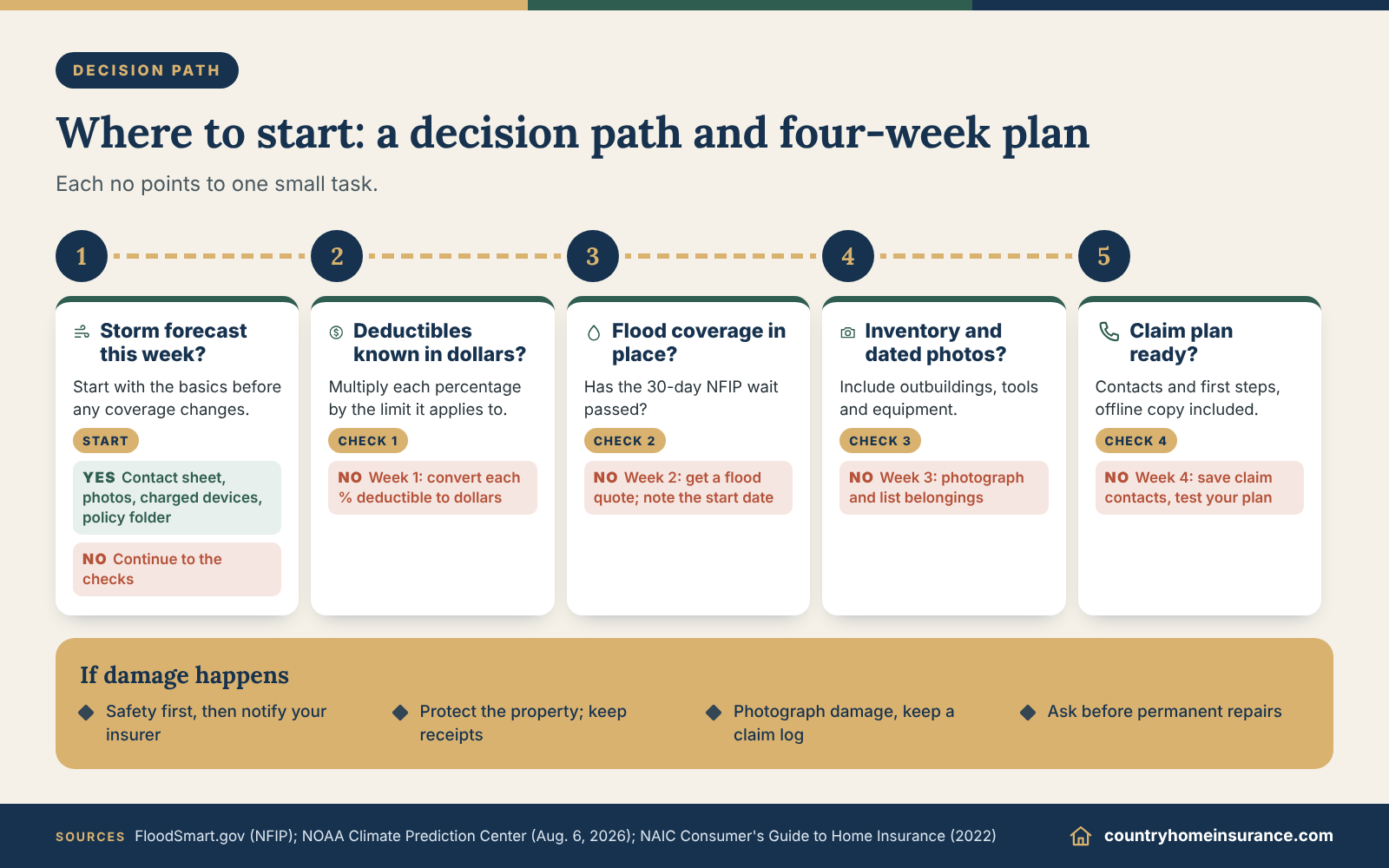
Trying to do everything in one evening usually means doing nothing. A short plan spread over four weeks keeps each task small. Adjust the order if a storm is forecast, in which case start with contact information, photos and your agent’s phone number.
A week-by-week plan you can finish in about a month
The tasks below take roughly an hour or two each, with the inventory being the longest.
Week one: read and convert
Find your declarations page and every endorsement. Write the dollar value of every percentage deductible beside it. Note the Coverage A through F limits, the roof settlement terms and the policy and claim numbers. Read the renewal packet if you have one. Mark each question you cannot answer from the paperwork and send them to your agent in a single email so the answers come back in one place.
Week two: close the gaps
Get at least one flood quote from FloodSmart or an agent and, if you want a comparison, a private flood quote. Ask about water-backup and outbuilding coverage. If you decide to buy flood coverage, note the effective date. If a limit or deductible needs to change, ask whether the change can be made mid-term or must wait for renewal.
Week three: document
Walk every room and outbuilding with your phone, start the inventory in the NAIC app or another tool, and take dated exterior photos. Scan receipts and upgrade records. Put copies in a cloud folder and on a drive kept away from the house. Mark the hardest-to-replace items and the most expensive ones for a closer second pass.
Week four: prepare and rehearse
Walk through your claim plan. Put your insurer’s claim number in your phone, tell the household where the folder is, check shutoffs and sump pumps, and clear gutters and limbs. If a family member would be the one reporting a claim, make sure they have the policy number and know who to call. Put a reminder on your calendar to repeat the review before the next season starts.
Questions to ask your insurer or agent this month
A good agent expects these questions, and written answers give you something to compare at renewal.
Coverage and cost questions
Ask how the dwelling limit was calculated and when it was last updated. Ask which perils have separate deductibles, how those deductibles convert to dollars and what triggers a named-storm deductible. Ask about roof payment terms by age, replacement cost on personal property, the Coverage B limit for your outbuildings and any water-backup or service-line endorsements. Ask what documentation earns any mitigation credit, and what would change your premium at renewal.
When to contact your state regulator
If an answer seems inconsistent with your policy, if you receive a nonrenewal notice you do not understand, or if a claim is delayed longer than your state’s rules appear to allow, your state Department of Insurance can explain the rules and take consumer complaints. Look for its consumer help page and keep copies of your documents ready. NAIC also provides consumer tools, including a shopping tool for homeowners insurance, that can help you compare and ask better questions.
Frequently asked questions
Timing and coverage questions
Is it too late in the year to review my homeowners insurance?
No. NOAA’s season runs through November 30, and wind, hail, freeze and heavy-rain risks continue after it ends in many regions. A review in October or November still helps with renewal decisions and any gaps you can close, and a flood policy bought now begins to protect you after its waiting period. If a storm is already in the forecast, focus on documentation and contact information first because coverage changes may not be possible in time.
Does my homeowners policy cover flood damage from a hurricane or heavy rain?
Typically not. FloodSmart says most homeowners insurance does not cover flood damage, and NAIC lists ground water, runoff and snow melt among common exclusions. Wind damage may be covered under the homeowners policy, subject to your deductible and policy terms, while the rising water may need a separate flood policy. How a particular loss is divided between those causes is decided under the policy language and the facts, so ask your insurer before a loss.
Can I raise my coverage or buy flood insurance when a storm is approaching?
Possibly not. A new NFIP flood policy generally takes effect 30 days after purchase, with listed exceptions such as certain mortgage-related purchases. Some insurers and residual-market plans may also pause new or increased coverage while a storm threatens, and the Texas FAIR Plan Association’s page describes such a moratorium for its own program. Ask your agent what restrictions apply to you.
Claims and cost questions
Why is my hurricane or wind deductible so much bigger than my regular one?
Many policies in storm-prone areas set wind, hail or hurricane deductibles as a percentage of a coverage limit instead of a flat dollar amount, as Maine’s Bureau of Insurance explains with a 1 percent windstorm example on $150,000 of coverage. Percentages produce larger dollar amounts on higher limits. Check your declarations page for the base the percentage applies to, and ask if a different option is available at renewal.
What happens if my dwelling limit is too low when a storm hits?
If your coverage is below the level your policy requires, usually around 80 percent of replacement cost according to NAIC, the insurer may reduce what it pays on a claim, even a partial one. Maine’s example shows a home insured at 60 percent of rebuild cost receiving 75 percent of a partial loss. The terms in your own policy control, so ask how your insurer applies them, and update the limit before a loss rather than after.
Should I wait for my insurer before making any repairs?
You should protect the property from further damage, since NAIC lists that among the first claim steps, but ask the insurer before permanent repairs or disposal of damaged items. Keep receipts for emergency measures, take photos before and after, and document the conversation. If you are unsure whether an expense is reasonable, call the insurer and ask first; you can also contact your state Department of Insurance for guidance on your state’s rules.
Sources
- NOAA Climate Prediction Center: 2026 Atlantic hurricane season outlook, August update (issued 2026-08-06)
- FloodSmart (NFIP): Buy a flood insurance policy, including waiting period and coverage limits (undated page)
- FloodSmart (NFIP): Flood insurance basics (undated page)
- FloodSmart (NFIP): Flood zones and maps (undated page)
- NAIC: Homeowners insurance consumer page (undated)
- NAIC: A Consumer’s Guide to Home Insurance (2022 edition)
- NAIC: Actual cash value versus replacement cost (2025-01-02)
- NAIC: Home inventory guidance and app (undated)
- U.S. GAO: GAO-26-107867, Homeowners Insurance premiums and disaster-prone areas (published 2026-02-27)
- Congressional Budget Office: Climate Change, Disaster Risk, and Homeowner’s Insurance (2024-08-27)
- Maine Bureau of Insurance: homeowners and renters out-of-pocket costs (undated, copyright 2022)
- Florida Chief Financial Officer: homeowners insurance FAQ (undated)
- Texas FAIR Plan Association: deductible changes effective 2026-07-01 (published 2026-04-27)
- Colorado Division of Insurance: Marshall Fire underinsurance estimates (2022-04-26)
- Mississippi Insurance Department: consumer release on coverage and replacement cost (2025-02-05)
Important coverage note
Coverage depends on your actual policy, endorsements, exclusions, limits, deductible and the cause of loss. Your declarations page and policy form control, and state laws and insurance programs vary. This guide is educational information and not legal advice. For questions about your own policy or claim, check with your insurer or agent and your state Department of Insurance. Flood, wind, FAIR Plan and surplus-lines rules differ by state and program, so verify current terms before relying on them.
About the editorial team
This guide was prepared by the countryhomeinsurance.com editorial team as general, educational information for homeowners. We research and summarize publicly available material, including state insurance departments, the NAIC, federal agencies, regulators’ consumer guides and published insurer and industry resources. We draw only on the sources that were available to us when we wrote this guide, and we list them in the Sources section with dates where we could find them.
Insurance rules, rates, products and program terms change, differ by state and by insurer, and can apply differently to your situation. We cannot guarantee that this content is complete, current or free of errors. It is not legal, financial, tax or insurance advice, it is not an offer to sell insurance or a recommendation of any insurer, agent or product, and reading it does not create a professional relationship of any kind.
To the fullest extent permitted by law, countryhomeinsurance.com and its editorial team, authors and contributors exclude all liability for any loss, damage or decision arising from the use of, or reliance on, this content. For questions about your own policy or claim, contact your insurer, a licensed agent or broker, your state Department of Insurance or another qualified professional.
Content created: October 11, 2026
