
Delaware homeowners insurance is regulated by the Delaware Department of Insurance, and the published premium averages we reviewed come from different methods, so they should not be compared with each other. The costly surprises are mostly about weather. Standard policies exclude flood, many carry a separate percentage deductible for hurricanes, and Sussex County’s bay and ocean shoreline carries the most tidal and storm exposure. Delaware also has a FAIR Plan and statutory limits on claims-based nonrenewal.
Key takeaways
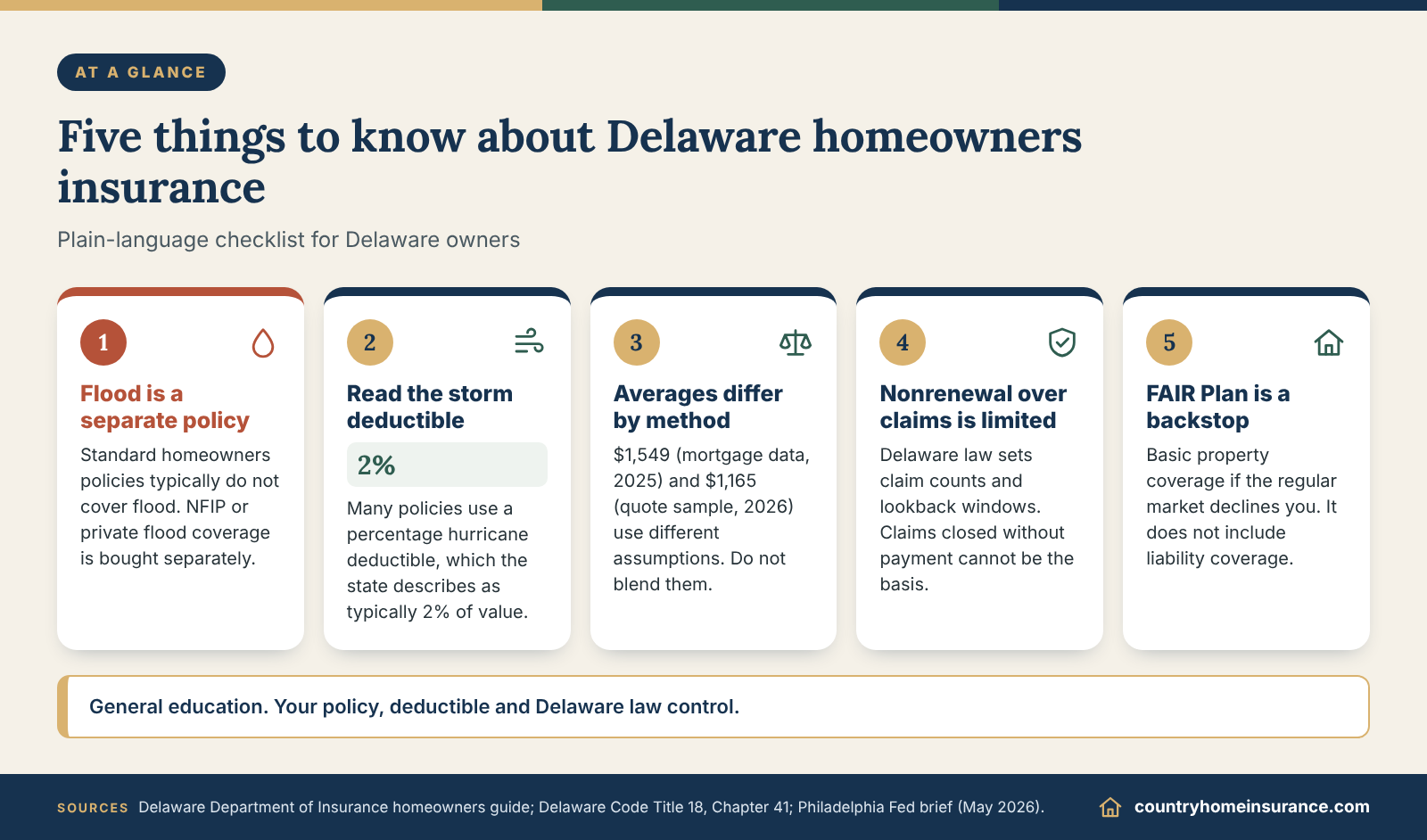
- Flood is not covered by a standard homeowners policy, and the state’s own consumer guide says so; flood coverage is a separate purchase (federal NFIP or a private flood policy).
- Many Delaware policies carry a separate hurricane or named-storm deductible, which the Department of Insurance describes as typically 2% of the property’s value, and Delaware law requires a clear, prominent notice of it.
- Delaware law, as amended in 2024, limits when an insurer can decline to renew a homeowners policy over claims, and claims closed without payment cannot be the basis.
- The Delaware FAIR Plan (the Insurance Placement Facility of Delaware) offers basic property coverage if you cannot get it in the regular market. It does not include liability coverage, and its rules list a mandatory $2,000 hurricane deductible in certain listed ZIP codes.
- Published average premiums vary by publisher and method: $1,549 (Federal Reserve Bank of Philadelphia, June 2025, escrowed mortgages) versus $1,165 (ValuePenguin quotes, 2026, $350,000 dwelling). Do not treat them as interchangeable.
- A new federal flood (NFIP) policy generally starts 30 days after purchase, and homeowner building coverage tops out at $250,000, so decide on flood coverage well before a storm threatens.
- Delaware’s farm counties, Kent and Sussex, deserve a rural-literate read of outbuildings, poultry operations, wells and fire-protection class.
Delaware homeowners insurance: how the market works
Delaware homeowners insurance looks simple on paper. The state has three counties, a single regulator, and published statewide premium averages that differ by method. The details that decide whether a policy actually protects you are more local than that: how close the house is to tidal water, how your insurer words its wind deductible, and whether you can produce proof of what you own after a loss. This guide stays on Delaware specifics and points to our national explainers for general mechanics.
Who regulates your policy
The Department of Insurance and its consumer role
The Delaware Department of Insurance, led by the Insurance Commissioner, regulates insurers, agents and policy forms in the state. Its Consumer Services Division answers coverage questions, mediates between you and an insurer, and can help with complaints. The Department lists a toll-free number in Delaware (1-800-282-8611), a Dover office and a Wilmington office, and an online complaint form. Consumer Services says it cannot give legal advice, determine liability, or require a company to pay benefits unless a founded violation of the law has occurred.
How rates reach the market
A Federal Reserve Bank of Philadelphia brief published in May 2026 states that Delaware uses a file-and-use system for homeowners rates, which generally means insurers file their rates with the state rather than waiting for advance approval to start using them. Filings are viewable through the NAIC’s SERFF public access, which the Department links at no fee. In practice, that means two neighbors can see different premiums for similar houses depending on each insurer’s filed rating plan and underwriting rules.
What this guide does and does not cover
State-specific focus
The sections below cover Delaware’s cost context, coastal and flood exposure, named-storm deductibles, the nonrenewal statute, the FAIR Plan, farm-county considerations and the discounts the Department itself documents. For coverage fundamentals, see our national explainers on coverage amounts; for how to buy, see buying homeowners insurance step by step.
How to use this guide with your own policy
Statutes, program rules and published averages here are general. Your declarations page, endorsements and the insurer’s filed forms decide what applies to your house. Insurer availability, appetite and pricing differ by company and by address, so the questions to put to each insurer appear in the checklist table near the end, and the Delaware Department of Insurance can help if an answer is unclear.
| Situation | Typical treatment | What to check in Delaware |
|---|---|---|
| Fire, lightning, theft, vandalism to the house | Typically covered, subject to the policy’s named or open perils, limits and deductible. | Dwelling limit versus current rebuilding cost; whether loss settlement is replacement cost or actual cash value. |
| Wind, hail and tornado | Depends on the policy: usually covered, but a separate wind/hail deductible may apply. | Delaware law requires clear notice of any separate wind, hail or hurricane deductible (18 Del. C. § 4140). |
| Hurricane or named-storm wind | Depends: many policies use a percentage deductible, which the Department describes as typically 2% of property value. | What triggers it, whether it applies to dwelling limit or another base, and whether it applies to non-hurricane wind. |
| Rising water, storm surge, tidal flooding | Typically not covered by a standard homeowners policy. | NFIP or a private flood policy; a new NFIP policy generally starts 30 days after purchase, so ask about building versus contents coverage and timing. |
| Sewer or drain backup | Depends on whether the optional backup endorsement is attached, and its sublimit. | The Department’s guide lists sewer backup among commonly excluded perils. |
| Detached garage, barn, shed, fence | Depends: Coverage B (other structures) usually applies with its own limit; farm use may change eligibility. | Whether any business or farm use is excluded; see the farm section below. |
| Personal belongings | Typically covered up to a percentage of the dwelling limit; the Department cites 50% to 70%. | Special limits on jewelry, firearms, silver and computer equipment; scheduled endorsements for valuables. |
| Earth movement, sinkholes, mudslides | Typically not covered under a standard homeowners policy. | The Department lists these as commonly excluded perils. |
What a Delaware homeowners policy covers and where it stops
Most Delaware owners carry a special-form policy known as an HO-3, which the Department’s homeowners guide calls the most common type. The sections below keep to what the Department says is specific or useful in this state and link out for deeper coverage logic.
Core coverages in plain English
Dwelling, other structures and belongings
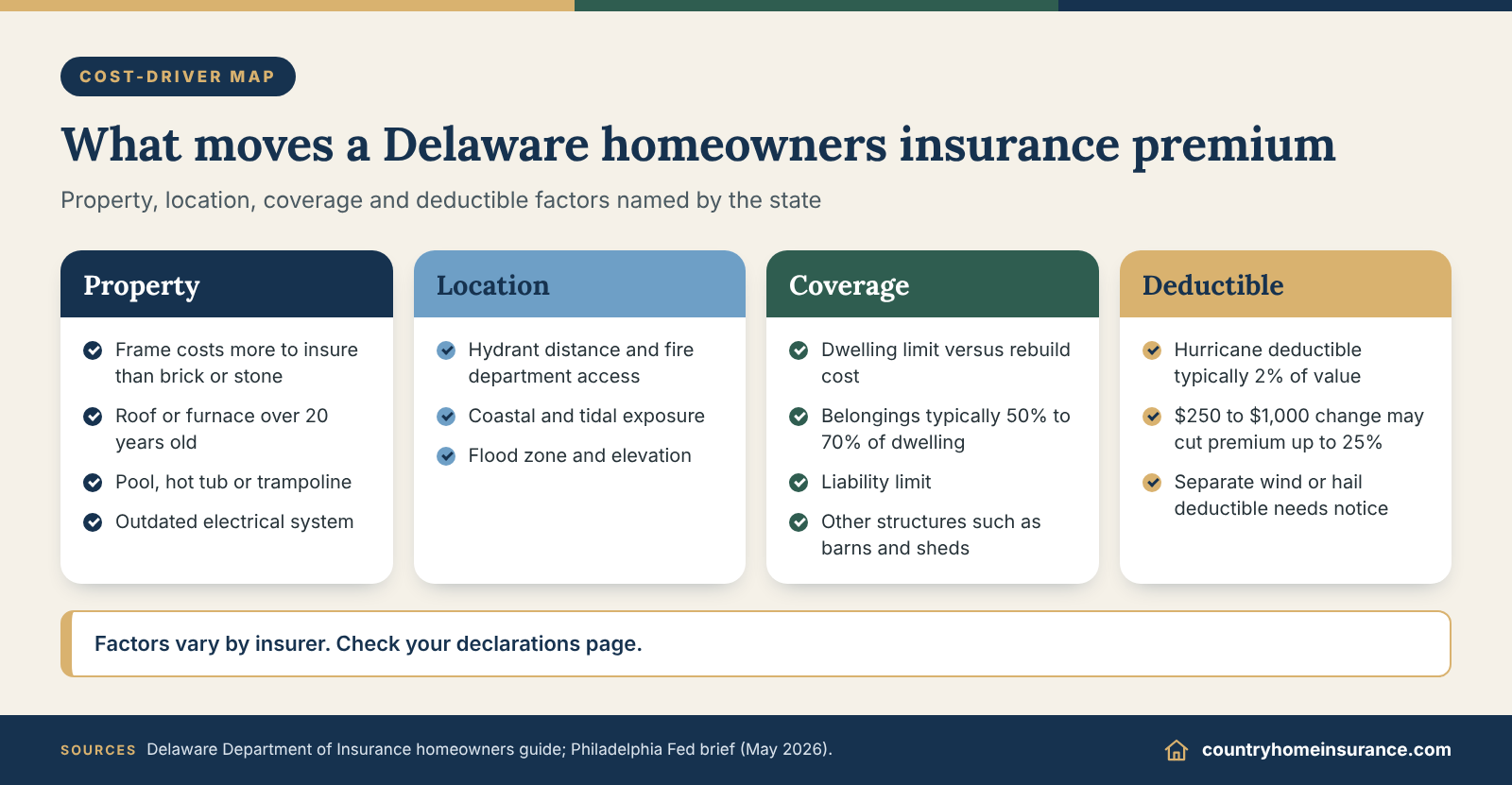
Coverage A (dwelling) pays for the house itself, Coverage B (other structures) for detached buildings and fences, and Coverage C (personal property) for belongings. The Department explains that belongings are typically insured at 50% to 70% of the dwelling limit, so a policy with a $100,000 dwelling limit would generally give $50,000 to $70,000 for contents. It also notes that landscaping is generally covered up to about 5% of the policy value. Those percentages are typical, not guaranteed, so check the declarations page, the one-to-two page summary of limits at the front of your policy.
Liability, medical payments and loss of use
Coverage E (personal liability) responds when you are legally responsible for injury to others or damage to their property, and Coverage F (medical payments) covers minor injuries to guests regardless of fault. Coverage D (loss of use, also called additional living expense) helps with temporary housing if a covered loss makes the home unlivable. The Department notes that liability limits can often be raised for a relatively small additional cost, which matters for owners with ponds, pools, horses or frequent visitors.
Delaware-specific policy points from the state guide
Special limits on valuables
The Department’s guide lists typical sublimits, which are caps for particular categories inside the contents limit: about $200 for money and coins, $1,000 for certain securities and documents, $1,000 for theft of jewelry and watches, $2,000 for theft of firearms, $2,500 for theft of silverware and $5,000 for computer equipment. Treat these as typical examples from a state consumer guide, since your form may differ. Anything above the cap generally needs a scheduled floater or rider, usually supported by an appraisal.
Older homes and the HO-8 form
The Department states that homes built before 1900 may not qualify for an HO-3 and might be offered an HO-8, a form for older homes that does not cover some accident-related damage such as bursting pipes or electrical shorts. If your home is old, ask whether the quote is on an HO-3 or an HO-8 and what the replacement cost basis is. Our guide to how home age affects homeowners insurance goes further.
How much Delaware homeowners insurance costs, and why published averages disagree
Search for a Delaware average and you will find several different numbers. They are not contradictions so much as answers to different questions, built on different houses, coverage limits and data sources. Pick the one whose method resembles your situation, then treat any average as a starting point for comparing real quotes.
Two recent averages and how each was built
Federal Reserve Bank of Philadelphia: mortgage-based data
A May 2026 Philadelphia Fed community development brief, using ICE McDash loan-level data for single-family homes with an escrow account, reported an average Delaware premium of $1,549 as of June 2025, in inflation-adjusted terms. The median was $1,296. The same brief found the average rose 25.4% (from $1,235) between December 2021 and June 2025, while the average premium rate per $1,000 of coverage moved from 3.3 to 3.7, a 13.6% increase. The brief describes Delaware’s average premium as below the national average, without giving a national dollar figure. Because the study covers escrowed mortgages, it leaves out owners who pay insurance directly or have no mortgage.
ValuePenguin: quote-based estimate
ValuePenguin, a consumer finance publisher, lists $1,165 per year for a policy with $350,000 of dwelling coverage, based on 6,384 quotes from six companies across 70 ZIP codes, on a page updated September 25, 2026. The page does not state the deductible behind that quote. It lists a national figure of $2,395 on its own method. Because one figure is a loan-data average and the other is a quote sample at a stated coverage level, do not subtract one from the other or blend them; they answer different questions.
Reading the trend without over-reading it
Premium growth versus rate growth
The Philadelphia Fed figures show the average premium (up 25.4%) rising faster than the average rate per $1,000 of coverage (up 13.6%). One plausible explanation, offered here as an inference rather than the brief’s finding, is that insured values also increased as rebuilding costs climbed, so a given rate produces a bigger premium. That is a reason to check your dwelling limit yearly; our guide on how dwelling coverage amount affects cost explains the tradeoff between a higher limit and a higher premium.
Affordability pressure in the same data
The brief also reported a 30-day-plus mortgage delinquency rate of 5.7% for Delaware in June 2025, and it associates a 25% premium increase with a delinquency likelihood about 0.7 percentage points higher in Delaware. That is a statistical association across loans, not a forecast for any one household. For owners, the practical point is to treat a renewal increase as a prompt to review deductible, limits and discounts rather than to accept it silently.
What moves your own premium
Factors the Department of Insurance names
The Department’s homeowners guide lists the main drivers: construction type (frame generally costs more to insure than brick or stone), home age, coverage levels, the deductible, distance from a fire hydrant and fire department access (which feed the fire protection class), pets, and features such as pools, hot tubs, trampolines, outdated electrical systems, and roofs or furnaces over 20 years old. It also says insurers may use an insurance score based on credit and claims history.
Where your ZIP code and roof fit
Location matters beyond the county line, since each insurer maps its own territories. Our explainer on how ZIP code affects homeowners insurance cost shows how these factors work nationally. In Delaware, a roof over 20 years old is one of the few age thresholds the state’s own guide mentions, so photograph roof condition and keep replacement records.
| Item | What the source reports | Why it matters when you shop |
|---|---|---|
| Average premium, mortgage-based | $1,549 (June 2025, inflation-adjusted); median $1,296. Federal Reserve Bank of Philadelphia, May 2026; escrowed single-family loans. | Reflects owners with mortgages, so it may differ from cash owners or unusual properties. |
| Average premium, quote-based | $1,165 for $350,000 dwelling coverage; 6,384 quotes, six companies, 70 ZIP codes. ValuePenguin, updated 2026-09-25. | Shows quotes at one coverage level; your limits and deductible will shift the result. |
| Premium change, Dec 2021 to Jun 2025 | Average up 25.4%; average premium rate per $1,000 of coverage rose from 3.3 to 3.7 (up 13.6%). | Review the dwelling limit and deductible at each renewal. |
| Typical hurricane deductible | Typically 2% of property value for hurricane-caused wind, rain, hail, tornado or cyclone loss (Delaware DOI guide). | A percentage can be many times a flat dollar deductible. |
| All-other-perils deductible | Raising from $250 to $1,000 may lower premium by up to 25% (Delaware DOI guide). | Only choose a deductible you could pay from savings after a loss. |
| Personal property limit | Typically 50% to 70% of the dwelling limit (Delaware DOI guide). | Check against a home inventory; ask about replacement cost on contents. |
| Roof or furnace over 20 years | Listed by the DOI as a factor that can raise premiums. | Document updates and ask whether an inspection or roof schedule applies. |
| Fire protection class | Hydrant distance and fire department access affect the class (Delaware DOI guide). | Ask the insurer which protection class it assigned to your address. |
| NFIP limits and start date | Homeowner building coverage up to $250,000 and contents up to $100,000; coverage generally begins 30 days after purchase, with exceptions such as buying while making, increasing, extending or renewing a mortgage (FEMA FloodSmart). | A rebuild cost above $250,000 leaves a gap, so ask about private or excess flood options and buy early. |
| FAIR Plan hurricane deductible | A $2,000 Delaware hurricane deductible is mandatory for dwellings in five listed ZIP codes and optional in eleven others (FAIR Plan General Rules Manual, edition 12.2024). | Ask the plan whether your ZIP code is on either list and what it costs. |
| FAIR Plan maximum limit | $1,000,000 for all insurable property at one location, building and contents combined for one- to four-family dwellings (same manual). | Compare with your rebuild estimate and with what a standard policy would provide. |
Delaware coastal, bay and tidal-flood exposure: Sussex County and beyond
Delaware is small, but its water boundary is long: the Atlantic coast, Delaware Bay and tidal rivers. The state’s own climate planning shows that the water at the edge is changing, which affects both flood insurance decisions and homeowners underwriting.
What state and federal sources say about the water
Sea level and tidal flooding trends
DNREC’s 2025 Delaware Climate Action Plan (December 2025) reports that the Lewes tide gauge has recorded roughly 15 inches of sea level rise since 1919, about twice the global rate, with more than 6 inches of it between 1990 and 2020. It projects 1.2 to 1.5 feet more by 2050 and 4 to 6 feet by 2100 under a high-emissions scenario. It also reports that days with minor tidal flooding rose from fewer than 10 a year in the 1950s to more than 50 today.
What it means for an individual house
Statewide trends do not tell you what happens at your address, because elevation, distance to tidal water and drainage vary block by block. Look up your actual flood zone and ask whether an elevation certificate exists for the building. Those two facts do more to shape your flood decision than any regional projection.
Where homeowners policies and flood risk meet
Sussex County beach and bay communities
Delaware’s ocean and bay communities in Sussex County, from Lewes through the Inland Bays, are where much of the state’s ocean, bay and tidal exposure sits. Seasonal and second homes there raise further questions, because insurers differ in how they treat seasonal occupancy, so ask directly whether a beach house is written as a primary residence, secondary home or rental.
Flooding that is not tidal
Floods do not stay in mapped zones. FEMA’s FloodSmart site reports that almost one-third of NFIP claims come from outside high-risk flood areas, and the NCEI Delaware climate summary (2022) projects more winter and spring rainfall. Heavy rain overwhelming a creek, ditch or drain in Kent or New Castle County can produce the same uninsured-flood problem as a coastal surge.
Storm types: nor’easters, hurricanes and tropical remnants
Nor’easters are the common coastal storm
NOAA’s State Climate Summary for Delaware (2022) says nor’easters are the most common coastal storms in the state, peak in March, and bring strong winds, heavy precipitation and coastal flooding. It names the Ash Wednesday nor’easter of March 1962 as the worst on record in Delaware. A winter storm can therefore produce wind damage, which is typically covered, and flood damage, which is typically not, in the same event.
Tropical storms and recent hurricane impacts
The same summary says tropical storms and hurricanes occasionally affect Delaware in late summer and fall, and that Hurricanes Irene (2011) and Sandy (2012) caused significant economic and infrastructure damage, with Irene leaving at least 119,000 residents without power. The National Hurricane Center lists the Atlantic season as June 1 to November 30 with a peak around September 10, so this year’s season runs through November 30.
Wind and water often arrive together, and who pays can depend on the cause of each part of a loss. Our guides to whether homeowners insurance covers wind damage and whether it covers flood damage explain that logic, and hurricane evacuation expense coverage covers the related lodging question.
Hurricane, named-storm and wind deductibles in Delaware
A deductible is the amount you absorb before the insurer pays on a covered loss. In a storm-exposed state the structure of that deductible can matter more than the premium itself, since a percentage deductible rises with your home’s value.
What Delaware law and the Department require you to be told
The notice rule in 18 Del. C. § 4140
Delaware Code, Title 18, § 4140 requires insurers writing residential property coverage to give policyholders clear and prominent notice of any separate wind, hail or hurricane deductible. The notice must explain what triggers the deductible and whether it is a percentage or a dollar amount. For percentage deductibles it must include an example of how it applies, and the statute’s own illustration is a 2% deductible on a $300,000 house, which leaves the owner responsible for $6,000. If a policy has no separate deductible, no notice is required.
What the Department’s guide says about typical percentages
The Department of Insurance guide says many policies require a deductible, typically 2% of the property’s value, before covering wind, rain, hail, tornado or cyclone losses directly caused by a hurricane, and its May 2026 newsletter repeats that point. The word typically matters: the notice statute requires disclosure of whatever deductible a policy uses but does not itself set the percentage or the trigger, so your insurer’s filed form controls what applies to you.
How the arithmetic works
A worked example with clearly hypothetical numbers
Hypothetical example: A home has a $350,000 dwelling limit, a $1,000 deductible for ordinary losses, and a 2% hurricane deductible calculated on the dwelling limit. A hurricane-caused wind loss of $18,000 would leave the owner responsible for $7,000, with the insurer paying the remainder subject to policy terms. A $5,000 wind loss from the same storm would fall below the deductible and typically pay nothing. These figures are illustrative only and are not a prediction of any claim or any policy.
When a hurricane deductible applies
Forms across the wider market define the trigger in different ways, such as a declared hurricane, any named storm or all wind. The Department’s description is limited to losses directly caused by a hurricane, so do not assume your form matches it. Because definitions vary, ask the insurer for the exact definition of the triggering event and the date range, and see our guide to whether homeowners insurance covers wind damage for how wind deductibles interact with a loss.
Reducing the sting
Building a deductible reserve
If a 2% deductible on your dwelling limit would be hard to pay, set up a dedicated savings line for it. Ask whether a lower percentage or a flat-dollar option is available and what it costs, and confirm any mortgage lender requirements before changing the deductible.
Documenting mitigation work
The Department’s guide says that storm shutters, shatter-resistant glass, certain roofing and monitored alarms may qualify for discounts, though it tells owners to ask the insurer. Keep invoices, permits and dated photos for any hardening work, because a discount usually depends on proof. Ask each insurer in writing which mitigation features it credits and by how much.
Flood insurance in Delaware: NFIP, private flood and what to ask
The Delaware Department of Insurance’s homeowners guide is direct on this point: flood damage is not covered by standard homeowners or renters policies, and flood insurance is usually bought separately, often through the federal government via an agent or from some private insurers. FEMA’s FloodSmart site agrees that most homeowners policies do not cover flood. The decision for Delaware owners is which flood product to buy and when.
The federal program
What the NFIP offers and how it works
The National Flood Insurance Program (NFIP) is the federal program FEMA runs, sold through insurance agents. FloodSmart says it offers two types of coverage, building and contents, and that your premium depends on several factors specific to the property. It also says flood policies do not renew automatically, so a policy can lapse if the renewal notice is missed.
Limits and the 30-day wait
FloodSmart states that, for homeowners, building coverage goes up to $250,000 and contents coverage up to $100,000. It also states that coverage generally goes into effect 30 days after the date of purchase, with exceptions, such as buying flood insurance while making, increasing, extending or renewing a mortgage. If your rebuilding cost is above the building limit, the gap is yours unless you add a private or excess flood policy, and the 30-day wait means a policy bought once a storm is forecast will not respond to that storm. Premiums depend on the property, so request a quote for your address from an agent rather than relying on a state average.
Mapped zone versus real exposure
A flood zone designation matters to lenders, but water does not follow map lines. FloodSmart notes that almost one-third of NFIP claims come from outside high-risk areas. Elevation certificates, which document your building’s height relative to flood levels, can lower what some owners pay according to FloodSmart. If you own near the Inland Bays or a tidal creek, ask whether an elevation certificate exists for your address.
Delaware’s private primary flood framework
What Subchapter V of Chapter 41 sets up
Delaware Code Title 18, Chapter 41, Subchapter V is titled the Private Primary Residential Flood Insurance Model Act. Its stated purpose is to encourage a robust private primary residential flood insurance market as an alternative to the NFIP. Insurers that intend to sell this coverage must notify the Department at least 30 days before making a form or rate filing and must file a plan of operation with financial projections. The code page lists 83 Del. Laws c. 530 as the source.
Consumer protections in the statute
For applicants in FEMA special flood hazard areas, the act requires insurers, producers or surplus lines brokers to inform consumers about the NFIP, including subsidized rates and the possibility of full-risk rates on reinstatement. Cancellations or nonrenewals other than for nonpayment require at least 45 days’ notice, and non-payment cancellations follow the general notice rule. Whether a lender accepts a private policy is the lender’s decision, so ask your mortgage servicer in writing before replacing an NFIP policy, and ask an agent which private flood carriers currently quote your address.
Related water exclusions to check separately
Sewer and drain backup
Sewer backup is not flood, and the Department lists it among perils typically excluded unless an endorsement is added. Delaware owners with finished basements, or properties served by a sump pump or a septic field, should check for a water backup endorsement and its sublimit. Our guides explain whether homeowners insurance covers sewer backup and related water-backup endorsements.
Surface water, storm surge and groundwater
Whether rain pooling at a foundation, surge pushing through a door or groundwater rising through a floor counts as flood is defined in the policy, and the definition decides the outcome. Ask your agent to show you the flood exclusion wording and the water-damage definitions in plain language, then note them in your file.
Cancellation, nonrenewal and claims history: Delaware’s statutory rules
Delaware has a detailed statute on when a property insurer may decline, cancel or not renew a policy. It is one of the more owner-protective parts of Delaware homeowners insurance, and it changed again in 2024. What follows summarizes Delaware Code Title 18, Chapter 41, Subchapter III as shown on the state code site; the text controls over this summary.
Who the statute covers and when an insurer can cancel
Scope of the protections
Section 4120 says the subchapter applies to property insurance on real property of up to four residential units, one of which is the named insured’s principal residence, and on personal property kept in a residential dwelling, for policies issued or renewed after January 19, 1986. It excludes inland marine policies and residual market policies. Because the scope is framed around the named insured’s principal residence, a seasonal beach house that is not your principal residence may fall outside these protections, so ask your insurer how a second home is treated.
Cancellation reasons after the first 60 days
Once a policy has been in effect more than 60 days, or after a renewal takes effect, § 4123 allows cancellation only for listed reasons: nonpayment; fraud or material misrepresentation; willful or reckless acts that increase an insured hazard; a change in risk that substantially increases a hazard; violations of fire, health, safety, building or construction rules that substantially increase a hazard; a Commissioner determination that continuing would violate Delaware law; and real property taxes delinquent for two or more years. The Department’s guide adds that an insurer may cancel for any reason in the first 60 days.
Notice rules and renewal
How much notice and in what form
Under § 4122, a cancellation notice must be written, state the effective date and give specific reasons, with at least 30 days’ notice (10 days for nonpayment). For a nonrenewal, the insurer must send either a renewal offer or a notice of intent not to renew with reasons at least 30 days before the policy period ends. Notices other than nonpayment must go by certified mail or the USPS Intelligent Mail barcode, and insurers must keep proof of mailing for at least one year. If an insurer does not follow the renewal-notice rules, the statute says coverage is deemed renewed on the same terms until you accept other coverage or agree to the nonrenewal.
Asking why you were declined
When an insurer declines an application, § 4122 requires specific written reasons or reasons within 21 days of a timely written request, with a request treated as timely if received within 90 days of the declination notice. Section 4124 bars declination or termination based on race, religion, national origin, age, sex or marital status, on a prior decline by another insurer, or on prior residual market coverage.
Claims-based nonrenewal after the 2024 amendment
The thresholds in § 4130
Under § 4130, an insurer may not refuse to renew a homeowners policy solely because of claims, unless the policyholder had three or more weather claims in the 36 months before expiration, two or more non-weather claims in the 60 months before expiration, or three or more claims of any kind in the 48 months before expiration. Claims closed without payment cannot be the basis. The state code reflects 84 Del. Laws c. 272 (former Senate Bill 200), approved June 20, 2024, effective October 1, 2024, which also requires cancellation and nonrenewal notices to go by USPS certified mail or the Intelligent Mail barcode. The Department’s Universally Applicable Bulletin 11 (November 6, 2025) summarizes insurance laws from the 2025 legislative session and lists no homeowners or property-insurance coverage items. Because statutes change, check the General Assembly’s website or ask your agent whether anything newer affects your renewal.
Exceptions and inquiries
The statute also lets an insurer nonrenew when claims show a reasonably substantial increase in hazard since issuance, applied to similarly situated policies, or when the policyholder refused to make reasonably necessary repairs after notice. Section 4131 provides that an insured-initiated inquiry about a policy or loss that is not a claim filing may not be treated as a claim for underwriting decisions. That gives owners a safer way to ask a question before filing, but keep a record of what you asked and when.
Hypothetical example: An owner has two weather claims over the past 20 months and one non-weather claim from 30 months ago. That is three claims within 48 months, so the combined-claims threshold would be met, and the statute would not bar a claims-based nonrenewal on that ground alone. A different owner with two weather claims and one non-weather claim from 50 months ago would fall below all three thresholds. These are illustrations of how to read the numbers, not predictions of any insurer’s decision and not legal advice.
| Claim type counted | Lookback window | Claims needed before claims alone may support nonrenewal |
|---|---|---|
| Weather-related claims | 36 months before policy expiration | Three or more |
| Non-weather claims | 60 months before policy expiration | Two or more |
| Combined, any type | 48 months before policy expiration | Three or more |
| Claims closed without payment | Any period | Cannot be the basis for nonrenewal |
| Insured-initiated inquiries (not a claim) | Any period | Cannot be treated as a claim for underwriting (§ 4131) |
| Substantial increase in hazard, or refused repairs | Not a claim-count test | Separate exceptions that may allow nonrenewal (§ 4130) |
For how claims history affects rating, not just renewal, see how claims history affects homeowners insurance cost.
The Delaware FAIR Plan and other options when standard insurers say no
If you cannot find coverage in the regular market, Delaware has a residual market program. Residual market means a program insurers fund collectively so that otherwise insurable property is not left with no option at all. Think of it as a bridge, because it offers narrower protection than a standard policy.
What the plan is and who runs it
Name, history and structure
The plan’s website identifies it as the Insurance Placement Facility of Delaware, which began operating on October 28, 1968 and was created under House Bill 712. It states that it is an association of property insurance companies doing business in Delaware, with a board elected annually by member companies and no federal, state or local funds supporting it. The Delaware Code, Title 18, Chapter 41, Subchapter II, authorizes an industry placement facility and, if that does not work, a joint underwriting association.
Who is eligible
The plan says applicants must have an insurable interest in real or tangible personal property in Delaware and have been unable to secure that insurance in the voluntary market. The statute defines qualified property as property that complies with state law and local building codes and is not otherwise excluded on public-policy grounds. It adds that a dwelling cannot be excluded as unoccupied if it is regularly maintained, has utilities in use and stays furnished, though that protection ends after 60 consecutive days of vacancy. The plan’s own General Rules Manual (edition 12.2024) adds underwriting detail: it lists farms among ineligible property, treats buildings vacant or unoccupied for more than 30 days as ineligible unless an exception applies (furnished seasonal and secondary homes are among the listed exceptions), and requires applicants to allow an inspection of the property. It also says no new or increased coverage is accepted while a designated tropical storm or hurricane is within listed boundaries, so apply before a storm threatens.
What it covers and how to apply
Basic property coverage, no liability
The Department of Insurance describes the plan as basic property insurance for the structure and personal contents, without liability coverage. The plan’s coverage page says habitational coverage follows ISO form DP-00 01, the basic dwelling form, which includes fire, extended coverage and vandalism, and that other perils and time-element or indirect loss are not provided. That page names windstorm or hail only in its list of commercial-property perils, so ask the plan in writing how wind and hail losses are treated for a house before you rely on it for storm protection. Policies run for one year.
Limits, deductibles and cancellation in the plan’s rules
The plan’s General Rules Manual (edition 12.2024) sets the following for habitational risks. The maximum insurance for all insurable property at one location is $1,000,000, and for one- to four-family dwellings that figure covers building and household contents combined, with household contents capped at $500,000 if occupied and $335,000 if vacant. For a property bought within six months of the application, the limit is generally 200% of the recent purchase price if owner-occupied and 125% if tenant-occupied, unless the underwriting manager approves more. A $2,000 Delaware Hurricane Deductible is mandatory for dwellings in ZIP codes 19930, 19944, 19958, 19970 and 19971 and optional in 19939, 19941, 19945, 19947, 19951, 19960, 19966, 19967, 19968, 19969 and 19975. The hurricane period begins when the National Hurricane Center issues a hurricane watch or warning for any part of Delaware and ends 72 hours after the last one is terminated. If the plan cancels or declines to renew, it must give at least 30 days’ written notice, or at least five days in listed circumstances such as unpaid utilities, unpaid real estate taxes or code violations. The manual’s rates and rules can be revised, so ask the plan for a written quote and the current manual before you rely on any figure. The plan’s phone number on its coverage page is (215) 629-8800.
Applying and lender questions
A licensed producer can file for you, or someone with an insurable interest can apply directly. Each location needs its own application, signed by the applicant, and the plan states that submitting an application does not bind it to provide insurance. The Department advises that a FAIR Plan policy may satisfy a mortgage lender but you should confirm with the lender first. Because the plan does not include liability, ask your agent how to buy a separate liability policy if you need one.
Your rights, appeals and the surplus lines route
Inspections and appeals under the statute
Under § 4105, a person with an insurable interest who has made a diligent effort to obtain coverage in the normal market can request an inspection. Under § 4112, a person aggrieved by an action of the inspection bureau or placement facility may appeal to the Insurance Commissioner within 30 days. The residual-market exclusion in § 4120 means the statutory cancellation and nonrenewal rules above do not automatically govern a FAIR Plan policy, which follows the plan’s own cancellation rules summarized earlier.
Surplus lines as another path
A Department of Insurance information sheet explains that an agent unable to place a risk in the regular market can turn to a surplus lines broker. Under 18 Del. C. § 1923, the broker documents a diligent effort to place the coverage with admitted insurers on a Commissioner-prescribed form, and the form must affirm that the insured was told in writing, before placement, that the surplus lines insurer is not licensed in Delaware or subject to state supervision and that the State Insurance Guaranty Fund will not pay losses if the insurer becomes insolvent. Read that disclosure carefully and ask about the insurer’s financial-strength rating and its cancellation and claims terms.
Rural Delaware: farm counties, outbuildings and fire protection
Delaware is not only beaches and Wilmington suburbs. Kent and Sussex counties are strongly agricultural, and a rural owner there faces questions that a coastal or suburban owner does not. A rural home is not just a suburban home with more land, so the policy needs to match how the property is really used.
Delaware’s farm landscape in numbers
County profiles from the 2022 Census of Agriculture
The USDA’s 2022 Census of Agriculture county profiles show Sussex County with 1,053 farms on 262,079 acres and about $1.4 billion in products sold, with poultry and eggs accounting for about $1.16 billion. Kent County had 770 farms on 187,248 acres and about $570.7 million in sales, and New Castle County had 335 farms on 73,507 acres and about $108.6 million. In New Castle, 45% of farms sold under $2,500 a year, a reminder that many Delaware farms are small or hobby-scale.
Why that matters for a homeowners policy
Poultry houses, grain bins and equipment sheds used in a commercial operation are typically insured under farm policies rather than a homeowners policy, which usually limits coverage for business or farming activities. Whether a small flock, a roadside stand or rented acreage changes your eligibility depends on the insurer’s form, so describe the activity accurately at application. Our guides on small farm insurance versus homeowners insurance and rural home insurance explain the dividing line in detail.
Rural property features to price and document
Outbuildings, wells, septic and private lanes
List every detached building with its use, age and approximate replacement cost, because Coverage B limits are often a fraction of the dwelling limit. Note a well pump, septic system, propane tank, wood stove or generator, as insurers may ask about them. The Department’s guide does not address wells or septic systems, so ask whether failure of those components is covered and whether equipment breakdown or service-line coverage is available.
Fire protection class and response distance
The Department’s guide says distance to a fire hydrant and fire department access affect the fire protection class used in pricing. In rural areas without hydrants, a tanker or pond-draft arrangement may matter. Each insurer assigns protection class by its own method, so ask which class it assigned to your address, what drives it, and how to challenge it if you think it is wrong.
Liability on land with animals and water
Animals, ponds and visitors
The Department notes that certain dog breeds or wild animals can lead to cancellation or nonrenewal and that liability limits can be increased for a relatively small cost. For owners with horses, a pond or children visiting, consider a higher liability limit or an umbrella policy and confirm that no animal exclusion applies.
Vacant or seasonal rural property
If you spend months away from a farmhouse or a bay cottage, vacancy and seasonal occupancy terms may limit coverage after a period without occupants. Ask for the specific number of days and the perils affected. The FAIR Plan statute separately protects a maintained, furnished dwelling with utilities on from being excluded as unoccupied, but that protection ends after 60 consecutive days of vacancy, and the plan’s manual separately lists farms as ineligible property.
Delaware homeowners insurance discounts and savings the state documents
Discounts are a place where articles often overpromise. The Department of Insurance’s guide lists categories insurers may offer; it does not state percentages or say any insurer must provide them. Treat the list as a set of questions to ask, not a promise of savings.
Discount categories named in the state guide
Household and loyalty discounts
The guide lists bundling home and auto with one insurer, senior citizen discounts, staying with the same insurer for three or six years, no smokers in the home, and membership in alumni, service or fraternal groups. Some of these are rarely advertised, so ask by name. Eligibility and size vary by insurer, so request the discount list in writing.
Safety and structural upgrades
The guide says updated plumbing or electrical systems may earn a discount, as may deadbolts, smoke detectors and monitored alarms, and structural upgrades such as shatter-resistant glass, storm shutters or certain roofing. For flood, FloodSmart says elevating a home is one of several ways to earn an NFIP discount. Keep dated invoices, permits and photographs, because insurers typically need proof.
Savings that are not discounts
Deductible choices
The Department says that raising an all-other-perils deductible from $250 to $1,000 may lower premiums by up to 25%. Only pick a higher deductible if you could pay it from savings after a loss, and remember a hurricane deductible may be separate and percentage-based.
Comparing real quotes
The same house can price very differently between insurers because each files its own rating plan. Compare quotes with identical dwelling limit, deductible structure and endorsements, which our guide to comparing home insurance quotes walks through. Avoid trimming dwelling coverage below rebuilding cost to cut a premium.
When a lower price signals a problem
Coverage differences hiding in a low quote
A low premium can reflect actual cash value roof settlement, a high percentage deductible, a lower contents percentage or exclusions. Read the declarations page and endorsement list line by line, not just the total.
Insurer stability and complaints
Price is only one part of an insurer’s value. The Department’s Consumer Services Division can discuss complaint information, and independent rating agencies publish financial strength ratings, so check both before you commit to a company you do not know.
Where to get help in Delaware: complaints, claims paperwork and the state’s resources
Most homeowners deal with their insurer directly. When that does not resolve things, Delaware has a state office to turn to, and a few statutory points worth knowing before a claim starts.
Working with Consumer Services
What the Department can and cannot do
The Department’s Consumer Services Division educates consumers about their rights, mediates between consumers and companies, and helps explain appeals of adverse decisions. It cannot give legal advice, determine liability, or require payment unless a founded violation of law has occurred. Its brochure says to review your coverage and contact your insurer first, and to have the policy ready when you reach out.
How to reach the Department
Delaware residents can call 1-800-282-8611 (toll-free in the state) or (302) 674-7310, email [email protected], or use the online complaint form; there are in-person offices in Dover and Wilmington. The brochure does not state a response timeframe, so keep copies of everything and note dates.
Claims paperwork in Delaware
Limitation periods and the insurer’s duty to tell you
Under § 4129, while a property claim is pending, the insurer must promptly give you written notice of the applicable statute of limitations or contractual limitation period. Calendar that date when you receive it, and ask in writing if the notice is missing. Delaware’s unfair claim settlement practices regulation (18 Del. Admin. Code 902, section 3.0), as published in the state’s Administrative Code, sets these timelines: respond to claim communications within 15 working days of receipt (3.1.2), begin investigating within 10 working days of notice of loss (3.1.3), and affirm or deny coverage, or explain in writing why it cannot yet, within 30 days after proof of loss statements (3.1.5). It sets no fixed payment day count; it requires prompt, fair settlement once liability is reasonably clear (3.1.6). These are conduct standards for insurers, so treat them as a basis for a written follow-up or a Department inquiry, not as a guarantee of a payment date.
Building your proof before you need it
The Department publishes a printable home inventory form that asks for description, brand, model, serial number, purchase year, original cost and replacement cost room by room. A video walk-through with dated receipts for big items works alongside it.
A Delaware shopping and verification plan
Everything above comes down to a sequence you can follow: confirm the facts of your property, ask the same questions of each insurer, and keep the answers in writing. The Department notes that some type of homeowners insurance is generally a requirement to get a mortgage, so buyers face this on a deadline; owners renewing have more time to compare.
Before you request quotes
Set the dwelling limit and loss settlement basis
Decide whether you want replacement cost value (RCV), which the NAIC describes as paying what it takes to rebuild or replace, or actual cash value (ACV), which accounts for depreciation. The NAIC also says dwelling coverage should be enough to fully rebuild your home. A contractor’s rebuild estimate for your address is a better anchor than market value, because land value is not insured.
Know your flood and tidal status
Look up your property’s flood zone through your lender, county or FEMA’s tools, and ask whether an elevation certificate exists. If you are near Delaware Bay, the Inland Bays or a tidal river, assume the question is when to buy flood coverage, not whether homeowners insurance will cover it. Our flood coverage explainer is the companion to this step.
Questions for every insurer
Deductible and storm questions
Ask for the exact wording of the hurricane or named-storm deductible, what base the percentage uses, and the dollar amount at your dwelling limit. Request the notice Delaware law requires under § 4140. Ask whether non-hurricane wind, such as a nor’easter, falls under the standard deductible or a separate one.
Renewal and nonrenewal questions
Ask how the insurer counts claims, whether it treats inquiries as claims, and how it applies the claim thresholds in Delaware law. Ask for its policy on seasonal or rented occupancy and for any restrictions on older roofs. If an insurer declines you, ask for the specific written reasons, and remember that Delaware law lets you request them in writing within 90 days of the declination notice.
After you buy
File the paperwork
Save the declarations page, every endorsement, the hurricane deductible notice, your flood policy, and your agent’s written answers in one folder. Photograph each room and the exterior once a year and update the Department of Insurance inventory form after major purchases.
Review at every renewal
Compare the renewal’s dwelling limit and deductible to last year’s, and read any notice of changes in coverage. If the premium jumped, ask for the rating factors that changed. Then re-shop if the numbers no longer fit, using the same specification for each quote.
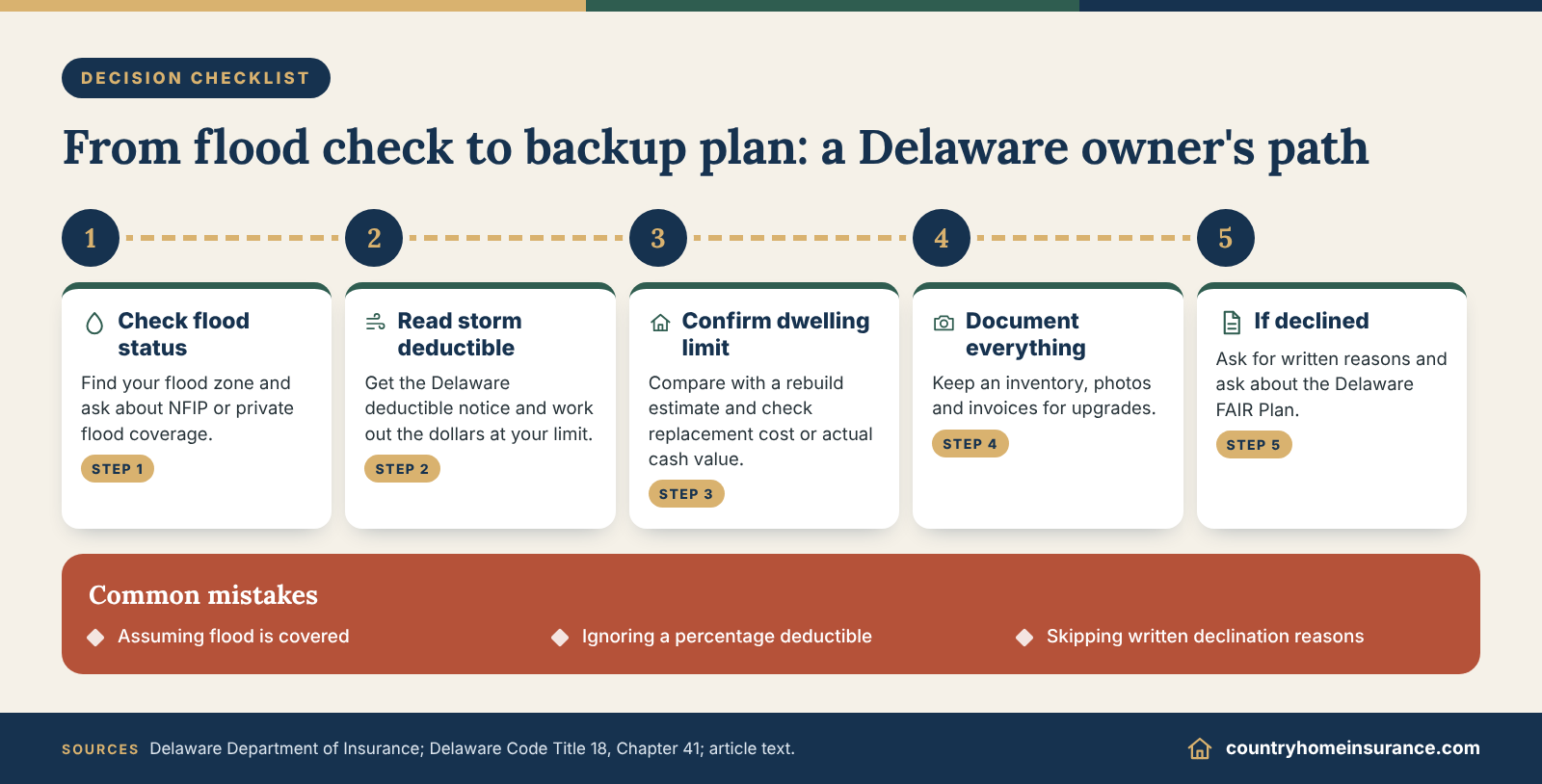
| Action | What to verify or document | Question to ask the insurer or agent |
|---|---|---|
| Confirm the dwelling limit | A recent rebuild estimate and the declarations page limit. | Does the policy use replacement cost or actual cash value for the dwelling and the roof? |
| Read the storm deductible | The § 4140 notice and the declarations page. | What triggers the hurricane or named-storm deductible, and what is the dollar amount at my limit? |
| Settle the flood question | Flood zone, elevation certificate, lender requirements. | Can I get NFIP or private flood quotes, and do the building limit ($250,000 for NFIP homeowner coverage) and contents limit fit my home, given the 30-day wait? |
| Document belongings | Room-by-room inventory, receipts, serial numbers, photos. | Is contents coverage replacement cost, and what special limits apply to my valuables? |
| Describe outbuildings and land use | List of buildings, uses, ages and any farm or business activity. | Which structures are covered under Coverage B, and does any farm or business use affect eligibility? |
| Check fire protection details | Distance to hydrant or station, road access. | What protection class did you assign to my address? |
| Collect discount proof | Alarm certificates, roof invoices, plumbing and electrical updates. | Which discounts am I receiving and which could I add? |
| Prepare for nonrenewal | Claim dates, claim types and closed-without-payment records. | How are my claims counted under Delaware’s nonrenewal thresholds? |
| Know your backup options | Declination letters; FAIR Plan contact information. | If you do not renew my policy, what are my FAIR Plan or surplus lines options? |
| Track claim deadlines | Written notice of limitation periods once you file. | What is the written deadline to complete proof of loss or sue? |
Frequently asked questions
Coverage and cost
Does Delaware homeowners insurance cover flood damage?
Typically not. The Department of Insurance’s guide says standard homeowners and renters policies do not cover flood, and flood coverage is usually bought separately through the NFIP or from some private insurers. Check the policy’s water-damage definitions, since wind-driven rain and backup may be handled differently. A new NFIP policy generally takes effect 30 days after purchase, so buy before a storm is forecast.
Is Delaware homeowners insurance cheaper than the national average?
The two published sources we reviewed both point that way. The Philadelphia Fed brief describes Delaware’s average premium as below the national average, and ValuePenguin lists $1,165 for Delaware against a national figure of $2,395 on its own method. The two use different data and are not comparable with each other, and your price depends on the home, the limits, the deductible and the insurer.
Storms and deductibles
What is a typical Delaware hurricane deductible?
The Department describes it as typically 2% of the property’s value, but your policy’s declarations page controls the actual percentage or dollar amount. Delaware law requires a clear notice of any separate wind, hail or hurricane deductible.
Does a nor’easter trigger the hurricane deductible?
It depends on the policy’s definition of the triggering event. The Department describes the deductible in terms of hurricane-caused losses, but definitions vary, so ask the insurer how non-hurricane storms are treated.
Renewal and backup coverage
Can my insurer drop me after a claim?
Delaware limits claims-based nonrenewal for homeowners policies to specific counts within lookback windows, and claims closed without payment cannot be the basis. Other lawful reasons, such as a substantial change in risk, may still apply, and the statute’s 30-day notice and written-reason rules govern the process.
Is the Delaware FAIR Plan a substitute for a regular policy?
Not fully. It offers basic property coverage for people who cannot get it in the voluntary market, and the Department says it does not include liability. Its rules cap coverage at $1,000,000 per location and list a $2,000 hurricane deductible in certain ZIP codes. Get a written quote, read the form, and ask your lender whether it satisfies the loan requirements.
Help and records
Who do I call if my insurer will not answer?
Start with the insurer in writing, then contact the Delaware Department of Insurance’s Consumer Services Division, which can mediate and explain your rights. It cannot give legal advice or order payment without a founded violation of law.
What records should I keep?
Keep the declarations page, endorsements, deductible notice, inventory, receipts, mitigation invoices and dated photos. After a loss, keep every claim communication and note the limitation period the insurer must provide in writing.
Sources
- Delaware Department of Insurance — Homeowners Guide (PDF, undated; hosted in the Department’s 2022 uploads; accessed 2026-10-16)
- Delaware Department of Insurance — Monthly newsletter (May 2026; accessed 2026-10-16)
- Delaware Department of Insurance — Consumer resources page (accessed 2026-10-16)
- Delaware Department of Insurance — Consumer Services brochure (2024; accessed 2026-10-16)
- Delaware Department of Insurance — Home Inventory Form (2018; accessed 2026-10-16)
- Delaware Department of Insurance — FAIR Plan and surplus lines information (PDF, undated; accessed 2026-10-16)
- Delaware Code Title 18, Chapter 19, Subchapter II — Surplus Lines Insurance (§ 1923) (current code; accessed 2026-10-16)
- Delaware Department of Insurance — SERFF public access (accessed 2026-10-16)
- Delaware Code Title 18, Chapter 41, Subchapter III — Declinations, Renewals and Cancellations of Property Insurance Contracts (current code; accessed 2026-10-16)
- Delaware Code Title 18, Chapter 41, Subchapter II — Basic Property Protection Plan (current code; accessed 2026-10-16)
- Delaware Code Title 18, § 4140 — Notice regarding deductibles (current code; accessed 2026-10-16)
- Delaware Code Title 18, Chapter 41, Subchapter V — Private Primary Residential Flood Insurance Model Act (current code; accessed 2026-10-16)
- Delaware General Assembly — 84 Del. Laws c. 272 (formerly Senate Bill 200) (approved 2024-06-20; accessed 2026-10-16)
- Delaware Administrative Code — 18 DE Admin. Code 902, Prohibited Unfair Claims Settlement Practices (section 3.0) (accessed 2026-10-16)
- Delaware Department of Insurance — Universally Applicable Bulletin 11, 2025 legislative session summary (2025-11-06; accessed 2026-10-16)
- Delaware FAIR Plan (Insurance Placement Facility of Delaware) — home page, coverage and how-to-apply pages (accessed 2026-10-16), plus its coverage page and General Rules Manual, including Sections II, IV, V and XII (edition 12.2024; accessed 2026-10-16)
- Federal Reserve Bank of Philadelphia — Homeowners insurance brief (May 2026; accessed 2026-10-16)
- ValuePenguin — Best and cheapest home insurance in Delaware (page updated 2026-09-25; accessed 2026-10-16)
- DNREC — Sea level rise (published 2026-01-07; accessed 2026-10-16)
- DNREC — 2025 Delaware Climate Action Plan (December 2025; accessed 2026-10-16)
- NOAA NCEI — State Climate Summaries 2022: Delaware (2022; accessed 2026-10-16)
- NOAA National Hurricane Center — Hurricane climatology (accessed 2026-10-16)
- FEMA — FloodSmart (National Flood Insurance Program) and its Buy a Flood Insurance Policy page (accessed 2026-10-16)
- USDA NASS — 2022 Census of Agriculture, Sussex County, Delaware profile (2022 census; accessed 2026-10-16); the Kent County and New Castle County profiles were used for county comparisons
- NAIC — Homeowners insurance (consumer topic page) (accessed 2026-10-16)
Important coverage note
Coverage depends on the actual policy, endorsements, exclusions, limits, deductible and cause of loss. Delaware statutes, regulations, residual-market rules and insurer filings can change, and this article summarizes them as shown on the cited pages on 2026-10-16; the official text controls. Verify case-specific questions with your insurer or agent and the Delaware Department of Insurance. This article is educational information, not legal or insurance advice.
About the editorial team
This guide was prepared by the countryhomeinsurance.com editorial team as general, educational information for homeowners. We research and summarize publicly available material, including state insurance departments, the NAIC, federal agencies, regulators’ consumer guides and published insurer and industry resources. We draw only on the sources that were available to us when we wrote this guide, and we list them in the Sources section with dates where we could find them.
Insurance rules, rates, products and program terms change, differ by state and by insurer, and can apply differently to your situation. We cannot guarantee that this content is complete, current or free of errors. It is not legal, financial, tax or insurance advice, it is not an offer to sell insurance or a recommendation of any insurer, agent or product, and reading it does not create a professional relationship of any kind.
To the fullest extent permitted by law, countryhomeinsurance.com and its editorial team, authors and contributors exclude all liability for any loss, damage or decision arising from the use of, or reliance on, this content. For questions about your own policy or claim, contact your insurer, a licensed agent or broker, your state Department of Insurance or another qualified professional.
Content created: October 16, 2026