Quick answer
Rural home insurance usually isn’t a separate product. It’s a standard homeowners policy, a homeowners policy with farm-related add-ons, or a farm package, chosen to match what happens on your land. Standard forms often miss farming and business activity, livestock, farm equipment, some outbuilding uses and wear-related failures of systems like septic, and they exclude flood. Distance from fire protection can also affect price and underwriting. Forms vary by insurer and state, so compare your declarations page and endorsements against how you actually use the property.
Key takeaways
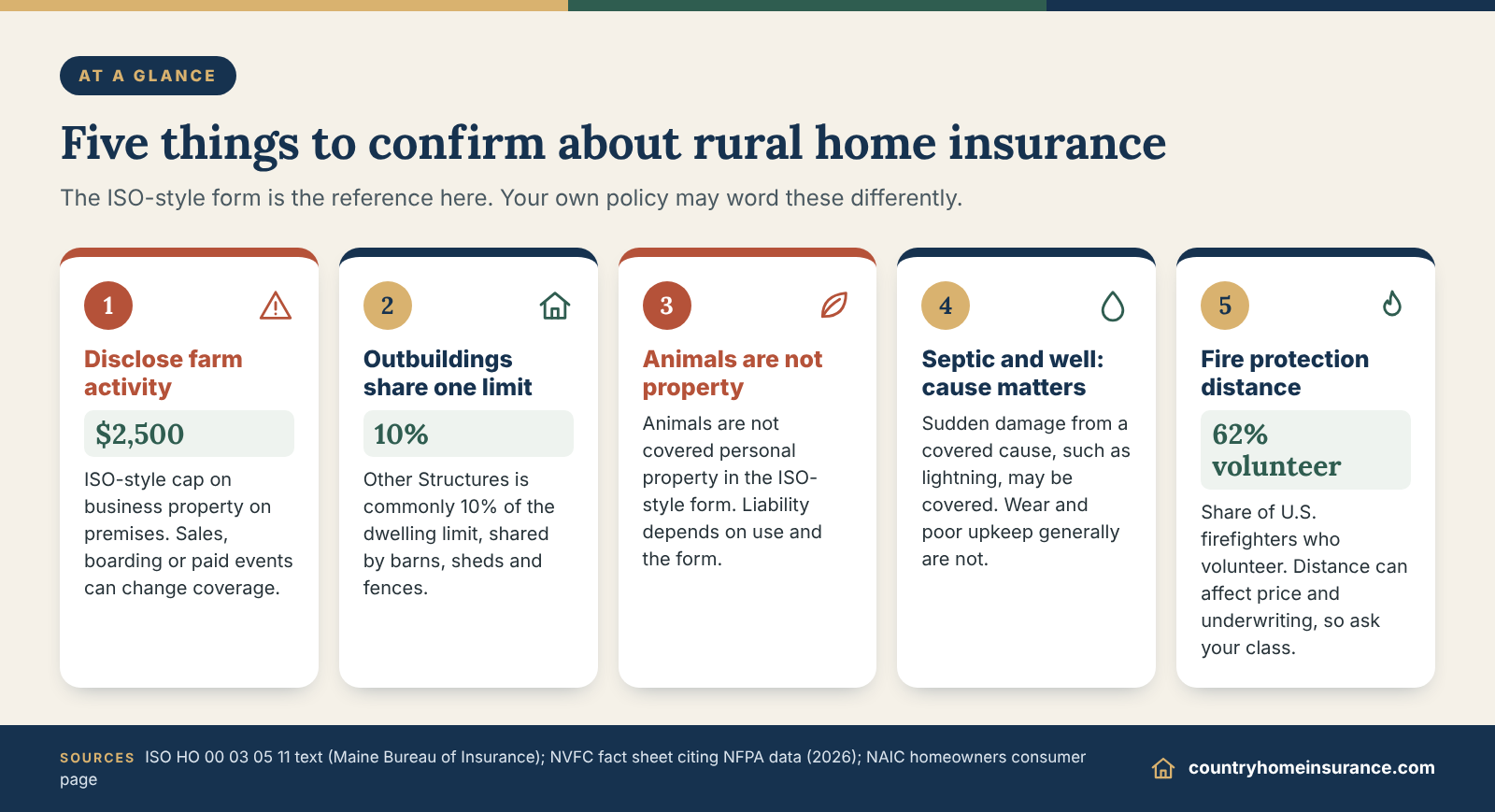
- In the widely used ISO-style homeowners form, animals are not covered as personal property, and structures used for a “business” are excluded from Other Structures coverage. Your own form may word this differently.
- Other Structures coverage (barns, sheds, fences, detached garages) is commonly set at 10% of the dwelling limit, so a property with several buildings can outgrow it quickly.
- Selling eggs, boarding horses, running a farm stand or hosting visitors can change both your property and liability coverage. Disclose activities before a loss, not after.
- A septic tank or well pump damaged by a covered event, such as lightning, may be covered, but wear, poor maintenance and tree-root damage generally are not.
- Fire protection class, which reflects distance to a fire station and to water, can affect price and underwriting. Most U.S. fire departments are all or mostly volunteer, so ask your insurer how your address is classified.
- When a standard insurer won’t write the property, the options include farm-owners policies, endorsements and, in many states, a FAIR Plan. These have different limits, and FAIR Plans generally don’t offer liability coverage.
| Situation on the property | Typical treatment under a standard homeowners form | Status | What to verify |
|---|---|---|---|
| The house and its contents | Insured against covered causes of loss, subject to limits, deductible and exclusions | Typically covered | Dwelling limit versus current rebuild cost; whether settlement is replacement cost or actual cash value |
| Detached garage, workshop or shed used for personal storage | Usually falls under Other Structures, often at a percentage of the dwelling limit | Typically covered, with a cap | The Coverage B dollar limit and whether older buildings settle at depreciated value |
| Barn, shop or building used for farming or business | Business use can remove a structure from Other Structures coverage in the ISO-style form | Often excluded or limited | Whether a farm endorsement or farm-owners policy is needed |
| Horses, cattle, chickens or other animals | Animals are not covered property in the ISO-style form; liability for animals depends on use and the form | Typically not covered as property | Animal-liability wording, headcount limits and any boarding or fee exclusions |
| Tractor, implements and farm equipment | Often outside personal property coverage when used for farming; limited add-ons exist | Often not covered or capped | Equipment schedule, endorsement dollar limits and whether ACV or replacement cost applies |
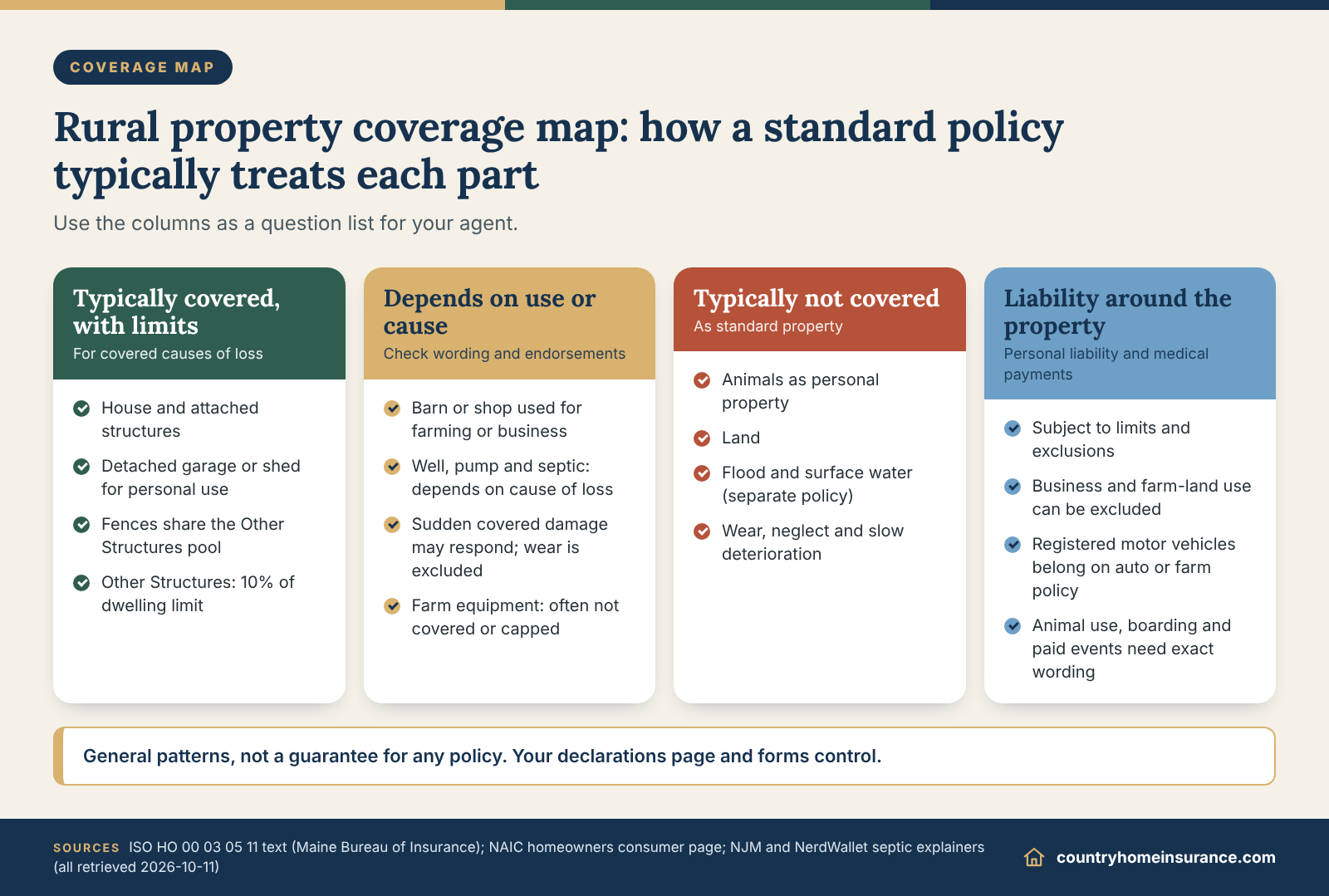
| Septic tank, drain field and well pump | May respond to sudden damage from a covered cause; wear, deterioration and neglect are excluded | Depends on cause of loss | Whether the system counts as dwelling or other structure, and whether a water-backup endorsement is attached |
| Flood or surface water | Excluded from standard homeowners coverage | Not covered | Separate NFIP or private flood policy, and its building limit |
| Long distance to a fire station or water source | Not a coverage term, but a rating and underwriting factor | May affect price and underwriting | The protection class your insurer assigns to your address |
What rural home insurance means in practice
People searching for rural home insurance are often hoping to find one policy built for a country property. Insurers don’t generally sell it that way. What you buy is a combination of a homeowners form, optional endorsements and sometimes a separate farm or liability policy, and the combination should reflect what the property is used for. The risk is rarely that the policy is “bad.” It’s that a standard homeowners form was designed around a house on a residential lot, and a country property can quietly stretch that design.
This guide stays on one question: where do standard policies fall short for rural owners, and what should you ask about? Acreage-specific questions, such as how land size affects eligibility, have their own guides in this cluster.
Why a rural property is not simply a suburban house with more land
Three routes people actually use
Most rural homeowners end up on one of three routes. The first is a standard homeowners policy used as written, which suits a country house with a detached garage and no farm activity. The second is a homeowners policy with added endorsements, which can bring limited farming activity, extra liability or scheduled equipment into the picture. The third is a farm-owners or farm package policy, which is built around farm buildings, equipment and farm liability, and which can also insure the farmhouse. The Maryland Insurance Administration’s farm insurance consumer guide (January 2022 edition) says plainly that a farm policy differs from a homeowners policy, and that items people take for granted on a homeowners form, such as fences, outbuildings and swimming pools, may need an endorsement on a farm policy. Neither route is automatically better. The fit depends on what you do on the land.
Why the same words can mean different things
Terms like “outbuilding,” “farm” and “business” feel obvious until a claim turns on them. A shed where you keep a lawn mower is an outbuilding in everyone’s mind. A barn where you keep hay you sell is, to an insurer, potentially a building used in a business. Because those labels drive coverage, the same property can be treated differently by two insurers, and even by the same insurer after you add a few animals or start selling product. Reading your own policy language is therefore more reliable than relying on general rules, including the ones in this article.
The policy language behind this guide
The ISO-style form used as a reference
The Insurance Services Office (ISO), a Verisk company, publishes standard homeowners forms that serve as a common template in the industry. To keep the discussion concrete, this guide refers to a copy of the ISO Homeowners 3 – Special Form (edition 05 11) that the Maine Bureau of Insurance posts on its website. It’s a reference point, not your contract. When this article says “the ISO-style form,” it means that text, and when it says “your policy,” it means the declarations page, form and endorsements that actually apply to you.
Why your own policy can read differently
Insurers can use their own forms and attach endorsements that change limits or settlement rules, and filing requirements differ by state; the Texas Department of Insurance’s farm and ranch checklist, for example, describes a prior-approval filing process for those forms in Texas. If a limit, an exclusion or a definition in your policy differs from what you read here, your policy controls. The point of showing the ISO-style language is to teach you which questions to ask, not to tell you what your insurer will pay.
How the six standard coverages strain under rural conditions
A homeowners policy is organized into property coverages (Section I) and liability coverages (Section II). Industry shorthand labels them Coverage A through F. Here is how each tends to behave when the property has land, buildings and animals.
Coverage A and B: the house and the buildings around it
Coverage A (Dwelling) insures the house itself and attached structures. Coverage B (Other Structures) insures detached structures such as garages, sheds and fences. In the ISO-style form, Coverage B is set at 10% of the Coverage A limit and doesn’t reduce the dwelling limit, and both coverages exclude land. The NAIC’s homeowners insurance consumer page describes other structures as detached garages, work sheds and fencing, and notes that an in-ground pool or a garage holding classic cars may need additional coverage. A country property with a garage, a shop, a pole barn and a mile of fence can use up that percentage faster than the dwelling limit suggests.
Coverage C and D: belongings and living expenses
Coverage C (Personal Property) insures your belongings. In the ISO-style form, it doesn’t cover animals, birds or fish, and it sets special dollar limits for things like money, watercraft and trailers, firearm theft and business property. Coverage D (Loss of Use) pays additional living expenses when a covered loss makes the home unlivable, typically for the shortest time needed to repair or resettle. For rural owners, the practical issue is that a long rebuild can outlast an assumed timeline, so ask how your policy handles a loss that takes longer than expected.
Coverage E and F: liability and medical payments
Coverage E (Personal Liability) responds when you’re legally responsible for injury or property damage to others. Coverage F (Medical Payments to Others) pays certain medical costs for guests hurt on the property regardless of fault, but not for you or regular residents of your household. The ISO-style form carries a business exclusion for liability, and its definition of “insured location” includes vacant land but expressly carves out farm land. Those two details are why farm activity is the single most important thing to disclose, and the next section explains why.
When farming, animals or income change the answer
If a standard homeowners policy has a blind spot for country living, this is it. The form is built to insure a household, and it treats activity that earns money differently from activity that fills the pantry. The line between the two isn’t always where owners expect it, and an insurer usually draws it at underwriting or at claim time, not in a conversation at the feed store.
How the business exclusion works
What counts as a “business” in the ISO-style form
In the ISO-style form, “business” means a trade, profession or occupation, whether full-time, part-time or occasional, plus any other activity engaged in for money or other compensation. The form carves out a few exceptions, including an activity that brings in no more than $2,000 across 12 months for any insured, and volunteer work with only expense reimbursement. Farming isn’t named in that definition, so a reader can’t tell from the definition alone whether a flock of laying hens or a hay field counts. Your insurer’s own endorsements and underwriting rules fill that gap, which is why the answer can differ by company.
What happens to the buildings and belongings involved
The business definition feeds several exclusions at once. Under Other Structures, the ISO-style form excludes structures used to conduct a business and structures used to store business property, with a narrow exception for business property owned by an insured or a dwelling tenant, an exception that doesn’t extend to gaseous or liquid fuel. Coverage C sets a $2,500 limit on business property kept on the premises and $1,500 away from it, and it doesn’t cover business data. Trees, shrubs and plants grown for business are excluded from the plant coverage. In practical terms, a pole barn full of equipment and product that you sell may be treated very differently from the same barn holding family belongings.
Why “it’s only a hobby” is not a safe assumption
Many owners describe their operation as a hobby because it doesn’t pay the bills. The ISO-style definition of “business,” though, turns on whether an activity is done for money or compensation, not on whether it turns a profit. An Insurance Journal article from 2012, written by an insurer’s agribusiness manager, notes that homeowners policies usually carry a business or farming exclusion that can strip out both liability and property coverage, and gives the example that unreported egg sales could undermine coverage for a related food-borne illness claim. The article is more than a decade old, so treat it as an illustration of a long-standing underwriting pattern rather than current policy language. More recently, Farm Bureau Financial Services (an insurer) said in a February 2026 article that homeowners policies usually exclude farming activity. The NAIC adds a related caution on its consumer page: failing to disclose a home business could lead to cancellation. The consistent thread is disclosure.
Hypothetical example: A couple with 12 acres keeps six laying hens and sells surplus eggs from a cooler at the end of their driveway. They never mention it to their agent. If a customer later alleges illness from the eggs, the insurer’s first questions may be whether egg sales were disclosed and whether the policy has any farming endorsement. How that plays out depends entirely on the actual policy and state law, which is the point: the time to ask is before the cooler goes out.
Animals: property and liability are two separate questions
Livestock and pets as property
In the ISO-style form, Coverage C excludes animals, birds and fish. That means a horse, a steer or a flock isn’t covered as personal property under the standard homeowners contract, whatever happens to it. Oklahoma Farm Bureau Insurance, in a July 2025 comparison, likewise lists loss of livestock among things a homeowners policy doesn’t cover, and American Family describes optional livestock coverage on its small farm policy page for situations such as electrocution and loading accidents. Those are insurer descriptions of their own products, and they illustrate that livestock coverage, where it exists, is added deliberately.
Animals as a liability exposure
Liability is a different question. A homeowners policy may respond to a claim that your animal hurt someone on your property, but animal exposures are where insurers tend to write specific limits. The 2012 Insurance Journal article says larger animals such as horses and cows are usually excluded, and that fee-based arrangements such as boarding are typically excluded; its example is a boarded horse that escapes and is struck by a car. University of Missouri Extension, in a consumer article on farm liability, lists boarding dogs or horses among activities that farm liability policies may exclude, which shows that even a farm policy needs the activity named. Ask for the exact animal-liability wording, not a verbal summary.
Headcount, species and who rides
Underwriters often care about how many animals you keep and what they’re used for. A 2023 post by an insurance agency, Smart Choice Agents, says carriers cap the number of animals they’ll insure under a homeowners policy, exclude commercial use of animals, and treat horses as especially hard to cover, with number of horses, riders and frequency of riding all mattering. That’s one agency’s description and not a rule, but it matches the questions applications tend to ask. If you keep a few horses for family riding, expect to be asked about them, and answer exactly.
Equipment, hired help, products and visitors
Tractors, implements and farm equipment
A riding mower is household equipment. A tractor with a loader, a baler and a utility trailer is farm equipment, and insurers often treat it that way. Farm Bureau Financial Services lists farm equipment damaged by storms and stolen items such as beehives among things a homeowners policy may not cover. The Maryland Insurance Administration guide describes tractor and equipment coverage as available as a standalone policy or an endorsement, and notes that replacement cost on equipment is typically offered for equipment less than ten years old. The Smart Choice article cites one carrier’s incidental-farming endorsement with a $10,000 farm personal property limit and observes that a small tractor can exceed it. Treat that as an example of how modest add-on limits can be, not a typical figure.
Hired and seasonal help
Personal lines policies are designed for households, not employers. The same agency post says hired help, including temporary workers, is generally hard to cover on personal lines, though some carriers allow it when workers don’t live on the property. Workers’ compensation rules differ by state and by arrangement, and this article doesn’t try to summarize them. If you pay anyone to help with haying, fencing, harvest or animal care, ask your agent and your state’s workers’ compensation agency how it should be handled, and don’t assume the homeowners policy answers it.
Selling products and hosting visitors
Product sales and visitors create liability that a household policy wasn’t priced for. The Maryland guide suggests considering product liability if you sell items such as jams, pies, fruits or vegetables, and says agritourism activities such as hayrides, petting zoos and corn mazes may require higher liability limits or even a business policy. An Oregon State University Extension factsheet of questions for your insurance agent adds practical items: whether sales away from the farm are covered, whether farm-vehicle auto coverage extends to agritourism travel, whether guests should sign waivers, and what records to keep to defend a negligence claim.
| Route | Built for | Typical strengths | Typical gaps to check | Basis |
|---|---|---|---|---|
| Standard homeowners policy | A household living in a house, with detached structures for personal use | Dwelling, personal property, loss of use, personal liability and medical payments in one contract | Business or farming activity, animals, farm equipment, the Other Structures cap, flood, wear and tear | ISO HO 00 03 05 11 text (Maine Bureau of Insurance); NAIC consumer page |
| Homeowners policy plus farming-related endorsements | Low-exposure or incidental farming alongside a residence | Can add farming-related liability or limited farm property to a familiar form | Endorsement dollar limits, activities that must be declared, availability varies by insurer | Insurance Journal 2012 (describes ISO endorsements); Smart Choice Agents 2023 |
| Farm-owners or farm package policy | Properties with farm buildings, equipment and farm liability exposure | Designed to cover farm buildings, equipment, household belongings and farm liability under one contract | Fences, outbuildings and pools may need endorsements; agritourism may need a business policy; vehicles may be separate | Maryland Insurance Administration guide (Jan. 2022); Ohio State University Extension (Feb. 2023) |
| State FAIR Plan or residual-market policy | Owners who cannot obtain coverage in the regular market | A last-resort source of property coverage on hard-to-insure homes | Often higher cost and more limited protection; liability generally not offered; rules vary by state | NAIC FAIR Plan page (updated Dec. 2024) |
Outbuildings, fences, wells and septic systems
A country property is a collection of assets, and most of them sit outside the walls of the house. Wells, septic systems, barns, fences, trees and fuel tanks each respond differently to the same storm or the same slow failure. The sections below sort out which questions to settle with your insurer, using the ISO-style form as a reference point.
Outbuildings and the Other Structures limit
How the 10% default adds up
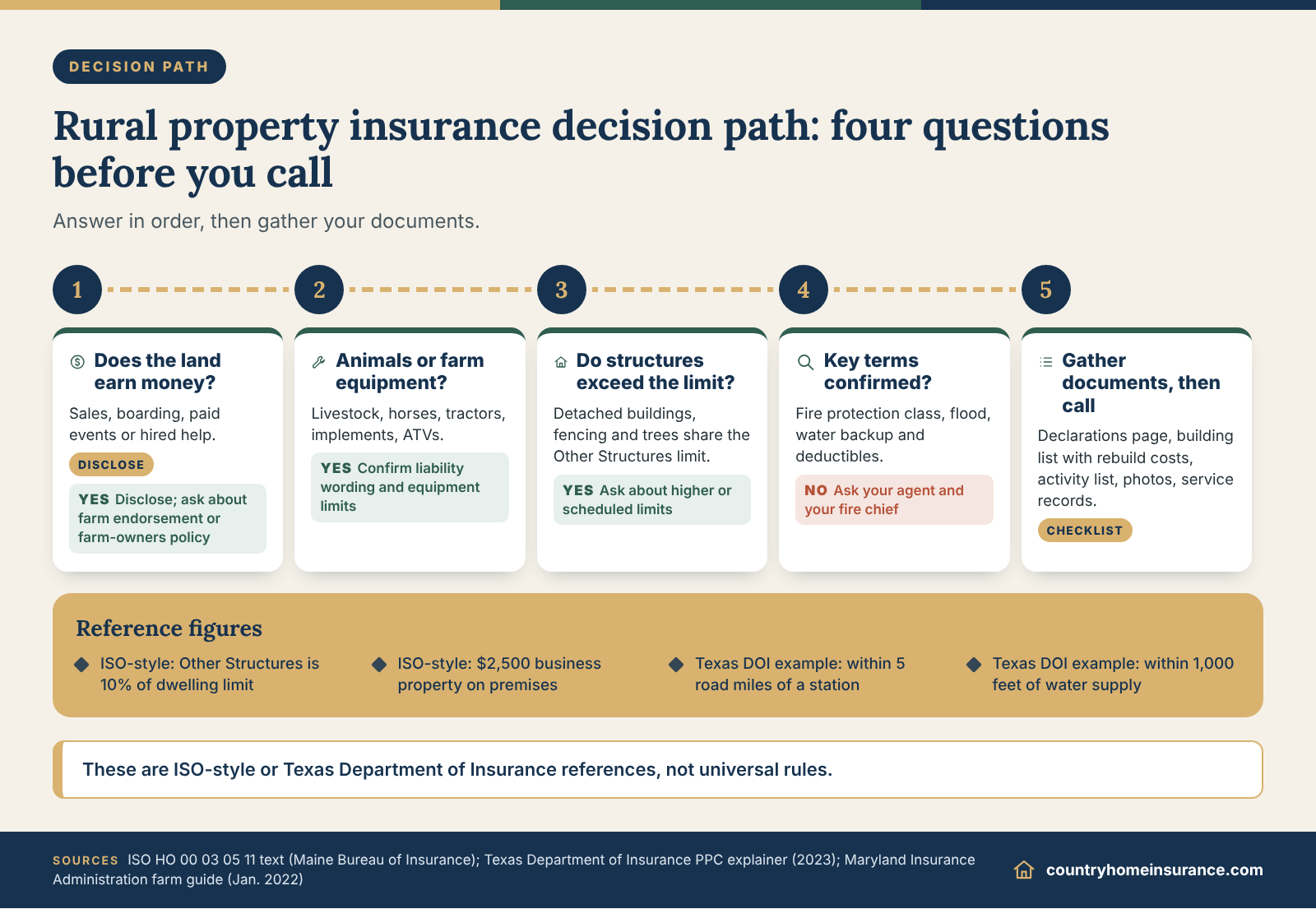
In the ISO-style form, the Coverage B limit equals 10% of the Coverage A limit. That’s an additional amount, not a slice of the dwelling limit, but it’s still a single pool for all your detached structures. Hypothetical example: a home insured for $350,000 would have about $35,000 for Other Structures. If one windstorm damages a detached garage, a shop and part of a perimeter fence, those losses typically draw on that same pool. Whether $35,000 is enough depends on what you own, and nothing in this example is a quote or a promise of payment. The useful exercise is to add up a realistic rebuild cost for every detached structure and compare it with your declarations page.
How older buildings are settled
Replacement cost pays to repair or replace with like kind and quality, while actual cash value factors in age and wear. The NAIC’s explainer on actual cash value and replacement cost (January 2025) says actual cash value often doesn’t pay enough to fully replace what was lost. Older outbuildings are exactly the kind of structure where an insurer may settle on depreciated value. The U.S. Government Accountability Office also reported, in its February 2026 homeowners insurance report (GAO-26-107867), that some insurers pay depreciated value on older roofs. Ask directly whether detached structures are settled at replacement cost or actual cash value, and whether that changes with building age.
Raising or scheduling the limit
If the default limit falls short, the usual fixes are a higher Coverage B limit or scheduling a specific building, though availability varies by insurer. GAO noted that adding coverage for detached structures or personal property can raise premiums, which is intuitive: more insured value means more premium. Because the report’s premium estimates came from a standardized policy and not from rural-specific data, it can’t tell you how much more. Get the price from a quote, and ask whether a barn or shop would be treated differently if it has any income-producing use.
Wells, pumps and septic systems
Septic: sudden damage versus slow failure
Septic systems illustrate the cause-of-loss logic better than almost anything else. NJM Insurance, in an insurer FAQ, says policies typically don’t cover failures from normal wear and tear or negligence, but that damage to the tank or pipes from a covered event, such as lightning, may be covered under Other Structures. A June 2026 NerdWallet explainer adds that tree roots that slowly crack a tank, lack of maintenance and improper installation are generally excluded. The EPA’s septic maintenance guidance (updated March 2026) puts the stakes in dollars: it describes repair or replacement of a conventional system at roughly $5,000 to $15,000, against about $250 to $500 for routine pumping every three to five years, and recommends inspection every one to three years. The economics favor maintenance, and policies commonly exclude damage from lack of maintenance.
Wells and water quality: a question to put in writing
The consumer sources reviewed for this guide don’t directly address well pumps, well casings or water contamination, so there is no reliable general rule to give you. What the ISO-style form does show is the pattern: wear and deterioration are excluded, and discharge or release of pollutants is excluded unless it comes from a listed peril. A pump burned out by a lightning strike and a well whose water turns bad because of a slow leak from somewhere else are different situations. Ask your agent, in writing, whether the well, pump, pressure tank and water lines are insured as part of the dwelling or as other structures, and how a contamination event would be treated.
Backups and overflows
Sewer and water backup is a separate gap. The ISO-style form excludes water damage from flood, surface water, groundwater and sewer backup, and NerdWallet says a standard policy won’t pay for sewer backup damage, though a water-backup endorsement can fill the gap. For a septic home, that includes a tank that backs up into the house. NJM says a water backup and sump discharge or overflow endorsement may be available. Endorsement limits are often modest, so ask for the dollar figure.
Fences, trees, fuel tanks and the small items that add up
Fences and gates
The NAIC’s consumer page lists fencing as an other structure, which means a long run of pasture fence competes with your barn and garage for the same Coverage B limit. Storms and falling trees can damage fences, and the cost per foot can add up over a perimeter measured in miles. If fencing exists mostly to contain animals, also check whether it falls under a business or farming exclusion on your policy.
Trees, windbreaks and orchards
Trees, shrubs and plants get special treatment. In the ISO-style form, covered perils for them are listed, the total is capped at 5% of the dwelling limit with up to $500 per tree, shrub or plant, and plants grown for business are excluded. Debris removal for fallen trees is also capped, at $1,000 in total and $500 per tree in that form. A property with a shelterbelt, an orchard or a wooded driveway can see those caps reached quickly. Whether your policy matches the ISO figures is something only your declarations and form can tell you.
Fuel tanks and pollutants
Country homes often depend on propane, heating oil or stored fuel for equipment. The ISO-style form excludes discharge or release of pollutants unless it comes from a listed peril, and its business-property exception doesn’t extend to liquid or gaseous fuel. Beyond that, the sources reviewed don’t give a reliable rule for tank leaks or spills. Ask whether fuel tank leaks, cleanup costs and damage to a neighbor’s land or water are covered, and whether the answer changes for fuel kept for farm equipment.
| Provision | Default in the ISO-style form | Why it matters on a country property | Form reference |
|---|---|---|---|
| Other Structures (Coverage B) | 10% of the Coverage A limit | One pool for garage, shop, barn, shed and fencing | Section I, Property Coverages, B |
| Business property on premises / away | $2,500 / $1,500 | Product, tools or inventory from a farm stand or craft business can exceed it quickly | Section I, Coverage C special limits |
| Trees, shrubs and plants | 5% of Coverage A in total; $500 per item | Windbreaks, orchards and landscaped drives add up | Section I, Additional Coverages, Trees, Shrubs and Other Plants |
| Tree removal after a covered loss | $1,000 total; $500 per tree | Several downed trees on a long drive can exceed the cap | Section I, Additional Coverages, Debris Removal |
| Fire Department Service Charge | Up to $500; not applicable inside the city or district that responds | Relevant where a rural or contract department bills for a response | Section I, Additional Coverages |
| Ordinance or law | Up to 10% of Coverage A for increased costs from code enforcement | Rebuilding can trigger current code, well or septic requirements | Section I, Additional Coverages |
| Vacancy and vandalism | Vandalism not covered after more than 60 consecutive days of vacancy | Seasonal, inherited or for-sale rural homes may sit empty | Section I, Perils Insured Against |
| Damage to property of others | Up to $1,000 per occurrence | Low cap for a loose animal or a runaway machine damaging a neighbor’s property | Section II, Additional Coverages |
Rural fire protection and why distance shows up in pricing and underwriting
Fire protection isn’t a coverage you buy, yet it can influence what an insurer charges and how it underwrites your home. Insurers want to know how quickly trained firefighters and water can reach a fire at your address. In a city, that question is answered by hydrants and nearby stations. In the country, the answer depends on road distance, tanker capacity and whether the nearest department is staffed by volunteers.
How insurers see your fire protection
What a Public Protection Classification measures
Most insurers draw on a Public Protection Classification (PPC), a rating developed by ISO, a Verisk business, that grades a community’s ability to suppress structure fires. A Verisk article from 2018 (so dated, but the concept has long been in use) explains that insurers need to know which station responds first to each address, what staff and equipment are in it, and where firefighters get water, and warns that mileage or travel time alone can misclassify a risk. A March 2023 Texas Department of Insurance explainer describes the grading schedule as weighting the fire department most heavily (50 points), then water supply (40 points), emergency communications (10 points) and community risk reduction (5.5 points), plus a few Texas-specific items. The details are published from a Texas perspective, so check your own state’s regulator if you live elsewhere.
Road miles, hydrants, hauled water and the X rating
The Texas explainer spells out how location inside a fire district affects the class. Properties within five road miles of a fire station and within 1,000 feet of a creditable water supply receive the district’s primary class. Properties within five road miles but farther than 1,000 feet from that water receive a second class marked with an X, which the explainer says is typical for rural or large lots surrounded by a single-class community. Beyond five road miles, the property is Class 10, with a possible 10W designation for properties five to seven road miles from a station that have a creditable water supply. Notably, the explainer says hauled water may qualify as a creditable supply, which is relevant where tanker trucks stand in for hydrants.
What volunteer departments mean for the rating
A volunteer department isn’t an unrated one. The Verisk article says PPC surveys cover departments from the largest city agencies to the smallest rural volunteer companies. The National Volunteer Fire Council’s 2026 fact sheet, citing NFPA data, reports that volunteers make up 62% of U.S. firefighters (about 635,100 of 1,018,100), and that roughly 82% of the country’s 29,452 fire departments in NFPA’s 2020 profile were all or mostly volunteer. It adds that communities under 10,000 people are typically protected by all-volunteer departments. So if you live in the country, your fire protection is very likely volunteer, and what matters for insurance is the department’s measured capability, not its payroll.
| Where the property sits | Class notation described | What it signals | Question to ask your insurer |
|---|---|---|---|
| Within 5 road miles of a station and within 1,000 feet of a creditable water supply | Primary class, such as Class 4 | Station and water supply both within the scoring distances | Is this the class used for my address at renewal? |
| Within 5 road miles of a station but beyond 1,000 feet of a creditable water supply | Second class with an X, such as Class 4X | Station is near enough, but water is not close; typical of rural or large lots | Would a recognized water supply change my class? |
| More than 5 road miles from a station | Class 10 | Beyond the scored distance | Does my insurer have eligibility limits for Class 10 addresses? |
| 5 to 7 road miles from a station with a creditable water supply | Possible Class 10W | Water supply recognized even though the station is farther | Does my insurer treat 10W differently from Class 10? |
Subscription fees, service charges and who actually shows up
Subscription fee programs
Not every rural department is funded the same way. A 2012 Fire Engineering report, summarizing a Wall Street Journal story, described some rural volunteer departments asking residents for voluntary annual subscription fees, and said firefighters in South Fulton, Tennessee, twice allowed structures to burn where owners had not paid. That article is old and describes particular local policies, so it’s offered here as a reminder that arrangements differ by county and town, not as a current rule. Find out how your department is funded and whether a fee affects service at your address.
Fire department service charges in the policy
Some localities bill for fire response. The ISO-style form includes an additional coverage of up to $500 for fire department service charges, with no deductible, and it doesn’t apply where the property sits inside the city, municipality or district that provides the response. If your local department bills for response or hauling, ask whether your policy matches that form or offers a higher amount. A charge above the limit would be your responsibility.
Questions to put to the fire chief
Your fire chief is a free source of useful information. Ask which station responds first to your address, how far away it is by road, how the department gets water where hydrants don’t exist, and when the department last had its classification reviewed. Verisk says ISO sends a community outreach questionnaire about every two years and that community officials can request one when changes may warrant a new survey. If the department added a station or a tanker since the last survey, your class may be out of date, and that’s worth raising.
Moving the needle on a high fire-protection class
Confirm the class your insurer uses
The Texas Department of Insurance explainer cautions that insurers use classifications at their discretion, that a better class doesn’t guarantee a lower premium, and that insurers may be relying on an old score, so an updated one is better. It advises comparing providers at renewal. Ask your agent which class they have on file for your address and the date it was set. If it looks wrong, the local fire department or district can tell you whether a re-survey is possible.
Water supply near the property
Water is a large share of the grading schedule, and the Texas explainer recognizes that hauled water may count. Whether a pond, cistern or dry hydrant near your property influences your specific classification is a local question, and no source reviewed here answers it for every district. Ask the department and your insurer; don’t spend money on a water feature expecting a rating change.
Discounts and safety steps
The NAIC’s consumer page lists discounts that may be available, such as burglar alarms, deadbolts, window security devices and insuring home and auto together, noting that they vary by insurer and state. The Maryland farm guide adds that a farm safety and security plan may reduce premiums, and that proximity to a fire department and water source can affect them. Ask for a written list of every discount and the documentation each requires.
Remote and seasonal properties
Access, gates and long driveways
No authoritative source reviewed for this guide sets an access rule for private roads or gated drives, so treat this as practical advice, not a policy requirement. A long, narrow or gated driveway can slow a fire truck or an ambulance. Tell your fire department where your gate code or lockbox is, mark the address visibly at the county road, and mention unusual access in the application if the questions invite it. Insurers ask what they ask, and honest answers protect you.
Vacancy, freezing and seasonal use
Empty rural houses are common: seasonal cabins, inherited homes, properties between tenants or owners. The ISO-style form stops covering vandalism and glass breakage after a dwelling has been vacant for more than 60 consecutive days, and it conditions freezing coverage on reasonable care to maintain heat or shut off and drain the water. Ohio State University Extension, in a February 2023 article on farm policies, notes a similar pattern in farm forms: vandalism coverage can exclude buildings vacant over 30 days, and freeze coverage may not apply in a building that isn’t heated. If the house will sit empty over winter, ask what the policy requires and whether a vacancy endorsement is available.
Liability on land: vehicles, animals, visitors and neighbors
Liability is where a rural property can cost the most when something goes wrong, and it’s also where the policy’s exclusions tend to concentrate. The devil is in the details here: a few words in a definition can decide whether an accident in the pasture belongs to the homeowners policy, a farm policy or nobody.
What personal liability and medical payments do on a property with land
The basics of Coverages E and F
Coverage E pays, subject to limits and exclusions, when you’re legally responsible for bodily injury or property damage to others, and the policy typically includes a defense for covered claims. Coverage F pays certain medical expenses of people hurt on the insured location, regardless of fault, but not expenses of you or regular household residents. In the ISO-style form, those expenses must be incurred or medically ascertained within three years of the accident. You choose the liability limit, and the NAIC consumer page says additional liability and medical coverage can be bought for a small added premium.
Insured location, farm land and leased ground
The ISO-style form’s “insured location” includes your residence premises and certain other places, and it includes vacant land owned by or rented to an insured with an explicit exception for farm land. It also excludes bodily injury arising from premises you own or rent that aren’t an insured location. For a rural owner, this matters if you own a separate parcel, lease pasture or let a neighbor farm part of your land. Ask whether each parcel is an insured location on your policy and, if not, which policy would respond to an accident there.
ATVs, tractors and other motor vehicles
The motor vehicle exclusion
Homeowners liability isn’t designed to insure vehicles. In the ISO-style form, Coverages E and F don’t apply to motor vehicles that are registered or required to be registered where the accident occurs, or that are being raced, rented, used for hire or used for business. The ordinary rule is that auto, farm-truck and similar liability belongs on an auto policy or a farm policy. That includes vehicles you use on the farm. Farm Bureau Financial Services notes that vehicles used on a farm may require an adjustment to your auto coverage.
Exceptions that often matter in the country
The same form lists exceptions to the exclusion. Among them are vehicles in dead storage on an insured location, vehicles used solely to service a residence, and recreational vehicles designed for off-road use, which are covered when owned by an insured only if the accident occurs on an insured location. Golf carts are covered under conditions. These exceptions can bring a garden tractor or an ATV back into liability coverage, but only within their terms. Riding the ATV on a neighbor’s land, a public trail or a hunting lease may not satisfy the “insured location” condition, so ask how your policy treats off-property use.
Mower, garden tractor or farm tractor
The phrase “used solely to service a residence” does a lot of work. A riding mower that keeps your lawn trimmed fits comfortably. A tractor that also bales hay for sale, plows a neighbor’s drive for pay or moves feed for animals kept as a business may not. The business definition we covered earlier applies, so the same machine can fall on either side of the line depending on use. Describe real use to your agent and ask for any limitation in writing.
Guests, events and extra liability limits
Visitors, customers and paid events
Hosting friends is household liability. Inviting the public, even occasionally, is another matter. Under the business definition in the ISO-style form, an activity done for money is potentially a business, which would put a pumpkin patch, a hayride, a u-pick weekend or a paid wedding on the lawn in a different category. The Maryland guide treats agritourism as an exposure that may need higher liability limits or a separate business policy, and Oregon State’s factsheet suggests asking whether guests should sign waivers and what proof of insurance event groups should provide. Those are questions for an agent who understands your plans.
When to ask about excess liability
A personal umbrella or excess liability policy sits above your underlying coverage, but it may carry its own exclusions for farm, business or animal exposures. The University of Missouri Extension article suggests asking whether endorsements, riders or an umbrella are needed to fill gaps in a farm liability policy, and the Oregon State factsheet suggests asking what umbrella size is right. For rural owners, the most useful question is whether the umbrella applies to the specific activities on your land, and whether it requires certain underlying limits or excludes any listed animals or vehicles.
Weather, deductibles and settlement rules that hit harder in the country
Wind, hail and falling trees are familiar threats to country property. The cause of loss matters, but so do the deductible and the way the policy settles the claim. Those two pieces of arithmetic decide how much cash arrives, and they’re easy to miss when you compare quotes on price alone.
Wind and hail deductibles and roof terms
Percentage deductibles
Many policies use a flat deductible, such as $500 or $1,000, but some set a separate windstorm deductible as a percentage of coverage. The Maine Bureau of Insurance’s out-of-pocket costs page (copyright 2022) shows how it works: with $150,000 of dwelling coverage, a 1% windstorm deductible is $1,500. The same math scales up. A 1% deductible on a $400,000 dwelling limit would be $4,000, and a 2% deductible would be $8,000. Which perils get a percentage deductible, and what percentage, varies by insurer and state, so look at the declarations page for the wind or hail line.
Split deductibles and roof settlement
GAO’s February 2026 report found that some insurers have changed how roofs are handled: paying depreciated value on older roofs, applying a separate deductible to roof damage, and in one case offering a discount to policyholders who accept lower roof claim payments in an area with high hail risk in Oklahoma. GAO also cautioned that its rate-filing review covered only 18 filings from 12 insurers in six states and isn’t generalizable. The takeaway isn’t that every policy works this way, but that roof terms are now a central point of comparison. If your roof is older than a decade or two, ask exactly how it is settled.
A worked illustration of deductible and depreciation
Hypothetical example: a farmhouse insured for $400,000 has a 1% wind and hail deductible. A storm causes $10,000 of covered roof damage and $5,000 of covered gutter and siding damage. The deductible is $4,000. Suppose the policy settles the roof on an actual cash value basis and the insurer applies $4,000 of depreciation to the roof. The first payment could be roughly $15,000 minus $4,000 of depreciation minus the $4,000 deductible, or $7,000. In the ISO-style form, payment is limited to actual cash value until repair or replacement is completed, and the form calls for notice of intent to repair within 180 days when a claim is first made on that basis. Whether withheld depreciation can later be recovered depends on the policy. These numbers are invented to show the mechanics, not to predict a payment.
Perils the standard policy leaves out
Flood and surface water
The standard homeowners policy excludes flood, and the NAIC consumer page says that includes ground-water, runoff and snow-melt damage. FloodSmart, the National Flood Insurance Program’s consumer site, states that most homeowners insurance doesn’t cover flood damage and says 99% of counties have had a flood event in the past 20 years. That matters in the country, where creeks, low pastures and culverts can carry water whether or not a flood map flags the spot. Flood coverage comes from the NFIP or private insurers, and buying it is a separate decision with its own terms and limits that the flood-focused guides in this cluster explain.
Wear, neglect, mold, pests and earth movement
The ISO-style form also excludes wear and tear, deterioration, neglect, faulty workmanship and maintenance, earth movement, and mold or fungus except under limited conditions. The NAIC page adds that insect and rodent damage is typically not covered and that earthquake coverage is a separate endorsement or policy. These exclusions fall hard on older rural buildings, because slow deterioration is exactly what age brings. A barn that has leaked for a decade, a well house with failing wiring and a septic tank that was never pumped all have something in common: the loss is a maintenance story before it’s a claim story.
Ordinance or law and rebuild requirements
If a covered loss forces you to rebuild to current codes, the standard form may not pay all the added cost. In the ISO-style form, ordinance or law is excluded except under an additional coverage of up to 10% of the dwelling limit. Triple-I’s page on insuring your house and possessions says standard policies generally don’t pay building-code upgrade costs and that an endorsement can add a specified amount. A rebuild in the country can raise questions about septic capacity, well placement, setbacks or road access, but this guide hasn’t verified a general rule about what local codes require. Ask your agent how your policy handles code-driven costs and consider asking your county building department what a rebuild would trigger.
Cost, availability and what to do when a standard insurer says no
Everything above affects price, but price is also set by factors outside your control, such as your address and the fire protection serving it. This section covers what you can reasonably learn about cost and where you can go if standard coverage proves hard to find.
What shapes a rural premium
Property and location factors
The NAIC’s consumer page lists the usual rating factors: location, including crime and access to fire, police and water; protection class based on hydrant distance and the quality of the fire department; construction type, with frame homes usually costing more to insure than brick; the age of the house; the value of the house and amount of coverage; and the deductible. It also says older homes may not qualify for preferred programs and that insurers may require updated heating, plumbing, wiring and roofing. Wood-burning fireplaces and wooden decks can increase costs. A rural house with a wood stove and an older roof can land on the wrong side of several of those factors at once.
Choices you control
You influence price through your deductible, the coverage amounts you choose and the discounts you qualify for. The NAIC says a higher deductible lowers the premium, while the Maine Bureau of Insurance advises choosing a deductible you can afford. Ohio State University Extension notes that combining farm and non-farm coverage under one policy is usually less expensive than holding two separate policies, which is a useful point if you are weighing a farm package against a homeowners policy plus separate coverage. Compare options at matching limits, deductibles and endorsements, not just matching dwelling amounts.
What the published data can and cannot tell you
Premium statistics are everywhere, and few of them describe rural homes specifically. GAO’s 2026 report estimated that the average U.S. homeowners premium, using First Street estimates for a standardized policy, rose about 27% from $2,235 to $2,829 between 2019 and 2024 in nominal dollars, or about 3% after adjusting for inflation. The report didn’t analyze rural areas as a group, and its premium figures are modeled estimates rather than actual premiums. For that reason this article doesn’t offer a “typical rural premium.” Use national figures as context only, and get actual quotes for your property.
When a standard insurer declines or limits the property
Specialty and farm-oriented routes
If a mainstream insurer won’t write your home with its animals, outbuildings or fire-protection class, another insurer may. Farm-oriented carriers, such as the farm bureau companies cited in this article, build policies around exactly these exposures, and farm-owners forms can insure the farmhouse together with the barn and equipment. Different insurers draw eligibility lines differently, which is why a decline from one company isn’t a verdict on your property. The Maryland guide adds a useful tip: if one insurer declines you, keep shopping, since underwriting criteria vary.
FAIR Plans and residual markets
FAIR (Fair Access to Insurance Requirements) Plans are state-mandated property insurance programs for people who can’t get coverage in the regular market. The NAIC’s page, updated in December 2024, says 33 states had some form of residual market plan as of October 2024, that these plans are generally more expensive and offer more limited protection, that dwelling coverage is the minimum in most states, and that personal liability and loss-of-use coverage are generally not offered. GAO reported that the national share of homeowners policies in FAIR and beach plans rose from about 1.4% in 2019 to about 2.5% in 2023. If you end up on a FAIR Plan, ask what else you need to buy for liability, and what you would need to buy separately to fill the liability gap.
Cancellation and nonrenewal notices
Notice periods and permitted reasons for cancellation and nonrenewal are set by state law and your policy, and they differ widely. This guide hasn’t verified a general rule. One illustration is Texas, where the Department of Insurance’s farm and ranch review checklist (page updated January 2026) says cancellation and nonrenewal protections for one- and two-unit dwellings apply to residences on farm and ranch properties. That’s a Texas fact, not a national one. To see what applies where you live, use the NAIC’s state insurance department directory to find your regulator and ask what protections apply to your home.
How to shop for and document a rural property
By now the pattern should be clear: rural gaps are mostly gaps in what the insurer knows and in what the policy says, not mysterious holes. The best defense is a clear picture of your property, honest answers on the application and written answers from your agent. This section turns that into a process.
Questions that surface the gaps
Disclose what you actually do on the land
The ISO-style form says no coverage is provided to an insured who intentionally conceals or misrepresents a material fact, either before or after a loss. The Maryland Insurance Administration’s guide similarly says to answer application questions truthfully because misstatements can affect pricing or lead to cancellation. Tell your agent about animals, sales of any kind, paid help, visitors, vehicles and equipment, and any structure used for something other than family storage. If an activity changes, say so at the next renewal, or sooner when it’s a significant change.
Ask for the forms and endorsements by name
A quote summary tells you limits and price; the policy forms tell you what is covered. Ask which form edition and which endorsements apply, and read the definitions of “business,” “insured location” and “residence premises,” the Other Structures section and the loss settlement condition. It’s a chore, but it’s where the fine print lives, and the fine print is what a claims adjuster will read. If the agent says an exclusion “never comes up,” ask them to put that in writing or to show you the endorsement that addresses it.
Compare options on equal terms
A cheaper quote usually has something missing. The Maryland guide advises comparing coverages, limits and deductibles, not just price; checking insurers’ financial strength through rating agencies such as A.M. Best or Moody’s; and keeping your existing coverage in place until the new policy is confirmed in writing. For a rural property, add your own checklist items: Other Structures limit, settlement basis for outbuildings, animal and farm-activity wording, wind and hail deductible, roof settlement, water-backup limit and the fire-protection class on file. Our guide to comparing quotes explains the general method.
Document the property before you need to
Photograph and list the buildings, equipment and improvements
Country properties have more to inventory than a house: outbuildings, fencing, fuel tanks, equipment, tools, stored materials and improvements that are easy to forget until they are gone. Walk the property with a phone, shoot video of each building inside and out, and record dimensions, construction and condition. Keep serial numbers for equipment and store copies somewhere other than the property, such as cloud storage. This will not change what the policy covers, but it makes a claim much easier to prove and can reveal gaps while there is still time to close them.
Keep maintenance records
Because wear, deterioration and neglect are common exclusions, records of maintenance help show that a loss was sudden and not the result of neglect. Keep receipts for septic pumping and inspections, roof and gutter work, well and pump service, wiring updates and tree work. The EPA’s septic guidance suggests pumping every three to five years and inspection every one to three years, which gives you a schedule to follow and a paper trail to build.
Know your duties if a loss happens
The ISO-style form lists duties after a loss, including protecting the property from further damage and, if the insurer asks, giving a sworn proof of loss within 60 days of the request. It also provides an additional coverage for the reasonable cost of necessary protective measures, subject to the policy. Take photos before cleaning up, keep receipts for emergency repairs and talk to your insurer before agreeing to major work. Specific claim steps for hail, wind and tree losses are covered in the claims guides in this cluster. The terms of your own policy and state law control what is owed and when.
Turning this into a short action plan
A review you can finish in an afternoon
- Pull your declarations page and list the Coverage A, B, C, D, E and F limits, deductibles and endorsements.
- List every building, fence line, well, septic system and fuel tank, with a rough replacement cost for each.
- List every animal, vehicle, machine, sale, helper and visitor activity on the property, including seasonal ones.
- Call your agent and ask the questions in Table 5, in writing if possible.
- Request the fire-protection class on file for your address and ask your fire chief about the most recent survey.
- Ask for quotes with matching limits and deductibles, and compare the farm-endorsement and farm-owners options side by side.
When to bring in your state insurance department
If an insurer’s answer seems inconsistent with the policy, or you are denied coverage and don’t understand why, your state’s insurance department is the right place for case-specific questions. The NAIC’s directory of state insurance departments links to each regulator’s contact information and complaint process. Bring the declarations page, the policy forms and your correspondence so the regulator can see what you are asking about.
| Area | What to verify | What to document or request | Question for the agent |
|---|---|---|---|
| Detached buildings | Coverage B limit, settlement basis, any exclusions for business use | Photos, dimensions, construction type and condition of each building | Would my barn or shop be settled at replacement cost or actual cash value? |
| Farm and income activity | Whether any sale, boarding or paid activity is on the application | A written list of activities, headcounts and approximate sales | Which endorsement or policy fits what I do, and what must I declare? |
| Animals | Liability wording, species and headcount limits, fee-based exclusions | Count by species and use (family, breeding, boarding, sale) | Are my animals covered for liability, and under which form? |
| Equipment and vehicles | Whether tractors, implements and ATVs are insured and where | Make, model, serial number and value of each machine | Is my equipment scheduled, capped or excluded, and does ATV liability apply off my land? |
| Well and septic | Covered causes, water-backup limit, treatment of contamination | Pumping and service receipts, installation records | Is a well or septic loss treated as dwelling or other structure, and what is the backup limit? |
| Fire protection | The class on file, station distance, water source, any response fee | Fire department contact, gate or lockbox details, address signage | What class is my address, and when was it last updated? |
| Weather deductibles and roof | Wind and hail percentage, any split roof deductible, roof settlement terms | Roof age, last inspection and repair records | What would I pay out of pocket on a hail loss, and how is my roof settled? |
| Gaps outside the policy | Flood, vacancy limits, code-upgrade cost, umbrella exclusions | Flood map or local drainage history, plans for any vacancy | Which of these have separate coverage, and what do they cost? |
Frequently asked questions
Coverage questions
Does a standard homeowners policy cover my barn?
It may, if the barn is a detached structure used for personal purposes and the cause of loss is covered, but the payment would be limited by the Other Structures amount and by any business-use exclusion. A barn used to store product or house animals kept as a business can be excluded in the ISO-style form. Your policy’s definitions decide, so ask how your barn is classified.
Will homeowners insurance cover my horses or livestock?
As property, generally no: the ISO-style form excludes animals from Coverage C, and insurers that sell farm policies offer livestock coverage as a deliberate add-on. As a liability matter, it depends on the animal, the use and the form. Horses are often singled out, so ask for the animal-liability language.
Is a hobby farm covered if I don’t make a profit?
Profit isn’t the only test. The business definition in the ISO-style form covers any activity done for money or compensation, with limited exceptions such as an activity earning no more than $2,000 across 12 months. Insurers also have their own endorsements and underwriting rules for farming activity, so describe your operation to your agent and get the answer in writing.
Cost, fire protection and process questions
Why does my insurer care how far I am from a fire station?
Because a fire grows quickly, and insurers use classification systems to estimate how soon trained firefighters and water can reach an address. Distance by road and the proximity of a recognized water supply feed into those classifications. A farther address may mean a higher protection class, which insurers may weigh in pricing and underwriting, so ask yours how it is used. A better class doesn’t always mean a lower price, since insurers apply it in their own way.
What can I do if my insurer declines or nonrenews my rural home?
Ask the insurer for the specific reason in writing, then shop other admitted insurers, including farm-oriented companies, and check whether your state has a FAIR Plan or other residual-market program. Contact your state insurance department if the notice seems inconsistent with state rules. Keep your existing coverage in place until a new policy is confirmed, as the Maryland guide advises.
Is rural home insurance more expensive than insurance in town?
There’s no reliable general answer. Some rural features, such as greater distance to fire protection and extra buildings, can raise costs, while others, such as a lower-cost-to-rebuild house or a newer roof, may lower them. The published national premium data this guide reviewed does not break out rural homes, so compare real quotes for your own property with matching coverage.
Do I need flood insurance if I live in the country?
A standard homeowners policy excludes flood, and FloodSmart reports that 99% of counties have had a flood event in the past 20 years, so the question is worth asking even if your lender doesn’t require it. Check local drainage history, ask your county about floodplain maps and get a flood quote from the National Flood Insurance Program or a private insurer to see the actual limits and price.
Sources
- ISO Homeowners 3 – Special Form (edition 05 11), copy posted by the Maine Bureau of Insurance (reference form; undated posting; retrieved 2026-10-11)
- NAIC consumer page on homeowners insurance (undated; retrieved 2026-10-11)
- NAIC: the difference between actual cash value and replacement cost (January 2, 2025)
- NAIC: Fair Access to Insurance Requirements Plans (updated December 13, 2024)
- NAIC directory of state insurance departments (undated; retrieved 2026-10-11)
- U.S. Government Accountability Office, GAO-26-107867, homeowners insurance report (February 27, 2026)
- Maine Bureau of Insurance: out-of-pocket costs (copyright 2022)
- Texas Department of Insurance: Public Protection Classification explainer (March 23, 2023)
- Texas Department of Insurance: farm and ranch policy review checklist (page updated January 21, 2026)
- Verisk: PPC, evaluating fire protection at the grass roots (September 7, 2018; dated)
- National Volunteer Fire Council: volunteer fire service fact sheet (posted February 2026, citing NFPA data)
- Fire Engineering: rural volunteer fire departments and subscription fees (March 13, 2012; dated)
- Maryland Insurance Administration: farm insurance consumer guide (January 2022 edition)
- Ohio State University Extension: farm insurance policies, part 1 (February 2, 2023)
- University of Missouri Extension: what your farm liability insurance covers (undated)
- Oregon State University Extension: questions to ask your insurance agent (undated)
- Farm Bureau Financial Services: hobby farm insurance (insurer article; February 4, 2026)
- Oklahoma Farm Bureau Insurance: farm and ranch versus homeowners insurance (insurer article; July 17, 2025)
- American Family Insurance: small farm insurance (insurer page; undated)
- Insurance Journal: what to know about hobby farm insurance (February 20, 2012; dated)
- Smart Choice Agents: when a homeowner needs a commercial farm policy (agency blog; November 17, 2023)
- U.S. EPA: why maintain your septic system (updated March 11, 2026)
- NJM Insurance: are septic systems covered by home insurance (insurer FAQ; undated)
- NerdWallet: does homeowners insurance cover septic (updated June 16, 2026)
- Insurance Information Institute: insurance for your house and personal possessions (undated)
- FloodSmart (NFIP): flood insurance basics (undated)
Important coverage note
Coverage depends on your actual policy, endorsements, exclusions, limits, deductible and the cause of loss. The ISO-style form discussed here is a reference example, and your insurer’s form may differ. State insurance laws and programs vary, including rules on cancellation, nonrenewal, deductibles and residual-market plans. Check case-specific questions with your insurer or agent and with your state Department of Insurance, and review the declarations page for your limits and deductibles. This article is educational information, not legal advice, and it does not guarantee that any claim will be paid.
About the editorial team
This guide was prepared by the countryhomeinsurance.com editorial team as general, educational information for homeowners. We research and summarize publicly available material, including state insurance departments, the NAIC, federal agencies, regulators’ consumer guides and published insurer and industry resources. We draw only on the sources that were available to us when we wrote this guide, and we list them in the Sources section with dates where we could find them.
Insurance rules, rates, products and program terms change, differ by state and by insurer, and can apply differently to your situation. We cannot guarantee that this content is complete, current or free of errors. It is not legal, financial, tax or insurance advice, it is not an offer to sell insurance or a recommendation of any insurer, agent or product, and reading it does not create a professional relationship of any kind.
To the fullest extent permitted by law, countryhomeinsurance.com and its editorial team, authors and contributors exclude all liability for any loss, damage or decision arising from the use of, or reliance on, this content. For questions about your own policy or claim, contact your insurer, a licensed agent or broker, your state Department of Insurance or another qualified professional.
Content created: October 12, 2026