Roof material homeowners insurance rates depend less on the material’s name than on how the roof performs against your local hail, wind and fire hazards, how old it is, and which roof endorsements your policy carries. Impact-resistant, metal and Class A fire-rated roofs may earn credits with some insurers, and a few states require certain discounts. Some policies add a cosmetic-damage exclusion to metal roofs, so a dent may not be paid. Confirm every credit and exclusion in writing before you re-roof.
Key takeaways
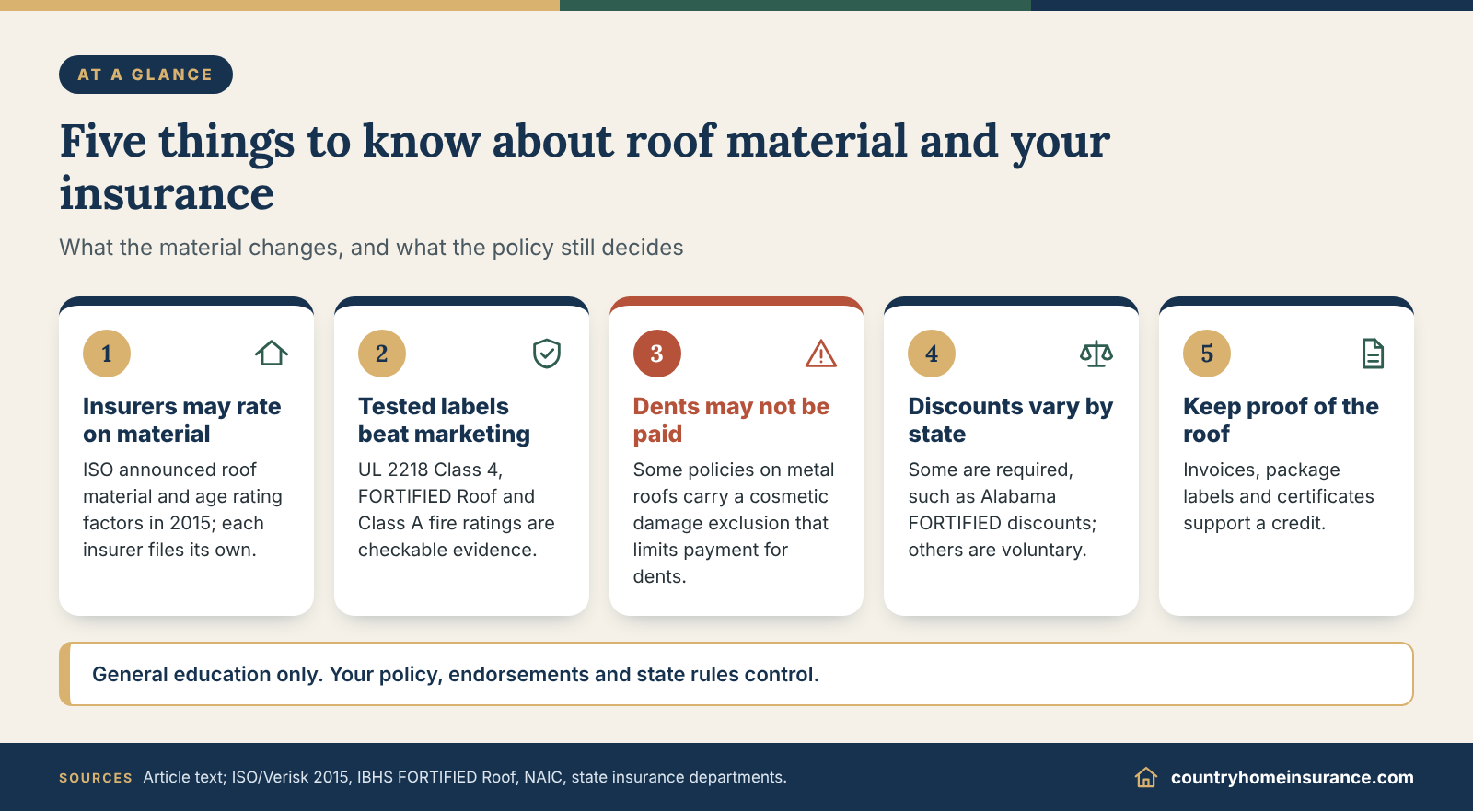
- Insurers may rate on roof material and age; ISO, the industry rating-data organization, announced roof material and age rating factors in 2015, but each insurer files its own. The credits regulators document attach to tested performance (an impact class, a FORTIFIED designation), not to a material name.
- Test-based evidence (UL 2218 Class 4, IBHS ratings, FORTIFIED Roof, Class A fire rating) carries more weight with underwriters than a brochure’s “hail-proof” claim.
- Metal roofs can resist cracking yet still dent, and some policies pair a lower price with a cosmetic-damage exclusion that limits payment for dents.
- Some discounts are legally required (Alabama’s FORTIFIED discounts, Florida’s filed wind-mitigation credits and, from 2027, Louisiana’s FORTIFIED discounts), while others are voluntary and vary by insurer, so never assume a credit exists.
- Keep product markings, certificates and invoices; a credit usually follows paperwork, not the roof itself.
Roof material and homeowners insurance rates: the short version
A roof is the part of a house that takes the first hit from hail, wind-driven rain, falling branches and wildfire embers, so insurers pay attention to what it is made of. Still, the phrase “metal roofs get a discount” or “wood shake roofs are uninsurable” oversimplifies a market where each insurer sets its own rules. This guide separates what is documented from what is folklore, and it stays on one question: what does the material itself change? Roof age, depreciation schedules and age-based denials are handled in our guide on how roof age affects homeowners insurance cost, so they appear here only where material makes them different.
Where roof material enters pricing and eligibility
The rating factors insurers can use
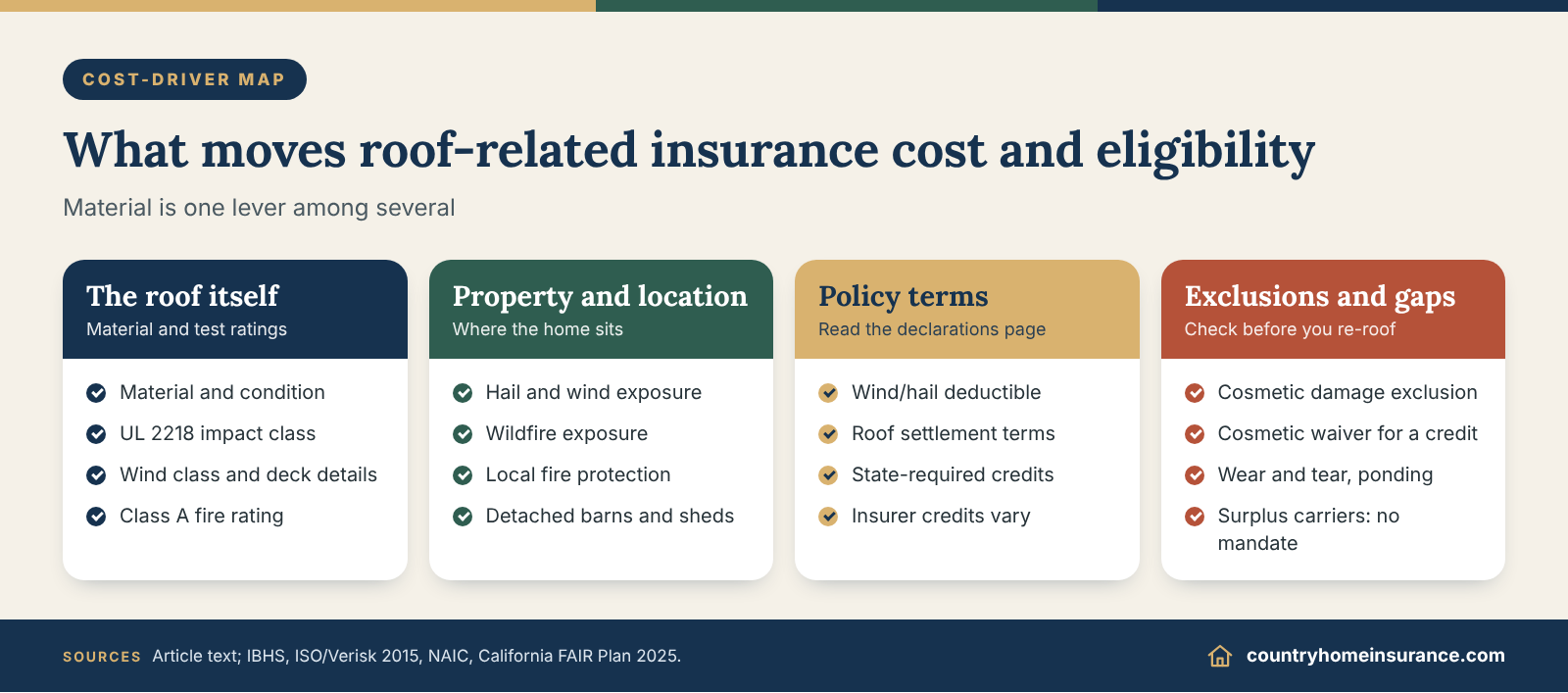
In August 2015, Verisk’s ISO unit announced new rating tools that let homeowners insurers price policies by roof age and roof material, along with two optional endorsements that provide premium credits in exchange for limiting loss settlement on wind, hail or cosmetic roof damage (Verisk, 2015). The key word is “optional.” ISO supplies advisory data, and an insurer then decides what to file with its state regulator and how much weight to give each factor. The result is that two companies can treat the same tile roof very differently.
Why material works as a stand-in for hazard
Material is a convenient proxy for several things underwriters worry about: how a covering fails in hail, how it holds up in wind, whether it ignites from embers, how costly it is to repair and how easily a matching product can be found. The National Association of Insurance Commissioners (NAIC) lists construction type, home age and local fire protection among premium factors, and notes that replacing a roof can earn a discount in some states (NAIC, consumer page). Those factors interact, which is why a homeowner who swaps materials seldom sees a clean, predictable change in price.
What roof material does not decide
Coverage terms matter as much as the covering
The same asphalt roof can sit under a policy that pays replacement cost for hail or one that pays actual cash value (replacement cost minus depreciation) once the roof passes a certain age. The same metal roof can be covered for dents or excluded for them. Those terms live in the policy form and its endorsements, not in the roofing product. If you want the coverage logic behind hail and wind itself, see our explainers on whether homeowners insurance covers hail damage and how wind damage coverage works.
Location and age often outweigh the label
Hail frequency, wind exposure, wildfire risk, distance to a fire station and the insurer’s catastrophe appetite are all tied to the address. A Class 4 impact-resistant roof in a low-hail county may produce a small credit, or none, while the identical roof in a high-hail county could matter much more to underwriting. The roof’s age can also overwhelm the material: a worn roof of any kind can attract questions. Treat the material as one lever among several, and read the table below as a map of where it commonly changes the outcome rather than a promise.
| Scenario | Likely treatment | What decides it |
|---|---|---|
| Sudden hail cracks or bruises asphalt shingles and lets in water | Typically covered, subject to the deductible and roof settlement terms | Cause of loss, wind/hail deductible, replacement cost versus actual cash value |
| Hail dents a metal roof but nothing leaks | Depends: typically not covered if a cosmetic damage exclusion applies | Whether the policy carries a cosmetic damage endorsement and how it defines “cosmetic” |
| Wind lifts tile or shingles during a storm | Typically covered as a windstorm loss, subject to the wind or hurricane deductible | Named-storm or wind/hail deductible triggers and any roof schedule |
| Wood shake roof is hit by wildfire embers | Typically covered as fire damage if the policy is in force | Whether the insurer renewed or limited the policy because of the material and location |
| Flat membrane roof leaks slowly from ponding or worn seams | Typically not covered as wear, deterioration or maintenance | Exclusions for wear and tear, repeated seepage and neglect |
| Impact-resistant roof is installed and you expect a credit | Depends: a credit is required in some states and voluntary in others | Insurer filing, state law, proof of rating and any cosmetic waiver you accept |
| Matching replacement tile or slate is no longer made | Depends on policy wording and state rules on matching | Policy language, appraisal outcome and any ordinance or law coverage |
Asphalt, metal, tile, slate, wood and flat roofs through an underwriter’s eyes
This section walks through the common coverings in the order most homeowners meet them. It describes how each tends to behave in hail, wind and fire and what questions an insurer may ask. It is not a ranking, and it does not say which roof is “best,” because the right choice depends on your hazards, budget and policy.
Asphalt shingles, standard and impact-resistant
Why standard asphalt is the baseline
Asphalt shingles are the baseline covering in this guide, and the other materials are easiest to understand by how they differ from it. The Insurance Institute for Business and Home Safety (IBHS), an insurance-industry research nonprofit, publishes its own hail impact ratings for asphalt shingles, which gives buyers a checkable way to compare products. Ask any insurer whether a standard asphalt roof in sound condition raises material-based questions; the more useful conversation usually starts with the roof’s age, condition and hail history.
Hail is the recurring weakness. IBHS lab work found that roofs weathered outdoors and then struck by two simulated “sub-severe” hail events, meaning stones under 1 inch, became up to ten times more susceptible to later large-hail damage than new shingles, because small hail knocks off protective granules (IBHS, 2021). In practice, a run of small hailstorms can quietly raise a roof’s vulnerability, which is one reason claim history and roof condition travel together. For how that history follows a property, see how claims history affects homeowners insurance rates.
What “impact-resistant” means and what it does not
Impact-resistant asphalt shingles are products tested to a hail standard, most commonly UL 2218 Class 3 or Class 4, and in recent years also evaluated through IBHS’s own shingle ratings. GAF, a shingle manufacturer, says that only products sold in packaging that carries a Class 3 or Class 4 statement are rated for that class, that insurance discounts for such products are not guaranteed and vary by state and company, and that some carriers may require a cosmetic waiver endorsement that can limit future hail coverage (GAF, product guidance). That last point matters: a discount sometimes comes bundled with a coverage trade-off, so the net value depends on what you give up. UL Solutions adds that UL 2218 focuses on physical breach and does not account for denting or granule loss, which is why IBHS developed a separate lab protocol that also scores those (UL Solutions, 2023).
Metal roofs
Strong against cracking, fire and many wind loads
Metal is generally difficult for embers to ignite, and the California FAIR Plan’s wildfire-hardening discount sheet lists metal among the materials that count as a Class A fire-rated roof (California FAIR Plan, 2025). For hail, metal panels seldom crack or puncture the way brittle coverings can. UL 2218 judges whether the covering is breached, and dents or granule loss on the top surface do not count as failures (IBHS, 2014 summary of UL 2218 tests), so a metal product can earn a Class 4 mark and still dent visibly. IBHS and the Metal Building Manufacturers Association have studied hail on low-slope metal roofs, but the public summary reports no findings on denting or insurance treatment, and the full report is limited to IBHS members (IBHS, 2025).
The dent problem: cosmetic damage versus function
Dents can be harmless to a roof’s watertightness yet obvious to the eye. Insurers know this, and many pair metal roofs with an endorsement that stops payment for damage that changes appearance without letting weather in. Section 4 explains how those endorsements are worded and disputed. For now, the practical point is that a metal roof can lower one risk (leaks and ignition) while introducing a different coverage question (whether dents are paid).
Tile and slate
Heavy, durable and expensive to fix
Concrete tile, clay tile and slate are rigid coverings. IBHS sorts tile by profile (low, medium or high) and material, and it lists slate only as a type of flat tile (IBHS, Roof 101). Rigid pieces are tested for hail under FM 4473, which passes a specimen only if no visible cracking or breakage results, so the typical failure is a broken piece rather than a dent. Whether a single broken piece can be replaced, and whether an exact match is still available, are questions for your roofer and your insurer, because a claim that looks small in square footage can be costly if the matching product is scarce or specialty labor is needed.
Wind and testing for these materials
IBHS’s FORTIFIED Roof standard handles metal, tile and low-slope coverings differently from shingles: instead of a shingle class, these roofs must be tested for site-specific design pressures, and the optional hail supplement uses FM 4473 Class 4 for tile and UL 2218 Class 4 for metal and low-slope roofs (IBHS, FORTIFIED Roof). IBHS also says tile wind uplift is assessed under ASTM C1568 and metal wind resistance under UL 580 and UL 1897 (IBHS, Roof 101). The takeaway for a buyer is to get the installer’s wind-pressure documentation, because an insurer may ask for it before granting a wind credit.
Wood shake and flat or membrane roofs
Wood shakes and shingles: the fire question
Fire performance is the central question for wood roofs. Cedar shake industry guidance reproduced by IBHS says untreated shakes and shingles are unrated for fire, meaning they do not even meet Class C. The same guidance says pressure-treated products can be rated, that a Class A rating can be reached by pairing a Class B shake or shingle with underlying materials that form a fire-resistant assembly, and that in wildfire-prone areas where cedar is allowed the roof must typically be Class A (IBHS, reproducing Cedar Shake and Shingle Bureau guidance, 2019). By contrast, the California FAIR Plan’s list of Class A materials for its discount names composition shingles, stone, concrete or clay tile and metal, and does not name wood. Insurers set their own appetite for wood roofs, so the practical advice is to ask any carrier directly whether it writes homes with wood roofs in your area, whether the shakes are fire-retardant treated and on what terms. In rural settings with a volunteer fire department and a longer response time, that conversation is worth having before you buy a house with an existing shake roof.
Flat and low-slope membranes
Flat roofs on additions, porches, garages and some farmhouses commonly use low-slope membranes such as EPDM, TPO or built-up layers. IBHS’s FORTIFIED Roof standard tests low-slope roofs to site-specific design pressures, as it does for metal and tile. For insurance, the central issue is cause of loss: sudden storm damage may be covered, while slow seepage from worn seams or poor drainage is typically treated as wear and maintenance. The Texas Department of Insurance notes that a policy might not pay for damage to a roof in poor condition (TDI). Our guide on whether homeowners insurance covers roof leaks walks through that line, and the table below summarizes how the materials compare.
| Roof covering | Hail and wind notes | Fire notes | Questions an insurer may raise |
|---|---|---|---|
| Standard asphalt shingles | Common; granule loss, bruising and cracking after hail; small hail can add up | Fiberglass asphalt shingles are on the California FAIR Plan Class A list | Age, condition, roof settlement terms, prior hail claims |
| Impact-resistant asphalt (UL 2218 Class 3 or 4) | Tested to resist cracking from steel-ball impact; FORTIFIED allows an IBHS shingle rating as its hail supplement | Same family as standard asphalt | Proof of class, whether a credit applies, whether a cosmetic waiver is attached |
| Metal (standing seam, panels, metal shingles) | Resists cracking; dents are possible and may be excluded as cosmetic | Listed among Class A materials by the California FAIR Plan | Cosmetic damage endorsement, roof surfacing limits, panel replacement scope |
| Concrete or clay tile | Rigid pieces can crack or break; FORTIFIED uses design-pressure testing and optional FM 4473 Class 4 | Listed among Class A materials by the California FAIR Plan | Matching, specialty labor, broken-tile history |
| Slate | Rigid; pieces crack or break rather than dent; hail-tested under FM 4473 like other tile | The California FAIR Plan list names stone, concrete or clay tile; confirm slate treatment with the insurer | Repair feasibility, matching, replacement cost estimate accuracy |
| Wood shake or shingle | Some cedar products are tested to UL 2218 Class 3 or 4; performance varies by product and installation | Untreated shakes are unrated for fire; treated products and assemblies can reach Class B or Class A | Whether the carrier writes the home at all, and any fire-related conditions |
| Flat or low-slope membrane | Seam wear and drainage problems are usually treated as maintenance; FORTIFIED tests low-slope roofs to site-specific design pressures | Depends on the membrane and assembly; ask for the assembly’s fire rating | Drainage, seam condition, wear-and-tear versus sudden damage |
Hail, wind and fire ratings decoded: UL 2218, FORTIFIED and Class A
Marketing words such as “storm-proof” have no standing with underwriters. Test-based labels do, because they are specific and checkable. Here is what each common label measures and where its limits are, so you can tell a meaningful credential from a decorative one.
Hail ratings: UL 2218, FM 4473 and IBHS shingle ratings
How the UL 2218 classes work
UL 2218 is a laboratory test in which a steel ball is dropped onto roofing from a height chosen to match the energy of a hailstone of the same size. Class 1 uses a 1.25-inch ball, Class 2 a 1.5-inch ball, Class 3 a 1.75-inch ball and Class 4 a 2-inch ball, and Class 4 is the highest rating. A sample fails if the back shows a tear, crack, fracture or rupture, while dents and granule loss on the top surface are not counted (IBHS, 2014 summary; UL Solutions, 2023). The class describes laboratory behavior of one new product, not a guarantee about your roof in a particular storm.
FORTIFIED names FM 4473 Class 4 as the hail supplement for tile, and an IBHS shingle rating of “Good” or “Excellent” as the hail supplement for asphalt shingles (IBHS, FORTIFIED Roof). FM 4473, from FM Approvals, tests new rigid roofing such as slate, concrete and clay tile by launching ice balls sized to match hailstone energy; Class 4 uses a 2-inch ice ball, and a specimen passes only if no visible cracking or breakage results (FM Approvals, 2005). IBHS builds its own shingle ratings by buying products at retail and testing them with hail-impact methods meant to mimic natural hail, then reporting dents, tears and granule loss; the interactive ratings were last modified in March 2026 (IBHS, shingle ratings). A 2014 IBHS report covered 22 shingle products from five manufacturers, using laboratory hailstones of 1.5 and 2.0 inches.
What lab ratings miss: small hail, dents and time
Standardized tests are snapshots. IBHS notes that these tests evaluate new products and do not account for weathering, temperature or aging (IBHS, Roof 101), and its small-hail work shows cumulative granule loss can make an older roof markedly more vulnerable (IBHS, 2021). Another IBHS study found larger dents were associated with higher leakage, small dents produced negligible leakage, and tears produced large leaks, which is why the group recommends shingles with an excellent tear rating (IBHS, 2019 study; page December 2025). In short, a Class 4 label reduces a risk. It does not eliminate wear, and it says nothing about cosmetic dents on metal.
Wind ratings and the roof system under the covering
ASTM D3161 Class F and ASTM D7158 Class H for shingles
For asphalt shingles, FORTIFIED Roof requires ASTM D3161 Class F or ASTM D7158 Class H. The Florida Division of Emergency Management describes the two methods this way: D3161 Class F corresponds to a 110 mph test, and D7158 classes are tied to 3-second gust design wind speeds of 90 mph for Class D, 120 mph for Class G and 150 mph for Class H (Florida Division of Emergency Management, shingle roof guidance, undated). Your roofer or the shingle’s technical data sheet should state the class and the wind speed it supports.
Deck sealing, nails and edges matter as much as the shingle
A wind rating applies to the covering when it is installed as tested. FORTIFIED Roof therefore specifies the system underneath: a sealed roof deck so water cannot pass through gaps if the covering is torn off (IBHS says sealed seams can cut water intrusion by up to 95%), ring-shank nails in an enhanced pattern (which IBHS testing indicates can double uplift resistance), a wider drip edge with a fully adhered starter strip, and engineered roof-to-wall connections (IBHS, FORTIFIED Roof). Most of that is invisible after installation, which is exactly why documentation matters for credits.
Fire ratings: Class A and wildfire hardening
What Class A means in plain English
Roof coverings are rated Class A, B or C under UL 790 (ASTM E108) for resistance to fire that starts outside the building, with Class A applying to the most severe test exposures. The ratings are earned by tested assemblies, which can include the deck and underlayment, not just the covering (UL, The Code Authority, 2014). The California FAIR Plan, the state’s insurer of last resort for fire, identifies Class A roofs made of asphalt fiberglass composition shingles, stone, concrete or clay tile, or metal when it grants wildfire-hardening discounts (California FAIR Plan, 2025). Ask your insurer which Class A documentation it accepts.
Why the roof is only one part of a wildfire discount
IBHS’s wildfire research stresses that homes ignite through embers and direct flame and that no single measure fully protects a building, so it recommends a system-based approach that includes a noncombustible zone within 0 to 5 feet of the house (IBHS, 2025). The FAIR Plan’s discount structure reflects this: effective for policies starting November 15, 2025 or later, a Class A roof is one of five structure criteria, alongside enclosed eaves, ember-resistant vents, upgraded windows or shutters and a noncombustible wall base, and the plan says a dwelling-fire policyholder meeting all twelve listed criteria may receive up to 16.4% off the wildfire portion of the premium. The sheet does not state a separate percentage for the roof alone. For nonrenewal risk and documentation habits in fire country, see our guide on wildfire nonrenewal and home-hardening documentation.
| Label | What it measures | What it may tell an insurer | Limits to remember |
|---|---|---|---|
| UL 2218 Class 1 to 4 | Steel-ball impact sized to match hailstone energy; ball sizes 1.25 to 2 inches | The covering resisted cracking or rupture at that class | Does not measure cosmetic denting, aging or repeated small hail |
| FM 4473 Class 4 | Ice-ball impact test for new rigid roofing such as slate and tile; Class 4 uses a 2-inch ball | Hail supplement evidence for tile | Pass or fail depends on visible cracking or breakage; it does not measure aging |
| IBHS Hail Impact-Resistant Shingle Ratings | Retail-bought shingles tested for dents, tears and granule loss | Relative performance among products | Applies to listed asphalt products, not metal or tile |
| ASTM D3161 Class F and ASTM D7158 Class H | Shingle wind-resistance classes named by FORTIFIED Roof | Shingle meets a wind class when installed as tested | Class F is a 110 mph test and Class H a 150 mph design wind speed; installation details matter |
| Class A fire rating | Fire performance class for roof coverings | Lower ember and flame vulnerability of the covering | Assembly, vents, eaves and surroundings also decide ignition |
| FORTIFIED Roof designation | System: sealed deck, nailing, edges, roof-to-wall load path, rated cover | An evaluator-verified, documented wind upgrade | Credit depends on state law and insurer; designation is time-limited (Oklahoma page notes five years) |
Cosmetic damage exclusions and metal roofs: when a dent is not paid
Few roof-material questions cause more surprise at claim time than the cosmetic damage endorsement. It is optional, it is often attached in exchange for a lower price, and it is easy to miss on a renewal declarations page. Because metal, and sometimes tile or other hard-surface roofs, can take dents without leaking, this is where material and coverage terms collide.
How cosmetic damage endorsements are written
The ISO and AAIS forms in plain English
ISO’s roof surfacing cosmetic damage exclusion endorsement, form HO 06 44, removes coverage for cosmetic damage to roof surfacing caused by wind or hail, and a companion form, HO 06 43, applies the same idea to all exterior surfacing such as siding, doors and windows. Cosmetic damage is described as marring, pitting or other superficial damage that changes appearance but does not stop the surface from functioning as a barrier to the elements as it did before. “Roof surfacing” in the ISO wording covers shingles or tiles, cladding, metal or synthetic sheeting, flashing and the materials that secure or protect the surface (FC&S via PropertyCasualty360, 2016). A filed example from the American Association of Insurance Services (AAIS) shows similar wording: form HO 2002 07 13, filed with the Wisconsin Office of the Commissioner of Insurance in 2023, defines cosmetic damage as marring, scratching, denting, pitting or discoloration that does not reduce the property’s ability to keep out weather, and it excludes that damage only when it is the sole damage from wind or hail (Wisconsin OCI filing, 2023).
The premium-credit trade-off
Verisk’s 2015 announcement describes a cosmetic damage endorsement that carries a premium credit and limits loss settlement. The policyholder gets a lower price and gives up payment for damage that does not impair function. That can be a sound trade if you live where hail is rare or you do not mind dents. It is a poor trade if you chose metal for its storm reputation and later learn dents are not paid.
How disputes have played out
Courts apply the wording, and the wording differs
Where a policy has no exclusion, some courts have treated hail indentations as covered loss even when metal roofs still shed water. In Advance Cable Co. v. Cincinnati Insurance Co. (7th Cir. June 11, 2015), a commercial property case decided under Wisconsin law, the court held that coverage for direct physical loss reached cosmetic hail dents to a metal roof, because the policy had no cosmetic damage exclusion and ambiguity is read in the owner’s favor (Seventh Circuit opinion, 2015). Cosmetic damage endorsements add the exclusion that policy lacked.
Once an exclusion is in the contract, the dispute moves to its wording. In Cannon Falls Area Schools v. Hanover American Insurance Co., a 2022 hailstorm dented metal school roofs without punctures or leaks, and the insurer denied the claim under an exclusion for cosmetic wind or hail damage to roof surfacing. A federal district court granted summary judgment to the insurer. On July 27, 2026, the Eighth Circuit vacated that judgment over one dissent. The majority reasoned that the exclusion asks whether the roof still works as a weather barrier “to the same extent,” so hail damage that weakens the roof’s ability to carry typical wind or snow loads can fall outside the exclusion even without a leak, while damage that only shortens expected lifespan stays excluded. The court sent the case back for further proceedings, including a ruling on the challenge to the owner’s expert, so it did not decide who ultimately wins. The dissenting judge would have affirmed, pointing to decisions elsewhere that require penetration or intrusion (Eighth Circuit, 2026). The case involved a school district’s property policy under Minnesota law, so treat it as an illustration of how courts read the wording, not a rule that applies to your homeowners policy or your state.
Why “function” is the pivot
Under these endorsements, the question is generally whether the roof still performs as a weather barrier, not whether it looks new. That puts the argument over what counts as lost function: a punctured panel, a disengaged seam or a leak points toward covered damage, while dents alone point toward the exclusion, and the Eighth Circuit’s 2026 decision shows that courts can disagree about how far weakening without a leak counts. Because the definition of “cosmetic” drives the outcome, ask your agent to show you the actual definition in your own policy.
Protecting yourself on a metal or hard-surface roof
A hypothetical example
Hypothetical example: Suppose a homeowner has a standing-seam metal roof with a $30,000 replacement estimate and a 1% wind/hail deductible on a $400,000 dwelling limit, which would be $4,000. A hailstorm leaves dozens of dents but no leaks or open seams. If the policy has no cosmetic damage endorsement, the insurer might evaluate the dents as physical damage and the payment, if the damage meets the policy’s loss standard, would be reduced by the $4,000 deductible. If the policy has a cosmetic damage exclusion, the insurer could deny payment for the roof because the dents did not impair function, leaving the homeowner with the dents, or with the full replacement cost if they want a new roof. These figures are invented for illustration only and are not a prediction of any claim.
Before you buy or renew: baseline and questions
Ask the agent to point to the exact endorsement name on the declarations page and to read the definition of “cosmetic” aloud. Ask what premium credit it provides and whether it can be removed. Photograph the roof in good condition, including close-ups and panel profile, so later damage can be compared to a baseline. After any hailstorm, photograph new dents, check for open seams, fastener problems or coating cracks that could count as functional damage, and read our roof hail damage insurance claim steps before you talk to an adjuster.
Roof material discounts: what is documented and what is not
Online articles often say a Class 4 or metal roof saves a fixed percentage. This section sticks to what a regulator, statute or the insurers’ own materials document.
Where credits are required or documented
Florida’s filed wind-mitigation credits
Section 627.0629 of the Florida Statutes (2026 text, last amended in 2023) requires residential property rate filings to include actuarially reasonable discounts, credits, other rate differentials or deductible reductions for properties with windstorm-loss-reducing features. The listed features include roof covering performance, roof strength and roof-to-wall strength, among others. The Florida Office of Insurance Regulation sets the values, must reevaluate the qualifying features and discounts by January 1, 2025 and every five years afterward, and insurers must post information about their hurricane mitigation discounts on their websites effective October 1, 2023 (Florida Senate, 2026). The statute does not give a single percentage for a particular roof material. Our homeowners insurance in Florida guide covers the broader state market.
What national consumer sources say
The Insurance Information Institute suggests that reinforcing your roof or buying stronger roofing materials may lower premiums, and the NAIC says that in some states replacing the roof can earn a discount (III; NAIC). Both are careful to say “may” and “some.” Neither publishes a schedule of percentages by material.
Where credits are voluntary
Class 4 and impact-resistant roofs
GAF states that products rated Class 3 or Class 4 may qualify for insurance discounts, that discounts are not guaranteed and vary by state and insurer, that some insurers may require a cosmetic waiver endorsement first, and that homeowners should contact their agent before installing (GAF). Texas offers a documented example of how this works. The Texas Department of Insurance says each insurer sets its own impact-resistant roofing credit, accepted test criteria and paperwork, with Class 4 earning the highest credit. The Texas Windstorm Insurance Association gives the credit when the product carries a UL 2218 label showing its impact class, and the contractor completes TDI Form PC068, which goes to the insurer to obtain the credit. The page lists no percentages (Texas Department of Insurance, page current as of February 24, 2023).
Metal, tile and other materials
The credits documented in this section attach to measured performance (an impact class, a FORTIFIED designation, a Class A fire rating) or to wind-resistant features, rather than to a material name. In Texas, for example, shingles, tiles, shakes and formed metal panels can all qualify if the product passes impact testing and carries its class label (Texas Department of Insurance). The Oklahoma Insurance Department says FORTIFIED discounts on the wind portion of the premium are set by carriers and that not all carriers offer them (Oklahoma Insurance Department).
Proving the roof to the insurer
What documents to keep
Keep the contractor’s invoice naming the product and class, the shingle bundle or panel packaging statement, photographs taken during installation (especially a sealed deck, nailing and edge details), the building permit and any FORTIFIED certificate. GAF notes that only products sold in packages bearing the Class 3 or Class 4 statement are rated for that class, so a photo of the package label can matter later (GAF).
When and how to submit it
Send documents to your agent or insurer soon after installation, and ask for a revised declarations page showing any credit. In Alabama’s grant program, homeowners must upload the new declarations page reflecting the discount to finish the application (Strengthen Alabama Homes). Hypothetical example: a homeowner with a $2,600 annual premium installs a Class 4 roof for about $2,000 more than a standard replacement. If the insurer offered an 8% credit, the saving would be about $208 a year and the added cost would take roughly ten years to recover, before considering any cosmetic waiver or deductible changes. These numbers are invented for illustration; actual credits, roof costs and premiums differ by state, insurer and home.
FORTIFIED Roof: the program, the grants and the state discount patchwork
FORTIFIED Roof is a voluntary construction standard from IBHS for strengthening an existing or new roof against high wind and wind-driven rain. It is the best-documented route from a roof upgrade to an insurance credit, and it is also the clearest example of how much state law matters.
How the designation works
The evaluator, the roofer and the certificate
A FORTIFIED designation is issued after a trained evaluator verifies the work against IBHS’s technical requirements; homeowners can use IBHS’s directory to find FORTIFIED-trained roofers, and IBHS says more than 100,000 families have chosen the program. IBHS’s 2025 Residential Technical Resources took effect November 1, 2025, so requirements can change between editions (IBHS, FORTIFIED Roof). Oklahoma’s program page notes that designations last five years and can be renewed with a re-inspection (Oklahoma Insurance Department), a detail worth confirming for any designation you rely on for a credit.
What it costs the homeowner, beyond the roof
Alabama’s Strengthen Alabama Homes program, which pays up to $10,000 toward a FORTIFIED Roof, is explicit that the grant may not cover the full cost, that the homeowner pays any overage and the evaluator’s fee, and that the grant is paid to the contractor only after the FORTIFIED certificate is issued (Strengthen Alabama Homes). The pattern generalizes: the evaluation, documentation and sequencing are part of the price of a credit, so ask the evaluator for a full cost picture before work begins.
The state patchwork
Alabama: mandated discounts and grants
Alabama is the most developed example. Section 27-31D-2 of the Code of Alabama requires insurers that file rates to submit actuarially justified rating plans for policyholders who retrofit a home to a FORTIFIED standard, applied to the wind portion of the premium where the insurer separates it (Code of Alabama, via Justia). In a December 23, 2016 announcement (Bulletin 2016-07), the Alabama Department of Insurance described benchmark discounts of 35% to 60% on the hurricane portion and 20% to 35% on the other wind portion. A July 2024 department bulletin that launched a data call on how FORTIFIED homes performed in Hurricane Sally measures results against those 2016 benchmarks (Alabama Department of Insurance, Bulletin 2024-03). Schedules and program names can change, so check the current bulletins with the department. Our homeowners insurance in Alabama guide describes the wider market.
Oklahoma, Louisiana, Kentucky, South Carolina and others
Other states have built grant or incentive programs, with differing discount rules. Oklahoma’s Strengthen Oklahoma Homes program, funded by insurance industry money rather than the state budget, offers grants of up to $10,000 for a FORTIFIED Roof with the hail supplement, and says discounts on the wind portion are set by carriers (Oklahoma Insurance Department). Louisiana is moving from voluntary to required credits. Regulation 136, issued under Louisiana Department of Insurance Bulletin 2026-04, directs property insurers to apply hurricane-portion discounts to FORTIFIED Roof, Silver and Gold homes no later than January 1, 2027, with FORTIFIED Roof discounts ranging by region from 16% in the north to 29% in the south (Louisiana Department of Insurance). Louisiana’s Fortify Homes Program separately offers grants of up to $10,000 toward a FORTIFIED Roof, though its current lottery is closed (Louisiana Department of Insurance). Kentucky’s Strengthen Kentucky Homes Act of 2024 requires insurers writing wind or hail coverage to give a premium discount or rate reduction for FORTIFIED-certified properties when the discount is actuarially justified, applying to policies issued or renewed on or after March 1, 2026, and it requires insurers to offer an optional rider toward the cost of a FORTIFIED roof upgrade after a covered roof claim (Kentucky General Assembly, 2024 Acts ch. 102; KRS 304.13-346). South Carolina runs the SC Safe Home grant program, and a June 2026 South Carolina Department of Insurance report describes a FORTIFIED designation as the main route to mandatory wind-mitigation premium discounts, adding that homeowners must recertify to keep them (South Carolina Department of Insurance, 2026). For Kentucky and South Carolina, ask your insurer for the current discount figure in writing and confirm it with the state insurance department.
| State | Grant program | Insurance discount status | What to verify |
|---|---|---|---|
| Alabama | Up to $10,000 per home through Strengthen Alabama Homes; expanded on November 4, 2025 to residents of Jefferson, Tuscaloosa and Escambia counties | Insurers file actuarially justified rating plans for FORTIFIED retrofits (section 27-31D-2); 2016 bulletin benchmarks of 35% to 60% and 20% to 35% | Current bulletin, admitted versus surplus carrier, revised declarations page |
| Oklahoma | Up to $10,000; industry-funded; FORTIFIED Roof with hail supplement | Discounts on the wind portion exist but carriers set amounts and not all offer them | OID list of participating insurers, income tier, designation renewal |
| Louisiana | Fortify Homes Program, grants up to $10,000; lottery rounds announced later | Regulation 136 discounts required no later than January 1, 2027; FORTIFIED Roof 16% to 29% of the hurricane portion by region | Your region, the insurer’s filing and the effective date on your policy |
| Kentucky | Strengthen Kentucky Homes Program (2024 Act) | Discount required when actuarially justified, for policies issued or renewed on or after March 1, 2026; optional roof-upgrade rider | Percentage, eligibility and whether the insurer has filed |
| South Carolina | SC Safe Home; fiscal 2025-26 grants up to $7,500 for a FORTIFIED Roof project in 11 coastal and near-coastal counties | Described by the state insurance department as mandatory wind-mitigation discounts reached through FORTIFIED designation | Discount amounts, recertification after five years |
| Texas | No grant program described by the sources reviewed | Impact-resistant roofing credits set by each insurer; TWIA offers them with a UL 2218 label and Form PC068 | Insurer’s credit, label and paperwork |
| Florida | Not addressed in this article | Statute requires filed credits for roof covering and roof strength features; amounts set by the Office of Insurance Regulation | Insurer’s posted mitigation discounts and current OIR form |
| Connecticut | Insurance Department promoted FORTIFIED roofing at a builder event (July 17, 2026) | The department’s release does not address premium credits | Ask each insurer in writing whether it gives a credit |
Voluntary-credit states and carrier choice
Connecticut: promotion is not a promised credit
In July 2026 the Connecticut Insurance Department promoted FORTIFIED roofing at an event for builders and remodelers (Connecticut Insurance Department, July 17, 2026). The department’s release describes the standard but says nothing about whether insurers must give a premium credit for it. A homeowner there should ask each insurer in writing what, if anything, it gives for a FORTIFIED roof before paying for the upgrade. Our homeowners insurance in Connecticut guide gives the local market context.
Admitted carriers versus surplus-lines carriers
An admitted insurer is licensed and regulated by the state, files its rates and forms, and is bound by state discount laws. A surplus-lines or E&S insurer is a non-admitted carrier that serves risks the admitted market declines. Strengthen Alabama Homes advises choosing an admitted carrier because it must honor the certificate, and says surplus carriers are not required by law to provide the discount (Strengthen Alabama Homes). For rural homes that end up in the surplus market, a mandated state credit may not follow the policy.
Eligibility, deductibles and repair costs: where roof material shows up in practice
Beyond the price tag, roof material can influence whether a company will write the home, how a wind or hail deductible works and what a repair really costs. Keep in mind that roof age and the actual cash value roof schedule are treated in detail in the roof age guide linked at the start of this article.
Eligibility and renewal
Inspections, photos and conditions
The NAIC notes that some insurers may require older homes to have updated roofing (NAIC). When a company asks for a roof inspection, photos or a repair, it is usually judging condition and covering together: a worn composition roof, a cracked-tile section or a patched shake roof each tells the underwriter something different. Ask what the company reviewed, request any report it relied on, and fix documented problems before the renewal date rather than after a notice arrives. Our fall roof and gutter inspection checklist covers how to prepare.
Wood roofs, wildfire country and last-resort markets
If an admitted insurer will not write a home because of its roof or its wildfire exposure, last-resort programs may help. The California FAIR Plan describes itself as providing basic fire insurance for high-risk properties when traditional insurers will not, and its brokers first search the traditional market (California FAIR Plan, 2025). The plan describes its standard policies as basic fire coverage and says a Difference in Conditions policy can add coverage, so ask exactly what is and is not included and whether flood and earthquake coverage must be bought separately. For a rural home with a volunteer fire department, ask each insurer how its protection-class assumptions interact with the roof material.
Deductibles and repair economics by material
Percentage deductibles and the roof
The Oklahoma Insurance Department notes that policies often have separate deductibles for wind and hail losses and describes a percentage deductible as typically one or two percent of the property’s insured value; your own declarations page shows the actual figure. On a roof claim that percentage matters more than the standard flat deductible. Hypothetical example: a home insured for $350,000 with a 2% wind/hail deductible would have a $7,000 deductible, so a $9,000 shingle repair would pay only about $2,000 before any depreciation, while the same storm on a similar home with a $1,000 flat deductible would pay far more. The figures are illustrative only. Roof material influences how often you reach that threshold because lighter, more repairable coverings may produce smaller claims that fall under it.
Matching, specialty labor and code upgrades
Tile, slate and some metal systems can be costly to repair because pieces must match in color, profile and gauge, and skilled labor may be scarce. Matching rules differ by state and policy, so ask how the insurer handles partial repairs when the same product is discontinued. Ordinance or law coverage, an optional coverage that helps pay the extra cost of bringing repairs up to current building code, can matter where codes require sealed decks or stronger fastening. Alabama requires insurers writing homeowners coverage to offer a “fortified bronze roof endorsement” that lets the owner of a nonfortified home upgrade to the FORTIFIED standard when a covered loss requires roof replacement, offered when a policy is written and at renewal (Code of Alabama section 27-31D-2.1, via Justia). Kentucky has a similar optional-rider requirement (KRS 304.13-346). Ask your own insurer whether a comparable upgrade endorsement is available in your state.
Choosing or keeping a roof material with insurance in mind
The most expensive roof-insurance mistakes happen before a single shingle is nailed down. A short checklist, in the right order, protects both the budget and the coverage.
Before you re-roof or buy a house with a particular roof
Call the insurer first and get answers in writing
Ask your current insurer, and at least one competitor, what changes if the roof becomes asphalt, impact-resistant asphalt, metal, tile or something else. Ask whether the new roof earns a credit, whether any credit depends on a cosmetic damage waiver, and whether the company will write the home at all. An email reply from an agent is not a contract, but it is a record that helps if the filed rating rules later differ from what you were told. If you are buying, make the same calls before closing, since a roof the seller considers fine may be unwelcome to your insurer.
Match the material to your hazard, not to a discount
If hail drives your losses, test-rated impact resistance and a plan for cosmetic coverage may matter most. If wind is the main threat, the deck, nailing and edge details behind a FORTIFIED Roof matter at least as much as the cover. If wildfire embers are the risk, Class A coverings plus ember-resistant details and a clear zone around the house matter. A discount is a bonus, not a design goal, because credits can be small, voluntary, or withdrawn when an insurer changes its filing.
Comparing quotes on equal terms
Hold the roof facts constant
When you compare offers, give every insurer the same roof description: material, approximate age, impact class, FORTIFIED status and any recent repairs. Compare the roof-related endorsements, not just the total, because a lower quote may be lower because it includes a cosmetic exclusion or an actual cash value roof schedule. Our guide to how to compare home insurance quotes explains how to line them up.
Questions worth asking every agent
Ask which roof endorsements are attached and what premium credit each provides; whether the roof is paid at replacement cost or actual cash value, and at what age that changes; what the wind/hail deductible is in dollars; how detached buildings such as a barn or workshop roof are treated, since Coverage B (Other Structures) can carry different terms than the dwelling; and what documents the company needs for a roof credit. The rural coverage pitfalls are described in what standard rural home policies miss.
When a roof upgrade may not pay for itself
Weigh credits against waivers and costs
If a credit is only a few percent, if the upgrade costs thousands more than a standard replacement and if the insurer wants a cosmetic waiver, the premium saving alone may never repay the extra cost. The case for an upgrade then rests on loss avoidance: fewer leaks, fewer claims on your record, less hassle after storms and, in some markets, easier eligibility. Those benefits are real but hard to price, so be honest about which one you are buying.
Think about claims history and timing
A roof that survives a hailstorm without a claim also avoids a claim on your insurance record, which is one reason loss avoidance can be worth more than a small credit. Timing also counts. Installing a better roof just before renewal, sending the paperwork immediately and asking for a revised declarations page can prevent months of paying the old rate.
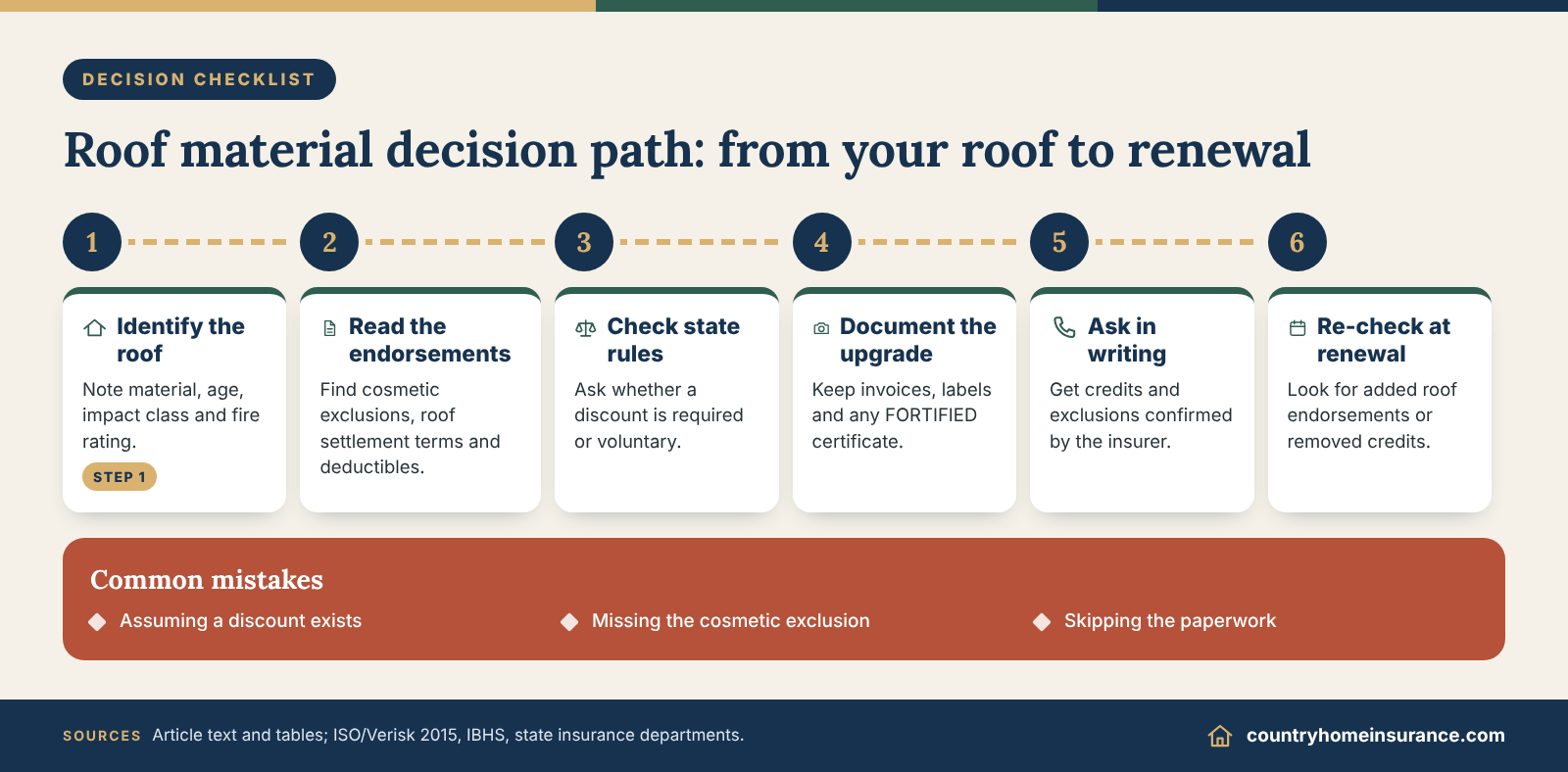
| Step | What to verify | What to document | What to ask the insurer |
|---|---|---|---|
| 1. Identify the roof | Material, layers, approximate age, any impact or fire rating on the product | Photos, invoices, product labels, permit | Does the roof material change eligibility or price? |
| 2. Read the endorsements | Cosmetic damage exclusion, roof surfacing payment schedule, wind/hail or hurricane deductible | Declarations page and endorsement list | What credit does each endorsement provide, and can it be removed? |
| 3. Check state rules | Whether your state requires mitigation discounts or sets rules for matching | Insurance department bulletin or statute page | Is the credit filed, and can I see it in writing? |
| 4. Prove upgrades | Impact class, FORTIFIED certificate, Class A documentation | Evaluator report, package label, installer letter | Which documents satisfy the credit, and when does it take effect? |
| 5. Check outbuildings | Whether barns, garages and sheds follow the same roof terms | Roof type and age for each structure | Do cosmetic or ACV roof terms apply to Coverage B? |
| 6. Baseline the roof | Current condition, open seams, dents, missing pieces | Dated photos before storm season | What does the insurer need to see after a loss? |
| 7. Re-check yearly | Renewal notice for added roof endorsements or removed credits | Last year’s declarations page | What changed in the roof terms since last term? |
Frequently asked questions
Rates and discounts
Does a metal roof lower homeowners insurance rates?
It may with some insurers, but the credits regulators document attach to tested performance rather than to metal as a material. Metal helps with fire and cracking resistance, yet insurers may attach a cosmetic damage exclusion, which affects what you receive after hail. Ask for the credit and the endorsement together, in writing, before you install.
Do impact-resistant shingles always qualify for a discount?
No. Manufacturers say discounts are not guaranteed and vary by state and insurer, and some carriers require a cosmetic waiver that can limit hail coverage. Bring your Class 3 or Class 4 documentation to your agent before and after installation.
Can I get homeowners insurance with a wood shake roof?
Sometimes, but terms vary by insurer, so ask carriers whether they write wood roofs in your area, whether the shakes are fire-retardant treated and what conditions apply. If standard carriers decline, a last-resort program may be an option in some states.
Does FORTIFIED Roof guarantee a lower premium?
Not everywhere. Alabama requires insurers to file FORTIFIED discount plans for the wind portion and Louisiana will require hurricane-portion discounts from January 1, 2027, while in Oklahoma carriers set the amounts and not all offer them. Where a credit exists, it applies to the wind portion rather than the whole premium. Confirm with your state insurance department and your insurer.
Coverage and claims
Are hail dents on a metal roof covered?
It depends on the policy. Without a cosmetic damage exclusion, dents may be treated as physical damage, subject to your deductible. With one, dents that do not impair the roof’s function as a weather barrier typically are not paid. Read the endorsement and see our hail damage coverage guide.
How do I know if my policy has a cosmetic damage exclusion?
Look in the declarations page and the list of attached endorsements for wording such as cosmetic damage, roof surfacing or exterior surfacing. If you cannot find it, ask your agent to confirm in writing, and ask at every renewal because endorsements can change.
Does insurance pay to upgrade my roof to FORTIFIED after a claim?
Not automatically. Alabama and Kentucky require insurers to offer an optional endorsement or rider that pays toward a FORTIFIED upgrade when a covered loss requires roof replacement. Elsewhere, ask your insurer whether an upgrade endorsement or ordinance or law coverage is available.
Do barn and shed roofs follow the same rules as the house?
Not necessarily. Detached structures fall under Coverage B (Other Structures) and may carry different roof terms, deductibles or exclusions. Ask whether cosmetic damage and roof schedule endorsements apply to them too, and see the guidance on wind-damaged roof insurance claims if a storm has already hit.
Sources
- IBHS — FORTIFIED Roof requirements and ratings (copyright 2025; 2025 Residential Technical Resources effective November 1, 2025; accessed 2026-10-16)
- IBHS — Hail Impact-Resistant Shingle Ratings (page modified March 10, 2026; accessed 2026-10-16)
- IBHS — Relative Impact Resistance of Asphalt Shingles (published January 21, 2019; modified April 27, 2026; accessed 2026-10-16)
- IBHS — Impact Testing of High Concentrations of Small Hail (report 2021; page modified December 16, 2025; accessed 2026-10-16)
- IBHS — Water Leakage Vulnerabilities for Shingles with Hail Damage (study 2019; page published December 15, 2025; accessed 2026-10-16)
- IBHS — Hail Impact Performance of Low-Slope Metal Roofing (published November 25, 2025; accessed 2026-10-16)
- IBHS — Wildland Fire Embers and Flames: Home Mitigations That Matter (October 17, 2025; accessed 2026-10-16)
- Alabama Department of Insurance — Alabama announces new mitigation discounts for IBHS FORTIFIED structures (Bulletin 2016-07) (December 23, 2016; accessed 2026-10-16)
- Alabama Department of Insurance — Bulletin No. 2024-03, Hurricane Sally data call (July 9, 2024; accessed 2026-10-16)
- Code of Alabama via Justia — section 27-31D-2, mitigation rating plans (accessed 2026-10-16)
- Code of Alabama via Justia — section 27-31D-2.1, fortified bronze roof endorsement (Act 2019-240; accessed 2026-10-16)
- Louisiana Department of Insurance — FORTIFIED benchmark discounts (Regulation 136, Bulletin 2026-04) (accessed 2026-10-16)
- Louisiana Department of Insurance — Louisiana Fortify Homes Program (accessed 2026-10-16)
- Kentucky General Assembly — 2024 Acts ch. 102 (HB 256), Strengthen Kentucky Homes Act (signed April 5, 2024; accessed 2026-10-16)
- Kentucky Revised Statutes — KRS 304.13-346, FORTIFIED roof upgrade rider (as amended 2026; accessed 2026-10-16)
- South Carolina Department of Insurance — Proviso 117.200 report on the SC Safe Home Program (June 30, 2026; accessed 2026-10-16)
- Texas Department of Insurance — Products qualifying for impact-resistant roofing credits (page current as of February 24, 2023; accessed 2026-10-16)
- Texas Department of Insurance — What to know about insurance and your roof (accessed 2026-10-16)
- Connecticut Insurance Department — FORTIFIED roofing standards release (July 17, 2026; accessed 2026-10-16)
- Strengthen Alabama Homes — program eligibility, grants and insurance discount notes (current page; accessed 2026-10-16)
- Oklahoma Insurance Department — Strengthen Oklahoma Homes program (current page; accessed 2026-10-16)
- Oklahoma Insurance Department — Lowering your home and auto rates (current page; accessed 2026-10-16)
- Florida Senate — Florida Statutes section 627.0629, residential property rate filings (2026 statutes; accessed 2026-10-16)
- California FAIR Plan Association — Wildfire hardening discounts for dwelling fire and commercial policies (effective November 15, 2025; accessed 2026-10-16)
- California FAIR Plan Association — plan overview (current page; accessed 2026-10-16)
- NAIC — Homeowners insurance consumer page (copyright 1991-2026; accessed 2026-10-16)
- Insurance Information Institute — 12 ways to lower your homeowners insurance costs (copyright 2026; accessed 2026-10-16)
- Verisk — Insurance Solutions introduces new rating tools and coverage options for homeowners roof exposures (August 13, 2015; accessed 2026-10-16)
- FC&S via PropertyCasualty360 — Roof surfacing cosmetic damage exclusion (June 15, 2016; accessed 2026-10-16)
- U.S. Court of Appeals for the Eighth Circuit — Cannon Falls Area Schools, ISD 252 v. Hanover American Insurance Co., No. 25-3315 (July 27, 2026; accessed 2026-10-16)
- U.S. Court of Appeals for the Seventh Circuit — Advance Cable Co. v. Cincinnati Insurance Co. (via FindLaw) (June 11, 2015; accessed 2026-10-16)
- Wisconsin Office of the Commissioner of Insurance — filed cosmetic damage exclusion endorsement, AAIS form HO 2002 07 13 (filed November 20, 2023; accessed 2026-10-16)
- FM Approvals — Approval Standard 4473, laboratory test for hail impact resistance of rigid roofing (July 2005; accessed 2026-10-16)
- IBHS — Roof 101 (page modified September 1, 2026; accessed 2026-10-16)
- IBHS — Relative Impact Resistance of Asphalt Shingles: Summary of UL 2218 Impact Tests (August 2014; accessed 2026-10-16)
- IBHS — Cedar Shingles and Shakes (reproducing Cedar Shake and Shingle Bureau guidance) (published June 18, 2019; accessed 2026-10-16)
- UL Solutions — UL Solutions and IBHS drive trust in residential roofing shingles (September 11, 2023; accessed 2026-10-16)
- UL — Class A, B and C roof ratings (The Code Authority) (Issue 1, 2014; accessed 2026-10-16)
- Florida Division of Emergency Management — shingle roofs guidance (undated; accessed 2026-10-16)
- GAF — Impact-resistant roof materials (manufacturer guidance on UL 2218 classes and discounts) (current page; accessed 2026-10-16)
Important coverage note
Coverage depends on the actual policy, endorsements, exclusions, limits, deductible and cause of loss. Roof endorsements, discounts and state programs change, and state laws and insurer practices vary. This article is educational, not legal or insurance advice. Verify case-specific questions with your insurer or agent and your state Department of Insurance before you buy, re-roof or file a claim.
About the editorial team
This guide was prepared by the countryhomeinsurance.com editorial team as general, educational information for homeowners. We research and summarize publicly available material, including state insurance departments, the NAIC, federal agencies, regulators’ consumer guides and published insurer and industry resources. We draw only on the sources that were available to us when we wrote this guide, and we list them in the Sources section with dates where we could find them.
Insurance rules, rates, products and program terms change, differ by state and by insurer, and can apply differently to your situation. We cannot guarantee that this content is complete, current or free of errors. It is not legal, financial, tax or insurance advice, it is not an offer to sell insurance or a recommendation of any insurer, agent or product, and reading it does not create a professional relationship of any kind.
To the fullest extent permitted by law, countryhomeinsurance.com and its editorial team, authors and contributors exclude all liability for any loss, damage or decision arising from the use of, or reliance on, this content. For questions about your own policy or claim, contact your insurer, a licensed agent or broker, your state Department of Insurance or another qualified professional.
Content created: October 16, 2026