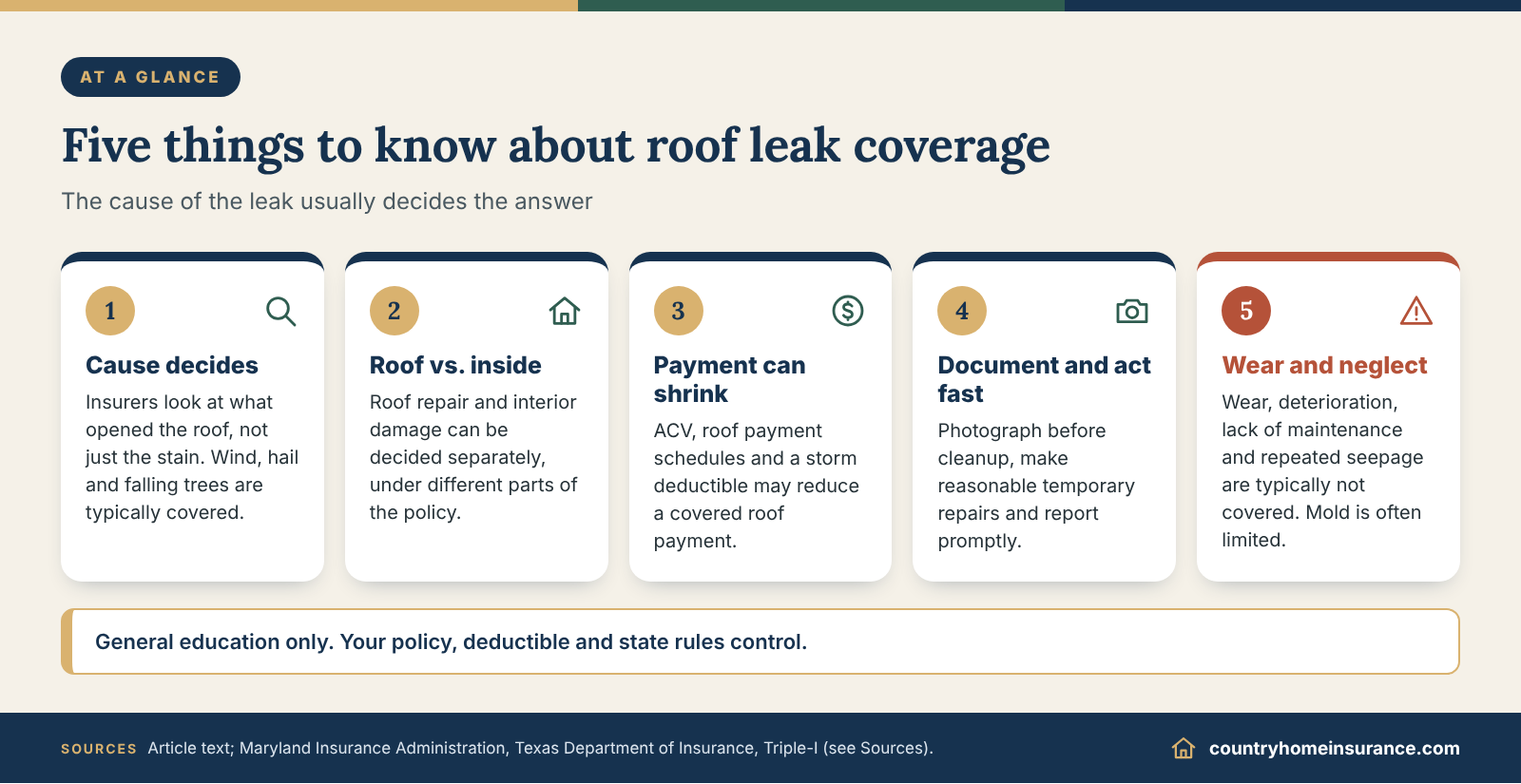
Does homeowners insurance cover roof leaks? It depends on what caused the leak. A leak that starts when a covered peril, such as wind, hail or a falling tree, damages the roof is typically covered, subject to your deductible and roof settlement terms. A leak from wear, age, deterioration, neglect or long-running seepage is typically not covered. Water damage inside the home is judged by the same cause-of-loss logic, and mold is usually limited.
Key takeaways
- The drip is not the cause of loss. Insurers look at what opened the roof or let water in, and whether that cause is covered, excluded or arguable.
- Wear, deterioration and lack of maintenance are typically excluded, even when the resulting ceiling damage looks sudden.
- Roof repair and interior damage can be decided separately, and some policies add conditions for rain that enters the home.
- Actual cash value (ACV) settlement, roof payment schedules and a separate wind or hail deductible can shrink a covered roof payment a lot.
- Mold from a roof leak is usually treated as a maintenance issue unless a covered peril caused the water, and many policies cap or exclude remediation.
- Fast photos, reasonable temporary repairs, saved receipts and a prompt report help you keep options open. Reporting deadlines vary by state and policy.
Does homeowners insurance cover roof leaks? The cause decides
The short answer: the cause of the leak matters more than the leak
Why a leak is a symptom, not a cause of loss
A homeowners policy doesn’t insure “leaks” as a category. It insures your home against certain causes of loss, which the industry calls perils, and it excludes others. A wet ceiling is only the visible result. The adjuster’s first job is to work backward from that stain to the event that let water in, then ask whether that event is a covered peril, an excluded cause, or something that needs more investigation.
That is why two homes with identical brown ceiling stains can get opposite answers. In one, a windstorm tore off a section of shingles last Tuesday. In the other, a flashing seal has been failing for years. The water looks the same. The coverage logic is not.
What “sudden and accidental” usually means in practice
Consumer regulators describe homeowners policies as generally covering sudden, accidental losses from listed events such as fire, wind, hail and the weight of ice or snow, and not covering maintenance. The Maryland Insurance Administration roof advisory says that gradual deterioration is generally not paid, and that if a covered peril damages a roof that already needed upkeep, the claim may be partly or fully denied. The Triple-I overview of covered disasters says plainly that a policy will not cover damage due to lack of maintenance.
In practice, “sudden” is less about how fast the stain appeared and more about how the roof failed. A branch punching through decking is an event. Granules wearing off shingles over fifteen years is a condition. Adjusters, roofers and sometimes engineers are asked to tell the difference, and that judgment is where most roof-leak disputes begin.
Two separate questions: the roof and what’s underneath it
The roof itself: repairing the opening
The first question is whether the insurer will pay to repair or replace the roof covering, decking or flashing that was damaged. This part of the claim falls under the dwelling coverage (usually called Coverage A, the limit for the house structure). If a covered peril damaged the roof, the policy typically pays for repair of that damage, less your deductible and any depreciation your loss settlement terms allow. If the roof failed from age, the roof repair itself is typically excluded.
Partial damage matters here. The Maryland advisory notes that when only part of a roof is damaged, the policy may pay only to repair that portion, and a March 2026 Texas Department of Insurance column warns that an insurer may not replace the whole roof just because new shingles do not perfectly match the old ones. How much of the roof gets paid for, and whether matching is owed, depends on the policy and sometimes on state rules.
The inside of the house: ceilings, insulation, floors and belongings
The second question is whether the insurer will pay for what the water ruined inside: drywall, insulation, flooring, wiring and the contents of the room. Drywall and flooring are part of the structure under Coverage A. Furniture, clothing and electronics fall under personal property coverage (Coverage C). Some forms treat rain that enters the building differently from other water, which is covered in detail in the interior damage section below.
The two questions can land differently. A policy might decline to pay for a worn-out roof surface yet still consider the sudden interior damage that followed, or it might pay to fix a storm-damaged roof while refusing the ceiling that stained slowly over months before anyone looked. Because the outcomes can split, it’s worth asking the insurer to explain each part of the decision in writing.
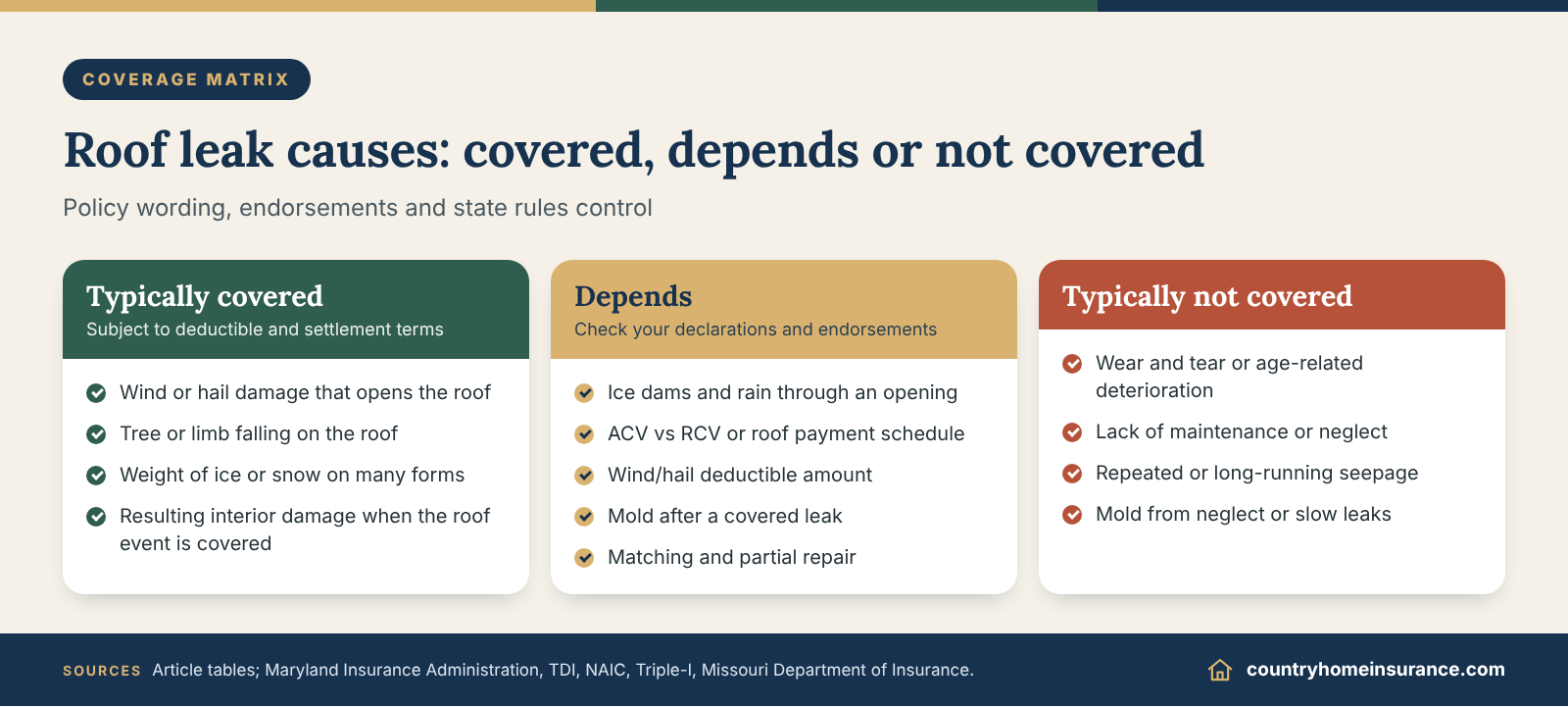
| Cause of the leak | How it is typically treated | What changes the answer |
|---|---|---|
| Wind tears off shingles or flashing | Typically covered, subject to the deductible and roof settlement terms | Separate wind/hail deductible, ACV roof endorsements, age-based payment schedules |
| Hail bruises or punctures the roof surface | Typically covered when the damage is real, not cosmetic-only | Cosmetic damage exclusions, roof surfacing limits, proof the damage came from a storm |
| Tree limb or tree falls on the roof | Typically covered | Whether the tree was dead or neglected, deductible, policy wording on debris removal |
| Weight of ice or snow damages the roof | Typically covered under many standard forms, but check your form | Policy form (broader forms list it, the most basic form may not), snow-load and structural findings |
| Ice dam backs water under shingles | Depends | How the form words the rain-and-snow condition, whether the roof was damaged, and what exactly was ruined |
| Rain enters through an opening | Depends | Some forms pay interior rain damage only if wind or hail first created the opening |
| Worn, old or cracked roofing | Typically not covered | Wear and tear, deterioration and age exclusions |
| Failed sealant, flashing or rusted fasteners | Typically not covered | Maintenance and neglect exclusions; proof of a sudden storm event |
| Slow or repeated leak over weeks or months | Typically not covered | Repeated-seepage or rot language; how quickly you acted once you noticed |
| Mold or rot that follows a roof leak | Depends | Whether a covered peril caused the water, fungi limits or exclusions, and how fast it was dried |
Roof leak causes that are typically covered
Storm and impact events that open the roof
Wind and hail that damage or lift the roofing
Wind and hail are the classic covered causes. The Triple-I table of covered perils lists windstorm or hail for every standard homeowners policy form it describes, including the most basic one. When wind lifts and tears shingles, or hail fractures or punctures the surface, and water then gets in through that damage, the storm is the cause of loss and the resulting roof repair is typically covered.
The details of wind and hail claims, such as how adjusters judge hail hits, test squares and replacement scope, are covered in our guides on the hail-damaged roof claim and the wind-damaged roof claim. For the coverage side of those perils, see does homeowners insurance cover hail damage and wind damage coverage. This article stays on the leak itself: how to decide whether the water is traceable to one of those events.
Falling trees and limbs
A tree or large limb that lands on the roof is another common covered cause. The roof damage is an impact, the opening is visible, and the timeline is easy to prove. The condition of the tree before it fell can come up in the investigation, so photos of the tree and the roof damage are worth taking. Removing the tree is often a separate, capped item: the ISO-based Oklahoma homeowners form used as an example in this guide pays up to $1,000 per loss for removing trees felled by wind, hail or the weight of ice or snow, no more than $500 for any one tree, and only when the tree damages a covered structure or blocks a driveway or access ramp. Other forms set different limits, and the guide on a tree that fell on a house covers them in more depth.
For leaks, the practical lesson is the same: cover the hole quickly. An impact that opens the roof is a covered event, but rain that pours through a hole for days after you knew about it can invite an argument that the later damage was preventable.
Ice, snow and fire-related damage
Weight of ice and snow
Triple-I’s table of perils shows the weight of ice, snow or sleet as covered under the broader standard forms (HO-2 and HO-3) but not under the most basic HO-1 or the limited HO-8 form. If heavy snow cracks rafters or buckles decking and the roof then leaks, that is typically a covered cause on those forms. The damage has to come from the weight itself, not from ordinary melt running through an already worn roof.
Because forms differ and some policies are customized by state, confirm the peril list in your own contract rather than relying on the label HO-3 alone.
Ice dams: a real gray area
An ice dam forms when snow melts, runs down to a cold eave and refreezes, pushing water back under shingles. The NAIC ties ice dams to heavy snow that melts and refreezes when attic insulation is poor, suggests better insulation, attic ventilation and clear gutters to prevent them, and advises reviewing your homeowners policy before winter to confirm that the winter perils you expect are covered.
No single rule settles whether an ice dam leak is paid. The answer depends on the form’s wording, on whether the roof itself was damaged and on what was ruined. A peril for the weight of ice or snow, which the Triple-I table shows on HO-2 and HO-3 forms, addresses a different mechanism than meltwater backing up under shingles. If an ice dam leak is your situation, ask your insurer which peril it is applying and why, and ask for the provision in writing.
Roof leak causes that are typically excluded
Wear, age and deterioration
Worn shingles, cracked sealant and failed flashing
This is the heart of most denied roof-leak claims. Policies commonly exclude wear and tear, deterioration, rust, rot and similar gradual conditions. The ISO special form that Triple-I hosts as a sample HO 00 03 excludes wear and tear, deterioration, rust and corrosion, and a newer example filed with the Oklahoma Insurance Department, the HS 00 03 OK 10 14 homeowners policy, lists wear and tear, marring and deterioration the same way, while leaving ensuing loss that is not otherwise excluded potentially covered. Other insurers use different wording, but the idea is consistent: the policy pays for events, not for the ordinary end of a material’s life.
A roof that leaks because its shingles are brittle, its sealant has cracked or its flashing has corroded is typically a maintenance and replacement cost for the owner, not an insurance claim.
Age alone is not a peril, but it changes the settlement
A 20-year-old roof isn’t excluded simply for being 20 years old. Age works in two quieter ways. First, an older roof is more likely to have the wear that triggers the exclusion above. Second, age feeds the settlement formula: when a covered peril does damage an older roof, the payout may be depreciated or follow an age-based schedule. The Texas Department of Insurance says insurers generally won’t pay for a new roof just because the existing one is old or worn, and that a roof in poor condition may not be covered at all. Our guide to how roof age affects homeowners insurance cost and eligibility goes deeper into that underwriting side.
Neglect, lack of maintenance and repeated seepage
The maintenance and neglect exclusions
Many forms also exclude loss caused by faulty or inadequate maintenance. In the ISO-based Oklahoma form, the exclusion list includes faulty, inadequate or defective planning, workmanship, repair, construction, materials or maintenance, with ensuing loss that is not otherwise excluded still potentially covered. A separate “neglect” exclusion in that form is narrower: it applies to a failure to use reasonable means to save and preserve property at and after a loss. The Triple-I page on covered disasters states the lack-of-maintenance principle in consumer terms. For a leak, this reaches situations such as clogged gutters that spill water behind the fascia, missing shingles left unrepaired through several storms, or a known soft spot that was never fixed.
Maintenance arguments are strongest when the insurer can show the problem existed and was ignored. If a storm tears away a shingle on a roof that was otherwise in sound shape, maintenance is not the cause. Documenting the roof’s condition before a loss, as discussed in the maintenance section below, is the best answer to that argument.
Continuous or repeated seepage and the known-leak problem
Some policies exclude water damage from continuous or repeated seepage or leakage over time. In the Oklahoma-filed form, the exclusion reaches water seepage or leakage, or humidity, moisture or vapor, that occurs over weeks, months or years, with an exception when the condition and the resulting damage were unknown to every insured and hidden within walls, ceilings or floors. Other editions word this differently, and the older ISO sample linked above has no stand-alone seepage exclusion in its perils list, so your own policy’s wording controls.
The practical principle for roof leaks is simple: when you see a stain, act at once. Photograph it, stop the water, and report it. A stain that sat unaddressed for months looks like seepage; a stain reported within days looks like a loss.
Other gaps that affect a roof leak claim
Faulty or low-quality repairs and installation
If a previous repair or installation was done poorly and a leak follows, the claim often turns on policy wording about faulty or inadequate workmanship, repair or construction and on whether a covered peril also contributed. ISO-based special forms, including the examples cited above, exclude loss caused by faulty workmanship or materials but leave ensuing loss that is not otherwise excluded potentially covered, and the exact language differs from insurer to insurer. Ask the adjuster which provision is being applied and whether any resulting covered damage is treated separately. Roofing contractors who made the error may carry their own liability or warranty obligations, which are separate from your homeowners policy.
Roof surfacing limits and endorsements that narrow coverage
Some insurers attach endorsements or use rating rules that treat roof surfacing differently from the rest of the house, especially as roofs age. The Missouri Department of Insurance urges consumers to check the declarations page for replacement cost coverage and notes that policies may limit payments for certain surfaces, such as roofs. Its summary of one insurer’s Missouri program describes an optional wind and hail endorsement that lowers the premium but limits a claim payment to a percentage of replacement cost under a predetermined schedule. These do not exclude leaks as such, but they can sharply reduce what a covered roof claim pays. The next sections explain how that works. Roof terms vary by state; our Arkansas homeowners insurance guide covers one state’s cost, coverage and discounts.
Interior water damage and the “opening” rule
The wind-created opening condition
What the clause says
Many homeowners forms contain a condition about rain, snow, sleet, sand or dust. In both the ISO HO 00 03 sample and the Oklahoma-filed ISO-based form, damage to personal property inside a building from those elements is covered only if wind or hail first damages the roof or a wall and creates an opening that the precipitation enters.
Notice what the clause does not say. It does not say the roof repair is excluded. It says that, for that kind of water entering the building, the policy wants proof that a covered event created the pathway. In both forms the condition sits in the windstorm-or-hail peril for personal property (Coverage C), while the structure is insured on a broader basis. Because forms vary, treat this as a prompt to read your own wording, not as a universal rule.
Why “where did the water come in” becomes a fight
An opening can be small or hard for a layperson to see. An adjuster may find no wind-created opening, while a roofer finds lifted tabs, a cracked pipe boot or a displaced ridge cap. Disagreements usually come down to evidence: dated photos of the roof after the storm, a roofer’s written findings, and weather data for your area on the date in question.
This is also why a roof that was already deteriorated can complicate a storm claim. If the insurer concludes the water came through a gap that existed before the storm, the opening was not created by wind, and the interior damage may be treated as excluded.
The house versus the contents
Coverage A and Coverage C can follow different rules
Coverage A insures the structure: roof, walls, ceilings, built-in flooring, attached finishes. Coverage C insures personal property: furniture, clothing, electronics, rugs. On a typical special-form (HO-3) policy, the structure is insured against most causes unless excluded, while personal property is insured only against a list of named perils. The rain-through-an-opening condition tends to matter most for personal property.
If your living room ceiling collapsed onto the sofa, the ceiling and the sofa could be reviewed under different parts of the policy with different conditions. When you file, list the damaged structure and the damaged belongings separately, and ask which coverage the insurer is applying to each.
Hypothetical example: A storm lifts a section of shingles and rain enters the attic, stains the bedroom ceiling and soaks a rug. In this made-up scenario the adjuster finds fresh wind creasing on the shingles and agrees wind created the opening. The roof repair, the drywall and the rug are then all evaluated as storm-related losses. If instead the adjuster finds long-standing granule loss and a rusted pipe flashing with no storm creasing, the same stain and the same rug might be treated as excluded, because no covered event created the opening. These figures and outcomes are illustrative only and do not predict any real claim.
When a leak crosses into plumbing, appliances or flood
Not every ceiling leak starts on the roof. Water in an upstairs ceiling can come from a supply line, a water heater or an air-conditioning condensate line, and each follows different rules. Triple-I’s table shows that accidental discharge from plumbing, heating, air-conditioning or appliances is covered on broader forms such as HO-2 and HO-3, but it is not a roof peril. Before you assume the roof is to blame, have someone check the plumbing in the area above the stain. Our guides on burst pipe coverage and appliance leak claims explain those paths. Surface flooding is a separate matter entirely and is usually excluded from standard homeowners policies, as covered in does homeowners insurance cover flood damage.
How a covered roof leak gets paid: ACV, RCV and the deductible
Replacement cost, actual cash value and roof payment schedules
Replacement cost versus actual cash value
Replacement cost value (RCV) pays to repair or replace damaged property without subtracting depreciation. Actual cash value (ACV) pays the depreciated amount. The NAIC (the association of state insurance regulators) explains that insurers base depreciation on the item’s condition at the time of loss, the cost of a new one and how long such items normally last. In the NAIC’s July 2021 example, two homes each have $15,000 of roof damage and a $1,000 deductible. The RCV home receives $14,000. The ACV home, after $10,000 of depreciation, receives $4,000.
The Maryland Insurance Administration adds a timing point: under replacement cost coverage, most policies pay the depreciated amount first and release the withheld depreciation after repairs are finished. The Texas Department of Insurance likewise says to expect two payments with replacement cost roof coverage. So even on a good policy, the first check can be smaller than the final amount.
Roof surfacing schedules and ACV roof endorsements
Some insurers don’t use ordinary depreciation for older roofs. The Missouri Department of Insurance gives an example (published April 2020) in which an ACV policy may pay as little as 20% of the replacement cost of a destroyed 20-year-old roof, because depreciation can be significant for property near the end of its useful life, and it notes that a roof’s useful life is usually about 25 years. The same department’s summary of one insurer’s Missouri program describes an optional wind and hail endorsement that pays a scheduled percentage of replacement cost. Payment schedules and endorsements vary by company, so treat these as illustrations of what to look for rather than a standard.
The takeaway for a leak claim is that a covered roof loss can still pay well under the full repair cost. Check your declarations and endorsements for terms such as “roof surfacing,” “ACV,” “payment schedule” or “cosmetic damage.” The Oklahoma Insurance Department notes that some policies exclude cosmetic damage, which it describes as damage affecting only appearance rather than function. Our guide on roof material and homeowners insurance rates shows how material choice interacts with pricing and eligibility.
Deductibles and who pays for what
Flat deductibles, percentage deductibles and separate storm deductibles
A deductible is the part of a covered loss you pay before insurance pays. Some policies use a separate deductible for wind, hail, hurricane or storm losses, set as a flat amount or as a percentage of the dwelling coverage limit. The Maryland advisory gives a clear example using a percentage hurricane deductible: on a $100,000 dwelling and a $3,000 wind-related roof repair, a 2% deductible is $2,000, so the insurer pays $1,000, while a 5% deductible is $5,000, which exceeds the repair, so nothing is paid. The Texas Department of Insurance warns that the wind and hail deductible is often higher than the deductible for other damage, and the Oklahoma Insurance Department says that in higher-risk areas wind or hail may fall under a separate deductible.
Check which deductible applies to your leak before you file. A leak that stems from a storm may fall under the storm deductible, while a leak from a different covered cause may fall under the standard one.
Putting the pieces together: a hypothetical payout
Hypothetical example: A storm damages a roof, and the contractor’s repair estimate for the damaged slope and the interior ceiling is $12,000, of which $9,000 is roofing and $3,000 is drywall and paint. Assume the roof settlement is ACV, the roofing is depreciated 50% ($4,500), the interior is not depreciated, and the storm deductible is $2,500. The math in this made-up scenario would be $12,000 minus $4,500 minus $2,500, or $5,000, with the possibility of different results under RCV or a payment schedule. Real depreciation, deductibles and timing depend on your policy, the insurer’s estimate and state rules.
The same order of operations applies in every claim: price the repair, subtract depreciation if the settlement is ACV or a schedule, then subtract the deductible. Whether the withheld depreciation comes back later depends on your loss settlement wording.
| Factor | How it affects a roof leak claim | What to check or ask |
|---|---|---|
| Loss settlement type | Depends: RCV pays without depreciation (often in stages), ACV subtracts depreciation | Is the roof settled at RCV, ACV or a schedule? Has it changed at renewal? |
| Roof age and material | Depends: may drive depreciation, payment percentages or whether roof coverage is limited | Install year on the declarations; roof surfacing endorsement |
| Wind, hail or storm deductible | Depends: can be a flat amount or a percentage of the dwelling limit and may exceed the standard one | Dollar value of the deductible on your roof loss |
| Coverage A dwelling limit | Typically covered up to the limit for structural repair, including roof and interior finishes | Whether the limit reflects current rebuilding costs |
| Coverage C personal property | Depends: named-perils wording and the rain-through-opening condition may apply | Whether contents are RCV or ACV; any open-perils endorsement |
| Mold or fungi limits | Depends: remediation may be excluded or capped | Fungi sublimit or exclusion in the policy |
| Cosmetic damage exclusion | Typically not covered when damage affects only appearance and not function, if your policy includes it | Whether the exclusion exists and how it defines functional damage |
| Matching and partial repair | Depends: insurer may repair only the damaged portion, and matching rules vary | Written explanation of repair scope; state rules |
Mold, rot and slow moisture after a roof leak
How mold limits and exclusions work
Mold is usually treated as a maintenance issue
Triple-I describes mold as a home maintenance issue that standard homeowners policies generally do not cover, but it adds that if mold results from a covered peril, the cost of eliminating it may be covered. For a roof leak, that links mold back to the cause of the water. Mold that grows after a covered storm opening may be addressed as part of that claim, while mold that grows from a slow leak or long-ignored condition is typically excluded.
Triple-I names roofs among the sources of leaks that can lead to mold on ceilings and walls, and advises keeping the roof maintained so water stays out. Insurers see this connection too, which is part of why maintenance records matter.
Fungi sublimits, caps and the fine print
Even when mold is connected to a covered loss, the policy may limit what it pays. In the Oklahoma-filed ISO-based form, fungi, wet or dry rot and bacteria are excluded except where fire or lightning causes them, and a limited additional coverage pays up to $5,000 in total for all occurrences in a policy period when a covered peril caused the loss and reasonable steps were taken to save the property. That figure belongs to one filed form, not a market standard, and other forms and endorsements set different limits or none. Check your declarations and endorsements for a fungi, mold or “wet or dry rot” limit and ask the agent what is included.
If the leak is severe, ask separately about testing, containment, removal and rebuilding, because some policies treat remediation, repair and contents cleaning under different provisions.
The drying clock
Why 24 to 48 hours matters
Triple-I recommends removing standing water quickly and drying or discarding soaked materials within 24 to 48 hours, then fixing the moisture source. The Oklahoma-filed form also lists, among a policyholder’s duties after a water loss, drying the property promptly and guarding against fungi. For roof leaks that means stopping the entry point first with a tarp or temporary patch, then pulling wet insulation or saturated ceiling tiles if it is safe to do so. Take photos before you remove anything, and keep samples of materials the adjuster may want to see.
Speed helps coverage as well as health. Damage that grows because nobody acted after the first sign of water is the kind of loss insurers may argue was preventable.
Humidity, attic ventilation and slow leaks you can’t see
Triple-I suggests keeping indoor humidity between 30% and 60% and using exhaust fans in kitchens and bathrooms. In a house with a slow roof leak, attic insulation can hide moisture for weeks. Look for a musty odor, discolored rafters or sheathing, damp insulation and ceiling spots that grow after rain. Finding these early is the difference between a small repair and an excluded long-term seepage argument.
If you discover mold or rot already established, avoid guessing when it started. Describe what you saw, when you saw it and what you did next, and let the inspection document the rest.
Roof maintenance, age and inspections that protect your coverage
What insurers look at before and after a loss
Underwriting inspections and roof age
Roof condition is part of how insurers decide whether and how to cover a home. The Texas Department of Insurance says insurers inspect the roof when you apply and may raise the premium or refuse coverage based on what they find. Triple-I says a roof more than 20 years old typically has to pass an inspection when you apply for coverage, and that some insurers may decline older roofs altogether. Triple-I also calls roof condition a major factor in how insurers pay for roof replacement.
A clean inspection at application does not make future wear a covered event, but it does create a baseline. If a leak claim later raises a neglect argument, an inspection report from before the loss is useful evidence. Our guide to fall roof inspections and insurance walks through what to expect from an inspection and why timing matters.
Watch for a quiet switch from RCV to ACV at renewal
The Texas Department of Insurance advises checking at renewal whether your insurer has changed your roof coverage from replacement cost to actual cash value, and notes that insurers may make this change as roofs age and should tell you when they do. Its March 2026 column adds that after a roof is repaired or replaced, you can ask whether roof coverage can be added back. Read the renewal documents rather than assuming last year’s terms carried over, and look for new endorsements about roof surfacing or cosmetic damage.
A switch to ACV does not change what causes a leak to be covered. It changes how much a covered roof claim pays, which may be the difference between a manageable claim and a disappointing one.
A practical maintenance routine
Seasonal checks that address common leak sources
The Texas Department of Insurance lists several maintenance habits that help protect a roof: trimming overhanging limbs, checking for storm damage, inspecting the chimney and keeping gutters clean. For leaks, the places to look are where roofing meets something else: chimney and wall flashing, pipe boots, skylights, valleys, ridge caps and eaves. After a hard wind or hail event, a ground-level look and an attic check with a flashlight can spot daylight, damp sheathing or stains. Our guide on chimney and fireplace homeowners insurance covers one of the most common leak points in more depth.
Don’t climb a steep or wet roof to do any of this. Binoculars, a phone zoom and an attic check are often enough to decide whether a professional needs to look.
Hiring an inspector and keeping records
The Texas Department of Insurance recommends hiring a roof inspector every few years to catch problems early. Keep the written report, dated photos and receipts for every repair. If a roofer or inspector recommends work, ask for the finding in writing and ask whether the issue is storm-related, age-related or workmanship-related. That distinction is what a later adjuster will ask too.
Be careful with unsolicited offers. The Maryland Insurance Administration warns that some contractors who offer unsolicited roof inspections misrepresent normal wear as storm damage, and it lists a state fraud tip line. The NAIC likewise advises not feeling pressured or rushed to sign a contract. Tell your insurer before you commit to major work.
What to do when the ceiling drips: claim tips and documentation
The first day
Protect people first, then stop more water
If the ceiling is sagging, bulging with water or near electrical fixtures, move people and valuables away and stay out of the room. Water and electricity don’t mix, and a saturated ceiling can fall. Once it is safe, place buckets, move belongings and, if you can do it safely, cover the roof opening with a tarp.
Most policies expect you to protect the property from further damage. In the ISO-based Oklahoma form, the duties after loss include making reasonable repairs to protect the property and keeping a record of repair expenses, and an additional coverage pays the reasonable cost of necessary measures taken solely to protect covered property from further damage from a covered peril. A separate exclusion in that form applies to a failure to use reasonable means to save and preserve property at and after a loss, which is why rain pouring through a hole for days can lead to a dispute. Temporary repairs are therefore expected, and their cost is typically reimbursed if the loss is covered, so keep receipts. Before starting permanent repairs, ask the insurer whether it wants to inspect the damage first.
Document before you clean up
The NAIC advises photographing or recording video of the damage and listing damaged property for the adjuster meeting. Taking photos before you move or discard anything, and keeping damaged items the adjuster may want to see, is a sensible way to follow that advice. For a leak, capture the stain and the room from several angles, a wide shot and a close-up, the attic side of the leak, any visible roof damage from the ground, the weather on the day, and the date and time. Note when you first noticed the leak and when it last rained. A short written timeline made the same day is often more reliable than memory two weeks later.
List damaged belongings with approximate age and replacement cost. A home inventory made before a loss makes this much easier, and the NAIC offers a free home inventory app.
Working the claim
Decide whether to file, and report promptly
The NAIC suggests checking your deductible first, because minor damage may cost less than the deductible to fix, and filing if repairs will exceed it or the damage is extensive. Triple-I’s ISO-based loss data for 2019 to 2023 show average paid claims of about $14,747 for wind and hail and $15,400 for water damage and freezing (ISO figures for multiple-peril homeowners policies in the states the table covers), which shows these categories can produce sizable claims, though your own loss may be smaller or bigger. A claim can affect future premiums or eligibility, so it’s reasonable to ask your agent how a claim might affect renewal. Our guide on claims history and homeowners insurance rates explains that side.
Once you decide to file, report promptly. The NAIC notes that the time you have to report a claim varies by state, and policies carry their own notice requirements, so do not wait to see whether the stain grows. Having your policy number, a description of what happened and your photos ready speeds the first call.
Adjusters, estimates and how payments arrive
The NAIC says insurer-sent adjusters are free to you, while public adjusters charge fees, and that you should bring your list of damaged property to the adjuster meeting. It also says not to agree to repairs you are uncomfortable with and not to let anyone rush you. If your contractor’s estimate differs from the insurer’s, ask for a line-by-line comparison and be specific about what you disagree with.
Payments can come in more than one check. The NAIC notes that if you have a mortgage, structural payments may be made jointly to you and your lender, and the lender may hold funds in escrow for repairs. With replacement cost roof coverage, expect an initial payment and a later release of withheld depreciation once work is complete.
If you disagree with the decision
Ask for the denial or partial payment in writing, with the specific policy provision cited, and compare it with your policy. If you believe the insurer has not followed the policy or handled the claim reasonably, the NAIC says to contact your state insurance department if an insurer responds slowly or does not conduct a reasonable claim investigation. The Maryland Insurance Administration, for example, handles complaints about whether an insurer followed policy terms. Each state has its own process, and legal questions belong with a licensed attorney.
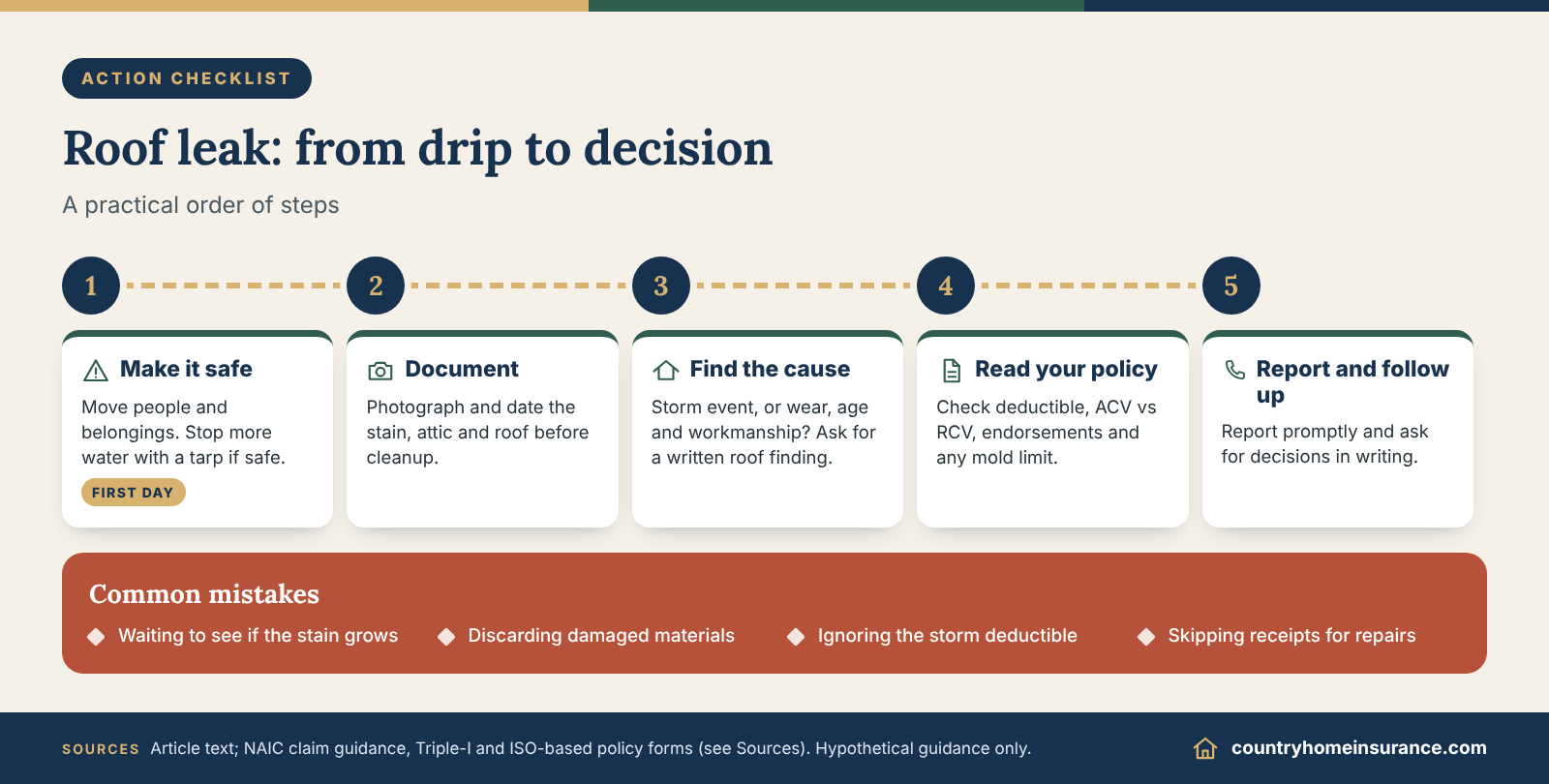
| Step | What to do | Why it matters for coverage |
|---|---|---|
| 1. Make it safe | Move people and belongings, avoid sagging ceilings and wet electrical fixtures | Safety first; also prevents further loss |
| 2. Photograph and date | Wide and close photos of the stain, attic side, roof from the ground, and weather conditions | Evidence of cause and timing before cleanup |
| 3. Stop more water | Tarp or temporarily patch; save receipts | Typically expected as mitigation; costs may be reimbursed for a covered loss |
| 4. Read the policy | Check the declarations for the deductible type, roof settlement terms, endorsements and any fungi limit | Determines how a covered claim would be paid |
| 5. Report promptly | Call the insurer or agent with the policy number and a description; ask for the claim number | Deadlines vary by state and policy; late notice can complicate a claim |
| 6. Get a roof assessment | Ask a licensed roofer for a written finding on cause (storm, age, workmanship) | Separates a covered event from wear before the adjuster visit |
| 7. Track the dry-out | Dry or remove soaked materials within 24 to 48 hours where safe; photograph first | Limits mold and supports the claim that you acted promptly |
| 8. Ask for the decision in writing | Request cited policy provisions for any denial or partial payment | Lets you compare it with your policy and escalate to the state department of insurance if needed |
Common roof leak scenarios and how coverage logic applies
Storm-related scenarios
A branch punctures the roof during a storm
Hypothetical example: A limb falls during a windstorm, punches through shingles and decking, and rain enters the attic that night. The homeowner photographs the damage the next morning, tarps the hole and reports the claim. In this made-up scenario, the impact is an identifiable covered event, the roof repair and resulting ceiling damage are evaluated as storm losses, and the tarp cost is a reimbursable mitigation expense if the loss is covered. The outcome would still depend on the deductible, the roof settlement terms and the tree-related provisions in the policy.
Wind lifts shingles and a stain appears days later
This case turns on evidence. A homeowner finds a stain three days after a windy evening. A roofer documents creased and missing tabs on the windward slope, the weather record shows a gusty day, and the attic shows fresh water tracks beneath the damage. That combination supports a wind-created opening. If, instead, the roofer sees weathered, curled shingles across the whole roof and no fresh creasing, the insurer may attribute the leak to age and wear. The first homeowner and the second may have the same stain and different outcomes.
Age-related and maintenance scenarios
A stain slowly grows around a chimney or skylight
A ring that gets slightly larger after each rain, around flashing or a skylight, is usually a maintenance and seepage pattern, not a sudden event. It’s typically not covered, particularly if there are signs of repeated moisture such as rust, rot or old stains. If the area was damaged by a specific storm, a documented storm date and fresh damage can change the analysis. The best step is to repair the source promptly and document the condition, even if you expect the claim to be denied.
A storm hits an older roof that was already near the end of its life
These are the most disputed claims. The storm may be a covered cause, but the roof’s age may reduce the payment through depreciation, a payment schedule or an ACV endorsement, and an insurer may argue part of the damage was pre-existing. As the Maryland advisory puts it, if a covered peril damages a roof that already needed upkeep, the claim may be partly or fully denied. A pre-loss inspection report, maintenance receipts and dated photos can show what condition the roof was in before the storm. For a closer look at how age changes underwriting, see the roof age guide linked earlier.
| Scenario | Likely cause finding | How coverage typically lands |
|---|---|---|
| Fresh wind creasing and missing tabs after a storm | Wind-created opening | Typically covered, less deductible and subject to roof settlement terms |
| Tree limb through decking | Impact by a covered peril | Typically covered; mitigation costs may be reimbursed |
| Curling, brittle shingles all over, no storm marks | Wear and age | Typically not covered |
| Slow growing ring around flashing for months | Seepage, maintenance | Typically not covered |
| Ice dam with water behind eave | Contested cause | Depends on the form and the insurer’s reading |
| Covered storm on a roof with age-based schedule | Covered peril, aged roof | Depends: payment may follow the schedule or ACV terms |
| Mold found after an unreported leak | Possible neglect or late notice | Typically not covered; depends on cause and fungi terms |
Roof leaks on country homes, outbuildings and remote properties
Barns, sheds and detached structures
Outbuilding roofs are often a separate coverage question
On acreage, the roof that leaks may not be the house. Detached garages, workshops, barns and sheds are typically insured under a separate other-structures coverage with its own limit, and how a detached building is used matters. Outbuildings used for business may be treated differently from those used for personal storage: the Oklahoma-filed ISO-based form, for example, does not cover other structures from which any business is conducted, with narrow exceptions. Farm use raises similar questions, so ask the agent how each building is used and insured. The same cause-of-loss logic described here applies, but the limits, the settlement type and the eligibility for older buildings can differ. Our guide on rural home insurance covers the broader differences for country properties.
Metal, older and unusual roofing
Older barns often have metal or other roofing that has been patched over decades, and fasteners and seams can fail gradually. That pattern leans toward wear and maintenance rather than a sudden covered event. If you plan to insure a building with an aged roof, ask whether it would be settled at ACV, whether a payment schedule applies and whether roof surfacing is limited. Ask the agent about each building separately instead of assuming the house terms apply to everything.
Remote and seasonal properties
Leaks nobody sees for weeks
A long driveway, a second home or a hunting property can hide a leak for a long time, and the delay is the problem. Because policies may exclude damage from continuous or repeated seepage, a leak that ran unseen for weeks risks being treated as excluded even if the original opening was sudden. Ask your insurer what it expects for periodic checks, whether any vacancy or unoccupancy conditions apply to water damage, and whether you need a caretaker or inspection routine to preserve coverage.
After a regional storm: contractors, tarps and timing
After a widespread storm, roofing crews can be booked for weeks, and temporary protection matters more. Rural homeowners may need to arrange a tarp themselves or ask neighbors for help. Keep receipts, take photos of any temporary work and tell the insurer about delays in getting a contractor. Be wary of out-of-area crews that knock on doors, and consider what the Maryland Insurance Administration said about fraud warnings before signing anything.
Frequently asked questions
Coverage questions
Is a roof leak covered if the roof is old?
Age alone doesn’t make a leak a covered or excluded event. If a covered peril such as wind or a falling tree damaged an older roof, the claim may be covered, but the payment can be reduced through depreciation, an ACV endorsement or a roof payment schedule. If the leak comes from wear and deterioration, it’s typically not covered whatever the roof’s age.
Will my insurer pay for a whole new roof if it leaks?
Usually not for a leak alone. The Texas Department of Insurance notes that insurers generally don’t pay for a new roof just because the existing one is old or worn. When a covered storm damages part of a roof, the policy may pay to repair that part, and whether it replaces the whole roof depends on the damage, your policy and state rules.
Does homeowners insurance cover water damage inside if the roof leak itself isn’t covered?
It depends on the cause and the policy wording. If the opening was caused by a covered peril, the interior damage may be covered. If the roof failed from wear or the leak was long running, the interior damage is also typically excluded. Some forms add a condition that rain damage inside is paid only if a covered event first opened the roof, so ask the insurer to cite the provision it relied on.
Is mold from a roof leak covered?
Triple-I says mold is generally a maintenance issue, but removal may be covered if the mold results from a covered peril. Even then, many policies cap or exclude remediation. Check your declarations and endorsements for a fungi limit, and dry out quickly.
Claim and cost questions
Should I file a claim for a small leak?
Compare the likely repair cost with your deductible, and ask your agent or insurer how a claim might affect your policy before you decide. The NAIC suggests checking your deductible first and filing if repairs exceed it or the damage is extensive. Reporting a loss and filing a claim are not always the same step, so ask how your insurer handles each.
How long do you have to report a roof leak?
It varies by state and by policy. The NAIC says the time you have to report a claim varies by state, and most policies require prompt notice. Don’t wait for certainty about the cause. Report early and let the investigation sort out the details.
Who pays for the tarp or emergency repair?
You typically pay first and ask for reimbursement. ISO-based policies commonly pay the reasonable cost of necessary measures to protect covered property from further damage from a covered peril, so keep receipts and photos. If the loss turns out to be excluded, the cost usually stays with you.
What if the insurer says the leak is wear and tear and I disagree?
Ask for the written decision with the policy provision cited, get an independent written roof assessment, and send your documentation. If you still disagree, contact your state insurance department about its complaint process. For disputes over legal rights, consult a licensed attorney.
Prevention questions
How often should a roof be inspected?
The Texas Department of Insurance recommends a roof inspector every few years, and checking for storm damage after severe weather. Insurers may also require an inspection for older roofs when you apply for coverage. An inspection after a major storm is worth considering regardless of schedule.
Can fixing a small leak quickly protect my coverage?
It can help. Prompt repair and documentation reduce the chance that a later claim looks like neglect or long-running seepage. It also keeps a minor problem from growing into rot or mold, which are harder to cover.
Sources
- Maryland Insurance Administration — Consumer Advisory: Roof Replacement (undated state advisory; accessed 2026-10-16)
- Texas Department of Insurance — Insurance and your roof (last updated 2024-01-30; accessed 2026-10-16)
- Texas Department of Insurance — What to know about replacing your roof with insurance (March 2026; accessed 2026-10-16)
- NAIC — Rebuilding After a Storm: Replacement Cost and Actual Cash Value When It Comes to Your Roof (2021-07-22; accessed 2026-10-16)
- NAIC — What You Need to Know When Filing a Homeowners Claim (2022-04-20; accessed 2026-10-16)
- NAIC — Consumer Insight: Navigating the Claims Process to Recover and Rebuild (2017-09-01; accessed 2026-10-16)
- Triple-I — Protecting your home from mold (undated; page copyright 2026; accessed 2026-10-16)
- Triple-I — How Your Roof Influences Your Home and Business Insurance (undated; page copyright 2026; accessed 2026-10-16)
- Triple-I — Which disasters are covered by homeowners insurance? (undated; page copyright 2026; accessed 2026-10-16)
- Triple-I — Facts + Statistics: Homeowners and renters insurance (ISO data for 2019–2023; page copyright 2026; accessed 2026-10-16)
- Oklahoma Insurance Department — HS 00 03 OK 10 14 Oklahoma Homeowners Policy (example of an ISO-based filed form) (accessed 2026-10-16)
- Triple-I — Sample ISO homeowners special form HO 00 03 10 00 (2000 edition sample; accessed 2026-10-16)
- Oklahoma Insurance Department — Wind and hail (undated consumer page; accessed 2026-10-16)
- Missouri Department of Commerce and Insurance — Raising the Roof on Insurance Coverage (April 8, 2020; accessed 2026-10-16)
- Missouri Department of Commerce and Insurance — Roof coverage summary for one insurer (undated; accessed 2026-10-16)
- NAIC — Consumer Insight: Protect Your Home from Damaging Winter Weather (undated; accessed 2026-10-16)
Important coverage note
Coverage depends on the actual policy, endorsements, exclusions, limits, deductible and cause of loss. This article describes general patterns and uses hypothetical examples only; it does not promise that any claim will be paid. Policy forms differ by insurer and state, and laws, claim deadlines and consumer protections vary. Review your declarations page and policy, and verify case-specific questions with your insurer or agent and your state Department of Insurance. This guide is educational and is not legal advice.
About the editorial team
This guide was prepared by the countryhomeinsurance.com editorial team as general, educational information for homeowners. We research and summarize publicly available material, including state insurance departments, the NAIC, federal agencies, regulators’ consumer guides and published insurer and industry resources. We draw only on the sources that were available to us when we wrote this guide, and we list them in the Sources section with dates where we could find them.
Insurance rules, rates, products and program terms change, differ by state and by insurer, and can apply differently to your situation. We cannot guarantee that this content is complete, current or free of errors. It is not legal, financial, tax or insurance advice, it is not an offer to sell insurance or a recommendation of any insurer, agent or product, and reading it does not create a professional relationship of any kind.
To the fullest extent permitted by law, countryhomeinsurance.com and its editorial team, authors and contributors exclude all liability for any loss, damage or decision arising from the use of, or reliance on, this content. For questions about your own policy or claim, contact your insurer, a licensed agent or broker, your state Department of Insurance or another qualified professional.
Content created: October 16, 2026