A frozen pipe insurance claim usually starts with three moves: stop the water, protect the house from more damage, and report the loss promptly. Many homeowners policies pay for sudden water damage after a pipe freezes and bursts, but they typically expect reasonable care, such as keeping the heat on or draining the system, and the pipe repair itself may not be paid. Expect the adjuster to ask about your thermostat, occupancy and the plumber’s findings. Your policy, deductible and state rules control the outcome.
Key takeaways
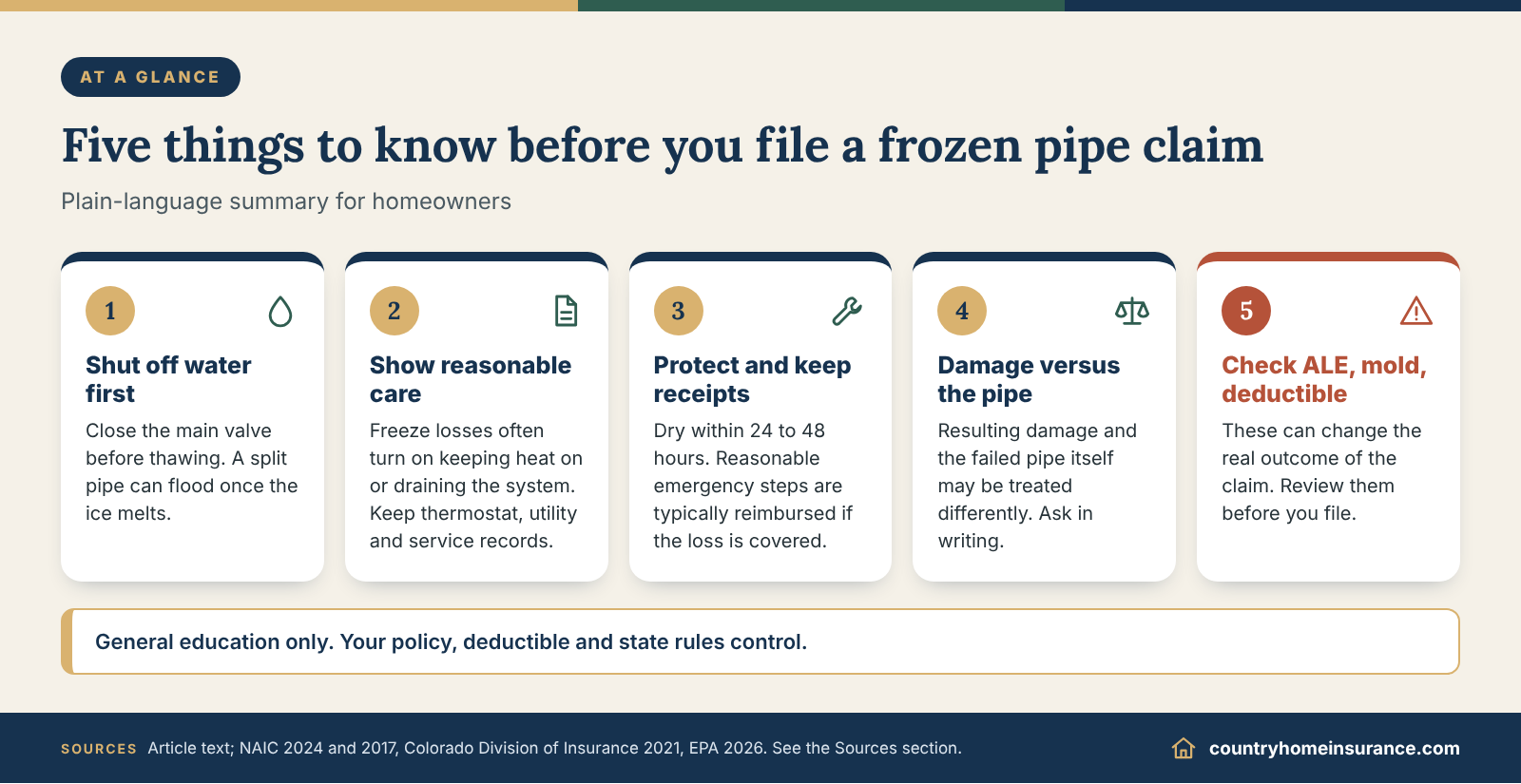
- Shut off the water first, then document, then thaw. A pipe that has already split can flood the house the moment it warms up.
- Freeze claims turn on cause. Standard forms commonly exclude freezing unless you used reasonable care to maintain heat or to shut off and drain the water system, so evidence of your heat and maintenance matters.
- Protecting the property from further damage is a policy duty, not a courtesy. Keep receipts for emergency drying, temporary repairs and lodging.
- What gets paid is often the resulting damage (walls, floors, contents, cleanup), while the broken pipe or fixture itself is frequently treated differently. Check your form.
- Additional living expenses, mold and the deductible type can change the real value of a claim more than the headline coverage limit.
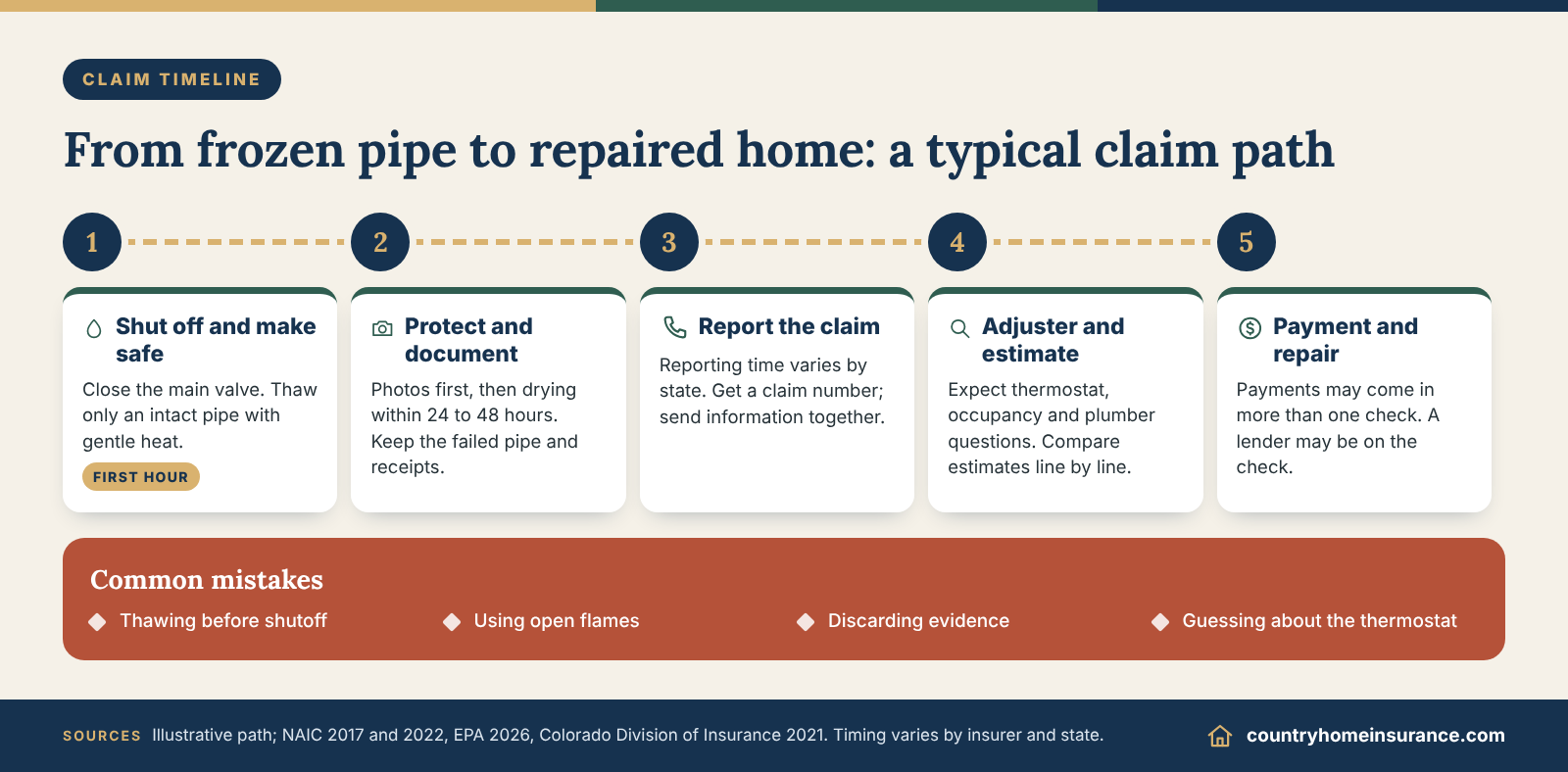
- Common mistakes are avoidable: waiting to report, discarding evidence, guessing about the thermostat, using open flames, and signing before you understand the scope.
What a frozen pipe insurance claim involves
A frozen pipe insurance claim is really two questions asked in sequence. The first is why the pipe failed, because freezing is a cause of loss that many homeowners forms treat with conditions. The second is how much the covered damage costs once that question is settled. Most people only prepare for the second one, which is why freeze claims surprise them. This guide walks the claim in the order it actually happens: the first hour at the house, the mitigation duty, the cause evidence, the adjuster conversation, the plumber’s report, payment, living expenses, mold, rural complications and the mistakes that tend to cost people money.
How a frozen pipe claim differs from other water claims
Freeze plus discharge: two events in one loss
When a pipe freezes, ice expands inside it and the pipe may crack. The water often doesn’t escape until the ice melts and pressure returns, so the visible flood can happen hours or days after the actual freeze. Insurers therefore look at both the freezing event and the later discharge. The National Association of Insurance Commissioners (NAIC), the group of state insurance regulators, explains in a 2024 consumer article that policies commonly cover a “sudden and accidental” discharge from a plumbing system, provided the homeowner took reasonable steps to maintain the pipes and prevent freezing (NAIC, February 2024).
Why the insurer asks “why” before “how much”
With a roof leak or an appliance failure, cause is usually obvious. With a frozen pipe, the insurer wants to know whether heat was maintained, whether the house was occupied, whether the cold was unusual and whether anything failed that you couldn’t have known about, such as a furnace stopping at night. Those facts decide whether a freeze condition in the policy is satisfied. Preparing your answers before the first call is the most useful single thing you can do.
Where this guide fits and what it leaves to other articles
Coverage logic, claim workflow and preparation are different jobs
This article covers the workflow after a freeze. The question of what the policy covers in principle is handled in our guide to whether homeowners insurance covers frozen pipes, and the broader burst-pipe claim path is in the burst pipe insurance claim guide. If you are reading this before a cold snap, the preparation side lives in the first freeze insurance checklist. We’ll refer to those rather than repeat them.
When the pipe froze but never burst
A pipe that freezes and thaws without splitting may cause no loss at all, and there may be nothing to claim. If you do find a slow leak days later, the claim becomes a leak claim with a freeze cause, and the discovery date and the plumber’s description of the split become important. Photograph the pipe before anyone repairs it. If the damage is smaller than your deductible, read the deductible section below before you decide whether to file.
How common freeze losses are, and what the data can and can’t tell you
What Triple-I reports for water damage and freezing
The Insurance Information Institute and Triple-I publish homeowners loss data by cause. Their “water damage and freezing” category made up 22.6 percent of homeowners losses in 2023, and over 2019 to 2023 it averaged about 1.50 claims per 100 house-years at roughly $15,400 per claim (Triple-I, homeowners and renters insurance facts and statistics). That category also includes mold damage when mold is covered and does not isolate frozen pipes.
Why a national average is not your estimate
An average blends small leaks with whole-house floods, and it blends regions where freezing is routine with regions where it is rare. Use it only to see that these claims are common and often significant. Your own number depends on how many rooms got wet, how long water ran, what finishes were affected and how fast drying began.
| Item in the claim | Typical treatment | What decides it |
|---|---|---|
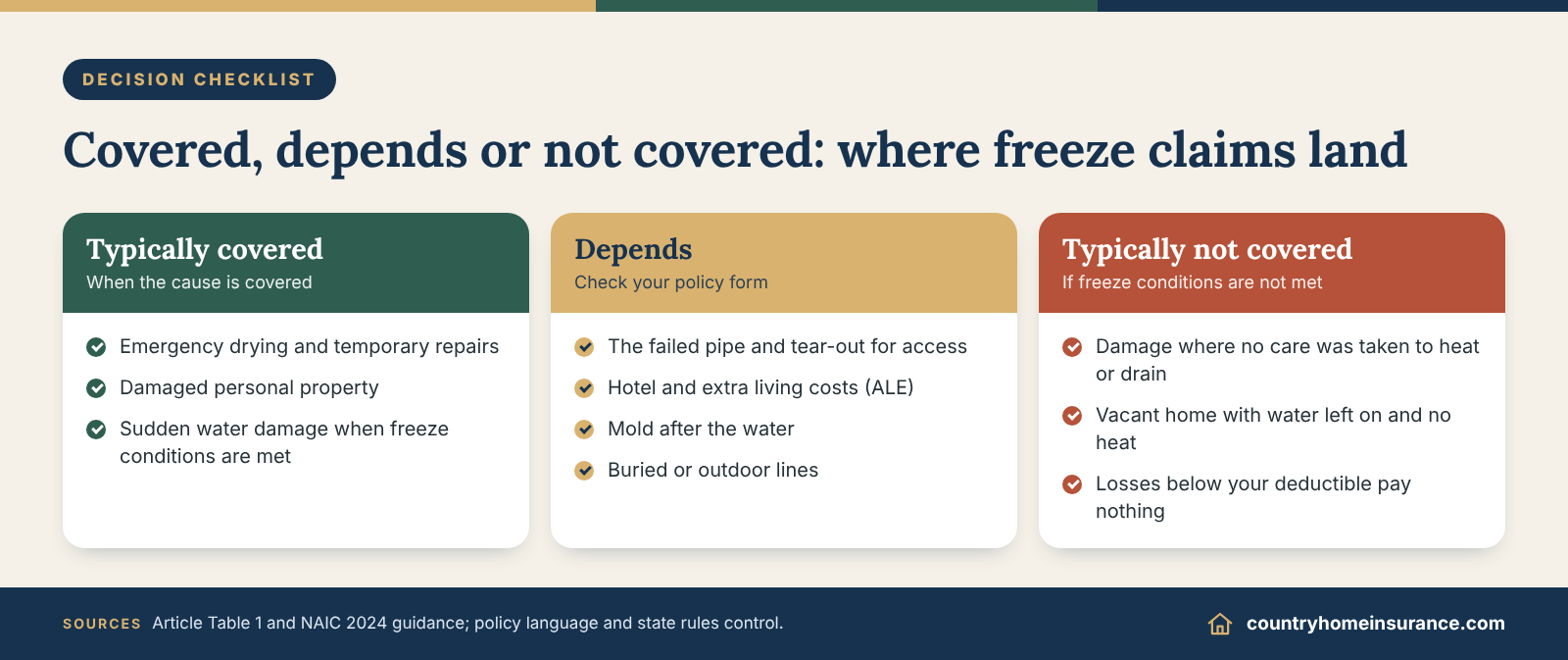
| Water damage to walls, floors and ceilings after a freeze-related burst | Depends. Often paid when the policy’s freeze conditions are met; may be excluded if heat or draining requirements weren’t met. | Reasonable care to maintain heat or drain the system, occupancy, policy form wording |
| Emergency drying, water extraction and temporary repairs | Typically covered when the underlying loss is covered, with receipts kept. | Whether the loss itself is covered; reasonableness of the steps taken |
| Damaged furniture, clothing and other personal property | Typically covered when the cause is covered, usually under Coverage C (personal property). | Cause of loss, ACV or RCV settlement terms, listed sublimits |
| The frozen or split pipe, fixture or appliance itself | Depends. Many forms treat the failed system differently from the damage it caused. | Policy wording on the system or appliance, plus any service-line or equipment endorsement |
| Opening walls or floors to reach the pipe | Depends. Some forms address access and tear-out as part of a covered water loss. | Exact tear-out language and whether the water loss is covered |
| Hotel and extra living costs while the house is unlivable | Depends. Additional living expense (ALE) generally requires a covered loss that makes the home unfit to live in. | Coverage D limit, time limit, documentation |
| Mold that follows the water | Depends. Some forms exclude it, cap it with a sublimit, or cover it only when it results from a covered discharge. | Mold exclusion or endorsement, how quickly drying started |
| Damage in a vacant or unheated home where no care was taken | Typically not covered under a freeze exclusion when its conditions aren’t met. | Heat, drain-down, vacancy and unoccupancy wording |
| Buried or outdoor lines such as a well or yard service line | Depends. These lines often need a specific endorsement. | Service-line coverage, where the line sits, who owns it |
The first hours: shutting off water and thawing safely
The first hour at the house is a safety and damage-control problem, not an insurance problem, but the order of your actions affects both. Keep the sequence simple: make the area safe, stop the water, photograph what you see, and only then work on a thaw. State agencies and utilities that have published thaw guidance agree on the broad strokes. Where they are silent, this article says so rather than guessing.
Stopping the water before anything thaws
Find and close the main shutoff
If a pipe has split, thawing it will release whatever water is trapped behind the ice. The Georgia Office of Insurance and Safety Fire Commissioner’s cold-weather release advises shutting the water flow off right away and calling a plumber or contractor (Georgia OCI, December 2019). Know where the main valve is before winter, and if the house has a well, know where the pump breaker and pressure tank valve are too. A shutoff you can’t find or turn is a common reason small leaks become large claims.
Cut power where water and electricity meet
If water is running near outlets, panels, appliances or a sump or well-pump circuit, turn off power to that area at the breaker only if you can reach the panel without standing in water. If you cannot do that safely, leave the building and call the utility or emergency services. No claim is worth an electrical injury, and no insurer expects you to take that risk.
Stand clear of sagging ceilings
Water can collect above a ceiling and bring down drywall or insulation. If a ceiling is bulging or dripping heavily, stay out from under it, photograph it from a safe distance, and let a mitigation professional decide how to relieve it.
Thawing a frozen but intact pipe
Open the tap, then apply gentle heat
Public risk-management guidance published by the PRISM program advises opening the faucets connected to the frozen pipe so water can flow once it thaws, then warming the pipe gradually with an electric heating pad, heat lamp or hair dryer (PRISM risk-control toolbox, undated). A 2024 CBS News report quoting plumbers gave similar advice and added that heat should continue until full water pressure returns (CBS News, January 2024). Opening cabinet doors under sinks lets room air reach the pipe slowly.
What not to use
Both sources warn against open flames and propane torches, which can damage pipes or start a fire. The CBS piece also lists blowtorches, gas heaters and charcoal stoves, and advises keeping the cabinet clear of combustibles during a thaw. Never use an open flame to thaw a pipe. A fire claim is a much worse problem than a water claim.
Check for damage as the pipe warms
The PRISM guidance suggests looking for bulges or cracks, which indicate pressure and a risk of rupture. If you see a split, wet insulation or water where there shouldn’t be any, close the shutoff valve upstream and stop thawing. At that point you have a burst pipe, not a frozen one, and the claim workflow begins.
When to stop and call a plumber
Signs the thaw is beyond DIY
Stop and call a licensed plumber if you can’t find where the pipe is frozen, if it is behind a wall or under a slab, if you see a crack or bulge, or if the freeze affects the main line, the water heater connections or a heating system loop. Gentle heat on an exposed pipe is reasonable. Cutting open walls to chase a freeze is better done by a professional who can also document what they find.
Book early, because everyone else is calling too
During a regional cold snap, plumbers get backed up. A State Farm agent interviewed by WBRC in Birmingham, Alabama, in January 2024 advised getting on a plumber’s list quickly if a pipe bursts (WBRC, January 2024). Ask for the plumber’s written findings at the time of booking, because that report becomes part of the claim file (more on that below). For the wider Alabama market, see our guide to homeowners insurance in Alabama.
Mitigation duty: protecting the property without hurting your claim
Homeowners policies typically require the insured to take reasonable steps to protect the property from further damage after a loss. In practical terms, that means you can’t leave standing water, wet insulation or open wall cavities untreated while waiting for the adjuster. The NAIC’s claims guidance says reasonable steps to prevent more damage are typically reimbursed if the loss is covered, and that receipts should be kept (NAIC consumer insight, September 2017).
What counts as reasonable emergency steps
Water removal and drying
The U.S. Environmental Protection Agency says water-damaged areas and items should be dried within 24 to 48 hours to prevent mold growth, and notes that porous materials such as carpet or ceiling tiles may need to be discarded if they become moldy (EPA, A Brief Guide to Mold, Moisture and Your Home, updated February 2026). Treat that 24-to-48-hour window as a sensible working target for your mitigation. If the water is clean supply water, you can begin extraction, fans and dehumidifiers immediately, or hire a water-mitigation company that does so.
Temporary repairs and keeping the house warm
Temporary measures may include capping or clamping the split pipe, tarping, boarding, moving furniture off wet floors and keeping the building heated so that more pipes don’t freeze. If the heating system failed, heating is itself part of protecting the house. Written receipts for rented equipment, supplies and emergency labor are your evidence that you acted reasonably.
Your own time and labor
Whether a policy reimburses your own cleanup time varies by form and insurer. The WBRC interview mentioned that insurers may compensate for some cleanup, but a single agent’s comment isn’t a rule. Ask your adjuster directly, and don’t assume you’ll be paid for unpaid hours.
Ask before large work, document before any work
Get instructions from the insurer before major repairs
The Colorado Division of Insurance, in a February 2021 advisory on burst-pipe claims, recommends limiting further damage but getting instructions from the company before making repairs (Colorado Division of Insurance, February 2021). Emergency mitigation can’t wait for an appointment, but demolition, new flooring and replacement of fixtures should. The NAIC’s 2017 guidance also notes that an adjuster may want to see repair estimates before you start.
Photograph and video before cleanup
The NAIC advises documenting all damage before cleaning up or removing debris, using photos or video plus a list of damaged items, and saving damaged items for inspection if possible. Do a slow walkthrough video of every wet room, narrating what you see, then take close-up stills of waterlines, stained ceilings, swollen baseboards and damaged contents. Include the date and time on the file.
Evidence worth keeping
The failed pipe section
The Georgia release advises keeping the broken or damaged pipe as evidence for the insurance company. Ask the plumber to bag, label and set aside the split section instead of throwing it away. The physical pipe helps an adjuster or plumber judge whether the failure looks like a freeze split or a corroded fitting or loose joint, which bears on the cause of loss.
Damaged materials and contents
Before discarding saturated carpet padding, ceiling tile or appliances, photograph them and keep samples or the manufacturer labels if the adjuster hasn’t yet inspected. If space or health concerns make that impossible, tell the adjuster what you plan to dispose of and ask for approval in writing. Keep an itemized list with age, purchase price if known, and where each item was.
Documenting the freeze cause and your heat maintenance
Because freezing is a conditional cause of loss in many policies, the strongest frozen pipe claim file is one that shows the house was being kept reasonably safe from freezing. That doesn’t mean a perfect record. It means ordinary, believable evidence that you or a caretaker were heating the building, monitoring it, or had properly drained and shut down the water system.
Why the cause evidence carries so much weight
The reasonable-care exception in standard forms
An Insurance Journal column by Bill Wilson quotes the freezing exclusion in the ISO homeowners form HO 00 03 05 11: it excludes loss from freezing of a plumbing, heating, air conditioning or sprinkler system or an appliance, but the exclusion does not apply if you kept heat on in the building or shut off the water and drained the systems (Insurance Journal, February 2020). Your own form may be worded differently, because insurers file their own versions and endorsements, so read your actual policy.
What “reasonable care” has meant in disputes
Courts and commentators treat reasonable care as a fact question judged by what a prudent person would do in the same situation. Two New Jersey federal decisions discussed in a 2019 Merlin article show the range: one court read the exclusion as applying only if the insured failed to take steps an ordinary person would have taken to keep the home above freezing, and another let a claim proceed because whether heat was maintained could not be decided before discovery (Merlin Law Group, February 2019). Neither outcome is a guarantee for your claim.
One recent ruling for the insurer, and why it turned on facts
A March 11, 2026 order from the U.S. District Court for the Eastern District of Washington in Hill v. Farmers Property & Casualty Insurance Co. (No. 2:25-CV-0048-TOR) went the insurer’s way (court order, posted by Merlin Law Group; see also Merlin’s March 2026 summary). The facts the court relied on included service records showing a clogged furnace filter, a thermostat that still read 40 degrees on a second visit after it had been raised and that no one investigated, a utility bill showing very little gas use and temperatures as low as negative 10 degrees. The takeaway for homeowners is not the outcome but the pattern: ignored warning signs plus data suggesting no real heat is the kind of evidence insurers and courts weigh. Other courts, applying other states’ law and other facts, can reach different results.
Building a heat-maintenance record
Thermostat settings and history
Write down the thermostat setting at the time of the freeze, and whether it was a heating or cooling mode, auto or manual, and whether a battery or sensor was dead. If you have a smart thermostat or a home-monitoring app, export or screenshot the temperature history for the days before the loss. Those logs can show that the house was being kept warm, or reveal when heat stopped. Either way, you want to know what they show before the adjuster asks.
Utility, fuel and service records
Utility bills and fuel deliveries show whether the heat was running. Recent furnace or boiler service records, and the date of any filter change, show maintenance. Heating oil or propane tank gauge photos and delivery tickets help for homes without natural gas. In Hill, utility usage data cut against the policyholders, so check your own usage first. If the numbers look low for a period when you thought the heat was on, find out why before the interview.
Power outages and equipment failures
A furnace that quits on a cold night, a tripped breaker or a power outage are different facts from simply not heating. The Insurance Institute for Business and Home Safety (IBHS) notes that a broken heating system can make a home cold enough for pipes to freeze, and that plumbing is especially at risk during outages and in older homes (IBHS Winter Ready, page modified November 2023). Keep the repair invoice, the technician’s diagnosis, and outage notices or the utility’s outage history for your address. Whether such an event satisfies your policy’s wording is a question for the adjuster and your policy, not a conclusion to assume.
Documenting the scene as a timeline
Where the freeze happened
Note whether the failed pipe sat on an exterior wall, in an attic, a crawl space, a garage, a pump house or an unheated corner. Photograph insulation (or its absence), open cabinet doors, drafts, gaps and any vent or opening that let cold air in. The IBHS guidance lists these as common weak points: pipes in attics, crawl spaces and exterior walls, gaps around doors and windows, and uncovered ventilated crawl spaces. Don’t fix cosmetic issues before photographing them.
What the weather was doing
Save the local forecast and observed low temperatures for the days around the loss, from the National Weather Service or a local station. A prolonged hard freeze is not the same as a single cold morning. In Hill, the court held that past efforts and years without a frozen pipe did not establish reasonable care for an extreme cold snap, which is a reminder that your evidence of precautions should match the severity of the cold.
Who was home, and when
List who was in the house, when each person last checked it, and when the water damage was discovered. This establishes both occupancy and the discovery timeline. If a caretaker, tenant or family member monitored a seasonal or secondary property, ask that person to write a short dated account.
Policies generally expect you to keep the home at some minimum temperature while it is occupied, but the NAIC and the Maryland Insurance Administration do not name a number, and no single figure applies to every insurer. As a planning reference only, the PRISM public risk-management guidance recommends a consistent 50 degrees Fahrenheit even in lightly used areas such as storage and mechanical spaces. That is a building-management recommendation, not an insurance rule, so ask your insurer whether your policy states a minimum.
Reporting the claim and talking to the adjuster
You usually report by phone, app or online portal, but the timing and content of that first report matter. Before you do, decide whether the loss is likely to exceed your deductible, because a small claim can have long-term effects.
Deciding whether and when to file
Check the deductible and the likely repair cost
The NAIC advises finding your deductible before reporting a claim and notes that minor damage may be cheaper to pay for out of pocket, while larger or extensive damage justifies a claim (NAIC consumer insight, April 2022). A professional estimate from a plumber and mitigation company before you file helps you compare cost to deductible. United Policyholders, a consumer advocacy nonprofit, makes the same point in a 2021 article on winter storm pipe claims (United Policyholders, February 2021).
Claims history can follow you
United Policyholders warns that even a claim that results in no payment still appears in the C.L.U.E. database, the industry report of past claims. That is a reason to understand your loss before reporting, but it is not a reason to delay reporting a serious one. How claims history can affect renewal and pricing is covered in our article on claims history and homeowners insurance rates.
Don’t let a deadline slip while you decide
The NAIC says the amount of time you have to report a claim varies by state and that insurers have their own requirements. Policies commonly require “prompt” notice. If you’re uncertain about a freeze loss that is still being discovered, report it and ask the insurer how they would handle supplements as more damage appears.
Making the report
What to have ready
Have your policy number, name, address and phone number, a short description of what happened, the date you discovered the loss, the steps you’ve taken to stop the damage, and the name of your plumber and mitigation company. The Colorado Division of Insurance recommends including an inventory of damaged property with the initial claim and submitting all information at once, because sending it in pieces slows processing.
Ask for the claim number and the process in writing
Write down the claim number, the name of the person you spoke to, the date and time, and what they told you about next steps. United Policyholders recommends documenting all conversations with the adjuster and contractors. A short follow-up email summarizing the call creates a record without confrontation.
Know the regulatory clock in your state
States set their own claim-handling rules. As one example, the Texas Department of Insurance says an insurer has 15 business days to acknowledge a claim, 15 business days after receiving the information it needs to accept or reject it, with a possible 45-day extension if it explains why, and that a rejection must include written reasons (Texas Department of Insurance, May 2025). That is Texas only. Other states set their own timelines, so check your state’s department of insurance for the acknowledgment, decision and payment deadlines that apply to you.
Questions adjusters commonly ask about a freeze
Heat, thermostat and last time in the house
Expect questions such as: What was the thermostat set to? What heat source runs the house? When did the heat last run? When were you last home? Did anything go wrong with the furnace, a power outage or a fuel delivery? Answer from records where you can, and say plainly when you don’t know. A guess that is later contradicted by a thermostat log or utility record is worse than saying you’ll check.
Occupancy, vacancy and seasonal use
Because the freeze exclusion in some forms is tied to vacancy or unoccupancy, adjusters ask whether anyone lived in the house and for how long it was empty. Ask your insurer in writing how your policy defines vacant and unoccupied and whether any number of days changes its freeze or water-damage terms, since definitions vary by insurer and form. If you own a seasonal, rental or recently inherited property, ask your agent how your policy defines vacant and unoccupied before the winter, and read the freeze checklist for preparation steps.
Prior leaks, repairs and maintenance
Adjusters also ask about previous leaks, plumbing repairs, pipe materials, insulation, heat tape and whether a prior freeze occurred. Give accurate, brief answers. If a past repair or earlier loss is relevant, bring the invoice. Hiding a prior problem is a bigger risk than disclosing it.
Working with the adjuster
Adjuster roles and your options
The NAIC explains that the insurer sends a claims adjuster at no cost to you, and that you may hire a public adjuster who provides similar services but whom you pay. The adjuster inspects the damage and documents the loss for settlement. The NAIC also suggests bringing your damaged-property list to the meeting and considering having your contractor attend.
Walk the whole path of the water
Show the adjuster every place water traveled, including the room below a leak, wall cavities, crawlspaces and cabinets. Freeze breaks often occur in hidden spots and water can travel to a different level. If you discover more damage after the visit, report it as a supplement instead of waiting until repairs are done.
If your insurer is slow or one-sided
The NAIC says states regulate claim handling and that homeowners can contact their state insurance department if an insurer responds slowly or does not conduct a reasonable investigation. Keep your own records of dates and contacts. Escalate to the regulator after you’ve given the insurer a fair, documented chance to respond.
The plumber’s report, repair scope and estimates
Your plumber is both a repair provider and a witness. A clear report written at the time of repair can answer questions about where the failure occurred and what it looked like, without relying on memory weeks later.
What to ask the plumber to document
Location, type of failure and condition of the pipe
Ask for a dated invoice or short report that states the address, the exact location of the failure (for example, an exterior-wall branch line in an unheated crawl space), the pipe material, what the failure looked like, what was repaired and what was replaced. Photographs taken by the plumber with the pipe still in place are especially valuable. Ask whether other pipes show freeze damage that could fail later.
Observations, not legal conclusions
A plumber can describe what they saw, such as a split typical of ice expansion, insulation condition or an unheated area. They shouldn’t be asked to decide coverage or blame. If the adjuster wants a cause statement, the plumber’s factual observations, together with your heat records, let the insurer reach its own conclusion.
Scope, estimates and who does the repair
Separate the plumbing repair from the water damage repair
Ask for itemized estimates. One covers the plumbing fix. Another covers drying and mitigation. A third covers rebuilding drywall, insulation, flooring and finishes. Separating them helps because the policy may treat them differently, and it makes disagreements about scope easier to resolve line by line.
Choosing contractors carefully
The NAIC cautions against aggressive contractors, demands for upfront payment and pressure to sign quickly. It recommends using local or trusted companies, obtaining references, checking licensing, getting multiple bids, paying in installments and making the final payment after completion. Your insurer may also have recommendations; ask whether your policy places any limits on your choice of contractor.
How payment typically reaches the contractor
Mortgage lenders on the check
If you have a mortgage, the NAIC notes that structural damage payments may be issued to both you and your lender, and the lender may hold funds in escrow and release them as repairs are completed. Ask the lender about its process early, because it can add days or weeks between the check and the contractor’s payment.
Multiple payments and supplements
The NAIC explains that you may receive more than one payment, with the first typically an advance for emergency needs and later payments covering other items such as contents. When hidden damage appears during repairs, the contractor may submit a supplement. Keep the original estimate, the adjuster’s estimate and every supplement together so you can reconcile the differences.
| Factor | Why it matters | What to check or ask |
|---|---|---|
| Deductible type and amount | A flat deductible and a percentage deductible produce very different out-of-pocket costs; a small freeze loss may fall below either. | Declarations page: all-peril deductible, any separate water or freeze deductible, and whether it applies per claim |
| Freeze conditions in the form | Many forms exclude freezing unless reasonable care to maintain heat or drain the system was used. | The wording of the freezing exclusion and any vacancy or unoccupancy provisions |
| Loss settlement: replacement cost value (RCV) or actual cash value (ACV) | ACV subtracts depreciation from older flooring, cabinets and contents; RCV may pay the difference later after repair. | Whether the dwelling and contents settle at RCV or ACV, and the holdback rules |
| Coverage D loss of use or ALE | Caps and time limits determine how long displaced households can be reimbursed for extra costs. | The Coverage D limit and any time limit |
| Mold limits | Mold may be excluded or capped, even when the water damage is covered. | Mold exclusion, endorsement and sublimit |
| Mortgagee on the check | Funds may be held in escrow and released as work is completed. | Lender’s disbursement process and inspection requirements |
| State claim rules | States set deadlines for acknowledging, deciding and paying claims, and for what denial letters must say. | Your state department of insurance consumer page |
| Triple-I benchmark | Water damage and freezing averaged about $15,400 per claim over 2019 to 2023 nationally; it is context, not a prediction. | Use it only to gauge seriousness, not to estimate your own payout |
What a frozen pipe claim typically pays, and how the payment is built
A payment is a calculation, not a lump sum: covered damage priced at the policy’s settlement terms, minus depreciation where the policy applies it, minus the deductible. Understanding each layer lets you read the adjuster’s estimate critically instead of just waiting for a check.
The damage versus the pipe
Resulting water damage to the structure
The center of most frozen pipe claims is damage to the dwelling (Coverage A): drywall, insulation, framing, flooring, cabinets, paint and finish work, plus the drying needed to save them. When the freeze conditions are satisfied and the discharge is sudden, these are typically the largest lines in the estimate. For the wider burst-pipe picture, including non-freeze causes, see the burst pipe claim guide.
The failed pipe, fixture or appliance
The cost of fixing the failed pipe, fixture or appliance itself may be treated differently from the water damage it caused, and forms differ on whether they address the cost of opening walls or floors to reach the problem. Ask your adjuster in writing which parts of the plumbing repair, if any, are included, and compare the answer against your policy language. When the failure came from an appliance such as a water heater or dishwasher supply line, the same logic applies and is discussed in the water heater leak claim guide and the appliance leak claim guide.
Outdoor and buried lines
A frozen yard line, outdoor spigot or well line may sit outside the part of the plumbing system the standard form describes, and service-line coverage is usually an optional endorsement. IBHS notes that homes built before 2010 typically lack frost-proof outdoor faucets, which matters when a spigot line freezes into the wall. Ask about service-line coverage before you need it.
Contents, depreciation and settlement terms
Coverage C and the home inventory
Furniture, rugs, electronics and clothing damaged by the water are usually claimed under personal property coverage (Coverage C). The NAIC says that if you have no home inventory, you can list lost items room by room with as much detail as possible. List each item with description, age and approximate cost.
Replacement cost value versus actual cash value
Replacement cost value (RCV) is what it costs to replace an item with a similar new one. Actual cash value (ACV) is replacement cost minus depreciation. United Policyholders recommends checking whether your policy pays ACV or RCV and whether the deductible is a flat amount or a percentage. Under RCV settlement, an insurer may pay ACV first and release the withheld depreciation, called recoverable depreciation, after you complete the repair or replacement. Ask for the exact release steps.
Holdbacks, proof and timelines
If depreciation is withheld, keep invoices and photos of completed work and ask whether there is a deadline for claiming it back. Time limits for recovering withheld depreciation vary by policy, so ask your insurer for the date in writing.
Deductible mechanics, with a worked illustration
Flat versus percentage deductibles
A flat deductible is a dollar amount, such as $1,000. A percentage deductible is a share of the dwelling limit, so it rises with the value of the home. Most freeze losses fall under the all-other-perils deductible, but check your declarations page for any separate water or freeze deductible, and whether it applies per claim.
How it flows through a claim
Hypothetical example: Suppose a freeze split in an exterior-wall pipe floods a kitchen and hallway. Drying and extraction cost $3,200, drywall, insulation and paint $6,800, and flooring $4,500 (of which $1,200 is depreciation under an RCV policy). Contents cost $2,500 to replace new, with $1,100 of depreciation. The plumber’s repair is $450. Assume a single $1,500 per-loss deductible and that the plumbing repair is not paid under the form. The structure at replacement cost is $14,500 and the first payment might subtract the $1,200 holdback, giving $13,300, then the $1,500 deductible, leaving $11,800. Contents might pay $1,400 at ACV first. Initial payments of roughly $13,200 would then be followed by up to $2,300 in recoverable depreciation after documented replacement. The $450 plumbing bill stays with the homeowner. These figures are illustrative only, not a prediction of any claim, and your policy language controls.
When a small claim isn’t worth filing
If this same loss were limited to the plumbing fix and a few hundred dollars of drywall, it would fall below the deductible. Paying out of pocket avoids a claim record but gives up the protection if hidden damage shows up later. Talk it through with your agent, and keep all documents either way.
Additional living expenses and food spoilage after a freeze
A serious freeze loss can make parts of a home unlivable for weeks. Coverage D, loss of use, is the part of the policy that addresses the extra cost of living elsewhere.
When additional living expense coverage applies
A covered loss that makes the home unfit
The Colorado Division of Insurance says that if the home is uninhabitable because of a covered loss, additional living expense (ALE) coverage may reimburse the extra costs of a hotel or other residence. If the freeze exclusion defeats the underlying claim, ALE usually falls with it. A cold house with a working kitchen and bath may not meet the standard even if it is uncomfortable.
Only the increase counts
A Merlin Law Group article describes ALE as paying the necessary increase in living expenses so the household can maintain its normal standard of living, not total living costs (Merlin Law Group, November 2021). If you normally spend $400 a month on groceries and now spend more on restaurant meals, the claim is the difference. Track your baseline spending to show it.
Duration and endpoints
The same article explains that the standard wording ties payment to the shortest time needed to repair or replace, and that disputes arise when an insurer ends ALE after drying but before reconstruction is finished. Ask when you expect to move back, and get any time limit and cap in writing.
Keeping ALE records
Receipts and a simple log
The NAIC and Colorado both advise keeping receipts for lodging and related costs. Keep a running table with date, vendor, purpose and amount, and save lease or hotel confirmations. Ask in advance whether the insurer will pay vendors directly or reimburse.
Power outage and food spoilage
Colorado’s advisory notes that after an extended power outage from an ice storm, you may be able to claim food spoilage, and that ALE may apply if the outage makes the home uninhabitable. Whether spoilage is covered depends on your policy, cause of the outage and any limit or deductible, so ask before discarding large amounts of food and photograph what you throw away.
Mold after a frozen pipe: speed, hidden damage and sublimits
Mold is where a manageable water claim can turn into a larger dispute. It is both a health and housing problem and a coverage problem, and the best protection is fast drying.
Why drying speed matters for the claim and the house
The 24-to-48-hour guideline
The EPA says to dry water-damaged areas and items within 24 to 48 hours to prevent mold growth, which is why speed matters. Photographs, drying logs and moisture readings from your mitigation company show what you did and when.
Hidden moisture in walls and floors
Water from a freeze split often runs inside the wall cavity, down to the subfloor and under cabinets. The EPA guide suggests considering an experienced professional for suspected hidden mold, and notes that large affected areas, about 10 square feet or more, call for more formal remediation guidance. Tell the adjuster about any musty smell or discoloration right away, and don’t wait until repairs are finished.
How policies treat mold
Exclusions, ensuing-loss language and sublimits
Policies differ: some exclude mold generally but cover or limit it when it results from a covered water discharge, and some set a separate dollar limit. Triple-I notes that its water-damage and freezing category includes mold damage if covered. Ask your insurer whether mold from this loss is covered, what the sublimit is, and whether remediation costs are included.
A Texas illustration of how much forms can differ
As one dated example, Texas Department of Insurance orders effective January 1, 2002 prescribed mold endorsements that excluded mold loss but made exceptions for ensuing mold from a sudden and accidental water discharge, required hidden losses to be reported within 30 days of detection, and required insurers to offer optional coverage at limits of 25, 50 and 100 percent of certain coverages (Texas Department of Insurance, mold endorsements, effective 2002). That is a 2002 example, and current forms differ by company and state. The point is that reporting windows and sublimits can exist, so ask your insurer for your mold terms in writing.
Rural and country-home freeze claims: wells, outbuildings and empty properties
Country homes tend to have more places for water to freeze and fewer people nearby to notice. The claim logic is the same, but the evidence and the coverage questions differ. For broader rural coverage context, see our rural home insurance guide.
Wells, pumps and pump houses
Common freeze points in a private water system
The wellcare program of the Water Systems Council advises keeping an above-ground pump where temperatures stay above 40 degrees Fahrenheit and housing it in an insulated enclosure if temperatures fall below 32 degrees, and notes the small nipple between the pressure switch and tank as a common freeze point (Water Systems Council wellcare, undated).
Thawing and safety for pump equipment
The same sheet advises gentle heat from a heating pad, hair dryer or a space heater kept away from flammables, turning off the pump breaker until the switch nipple warms, and contacting a licensed well contractor or plumber promptly for burst pipes. Document the pump house conditions before you repair, and ask your insurer whether a pump, tank or buried line counts as part of the home or needs separate coverage.
Outbuildings, shops and seasonal homes
Detached structures and other structures coverage
A barn, shop, guest cottage or detached garage with plumbing is usually considered under other structures coverage (Coverage B), which has its own limit. Whether business, livestock or farm use changes the answer depends on the policy and use, so confirm early. A frozen line serving a livestock waterer is a different question from a frozen bathroom line in a house.
Vacant, seasonal and remote properties
The NAIC says policies generally require a minimum temperature when occupied and a water shutoff when the home is vacant. If you’re away, the practical proof of care is a documented drain-down, a shutoff, or a monitored thermostat. IBHS recommends planning for power outages, including a safely operated generator. A remote monitor with alerts creates a time-stamped record that helps you and the adjuster. For a cold-weather state’s view of weather risk and coverage, see our Alaska homeowners insurance guide.
Distance, access and response time
On long gravel roads, a leak found a day late means more water damage. Record when you found the loss, how you got there and who reached the property first. Those facts help explain why the discovery was when it was.
Common frozen pipe claim mistakes and how to avoid them
Most claim problems come from a short list of avoidable errors. They cluster in three places: the first two days, the conversation with the insurer, and the money.
Mistakes in the first 48 hours
Thawing before shutting off the water
Warming a split pipe with the supply still open restarts the flood. Close the shutoff valve first, then thaw only an intact pipe, and call a plumber at the first sign of a crack.
Using open flames or unsafe heat
Torches, charcoal stoves and gas heaters were singled out by the sources above as hazards. A fire loss can be far more serious than the freeze you were trying to fix. Use a hair dryer, heating pad or warm air, and keep combustibles away.
Throwing away evidence
Discarding the split pipe, saturated materials or damaged contents before documenting them can make cause and value harder to prove. Photograph first, keep the pipe section, and ask the adjuster before disposal when items are large or numerous.
Mistakes in dealing with the insurer
Guessing about the thermostat or the last time you were home
Say what you know and what you will check. Utility records, smart-thermostat logs and neighbors’ observations can contradict a confident guess, and inconsistency can damage credibility more than uncertainty would.
Sending information in pieces or skipping the inventory
Colorado’s advisory states that submitting all information at once speeds processing and that an inventory should accompany the claim. Late, piecemeal submissions invite delay. Where you are still discovering damage, say so and promise a supplement.
Accepting the first estimate without a line-by-line review
Compare the adjuster’s estimate to your contractor’s. Look for missing rooms, hidden-damage allowances, underpriced materials and unclear depreciation. Ask for an explanation of every difference in writing. If the dispute is about the amount of loss, ask the insurer what process your policy provides.
Mistakes with money and contractors
Paying a contractor in full up front
The NAIC advises against paying cash or checks before work is done, and recommends installments with the final payment after completion. Pressure to sign quickly is a warning sign.
Starting major repairs before the scope is agreed
Emergency mitigation is expected, but major rebuilding before the insurer has seen the damage or the estimate can create scope disputes. Colorado advises getting instructions from the company before repairs, and the NAIC notes adjusters may want to review estimates first.
Filing without comparing the loss to the deductible
As United Policyholders notes, a claim that results in no payment still shows in claims databases. Weigh the amount, the deductible and possible hidden damage before filing, and talk to your agent. For preparation that reduces the chance of repeat losses, see the October home insurance checklist.
If a frozen pipe claim is denied, limited or delayed
Not every freeze claim ends in a full payment. A denial or reduced payment isn’t necessarily the end of the discussion, and your records are the tools for continuing it.
Understanding the reasons
Freeze-exclusion denials
If the insurer cites the freezing exclusion, the key question is whether the reasonable-care exception applies on the facts. Ask the insurer which policy provisions it relied on and which facts it found missing. In the Hill matter described above, the insurer agreed to reopen the claim after the policyholders hired a claim advocate and supplied more information, then reviewed it and affirmed its denial, and the court found no bad faith. That sequence shows that supplying new evidence is a legitimate step, though it does not guarantee a different result.
Partial payments and scope reductions
Reduced payments may reflect depreciation, deductible, items treated as not covered or disagreement over scope. Ask for the estimate in itemized form so you can see which category each reduction falls into.
Practical next steps
Ask for the decision and reasons in writing
The Texas Department of Insurance states that a rejection in that state must include written reasons. Other states differ. Request the written explanation and the policy sections cited, wherever you live.
Respond with evidence, not frustration
Prepare a short, organized package: the plumber’s report, photos of the pipe and location, thermostat and utility records, service invoices, weather data and a timeline. Ask the insurer to reconsider in light of the new documents, and keep copies of what you send.
Outside help: regulators, adjusters and attorneys
If the insurer is slow or has not conducted a reasonable investigation, the NAIC says to contact your state insurance department. A public adjuster, whom you pay, can help with scope and negotiation. For coverage disputes that turn on legal interpretation, a licensed attorney in your state is the appropriate resource. This article is educational and can’t tell you how your dispute will be resolved.
Your frozen pipe claim action plan
Use the checklist below as a working document. It follows the claim from the first hour to the final payment and shows what to verify, what to document and what to ask your insurer.
Hours 0 to 48
Safety, shutoff and first photos
Make the area safe, close the main valve, photograph and film everything, call a plumber and a mitigation company, and start drying. Keep every receipt.
Notify the insurer and protect the property
Report the loss, obtain a claim number and take reasonable steps to prevent more damage. Write down the cause evidence you will need: thermostat reading, last time in the house, and any furnace or power event.
Days 2 to 30
Adjuster visit, estimates and supplements
Walk the adjuster through the entire water path, share your inventory and estimates, and ask what the next payment and next deadline are. Report new damage as a supplement.
Repairs, payments and ALE records
Keep ALE logs, track checks and lender requirements, and hold the final contractor payment until work is complete. Request the recoverable depreciation steps in writing.
| Stage | What to verify or do | What to document | What to ask the insurer |
|---|---|---|---|
| Stop the damage | Close the main shutoff; shut off power only if safe; thaw only intact pipes with gentle heat | Photos and video before cleanup; time of discovery | Whether they have an emergency mitigation vendor or approve yours |
| Protect the property | Start extraction and drying within 24 to 48 hours; keep the building heated | Receipts, drying logs, moisture readings | Which temporary repairs and equipment costs are reimbursable |
| Prove the cause | Thermostat setting, heat source, furnace or power failures, occupancy | Smart-thermostat history, utility and fuel records, service invoices, weather data | Which freeze conditions and vacancy terms apply to your policy |
| Report and meet the adjuster | Check deductible and filing deadline; submit info together | Claim number, call log, inventory, plumber’s report, the failed pipe section | What is the process, who is the contact, and what timelines apply in your state |
| Review the estimate | Compare scope line by line; confirm RCV or ACV and depreciation | Contractor bids, adjuster estimate, supplements | How to submit supplements and how recoverable depreciation is released |
| Living expenses and mold | Decide if the home is livable; watch for odors and discoloration | ALE log with baseline spending; mold photos and test results | Coverage D limit and time limit; mold exclusion or sublimit |
| Payment and repair | Check payee names, mortgagee requirements and contractor licensing | Contracts, invoices, proof of completion | Lender disbursement steps and the deadline to claim withheld depreciation |
Frequently asked questions
Before and at the start of the claim
Should I thaw a frozen pipe myself or call a plumber?
You can try gentle heat on an exposed, intact pipe with the tap open: a hair dryer or heating pad, never an open flame. Call a plumber if the pipe is behind a wall, if you see a crack or bulge, or if water appears. Shut the main valve first if you suspect a split.
Does my insurer need to approve emergency repairs first?
Emergency steps to stop more damage usually can’t wait, and the NAIC says reasonable temporary repairs are typically reimbursed when the loss is covered. For major rebuilding, Colorado’s advisory suggests getting the company’s instructions first. Keep receipts either way.
How soon must a homeowner report a frozen pipe claim?
The NAIC says the time allowed varies by state and that insurers have their own requirements. Report promptly and ask your insurer for the specific requirement in your policy.
Cause, coverage and payment
Will insurance cover a frozen pipe if I wasn’t home?
It depends. The NAIC says policies commonly require a minimum temperature, or a water shutoff if the home is vacant, and that neglect can lead to denial. Occupancy definitions and the evidence of care you can show matter. For the coverage side, see our burst pipes coverage guide.
Is the broken pipe itself paid for?
Often the resulting damage is treated differently from the failed pipe. Forms differ on that point, so ask the adjuster in writing which plumbing repair costs are included.
Can an insurer deny a claim because the thermostat was set low?
It can raise the issue as part of deciding whether reasonable care was used. Courts treat reasonableness as fact-specific, so no single temperature decides every case.
Living expenses, mold and disputes
Will insurance pay for a hotel after a pipe bursts?
It may, if the loss is covered and the home is unfit to live in, under additional living expense coverage, subject to your limit. Keep receipts.
Is mold from a frozen pipe covered?
It depends on your mold exclusion, any sublimit and whether the mold resulted from a covered discharge. Drying quickly and reporting hidden moisture protect both your home and your claim.
What if my claim is denied?
Ask for the written reasons and policy sections, submit additional evidence, and contact your state department of insurance if you believe the investigation was unreasonable or slow.
Sources
- NAIC — Will My Homeowners Insurance Policy Cover Water Damage From a Burst Pipe? (February 8, 2024; accessed 2026-10-16)
- NAIC — What You Need to Know When Filing a Homeowners Claim (April 20, 2022; accessed 2026-10-16)
- NAIC — Consumer Insight: Navigating the Claims Process to Recover and Rebuild (September 1, 2017; accessed 2026-10-16)
- Colorado Division of Insurance — Consumer Advisory: Insurance Tips on Burst Pipes Claims (February 25, 2021; accessed 2026-10-16)
- Texas Department of Insurance — Insurance Claim Deadlines (May 7, 2025; accessed 2026-10-16)
- Texas Department of Insurance — Mold endorsements (effective January 1, 2002; accessed 2026-10-16)
- Georgia Office of Commissioner of Insurance and Safety Fire — Cold weather home maintenance tips (December 4, 2019; accessed 2026-10-16)
- Maryland Insurance Administration — Protect Your Pipes (undated; accessed 2026-10-16)
- Triple-I (Insurance Information Institute) — Facts + Statistics: Homeowners and renters insurance (2019 to 2023 data; accessed 2026-10-16)
- Insurance Institute for Business and Home Safety — Winter Ready (page modified November 15, 2023; accessed 2026-10-16)
- U.S. Environmental Protection Agency — A Brief Guide to Mold, Moisture and Your Home (updated February 18, 2026; accessed 2026-10-16)
- PRISM — Strategies for Preventing Frozen Pipes and Bursts (undated; accessed 2026-10-16)
- Water Systems Council wellcare — Protecting Your Pipes and Well System From Freezing (undated; accessed 2026-10-16)
- United Policyholders — Insurance claims skyrocket as pipes burst from winter storm (February 26, 2021; accessed 2026-10-16)
- Merlin Law Group — What Is Reasonable Care to Maintain Heat in a Frozen Pipe Claim? (March 20, 2026; accessed 2026-10-16)
- Merlin Law Group — Broken Pipe During Polar Vortex: Freezing Exclusion (February 2, 2019; accessed 2026-10-16)
- Insurance Journal — Logic & Language, Forms & Facts: Frozen II, The Sequel (February 24, 2020; accessed 2026-10-16)
- U.S. District Court, E.D. Wash. — Hill v. Farmers Property & Casualty Insurance Co., No. 2:25-CV-0048-TOR, order of March 11, 2026 (copy posted by Merlin Law Group; accessed 2026-10-16)
- Tennessee Department of Commerce and Insurance — Actual cash value versus replacement cost (updated March 30, 2026; accessed 2026-10-16)
- Merlin Law Group — Additional Living Expenses: What Does Your Policy Cover and For How Long? (November 27, 2021; accessed 2026-10-16)
- CBS News — What to do if your pipes freeze at home, according to plumbing experts (January 17, 2024; accessed 2026-10-16)
- WBRC — Expert tips to thaw frozen pipes and navigate insurance claims (January 16, 2024; accessed 2026-10-16)
Important coverage note
Coverage depends on the actual policy, endorsements, exclusions, limits, deductible and cause of loss. State laws, claim-handling rules and insurer forms vary, and several sources cited here are consumer or law-firm commentary, court summaries or dated forms rather than your contract. This article is educational, is not legal advice and does not promise that any claim will be paid. For case-specific questions, contact your insurer or agent and your state Department of Insurance.
About the editorial team
This guide was prepared by the countryhomeinsurance.com editorial team as general, educational information for homeowners. We research and summarize publicly available material, including state insurance departments, the NAIC, federal agencies, regulators’ consumer guides and published insurer and industry resources. We draw only on the sources that were available to us when we wrote this guide, and we list them in the Sources section with dates where we could find them.
Insurance rules, rates, products and program terms change, differ by state and by insurer, and can apply differently to your situation. We cannot guarantee that this content is complete, current or free of errors. It is not legal, financial, tax or insurance advice, it is not an offer to sell insurance or a recommendation of any insurer, agent or product, and reading it does not create a professional relationship of any kind.
To the fullest extent permitted by law, countryhomeinsurance.com and its editorial team, authors and contributors exclude all liability for any loss, damage or decision arising from the use of, or reliance on, this content. For questions about your own policy or claim, contact your insurer, a licensed agent or broker, your state Department of Insurance or another qualified professional.
Content created: October 16, 2026