Home insurance for 20 acres still insures mainly the house, detached buildings and your personal liability, not the land itself. What changes at this size is the exposure around the house: barns that outgrow the Coverage B limit, ponds and trails that widen liability, hay or livestock that look like a business, wells and septic systems you maintain yourself, and fire protection that may be volunteer-based. Review each one against your actual policy form, and ask whether a farm-type policy fits better.
Key takeaways
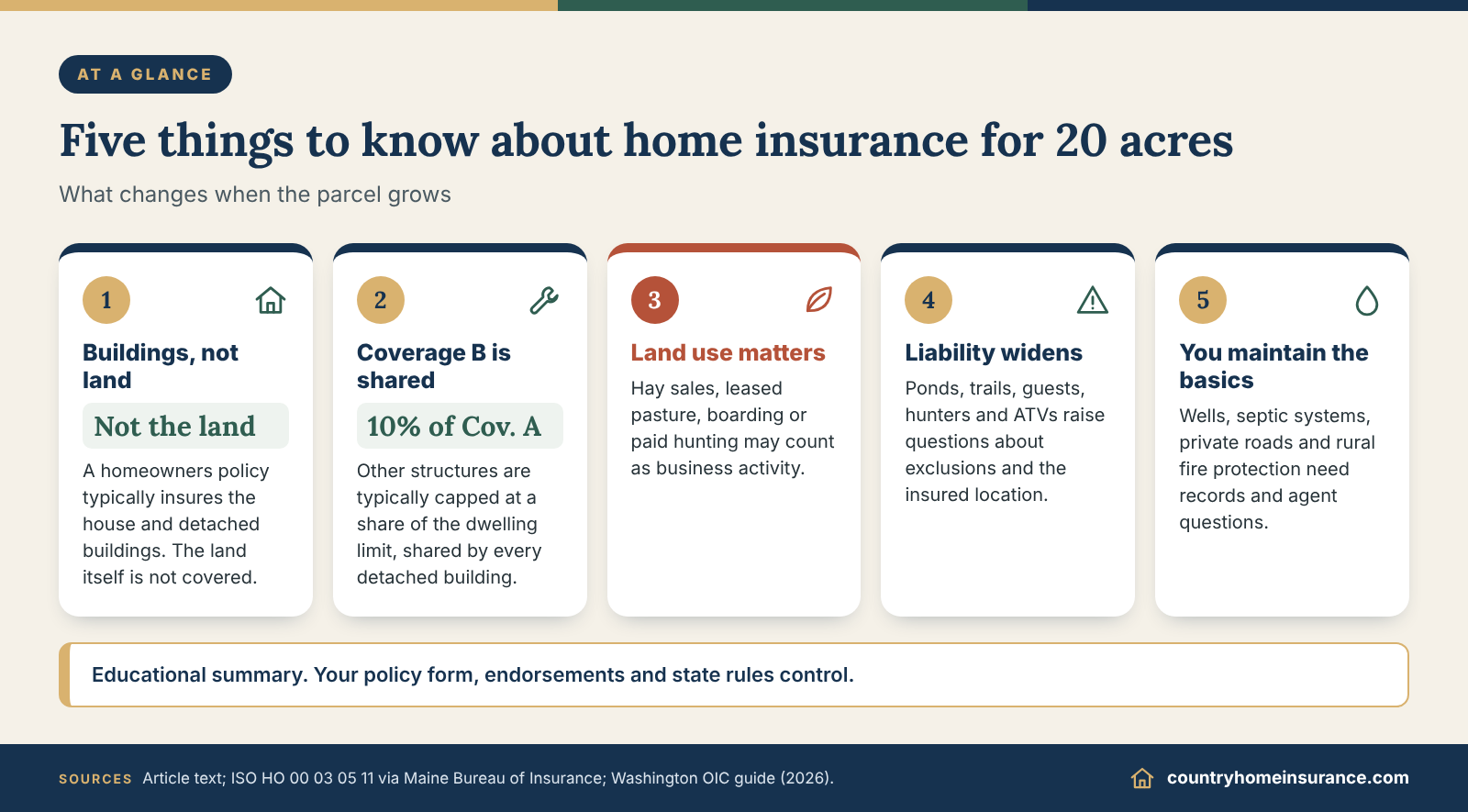
- A standard homeowners policy typically insures the dwelling and detached buildings, not the dirt. Acreage adds liability exposure and building value, not land coverage.
- Coverage B (other structures) is typically set at 10% of the dwelling limit. A few barns, a shop and a machine shed can exceed that quickly at 20 acres.
- Activity on the land matters more than the acre count: hay sales, leased pasture, boarding horses or paid hunting can push the property into business territory that homeowners forms exclude.
- Ponds, trails, guests, hunters and ATVs are the liability points to review, and the “insured location” wording decides where some vehicle coverage stops.
- Wells, septic systems, private roads and rural fire protection are your responsibility to document, and they influence both underwriting and claims.
How home insurance for 20 acres works: the house, the buildings and the liability
Twenty acres is a lot of ground to look after, and it is also the size at which many owners start asking whether a homeowners policy is still the right tool. The short answer is that the policy is the same product it was on a quarter acre. It was designed around a residence, and it stretches to cover rural life only so far. The sections below show where that stretch ends so you can decide what to fix before a loss, not after.
This guide focuses on what changes at roughly 20 acres. If you want the broader acreage basics, start with our general guide to country homes with acreage or the what standard policies miss in rural areas overview, and then come back here for the decisions that show up at this size.
The policy’s map of your property
Insurance policies draw a boundary around the property they cover. The wording of that boundary decides which buildings, which land and which accidents fall inside the policy. On a small lot the boundary is barely noticeable. On 20 acres it matters.
What “residence premises” and “insured location” mean
In the standard ISO Homeowners 3 (HO 00 03 05 11) form, published by the Insurance Services Office and available through the Maine Bureau of Insurance, the “residence premises” is the dwelling where you live plus the other structures and grounds at that location, as shown in the declarations page. The “insured location” is a broader term used for liability. It includes the residence premises and certain other places. Many insurers use their own versions of these forms, so your policy wording controls. Ask for the actual form number on your declarations page and read the definitions section.
Why the land itself is not insured property
Coverage B in that ISO form specifically excludes land, including the land under the other structures. Put plainly, the policy pays to repair or rebuild covered buildings, not to replace soil, pasture, timber or acreage value. If a flood scours a hayfield or a storm topples a stand of trees, the loss to the land and the trees generally depends on specific property provisions and exclusions, not on how many acres you own. Trees and plants are handled by a separate, limited provision. In the ISO form, trees, shrubs, plants and lawns are covered only for listed causes such as fire or lightning, explosion, vandalism and theft, up to 5% of the Coverage A limit and $500 for any one tree, shrub or plant, and windstorm is not on that list. Other forms differ, so ask your agent which causes of loss qualify.
What changes at about 20 acres
The ISO homeowners form has no acreage trigger at 20 acres, and how an insurer treats acreage is an underwriting decision that each company makes for itself. What does shift as parcels grow is the pile of practical issues that tend to appear together.
Why 20 acres is a practical tipping point
At 5 or 10 acres, most owners have the house, a garage and perhaps one outbuilding. At 20 acres, it becomes ordinary to have a pole barn, a shop, fenced pasture, a pond, miles of internal trails, a well and a septic system, and a neighbor who asks to cut hay or hunt. Each item is manageable alone. Together they raise the odds that something sits outside the standard form, and the land is large enough that you cannot watch all of it. Underwriters often ask about land use for the same reason.
How this guide differs from the 5-, 10- and 50-acre guides
Our 5+ acre guide and 10+ acre guide cover the early-stage questions: outbuildings, basic liability and eligibility. The 50+ acre guide moves toward working-land and operating-farm questions. This 20-acre guide sits in the middle, where the property is still a home first but the land use starts to look like something else. We concentrate on the insured location wording, land use, liability from trails and water, wells and septic, fire protection and the moment a farm policy makes sense.
| Item on a 20-acre property | Typical homeowners (HO-3 style) treatment | What to check |
|---|---|---|
| The house (Coverage A) | Typically covered for direct physical loss from non-excluded causes, up to the dwelling limit. | Replacement cost vs. actual cash value; rebuild cost for a remote site. |
| Detached garage, shed, workshop (Coverage B) | Typically covered, subject to a limit commonly set at 10% of the dwelling limit. | Whether all buildings together exceed the Coverage B limit. |
| Barn used for personal storage or a few animals | Depends on how the building is used and how the insurer treats it. | Any business or farm use; age, condition and roof type. |
| Barn or shop used for a business or commercial farming | Typically not covered under the standard other-structures coverage when business is conducted there. | Farm or commercial coverage for the building and its contents. |
| The land, pasture and timber | Typically not covered as land. Depends for trees and plants, which fall under limited additional-coverage terms that vary by form. | Whether your form covers trees and plants, for which causes and up to what limit. |
| Livestock and animals | Typically not covered; the standard form lists animals, birds and fish as property not covered. | Livestock endorsement or farm policy. |
| Tractors, ATVs, farm machinery | Typically not covered as personal property; motor vehicles are generally excluded with limited exceptions. | Separate equipment, off-road or farm policy. |
| Personal liability for guests and visitors | Typically covered for accidents tied to the insured location, subject to exclusions such as business activity and certain vehicles. | Liability limit, exclusions and the activities you allow. |
| Flood, surface water, pond overflow | Typically not covered under homeowners policies; flood is a separate policy. | NFIP or private flood; creek, pond and drainage exposure. |
| Well pump, pressure tank, septic system | Depends on the cause of loss and the form; wear and tear and underground water are commonly excluded. | Which parts are covered, under which coverage, and any endorsement. |
Coverage A and Coverage B: the house, the barn and everything between
Coverage A insures the dwelling. Coverage B, called other structures, insures detached buildings set apart from the house by clear space. Most acreage owners underestimate how much value sits in the second group, so the arithmetic below deserves a slow read.
Insuring the dwelling on a rural site
A rural house can cost more or less to rebuild than a similar suburban one, and the reasons are specific to the site.
Why rebuild cost on a remote parcel can differ
Rebuild estimates typically reflect local labor, materials and square footage. On a remote parcel, factors such as a long gravel drive, limited contractor availability and the need to bring in utilities may raise the practical cost of rebuilding, and the effect varies widely by region. Ask your insurer how the replacement cost estimate was built and whether it accounts for site access. Our guide on how much homeowners insurance you need walks through the estimating logic in more depth. Our guide to how square footage figures into rebuild cost explains which measurements count and how estimators use size.
Ordinance or law, wells and septic rules
Rebuilding after a large loss can trigger current building, septic and well-setback rules that did not apply when the house was built. The Washington Office of the Insurance Commissioner lists ordinance or law among the additional coverages in a homeowners policy, and notes that additional coverages may carry their own limits, limited perils or different deductibles. In the ISO HO 00 03 05 11 form, ordinance or law is an additional coverage of up to 10% of the Coverage A limit, on top of the dwelling limit, for the increased cost of complying with laws that regulate repairing, rebuilding or demolishing damaged parts of covered structures. Insurers can change that figure, so ask what percentage of Coverage A your ordinance or law coverage provides and whether septic and well upgrades are included in it.
Coverage B and the 10% problem
Coverage B is where acreage properties most often come up short. The standard form sets it as a percentage of the dwelling limit rather than as a standalone number.
How the typical 10% limit works
In the ISO HO 00 03 05 11 form, the Coverage B limit is 10% of Coverage A. The Washington OIC guide describes the same typical cap and warns that unusually large garages or several outbuildings may need extra coverage. That one number covers every detached structure on the parcel combined, so it is shared, not repeated per building.
Hypothetical example: Suppose a dwelling is insured at $400,000. A 10% Coverage B limit would be $40,000 for all other structures together. If the property has a $65,000 pole barn, a $35,000 shop and a $25,000 machine shed, the replacement value of those buildings is $125,000, which is well beyond $40,000. The figures are illustrative only and are not a quote, a recommendation or a promise of any payment.
Raising the limit instead of hoping
Options include increasing the Coverage B percentage by endorsement, scheduling a high-value building separately, or moving a barn to a farm-type policy that lists each building with its own limit. The Maine Bureau of Insurance notes that on a farmowners policy, detached garages and other structures may need their own listed limits, which is the mirror image of the percentage approach. Request a written quote for each option because insurers price them differently.
Barns, shops and rented or business buildings
The second layer of the Coverage B question is not how much, but whether a particular building is covered at all.
When a barn stops being “other structures”
The ISO form excludes other structures from which any business is conducted and other structures used to store business property. It also excludes structures rented or held for rental to someone who is not a tenant of the dwelling, unless used solely as a private garage. Travelers likewise says a homeowners policy does not protect farm or ranch operations. A barn that stores hay you sell, or a shop where you repair equipment for pay, can fall into those exclusions even if the building looks like a garage.
Guest cottages, hunting cabins and short-term rentals
A cabin on the back forty may be a family retreat, a rental or both. If you rent it to guests, the exclusion for rented structures may apply, and liability from that rental may also fall outside the policy. The standard form carves out occasional rental of a residence, but the rules differ by insurer. Ask in writing how your carrier treats any building that a guest sleeps in, with or without payment.
Fences, equipment and what is stored inside
Fences, gates and the contents of the barn sit in a gray zone that surprises people at claim time.
Fences, gates and pasture infrastructure
The Washington OIC guide lists fences among typical other structures, but at 20 acres a perimeter or cross-fence line may represent thousands of dollars of posts, wire and gates that all share the same Coverage B limit. The Maryland Insurance Administration notes that items a homeowners policy usually covers, such as fences and outbuildings, often are not covered by a farm policy unless you add an endorsement. Whichever way you go, ask how fences are valued and whether covered perils include wind, fire and falling trees.
Tools, tractors, hay, livestock and vehicles
Coverage C, personal property, lists animals, birds and fish as property not covered in the ISO form, and it generally excludes motor vehicles with exceptions. It also sets a special limit of $2,500 on business property on the residence premises. Travelers states that homeowners policies do not cover farm machinery, tools or irrigation equipment, livestock or harvested farm products. For a lawn tractor and a log splitter, a scheduled item or endorsement may be enough. For a compact tractor, baler or stock trailer, expect to talk about equipment coverage.
Underwriting, eligibility and what drives cost on 20 acres
Insurers decide whether to write a rural property, and at what price, based on a mix of land use, buildings and location. Specific rates vary by company and state, and so this article does not publish a premium figure. The reliable number for your property is a written quote based on your own buildings, land use and location.
What an underwriter may ask about the land
Expect a longer application than a subdivision home would need. The questions are usually about use, not size.
Land use: hay, grazing, crops and leases
Underwriters often ask who uses the land and whether any income is earned from it. Cutting your own hay for your own horses sits differently from selling bales or leasing pasture to a neighbor’s cattle. Answer accurately: the Maryland Insurance Administration warns that misstating information on an application can lead to a higher quote, a rejected application or cancellation.
Outbuildings: number, age, condition and use
Expect questions about each building’s construction, age, roof type, electrical service and what is stored inside. Older barns with wiring added over decades are a common concern. Photographs and a written list ahead of time speed the process and give you a record of condition before any loss.
The cost drivers that move at this size
A summary of the main factors appears in Table 2. The list mixes things you control with things you do not, which is why it is useful to compare several insurers rather than assume one answer is universal.
Protection class, distance and water supply
The Maryland guide lists county, distance to fire protection and water sources, coverage type and claims history as factors affecting premiums, and the Washington guide says insurers consider distance to the nearest fire department and hydrant and the department’s response time. The dedicated fire protection section below goes deeper.
Deductibles, coverage form and endorsements
A higher deductible can lower premium, and the Maryland guide suggests considering one if you rarely file small claims. On farm-type policies, the Maine Bureau of Insurance notes that each building and item generally has its own deductible, which changes how a multi-building loss feels. Endorsements add coverage but also raise premiums, according to the Maryland guide.
| Factor | Why it matters at about 20 acres | Source or basis |
|---|---|---|
| Coverage B limit | Depends on the policy; the standard form uses 10% of Coverage A, shared by all detached buildings combined. | ISO HO 00 03 05 11; Washington OIC guide (2026) |
| Personal liability limit | Depends on the policy; the Washington OIC says most policies include at least $100,000, with higher limits available, and suggests basing limits on total assets. | Washington OIC guide (2026) |
| Medical payments to others | Depends on the policy; commonly starts around $1,000 and does not apply to household residents. | Washington OIC guide (2026); ISO form |
| Damage to property of others | The ISO form pays up to $1,000 per occurrence at replacement cost under additional coverages. | ISO HO 00 03 05 11 |
| Business property on premises | The ISO form sets a special limit of $2,500 for business property on the residence premises. | ISO HO 00 03 05 11 |
| Distance to fire station and water | Properties beyond five road miles of a station are generally Class 10 (with a 10W exception near water within seven miles), and water within 1,000 feet affects the split class. | Texas State Fire Marshal presentation (2023); Verisk |
| Land use and income | Depends on the insurer; hay sales, leased pasture, boarding or paid hunting can move a risk toward farm or commercial forms. | ISO business definition; Maryland Insurance Administration (2022) |
| Deductible structure | Depends on the form; farm-type policies may apply a deductible per building or item. | Maine Bureau of Insurance farm guide |
| Claims history and application accuracy | Depends on the insurer; misstatements may lead to higher quotes, rejection or cancellation. | Maryland Insurance Administration (2022) |
Liability on 20 acres: trails, ponds, guests, hunters and ATVs
Personal liability is usually the most valuable part of a rural policy and the part most likely to be stretched by land use. More acres mean more places for someone to get hurt, and fewer places where you can see them do it.
How the liability coverages work
Two coverages sit in Section II of the standard form, and their limits are the starting point for every question below.
Coverage E and Coverage F in plain terms
Coverage E, personal liability, pays for bodily injury or property damage to others when you are legally responsible, and it includes a duty to defend certain suits. Coverage F, medical payments to others, pays necessary medical expenses for people hurt on the insured location, generally within three years of the accident, regardless of fault. It does not apply to you or regular residents of your household. The Washington OIC guide notes that most policies include at least $100,000 of liability and that medical payments usually start at $1,000. The ISO form also pays for first aid and up to $1,000 per occurrence for damage to others’ property under additional coverages.
Why large acreage widens the reach
On a small lot, a guest is almost always in sight. On 20 acres, a visitor may be on a trail, near a creek or inside a barn with no one around. Liability coverage depends on the cause, the location and the exclusions, not on whether you knew about the hazard. The Washington OIC guide also notes that personal liability can follow you off the property unless excluded, which is helpful if a horse gets loose or a tree you own falls across a neighbor’s driveway, but exclusions still apply.
Ponds, trails and other hazards
Some features of rural land attract people, particularly children, and the law treats owners differently depending on who was on the land and why.
Ponds, ditches and the attractive nuisance idea
An attractive nuisance is a hazardous feature that can draw people in and injure them. A Nationwide article published through Ag Alert (California Farm Bureau, 2023) lists ponds, sharp changes in elevation and equipment storage as examples, and notes that liability rules differ depending on whether the person was invited or trespassed. It advises visible signs, a hazard review with an agent or risk specialist and a conversation with an attorney because the laws are often unclear. It also says standard homeowner policies often do not account for farm-related attractive nuisance exposures. This article cannot say how a particular court or insurer would treat a given pond, so treat these as questions for your agent.
Trails, bridges, culverts and gates
Internal trails and stream crossings are common on 20-acre properties, and they are where informal use grows over time: a neighbor’s teenager rides a dirt bike, a friend crosses on foot or a contractor drives across a bridge you built. Walk the property with the question “what would I do if someone were hurt here?” Note low-clearance gates, unmarked drop-offs and failing bridge planks. Fix or sign what you can, and tell your agent about anything unusual because an insurer may treat a long bridge or a swimming hole differently from an ordinary yard.
Hunters, guests and recreational use
Permission to use your land turns strangers into invitees or licensees, and the rules vary by state.
Recreational use statutes and what they do and do not do
The National Agricultural Law Center reports that all 50 states have laws giving landowners some degree of liability protection when the public uses land for recreation, with each state’s text compiled on its site (updated September 2022). A 2016 article by Tiffany Lashmet of Texas A&M AgriLife Extension notes that definitions of recreational purpose vary but commonly include hunting, fishing, hiking and other outdoor activities, that statutes may include requirements about charging a fee or carrying a certain level of liability insurance, and that protection has exceptions, such as gross negligence or intentional acts in Texas. Statutes differ from state to state and are amended over time, so read your state’s current version through the National Agricultural Law Center compilation or ask an attorney.
Hunting leases, paid access and friends who hunt
Letting a friend hunt for free is a different legal and insurance setup from leasing hunting rights. A fee may alter statutory protection depending on the state, and it may also bring the activity closer to the business definition in a homeowners policy, which in the ISO form includes activities engaged in for money or compensation. Ask your agent before signing any lease, and ask whether the carrier requires a separate policy, an endorsement or written releases from lessees. Whether a release would hold up is a legal question this article cannot answer.
ATVs, UTVs and where the insured location ends
Off-road vehicles are among the most common sources of rural injury claims, and the policy text controls them closely.
What homeowners policies typically say about off-road vehicles
State Farm states that most homeowners policies exclude motor vehicles and that an off-road policy is needed even for accidents on your own property. The ISO form’s liability exclusion for motor vehicles has exceptions: for recreational off-road vehicles that are not required to be registered, liability coverage can apply when the vehicle is not owned by an insured, or when an insured owns it and the accident happens on an insured location. Individual insurers often modify those exceptions, which is one reason State Farm’s advice and the ISO text can point in different directions. Treat the wording in your own policy as the answer, and confirm by phone or in writing before you let a guest ride a vehicle you own.
Why the boundary matters: a court example
In Farm Bureau Property & Casualty Insurance Co. v. Cleaver (No. 22-4118, decided December 20, 2023), the U.S. Court of Appeals for the Tenth Circuit upheld an insurer’s denial under a homeowners exclusion for recreational motor vehicles that are not on an insured location. A 15-year-old was injured when an ATV overturned on a county-owned unpaved road that connected the family’s home to a gravel pit, and the court held that the public road was not part of the insured location. The decision applied Utah law to that policy’s wording and is unpublished, so it is an illustration, not a rule for every state. The practical point: if your trails cross a neighboring parcel, an easement or a public road, an ATV accident there may fall outside the insured location even though the ride started at home.
Raising liability limits as the property grows
Limits that suited a suburban lot may not fit a property with a pond, a rental cabin and hunters.
When an umbrella policy enters the conversation
The Washington OIC guide suggests setting liability limits based on total assets. The NAIC lists umbrella liability among the optional add-ons to a homeowners policy. Umbrella policies add liability limits above the underlying policy and may have their own conditions on rural activity, so ask whether your carrier requires specific underlying limits and whether farm activities are included. Our country estate insurance guide covers the high-value end of this question.
Documenting what you allow and what you don’t
Keep a simple written record: which activities you permit, who has permission, what signs are posted and what you have repaired. If an insurer or a court later asks what you knew and what you did, that record shows reasonable care. A record is not a coverage guarantee, but it supports a prompt, accurate conversation if there is a claim.
Farming and business exposures outside homeowners policies
Many 20-acre owners do not think of themselves as farmers. They keep a few horses, cut hay or let a neighbor graze steers. Insurers do not decide by self-image. They look at activity, income and the policy definitions, and the gap between the two surprises people at claim time.
Where hobby ends and business begins
There is no single bright line, and different tests apply in insurance, tax and agricultural statistics. Keep them separate.
The policy’s definition of “business”
The ISO HO 00 03 05 11 form defines business as a trade, profession or occupation engaged in full time, part time or occasionally, or any other activity engaged in for money or compensation, with exceptions that include activities where no insured receives more than $2,000 in total compensation over the prior 12 months. The liability exclusion for business applies to bodily injury or property damage arising from a business conducted from an insured location or engaged in by an insured. Your insurer’s form may use different thresholds, so ask what yours says. Do not assume a small income is automatically harmless.
The USDA farm definition is not an insurance test
The USDA Economic Research Service defines a farm as any place that produced and sold, or normally would have sold, at least $1,000 of agricultural products in a year. That is a statistical definition and says nothing about your insurance policy. It is useful for one reason: it shows how low the bar for “farm” can be in the federal data, which is why insurers ask about land use rather than relying on acreage. The ERS also separates residence farms, where the operator’s main occupation is not farming and gross cash farm income is under $350,000, from other categories, which is a reminder that many 20-acre properties are lifestyle properties.
Common 20-acre activities and where they land
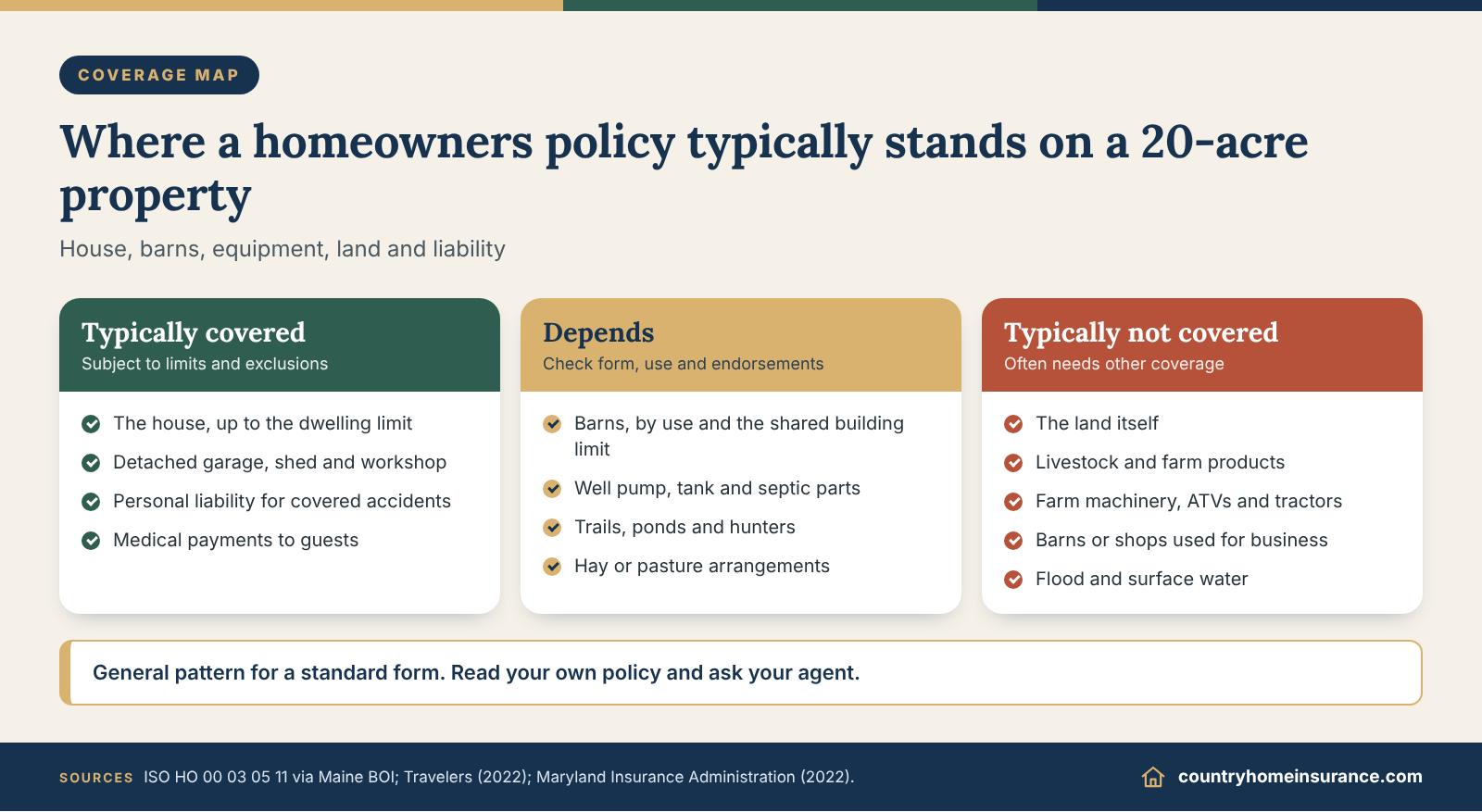
Table 3 below sorts typical activities into covered, depends and not covered buckets for a standard homeowners policy. Use it to prepare questions, not to predict a claim result.
Hay, pasture leases, livestock and boarding
Cutting hay for your own animals is generally a personal activity. Selling hay, leasing pasture or boarding someone else’s horses is income-producing activity that may invoke the business exclusions for liability and for the barn. Livestock themselves are not covered property under the standard personal property coverage. Travelers notes that a small enterprise on rural property, such as raising livestock, boarding horses or cutting hay, is a situation where homeowners coverage may not be enough.
Farm stands, events and agritourism
The Maryland Insurance Administration says hayrides, petting zoos, corn mazes, pick-your-own operations and farm stands bring new liability risks and that these activities may need a business policy rather than a farmowners policy. If you sell jams, pies or produce, it suggests considering product liability coverage. A single pumpkin weekend or a wedding in the barn can be treated as a commercial event by an insurer, so ask before the first booking, not after.
Equipment, trailers and contractors on your land
Farm equipment is generally outside homeowners coverage, as noted above. Contractors and hired help create another layer: a residence employee in the ISO form is one whose duties relate to maintaining or using the residence premises, and temporary substitutes are not included. Workers’ compensation rules for farm labor vary by state, and the Maryland guide mentions workers’ compensation if you have employees. Ask your agent and your state’s labor or insurance department which rules apply to you.
| Activity or item | Homeowners treatment | Next step |
|---|---|---|
| Mowing and baling hay for your own animals | Depends on the insurer’s view of land use and any income; liability for personal activity is typically within the policy. | Disclose accurately on the application. |
| Selling hay or leasing pasture | Depends, and may be treated as business activity under the form’s business definition. | Ask about a farm policy or endorsement before the first sale or lease. |
| Boarding horses or taking in cattle | Typically not covered for liability tied to the business, and animals are not covered property. | Ask about farm or equine liability. |
| Farm stand, u-pick or events | Typically not covered when operated as a business; the Maryland guide says some may need a business policy. | Ask about commercial liability and product liability. |
| Friends or family hunting for free | Depends on the policy, the state’s recreational use statute and the activities involved. | Ask about guests, firearms and written permission rules. |
| Leasing hunting rights | Depends, and a fee may be treated as business activity and may affect statutory protection in some states. | Ask before signing a lease; consider an attorney. |
| ATVs and UTVs you own | Typically not covered under most homeowners policies; some policies carve out limited exceptions. | Ask about a separate off-road policy. |
| Compact tractor and attachments | Typically not covered as farm machinery under a homeowners policy. | Ask about an equipment endorsement or farm policy. |
Private wells, septic systems and private roads
Out in the country, you are often your own utility company. The well, the septic system and the road to the house are yours to maintain, and each one creates questions for insurance that a city homeowner never has to ask.
Wells and water supply
The well is easy to forget until the water stops, and a policy may respond differently to a failed pump than to a storm-damaged wellhouse.
Who is responsible for private well water
The EPA states that owners of private wells are responsible for making sure their household drinking water is safe, that private domestic well water is not regulated under the Safe Drinking Water Act and that most state governments do not regulate it either. It reports that about 15 percent of the U.S. population relies on private wells (EPA page updated August 2026). That puts maintenance, testing and records in your hands, and no insurance policy replaces them.
What a homeowners policy may do about the pump, tank and wellhouse
The ISO HO 00 03 05 11 form does not mention wells or well pumps by name. A wellhouse may qualify as an other structure. A pump or pressure tank that fails from age or wear is typically a wear-and-tear or mechanical breakdown issue, which the ISO form lists as excluded, while damage from a covered cause such as fire or a falling tree is a different story. Ask your agent which well components are covered, under which coverage, and whether an equipment breakdown or service line endorsement is available.
Septic systems and sewer backup
A septic failure is expensive and often gradual, which is exactly the kind of loss policies treat cautiously.
Maintenance expectations and why they matter to claims
The EPA says a typical household septic system should be inspected about every three years, tanks usually need pumping every three to five years, and systems with pumps or float switches need annual inspection (EPA, updated August 2026). It also advises keeping vehicles and heavy equipment off the drainfield. The ISO form excludes wear and tear, deterioration, freezing without reasonable care and certain water sources, so records showing maintenance can help in any conversation with an insurer about what caused a loss.
Backup, drainfield failure and endorsements
The ISO form excludes water that backs up through sewers or drains and water below the surface of the ground. Many insurers offer a water or sewer backup endorsement for a fee, but the NAIC lists sewer backup as an optional add-on, and the actual terms depend on the insurer. The ISO form mentions septic tanks only in its collapse provision, which says damage to septic tanks, cesspools and underground pipes is not covered by the listed collapse causes unless it directly results from the collapse of a building. Whether a failed tank or drainfield is covered at all is highly policy-specific, so ask for the answer in writing. Read our guide on sewer backup coverage for the claim mechanics and ask your agent about septic specifically.
Private roads, driveways and easements
A long driveway or shared lane is part of the property, and it is also a place where liability and access questions collect.
Long drives, bridges and culverts
Whether a driveway, culvert or bridge is a covered other structure depends on the form and the wording. Land and paving are treated differently from structures, and washouts from heavy rain are typically a surface water or flood issue under the standard exclusions. Photograph culverts and bridges and note their condition, and ask your agent whether any of them fall under Coverage B or any additional coverage.
Easements, shared lanes and emergency access
If neighbors use your lane or you use theirs, ask whether a written maintenance agreement exists and whether your liability policy covers accidents on that stretch. Access also matters in emergencies. The Maryland guide lists distance to fire protection and water sources among premium factors, and a narrow, gated or washboard drive can slow a response. Clear overhead branches, post a visible address number and confirm gate access with your fire department.
Water, fire and wind on open land
More land also means more weather. The causes of loss that matter most on large parcels are often the ones the standard form treats with the most conditions.
Surface water, ponds and drainage
Water is the biggest gap in a standard policy, and acreage makes it more likely than usual that you are near a creek, pond or ditch.
Flood and surface water exclusions
The ISO form excludes flood, surface water, waves and tidal water, water that backs up through sewers or drains, and water below the surface of the ground. The NAIC says separate policies for flood or earthquake may be purchased by those in prone areas, and the Washington OIC says a standard homeowners policy does not cover flooding and that you need separate flood insurance such as through the NFIP. Our guide on flood damage and homeowners insurance explains the program, and your county floodplain map is a good starting point.
Pond dams, culverts and erosion
A failing pond dam or an eroded culvert is a maintenance and liability issue before it is a coverage issue. The ISO form excludes loss from faulty planning, design, materials or maintenance, and from wear, deterioration and settling. If a pond is above a neighbor, ask an attorney or your agent what exposure that creates and whether the policy contemplates it.
Wildfire, brush and burn piles
On open land, vegetation and fuel loads are part of the underwriting picture, and fires that start on your land can spread far.
Vegetation, defensible space and underwriting
Insurers in fire-prone regions may ask about vegetation near structures, roof material and access. Defensible-space rules and insurer practices differ by state and by company, so check your state insurance department and local fire authority for the requirements that apply to your address. Our guide on wildfire nonrenewal risk covers the hardening documentation insurers may ask for, and the NFPA Firewise USA program teaches residents how to live with wildfire risk and encourages neighbors to act together.
Burning, equipment and liability for fire spread
Burn piles, field burning, hot equipment in dry grass and fireworks are classic ways a fire starts on your land and spreads to someone else’s. Liability coverage may respond to a fire you accidentally cause, but exclusions, local burn rules and negligence standards vary. Check local burn permits, and ask your agent how a fire that crosses a property line would be treated.
Wind, hail and trees
Large parcels typically include windbreaks, woodlots and aging trees that can damage buildings.
Falling trees and who pays
Falling trees that damage covered buildings are generally handled under wind or other covered perils, subject to the deductible. For removal, the ISO form’s debris removal coverage pays up to $1,000 per loss, and no more than $500 per tree, for your trees felled by windstorm, hail or the weight of ice, snow or sleet. It applies when the tree damages a covered structure or blocks the driveway or a wheelchair ramp, so a tree that falls in the woods without touching a building or the drive is generally yours to clear. Photograph trees near buildings, drives and power lines before a storm.
Metal roofs, wind and hail deductibles on outbuildings
The Maryland Insurance Administration explains that some policies carry a special deductible for wind, hail or other storm losses, and that a percentage deductible is calculated from the dwelling coverage amount: 2% of a $100,000 dwelling limit is $2,000. Large barn roofs are exposed to wind and hail. Ask whether a percentage deductible applies to Coverage B losses and whether cosmetic roof damage is excluded on metal roofing, and get both answers in writing.
Rural fire protection, protection class and volunteer departments
Fire protection is the underwriting factor that rural owners can influence least and understand least, and it is the one that most clearly separates a subdivision from a country road.
How insurers measure fire protection
Most insurers in the United States use some version of the Insurance Services Office public protection classification, called PPC.
What the PPC rating is
A Texas State Fire Marshal’s Office presentation on PPC oversight (March 2023) describes the rating as one assigned by ISO, a Verisk company, based on a community’s ability to suppress first-alarm structure fires, on a scale from 1 to 10, produced through ISO’s Fire Suppression Rating Schedule. The scoring there weights fire departments at 50 points, water supply at 40, emergency communications at 10 and community risk reduction at 5.5. That is Texas oversight material, but it describes ISO’s general method.
Five road miles, 1,000 feet and split classes
The same presentation states that properties beyond five road miles of a fire station are generally Class 10, and that properties within five miles are measured differently depending on whether they are within 1,000 feet of a creditable water supply. Rural properties may receive split classifications and suffixes such as X, Y or W. Verisk, which runs the ISO PPC program, explains that X replaced the old Class 9 in the second part of a split class (more than 1,000 feet from creditable water), Y replaced the old Class 8B in that position, and 10W applies to properties more than five but less than seven road miles from a station with creditable water within 1,000 feet. Verisk’s announcement said insurers could choose whether to adopt these classes and that they were not filed in a handful of states, so ask your agent which class your address carries. Hauled water can count as a creditable water supply.
Volunteer departments and what you can do
Most rural land is served by volunteer or combination departments, and they are not all equal for ratings.
How volunteer departments figure into the picture
The Texas presentation does not describe volunteer departments as a category, but it does say training credit is available for attending a fire school or having certified volunteers. A volunteer department can earn a better class when it has equipment, trained members, water supply and mutual aid. Two properties served by the same department can carry different classes, depending on how far each sits from the station and from a creditable water supply. Call your department and ask for its latest rating survey.
Water sources, updated surveys and shopping around
The presentation states that PPC scores do not automatically change premiums, that homeowners insurers use them at their own discretion alongside other underwriting factors, and that insurers may still act on older scores, so it recommends updated surveys. It also advises homeowners to compare multiple insurers at renewal. If a pond or cistern could serve as a water source for firefighters, ask your fire chief what the department needs.
When to consider a farm, ranch or farmowners policy
At some point the question changes from “does my homeowners policy stretch?” to “is this the wrong kind of policy?” Neither answer is automatic at 20 acres. The decision depends on what you do on the land, not how much of it you own.
What farm-style policies add
Farm-type policies are built for property where agricultural activity is part of the picture. They are not a bigger version of a homeowners policy.
The farmowners package
The Maine Bureau of Insurance describes a farmowners policy as a specialized package that includes coverage for both farm operations and the residence premises, generally written on a special (all-risk) form. It says you may need to set the household contents limit yourself and list detached garages and other structures separately, and that farm schedules cover livestock, machinery, products, supplies and tools. The Maryland guide adds that farmowners policies typically include liability, medical payments, additional living expenses and optional endorsements for livestock, equipment and replacement cost.
Farm liability and equipment
Travelers states that farm and ranch policies add farm premises liability, farm product liability, equine liability and chemical drift liability, and that they cover machinery, livestock, harvested products, fences and corrals that homeowners policies do not. Coverage and eligibility vary by carrier, and some activities, such as agritourism, may require a business policy instead, according to the Maryland guide.
Trade-offs and signs it is time
A farm policy is not automatically better. It is a different arrangement with different strengths.
What a farm policy may do differently
The Maryland guide notes that items a homeowners policy usually covers, such as fences, outbuildings and swimming pools, often are not covered by a farm policy unless you add an endorsement. The Maine guide says each building and item generally has its own deductible, that coinsurance (a minimum amount of insurance you must carry, usually 80% but sometimes 100%) may apply, and gives an example where insuring only part of your property value produced a 50% payment. Those mechanics reward careful valuation and punish guesswork. Not every insurer writes every farm, so a decline from one company does not mean all will decline.
Signs a farm-type policy may fit
Consider the conversation if you earn income from hay, livestock, boarding, produce or leased land, own farm equipment, have employees, hold events or let paying guests on the property, or have several buildings whose value exceeds the Coverage B limit. Travelers lists farm or ranch property beyond the house and small enterprises on rural property among the situations where homeowners coverage may not be enough. Our hobby farm insurance and small farm insurance compared with homeowners insurance guides compare the two approaches in depth.
Combining policies instead of switching
The answer is not always one policy or the other. Many owners keep a homeowners policy on the house and add a separate farm policy or endorsements for the rest.
Homeowners plus endorsements
If the activity is small, a homeowners policy with a farm-related endorsement, an increased Coverage B limit and an umbrella may be enough, and it is usually simpler. Ask for the endorsement wording in writing and read the exclusions at the same time, because an endorsement can both add and restrict coverage.
A split between house and operation
Where income is real, a split is common: a homeowners policy on the dwelling and household contents, and a separate farm or commercial policy for the buildings, equipment and liability tied to the operation. The risk of a split is a gap or an overlap, so ask both insurers to confirm in writing which one responds to a loss in a building that serves both purposes.
Three 20-acre scenarios, walked through
These hypothetical profiles show how the ideas above combine. They are teaching tools, not predictions, and every real outcome depends on the policy, the facts and state law.
Three property profiles
Each profile starts with how the owner uses the land and then lists the questions worth asking.
Weekend house on wooded acreage with trails
Hypothetical example: A couple owns a cabin-style home on 22 wooded acres with a detached garage, a small shed and a network of ATV trails shared with friends. The main questions are liability related: who rides, what vehicles they own, whether the trails leave the property, and how the policy treats guests on motorized vehicles. The Cleaver case above shows why the insured location wording matters. The owners might ask about an off-road policy, a higher liability limit and signage.
Retiree with hay leased to a neighbor
Hypothetical example: A retired owner has a ranch-style home, a pole barn and 25 acres of grass. A neighbor cuts and sells the hay under an informal arrangement and pays a small fee. The barn might be used to store the neighbor’s baler. The questions are about the business definition, the barn’s contents and who is responsible if the neighbor is hurt. The owner should ask the insurer in writing whether the lease changes the policy, and whether the farm-related income affects eligibility.
Family with horses, a pond and a rental cabin
Hypothetical example: A family keeps three horses on 20 acres with a barn, a pond and a small cabin rented through a short-term platform. Animals are not covered property, the cabin may be a rented structure and the pond is an attractive nuisance question. This property is likely to need farm or equine coverage, a conversation about rental liability, a higher umbrella limit and a documented safety plan. A single homeowners policy would likely leave several gaps.
How to use the profiles
The profiles are a way of finding your own pressure points.
Match your activities to the questions
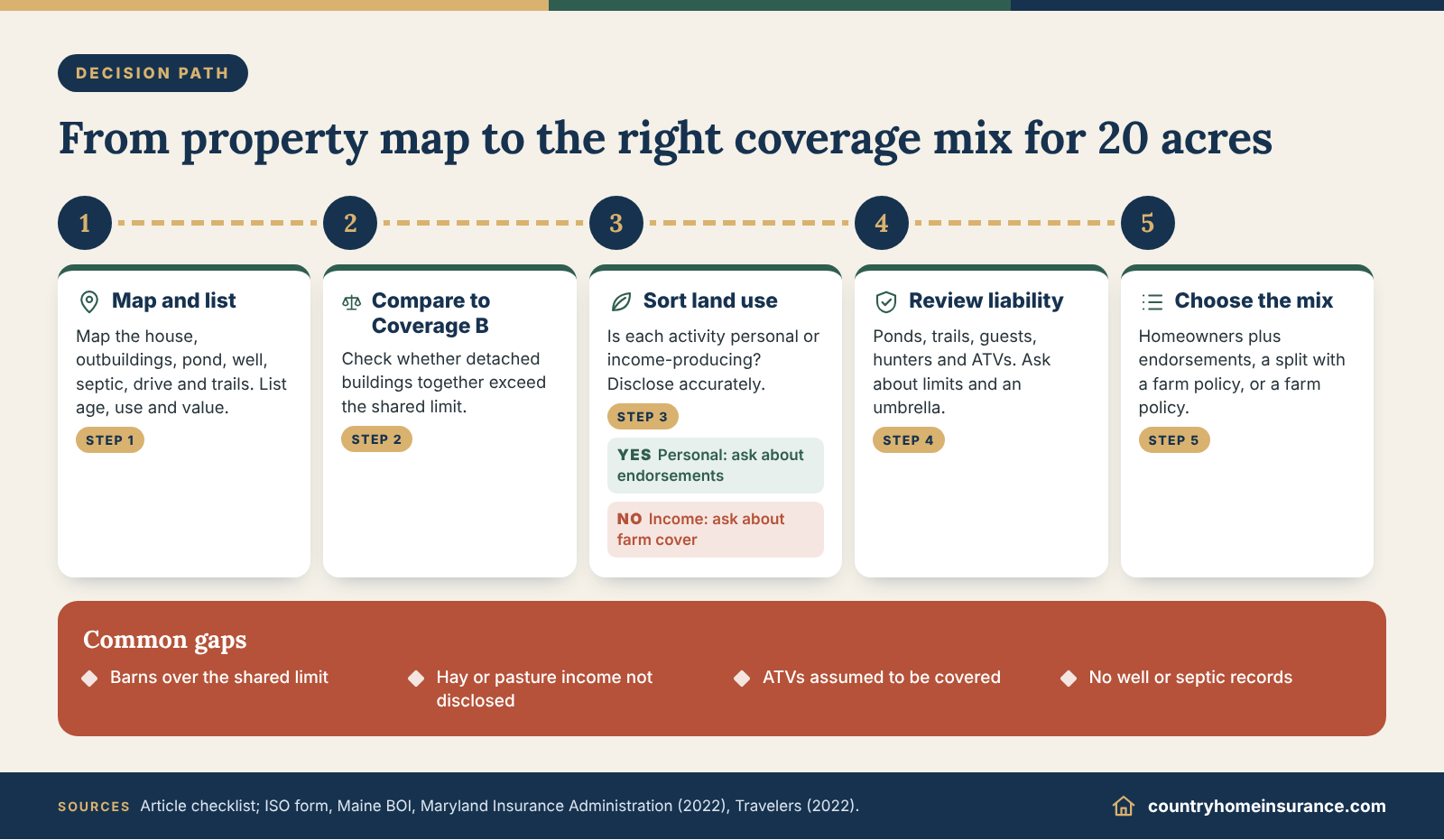
Write down every regular activity on your land, every building and every person who comes onto it. For each, ask: is it personal or income-producing, is it inside the insured location, and who is responsible if something goes wrong? The ones where you cannot answer quickly are the ones to take to your agent.
Where figures and limits come from
Any dollar amounts in the hypothetical examples are illustrative. The limits quoted from policy forms and regulator guides, such as the 10% Coverage B figure and the $1,000 damage to property of others coverage, come from the sources listed at the end of this article and may differ in your policy.
Before you buy or renew: a 20-acre checklist
The most practical use of this guide is a short list of actions. Table 4 puts the checks in one place, and the sections below explain how to gather what you need.
Documents and records to gather
A complete record helps you get accurate quotes, speeds up applications and supports a claim.
A property map and building inventory
Draw or print an aerial map that shows the house, every outbuilding, the pond, the well, the septic tank and drainfield, the driveway, gates and any trails that cross neighboring land. List each building with approximate size, age, roof type, use and replacement value. This single document answers many underwriting and claim questions.
Photos, receipts and maintenance logs
Take dated photos of each building, the well and septic access points, fences, culverts and bridges. Keep septic pumping receipts, well test results and equipment purchase records. The EPA recommends keeping written records of septic inspections and repairs, and the same habit pays off for everything else.
Questions to ask your agent or insurer
Use these as written questions and ask for written answers, since coverage depends on policy language, not conversation.
Policy-form questions
Ask which form number you hold, how Coverage B is calculated, whether other structures are valued at replacement cost or actual cash value, how ordinance or law coverage applies, whether the residence premises includes all your parcels, and which wells, septic and road items are covered or excluded. Our rural home insurance overview offers a longer list for general rural issues.
Liability and activity questions
Ask how the policy treats hunters, ATVs, rentals, hay leases, boarding, events and employees, what the liability and medical payments limits are, and whether an umbrella policy is available. Ask which activities you must disclose, and what a nonrenewal or cancellation notice would look like. State rules on cancellation and nonrenewal vary, so contact your state department of insurance for specifics.
| Area | What to verify or document | What to ask the insurer |
|---|---|---|
| Dwelling | Replacement cost estimate and how it was built. | Does the estimate account for site access and rebuild requirements? |
| Outbuildings | List each building, size, age, use and replacement value. | Is the total above the Coverage B limit, and can it be raised or scheduled? |
| Land use | Write down hay, grazing, leases, boarding, stands and events. | Does any activity count as business under the policy form? |
| Liability | Note ponds, trails, bridges, gates, guests and hunters. | What are the liability and medical payments limits, and is an umbrella advisable? |
| Vehicles and equipment | Record ATVs, UTVs, tractors and trailers with values. | Which are excluded, and what separate policy or endorsement is needed? |
| Well and septic | Keep test results, inspection and pumping records. | Which components are covered, and is a backup or equipment endorsement available? |
| Roads and access | Photograph culverts and bridges; keep any maintenance agreement. | Are drives and bridges covered, and what happens with shared lanes? |
| Fire protection | Find your PPC class, nearest station and any water sources. | Which class does the insurer use, and has it been updated? |
| Water and weather | Check flood maps, tree locations and roof condition. | Is flood coverage separate, and what are the wind or hail deductibles? |
Frequently asked questions
Coverage and eligibility
Will a standard homeowners policy cover a house on 20 acres?
Many insurers will write a homeowners policy for a house on 20 acres, but acreage limits and land-use questions are underwriting decisions that differ by company. Ask directly, and expect to disclose how the land is used.
Does my policy cover the land itself?
Typically not. The ISO other structures coverage excludes land, including the land under buildings. Policies pay to repair or replace covered structures, with limited provisions for trees and plants that vary by form.
Are barns and outbuildings covered?
Often, up to the Coverage B limit, which the standard form sets at 10% of the dwelling limit. Buildings used for business or rented to others are typically excluded, so how you use the barn matters as much as its value.
Liability and activities
What if someone gets hurt on a trail or at the pond?
Personal liability coverage may respond, depending on the facts, state law and policy exclusions. Recreational use statutes in every state give landowners some protection in some circumstances. Report any incident to your insurer promptly and do not assume either outcome.
Does homeowners insurance cover ATV accidents on my land?
Often not. State Farm says most homeowners policies exclude motor vehicles, and a court decision shows that coverage can depend on whether the accident happened on the insured location. Ask your insurer about an off-road policy.
Can I let friends hunt on my land?
Letting people hunt may be allowed under state recreational use law and may raise insurance questions. Charging a fee may change both legal protection and policy treatment, depending on the state and the policy. Check with your agent and your state’s statute before granting access.
Farm policies, wells and fire protection
When do I need a farm policy instead of homeowners?
When you earn income from the land, keep livestock or farm equipment, hire help, host paying visitors or have buildings that exceed Coverage B. A split between homeowners and farm coverage is also common.
Is my well or septic system covered?
It depends. The standard form does not mention wells, wear and tear is excluded and underground water is excluded. A wellhouse or damage from a covered cause such as fire may be handled differently. Ask about specific endorsements.
How does a volunteer fire department affect my rate?
Protection class is based on the fire department, water supply and communications, and insurers use it at their discretion. A volunteer department is not automatically a worse rating, but distance to a station and water supply are important. Ask your insurer for your class and your fire department for its latest survey.
Sources
- Insurance Services Office, hosted by Maine Bureau of Insurance — Homeowners 3 Special Form (HO 00 03 05 11) (edition 05 11, copyright 2010; accessed 2026-10-16)
- Maine Bureau of Insurance — Insuring Your Farm consumer guide (undated; accessed 2026-10-16)
- Maryland Insurance Administration — Consumer Guide to Farm Insurance (MIA-FI-1, January 2022; accessed 2026-10-16)
- Washington Office of the Insurance Commissioner — Homeowner Insurance consumer guide (revised March 2026; accessed 2026-10-16)
- National Association of Insurance Commissioners — Homeowners Insurance topic page (updated 2025-10-25; accessed 2026-10-16)
- Texas Department of Insurance, State Fire Marshal’s Office — Public Protection Classification Oversight presentation (2023-03-23; accessed 2026-10-16)
- Travelers — Farm and Ranch Insurance vs. Homeowners Insurance (2022-12-22; accessed 2026-10-16)
- Verisk — New PPC fire protection classes to benefit insurers and communities (announcement of changes effective July 1, 2014; accessed 2026-10-16)
- Verisk — PPC improvement brochure (undated; accessed 2026-10-16)
- Maryland Insurance Administration — Roof Replacement Insurance Advisory (2019; accessed 2026-10-16)
- USDA Economic Research Service — Farm Household Well-being glossary (updated 2026-05-15; accessed 2026-10-16)
- National Agricultural Law Center — States’ Recreational Use Statutes (updated 2022-09-07; accessed 2026-10-16)
- AgProud (Tiffany Lashmet, Texas A&M AgriLife Extension) — Know the landowner liability statutes for your state (2016-09-23; accessed 2026-10-16)
- Ag Alert, California Farm Bureau (content from Nationwide) — Attractive farm nuisances can create liability concerns (2023-03-22; accessed 2026-10-16)
- U.S. Court of Appeals for the Tenth Circuit — Farm Bureau Property & Casualty Insurance Co. v. Cleaver, No. 22-4118, order and judgment (2023-12-20; text hosted by Washburn University School of Law; accessed 2026-10-16)
- State Farm — Off-road vehicles insurance (undated; accessed 2026-10-16)
- U.S. Environmental Protection Agency — Private Drinking Water Wells (updated 2026-08-25; accessed 2026-10-16)
- U.S. Environmental Protection Agency — How to Care for Your Septic System (updated 2026-08-17; accessed 2026-10-16)
- National Fire Protection Association — Firewise USA (accessed 2026-10-16)
Important coverage note
Coverage depends on the actual policy, endorsements, exclusions, limits, deductible and cause of loss. Policy forms differ by insurer and state, state laws and programs vary, and the form language quoted here is from a standard ISO edition that your insurer may have modified. This article is educational, not legal advice. Verify case-specific questions with your insurer or agent, your state Department of Insurance and, where liability or land-use agreements are involved, a licensed attorney.
About the editorial team
This guide was prepared by the countryhomeinsurance.com editorial team as general, educational information for homeowners. We research and summarize publicly available material, including state insurance departments, the NAIC, federal agencies, regulators’ consumer guides and published insurer and industry resources. We draw only on the sources that were available to us when we wrote this guide, and we list them in the Sources section with dates where we could find them.
Insurance rules, rates, products and program terms change, differ by state and by insurer, and can apply differently to your situation. We cannot guarantee that this content is complete, current or free of errors. It is not legal, financial, tax or insurance advice, it is not an offer to sell insurance or a recommendation of any insurer, agent or product, and reading it does not create a professional relationship of any kind.
To the fullest extent permitted by law, countryhomeinsurance.com and its editorial team, authors and contributors exclude all liability for any loss, damage or decision arising from the use of, or reliance on, this content. For questions about your own policy or claim, contact your insurer, a licensed agent or broker, your state Department of Insurance or another qualified professional.
Content created: October 16, 2026