
Quick answer
Does homeowners insurance cover flood damage? Typically no. A standard homeowners policy generally excludes flood, so damage from rising water, overflowing creeks or surface-water runoff usually needs a separate flood policy from the National Flood Insurance Program (NFIP) or a private insurer. Some water losses, such as a burst pipe or rain entering through a storm-damaged roof, may still fall under the homeowners policy. Your declarations page, exclusions and endorsements decide the outcome, and flood policies usually have a waiting period.
Key takeaways
- Regulators and FEMA agree that most homeowners policies do not cover flood; flood protection is a separate purchase.
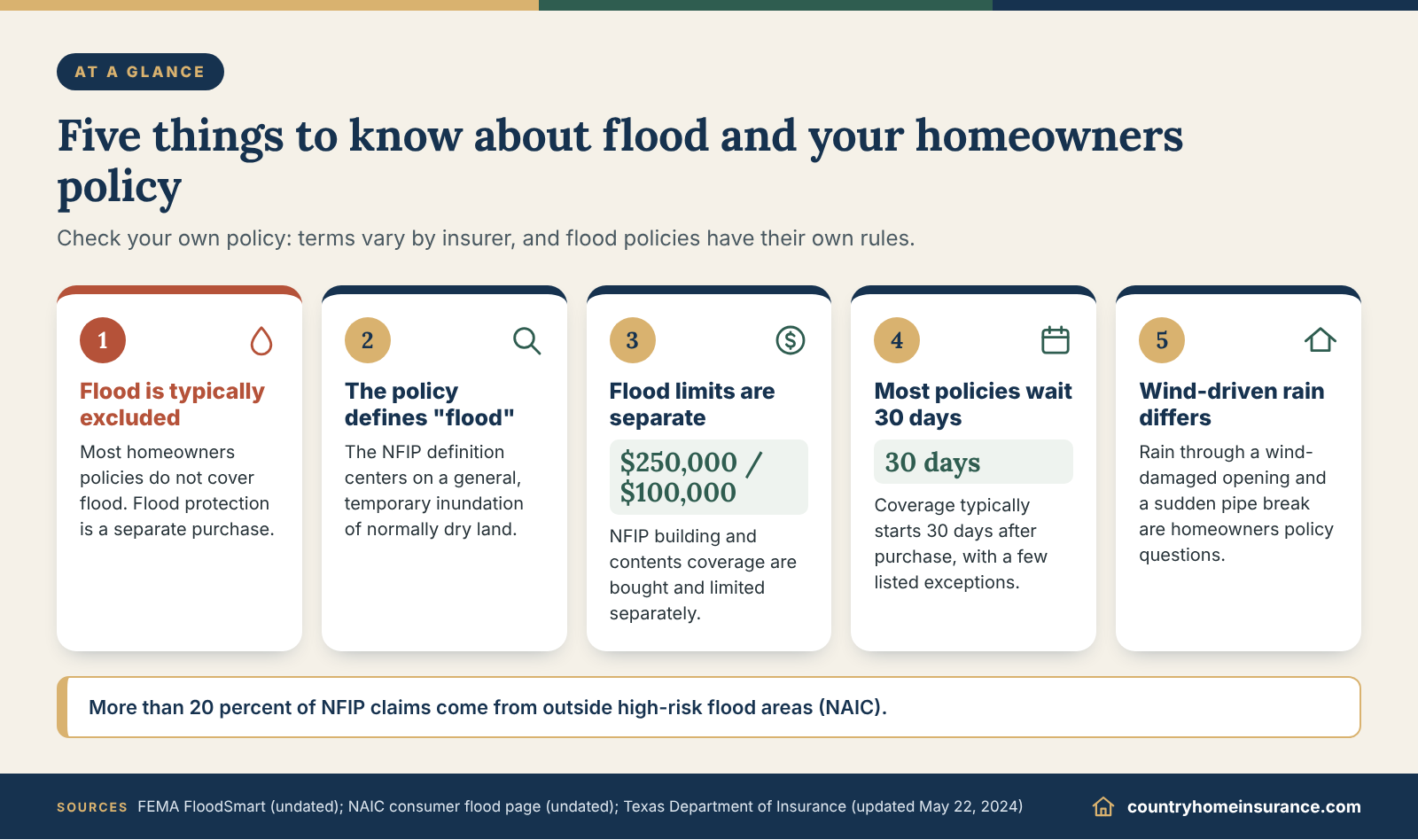
- Whether a loss counts as a “flood” depends on a policy definition, and the NFIP definition centers on a general, temporary inundation of normally dry land.
- Rain coming through a wind-damaged opening and a sudden pipe break are different water losses that a homeowners policy may handle, subject to its terms.
- NFIP building coverage tops out at $250,000 and contents at $100,000, and most policies take effect 30 days after purchase, with a few exceptions.
- More than 20 percent of NFIP claims come from outside high-risk flood areas, so a low-risk map label is not the same as no risk.
- The NFIP’s authorization is currently set to run to December 11, 2026, so check its status if you are buying, renewing or closing on a home around then.
| Situation | Standard homeowners policy (typical) | Standard NFIP flood policy (typical) | What to verify |
|---|---|---|---|
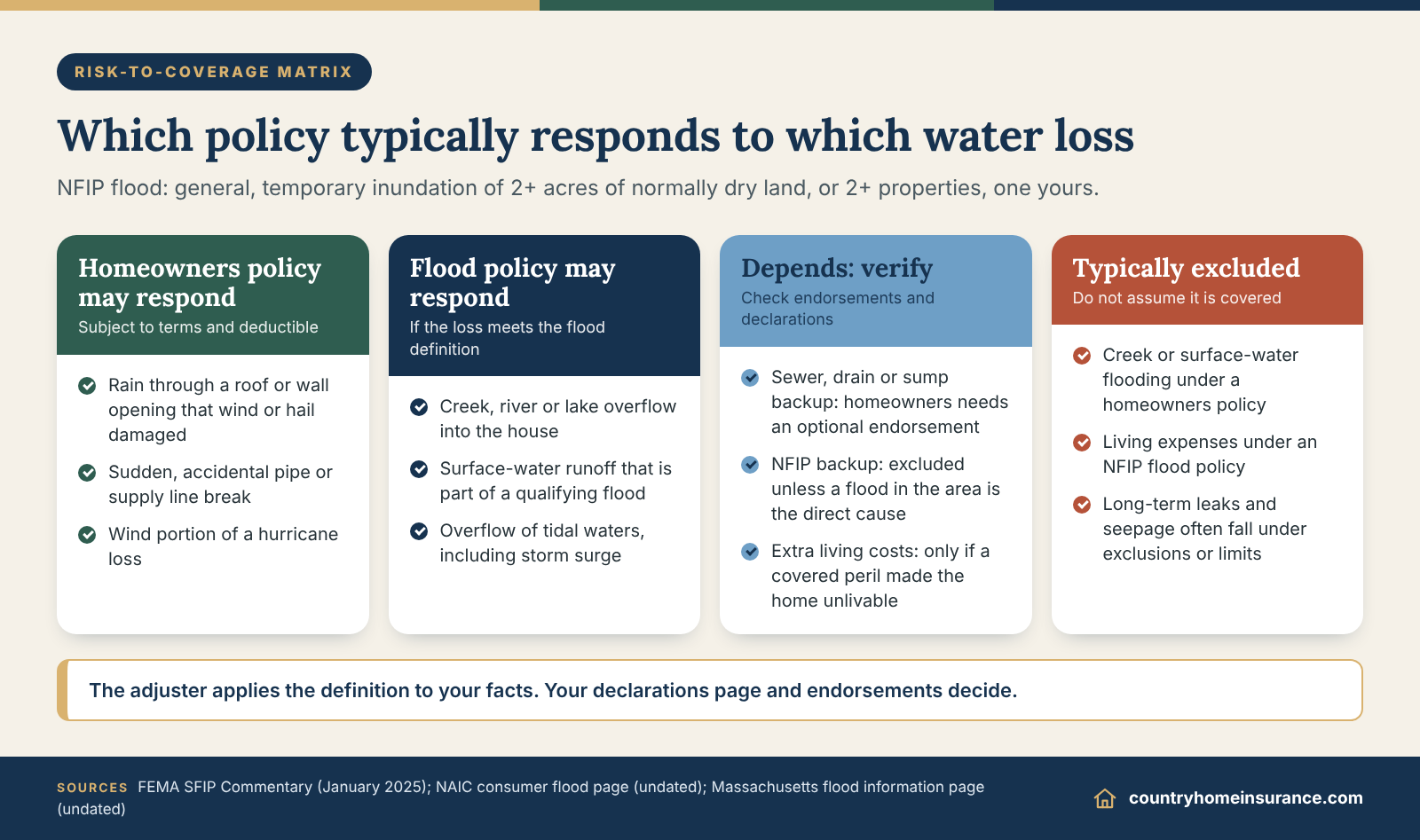
| Creek, river or lake overflows into the house | Typically excluded as flood | May cover direct physical damage if the loss meets the policy’s flood definition and the coverage was in force | Flood exclusion wording; flood policy effective date |
| Heavy rain runs across the yard and into the house as surface water | Typically excluded; often grouped with flood or surface-water exclusions | May cover if the surface-water runoff is part of a qualifying flood | Exclusion list under “water damage”; flood definition |
| Rain enters through a roof, window or wall opening that wind or hail damaged | Often covered, subject to the policy’s terms and deductible | Generally not the flood policy’s job | Wind/hail deductible; whether the opening was caused by a covered peril |
| Sewer or drain backup, or sump pump overflow | Depends on an optional endorsement and its limit | Excluded unless a flood in the area is the proximate (direct) cause | Whether a water-backup endorsement is on the declarations page |
| A supply line or pipe breaks inside the house | Often covered when the damage is sudden and accidental, subject to exclusions | Not a flood loss | Exclusions for long-term leakage or maintenance issues |
| Storm surge or tidal water pushed ashore by a hurricane | Wind portion may be covered; rising water typically is not | Overflow of tidal waters is part of the flood definition | Separate wind or named-storm deductible; flood policy in force |
| Living elsewhere while a flooded house is uninhabitable | Additional living expense (ALE) may apply only when a covered peril made the home unlivable | Living expenses are not covered | Loss of Use (Coverage D) limit and the cause of the damage |
Does homeowners insurance cover flood damage? The short answer and the reasoning
The one-sentence answer is “usually not,” but a one-sentence answer is a poor guide when water is already in the house. This section explains how a homeowners policy is built, what insurers and FEMA mean by “flood,” and where ordinary policies and flood policies overlap. If you remember only one thing, remember that the cause of the water decides which policy, if any, responds.
How a homeowners policy is built, and why flood sits outside it
Most homeowners policies bundle several coverages: the dwelling (Coverage A), other structures (Coverage B), personal property (Coverage C), loss of use (Coverage D), liability (Coverage E) and medical payments to others (Coverage F). Each one responds to certain causes of loss and is limited by exclusions. Flood is one of the exclusions.
The policy responds to listed causes of loss, then carves out exclusions
Think of a homeowners policy as a long list of things it will pay for, followed by a shorter list of things it won’t. The National Association of Insurance Commissioners (NAIC), the organization of state insurance regulators, states that flood is typically not covered by homeowners or renters policies, and its consumer materials point readers to the exclusions section, where flood damage is generally grouped under “water damage.” Reading that section before you need it is the cheapest fact-finding you can do.
FEMA and state regulators say the same thing in plain words
This isn’t a quirk of one insurer. FEMA’s FloodSmart program says most homeowners insurance does not cover flood damage, and state insurance departments such as the Texas Department of Insurance and the Massachusetts state flood information page repeat it in consumer language. The message is consistent enough that it is safer to assume your policy excludes flood unless the declarations page and endorsements clearly say otherwise.
What counts as a flood under the National Flood Insurance Program
People use “flood” loosely. A flooded basement after a plumbing failure feels like a flood, and so does a pond that creeps up a lawn. Insurance policies are less flexible. The NFIP’s Standard Flood Insurance Policy (SFIP) defines the word, and many private flood forms follow similar ideas, though private wording can differ.
A general and temporary inundation of normally dry land
Under the SFIP, a flood is a general and temporary condition of partial or complete inundation of two or more acres of normally dry land, or of two or more properties, one of which is yours. FEMA’s January 2025 commentary on the policy also lists the usual sources: overflow of inland or tidal waters, unusual and rapid accumulation or runoff of surface waters from any source, and mudflow. This is the NFIP’s wording, so confirm how your own flood policy phrases it, especially a private one.
Mudflow counts, but landslides generally do not
The SFIP describes mudflow as a river of liquid and flowing mud on the surface of normally dry land. It treats a landslide, slope failure or saturated soil mass moving down a slope differently. FEMA materials list earth movement not caused by flood, such as earthquake and landslide, among the exclusions. For hillside country properties, that distinction matters, and it is worth asking an agent how a specific policy would treat a slope that gives way after heavy rain.
One property alone may not meet the test
The two-acre or two-property wording means a localized problem on only your lot can raise a coverage question. A small pond overtopping onto your own land is a different fact pattern from a creek spilling across several neighboring parcels. The adjuster, not this article, applies the definition to your facts, so describe what happened plainly and photograph how far the water spread beyond your lot.
Where homeowners and flood coverage overlap or blur
Real losses rarely arrive labeled. A single storm can deliver wind, rain, runoff and sewer pressure within hours. Understanding the seams helps you file under the right policy and avoid assuming a denial that isn’t there.
Wind-driven rain through a damaged opening is a different loss
NAIC consumer guidance notes that rain entering through a window, door, wall opening or roof that wind damaged is typically not covered by a flood policy but is generally included in most homeowners policies. That is a general statement, and the details depend on your form, including whether the opening was created by a covered cause of loss and which deductible applies. If a storm tore shingles off first and rain followed, mention that sequence to your insurer.
Additional living expenses depend on the cause of the damage
NAIC says a standard home policy generally does not cover flood damage, but it may provide additional living expenses (ALE, the extra cost of living elsewhere) if a home is uninhabitable because of wind or another covered peril connected to the flood. A flood policy under the NFIP does not cover living expenses. If a flood alone makes the house unlivable, plan on the possibility that hotel and rental costs fall on you unless other help applies.
A burst pipe is not a flood, even though the water looks the same
The Massachusetts page advises homeowners with a problem such as a burst pipe to contact their home insurer, noting that standard policies usually cover water damage that is sudden and accidental, and that the insurer will investigate the cause. The burst-pipe scenario is covered in more depth in a sibling article.
Flood, surface water, backup and rain: sorting out which water loss you have
Water gets into a house from above, from the sides and from below. Insurers sort those paths into different causes of loss, and the sorting drives who pays. This section walks through the main paths, then looks at the extra ones that show up on rural properties.
Water that arrives from above or from the building itself
Rain and plumbing are the paths most likely to stay inside a homeowners policy, though both come with conditions. The policy’s wording on cause, timing and maintenance matters more than the amount of water.
Rain through the roof or walls after a covered event
If wind or hail opens the roof and rain follows, many homeowners policies treat the interior water damage as part of the same covered event, subject to the policy’s terms. That is different from rain that seeps through an old, worn roof or a foundation crack over time. Insurers often distinguish sudden damage from wear, deterioration and neglected maintenance, so a roof that is already failing can complicate the claim.
Sudden plumbing failures versus slow leaks
A supply line that bursts overnight and a drip behind a cabinet that has run for months are not treated alike. The Massachusetts page uses the phrase “sudden and accidental” to describe the type of water damage standard policies usually cover. Long-term leaks, seepage and mold often fall under exclusions or limits, which is why a prompt repair and records of maintenance can help later.
Water that rises from the ground or backs up through drains
Water that comes from below is where most disputes start, because several different causes look the same once the carpet is wet. Each cause has its own coverage question.
Rising or flowing surface water is a flood issue
Overflow from rivers, creeks and tidal waters, plus unusual and rapid runoff of surface water, falls inside the NFIP’s flood definition. The Massachusetts page notes that the NFIP defines flood to include unusual and rapid accumulation or runoff of surface waters from any source. A standard homeowners policy typically excludes that water, which is why the flood policy exists.
Sewer, drain and sump backup is usually its own question
Backup is the awkward middle case. According to the NFIP’s policy commentary, water that backs up through sewers or drains, overflows from a sump pump or seeps through the property is excluded unless a flood in the area is the proximate (direct) cause. On the homeowners side, backup coverage is commonly handled through an optional add-on whose availability and limit vary by insurer, so check your declarations page. Two sibling articles cover this in detail.
Rural water paths that city-focused guides skip
Country properties add water sources and structures that suburban lots don’t have. Some of them are simply outside the flood policy, and some sit in gray areas between a homeowners policy and a farm policy. The details below are reasons to ask questions, not conclusions about your policy.
Ponds, creeks, culverts and field runoff
Acreage often means a seasonal creek, a stock pond or a ditch that carries more water than the culvert beneath your driveway can handle. When that water spreads across several parcels and reaches the house, the flood definition may be satisfied. When a clogged culvert diverts runoff only onto your own land, the facts are harder to fit. The Texas Department of Insurance also notes that replacing prairie and pasture with concrete and asphalt can expose areas that never flooded before, so changes upstream can matter as much as your own lot.
Wells, septic systems and detached outbuildings
An older FEMA summary of NFIP coverage lists outdoor property such as trees, fences, decks, pools, septic systems and wells among items the dwelling-form flood policy does not cover. If a flood contaminates a well or saturates a drain field, expect the repair bill for those systems to sit largely outside a standard NFIP policy. Detached barns, workshops and sheds raise separate questions that the building-coverage section below sorts out.
What a flood policy actually pays for, and what it leaves out
Buying flood insurance doesn’t mean everything wet gets replaced. A flood policy is a single-peril contract with its own limits, its own deductibles and its own exclusions. The figures below come from FEMA and NAIC materials; they describe the NFIP’s standard policy, and your own policy documents control.
Building coverage and contents coverage are bought and limited separately
The most common surprise for new flood policyholders is that the house and its belongings are different purchases. FEMA’s FloodSmart describes NFIP coverage as having a building part and a contents part, and each has its own ceiling, its own premium and its own deductible.
Building coverage protects the structure and certain systems
For a homeowner, NFIP building coverage can reach $250,000. NAIC describes it as covering structural damage along with items such as the furnace, water heater, air conditioner and flooring. FEMA’s SFIP commentary adds that coverage for the dwelling and attached additions comes with conditions and listed building items. If your home would cost more than the building limit to rebuild, the NFIP will not pay beyond the limit, because NAIC notes payment is capped at the lesser of the loss amount or the policy limit.
Contents coverage has to be added and has a separate ceiling
Personal property coverage can reach $100,000 for homeowners, and the Texas Department of Insurance notes that belongings need to be insured under a separate policy or part. The SFIP commentary says personal property is covered inside a building at the described location when you bought that coverage. A separate special limit of $2,500 applies to certain items, and FloodSmart lists original artwork and furs as examples. Keep your home inventory current so you can show what you owned.
Each part carries its own deductible
FEMA’s deductible FAQ states that building and contents policies have separate deductibles, and if both are damaged in the same flood, both apply. An undated NFIP application guide published by a state agency shows deductible choices that start around $1,000 and can be raised to $2,000, $5,000 or $10,000, but its edition is unclear, so treat those figures as an illustration and confirm current options on a quote.
| Item | What the sources say | Why it matters |
|---|---|---|
| Building coverage, homeowner | Up to $250,000 (FEMA FloodSmart) | Rebuild cost above the limit is your responsibility |
| Contents coverage, homeowner | Up to $100,000, bought separately (FloodSmart; Texas DOI) | No contents policy, no contents payment |
| Special limit for certain valuables | Up to $2,500 for items such as original artwork and furs (FloodSmart); SFIP commentary lists a $2,500 special limit | Collectibles may need other insurance |
| Increased Cost of Compliance (ICC) | Up to $30,000 toward meeting floodplain rules after qualifying damage, with no separate deductible (SFIP commentary) | Can help fund elevating or other mitigation if the community’s requirements are triggered |
| Loss avoidance | $1,000 for sandbags and supplies and $1,000 for moving property to safety (SFIP commentary) | Keep receipts if you protect property before a flood |
| Detached garage | One may be covered at no more than 10 percent of the dwelling limit; it must be designed for car storage and not used for residential, business or farming purposes (SFIP commentary) | Barns and shops used for farming are not described by this provision |
| Waiting period | Coverage begins 30 days after purchase, with listed exceptions (FloodSmart) | Buying when water is on the radar is typically too late |
| Policy term | One year, followed by a 30-day grace period if you renew and pay in full by its end (FloodSmart); the SFIP is not continuous (commentary) | Renewal deadlines are your responsibility |
Basements and below-the-first-floor spaces get limited coverage
Basements and crawlspaces are where much of the flood damage in older and country homes occurs, and they are also where policy limits bite hardest. NAIC says coverage for basements, crawlspaces and ground-level enclosures is limited. The details come from FEMA’s own definitions.
What the policy means by “basement”
The SFIP defines a basement as any area whose floor is below ground level on all sides, regardless of how the space is used or described in a real estate listing. A utility pit without a floor, such as a sump pit, is not a basement under that definition. That means a walkout lower level on a slope may or may not count, so ask your agent how the policy would classify your lower level.
Items the dwelling form covers there, and items it does not
An older NFIP summary of coverage, dated June 2019, lists limited items covered below the lowest elevated floor, including furnaces, water heaters, central air conditioners, pumps, electrical panels, fuel tanks, foundation walls, washers, dryers and food freezers. Furniture and electronics stored in a basement were not covered even though the same items are covered above that floor. Because that is an older edition, check the current policy form before relying on the list.
Planning around the gap
If your family room, workshop or storage area is below grade, decide ahead of time what you would replace out of pocket and what you would move upstairs. Elevated machinery can also matter to the premium: the application guide mentioned earlier describes mitigation discounts for elevated equipment and proper flood openings, subject to eligibility.
Yard features and outbuildings on a country property
Acreage owners usually have more at risk outside the house than inside it. That is also the part of the property the NFIP is least designed to cover.
Landscaping, fences, septic systems and wells
FEMA’s commentary on the dwelling form says the policy does not cover land, lawns, trees, shrubs, plants, growing crops or animals. It also lists fences, retaining walls, seawalls and docks as not covered unless they directly support the foundation, and swimming pools are listed among the excluded items. The older coverage summary adds septic systems and wells. If those items matter to you, treat any loss to them as uninsured unless another policy says otherwise.
Barns, workshops and other detached buildings
The NFIP materials reviewed for this article describe one detached garage, with the farming exclusion noted above. They did not describe coverage for barns, workshops or sheds, so a farm outbuilding should be treated as an open question. Ask an agent in writing, and ask whether any private flood insurer offers broader options for detached structures. This ties directly to the Coverage B (other structures) conversation on your homeowners policy.
NFIP versus private flood insurance: how to choose where to buy
There are two broad places to buy flood coverage. The federal program sets uniform terms and prices through participating insurers, while private insurers write their own forms. The right choice depends on your home’s value, your lender and what each option leaves out. This section lays out the differences without recommending a winner, because no single option is best for every property.
How the NFIP works for a homeowner
The NFIP is managed by FEMA. FloodSmart says policies are sold through NFIP partner insurance companies and independent agents, and that they all use the same pricing, so the premium for the same property is identical across providers. That makes comparison shopping within the NFIP about service, not price.
Timing: the 30-day wait and its exceptions
FloodSmart states that coverage goes into effect 30 days after the date of purchase. Listed exceptions include buying while making, increasing, extending or renewing a mortgage, changing coverage at renewal, a one-day wait for a property newly designated high-risk if you buy within 12 months of the map update, and a one-day wait after certain wildfire-related flooding on federal land. The SFIP also excludes loss from a flood already in progress when coverage begins. Damage that occurs before the policy takes effect is not covered, as NAIC notes.
Renewal and the principal residence rule
NFIP policies last one year, with a 30-day grace period after expiration. The SFIP commentary stresses the policy is not continuous, so it ends at the expiration time unless renewed. It also explains that replacement cost loss settlement is tied to whether the dwelling is your principal residence, defined as lived in at least 80 percent of the 365 days before the loss. A second home or rental may be settled differently, so ask about that if it applies.
What private flood insurance can look like
Private flood insurance is sold by non-NFIP insurers, and it is regulated by the states. NAIC says private policies may offer higher limits or broader coverage than the NFIP and encourages shoppers to compare coverage and premiums.
Stand-alone, endorsement and excess forms
The Massachusetts page describes three private forms: stand-alone flood policies, endorsements added to an existing home policy (which it says are typically more limited), and excess policies that sit above the limits of an existing flood policy. The excess form can matter for higher-value country homes where the $250,000 NFIP ceiling is below the rebuild cost.
How large the private market is, according to one industry source
Triple-I, the Insurance Information Institute, reported (as covered by Reinsurance News in February 2026) that private flood insurers’ direct written premiums rose nearly 43 percent, from $3.29 billion in 2016 to $4.7 billion in 2024, and that more than half of flood policies in force are written through the NFIP. These are one publisher’s national totals and do not tell you whether a private insurer writes in your county or what it would charge.
Questions to ask before you sign on the dotted line
Ask the private insurer whether it is licensed or approved in your state, whether replacement cost or actual cash value applies, what the waiting period is, how basements and outbuildings are treated, and whether the policy would satisfy your lender. NAIC notes that some private policies have a 30-day waiting period, though not all do, so confirm it in writing. Your state insurance department keeps information on private options, and Massachusetts, for example, maintains a list of companies.
Lender requirements and the status of the federal program
Two outside forces affect your choice: your mortgage lender and the NFIP’s own authorization. Neither changes what your policy covers, but both can change when and where you can buy it.
When a lender must require flood insurance
Federal law generally requires flood insurance when a loan from a regulated lender is secured by improved real estate in a special flood hazard area (SFHA, the mapped high-risk area) in a participating community. Interagency guidance issued in February 2019 and effective July 1, 2019 says lenders must accept private flood policies that meet the statutory definition and may accept others under certain conditions. Ask your lender what documentation it needs before you cancel an NFIP policy or buy a private one.
Why the December 11, 2026 date deserves a calendar note
A Congressional Research Service Insight updated September 11, 2026 says the NFIP is authorized until December 11, 2026, and that Congress has enacted 36 short-term reauthorizations since the end of fiscal year 2017. During a lapse, existing policies generally continue until the end of their term, new contracts cannot be written, and claims continue to be paid while FEMA has funds. The National Association of Realtors makes similar points and notes that private flood insurance is not affected. Because the situation can change quickly, verify the program’s status on FEMA’s site before closing or renewing near that date.
Flood zones, risk outside the map and what drives a flood policy’s price
A flood zone is a risk label on a map, not a prediction about your driveway. Understanding what the label means, and what it misses, helps you decide whether coverage is worth carrying even when no lender is asking for it. It also explains why two neighbors can pay different premiums.
What the flood zone label tells you
NAIC sorts flood risk into three broad groups, and the group affects whether a lender must require coverage. The labels are a starting point for a conversation with an agent, not a final answer.
High-risk, moderate-to-low-risk and undetermined areas
According to NAIC, a high-risk area has at least a 1 percent annual chance of flooding, and homeowners with mortgages from federally regulated or insured lenders in those areas must buy flood insurance. Moderate-to-low-risk areas have less than a 1 percent annual chance, where coverage is not required by federal law but is recommended, although some lenders still ask for it. Some areas are “undetermined,” meaning a flood hazard analysis hasn’t been done even though risk may exist.
A 1 percent annual chance is not a once-a-century event
A 1 percent chance each year is easy to misread. Using simple arithmetic, the chance of at least one such flood across a 30-year mortgage is roughly 26 percent (one minus 0.99 raised to the 30th power), assuming the annual odds stay constant. That is an illustration of probability, not a forecast for any specific address, and the actual risk can change as maps, weather patterns and land use change.
Maps are revised, so a check once is not enough
NAIC suggests checking FEMA flood maps annually because maps are revised over time, and signing up for alerts about map updates in your community. If your property is newly mapped into a high-risk area, FloodSmart says a shorter one-day wait applies if you buy within 12 months of the map change. Ask your agent or county floodplain administrator what map date applies to your parcel.
Flood losses outside the mapped high-risk zones
Many people with a low-risk label assume they can skip coverage. The data suggests that assumption is risky, and the reasons are especially relevant to land that is changing or that sits near small streams.
What the claims data shows
NAIC reports that over 20 percent of NFIP claims come from outside high-risk flood areas. FloodSmart says 99 percent of U.S. counties have experienced a flood event in the past 20 years. The Texas Department of Insurance notes that more than half of the homes flooded by Hurricane Harvey were outside flood zones. These statements come from different agencies and different measures, so use them as directional signs of exposure, not as a combined statistic.
Why perception lags behind exposure
A 2023 survey by Munich Re and Triple-I, reported by Reinsurance News in February 2026, found that 64 percent of homeowners believed their property was not at risk of flooding. The same report noted that in some of the hardest-hit North Carolina communities fewer than 1 percent of households held flood policies. Those findings do not predict your situation, but they show why checking your own exposure before a storm beats relying on assumptions.
Land change upstream can alter your risk
The Texas Department of Insurance points out that replacing prairie and pasture with concrete and asphalt can expose areas that never flooded before. On a country road, a new subdivision, a graded parking lot or a beaver dam can change where water goes after heavy rain. If something like that has changed near you, consider asking the county floodplain office what it knows.
What drives a flood policy’s premium and deductible
Flood pricing isn’t an average of the neighborhood. FloodSmart says NFIP premiums depend on where the property is located, how it is built and the cost to rebuild it. The following factors show up in the program’s own forms.
Elevation, foundation and construction details
The undated state-hosted NFIP application guide mentioned earlier lists first floor height as a key rating variable, along with foundation type, number of floors, construction type, building replacement cost, primary residence status and the date of any substantial improvement. It also says an elevation certificate is optional, though it can be a tool to establish first floor height. Installing proper flood openings or elevating machinery may qualify for mitigation discounts, according to that same guide.
Typical premium figures should be read as context
NAIC says the typical NFIP cost is around $700 a year in high-risk areas, and the Texas Department of Insurance describes the average flood policy as costing about $700 a year, adding that policies for homes outside flood zones are typically very affordable. Both statements are undated or from 2024, do not describe your coverage amounts and shouldn’t be treated as a quote. Get a personalized quote at FloodSmart or from an agent.
Discounts and deductibles to ask about
NAIC suggests asking about the Preferred Risk Policy, which it says can cost less than a standard high-risk policy, and whether your community’s Community Rating System (CRS) offers a discount. Higher deductible options exist, but a higher deductible means a larger share of any loss comes out of your pocket before payment begins. Since the building and contents deductibles apply separately, add them together when you run a worst-case scenario.
Filing a flood claim: steps, deadlines and common mistakes
If water has already reached your home, speed and records matter more than anything else. This section follows the order of events for an NFIP claim, since FEMA publishes its process in detail, and notes where a homeowners claim may run alongside. Procedures for private flood policies can differ, so read yours.
The first days after the water arrives
The first calls and photos set the tone for the whole claim. Follow local officials’ safety guidance first, since claims can wait a few hours but safety can’t.
Notify the insurer and have your details ready
FEMA’s claims guidance says to contact your agent or insurer and have your insurer’s name, policy number and a phone number or email where you can always be reached. It adds that an adjuster should contact you within a few days, and FEMA’s flood insurance manual describes a general expectation of contact within 24 to 48 hours, though severe flooding can delay that. If you haven’t heard back, call again.
Separate adjusters for wind and flood are common
A 2016 Louisiana Department of Insurance newsletter notes that windstorm and flood damage often go to separate adjusters, and that one adjuster may handle both if the same company writes both policies. After a storm that brought wind and water, keep notes on which damage you believe came from which cause, and let each insurer see the same photographs. That older bulletin is general advice, not current law.
Document first, then clean up, within reason
FEMA recommends photographing all damage, including discarded items, structural damage and floodwater levels, separating damaged property from undamaged property and listing damaged items with purchase dates, values and receipts. Massachusetts guidance adds photographing the inside and outside, including water height, and using a home inventory with the adjuster. Local officials may require disposal of flooded items, so keep a record or sample before they go.
Limit further damage without destroying evidence
NAIC advises mitigating damage quickly by removing wet items and cleaning and drying them to prevent mold. FEMA’s older summary of coverage lists mold, mildew or moisture damage that the owner could have avoided as not covered. The Louisiana newsletter suggests making temporary repairs to prevent further damage while considering delaying permanent repairs until the adjuster has inspected and you agree on costs. Save every receipt.
The sworn proof of loss and the documentation behind it
The proof of loss is the document that turns your damage into a dollar claim. FEMA treats it as a formal sworn statement, and it has a firm clock.
What a proof of loss is
FEMA describes the proof of loss as your sworn statement of the amount you are claiming, with supporting documents, and says your adjuster will help you prepare it. Payment comes only after you and the insurer agree on the damage amount and the insurer receives a complete, accurate, signed proof of loss. The claims manual adds that you should submit one even if you disagree with the adjuster’s estimate.
The 60-day deadline
The proof of loss is generally due within 60 days after the loss, per the SFIP commentary and FEMA’s claims guidance. FEMA may extend the deadline in severe flood events, but do not count on it. Amended proofs of loss, which you may file for omitted items or higher repair costs, follow the same deadline rules, according to the claims manual.
Contractor estimates and fraud warnings
Contractor estimates are useful support for the adjuster’s review, so share any you obtain. Both the Louisiana newsletter and the NAIC alert on flooding suggest getting multiple bids, checking references and verifying licenses, insurance and bonding, and being cautious of anyone demanding full payment upfront. Insurers typically do not recommend contractors, so be wary of anyone claiming otherwise.
| Stage | Timing | What to do | Source and date |
|---|---|---|---|
| Notice of loss | As soon as possible | Contact your agent or insurer with policy number and contact details | FEMA claims guidance (undated) |
| Adjuster contact | Within a few days; manual says generally 24 to 48 hours, longer after severe floods | Follow up if you hear nothing | FEMA claims guidance (undated); NFIP Flood Insurance Manual Appendix E (April 2020) |
| Proof of loss | Within 60 days after the loss, unless FEMA grants an extension | Submit a signed, sworn proof of loss with supporting documents | SFIP commentary (January 2025); manual Appendix E (April 2020) |
| Appraisal (if invoked) | Each side names an appraiser within 20 days of the demand | Use only for disagreement on the amount of loss, not on coverage or cause | SFIP commentary (January 2025) |
| Appeal to FEMA | Within 60 days of the date of the denial letter | Send required details and documents; FEMA typically decides within 90 days of receiving complete documentation | Manual Appendix E (April 2020) |
| Lawsuit | Within one year of the first written denial of all or part of the claim | Appeals do not extend this deadline; suit is filed in U.S. District Court | SFIP commentary (January 2025); manual Appendix E (April 2020) |
When you disagree with the estimate or the denial
A lower-than-expected estimate isn’t the end of the process. The NFIP has a defined path for disagreement, and other deadlines run while you work through it, so keep dates in front of you.
Escalate in order and ask for itemized explanations
FEMA’s claims manual describes escalating from the adjuster to the adjusting firm’s supervisor and then to the insurer’s claims department. If disagreement continues, the insured files a proof of loss for the full amount requested; the insurer pays the undisputed portion and issues a written denial for the rest. The Louisiana newsletter suggests asking for an itemized explanation of any settlement offer.
Appraisal, FEMA appeal or a lawsuit
Appraisal can resolve disagreements about the value or amount of loss, but not scope, coverage or causation, per the SFIP commentary. A FEMA appeal can’t be considered once the insured sues or invokes appraisal, according to the claims manual. The one-year lawsuit clock starts with the first written denial and is not paused by an appeal, so if you are heading toward either route, consider speaking with a licensed attorney or your state insurance department.
Hypothetical example: how a payment might be calculated
Hypothetical example, not a quote or a promise of payment. A homeowner with a flood policy has a $2,000 building deductible. After a creek overflow, the adjuster and homeowner agree on $34,000 of covered building damage to flooring, drywall and a furnace. A fence, landscaping and some lawn damage total $6,000 more, and those items are typically not covered under the standard flood form. In this simplified illustration, the building payment would be $34,000 minus the $2,000 deductible, or $32,000, and the homeowner would bear the $6,000 of uncovered items plus the deductible. Actual results depend on the policy, the proof of loss and the adjuster’s findings.
If you have no flood policy, or the limits fall short
Not every household has flood coverage, and even those that do can find the limits thinner than expected. This section covers what your homeowners policy may still do, what public help exists and how to think about a shortfall. None of it replaces a flood policy, and none of it is guaranteed.
What a homeowners policy may still pay after a flood event
A flood often arrives with other damage. The parts of the loss that come from covered perils may be eligible under the homeowners policy, subject to its terms, deductibles and exclusions.
Wind, falling trees and other covered causes
If a storm that brought flooding also tore off part of the roof or dropped a tree on the house, those losses are separate causes. NAIC notes that rain entering through a wind-damaged opening is generally included in most homeowners policies. Your claim is stronger when photographs and notes show which damage came first and which cause produced it, because the insurer may need to separate the two.
Loss of use when a covered peril made the home unlivable
NAIC says a home policy may provide additional living expenses if the home is uninhabitable because of wind or another covered peril tied to the flood. The NFIP does not cover living expenses. If the only cause is rising water and you don’t have separate coverage for temporary housing, those costs may come from savings or from assistance programs.
Vehicles are handled on the auto policy
The Louisiana Department of Insurance newsletter says comprehensive auto coverage will likely cover flood damage to a vehicle, while liability-only or liability-and-collision coverage likely will not. This is an older general statement, and your auto policy controls, so ask your agent before a storm rather than after.
Federal disaster help is limited and works around insurance
Public disaster programs are designed to fill gaps, not to replace insurance. Rules, caps and eligibility change from year to year and from disaster to disaster, so check FEMA and the Small Business Administration (SBA) for current terms rather than relying on any figure printed here.
FEMA assistance depends on a declaration and doesn’t duplicate insurance
A Consumer Action article, published in 2018 and last reviewed in December 2020, says FEMA cannot duplicate coverage that your insurer provides, that insured applicants generally need to file an insurance claim first, and that partial coverage or underinsurance can still lead to help after the claim settles. Those details are dated, so confirm them with FEMA. The Louisiana newsletter says people in a federally declared disaster area who were not required to carry flood insurance may qualify for FEMA’s Individuals and Households Program.
SBA disaster loans are loans, not grants
Consumer Action also describes SBA disaster loans as low-interest loans that require the borrower to repay, with approval depending on credit and ability to repay. The Louisiana newsletter says homeowners who were required to carry flood insurance but didn’t may be eligible for an SBA loan. Treat a loan as debt you would take on, and compare its cost before you accept.
Planning for a shortfall between limits and rebuild cost
A flood policy with a $250,000 building limit and a $350,000 rebuild cost leaves a $100,000 gap before any deductible. Thinking through that gap before a storm gives you options that don’t exist afterward.
The NFIP isn’t a guaranteed replacement cost policy
NAIC says standard NFIP policies pay up to replacement cost or actual cash value, or the policy limit, whichever is less, so the policy will not pay beyond its limit even if rebuilding costs more. For a larger country home, compare your building limit against a realistic rebuild estimate.
Excess flood and higher-limit private options
If the gap is large, ask whether a private excess or higher-limit flood policy is available in your state. The Massachusetts page notes that higher limits than the NFIP may be available from private insurers, and describes excess policies that sit above an existing flood policy. Availability, pricing and underwriting rules depend on the insurer and property, so confirm each in writing.
Increased Cost of Compliance can help with required upgrades
ICC, described in the SFIP commentary as Coverage D, can contribute up to $30,000 toward meeting floodplain management rules for a repetitive-loss building or one damaged to 50 percent or more of its market value where a substantial damage provision applies. The claims manual says insureds have up to six years from the loss date to complete the approved mitigation activity. It is not available in every circumstance, so ask your community and your insurer early.
Reviewing your coverage and preparing before the next flood
The cheapest time to find a coverage gap is before water shows up. A short review, a few mitigation steps and good records take an afternoon and can change how a claim goes. This section turns the article’s points into a practical routine.
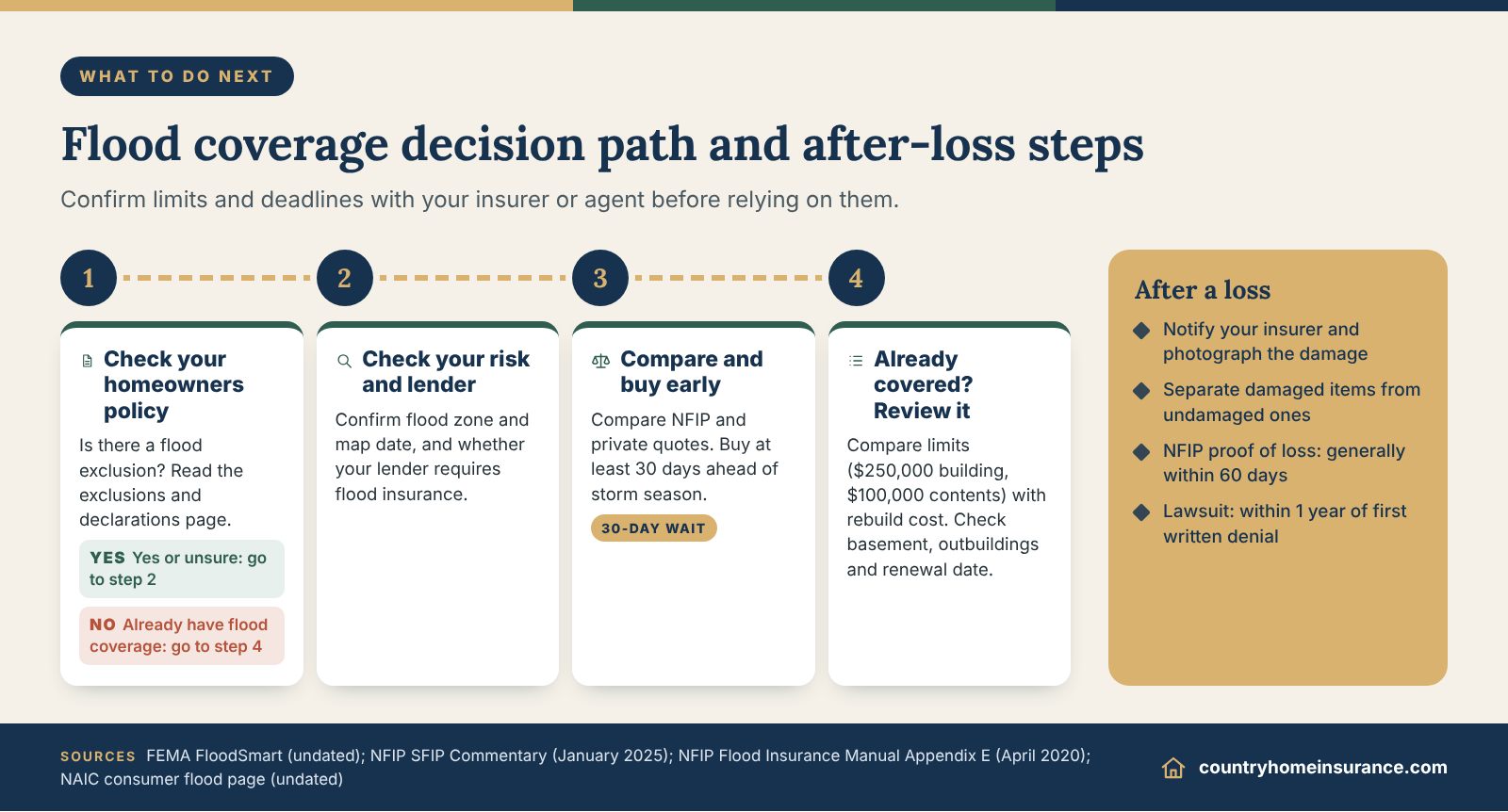
Questions to ask your agent and what to read in your own policy
Start with documents you already have. The declarations page lists your coverages, limits and deductibles, and the endorsements attached to the policy modify the standard terms.
Read the exclusions and the declarations page together
Find the flood exclusion and any language about surface water, water backup, seepage or sump overflow. Then check the declarations page for endorsements that add back some water coverage, and for separate wind, hail or named-storm deductibles. Read the fine print once, then write down the three or four phrases that matter most to you and ask your agent to explain each one.
Ask questions that reveal gaps
NAIC suggests asking: Does my homeowners policy cover flood? What is my flood zone? Is the flood policy replacement cost or actual cash value? Will my lender require flood insurance? Are there extra fees? Add rural questions about outbuildings, wells and septic systems, and ask whether any private flood product can cover items the NFIP leaves out.
| Action | What to check or collect | Who to ask |
|---|---|---|
| Confirm the exclusion | Flood, surface-water and water-backup language in the homeowners policy; endorsements on the declarations page | Your insurer or agent |
| Identify your flood risk | Mapped flood zone, map date and whether risk is high, moderate-to-low or undetermined | FEMA flood maps; county floodplain or emergency management office |
| Compare flood options | NFIP versus private: limits, deductibles, replacement cost versus actual cash value, outbuilding treatment, waiting period | NFIP agent; state insurance department’s private flood list or contact |
| Check lender rules | Whether flood insurance is required and whether a private policy meets the lender’s standards | Mortgage servicer or lender |
| Match limits to rebuild cost | A realistic rebuild estimate compared with the $250,000 building and $100,000 contents NFIP ceilings | Agent, builder or appraiser |
| Build your records | Home inventory with photos or video, receipts for major items, policy numbers and contact details stored off-site | You, with your insurer’s guidance |
| Note renewal and grace dates | Policy expiration, 30-day grace period and any NFIP reauthorization notices | Agent; FEMA FloodSmart |
Reducing flood damage and protecting your records
Mitigation won’t stop a flood, but it can reduce what is lost and make a claim easier to document. Which steps make sense depends on your site, so treat the list below as ideas to discuss with a local expert.
Home inventory and document storage
FloodSmart recommends taking an inventory of belongings and checking mortgage flood insurance requirements, and Massachusetts guidance suggests using a home inventory with the adjuster after a loss. Keep a digital copy where flood can’t reach it, such as cloud storage, plus policy numbers and agent contacts. A phone video walkthrough of every room and outbuilding takes less than an hour.
Waterproofing and elevating utilities
FloodSmart lists waterproofing basements and elevating utilities among protective steps. The NFIP application guide described earlier mentions mitigation discounts for elevated machinery and for properly engineered flood openings in certain foundation types, subject to eligibility. Check with your agent before you spend money, so you know whether a discount is likely and what documentation is needed.
Loss avoidance supplies and receipts
The SFIP commentary says the policy provides $1,000 for sandbags, supplies and labor used to protect insured property, and another $1,000 for moving property to safety. Moved property is protected for 45 consecutive days at the new location. Keep receipts for supplies and labor, and take photographs of what you protected.
Timing: when to buy, renew and revisit
Because of the waiting period, the best time to buy is well before a forecast. Timing also interacts with real estate closings and with the federal program’s authorization schedule.
Buy early because most policies wait 30 days
NAIC notes that hurricane season starts June 1 and advises buying an NFIP policy at least 30 days earlier. The principle applies to any heavy-rain or snowmelt season where you live, not just coastal ones. Since the exceptions are narrow, such as a purchase tied to a loan closing, don’t count on one applying to you.
Revisit coverage after any major change
Review your flood coverage after a remodel, a new outbuilding, a change in map status, a large purchase of equipment or a change in who lives in the home. Also review it when you renew, since the policy is not continuous and must be renewed each year. Our sibling article on hurricane-season coverage covers the wind side of that review.
Real estate closings and program status
If you are buying or selling a home in a mapped flood area around the NFIP’s current December 11, 2026 authorization date, talk to your lender, agent and closing attorney early. The Congressional Research Service reports that past lapses delayed or canceled closings, and the National Association of Realtors notes that insurers may move a seller’s NFIP policy to a buyer by substituting names. Rules and practices can change, so verify them close to your closing date.
Frequently asked questions
Coverage questions
Does homeowners insurance cover flood damage from a hurricane?
Typically the wind portion of a hurricane loss may be covered under a homeowners policy, subject to its terms and any separate wind or named-storm deductible. Rising water, including storm surge, is generally treated as flood and needs a flood policy. Some coastal homeowners also need a separate wind policy, as the Texas Department of Insurance notes for its coast, so read your own declarations page.
Is a flooded basement covered by homeowners insurance?
It depends on how the water got in. A basement flooded by a burst pipe may be handled under the homeowners policy if the damage is sudden and accidental. A basement flooded by rising surface water is typically excluded from homeowners coverage, and NFIP coverage for basements is limited. Backup from a sewer or sump is a separate question that often hinges on an optional endorsement.
Does homeowners insurance cover heavy rain that seeps in or runs across the yard?
Rain entering through a covered-peril opening, such as a storm-damaged roof, may be covered. Water that runs across the ground and enters the house is typically excluded as surface water or flood. Seepage through foundation walls also tends to raise exclusion questions. Photographs showing how the water entered help the insurer classify the loss.
Are my belongings and vehicles covered if the house floods?
Belongings are typically not covered by the homeowners policy for flood and need contents coverage under a flood policy, up to $100,000 for NFIP homeowner contents. Vehicles are usually handled on the auto policy, where comprehensive coverage will likely respond to flood damage and liability-only coverage likely will not, according to an older Louisiana Department of Insurance bulletin.
Buying and claims questions
Can I buy flood insurance when a storm is already forecast?
You can often buy, but the policy typically does not take effect for 30 days, and damage that occurs before it takes effect is not covered. FloodSmart lists a few exceptions, such as buying in connection with a mortgage. Buy before the season, not during the storm.
Is flood insurance required?
Federal law generally requires it for loans from regulated lenders on improved property in mapped high-risk areas. Massachusetts notes that no state law requires flood insurance there, though lenders usually do. If you own your home outright or live outside a mapped high-risk area, the decision is yours, and NAIC recommends coverage for moderate-to-low-risk areas as well.
How long do I have to file a flood claim?
Notify your insurer as soon as possible. For NFIP policies, the sworn proof of loss is generally due within 60 days after the loss, unless FEMA grants an extension. Private policies may set different deadlines, so check the policy and ask your insurer in writing.
Does flood insurance pay for a hotel while repairs are made?
The NFIP does not cover living expenses, according to FEMA’s coverage summaries. Some private policies may differ, so ask. A homeowners policy may provide additional living expenses only when a covered peril, not flood alone, made the home unlivable.
Sources
- NAIC consumer page on flood insurance (undated; retrieved 2026-10-11)
- FEMA FloodSmart: flood insurance basics (undated; retrieved 2026-10-11)
- FEMA FloodSmart: buy a flood insurance policy (undated; retrieved 2026-10-11)
- NFIP Standard Flood Insurance Policy commentary, January 2025 (Dwelling Form October 2021 edition)
- NFIP Flood Insurance Manual, Appendix E: Claims, April 2020 (older edition; verify current manual)
- FEMA: filing a flood insurance claim (undated; retrieved 2026-10-11)
- FEMA FAQ: flood insurance deductible (undated; retrieved 2026-10-11)
- FEMA presentation: NFIP introduction to coverage and exclusions (2021 slides, hosted by the Maryland Insurance Administration)
- NFIP Summary of Coverage, Dwelling Form (June 2019 edition) (older edition; verify current form)
- Texas Department of Insurance: flood insurance (updated May 22, 2024)
- Texas Department of Insurance: home, flood and wind policies (undated)
- Massachusetts: flood assistance and insurance information (undated; retrieved 2026-10-11)
- NAIC consumer alert on flooding, hosted by the Kentucky Department of Insurance (undated, likely 2015)
- Louisiana Department of Insurance: special flood tips issue (August 16, 2016)
- NFIP single-family application guide, hosted by the Montana DNRC (undated; edition unclear)
- Interagency guidance on private flood insurance (FIL-8-2019) (issued February 13, 2019)
- Congressional Research Service Insight: what happens if the NFIP lapses (updated September 11, 2026)
- National Association of Realtors: NFIP expiration FAQ (page dated February 4, 2026)
- Reinsurance News on Triple-I flood findings (February 18, 2026; trade-press summary)
- Consumer Action: federal disaster relief for homeowners and renters (published 2018, reviewed December 2020; dated)
Important coverage note
Coverage depends on the actual policy, endorsements, exclusions, limits, deductible and cause of loss. State laws and insurance programs vary, and federal programs such as the NFIP can change. For case-specific questions, verify with your insurer or agent and your state Department of Insurance, and review your declarations page and policy forms. This article is educational information, not legal advice, and it is not a substitute for the insurance contract.
About the editorial team
This guide was prepared by the countryhomeinsurance.com editorial team as general, educational information for homeowners. We research and summarize publicly available material, including state insurance departments, the NAIC, federal agencies, regulators’ consumer guides and published insurer and industry resources. We draw only on the sources that were available to us when we wrote this guide, and we list them in the Sources section with dates where we could find them.
Insurance rules, rates, products and program terms change, differ by state and by insurer, and can apply differently to your situation. We cannot guarantee that this content is complete, current or free of errors. It is not legal, financial, tax or insurance advice, it is not an offer to sell insurance or a recommendation of any insurer, agent or product, and reading it does not create a professional relationship of any kind.
To the fullest extent permitted by law, countryhomeinsurance.com and its editorial team, authors and contributors exclude all liability for any loss, damage or decision arising from the use of, or reliance on, this content. For questions about your own policy or claim, contact your insurer, a licensed agent or broker, your state Department of Insurance or another qualified professional.
Content created: October 11, 2026
