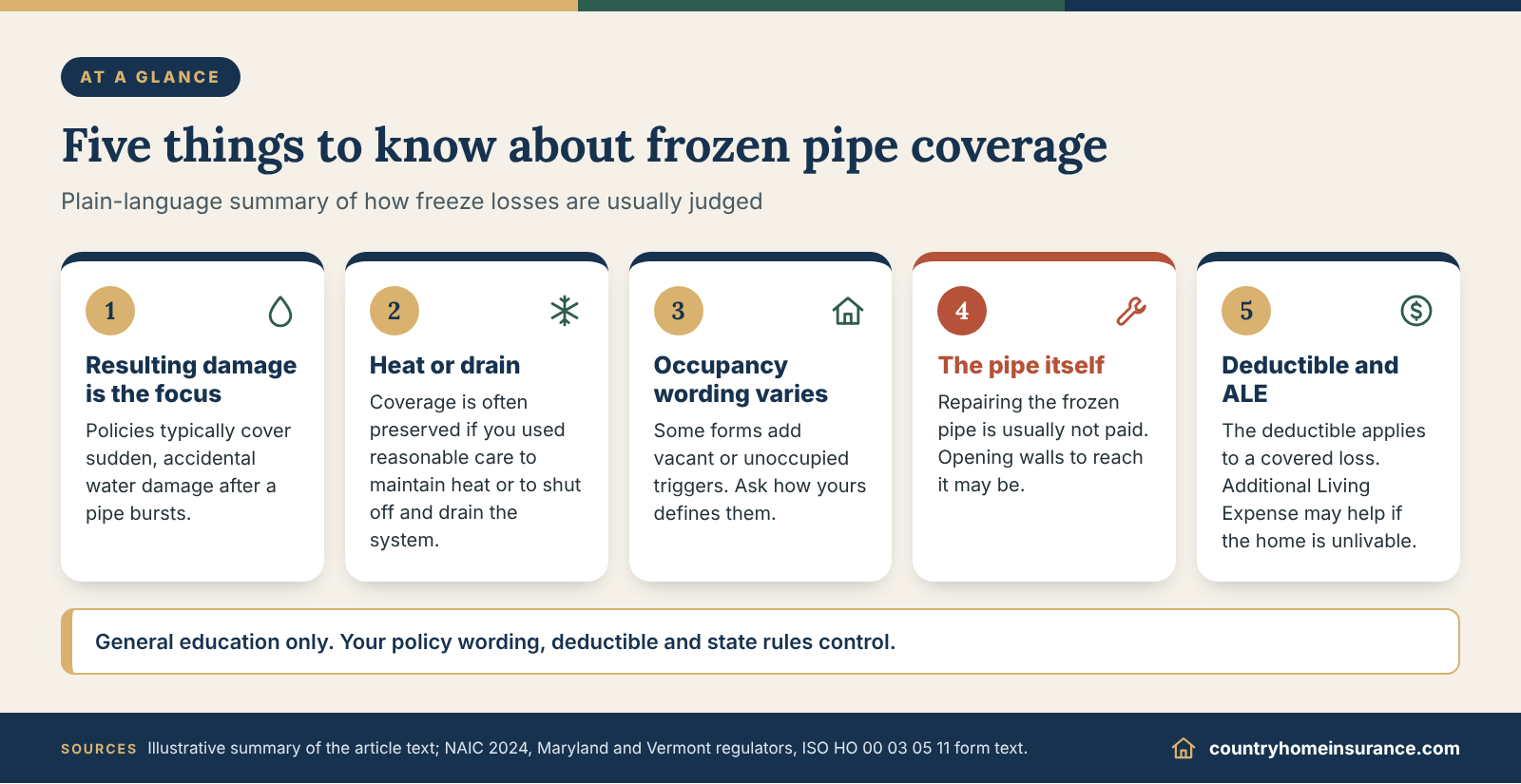
Does homeowners insurance cover frozen pipes? Often yes, for the sudden water damage after a pipe bursts, provided you used reasonable care to keep the home heated or to shut off and drain the water. The pipe repair itself, damage in an unheated or vacant home, and losses blamed on neglect are the usual trouble spots. Your exact policy wording, endorsements, deductible and state rules decide the outcome.
Key takeaways
- Standard homeowners forms typically cover sudden, accidental water damage, and insurers and regulators say burst-pipe damage is often covered when the owner took reasonable steps to prevent freezing.
- The common ISO HO-3 freezing language restores coverage if you used reasonable care to maintain heat or to shut off and drain the system; either one can satisfy the condition.
- Vacancy and unoccupancy wording differs by insurer, so a home you leave for the winter may be treated very differently from one you live in.
- Policies usually pay for the resulting damage and sometimes the cost of opening walls to reach the pipe, but not the repair of the frozen pipe itself.
- Your deductible applies to the covered loss, and Additional Living Expense (ALE) may help if a covered freeze loss makes the home unlivable.
- Keeping thermostat records, maintenance receipts and caretaker logs gives you evidence of reasonable care if an insurer questions it.
Does homeowners insurance cover frozen pipes? The short answer
A frozen pipe is really two events: the freeze, and the water that pours out when the ice splits the pipe or thaws. Homeowners policies mostly respond to the second event. This guide explains the coverage logic, meaning the questions an insurer works through when it decides whether a freeze-related loss falls inside or outside your policy. It is built around the standard ISO HO-3 form (edition HO 00 03 05 11, the form type the NAIC’s 2021 data report shows covering roughly 78 percent of owner-occupied exposures) and notes where insurer-specific forms diverge. Water damage and freezing losses are a large share of homeowners claims: Triple-I reports that the category made up about 20 to 29 percent of homeowners losses each year from 2019 to 2023, at an average cost of about $15,400 per claim over that period. Claim workflow, prevention checklists and general burst-pipe coverage live in separate guides we link along the way.
What “typically covered” means for freeze damage
The baseline from regulators
The National Association of Insurance Commissioners (NAIC) says homeowners policies generally cover water damage from a “sudden and accidental” discharge from a plumbing system, and that burst-pipe damage is often covered if you took reasonable steps to maintain the pipes and prevent freezing (NAIC consumer insight, February 2024). The Maryland Insurance Administration and the Alabama Department of Insurance use almost identical wording. Vermont’s Department of Financial Regulation, in a January 2025 advisory, goes a little further and says most homeowners policies cover damage from frozen or burst pipes while telling readers to check what they must do to keep that coverage.
Why the word “typically” keeps appearing
Regulators speak in general terms because no single national policy exists. The ISO forms are widely used templates, but insurers use their own versions, and the freezing language can differ in important ways. Coverage is a product of your declarations page, base form, endorsements, state rules and the facts of the loss. Nothing here promises that a particular claim will be paid.
Why the answer turns on three tests
Test one: was the water loss sudden and accidental?
Policies are written to cover sudden events, not slow deterioration. A pipe that splits during a hard freeze usually looks sudden. A drip that has run behind a wall for months does not, as the NAIC consumer guide says, policies cover sudden perils rather than gradual deterioration, and some forms add specific wording for constant or repeated seepage or leakage. The timing of the discharge matters even when freezing was the original cause.
Test two: did you meet the freeze condition?
Most freeze language comes with an exception: the exclusion does not apply if you used reasonable care to keep the building heated or to shut off the water supply and drain the systems. That is the center of nearly every freeze dispute, and the next sections break it down.
Test three: what, exactly, is being claimed?
Even a covered freeze loss does not mean every dollar is paid. Resulting damage to floors, drywall, cabinets and belongings is treated differently from the cost of the failed pipe, and your deductible comes off the top. We cover those mechanics in the “what gets paid” section.
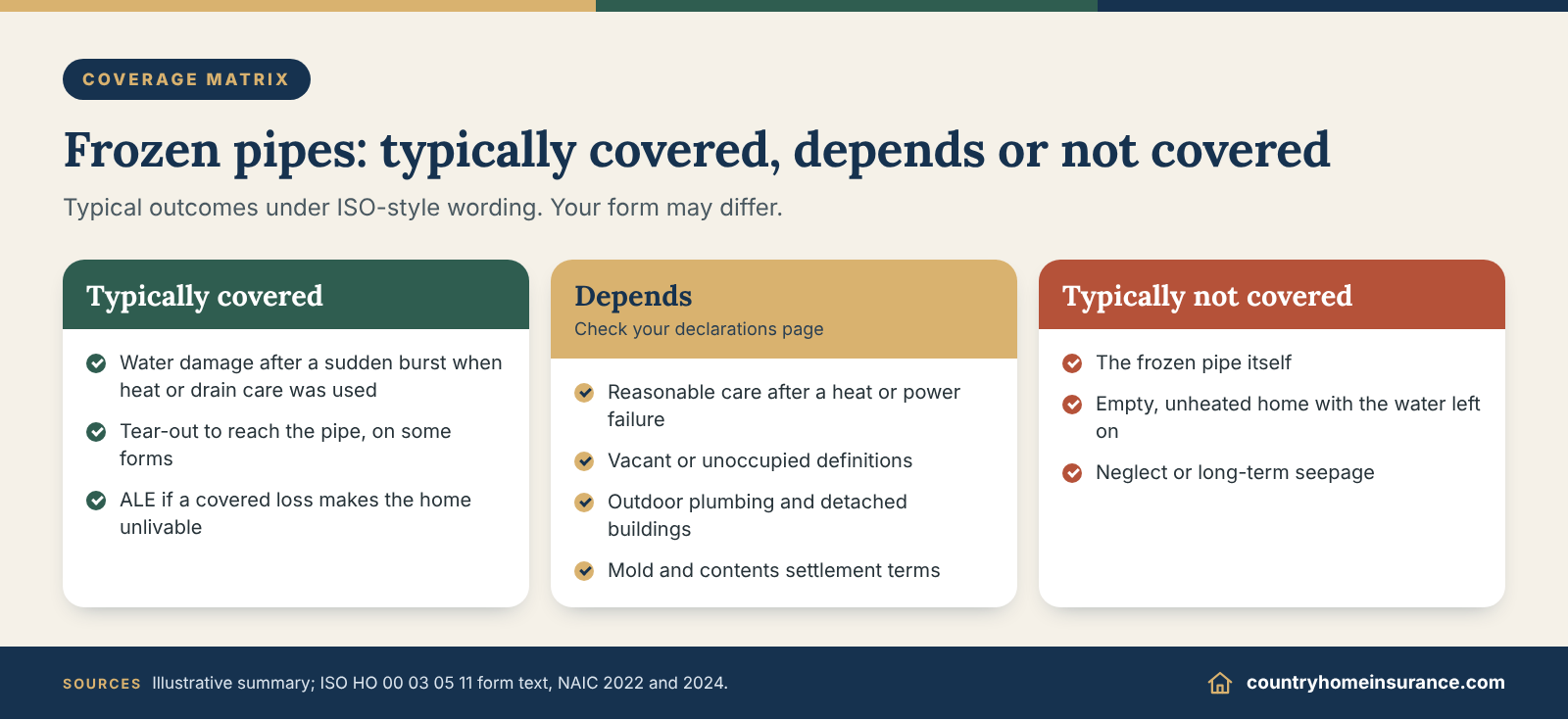
| Situation | Typical outcome | Why it usually lands there |
|---|---|---|
| Pipe bursts in a heated, lived-in home during a cold snap and you kept the heat on | Typically covered: the resulting water damage, subject to your deductible | Sudden discharge; the heat-maintenance exception to the freezing exclusion is met. |
| Furnace fails or power goes out and pipes freeze while you are home or briefly away | Depends on whether you used reasonable care and what the insurer’s evidence shows | Reasonable care is judged case by case; the Texas Department of Insurance has said outages outside the owner’s control are a factor insurers should weigh. |
| Home left empty or unheated, water on, no one checking | Typically not covered for freeze damage | Neither heat was maintained nor was the system drained, so the exception is not met. |
| Cost to repair or replace the frozen pipe itself | Typically not covered; the cost of opening walls to reach it may be | The ISO HO-3 does not pay for the failed system itself but separately addresses tear-out and replacement of building parts needed to repair it. |
| Outdoor plumbing, irrigation lines, hot tubs, hoses | Depends on the form’s definition of plumbing system and where the equipment sits | The ISO wording names specific systems and appliances and carves out sumps, roof drains, gutters and downspouts; other forms word it differently. |
| Hotel or rental costs while repairs make the home unlivable | Depends on whether the underlying loss is covered and on your loss-of-use limit | ALE follows a covered loss; it is not a separate benefit for any freeze. |
The coverage logic: four questions an insurer works through
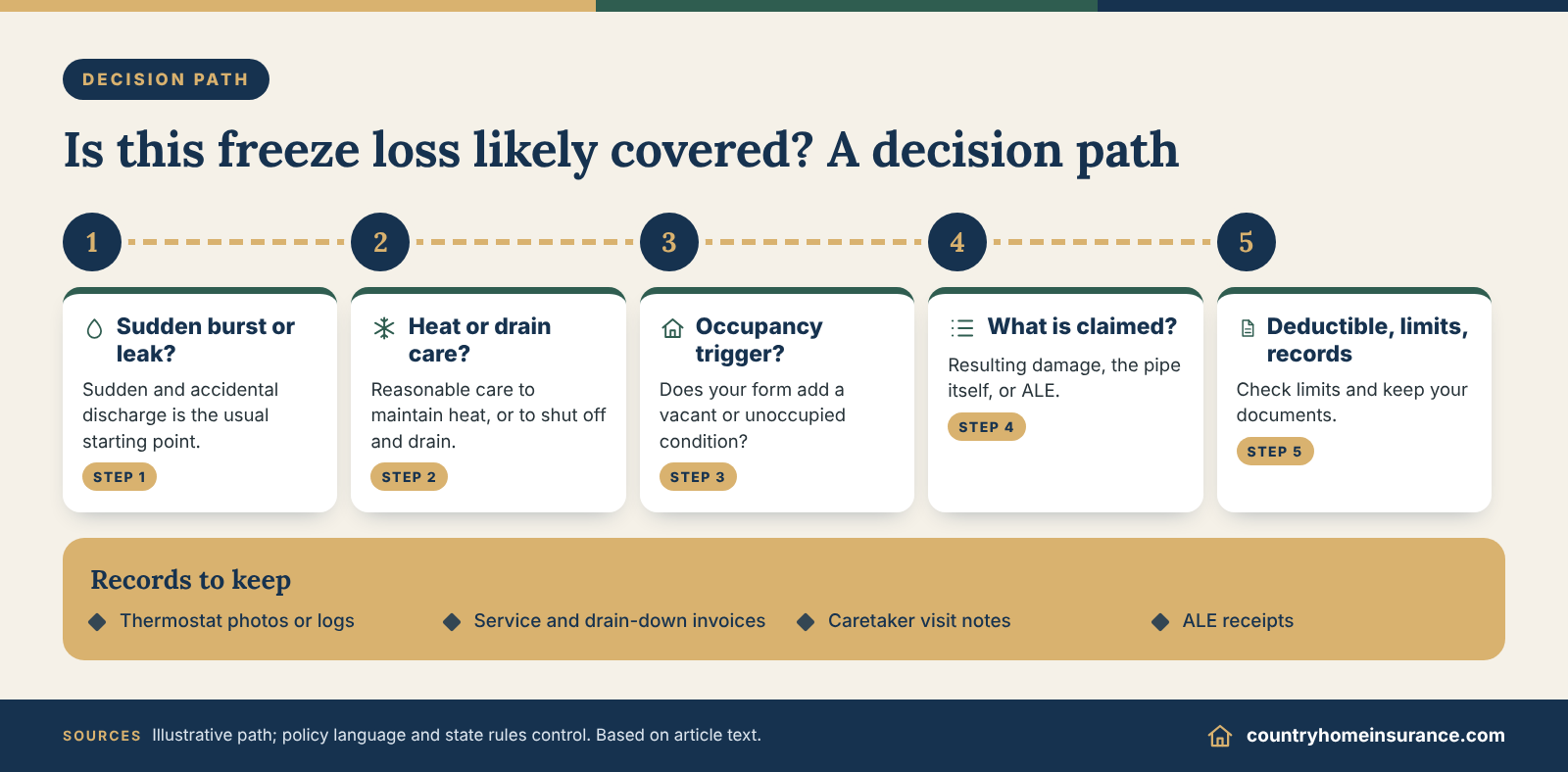
Adjusters rarely ask “was there a freeze?” and stop. They move through a sequence, and knowing the sequence tells you which facts to protect. Think of it as a funnel: a loss has to clear each stage before money changes hands.
Stage one: is freezing-related water damage a covered cause of loss on your form?
The dwelling under an HO-3
An HO-3 is generally an open-perils (all-risk) form for the dwelling and other structures: the NAIC guide explains that special forms cover all perils except those specifically excluded, while basic and broad forms cover only listed perils. So for the house itself, the question is less “is freezing listed?” and more “does an exclusion apply, and does the exception to it restore coverage?” The ISO HO 00 03 05 11 form excludes water damage from a plumbing system when freezing causes the discharge, leakage or overflow, with the heat-or-drain exception described below (ISO HO 00 03 05 11, Section I, Perils Insured Against, as hosted by the Maine Bureau of Insurance). The Florida Office of Insurance Regulation likewise describes HO-3 as covering the dwelling on an open-peril basis.
Personal property and higher-end forms
In the ISO HO-3, belongings (Coverage C) are insured against listed perils, and the freezing peril carries the same reasonable-care condition. The Florida Office of Insurance Regulation describes HO-5 as covering both the structure and belongings on an open-peril basis. Whichever form you hold, the freeze condition tends to travel with the coverage, so check your declarations page for the form number and read the freezing wording for yourself.
Stage two: did the exception to the freezing exclusion apply?
Heat or drain, not both
The ISO wording makes the exception an either/or: the freezing exclusion does not apply if you used reasonable care to maintain heat in the building, or to shut off the water supply and drain the systems and appliances. On the face of the form, satisfying either alternative is enough. Because the text speaks of heat in the building, ask your insurer how it applies the exception to outdoor or detached plumbing, where indoor heat does not help.
The sprinkler wrinkle
If an automatic fire protective sprinkler system protects the building, the ISO form requires you to keep the water supply on and maintain heat, since draining the system would disable the sprinklers. Rural homes rarely have residential sprinklers, but a newer build or a detached shop with one can change the playbook.
Stage three: does a vacancy or occupancy trigger apply?
Forms that ignore occupancy
The standard ISO HO-3 freezing exclusion is not worded around vacancy or occupancy status. The heat-or-drain exception applies to every insured.
Forms that add an occupancy trigger
Some insurer forms do add an occupancy trigger. A USAA Maine special-provisions endorsement (HO-ME 08-16) applies its dwelling freezing exclusion only while the dwelling is vacant, unoccupied or under construction, and it attaches the reasonable-care condition to a freezing peril while the dwelling is unoccupied. The policy at issue in the Zimmerman case discussed below likewise excluded freezing losses while the residence was vacant or unoccupied unless reasonable care was used to maintain heat. Insurers differ, so we give vacancy its own section below.
Stage four: what is being paid for?
Separating the loss into pieces
Adjusters typically itemize: water damage to the building, damage to personal property, the pipe or fixture that failed, drying and mitigation, and loss-of-use expenses. Each piece may run through a different coverage part, limit or exclusion.
Why itemizing helps you too
If you understand which line sits where, you can see why a payment looks smaller than the total invoice. The deductible, any depreciation under actual cash value (ACV) settlement, and excluded items all show up at this stage.
Maintaining heat: what “reasonable care” means in practice
The phrase “reasonable care to maintain heat in the building” sounds precise but is not. Neither ISO nor most regulators publish a required temperature, and that gap is where many disagreements start.
What the wording does and doesn’t say
No thermostat number in the form
The ISO form sets no thermostat temperature, and the guidance from Maryland, Alabama and the NAIC says only that policies generally expect a minimum temperature, without naming a number. Your policy wording, not a rule of thumb, sets the standard, so ask your agent whether the insurer has published any more specific expectation.
Reasonable care is not a guarantee of freeze-proofing
The wording asks whether you used reasonable care to maintain heat or to shut off and drain, not whether the pipes survived. That distinction matters in practice, but insurers and courts can still disagree about what care was reasonable, as the court case below shows.
The evidence that tends to matter
Thermostat, utility and equipment records
Investigators and adjusters can look at thermostat settings, utility usage, service records and sometimes smart-thermostat histories. In the Zimmerman case discussed below, the insurer pointed to gas and electric bills, the thermostat setting, the absence of a remote alarm or monitoring system and the condition of the house to argue that heat was not reasonably maintained.
Known weak spots
The ISO form also excludes loss caused by neglect, which it describes as failing to use all reasonable means to save and preserve property at and after a loss, and the NAIC says an insurer that finds freeze prevention was neglected may deny burst-pipe damage. Practical steps from the Insurance Institute for Business and Home Safety (IBHS), such as insulating pipes in attics and crawl spaces, sealing exterior gaps and covering ventilated crawl spaces, double as evidence that you cared for the plumbing. Our first freeze insurance checklist covers those steps in a ready-to-use list.
When the heat fails through no fault of yours
Power outages and equipment failure
After the February 2021 winter storm, the Texas Department of Insurance issued Bulletin B-0010-21 (updated January 2022). It says some property policies cover freeze damage if the policyholder reasonably tried to keep the home heated or to shut off and drain the pipes, that this is judged case by case, and that long power outages outside the owner’s control, earlier messages that outages would be short, and icy conditions that made shutoff hard were factors insurers should weigh. That bulletin is Texas guidance tied to a specific event; other states may handle such situations differently, and it does not guarantee any outcome.
When a reasonable-care dispute reaches court
In Zimmerman v. Leatherstocking Cooperative Insurance Co. (New York Supreme Court, Saratoga County, January 31, 2023), a homeowner on an extended trip of more than a month said a failed boiler control unit, not negligence, cut the heat. The insurer argued that the house was vacant or unoccupied, that gas and electric bills showed insufficient heating, that the thermostat was not set to maintain heat, that no remote alarm was installed and that the house was drafty. The court denied both sides’ motions for summary judgment because factual questions remained about whether reasonable care was used. The lesson is that reasonable care is often a fact question, and good records are the best evidence on it.
Vacancy, unoccupancy and seasonal homes
If heat maintenance is the most argued condition, occupancy is the least understood. People use “vacant” and “unoccupied” interchangeably; insurers and courts often do not, and the difference can decide a freeze claim.
Vacant versus unoccupied
How the forms use the terms
The ISO HO-3 form does not define vacant. It uses the word only in its 60-consecutive-day provisions and states that a dwelling under construction is not considered vacant. The USAA Maine endorsement also leaves vacant, unoccupied and under construction undefined. Because these terms can go undefined, ask the insurer how it reads them for a furnished home whose owners are away for a season compared with a home that is empty.
How courts have read them
When a policy leaves the terms undefined, a court may be asked to decide what they mean, and the answer can turn on state law and facts such as whether the home is furnished and whether anyone is living there. In the Zimmerman case the court declined to apply a separate vacancy-based exclusion because the insurer had not raised it in its answer or disclaimer and the provision was ambiguous.
Different forms, different triggers
Freeze exclusions tied to occupancy
As noted, some insurer forms restrict the freezing exclusion to periods when the dwelling is vacant, unoccupied or under construction, while the ISO wording applies regardless. Both approaches point the same direction for a house that sits empty in January: get the plumbing drained or the heat reliably on.
The separate 60-day vacancy clause
In the ISO HO-3, the vandalism and malicious mischief exclusion applies if the dwelling has been vacant for more than 60 consecutive days right before the loss, and glass breakage is not covered after the same period. That clause is about other perils, not freezing, but it illustrates how a long vacancy can quietly narrow a policy. Your own form may carry different day counts.
Second homes, cabins and long absences
What regulators suggest for time away
Vermont’s January 2025 advisory suggests keeping the thermostat warmer while you are away, since that buys time if the power fails, and either shutting off and draining the plumbing or having someone check periodically that the heat is working. Maryland and the NAIC add that policies generally expect water to be shut off in a vacant home.
Questions to settle before you leave
Ask your agent how your policy defines vacant and unoccupied, how many consecutive days trigger any limitation, and whether the insurer wants notice of a seasonal absence. If you will be gone through winter, a documented drain-down is generally a stronger position than relying on a thermostat alone; a caretaker’s dated visit log supports either approach. Never assume a family member’s occasional visit counts as occupancy.
What gets paid: resulting water damage versus the pipe itself
Once a freeze loss clears the coverage hurdles, the next question is which costs the insurer pays. This is the stage where expectations and settlements most often diverge.
Resulting water damage to the home and belongings
Building materials and finishes
Water from a burst pipe can ruin drywall, insulation, flooring and cabinets. Where the loss is covered, these repairs generally fall under Coverage A (Dwelling), which includes built-in parts such as plumbing, wiring and heating according to the NAIC guide. Colorado’s Division of Insurance, in a February 2021 advisory, similarly describes resulting damage to flooring, cabinets and belongings as generally falling under homeowners policies.
Personal property and mold
Damaged furniture, electronics and clothing fall under Coverage C (Personal Property), which has its own limit and may be settled at actual cash value (ACV, which subtracts depreciation) or replacement cost value (RCV) depending on your policy. Mold is a separate worry: Triple-I notes that its water damage and freezing loss category includes mold damage only when the policy covers it, and the NAIC guide says most homeowners policies offer limited or no mold coverage. The ISO HO-3 excludes mold, fungus and wet rot except for hidden mold inside walls, ceilings or floors that results from accidental discharge from a plumbing or similar system on the premises.
The pipe, tear-out and access costs
Why the failed pipe is often excluded
Many homeowners forms do not pay to repair the system or appliance from which water escaped. The ISO HO-3 covers water damage from an on-premises plumbing system and pays the cost to tear out and replace part of the building only when that is necessary to repair the system, but the system itself is not covered.
Tear-out and the “whole system” question
How far tear-out reaches can be disputed, for example when a plumber recommends replacing a whole run of pipe rather than one section. Ask your insurer in writing how it treats access costs before you hire a plumber to open walls, and keep the plumber’s explanation of why each opening was needed. For detached buildings, the ISO form pays tear-out only if the water actually damages a building on the residence premises.
Outdoor, detached and special equipment
Hoses, spigots and irrigation
Outdoor faucets and irrigation lines are common failure points. IBHS notes that homes built before 2010 typically lack frost-proof outdoor faucets, and recommends shutting off and insulating them. Because the heat-maintenance idea fits poorly with exterior plumbing, shutting off and draining outdoor lines is the more defensible form of care. Whether the damage is covered still depends on the form.
Sumps, gutters and detached buildings
The ISO wording does not treat sumps, sump pumps, roof drains, gutters and downspouts as plumbing systems for the freezing provisions. A detached garage or barn is typically Coverage B (Other Structures), which is a separate limit; ask whether the same freeze wording governs it. For water that enters from outside rather than from a pipe, see our guide to water backup coverage.
Deductibles, limits and Additional Living Expense
The money side of a freeze claim is governed by a handful of numbers on your declarations page. None of them is exotic, but each can change what lands in your bank account.
How the deductible works
Per-claim out-of-pocket amount
The NAIC guide defines a deductible as the amount you pay out of pocket on each claim before the insurer pays, and notes that a higher deductible generally lowers premium. For a freeze loss, the deductible is subtracted from the covered portion of the loss, not the invoice total, so excluded items such as the failed pipe do not reduce your deductible.
Which deductible applies
Maryland’s guidance tells readers to ask which deductible applies to a freeze claim. The NAIC guide says some locations use catastrophe deductibles stated as a percentage rather than a dollar amount, so read your declarations and any wind/hail or catastrophe sections to see every deductible listed. Under the ISO form, if two or more deductibles apply to one loss, only the highest one applies.
Hypothetical example: Suppose a supply line in an exterior wall splits and the covered water damage is estimated at $14,000, the plumber’s charge to replace the pipe is $650, and your deductible is $2,500. If the pipe repair is excluded and the damage is covered, the insurer would measure the loss at $14,000, subtract the $2,500 deductible, and pay about $11,500 before any depreciation holdback. You would pay the $650 plumber charge and the deductible yourself. These figures are invented for illustration and do not predict any real settlement.
Loss of use and Additional Living Expense
When ALE is triggered
Additional Living Expense (ALE), sometimes labeled Coverage D or loss of use, helps with extra costs such as a hotel while a covered loss makes the home uninhabitable. Colorado’s advisory says ALE may apply when burst-pipe water damage makes the home uninhabitable, and advises keeping receipts. ALE follows a covered cause of loss; if the freeze itself falls under an exclusion, the housing costs generally do too.
Limits and time caps
The NAIC guide gives 20 percent of the dwelling limit as a typical loss-of-use limit but says policies may use different percentages. The ISO HO-3 states one Coverage D limit on the declarations that applies to additional living expense, fair rental value and civil authority combined, and it pays the necessary increase in living costs for the shortest time needed to repair or replace the damage or to settle elsewhere. ALE pays for the increase over your normal living costs, not for costs you would have had anyway.
Limits that can quietly constrain a payout
Coverage limits and settlement terms
Coverage A, B and C each have a limit, and losses settle at RCV or ACV depending on your policy. A freeze that wrecks a kitchen and a finished basement can touch several limits at once.
Premium and claims-history effects
Ask your agent how a freeze claim might affect your premium or renewal; your state Department of Insurance can explain the rules where you live. See our guide to how much homeowners insurance you need for the limits question.
| Factor | What it does | What to verify |
|---|---|---|
| Deductible | Subtracted from the covered loss per claim | Dollar or percentage amount; whether a separate deductible applies to water or freeze losses |
| Coverage A limit | Caps repairs to the house, including built-in plumbing and finishes | Whether the limit is enough for a major interior water loss and whether settlement is RCV or ACV |
| Coverage C limit | Caps payment for damaged belongings | Contents settlement basis; special limits for certain items |
| Coverage D (loss of use) | Pays extra living costs after a covered loss | The dollar limit on the declarations and how long payments last; receipt requirements |
| Freezing wording | Defines the heat-or-drain condition and any vacancy trigger | Exact exclusion text; definitions of vacant and unoccupied |
| Mold limits | May cap or exclude mold that follows water damage | Mold sublimit or exclusion; any related endorsement |
Exclusions and common reasons freeze claims are denied
Denials usually trace back to a short list of reasons. Understanding them helps you prepare and, if needed, ask better questions of your insurer.
Freeze-specific reasons
Heat off, system not drained
If a house is unheated and the water is still on, the exception does not apply. Maryland, Alabama and the NAIC all say policies generally require a minimum home temperature or a water shutoff when the home is vacant, and that neglect of the plumbing can lead to denial of burst-pipe damage.
Failure to protect the property after the loss
The NAIC guide says you are expected to protect the property, such as cleaning up after water damage. Letting wet materials sit or running water continue after you discover a break can create a second problem on top of the first. Colorado also advises taking steps to prevent further damage but getting the insurer’s instructions before making repairs.
Neglect, wear and slow leaks
Wear and tear and maintenance issues
The NAIC guide notes that wear, tear and routine upkeep are not covered; the policy protects against sudden perils, not maintenance. An old corroded pipe that fails in the cold may draw questions about whether freezing or deterioration was the real cause.
Seepage over time
Gradual leaks are usually distinguished from sudden bursts. The ISO HO-3 limits coverage for wear and tear, deterioration, rust and corrosion, and a USAA Maine endorsement has wording for constant or repeated seepage or leakage over a 14-day period, with an exception for leaks hidden inside walls, floors or ceilings. For appliance-originated leaks, see appliance leak claims and, for tank failures, water heater leak claims.
When the cause of loss is disputed
Freeze versus failed part
The wear-and-tear limitation and the freezing exclusion are separate provisions, so if the cause is disputed, for instance a failed shut-off valve versus a freeze, ask the insurer to identify which provision it relies on and the facts behind it. A state Department of Insurance or a licensed attorney can explain how cause-of-loss disputes are handled where you live.
Related burst-pipe questions
Burst pipes caused by pressure, corrosion or construction defects raise different coverage questions than freezing. Our burst pipe coverage guide addresses the broader picture, and the burst pipe claim guide walks through the claim steps.
How the logic plays out: freeze scenarios side by side
Abstract rules get clearer when you run them against real-life situations. The scenarios below are simplified composites, not predictions, and each assumes the policy follows the ISO-style wording described above. Insurer-specific forms can change the answer.
You are home, and something fails
Heat on, pipe in an exterior wall bursts anyway
This is the classic covered pattern. You kept the home heated, the pipe sat in a cold wall cavity, and the water was sudden. Because the wording asks about the care you used rather than whether the pipes survived, the exception is typically satisfied. Expect the insurer to look at your heating records and the condition of insulation, and expect the pipe repair itself to fall outside the payment.
Furnace breaks overnight, then pipes freeze
If a heating failure you did not cause leaves the house cold, your efforts after you notice it matter: calling for repair, shutting off the water, opening cabinet doors and using safe supplemental heat. Whether this lands as covered depends on the facts and how the insurer views the maintenance history of the system. Keep the service invoice.
You are away from the house
A one-week winter trip
A short absence of a furnished, heated home is the scenario least likely to raise a vacancy question, although definitions vary by form. Lowering the thermostat is the risk. Vermont’s advisory points the other way, suggesting a warmer setting while away so a power loss does not freeze things quickly.
A cabin closed for the season
A home left unheated with the water on is the highest-risk scenario. If you drain the system and shut off the water, the shutoff-and-drain alternative may preserve coverage, though the exact wording and any vacancy provision control. Without draining and without reliable heat, the freezing exception is hard to meet.
Other occupancy arrangements
Rentals and tenant-occupied homes
If you rent the house to a tenant, check which policy form applies. The ISO HO-3 defines the residence premises as the dwelling where you live, so a rented-out house is typically insured on a different form, and the wording on heat and occupancy can differ. Ask who is responsible for keeping the heat on and how the insurer will document it.
Homes for sale or under renovation
A home that is empty while listed for sale, or that is under renovation, can fall into vacancy or construction wording on some forms. If this is you, tell your agent early; a vacancy or renovation endorsement or a different form may be needed.
| Scenario | Typical coverage outlook | Evidence that often matters |
|---|---|---|
| Occupied home, heat on, exterior-wall pipe bursts | Typically covered for resulting damage; pipe itself typically not covered | Thermostat history, insulation condition, plumber’s report |
| Furnace or boiler fails while the family is home | Depends on reasonable care before and after the failure | Service records, repair call time, shutoff steps taken |
| Extended power outage in a regional storm | Depends; regulators such as Texas have said reasonable care is judged case by case | Outage records, whether shutoff and drain were possible and safe |
| Furnished home, owners away one week, heat set low | Depends on the thermostat setting and policy language | Thermostat setting, utility use, neighbor or caretaker checks |
| Seasonal cabin drained and water shut off | Typically covered if the drain-and-shutoff condition is satisfied and no other exclusion applies | Dated drain-down record, plumber invoice, photos of open drains |
| Empty home, no heat, water on, no checks | Typically not covered for freeze-related water damage | Utility shutoff dates, absence of visits, thermostat state |
Country and rural properties: where freeze coverage gets tricky
A rural property often has more plumbing in more places, and heat sources that depend on delivered fuel or a single electric service. Those features raise both freeze risk and the number of coverage questions. For the broader picture of insuring country property, see our rural home insurance guide.
Wells, pump houses and outdoor water lines
Well equipment and pressure tanks
Pump houses, pressure tanks and the buried line between a well and the house freeze for different reasons than interior pipes. Standard homeowners wording may treat the equipment differently depending on whether it is part of the dwelling, in a detached structure or underground. Ask your agent in writing how your form treats well pumps, pressure tanks, pump houses and the underground water line, because the answer can change a decision about heat tape, insulation or an endorsement.
Frost-proof hydrants and stock water
Livestock waterers and yard hydrants are exposed plumbing. IBHS notes older homes often lack frost-proof outdoor faucets, so shutting off and draining exterior spigots is the realistic way to show care. Ask whether farm or hobby-farm use of a structure changes which policy applies; our acreage coverage guide covers that boundary.
Outbuildings, shops and guest cottages
Coverage B and its freeze wording
Detached garages, sheds and guest cottages are generally Coverage B (Other Structures), according to the NAIC guide, and the ISO form calculates the Coverage B limit as 10 percent of the Coverage A limit; check your declarations for the amounts on your policy. Ask whether the freezing exclusion language and reasonable-care condition are the same for them. A heated workshop and an unheated machine shed with a wash sink are not the same risk.
Plumbing in rarely visited buildings
Buildings that are visited only occasionally are the most likely to be judged unoccupied or neglected. Keep a visit log, and if the building has no heat source, consider draining the lines and shutting off the supply at the main so you can document the shutoff-and-drain option.
Heat sources, fuel and power outages
Propane, oil and wood heat
If heat depends on a delivered fuel, running out of fuel is a heat failure with a paper trail: delivery tickets, tank gauges and delivery schedules can help show you managed supply reasonably. A fuel-delivery contract with automatic top-ups is a documented form of care.
Backup power and monitoring
IBHS reminds readers that pipes and interior sprinklers can freeze during power outages. Vermont suggests considering a leak detection monitor with automatic shutoff, especially if you are away for long periods. Ask your insurer whether such devices earn any premium credit.
Questions to ask your insurer or agent before winter
The most useful way to know if your policy covers frozen pipes is to ask specific questions and keep the answers in writing. Agents sell and service policies, but only the policy language and a claim decision resolve a coverage dispute.
Wording to locate in your policy
The freezing exclusion and its exceptions
Search your policy form for the word “freezing.” Note whether the exception requires heat or draining, whether it mentions a vacant or unoccupied dwelling, and whether sprinkler systems are addressed. Ask the agent to point to the page. If you cannot get a clear explanation, Vermont’s advisory says to contact the state insurance regulator’s consumer services section.
Definitions and conditions
Check the definitions of “vacant,” “unoccupied” and “residence premises” and any condition requiring you to notify the insurer about an extended absence. These details separate a standard answer from yours.
Coverage options and endorsements
Endorsements that touch water damage
Water backup coverage is the best-known water-related endorsement, but it addresses drains and sumps, not frozen supply lines. Ask whether any endorsement on your policy changes the freeze, water-damage, mold or vacancy terms, and whether the insurer offers a vacancy or seasonal-use endorsement.
Higher limits for the exposed pieces
If you have a finished basement, a guest cottage, or expensive contents, ask how Coverage A, B and C limits would respond to a major interior water loss, and whether a higher deductible would meaningfully change your premium.
Building a record of reasonable care
What to keep
Keeping records of your preventive steps gives you evidence if the insurer questions whether you took reasonable precautions. Colorado’s advisory stresses saving receipts and records after a loss, and the ISO form requires you to keep an accurate record of repair expenses. Useful records include thermostat photos or smart-thermostat logs, HVAC service invoices, pipe-insulation receipts, drain-down invoices, fuel delivery tickets and caretaker visit notes with dates.
A pre-winter walk-through
Once a year, before the first hard freeze, walk the property with your policy and this list in hand. The freeze checklist lays out the preparation tasks, so this article uses the action table below to focus on what to verify and document for coverage purposes.
| Step | What to do | Why it matters for coverage |
|---|---|---|
| Find the freezing wording | Locate the exclusion and exception in your base form and endorsements | Shows whether heat, draining or both preserve coverage |
| Confirm occupancy terms | Ask how the policy defines vacant and unoccupied and what notice is required | Occupancy triggers can change the freeze result |
| Set and record heat | Keep steady heat, photograph the thermostat, save utility statements | Evidence of reasonable care to maintain heat |
| Plan for absences | Choose drain-and-shut-off or reliable heat plus checks; record dates | Either condition may satisfy the exception |
| Check limits and deductible | Read Coverage A, B, C, D limits and the deductible on the declarations page | Determines out-of-pocket cost and payment ceilings |
| Photograph and inventory | Keep a home inventory stored off-site | Colorado’s advisory says claims often stall when the inventory of damaged property is missing |
If a freeze loss happens: the coverage-focused first moves
The full claim workflow has its own guides. What follows is only the part that protects your coverage position.
Protect the home and the claim
Stop the water and limit the damage
Shut off the main water supply if it is safe to do so, and take reasonable steps to prevent further damage. The NAIC guide states that protecting the property is expected of policyholders. Photograph the damage before you move or discard anything.
Call before you commit to major repairs
Colorado’s Division of Insurance advises contacting your insurer as soon as possible and getting the company’s instructions before making repairs beyond emergency steps. Submit documents together where possible, since sending them piecemeal slows processing. Our frozen pipe insurance claim guide covers the full sequence, from adjuster visit to payment.
If the insurer says no
Ask for the specific provision
Ask the insurer to identify, in writing, the policy language and the facts it relied on. A denial that cites “freezing” should say whether it rests on heat, draining, occupancy or something else.
Where to turn next
The NAIC guide suggests trying to resolve disagreements with your insurer first, then checking your policy for an appraisal clause, or considering a public adjuster or an attorney; your state insurance department can also help. For questions that depend on your state’s law, a licensed attorney or the department of insurance can speak to your situation in ways general guides cannot.
Frequently asked questions
Coverage basics
Is a frozen pipe covered by homeowners insurance?
The resulting water damage is often covered when the discharge is sudden and you used reasonable care to maintain heat or shut off and drain the system. The frozen pipe itself is usually not paid. Policy language, endorsements and state rules decide the outcome.
Does homeowners insurance cover a pipe that is frozen but has not burst?
Generally no payment is due until there is a covered loss, such as a discharge of water. A thawing cost, a plumber’s visit or insulation is typically maintenance. Ask your insurer if you have a specific situation.
Is a burst pipe the same as a frozen pipe for coverage?
Not exactly. Burst pipes can have causes other than freezing, such as pressure or corrosion, and those face different exclusions. Our burst pipe coverage guide compares them.
Heat, vacancy and records
What temperature must I keep my house to stay covered?
The standard wording sets no number, and regulator guidance generally refers to a minimum temperature without naming one. Your policy language and the facts of your case decide what is reasonable, so ask your agent whether the insurer has published a more specific expectation.
Am I covered if I go on vacation for a month?
It depends on your form. Some forms apply the freezing exclusion regardless of occupancy; others apply it when the home is vacant or unoccupied. Keeping heat on, or draining the system, and documenting the arrangements gives you the best footing.
What if the power went out and the heat could not be kept on?
Texas regulators said reasonable care is judged case by case and recognized outage-related obstacles after the 2021 storm. Other states may differ. Keep outage records and document what you did to protect the home.
What records prove reasonable care?
Thermostat settings or smart-thermostat logs, utility bills, HVAC service invoices, drain-down receipts, caretaker logs and photos are the main categories. Colorado’s insurance division stresses saving receipts and records after a loss.
Money and claims
Will insurance pay to repair the pipe that froze?
Usually not the pipe itself. Some policies pay the cost of tearing out and replacing part of the building to reach the leak. Ask how your policy treats access costs.
Does homeowners insurance pay for a hotel after a pipe bursts?
Additional Living Expense may help if a covered loss makes the home uninhabitable, subject to your loss-of-use limit. Keep receipts.
Will my deductible apply to a frozen pipe claim?
Yes, a deductible generally applies to covered losses. Ask whether a different deductible applies to water damage on your policy.
Where can I find the full claim steps?
See the frozen pipe insurance claim guide and the burst pipe claim guide for the workflow. The freeze checklist covers preparation.
Sources
- NAIC — Will My Homeowners Insurance Policy Cover Water Damage From a Burst Pipe? (Consumer Insight, February 8, 2024; accessed 2026-10-16)
- NAIC — A Consumer’s Guide to Home Insurance (2022 edition; accessed 2026-10-16)
- Maryland Insurance Administration — Protect Your Pipes (accessed 2026-10-16)
- Maryland Insurance Administration — Consumer Advisory: Frozen Pipes (accessed 2026-10-16)
- Vermont Department of Financial Regulation — Consumer Advisory: Frozen Pipes (January 22, 2025; accessed 2026-10-16)
- Alabama Department of Insurance — Will a homeowners policy cover damage from a pipe that bursts? (February 8, 2024; accessed 2026-10-16)
- Colorado Division of Insurance — Consumer Advisory: Insurance tips on burst pipes claims (February 25, 2021; accessed 2026-10-16)
- Texas Department of Insurance — Bulletin B-0010-21, frozen pipe claims after the February 2021 winter storm (issued March 9, 2021; updated January 6, 2022; accessed 2026-10-16)
- Insurance Information Institute (Triple-I) — Facts + Statistics: Homeowners and renters insurance (data for 2019-2023; accessed 2026-10-16)
- Insurance Institute for Business and Home Safety — Winter Ready (accessed 2026-10-16)
- New York Supreme Court, Saratoga County — Zimmerman v. Leatherstocking Cooperative Insurance Co., 2023 NY Slip Op 30314(U) (January 31, 2023; accessed 2026-10-16)
- USAA — Form HO-ME (08-16), Maine Special Provisions endorsement (2016; hosted by the Maine Bureau of Insurance; accessed 2026-10-16)
- Insurance Services Office — Homeowners 3 Special Form, HO 00 03 05 11 (2011 edition; copy hosted by the Maine Bureau of Insurance; accessed 2026-10-16)
- NAIC — NAIC Releases Homeowners Insurance Report for 2021 (2024-01-04; accessed 2026-10-16)
- Florida Office of Insurance Regulation — Homeowners insurance (accessed 2026-10-16)
Important coverage note
Coverage depends on the actual policy, endorsements, exclusions, limits, deductible and cause of loss. Freezing language, vacancy definitions, loss-settlement terms and claim rules vary by insurer, form edition and state, and the court and regulator materials cited here reflect specific facts and jurisdictions. This article is educational and is not legal advice or a coverage determination. For questions about your own policy or claim, read your declarations page and policy form and contact your insurer or agent; your state Department of Insurance or a licensed attorney can help with disputes.
About the editorial team
This guide was prepared by the countryhomeinsurance.com editorial team as general, educational information for homeowners. We research and summarize publicly available material, including state insurance departments, the NAIC, federal agencies, regulators’ consumer guides and published insurer and industry resources. We draw only on the sources that were available to us when we wrote this guide, and we list them in the Sources section with dates where we could find them.
Insurance rules, rates, products and program terms change, differ by state and by insurer, and can apply differently to your situation. We cannot guarantee that this content is complete, current or free of errors. It is not legal, financial, tax or insurance advice, it is not an offer to sell insurance or a recommendation of any insurer, agent or product, and reading it does not create a professional relationship of any kind.
To the fullest extent permitted by law, countryhomeinsurance.com and its editorial team, authors and contributors exclude all liability for any loss, damage or decision arising from the use of, or reliance on, this content. For questions about your own policy or claim, contact your insurer, a licensed agent or broker, your state Department of Insurance or another qualified professional.
Content created: October 16, 2026