Quick answer
Claims history homeowners insurance rates are shaped by what your insurer and the industry’s loss databases show about past losses on you and on your property. Filed claims, including some that were denied or paid nothing, can stay in the CLUE database for up to seven years, although an insurer’s own pricing window may be shorter. The effect varies by insurer, claim type and state. It can appear as a higher premium, a lost discount, a higher deductible or, less often, nonrenewal.
Key takeaways
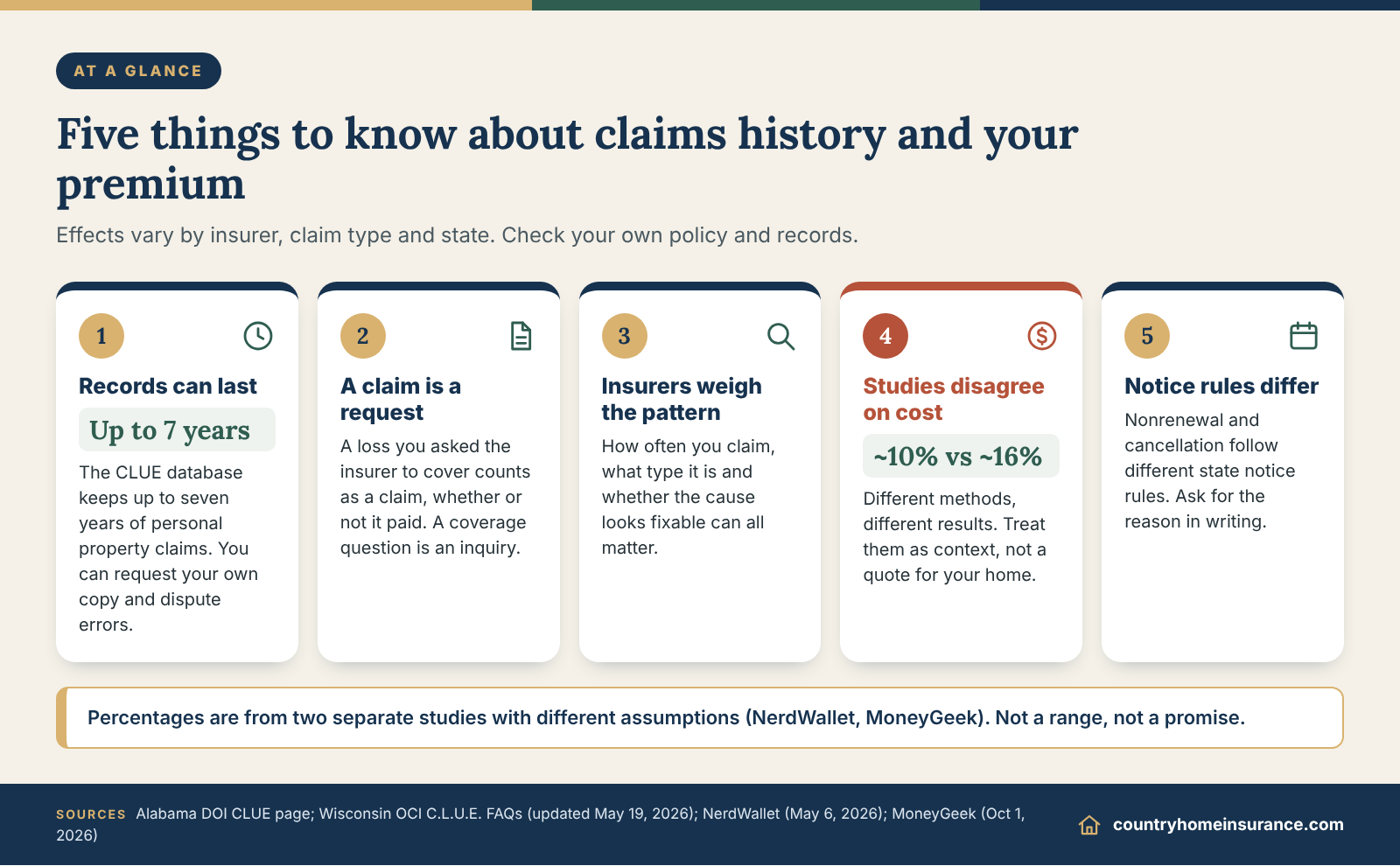
- The main claims database consumers hear about, CLUE, holds up to seven years of personal property claims, according to the Alabama and Wisconsin insurance departments. You can request your own copy and dispute errors.
- A claim is a loss you asked the insurer to cover, whether or not it paid. A general inquiry about coverage is different, but the line blurs if you describe an actual loss.
- Published studies disagree on how much one claim costs. NerdWallet found about 10 percent; MoneyGeek found about 16 percent. Their methods differ, so treat both as context, not a quote.
- Insurers weigh how often you claim, what type of claim it is and whether the cause looks fixable. One water claim and one hail claim may be treated differently.
- Nonrenewal and cancellation are separate events with different notice rules, and those rules vary by state. Ask for the reason in writing.
- For small losses, do the math before you file: compare the repair estimate, your deductible and the possible cost at renewal, and ask your insurer how it handles claims.
| Record or term | What it is | How long it may matter | Why it matters to you |
|---|---|---|---|
| CLUE report | A claims history database run by LexisNexis that insurers use to price or underwrite a policy | Up to seven years of personal property claims, per the Alabama and Wisconsin insurance departments | Can influence quotes and eligibility when you apply with a new insurer |
| Insurer’s own loss record | The claims your current insurer has handled on your policy | Varies by insurer; ask how far back its rating plan looks | Most insurers rely on it at renewal instead of pulling a new CLUE report, according to those two departments |
| Application questions | Questions about prior losses and claims on your application | Depends on the wording of each question | Answer exactly as asked; inaccurate answers can create cancellation or claim problems |
| Inquiry | A general conversation with an insurer or agent about coverage, not a request to pay a loss | Not supposed to be reported to CLUE, per the Alabama page | Be clear whether you are asking a question or reporting a loss |
| Occurrence | A loss that was never reported or never became a processed claim (Washington’s definition) | Insurers may still ask about it on an application | Unreported does not always mean undisclosed |
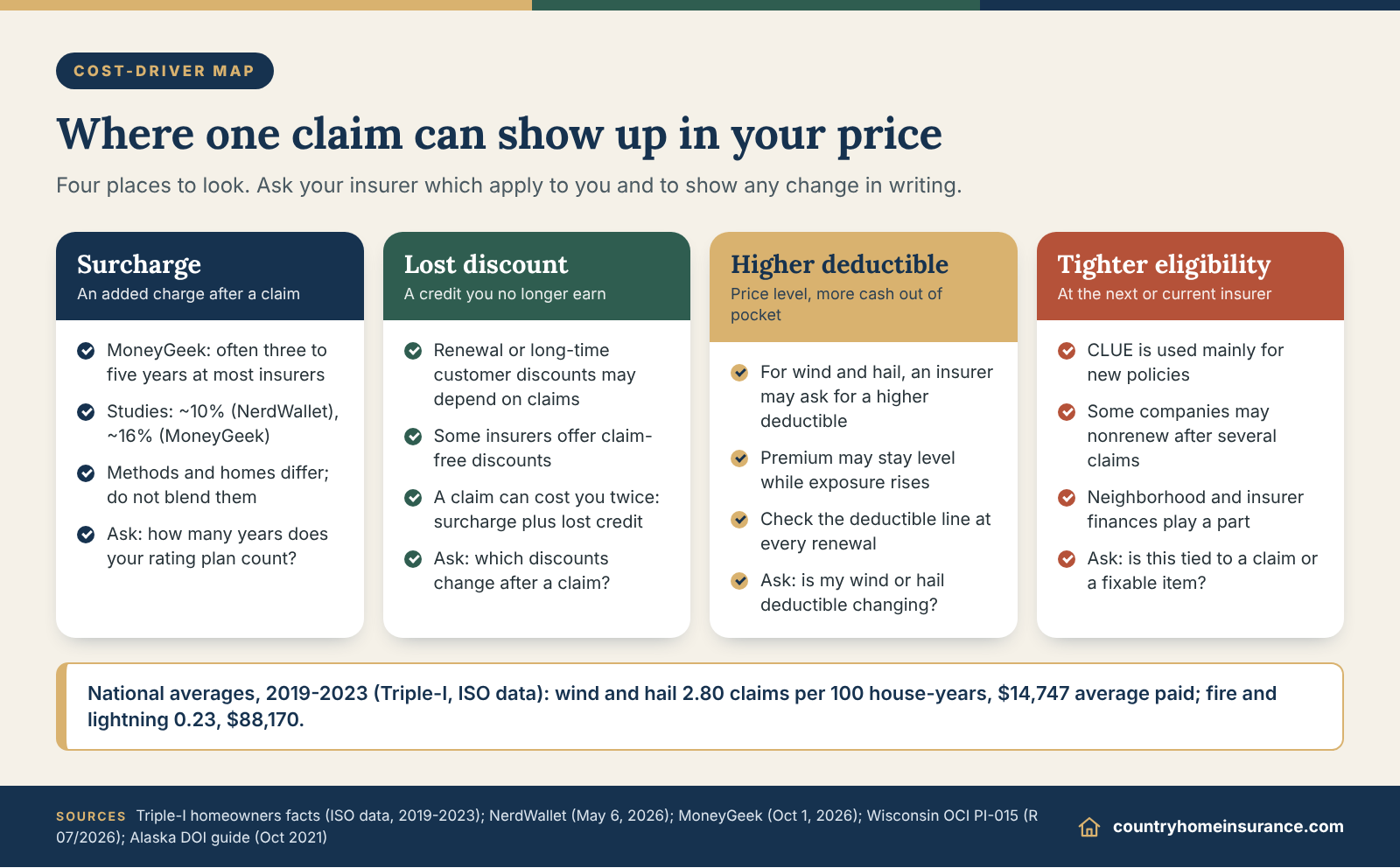
| Surcharge or lost discount | A price increase or removed credit after claims | One publisher says three to five years at most insurers; verify with yours | The visible dollar effect at renewal |
How claims get recorded and who can see them
Most people picture a claim as a single event: something breaks, you call, someone pays. Behind the scenes, that call can leave a trail that follows you to the next insurer. This section explains where the trail lives, what it contains and who is allowed to read it, so you know what an insurer may already know before you say a word.
What does a CLUE report contain?
CLUE stands for Comprehensive Loss Underwriting Exchange. The National Association of Insurance Commissioners (NAIC), the group of state insurance regulators, notes in its 2022 consumer guide that most insurers report homeowners claims to private nationwide databases and names CLUE as an example. Two state insurance departments describe it in more detail, and their descriptions line up closely.
The fields a report typically lists
According to the Alabama Department of Insurance and the Wisconsin Office of the Commissioner of Insurance (OCI), a CLUE report is a claims history database generated by LexisNexis. It lists policy details such as name, date of birth and policy number, plus claim details including the date of loss, the type of loss and the amount paid. A homeowners report carries the property address, while an auto report carries vehicle information. In plain terms, the record follows both the person and the address, which is why a home can carry a loss history that the current owner never created.
What a report leaves out
Both departments say the report does not include credit reports, criminal records, civil lawsuits or judgments. That matters because people sometimes assume one report bundles everything an insurer might check. It doesn’t. Credit-based information, where states allow insurers to use it, comes from separate sources, and the Wisconsin guide discusses that separately. We cover credit-based insurance scores in a companion article.
Where else your history lives
The Alabama page adds an important limit: losses reported to insurers that don’t contribute data to the database won’t appear on it. So a clean CLUE report is not proof of a clean history. Insurers also keep their own records, and they can ask you directly. The Washington Office of the Insurance Commissioner’s guide, revised in March 2026, says insurers may ask applicants to disclose past claims and occurrences, which means your answers on an application are another channel for the same information.
Who pulls the report, and when?
Because the database touches your financial life, federal law restricts who can order it and why. The Alabama department explains that a report may be pulled only for underwriting purposes, such as when you apply for coverage or request a quote, or when an insurer or agent starts the request.
New business versus renewal
The Alabama page says the report is mainly used for new policies, and the Wisconsin page says almost exclusively; both say most insurers don’t check it at renewal because they already hold their own loss records. That pattern has a practical consequence. A claim may never show up in a renewal review by name, yet it still sits in your insurer’s file and in the database, ready for the next company you apply to. Practices differ, so the two state pages describe the general pattern, not a promise about your insurer.
Your rights to see it and fix it
The Wisconsin page says the federal FACT Act entitles you to one free copy every 12 months, and the Alabama page also says you can request your report free of charge. Both pages say that if you find an error, LexisNexis will contact the insurer that reported it and tell you the result within 30 days. You can also add a personal statement that appears on future reports. The two pages list different contact details for LexisNexis, so use the consumer site your own state insurance department points to rather than a number copied from an article, including this one.
Buying a home with someone else’s history
The Alabama page says you can’t order a report on a property you plan to buy; only the owner, its insurer or its lender can. If you’re a buyer, the NAIC guide suggests asking how to find out a home’s claims history before you buy, because it may affect your premium. Wisconsin adds a limit on the insurer’s side: it says insurers may use a prior owner’s loss history only if they can show it correlates with the probability of future loss.
How long claims stay on your record
“How long will this follow me?” is probably the question behind most searches on this topic. The honest answer has more than one clock, because the database, your insurer’s pricing plan and each application question can look back over different periods. Keeping those clocks separate prevents a lot of confusion.
Is seven years the rule for every record?
Seven years is the figure both state pages give, but it describes one database, not every record or every price effect.
The database ceiling is “up to” seven years
The Alabama and Wisconsin pages both say CLUE keeps up to seven years of personal property claims history. The words “up to” matter. They describe a maximum retention period, not a guarantee that every insurer looks back that far or weighs a six-year-old claim the way it weighs last year’s. A claim from the sixth year is still visible to an insurer that pulls the report, but whether it moves your price depends on that insurer’s rules.
Your insurer’s pricing window can be shorter
One consumer publisher, MoneyGeek, says surcharges typically remain for three to five years at most insurers. That is a single publisher’s statement, not a regulator’s finding, and no insurer is bound by it. A fair way to use it is as a question for your agent: “How many years of claims does your rating plan count, and does that window run from the date of loss or the date of the claim?”
Application questions have their own lookback
Applications often ask about losses “in the last five years” or a similar period. The period depends on the insurer’s form, so read the exact wording and answer the question that is actually asked. If the form asks about claims, think about both filed claims and, in states that define them, occurrences. The Washington guide treats an occurrence as a loss that was never reported or never became a processed claim, and says insurers may ask about both.
Can anything shorten or soften what the record shows?
You can’t erase an accurate entry, but you can make sure the entry is correct and add context.
Fixing mistakes
The dispute path is the same on both state pages. You contact LexisNexis, it checks with the reporting insurer, and it tells you the outcome within 30 days. Typical errors to look for are a loss date that doesn’t match your records, a claim attributed to your address that predates your ownership, an amount paid that looks wrong and a claim that was opened but never paid. Compare each line against your own paperwork before you contact anyone.
Adding a personal statement
Both pages say you can add a personal statement that appears on future reports, and Alabama stresses that insurers can’t add notations to your report. Only you can. The Alabama page offers an example: a note that a dog involved in an earlier claim has been rehomed. A short, factual statement about a repair, a replaced component or a changed circumstance can help the next underwriter see the loss in context.
Losses that never reached the database
Because some insurers don’t contribute to the database, a record can be missing or incomplete, and that cuts both ways. A missing entry may help you, but if you are asked directly about a loss, the missing entry is no excuse to leave it out. Accuracy on the application protects your coverage later, and Arizona’s insurance department lists misrepresentation in obtaining a policy or filing a claim among the reasons a homeowners policy can be cancelled.
Inquiry, claim and occurrence: why the words matter
Insurance people use “inquiry,” “claim” and “occurrence” as if everyone shares the same dictionary. Most homeowners don’t, and a casual phone call can land in the wrong category. This section separates the three terms using the definitions state regulators actually publish, then looks at how to decide whether a small loss is worth reporting.
What counts as an inquiry, and what counts as a claim?
Start with the plainest definition. The Wisconsin OCI describes claims information as losses you asked the insurer to cover, whether or not the insurer paid. That sentence does most of the work.
An inquiry is a coverage question
The Alabama Department of Insurance describes an inquiry as a general discussion of coverage with an insurer or agent. Asking “Does my policy cover wind damage to a detached shop?” is a coverage question. The Alabama page says LexisNexis has told insurers not to report pure coverage inquiries. That is a statement about industry reporting practice on one state page, not a legal guarantee, so it’s still worth keeping your wording precise.
A claim can exist even if nothing is paid
The same Alabama page warns that discussing an actual loss may count as a claim even if the insurer pays nothing, and that claims which were filed and then denied may still be reported. This is the part that surprises people. If the damage was below your deductible, or the cause turned out to be excluded, the paperwork may still say a claim was opened. Wisconsin’s definition points the same way: it turns on what you asked the insurer to cover, not on what it ended up paying.
An occurrence is a loss you never reported
Washington’s guide defines a claim as a loss reported for coverage and an occurrence as a loss that was never reported or never became a processed claim. It says insurers may ask applicants about both. So choosing not to file doesn’t always remove the loss from the conversation. If an application asks about losses, including ones you paid for yourself, the honest answer may have to include them, depending on the question’s wording.
How do you talk to your insurer without creating a record you didn’t intend?
You can’t control how a company logs a call, but you can control how clearly you describe your purpose. The goal is accuracy, not avoidance.
Say what you are doing
The Alabama guidance is direct: be clear about whether you are filing a claim or just asking a question. A useful opening line is “I have a coverage question and I’m not reporting a loss yet.” If the agent then asks you to describe damage, pause and ask whether answering would open a claim. A good agent will tell you. Write down the date, the person’s name and what was said, in case you later need to show how the contact began.
Know when you do have to report
The NAIC says most insurers have deadlines for reporting claims, and that the time limit for reporting varies by state, so delaying a call to protect your record can backfire. For a significant loss, the NAIC advises contacting your insurer as soon as possible, and reporting to each company separately when your home and auto policies are with different insurers. A late report on a major loss is a bigger risk than a recorded claim.
Small losses still deserve notes
Florida’s hurricane deductible statute offers a useful illustration. For a later storm in the same calendar year, the deductible is reduced by earlier hurricane losses, and the statute says insurers may require policyholders to report sub-deductible losses or keep records of them. Your state may differ, and that rule applies to one kind of deductible, but the principle is portable: photos, estimates and receipts for a loss you absorbed yourself can matter later, and they cost nothing to keep.
Should you file a small claim or pay for the repair yourself?
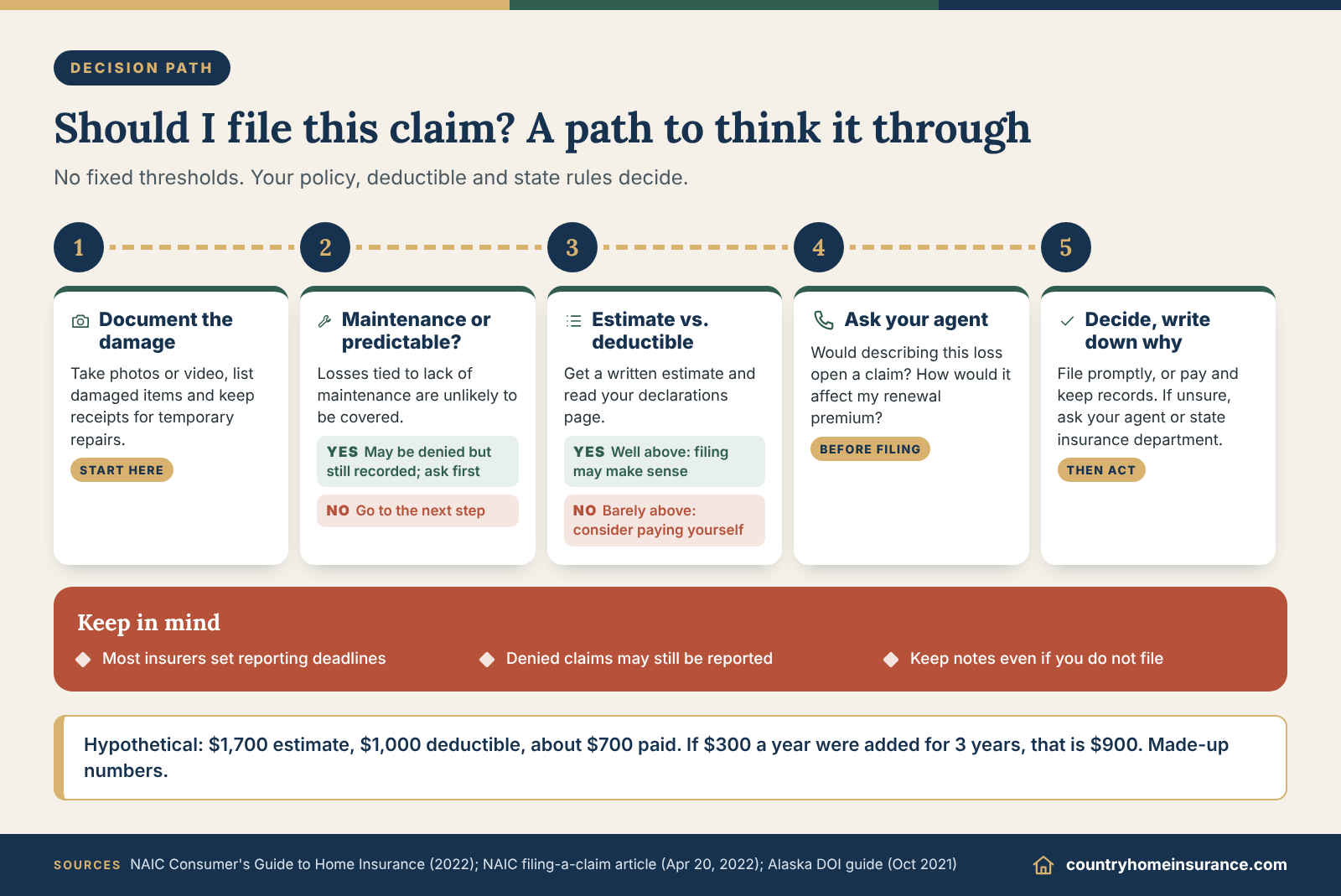
Both the NAIC and the Alaska Division of Insurance say it can make sense to pay for minor repairs yourself when the cost is only slightly above your deductible. The harder part is judging what “minor” means for your own policy.
Compare the estimate to the deductible
A deductible is the amount you pay out of pocket on a claim before the policy pays, as the NAIC guide puts it. If the repair estimate barely clears the deductible, the insurer’s check will be small, while the claim may still be recorded. Alaska’s guide recommends getting a repair estimate before filing for minor damage. Get one from a local contractor, then read your declarations page to see which deductible applies, since wind, hail and roof losses sometimes carry separate or percentage deductibles.
Hypothetical example
Hypothetical example: a windstorm lifts shingles off a detached workshop. The contractor’s estimate is $1,700, and the policy’s deductible is $1,000. If the loss is covered and paid as estimated, the insurer would pay about $700. Now suppose, for illustration only, that the insurer adds $300 a year to the premium for three years after the claim. That would be $900 in added cost against a $700 payment. Those numbers are made up, no insurer is bound to them, and a different insurer might add nothing. The point is the method: estimate the check, ask about the renewal effect and compare. Do the same math for a loss with a much larger estimate and the answer will likely flip.
Losses tied to maintenance or foreseeable damage
Alaska’s guide also cautions that a loss tied to lack of maintenance, or one that could have been predicted, is unlikely to be covered. A leaking roof that was patched twice, a supply line that was weeping for months or a tree with visible rot are examples where the claim may be denied and still sit on your record. Fixing known problems before they become losses is cheaper than learning the exclusion the hard way.
How claims history changes what you pay
No single formula applies. Each insurer files its own rating plan with the state, and regulators describe claims history as one factor among many. The Texas Department of Insurance, in a page updated September 1, 2026, lists claim history among the factors in home premiums, and the NAIC lists claims history as a personal risk factor in its November 2024 premium explainer. Beyond that, the numbers come from published studies, and they need careful reading.
Claims history homeowners insurance rates: what do published studies show?
Two consumer publishers have published figures for the cost of a claim in 2026. Both draw on rate data from Quadrant Information Services, yet they report different results, which is a lesson in itself.
NerdWallet: about 10 percent for one claim
NerdWallet’s 2026 average-cost page, updated May 6, 2026, reports $2,490 a year for homeowners with no claims and $2,750 a year with one claim, an increase of 10 percent. It describes a median across ZIP codes in all 50 states and Washington, D.C., for a 40-year-old homeowner with good credit, a two-story single-family home built in 1984, a $1,000 deductible, $400,000 of dwelling coverage and $300,000 of liability coverage. For its claims scenario, it added a single wind damage claim.
MoneyGeek: about 16 percent for one claim, about 29 percent for two
MoneyGeek’s rate-factor page, published July 6, 2026 and showing an October 1, 2026 update, uses a claim-free baseline of $3,467 a year. One claim adds $552 a year (15.9 percent) and two claims add $1,016 a year (29.3 percent). Its profile is a 2000-built, 2,500-square-foot home with $250,000 of dwelling coverage, $125,000 of personal property coverage, $200,000 of liability coverage, a $1,000 deductible, good credit and no claims in the prior five years. It varies one factor at a time.
Why you shouldn’t blend the two
The baselines differ by about a thousand dollars, the homes and coverage limits differ, NerdWallet modeled a single wind claim, and the two methods may not treat claims alike. That is why Table 2 sets them side by side without averaging them. A third publisher, Insurify, says its published averages assume no prior claims and good credit, and it advises avoiding small claims where feasible, but it publishes no claim-based percentage. Your own quote could land far from any of these figures.
| Publisher and page date | Claim-free figure | With claims | Key assumptions |
|---|---|---|---|
| NerdWallet, updated 2026-05-06 | $2,490 a year | One claim: $2,750 a year (about 10 percent higher) | Median of Quadrant rates; ZIP codes in all states and D.C.; 1984 home; $400,000 dwelling; $1,000 deductible; good credit; one wind claim added |
| MoneyGeek, published 2026-07-06, shows update 2026-10-01 | $3,467 a year | One claim: +$552 (15.9 percent). Two claims: +$1,016 (29.3 percent) | Quadrant rate data; 2000-built, 2,500 sq ft home; $250,000 dwelling; $1,000 deductible; good credit; no claims in five years |
| Insurify, updated 2026-09-30 | Averages assume no prior claims | No claim-based percentage published | 180-plus insurers; $300,000 dwelling; $1,000 deductible; 1980 construction; good credit |
| Your own quote | Depends on home, location, limits and insurer | Depends on the claim type, count and the insurer’s rating plan | Ask the insurer to show the change in writing, with the same coverage on both versions |
Is it a surcharge, a lost discount or something else?
Consumers use “surcharge” loosely. The regulator guides reviewed for this article describe the effects without defining the word, so it’s best to ask the insurer how a claim is actually reflected in your price.
A surcharge is an added charge
In common usage, a surcharge is an extra amount added to a premium after a claim. MoneyGeek says surcharges typically remain for three to five years at most insurers, and the Washington guide says some companies may charge more based on the number of claims you’ve filed. Neither tells you how your insurer calculates it, and neither establishes a standard percentage.
A claim-free discount can disappear
Alaska’s guide says a renewal or valued policyholder discount may depend on how many years you’ve held the policy and how many claims you filed, and that one or two companies in that state offer a claim-free discount tied to the number of claims in a set period. Washington’s guide likewise says some insurers discount long-time customers with no claims history. In practice, a claim can cost you twice: once through any surcharge and again through a credit you no longer earn.
Deductible changes can substitute for a price increase
Wisconsin’s guide says that for claims driven by factors you can’t control, such as wind and hail, the insurer may ask you to accept a higher deductible. That’s a different lever. Your premium may stay level while your out-of-pocket exposure on the next storm rises. Compare the deductible line on your renewal declarations page every year, not just the premium line.
Which kinds of claims weigh most?
Maine’s and the NAIC’s guides both say how often you file and which types you file often affect your premium and whether the insurer renews. Industry loss data show why type and frequency can matter.
Frequency and severity by cause
Triple-I, using data from the Verisk subsidiary ISO, reports that for 2019 through 2023 the weighted average was 5.64 claims per 100 house-years, with an average paid per claim of $17,059. Table 3 breaks that down by cause. Wind and hail are the most frequent, water damage and freezing come next, and fire is rare but far more costly per claim. Insurers may weigh those patterns, and an applicant’s own history can be read against them.
| Cause of loss | Claims per 100 house-years | Average paid per claim |
|---|---|---|
| Wind and hail | 2.80 | $14,747 |
| Water damage and freezing | 1.50 | $15,400 |
| Fire and lightning | 0.23 | $88,170 |
| Theft | 0.12 | $5,524 |
| Liability (all types) | 0.09 | $29,880 |
| All claims, weighted average | 5.64 | $17,059 |
What the Triple-I table does and doesn’t tell you
The scope covers homeowners multiple-peril policies (HO-2, HO-3, HO-5 and North Carolina’s HE-7) and excludes tenants and condominium policies, Alaska, Texas and Puerto Rico. In 2023, 5.3 percent of insured homes had a claim, per the same page. Those are national averages, not a rural or state-specific rate, and they don’t say which claims an individual insurer penalizes. They simply show that a wind claim and a fire claim are very different events statistically.
Neighborhood history and the insurer’s finances also play a part
The NAIC guide says premiums can reflect the claims history of your home and of homes in your area, so a quiet personal record doesn’t fully insulate you. The Government Accountability Office (GAO), in a report dated February 27, 2026, found that homeowners claims and expenses exceeded premium income in 22 of the 30 years from 1995 to 2024, and that insurers become more selective in the risks they accept when profitability falls. Neither finding is about individual claimants, but together they explain why underwriting can tighten even when your own record hasn’t changed.
Eligibility: when claims affect whether you can keep or get coverage
Price is only half the story. A claims record can also shape whether an insurer will offer you a policy at all, and whether it will keep you after the term ends. The rules that govern those decisions are state rules, so this section explains the vocabulary first, then looks at examples from four states, and finally at what to do when a notice arrives.
What is the difference between cancellation, nonrenewal and conditional renewal?
These three outcomes are easy to confuse, and the differences decide what notice you are owed and what you can challenge.
The basic definitions
The NAIC’s 2022 consumer guide defines cancellation as you or the insurer stopping coverage before the policy’s normal expiration date, and nonrenewal as the company refusing to renew the policy after it expires. For nonrenewal, insurers must give notice, typically 30 days before the renewal date according to the guide, and the exact timing varies by state. You may ask the insurer for its reason. Because the days vary, your state’s rule controls, not the typical figure.
The early window on a new policy
States give insurers a short period in which a new policy can be cancelled more freely. The NAIC guide says the window is typically 60 days. Wisconsin’s page says an insurer may cancel for most policy types within the first 59 days without giving a reason, and Maine’s guide allows cancellation for any reason within 90 days for a primary residence or 120 days for a seasonal home. If your claims history is thin or contested, expect underwriting to look hardest during that early period.
Conditional renewal and changed terms
Sometimes the insurer renews but changes the deal. Arizona’s insurance department says an insurer may offer renewal on reduced limits or without certain coverages, and that this also requires at least 30 days’ notice. Wisconsin’s page says that for personal lines policies, including homeowners, an insurer may not change terms or raise premiums until 45 days after the notice is mailed, though those timing conditions do not apply if the only change is a rate increase under 25 percent. A renewal notice can therefore change your deductible, your limits or your price, so read every page.
What do a few states say about notice and reasons?
The state examples below are not a survey of all states. They show how much the rules vary and which questions to ask. Table 4 summarizes them with the page dates.
| State and source date | Nonrenewal notice | Reason required? | Notable points |
|---|---|---|---|
| Wisconsin (OCI page updated 2026-03-05; guide R 07/2026) | At least 60 days before expiration | Yes, stated in the notice | Notice must explain how to apply to the Wisconsin Insurance Plan; late notice continues prior terms for the term or one year, whichever is less |
| Maine (Bureau guide updated 2021-09-28) | At least 30 days before expiration | Yes, clearly stated | Allowed reasons include a good-faith reason tied to insurability; a hearing may be requested within 30 days of the notice |
| Arizona (DIFI FAQ, undated) | At least 30 days before the period ends | The page lists permitted reasons but does not cite statutes | Conditional renewal on reduced limits also needs 30 days; misrepresentation in filing a claim is a listed ground |
| Florida (CFO consumer FAQ, undated) | The page does not state a general notice period | Not stated on the page | An insurer may generally nonrenew even with a pending claim; special limits apply after a declared emergency and order |
| NAIC general guide (2022) | Typically 30 days; varies by state | You may ask the insurer for its reason | Use only as a starting point; your state controls |
Wisconsin: a long notice and a safety net
Wisconsin’s insurance office says a nonrenewal notice must be sent at least 60 days before expiration and must state the reason. For homeowners, the notice has to explain how to apply to the Wisconsin Insurance Plan, the state’s property plan. If the insurer sends no timely notice, coverage continues on the prior terms and premium for the policy term or one year, whichever is less. The state’s guide also says that after four years in the Wisconsin Insurance Plan, the plan cannot renew the policy and you must look for coverage elsewhere, so it’s a bridge rather than a permanent home.
Maine: a stated reason and a right to a hearing
Maine’s guide says an insurer may decline renewal for a reason allowed for cancellation or for a good-faith reason tied to insurability, such as a poor roof or a home that is no longer owner-occupied. It requires at least 30 days’ notice and a clearly stated reason, and it allows you to request a hearing with the Bureau of Insurance within 30 days of a cancellation after the first 90 days or a nonrenewal. That guide is dated September 2021, so confirm the current process with the Bureau.
Arizona and Florida: shorter on detail
Arizona’s department describes 30 days’ notice for nonrenewal and says the same reasons that permit cancellation can be used for nonrenewal. Florida’s consumer pages say an insurer may generally nonrenew a property policy even with a pending claim, subject to a restriction after a declared emergency and a Commissioner of Insurance Regulation order. In that situation, the insurer cannot cancel or nonrenew a residential policy for hurricane or wind damage until 90 days after repairs, with exceptions that allow nonrenewal on 45 days’ notice for unreasonable repair delay, claim-related fraud or material misstatement, or payment of policy limits. Neither the Arizona nor Florida page is dated, and neither cites statute numbers, so treat them as starting points.
Georgia and the legislative trail
States keep adjusting these rules. The National Conference of State Legislatures’ 2025 tracker lists Georgia S 35 as enacted, increasing the notice days required before a homeowners nonrenewal and requiring insurers to state the reasons. The tracker doesn’t give the day counts. In the portion reviewed, it listed no 2025 bills specifically on claims history or insurance inquiries. For your own state, check your Department of Insurance’s current consumer page and the notice itself.
When does a claims record lead to nonrenewal?
Claims history rarely stands alone. The guides describe it as one input, and an insurer’s reasoning can include other items on the same file, such as roof age, property condition, location or a pattern of weather losses.
A pattern of claims
Washington’s guide says some companies may nonrenew after several claims and adds that “every company is different.” Maine’s and the NAIC’s guides say how often you file and which types you file often affect both your premium and whether the insurer renews. The wording is deliberately general. No source reviewed here gives a number of claims that triggers nonrenewal, and you should be skeptical of any article that does.
A claim that is still open
Florida’s page is notable because it says an insurer may generally nonrenew even when a claim is pending. If you’re in the middle of a large loss, that means your renewal date, your repair schedule and your claim payments deserve a calendar. Ask the insurer in writing how an open claim will be handled at renewal and what documents it needs from you.
Steps when the notice arrives
Read the notice for the effective date and the stated reason, and compare the date it was mailed with the notice period your state requires. Call your agent and ask whether the decision is tied to a specific claim or to something that can be corrected, such as a roof or a hazard. Then start shopping right away. If standard insurers decline you, your state’s residual-market plan may be an option, as Wisconsin’s property plan shows. We discuss that path in our companion pieces on high-risk coverage.
Buying a home or insuring a country property with a claims history
A claims record doesn’t only belong to the person who filed the claim. It travels with an address, and it travels with an applicant. That matters twice for country buyers, because older farmhouses and properties with outbuildings tend to have more places for a loss to start and a longer paper trail.
How do you learn a home’s claims history before you buy?
The NAIC guide lists a question worth asking before closing: how can you find out the claims history of the home you want to buy, since it may affect your premium?
Ask the seller and the agent
You can’t order a CLUE report on a property you don’t own, per the Alabama page, but the seller can. Ask whether they will share their own report, or a list of past claims with dates and causes. A Mississippi consumer guide dated 2008 gives examples of the home history that insurers care about, such as water damage or roof damage. That guide is old, but the examples still fit what most buyers worry about.
Know the limits on prior-owner history
Wisconsin says insurers may use a prior owner’s loss history only if they can show it correlates with the probability of future loss. In other words, a previous owner’s claim does not automatically follow the new owner. Still, the NAIC’s shopping tool suggests asking whether you’re eligible if the home had damage and a claim from a previous owner. Raise the question while you’re still shopping, not after the quote comes back high.
Documentation beats memory
If the seller tells you a leak was fixed, ask for the invoice, the plumber’s name and the date. Photos of repaired framing, a new roof receipt and an inspection report are the sort of records that can help an underwriter see a past loss as resolved. Tuck copies into one folder with your declarations page so they’re there when you need them.
What is different about claims on country and acreage properties?
The databases don’t care whether your house sits on a quarter acre or forty. They record loss type, date and amount for an address. What differs is how many structures and systems on that address can generate a claim.
Outbuildings and systems count as losses too
A windstorm that damages a barn, a shop or a detached garage is still a property loss associated with your address, and the fields CLUE records, loss type, date and amount paid, don’t distinguish between the house and the shed. When you request your own report, look for entries that relate to outbuildings, fences or other structures, and make sure the cause and amount are right. If you hold a separate farm policy, ask each insurer how it reports and rates claims, since this article’s sources don’t address farm policies.
Wind and hail are the most frequent losses
Triple-I’s 2019 through 2023 data show wind and hail as the most frequent homeowners claim cause, at 2.80 claims per 100 house-years, with water damage and freezing at 1.50. Those national figures aren’t specific to rural homes, but open country can leave outbuildings and roofs exposed to storms. Wisconsin’s guide says insurers may ask for a higher deductible on wind and hail when claims come from factors you can’t control. So two or three weather claims in a few years may show up as a deductible change rather than a price increase.
Fire is rare and costly
The same Triple-I data put fire and lightning at 0.23 claims per 100 house-years but $88,170 per claim, and a separate non-catastrophe fire series shows average severity climbing from $99,613 in 2020 to $173,111 in 2024. A single large fire claim is a major event in any record. Documenting wiring updates, heating-system service and similar upkeep is a sensible way to show that a past loss has been addressed.
What should you do about claims history when you switch insurers?
Shopping with a claim on your record is normal. The aim is to keep the comparison honest and the answers accurate.
Answer application questions exactly
The NAIC shopping tool suggests asking whether you’re eligible if you had a prior homeowners claim with another insurer. Arizona lists fraud or misrepresentation in obtaining a policy or filing a claim among the reasons for cancellation. Take the time to answer each question as written, and if you aren’t sure whether something counts, ask the agent rather than guessing.
Compare matched quotes
Advertised averages assume away the problem. NerdWallet’s baseline is a no-claims homeowner, and Insurify says its averages assume no prior claims. Your quote may therefore sit above published figures. Ask each insurer to quote the same dwelling limit, deductible and endorsements, and ask how it counted your claims. Our guide to comparing quotes explains the full process.
Check complaint history, not only price
The NAIC’s Consumer Insurance Search, described in its complaint article from September 2022, compiles closed, confirmed complaint information from state departments and lets you search by state, company and insurance type for the past three years. It cautions that complaint counts can shift with overall market conditions. Use it as one input beside price, financial strength and how a company handles claims.
A practical playbook: before a loss, after a loss and when the price moves
Everything above comes down to a handful of habits. Some you build before anything goes wrong, some apply in the first days after a loss, and some matter when a renewal notice shows up with a bigger number or a nonrenewal letter. The checklist in Table 5 pulls them together.
What should you do before you ever file a claim?
Preparation is the cheapest part of this topic. None of it costs much, and all of it makes later decisions easier.
Request your own report and read it line by line
Wisconsin’s page says you’re entitled to one free copy every 12 months under the FACT Act. Order yours before you shop or before a renewal, not in the middle of a crisis. Check the address, the dates, the loss types and the amounts. Look for claims you don’t recognize, claims from before you owned the home and amounts that look off. If you find a problem, the dispute process described earlier, with a 30-day answer from LexisNexis, starts there.
Build a maintenance and repair file
Alaska’s guide warns that losses tied to lack of maintenance, or predictable ones, are unlikely to be covered. A folder with roof inspections, plumbing repairs, septic or well service, electrical work and receipts does double duty: it helps you spot problems before they become losses and it gives you proof of repair if a past loss needs explaining. Digital photos with dates are fine.
Choose a deductible you can live with
The NAIC guide says higher deductibles lower premiums, and that some areas use percentage deductibles for catastrophes. A higher deductible can make small claims pointless, which keeps your record quieter, but it also means more cash out of pocket on a real loss. Pick a figure you could pay from savings without borrowing, and confirm what the declarations page says for wind, hail and other special deductibles.
What should you do in the days after a loss?
The NAIC’s claims guidance puts safety and documentation first, and that sequence also helps you decide whether to file.
Protect the property and document the damage
The NAIC says to document losses with photos or video and a list of damaged and lost items before removing debris or belongings, and to make temporary repairs such as covering roof holes, keeping all receipts. It notes those costs are typically reimbursed if the policy covers the loss. Do this whether or not you eventually file, because the documentation supports either path.
Get an estimate and compare it to the deductible
Call a local contractor and get a written estimate. Compare it to the deductible on your declarations page. Then ask your agent two questions: whether you would be reporting a claim by describing the loss, and how a claim would affect your premium at renewal. The second question appears in the NAIC consumer guide almost word for word.
Decide, and write down why
If you decide not to file, record the date, the estimate and the reason. If you decide to file, report promptly, since the NAIC says most insurers set reporting deadlines and the limit varies by state. In either case, a short note to your file is helpful if an application or an adjuster later asks about the loss.
What if your price rises or a notice arrives?
A higher renewal premium is not necessarily a verdict on you. Costs have risen across the market, and the NAIC lists extreme weather, higher construction and repair costs, inflation, litigation and reinsurance costs among the drivers of higher premiums. Still, if a claim might be part of the story, find out.
Ask for the reason, in writing
Wisconsin and Maine both say a nonrenewal notice must state the reason, and the NAIC says you may ask the insurer for its reason. Ask whether a specific claim, a property condition or an area-wide decision is behind the change. If the answer is a condition you can fix, such as a roof, ask what documentation the insurer would accept and by when.
Re-shop with matched quotes
Run the process again with identical limits and deductibles, and tell each insurer the truth about your history. Some insurers may weigh the same claim differently, a point the Washington guide makes when it says every company is different. Give yourself enough time before the policy expires, especially if you are in an area where standard insurers are pulling back.
Dispute, escalate and use your regulator
If you think a record is wrong, use the LexisNexis dispute path. If you think the insurer mishandled a claim or a notice, contact the insurer first and then your state insurance department. The NAIC’s complaint article suggests gathering documents, photos, emails and a record of calls, and writing a detailed account. State departments can explain what the notice must contain and whether the timing was correct.
| Step | What to do | What to ask or look for | Basis |
|---|---|---|---|
| 1. Get your report | Request your free CLUE copy (one every 12 months) and review it | Wrong dates, amounts, addresses, or claims you never made | Wisconsin OCI (updated 2026-05-19); Alabama DOI |
| 2. Fix or explain | Dispute errors; add a personal statement if context helps | LexisNexis reports dispute results within 30 days | Wisconsin OCI; Alabama DOI |
| 3. Before filing | Get a written repair estimate and read your deductible | “Would describing this loss open a claim, and how would it affect my renewal premium?” | NAIC consumer guide (2022); Alabama DOI |
| 4. Document | Photos, video, item list, receipts for temporary repairs | Keep records even if you pay for repairs yourself | NAIC claims guidance (2021) |
| 5. At renewal | Compare premium, deductibles, limits and any discount changes | Is a surcharge, lost credit or higher deductible tied to a claim? | Alaska guide (2021); Wisconsin guide (2026) |
| 6. If nonrenewed | Read the notice date and stated reason; ask what can be corrected | Does the notice meet your state’s timing rule? Is there a state plan? | Your state DOI page; NAIC guide |
| 7. Escalate if needed | Insurer first, then your state insurance department | Complaint history for any new insurer, via NAIC search | NAIC complaint article (2022) |
Frequently asked questions
Questions about records and reporting
Does a denied or zero-dollar claim still show up on my record?
It can. The Alabama Department of Insurance says claims that were filed and then denied may still be reported, and Wisconsin’s definition of claims information includes losses you asked the insurer to cover whether or not it paid. The Alabama page also says discussing an actual loss may count as a claim even if nothing is paid. If you are unsure how a past event was logged, request your own CLUE report and look for it.
Will requesting my own report hurt my rates?
Neither the Alabama nor the Wisconsin page says it will. Both describe a consumer’s copy as a right, and the Wisconsin page says the federal FACT Act gives you one free copy every 12 months. A consumer request is separate from an insurer’s underwriting request. If you have a specific worry, ask your insurer or your state insurance department rather than assuming.
Do I have to tell my insurer about damage I repaired myself?
The answer depends on your policy conditions and on the exact wording of any application question. The Washington guide says insurers may ask about occurrences, meaning losses that were never reported or processed, so an application may ask about them. A policy may also require prompt notice of losses. Read both documents, and if the wording is unclear, ask in writing.
Questions about price and eligibility
Will one claim raise my premium, and by how much?
It may, but no source reviewed gives a universal figure. NerdWallet’s 2026 analysis found about 10 percent higher rates with one wind claim; MoneyGeek’s 2026 analysis found about 16 percent for one claim. Those numbers rest on different assumptions and don’t predict your quote. Washington’s guide says some companies may charge more based on the number of claims, and practices differ by company. Ask your insurer to show the effect.
Can an insurer drop me because of a claim?
Cancellation in the middle of a term is usually limited to reasons set by law. Wisconsin’s page says midterm cancellation is generally restricted, mostly to nonpayment, and Arizona lists specific permitted reasons. Nonrenewal at the end of the term is a separate decision with its own notice rules. Washington’s guide says some companies may nonrenew after several claims, and Florida’s page says an insurer may generally nonrenew even with a pending claim. Your state’s rules decide what is allowed.
Is a weather claim treated more kindly than a claim I caused?
No source reviewed settles that. Wisconsin’s guide says that for claims driven by factors you can’t control, such as wind and hail, an insurer may ask you to accept a higher deductible instead, which suggests weather claims are not ignored. Treatment differs by company, so ask each insurer how it counts weather-related claims in its rating plan. The Triple-I data show wind and hail are the most frequent causes, which is why insurers pay attention to them.
Sources
- Alabama Department of Insurance: What is a CLUE report? (undated; reviewed 2026-10-11)
- Wisconsin Office of the Commissioner of Insurance: C.L.U.E. FAQs (last updated May 19, 2026)
- Wisconsin OCI: Denials and cancellations (last updated March 5, 2026)
- Wisconsin OCI: Consumer’s Guide to Homeowners Insurance, PI-015 (revised July 2026)
- NAIC: A Consumer’s Guide to Home Insurance (2022 edition)
- NAIC: Why are my insurance premiums increasing? (November 19, 2024)
- NAIC: What you need to know when filing a homeowners claim (April 20, 2022)
- NAIC: Navigating the claims process (June 23, 2021; older source)
- NAIC: How to file a complaint and research complaints against carriers (September 1, 2022)
- NAIC shopping tool for homeowners insurance, Colorado Division of Insurance copy (2014; older source)
- Mississippi Insurance Department: Consumer quick guide to home insurance (2008; older source)
- Washington Office of the Insurance Commissioner: Homeowner insurance guide (revised March 2026)
- Maine Bureau of Insurance: Consumer’s Guide to Homeowners Insurance (updated September 28, 2021; older source)
- Arizona Department of Insurance and Financial Institutions: Notice of cancellation or nonrenewal (undated)
- Florida Chief Financial Officer: Homeowners insurance consumer FAQ (undated)
- Florida Statutes section 627.701: Liability of insureds; coinsurance; deductibles (2026 text)
- Alaska Division of Insurance: Consumer Guide to Homeowners Insurance (October 2021; older source)
- Texas Department of Insurance: How are your auto and homeowners insurance costs calculated? (last updated September 1, 2026)
- Triple-I: Facts and statistics, homeowners and renters insurance (ISO data, 2019-2023; page undated)
- U.S. Government Accountability Office: GAO-26-107867, homeowners insurance report (February 27, 2026)
- National Conference of State Legislatures: Homeowners and renters insurance, 2025 legislation (2025 sessions)
- NerdWallet: Average cost of homeowners insurance, 2026 (updated May 6, 2026; consumer publisher)
- MoneyGeek: What factors affect homeowners insurance rates? (updated October 1, 2026; consumer publisher)
- Insurify: Home insurance premiums (updated September 30, 2026; consumer publisher)
Important coverage note
Coverage depends on the actual policy, endorsements, exclusions, limits, deductible and cause of loss. State laws and insurance programs vary, and insurers apply their own underwriting and rating rules within them. Averages, examples and percentages in this article are illustrations, not quotes, and nothing here promises that any claim will be paid or that any premium, discount or renewal outcome will apply to you. For questions about your own situation, check your declarations page and policy forms, then verify with your insurer or agent and your state Department of Insurance. This article is educational and is not legal advice.
About the editorial team
This guide was prepared by the countryhomeinsurance.com editorial team as general, educational information for homeowners. We research and summarize publicly available material, including state insurance departments, the NAIC, federal agencies, regulators’ consumer guides and published insurer and industry resources. We draw only on the sources that were available to us when we wrote this guide, and we list them in the Sources section with dates where we could find them.
Insurance rules, rates, products and program terms change, differ by state and by insurer, and can apply differently to your situation. We cannot guarantee that this content is complete, current or free of errors. It is not legal, financial, tax or insurance advice, it is not an offer to sell insurance or a recommendation of any insurer, agent or product, and reading it does not create a professional relationship of any kind.
To the fullest extent permitted by law, countryhomeinsurance.com and its editorial team, authors and contributors exclude all liability for any loss, damage or decision arising from the use of, or reliance on, this content. For questions about your own policy or claim, contact your insurer, a licensed agent or broker, your state Department of Insurance or another qualified professional.
Content created: October 11, 2026