Quick answer
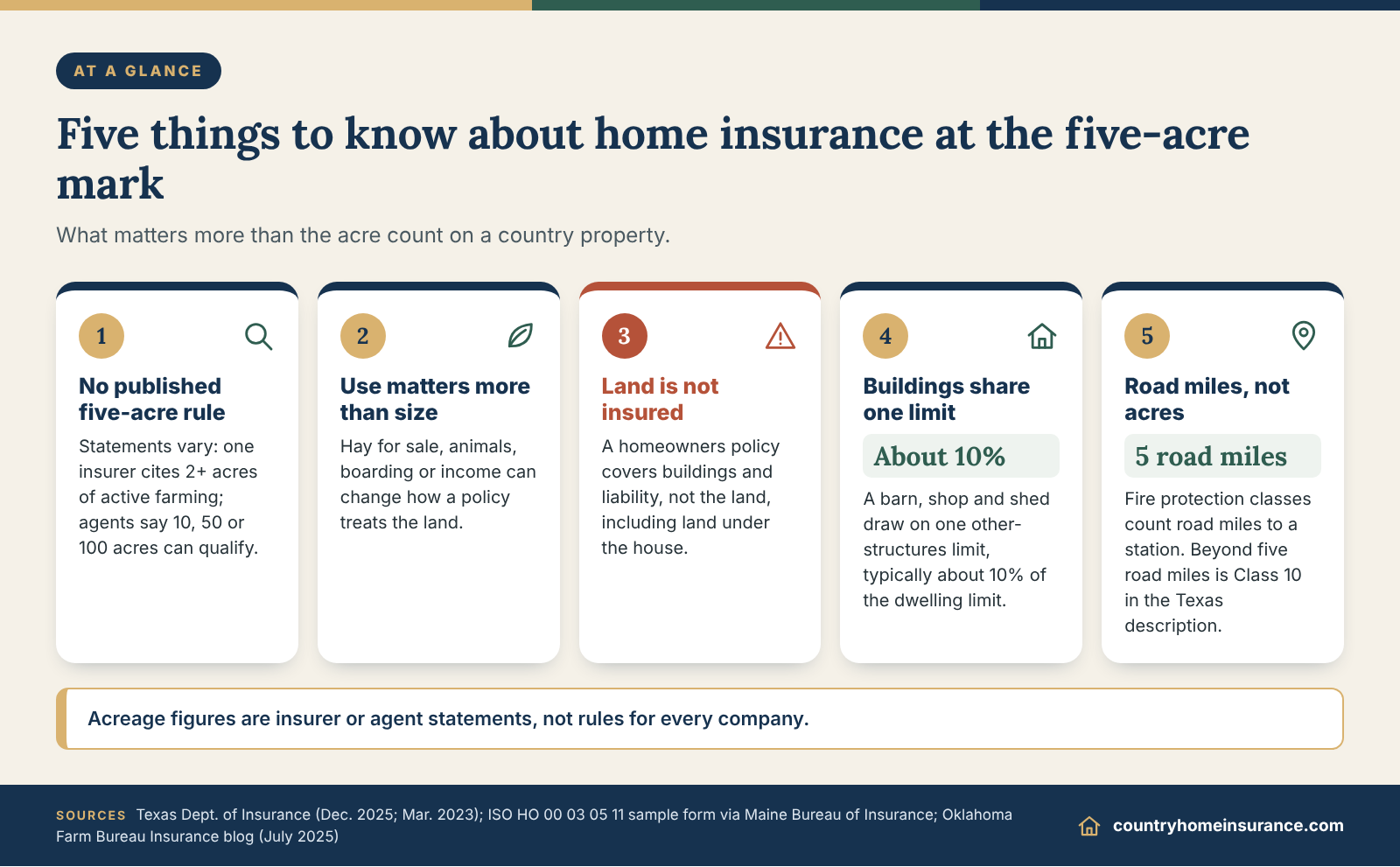
Home insurance for acreage doesn’t change at one magic number. None of the sources reviewed for this guide names a five-acre cutoff, and each insurer sets its own rules. What tends to matter more than the acre count is how the land is used (lawn and woods versus hay, animals or income), how many buildings sit on it, and how far you are from a fire station. Five acres is simply a sensible moment to ask your insurer how it classifies the property.
Key takeaways
- No retrieved source gives a universal five-acre rule. Public statements range from “more than 2 acres with active farming” to “10, 50 or 100 acres can still qualify,” so treat any single number as a prompt for questions.
- Use usually outweighs size. A sample homeowners form excludes business and farming activity, and one 2024 court decision applied a farming exclusion to ten heifers on 600 acres whether or not they earned a profit.
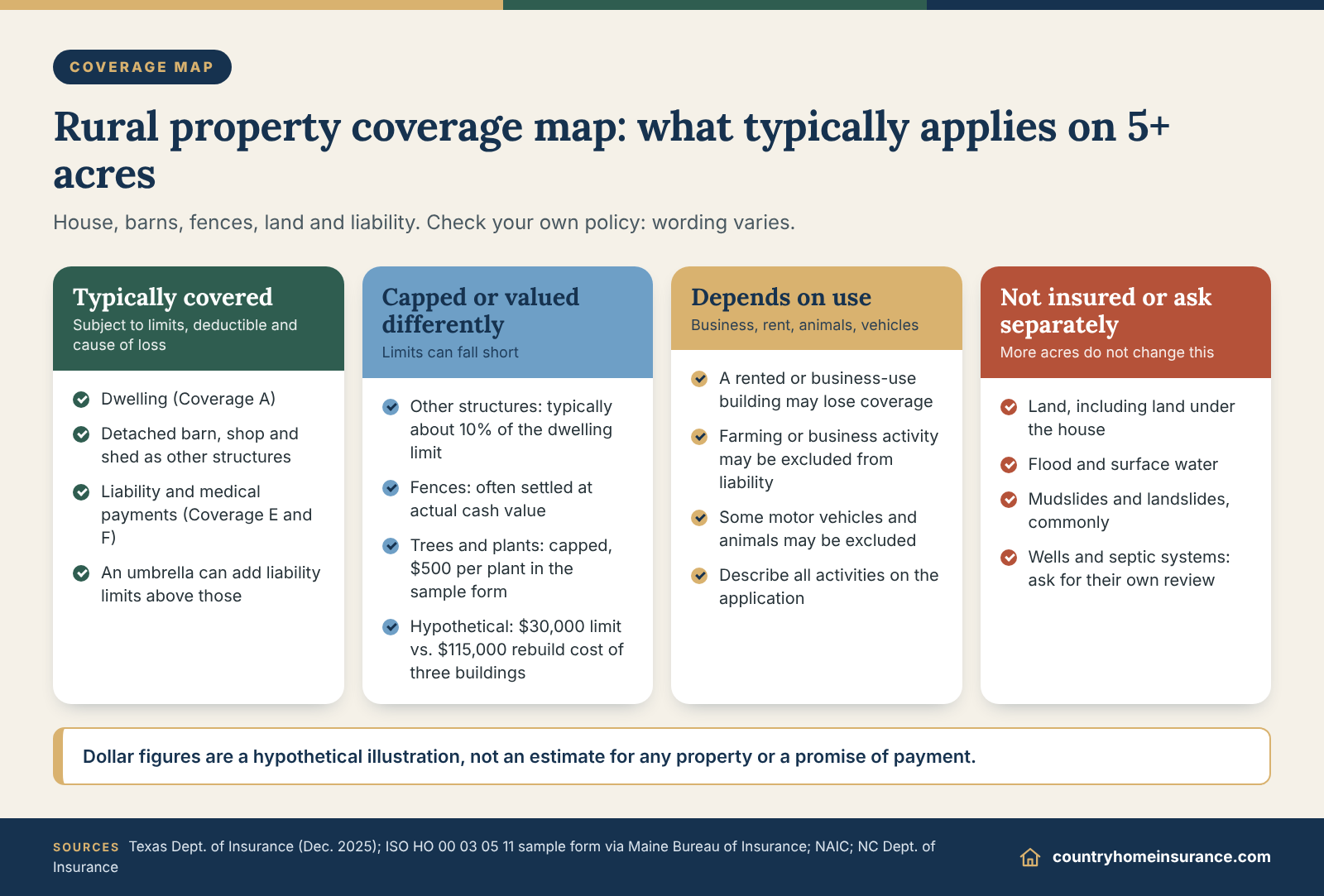
- Several buildings share one other-structures limit, which is typically about 10% of the dwelling limit. A barn, a shop and a run-in shed can outgrow it quickly.
- Land itself is not insured under a homeowners policy, and flood, wells and septic systems raise separate questions that more acres do not solve.
- Distance to a fire station matters in underwriting, and the common Public Protection Classification yardstick is five road miles, not five acres.
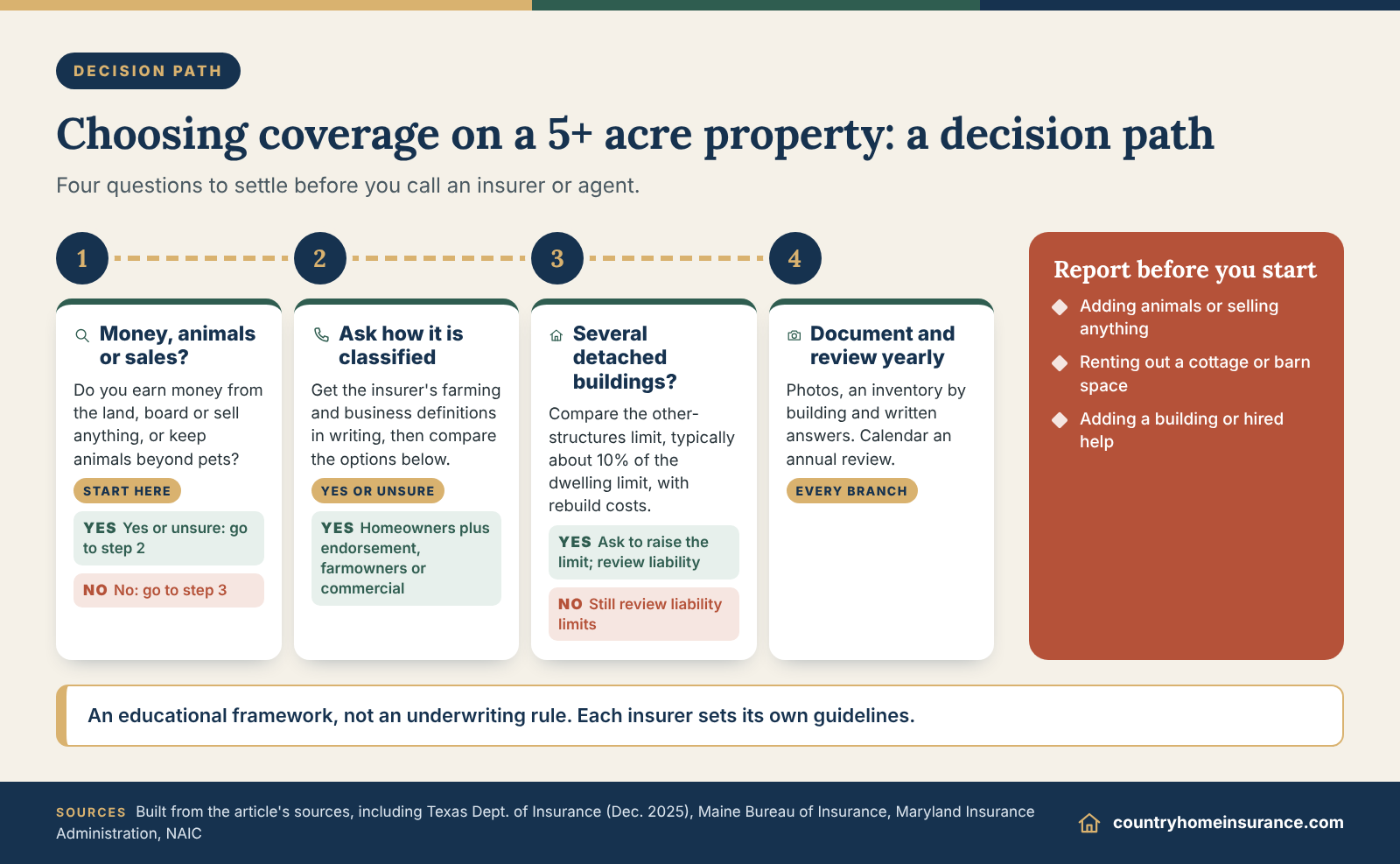
- Describe your activities accurately on the application and again whenever they change. Concealed farming or business activity can put coverage at risk.
| Factor | What can change | How to confirm |
|---|---|---|
| How the land is used | Lawn, woods and a garden are treated differently from hay for sale, grazing, boarding or other income. Policies may exclude farming or business activity. | Ask the insurer in writing how it defines farming and business; read the exclusion wording in your own policy. |
| Number and use of buildings | More detached buildings compete for one other-structures limit, which is commonly about 10% of the dwelling limit. Buildings used for business or rented out may drop out of coverage. | Compare the declarations page limit with a building-by-building rebuild estimate. |
| Fire protection | Distance to the nearest station, hydrant access and response time feed rating and underwriting. A common classification yardstick is five road miles. | Ask your fire department or insurer for the protection class assigned to your address. |
| Liability exposure | More ground can mean more visitors, vehicles, animals and hazards that draw children. Off-road vehicles and loose livestock can raise coverage questions. | Check liability limits, the motor-vehicle and animal exclusions, and whether an umbrella policy is available. |
| Eligibility | Some insurers may decide a property on a certain number of acres no longer fits a traditional homeowners policy, but no source gives the number. | Ask each insurer or agent for its acreage and use guidelines before you apply. |
| What stays the same | Land value is not insured, flood is excluded, and wells and septic systems still need their own review. | Read the Section I exclusions and ask about any endorsements you could add. |
Is there a real five-acre rule for home insurance for acreage?
If you’ve searched for a clear answer on where a country home stops being “a house with a big yard” and starts being “a farm,” you’ve probably noticed that everyone tells you to call an agent. That advice is sound, but it’s unsatisfying. This guide tries to do something more useful: lay out what the published sources actually say about size, use and classification so you can walk into that call with better questions. It stays focused on the five-acre range. For the wider picture of how a policy treats land, buildings and liability, see the companion guides on country homes with acreage and on rural homes in general, and for larger parcels see the 10-acre guide.
The short version of the research: the five-acre figure is a convenient rule of thumb, not a term you’ll find in a policy form or a regulator’s consumer guide. The sections below explain what the forms say, what insurers say publicly, and why this size is still a useful moment to pause and review.
What the standard policy forms say about size
The Maine Bureau of Insurance hosts the text of an ISO HO-3 special form (the 05 11 edition), which makes a handy reference point for the kind of language homeowners policies contain. Your own insurer’s policy may differ, so treat this as an illustration of the pattern, not a quote of your contract.
The form is silent on acreage
Reading the HO 00 03 05 11 form text hosted by the Maine Bureau of Insurance, there is no definition of farm, farming or acreage. The only farm reference is in the definition of “insured location,” which includes vacant land an insured person owns, other than farm land. In other words, the form never says “up to X acres.” Size shows up indirectly, through what the land is used for and what is built on it.
The residence premises includes the grounds
The same form defines the “residence premises” as the dwelling where you live, as shown on the declarations page, together with the other structures and grounds at that location. That wording is why a lawn, a garden and a few sheds around the house are routine. It also explains why a second parcel across the road, or a pasture that isn’t part of the home site, can raise a separate question about whether it counts as part of the insured premises at all.
The land under the house is not insured
Coverage A insures the dwelling and attached structures, and the form states that land, including the land under the dwelling, is not covered. The NAIC makes the same point in its explanation of replacement cost: the market value of a home includes land, while replacement cost does not. Buying more acres can therefore raise your property value without raising the amount an insurer would owe to rebuild. The NAIC’s article on actual cash value and replacement cost, dated January 2025, spells out that distinction.
What insurers and publishers say publicly about cutoffs
Most carriers don’t publish underwriting manuals, so the public record is mostly consumer pages, agent blogs and trade articles. Reading them side by side is revealing because they don’t agree, and several say outright that there is no fixed line. Table 2 summarizes what each retrieved source does and doesn’t say. These are statements from insurers, agencies and publishers, not rules that bind any particular company.
| Source and date | What it says about acreage or size | What it does not say |
|---|---|---|
| Oklahoma Farm Bureau Insurance blog, July 2025 (insurer) | Lists operating, leasing or inheriting more than 2 acres with active farming exposure as a reason to consider farm and ranch coverage, while stating there is no strict acreage or income cutoff. | Does not say a homeowners policy ends at any acreage; a large garden or a few chickens may be adequately covered by a homeowners policy. |
| Smart Choice Agents blog, November 2023 (agency) | Says homes on 10, 50 or 100 acres are usually eligible for a homeowners policy, subject to acreage guidelines. | Does not publish the guidelines or any carrier’s maximum. |
| IA Magazine, June 2023 (trade article sponsored by an insurer) | Makes the same 10, 50 or 100 acre statement and frames acreage as the first of five screening questions. | No figure for animal caps or revenue. |
| Kiplinger, November 2024 (consumer publisher) | Says some insurers may decide a home on a certain number of acres no longer qualifies for a traditional homeowners policy. | Gives no number and names no insurer. |
| Travelers farm versus homeowners page, December 2022 (insurer) | Says farm coverage is for buildings beyond the home or a small enterprise such as hay cutting, boarding or livestock. | No acreage or income threshold; no definition of where a hobby farm ends. |
| Farm Bureau Financial Services hobby farm article, February 2026 (insurer) | Describes a hobby farm as one that is generally not your primary income. | No acreage or income cutoffs. |
| Washington Office of the Insurance Commissioner guide, rev. March 2026 (regulator) | Says a farm or ranch policy is similar to a homeowners policy but customized for many structures and equipment. | Does not address acreage without a farm. |
Two acres, ten acres and “a certain number”
Look at the spread. One insurer’s blog points to two acres of active farming as a trigger to consider a different product, while agent-facing material says homes on 10, 50 or 100 acres are usually eligible for a homeowners policy. Those two statements aren’t actually in conflict, because the first is about farming activity and the second is about residential eligibility. The takeaway is that acres and activity are measured separately, and activity is what pushes you toward farm coverage.
What regulators emphasize instead
State insurance departments mostly describe farm coverage by what it contains rather than by a size test. The Maine Bureau of Insurance suggests that if your home sits on land used for farming or raising livestock, you should ask about a farmowners policy with specialized coverage for those exposures. The Texas Department of Insurance’s farm and ranch page, updated in January 2026, is a checklist for insurers filing forms and never mentions acreage; where it distinguishes “large risk” accounts it uses insured values, revenue and premium instead of land size.
How to read a number you find online
If you do see a specific acreage figure on a blog or an agent’s website, ask three things. Who published it, and when? Does it describe eligibility for a homeowners policy, or a reason to consider a farm product? And is it a company rule or a generalization? Without those answers, a stray number tells you very little about the insurer you’re actually dealing with.
Why five acres is still a useful moment to review
The absence of an official line doesn’t mean size is irrelevant. This part is analysis, not a sourced rule: as a parcel grows past a few acres, several ordinary exposures tend to accumulate, and each one is something an underwriter may ask about.
More ground usually means more things on it
A town lot might hold a house, a garage and a fence. Five acres often adds a detached shop, a hay or equipment shed, a well house, a long driveway, a pond, fencing around a pasture and a septic field. Each item carries a replacement cost, and most of them fall under the same other-structures limit or under no coverage at all. The count of structures is one reason Washington’s consumer guide tells owners with an unusually large detached garage or several outbuildings to talk to their agent.
Distance grows along with the lot
Larger parcels tend to sit farther from hydrants and fire stations, and a long private driveway adds time before responders reach the house. Washington’s guide lists distance to the nearest fire department and hydrant, and the department’s response time, among the things insurers consider. The five-road-mile benchmark used in fire protection classifications is a separate yardstick covered later in this guide.
Land use drifts from lawn to something else
People rarely buy five acres intending to run an agricultural business. They buy a view and some room. Then a neighbor offers to cut the hay and pays in bales, a few chickens turn into a flock that sells eggs, or a friend asks to keep two horses in the pasture. Each step is small, but each can change how a policy sees the property. The next sections explain how those lines are drawn.
Size versus use: how insurers separate a residence from a farm
Every explanation of this topic eventually lands on the same point: the dividing line is about what you do on the land, not simply how much land you own. This section breaks down the questions underwriters tend to ask, how the exclusions are worded, and what that means for common five-acre situations. None of it substitutes for your own policy language.
The questions underwriters tend to ask
The IA Magazine piece published in June 2023, sponsored by an insurer, is aimed at agents and lists five screening questions for personal-lines clients with farm exposures. The Smart Choice Agents blog, dated November 2023, repeats the same list. They’re not an official underwriting standard, but they’re a useful preview of how a conversation with an agent tends to go.
Acreage and how the land is actually used
The first question is simply how many acres you have, and the second is what happens on them. Both sources say activity that adds liability beyond what a homeowners policy contemplates, or that produces meaningful income, points toward a commercial farm policy. In other words, the acreage question is really a gateway to the use question. That is consistent with the two-acre trigger the Oklahoma Farm Bureau Insurance blog attaches to active farming.
Income and the word “hobby”
Farm Bureau Financial Services describes a hobby farm as one that generally isn’t a primary source of income, and notes that agents will ask about your activities and income. None of the retrieved pages sets a dollar threshold. The sample HO-3 form does contain a small carve-out inside its definition of “business”: activity is not treated as business if no insured person earned more than $2,000 in the 12 months before the policy period. That figure comes from one sample form edition, and your insurer’s form may set a different number or none at all. As the court decision discussed below shows, a farming exclusion can also be written independently of the business definition.
Animals, equipment and hired help
The agent-facing sources say carriers cap the number of animals they’ll include on a homeowners policy, though they give no figure, and that horses are especially hard to place. They also say covering hired help, even temporary workers, is typically difficult under personal lines, with some carriers allowing it only if the workers don’t live on the premises. On equipment, the same pieces cite one carrier’s incidental farming endorsement that provides up to $10,000 for farm personal property and note that even a small tractor can exceed that amount. Treat the $10,000 as one carrier’s example, not an industry standard.
How the farming and business exclusions are written
Exclusions are where classification turns into dollars. Two ideas appear again and again: “business” and “farming.” They overlap but they aren’t the same.
The business definition and what it reaches
In the sample HO-3 form, “business” includes any trade, profession or occupation, whether full-time, part-time or occasional, and any other activity engaged in for money, with specific exceptions. The liability section excludes injury arising from a business conducted at an insured location. On the property side, the other-structures coverage does not apply to a structure used for business or one rented to someone who isn’t a tenant of the dwelling, other than as a private garage. The Maine Bureau of Insurance’s page on business use of the home lists renting storage space in a garage, barn or outbuilding among activities that can count as business use.
A court read “farming” broadly: Clark v. Alfa
In Clark v. Alfa Insurance Co., decided by the Mississippi Court of Appeals on July 23, 2024, a landowner with 600 acres bought ten heifers; they escaped on their first night and one was involved in a highway collision. As summarized by Coverage Opinions, the policy excluded bodily injury arising from business or farming, and defined farming as operating an agricultural or aquacultural enterprise or a roadside stand. The court held that buying and raising cattle was an agricultural enterprise even without a profit motive, and the insurer prevailed. It is one decision, about one policy, in one state, and it should not be read as how every court or insurer treats ten cows. But it illustrates why the wording of your own farming exclusion matters more than your acreage.
Activities that can flip the classification
Several sources name specific activities that move a property toward business or farming treatment. An Insurance Journal article from 2012 gives examples of undisclosed egg sales at a farmers market and boarding horses for a fee, and the University of Missouri Extension lists farmers market sales, agritourism, boarding dogs or horses, custom work and chemical spraying as items commonly excluded from farm liability policies. These come from older or farm-policy-focused sources, so use them as prompts for questions rather than as rules about a homeowners policy.
A scenario matrix for common five-acre situations
Table 3 is an illustrative framework, not a prediction. It pairs everyday scenarios with the question an insurer is likely to ask and the typical direction the answer points. Whether any given insurer accepts a scenario on a homeowners policy, on a homeowners policy with an endorsement, or only on a farm policy depends on that insurer.
| Scenario (hypothetical) | Question an insurer may ask | Where it may point |
|---|---|---|
| Five acres of lawn, woods and a vegetable garden for the household | Any income, animals or non-residential buildings? | Often a homeowners policy with attention to outbuilding limits and fire protection. |
| A neighbor cuts and keeps the hay, no payment to you | Is anyone earning money from the land, and who is liable for the equipment? | Ask whether the arrangement counts as farming or business on your policy. |
| A small flock sells eggs at a roadside stand | Is there sales income, and is a roadside stand a defined farming activity? | May need an incidental farming type of endorsement or a farm policy; disclosure matters. |
| Two pasture horses kept for family riding | How many horses, who rides them, and is any fee charged? | Some carriers limit animals; liability and property treatment differ. |
| Horses boarded for a fee | Is this a business with customers on site? | Boarding is named in sources as an excluded or separately insured activity. |
| A rented-out guest cottage or barn storage unit | Is the structure rented to non-tenants of the dwelling? | Other-structures coverage may not apply to rented buildings. |
What the matrix is and isn’t telling you
The rows are ordered from least to most activity. Notice that none of them depends on whether the land is four, five or seven acres. What shifts the answer is income, fees, animals and rented space. If you want a rule of thumb, it’s that the more a scenario involves other people’s money, other people’s animals or other people on your property, the more likely it is to leave ordinary homeowners territory.
Why changes mid-term matter
In the Clark decision, the court treated the purchase of the cattle as the moment the agricultural enterprise began. The practical lesson is that a policy that fit your property on the day it was issued may not fit after you add animals, start selling something, or lease out a building. Treat those changes as a reason to phone the agent before the new activity starts, not after the first loss.
The policy ladder: from a homeowners form to farm and commercial coverage
Once you know that use drives classification, the practical question becomes which product fits. Think of it as a ladder with four rungs: a standard homeowners policy, a homeowners policy with farm-related endorsements, a farmowners policy, and commercial coverage. An umbrella policy can sit above whichever rung you stand on. You don’t have to climb all the way up just because you own five acres, and you shouldn’t stay on the bottom rung if your activities have outgrown it.
Staying on a homeowners form
For many five-acre owners with no farming or business, a homeowners policy remains the right tool. The work is making sure its limits fit the buildings and that the insurer knows exactly what’s on the property.
Raising the limit for detached buildings
The sample HO-3 form sets the other-structures limit at 10% of the dwelling limit. The Maine Bureau of Insurance’s consumer guide says many companies let you raise that limit, generally in increments of 10%, for an additional premium. The North Carolina Department of Insurance says the same thing in plainer words: other structures are normally limited to 10% of the dwelling coverage, and you can buy more. Whether an increase is available, and how large, is the insurer’s call, so ask for the specific options in writing.
Incidental farming and farmers personal liability endorsements
If you grow or raise things on a small scale, the middle rung is an endorsement (an add-on form that changes the base policy). A 2012 Insurance Journal article by an agribusiness manager at Acadia Insurance describes two ISO endorsements: HO 24 72, for incidental farming personal liability aimed at low-exposure farming for personal consumption, and HO 24 73, for farmers personal liability aimed at clearly small or true hobby farms. Form editions and insurer-specific versions have changed since 2012, so treat the numbers as an example of the idea. The article’s warning is the part that still matters: both endorsements require you to declare all farming activities, and an activity you leave out may not be covered.
What endorsements do not do
An endorsement can fill a liability gap without turning the policy into a farm policy. The agent-facing sources describe a homeowners policy with an incidental farming endorsement as one option and a commercial farm policy as the other, with the choice depending on income, animals, equipment, structures and hired help. The one carrier example in those sources provides up to $10,000 for farm personal property, which a small tractor can exceed. In short, an endorsement may help with a few chickens and a push mower, but it isn’t built to carry a working barn or a line of equipment.
Farmowners and farm package policies
A farmowners policy is a package that combines the house with the farm. Several state regulators describe it, and their descriptions differ in emphasis, which is a good reminder to read the schedule on your own policy.
What the package usually bundles
According to the Maine Bureau of Insurance’s farm brochure, a farmowners policy covers the residence premises (the dwelling, private structures such as garages, household belongings and loss of use) along with farm buildings, equipment, livestock, hay, machinery and farm help. Liability covers both personal exposures and farm exposures, including damage from selling produce or owning animals. The Maryland Insurance Administration’s farm guide adds that agritourism operations may need a business policy rather than a farmowners policy.
What changes for the house and the small buildings
The Maine brochure points out that under a homeowners policy, detached structures, contents and loss of use are set as percentages of the dwelling limit, while under a farmowners policy you may need to set those limits yourself. The Maryland guide goes a step further: items often covered under homeowners policies, such as fences, outbuildings and swimming pools, are generally not covered under a farm policy unless you buy an endorsement for them. That’s a genuine trade-off. Moving up the ladder can add farm coverage while also changing how the ordinary home items are treated.
One policy or two
The Oklahoma Farm Bureau Insurance blog says a customer typically has either a homeowners policy or a farm and ranch policy, not both. Ohio State University’s Farm Office notes that covering farm and non-farm assets under one policy is usually less expensive than holding separate policies. Wisconsin’s fact sheet adds that crops, livestock and farm equipment are usually insured under separate policies, and Ohio State says vehicles are typically not part of a farm policy. So even on a farmowners policy you may end up with a small stack of policies. Ask your agent to name every item that sits outside the package.
Commercial coverage and umbrella layers
The top rungs matter when the activity on the land looks like a business. Most five-acre owners won’t need them, but it helps to know where the boundary is.
When a commercial policy enters the picture
The Texas Department of Insurance’s farm and ranch filing page states that adding an umbrella or commercial general liability coverage to a farm and ranch owners policy would make it a commercial multiperil policy. The Maine brochure separately describes a commercial package policy, in which you and the agent choose the coverages, as an alternative to a farmowners policy. For a hobby-scale property, the usual trigger is customers or visitors, such as farm stands, events, agritourism or custom work, rather than the acreage itself.
How an umbrella layers on top
A personal umbrella adds liability limits above your homeowners and auto policies, according to the Maine consumer guide. On the farm side, IRMI defines a farm umbrella as a policy that stacks on top of the farmowners, personal auto and other scheduled liability policies, and American Family’s farm and ranch umbrella page gives an example of a $1 million primary limit plus a $1 million umbrella. That page is insurer marketing, but its structural point is sound: an umbrella requires underlying liability coverage to be in place, and it pays only after those limits are used up.
Which rung fits: a decision shortcut
Table 4 compares the rungs. It condenses statements from the sources above rather than describing any one company’s products. Where a source did not say, the cell says so.
| Option | Built for | How it treats the house and buildings | Watch-outs from the sources |
|---|---|---|---|
| Homeowners policy | A residence with no farming or business use | Other structures typically about 10% of the dwelling limit; many insurers allow increases in steps for extra premium. | Business and farming exclusions; business-use buildings not covered; land not insured. |
| Homeowners plus farm-related endorsement | Small, incidental farming or hobby activity | Same base structure; the endorsement adds liability or a modest amount of farm property. | All farming activities must be declared; one carrier example caps farm personal property at $10,000. |
| Farmowners policy | A working or larger farm that includes a residence | Dwelling, private structures and contents plus farm buildings, equipment, livestock and hay; some limits set by you. | Fences, outbuildings and pools may need endorsement; crops, livestock and equipment may be separate; vehicles usually separate. |
| Commercial package or commercial farm policy | Operations with customers, visitors, employees or higher exposure | Coverages chosen with the agent; scope depends on the schedule. | Adding umbrella or general liability can make a farm policy a commercial multiperil policy; agritourism may need a business policy. |
| Umbrella | Extra liability above underlying policies | Does not insure property; sits above liability limits. | Needs underlying liability coverage; pays only after those limits are exhausted; eligibility rules vary. |
Outbuildings on a five-plus-acre property: when the other-structures limit gets crowded
The companion guide on acreage explains how other-structures coverage works in general. This section stays on the threshold question: what happens when a property has enough buildings that the typical limit stops fitting. That’s the point where a five-acre owner often discovers that “covered” and “covered for the full cost” are different things.
One limit, many buildings
Coverage B, other structures, is typically a single limit expressed as a percentage of the dwelling limit. Every detached building draws from the same pool.
How the shared limit works
The Texas Department of Insurance explains that most policies set other-structures coverage at 10% of the house’s insured value, so $300,000 of dwelling coverage provides $30,000 for other structures. Its list of qualifying structures includes barns and chicken coops, alongside garages, sheds, pools, guest houses and outdoor kitchens. The deductible applies to those claims, and the covered perils are the same types that apply to the house. The sample HO-3 form adds that the other-structures limit does not reduce the dwelling limit.
A hypothetical example with real arithmetic
Hypothetical example: Suppose a home has a $300,000 dwelling limit and a typical 10% other-structures limit of $30,000. The property also has a workshop, a barn and a run-in shed. Table 5 shows illustrative rebuild costs. They are made-up round numbers, not estimates for any property, and not a quote or a promise about payment.
| Item (hypothetical) | Illustrative rebuild cost | Note |
|---|---|---|
| Workshop | $55,000 | Detached building; shares the one limit. |
| Barn | $48,000 | Covered as an other structure only if not used for commercial farming or rented. |
| Run-in shed | $12,000 | Detached building; shares the one limit. |
| Combined rebuild cost | $115,000 | Total of the three buildings above. |
| Typical limit at 10% of $300,000 | $30,000 | About 26% of the combined rebuild cost. |
| 80% guidance for other structures | $92,000 | 80% of $115,000; the NC Department of Insurance says other structures should be insured to at least this share of replacement cost. |
If a windstorm destroyed only the barn, the most the policy could pay for that loss in this example is the $30,000 limit, before the deductible and subject to the policy terms. The remaining $18,000 of the $48,000 rebuild would fall to the owner. If the same $30,000 were shared among several buildings damaged in one event, the shortfall could be larger.
The insurance-to-value penalty
There’s a second mechanic that surprises owners. The North Carolina Department of Insurance advises insuring other structures to at least 80% of their replacement cost, or the payout for a loss may be reduced. The Maine consumer guide illustrates the penalty on a house: when a home was insured at 75% of the amount required, a $25,000 loss was paid at 75%, or $18,750. Applying the same proportional logic to the example, $30,000 against a $92,000 requirement is about 33%, so a $10,000 shed repair might be paid at roughly $3,260 before the deductible. That is an illustration of the formula, not a statement that your policy works that way. Many policies apply a limit-only approach, and the loss settlement section of your contract controls.
Valuation and code upgrades for older barns
Value, not just limits, decides what a loss feels like. Older farm buildings are where the gap between “what it’s worth” and “what it costs to replace” tends to be widest.
Replacement cost versus actual cash value on buildings
The NAIC explains that actual cash value (ACV) reduces the payment for age and condition, while replacement cost value (RCV) pays to repair or rebuild with comparable materials without the age reduction. In the sample HO-3 form, buildings are settled on a replacement cost basis subject to conditions, while structures that aren’t buildings, such as fences, are settled at actual cash value. The Texas Department of Insurance says the same about fences in wind losses, adding that damage from ice or snow is generally not covered unless the house collapses onto the fence. With acreage, fence lines can be long, so the ACV treatment adds up.
Why a barn needs its own estimate
The IA Magazine piece notes that farm structures need different reconstruction estimates than houses, so they may need separate evaluation. That’s intuitive for anyone who has priced a pole barn against a bathroom remodel. A dwelling-focused estimating tool may not capture clear-span framing, concrete floors, electrical service or a hay loft. Ask your agent whether the insurer will accept your own contractor’s estimate, and document the buildings with photos and dimensions.
Ordinance or law and older structures
The sample HO-3 form provides an ordinance or law additional coverage of up to 10% of the dwelling limit for increased costs from code enforcement, while the Maine consumer guide describes ordinance or law as an optional endorsement. The Insurance Information Institute says homeowners policies generally won’t pay extra to bring a rebuilt home up to newer codes, though an endorsement can pay a specified amount. Those descriptions are about the house. Whether any of it extends to a barn or shop is something to ask, because the answer varies by form.
Changes of use that can remove building coverage
A building that qualifies on Monday can fall outside coverage by Friday if its use changes. These are the most common triggers at this scale.
Business use and rented space
The sample HO-3 form excludes from other-structures coverage any structure rented to a non-tenant of the dwelling (apart from a private garage) and any structure used for business or storing business property, with a limited exception. The Washington guide says the same in general terms: other-structures coverage usually excludes buildings renters occupy or that you use for business. ValuePenguin, a consumer publisher, adds that a barn is typically covered unless it’s used for commercial farming. If you rent stall space, lease a shop bay or store a neighbor’s equipment for pay, treat that as a question for your agent.
Contents, equipment and the limits inside the building
Even where the barn itself qualifies, what’s inside may not. The sample HO-3 form limits business property on the premises to $2,500 under personal property coverage. Farm Bureau Financial Services warns that a homeowners policy may not cover storm damage to farm equipment, stolen beehives, or essential structures such as barns and grain silos. A home inventory that lists tools, equipment and stored items by building makes these conversations concrete, and the NAIC recommends keeping one.
Small items that quietly add up
Fences, gates, tack, fuel and feed storage, and hobby equipment are individually modest, but together they can rival the cost of a building. The NAIC notes that an in-ground pool or a detached garage with classic cars may need separate coverage. Make a point of listing the odd items too, so that you know which of them you would be paying for yourself.
Liability when you have more ground, more vehicles and more visitors
Property coverage gets most of the attention, but for many acreage owners the larger financial risk is a lawsuit. The general explanation of personal liability and medical payments is covered in the companion rural guides. Here the focus is on what changes in the liability picture as the parcel grows.
What more land adds to the liability picture
Personal liability coverage (Coverage E) responds when you’re legally responsible for injuring someone or damaging their property, and medical payments (Coverage F) pays certain medical bills for guests regardless of fault. Neither coverage cares how many acres you own, but the opportunities for something to go wrong multiply with ground, visitors and equipment.
Which land counts as an insured location
In the sample HO-3 form, “insured location” includes the residence premises, parts of other premises used as a residence, and premises used in connection with them. It also includes vacant land, other than farm land, that an insured person owns or rents. That wording may matter if you own a separate lot or a back parcel. A vacant wood lot may qualify, but land used for farming does not fit the same definition. Travelers’ farm and ranch page makes a related point from the farm-policy side: land not adjacent to the home can be included for liability under a farm and ranch policy, while vacant land needs separate liability coverage. Ask your insurer how it treats every parcel you own, not just the one with the house.
Visitors, children and hazards that attract them
A larger property tends to have more things that can draw a curious child: a pond, a stack of lumber, an old equipment pile, a hayloft. AAA Oregon/Idaho’s April 2026 article on attractive nuisances explains that the doctrine can hold an owner responsible when trespassing children are hurt by a dangerous condition likely to attract them. Its examples include pools, hot tubs, trampolines, construction materials and open pits, treehouses and abandoned items such as old refrigerators and cars. Ponds aren’t named in that article, and how courts treat ponds varies by state, so ask a local attorney or your agent rather than assuming. The practical takeaways in the article, such as fencing, covers and securing equipment, apply to anything on your land that a child could climb into or onto.
Medical payments and damage to property of others
The North Carolina Department of Insurance describes medical payments coverage as paying reasonable expenses for people accidentally injured on your property, excluding you and your household and excluding business activities. The Washington guide says most policies include at least $1,000. The sample HO-3 form also has a small additional coverage for damage to property of others, with a $1,000 limit per occurrence and exclusions for business activities and motor vehicles. These are modest amounts, which is why liability limits and an umbrella policy carry more weight than medical payments on a property with regular guests.
Vehicles and animals that live on acreage
Land invites vehicles and animals. Both are classic exclusion territory in a homeowners policy, so the exact wording is worth reading.
ATVs, utility vehicles and tractors
In the sample HO-3 form, liability coverage is excluded for a motor vehicle registered or required to be registered for public roads, or used for racing, rental, paid transport or business. There are exceptions for recreational vehicles designed for off-road use, which are covered when the vehicle isn’t owned by an insured person, or when an insured person owns it and uses it on an insured location. A training module from the CISR curriculum summarizes the same structure. Practically, that means your own ATV on your own land is treated differently from your ATV on a neighbor’s trail. In Erie Insurance Exchange v. Jones, decided by the Supreme Court of Virginia in 2022, a multi-use ATV was not a “lawn or farm type vehicle,” and because the accident happened away from the insured location, the vehicle exclusion applied. Rough Notes summarized the case, and it too is one policy in one state, so confirm what your policy says about each machine you own.
Dogs and exotic animals
The NAIC notes that policies may exclude liability for certain dog breeds or exotic pets, and the Maine consumer guide says most insurers won’t insure you if you own certain breeds or dogs with a history of aggressive behavior. Rural owners often keep working dogs, guard animals or a mix of pets, so answer breed questions precisely on the application. If a policy excludes a particular animal, ask about a separate liability option instead of assuming it is covered.
Livestock that gets out
The Clark decision turned on a roadway collision involving escaped cattle, and it shows why animals are the most consequential change in use. A homeowners policy that works well for a family dog may not respond at all to a loose cow, if its farming exclusion applies. Even a very small herd of animals can raise the question, so any plan to graze, board or breed animals should start with a call to the insurer.
Liability limits and umbrella coverage
If you remember one number from this section, it’s that the limit on the declarations page is a starting point, not a recommendation.
Typical limits and how to choose
The Washington Office of the Insurance Commissioner says most homeowners policies include at least $100,000 of personal liability coverage and suggests considering your total assets when choosing a limit. A larger acreage often means larger assets, which means a bigger target in a serious claim. That doesn’t mean a specific limit is right for you. It means the reasoning, how much you could lose compared with how much the policy would pay, deserves an actual calculation.
When an umbrella makes sense, and what it needs
AAA’s attractive nuisance article mentions umbrella policies typically starting at $1 million for added protection. American Family’s farm and ranch umbrella page suggests considering one if you drive machinery on public roads, own livestock, own ATVs or snowmobiles, have a pool or trampoline, or own land. It also says an umbrella requires underlying liability coverage and works as an extra layer above those limits. Ask each insurer what underlying limits it requires before it will write an umbrella, since requirements differ.
What an umbrella will not fix
An umbrella can follow the underlying policy’s terms, so it may not turn an excluded activity into a covered one. If your homeowners policy excludes farming liability, the umbrella may be of little help for a farming claim. The Missouri Extension article adds that dishonesty on applications or claims can void coverage. Sort out classification first, then size the umbrella around it.
Eligibility, inspections and what to do when a standard insurer says no
This section covers the limits and rules that can be verified. No source gave an insurer’s maximum acreage, so what follows describes the factors that are documented and the steps to take if a company declines or non-renews a property.
What underwriters check on a larger rural property
Underwriting is the insurer’s process of deciding whether to offer coverage and on what terms. The Washington guide lists the information it typically draws on, and several items sharpen on a rural parcel.
Property details and inspections
The guide says insurers consider property information such as construction, the age of the roof and systems and square footage, and that an insurer may require an inspection before issuing or renewing a policy. For an acreage property, an inspector may look past the house to the condition of outbuildings, accumulated equipment and debris, heating sources in shops and the driveway. Cleaning up before an inspection is a reasonable use of a weekend, and photographing the result is better still.
Claims, prior insurance and credit information
The same guide lists prior insurance history, claims and occurrence history, stability and credit information as underwriting factors. Those aren’t specific to acreage, but they matter for rural owners who may have fewer insurers willing to quote. A recent claim on an outbuilding may weigh more when the pool of willing insurers is already smaller. A related guide in this series covers how claims history and credit-based scores affect cost and eligibility.
Why the application answers matter
The NAIC warns that failing to disclose a home business could lead to policy cancellation, and the Missouri Extension article makes the same point about dishonesty on applications. On acreage, the temptation is often unintentional: you list “no animals” because the horses belong to a friend, or “no business” because the egg money is small. Your agent can’t match you with a policy that fits unless the facts are on the table. When in doubt, describe the activity in plain language and ask how it’s classified.
Five road miles, not five acres: fire protection and access
Fire protection is where a number near five truly appears in insurance language, but it measures distance, not land. The companion guides on rural homes and acreage cover fire protection in more depth, so this is a short orientation focused on the threshold.
How a protection class is assigned
The Texas Department of Insurance explains that a Public Protection Classification (PPC) rates a community’s ability to fight first-alarm structure fires, and that ISO, a Verisk business, surveys communities and assigns the scores. In the Texas description, the first number counts properties within five road miles of a fire station, and properties beyond five road miles are Class 10. Verisk’s own blog adds that the surveys examine the fire department, water supply and emergency communications, and cautions that mileage or travel time alone isn’t the basis for a class. The Texas page is about Texas, but the PPC concept is used by insurers elsewhere.
Water supply: the 1,000-foot line and the X suffix
The same Texas document says properties within five road miles of a station are further divided by whether they’re within 1,000 feet of a creditable water supply, and that the “X” suffix marks properties beyond that distance, which it describes as typically rural areas or large plots. A property five to seven road miles from a station may qualify as 10W if it has a creditable water supply, and hauled water can count. For an acreage owner, the practical point is that the house location, the driveway and the nearest hydrant or water source matter more than the number of acres you own.
Volunteer departments and subscription fees
The National Volunteer Fire Council’s fact sheet reports that 18,873 of 29,452 U.S. fire departments are all-volunteer, about 64% by simple division, and that small communities under 10,000 people are typically protected by all-volunteer departments. Its figures rest on 2020 national data. A 2012 Fire Engineering article describes some rural volunteer departments using voluntary subscriber fees, and reports cases in Tennessee where structures burned when owners hadn’t paid. That is older and based on a single report, but it supports a simple action item: find out who responds to your address and whether any fee or membership applies.
If a standard insurer declines or non-renews
A decline isn’t the end of the road. It does mean the next steps need to be deliberate, because state rules on notice, reasons and appeal vary.
Ask what prompted the decision
Request the reason in writing and ask whether the issue is the dwelling, the outbuildings, the activity on the land, the fire protection class or claims history. Different reasons have different fixes. An activity-based decline might lead to a different product from the same insurer, while a distance-based decline may require a different company. State insurance departments publish complaint and consumer-help information if you believe a decision was handled improperly.
Compare products, not just companies
Wisconsin’s fact sheet notes that its Office of the Commissioner of Insurance lists 30 carriers that offered farmowners coverage at the time of its most recent Wisconsin Insurance Report. That’s a Wisconsin snapshot, not a national count, but it demonstrates that farm products come from a different, sometimes larger, set of insurers than the ones advertising homeowners policies. An independent agent can quote more than one. A separate guide in this series covers how to compare quotes.
FAIR plans and residual markets as a last resort
The NAIC describes FAIR plans as state-level property insurance plans typically used as a last resort for properties considered high-risk or hard to insure, usually more expensive and more limited than regular coverage. Its page says dwelling coverage is usually included, personal belongings and additional structures are usually optional add-ons, and loss of use and personal liability generally aren’t offered. The page notes that 33 states had some form of residual market plan as of October 2024 and does not discuss rural or farm eligibility. Whether your state has such a plan, and what it accepts, is a question for your state insurance department.
What extra acres do not change: flood, wells, septic systems and trees
More acres don’t make a policy broader. Several items stay excluded or limited no matter how much land you own, and a bigger parcel can make them more prominent. The sibling guides on acreage and on flood coverage go deeper, so this section is a short checklist of what stays the same.
Water and ground movement
Water is the coverage gap rural owners most often discover after the fact, partly because larger properties have creeks, ponds, ditches and low spots.
Flood and surface water
The NAIC says standard homeowners policies exclude flood, including groundwater, rainwater runoff and snowmelt, although plumbing and roof leaks are usually covered. Wisconsin’s fact sheet makes the same point for homeowners, farm and ranch policies: they generally don’t cover flood damage. Flood coverage comes from the National Flood Insurance Program or a private insurer. According to FloodSmart, the federal program offers up to $250,000 of building coverage to homeowners and generally has a 30-day wait, with exceptions, such as when a mortgage is involved.
What flood insurance leaves out on a country property
FloodSmart lists landscaping, septic systems, decks and patios, fences and swimming pools among property outside the building that its policy does not cover. For an acreage owner, that is a long list of things that can be damaged by one event without a matching insurance source. Add the NC Department of Insurance’s note that mudslides, mudflows and landslides are commonly not covered by homeowners policies, and the picture is that water and moving ground are largely uninsured by the base policy.
Surface water and the barn
The sample HO-3 form excludes water damage such as flood and surface water in Section I. A barn in a low pasture is therefore no better protected than the house under a base policy. If a building sits near a creek or drainage path, ask your agent whether any flood option exists for detached buildings, and what it covers.
Wells, septic systems and trees
These are the features that make rural homes work, and each has its own maintenance and claim logic. The companion acreage guide covers coverage questions in depth.
Private wells
The EPA states that private well owners are responsible for delivering safe drinking water to their households, and that the federal government does not regulate private well water under the Safe Drinking Water Act. It also cites a USGS study of about 2,100 private wells in which roughly one in five had at least one contaminant above a health benchmark. This is a maintenance and testing matter first. Ask your insurer separately whether pumps, pump houses or water systems are treated as part of a covered structure.
Septic systems
The EPA recommends that a typical household septic system be inspected at least every three years and pumped every three to five years, and says not to drive or park on the drain field. Whether a sudden covered-peril loss to a septic tank is covered, and whether a drain field failure from age or neglect is excluded, depends on the policy. Wear and tear is excluded in the sample HO-3 form, so a documented maintenance history helps your case on any claim that could be argued either way.
Trees, shrubs and plants
In the sample HO-3 form, trees, shrubs and plants are covered for certain named perils up to 5% of the dwelling limit, with no more than $500 for any one tree, shrub or plant, and plants grown for business purposes are not covered. Debris removal of fallen trees is limited to $1,000 under specified conditions. The Washington guide similarly says your policy may limit the amount, the perils or the deductible for trees. On five acres of woods and windbreaks, those caps can matter, so find your own policy’s figures.
Applying honestly, shopping smartly and documenting what you own
Most of what goes wrong on acreage claims traces back to a mismatch between what the policy assumed and what was really on the land. Closing that gap takes three habits: describe the property accurately, ask direct questions before you buy, and keep records that let you prove what you own.
Applying accurately and keeping the file current
Accuracy on the application is a coverage issue, not just paperwork. The Missouri Extension article warns that dishonesty on applications or claims can void coverage, and the NAIC warns that an undisclosed home business can lead to cancellation.
Describe the land and its use the same way every time
Use the same words on the application, in emails and when you talk to an inspector. If you lease the back field to a neighbor, say so. If you mow hay for your own horses, say that. Consistent descriptions leave less room for a later dispute about what the insurer was told, and they let the underwriter put you in the right product from the start.
Report changes during the policy term
New animals, a new building, a rented-out cottage, farm stand sales and hired help are all changes worth reporting before they begin. The Clark decision treated the purchase of the cattle as the start of the enterprise, and the Insurance Journal article describes undisclosed egg sales as a way to create a coverage gap. A short call or email is a small cost compared with discovering the gap after a loss.
Keep a record of what you told the insurer
Save the application, the quote summary and any emails about activities or animals. If an agent tells you something is fine, ask for it in writing or ask for the endorsement that confirms it. Policy language controls over casual assurances, which is why the exact wording on your declarations page and endorsements matters.
Questions that surface the classification
Table 6 turns this guide into a checklist you can use with any insurer. The right-hand column explains why each item matters, and points back to a source where there is one.
| Topic | Ask or document | Why it matters |
|---|---|---|
| Classification | How does the insurer define farming and business? Do hay cutting, animals, egg sales or boarding change my policy? | Farming exclusions can be written broadly; a 2024 Mississippi decision applied one to ten heifers regardless of profit. |
| Eligibility | Is there an acreage or animal-count guideline for a homeowners policy? What happens if I add animals? | Sources describe carriers capping animals and “acreage guidelines” without publishing them. |
| Other-structures limit | What is the limit in dollars, how many buildings share it, and what are my options to raise it? | Typical 10% limits can fall short of several rebuild costs; some insurers allow increases in steps. |
| Valuation | Are buildings settled at replacement cost or actual cash value? What about fences? | Fences are settled at actual cash value in the sample form; the insurance-to-value rule can reduce payouts. |
| Use of buildings | Is any building rented, used for business or storing business property? | Those uses can remove other-structures coverage. |
| Liability | What are the limits, what vehicles and animals are excluded, and what does an umbrella require? | Off-road vehicles and loose livestock are known flashpoints. |
| Fire protection | Who responds, how far is the station by road, how far to a creditable water source, and is a fee involved? | Distance, water supply and response feed underwriting and rating. |
| Excluded perils | Is flood, surface water or ground movement covered by anything? Do I want a separate flood policy? | Homeowners, farm and ranch policies generally exclude flood. |
Classification and eligibility questions
Start with the questions that decide which product you’re shopping for. Ask each insurer to describe, in its own words, how it treats hay, animals, sales and rented space. Because definitions differ, the answers may differ company to company, and that is information in itself. A company that can’t or won’t explain its farming exclusion is telling you something.
Building and limit questions
Next, ask for the other-structures limit as a dollar amount and compare it with a realistic rebuild estimate for each building. Ask how the insurer treats your oldest barn, whether it uses actual cash value for any detached structures and whether it applies a percentage-of-value requirement. If the answers are unclear, ask to see the loss settlement section and the declarations page before you sign on the dotted line.
Liability and umbrella questions
Then ask about liability. Which vehicles are excluded, which animals, and which activities? Is an umbrella available, and what underlying limits does it require? If you have an unusual feature, such as a pond, trails open to friends or a seasonal stand, name it and ask how the policy responds.
Documenting the property before you need to
Documentation is how you turn an argument about what you owned into a simple list. The NAIC recommends keeping a home inventory with photos, receipts and serial numbers, stored somewhere safe, and reviewing coverage at least once a year, especially after renovations.
An inventory organized by building
On an acreage, organize the inventory by location: house, garage, workshop, barn, sheds, pasture. List tools, equipment, tack, supplies and stored items, with approximate values. Photographs of each building’s interior and exterior, taken on a clear day, are worth more than a long written description.
Records for wells, septic and improvements
Keep well test results, septic inspection and pumping receipts, contractor invoices for roofs, wiring and foundations, and any permits. The EPA’s guidance on inspection and pumping intervals gives you a schedule to follow, and a paper trail shows that the system was maintained, which may matter if an insurer asks whether a failure came from wear.
A yearly review tied to the calendar
Pick a date each year to compare the declarations page with what’s actually on the land. Did you add a building, retire an animal, start selling something, or change the use of a barn? A fall review fits naturally with winterizing. Whichever date you choose, make the call to your agent part of the routine instead of an afterthought.
Frequently asked questions
Classification and eligibility
Does owning five acres mean I need a farm policy?
Not by itself. No retrieved source ties the switch to five acres, and one insurer blog says there is no strict acreage or income cutoff. What tends to push owners toward farm coverage is activity: income from the land, animals beyond pets, equipment, hired help or visitors. Ask your insurer how it classifies your specific mix of activities.
Can I still get a homeowners policy on 10, 50 or 100 acres?
Agent-facing sources say homes on 10, 50 or 100 acres are usually eligible for a homeowners policy, subject to acreage guidelines that they don’t publish. That is a generalization from an agency and a trade article, not a promise from any insurer. For larger parcels, the 10-acre guide in this series explores the added questions.
Does mowing hay for a neighbor, or keeping a friend’s horse, count as farming?
It depends on how your policy defines farming and business. One decision involved a farming definition that reached any agricultural enterprise regardless of profit, and sources name boarding for a fee as an activity to disclose. Even an informal arrangement is worth describing to the agent before it starts, and the answer should be in writing.
Buildings, land and cost
Does homeowners insurance cover my barn?
Typically a detached barn is treated as an other structure, covered for the same perils as the house up to a limit that is commonly about 10% of the dwelling limit. Coverage may not apply if the barn is used for business or commercial farming, or rented to others. Your declarations page and policy form control, and a barn may also be subject to a different valuation basis.
Is the land itself insured?
No. The sample HO-3 form says land, including land under the dwelling, is not covered, and the NAIC distinguishes the market value of a home, which includes land, from replacement cost, which does not. Insurance is designed to pay to repair or rebuild structures, not to replace the dirt. A larger parcel therefore doesn’t, on its own, increase the amount an insurer would pay.
Will more acres raise my premium?
No retrieved source quantifies a premium effect for acreage, and none is claimed here. Maryland’s farm guide lists county, fire protection, policy type and coverage amount as premium factors for farm policies, and the NAIC lists fire protection class as a factor for homeowners policies. Ask each insurer what drives its price and compare identical limits and deductibles.
Liability, claims and process
Is an umbrella policy worth considering on acreage?
Possibly. AAA’s article says umbrella policies typically start at $1 million, and American Family suggests considering one with livestock, machinery on public roads, off-road vehicles or land ownership. Whether it makes sense for you depends on your assets and exposure, and an umbrella requires underlying liability coverage. Ask for quotes at more than one limit.
What if an animal gets out and causes a crash?
It depends on the policy language, the use of the animal and the circumstances. In the Clark case, a homeowners policy’s farming exclusion defeated coverage for a collision involving escaped heifers. That outcome is specific to one policy, but it is a reason to confirm your own animals are within your policy before they arrive.
What should I do after a loss to a barn or outbuilding?
Wisconsin’s fact sheet suggests reporting losses promptly, making temporary repairs to prevent further damage, keeping receipts and photos, and holding off on permanent repairs until the adjuster has assessed the damage. It also advises listing damage to other buildings, such as garages or tool sheds, in your claim. Check your policy for deadlines and your state’s rules on claims handling.
Next steps for a five-plus-acre owner
You don’t need to solve everything at once. These steps move you from reading to a clear conversation with an insurer.
Before you call anyone
Preparation makes the conversation shorter and the answers more useful.
Write down what happens on the land
List every activity, animal, vehicle, building and arrangement with another person, including informal ones. Note any money that changes hands. This list is the raw material for classification.
Pull your current policy documents
Find the declarations page, the policy form and any endorsements. Look at the other-structures limit, the liability limits, and the wording of the business and farming exclusions. Mark anything you don’t understand and bring it to the call.
When you talk to an insurer or agent
Treat the call as a fact-finding exercise rather than a purchase decision.
Use the checklist and ask for answers in writing
Work through Table 6 and ask the insurer to put its answers about classification, limits and exclusions in an email. Written answers are easier to compare across companies, and they protect you if the policy later says something different.
Decide which rung of the ladder fits
With answers in hand, decide whether you stay on a homeowners policy, add an endorsement, move to farmowners coverage or involve a commercial agent. Revisit the decision each year, and again whenever the land use changes. Your state insurance department can help with questions an insurer can’t or won’t answer.
Sources
All pages were retrieved in October 2026. Where a page showed no date, the list says so. Insurer pages and agency blogs are marketing or commentary and are listed as context only.
- ISO HO 00 03 05 11 homeowners special form text, hosted by the Maine Bureau of Insurance (sample form; undated hosting)
- Maine Bureau of Insurance: consumer’s guide to homeowner insurance (updated September 28, 2021)
- Maine Bureau of Insurance: insuring your farm (undated)
- Maine Bureau of Insurance: business use of the home (copyright 2022)
- Maryland Insurance Administration: farm insurance guide (publication code suggests January 2022)
- Wisconsin Office of the Commissioner of Insurance: farm insurance fact sheet PI-239 (revised October 2024)
- Texas Department of Insurance: farm and ranch filing checklist (updated January 21, 2026)
- Texas Department of Insurance: structures covered by home insurance (updated December 18, 2025)
- Texas Department of Insurance: public protection classification explainer (March 23, 2023)
- Washington Office of the Insurance Commissioner: homeowner insurance guide (rev. March 2026)
- North Carolina Department of Insurance: basic homeowners insurance (undated)
- NAIC: homeowners insurance consumer page (undated)
- NAIC: actual cash value versus replacement cost (January 2, 2025)
- NAIC: FAIR access to insurance requirements plans (December 13, 2024)
- FEMA FloodSmart: buy a flood insurance policy (undated)
- U.S. EPA: private drinking water wells (updated August 25, 2026)
- U.S. EPA: how to care for your septic system (updated August 17, 2026)
- Insurance Information Institute: insurance for your house and personal possessions (undated)
- Verisk: Public Protection Classification, evaluating fire protection (September 7, 2018)
- National Volunteer Fire Council: volunteer fire service fact sheet (undated; 2020 national data)
- Coverage Opinions: Clark v. Alfa Insurance Co. commentary (August 2024)
- Rough Notes: Erie Insurance Exchange v. Jones summary (November 30, 2022)
- University of Missouri Extension: what your farm liability insurance covers (undated)
- Ohio State University Farm Office: farm insurance policies, part 1 (February 2, 2023)
- Insurance Journal: hobby farm insurance article (February 20, 2012; older source)
- IA Magazine: five questions to ask personal lines clients with farm exposures (June 5, 2023; sponsored)
- Smart Choice Agents: when a homeowner needs a commercial farm policy (November 17, 2023; agency blog)
- Oklahoma Farm Bureau Insurance: farm and ranch versus homeowners insurance (July 17, 2025; insurer blog)
- Travelers: farm and ranch insurance versus homeowners insurance (December 22, 2022; insurer page)
- Farm Bureau Financial Services: hobby farm insurance (February 4, 2026; insurer page)
- Kiplinger: does a farm need a different homeowners insurance policy (November 15, 2024)
- American Family Insurance: farm and ranch umbrella (undated; insurer marketing)
- IRMI: farm umbrella policy definition (undated)
- AAA Oregon/Idaho: attractive nuisances (April 24, 2026)
- ValuePenguin: does homeowners insurance cover other structures (updated June 30, 2026; consumer publisher)
- Fire Engineering: rural volunteer fire department subscription fees (March 13, 2012; older source)
- CISR module: homeowners Section II exclusions (undated; publisher not dated)
Important coverage note
Coverage depends on the actual policy, endorsements, exclusions, limits, deductible and cause of loss. State insurance laws and programs vary, and insurers set their own acreage, animal and activity guidelines. This guide is educational information, not legal advice or a statement of what any policy will pay. For questions about your own property, review your declarations page and policy form, and confirm the details with your insurer or agent and your state Department of Insurance.
About the editorial team
This guide was prepared by the countryhomeinsurance.com editorial team as general, educational information for homeowners. We research and summarize publicly available material, including state insurance departments, the NAIC, federal agencies, regulators’ consumer guides and published insurer and industry resources. We draw only on the sources that were available to us when we wrote this guide, and we list them in the Sources section with dates where we could find them.
Insurance rules, rates, products and program terms change, differ by state and by insurer, and can apply differently to your situation. We cannot guarantee that this content is complete, current or free of errors. It is not legal, financial, tax or insurance advice, it is not an offer to sell insurance or a recommendation of any insurer, agent or product, and reading it does not create a professional relationship of any kind.
To the fullest extent permitted by law, countryhomeinsurance.com and its editorial team, authors and contributors exclude all liability for any loss, damage or decision arising from the use of, or reliance on, this content. For questions about your own policy or claim, contact your insurer, a licensed agent or broker, your state Department of Insurance or another qualified professional.
Content created: October 11, 2026