Quick answer
Homeowners insurance cost by dwelling coverage generally rises with your Coverage A limit, the part of the policy that pays to repair or rebuild the house, but the premium climbs more slowly than the limit does. In one September 2026 rate study, averages ran from $2,040 at $200,000 to $6,180 at $750,000 under that study’s assumptions. The limit also feeds percentage deductibles, lender and insurer eligibility rules, and the dollar value of discounts. Cutting it below your insurer’s rebuild estimate to save money can reduce claim payments, so check your own declarations page.
Key takeaways
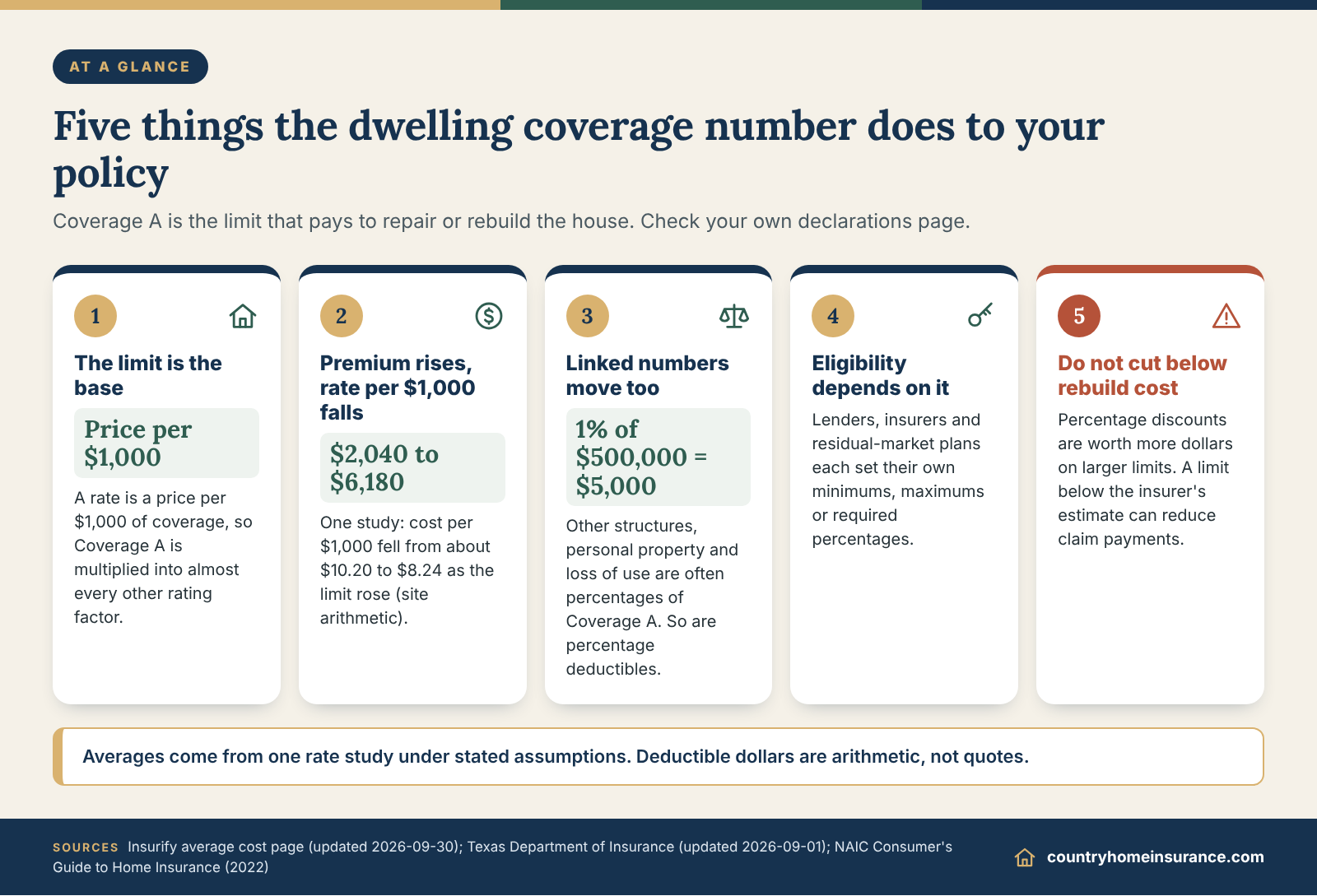
- Coverage A is the exposure base in most rate math: the Texas Department of Insurance describes a home-coverage rate as a price per $1,000 of coverage, so the limit you choose is multiplied into almost every other rating factor.
- In Insurify’s September 30, 2026 averages, the premium rose from $2,040 to $6,180 as the dwelling limit rose from $200,000 to $750,000, while the cost per $1,000 of coverage fell from about $10.20 to $8.24 (this site’s arithmetic).
- Changing Coverage A also changes other numbers automatically: other structures, personal property and loss of use are often set as percentages of it, and percentage deductibles are dollar amounts that grow with the limit.
- Eligibility depends on the number too. Lenders, insurers and residual-market plans each set their own rules about minimum, maximum or “required percentage of replacement cost” limits.
- Most discounts work as a percentage of premium, so the same discount is worth more dollars on a larger limit, but amounts and rules are set by each insurer and state and must be confirmed.
- The riskiest way to save money is to lower the dwelling limit below the insurer’s rebuild estimate; deductible choices, mitigation and quote comparison are usually safer levers.
| Where the limit appears | What typically happens as Coverage A rises | What to verify on your policy |
|---|---|---|
| Base premium | The premium generally rises, though in published averages the cost per $1,000 of coverage tends to fall at higher limits | Your insurer’s rate for your territory, plus the rating factors it applies |
| Other structures, personal property, loss of use | Often set as percentages of Coverage A (the NAIC guide shows 10%, 50% and 20%), so they move with it | The actual percentages and dollar limits on your declarations page |
| Percentage deductibles | The dollar deductible grows with the limit when the deductible is a percent of the dwelling coverage | Whether each deductible is a flat amount or a percent, and which amount it is a percent of |
| Insurance-to-value rules | Insurers may require 80%, 90% or 100% of replacement cost; falling short can reduce claim payments | The loss-settlement wording and your insurer’s required percentage |
| Lender and insurer eligibility | Lenders look at coverage sufficiency; insurers and residual-market plans may set minimums or maximums | Your lender’s current requirement and the insurer’s or plan’s limits |
| Discount value | A percentage discount saves more dollars on a larger premium, though some discounts apply only to part of the premium | Which premium component each discount applies to, in writing |
Homeowners insurance cost by dwelling coverage: how the limit becomes a price
Dwelling coverage, usually called Coverage A, is the limit on what the policy pays to repair or rebuild the house itself after a covered loss. It is the biggest single number on most homeowners policies, and it sits underneath the price in a way that surprises people. You don’t pay for “a house”; you pay a rate for each unit of coverage, adjusted for everything an insurer knows about where and how the house is built.
This article follows that number through three decisions: what it does to the premium, whether it affects who will insure you, and how it changes the value of discounts. It deliberately skips two neighboring questions. How home value differs from rebuild cost is covered in a separate guide on how home value affects homeowners insurance cost, and the process for estimating the right amount lives in the guide on how much homeowners insurance you need.
How insurers turn a dwelling limit into a premium
Every insurer builds its own formula, but the logic is similar across the industry. A starting rate is applied to the amount of coverage, and then factors for location, construction, roof, deductible and the policyholder adjust it up or down. Regulators publish enough of this to show the shape of the calculation, even though no consumer site can show your exact price.
The rate per $1,000 of coverage is the basic building block
The Texas Department of Insurance, in a consumer explainer last updated September 1, 2026, defines a rate as the cost per exposure unit and says that for home coverage the unit is $1,000 of coverage. The premium is the total you pay once the rate has been applied to your coverage amount and your other characteristics. That framing explains why Coverage A matters so much: it is the quantity everything else multiplies. The same page lists the home factors insurers weigh, including the age of the house, the age and material of the roof, where you live, the cost to replace the house, your claim history and your credit information, and it states plainly that each company’s premium formula is different. Texas Department of Insurance, how insurance costs are calculated is a good plain-language starting point for any state’s readers, though other states’ rules vary.
A rate filing shows the same idea on paper
In many states insurers file their rates and rating rules with the insurance regulator (filing requirements vary by state), and some departments post those filings online. North Carolina’s posted 2024 homeowners rate filing materials, for example, define an owners base class: Protection Class 5, frame construction, a $200,000 Coverage A and a $1,000 deductible. Premiums for other combinations are reached by applying differentials, and the sample calculation in the filing uses a Coverage A factor of 1.000 at $200,000. The filing materials also list individual insurers’ deviations, including some tied to bands of Coverage A, which tells you that two companies can treat the same dwelling limit differently. Treat that as an illustration of method from one state; the North Carolina Department of Insurance filing excerpt does not describe how your state or your insurer rates the limit.
Why your quote may not match any published average
Even a federal premium study is simplified. The U.S. Government Accountability Office’s 2026 report on homeowners premiums (GAO-26-107867) used estimates that held the level of coverage and deductibles equal across the country, described them as a standardized policy rather than actual quotes, and noted that the findings show associations, not causation. The same report says insurers use the amount of insurance, optional coverages and coverage limits as rating factors. In plain terms, a national table is a map of typical patterns, not a price tag. When your agent’s number differs from a website’s number, that usually reflects the stated assumptions, not an error on either side.
What published averages show about price and dwelling limit
Rate publishers collect quotes from many insurers and report averages at different coverage levels. These tables are useful for seeing the shape of the relationship, and they are risky for anything else. Each publisher chooses its own sample home, deductible and geography, so the rule is to compare within one publisher’s table and never across publishers.
One September 2026 dataset: Insurify’s averages by dwelling limit
Insurify reports averages built from partner-company data and Quadrant Information Services rate data, covering more than 180 insurers across all 50 states and Washington, D.C. Its default profile is a $300,000 dwelling limit, a $1,000 deductible, $25,000 of personal property, $300,000 of liability, no prior claims, good credit and a home built in 1980. The page was updated on September 30, 2026 and states that rates are refreshed monthly. Table 2 reproduces its dwelling-limit averages and adds two columns of arithmetic by this site, so you can see the slope without doing the division yourself.
| Dwelling limit (Coverage A) | Average annual premium (Insurify, updated 2026-09-30) | Premium per $1,000 of coverage (this site’s arithmetic) | Added premium per extra $1,000 versus the row above (this site’s arithmetic) |
|---|---|---|---|
| $200,000 | $2,040 | About $10.20 | Not applicable |
| $300,000 | $2,808 | About $9.36 | About $7.68 |
| $400,000 | $3,552 | About $8.88 | About $7.44 |
| $500,000 | $4,320 | About $8.64 | About $7.68 |
| $750,000 | $6,180 | About $8.24 | About $7.44 |
Read the table with its assumptions in mind: a 1980 build, a $1,000 deductible, good credit and no claims. A rural home with a different roof, a farther fire station or a claim last year would sit on a different line entirely. Insurify’s own text says the more dwelling coverage you have, the higher your premiums will generally be, which matches the table.
A second dataset with a different sample home
MoneyGeek’s rating-factors page, which shows an update line of October 1, 2026, uses Quadrant Information Services rate data too, but for a different profile: a home built in 2000 with 2,500 square feet, a $250,000 baseline dwelling limit, $125,000 of personal property, $200,000 of liability, a $1,000 deductible, good credit and no claims in five years. The retrieved page text did not state the geography. Its averages run from $1,828 at a $100,000 limit to $10,733 at $1 million. Because the sample home and baseline differ, the dollar levels are not comparable with Insurify’s, and putting the two tables side by side would be comparing apples to oranges. The useful comparison is the shape, shown in Table 3.
| Dwelling limit | Average annual premium (MoneyGeek, update line 2026-10-01) | Premium per $1,000 (this site’s arithmetic) | Added premium per extra $1,000 versus the row above (this site’s arithmetic) |
|---|---|---|---|
| $100,000 | $1,828 | About $18.28 | Not applicable |
| $250,000 | $3,467 | About $13.87 | About $10.93 |
| $500,000 | $5,874 | About $11.75 | About $9.63 |
| $750,000 | $8,317 | About $11.09 | About $9.77 |
| $1,000,000 | $10,733 | About $10.73 | About $9.66 |
Reading the curve: a base amount plus a per-$1,000 charge
Both tables show the same pattern. The average premium rises with the limit, but the premium per $1,000 of coverage falls, and the extra cost of each additional $1,000 settles into a fairly steady band: roughly $7.40 to $7.70 in the Insurify table and roughly $9.60 to $9.80 above $250,000 in the MoneyGeek table. This site’s reading, which neither publisher states, is that part of the premium behaves like a base amount that doesn’t scale with the limit, with a per-$1,000 charge stacked on top. One plausible reason is that items such as liability coverage and per-policy costs don’t grow with the dwelling limit, but the sources don’t explain the pattern, so treat that as a hypothesis. The practical point is that a cut in the limit saves the marginal amount, not the average. Using the Insurify band, removing $50,000 of dwelling coverage would save roughly $370 to $385 a year, about $75 less than the roughly $450 that the average rate of around $9 per $1,000 would suggest. That arithmetic is illustrative, but it explains why trimming the limit saves less than most people expect.
Why two homes with the same dwelling limit can pay very different premiums
The limit is only one input. Two farmhouses insured for exactly $350,000 can be priced quite differently because the rest of the formula treats them differently.
Location, hazard and fire protection ride on top of the limit
The Congressional Budget Office’s 2024 report on climate and homeowner’s insurance says private insurers try to price premiums to a specific property’s risk, considering the size and location of the structures, the hazards in the area and how likely those hazards are. The NAIC’s consumer page adds crime rates, access to fire, police and water supply, and the distance to a hydrant and fire department as location factors. For a country home, the practical translation is that the same limit costs more in a hail corridor, a wildfire-prone canyon or a place where the nearest station is miles away. Later sections return to protection class, because it matters more on acreage than most buyers expect. ZIP-code effects have their own guide: see how ZIP code affects homeowners insurance cost.
Age, roof, construction and personal factors
The NAIC says frame homes usually cost more to insure than brick ones, newer homes may earn discounts, and older homes may need updated heating, plumbing, wiring or roofing. The Texas page above singles out roof age and material. Personal factors such as claims history and credit-based insurance scores also enter in many states, and each has its own guide: see claims history and rates and credit-based insurance score and rates. The point for this article is that none of these factors changes how the limit works; they change the rate that the limit is multiplied by.
What else moves when you change Coverage A
Changing the dwelling limit is never a one-line edit. Several other protections are written as percentages of it, deductibles can be tied to it, and the number tends to drift at renewal even if you never touch it. Understanding those links prevents the two most common surprises: a coverage that quietly became too small for an outbuilding, and a storm deductible that is larger in dollars than the owner expected.
Coverages written as a percent of Coverage A
Standard homeowners forms are built so that several coverages scale from the dwelling limit unless the policy says otherwise. The details below come from consumer guidance, so confirm your own percentages on the declarations page, which is the summary page of your policy that lists limits, deductibles and endorsements.
Other structures, personal property and loss of use
The NAIC’s 2022 consumer guide shows other structures (Coverage B) at 10 percent of the dwelling limit, personal property (Coverage C) at 50 percent and loss of use (Coverage D, which helps pay for living elsewhere after a covered loss) at 20 percent, and it adds that your policy may use different percentages. Triple-I says most companies provide personal property coverage equal to 50 to 70 percent of the dwelling amount. Liability and medical payments are different: the NAIC guide says you choose those amounts, so they don’t follow Coverage A automatically. The result is that a higher dwelling limit lifts several protections at once, and a lower limit shrinks them at once, which is one reason cutting Coverage A is a bigger decision than it looks.
A rural example: the barn that outgrows its 10 percent
Hypothetical example, not a quote: a farmhouse is insured for a $280,000 dwelling limit, which at 10 percent would put other structures at $28,000. The owner also has a pole barn and a detached shop that would cost about $110,000 to replace. Raising Coverage A just to lift Coverage B would require a dwelling limit of $1.1 million, which would be absurd and expensive, so that is the wrong lever. The better questions are whether the insurer will raise Coverage B on its own, schedule the structures separately, or whether the buildings belong on a different form. Acreage and outbuilding specifics are covered in the guides on country homes with acreage and in the planned hub on outbuildings and other structures (planned).
Adding coverage separately can cost extra
The NAIC consumer page says contents coverage can be raised for a small extra charge without increasing the dwelling coverage, which is the reverse of the barn problem. The GAO report adds a caution that adding coverage for detached structures or personal property can raise premiums. Together these sources suggest a rule of thumb for any percentage-linked coverage: if the automatic percentage doesn’t fit your property, ask for the specific coverage you need and ask what it adds to the premium, rather than moving Coverage A to fix a different problem.
Percentage deductibles turn the limit into an out-of-pocket number
A deductible is the amount you pay out of pocket on a covered loss before the insurer pays the rest. Some deductibles are flat dollar amounts, and some, especially for wind, hail or hurricane, are percentages. When the percentage applies to the dwelling limit, your Coverage A choice sets the dollar amount.
How the arithmetic works
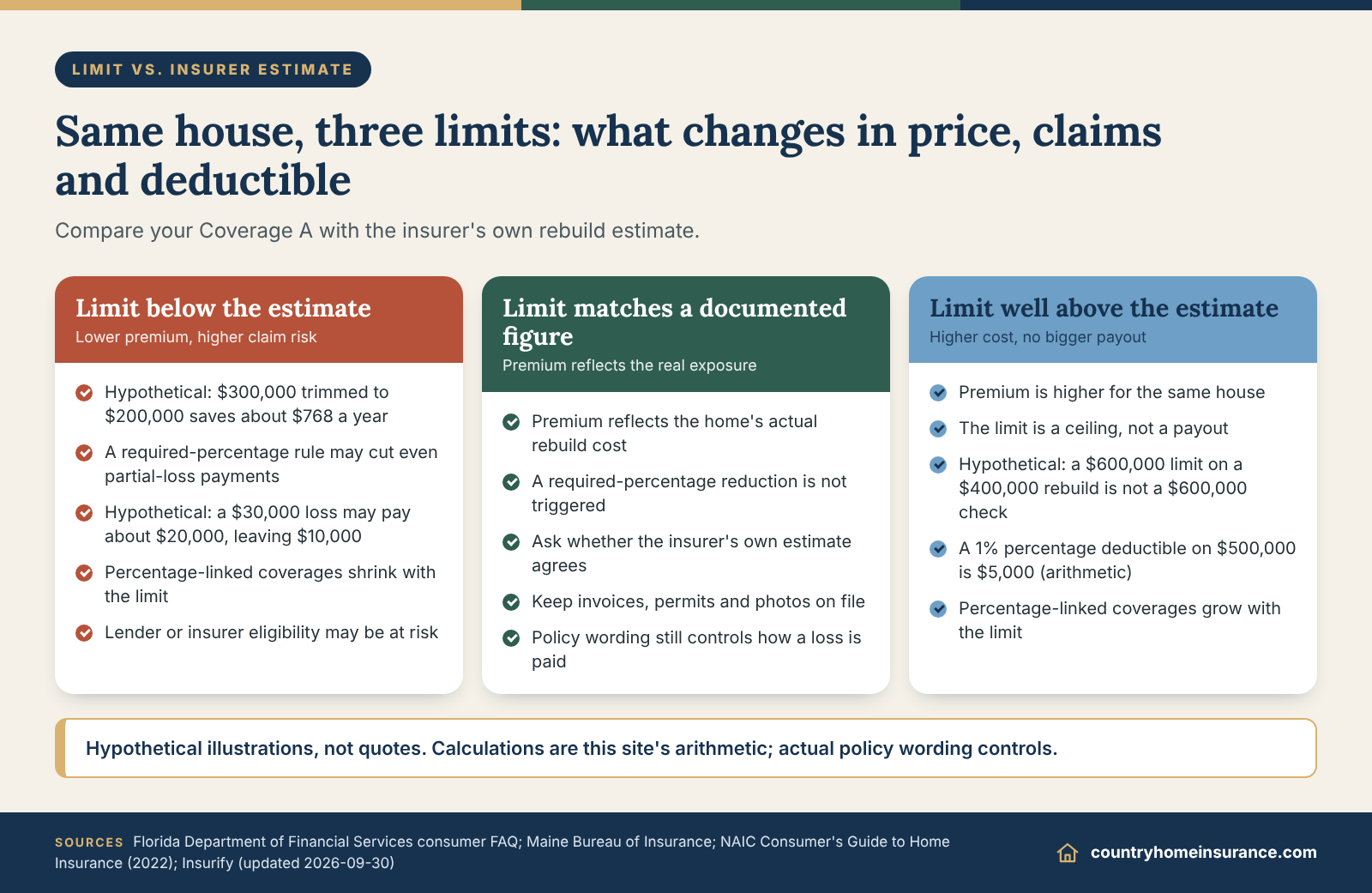
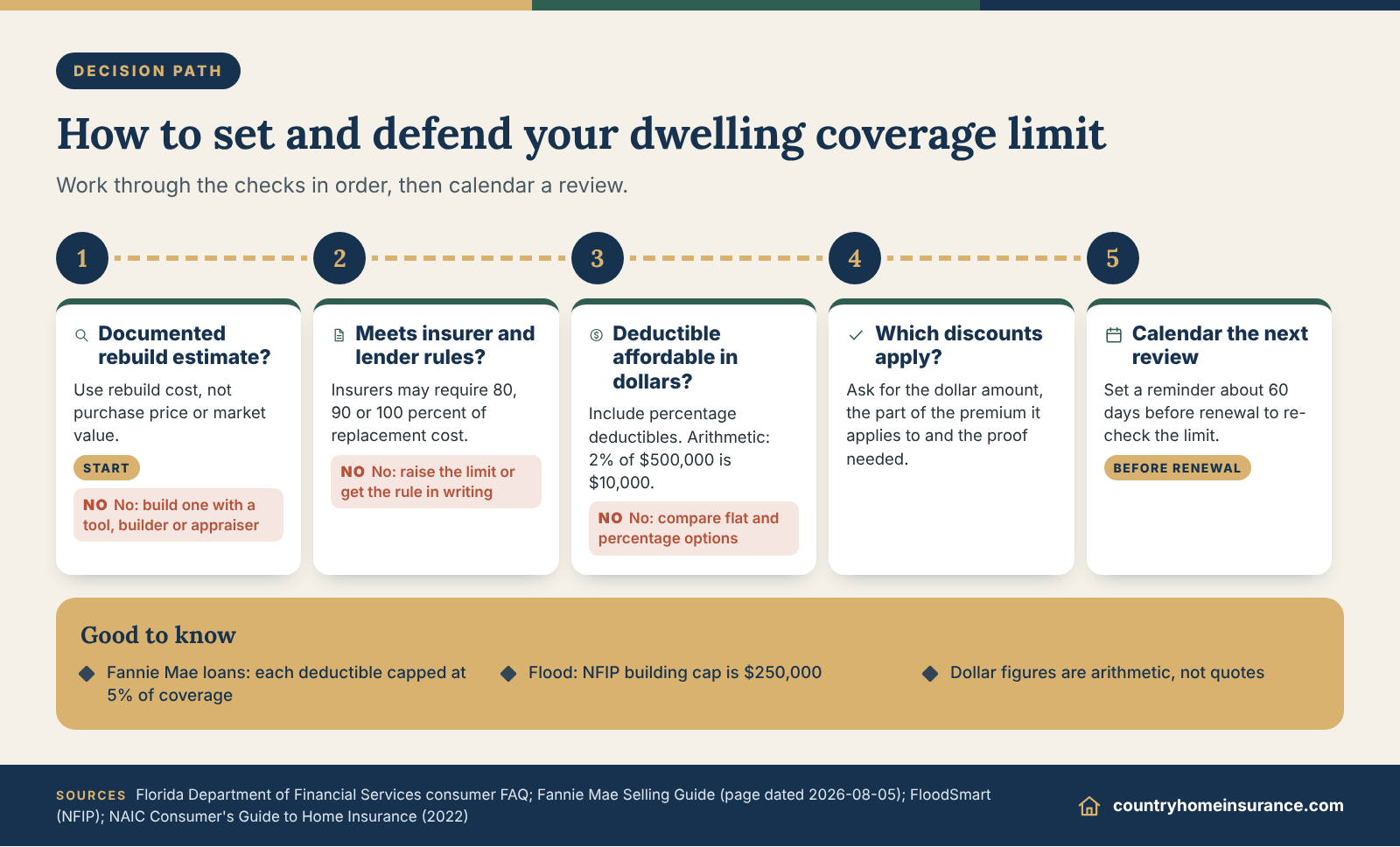
The Maine Bureau of Insurance gives a simple example: with $150,000 of dwelling coverage and a 1 percent windstorm deductible, the deductible on a windstorm loss would be $1,500. The same 1 percent on a $500,000 limit would be $5,000. Table 4 lays out the dollar amounts for a few limits and percentages. It assumes the percentage applies to Coverage A, as in the Maine example; some policies apply it to a different base, so the policy language controls.
| Coverage A limit | 1 percent deductible | 2 percent deductible | 5 percent deductible |
|---|---|---|---|
| $200,000 | $2,000 | $4,000 | $10,000 |
| $350,000 | $3,500 | $7,000 | $17,500 |
| $500,000 | $5,000 | $10,000 | $25,000 |
| $750,000 | $7,500 | $15,000 | $37,500 |
Lender and program guardrails on deductible size
Percentages are not unlimited. For loans it buys, Fannie Mae’s Selling Guide caps the deductible for each required peril at 5 percent of the property insurance coverage amount, and if separate deductibles apply to different perils, each must stay within that cap. Residual-market plans publish their own menus: the Texas FAIR Plan Association says that for policies on or after July 1, 2026 the wind and hail deductible options are 2 to 5 percent (the 1 percent option was eliminated and existing 1 percent policies switch to 2 percent at renewal), while other perils offer 1 to 5 percent. That page does not say what amount the percentage applies to, so confirm the base with the plan. Your lender’s current rules should be checked directly because other loan programs may differ.
Flat deductibles and the premium trade
The NAIC says a higher deductible generally lowers the premium. Insurify’s September 30, 2026 table, at a $300,000 dwelling limit, shows average premiums of $2,659 at a $500 deductible, $2,055 at $5,000 and $1,934 at $10,000. One caution: its $1,000 row ($2,417) doesn’t line up with its own $300,000 dwelling row ($2,808), which is described under the same default assumptions, and the page doesn’t explain the gap. That makes the relative step useful and the exact dollars shaky: moving from $1,000 to $5,000 would be about a 15 percent reduction using the page’s own deductible rows, and to $10,000 about 20 percent. Whether the savings justify the risk depends on whether you could pay the deductible tomorrow without borrowing.
Why the limit drifts after you buy it
Construction costs change, so insurers have two ways to keep a policy aligned with them: raise the limit, or raise the price of each unit of coverage. Both raise your bill, and they are easy to confuse.
Automatic limit increases at renewal
Triple-I describes an inflation guard clause that automatically adjusts the limit to current local construction costs at renewal, and says that if your policy lacks it, you may be able to add it as an endorsement, which is an optional policy change that modifies coverage. The NAIC guide describes an inflation guard endorsement that raises the dwelling limit each year in line with inflation. When the limit rises, the premium typically rises with it, and the declarations page should show the new Coverage A. Not every policy has this feature, so owners without it carry the burden of updating their own number.
Rate-side changes: an amount-of-insurance factor example
The GAO report describes a rate filing in which one insurer raised its amount-of-insurance factor by 7.2 percent because replacement costs and inflation had risen. That is a different mechanism: the limit on the policy could stay the same while the price charged per unit of coverage goes up. It is one example from the report, not a statement about how often or by how much insurers do this, but it explains why a premium can rise at renewal when nothing about the house changed.
Questions to ask when the renewal number changes
If your renewal premium rises, ask three things. Did Coverage A change, and if so, was it because of an inflation guard, a new valuation or a request from you? Did the rate per unit of coverage change, in your territory or statewide? And did other factors, such as roof age, claims or deductible, change at the same time? Asking the agent to split the increase into these pieces turns a vague complaint into a specific answer, and it tells you whether shopping or adjusting coverage could help.
When your dwelling limit and the insurer’s rebuild estimate disagree
Most of the damage in this topic comes from a mismatch. Your insurer has a view of what it would cost to rebuild your house, and your chosen limit either meets that view or doesn’t. The gap shows up in premium, eligibility and, unfortunately, in claims. This section covers what the sources say about each direction.
Setting the limit below the insurer’s estimate
Choosing a lower limit is the most direct way to shrink a premium, and it is also the one regulators warn about most consistently. The saving is immediate and certain; the cost arrives only after a loss, which is exactly why it deserves a worked example.
Insurers can require a set percentage of replacement cost
The NAIC says it is important to insure for at least 80 percent of replacement value, and its 2022 consumer guide adds that if coverage falls below 80 percent of full replacement cost, the insurer may reduce the amount it pays on a claim. The Florida Department of Financial Services’ consumer FAQ explains that insurers may require 80, 90 or 100 percent of replacement cost, depending on the company, and uses a $240,000 replacement cost to show required limits of $192,000, $216,000 or $240,000. The required percentage is a company rule, so the same limit can satisfy one insurer and fall short for another. Replacement cost excludes land, so your purchase price or market value is not the benchmark.
How a payment reduction works
Both the Florida FAQ and the Maine Bureau of Insurance describe the same type of formula: the limit you carry divided by the limit required, multiplied by the loss. Florida’s example is a $100,000 limit carried, $200,000 required and a $50,000 loss, which produces a $25,000 payment. Maine’s is a $100,000 rebuild cost, a $25,000 fire loss and a requirement of $80,000: carrying $60,000 gives 75 percent, so the formula yields $18,750 and leaves a $6,250 gap, with the deductible then handled according to the policy. Table 5 applies the same formula to a hypothetical partial loss at different required percentages.
| Insurer’s required percentage of $240,000 replacement cost | Required limit | Payment on a $30,000 partial loss if you carry $180,000 | Amount shifted to the owner |
|---|---|---|---|
| Limit meets or exceeds the requirement | Not applicable | $30,000 | $0 |
| 80 percent | $192,000 | $28,125 | $1,875 |
| 90 percent | $216,000 | $25,000 | $5,000 |
| 100 percent | $240,000 | $22,500 | $7,500 |
The table is an illustration of the regulators’ formula, not a prediction. Actual policy wording controls, including how the deductible, replacement-cost conditions and any endorsements interact, and not every policy settles partial losses this way.
The savings versus the shortfall
Hypothetical example: a home that would cost $300,000 to rebuild is insured for $300,000, then trimmed to $200,000 to save money. Using Insurify’s September 2026 averages as a rough guide, that cut is worth about $768 a year ($2,808 minus $2,040). If the insurer requires 100 percent of replacement cost, the formula treats $200,000 as two thirds of what is required. A $30,000 partial loss would then pay about $20,000, leaving about $10,000 with the owner before the deductible. In that illustration, one ordinary claim would cancel roughly 13 years of premium savings, and a total loss would be capped at a limit well below the rebuild cost. The numbers are invented for illustration, and your own result depends on your policy.
Setting the limit above the insurer’s estimate
The opposite mistake is less dangerous, but it is not free. A limit higher than needed raises the premium and doesn’t change what the house is worth to rebuild.
A higher limit is a ceiling, not a payout
The NAIC explains that replacement cost value pays to repair or replace damaged property with materials of like kind and quality, and that it does not include the value of the land. In plain terms, the dwelling limit sets the most the policy will pay for the structure, subject to the policy terms, while the settlement itself follows the cost of repair or replacement. Paying for $600,000 of coverage on a house that would cost $400,000 to rebuild doesn’t produce a $600,000 check. It produces a larger premium, and probably larger percentage-based coverages and deductibles as side effects.
When extra headroom is legitimate
Some owners have good reasons to carry a limit above a simple estimate, such as an older house with custom millwork, rising local labor costs or a remote site where materials cost more to deliver. Triple-I notes that homeowners policies generally won’t pay the extra cost of meeting new building codes and that insurers offer an endorsement for that purpose, usually called ordinance or law coverage. That is often a more targeted tool than inflating Coverage A. The planned guide on ordinance or law coverage will cover the mechanics in depth.
Why insurers care about the estimate
Texas lists “the cost to replace your house” among the factors insurers use, and the GAO report notes that premium models consider each home’s replacement cost. If your chosen limit sits well below the insurer’s own estimate, the insurer may ask you to raise it or may apply its required percentage at claim time, as the regulator examples above describe, depending on the company and state. If you think the estimate is wrong, say so and document why, such as a smaller finished area or simpler materials, instead of quietly accepting a lower limit.
Extended and guaranteed replacement cost: the eligibility strings
Two optional protections change how much the limit matters. Both come with conditions that depend on the limit you carry, so they are best thought of as eligibility questions rather than free upgrades.
Extended replacement cost
Triple-I says extended replacement cost pays a set percentage above the policy limit, “20 percent or more depending on the insurer,” for unexpected increases in building costs. The Colorado Division of Insurance’s buyer’s guide (an NAIC publication with a 2014 copyright) describes it as paying above the limit up to a set percentage or dollar amount. The cushion makes the limit less of a hard stop, but it doesn’t make the limit irrelevant: when the cushion is a percentage of the limit, a limit that is too low produces a smaller cushion in dollars.
Guaranteed replacement cost
Guaranteed replacement cost pays to rebuild even above the declared limit, according to the same buyer’s guide, which says to ask whether there is a cap and notes that very few insurers offer it. Triple-I adds that it generally doesn’t cover building-code upgrades and may not be available for older homes. Insurify’s high-value page says it may be included in high-value policies, though it is optional in standard ones. Insurers that offer it may attach conditions to the limit you carry, so ask exactly what the condition is before assuming you qualify. This is one place where an honest, documented limit can matter beyond the premium.
What the Marshall Fire analysis suggests about limits
After the Marshall Fire in Colorado, the state Division of Insurance analyzed 951 total-loss homes, looking at Coverage A only. Under three rebuild-cost assumptions of $250, $300 and $350 per square foot, it estimated that 36, 55 and 67 percent of the homes, respectively, were underinsured, with average shortfalls of $98,967, $164,855 and $242,670. The 76 homes with guaranteed replacement coverage (8 percent) were not counted as underinsured. This is one event in one state, with surplus-lines policies not collected, so it shows what a shortfall can look like rather than predicting your own; the Colorado Division of Insurance release has the full method.
How your dwelling limit affects who will insure you
Eligibility sounds like a question about the house, and mostly it is. But the dwelling limit takes part in the conversation in three ways: your lender checks it, your insurer compares it with its own estimate, and some programs have a ceiling or a floor that defines who qualifies. Table 6 summarizes the checkpoints discussed below, and each source is named so you can read the original.
| Checkpoint | What the source says | Who sets the rule | What to ask or verify |
|---|---|---|---|
| Loan sold to Fannie Mae | Coverage must be on a replacement-cost basis, except roofs, with each required-peril deductible capped at 5 percent of the coverage amount (Selling Guide page dated 2026-08-05) | Fannie Mae, enforced through your servicer | Ask your servicer which requirement applies to your loan and when it re-checks |
| Insurer’s insurance-to-value rule | Insurers may require 80, 90 or 100 percent of replacement cost, depending on the company (Florida DFS FAQ) | Each insurer, within state rules | Ask for the required percentage and the loss-settlement wording |
| High-value home programs | Homes needing more than $500,000 of dwelling coverage are generally treated as high value; some insurers set minimums of $750,000, $1 million or more (Insurify, updated 2025-10-15) | Each insurer | Ask whether the home needs a different form or an insurer that writes larger limits |
| California FAIR Plan residential limit | The Insurance Commissioner doubled residential limits to $3 million in 2019; the March 2025 release lists $3 million as a current limit | California FAIR Plan, under the Insurance Commissioner | Confirm the current cap and whether it is combined across coverages |
| Flood insurance through the NFIP | Homeowner building coverage up to $250,000 and contents up to $100,000, with a 30-day wait and exceptions (FloodSmart) | FEMA’s National Flood Insurance Program | Compare the cap with your rebuild cost; ask about private flood options |
| Lender-placed insurance | If coverage lapses, the lender may buy a policy that usually costs more and covers only the structure (NAIC) | Your lender, under the mortgage contract | Keep continuous coverage and send renewals to your servicer |
Mortgage lenders and coverage sufficiency
If you have a mortgage, your lender is a second reader of your dwelling limit. It cares less about the price and more about whether the collateral is protected, which is why lender requirements are best understood as a floor and not a recommendation.
What Fannie Mae’s current guide says
Fannie Mae’s Selling Guide, in the version dated August 5, 2026, requires the property insurance policy to provide coverage on a replacement-cost basis, with an exception for roofs: roofs must be insured but needn’t be on a replacement-cost basis. The same page lets actual cash value apply to personal property and to structures that aren’t buildings, requires a special-form policy or equivalent, and caps each required-peril deductible at 5 percent of the property insurance coverage amount. A law-firm summary reports that updated requirements issued on March 18, 2026 removed an earlier option based on the unpaid principal balance and rescinded a verification requirement that had been announced in 2024. These rules apply to loans Fannie Mae buys; loans held by other investors or insured by government programs follow whatever rules the lender or program sets, so ask.
Servicers monitor the number every year
The Servicing Guide section on these requirements says servicers confirm that new policies meet the standards and confirm at least annually for renewal policies. If a servicer can’t confirm replacement-cost coverage from the evidence on file, it checks whether the coverage amount has decreased from the last known amount, and if it has, must take and document additional steps. Servicers must notify borrowers of any insufficiency, and their procedures can include lender-placed insurance. The practical reading is that lowering Coverage A at renewal is more likely to draw a letter than leaving it alone, though what your servicer actually does is a question for the servicer.
Lender-placed insurance usually costs more
The NAIC says most lenders require insurance for the life of the loan and name themselves as mortgagee, meaning the lender with a financial interest in the property. If coverage lapses, the lender may buy a policy on your behalf. That policy usually costs more and covers only the structure, and you can be required to pay the higher premium until you get your own coverage. The NAIC also says you aren’t required to buy from the insurer your lender recommends. A lender minimum, which the NAIC says is often at least the mortgage amount, tells you the least the lender will accept, not the amount your house needs.
Insurer and residual-market thresholds
Beyond lenders, some insurers and public plans define themselves by dwelling size. This matters most at the high end, where the number of willing insurers shrinks, and for homes in places where the standard market has pulled back.
High-value homes and the dwelling-limit thresholds
Insurify’s high-value page, updated October 15, 2025, says insurers generally treat homes needing more than $500,000 of dwelling coverage as high value, and that some set minimums of $750,000, $1 million, $1.5 million or more. It adds that many insurers don’t offer the more comprehensive HO-5 form, because fewer homes qualify. A country estate with a large rebuild cost on a modest-looking parcel can cross those lines without the owner noticing. The thresholds are insurer-specific and the page is a rate publisher’s summary, so use it as a prompt to ask each insurer, not as a rule. For a fuller look at larger homes, see the guide on how home value affects eligibility and cost.
Residual-market plans have their own ceilings
FAIR Plans and similar residual-market programs are insurers of last resort for property that can’t get standard coverage, and their limits are set by program rules. The California Department of Insurance’s March 28, 2025 release says the Commissioner ordered the California FAIR Plan to double its residential limits to $3 million in 2019 and lists $3 million as a current residential limit; the same release concerns expanded commercial limits. A consumer-publisher explainer describes the cap as combined across several coverages, but that detail wasn’t confirmed by a regulator source, so ask the plan how it counts. Other states’ plans set different caps. A 2024 Florida Senate analysis, for example, described a $700,000 replacement-cost line for Citizens Property Insurance (with higher thresholds in two counties) and a bill proposing to change it; whether that proposal became law was not verified here, so check the plan’s current rule. If a plan’s cap is below your rebuild cost, ask a licensed broker whether excess coverage can be layered on top, because a cap is a limit on the plan, not on your exposure.
Flood has its own, separate ceiling
Homeowners policies generally exclude flood, and FloodSmart, the National Flood Insurance Program’s consumer site, lists maximum homeowner coverage of $250,000 for the building and $100,000 for contents. The Congressional Budget Office reported that the building cap affected about 1.4 percent of flood claims paid from 2003 to 2022, but those claims made up 8.1 percent of building-damage dollars paid. For a house with a rebuild cost above $250,000, the flood limit won’t follow Coverage A at all. The detailed rules, including waiting periods, are in the guide on whether homeowners insurance covers flood damage.
Underwriting reviews that key off the number
Underwriting is the insurer’s process of deciding whether to offer coverage and at what price. Several parts of it focus on how your limit compares with the home’s rebuild cost.
Replacement-cost checks at quote and renewal
Triple-I advises asking the insurer to calculate rebuilding costs or hiring an appraiser, and lists cost factors that include exterior wall type, square footage, architectural style, bathrooms, roof materials, custom construction, an attached garage and fireplaces. Texas names the cost to replace the house as a rating factor, and the GAO says premium models take replacement cost into account. How a given insurer checks your number, whether with an online estimator or an inspection, varies and wasn’t verified, so ask. If your limit and the insurer’s estimate differ by more than a small margin, expect to be asked about it, and bring evidence if you disagree.
Telling the insurer about renovations
Triple-I says to report improvements or additions to your agent so the limit reflects them. That advice cuts both ways: a finished walkout basement or an addition raises rebuild cost, and an upgraded roof, wiring or plumbing can support a discount. The NAIC lists updated electrical or plumbing and a new roof among possible discount triggers, and says a new wood-burning fireplace or a wooden deck can raise costs. Keep contractor invoices, permits and photos, because they are the documents that make either side of the conversation concrete.
Roof terms can change what the number really buys
Coverage A includes the roof, but how roof damage is settled can differ from the rest of the house. The GAO reports that some insurers have shifted to paying the depreciated value of older roofs, using separate roof deductibles, or offering discounts to customers who accept lower roof payments, and Fannie Mae’s guide treats roofs differently from the rest of the dwelling. Two policies with the identical Coverage A can therefore feel very different after a hailstorm. Ask whether your roof is settled at replacement cost or actual cash value, and read the guide on a hail-damaged roof insurance claim before storm season if your area sees frequent hail.
Discounts: how the dwelling limit changes what they are worth
No source this article reviewed shows a single national list of guaranteed discounts, and none of the figures here is an offer. What the sources do show is the structure: discounts generally reduce a premium that was built from your limit, which ties their dollar value to the number you picked. Amounts, eligibility and required documents are set by each insurer and state, so use this section to ask better questions, not to assume a saving.
Why a percentage discount grows with the limit
Most discounts are expressed as percentages, and a percentage of a bigger number is a bigger number. That sounds obvious, but it changes how to prioritize your effort on an expensive-to-insure property.
The arithmetic on a small and a large premium
Hypothetical example, arithmetic only: suppose an insurer offered a 5 percent credit. On the Insurify averages in Table 2, a 5 percent credit applied to a $2,040 premium would be about $102 a year, while the same credit on a $6,180 premium would be about $309. The percentage is identical; the incentive to chase it is three times as large. No such discount is promised here, and your insurer’s actual credits, if any, might apply to the whole premium or only to part of it.
Discounts that apply to only part of the premium
The FORTIFIED Home program’s Alabama page says most Alabama insurers offer discounts of up to 55 percent off the wind portion of the property insurance premium, with ranges of 25 to 35 percent for a FORTIFIED Roof, 35 to 45 percent for Silver and 45 to 55 percent for Gold. It describes the program as voluntary and the discounts as insurer-offered rather than required by law, and says grants of up to $10,000 are available for qualifying owners when funded. The page’s date indicators conflict (its metadata shows 2021 while its content refers to 2025 materials), so verify the current figures with your insurer. Because the discount applies to the wind portion, not the whole premium, the dollar effect depends on how much of your premium is attributed to wind, which only your insurer can tell you.
Ask how each discount is calculated
Before you spend money on a mitigation project, ask the insurer for three things in writing: the discount’s dollar amount for your policy, which premium component it applies to, and what documentation proves eligibility. A discount quoted as a range on a program website is not a promise about your renewal. If your state has a mandated mitigation discount, the state insurance department site is where that rule would be published, and state rules vary.
Discount categories regulators and the NAIC mention
The categories below come from consumer guidance. They aren’t a complete list and aren’t offered by every insurer.
Bundling, security devices and updated systems
The NAIC consumer page lists insuring the home and car with the same company, deadbolts, burglar alarms and window security devices, new homes in some cases, and roof replacement in some states. The NAIC guide adds storm shutters and other disaster-proofing, and updated electrical or plumbing, and it lists protective devices such as smoke detectors and sprinklers among the premium factors. The Congressional Budget Office adds fire-resistant building materials, trimmed vegetation and elevated structures as steps insurers may reward. When a credit is a percentage of premium, the larger your limit, the larger the dollar value of the same percentage, so a security package may be worth chasing more actively on a $600,000 house than on a $150,000 one.
Features that can raise the price
The NAIC page cautions that a new wood-burning fireplace or a wooden deck can raise costs, and the guide lists wood stoves, pools or trampolines, certain dog breeds and business use of the home among other factors. These can interact with the dwelling limit, since some features raise rebuild cost and some raise liability exposure. Disclose them honestly, because an undisclosed feature can create a problem at claim time.
Rural fire protection and protection class
For country homes, the fire protection score can matter as much as the limit. The Texas Department of Insurance explains that a Public Protection Classification, produced by Verisk’s Insurance Services Office, rates how well a community can suppress first-alarm structure fires. Properties within five road miles of a station are scored with the community’s class, those beyond that are Class 10, and within five miles but more than 1,000 feet from a creditable water supply, a property gets an X suffix such as 4X, which is typical for rural parcels. TDI notes that hauled water can count as a creditable supply in some cases, that insurers use the class at their discretion, and that a better class doesn’t guarantee a lower premium. The concept is national, though the explainer comes from Texas. Ask your insurer which class it has on file for your address, because an outdated score can cost money. The guide on rural home insurance goes further on those issues.
Savings moves that keep the limit honest
If the goal is a lower bill, there is a ranking of levers by how much risk they add. Changing the limit sits at the risky end, which is the main point of this article.
Ranking the levers by risk
Lower-risk levers usually include shopping with identical coverage terms, bundling, documented mitigation, and a deductible you can actually afford. Medium-risk levers include moving to a percentage wind or hail deductible, because the dollar amount rises with the limit and can be large on a bigger house. The highest-risk lever is a Coverage A below the insurer’s estimate, because it can trigger a claim penalty, shrink percentage-linked coverages and attract lender attention. The sources reviewed treat the deductible and discount questions as routine shopping topics, and the limit as something to anchor to rebuild cost.
Match the deductible to cash you can reach
A practical test: if the deductible were due next week, could you pay it without a high-interest loan? A flat $2,500 may pass that test where a 2 percent deductible on a $500,000 house, which is $10,000 by Table 4, would not. The NAIC advises choosing a deductible you can afford to pay after a loss. If you are weighing a higher deductible, ask the insurer to quote two or three options side by side so the saving is a figure, not a guess; the Colorado buyer’s guide recommends asking how much you could save by raising it.
Use free tools and compare like with like
The NAIC’s Shopping Tool for Homeowners Insurance helps you work out where to look, what to ask and what information to gather before you shop, and your state insurance department site is a good place to find consumer guides. When you request quotes, keep the dwelling limit, deductibles and endorsements identical so the price differences mean something. The guide on how to compare home insurance quotes covers that process step by step.
Keeping Coverage A right after you buy it
Choosing a limit is a one-time decision only on the day you sign. After that, the house changes, construction costs change, and the policy may adjust on its own. A short routine keeps the number from drifting out of line with the house.
Reading the dwelling line on your declarations page
The declarations page is the cleanest single document for this job, because it states the limit, the deductibles and the endorsements without the policy form’s legal language.
Where the limit and its neighbors sit
Triple-I says your dwelling limit appears on the declarations page under Section I, Coverages, A. Dwelling. Right beneath it you should find the other structures, personal property and loss-of-use amounts, which is where you can see whether your policy uses the common percentage pattern or something different. Liability and medical payments appear in the Section II lines. Also look for the deductible lines, which may list a flat all-peril deductible, a separate wind or hail deductible, or both, and for the endorsement list, where an inflation guard, extended replacement cost or ordinance or law coverage would be named.
What to compare from one year to the next
Put last year’s declarations page next to this year’s and compare five things: the Coverage A figure, the three percentage-linked coverages, each deductible, the endorsement list and the premium. If Coverage A rose, find out whether an inflation guard, a valuation update or your own request caused it. If it didn’t change but the premium did, the cause is on the rate side, as in the GAO’s amount-of-insurance example. Any line you can’t explain deserves a question to the agent before the renewal date, not after a loss.
Three hypothetical homes and what the limit does for each
Examples help because the limit behaves differently depending on the house. Table 7 uses three invented homes. None of the figures is a quote or a promise, and the loss formula is the regulator-described one from Table 5 applied before any deductible.
| Hypothetical home | Limit situation | What the limit drives | Sensible next question |
|---|---|---|---|
| Newer house in a hail-prone county, rebuild estimate $320,000 | Limit set at $320,000 with a 2 percent wind and hail deductible | The percentage deductible equals $6,400 (2 percent of $320,000), a figure that grows if an inflation guard raises the limit | Could I pay $6,400 next month, and what would a flat deductible cost instead? |
| Older inherited farmhouse, market value $180,000, rebuild estimate $340,000 | Limit set at $200,000 to “match value”; insurer requires 80 percent of $340,000, which is $272,000 | On a $40,000 partial loss the formula pays about $29,412 ($200,000 divided by $272,000, times $40,000), shifting about $10,588 to the owner before the deductible | Can I raise the limit to the required level, and what does that add to the premium? |
| Country estate on acreage, rebuild estimate $1,200,000 | Limit set at $1,200,000, above the $500,000 level that one rate publisher says insurers generally treat as high value | Fewer insurers may write the home; a 1 percent percentage deductible would be $12,000; larger dwellings can hit residential-market caps | Which insurers write homes this size, and what forms and deductibles do they offer? |
| Mid-priced ranch house with a new FORTIFIED roof, rebuild estimate $410,000 | Limit set at $410,000 with a wind-portion discount offered by the insurer | The discount applies to the wind portion of the premium, so its dollar value depends on how much of the premium is attributed to wind | What is the discount in dollars on my policy, and what documents prove the roof? |
What the table shows about priorities
The first home’s issue is liquidity, the second’s is penalty exposure, the third’s is market access and the fourth’s is how a discount is calculated. None of them is solved by lowering Coverage A. In two of the four, the right fix is the opposite: a limit that matches a documented estimate, or the right question about the deductible. That is the central claim of this guide: the number sets price, rules and discounts, but it isn’t a dial to turn down casually.
When these scenarios do not apply
Policies differ. Some insurers settle partial losses without a required-percentage penalty, some policies include guaranteed replacement cost, and some states regulate these clauses. A farm or ranch policy or a dwelling-fire policy for a rental or seasonal property may work differently, and so may a policy from a residual-market plan. Use the scenarios as prompts, and let your own declarations page and loss-settlement wording decide.
Events that justify a mid-term review
Waiting for renewal is fine in a quiet year. Some events deserve a call to the agent when they happen.
Projects and changes that move the rebuild cost
Triple-I advises reporting improvements and additions. In practice, that means a finished basement, a new addition, a kitchen remodel with custom cabinetry, a metal roof, a converted barn apartment or a garage that became a workshop. Each can change the cost to rebuild, and some can change the price or eligibility. Ask whether the limit needs to change and whether any structure now belongs in a different category, such as a home business or a rental.
What to keep on file
Save contractor contracts and invoices, building permits, dated photos of finishes and the roof, and the insurer’s own replacement-cost worksheet if it provides one. Those records support a higher limit, answer an underwriter’s questions and back up a discount request for a roof or electrical upgrade. They also help if a claim ever turns on what the house was like before a loss.
A step-by-step way to compare quotes with the limit held steady
Because the limit drives so much of the price, a fair comparison starts by locking it. If one quote carries $300,000 and another carries $250,000, the cheaper price may simply be less protection. The steps below keep the comparison honest.
Before you request quotes
Preparation takes an hour, and it saves you from re-quoting every time a number changes.
Settle the dwelling number first
Decide the target Coverage A before you collect any prices, using a rebuild estimate and not a purchase price, and ask each insurer whether its own estimate agrees. The process for building that estimate is in the guide on how much homeowners insurance you need, so this article takes it as given. If you can’t settle on one figure, ask for quotes at two limits, so you can see the price of the difference.
Gather the facts that feed the rate
Insurers will ask about the home’s age, construction, roof age and material, square footage and finishes, the distance to the nearest station and water source, claims in recent years, and features such as a wood stove, pool or home business. Having these ready reduces mistakes, and a mistake in any of them can distort a quote. The Texas Department of Insurance’s factor list is a handy template.
Use a checklist
Table 8 is a reusable checklist built from the points in this article. Print it or copy it into your notes, and fill it in for each quote.
| Item | Why it matters | Where to look or whom to ask |
|---|---|---|
| Coverage A amount and the rebuild estimate behind it | It is the exposure base for the rate and the reference for any required percentage | Declarations page; insurer’s estimate worksheet; your own documentation |
| Required percentage of replacement cost | Insurers may require 80, 90 or 100 percent, and falling short can reduce payments | Agent or insurer; the policy’s loss-settlement section |
| Percent-of-A coverages (B, C, D) and any separate limits | They move automatically with Coverage A and may not fit outbuildings or valuables | Declarations page; agent |
| Deductibles: flat or percentage, and the base for any percentage | A percentage deductible grows with the limit and can be large in dollars | Declarations page; Table 4 for the arithmetic |
| Roof settlement terms and any separate roof deductible | Roof damage may be settled differently from the rest of the dwelling | Policy form; endorsements; agent |
| Inflation guard, extended or guaranteed replacement cost, ordinance or law | They change how well the limit holds up if costs rise or codes change | Endorsement list; ask for any cap or condition |
| Discounts: dollar amount, premium component and proof required | A percentage credit may apply to the whole premium or only part of it | Written quote; insurer’s underwriting department |
| Lender requirement and mortgagee details | Lenders check coverage sufficiency and may place coverage if it lapses | Loan servicer; mortgage documents |
| Protection class on file for your address | Rural fire protection scores can affect price independent of the limit | Insurer; local fire department |
Comparing quotes on equal footing
Once quotes arrive, resist the urge to sort by price. The first pass should confirm the coverage is the same.
Identical limits and deductibles first
Line up Coverage A, B, C and D, liability, and each deductible. If the dwelling limit differs between quotes, ask the cheaper insurer to re-quote at your target or compare per-$1,000 cost using the same rebuild estimate. The NAIC Shopping Tool for Homeowners Insurance can help you structure your questions. Compare apples to apples, or the cheapest quote will often turn out to be the thinnest.
Loss settlement, roof terms and endorsements second
Two quotes with identical limits can pay differently after a loss. Ask whether each quote settles the dwelling at replacement cost, how the roof is settled, whether a required percentage applies, and whether inflation guard, extended replacement cost and ordinance or law are included or optional. Those differences often explain a price gap better than the limit does.
Financial strength and complaint records last
After the coverage matches, look at the insurer’s financial strength rating from a recognized rating agency and its complaint record with your state insurance department. Neither was reviewed for this article, so check each directly. A cheaper policy from an insurer that is slow to pay or financially weak can cost much more than it saves.
After you buy
The first month after binding and the weeks before each renewal are the best moments to catch errors.
Verify what was issued
When the declarations page arrives, check it against the quote line by line: the limit, the percentages, the deductibles, the endorsements and the discounts. Errors are far easier to fix in the first weeks than after a claim. Make sure your lender has the correct mortgagee information so that proof of coverage and renewals reach the servicer.
Calendar the review
Set a reminder about 60 days before renewal to re-check the limit against current rebuild costs, ask about discounts you might have missed and request a second quote if the premium moved sharply. Keep a copy of every declarations page. The next step in the cluster is the guide on how to buy homeowners insurance step by step.
Frequently asked questions
Questions about price and premium
Does doubling my dwelling coverage double my premium?
In the published averages reviewed, no. Insurify’s September 30, 2026 table shows the average premium going from $2,040 at $200,000 to $3,552 at $400,000, roughly 74 percent more for 100 percent more coverage. Its $750,000 average of $6,180 is about 2.2 times the $300,000 average of $2,808 for a limit that is 2.5 times as large. MoneyGeek’s table, built on a different sample home, shows $5,874 at $500,000 and $10,733 at $1 million, about 1.8 times. These are averages under stated assumptions, so your own quote can behave differently, but the pattern of premiums rising more slowly than limits was consistent in both tables.
Will lowering my dwelling coverage lower my premium?
Usually, yes, but by less than most people expect, and the risks are asymmetric. In the Insurify averages, each $1,000 of added dwelling coverage cost roughly $7.40 to $7.70 a year, so a $50,000 reduction would save roughly $370 to $385 in that illustration. Against that, a limit below the insurer’s required percentage of replacement cost can reduce claim payments, and your lender may notice a lower figure at renewal. Ask for a quote at your target limit and at the lower limit, so you see the actual saving in your own market before deciding.
Why did my premium rise when my limit didn’t change?
Several things can do it. The insurer may have raised the price per unit of coverage, as in the GAO’s example of an insurer lifting its amount-of-insurance factor by 7.2 percent. Your roof may have aged into a different rating tier, a claim may have entered your history, or the territory’s rates may have changed. Ask the agent to separate the increase into limit, rate and other factors. If the explanation is only that rates went up, comparing quotes at the same limit is the natural next step.
Questions about eligibility and discounts
Can my lender make me raise my dwelling limit?
Your mortgage contract usually requires continuous insurance, and the lender or servicer monitors it. For loans Fannie Mae buys, its Servicing Guide says servicers confirm coverage sufficiency on new policies and at least annually at renewal, notify borrowers of any insufficiency and may use lender-placed insurance when problems aren’t resolved. The NAIC says a lender may set a minimum that is often at least the mortgage amount. Other loan types follow their own rules, so ask your servicer what it requires, in writing, and what it considers sufficient.
Is there a minimum Coverage A that the law requires?
None of the sources reviewed describes a universal legal minimum dwelling limit for homeowners policies. The minimums that come up in practice are set by lenders, by insurers, which may require 80, 90 or 100 percent of replacement cost, and by programs. State rules vary and can change, so if you want to know whether your state regulates required percentages or how policies must handle underinsurance, your state insurance department is the right place to ask.
Do my discounts get bigger if I raise Coverage A?
Where a discount is a percentage of premium, the dollar value generally rises with a larger premium, as the arithmetic in this guide shows. But discounts can apply to only part of the premium, as with the wind-portion discounts described for FORTIFIED homes in Alabama, and some may be flat credits or may be tied to specific documentation. Neither the sources nor this article can tell you how your insurer calculates yours. Ask the agent for the dollar amount of each discount at your current limit and at the one you are considering.
Sources
- Texas Department of Insurance: How are your auto and homeowners insurance costs calculated? (page updated 2026-09-01; reviewed 2026-10-11)
- North Carolina Department of Insurance: 2024 homeowner rate filing excerpt (no filing date stated in the excerpt; reviewed 2026-10-11)
- U.S. Government Accountability Office: Homeowners Insurance, GAO-26-107867 (published 2026-02-27; public 2026-03-30)
- Congressional Budget Office: Climate Change, Disaster Risk, and Homeowner’s Insurance (August 2024)
- NAIC: Homeowners insurance consumer page (undated; reviewed 2026-10-11)
- NAIC: A Consumer’s Guide to Home Insurance (2022 edition; reviewed 2026-10-11)
- NAIC: Actual cash value versus replacement cost coverage (dated 2025-01-02)
- Triple-I: Insurance for your house and personal possessions (undated; reviewed 2026-10-11)
- Insurify: Average cost of homeowners insurance (updated 2026-09-30)
- Insurify: High-value home insurance (updated 2025-10-15)
- MoneyGeek: What factors affect homeowners insurance rates (update line 2026-10-01)
- Florida Department of Financial Services: Homeowners insurance consumer FAQ (undated; reviewed 2026-10-11)
- Maine Bureau of Insurance: Out-of-pocket costs (undated; reviewed 2026-10-11)
- Colorado Division of Insurance: Initial estimates of underinsurance for Marshall Fire homes (2022-04-26)
- Colorado Division of Insurance: Homeowners insurance buyer’s guide (NAIC copyright 2014)
- Fannie Mae Selling Guide B7-3-02: Property insurance requirements for one- to four-unit properties (page version dated 2026-08-05)
- Fannie Mae Servicing Guide B-2-02: Property insurance requirements for one- to four-unit properties (page version dated 2026-08-12)
- WBK law firm: GSEs amend guidelines regarding property insurance requirements (law-firm summary; reviewed 2026-10-11)
- FloodSmart (NFIP): Buy a flood insurance policy (undated; reviewed 2026-10-11)
- California Department of Insurance: FAIR Plan expansion release (2025-03-28)
- CoverageCat: FAIR Plan coverage for high-value homes (consumer publisher; states it is current as of April 2026)
- Florida Senate: Bill analysis of CS/SB 1106 (2024), Citizens eligibility (2024 analysis; outcome not verified)
- Texas Department of Insurance: Public Protection Classification (2023-03-23)
- FORTIFIED Home: Alabama incentives (dates on the page conflict; verify current figures)
- Texas FAIR Plan Association: Deductible changes effective July 1, 2026 (published 2026-04-27)
Important coverage note
Coverage depends on the actual policy, endorsements, exclusions, limits, deductible and cause of loss. State laws and insurance programs vary, and insurers apply their own underwriting and rating rules within them. Averages, examples, percentages and arithmetic in this article are illustrations, not quotes, and nothing here promises that any claim will be paid or that any discount will apply. For questions about your own situation, check your declarations page and policy form, then verify the details with your insurer or agent and your state Department of Insurance. This article is educational and is not legal advice or a substitute for your policy.
About the editorial team
This guide was prepared by the countryhomeinsurance.com editorial team as general, educational information for homeowners. We research and summarize publicly available material, including state insurance departments, the NAIC, federal agencies, regulators’ consumer guides and published insurer and industry resources. We draw only on the sources that were available to us when we wrote this guide, and we list them in the Sources section with dates where we could find them.
Insurance rules, rates, products and program terms change, differ by state and by insurer, and can apply differently to your situation. We cannot guarantee that this content is complete, current or free of errors. It is not legal, financial, tax or insurance advice, it is not an offer to sell insurance or a recommendation of any insurer, agent or product, and reading it does not create a professional relationship of any kind.
To the fullest extent permitted by law, countryhomeinsurance.com and its editorial team, authors and contributors exclude all liability for any loss, damage or decision arising from the use of, or reliance on, this content. For questions about your own policy or claim, contact your insurer, a licensed agent or broker, your state Department of Insurance or another qualified professional.
Content created: October 11, 2026