Quick answer
A wind damage roof insurance claim is usually handled under the dwelling coverage of a homeowners policy, and wind is generally a covered cause of loss. What you collect depends on your wind or named-storm deductible, whether the roof is settled at replacement cost or actual cash value, and whether the damage is truly wind-caused rather than age or wear. Protect the home, photograph first, keep receipts, and delay permanent repairs until the insurer inspects. Policy terms and state rules vary.
Key takeaways
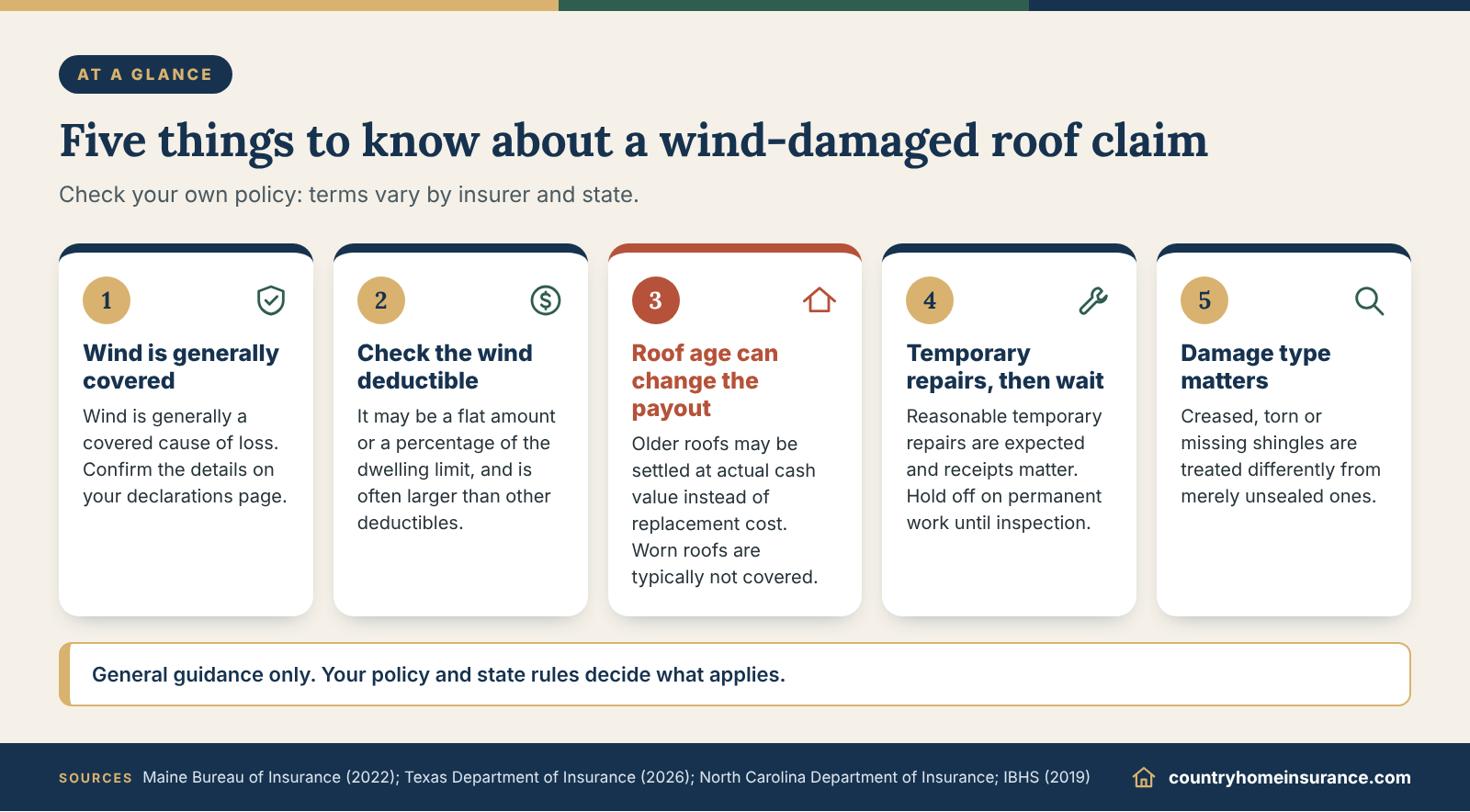
- Wind damage to a roof is generally covered under homeowners policies, but the wind deductible is often larger than your standard deductible and may be a percentage of the dwelling limit.
- Reasonable temporary repairs, such as a tarp over an opening, are expected, and the receipts may be reimbursed if the loss is covered. Photograph the damage before you cover it.
- Rain inside the house is not always covered. Some policies require that wind first create an actual opening in the roof or wall, so the order of events matters.
- Older roofs may be settled at actual cash value, and some insurers move aging roofs to that basis at renewal. Check your declarations page before a storm, not after.
- Shingles that are merely unsealed are treated differently from shingles that are creased, torn or missing. Ask what evidence the adjuster used to decide the cause.
- Contractors may not lawfully offer to waive your deductible in states such as Texas and Oklahoma. Get the insurer’s inspection and a written estimate before signing anything.
| Scenario | Typical treatment | What it depends on |
|---|---|---|
| Shingles torn off or missing after a windstorm | Typically covered as wind damage to the dwelling | Wind deductible, roof settlement basis (replacement cost or actual cash value), any roof-age schedule |
| Creased or folded shingles | Generally treated as physical wind damage | Number and location of damaged shingles, repairability, matching rules in your state |
| Shingles unsealed but not creased, torn or missing | Often disputed | Evidence of cause, roof age, installation, and how the insurer’s inspector reads the pattern |
| Rain inside the house after wind damages the roof | Often covered when wind opened the roof, but wording varies | Whether your policy requires an actual opening, and whether personal belongings are covered the same way |
| Worn, aged or deteriorated roof leaking without a wind event | Typically not covered | Maintenance exclusions and wear-and-tear language in the policy |
| Temporary tarp and board-up costs | Reasonable costs may be reimbursed if the loss is covered | Receipts, reasonableness, and policy duties after loss |
| Wind damage to a detached barn, shed or fence | Often falls under other structures coverage | Coverage B limit, ACV or RCV basis for outbuildings, farm-use exclusions |
| Storm surge or rising water | Not covered by standard homeowners policies | Separate flood coverage, such as NFIP or private flood |
What wind damage to a roof actually looks like
Before you can file a wind damage roof insurance claim with any confidence, it helps to know what insurers and inspectors are looking for on the roof itself. Cause of loss drives almost every decision that follows: whether the claim is covered, which deductible applies, and whether the roof is repaired or replaced. This section walks through the physical side so the paperwork side makes sense.
How wind pulls shingles apart
Asphalt shingles are held down by nails and by a factory-applied adhesive strip, so most of what follows is about how that strip lets go. Understanding the mechanics also helps you describe what you saw to an adjuster in plain terms.
Uplift and the sealant strip
Wind flowing over a roof creates suction, called uplift, that tries to peel the edge of a shingle upward. Most modern asphalt shingles are self-sealing, which means a temperature-activated adhesive strip applied at the factory bonds the lower edge of each shingle to the one beneath it. Insurance Institute for Business & Home Safety (IBHS) testing found that the strength of that bond is the single most important factor in how self-sealing shingles perform in high wind, and that better sealants have raised wind ratings over time. IBHS published that summary in January 2019 and modified it in August 2019, so it describes research from roughly 2015 and 2016 rather than the newest products.
Once the bond fails, the free tab can lift, flutter, flip and fold. An engineering article from 2018 describes the pattern this way: as a tab rises, more surface is exposed, the force grows, and the tab may crease or tear. Edges, hips and ridges tend to go first because wind pressure is highest there.
Creased, torn or missing versus merely unsealed
This distinction is where many wind roof disputes begin. A shingle that has lost pieces, been torn, or shows a crease or fold has clear physical damage. A shingle whose adhesive bond has simply let go, with no crease, tear or loss, is a grayer case. The same 2018 article, written by forensic engineers at Haag Engineering for a roofing-industry journal, says an unbonded shingle that is not creased, folded, torn or missing is not, in the authors’ view, evidence of wind damage. Keep in mind that this is one professional perspective, and policyholder advocates and contractors often see it differently.
For you, the practical point is simple: photograph creases, tears and missing tabs close up, and note exactly where they are. On new shingles in the authors’ lab tests, creases were subtle and visible only on close inspection, sometimes detectable by touch on the granule surface, so a quick glance from the ground may miss them.
How inspectors separate wind damage from wear
Policies are written to cover sudden storm damage, not the slow aging of materials. That is why an adjuster or engineer will often ask whether what they see on the roof is consistent with a wind event on a specific date.
Unsealing that happens without wind
Shingles can come unsealed for reasons unrelated to a storm. The 2018 article lists under-driven nails, debris or release tape on the sealant strip, cold-weather installation, manufacturing inconsistencies and repeated heating and cooling. It also cites a study in which shingles generally stayed sealed for about four to five years before unsealing became more frequent. IBHS adds that manufacturers recommend hand-sealing on steep slopes and during extended cold weather, and that the association of roofing manufacturers (ARMA) recommends it on slopes steeper than 12:12, which is 45 degrees, yet hand-sealing is not common practice in those conditions.
None of that means your roof is not wind-damaged. It means an insurer may argue that unsealed shingles pre-existed the storm, so your evidence of fresh damage matters.
Patterns, direction and how to ask about them
The engineers’ article says evaluators should look at where damaged shingles sit, whether unsealing follows a diagonal or stair-step pattern that tracks how the roof was installed, which slopes are affected, and which direction the storm wind came from. Wind-caused damage tends to concentrate on the windward edges and exposed areas, while installation-related unsealing often follows the pattern of the work.
You do not need to become an engineer. You can, however, ask the adjuster three plain questions: which shingles were treated as wind-damaged, what physical evidence supports that, and what the inspector concluded about the storm’s direction and the pattern across slopes. Put the answers in your claim notes. If the inspector’s report points to hail rather than wind, that is a different claim path, covered in our guide to hail damage on roofs.
What a homeowners policy typically covers after wind hits the roof
Homeowners policies are built from numbered coverage parts. Which one responds to a wind loss depends on what was damaged, and each part has its own limit and sometimes its own rules. This section maps the common pieces so you can read your own declarations page against them.
Which coverage parts respond to a wind loss
A single storm can touch the roof, a detached building, a fence and the contents of the house, and those can fall under different coverage parts with different limits.
The roof as part of the dwelling
The roof is part of the house, so wind damage to it typically falls under dwelling coverage, often labeled Coverage A. The Maine Bureau of Insurance says that wind damage to a roof is generally covered under homeowners and property policies, and that windstorm deductibles are often larger than other deductibles. The deductible may be a flat amount or a percentage of the dwelling limit, and it appears on the declarations page, which is the summary page of your policy listing limits, deductibles and endorsements.
Coverage A is the part that matters most for the roof itself. If your dwelling limit is low relative to rebuilding costs, a large wind loss can be affected by that gap, which is why our guide on how much homeowners insurance you need is worth reading before storm season.
Detached buildings and fences
On a country property, the roof that blows off may be a barn, a workshop or a machine shed instead of the house. Detached structures generally fall under other structures coverage, often called Coverage B, which usually carries a limit set as a percentage of the dwelling limit. Many policies also settle outbuildings differently from the house, and some exclude buildings used for farming or business. Look at your declarations page for the Coverage B limit and at the form for the loss-settlement wording that applies to outbuildings. Our rural coverage guide goes deeper on that gap, and fence claims are covered separately.
Rain inside the house and your belongings
The Maine Bureau of Insurance describes two common approaches to interior water damage after wind strips shingles. The most common type covers interior water damage that follows wind damage to the roof. Another type covers water damage to the structure only if the wind created an actual opening in the roof or wall. For personal belongings, the Bureau says damage from a windstorm is generally covered only when there is an actual opening, unless you bought additional coverage.
That wording matters when a roof leaks slowly through intact shingles during a heavy rain. If wind never created an opening, rain damage to belongings may not be covered, even though a windstorm was happening. Ask your agent which approach your policy uses, and keep photographs showing how water entered.
Common gaps in a wind roof claim
Coverage for wind is broad, but a few gaps catch people off guard, particularly on older rural roofs and in coastal or storm-surge areas.
Age-based roof terms and worn roofs
The Texas Department of Insurance explains that replacement cost coverage can pay up to what it costs to fix or replace the roof at today’s prices, while actual cash value coverage pays less when the roof is older or worn, because it subtracts depreciation. TDI also says insurers may switch an aging roof from replacement cost to actual cash value at renewal, a roof in poor condition may not be covered at all, and insurers will not pay for a new roof simply because the old one is worn out. TDI says insurers should notify you when they change roof coverage, so read renewal paperwork carefully.
Flood, surge and separate wind policies
Standard homeowners policies generally do not cover flood. Maine’s Bureau of Insurance notes that flood and rising groundwater require National Flood Insurance Program (NFIP) coverage, and storm surge is flood water. In some coastal areas, wind coverage itself may be a separate policy. The United Policyholders advocacy group notes that some Texas coastal counties require a separate Texas Windstorm Insurance Association (TWIA) policy. The North Carolina Department of Insurance says that in North Carolina, your homeowners insurer investigates and adjusts a wind or hail claim even when you also hold a separate windstorm policy. Where you live determines how these pieces fit together, so confirm with your agent.
Power outages, generators and other extras
Wind storms often knock out power for days. The Maine Bureau of Insurance says food spoilage from a power outage is usually not covered, though some insurers sell a separate endorsement that is often limited to about $500, and that generators are typically not covered. Wind damage to small watercraft and trailers is generally covered only if they are stored in a fully enclosed building. If you keep a boat trailer or utility trailer in the yard, a separate policy may be the only protection.
Living costs and cleanup after a wind loss
A damaged roof can make part or all of the house unlivable, and fallen debris can block drives and fields. These costs sit outside the roof estimate itself.
Additional living expenses
If you cannot stay in the home while repairs are made, many policies include additional living expenses (ALE), sometimes called loss of use or Coverage D, which can help with temporary housing and related costs. The Oklahoma Insurance Department says to ask whether your policy covers additional living expenses if the home is unlivable, and North Carolina’s department tells policyholders to ask which temporary living expenses the insurer will reimburse. Keep receipts and ask before you commit to a long hotel or rental stay.
Debris removal
The Iowa Insurance Division says most homeowners policies cover debris removal, though limits may apply, so check your policy. For a rural property, that question can be significant: a toppled shed or scattered roofing across several acres is a different cleanup job than a suburban lot. Ask whether debris removal is included inside the structure limit or added on top of it, and whether removing trees from a covered structure is treated differently. Our tree-on-house article covers that scenario in more depth.
How wind and named-storm deductibles change what you collect
The deductible is the part of a covered loss you pay before the insurer pays. For wind claims, it is often the single biggest factor in how much money arrives. Many homeowners are surprised because the deductible that applies to a stolen bicycle is not the one that applies to a lost roof.
Three ways a wind deductible can be written
Your declarations page will show which structure your policy uses. The wording differs from state to state and insurer to insurer, so treat the descriptions below as categories, not as promises about your own policy.
A flat dollar amount
Some policies simply use one dollar deductible for most perils, and some set a separate flat deductible for wind. A flat wind deductible is the easiest to plan for, because the number does not change when your dwelling limit changes. The Maine Bureau of Insurance says windstorm deductibles may be a flat amount or a percentage of the dwelling limit and that they are often larger than other deductibles. A 2014 consumer article reposted by United Policyholders described flat wind or hail deductibles of $1,000 or $2,000, but that is dated background, not a current market benchmark.
A percentage of the dwelling limit
A percentage deductible is calculated from your Coverage A limit, not from the size of the repair bill. United Policyholders, in an article published in April 2026, says Texas wind and hail deductibles are often a percentage of insured dwelling value, that the Insurance Information Institute has described them as typically running 1 percent to 5 percent, and that 2 percent is the most common level in much of Texas. It also says some carriers use 3 percent in higher-risk areas and that 1 percent is largely unavailable from major carriers in the most hail-active markets. That is an advocacy group’s characterization, not regulator data, and it is about Texas, so check your own policy.
Hypothetical example, not a quote or a payout promise: A home has a $300,000 dwelling limit, a 2 percent wind deductible and a $1,000 deductible for other perils. The wind deductible is $6,000. If an adjuster’s estimate for a wind-damaged roof is $9,500, the insurer might pay up to about $3,500, subject to the policy terms. If the estimate is $5,500, the deductible would exceed the estimate and nothing would be paid on that loss. Raising the dwelling limit later raises the dollar deductible even though nothing about the wind risk changed.
Hurricane and named-storm triggers
Some policies carry a separate hurricane or named-storm deductible that applies only when a specific weather event occurs. The trigger varies. The Maine Bureau of Insurance says hurricane deductibles there can apply from the time the National Weather Service issues a hurricane warning until 24 hours after the warning ends, typically range from 1 percent to 10 percent of the home’s value, and may apply per event, per season or per calendar year. In Florida, the Department of Financial Services says the hurricane deductible period starts when the National Hurricane Center issues a hurricane warning for any part of the state and ends 72 hours after the last hurricane watch or warning for Florida ends, and the storm must be declared a hurricane. When a hurricane deductible applies in Florida, no other deductible under the policy may be applied to that loss.
| Deductible type | How it is usually set | Rules and examples from regulators and advocates | What to verify on your policy |
|---|---|---|---|
| All-other-perils deductible | Flat dollar amount | Florida’s regulator calls the non-hurricane deductible “All Other Peril”; it can govern a later hurricane claim if the percentage deductible was already met in the same calendar year | Whether wind falls under this deductible or a separate one |
| Wind or hail deductible | Flat dollar or percentage of Coverage A | Maine: flat or percentage, shown on the declarations page. Texas, per United Policyholders (April 2026): often a percentage, with 2% common | Dollar amount after your latest renewal and whether an inflation-guard feature raises it |
| Hurricane or named-storm deductible | Percentage of Coverage A | Florida statute: options of $500, 2%, 5% or 10% of dwelling limits for many policies; applies per calendar year. Maine: typically 1% to 10% | The trigger (watch, warning, named storm), duration and whether it resets each year |
| Separate roof deductible | Percentage or dollar cap set by state law where allowed | Florida: capped at the lesser of 2% of Coverage A or 50% of roof replacement cost, only on replacement-cost claims; not applicable to hurricane roof losses or repairs under 50% of the roof | Whether your state allows one and whether you signed a form accepting it |
A state example: Florida’s separate roof deductible
Florida is useful to study because its statute spells out a mechanism that other states may handle only in policy language. Do not assume your state works the same way; use this as a way to understand what to look for.
How the Florida roof deductible is capped
Under Florida Statute 627.701 (2026 version), a personal lines policy may include a separate roof deductible if the insurer has already offered the standard non-hurricane deductible. The roof deductible cannot exceed the lesser of 2 percent of Coverage A or 50 percent of the roof’s replacement cost, the premium must reflect an actuarially sound credit, and it applies only to replacement-cost claims. When a roof deductible applies, no other deductible under the policy may be applied to that loss from the same peril. The statute also requires a bold 18-point warning on the page behind the declarations page and shows the dollar amount on the declarations or renewal notice.
When it does not apply
The statute says the roof deductible does not apply to total losses under the state’s valued policy law, to hurricane roof losses, to roof damage from falling trees that puncture the roof deck, or to repairs covering less than 50 percent of the roof. A policyholder may also reject it at issuance, or when it is added at renewal, using an approved signed form. The Florida regulator’s own page repeats that a roof deductible cannot be applied to a roof loss from a hurricane. The takeaway for any state is to ask whether a roof-specific or percentage deductible applies, and whether you accepted it in writing.
Deciding whether a wind claim is worth filing
A claim that barely clears the deductible may not be worth the trouble, but a decision made too early can also hurt you. Regulators give somewhat different advice, and both pieces are worth weighing.
Damage close to the deductible
The Oklahoma Insurance Department says that if damage is at or slightly above your deductible, you may choose to pay for repairs yourself rather than file a claim, and that if the cost substantially exceeds the deductible, you should file. The National Association of Insurance Commissioners (NAIC) likewise advises finding out your deductible before reporting damage and deciding whether the loss is worth claiming, noting that minor damage can cost less to pay for yourself than the deductible plus a claim. Get a written repair estimate from a trusted roofer first so the comparison uses a real number. How a filed claim affects your future premium or renewal varies by insurer and state, and our claims-history guide covers that trade-off.
Creating a record for later
On the other side, Florida’s regulator advises filing claims even when damage appears to be below the deductible, because the claim creates a record that can matter for later claims and supplements. That advice is specific to Florida’s regulator, and reporting rules differ, so ask your insurer whether a notice of loss that does not result in payment still counts against you. If a storm may have damaged hidden areas such as decking or flashing, an early report preserves your options while you gather estimates.
What to do in the first days after wind damages your roof
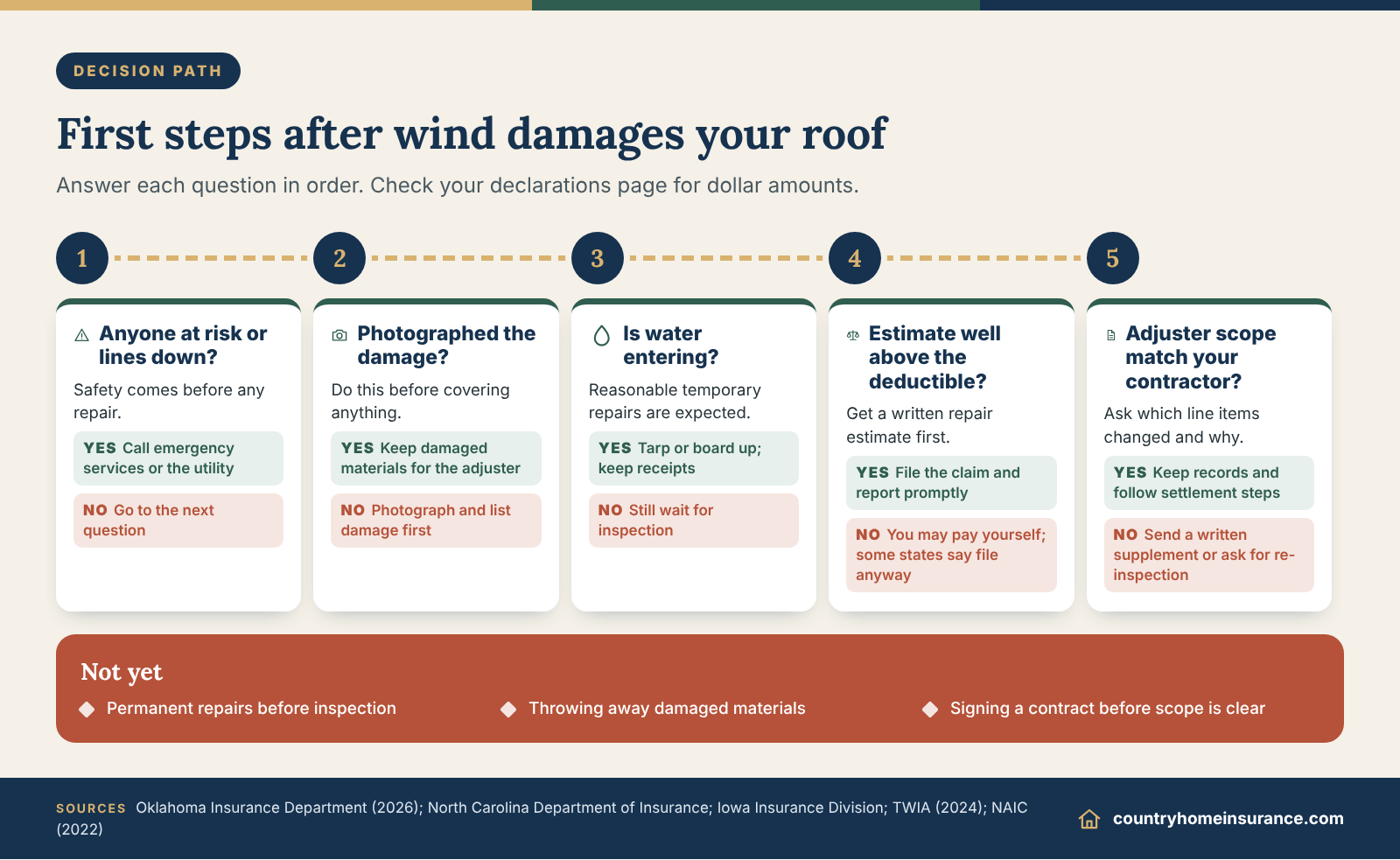
The first decisions are about safety and preventing further damage. The second set is about evidence. Regulators in several states give almost identical sequences, which is reassuring: the order is stop the damage, document it, report it, then wait for the inspection before doing permanent work.
Stopping further damage safely
Your policy generally expects you to protect the property from additional loss once a covered event has happened. The Iowa Insurance Division says policies typically require reasonable steps to prevent further damage and suggests asking your insurer about temporary repairs when you report the claim.
Safety comes first
A wind-damaged roof can be slick, unstable or hiding weak decking, and downed power lines near a house or outbuilding are a real hazard. Do not climb onto a damaged roof yourself and do not touch any line that might be energized. A temporary cover is worth little if getting it in place costs someone an injury, and a contractor who tarps roofs for a living will usually do it faster and with better fastening than a first-time attempt. Document the damage from the ground, a ladder at a safe height only if the ground is stable, or a drone if you already own and can fly one safely.
Reasonable temporary repairs
The Texas Windstorm Insurance Association lists covering openings with tarp or plastic, boarding up broken windows and doors, drying water-damaged areas quickly, removing standing water, and removing trees that damaged a covered structure as examples of temporary repairs. North Carolina’s department gives a roof tarp as its example of stopping further damage. The Oklahoma Insurance Department adds covering holes, leaks and damaged walls. Stop there. Permanent work such as a full roof replacement or patching with new shingles should wait for the insurer’s inspection, because the Maine Bureau of Insurance warns that doing permanent repairs first can lead to the claim being denied. Temporary repairs, by contrast, are expected.
Receipts for protective work
North Carolina’s regulator says reasonable costs for protecting your property may be reimbursed as part of the loss, and TWIA says reasonable temporary repair costs may be covered if the loss is covered by the policy. Keep every invoice and receipt, note who did the work and on what date, and photograph the temporary repair after it is in place. If you do the tarping yourself with materials from the farm supply store, the receipt for the tarp, lumber and fasteners is still valuable. Ask your insurer whether it has preferred emergency-service vendors, and whether its adjuster needs to approve costs above a particular amount.
Building the evidence file
Claims are won and lost on documentation more often than on policy language. Insurers expect to see what the property looked like before the storm, what it looked like after, and what you did next.
Photograph before you cover anything
North Carolina’s department says to make a list of the damages and take clear photographs before you make any temporary repairs. TWIA says the same, and notes that photos may help the claim move faster. Take wide shots of each slope, close-ups of every missing, creased or torn area, shots of the ridge, edges and flashing, interior ceiling stains with a ruler or tape measure for scale, and the surrounding yard to show any debris or tree limbs. Date-stamped video narrated as you walk the property is easy to produce and hard to dispute.
Keep damaged materials until the adjuster says otherwise
The Iowa Insurance Division and TWIA both advise keeping damaged items until the adjuster has seen them, and North Carolina says to ask your insurer before throwing away damaged materials. Oklahoma’s department says the same. Do not haul away loose shingles, torn flashing or ruined insulation until you have permission, and store a few representative pieces in a dry spot if the insurer approves disposal of the rest.
A claim diary and a home inventory
United Policyholders suggests keeping a diary of calls and meetings with insurers, contractors and officials, building a detailed itemized proof of loss without rushing, and getting a current copy of your full policy. The NAIC recommends a room-by-room home inventory with photos or video, stored somewhere other than the house, and says to keep receipts for repairs and new purchases. If water came through the roof and reached belongings, an inventory is the fastest way to support that part of the claim.
Reporting the claim to your insurer
Reporting a claim is simple in principle and slightly more complicated in practice because policies, deadlines and procedures vary. A quick call or app submission starts the clock on the insurer’s duties as well as yours.
Why prompt notice matters
The NAIC says to notify your insurer promptly and that reporting deadlines vary by state; it does not give a single number. Policies commonly require “prompt” notice, and some include other deadlines, such as for a signed proof of loss, a sworn statement of the amount claimed. Because those time limits differ by policy and state, check your policy and your state insurance department for the exact filing and proof-of-loss deadlines rather than assuming you have plenty of time.
What to tell the claims department
The Iowa Insurance Division suggests being ready to describe the type of storm, the date and time it occurred, and the damage. The NAIC suggests having your policy number, name, address and phone number handy and explaining what happened and how far the damage extends. Keep the claim number in your phone, and ask for the adjuster’s contact information and a rough schedule. If your state has a significant storm event with many claims, expect delays, as North Carolina’s department notes that insurers may be handling many claims at once.
When there is also a separate wind policy
If you have a separate windstorm policy, for example because your home is in a coastal wind-pool area, find out which insurer adjusts the roof claim and which pays what. North Carolina’s department says the homeowners insurer investigates and adjusts a wind or hail claim even with a separate windstorm policy, and TWIA tells its policyholders to contact it through its policyholder portal or phone line. Other states may differ, so ask both insurers, in writing, who is handling the claim and how the two policies coordinate.
How a wind damage roof insurance claim moves: adjuster, estimate, payment and repair
Once you report the loss, the claim usually follows a recognizable path: an assignment, an inspection, an estimate, a coverage decision, a first payment, repairs and, if you have replacement cost coverage, a second payment. How fast each step goes depends on the insurer, the severity of the storm and the rules of your state.
The adjuster inspection
An insurance adjuster is the person, whether a company employee or an independent contractor hired by the insurer, who investigates the loss and estimates the cost of covering it. What the adjuster concludes about cause and scope drives the rest of the claim.
What the adjuster is deciding
TWIA explains that its adjuster needs to determine whether roof damage came from wind or hail before permanent work such as roof replacement or asphalt patching begins. That is a good summary of the central question on any roof claim: what caused each piece of damage, and does the policy cover that cause. Wind and hail can both be present after a thunderstorm, and they may be handled under different deductibles in your policy, so be ready for the inspector to separate them. The hail side of that question is covered in our hail article, and this article stays with wind.
Bringing your contractor to the inspection
The NAIC suggests considering having your contractor meet with you and the insurance adjuster. A roofer who can point to creased tabs, fastener pull-through or damaged flashing while the adjuster is standing there often moves the conversation faster than a phone call afterward. Choose someone with a local address and references, and make clear the contractor is advising on the roof, not negotiating the claim for you. In Texas, for example, a roofer cannot act as a public adjuster on a claim for work they are performing.
Asking for a re-inspection
The Iowa Insurance Division says that if the settlement seems inadequate after more damage is found, you can request a re-inspection. Wind damage frequently reveals itself in stages: a ceiling stain appears a week later, or a contractor removing shingles finds cracked decking. Report new findings promptly and in writing, attach photographs, and ask the insurer to treat them as a supplement to the existing claim.
Estimate, depreciation and payment
The payment sequence confuses more homeowners than almost any other part of a roof claim, because the first check can be much smaller than the full repair cost.
Actual cash value first, replacement cost later
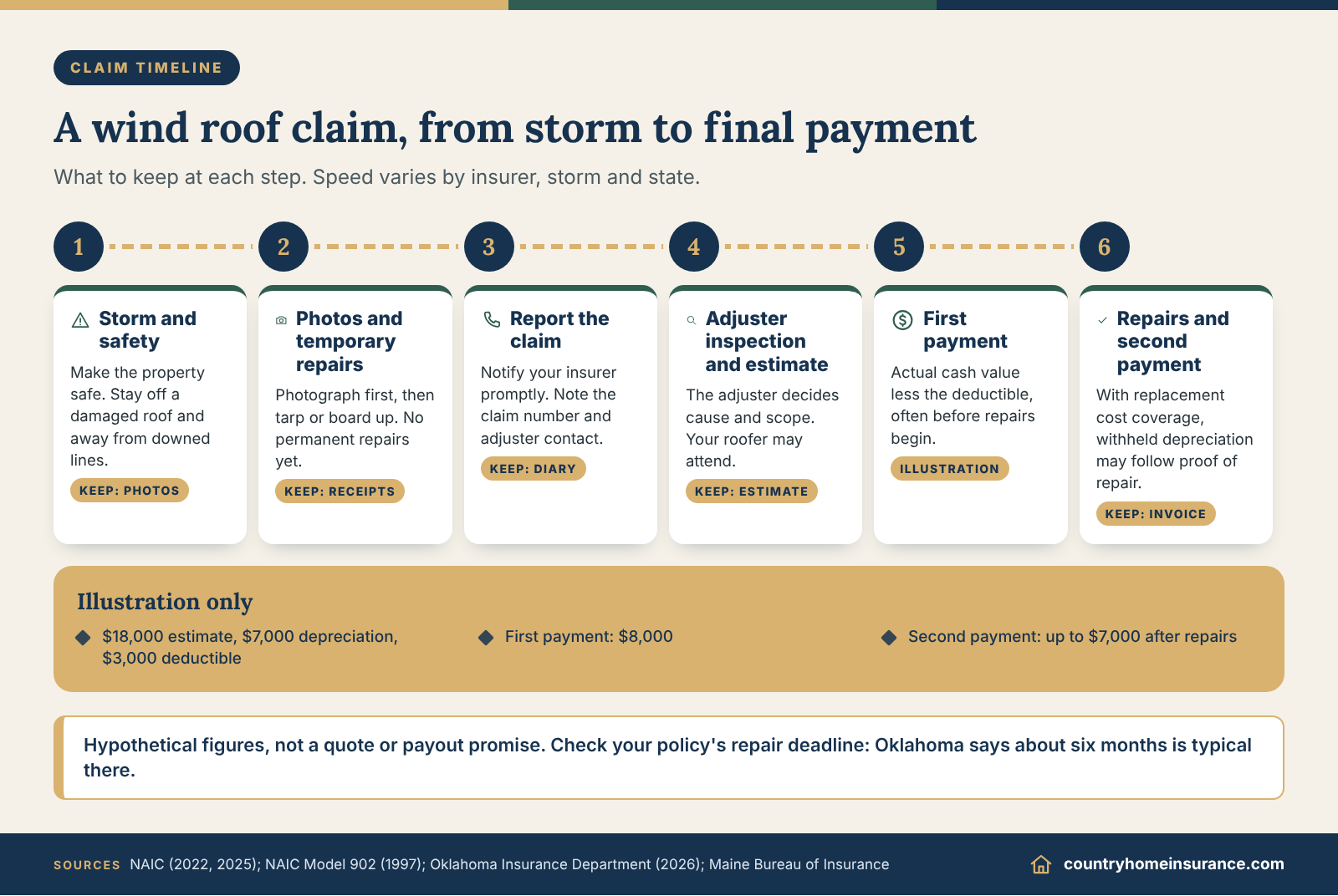
The NAIC explains that actual cash value (ACV) reflects age and wear, so it often falls short of the cost to fully repair or replace, while replacement cost value (RCV) pays to repair or replace with comparable materials without subtracting for age or wear. The Maine Bureau of Insurance says payouts may start at ACV and that replacement cost policyholders typically receive the remaining amount after proof of repair or replacement. The Texas Department of Insurance describes the same two-part pattern: a first partial payment, with the remainder after repairs have started. The withheld amount is often called recoverable depreciation.
| Step | Hypothetical amount | What is happening |
|---|---|---|
| Replacement cost estimate for the covered wind damage | $18,000 | Adjuster’s estimate of repairing or replacing with comparable materials |
| Depreciation for roof age and wear | $7,000 | Held back until repairs are made, if the policy pays replacement cost |
| Wind deductible (1% of a $300,000 dwelling limit) | $3,000 | Subtracted once; some insurers apply it to the first payment |
| First payment (actual cash value less deductible) | $8,000 | $18,000 minus $7,000 minus $3,000 |
| Second payment after proof the work is done | Up to $7,000 | Released if repairs are completed within the policy’s time limit and the actual cost supports it |
| Total if everything is paid under the policy terms | $15,000 | Replacement cost of $18,000 less the $3,000 deductible |
These figures are an illustration of the arithmetic, not a forecast. Insurers differ on how and when they apply the deductible, how they calculate depreciation, and what documents they need to release the second payment. If the policy covers the roof at actual cash value only, the second payment would not be owed, which is the reason roof settlement terms deserve a close read.
The time limit on the second payment
The Oklahoma Insurance Department says that replacement cost policies generally require the work to be completed within six months of the date of loss to receive withheld replacement cost payments. That is Oklahoma’s statement of what is typical there, not a universal rule. Contractor schedules in a storm-heavy season can run long, so read the exact repair-completion deadline in your policy, and ask the insurer in writing for an extension if your roofer cannot start in time. The Iowa Insurance Division asked insurers in 2021 to voluntarily extend policy deadlines after the 2020 derecho, according to a United Policyholders summary, which shows that extensions are sometimes possible but not guaranteed.
Roof surfacing and other settlement wrinkles
Some policies reduce roof payments through an age-based endorsement or payment schedule instead of, or on top of, ordinary depreciation. Names and formulas differ by insurer and state, and this article does not describe any particular form. The safest approach is to find your own policy’s roof endorsement, if it has one, and ask your agent for a worked example using your roof’s age. TDI notes that many policies reduce roof coverage based on age and materials. If you replace the roof, tell your insurer so the age on your policy is updated, and ask whether roof coverage that was reduced can be restored.
Deadlines the insurer is supposed to meet
Insurers have claim-handling duties too. The NAIC publishes a model regulation on claims settlement practices that many states have adapted, though each state sets its own numbers.
The NAIC model timeline
The NAIC’s Unfair Property/Casualty Claims Settlement Practices Model Regulation, a template that states may adopt in part or in whole, calls for acknowledging a claim within 15 days, unless payment is made in that period, and for accepting or denying a first-party claim within 21 days after receiving properly executed proofs of loss. If the insurer needs more time, the model says it should notify the claimant within 21 days with reasons and then send a written update 45 days after the first notice and every 45 days after. Denials must be in writing and cite the policy provision relied on. For an amount that is determined and not in dispute, the model calls for payment within 30 days of affirming liability.
Why your state’s numbers may differ
The model is a starting point, not law in your state. The NAIC’s Spring 2024 chart of claims-settlement provisions lists each state’s own statutes and regulations with their own timelines for acknowledging, accepting or denying, and paying claims, plus interest and penalties. Florida’s regulator, for example, says an insurer must pay or deny all or part of a new, reopened or supplemental property damage claim within 60 days after receiving notice, with exceptions for delays outside the insurer’s control. Look up your own state’s deadlines on your insurance department’s website. After a large regional storm, regulators sometimes issue bulletins that change how those deadlines are handled.
| Milestone | Reference point | Caution |
|---|---|---|
| Insurer acknowledges the claim | NAIC model: within 15 days, unless payment is made in that period | A model only. States set their own numbers; check yours |
| Accept or deny after proof of loss | NAIC model: within 21 days after receiving properly executed proofs of loss, with written, specific denials | Applies only if the state adopted similar language; the “clock” starts at proof of loss, not first call |
| Updates if the investigation continues | NAIC model: written update at 45 days after the initial notice and every 45 days after | States differ on whether and how they require this |
| Pay or deny a property claim | Florida: within 60 days after notice of a new, reopened or supplemental claim (Florida CFO FAQ, undated) | Exceptions apply for delays outside the insurer’s control |
| Complete repairs to collect withheld depreciation | Oklahoma regulator: generally six months from the date of loss on replacement cost policies | Set by your policy; ask about extensions in writing |
| Appraisal of a disputed loss amount | Texas: personal and residential property policies issued or renewed on or after January 1, 2026 must include an appraisal provision (SB 458, per United Policyholders) | Does not apply to TWIA policies; other states differ |
Repair, replace or match: the arguments that decide a wind roof settlement
Once cause of loss is accepted, the next fight is often about scope. Does the insurer pay for a few shingles, a whole slope or the entire roof? Three questions drive the answer: can the damage be repaired, must the repair match what is already there, and what does your policy say about roof age.
Can the roof actually be repaired?
Estimating software can price a repair that no contractor is willing to perform. The difference between what an estimate says and what a roofer will do is a common source of disagreement.
Brittle or aged roofing materials
A 2022 question-and-answer in IA Magazine, a publication for independent insurance agents, described a 30-year-old wood shake roof where wind removed shingles from one side. The adjuster priced patching, but local contractors would not attempt it because the remaining shingles were too fragile and could break during the repair. The responders treated repairability as the central issue and noted that a policy generally pays the lesser of repair or replacement cost, but that if replacement is the only workable fix, the insurer may owe it. That article is trade commentary, not legal authority, but the reasoning applies to any older or brittle roofing, including some aged asphalt or cedar roofs on country homes.
Written opinions from roofers
The IA Magazine responders recommended getting written estimates from one or two contractors that explain why a repair is not practical, presenting them to the carrier, asking for reconsideration, and escalating to the claim manager if needed. That is a reasonable template. A good written statement identifies the roof age, the product, the specific reason a repair would damage adjacent shingles or fail to seal, and the contractor’s license or business details. Opinions from several contractors carry more weight than one.
Matching: how much undamaged roof gets replaced?
Matching is about appearance. If new shingles do not look like the old ones, who pays to fix the mismatch? The answer varies sharply by state, so this is one of the topics where you should verify locally.
The model rule and the states that have addressed it
The NAIC model claims regulation says that when replacement items do not match in quality, color or size, the insurer should replace items in the affected area to achieve a reasonably uniform appearance, for interior and exterior losses, with the insured paying nothing beyond the deductible. A law-firm chart updated in May 2025 lists Alaska, California, Connecticut, Florida, Iowa, Kentucky, Montana, Nebraska, Ohio, Rhode Island, Tennessee, Utah and Vermont as having a statute, regulation or bulletin on uniform appearance, with Maryland, Louisiana and Wisconsin treated differently. Wisconsin’s entry points the other way, to payment for only the damaged siding. Because that chart is a secondary source and states change their positions, treat it as a prompt to check your own department of insurance.
Texas is not on that chart, and the Texas Department of Insurance says plainly that a company might not pay to replace an entire roof if only part is damaged, even if new shingles do not match the old ones perfectly. The same home, same storm and same shingle could produce different outcomes in Texas and in a state that follows the uniform-appearance approach.
Kentucky and Florida: two recent snapshots
Insurance Journal reported in October 2023 that Kentucky’s Department of Insurance issued an advisory opinion on October 17, 2023, saying insurers may not replace only the visible slope of a roof and that if matching shingles are unavailable, the whole roof must be replaced. The opinion also said age-related color fading does not require full replacement when the same make and model is still in production, and that discontinued shingles are judged on whether the replacement is a reasonable match. In Florida, the same report said regulators had approved endorsements from at least eight insurers capping matching payments for undamaged materials at 1 percent of the building limit, and that the state’s matching statute requires reasonable repairs to matching items unless the policy provides otherwise. Those are 2023 snapshots, so check current rules.
Questions to ask about matching in your policy
Ask your agent whether the policy contains a matching endorsement or limit, whether the insurer follows your state’s uniform-appearance rule, and how the policy treats undamaged slopes. If the shingle line has been discontinued, ask the insurer to explain in writing how it concluded that a reasonable match is or is not available. When you compare policies at renewal, matching and roof-settlement terms belong on the checklist alongside price.
Roof age, code upgrades and policy conditions
Two settlement factors sit outside the storm itself: the roof’s age on your policy and the building rules that apply when a roof is rebuilt.
Renewal changes that quietly change your roof coverage
As noted above, TDI says insurers may switch an aging roof from replacement cost to actual cash value at renewal and should notify you when they do. Check every renewal packet for roof-related changes. A fall inspection can document the roof’s condition while the policy is still in force, which is useful evidence if a later claim turns on pre-existing condition.
When a roof is only worn out
TDI says insurers will not pay for a new roof just because the existing roof is worn out or aging. That is a reminder that a wind claim must be tied to a wind event. If your roof was already near the end of its life, a storm may still have caused covered damage, but the payment may be reduced through depreciation, the roof schedule or the deductible. Honest documentation of the roof’s condition before the storm helps both sides.
Building code upgrades during rebuild
Rebuilding a roof sometimes triggers local building code requirements, such as underlayment, decking nailing or ventilation, that did not exist when the roof was first installed. Ordinance or law coverage is the endorsement that can help with those code-driven costs, and the limit and terms vary by policy. The Insurance Journal report notes that Florida’s 2022 Senate Bill 4D eased the long-standing rule requiring a whole-roof replacement when 25 percent of the roof was damaged, which made partial repairs easier in that state. Ask your agent and your local building department what applies to you, and ask whether your policy has ordinance or law coverage.
Disagreements, contractors and common mistakes
Most wind roof claims settle without a fight, but when they do not, the cause is usually a gap between the adjuster’s scope and a contractor’s scope, or a decision made too fast. This section covers the dispute tools that exist, the contractor rules that protect you, and the mistakes regulators warn about most.
When you and the adjuster disagree
Disagreement is not the same as denial. Start with the lowest-friction tools and move up only if they fail.
Supplements and written questions
A supplement is a request to add scope or cost to the original estimate, usually because new damage was found or a line item was missed. Send it in writing with photos and a contractor’s itemized estimate, and ask the adjuster to reply in writing. Insurers work through high claim volumes in big storm years, such as the severe convective storm losses reported for 2025, and a concise, well-documented supplement is generally easier to process than a long phone call. Ask specifically which line items were changed and why.
Appraisal clauses
An appraisal clause is a policy provision that lets both sides name appraisers to settle a disagreement about the amount of a loss. United Policyholders reports that in Texas, personal and residential property policies issued or renewed on or after January 1, 2026 must include an appraisal provision under Senate Bill 458, and that it does not apply to TWIA policies. Other states and policies handle appraisal differently, and appraisal generally concerns the amount of loss rather than whether the policy covers it, so read the clause in your policy, including who pays the costs, before invoking it. Ask your department of insurance or an attorney about your options if the dispute is about coverage and not price.
Complaints to the state department of insurance
State insurance departments take consumer complaints about claim handling. The Iowa Insurance Division says Iowans with wind or tornado coverage who believe a claim is not being handled properly can file a complaint with the division, the Texas Department of Insurance lists a consumer line at 800-252-3439, the Oklahoma Insurance Department lists Consumer Assistance at 800-522-0071, and the North Carolina Department of Insurance lists 855-408-1212. The NAIC consumer site also points to a complaint page. A complaint will not guarantee a different result, but it asks the regulator to look at whether the insurer followed the rules.
Public adjusters, attorneys and other advocates
A public adjuster is a licensed professional who represents the policyholder, not the insurer, in preparing and negotiating a claim, typically for a fee. Licensing rules and fee limits differ by state, so check your department of insurance before signing any agreement. North Carolina’s department links to a consumer guide on public adjusters, and United Policyholders lists professional claim advocates, attorneys, FEMA and the state insurance department among sources of help after a derecho. It also suggests getting an independent professional opinion if an adjuster says covered damage is not covered.
Contractors, deductibles and storm-chaser risk
After a wind event, out-of-town crews knock on doors, and some of them offer deals that cross legal lines. The rules below come from Texas and Oklahoma regulators, so confirm what applies in your state.
Why a deductible waiver is a red flag
The Texas Department of Insurance says contractors may not waive your deductible or help you avoid paying it, that offering a rebate or credit equal to the deductible is illegal, and that inflating an estimate so the insurance payment covers your deductible amounts to giving the insurer a false repair cost. Texas insurers can require proof that you paid the deductible, such as a canceled check, a receipt, a card statement or a copy of a payment plan. TDI cites Business and Commerce Code 27.02 and Insurance Code Chapter 707, and a 2019 TDI notice described fines of up to $2,000 and up to six months in jail for waiving a deductible; confirm current penalties before relying on those figures. The Oklahoma Insurance Department also calls deductible waivers and rebates unlawful.
Vetting a roofer
Oklahoma’s department recommends getting more than one bid, checking references and license status, confirming liability insurance, never paying upfront, withholding the final payment until the job is complete, and never signing a contract with blank spaces. TDI similarly recommends written estimates on company letterhead, several bids to spot unusually high or suspiciously low prices, caution with door-to-door contractors, and no full payment in advance. The Iowa Insurance Division adds that you should not contract for repairs without first discussing them with your adjuster or agent.
A contractor is not your public adjuster
Texas law, as described by TDI, bars a roofer from acting as a public adjuster on a claim for work the roofer is also performing and from advertising that service. It also bars the roofer from negotiating settlements or claiming to represent the policyholder on coverage questions. For contracts of $1,000 or more tied to an insurance settlement, TDI says the contract must include a notice that the policyholder must pay the deductible. Other states have their own versions of these rules, but the principle is portable: a contractor can estimate and repair, while coverage decisions stay between you and the insurer.
Mistakes that complicate wind claims
The table below collects the mistakes regulators mention most often and what to do instead. None of these is fatal in every case, but each one gives the insurer an argument.
| Mistake | Why it can hurt the claim | Safer move | Regulator or source basis |
|---|---|---|---|
| Permanent roof repairs before the inspection | The insurer cannot verify cause or scope, and the claim may be denied in some cases | Tarp or board up, keep receipts, wait for the adjuster | Maine Bureau of Insurance; Oklahoma Insurance Department; North Carolina Department of Insurance |
| Throwing away damaged materials | Evidence of wind damage and scope disappears | Keep items until the adjuster approves disposal | Iowa Insurance Division; TWIA; North Carolina Department of Insurance |
| Photographing only after the tarp is on | Original damage is hidden and harder to prove | Photograph and list damage first, then cover | North Carolina Department of Insurance; TWIA |
| Accepting a deductible waiver | May involve fraud and shoddy work; insurers can ask for proof of payment | Pay your deductible and keep proof | Texas Department of Insurance; Oklahoma Insurance Department |
| Missing the repair-completion deadline | Withheld replacement-cost money may not be released | Read the deadline and request any extension in writing | Oklahoma Insurance Department (typical six-month window; check policy) |
| Not updating the roof age after a replacement | Premium and coverage may keep reflecting an old roof | Tell your insurer and ask whether roof coverage can be restored | Texas Department of Insurance |
Rushing into permanent repairs
The pressure to fix a roof fast is real, particularly if the forecast shows more rain. The regulators quoted above draw the line at temporary measures. If a contractor says the roof cannot be saved without immediate replacement, ask the insurer in writing for authorization or an expedited inspection and document why delay would cause more harm.
Losing evidence before it is documented
It is easy to underestimate how quickly evidence disappears. Wind-blown shingles end up in fields and creeks, and tarped areas hide the very creases an inspector would check. Photographs taken at the start of the claim are the best protection, followed by a note of where fallen pieces were found and how far from the house.
Misreading the deductible or roof terms
People often discover a percentage wind deductible or an age-based roof reduction only when the estimate arrives. The United Policyholders Texas article notes that renewals may have raised the percentage and that older roofs may be settled at actual cash value, leaving a depreciation gap on top of the deductible. Read your renewal notice, and ask your agent for the dollar amount of every deductible that could apply to a wind claim today.
Signing before the scope is clear
Signing a repair contract before the insurer’s scope is known can lock you into a price that does not match the estimate, or an agreement you cannot undo. The NAIC says not to agree to repair terms you are uncomfortable with and not to let anyone rush you. Ask the contractor to wait for the insurer’s estimate, or to put any commitment in writing with an exit if coverage turns out to be lower than expected.
Rural wrinkles and ways to reduce the next wind claim
Country properties add complications to a wind claim: more buildings, longer distances, fewer contractors and sometimes mixed uses. They also offer chances to reduce risk, because roof details are cheaper to improve during a planned replacement than after a loss.
Rural property issues in a wind claim
A rural wind claim often involves more than the main house, and the policy for each structure may read differently.
Barns, sheds and other structures
Metal roofing panels on a pole barn, a hay shed with a lightweight roof, and a detached garage all catch wind differently from an asphalt shingle roof on the house. Other structures coverage, discussed above, may carry a lower limit than the house and might settle at actual cash value even when the house is covered at replacement cost. Check the declarations page and the form’s loss-settlement language, and list each outbuilding with its approximate age, size and use before storm season.
Distance, access and slow claim response
North Carolina’s department warns that insurers handling many claims at once can produce delays. On a rural property, that can be compounded by gravel roads that wash out, long drives for adjusters and roofing crews that triage in-town jobs first. Ask your insurer how it will inspect (in person, by drone or by photographs), send clear photographs if inspection is remote, and arrange temporary repairs early, since a tarp may need to hold for weeks.
Farm and business use
A homeowners policy is designed for a home, and farming or business use of outbuildings can change coverage or exclude it. If part of the property is used for livestock, equipment storage or a home business, ask your agent how a wind loss to that building would be treated, and whether a farm or rural package policy would respond differently. This is one of the topics where a policy review before a storm is much easier than a debate after one.
Reducing wind vulnerability at the roof
Mitigation will not prevent every claim, but several measures address the most common wind failure points.
Sealing and installation quality
Based on IBHS research, the strength of the seal between shingles is the most important factor in the high-wind performance of self-sealing asphalt shingles. Manufacturers generally say hand-sealing is needed on steep slopes and in extended cold weather, and ARMA recommends it on slopes steeper than 12:12. When you are replacing a roof, ask the roofer whether the product, slope and installation season call for hand-sealing, how nails will be driven, and how edges, hips and ridges will be detailed. That conversation costs nothing and addresses the weak points the engineers’ article identified.
Stronger roof programs and possible discounts
IBHS operates a voluntary FORTIFIED Roof program for homes, and TDI says roofing materials that hold up better against wind, hail or fire may earn an insurance discount. Whether a given insurer offers a discount, and how much, varies by insurer and state, and this article does not quote a figure. Ask your agent before you replace the roof, and get any promised credit in writing.
Maintenance that supports a claim
TDI’s maintenance list includes trimming tree limbs that hang over or near the roof, inspecting for missing or damaged shingles after storms, checking the chimney for loose bricks, keeping gutters clear and having a roof inspector check the roof every few years. It also notes that insurers inspect roofs when you apply and may raise premiums, decline coverage or refuse to insure based on what they find. Dated inspection photographs and repair invoices show that the roof was maintained, and they establish its condition before a storm.
Why wind roof claims are a growing cost concern
The big picture explains why deductibles and roof terms have become more important.
Severe convective storm losses
Carrier Management, reporting in April 2026 on a Triple-I members-only brief on severe convective storms, said these storms, which include tornadoes, hail, straight-line winds and severe thunderstorms, caused about $51 billion in U.S. insured losses in 2025, the third straight year above $50 billion. The report said hail makes up a large share of insured residential catastrophe losses from these storms and that wind is named as a loss driver as well. This article relied on the secondary report because the Triple-I brief itself was not available to read.
What rising losses mean for deductibles and terms
The same report, citing Gallagher Re, said non-weather factors such as construction cost increases account for up to 90 percent of loss growth since 2000. For a homeowner, the practical effect is that percentage deductibles, roof-age terms and renewal changes may keep tightening in storm-prone areas. United Policyholders, writing about Texas in April 2026, says 1 percent wind and hail deductibles are largely unavailable from major carriers in the most hail-active markets. Put aside a deductible fund if you can, and review your declarations page every year.
Frequently asked questions
Coverage and cost questions
Is an old roof still covered for wind damage?
Often yes for wind damage, but the payment may be smaller. The Texas Department of Insurance says that older or worn roofs may be paid at actual cash value, which subtracts depreciation, and a roof in poor condition may not be covered at all. The question is whether the storm caused the damage, not whether the roof is old, but age affects how much is paid. Ask your agent which settlement basis applies to your roof today.
Will insurance pay for a tarp or emergency repair?
Reasonable temporary repair costs may be covered if the loss itself is covered, according to TWIA, and North Carolina’s department says protective costs may be reimbursed as part of the loss. Keep receipts and photographs of the work. Costs that look excessive may be questioned, so ask the insurer for guidance if you are hiring an emergency service.
Should I file if the roof damage is close to my deductible?
It depends on the numbers and your goals. Oklahoma’s regulator says you may choose to pay yourself when damage is at or slightly above the deductible, while Florida’s regulator says to file even below the deductible to create a record. Get a written estimate, confirm your deductible in dollars, and ask your agent how reporting a claim could affect renewal in your state before deciding.
Process and dispute questions
How long does an insurer have to decide my claim?
The answer depends on your state. The NAIC model regulation suggests 15 days to acknowledge a claim and 21 days after proof of loss to accept or deny, and Florida’s regulator describes a 60-day deadline to pay or deny. Neither is a universal rule. Look up your state’s claims-handling rules and ask the adjuster in writing when you should expect a decision.
What if the adjuster says the damage is wear and tear?
Ask which shingles and which physical signs led to that conclusion, and ask for the report or inspection photographs. Get a written roofer’s opinion on the same points, and share the evidence you gathered at the start of the claim, such as photographs of creased or missing shingles and the storm date. If you remain at odds, use the supplement, appraisal, complaint and advocate options described above.
Do I need a public adjuster or an attorney?
Many straightforward claims do not need either. For a large loss, a denial or a dispute over cause that you cannot resolve, a licensed public adjuster or an attorney may be worth consulting. Check licensing and fee terms with your department of insurance, read any contract before you sign, and remember that a roofer who also wants to handle your claim negotiation may be crossing legal lines in some states.
Next steps
If your roof has wind damage now
The first three actions
Make the property safe, photograph the damage and list what you see, then cover openings and keep the receipts. Call your insurer or agent the same day if you can, and ask what temporary repairs it expects and when the adjuster will visit. Hold off on permanent work until the inspection is complete.
A checklist to carry with you
Use the table below as a working checklist. It collects the items to verify in your policy, the evidence to document and the questions to ask. Print it or save it with your claim notes.
| Area | Verify in your policy | Document | Ask your insurer or agent |
|---|---|---|---|
| Deductible | Wind, hail or named-storm deductible, in dollars and as a percentage | Declarations page and latest renewal notice | Which deductible applies to this storm, and whether it applies once per year or per event |
| Roof settlement | Replacement cost or actual cash value for the roof, any age-based schedule | Roof age, material, installation invoice and prior inspection photos | How depreciation is calculated and when the withheld amount is paid |
| Interior water | Whether an opening is required for rain damage to the structure and belongings | Photographs showing the opening and the water path | How the insurer will treat ceiling, insulation and contents damage |
| Temporary repairs | Policy duties after a loss | Before and after photos, invoices, dates | What costs it expects to reimburse and whether approval is needed above a set amount |
| Matching and repairability | Any matching endorsement or limit and your state’s uniform-appearance rule | Shingle brand and age, written contractor opinions | How it decided whether a repair or a match is feasible |
| Deadlines | Notice, proof-of-loss and repair-completion deadlines | A calendar with each date and the claim number | For any extension in writing |
If your roof is fine today
Review the policy before the next storm
Pull your declarations page and write down the wind or named-storm deductible in dollars, the roof settlement basis, the Coverage B limit and any endorsements that mention roofs or matching. Compare them with what you paid last year. If you live in a hurricane area, our hurricane season guide covers evacuation expense and named-storm issues alongside wind.
Build your records now
Photograph the roof, outbuildings and fences while they are in good condition, save the installation invoice, and update your home inventory. Those dated records are the easiest way to show the condition of your property before a loss.
Sources
- NAIC Consumer Insight: what to know when filing a homeowners claim (April 20, 2022; retrieved 2026-10-11)
- NAIC: actual cash value versus replacement cost coverage (January 2, 2025; retrieved 2026-10-11)
- NAIC Unfair Property/Casualty Claims Settlement Practices Model Regulation (Model 902) (copy dated July 1997; retrieved 2026-10-11)
- NAIC chart of state claims settlement provisions (Spring 2024; retrieved 2026-10-11)
- Texas Department of Insurance: replacing your roof (last updated April 1, 2026; retrieved 2026-10-11)
- Texas Department of Insurance: what to know about replacing your roof with insurance (March 2026; retrieved 2026-10-11)
- Texas Department of Insurance: can a contractor waive my deductible (last updated December 9, 2025; retrieved 2026-10-11)
- Texas Department of Insurance: roofing and insurance, know the law (last updated March 24, 2025; retrieved 2026-10-11)
- Texas Department of Insurance: state law cracks down on roof scams (published August 7, 2019; updated January 18, 2023; retrieved 2026-10-11)
- Florida Statutes section 627.701, hurricane and roof deductibles (2026 Florida Statutes; retrieved 2026-10-11)
- Florida Department of Financial Services: Florida’s hurricane deductible (undated; retrieved 2026-10-11)
- Florida Department of Financial Services: homeowners insurance FAQ (undated; retrieved 2026-10-11)
- Maine Bureau of Insurance: does my homeowners policy cover storm and wind damage (undated, copyright 2022; retrieved 2026-10-11)
- North Carolina Department of Insurance: dealing with the aftermath of a disaster (undated; retrieved 2026-10-11)
- Texas Windstorm Insurance Association: temporary and permanent repairs (last modified August 8, 2024; retrieved 2026-10-11)
- Iowa Insurance Division: storms and homeowners insurance (undated; retrieved 2026-10-11)
- Oklahoma Insurance Department: storm recovery news release (May 13, 2026; retrieved 2026-10-11)
- IBHS: wind uplift of asphalt shingles (published January 22, 2019; modified August 23, 2019; retrieved 2026-10-11)
- IIBEC (RCI Interface): misconceptions of wind damage to asphalt composition shingles (January 2018; industry engineering perspective; retrieved 2026-10-11)
- Carrier Management: severe convective storm losses, reporting on a Triple-I brief (April 16, 2026; retrieved 2026-10-11)
- Insurance Journal: Kentucky matching law and Florida replacement limits (October 24, 2023; retrieved 2026-10-11)
- IA Magazine: repair or replacement of a wind-damaged roof (August 12, 2022; trade Q&A; retrieved 2026-10-11)
- Law-firm chart of state matching regulations (updated May 6, 2025; secondary source; retrieved 2026-10-11)
- United Policyholders: Texas wind and hail deductibles (April 4, 2026, modified April 24, 2026; advocacy source; retrieved 2026-10-11)
- United Policyholders: 2020 Iowa derecho claim help (last modified October 4, 2022; advocacy source; retrieved 2026-10-11)
- United Policyholders: understanding a wind and hail deductible (2014 repost; dated background; retrieved 2026-10-11)
Important coverage note
Coverage depends on your actual policy, endorsements, exclusions, limits, deductible and cause of loss. State laws and insurance programs vary, and the examples from Texas, Florida, Oklahoma, Iowa, North Carolina, Maine and Kentucky in this article show how different the rules can be. Check your declarations page and policy form, and verify case-specific questions with your insurer or agent and your state Department of Insurance. This article is educational and is not legal advice or a substitute for your insurance contract. Dollar figures in hypothetical examples are illustrative only and do not promise any quote or payment.
About the editorial team
This guide was prepared by the countryhomeinsurance.com editorial team as general, educational information for homeowners. We research and summarize publicly available material, including state insurance departments, the NAIC, federal agencies, regulators’ consumer guides and published insurer and industry resources. We draw only on the sources that were available to us when we wrote this guide, and we list them in the Sources section with dates where we could find them.
Insurance rules, rates, products and program terms change, differ by state and by insurer, and can apply differently to your situation. We cannot guarantee that this content is complete, current or free of errors. It is not legal, financial, tax or insurance advice, it is not an offer to sell insurance or a recommendation of any insurer, agent or product, and reading it does not create a professional relationship of any kind.
To the fullest extent permitted by law, countryhomeinsurance.com and its editorial team, authors and contributors exclude all liability for any loss, damage or decision arising from the use of, or reliance on, this content. For questions about your own policy or claim, contact your insurer, a licensed agent or broker, your state Department of Insurance or another qualified professional.
Content created: October 11, 2026