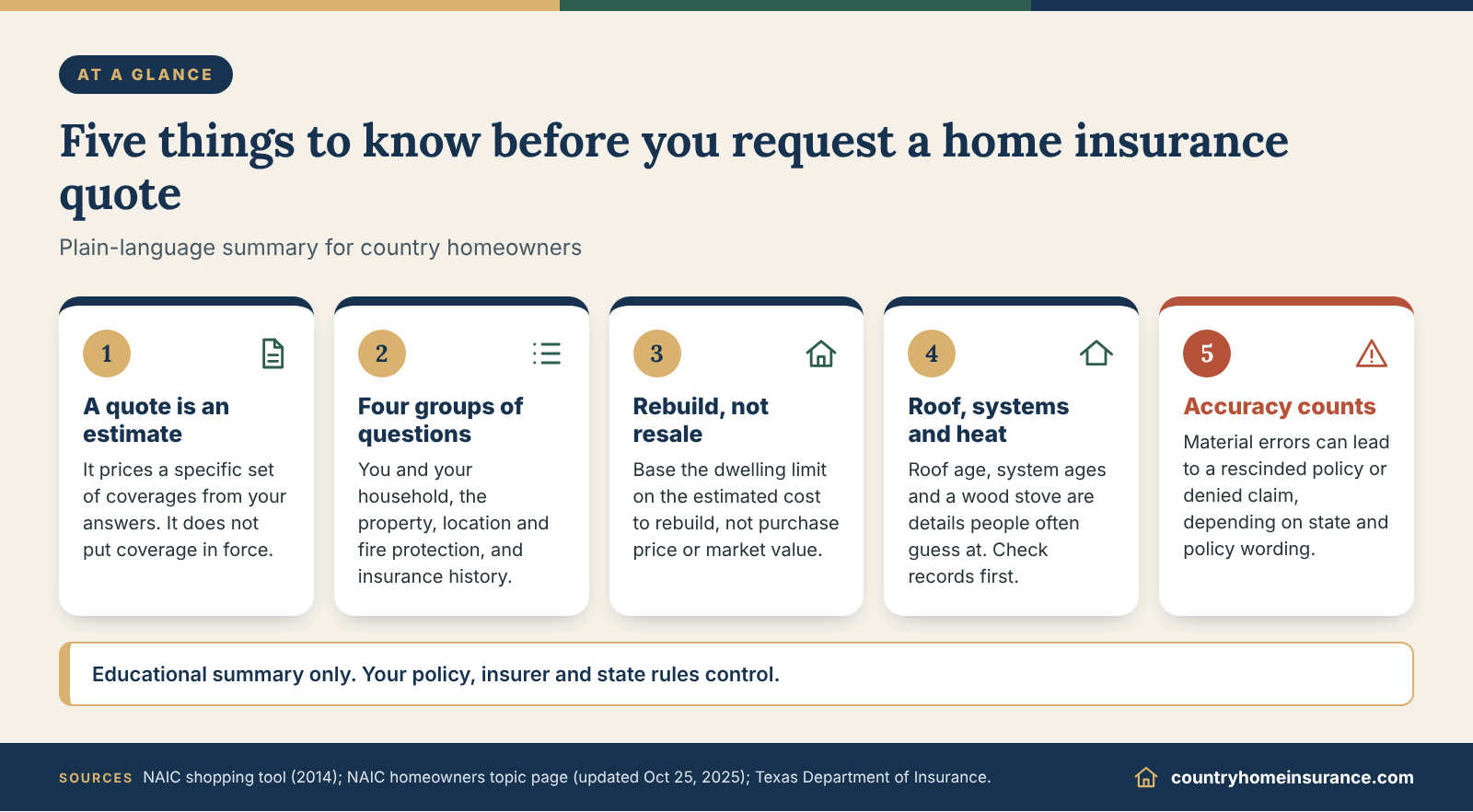
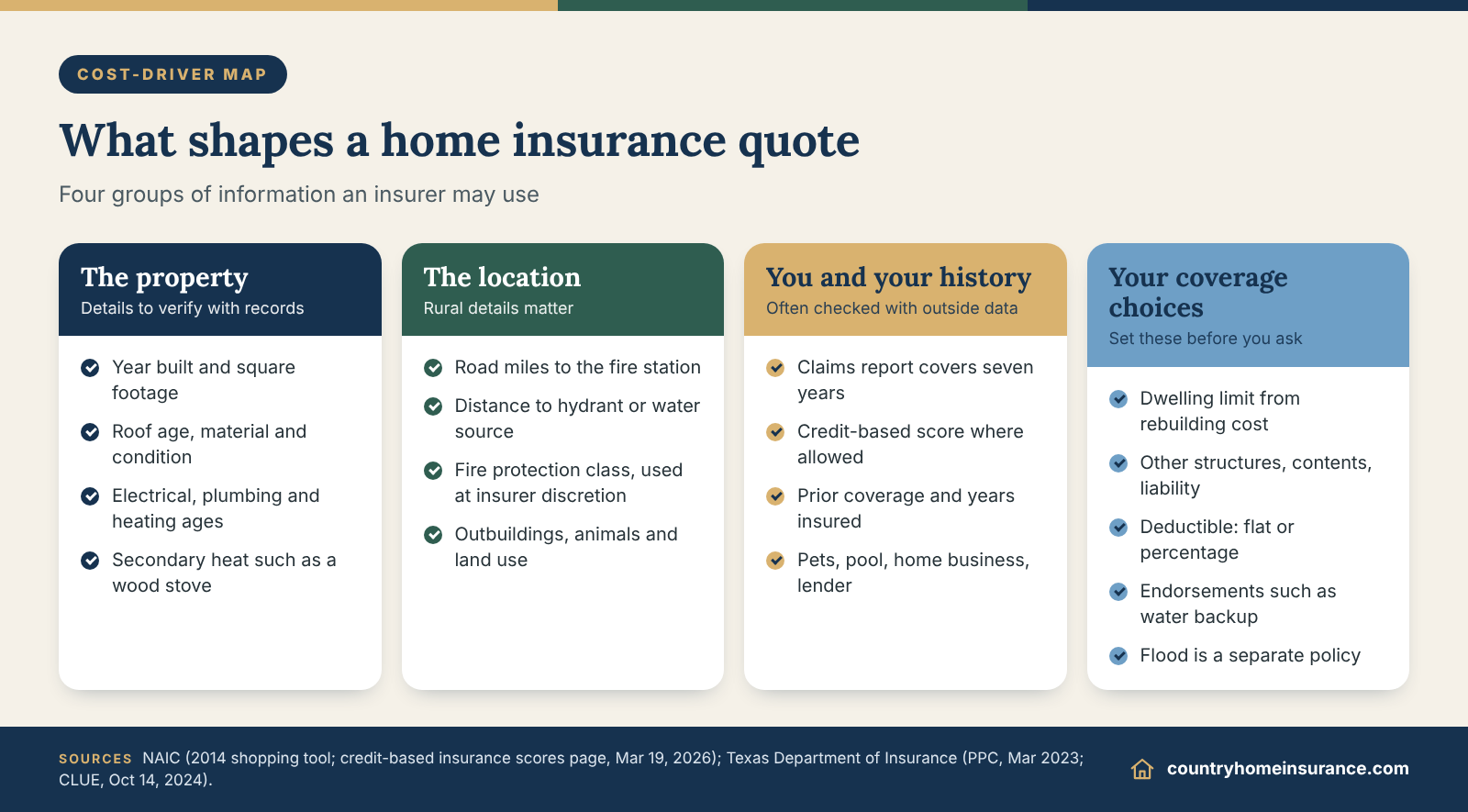
The information needed for a home insurance quote usually falls into four groups: who lives there and how the home is used, the property itself (age, size, roof, major systems), the rural and fire-protection details of its location, and your insurance history, including claims, prior coverage and mortgage lender. You also choose the coverage limits and deductibles. Accurate answers matter because the quote, and later the policy, rest on them.
Key takeaways
- Expect questions about you, the home, the land and outbuildings, your claims and coverage history, and any lender. Having the answers ready makes quotes faster and more comparable.
- Roof age and condition, the age of electrical, plumbing and heating systems, and a wood stove or other secondary heat source are the details people most often guess at.
- For country properties, distance to the responding fire station and to a water source can shape fire-protection ratings that insurers may use at their own discretion.
- Base the dwelling limit on the estimated cost to rebuild, not on the purchase price or market value.
- Material errors on an application can lead to a rescinded policy or a denied claim, depending on your state and the policy wording. Review the application as well as the quote.
- A quote is an estimate, not coverage. Hold limits, deductibles and endorsements constant across quotes before judging price.
What information do insurers ask for when you request a home insurance quote?
Most people start a quote expecting a name, an address and perhaps a zip code. A quote built on only those three items is a rough estimate at best. The real number depends on a longer list of details, and for a country home that list is longer still, because rural properties often have features a suburban lot never does: a well, a septic system, a wood stove, a detached shop, a long driveway and a volunteer fire department several miles away.
This guide is a documentation guide. It focuses on what to gather, why each item matters, where to find it, and what can go wrong if an answer is wrong. It does not repeat the buying sequence in how to buy homeowners insurance step by step, the side-by-side evaluation in how to compare home insurance quotes, or the question of volume in how many quotes to get. Think of this article as the homework you do before any of those steps.
Why do insurers need so many details before they can price a policy?
What is a quote, and what is it not?
A quote is an estimate of the premium for a specific set of coverages from a specific insurer, based on the answers you gave. The National Association of Insurance Commissioners (NAIC), the organization of state insurance regulators, describes quotes in just that way in its homeowners shopping tool (2014 edition, hosted by the Colorado Division of Insurance). A quote does not by itself put coverage in force. The Texas Department of Insurance separately advises consumers not to cancel an existing policy until the new one is in effect or they hold written proof of coverage (TDI, how to shop smart for home insurance).
Who actually reads your answers?
Your answers typically feed an underwriting system, which is the process insurers use to decide whether to offer coverage and on what terms, and a rating system, which turns the risk profile into a premium. Insurers may also check outside sources. The NAIC guide notes that companies may pull a credit-based insurance score and a claims-history report known as a CLUE report. Some insurers also review aerial imagery of the roof and lot, a practice discussed later in this article. In other words, the answers you type are often compared with data the insurer already has or can obtain.
What are the main categories of information?
Information about you and your household
The NAIC guide lists personal details such as date of birth, contact information, marital status, occupation and who else lives in the home. It also lists your current and past coverage, including policy numbers, expiration dates and how many years you have been insured, and whether you carry auto insurance.
Information about the property
The same guide lists the year built, year purchased, square footage, roof type and age, construction style and materials, and interior finishes. It also covers the ages of major systems such as plumbing, electrical, heating, air conditioning, septic, well and sump pump, along with safety features like smoke and carbon monoxide detectors, deadbolts and alarms.
Information about the coverage you want
Unlike a car quote, a home quote is partly a menu you build yourself. You choose a dwelling limit, a personal property limit, liability and medical payments limits, a deductible, and optional endorsements. The sections below on coverage limits and apples-to-apples comparison explain how to set these before you request any quotes.
What does a quote typically include, leave out or leave open?
Reading Table 1
Table 1 sorts common items into what a standard quote typically builds in, what a standard homeowners policy typically does not cover (so a quote will not price it unless you buy a separate policy), and what depends on the insurer, the endorsement or the state. Treat it as a starting map. The policy form and the declarations page, which is the summary page listing your limits, deductibles and endorsements, control the details.
Why the middle column matters most
The “Depends” rows are where two quotes for the same house can diverge without either insurer being wrong. A valuables sublimit, a water backup endorsement or a farm-use exclusion can be present in one quote and absent in another.
| Item you may be quoting | How it typically shows up in a quote | What to verify |
|---|---|---|
| Dwelling (the house itself) | Typically covered, up to the dwelling limit you choose, for losses from covered perils such as fire, windstorm, hail, theft and vandalism. | Whether the limit reflects rebuilding cost, and whether loss settlement is replacement cost or actual cash value. |
| Other structures such as sheds and fences | Typically covered as structures not attached to the house. The Texas Department of Insurance says most policies set this limit at about 10 percent of the house coverage, which can fall short for a barn or large shop. | The limit in dollars, construction type, age and what the building is used for. |
| Personal property and loss of use | Typically covered up to stated limits; some items such as jewelry or firearms may be limited. | Sublimits, and whether valuables need scheduling or extra coverage. |
| Personal liability and medical payments | Typically covered at the limits you select, for injuries or damage you are legally responsible for. | Whether a pool, trampoline, dog or livestock changes eligibility or pricing. |
| Flood damage | Typically not covered under a standard homeowners policy; flood is a separate policy, so it will not appear in a standard quote. | Ask separately about flood and earthquake coverage. |
| Sewer or drain water backup | Depends: the NAIC lists it as an optional add-on, so one quote may include it and another may not. | The endorsement limit and deductible. |
| Business run from the home | Depends on the insurer and the nature of the business; insurers ask about it and treatment varies. | Ask whether the business needs a separate policy or endorsement. |
| Wood stove or other secondary heat | Depends on the insurer’s underwriting questions; heating sources are among the items the NAIC guide says insurers ask about. | Installation date, installer and inspection records. |
Which personal and household details do you need for a home insurance quote?
Personal questions can feel intrusive, and some of them are. Understanding why an insurer asks lets you answer accurately and notice when a question seems out of place.
What identity and contact details come first?
Name, date of birth, address and contact information
These establish who is applying and what location is being insured. The address is the key that unlocks everything else: tax records, aerial images, fire-protection data and prior claims at that location. A mistyped street number or a mailing address that differs from the insured location can pull the wrong property record, so use the physical location of the house. In rural areas this matters more than it sounds, because a rural route address, a mailing-only box or a recently assigned 911 address may not match the physical location in other records, so confirm the insurer has the right parcel.
Social Security number and consent to outside reports
The NAIC guide lists the Social Security number among the items insurers may ask for, and notes that insurers may also consult outside sources such as a credit-based insurance score or a CLUE report. The guide does not explain how the number is used, so it is reasonable to ask the agent or company why they need it, how it is protected, and whether a quote can be started without it. If you are using a comparison website or an unfamiliar form, confirm that the company is licensed in your state before entering sensitive identifiers. The Texas Department of Insurance, for example, suggests contacting its help line to confirm that a company is licensed.
What credit and claims data do insurers pull about you?
The credit-based insurance score
According to the NAIC topic page on credit-based insurance scores (updated March 19, 2026), these scores are built partly or entirely from credit history to estimate how likely someone is to file a claim, not how likely they are to repay a loan. Insurers mainly use them to decide whether to offer a policy and what to charge. In most states, they cannot be the only reason to raise rates, deny, cancel or refuse to renew, though rules differ and some states add limits or bans. The NAIC’s consumer article on credit scoring in insurance adds that the Fair Credit Reporting Act requires an insurer to tell you when credit information contributed to an adverse action, and to name the bureau, so you can obtain a free report and dispute errors. For how this affects price, see how credit-based insurance scores affect homeowners insurance cost.
The CLUE claims-history report
CLUE stands for Comprehensive Loss Underwriting Exchange. According to the Texas Department of Insurance (last updated October 14, 2024), it records claims filed on a house or car over the past seven years, including claims made before you owned the property, and LexisNexis supplies consumer copies. You are entitled to a free copy once a year. This is covered further in the section on prior coverage, claims and mortgage information.
Which household and lifestyle facts change the quote?
People, pets and activities on the property
The NAIC list asks how many dogs you have and their breeds, whether you keep exotic pets or other animals, and whether the property has a swimming pool, trampoline or playscape. These are mainly liability questions. How each answer affects eligibility or price depends on the insurer, so answer fully and then ask what safeguards, such as fencing, the company expects.
Home businesses and how the home is occupied
The NAIC guide also asks about any business run from the home. A home office used for remote work is different from customers visiting, employees on site, stored inventory, or equipment used for hire. Describe the activity plainly. Similarly, say honestly whether the home will be your full-time residence, a seasonal home, a rental or temporarily vacant. The policy type an insurer offers depends on how the home is used, so ask the agent whether the form being quoted fits a seasonal, rental or vacant property. That is a conversation to have before the quote, not after a loss.
Which property details matter most, and where can you find them?
The home itself is the biggest block of the quote. These are the details underwriters typically work from, and each has a predictable place to look it up. When you do not know an answer, say so and ask the agent how the company handles unknowns, rather than choosing the answer that sounds most reasonable.
What basic structure details are asked?
Year built, square footage, stories and construction
The NAIC guide lists year built, square footage, construction style and materials. County assessor records, a recent appraisal, the real estate listing or a home inspection report are the usual places to verify them. The NAIC suggests that an appraisal or listing may hold useful details. County records can be wrong, especially after additions, so compare them with what you can measure or document. If you added a sunroom, finished a basement or converted a garage, that square footage may not appear in the public record, and it can affect the replacement cost estimate. For more on how size and home value feed into price, see how square footage affects homeowners insurance cost.
Renovations, additions and upgrade dates
Keep a short list of what was updated and when: roof, wiring, plumbing, water heater, furnace, windows, kitchen and bath. Contractor invoices, permits and inspection sign-offs are the best proof. Updates can improve how an insurer views an older house, and they also raise the cost of rebuilding it, which is why they belong on the form.
Why is the roof the most scrutinized item?
Age, material and condition
Roof type and age are standard questions in the NAIC list, and the NAIC’s question list for insurers also asks whether a policy has roof coverage limits. For a closer look at how these affect cost and eligibility, see how roof age affects homeowners insurance cost. The practical point for a quote is this: answer with the installation year, not a guess based on how the roof looks. If the roof was replaced by a previous owner, ask for the receipt or the permit. If you cannot find either, say the age is estimated.
Roof evidence and aerial imagery
Insurers can often evaluate a roof without visiting. United Policyholders, a consumer advocacy nonprofit (article dated July 21, 2026), reports that insurers use drones, aerial photos and satellite images to review roof condition, debris and overhanging limbs. The Vermont Department of Financial Regulation issued Insurance Bulletin 241 in August 2026, stating that images can be inaccurate, that images older than 24 months are generally inappropriate for consequential decisions, that insurers must provide copies of the images on request in non-renewal and claim disputes, and that insureds should get a chance to correct property information, such as a roof replaced after the image was taken. That bulletin applies to Vermont, and other states have their own rules, but the lesson travels: dated photos and a replacement invoice are cheap insurance against a misread image.
What about major systems and safety features?
Electrical, plumbing and heating
The NAIC list asks for the approximate ages of plumbing, electrical, heating and air conditioning systems, so expect the question. How an insurer responds to older wiring or plumbing varies by company, so ask directly what it needs. What you can do in advance is document updates: an electrician’s invoice for a panel upgrade or a plumber’s record for repiping gives the underwriter something firmer than a year-built estimate. Older houses are covered in more depth in how home age affects homeowners insurance cost.
Detectors, alarms and other protective devices
Smoke and carbon monoxide detectors, deadbolts, alarms and security systems are on the NAIC list. Ask whether the insurer gives any credit for these devices and what proof it needs, such as a monitoring certificate, before assuming a discount applies.
| Detail | Why it can matter to eligibility or price | Proof or source to gather |
|---|---|---|
| Year built and construction type | Feeds the rebuilding-cost estimate and can affect which policy forms are offered; the NAIC guide notes an HO-8 form exists for some older homes. | County assessor record, appraisal, inspection report. |
| Square footage and finishes | Drives the replacement cost estimate; unrecorded additions can leave the dwelling limit too low. | Appraisal, listing, measured floor plan, permits for additions. |
| Roof age, material and condition | Roof type and age are standard questions, and policies can carry roof limits, so ask how the roof is settled and whether payment comes up front or only after repairs. | Replacement invoice or permit, dated photos, roofer’s inspection note. |
| Electrical, plumbing and heating ages | The NAIC list asks for these ages; ask how the insurer treats older systems. | Contractor invoices, panel photos, home inspection report. |
| Distance to fire station and water source | Inputs to fire-protection classification, which insurers use at their discretion. | Fire district contact, road-mile measurement, any written water-source confirmation. |
| Outbuildings and their use | Other structures usually carry a separate limit; use (parking, shop, hay storage, business) can change eligibility. | Photos, size and age of each building, list of contents and activities. |
| Pools, trampolines, dogs and other liability features | Raise liability questions; ask what safeguards the insurer expects. | Fence and gate photos, breed and number of animals, vaccination records if asked. |
| Secondary heat and fuel storage | Heating sources are on the NAIC question list; disclose the stove and ask what documentation the company wants. | Installation date, installer receipt, inspection or sweep records. |
What rural details affect a country home insurance quote?
If the property sits outside a town, the questions change in kind, not just degree. Fire protection, water supply, outbuildings and land use carry more weight, and the national comparison sites do not always collect them well. For broader context, see rural home insurance: what standard policies miss.
How do protection class and distance to the fire station work?
The public protection classification in plain terms
Many insurers use a Public Protection Classification, or PPC, produced by Insurance Services Office (ISO), a Verisk business, which analyzes community fire-protection data to assign a class from 1 to 10. According to ISO, Class 1 generally represents superior property fire protection, while Class 10 indicates that the area’s fire-suppression program does not meet ISO’s minimum criteria. A March 2023 Texas Department of Insurance publication describing the program explains that a split score has two numbers: the first applies to properties within five road miles of a fire station and within 1,000 feet of a creditable water supply, and the second to properties within five road miles of a station but more than 1,000 feet from that supply (shown with an X, as in 4/4X). Areas beyond five road miles of a station are Class 10.
How much do insurers rely on it?
The same Texas publication says insurers use PPC at their own discretion, and that a better class does not guarantee a lower premium because insurers weigh several factors. For you, the useful move is to ask the agent which fire protection class the company has on file for your address, and whether it is current. Because each insurer subscribes to ISO’s data and uses it at its own discretion, two quotes for the same house can treat protection class differently.
What if the nearest station is far away or volunteer-staffed?
The distance question: road miles, not straight-line miles
The five-mile measure in the Texas publication is road miles, so a station that looks close on a map may sit farther along winding country roads. Measure by road, and if you do not know which station responds to your address, call the nonemergency number for the fire district and ask. Insurers typically ask for the distance to the fire department and to a hydrant or other water source, as the NAIC list shows.
Class 10W and hauled water
ISO’s Class 10W page describes a classification for properties more than 5 but less than 7 road miles from the responding fire station that have a creditable water supply within 1,000 feet, and says fire-protection systems using hauled water can count if they meet ISO’s minimum criteria. The page adds that not every property in that 5-to-7-mile band will qualify. The page says the class reflects the potential for reduced property insurance premiums and notes it is not available in North Carolina. Whether a given insurer recognizes Class 10W is a question to ask directly. If you have a pond, a dry hydrant or a cistern near the house, mention it, and keep photos and the fire department’s written confirmation if it uses the source.
How should outbuildings, land and animals be described?
Barns, garages, shops and sheds
The NAIC explains that homeowners insurance includes coverage for detached structures such as fences and sheds. For each outbuilding, gather the approximate size, construction (wood frame, steel, pole barn), age, roof type, whether it has electricity or heat, and what it holds. A detached garage used for parking is a different risk from a workshop with welding equipment or a barn holding hay. The Texas Department of Insurance says most policies set the other-structures limit at about 10 percent of the house coverage and lists barns among the buildings that can qualify, so a large barn can exceed it. Ask for the limit in dollars, not just as a percentage, and, because TDI advises asking whether a separate policy or added coverage is needed for a structure used in a business, ask how business or farm use is treated.
Livestock, equipment and income from the land
Pets are a liability question. Livestock, farm equipment and income from the land can move you into farm insurance territory. Where the line falls depends on the insurer and the policy form, and the following guides explore it: small farm insurance vs homeowners insurance and home insurance for 5+ acres. When in doubt, describe the activity precisely, including how many animals, whether you sell anything, and whether anyone besides family works there.
How should wells, septic, generators and wood stoves be handled?
Wells, septic systems and pumps
The NAIC list asks about the ages of septic, well and sump pump systems. The same guide lists sewer, drain or sump pump backup as optional coverage, so those systems point to an endorsement worth asking about. Gather installation dates and any maintenance or pumping records. See does homeowners insurance cover sewer backup for the coverage logic, which is not repeated here.
Wood stoves, fireplaces and generators
Heating sources appear on the NAIC list of items insurers ask about, so a wood stove, fireplace insert or similar secondary heat source belongs on the application. Gather the installation date, who installed it and any inspection or chimney-sweep records, tell the company about the stove, and then ask what documentation it wants. A stove left off the application is the kind of omission described in the section on accuracy.
How do you decide which coverage limits and deductibles to ask for?
This is the part of the quote you control, and it is where many quotes quietly go out of alignment. Coverage amounts are not facts about your house. They are choices, and two people can read the same house and ask for very different limits. Setting them deliberately before you start is the foundation of any fair comparison. For a deeper treatment of how much coverage to carry, see how much homeowners insurance you need and how dwelling coverage amount affects cost.
How do you set the dwelling limit?
Rebuilding cost, not market value or purchase price
The NAIC shopping tool says to base the dwelling limit on the estimated cost to rebuild, not the purchase price or market value. Market value includes the land and moves with the real estate market, while replacement cost value means rebuilding with materials of like kind and quality. The guide warns that insuring for less than rebuilding cost can leave you paying thousands out of pocket if the home is destroyed. It also notes that mortgage lenders typically require at least enough coverage to pay off the loan, which is a floor set for the lender’s protection and not necessarily enough to rebuild.
Getting a defensible rebuilding estimate
The NAIC suggests asking a local builder or real estate agent for the average new-construction cost per square foot for a similar home in your area. The insurer will usually run its own estimate too. Bring yours and compare. Rebuilding cost depends on local labor and materials and on custom features such as timber framing, a stone fireplace or a metal roof, so a rural home’s figure can differ from what its listing price suggests. Ask the agent which inputs the company’s estimator used, and correct any it got wrong.
Keeping the limit current
The NAIC also advises asking whether the limits will rise with inflation and what you must do to keep the home adequately insured. Ask whether the policy adjusts automatically, whether any extended or guaranteed replacement cost option is available, and what it requires of you, such as reporting renovations.
Hypothetical example: A buyer purchases a country house for $310,000 and asks for a $310,000 dwelling limit because that is what the home cost. A local builder estimates a rebuild at $395,000 because the lot price made up a share of the purchase. The quote at $310,000 looks cheaper than one at $395,000, but in a total loss the first would leave about $85,000 of rebuilding cost uncovered, before any endorsement or policy terms that might change the result. These figures are illustrative only and are not a quote or a prediction of any payout.
Which other limits belong on the request?
Other structures, personal property and loss of use
The NAIC’s comparison list includes personal property limits and additional living expenses, which is the payment for temporary housing if the home is unlivable after a covered loss. Decide what you need for outbuildings, belongings and loss of use, and write each number down. A home inventory helps: the NAIC offers a free home inventory app, and a room-by-room video is a reasonable alternative. If you keep equipment, tools or hay in outbuildings, check whether those contents are covered at all or fall under a sublimit.
Liability and medical payments
Personal liability covers financial losses if you are found legally responsible for others’ injuries or property damage, and medical payments covers bills for people hurt on your property, according to the NAIC topic page. Choose limits on purpose. Land with a pond, a dog, guests, hunting or events carries different exposure than a city lot, and the NAIC guide lists umbrella liability, which it says is typically sold at $1 million or more as a separate policy, as something to ask about. The point for quoting is consistency: get every quote at the same liability limit.
How should you handle deductibles?
Flat-dollar, percentage and separate deductibles
The NAIC explains that a deductible is the amount you pay before the policy pays and that it may be a flat dollar amount, a percentage or a combination. The guide asks whether there is one deductible or several, including separate deductibles for wind, hail, hurricane or the roof. A percentage deductible is typically applied to the dwelling coverage limit, so a 1 percent deductible on a $400,000 dwelling limit would be $4,000; check your policy for the exact base. United Policyholders describes percentage wind and hail deductibles this way in a 2014 article. The calculation is an illustration of the arithmetic, not a statement about any particular policy.
Choosing a deductible you can actually pay
A lower deductible generally means a higher premium, the NAIC says. The right deductible is one you could pay from savings the week after a loss without borrowing, not the one that makes the quote look smallest. Request quotes at two deductible levels so you can see the trade-off, then compare each pair consistently.
Which endorsements and separate policies should be quoted?
Valuables, water backup and ordinance or law
The NAIC list of optional coverages includes sewer or sump pump backup, jewelry and firearms, and equipment breakdown, and its comparison list includes ordinance or law coverage. Ordinance or law coverage helps pay the added cost of meeting current building codes when a damaged home is repaired or rebuilt. For older construction, ask how large the limit is and whether it is included or optional.
Flood, earthquake and umbrella coverage
The NAIC says most homeowners policies do not cover flood and advises asking separately about flood, earthquake and umbrella liability. See does homeowners insurance cover flood damage if the property is near a creek, low ground or a drainage path.
| Setting | What it controls | What to decide or ask |
|---|---|---|
| Dwelling limit (Coverage A) | The most the policy will pay to repair or rebuild the house itself, subject to its terms. | Use a rebuilding-cost estimate, not market value; ask how the insurer’s estimate was built. |
| Other structures limit | Detached buildings such as sheds, fences and barns. | Ask for the dollar limit (TDI says most policies use about 10 percent of the house coverage) and how farm or business use is treated. |
| Personal property limit | Belongings such as furniture, electronics and clothing. | Compare against a home inventory; check sublimits for jewelry, firearms and tools. |
| Loss of use | Additional living expenses if the home is unlivable after a covered loss. | Ask how it is limited, by dollars or time. |
| Liability and medical payments | Legal responsibility for injuries or damage to others; medical bills for guests hurt on the property. | Use the same limits on every quote; ask about umbrella coverage. |
| All-peril deductible | What you pay before the policy pays on most losses. | Request two deductible levels; confirm whether it is a flat amount or a percentage, and of what. |
| Wind, hail or roof deductible | A separate deductible some policies apply to certain weather losses. | Ask whether one exists, how it is calculated, and whether roof settlement is replacement cost or actual cash value. |
| Ordinance or law | Added cost of meeting current building codes during repair or rebuilding. | Ask whether it is included, what the limit is, and whether it is optional. |
What do you need to know about prior coverage, claims history and mortgage information?
Insurance history is the one category you cannot reconstruct from memory with confidence. Dates, claim details and lender information sit in documents, and a few minutes of retrieval can prevent an answer that is wrong by a year or a company name.
What prior coverage information will be requested?
Current insurer, policy dates and years insured
The NAIC guide lists current and past coverage, with policy numbers, expiration dates and years insured. Your current declarations page, the summary document listing limits, deductibles and endorsements, contains almost everything the application asks and gives you a baseline to compare against. Pull the most recent renewal notice or declarations page and keep it open while you complete any quote.
Timing the switch and avoiding a gap
The Texas Department of Insurance advises waiting until the new policy is in effect, or until you have written proof of coverage, before cancelling the old one. If you have a mortgage, the Consumer Financial Protection Bureau says a servicer may buy force-placed insurance when a policy lapses or does not meet the loan requirements, and that it usually costs more than a policy you find yourself and often protects only the lender. Ask your servicer what proof it needs and by when, and ask the new insurer whether a lapse affects eligibility. If you are buying a home, see when to buy home insurance before closing.
How does claims history enter the quote?
What the report shows
The Texas Department of Insurance says insurers report claims to CLUE, and each entry includes the date of loss, the type of loss and the amount paid, plus the policy number, claim number and insurer. Claims remain for seven years. It also says that questions about a policy or deductible are not supposed to be reported. The Washington Office of the Insurance Commissioner page on CLUE adds that insurers may request the report when you apply for coverage or a quote, and use it to decide whether to offer coverage and at what price.
Your own report, errors and explanations
You can request your free annual copy and review it before you start shopping. Per the Washington page, disputes go to the LexisNexis Consumer Center, which verifies the information with the reporting insurer and sends results within 30 days, and you can add an explanation to appear on future reports. If a closed claim shows the wrong amount or a claim that was never yours, correcting it before quoting is easier than explaining it afterward. For how claims history affects price, see how claims history affects homeowners insurance cost.
Why does the property’s own history matter?
Claims made by a previous owner
The Texas page says a CLUE report covers claims filed on a house, even if you were not the owner at the time. The NAIC guide similarly lists questions about getting coverage after a previous owner’s claim. If you are buying, the National Association of Realtors explains (January 29, 2024) that buyers and agents cannot access a property’s report directly and can ask the seller for a copy or make an offer contingent on one. A blank report does not prove a home has had no damage, since owners may not have filed claims.
Unrepaired damage and prior losses
If a prior claim was paid and the work was not completed, tell the insurer and the agent. Ask the insurer how open or unrepaired damage is handled before you rely on a quote. Keep repair invoices and photos from before and after, because they are the evidence that a past loss is resolved.
What mortgage and lender details are required?
Mortgagee name, loan number and escrow
If you have a mortgage, the lender is listed on the policy as the mortgagee, the policy’s term for the lender. Gather the exact lender name and mailing address for insurance notices, the loan number, and whether premiums are paid through escrow. Mistakes here are more likely to cause misdirected notices and delays than pricing differences, so check them against your loan documents. Home insurance at closing and what an insurance binder is for a mortgage explain the closing mechanics.
Lender minimums are not your coverage need
As noted above, the NAIC says lenders typically require at least enough coverage to pay off the loan. That is the lender’s test. Your own test is whether the limit would let you rebuild.
Why does accuracy matter when you request a home insurance quote?
Accuracy is not about perfection. Nobody knows the exact age of every pipe in a farmhouse built in 1940. It is about answering truthfully, flagging what you are unsure about, and not leaving out facts the insurer plainly asked for. The consequences of getting this wrong show up months or years later, usually at the worst time.
What can happen if an answer on the application is wrong?
Rescission and claim denial
Rescission means the insurer cancels the policy as if it never took effect, typically returning the premium. Many policies also contain a concealment or fraud condition; in a 2025 federal appeals decision, the Eighth Circuit described one such clause, in a Lloyd’s homeowners policy, as barring coverage for false statements relating to the insurance. A fact is generally “material” when it would have affected the insurer’s decision to issue the policy or its terms. What counts as material, and whether intent is required, differs by state and by policy wording.
Two state statutes show the range. Under Florida law (s. 627.409), a misstatement or omission in an application can defeat recovery only if it was fraudulent or material to the insurer’s acceptance of the risk, or if the insurer would in good faith have refused the policy, charged a different premium, written a smaller amount or excluded the hazard that caused the loss had it known the truth. Under Texas law (Insurance Code chapter 705), a policy clause voiding coverage for application misstatements is not a defense unless the insurer shows the matter was material to the risk or contributed to the loss, and the insurer generally must show it gave notice refusing to be bound within 91 days after discovering the falsity.
Good-faith mistakes are not always a defense
The Eighth Circuit’s December 16, 2025 opinion in Hiscox Dedicated Corporate Member, Ltd. v. Taylor applied Arkansas law to a Lloyd’s homeowners policy placed through a surplus lines agency. The homeowner had answered “No” on the application to a question about a foreclosure in the past five years, and the insurer rescinded after a fire. The court held that under Arkansas law a material misrepresentation supports rescission even if it was made innocently and in good faith, and that the policy’s concealment or fraud clause did not require intent either, so it affirmed judgment for the insurer. That case involved a foreclosure, not a wood stove, and Arkansas law is not every state’s law; the Florida and Texas statutes above are framed differently. The takeaway is about the risk of a wrong answer to a question the underwriter treats as decisive. This is a summary of court and statute text, not legal advice, and a lawyer licensed in your state is the right person for a specific dispute.
Who is responsible when an agent types the answer?
You sign what is on the form
Even when an agent or an online flow enters the answers, treat the completed application as your own statement. Read it before you sign or submit it, and correct anything that does not match what you told the agent. In the Hiscox case, the court also held that an agency’s knowledge of the foreclosure, gained while working for a different insurer, could not be imputed to the insurer that issued the policy. It is a reminder that telling someone something is not the same as having it on the application.
Practical habits that protect you
Ask for a copy of the completed application or the information summary and read it line by line. Check the claims history, roof age, heating sources, business use, occupancy and mortgage lines first. If an answer is wrong, correct it in writing. If you are unsure of an answer, say so and ask how it should be recorded. For online quotes, save a screenshot or PDF of your answers.
How does underinsurance arise from a quote?
Quiet ways a limit ends up too low
Underinsurance rarely comes from a single bad decision. It comes from accepting the cheapest-looking quote at a limit based on purchase price, forgetting an addition, letting an inflation guard lapse, or leaving a barn out. A study of Marshall Fire claims in Colorado, co-authored by University of Colorado Boulder and University of Wisconsin faculty and described in a January 2025 CU Boulder article, examined nearly 5,000 policyholders who filed claims with 24 insurers. It found that 74 percent were underinsured, including 36 percent who were severely underinsured, meaning their limits were below 75 percent of the home’s replacement cost. One wildfire in one state is not a national average, but it shows how far a limit can drift from rebuilding cost.
The percentage rules in some policies
Some policies tie full payment to carrying a minimum percentage of replacement cost. The Florida Department of Financial Services explains that insurers can require 80, 90 or 100 percent depending on the company, and that falling short can reduce a payment in proportion; its example divides the coverage carried by the coverage needed and applies that ratio to the loss. Read the section of your policy labeled loss settlement, or ask the agent to show it to you.
Hypothetical example: Suppose a house would cost about $400,000 to rebuild and the owner carries $300,000, or 75 percent. If the policy required 80 percent of replacement cost, that would be $320,000, and under the ratio method the Florida agency describes, a $20,000 partial loss might be paid at about 94 percent ($300,000 divided by $320,000), before the deductible and other policy terms. A total loss would face the gap between the limit and the actual rebuilding cost. Whether and how any such provision applies depends entirely on the policy. The numbers are illustrative only.
Why can the price change after you accept a quote?
Quote, binder and policy
A quote is an estimate, and the price can shift if underwriting finds something different from your answers. A binder is a temporary proof of coverage, and a policy is the final contract. If your quote came from an online flow, ask whether it is subject to underwriting review, inspection or photos. For lender-required proof of coverage at closing, see what an insurance binder is for a mortgage.
Aerial imagery, inspections and what to do if the price jumps
As described in the property section, insurers may review imagery and may ask for photos or an inspection. Vermont’s Insurance Bulletin 241 says insurers must provide copies of images on request in non-renewal and claim disputes and should let insureds correct property information, and United Policyholders suggests asking the insurer for the evidence it relied on, comparing it with current photos and working with an agent to submit updates. If a quote rises or conditions appear after review, ask in writing what changed, what document or image drove it, and whether a repair or corrected record would reverse it. Your state insurance department can tell you what rules apply where you live.
How do you compare quotes apples to apples once you have the right information?
This section does not replace the full evaluation framework in how to compare home insurance quotes. It covers the input side: making sure each quote is built on the same assumptions, so that the differences you see reflect the insurers rather than your own inconsistent answers.
How do you keep the inputs identical?
Create one master information sheet
Write your answers once in a single document: property facts, history, coverage limits, deductible choices and endorsements. Copy from that document into every quote request. The NAIC recommends getting at least three quotes and using its worksheet to compare dwelling and personal property limits, ACV or RCV settlement, liability and medical payments, additional living expenses, ordinance or law and deductibles, so a master sheet doubles as the worksheet’s first column. For the question of how many companies to ask, see how many home insurance quotes you should get.
Record what each insurer changed
When an insurer adjusts a limit, assumes a different roof age, drops a building or adds a surcharge, log it. Many mismatches come from automatic adjustments, not from deliberate differences in the insurer’s product.
What differences hide behind a lower price?
Replacement cost versus actual cash value
The Texas Department of Insurance explains that replacement cost coverage pays to repair or replace at today’s prices, while actual cash value subtracts depreciation, the value lost to wear and age. A quote that settles the roof at actual cash value can look cheaper than one that settles it at replacement cost. The NAIC’s question list asks whether there are roof limits or personal property sublimits, and whether you receive full replacement cost up front or only after repairs.
Named perils, exclusions and optional endorsements
The Texas guidance also tells consumers to compare coverage type, that is, all-risk versus named perils, and not just price. A named-perils form covers only listed causes of loss, while an all-risk form covers all causes except those excluded. Ask each company to list major exclusions in writing, and verify whether endorsements such as water backup and ordinance or law are included or optional.
How do you judge the insurer behind the quote?
Complaint records and the complaint index
The NAIC’s article on researching insurers (September 1, 2022) explains that its Consumer Insurance Search tool shows complaint data by state, company and insurance type for the past three years, drawn from closed, confirmed complaints. It describes the complaint index as a measure that changes with the company’s own complaints and premiums and with market-wide trends, though it does not give a formula. The NAIC advises against choosing an insurer on complaints alone and suggests looking at complaints, financials and premium volume together.
Financial strength and the agent in front of you
The NAIC page notes you can view an insurer’s financial condition and years in business. Ask the agent where to find the company’s financial-strength rating, and read the rating agency’s own explanation of its scale before relying on a grade. Also confirm that the company and the agent are licensed in your state, which your state insurance department can tell you. Ask an independent agent which companies they can quote, and a company representative whether they can quote other carriers, so you know the scope of the search.
| Assumption to hold constant | How it can differ between quotes | How to equalize it |
|---|---|---|
| Dwelling limit and rebuilding estimate | Each insurer’s estimator may reach a different figure from the same house. | Provide your own estimate; request a quote at the same limit from each company. |
| Roof age and settlement basis | Roof may be entered by year or by condition; settlement may be actual cash value or replacement cost. | Use the installation year with proof; ask each company how the roof is settled. |
| Deductible structure | Flat versus percentage; separate wind or hail deductible. | Request the same all-peril deductible and ask about weather-related deductibles. |
| Other structures and personal property | Different limits or sublimits for outbuildings, valuables and tools. | Specify dollar limits; list valuables and ask about scheduling. |
| Liability and medical payments | One company may default to a lower limit. | Request the same liability and medical payments limits on every quote. |
| Endorsements | Water backup, ordinance or law and equipment breakdown may be included, optional or unavailable. | List the endorsements you want and ask for each price separately. |
| Fire-protection and location data | Records may use an older protection class or distance. | Ask which class and station distance each company has on file for your address. |
| Discounts and billing | Bundling, protective devices, claims-free periods and pay-in-full may be included in one quote and not another. | Ask for a premium before and after discounts and the discounts used. |
How do you build a quote-ready information packet and know what to ask?
The previous sections explain the content. This one is about the process: gathering, verifying and asking. A packet that takes an afternoon to build can save hours of re-entering data and, more importantly, makes each quote reflect the same facts.
What documents and records should be in the packet?
Core documents most people already have
Start with your current declarations page or renewal notice, the mortgage statement showing the lender and loan number, the closing disclosure or deed if you recently bought, a home inspection report, a recent appraisal or listing, and the county tax or parcel record. These cover most of the NAIC’s list of items for the household, property and lender. Add your claims-history report if you ordered one. If you have a home inventory, keep it with the packet since personal property limits are part of every quote.
Records for the details most likely to be guessed
Gather the roof replacement invoice or permit, any electrical, plumbing and heating invoices, the installer receipt for a wood stove or hearth, septic pumping or inspection records, and a list of outbuildings with approximate size, age and use. When a record does not exist, write down how you estimated the answer. The note will help if the answer is questioned later.
What photos and measurements help?
Photographs that document condition and upgrades
Take dated photos of each side of the house, the roof from the ground and any visible roof features, the electrical panel, the water heater and furnace labels, each outbuilding, and any safety features such as detectors and alarms. Photos are not usually a requirement for requesting a quote, but they are useful if an insurer asks for confirmation or if aerial imagery seems to show something that is not there, a scenario described in the Vermont bulletin and the United Policyholders article discussed earlier.
Measurements and distances
Measure the road distance to the responding fire station, and note the closest hydrant, pond or other water source and how far it is from the house. For outbuildings, note the approximate footprint. These measurements fill in the location and structure sections of any application, and they allow you to challenge a record that does not match your situation.
What should you ask the agent or insurer?
Questions about the quote itself
Ask whether the quote is final or subject to underwriting review, inspection or photos. Ask for the dwelling estimate method, the loss settlement basis for the dwelling, roof and personal property, the deductible structure, and every exclusion or limitation that stands out. The NAIC’s question list adds: does the policy cover sewer or sump pump backup, mold, flood, earthquake, power-outage food spoilage or wear and tear, and are there roof limits or personal property sublimits.
Questions about discounts, mitigation and what happens next
Ask which discounts are included, how much a higher deductible saves, and what proof each discount needs. The Texas guidance notes some insurers offer a discount for three consecutive claim-free years, which is a good example of a credit that depends on records. Ask how renewal works, what would trigger a re-inspection, and how you will be notified if the insurer relies on imagery. For rural and acreage properties, ask specifically how outbuildings, livestock and farm use are treated, rather than assuming the answer.
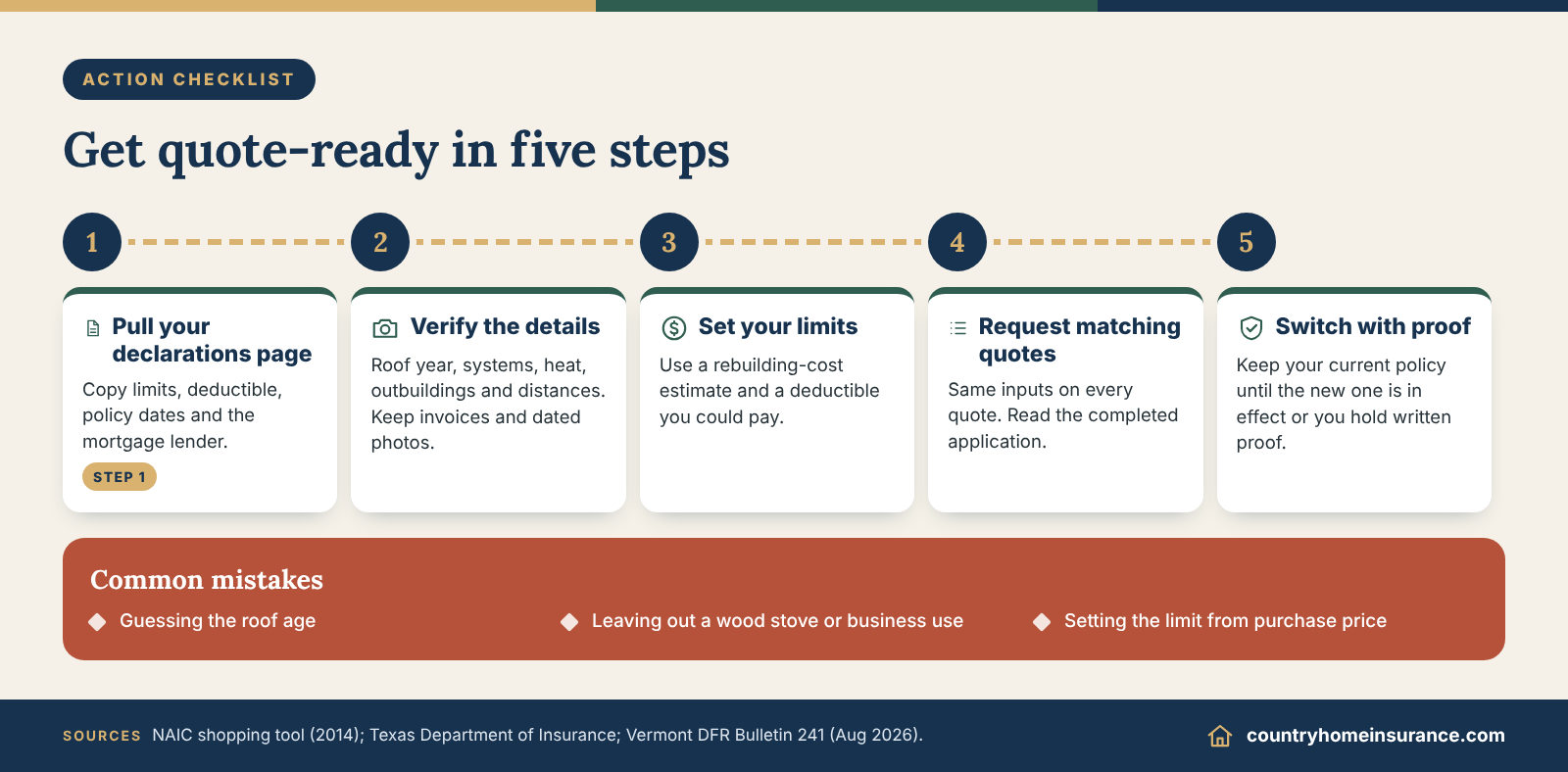
| Action | What to verify or document | What to ask the agent or insurer |
|---|---|---|
| Pull your current declarations page | Policy dates, limits, deductibles, endorsements, mortgagee. | Which of these should be matched exactly on new quotes? |
| Confirm roof facts | Installation year, material, invoice or permit, dated photos. | How is the roof valued and settled, and what age does the company assume? |
| Document systems and heating | Electrical, plumbing, heating invoices; wood stove installer receipt. | What documentation do you need for older systems or secondary heat? |
| Measure fire-protection data | Road miles to the station; distance to hydrant or water source. | What protection class and station distance do you have on file for this address? |
| List outbuildings and activities | Size, age, construction, use, contents, any business or livestock. | What limit applies to each structure, and does any use change eligibility? |
| Order your claims report | Seven-year claim list; errors; missing or wrong claims. | Does a previous owner’s claim affect this quote? |
| Set coverage limits | Rebuilding-cost estimate; home inventory; liability needs. | How did your estimator reach the dwelling figure, and can it be adjusted? |
| Review the application | Every answer on the form, with copies saved. | Can you send the completed application, and how is an error corrected? |
| Plan the switch | New policy effective date; proof of coverage; lender notification. | When is coverage bound, and what proof can be sent to the lender? |
How does the information needed change for older homes, acreage and a home purchase?
The basic list stays the same, but emphasis shifts with the situation. These are the three cases where the most recurring surprises appear.
What changes for older and renovated homes?
Documenting updates instead of relying on the year built
For a house built decades ago, the year built is a weak summary. What the underwriter wants to know is what has been updated. Gather permits and invoices for the wiring, plumbing, roof and heating, and describe the original construction accurately. The NAIC guide describes HO-8 as a modified form for older homes where the cost to rebuild exceeds market value; it covers only listed perils, pays actual cash value for the home and belongings, and provides less coverage than the broad and comprehensive forms. Ask whether the home qualifies for a standard form, and, if not, what the modified form leaves out. Compare it against a standard form on valuation and covered perils rather than on price alone. More detail on this topic appears in how home age affects homeowners insurance cost.
Reflecting recent renovations in the limit
A renovated kitchen, new addition or finished basement raises rebuilding cost. If the application was filled in from the original county record, update it. Otherwise the dwelling limit may track the house as it was, not as it is.
What changes with acreage and a hobby farm?
More buildings, more activity, more questions
As acreage grows, the number of outbuildings tends to grow with it, and so do questions about animals, equipment, hunting, rented land and visitors. The details matter more than the acreage number. A 5-acre lot with only lawn is a different risk from a 5-acre lot with a horse barn and boarders. See the acreage guides, such as country home insurance for homes with acreage, and the farm-versus-homeowners discussion in the earlier rural section.
Making the farm-or-home decision before quoting
If any income comes from the land, or if employees or customers are on site, ask early whether a standard homeowners policy can handle it or whether a farm or commercial policy is needed. Answering a quote form as if there were no farm activity, when there is, is exactly the type of mismatch that creates trouble at claim time.
What changes when you are buying a home or switching insurers?
Buyers: information you may not yet have
New buyers may not know roof age, system ages or the prior claims history. The inspection report, seller disclosures and the seller’s CLUE report are the sources. Request them early, and ask your lender when proof of coverage is due. Our guides on when to buy before closing and insurance at closing cover timing.
Switchers: use your renewal as a checklist
If you already have coverage, your renewal documents already include many answers. Review them with fresh eyes, because details may be outdated: a pet you no longer have, a roof replaced since you applied or a business that has grown. Correcting these before you shop gives you the best chance of a quote that reflects the home as it is.
Frequently asked questions
Getting started
Can you get a home insurance quote with only a few details?
Many online forms will show an estimate from limited information, but the number is only as reliable as the inputs. Expect the price to change once the insurer verifies details or you add rural specifics. Treat early numbers as a screening step, then request full quotes using your information sheet.
Does asking for quotes count as filing a claim?
No. A quote request is not a claim. The Washington Office of the Insurance Commissioner notes that LexisNexis advises insurers not to report a claim when you only ask a coverage or deductible question. The NAIC guide lists a credit-based insurance score as an outside source insurers may use, so ask the company whether it uses one when preparing a quote.
Is a home inspection report required to get a quote?
Requirements vary by insurer, so ask. An inspection report is a convenient source for roof, system and heating details; if you have one, keep a copy in your packet and make sure the dates you enter match it.
Accuracy and privacy
What if you do not know your roof age or system ages?
Say so and ask how the company handles unknown answers. Estimate carefully and note it is an estimate, ask the seller or previous contractor for records, and consider having a roofer or inspector give a written opinion. Do not choose a favorable year just to complete the form.
Is a CLUE report the same as a credit report?
No. A CLUE report lists insurance claims on a property or vehicle for roughly seven years, as the Texas Department of Insurance explains. A credit report describes credit accounts and payment history. Insurers may use both, and you can get a free copy of each, as the sources above explain.
What should you do if you find a mistake after buying the policy?
Contact the agent or insurer promptly and correct it in writing, keeping the response. If the correction changes the premium, ask for the revised declarations page. If the answer concerns something significant, such as a wood stove, a business or the occupancy of the home, ask the company how it affects coverage and keep the documentation. For a dispute, your state department of insurance can explain your options.
Country and special situations
How do you find your fire protection class?
The insurer or agent has the class on file for your address, so ask. The fire district can also tell you which station responds and what water sources it relies on. The Texas Department of Insurance publication says communities can publish their own PPC score, for example on a website or in a community letter, and that insurers subscribe to ISO’s data, so the fire district is also a good place to ask.
Do you have to mention a wood stove you rarely use?
Answer the insurer’s question about secondary heat accurately and describe how often it is used. A stove that exists but is unused may still be a question on the form. If you are unsure, ask the agent how the company wants it recorded.
Will the insurer inspect your property?
Some do and some rely on aerial imagery, public records or your photos. Ask whether an inspection is part of the process and how you would be notified of required repairs. United Policyholders notes that insurers typically give a short window to make repairs and send proof.
Does the information needed change for 10, 20 or 50 acres?
The core questions are the same, with more emphasis on outbuildings, animals, equipment, land use and any income. The more the land is used, the more likely the insurer is to ask whether a farm policy fits. Our acreage guides, including home insurance for 10+ acres, discuss the differences.
Sources
- NAIC (hosted by the Colorado Division of Insurance) — A Shopping Tool for Homeowners Insurance (2014; accessed 2026-10-16)
- NAIC — Homeowners Insurance topic page (last updated 2025-10-25; accessed 2026-10-16)
- NAIC — Credit-Based Insurance Scores (last updated 2026-03-19; accessed 2026-10-16)
- NAIC — Consumer Insight: Credit Scoring, How Does It Affect You? (accessed 2026-10-16)
- NAIC — How to File a Complaint and Research Complaints Against Insurance Carriers (2022-09-01; accessed 2026-10-16)
- Texas Department of Insurance — How to shop smart for home insurance (accessed 2026-10-16)
- Texas Department of Insurance — How to get a CLUE about your claims history (last updated 2024-10-14; accessed 2026-10-16)
- Texas Department of Insurance — Public Protection Classification (2023-03-23; accessed 2026-10-16)
- Verisk ISO Mitigation — Water Class 10W (accessed 2026-10-16)
- Washington Office of the Insurance Commissioner — CLUE reports (accessed 2026-10-16)
- National Association of Realtors — CLUE report (2024-01-29; accessed 2026-10-16)
- Vermont Department of Financial Regulation — Insurance Bulletin 241 on aerial imagery (August 2026; accessed 2026-10-16)
- United Policyholders — Eyes in the Skies: How Insurers Are Using Airborne Tech to Inspect Your Home (2026-07-21; accessed 2026-10-16)
- University of Colorado Boulder — Marshall Fire underinsurance study coverage (2025-01-09; accessed 2026-10-16)
- Florida Department of Financial Services — Home insurance FAQ (accessed 2026-10-16)
- United Policyholders — How to understand a wind/hail deductible (2014-07-20; accessed 2026-10-16)
- Texas Department of Insurance — Home insurance: structures covered (last updated 2025-12-18; accessed 2026-10-16)
- Verisk ISO Mitigation — Public Protection Classification (accessed 2026-10-16)
- Consumer Financial Protection Bureau — What is force-placed insurance? (accessed 2026-10-16)
- Florida Senate — Florida Statutes 2025, s. 627.409, representations in applications (accessed 2026-10-16)
- Texas Statutes — Insurance Code chapter 705, misrepresentation by policyholders (accessed 2026-10-16)
- U.S. Court of Appeals for the Eighth Circuit — Hiscox Dedicated Corporate Member, Ltd. v. Taylor, No. 24-1161 (filed 2025-12-16; accessed 2026-10-16)
Important coverage note
Coverage depends on the actual policy, endorsements, exclusions, limits, deductible and cause of loss. Underwriting questions, eligibility rules, misrepresentation law, cancellation and nonrenewal rules, and fire-protection ratings differ by insurer and state, and some sources cited here are advocacy-group articles rather than regulation. This article is educational and is not legal advice or an insurance quote. Verify case-specific questions with your insurer or licensed agent and your state Department of Insurance.
About the editorial team
This guide was prepared by the countryhomeinsurance.com editorial team as general, educational information for homeowners. We research and summarize publicly available material, including state insurance departments, the NAIC, federal agencies, regulators’ consumer guides and published insurer and industry resources. We draw only on the sources that were available to us when we wrote this guide, and we list them in the Sources section with dates where we could find them.
Insurance rules, rates, products and program terms change, differ by state and by insurer, and can apply differently to your situation. We cannot guarantee that this content is complete, current or free of errors. It is not legal, financial, tax or insurance advice, it is not an offer to sell insurance or a recommendation of any insurer, agent or product, and reading it does not create a professional relationship of any kind.
To the fullest extent permitted by law, countryhomeinsurance.com and its editorial team, authors and contributors exclude all liability for any loss, damage or decision arising from the use of, or reliance on, this content. For questions about your own policy or claim, contact your insurer, a licensed agent or broker, your state Department of Insurance or another qualified professional.
Content created: October 16, 2026