Quick answer
A tree fell on fence insurance claim is typically handled under Other Structures (Coverage B), and a windstorm or an ice and snow load that brings a tree down is often a covered cause of loss, subject to your policy. Whether filing makes sense depends on your deductible, the fence’s age and how your policy settles structures that aren’t buildings, which may be at actual cash value. Document first, make only temporary repairs, and check your declarations page before assuming the fence or the tree removal is covered.
Key takeaways
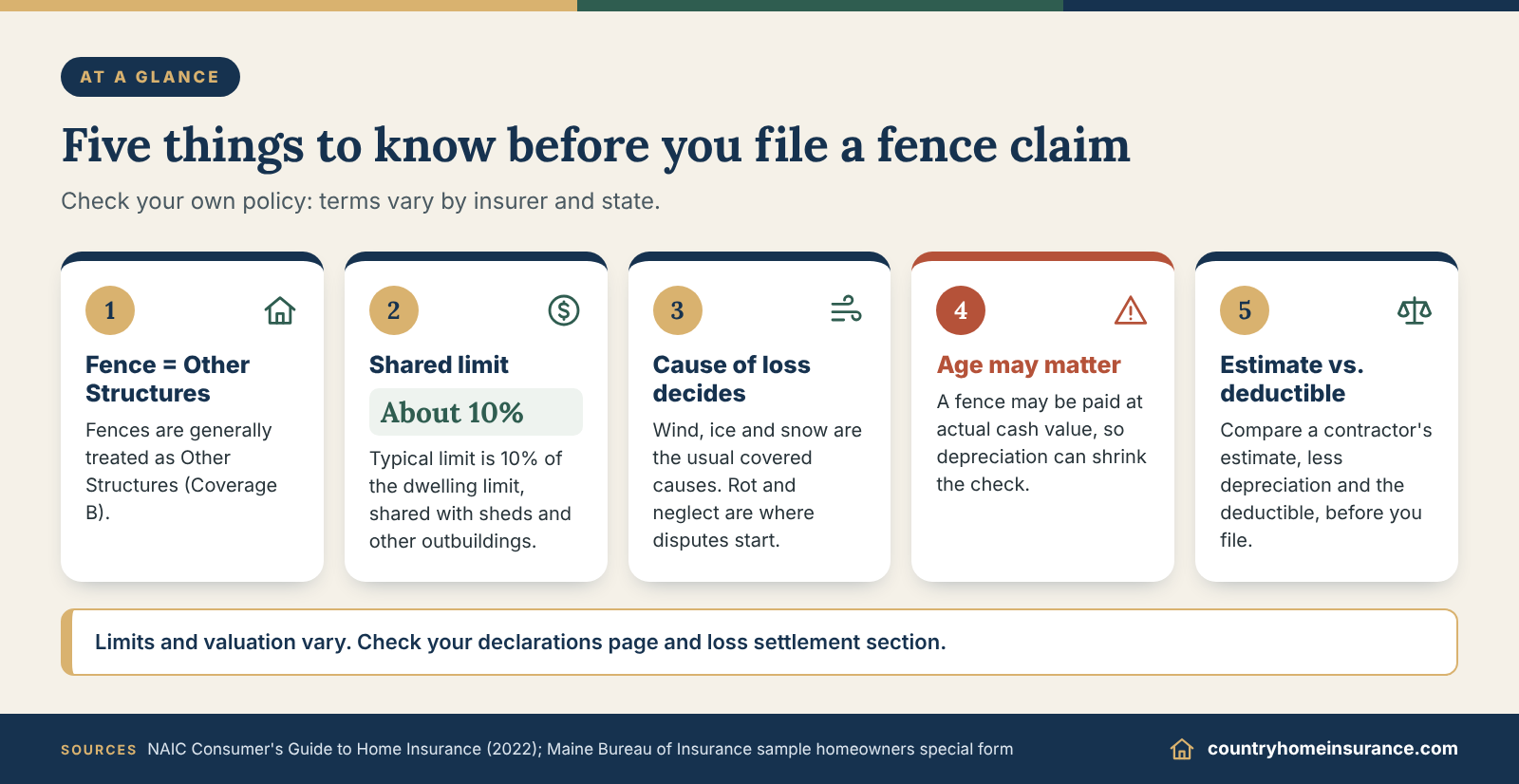
- Fences are generally treated as Other Structures (Coverage B), and the typical limit described by the NAIC is 10% of the dwelling limit. That limit is shared with sheds, detached garages and other outbuildings.
- A fallen tree is usually a cause of loss, not an exclusion, but the policy decides the details. Wind, ice and snow are the usual covered causes; rot, neglect and wear are where disputes tend to start.
- Fences are not buildings, so a sample standard form settles them at actual cash value, which means age-based depreciation may shrink the check even when replacement cost applies to your house.
- Tree removal usually has its own small sublimit. In the sample form we reviewed it was $1,000 per loss and $500 per tree, but forms differ, so confirm yours.
- With a fence-only loss, the deductible can swallow much of the payment. Run the numbers on a contractor’s estimate before you file, and ask your agent how a claim may affect renewal.
- Pasture fence, livestock containment and farm-use fencing may sit outside a homeowners policy. If animals are involved, containment comes first and the policy question second.
| Scenario | Typical treatment | What it usually turns on |
|---|---|---|
| A windstorm knocks a tree onto your perimeter fence | Typically covered, minus the deductible | Cause of loss, the Other Structures limit, the deductible (possibly a separate wind/hail deductible) and how the fence is valued |
| Ice, snow or sleet weight brings a tree or limb down on a fence | Typically covered, subject to the policy | Whether your form names this cause for tree removal, and whether a winter-weather deductible or exclusion applies |
| A dead or visibly rotted tree falls on a fence | Depends | Wording on wear, deterioration and neglect, plus what the insurer finds about the tree’s condition |
| A neighbor’s tree falls on your fence in a storm | Depends | Your own policy typically responds first for your fence; liability questions turn on facts and state law |
| The fallen tree itself (replanting or replacing it) | Typically not paid for wind | The sample form’s trees-and-shrubs coverage lists named causes that do not include windstorm |
| A pasture or livestock fence used in a farm operation | Depends | Business and farming exclusions in the homeowners policy, or whether a farm policy lists the fencing |
How a tree fell on fence insurance claim fits into a homeowners policy
When a tree comes down across a fence line, the first questions are practical: is anything still standing, are animals or kids at risk, and who pays? This guide covers the money side, and it stays with fences and other freestanding structures. If the tree landed on the house itself, that’s a different claim with different coverage pieces, and we cover it separately in the article on a tree falling on a house.
One timing note. Fall and winter bring wind events, early ice and wet snow that load up branches, and fences often take the hit because they sit at the edge of the yard or pasture where trees lean in. Everything here applies whenever the tree comes down, whether this season’s storm was last night or last month.
Where a fence sits inside the policy
Homeowners policies split coverage into lettered parts. Fences land in one of them, and which part is the single most useful thing to know before you pick up the phone.
Fences are usually Other Structures (Coverage B)
The National Association of Insurance Commissioners (NAIC), the organization of state insurance regulators, says in its Consumer’s Guide to Home Insurance that Other Structures coverage includes fences, tool sheds, freestanding garages, guest cottages and other structures not attached to the house. The NAIC’s separate homeowners consumer page lists fencing alongside detached garages and work sheds. The industry shorthand is Coverage B, and your declarations page, the summary page of your policy, should show a dollar limit beside it.
The usual limit and what shares it
The NAIC guide describes the typical Other Structures limit as 10% of the dwelling coverage limit, and the North Carolina Department of Insurance describes it the same way and notes that you can buy more for an added premium. Treat 10% as a common starting point, not a guarantee, because your policy can differ. The limit is one pool: fences, a detached garage, a hay shed and a workshop all draw from it. A $300,000 dwelling limit would suggest roughly $30,000 for everything detached, which can look generous for a fence and tight once a barn is involved. We unpack that pressure in the rural section below.
Why the cause of loss matters more than the object
A sample homeowners special form posted by the Maine Bureau of Insurance insures Other Structures on an open-perils basis, meaning it covers direct physical loss unless the policy excludes the cause. Personal property under the same form is covered only for listed causes. That difference is why a tree that damages a fence is analyzed differently from a tree that lands on belongings inside a building. For the fence, the question is usually whether an exclusion such as wear, deterioration or neglect applies, not whether “falling tree” appears on a list. Your form may be written differently, so read the section headed perils insured against for Other Structures.
What counts as a fence, and what sits outside it
The word fence covers a lot of ground on a country property, and some of it may not be treated as a fence at all.
Perimeter fencing versus fencing used in a business
A wood privacy fence around a garden is a different animal from three miles of woven wire holding cattle. The sample form we reviewed does not cover structures from which any business is conducted or structures used to store business property, with a narrow exception for property owned by an insured. Farm Bureau Financial Services notes that most homeowners policies exclude business and farming activities. A hobby horse paddock and a boarding operation can land on opposite sides of that line, so describe your use honestly to your agent.
Gates, posts, electric fence and attachments
Gates, posts, rails, wire, and often the hardware are part of the fence in most claim estimates. Electric fence chargers, solar panels on a post, trail cameras and automatic gate openers are different. They may be treated as separate property with their own coverage limits, or may be excluded, depending on the form. If a tree took out a gate operator along with the fence, ask the adjuster whether the operator is being scoped as part of the fence or as something else, and get the answer in writing.
Land, landscaping and the tree itself
Policies generally don’t pay for land, and the sample form does not cover the land under a structure. Trees, shrubs and plants have their own small coverage in that form, limited to named causes (fire, lightning, explosion, riot, aircraft, certain vehicles, vandalism and theft) and capped at 5% of the dwelling limit overall and $500 per plant. Windstorm is not on that list. So the typical outcome is that the policy may pay for the fence and for hauling the tree away, but not for replacing the tree that fell. Colorado’s consumer buyer’s guide encourages shoppers to ask specifically whether a policy covers damage to trees, which is a fair question to put to any agent.
What the policy may pay when a tree hits a fence
Here’s where the rubber meets the road. The fence repair, the debris cleanup and the tree removal are three different line items, and each one can follow different rules. Understanding the split helps you read an adjuster’s estimate without surprises.
Covered, excluded and it-depends causes
The tree’s origin and condition matter, and so do the weather and what the insurer finds when it looks at the stump.
When wind, ice or snow brings the tree down
This is the cleanest case. A healthy tree toppled by a windstorm, or a limb snapped by heavy ice or wet snow, is the kind of event the tree-removal wording in the sample form names directly: trees felled by windstorm or hail, or by the weight of ice, snow or sleet. Since Other Structures is covered for direct physical loss unless excluded, a fence crushed in those conditions is typically payable, less your deductible and subject to the limit. Windstorm coverage can still be modified, and the North Carolina Department of Insurance notes that a standard policy may exclude windstorm or hail in some areas, so confirm before you assume.
When rot, disease or neglect is part of the story
If an adjuster finds a long-dead trunk or a hollow, rotted tree that fell in a light breeze, expect a closer look. Many policies exclude loss caused by wear, deterioration or neglect, and ValuePenguin, a consumer publisher whose page was updated 2026-06-30, says falling trees are covered when the property has been maintained and that a known rotted tree left in place may lead to a denial. That’s a secondary source, and the outcome in a real claim depends on your policy language and the facts. If a tree was obviously dying before the storm, photograph any maintenance records, arborist notes or removal requests you made, since they show you weren’t ignoring a hazard.
When the tree came from a neighbor’s yard
Where the tree grew generally does not change whether your own policy responds to damage to your fence. Your homeowners policy insures your property. Questions about whether the neighbor is responsible are a separate matter, and a later section deals with them. For now, the practical point is that you typically start with your own insurer and let it sort out any responsibility question.
Debris and tree-removal sublimits
Getting the tree off the fence is often a bigger bill than people expect, and it’s usually covered by a separate, smaller provision.
Removing debris of the damaged fence
In the sample form, the debris-removal provision pays reasonable expenses to remove debris of covered property when a covered cause of loss damages it. That cost is generally counted inside the limit for the damaged property. If the damage plus the removal costs exceed that limit, the form adds an extra 5% of the limit for removal expenses. In plain terms, hauling off broken rails and tangled wire is typically part of the fence claim, not an extra on top of it, which is something to remember when you add up what your Other Structures limit really leaves for the fence.
The tree-removal sublimit and who counts as the tree’s owner
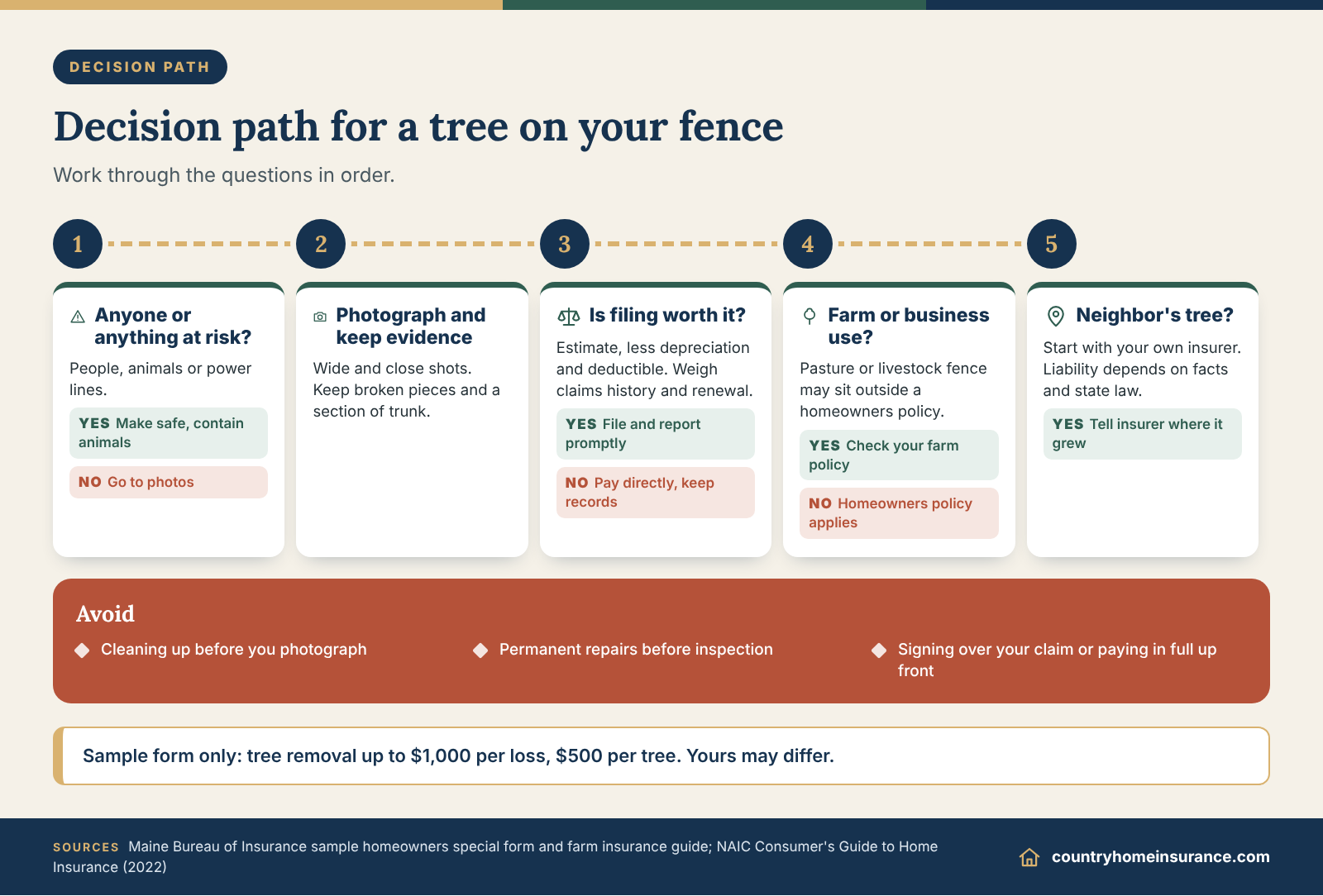
The same form pays up to $1,000 per loss to remove trees from the residence premises, with no more than $500 for any one tree. The covered trees are your own trees felled by windstorm, hail, or the weight of ice, snow or sleet, or a neighbor’s trees felled by a cause listed for personal property, and the tree must damage a covered structure. A fence that qualifies as a covered structure under Other Structures would typically satisfy that test, but the provision doesn’t mention fences by name, so ask the insurer to confirm in writing how it will treat your claim. The Alabama Department of Insurance’s disaster guide, which carries no date, mentions $500 for tree removal per event. The gap between that figure and the sample form’s $1,000 is the best illustration of why you must read your own policy.
When the tree didn’t hit anything but still has to go
The sample form also covers removal of a fallen tree that doesn’t damage a covered structure if it blocks a driveway, so that a registered vehicle can’t enter or leave, or blocks a ramp or fixture used by a person with a disability. A tree lying in a pasture or on a back trail that harms nothing and blocks nothing generally falls outside that provision, so the cleanup there may be on you. On acreage, where a windstorm can drop a dozen trees in a woodlot, this per-loss cap is where out-of-pocket costs start to build.
Replacement cost versus actual cash value for fencing
Settlement basis is the quiet driver of how large the check is, and fences often surprise owners here.
Why fences may be paid at actual cash value
The NAIC explains that actual cash value (ACV) takes the age and condition of the property into account, so depreciation from wear and tear reduces the payout, while replacement cost value pays to repair or replace with similar kind and quality. In the sample form, buildings under Coverage A and B get replacement-cost treatment under conditions, but structures that are not buildings are settled at actual cash value. A fence is generally a structure that isn’t a building. So even when your house is on replacement cost, a fence could be depreciated. Some insurers offer endorsements that change this, and many do not, so check the loss settlement section and your endorsement list.
How age and condition shrink the number
Suppose a fence is expected to last about 20 years and is 12 years old. An insurer applying age-based depreciation could reduce the payment by a substantial share before the deductible even enters the math. Each insurer uses its own method, and some cap depreciation on certain items, so the precise haircut is not something we can state. What you can do is bring evidence of condition: dated photos showing the fence was straight and sound, receipts for recent repairs, and the installation date if you have it. A well-kept fence typically supports a smaller deduction than a leaning, weathered one.
Holdbacks and the sample form’s repair conditions
Under the sample form, payment on buildings is limited to ACV until repairs are completed, with replacement cost applying once the work is finished and a 180-day window to notify the insurer of intent to repair. Those provisions are written for buildings, so do not assume they apply to your fence. The point is to ask early: Does my policy pay the full amount up front, or does it hold back depreciation until I rebuild? Is any holdback recoverable for fences, and by what date? Colorado’s buyer’s guide raises the same question for homeowners generally, asking whether you receive full replacement cost up front or only after repairs begin or finish.
| Item | What the sample form says | Why it matters on a fence claim |
|---|---|---|
| Other Structures limit | Up to 10% of the Coverage A (dwelling) limit; using it does not reduce Coverage A | All detached structures share one pool, so a barn loss in the same storm leaves less for the fence |
| Cause-of-loss basis for Other Structures | Open perils: direct physical loss unless excluded | The fight, if any, is usually about an exclusion such as wear or neglect, not about whether a tree is a listed cause |
| Debris removal | Reasonable cost inside the property’s limit, with an extra 5% of the limit if the limit is exceeded | Hauling off fence wreckage generally comes out of the same pool as the repair |
| Tree removal | Up to $1,000 per loss, no more than $500 per tree, for covered causes and for trees that damage a covered structure or block a driveway or ramp | A multi-tree blowdown can exceed the sublimit quickly |
| Replacing the fallen tree | Trees, shrubs and plants covered only for named causes that do not include windstorm, capped at $500 per item and 5% of Coverage A in total | Wind-felled trees typically are not replaced by the policy |
| Valuation of a fence | Structures that are not buildings settle at actual cash value | Depreciation may reduce the check below the cost to rebuild |
| Deductible | Insurer pays only the part of the loss above the deductible; if two deductibles apply to one loss, only the highest applies | One storm hitting fence, shed and roof should not produce stacked deductibles under this wording |
Deductible versus fence repair cost: should you file?
Fence losses sit in an awkward price range. They are often too big to shrug off and too small to clear a high deductible by much. Working through the arithmetic before you file is not gaming the system; it’s the same step the NAIC suggests when repair costs aren’t much more than the deductible.
How the deductible works on a fence loss
The deductible is the amount you pay out of pocket before the policy pays, and the details of how it’s set can change the answer.
Flat-dollar and percentage deductibles
The NAIC guide says a deductible is the money you pay on each claim before the policy pays, and that some areas use catastrophe deductibles expressed as a percentage rather than a dollar amount. Colorado’s buyer’s guide similarly notes that deductibles can be a dollar amount or a percentage, and its shopping worksheet asks whether there is a separate hurricane, wind, hail or roof deductible. If a windstorm dropped the tree, a separate wind/hail deductible may be the one that applies to your fence. Check your declarations page for every deductible listed and how each is calculated, because a percentage deductible is calculated from a limit named in the policy, and that limit is frequently the dwelling limit rather than the fence’s value.
One storm, several damaged structures, one deductible
If the same storm also took shingles off the roof and a limb off the shed, you might wonder whether each item brings its own deductible. The sample form we reviewed says that when two or more deductibles apply to the same loss, only the highest one applies. Your form may phrase it differently, and the definition of a single “loss” can vary, so ask the insurer how it will treat a multi-structure event. Our companion article on wind-damaged roofs covers the roof side of that question.
Where the deductible and depreciation come off
The order in which an adjuster subtracts depreciation and the deductible affects the arithmetic only in edge cases, but both usually reduce the final payment. The sample form says the insurer pays the part of the total payable loss that exceeds the deductible, subject to the limit. The NAIC’s actual-cash-value example makes the same general point: a loss is paid at less than its full cost under ACV, and the deductible still comes out. Ask the adjuster to show you both lines on the estimate so you can see what each one did.
Weighing the decision to file
No formula decides this for you, but a few comparisons keep the decision grounded in numbers instead of frustration.
Compare the likely net payment with what you would pay yourself
Start with a contractor’s written estimate for the full repair. Subtract any depreciation you reasonably expect if the fence settles at actual cash value, then subtract the deductible. What’s left is the most the claim might add to your pocket, before any tree-removal sublimit. If that number is small, you may be better off paying directly and keeping the claim off your record. The table below shows how the same storm can produce very different results, and every figure in it is a hypothetical illustration, not a quote or a promise.
Claims history and renewal
The NAIC guide notes that most insurers report homeowners claims to databases such as the Comprehensive Loss Underwriting Exchange, or CLUE, which insurers use to see past claims, and that how often you file and the types of claims can affect your premium and whether your policy is renewed. A small claim that pays little can still show up on that record. Read our companion piece on how claims history affects pricing before you decide a marginal claim is worth it.
Questions to ask your agent before you file
You can often get useful answers without opening a claim. Ask which deductible would apply to a windstorm loss on a fence, how the policy values a fence, what the tree-removal sublimit is, and whether the insurer treats a general inquiry differently from a reported claim. Your policy still requires prompt notice of a loss, so don’t let a long deliberation run past the point where notice could be late. The Mississippi Insurance Department reminds policyholders that a policy may require notice within a set period, and the exact period is in your contract.
| Hypothetical example | Contractor estimate | Assumed deductible | Assumed depreciation | Illustrative payment | Illustrative out-of-pocket |
|---|---|---|---|---|---|
| A. Small section, flat deductible | $900 | $1,000 | None assumed | $0 | $900 |
| B. Mid-size repair, flat deductible, ACV settlement | $2,400 | $1,000 | 25% ($600) | $800 | $1,600 |
| C. Large pasture-line repair, flat deductible, ACV settlement | $9,000 | $1,000 | 25% ($2,250) | $5,750 | $3,250 |
| D. Wind/hail percentage deductible of 1% on a $300,000 dwelling limit | $5,000 | $3,000 | 20% ($1,000) | $1,000 | $4,000 |
| E. Same storm also damages the roof | Fence $2,400 plus other damage | One deductible if the policy treats it as one loss | Varies by item | Depends on the combined loss | Depends on the combined loss |
The first 48 hours after a tree lands on your fence
What you do in the first couple of days shapes the claim more than almost anything an adjuster does later. The order matters: protect people and animals, document the scene, report the loss, then stabilize the property.
Safety and containment come first
No fence claim is worth an injury, and a fence down often means a fence that is energized, tangled or holding up a heavy tree.
Treat downed lines and tensioned wire as hazards
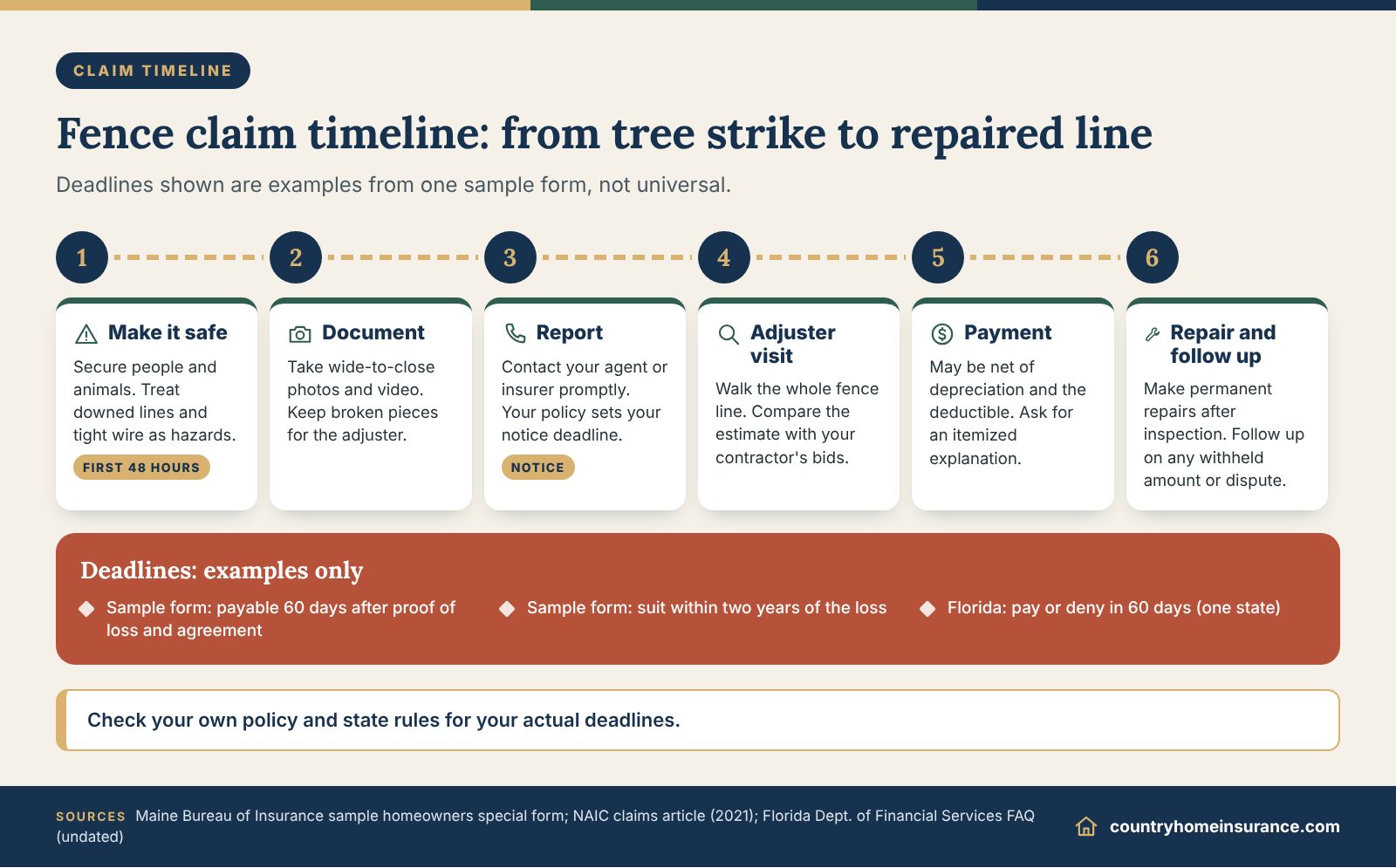
If a tree has brought down a power line along with the fence, stay well clear and call the utility or emergency services. A fallen limb touching a fence can energize the wire, and an electric fence charger adds its own hazard. Trees and limbs resting under tension can also shift suddenly when cut or moved. Where the tree is large, leaning on other trees or caught in wire, hiring a qualified tree service is usually safer than improvising with a chainsaw, and the invoice becomes a record for your claim.
Get animals secured before you worry about paperwork
On a farm or hobby property, a gap in the fence line is a gap in containment. Move animals to a safe paddock, barn or corral if you can, and put up a temporary line, such as panels, portable electric netting or even a vehicle across a gap, until a real repair is possible. Roaming livestock raises road-safety risks and possible liability, which we cover in the rural section. The reasonable cost of necessary temporary measures may be reimbursable, so keep receipts for panels you buy or rent.
Clear the way for access if the tree blocks a road or gate
On private roads and long driveways, a tree across the lane can block an ambulance or a volunteer fire department truck. If the tree blocks your only way out, tell your insurer, because the sample form’s tree-removal provision explicitly addresses trees blocking a driveway, and it is worth documenting the blockage with a photo before anyone cuts it. Then cut only what is needed to restore safe access.
Document before anything is moved
Your photos and notes become the story of the loss, and they’re easy to get wrong when the storm cleanup starts.
Photos and video from wide to close
The NAIC’s claims guidance says to document losses with photos or video before removing debris. For a fence, start wide enough to show where the tree sits relative to the fence line, the house, and any landmark, then walk the line and shoot each broken section, each post that leans or snapped, the tree’s trunk and the stump or root ball. A short narrated video with the date and time stamped helps. Capture the weather conditions if you can, such as snow on the limbs or downed neighboring trees.
Keep the damaged pieces and the evidence of cause
The Montana Commissioner of Securities and Insurance advises policyholders to hold on to damaged items until the adjuster says they can be discarded, and the NAIC makes the same point about saving damaged property for inspection. For a fence, that means stacking broken boards, panels and posts out of the way rather than hauling them off. If you must cut the tree to clear access, photograph the cut faces and keep a section of trunk, because the condition of the wood is often the crux of any dispute over cause.
Prove what the fence was before the storm
The NAIC recommends keeping a home inventory with photos or video, receipts and appraisals. For fencing, that includes installation invoices, a dated photo showing the fence in good shape, and a rough measurement of the line in linear feet. Older photos on your phone, such as the dog in front of the fence or a family gathering in the yard, can establish condition and length. If you don’t have a home inventory, the first week after a loss is a good time to start one for everything that’s left.
Notice and temporary repairs
Prompt notice and prudent stopgap repairs are two duties that appear in nearly every homeowners policy.
Report the loss promptly
The NAIC guide advises contacting your agent or insurer as soon as possible, asking which forms or documents you need, and keeping notes with dates of every conversation. The NAIC claims article adds that insurers have reporting deadlines. The sample form requires prompt notice and sets a separate window for a sworn proof of loss after the insurer asks for it. Your policy states your actual deadlines, and the state may add rules, so a quick call beats a careful guess.
Make reasonable temporary repairs and keep receipts
The sample form tells the policyholder to protect the property from further damage, make reasonable and necessary repairs and keep an accurate record of the expense, and it includes a reasonable-repairs provision that pays the cost of necessary measures to protect covered property. For a fence that might mean tarping an exposed gate post, tying up a leaning panel, or running temporary wire across a pasture gap. The NAIC says temporary repair costs are typically reimbursed through the claim when the policy covers the loss.
Hold off on permanent repairs until the insurer has inspected
Several state regulators give the same advice. Mississippi asks policyholders to wait on permanent repairs until the insurer has inspected and you agree on repair costs, and North Carolina’s Department of Insurance says the same. The Alabama Department of Insurance warns that unauthorized permanent repairs may not be reimbursed. A permanent rebuild before inspection can also erase the evidence of what was damaged. If the animals or the property are at real risk, ask the insurer for permission to proceed and get it in writing.
From adjuster inspection to payment on a fence claim
Fence claims tend to be handled quickly compared with house claims, but they still follow the same path: inspection, estimate, decision and payment. Knowing the steps keeps you from getting caught flat-footed when a number arrives that you didn’t expect.
What the adjuster visit looks like
An adjuster is the person who assesses the damage and helps determine what the policy pays. Some are company employees and some are independent contractors, according to the NAIC guide.
Be there and walk the whole line
The Alabama Department of Insurance suggests being present for the adjuster’s inspection and letting the adjuster see damaged property before you discard it. For a fence claim, walk the entire line with the adjuster, not just the spot where the tree fell. Impact damage often tugs at posts and wire well past the obvious break, and a section that looks fine can have a cracked post or a stretched wire. Point out each location and make sure it’s in the notes.
How fence damage tends to be scoped
Estimates for fences are typically built from linear feet of fence, the number of posts, panels or rails, gate hardware, labor, and haul-away. Ask the adjuster how they measured the damage, whether replacement is by section or by whole line, and how they handled sections that are intact but won’t match new material. Policies and state rules differ on matching, so treat this as a question to put in writing, not an assumption. The NAIC explainer on actual cash value versus replacement cost is a good primer on why the age of the item shows up on the estimate.
Bring your own contractor’s estimate
The Montana regulator suggests getting at least three written bids on company letterhead, with a phone number and address, and comparing them with the adjuster’s report. Alabama’s guide notes that a contractor’s estimate can help if you think the insurer’s estimate is too low. For a fence, a local fencing contractor or a farm-fence builder is better placed than a general handyman. Be wary of anyone who offers to cover or waive your deductible, because the Montana regulator says that practice is against the law in that state, and rules in other states vary.
Reading the estimate, getting paid and disagreeing
The estimate is where the claim becomes numbers, and it’s where most fence disputes start.
Line items worth checking
Mississippi’s insurance department recommends asking the adjuster for an itemized explanation of any settlement offer. Check that the footage matches what you measured, that gates and hardware are included, that tree-removal and debris-hauling are listed separately so the sublimits are visible, and that the depreciation line states its basis. If an item is missing, ask whether it’s excluded or simply overlooked. A short email listing the missing items, with photos, creates a clear record.
Payment timing and what the sample form says
In the sample form, loss is payable 60 days after the insurer receives your proof of loss and one of three things happens: you and the insurer agree, a judgment is entered or an appraisal award is filed. Separate state rules may speed things up. The Florida Department of Financial Services, for example, says a property damage claim generally has to be paid or denied within 60 days of notice unless factors beyond the insurer’s control cause delay. That is one state’s rule, so look up yours on your state insurance department’s site. If a lender is named on your policy, ask whether it must be a co-payee on a payment for other structures.
If the number looks low
The NAIC guide says to try to resolve a disagreement with your insurer first, then check the policy for an appraisal clause, consider an attorney or public adjuster, or contact your state insurance department’s consumer services staff. Public adjusters charge you a fee and are not permitted in every state. Under the sample form, appraisal lets each side pick an impartial appraiser, who then choose an umpire together, with each side paying its own appraiser and sharing the umpire’s cost. The same form says a lawsuit must be brought within two years of the loss, though your policy and your state may differ, so don’t let the clock run while you negotiate.
When the tree came from a neighbor’s property or the fence is shared
Fence lines are where properties meet, so it’s no surprise that a fallen tree often involves a neighbor. This is the part of the claim where facts, state law and your policy language all matter at once, and where an article can only give you the right questions. We did not survey state tree-and-boundary law for this guide, so nothing below is a statement of what the law is in your state.
Whose insurance responds first
Most homeowners start with their own insurer, even when the tree wasn’t theirs.
Your own policy typically responds for your own fence
Your homeowners policy insures your property against covered causes, and a storm that drops a neighbor’s oak on your fence is generally a covered storm loss for you, in the same way as if the oak had been yours. The sample form we reviewed even addresses this directly in its tree-removal provision, which includes a neighbor’s trees felled by a cause listed for personal property coverage. The detail that varies by policy is the sublimit, the causes listed, and whether the tree must have damaged a covered structure, so read that provision rather than relying on the general idea.
When a neighbor may be responsible
In some situations a property owner can be legally responsible for damage a tree causes next door, and the facts that tend to matter include whether the owner knew the tree was hazardous, whether the storm was severe enough to fell a healthy tree, and what the law of your state says. Those are legal questions that vary by state, and they are outside what this article can answer. If the tree was visibly dead or already leaning and a neighbor had been told, a short consultation with a local attorney or a call to your state insurance department’s consumer line can clarify your options. A storm that downs healthy trees across the whole neighborhood is a very different set of facts.
What to say and do with the neighbor
Keep it neighborly and factual. Photograph the tree’s roots, trunk and the break, note the weather, and avoid trading accusations. Tell your insurer that the tree came from next door and let it advise you on communication, since an insurer sometimes has its own steps for pursuing a responsible party. Ask whether doing so might affect your deductible and what your cooperation duties are. If the neighbor’s insurer contacts you, keep a record of the call and loop in your own insurer before you sign anything.
Boundary lines and shared fences
Not every fence belongs to one person, and not every tree sits wholly on one side.
A fence you co-own or share maintenance on
Some fences straddle the line or were built jointly, and some boundary agreements assign each owner a half. Who owns the damaged section affects whose policy responds and for how much. Look at your survey, deed, any written agreement and local rules, and tell your adjuster plainly if the fence is shared so the estimate doesn’t assume you own the whole run. If a neighbor’s policy is also involved, expect two adjusters and two estimates, and try to make sure the footage and photos agree.
A tree standing on the property line
A trunk that straddles the boundary raises an ownership question that insurers and courts handle differently from place to place. It matters because it may affect who arranges removal and who pays for it. An arborist’s written assessment of the tree’s health and a surveyor’s boundary markers are the two documents that tend to settle the practical argument. Neither replaces legal advice if the neighbor disagrees.
Records that help before there’s a problem
A dated photo of a worrying tree, a short email to the neighbor asking about it, and an arborist’s note all create a record. They protect you in two ways: they show you weren’t ignoring a hazard on your own side, and they document that a neighbor was notified of a hazard on theirs. Keep them with your policy papers. It’s a low-cost habit, and it pays off if a dead tree ever does come down across the line.
Rural fencing, pasture lines and livestock containment
A suburban privacy fence and a quarter-mile of pasture fence share a name and not much else when it comes to insurance. On acreage, the fence may be a working tool of a farm enterprise, and that can move it out of the homeowners policy altogether.
When fence coverage moves from a homeowners policy to a farm policy
The dividing line is use. Fencing around a family yard is ordinary Other Structures property. Fencing that contains animals raised or boarded for income is a different matter.
What the farm side lists that a homeowners policy may not
Travelers, an insurer, published a 2022 comparison saying that farm and ranch coverage lists fences and corrals, outbuildings and livestock, while a homeowners policy does not mention fences, covers outbuildings only within limits on size and use, and does not include protection for farm or ranch property or operations. That’s an insurer’s marketing content, so treat it as context, not as your policy. The practical lesson is that if animals and income are part of your property, ask your agent in writing whether your fences are covered under the policy you have.
Hobby farms and incidental farming
Farm Bureau Financial Services, in a February 2026 article, says most homeowners policies exclude business and farming activities and suggests asking about an endorsement for incidental farming or a separate farm policy. A few backyard hens or a pony for the kids is a different risk than a boarding stable or a cow-calf herd. Where your activity falls matters for both the fence claim and the liability coverage discussed below, so describe it accurately, even if the answer changes your premium.
Pro-rata and coinsurance clauses on farm fencing
The Maine Bureau of Insurance’s farm insurance guide groups fences, corrals, pens, chutes and feed racks among the property to which pro-rata and coinsurance clauses generally apply. In plain English, a coinsurance clause may reduce a payment if the amount of insurance on the property is less than a required share of its value, and the guide says most insurers require 80% coinsurance, though some require 100%. It also notes that each building and item generally has its own deductible. Farm forms use named-peril, broad or special-form coverage, and windstorm appears in the basic list of named perils. If your fencing is on a farm policy, ask whether it is scheduled, what value it is insured for and which perils apply.
Livestock out: containment, liability and the vet bill
When the fence goes down, the animals do not wait for the claim to be filed. The first job is containment, and the coverage questions come right behind it.
Immediate containment and who to call
Check the whole perimeter, not just the break. Bring animals into a secure area, close gates and use portable panels or temporary electric netting to span gaps. If animals have reached a road, notify neighbors and local authorities so drivers are warned. Photograph the gap, any tracks and the temporary measures you took, and keep the receipts. Those costs may be reimbursable as reasonable protection of covered property, though a lost-livestock or roadway incident is a separate question for your insurer.
Liability if animals leave the property
The University of Missouri Extension offers the example of a cow that jumps a fence and is struck by a car as exactly the kind of accident farmers worry about, and it advises checking whether a policy covers accidents on the road. The Maine farm guide says farm liability coverage extends to damage caused to others by animals you own, but a homeowners policy may exclude business and farming exposures. The answer to who pays in a road collision turns on your policy, the facts and state law. If you keep livestock, ask about farm liability, any umbrella policy and whether either covers roadway incidents. Our articles on rural home insurance and acreage cover that liability side in more depth.
Injured or lost livestock themselves
The animals are property too, but usually not homeowners-policy property. The Travelers comparison says only farm and ranch coverage lists livestock, and the Maine guide explains that farm policies use schedules to list livestock, machinery and farm products with their own limits. If a downed fence leads to injured or escaped animals, ask whether your policy covers livestock at all, which causes are listed, and whether a veterinary or recovery cost is included. If you have no livestock coverage, you will want to know that before the next storm, not after.
Long pasture lines and big blowdowns
Scale changes everything. A single tree on a garden fence is one repair. A windstorm through a woodlot boundary can break a fence in a dozen places.
Counting footage, breaks and gaps
On a long line, walk the fence with a notebook or phone and mark each break with a number, a photo and a rough length. Posts near a fall often loosen or lean for some distance on either side, and tight wire can pull neighboring posts out of line. Ask a farm-fence contractor, not just a general builder, for a line-by-line estimate, and give the adjuster your numbered list so the scope can be compared item by item.
Limit pressure when barns and sheds are damaged too
Hypothetical example: a homeowner with a $400,000 dwelling limit and the typical 10% Other Structures limit would have a $40,000 pool. If one storm damages a hay shed for $22,000, a workshop roof for $9,000 and a fence line for $14,000, the combined damage would reach $45,000 before depreciation and the deductible, and the pool might not cover all of it. That’s a made-up illustration, not a quote, but it shows why acreage owners should ask whether to raise Other Structures coverage or insure key buildings separately. Our articles on acreage and larger parcels go further.
Outside help for farm disasters
Government disaster-assistance programs for farms and ranches may exist that touch on damaged fencing, and programs of that kind may have rules about when work can begin. We were not able to verify any current program’s rules while researching this guide, so don’t take this as a statement about eligibility. If your property is a working farm, call your county USDA service center before you rebuild and ask whether any program applies, what the deadlines are and whether starting repairs early would affect eligibility. Your insurer will still want its own inspection first.
Common mistakes and how to prepare before the next storm
Most fence-claim problems are self-inflicted in small ways, and almost all are preventable. The devil is in the details, and the details here are mostly about the order in which you do things.
Mistakes that complicate a fence claim
None of these will necessarily sink a claim, but each one makes the adjuster’s job harder and your position weaker.
Cleaning up before documenting
It’s tempting to cut the tree, haul the debris and rebuild the gate so the pasture is usable again. Once that happens, the adjuster is looking at a repaired line and your word. The NAIC and several state regulators say to photograph first and to keep damaged items until the adjuster says otherwise. Move only what safety and containment require, and photograph the scene before and after each step.
Assuming the estimate equals the check
A contractor’s price to rebuild is not the same as what the policy pays. Depreciation, the deductible, sublimits and exclusions all sit between the two. Mississippi’s insurance department suggests asking for an itemized explanation, and Alabama’s guide recommends asking for a denial in writing if a claim is denied in whole or in part. Do the arithmetic yourself before you commit to a repair contract that assumes a particular payment.
Signing over your claim or paying a contractor up front
The NAIC warns that an assignment of benefits transfers policy rights, including any leftover money, to a third party, that you don’t need to sign one to get repairs done, and that you should read what you sign. It also cautions against paying cash or a check before work is complete and recommends references and multiple bids. The Montana regulator adds that you should not sign a contract with blank spaces. For a fence, which is a simple job, there is rarely a reason to hand over control of your claim.
Treating the tree, the fence and the removal as one coverage
These are three items with three sets of rules. The fence is typically Other Structures at actual cash value, the removal has a sublimit that may not reach the whole job, and the tree itself usually isn’t replaced for windstorm. Owners who expect one payment to cover all three are often disappointed. Ask the adjuster to show each item on the estimate and name the coverage it falls under.
Preparing before the next storm
An hour of paperwork now makes the next claim faster and less stressful.
Review limits, deductibles and settlement basis
Ask your agent or insurer five questions. What is my Other Structures limit in dollars? Are fences paid at actual cash value or replacement cost? What is the tree-removal sublimit? Which deductible applies to wind damage? Is there an endorsement that changes how outbuildings or fences are valued? The North Carolina Department of Insurance notes that you can buy more Other Structures coverage for an additional premium, which can matter on acreage. When you compare quotes, compare apples to apples by looking at these terms and not just the premium.
Inspect trees and fence lines
Walk your fence lines each season and look up. Dead limbs over a fence, trunks with fungus or cracks, trees leaning toward the line and root heaving after wet weather are worth a professional look. An arborist’s note on a tree you decide to remove, or one you decided to keep, becomes useful evidence of maintenance. Wide, healthy buffer zones between big trees and valuable fence also reduce the odds of a repeat.
Build the record now
The NAIC recommends a home inventory with photos or video, receipts or appraisals, and model and serial numbers, stored somewhere safe. Add your fences: date of installation, linear feet, material, contractor invoice, and a walk-the-line video once a year. Keep a copy off the property, such as in cloud storage, so a bad storm cannot take the record along with the fence.
| Step | What to verify or document | Question to put to your insurer or agent |
|---|---|---|
| Make safe | Downed lines, tensioned wire, animals contained, access cleared | Will the reasonable cost of temporary containment and tree cutting needed for safety be considered? |
| Document | Wide and close photos, video, stump and trunk, broken pieces kept, weather notes | When may I discard or haul away the damaged materials? |
| Check the policy | Other Structures limit, deductibles, loss settlement for fences, tree-removal sublimit | Is my fence paid at actual cash value or replacement cost, and which deductible applies? |
| Get estimates | Written bids from local fence contractors with footage, posts, gates and haul-away | How does your estimate treat intact sections that no longer match? |
| Decide on filing | Net payment after depreciation and deductible, claims history, renewal concerns | How might a claim of this size affect my record and renewal? |
| Neighbor and boundary | Where the tree grew, ownership of the fence section, any prior notice about the tree | Do you handle recovery from a responsible party, and how does that affect my deductible? |
| Rural and livestock | Whether the fence contains animals for income, farm policy schedules, liability coverage | Are fences, livestock and roadway incidents covered under my policies? |
Frequently asked questions
These are the questions homeowners most often raise after a tree comes down on a fence. The answers are general, and your policy language decides the specifics.
Coverage questions
Does homeowners insurance cover a fence damaged by a fallen tree?
Often, yes, if a covered cause of loss brought the tree down. The NAIC lists fences as Other Structures property, and the sample form we reviewed insures Other Structures against direct physical loss unless an exclusion applies. Wind, ice and snow are the usual covered causes. A dead, rotted or neglected tree can complicate things, and the deductible, limit and valuation rules still apply. Typically covered does not mean guaranteed paid, so confirm with your insurer.
Will the policy pay to remove the tree?
Many policies include a small tree-removal provision. In the sample form it pays up to $1,000 per loss and $500 per tree when covered causes fell a tree that damages a covered structure or blocks a driveway or accessibility ramp. Some forms use lower or higher figures, and the Alabama Department of Insurance’s undated guide mentions $500 per event. A tree that lands on nothing and blocks nothing is often a cleanup you pay for yourself.
Will insurance replace the tree that fell?
Typically not for a windstorm. In the sample form, coverage for trees, shrubs and plants applies to named causes such as fire, lightning, vandalism and theft, and windstorm is not among them. Limits are small: $500 per plant and 5% of the dwelling limit in total. If protecting landscaping matters to you, ask the agent whether any endorsement broadens it.
What if a neighbor’s tree fell on my fence?
Start with your own insurer. Your policy covers your fence for covered causes regardless of where the tree grew, and the sample form even lists a neighbor’s trees in its tree-removal provision. Whether the neighbor is legally responsible is a separate question that depends on the facts and your state’s law, so talk to your insurer, your state insurance department or a local attorney before you assign blame.
Money and claim questions
Should I file if the repair is close to my deductible?
The NAIC guide says that if repair costs are not much more than your deductible, you may choose to pay for the repairs yourself. Run the numbers in Table 3 with your own estimate. Weigh the likely net payment against the chance that a claim shows up in a claims database and affects pricing or renewal. If you’re unsure, ask your agent how a claim of this size is typically handled before you decide.
How long do I have to report the loss?
Your policy sets the notice requirement, and it typically requires prompt notice. The Mississippi Insurance Department says a policy may require notice within a set period, and the NAIC says insurers have reporting deadlines. Neither names a universal number, and neither do we. Report as soon as you can and ask the insurer what documents it needs. Separate time limits can also apply to proof of loss and to filing suit, and they vary by policy and state.
What if the insurer pays less than my contractor quoted?
First ask for an itemized explanation, then compare it with your estimate line by line. Depreciation on a fence valued at actual cash value is a common reason for the gap. If you still disagree, the NAIC suggests working it out with the insurer, checking for an appraisal clause, considering an attorney or public adjuster, and contacting your state insurance department. Keep your photos, estimates and notes organized so your case is easy to follow.
Do I need a public adjuster for a fence claim?
Probably not for a simple fence loss. A public adjuster is hired by you and paid by you, and the NAIC notes they aren’t permitted in every state. The insurer’s adjuster is provided at no cost to you. For a large, multi-structure farm loss with a disputed scope, some owners decide professional help is worth the fee, and that’s a judgment call to make after checking your state’s rules.
Rural and livestock questions
Is my pasture fence covered by my homeowners policy?
It depends on how the fence is used and how your policy reads. A fence at the edge of the yard is generally Other Structures property. A fence used to contain animals as part of a farm business may fall under the business and farming exclusions that Farm Bureau Financial Services says most homeowners policies contain. A farm or ranch policy may list fences and corrals. Ask your agent for a written answer about your specific fencing.
What if my animals got out because of the fallen tree?
Secure the animals first, then document the damage and the temporary measures you took. Whether a policy covers injuries or damage caused by escaped animals depends on whether you have farm liability coverage, personal liability or an umbrella policy, and on how each treats farming exposures. The Missouri Extension specifically suggests checking whether a policy responds to accidents on the road. Call your insurer promptly if any damage or injury to others is possible.
Should I raise my Other Structures limit if I have a lot of fence and outbuildings?
Possibly. With the typical limit at 10% of the dwelling limit, a property with long fence lines, a barn and several sheds can outgrow the shared pool. The North Carolina Department of Insurance notes that more coverage can be bought for an additional premium. Ask for a quote on a higher limit, ask how fences are valued, and compare the added premium to the exposure.
Next steps after a tree hits your fence
If you’re reading this with a fence down, work through the checklist in order. If you’re reading it before any storm, use it as a quiet-weekend project.
If the tree is already down
What to do today
Make the area safe, secure any animals, photograph everything before moving it, and call your insurer or agent. Keep receipts for any temporary measures. Do not sign a contractor’s agreement or an assignment of benefits that day, no matter how persuasive the pitch, and do not pay anyone in full up front.
What to do this week
Get at least two or three written estimates from local fence builders, compare them with the adjuster’s estimate once it arrives, and calculate your likely net payment after depreciation and the deductible. Ask for an itemized explanation. If the tree came from next door, tell your insurer and keep your photos of the tree’s condition.
If you’re preparing for the next storm
What to do this month
Read the declarations page and the loss settlement section for Other Structures. Write down the dollar limit, each deductible, how fences are valued and the tree-removal sublimit. Call your agent with any question you can’t answer from the paperwork, and ask whether an endorsement could improve how fences are valued.
What to do this season
Walk your fence lines and woodlot edges, flag dead or leaning trees for an arborist, and record a short video of each fence run with the date. Store a copy off site. For more on the broader claim process, our article on wind-damaged roofs and the claims history article linked above walk through related decisions.
Sources
- NAIC, Consumer’s Guide to Home Insurance (2022 edition): Other Structures, typical 10% limit, deductibles, claim steps, CLUE and appeal options
- NAIC, homeowners insurance consumer page (undated): fencing under Other Structures, home inventory
- NAIC, navigating the claims process (published 2021-06-23): documentation, temporary repairs, adjusters, contractor cautions
- NAIC, actual cash value versus replacement cost (published 2025-01-02)
- NAIC, after a storm read the fine print before signing away benefits (published 2018-09-01, older source)
- Maine Bureau of Insurance, sample homeowners special form (edition 05 11 per file name): sample wording only; your policy controls
- Maine Bureau of Insurance, Insuring Your Farm (undated)
- Montana Commissioner of Securities and Insurance, insurance before and after the storm (undated)
- Mississippi Insurance Department, claim advice release (2026-01-27)
- Alabama Department of Insurance, natural disasters guide (undated)
- North Carolina Department of Insurance, dealing with the aftermath of a disaster (undated)
- North Carolina Department of Insurance, basic homeowners insurance (undated)
- Colorado Division of Insurance, homeowners buyer’s guide (NAIC copyright 2014)
- Florida Department of Financial Services, homeowners insurance FAQ (undated)
- Travelers, farm and ranch insurance versus homeowners (published 2022-12-22; insurer content)
- Farm Bureau Financial Services, hobby farm insurance (2026-02-04; insurer content)
- University of Missouri Extension, what your farm liability insurance covers (undated)
- ValuePenguin, does homeowners insurance cover other structures (updated 2026-06-30; consumer publisher, context only)
Important coverage note
Coverage depends on your actual policy, endorsements, exclusions, limits, deductible and cause of loss. State laws and insurance programs vary, and the sample policy wording discussed here is one example, not your contract. Check your declarations page and policy forms, and verify case-specific questions with your insurer or agent and with your state Department of Insurance. This article is educational information, not legal advice, and it does not promise that any claim will be paid.
About the editorial team
This guide was prepared by the countryhomeinsurance.com editorial team as general, educational information for homeowners. We research and summarize publicly available material, including state insurance departments, the NAIC, federal agencies, regulators’ consumer guides and published insurer and industry resources. We draw only on the sources that were available to us when we wrote this guide, and we list them in the Sources section with dates where we could find them.
Insurance rules, rates, products and program terms change, differ by state and by insurer, and can apply differently to your situation. We cannot guarantee that this content is complete, current or free of errors. It is not legal, financial, tax or insurance advice, it is not an offer to sell insurance or a recommendation of any insurer, agent or product, and reading it does not create a professional relationship of any kind.
To the fullest extent permitted by law, countryhomeinsurance.com and its editorial team, authors and contributors exclude all liability for any loss, damage or decision arising from the use of, or reliance on, this content. For questions about your own policy or claim, contact your insurer, a licensed agent or broker, your state Department of Insurance or another qualified professional.
Content created: October 11, 2026