In most states, insurers may use a credit-based insurance score as one input when they price or decide whether to offer a homeowners policy, so credit score homeowners insurance rates can differ for otherwise identical homes. Published samples show gaps that can be large, but they are one publisher’s assumptions, not your quote. Some states restrict the practice and at least one, Maryland, bars it for homeowners. Check your state’s rules, your credit report and your insurer’s explanation before assuming a score is the reason for a price.
Key takeaways
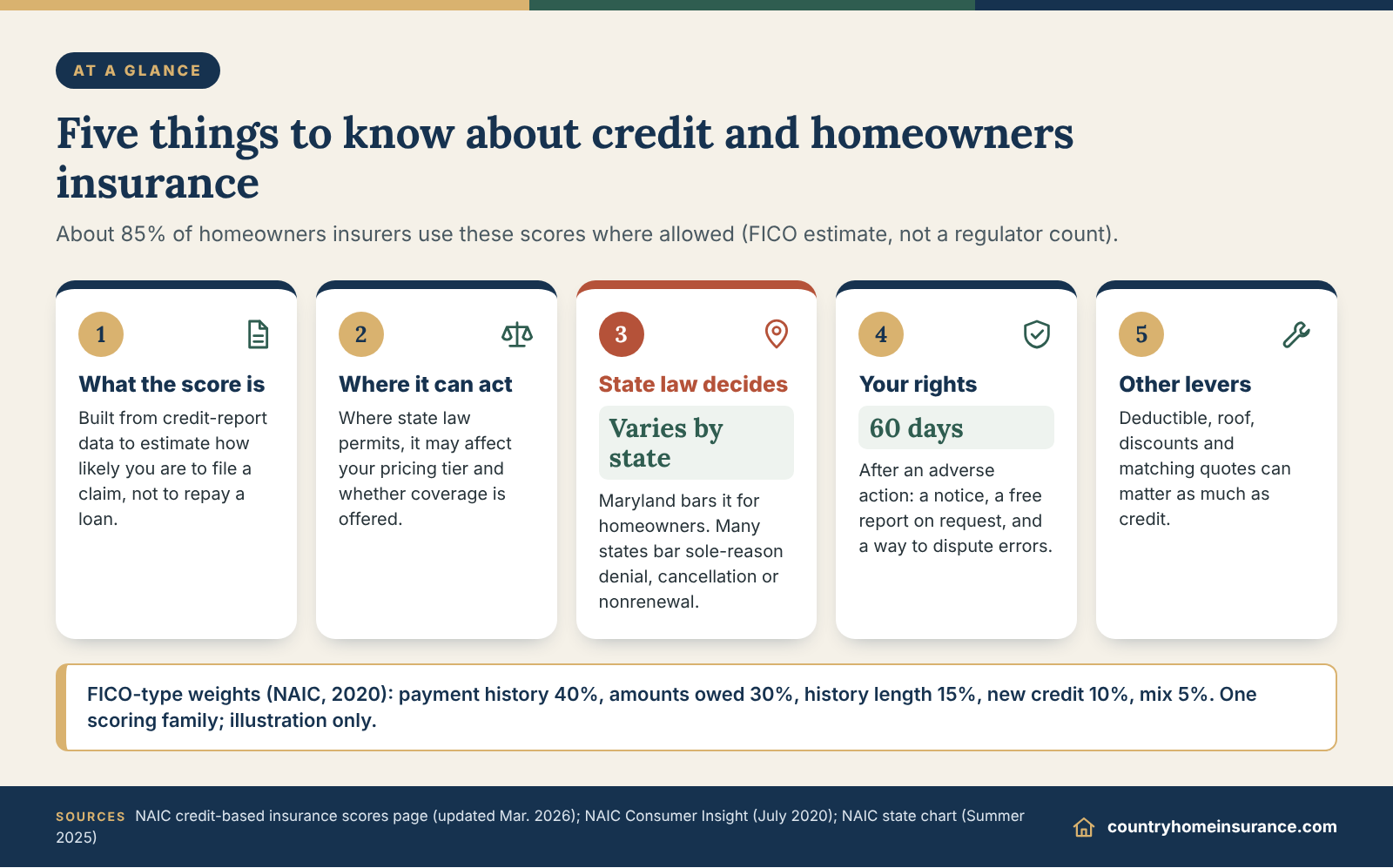
- A credit-based insurance score is built from credit report data, but it predicts the likelihood of an insurance claim, not whether you will repay a loan.
- State law decides how much weight credit can carry. Maryland prohibits it for homeowners underwriting and rating; many other states bar using it as the sole reason to deny, cancel or nonrenew.
- Two 2026 consumer-publisher samples show very different credit-tier gaps because their sample homes and coverage assumptions differ. Do not treat either as a universal price.
- If an insurer takes an adverse action partly because of a consumer report, federal law generally gives you the right to a notice, a free copy of the report within 60 days and a way to dispute errors.
- Credit is only one factor. Deductible, roof, rebuild cost, fire protection and your own claims can matter just as much, and several of those are within your control.
| Decision point | How credit information may be involved | What to verify |
|---|---|---|
| Quote and premium (rating) | Where state law permits, the insurer may place you in a pricing tier partly based on a credit-based insurance score. | Ask whether a score was used and which tier you received. |
| Acceptance (underwriting) | Some insurers may use the score when deciding whether to offer coverage or which company or program to place you in. | Ask whether an offer was declined or redirected, and for the specific reasons. |
| Renewal and nonrenewal | Many states limit using credit as the only reason to refuse renewal; a few prohibit it for homeowners. | Read the renewal notice and your state’s rule; ask the insurer in writing. |
| Errors in the report | An inaccurate or outdated item can flow through to the score the insurer sees. | Pull your reports, dispute mistakes, then ask the insurer to re-rate. |
| Life disruptions | Many states have extraordinary life event provisions, such as for job loss or serious illness, but not all do. | Ask whether your insurer and state offer an exception and what documents it wants. |
What a credit-based insurance score is, and what it is not
If you have ever shopped for coverage and been asked for permission to review your credit, you have met the topic of this article. The short version is that the number an insurer looks at is not the number your mortgage lender sees. The longer version matters because the rules, your rights and the realistic ways to respond all depend on understanding what this score is built to do.
This guide stays on one question: how credit information affects the price of a homeowners policy, whether you can get one and which discounts or offsets you can still use. It does not cover how claims history affects rates, how ZIP code or home value affect rates, or how to choose a dwelling limit; those have their own articles.
Definition: how an insurance score differs from a lending score
What the National Association of Insurance Commissioners says it is
The National Association of Insurance Commissioners (NAIC), the organization of state insurance regulators, describes a credit-based insurance score as a number built partly or entirely from a person’s credit history. In its topic page, last updated March 19, 2026, the NAIC says the score estimates how likely someone is to file an insurance claim, not how likely they are to repay a loan. It is used with auto and homeowners insurance, and it is usually one of several inputs rather than the only one.
That framing explains why a person with a strong lending score is not guaranteed a strong insurance score. The two products draw on the same credit file, but they are tuned to predict different outcomes, and each company that produces an insurance score uses its own method.
What typically goes into the score and what stays out
An NAIC consumer article from July 22, 2020 lists the kinds of credit information a FICO-type insurance score weighs: payment history at 40 percent, amounts owed at 30 percent, length of credit history at 15 percent, new credit pursuit at 10 percent and the mix of credit types at 5 percent. Treat those weights as an illustration from one scoring family and a six-year-old description, since each vendor and insurer can differ.
The same article says the score does not use personal characteristics such as race, color, national origin, religion, gender, marital status, age, income, occupation or employment history, or where you live. It also leaves out items such as the interest rates you pay, child or family support obligations, rental agreements, certain kinds of credit inquiries and participation in credit counseling. If an insurer or agent describes something different, ask which scoring model and which state rule they are relying on.
Why insurers use it and why critics object
The industry rationale and how widespread use is
Insurers generally argue that credit-based scores help them separate higher-risk from lower-risk customers, which they say keeps lower-risk households from subsidizing higher-risk ones. The NAIC page reports a FICO estimate that about 85 percent of homeowners insurers use these scores where state law allows it. That figure comes from the score vendor, not from a regulator survey, so read it as a signal that the practice is common rather than as a precise count.
The NAIC’s 2022 consumer materials add that these scores are used to predict both the likelihood and the size of a claim, and in some cases whether a policyholder is likely to stay or shop around. A higher score generally goes with a lower premium, and each insurer applies its own method. The same document notes that some states restrict or ban credit-based scoring, which is why the state section below matters so much.
The fairness and transparency objections
Critics question whether the scores are fair and transparent. The NAIC page notes the argument that they may disproportionately affect minority and low-income consumers, and that most people cannot see how a particular model weighs their file. That debate is the reason for the patchwork of state limits and for ongoing regulator work. The NAIC’s Third-Party Data and Models (H) Working Group, for example, is developing a framework for regulatory oversight of third-party data and predictive models used in pricing and underwriting. Its committee page showed a public comment period on an exposed framework closing August 5, 2026, and did not say whether the framework had been finalized or whether it addresses credit scores specifically.
For a homeowner, the practical takeaway is that this is a contested practice with real legal limits, not a settled industry constant. Your state, your insurer’s filed rating plan and your own credit report together decide how much it matters to you.
How credit score homeowners insurance rates and eligibility are decided
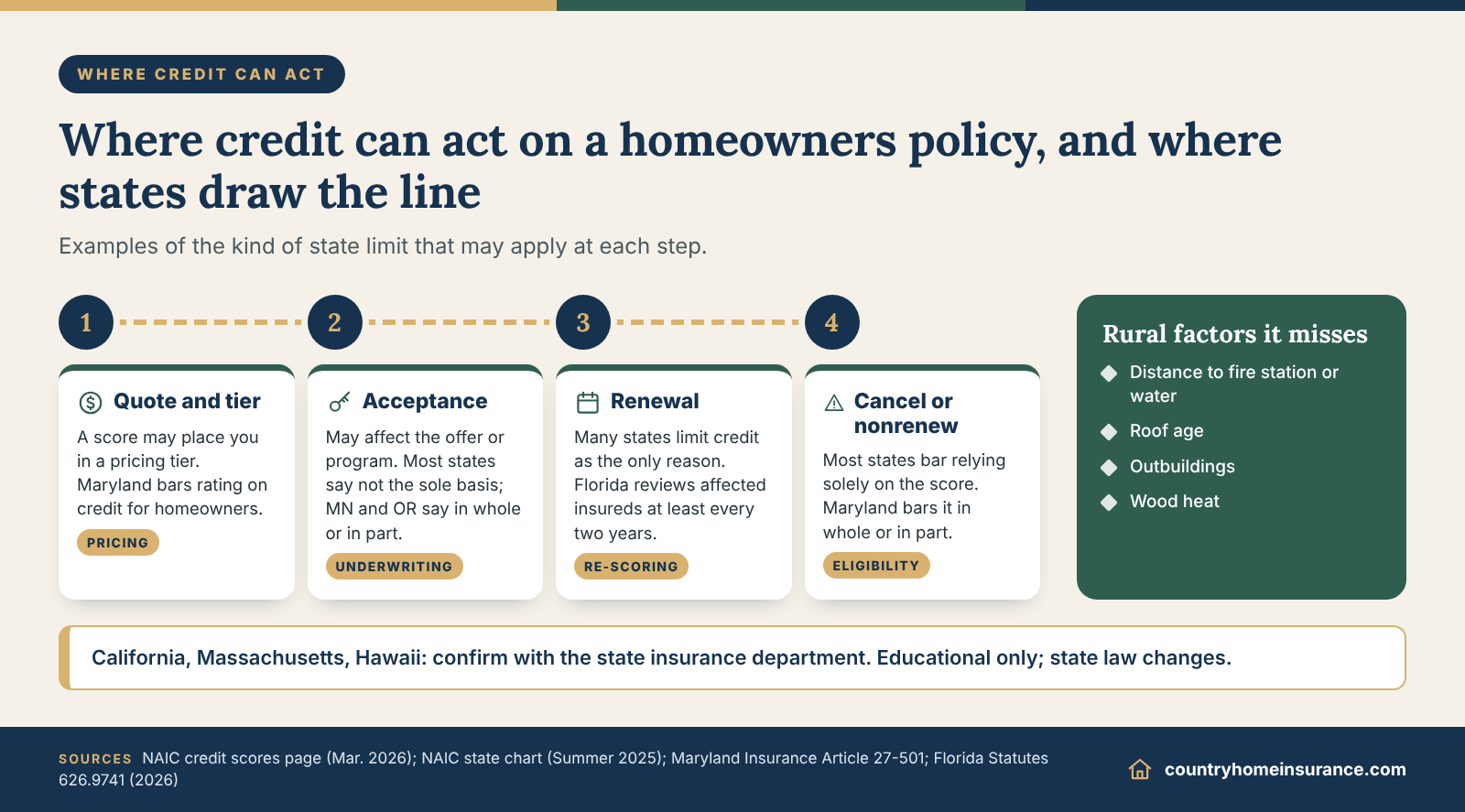
Credit information can act in two different places, and mixing them up is a common source of confusion. One is pricing: the premium you are quoted. The other is underwriting: whether an insurer is willing to offer, keep or renew coverage at all. State laws often treat these two uses differently, which is why a rule can say credit may help set your price while saying it cannot be the only reason for a cancellation.
Pricing: how a score can move a premium
Tier placement inside a filed rating plan
In states that allow it, an insurer typically converts your insurance score into a risk band or tier, and the tier changes the premium or the program you are offered. In some states insurers must file their credit models or justify them, and states add other requirements. The NAIC state chart summarizing credit rules (the Use of Credit Reports/Scoring in Underwriting chart, Summer 2025 edition) says, for example, that Alaska does not allow credit use without filed models and that Texas requires actuarial support for credit-based rate differences. Because the chart is a summary prepared by the NAIC, the underlying statutes and regulations control.
What this means for you is that a tier is not an insult or a judgment about character. It is an input in a model your insurer has filed, and your questions about it are fair ones.
Why two companies can score the same file differently
Each insurer chooses its own scoring vendor, its own cutoffs and its own weight for credit relative to other factors. The Texas Department of Insurance says plainly that each company’s premium formula is different, and its page on how home and auto costs are calculated, last updated September 1, 2026, lists credit score alongside home age, roof age and material, location, replacement cost and claim history.
The practical consequence is that the same household can land in a favorable tier with one insurer and a middle tier with another. That is one of the best reasons to get several quotes with matching coverage rather than accept the first number.
New business versus renewal
Whether credit is checked only when you apply or again later varies by state and insurer. Some state rules require insurers to re-check or recalculate periodically. The NAIC chart lists recalculation within three years in many states, while Florida’s statute, for example, requires a review of adversely affected insureds at least every two years or sooner on request. If your credit has improved since you first bought the policy, ask whether your insurer re-scores at renewal and how to request a fresh review.
Eligibility: acceptance, renewal and nonrenewal
Can credit influence whether you are accepted?
In states that permit it, an insurance score may influence whether an insurer will offer coverage or which of its companies or programs you are placed in. Several states block credit from being the only basis for that decision. Colorado’s entry in the NAIC chart, for instance, says an insurer must notify a homeowners applicant if credit scoring, property claims history or the applicant’s claims history is used in deciding whether to insure.
The wording in these rules matters. “Sole basis” restrictions leave room for credit to be one of several reasons. “In whole or in part” restrictions, like the ones the chart lists for Minnesota and Oregon, are stronger.
Renewal, cancellation and nonrenewal limits
Most states, according to the NAIC, do not allow insurers to rely solely on these scores to deny, cancel or refuse to renew a policy. Maryland’s statute goes further for homeowners and prohibits using credit history to refuse to underwrite, cancel or refuse to renew a risk, in whole or in part. If you receive a nonrenewal notice that mentions credit, treat it as a reason to ask for the specific reasons in writing and to check your state’s rule.
A nonrenewal that cites credit does not automatically mean the insurer broke a rule, and it does not automatically mean the insurer followed one. The answer depends on your state, the exact reasons stated and whether other factors were involved.
Thin or missing credit files
Some people, including younger adults, recent immigrants and those who have long avoided borrowing, have little credit history. A number of states restrict penalizing that. Florida’s statute says an adverse decision or score may not rest on no or insufficient credit history, and requires the insurer to treat the consumer as approved if the lack of history is risk-related, to treat the consumer as having neutral credit, or to exclude credit as a factor. Arizona and Arkansas also appear in the NAIC chart as barring use of absence of credit history. Households that mostly pay cash for trucks, equipment and repairs can end up with thinner credit files, so it is worth asking how your insurer treats them.
Where credit sits among all the other factors
The factor lists regulators publish
None of the regulator pages reviewed for this article ranks credit as the dominant homeowners rating factor. The NAIC’s November 19, 2024 article on rising premiums lists, for homes, location, claims history, rebuilding cost, insurance score, deductible, the age of the home, roof and building materials, and fire protection, alongside broader forces such as extreme weather, construction and repair costs, inflation, litigation and reinsurance costs. The NAIC’s consumer guide to home insurance (2022 edition) adds distance to a water source or fire department, wood stoves, pools, trampolines, certain dog breeds and home businesses.
A fair reading is that credit is one of many levers whose weight changes by insurer and state, and that you may be able to move other levers faster than you can move a credit tier.
Country-property factors that credit does not capture
Rural and acreage properties bring their own pricing questions: distance to a fire station and hydrant or other water supply, whether the local department is volunteer, road access, outbuildings, wood heat and the age of the roof. None of those appear in an insurance score, and several can matter a great deal on a farmhouse or hobby-farm home. If your premium jumped, do not assume credit is the cause before you have asked about roof age, protection class and any changes the insurer made to its rating of your area.
Why an insurance score is not a claims-history report
A claims-history report, such as a CLUE report, records losses reported on a property or by a person. An insurance score is derived from credit data. They are separate inputs, and insurers may use both. Some NAIC materials mention that certain insurers combine a credit-based score with claims history. When you question a price, ask separately about each one so you can tell whether a correctable credit error, a prior claim or something about the house itself is driving the number.
How big is the price effect? Reading published credit-tier samples
Most homeowners who search this topic want one number: how much more will I pay with weaker credit? There is no single answer, and anyone who offers one without naming the home, the coverage, the state and the data source is guessing. What can be done honestly is to look at what two consumer publishers measured in 2026, line up their assumptions and see why their results do not agree.
Two publishers, two samples
NerdWallet’s 2026 sample: two credit tiers
NerdWallet’s average homeowners insurance cost page, updated May 6, 2026, uses rates generated through Quadrant Information Services from more than 100 insurers, covering every ZIP code in the 50 states and Washington, D.C. The sample is a 40-year-old nonsmoker in a two-story, single-family home built in 1984, with $400,000 of dwelling coverage, $300,000 of liability, $200,000 of personal property, $80,000 of loss-of-use coverage and a $1,000 deductible. The page compares only two tiers: good credit at about $2,490 a year and poor credit at about $4,290, a difference of roughly 72 percent.
The page also says that credit-based pricing is not allowed for home insurance in California, Maryland and Massachusetts, and that for those states it reports only the good-credit rate. As the state section below explains, that is a statement by a consumer publisher, not a legal citation, and it could not be confirmed from a primary source for every state named.
MoneyGeek’s 2026 sample: five credit tiers
MoneyGeek’s page on factors that affect homeowners insurance rates (its byline says it was updated October 1, 2026) also uses Quadrant Information Services data, but its standard home is a 2,500-square-foot, single-family house built in 2000, with $250,000 of dwelling coverage, $125,000 of personal property, $200,000 of liability and a $1,000 deductible, with no claims in five years. Only the credit tier varies. It reports a good-credit baseline of $3,467 a year, with excellent credit about 38 percent lower, fair credit about 2 percent higher, below-fair credit about 36 percent higher and poor credit about 106 percent higher.
The two samples are the same kind of exercise, but they describe different houses and different coverage, so their dollar figures and percentage gaps cannot be combined or averaged.
| Publisher and sample home | Credit tier | Annual premium in the sample | Difference from that publisher’s good tier |
|---|---|---|---|
| NerdWallet, updated 2026-05-06: 1984-built two-story, $400,000 dwelling, $1,000 deductible | Good | About $2,490 | Baseline |
| NerdWallet (same sample) | Poor | About $4,290 | About 72% higher |
| MoneyGeek, byline updated 2026-10-01: 2000-built, 2,500 sq ft, $250,000 dwelling, $1,000 deductible, no claims in 5 years | Excellent | $2,151 | About 38% lower |
| MoneyGeek (same sample) | Good | $3,467 | Baseline |
| MoneyGeek (same sample) | Fair | $3,552 | About 2% higher |
| MoneyGeek (same sample) | Below fair | $4,728 | About 36% higher |
| MoneyGeek (same sample) | Poor | $7,136 | About 106% higher |
Why the two sets of numbers do not line up
Several things differ: the home’s age and size, the dwelling limit, the personal property and liability limits, the pool of insurers, how each publisher defines a credit tier, and how it handles states where credit is restricted. Insurify, another publisher whose average cost page was updated September 30, 2026, says only that most states let insurers review credit history and that solid credit can lower a premium. It does not quantify the effect and does not define what it means by “good credit.”
That is a useful reminder about reading rate studies generally: the headline gap depends on the definitions. If a publisher does not tell you what “poor” means, you cannot tell whether your own file would fall in that tier.
Using the numbers without being fooled by them
Averages across states hide state rules
A national average mixes states where credit can move a price dramatically with states where it cannot be used. NerdWallet’s own note that three states report only a good-credit rate shows the issue. If you live in a state that bans or tightly limits credit use for homeowners, a national tier gap says little about your price. If you live in a state that allows broad use, the published figures may understate or overstate your gap, depending on your insurer.
Hypothetical example: what a tier gap can mean for one household
Hypothetical example, not a quote: Suppose one insurer quotes a household $2,500 a year in its middle tier and $3,100 in a lower tier for the same coverage and a $1,000 deductible. The $600 difference is real money, but it has to be weighed against a few things. If the household reviews its credit report and corrects a wrongly reported late payment, the insurer might re-rate it into the better tier. If another insurer weights credit less heavily, a matching quote might narrow the gap. And a $2,500 deductible instead of $1,000 could reduce the premium in either tier, though the household would carry more of any loss. None of these outcomes is guaranteed.
What not to conclude from a tier gap
Do not conclude that your credit is the reason your premium rose. NAIC materials list many reasons premiums climb, including higher construction and repair costs, weather losses and reinsurance costs. A renewal increase can come entirely from those forces while your credit tier stays the same. Do not conclude, either, that improving credit will produce a specific dollar saving. The most you can reasonably say is that, in states where credit is used, a better file may help, and that you should ask your insurer how it works.
State rules: where credit use is banned, limited or conditioned
Insurance is regulated by the states, and credit rules are a good example of how much that matters. The NAIC says that in most states insurers cannot rely solely on these scores to raise rates or to deny, cancel or refuse to renew coverage, and that some states add restrictions or ban certain uses. The NAIC state chart is the best single starting point, but it is a summary dated Summer 2025, with each state entry marked June 2025. Treat it as a map and check the current statute or your state insurance department before relying on a detail.
The strictest rule, and the states where sources disagree
Maryland: credit history may not be used for homeowners
Maryland is the clearest case that could be verified from statutory text. Section 27-501 of the state’s Insurance Article, retrieved from the Maryland General Assembly site, provides that an insurer offering homeowner’s insurance may not use credit history to refuse to underwrite, cancel or refuse to renew a risk, in whole or in part. It also may not rate a risk based on credit history in any manner, including by giving or removing a discount, assigning a rating tier or placing the insured with an affiliated company, and it may not require a particular payment plan based on credit history. The NAIC chart agrees that Maryland bars credit for homeowners underwriting and rating.
The same statute treats private passenger auto insurance differently, which is a reminder that a state can allow credit in one line and prohibit it in another.
California, Massachusetts and Hawaii: reports disagree
Consumer publishers name California, Massachusetts and Hawaii as states that do not allow credit-based pricing for home insurance, but they do not agree with each other. NerdWallet lists California, Maryland and Massachusetts. MoneyGeek lists those three plus Hawaii. The NAIC chart, meanwhile, lists no homeowners-specific restriction for California, treats Hawaii’s rule as applying to auto and says the Massachusetts credit provisions concern auto. The Massachusetts statute retrieved, Chapter 175, Section 4E, covers private passenger motor vehicle insurance only. The California rating statute retrieved, Insurance Code Section 1861.02, concerns automobile insurance and does not mention credit.
This article could not confirm from a primary source that California, Massachusetts or Hawaii bars credit-based pricing for homeowners. It is possible that insurers in those states simply do not use it, or that other provisions apply that were not retrieved. Readers there should ask the insurer and the state insurance department directly.
How to settle a conflict like this for your own state
Start with the NAIC’s directory of state insurance departments to reach your regulator, then ask three questions: Does state law limit using credit information for homeowners insurance? Is there a notice or exception rule? How do I file a complaint if I think the rule was not followed? The department can answer from the current law, and written answers are worth keeping with your policy papers.
Common guardrails that appear across many states
Credit cannot be the only reason
The most common limit in the NAIC chart is the “sole basis” rule, which prevents an insurer from denying, cancelling, nonrenewing or pricing solely on credit. Alabama, Arkansas, Illinois, Iowa, Kansas, Oklahoma and Texas are among the states whose entries use language of this kind in one form or another. The weakness of such rules is that an insurer can point to a second factor. The stronger ones, such as Minnesota’s and Oregon’s “in whole or in part” wording, are harder to satisfy.
Recalculation periods
Many states require insurers to recalculate or re-rate on updated credit data, often within three years. The chart lists a three-year period for Arkansas, Florida, Georgia, Iowa, Montana, New Mexico, New York, North Dakota, Oklahoma, Tennessee, Vermont, Virginia and others, while Florida’s statute separately provides for reviews at least every two years for adversely affected insureds or sooner on request. Texas’s chart entry says credit used must be current within 90 days and updated every 36 months, effective September 1, 2025. If you are in a state with a recalculation rule, ask how and when your insurer applies it.
Extraordinary life events
Many states require or encourage insurers to set aside credit damaged by events outside the consumer’s control. The NAIC chart marks provisions of this kind for Alaska, Connecticut, Delaware, Louisiana, Michigan, Minnesota, Nevada, New Hampshire and Texas, among others, and Florida’s statute covers divorce, death of a spouse and temporary job loss. The chart lists examples such as medical crisis, death of a spouse, identity theft, catastrophic events, job loss and serious illness, but the covered events and the required procedure differ. Some states in the chart show no provision, so do not assume yours has one.
Missing history and medical collections
Several states say insurers may not penalize a lack of credit history or medical-collection accounts. Florida’s statute names both, and the NAIC chart notes similar limits for Arizona, Arkansas, Mississippi, Montana, North Dakota and Ohio. These rules can help people whose credit was disrupted by a hospital bill rather than by missed payments, but they only help if you know to ask about them.
| State | What the retrieved source says about homeowners or personal lines | Verification level |
|---|---|---|
| Maryland | Credit history may not be used to refuse, cancel or nonrenew, or to rate, homeowners risks in whole or in part. | Statute text read (Insurance Article 27-501) and NAIC chart |
| Florida | Applies to personal residential lines; credit may not alone cause an adverse decision; up to four specific reasons; appeal for extraordinary events; periodic review. | Statute text read (626.9741, 2026 Florida Statutes) |
| Washington | Insurance Commissioner’s guide says insurers may use credit history as one factor under federal law; NAIC chart says credit may not cancel or nonrenew and may support denial only with other factors. | State guide (Rev. 3/26) and NAIC chart; statute not read |
| Alaska | State guide says law allows insurers to consider credit; consumers may dispute, request an exception and request reconsideration. | State guide (Oct. 2021) and NAIC chart; statute not read |
| Colorado | Homeowners applicants must be notified if credit scoring or claims history is used in deciding whether to insure. | NAIC chart only; statute not read |
| Texas | No refusal to renew solely on credit; actuarial support for credit-based rate differences; credit current within 90 days and updated every 36 months. | NAIC chart (Summer 2025) and TDI page; statute not read |
| California, Massachusetts, Hawaii | Consumer publishers say credit is not allowed in home pricing; the statutes retrieved cover auto only. | Unconfirmed for homeowners; ask the state insurance department |
State snapshots worth a closer look
Florida: a detailed statute for residential policies
Florida’s statute is among the most detailed of those retrieved for this article. It applies to personal residential insurance including homeowners, mobile home, tenants and condo owners. Insurers must tell applicants that a credit report or score is being requested, and generalized phrases such as “poor credit history” do not satisfy the requirement to cite up to four specific primary reasons for an adverse decision. On request, an insurer must consider an appeal when credit was distorted by divorce, the death of a spouse or temporary job loss and must decide within 10 business days after getting the request and reasonable documents. Insurers also must review adversely affected insureds at least every two years or sooner on request. The statute’s text is the 2026 Florida Statutes version of section 626.9741.
Washington and Alaska: two different official postures
Washington’s homeowner insurance guide (revised March 2026) says that under federal law insurers can use credit history as one factor and may assign an insurance score to accept, decline or price. It also records the Insurance Commissioner’s position that use of credit information in insurance is “inherently unfair.” Alaska’s homeowners guide (revised October 2021) says state law allows insurers to consider credit information in selecting applicants and setting rates, that insurers usually receive a score or rating rather than the full report, and that consumers can dispute information, request an exception for extraordinary life circumstances and ask for reconsideration. A regulator’s opinion and a regulator’s rulebook are different things, so Washington residents should still check what the law actually permits.
Texas, Colorado and Michigan: notice, currency and corrections
Three more NAIC chart entries show how rules can vary on mechanics. Colorado emphasizes notice to homeowners applicants. Texas emphasizes data currency and actuarial support. Michigan’s chart entry says credit may not be part of a denial, cancellation or nonrenewal decision for any line, and a separate Michigan statute, MCL 500.2157, requires an insurer to reevaluate an insured within 30 days after being told that a federal dispute process found the insured’s credit information wrong or incomplete, and to refund any overpayment back to the shorter of 12 months or the policy period.
Your rights when credit affects a homeowners decision
Two layers of law matter here. Federal law, mainly the Fair Credit Reporting Act, governs credit reports and what happens when someone uses one against you. State insurance law sits on top of that and adds insurance-specific rules such as notice content, exceptions and recalculation. The practical rights below combine both, and the state layer is where you should expect the most variation.
Adverse action notices: what you should be told
What the federal notice contains
Under 15 U.S.C. Section 1681m, when someone takes an adverse action based in whole or in part on a consumer report, the notice generally has to tell you about the action, disclose the credit score used, name the consumer reporting agency that supplied the report with its contact details and state that the agency did not make the decision and cannot explain the specific reasons. It must also explain your rights to a free copy of the report from that agency within 60 days and to dispute the accuracy or completeness of anything in it.
Whether a particular price increase counts as adverse action can depend on the circumstances and on the state. Florida’s statute, for instance, says that keeping a less favorable rate or tier at renewal because of credit is not, by itself, an adverse decision, except where the statute’s review requirements apply. If you think credit played a role but you did not receive a notice, ask the insurer in writing whether a consumer report was used and why a notice was or was not sent.
How to ask the insurer for the reasons
The NAIC suggests asking your insurer whether a credit-based insurance score was used to rate your policy and which risk category you were placed in after receiving a quote. A good written request names the policy number, the date of the quote or renewal notice, the specific question and the response you want. Ask for the specific reasons, not a general label. Several states require reasons in clear, specific terms, and Florida’s statute says generalized phrases such as “poor credit history” are not enough.
Keep the insurer’s reply with the declarations page. If the answer is vague, that is a fair point to raise with your state insurance department.
Reports, errors and disputes
Getting a free copy of your report
Under 15 U.S.C. Section 1681j, nationwide credit reporting agencies must provide a free disclosure once during any 12-month period on request. A consumer who receives an adverse action notice can also get a free disclosure by requesting it within 60 days. The NAIC points consumers to annualcreditreport.com for the annual free report. Because the insurer’s data vendor may not be the one your bank uses, the Alaska Division of Insurance guide suggests periodically reviewing the information on file at all three credit reporting companies.
Look for accounts you do not recognize, balances that are wrong, closed accounts reported as open, and old items that should have aged off. Farm and ranch borrowers should check loans for equipment, trucks and trailers, which may appear as separate accounts that were opened, paid off or transferred in ways you did not expect.
Disputing errors
Under 15 U.S.C. Section 1681i, when you dispute an item, the consumer reporting agency must generally reinvestigate at no charge within 30 days, notify the company that supplied the information within five business days and delete or correct information that is inaccurate, incomplete or cannot be verified. It must send you written results within five business days after finishing. If a dispute is not resolved in your favor, you may add a short statement of dispute to your file.
Disputes are most effective when you document them. Send copies, not originals, of statements, payoff letters or identity-theft reports, and keep a dated log of every call and letter.
Asking the insurer to re-rate after a correction
A corrected report does not always change an insurance premium on its own. Some states put a duty on the insurer once it is told about the correction. Michigan’s MCL 500.2157, for example, requires an insurer that is told a federal dispute found the insured’s credit information incorrect or incomplete to reevaluate the insured within 30 days and refund any overpayment back to the shorter of 12 months or the policy period. Elsewhere, the process may depend on the insurer’s own procedures, so ask your agent or insurer in writing what they need and how long a re-rate takes.
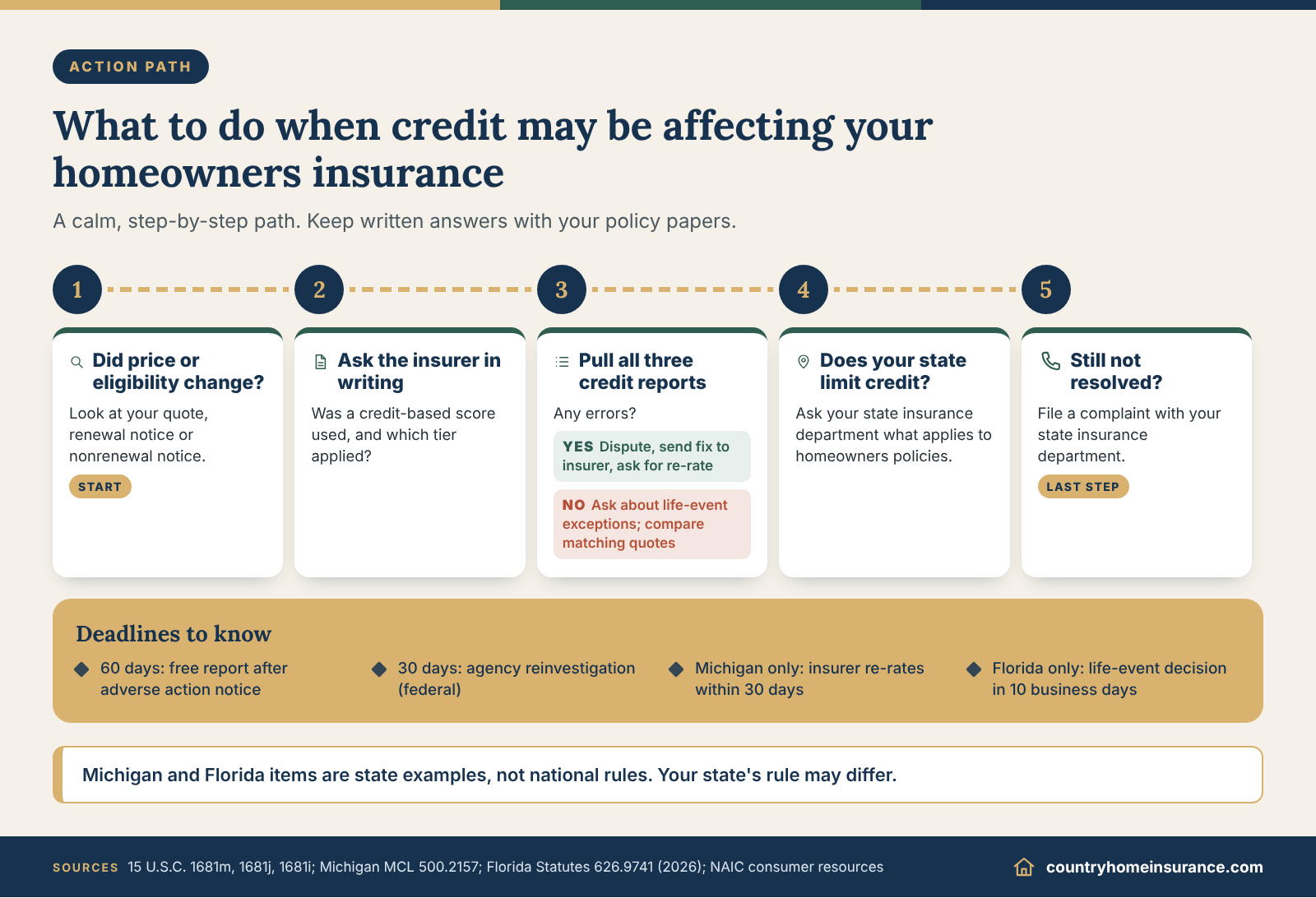
| Step | Timing or deadline | Source | What you do |
|---|---|---|---|
| Receive adverse action notice | When an insurer takes adverse action based in whole or part on a report | 15 U.S.C. 1681m | Note the agency named and the reasons given; keep the notice. |
| Request a free report after the notice | Request within 60 days of the notice | 15 U.S.C. 1681j | Contact the agency named in the notice. |
| Request your annual free report | Once in any 12-month period from nationwide agencies | 15 U.S.C. 1681j; NAIC points to annualcreditreport.com | Check all three agencies for errors. |
| Dispute an inaccurate item | Agency generally reinvestigates within 30 days | 15 U.S.C. 1681i | Dispute in writing; include evidence; keep proof of delivery. |
| Ask the insurer to re-rate | Michigan example: insurer reevaluates within 30 days of notice of the correction | MCL 500.2157 (Michigan only) | Send the corrected report and ask for a written re-rate decision. |
| Request an extraordinary-life-event review | Florida example: insurer decides within 10 business days after request and documents | Fla. Stat. 626.9741 (Florida only) | Ask whether your state offers one; supply documents. |
Deductibles, discounts and replacement cost: the levers that sit beside credit
If credit is working against you, or you simply want to know what else you can change, the rest of the policy is the next place to look. The aim is not to chase the lowest price at any cost. It is to compare complete coverage and decide which trade-offs fit your savings and your risk.
Coverage choices that change price and protection
Deductible mechanics
A deductible is the portion of a covered loss that you pay before the insurer pays. The NAIC says the lower the deductible, the higher the premium, and that a deductible generally applies per claim to the home and personal property. Some areas use catastrophe deductibles expressed as a percentage rather than a dollar amount, so ask whether your policy has a separate wind, hail or hurricane deductible and how it is calculated. The NAIC consumer guide advises choosing a deductible you can afford if you have a loss.
A higher deductible also changes how you use the policy. It can make small repairs a matter for your own savings and leave insurance for larger losses. That is a reasonable approach for some households and a bad fit for others who have little cash reserve.
Hypothetical example: deductible and payout
Hypothetical example, not a quote or a promise of payment: Imagine a covered wind loss with repair costs of $9,000. With a $1,000 deductible, the policy might pay up to $8,000, subject to its terms and limits. With a $2,500 deductible, it might pay up to $6,500. The higher deductible could lower the premium, but the homeowner would carry $1,500 more of this loss. Whether the premium savings justify that trade depends on how many years it would take to recoup the extra $1,500 and whether the homeowner could pay it from savings on short notice.
Do not underinsure the dwelling to chase a lower premium
It can be tempting to cut dwelling coverage to offset a higher credit-tier price. The NAIC says dwelling coverage should be enough to fully rebuild the home. Its consumer guide also says that if the limit falls below a threshold such as 80 percent of replacement cost, an insurer may reduce claim payments. Policies may settle losses on a replacement cost value (RCV) basis, which pays to rebuild or repair, or on an actual cash value (ACV) basis, which accounts for depreciation, so check how your loss settlement works on the declarations page before you change a limit.
Discounts that do not depend on credit
Devices, bundling and tenure
The NAIC consumer guide lists insurer discounts for buying auto coverage from the same company, protective devices such as smoke detectors, burglar alarms, sprinklers and deadbolts, and updated electrical or plumbing systems. It also notes that how long you have been with an insurer is a rating factor. Which discounts exist, how large they are and whether they stack varies by insurer and state, so do not assume any figure without seeing it in a quote.
Roof and hardening upgrades
The NAIC guide mentions discounts for a new roof and for disaster-proofing such as storm shutters. On a country home, the roof is often the largest exterior component and also a primary rating input; the Texas Department of Insurance lists roof age and material among its home rating factors. If a replacement roof is on your schedule, get written confirmation from your insurer of what documentation it wants and whether the discount applies before you pay a contractor.
Asking for every discount in writing
NAIC materials recommend asking about discounts at every renewal and comparing total cost after discounts. Do that by asking your agent for a list of available discounts and which ones are on your quote, then asking again after any home improvement. Some wood-burning heat sources, pools and trampolines can raise rather than lower cost, so disclose them accurately. Honest answers keep a quote aligned with the policy you will actually be sold.
A practical plan: check your credit, shop with matching coverage and respond to changes
You cannot control how every insurer weighs credit, but you can control the order in which you do things. The plan below puts the credit work first because errors and old information are the easiest items to fix, then moves to shopping and to what to do when a price or notice surprises you.
Before you shop or renew
Pull your reports and read them line by line
Get free copies of your reports from all three nationwide agencies and compare them. Check names, addresses, account balances, payment histories and any accounts you do not recognize. If you share finances with a spouse or a family business, confirm which accounts belong in your file. The goal is not to chase a perfect file but to be sure the information is accurate, since errors and outdated data can affect insurance outcomes, as the NAIC points out.
Fix what is wrong and keep proof
File disputes in writing for errors, attach evidence and track the 30-day reinvestigation window. After the agency confirms a correction, send it to your insurer or agent. The NAIC also recommends paying bills on time, catching up if you have fallen behind and keeping credit card balances low, which are slow remedies but sound ones.
Tell your agent about major life events and think about credit freezes
The NAIC’s consumer resource suggests telling your agent about major events such as divorce, job loss or serious illness that may have affected your credit. If you have a credit freeze in place, it also suggests temporarily lifting it when you apply, because insurers cannot see a frozen report and may charge more. Ask the insurer which agency it uses so you lift the freeze at the right one, then restore it afterward.
While you shop
Build an apples-to-apples comparison
Ask every insurer to quote the same dwelling limit, the same deductibles, the same endorsements and the same loss settlement basis. The NAIC advises getting quotes for the same coverages in writing, confirming the company and agent are licensed and checking financial strength and complaint information. Without matching coverage, a lower quote may only reflect a higher deductible or fewer protections.
Questions that surface credit’s role
Ask each insurer whether it uses a credit-based insurance score in your state, which tier you were placed in, whether it will re-score during the policy term and what its process is for errors and life events. Ask what happens if you change your answers or your credit changes mid-term. Write down the name of the person who answered and the date.
Understand credit inquiries and quote shopping
Many people worry that getting several quotes will hurt their credit. Rules differ by state and by how an insurer pulls the data, so ask. Florida’s statute, for example, says consumer-initiated inquiries and insurance-coverage inquiries that are identified as such may not be used against you. Other states may not say the same, so confirm with the insurer or the state insurance department rather than assuming.
After a quote, renewal notice or nonrenewal
When the renewal price jumps
Start by comparing the new declarations page to the old one for changes in dwelling limit, deductible, endorsements and discounts. Then ask whether credit, claims history, a change in your area’s rating or an inspection drove the change. Because NAIC materials identify weather losses, construction and repair costs and reinsurance costs as drivers of rising premiums, a jump does not by itself prove a credit problem.
When you think a rule was broken
Try to resolve the issue with the insurer first, then contact your state department of insurance. The NAIC’s complaint guidance suggests gathering your policy number, bills and records, keeping a log of communications, writing a factual timeline and stating the outcome you want. The department forwards the complaint to the insurer, which must respond, and insurers cannot retaliate for a filing. The NAIC’s how-to-file-a-complaint page explains the steps.
| Action | What to verify or collect | Ask the insurer or agent |
|---|---|---|
| Review credit reports at all three agencies | Account balances, late payments, unfamiliar accounts, old items | Which agency and score model do you use? |
| Dispute errors in writing | Dated letters, evidence, proof of delivery, outcome letters | Will you re-score after a correction, and how fast? |
| Confirm your state’s rule | State insurance department answer or statute reference | What state rule governs your use of credit for homeowners? |
| Match coverage on every quote | Dwelling limit, deductibles (including wind or hail), loss settlement basis, endorsements | Is this quote on the same coverage as my current policy? |
| Ask for the tier and the reasons | Written explanation of any adverse action or tier placement | Which factors, including credit, drove this price? |
| List discounts and offsets | Devices, bundling, roof, tenure, deductible options | Which discounts did I receive and which could I add? |
| Document life events | Divorce, job loss, medical events, identity theft, with supporting papers | Do you offer an extraordinary-life-event review? |
Frequently asked questions
Credit, pricing and eligibility questions
Is a credit-based insurance score the same as my FICO score?
No. The NAIC says an insurance score is based partly or entirely on credit history but is designed to estimate how likely you are to file an insurance claim, not how likely you are to repay a loan. It can weigh credit factors differently from a lending score, and different scoring companies and insurers use different models. A strong score from your bank or a free monitoring app is a hint about your credit health, not a prediction of the tier an insurer will assign.
Will improving my credit lower my homeowners premium?
It may, in a state that allows credit use and with an insurer that gives credit meaningful weight, but no source reviewed for this article supports a specific dollar saving. Premiums also move with construction costs, weather losses and your insurer’s filed rates. The most sensible approach is to fix reporting errors, keep accounts current, then ask your insurer in writing how and when it re-scores. Where the state requires periodic recalculation, such as Florida’s two-year review of adversely affected insureds or the three-year periods the NAIC chart lists for many states, you may not need to wait for a full policy replacement to get a fresh look.
Can an insurer cancel or nonrenew my policy because of my credit?
It depends on your state. The NAIC says that in most states insurers cannot rely solely on these scores to deny, cancel or refuse to renew coverage. Maryland goes further and prohibits using credit history for those decisions on homeowners policies. Florida’s statute says a credit review of an existing insured cannot be used to cancel or refuse to renew. If you receive a notice that cites credit, ask for the specific reasons in writing and then check your state’s rule with the state Department of Insurance.
Does my credit affect how a claim is paid?
The NAIC describes these scores as tools for underwriting and rating, meaning eligibility and price. How a claim is paid depends on the policy, the cause of loss, the limits, the deductible and the loss settlement terms, none of which are described in the NAIC materials as depending on the insurance score. If an insurer ever tells you otherwise, ask it to identify the policy provision or state rule it is relying on.
Rights, reports and next-step questions
Does checking my own credit report lower my insurance score?
The NAIC’s consumer article says the insurance score does not count certain kinds of inquiries, such as account reviews and employment checks. Florida’s statute likewise says consumer-initiated inquiries may not be used. Checking your own report through annualcreditreport.com, which the NAIC recommends, is the standard way to find errors. Rules in other states vary, and no source retrieved for this article addressed inquiries in every state, so ask if you are unsure.
Do I have to agree to a credit check to get a quote?
Insurers commonly ask for permission or a Social Security number to access a credit report, as the NAIC consumer guide notes, and some state rules require disclosure that a report is being requested. This article could not verify whether declining is allowed or what it does to a quote in every state. Ask the agent what happens if you decline, whether a quote is still available and whether the company will explain how a missing score is treated.
Who do I contact if I think the rules were not followed?
Start with the insurer in writing. If that does not resolve it, your state Department of Insurance handles complaints and can tell you what your state requires. The NAIC’s directory of state insurance departments at content.naic.org/state-insurance-departments lets you find yours. Include your policy number, a timeline and copies of notices and replies. For problems with the credit report itself, dispute directly with the consumer reporting agency under the process described above.
What if my credit was damaged by a hardship we did not control?
Ask whether your state or insurer has an extraordinary life event exception. The NAIC’s consumer article says many insurers will reconsider a premium after an extraordinary event, such as a catastrophic loss, job loss or serious illness. Florida’s statute spells out an appeal for divorce, death of a spouse or temporary job loss, and Alaska’s guide says consumers can request an exception for extraordinary life circumstances. Other states do not list a provision in the NAIC chart, so ask in writing and attach documents.
Sources
- NAIC: Credit-Based Insurance Scores (page last updated 2026-03-19; retrieved 2026-10-11)
- NAIC: Use of Credit Reports/Scoring in Underwriting state chart (Summer 2025; retrieved 2026-10-11)
- NAIC Consumer Insight: Credit-Based Insurance Scores Aren’t the Same as a Credit Score (2020-07-22; older source)
- NAIC: A Consumer’s Guide to Home Insurance (2022 edition)
- NAIC: Regulator Resources for Consumers on Personal Lines Pricing and Underwriting (2022 copyright)
- NAIC: Why are my insurance premiums increasing? (2024-11-19)
- NAIC: Homeowners Insurance topic page (updated 2025-10-25)
- NAIC: How to file a complaint (undated)
- NAIC: State insurance department directory (undated)
- NAIC: Third-Party Data and Models (H) Working Group (retrieved 2026-10-11)
- Maryland Insurance Article Section 27-501
- Florida Statutes Section 626.9741 (2026)
- Washington Office of the Insurance Commissioner: Homeowner Insurance Guide (Rev. 3/26)
- Alaska Division of Insurance: Homeowners Insurance Guide (revised October 2021; older source)
- Texas Department of Insurance: How are your auto and homeowners insurance costs calculated? (updated 2026-09-01)
- Michigan Compiled Laws Section 500.2157
- Massachusetts General Laws Chapter 175, Section 4E
- 15 U.S.C. Section 1681m, adverse action notices
- 15 U.S.C. Section 1681j, free consumer report disclosures
- 15 U.S.C. Section 1681i, disputed information
- NerdWallet: Average homeowners insurance cost (updated 2026-05-06; consumer publisher, context only)
- MoneyGeek: What factors affect homeowners insurance rates (updated 2026-10-01 per byline; consumer publisher, context only)
- Insurify: Average cost of homeowners insurance (updated 2026-09-30; consumer publisher, context only)
Important coverage note
Coverage and pricing depend on your actual policy, endorsements, exclusions, limits, deductible and the cause of loss. Your declarations page lists the coverages, limits and deductibles that apply to you, and your policy form and endorsements control what is covered. State laws and insurance programs vary, including the rules on credit-based insurance scores described here, and they can change. Verify case-specific questions with your insurer or agent and with your state Department of Insurance. This article is educational information, not legal advice, and it does not guarantee any price, eligibility decision or claim payment.
About the editorial team
This guide was prepared by the countryhomeinsurance.com editorial team as general, educational information for homeowners. We research and summarize publicly available material, including state insurance departments, the NAIC, federal agencies, regulators’ consumer guides and published insurer and industry resources. We draw only on the sources that were available to us when we wrote this guide, and we list them in the Sources section with dates where we could find them.
Insurance rules, rates, products and program terms change, differ by state and by insurer, and can apply differently to your situation. We cannot guarantee that this content is complete, current or free of errors. It is not legal, financial, tax or insurance advice, it is not an offer to sell insurance or a recommendation of any insurer, agent or product, and reading it does not create a professional relationship of any kind.
To the fullest extent permitted by law, countryhomeinsurance.com and its editorial team, authors and contributors exclude all liability for any loss, damage or decision arising from the use of, or reliance on, this content. For questions about your own policy or claim, contact your insurer, a licensed agent or broker, your state Department of Insurance or another qualified professional.
Content created: October 11, 2026