To compare homeowners insurance quotes fairly, first write down one coverage specification (dwelling limit, other structures, belongings, liability, deductibles, loss-settlement basis and endorsements) and ask every insurer to quote exactly that. Then line up whatever still differs, especially roof terms, wind or hail deductibles and water-backup limits, and check each company’s financial strength, complaint record and license. Price only means something when the protection behind it is the same. Rules and products vary by state and insurer, so confirm everything against the actual quote documents.
Key takeaways
- Quote the same specification everywhere. NAIC’s consumer guide calls it crucial to ask every company for the same coverages and limits, and to give each one the same facts about the home.
- The premium is the last number to judge. Compare limits, deductibles and the way losses are settled first, because those decide what a claim actually pays.
- Percentage deductibles, separate wind or hail deductibles and age-based roof payments are the most common places where a cheap quote hides a thinner policy.
- Endorsements (water backup, ordinance or law, scheduled valuables) and separate policies (flood, earthquake, umbrella) should be priced on the same footing or noted as missing.
- Check the company, not just the quote: licensing, independent financial-strength ratings and complaint records from state regulators tell you things price cannot.
- Keep a written worksheet, ask for revised quotes when something does not line up, and verify the final declarations page before you cancel the old policy.
| What to match | Where to find it on a quote or declarations page | Why a mismatch distorts the comparison |
|---|---|---|
| Dwelling limit and valuation basis | Coverage A limit; wording such as replacement cost, actual cash value, extended or guaranteed replacement cost | A lower limit or a depreciation-based basis lowers the premium and also lowers what a loss may pay |
| Other structures, belongings, loss of use | Coverage B, C and D limits, often shown as a percentage of the dwelling limit | Limits that move with the dwelling limit can differ even when the dwelling number looks the same |
| Liability and medical payments | Coverage E and F limits | Higher limits cost more, and a quote with lower limits is not directly comparable |
| Deductibles | All-other-perils deductible, plus any percentage, wind or hail, hurricane or roof deductible | A low premium can pair with a large separate deductible that applies to the most likely claim |
| Roof terms | Roof age and material fields, roof payment schedule, roof endorsement, cosmetic damage wording | Two quotes can price the same roof but pay differently when it is damaged |
| Endorsements and sublimits | Endorsement list, sublimits for backup, jewelry, firearms, equipment breakdown | An included endorsement is worth money; a missing one is a gap you may need to price separately |
| Insurer and producer | Legal company name, license status, financial-strength ratings, complaint data | Claims-paying ability and service are not visible in the premium |
| Premium and conditions | Annual premium, payment plan fees, discounts applied, inspection or underwriting conditions | A quote can change if a discount or assumption does not hold up |
What does it mean to compare homeowners insurance quotes apples to apples?
A quote is a price attached to a particular bundle of promises. When you set two quotes side by side and the numbers differ by a few hundred dollars, the first question isn’t which company is cheaper. It’s whether the two bundles are actually the same. This guide stays focused on that one job: lining up limits, deductibles, endorsements, loss-settlement terms, financial strength and complaint records so the price comparison is honest. It doesn’t repeat the full purchase process, which is covered in our guide to buying a policy, or the question of how many quotes to collect, which has its own article.
Why can two quotes for the same house describe two different products?
Insurers build quotes from their own rating models, their own policy forms and their own underwriting rules. Three things therefore move at once: the coverage terms, the risk assumptions about your home, and the price. Treating a quote as just a price skips the first two.
Price is the output, not the product
The premium you see is the result of a calculation that starts with coverage choices. Raise the dwelling limit, add an endorsement or lower a deductible, and the premium usually moves with it. NAIC’s homeowners insurance consumer page notes, for example, that a higher deductible generally lowers the premium. Any comparison that ignores those levers is really comparing three different experiments.
Why insurers can price the same home differently
The U.S. Government Accountability Office, in its 2026 report GAO-26-107867 (premium data 2019 to 2024), found that insurers weigh rating factors differently, so the same home can receive different premiums. It illustrates the point with a California example in which two insurers produced premiums of roughly $439 and $162 for a 20-year-old home. That figure is an illustration of modeling differences, not a prediction for your property, and GAO did not set out to analyze how consumers compare coverage terms. The practical takeaway is that a large gap between quotes can come from model differences, from coverage differences, or from both.
What a quote is, and what it is not
NAIC’s 2014 shopping tool, still hosted by at least two state insurance departments, describes a quote as an estimate of the premium for specific coverage with a specific insurer, and it cautions that rebuild-cost estimates are not guarantees. A quote usually isn’t a binder (a short-term agreement that provides temporary coverage until the policy is issued, as California’s Department of Insurance describes it in its consumer guide) and it isn’t the policy. Underwriting can still change the offer once the insurer verifies your roof, your claims history or your answers.
How do you build a baseline before you collect any quote?
The most useful hour in the whole process is the one you spend before contacting anyone. A baseline is a short written specification that you hand, unchanged, to every agent or insurer.
Decide your coverages and limits first
NAIC’s 2022 consumer guide to home insurance and the Alabama Department of Insurance’s smart-shopping page both start the same way: decide what coverage you want before you ask for prices. Write down the dwelling limit, the valuation basis you want, the deductible you can comfortably pay, liability and medical-payments limits, and any endorsements or separate policies you intend to price. If you’re unsure how much dwelling coverage to carry, work that out first using our guide on how much homeowners insurance you need.
Give every producer the same facts about the home
The Alabama Department of Insurance lists what each producer should receive: a description of the house, the distance to the nearest fire department and fire hydrant, square footage, security devices, a photo, and the coverages and limits you want. NAIC’s shopping tool adds details that matter on country properties, including roof type and age, the age of plumbing, electrical and heating systems, whether you have a septic system, well or sump pump, wood stoves or fireplaces, any home-based business, and any pool, trampoline or dogs. Leaving one of those out for one insurer and including it for another is a classic way to create a false price gap.
Get quotes in writing and keep a log
NAIC’s consumer guide advises getting rate quotes and key information in writing. A simple log helps: date, person you spoke with, the exact limits and deductibles quoted, which discounts were assumed, and any condition such as an inspection. When a phone quote and an emailed quote disagree, the log tells you which one to question.
Which coverage limits must match before the premiums mean anything?
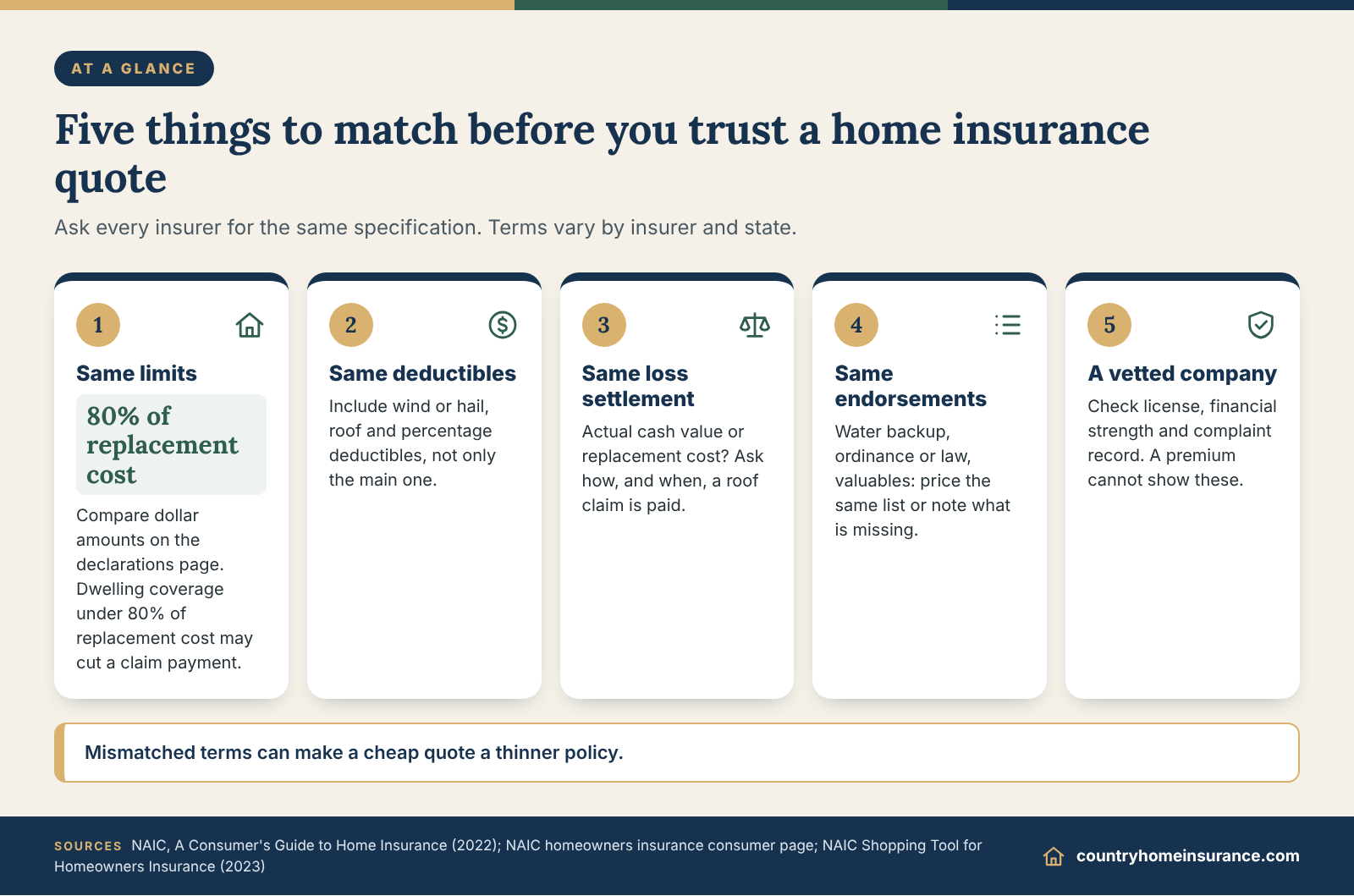
Limits are the ceiling on what the policy pays for each category of loss. Two quotes can show the same dwelling number and still differ in the supporting limits, so the declarations page deserves line-by-line attention. For definitions of Coverage A through F, the NAIC consumer page describes the same components in plain language: damage to the house, other structures, personal property, additional living expense, personal liability and medical expense.
How should you set and match the dwelling limit?
The dwelling limit, called Coverage A, is the most the policy pays to repair or rebuild the house itself. It is also the number most other limits key off, which makes a mismatch here ripple through the whole quote.
Base it on rebuild cost, not purchase price
NAIC’s shopping tool, in the 2014 edition hosted by the Colorado Division of Insurance and the Mississippi Insurance Department, says to set the limit from the estimated cost to rebuild rather than the purchase price or market value, and notes that lenders typically require at least enough to pay off the loan. It suggests asking a local builder or real estate agent for the average new-construction cost per square foot, and notes that an agent can also estimate the figure from your answers. The point for comparing quotes is simple: if one insurer’s estimator lands at a materially different rebuild figure than another’s, ask each to explain its inputs rather than quietly accepting the lower, cheaper-looking number.
Why rural rebuild cost deserves a second look
This paragraph is our own reasoning rather than a sourced statistic. On an acreage with a long private drive, a distant supplier base or a custom build, an online estimator that assumes ordinary suburban conditions may understate what a contractor would charge to rebuild. If the estimate seems low, ask for a local contractor’s opinion and tell every insurer the same thing about access and finishes so the estimates stay comparable.
What the 80% threshold can do to a partial claim
NAIC’s consumer guide warns that if dwelling coverage falls below 80% of the home’s full replacement cost, the insurer may reduce what it pays on a claim, and the consumer page advises insuring for at least 80% of replacement value. Under-insuring to win on price can therefore cost more than it saves. Policy language controls how any reduction is calculated, so ask each insurer to show you the wording and, if you can, a worked example using your own numbers.
How do other structures, belongings and loss of use compare across quotes?
These coverages are often set automatically as a share of the dwelling limit, so the best way to compare them is to read the dollar amounts, not the percentages.
Typical percentage relationships, and why to read the dollars
NAIC’s consumer guide lists typical limits as 10% of the dwelling limit for other structures, 50% for personal property and 20% for loss of use, and states that individual policies may use different percentages. If Quote A carries a $300,000 dwelling limit and Quote B carries $270,000, the supporting limits shrink in step. Hypothetical example: at 10%, other structures would be $30,000 on one and $27,000 on the other, a difference that has nothing to do with the insurer’s pricing. Always compare the dollar amounts printed on the declarations page.
Barns, sheds, fences and detached garages
Other structures (Coverage B) is where detached garages, sheds and fencing sit, according to NAIC’s consumer page. A country property with a workshop, a hay barn, a run-in shed and several hundred feet of fence can exceed a percentage-based limit quickly. Ask whether the limit can be raised, whether any structure is excluded or limited because of how it is used (for example, business or farming use), and whether the same answer holds at every insurer. Our rural guides go deeper on outbuildings and acreage.
Additional living expense and loss of use
NAIC describes additional living expense as the cost of maintaining your normal standard of living while the home can’t be lived in. The thing to compare is not only the dollar figure but also whether there’s a time limit, and how far you would have to travel for temporary housing in a thinly populated area. California’s consumer guide, which is dated 2016 and specific to that state, makes a practical point worth borrowing: keep receipts for additional living expenses.
How much liability and medical payments protection does each quote offer?
Liability (Coverage E) and medical payments to others (Coverage F) don’t depend on the value of your house, which is why they are easy to overlook when comparing.
Liability and medical payments are choices, not defaults
NAIC’s consumer guide says you choose your liability and medical-payments limits. NAIC’s sample declarations page shows personal liability of $300,000 and medical payments of $1,000, but that is an illustrative sample, not a recommendation. Make sure each quote lists the same figures, because a quote that quietly defaults to lower liability limits will look cheaper.
Pricing an umbrella policy separately
NAIC’s shopping tool lists umbrella liability among the separate policies to quote and describes it as typically starting at $1 million or more of coverage. Umbrella policies usually sit on top of underlying liability limits, so when you compare quotes, ask whether your chosen home liability limit meets any underlying requirement. Pricing the umbrella from the same company as the home policy may change what the bundle costs.
Features that prompt liability questions
NAIC’s information checklist asks about pools, trampolines, playscapes, dogs and their breeds, and home-based businesses. Those are the facts insurers use to decide eligibility and price. Out here, we’d add ponds, livestock, off-road vehicles and visitors on acreage as topics to raise directly. That addition is our judgment, not a sourced list, and the practical test is the same: tell every insurer the same thing and ask in writing what is limited or excluded.
How do deductibles change what you will really pay after a loss?
A deductible is the amount you pay out of pocket before the insurer pays, applied per claim. NAIC’s consumer page notes that it applies to the house and personal property coverages, and that a higher deductible generally lowers the premium. That relationship is exactly why deductibles must be identical, or priced at the same alternatives, across quotes. A policy with a $500 deductible and a policy with a 2% deductible are different financial products even if they carry the same name.
Which deductible structures should you identify on every quote?
Most declarations pages show a main deductible and then, sometimes in smaller type, one or more special ones. The special ones are the ones that bite.
Flat-dollar deductibles
A flat deductible is a fixed amount, such as the $500 shown for “other losses” on NAIC’s illustrative sample declarations page. It’s the easiest to compare because the same dollar figure applies no matter how large the loss is. When you request quotes, ask for the same flat amount from every insurer, and ask each one for the premium at two or three alternative amounts so you can see what a higher figure would save.
Percentage deductibles
NAIC’s consumer guide explains that some areas have catastrophe deductibles expressed as a percentage rather than a dollar amount, and NAIC’s sample declarations page shows 10% deductibles for hurricane or wind and for earthquake alongside a $500 deductible for other losses. The 2014 NAIC shopping tool tells shoppers to ask whether a deductible is a flat amount, a percentage of coverage or damage, or both. Always find out what the percentage is applied to. Hypothetical example: a 2% deductible applied to a $300,000 dwelling limit is $6,000, compared with $1,000 for a flat deductible. That is an illustration of the arithmetic, not a typical rate.
Wind, hail and roof deductibles
The Texas Department of Insurance, in a March 2026 consumer column, says wind and hail deductibles are often higher than the deductibles for other kinds of damage. The GAO report mentions another variation: insurers may require a split deductible, meaning a separate deductible for roof damage. Texas rules are not national rules, but the pattern of special deductibles for wind, hail and roofs is a good reason to read every deductible line on a quote and to compare the wind or hail deductible against your other deductibles, as TDI advises.
How do you weigh premium savings against the cash you would need on a bad day?
The right deductible is one you could pay without borrowing at a bad rate or skipping a repair. NAIC puts it plainly: choose a deductible you can afford.
What a higher deductible buys
It buys a lower premium and nothing else. It does not improve coverage, it does not reduce the number of claims you might file, and it increases your share of every claim the deductible applies to. NAIC’s shopping tool encourages you to ask how much you could save by raising the deductible, so make that a standard request: have each insurer quote the same policy at two deductible levels.
Testing the trade with simple arithmetic
Hypothetical example, not a quote: suppose raising a deductible from $1,000 to $2,500 lowers the annual premium by $120. You would take on $1,500 of extra risk per claim to save $120 per year, which means about twelve and a half claim-free years to break even on a single claim. If that math feels uncomfortable, a smaller deductible might be the better value for you. If you keep an emergency fund and rarely claim, the higher deductible could reasonably win. Your numbers will differ.
Per-claim and per-event questions
NAIC’s shopping tool lists “number of deductibles” among the claim-related questions to ask. On a property with a house, a barn and a shop, a single windstorm can damage several buildings at once. We’d ask each insurer, in writing, whether one storm event produces one deductible or several, and whether the answer is the same for the dwelling and for other structures. Policy language, not the sales conversation, decides it.
| Deductible type | How it typically works | What to ask each insurer | Illustration (hypothetical or NAIC sample, not a quote) |
|---|---|---|---|
| Flat dollar (all other perils) | A fixed amount you pay on each covered claim before the insurer pays | Which amounts are available, and what is the premium at each? | NAIC sample declarations page: $500 for other losses |
| Percentage of dwelling limit | A percentage of the coverage amount, so the dollar figure rises with the dwelling limit | Percentage of what, and does the dwelling limit used include any extended replacement amount? | Hypothetical: 2% of a $300,000 dwelling limit equals $6,000 |
| Wind or hail deductible | A separate amount or percentage for wind or hail losses, often higher than the standard deductible per TDI (2026) | Is it flat or percentage? Does it apply to roof claims and to other structures? | Hypothetical: $1,000 standard deductible but $3,000 for wind or hail |
| Roof-specific (split) deductible | GAO notes insurers may require a separate deductible for roof damage | Does it replace or add to the wind or hail deductible, and does it change as the roof ages? | Illustrative only: ask for the declarations language |
| Hurricane or named-storm deductible | Often shown as a percentage of the dwelling limit in areas with catastrophe deductibles (NAIC) | What triggers it, and does it replace the wind or hail deductible? | NAIC sample declarations page: 10% for hurricane or wind |
How do loss-settlement terms and roof provisions change what a claim pays?
Loss settlement is the policy’s rule for how much it pays to repair or replace damaged property. It is the single quietest difference between quotes. Two policies with the same dwelling limit and the same deductible can pay very different amounts on the same hail-damaged roof if one settles at replacement cost and the other at depreciated value.
What are the levels of replacement cost, from actual cash value up to guaranteed?
NAIC’s shopping tool lays out a ladder of dwelling-valuation options. Knowing the rungs lets you decode the shorthand on a quote.
Actual cash value and replacement cost in plain terms
NAIC’s explainer on actual cash value and replacement cost, published in 2025, says actual cash value (ACV) subtracts depreciation for age and wear, and often doesn’t pay enough to fully replace the property. Replacement cost value (RCV) covers repair or replacement with materials of similar kind and quality, without subtracting depreciation. Under either basis the deductible still reduces the payment, and neither is the same as market value, which includes land.
Functional, extended and guaranteed replacement cost
Between the two basic bases NAIC identifies functional RCV (replacing with similar function, for example drywall in place of plaster), extended replacement cost (coverage above the dwelling limit up to a set percentage or amount) and guaranteed replacement cost, which NAIC says is rarely offered and may come with caps. California’s consumer guide adds a useful warning: only a policy that pays to fully rebuild regardless of the limit should be called guaranteed. Ask each insurer to name the exact basis in the quote and to say what the extra percentage, if any, is.
When the replacement-cost money actually arrives
NAIC’s 2014 shopping tool says many policies pay only actual cash value until repairs begin or are completed, and tells shoppers to ask whether the full replacement amount is paid upfront or later. NAIC’s shopping tool also notes that some RCV policies pay only ACV until an item is actually replaced. Compare the payment timing, not only the label “replacement cost.” If you’d have to finance a rebuild between the first and second payment, that is a real cost of the policy.
What should you compare about roof coverage?
Roofs absorb most hail and wind damage, and insurers know it, so roof terms are where many policies differ the most.
Age-based or condition-based roof payments
TDI’s March 2026 column says some policies pay the full cost of a new roof while others pay less based on the roof’s age and condition, and that many policies reduce roof payouts by age and materials. GAO also reports that insurers may cover the depreciated value of older roofs rather than the total replacement cost, and that one insurer described offering a discount to policyholders who accept a lower payment on roof claims in high-hail areas. NAIC separately highlights full replacement cost on the roof, without a depreciation deduction, as something to ask about. Put the question to each insurer in the same words: “If hail damages my roof, how is the payment calculated?”
Partial repairs and shingles that do not match
TDI notes that an insurer may not replace the whole roof even when new shingles won’t match the old ones. Ask how a partial repair would be handled and whether the insurer would replace the whole roof, as TDI suggests. If the answer is “it depends,” ask which wording of the policy controls, and compare that language across quotes.
Keeping the roof facts accurate
TDI advises confirming the roof age and material shown on your policy and telling the insurer when you replace the roof so the record is updated. It also suggests asking whether coverage can be restored after repair or replacement if the roof was in poor condition, and asking about discounts for new roofs or wind-, hail- or fire-resistant materials. Wrong roof data can quietly inflate or deflate one quote against another.
How do belongings and valuables settle across quotes?
Contents coverage follows its own rules, and the differences between policy forms are easy to miss on a summary page.
Actual cash value versus replacement cost on contents
NAIC’s shopping tool describes the common HO-3 form as paying replacement cost for the home but actual cash value for contents, while the HO-5 form generally pays replacement cost for both and usually costs the most. NAIC’s consumer guide lists a personal property replacement cost endorsement among the optional coverages. If one quote includes that endorsement and another doesn’t, you aren’t comparing the same contents coverage.
Sublimits for jewelry, firearms and collectibles
The shopping tool refers to specific dollar sublimits (internal caps) for valuables such as jewelry and firearms, and its sample declarations page shows $5,000 each for jewelry and furs as an illustration. NAIC’s consumer guide also describes scheduled personal property endorsements (sometimes called a personal article floater) for items such as jewelry, furs, coins and antiques. Check the sublimits against what you own, and ask whether an appraisal is needed to schedule an item.
Using an inventory to test the contents limit
NAIC offers a Home Inventory app that lets you photograph items, sort them by room and export the list. NAIC says an accurate inventory gives the carrier the information it needs to settle claims. It also gives you a number to test against the contents limit on each quote, so you aren’t relying on a default percentage.
| Basis | What it generally pays (per NAIC descriptions) | Questions to ask | Price and protection direction |
|---|---|---|---|
| Actual cash value (ACV) | Value after subtracting depreciation for age and wear | How is depreciation calculated, and does it apply to the roof? | Typically lower premium, with more risk of a payment gap |
| Functional replacement cost | Replacement with similar function, such as drywall instead of plaster | Which materials are replaced with functional equivalents in an older home? | Between ACV and full RCV |
| Replacement cost value (RCV) | Repair or replacement with similar kind and quality, without depreciation | Is full payment upfront, or ACV first and the rest after repair? | More protection, usually higher premium |
| Extended replacement cost | Coverage above the dwelling limit up to a stated percentage or dollar amount | What is the percentage or cap, and does it apply to every loss? | Adds a cushion if rebuild costs exceed the limit |
| Guaranteed replacement cost | Pays the cost to rebuild even above the limit; NAIC says it is rarely offered and may be capped | Is it capped, and what conditions does the insurer attach? | Broadest protection and often the least available |
Which endorsements and separate policies belong on the same footing?
An endorsement (sometimes called a rider) is a written change that adds, removes or modifies coverage in the base policy. Quote requests often leave endorsements to the agent’s discretion, which means one quote may include protections that another omits. A fair comparison either puts the same endorsements on every quote or records exactly which ones are missing.
How do water-backup and equipment endorsements compare across quotes?
Some of the most expensive surprises in homeownership are non-sudden, indoor water events and failed mechanical systems. The base policy may treat them narrowly, so the endorsements matter.
Sewer, drain and sump pump backup
NAIC’s consumer guide lists sewer or drain backup and sump pump overflow among the endorsements, and notes that coverage for these is limited or absent unless added. NAIC’s sample declarations page shows sewer and water backup at $10,000 with a $500 deductible, which is an illustration of how this coverage can carry its own limit and deductible, not a standard. For a home with a septic system, a sump pump or a basement, compare the backup limit, the separate deductible, and any conditions. Our detailed guides explain the covered and excluded scenarios.
Equipment breakdown and other optional coverages
NAIC’s shopping tool lists equipment breakdown, art and collectibles, and ordinance or law on its optional-coverage checklist. It also lists questions about whether the policy addresses sinkholes, mine subsidence, power-outage food spoilage and deterioration. You don’t need every one of these, and the relevance depends on where you live and what you own. What matters for a comparison is that you ask the same list of every insurer and write down the answers.
Sublimits and separate deductibles on each add-on
For every endorsement a quote includes, record three things: the limit, any separate deductible and any condition that must be met. Two quotes that both say “water backup included” can differ substantially in limit. Without that detail the checkmark on a comparison sheet is misleading.
What about building-code, inflation and claim-handling provisions?
These provisions sit in the background until a major loss, which is exactly when you can’t renegotiate them.
Ordinance or law coverage
NAIC’s 2014 shopping tool says ordinance or law coverage pays the extra cost to rebuild to meet new or updated building codes, and California’s consumer guide warns that some policies don’t include it. NAIC’s sample declarations page shows it at 10% of the dwelling coverage as an illustration. Older homes are the obvious candidates for code-related costs after a major loss, so ask each insurer whether it is included, what the limit is and whether it can be increased by endorsement.
Inflation guard and rebuild-cost adjustments
NAIC’s consumer guide describes an inflation guard endorsement as one that raises the dwelling limit annually, and the 2014 shopping tool asks whether coverage limits rise with inflation. Rebuild costs can move faster than your renewal paperwork. Compare whether each quote adjusts the limit automatically, whether that adjustment is built in or optional, and whether it carries an extra charge.
Rebuild requirements and preferred contractors
NAIC’s shopping tool poses claim-related questions that can affect the real value of a policy: rebuild requirements, how obsolete materials are handled, when payment is made, and whether the insurer requires you to use preferred contractors. These details rarely appear in a quote summary. Ask for the relevant policy wording in advance, and compare it as carefully as you compare the premium.
Which risks sit outside the homeowners policy, and how do you price them?
Comparing homeowners quotes without comparing the protection around them can leave you with a tidy policy and a large uncovered exposure.
Flood insurance
NAIC says flood isn’t covered by a standard homeowners policy and must be bought separately through the National Flood Insurance Program (NFIP) or a private insurer. FEMA’s FloodSmart buying page says the NFIP works with more than 48 insurance companies and thousands of independent agents, and that its rates don’t vary by insurance provider, so you don’t need to shop among NFIP sellers for a better price. Coverage normally starts 30 days after purchase, with listed exceptions such as a purchase made in connection with originating, increasing, extending or renewing a mortgage. Comparing NFIP quotes is therefore about service and accuracy; comparing a private flood policy against NFIP is a coverage-terms exercise. Our flood guide covers the details.
Earthquake and umbrella liability
NAIC’s consumer guide describes earthquake coverage as a separate policy or endorsement, and says windstorm or hail coverage may require a separate policy in coastal areas. NAIC’s shopping tool also lists earthquake and umbrella among the separate policies to quote. If you want them priced, ask the same agent or company for both so you can see whether bundling changes the combined cost.
Farm, ranch and home-business exposures
NAIC’s consumer page lists home-based business property as a common gap, and its shopping tool asks about home businesses such as daycare. On a country property, a roadside stand, boarding stalls, a hobby flock or a rented-out barn can raise the same question. Whether a homeowners policy, an endorsement or a separate farm or business policy fits is something the insurer must answer in writing. As a rule of thumb from our own analysis, don’t compare a farm package against a homeowners quote line by line; they are different products and need a different worksheet.
| Exposure | In a standard policy? | Where to price or add it | What to compare |
|---|---|---|---|
| Flood | Not covered under standard policies, per NAIC and FEMA | NFIP policy or a private flood policy | Building and contents limits, deductible, waiting period |
| Earthquake | Generally not covered; NAIC lists it as a separate policy or endorsement | Separate policy or endorsement from your insurer | Percentage deductible and what the limit includes |
| Sewer, drain and sump backup | Coverage limited or absent unless added, per NAIC | Endorsement to the homeowners policy | Limit, separate deductible, conditions |
| Building-code upgrades | Depends; some policies don’t include ordinance or law coverage | Ordinance or law coverage or endorsement | Percentage of dwelling limit and whether it can be raised |
| Valuables such as jewelry and firearms | Typically subject to dollar sublimits, per NAIC’s shopping tool | Scheduled personal property endorsement | Per-item and per-category limits, appraisal requirements |
| Home-based business property | A common gap, per NAIC | Endorsement or separate business or farm policy | Which activities and equipment are covered |
| Liability above the base limit | Base limits only; you choose them | Umbrella policy, typically $1 million or more | Underlying limits required and exclusions |
How do you evaluate the company and the producer behind each quote?
A quote tells you what an insurer promises. It doesn’t tell you how well the company is positioned to keep the promise, how it treats customers when a claim is disputed, or whether the person selling the policy is licensed. Those are separate checks, and the information is public.
What do financial-strength ratings tell you, and what do they leave out?
Financial-strength ratings are independent opinions about an insurer’s ability to meet its obligations. They are one input, not a verdict.
Who publishes the ratings
NAIC’s consumer guide names three agencies for checking an insurer’s financial health: Standard & Poor’s, A.M. Best and Moody’s. Each uses its own scale and letter grades, so a letter from one agency doesn’t translate directly to another’s. The A.M. Best guide available to us (hosted by the State of Nevada, version dated 2009, so treat it as old) describes a scale that runs from A++ and A+ at the top, through the B and C grades, to categories for companies under regulatory supervision or in liquidation. Check the agency’s current scale before you rely on any particular letter.
What a rating does not measure
That same 2009 A.M. Best guide describes a financial-strength rating as an independent opinion of an insurer’s ability to meet ongoing insurance obligations. It adds that the rating isn’t assigned to specific policies, doesn’t address claims-payment procedures or claim disputes, and isn’t a recommendation to buy or keep a policy. A strong rating says something about solvency, not about how pleasant a claim will be. That’s why the complaint records in the next subsection matter.
Licensing and guaranty-fund protection
The Alabama Department of Insurance warns that business cards don’t prove that a producer or company is licensed, that unlicensed sellers may not honor coverage, and that companies not legally operating in the state aren’t covered by the state guaranty fund if they fail. New York’s Department of Financial Services offers an Insurance Company Search and a Licensee Search and says license checks apply to online purchases as well. Your own state’s department will have a similar tool, and NAIC’s directory of state insurance departments is the quickest way to find it. If a quote comes from a carrier that isn’t licensed in your state, ask the department how guaranty-fund protection would work before you proceed.
How do you read complaint records without being misled?
Complaint data is useful and easy to misread. A little context goes a long way.
What the complaint index measures
NAIC’s consumer guide describes a complaint index as the number of complaints a state insurance department receives about a company relative to the company’s size. The Kansas Insurance Department’s 2024 complaint index report gives the arithmetic: the index compares the company’s share of complaints with its share of Kansas business, so 1.00 means the two shares are equal and 2.00 means the complaint share is twice the business share. Methodology differs by state, and one state’s report doesn’t describe another’s.
Why small companies and single years can mislead
The Kansas report cautions that a company with a very small market share can show a high index from only a few complaints, and describes the data as a one-year snapshot of one line of business. In its homeowners and renters table, two small writers each held about 1% of the market and each had 11 complaints, producing indexes above 2.2. Only the top 20 premium writers per line, plus any company with 10 or more closed complaints, are listed. NAIC’s complaint-research article adds that an index can shift because of a company’s own complaint or premium changes, or because of market-wide changes, and says not to decide on one factor.
Where to look, and what each source shows
NAIC’s Consumer Insurance Search lets you look up a company and open its report options, and NAIC’s complaint-research article says it compiles closed, confirmed complaint data from state insurance departments over the past three years. The search page notes that a company may have subsidiaries with different names, so check your policy for the exact legal name. The Texas Department of Insurance posts its own complaint data sets, but its page was last updated in 2022 and doesn’t define its terms, so the freshness and definitions need checking. Ask neighbors, too: the Alabama department recommends asking friends and relatives about claims service in particular.
How do the agent and the sales channel change the comparison?
The way you buy shapes how many insurers you see and how much guidance you get.
Independent, exclusive and direct sellers
NAIC’s consumer guide describes independent agents as representing several companies, exclusive agents as selling for one insurer, and direct sales as happening over the internet, mail or telephone. The Alabama department suggests asking any producer how many companies they represent, because an exclusive producer can quote only one. New York’s department also notes that brokers usually can’t issue or bind a policy on their own.
Verifying the license even for online quotes
Vermont’s Department of Financial Regulation says that advertising online doesn’t mean a seller is licensed in the state and tells consumers they can check licensing and financial ratings on its website and call the department to ask about complaints. Take two minutes to verify the producer and the insurer before you hand over a Social Security number or financial details. New York’s department adds that there are many scam sites, so make sure any website you use is secure and legitimate.
Weighing a lower direct price against human guidance
Alabama and Vermont both note that direct sellers may charge less because there is no producer commission, and Alabama adds that some buyers pay more for a local producer. Vermont observes that you may need to press direct sellers for answers. New York’s guidance is that price is one factor alongside reputation, claim practices and services. For a country property with unusual structures, the guidance from a producer who has seen similar properties may be worth some premium, but that’s a judgment you can only make by comparing.
| Check | What it tells you | Where to look | Limits of the check |
|---|---|---|---|
| License status of insurer and producer | Whether the seller may legally sell in your state and whether guaranty-fund protection is likely to apply | Your state insurance department’s license lookup, found through NAIC’s directory | A license says nothing about price or claims service |
| Financial-strength rating | An independent opinion of the insurer’s ability to meet ongoing obligations | Rating agencies named by NAIC: S&P, A.M. Best and Moody’s | Not specific to your policy; doesn’t address claims-payment procedures or disputes |
| Complaint index | How a company’s share of complaints compares with its share of business in a state and year | State insurance department reports; NAIC Consumer Insurance Search | Small companies can look worse or better from a handful of complaints; one year only |
| Complaint reasons and outcomes | Which issues are most common and how cases were resolved | NAIC complaint reports by reason, type and disposition | Multi-state data, not specific to your state or company |
| Neighbors’ claim experience | Real-world claims service in your area | Friends, relatives and neighbors, as the Alabama department suggests | Anecdotal and small-sample |
| Policy form and endorsement wording | What the contract actually says about settlement, roofs and exclusions | Ask the producer for the sample policy and endorsements before purchase | Wording can change by state and policy edition |
Why can premiums differ when the coverage matches, and how should you weigh price?
Once limits, deductibles and endorsements line up, a price gap that remains usually comes from how each insurer rates your home and household. That is a legitimate difference, and it’s worth understanding because it tells you which inputs to double-check before you rely on a number.
What drives price differences between insurers?
No two companies price risk with the same recipe, even when they use many of the same ingredients.
Different rating models and reinsurance costs
GAO’s 2026 report explains that insurers may use different combinations of rating factors, depending on their actuarial models. Those factors include location, coverage amounts, property characteristics, risk-mitigation features and the policyholder’s claim history. GAO also notes that reinsurance costs vary by insurer; in one example it cites, reinsurance made up roughly 20 to 30 percent of premiums for insurers with many policies on the South Carolina coast, while inland insurers had lower costs. You can’t see any of that on a quote, but it helps explain why a gap isn’t necessarily a mistake.
Facts about your home and household
NAIC’s shopping tool lists the information an agent will ask for: year built, roof type and age, the age of plumbing, electrical and heating systems, pools and trampolines, dogs and their breeds, wood stoves or fireplaces, and protective devices. Its 2014 edition adds that insurers may use a credit-based insurance score and a CLUE report (the Comprehensive Loss Underwriting Exchange, which insurers may use to review past losses). NAIC’s consumer guide says claims history of the home and the area can matter and that credit history is used in many states. If you want to understand those factors in more depth, see our guides on credit-based insurance scores and claims history.
Fire protection, location and the rural factor
NAIC’s consumer page lists location and protection class, hydrant distance and fire department quality among the price factors. A Texas Department of Insurance presentation from March 2023 explains how public protection classifications are assigned in Texas: a rating organization surveys the community, and properties beyond five road miles of a fire station fall into Class 10, while properties within five road miles but far from a creditable water supply often receive a split class such as 4X. It adds that hauled water can qualify as a creditable supply, that insurers use the classification at their own discretion, and that an updated classification doesn’t guarantee a lower premium, so homeowners should compare multiple insurers at renewal. The mechanics outside Texas may differ, but the principle holds for rural buyers: the distance to a volunteer or municipal station and to water can change a quote, so give every insurer the same facts and ask which classification each one used.
How should you treat discounts and quote-time assumptions?
A discount that is assumed in a quote but never documented can vanish between the phone call and the policy.
Ask which discounts are inside the number
NAIC’s consumer page gives examples of discounts that vary by state, including bundling home and auto with one insurer, installing deadbolts or alarm systems, and replacing the roof. Ask each insurer to list the discounts built into the quoted premium and what proof it needs. If one quote assumes a bundle and another doesn’t, you’re comparing a package to a standalone policy, so request both versions from both companies.
Inspections, credit and conditions attached to a quote
NAIC’s 2014 shopping tool suggests asking whether the insurer will inspect the home, whether occupation, education or credit score affects the premium, and whether repairs or improvements could lower it. If a quote is subject to an inspection or to roof documentation, write that condition next to the premium on your worksheet. A quote with a condition isn’t a firm price.
Answering rating questions accurately
New York’s Department of Financial Services advises answering the rate-quote questions fully and accurately. NAIC’s guide explains that after the first 60 days or so, insurers can typically cancel only for reasons such as nonpayment, misrepresentation on the application or a substantial change in risk. Rounding down the roof age or leaving out a wood stove to nudge a price may look harmless at the quote stage and then create real trouble later. Accuracy protects both the comparison and the coverage.
How do you read the declarations page and the early-policy rules?
The declarations page is the one-to-two-page summary that tells you what you actually bought. Compare it against your worksheet before you consider the purchase final.
What the declarations page should show
NAIC’s shopping tool walks through a sample declarations page with the insurer’s information, policy number, policy period, deductibles, discounts, total premium, policy limits and extra coverages. Check each item against the quote you accepted: the same dwelling limit, the same valuation basis, the same deductibles and the same endorsements. If anything differs, ask for a written explanation or correction right away.
Binders and policy delivery
California’s Department of Insurance defines a binder as a short-term agreement providing temporary coverage until the policy is issued, and says a binder should show the limits, deductibles, coverage purchased, insurer name, dates and property covered. A 2010 NAIC guide hosted by New Hampshire says you should receive an actual policy, not a photocopy, and if it hasn’t arrived within 30 days, contact the insurance company rather than the agent. Both documents are dated, so confirm your own state’s rule with its department.
The early cancellation window and nonrenewal notices
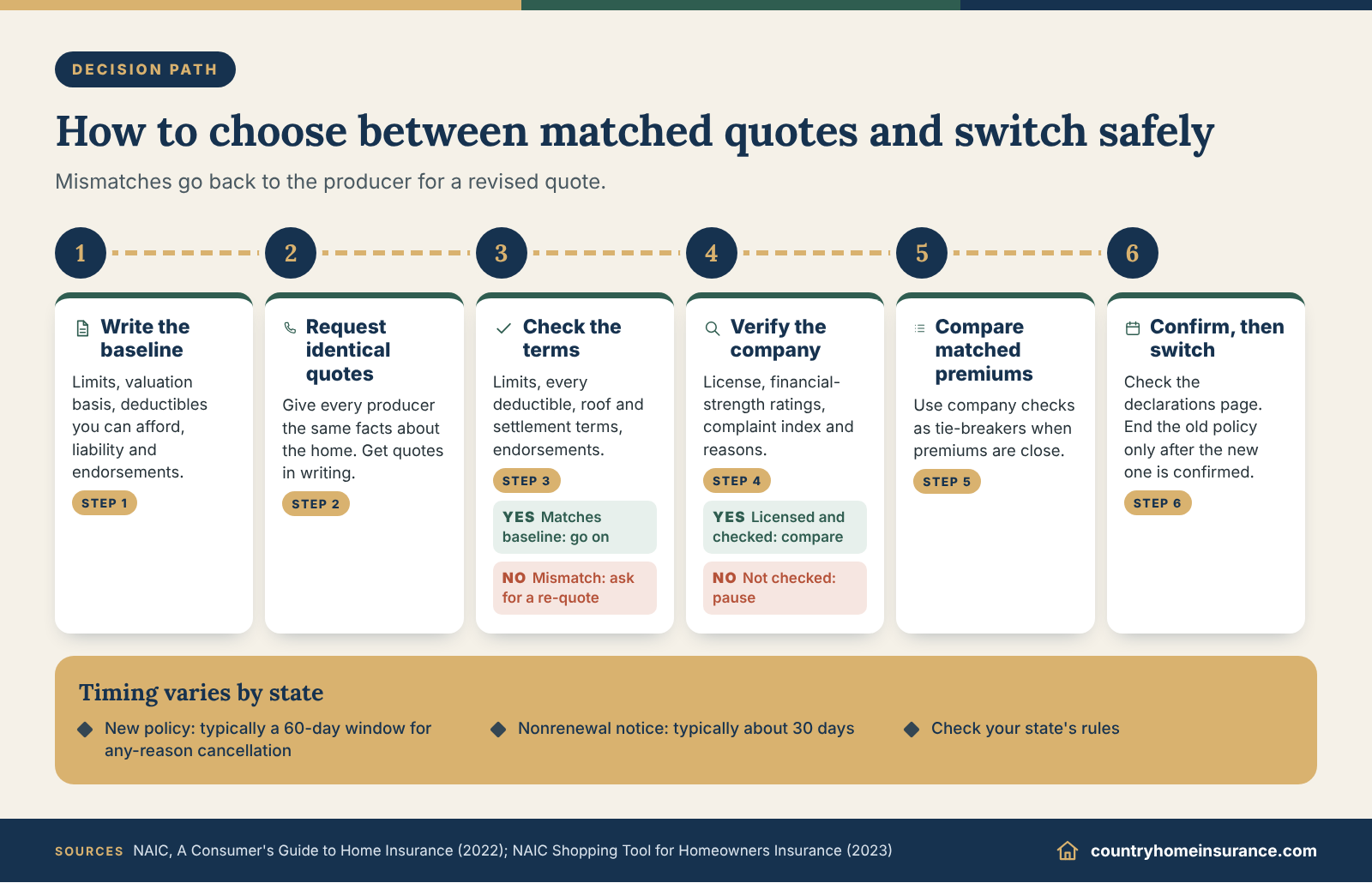
NAIC’s 2022 guide says you can cancel your own policy at any time and that new policyholders are typically subject to a 60-day period during which the insurer can cancel for any reason. It also says nonrenewal notices are typically given 30 days before the renewal date, with the number of days varying by state, and that you may ask for the reason. The notice periods differ by state, so check your state’s rules before relying on a specific number.
What is a reliable step-by-step way to compare quotes side by side?
A worksheet and a little arithmetic turn a pile of quotes into a decision. This section shows one workable method, with a hypothetical example, and it keeps the steps short because the full buying process lives in our how-to guide.
How do you build the comparison worksheet?
A spreadsheet or a printed grid works equally well. What matters is that every quote has its own column and every row means the same thing in every column.
Set up the columns and rows
Use one column per quote and one row per item from Table 1: dwelling limit, valuation basis, other structures, contents, loss of use, liability, medical payments, each deductible, roof terms, endorsements, sublimits, premium, discounts, conditions and company checks. NAIC’s shopping tool includes a coverage comparison worksheet with similar rows. Keep two premium rows: “as first quoted” and “after matching.”
Ask for revised quotes instead of guessing
Where a quote differs from your baseline, ask the producer to re-quote at your specification, and to price the alternatives you want to see, such as two deductible levels. A revised quote on paper is far more reliable than your estimate of what an endorsement might cost. Revisions also reveal whether an insurer can offer the coverage at all.
Mark gaps as gaps, not as zero
If an insurer can’t offer a feature, write “not available,” not “$0.” A missing endorsement is not a free one. If you’d have to buy a separate policy to fill the gap, note the cost of that policy in the same row so the totals stay fair.
What does a worked example look like?
The following example is hypothetical. The dollar figures are invented to show a method, and they aren’t rates, averages or quotes from any real insurer.
Three quotes as first received
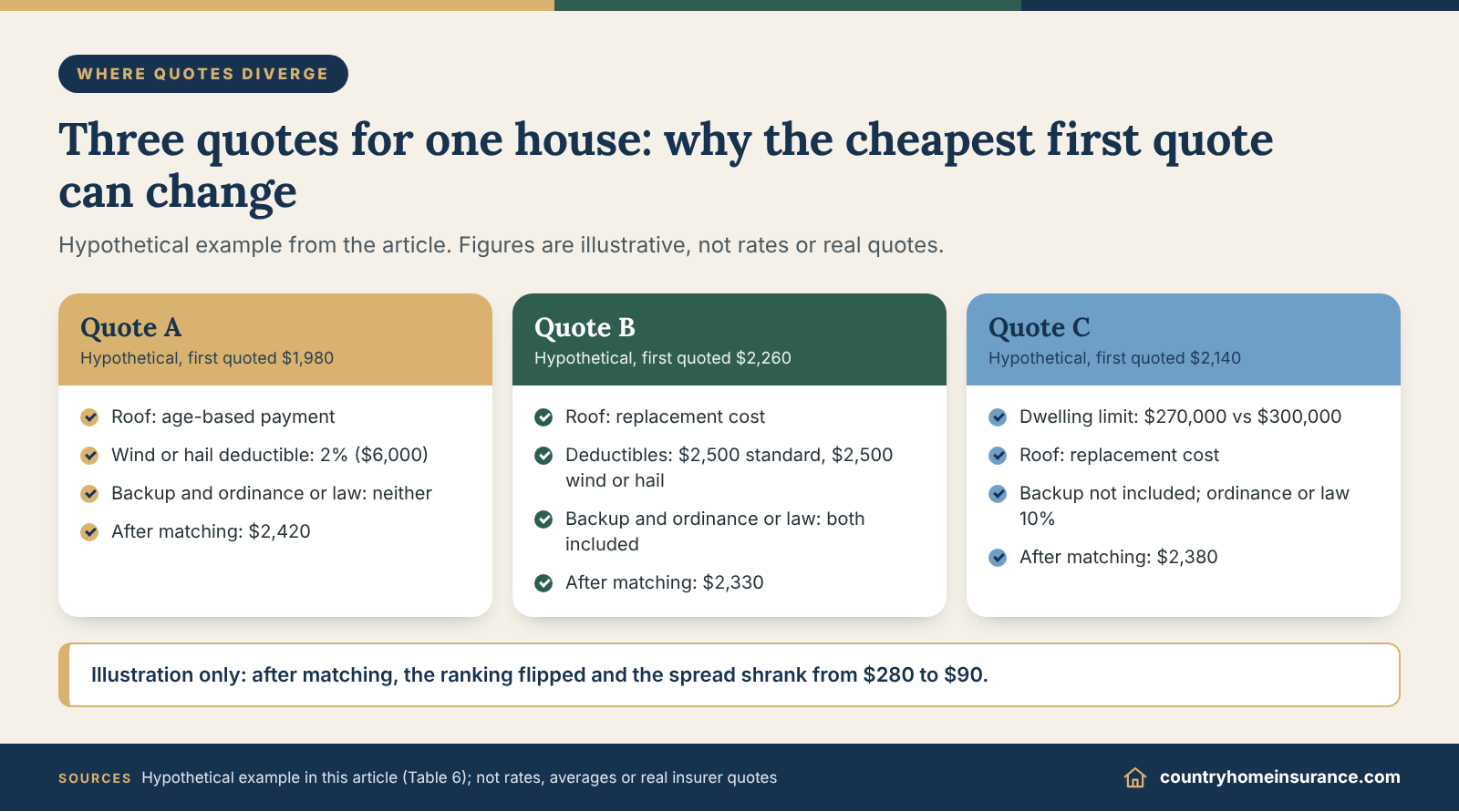
Hypothetical example: a homeowner with a country house and a detached shop collects three quotes and lists them in Table 6. At first glance, Quote A is cheapest at $1,980 a year, followed by Quote C at $2,140 and Quote B at $2,260. A quick glance at only the bottom line would stop here.
The same quotes after matching
The homeowner asks each producer to re-quote to the baseline: $300,000 dwelling limit on replacement cost, a $1,000 standard deductible, a $3,000 flat wind or hail deductible, replacement cost on the roof, a $10,000 sewer and water backup endorsement and ordinance or law at 10%. Quote A rises by $440 (roof replacement cost, a lower wind or hail deductible, backup and ordinance or law), Quote B rises by a net $70 (a lower standard deductible, partly offset by a higher wind or hail deductible), and Quote C rises by $240 (a higher dwelling limit and backup). The matched totals are $2,420, $2,330 and $2,380. The ranking has flipped, and the spread between highest and lowest shrank from $280 to $90.
What the example does and does not show
It shows how a first-glance winner can become the most expensive option once protection is equalized. It doesn’t show that the new lowest quote is a better company, that any insurer would price add-ons that way, or that every feature is available everywhere. Company checks come next: licensing, financial strength and complaint records can reasonably break a close tie.
How do you decide, document and switch safely?
Once the quotes are matched, the decision usually comes down to a few tie-breakers and a clean handoff from the old policy.
Using company checks as tie-breakers
When matched premiums sit within a small range, the company and producer checks in Table 5 carry more weight than a few dollars. A producer who answers questions in writing, a company with a solid complaint record and a rating from an agency you recognize are worth more than a small annual saving. Before you sign on the dotted line, make sure the legal company name on the quote matches the name you researched, because affiliated companies can have different records.
Avoiding a gap in coverage
Don’t cancel the old policy until the new one is confirmed in writing with an effective date. If you have a mortgage, the lender typically requires coverage; NAIC’s 2014 tool says lenders usually require at least enough to pay off the loan. A consumer-law explainer from Nolo (a general-audience publisher, so a Level 3 source) says that when a policy lapses, a mortgage servicer may buy force-placed insurance that is expensive and protects the lender’s interest rather than your belongings. Rules and notice periods are set by federal and state law, so verify your situation with your servicer.
Timing the shopping around renewal
NAIC says insurers typically give nonrenewal notice about 30 days before the renewal date, though states vary, and that you may choose not to renew. If you start comparing only after a nonrenewal or a large increase arrives, the time to get matched quotes can be short. Reviewing coverage yearly, as NAIC advises, makes a rushed comparison less likely. Leave room for revised quotes, which take longer than first quotes.
| Item | Quote A | Quote B | Quote C |
|---|---|---|---|
| Dwelling limit and basis as first quoted | $300,000, replacement cost | $300,000, replacement cost | $270,000, replacement cost |
| Standard and wind or hail deductibles as first quoted | $1,000 standard; 2% wind or hail ($6,000) | $2,500 standard; $2,500 wind or hail | $1,000 standard; $3,000 wind or hail |
| Roof payment as first quoted | Age-based payment on roof | Replacement cost on roof | Replacement cost on roof |
| Backup and ordinance or law as first quoted | Neither included | $10,000 backup and 10% ordinance or law included | Backup not included; ordinance or law 10% |
| Annual premium as first quoted | $1,980 | $2,260 | $2,140 |
| Adjustments needed to reach the baseline | Plus $440: roof replacement cost, lower wind or hail deductible, backup, ordinance or law | Net plus $70: lower standard deductible, offset in part by higher wind or hail deductible | Plus $240: higher dwelling limit, backup |
| Annual premium after matching | $2,420 | $2,330 | $2,380 |
| Step | What to verify | What to document | What to ask the insurer or agent |
|---|---|---|---|
| 1. Write the baseline | Dwelling limit from a rebuild estimate, valuation basis, deductible you can afford, liability limits | One-page specification you give to everyone | Can you quote exactly this, and at which alternative deductibles? |
| 2. Give identical facts | Roof age and type, systems, septic or well, distance to fire station and hydrant, outbuildings, dogs, business use | Date and details of what you disclosed to each producer | Which facts drive your price the most? |
| 3. Check limits | Other structures, contents and loss-of-use dollar amounts, not just percentages | Dollar amounts from each quote | Can the other-structures limit be raised, and are any buildings limited? |
| 4. Check deductibles | Every deductible line, including wind or hail, roof and percentage deductibles | Dollar value of each at your dwelling limit | How many deductibles apply in one storm event? |
| 5. Check roof and settlement terms | Roof payment rule, replacement-cost timing, depreciation treatment | Policy wording or endorsement name | If hail damages my roof, how is the payment calculated? |
| 6. Check endorsements | Backup, ordinance or law, scheduled items, equipment breakdown, inflation adjustment | Limit, deductible and conditions for each | What does each add-on cost, and what does it exclude? |
| 7. Check the company | License, financial-strength ratings, complaint index and reasons | Source and date of each check | What is the exact legal name of the issuing company? |
| 8. Confirm after purchase | Declarations page matches the accepted quote | Signed documents, binder, effective date, cancellation confirmation of old policy | Please confirm in writing that the old policy ends only after the new one starts. |
Frequently asked questions
Questions about price and quote mechanics
Is the lowest matched quote the one to buy?
Not automatically. After you’ve equalized limits, deductibles, loss settlement and endorsements, the lowest premium is a reasonable default, but company strength, complaint records and the quality of the producer’s answers can justify paying somewhat more. New York’s Department of Financial Services puts price alongside reputation, claim practices and services, and California’s consumer guide says comparing only prices is doing yourself a disservice. Treat a close call as a reason to run the company checks in Table 5.
Can I fairly compare an online quote with an agent’s quote?
Yes, provided both were built from the same specification and the same facts about your home. Online forms sometimes default to a deductible, a valuation basis or a set of optional coverages that you didn’t choose, so read the summary screen carefully. Alabama’s and Vermont’s departments note that direct sellers may charge less because there’s no commission, so compare the actual coverage documents rather than assuming the sales channel decides the price.
Why might my final premium differ from the quote?
Several things can change a price between quote and policy: an inspection result, a claims-history or credit-based report, a discount that couldn’t be documented, or an answer that turned out to be inaccurate. NAIC’s 2014 shopping tool says quotes are estimates and that insurers may use credit-based insurance scores and CLUE reports. If the final number moves, ask the insurer to identify exactly which input changed, and compare the revised price with your other matched quotes.
Questions about coverage and company strength
Does a high financial-strength rating mean my claim will be paid?
No rating can promise that. A.M. Best’s guide (version dated 2009) says its rating is an opinion of an insurer’s ability to meet ongoing insurance obligations and that it doesn’t address claims-payment procedures or claim disputes. Whether a particular claim is paid depends on the policy terms, the cause of loss, the limits and deductible, and the facts of the loss. A rating is a reasonable input to your decision, but it isn’t a guarantee about any claim.
How do I compare a roof that pays on a schedule with one that pays full replacement cost?
Ask each insurer for the exact wording and for a worked example using your roof’s age and material. TDI’s March 2026 column notes that some policies pay the full cost of a new roof and others pay less based on age and condition. Then price the difference: ask what it would cost to move the schedule-based policy to full roof replacement cost, if that option exists. Where the option doesn’t exist, you’ll have to decide how much roof risk you’re willing to carry yourself.
Can I compare a farm policy with a homeowners quote?
Not line by line. A farm or ranch package is a different kind of product with different structure, liability and property definitions. The useful approach is to compare each policy against your list of exposures (house, outbuildings, equipment, animals, business activity, visitors) and see which exposures each policy addresses, limits or leaves out. Ask each insurer to confirm in writing how it treats your specific activities.
Questions about switching and timing
Can I cancel my policy mid-term when I find a better quote?
NAIC’s 2022 guide says you can cancel your policy at any time, and notes that a premium refund may apply. The practical rule is to keep the old policy in force until the new one has an effective date confirmed in writing, so there is no gap. If a mortgage lender is involved, tell the new insurer to provide the lender with the evidence of coverage the lender requires, and ask your servicer how to confirm it.
How early should I start comparing before renewal?
Early enough that you can request revised quotes, gather inspection or roof paperwork and run company checks without pressure. NAIC says nonrenewal notices typically arrive about 30 days before renewal, though the required period varies by state. A reasonable habit is to review your coverage once a year, as NAIC recommends, and to start the comparison well before a notice period begins to tick.
Which documents should I keep after I choose?
Keep the accepted quote, your worksheet, any revised quotes, the binder, the full policy with all endorsements and the declarations page, plus the cancellation confirmation from the old insurer. NAIC advises keeping the policy somewhere safe and knowing your insurer’s name. Pair those with a current home inventory, which NAIC says helps a carrier settle claims, and store copies where you can reach them if the house itself is inaccessible.
Next steps: turning the comparison into a decision
If you already have quotes in hand, the fastest improvement is to rebuild them on a common baseline. If you haven’t started, the baseline comes first.
What should you do this week?
Three small actions create most of the value, and none requires a purchase.
Write the baseline and gather the facts
Estimate rebuild cost, choose the deductible you can afford, decide your liability limit and list the endorsements and separate policies you want priced. Collect your roof age and material, system ages, distance to the nearest fire station and hydrant, and a list of outbuildings. Use our buying guide for the surrounding steps and our quote-count article for how many companies to approach.
Request revised quotes on identical terms
Send the baseline in writing to each producer, ask for alternative deductible prices, and ask each to list assumed discounts and conditions. Note any missing feature as “not available.” Then complete the worksheet and the checks in Table 5 before you compare premiums.
What should you verify after you buy?
The comparison isn’t finished until the policy documents confirm what you were promised.
Check the declarations page line by line
Match the dwelling limit, valuation basis, deductibles, endorsements and sublimits against your accepted quote. Ask for corrections in writing if anything differs, and keep the response with your records.
Set a yearly review
Put a reminder on your calendar before each renewal to revisit the baseline. Renovations, a new roof, added outbuildings and changes in rebuild cost can all shift the right limits, and NAIC recommends asking your agent each year whether your coverage is still adequate.
Sources
- NAIC: Homeowners insurance consumer information (undated page, retrieved 2026-10-11)
- NAIC: What’s the difference between actual cash value coverage and replacement cost coverage? (published 2025, retrieved 2026-10-11)
- NAIC: A Shopping Tool for Homeowners Insurance (2023 edition, retrieved 2026-10-11)
- NAIC shopping tool, 2014 edition, as hosted by the Colorado Division of Insurance (dated; retrieved 2026-10-11)
- NAIC shopping tool, 2014 edition, as hosted by the Mississippi Insurance Department (dated; retrieved 2026-10-11)
- NAIC: A Consumer’s Guide to Home Insurance (2022 edition, retrieved 2026-10-11)
- NAIC home insurance guide, 2010 edition, as hosted by New Hampshire (dated; retrieved 2026-10-11)
- NAIC: How to file a complaint and research complaints against insurance carriers (September 2022, retrieved 2026-10-11)
- NAIC: Consumer Insurance Search (retrieved 2026-10-11)
- NAIC: How to file a complaint (retrieved 2026-10-11)
- NAIC: State insurance departments directory (retrieved 2026-10-11)
- NAIC: Home inventory (retrieved 2026-10-11)
- Kansas Insurance Department: 2024 complaint index report (calendar year 2024 data, Kansas only; retrieved 2026-10-11)
- Texas Department of Insurance: Complaint data (page last updated 2022-06-21; retrieved 2026-10-11)
- A.M. Best: Guide to Financial Strength Ratings, as hosted by the State of Nevada (version dated 2009; verify the current scale with the rating agency)
- Alabama Department of Insurance: Smart shopping for home insurance (undated; retrieved 2026-10-11)
- New York Department of Financial Services: Shopping for homeowners insurance (undated; retrieved 2026-10-11)
- Vermont Department of Financial Regulation: Buying insurance consumer guidance (undated; retrieved 2026-10-11)
- California Department of Insurance: Residential insurance guide (January 2016; California-specific and dated; retrieved 2026-10-11)
- Texas Department of Insurance: What to know about insurance and your roof (March 2026; Texas-specific; retrieved 2026-10-11)
- Texas Department of Insurance: Public protection classification presentation (March 23, 2023; Texas-specific; retrieved 2026-10-11)
- U.S. Government Accountability Office: GAO-26-107867, homeowners insurance premiums (published 2026-02-27; retrieved 2026-10-11)
- FEMA FloodSmart: Buy a flood insurance policy (undated; retrieved 2026-10-11)
- Nolo: Force-placed insurance rules (general-audience legal publisher, secondary source; retrieved 2026-10-11)
Important coverage note
Coverage depends on the actual policy, endorsements, exclusions, limits, deductible and cause of loss. State laws and insurance programs vary, and insurers define terms differently, so nothing in this article changes what your policy says. Review your declarations page, policy form and endorsements, and verify case-specific questions with your insurer or agent and with your state Department of Insurance. Every dollar figure in the worked examples is hypothetical or taken from a sample document and is not a quote or a prediction. This article is educational information, not legal advice, and it doesn’t promise that any claim will be paid.
About the editorial team
This guide was prepared by the countryhomeinsurance.com editorial team as general, educational information for homeowners. We research and summarize publicly available material, including state insurance departments, the NAIC, federal agencies, regulators’ consumer guides and published insurer and industry resources. We draw only on the sources that were available to us when we wrote this guide, and we list them in the Sources section with dates where we could find them.
Insurance rules, rates, products and program terms change, differ by state and by insurer, and can apply differently to your situation. We cannot guarantee that this content is complete, current or free of errors. It is not legal, financial, tax or insurance advice, it is not an offer to sell insurance or a recommendation of any insurer, agent or product, and reading it does not create a professional relationship of any kind.
To the fullest extent permitted by law, countryhomeinsurance.com and its editorial team, authors and contributors exclude all liability for any loss, damage or decision arising from the use of, or reliance on, this content. For questions about your own policy or claim, contact your insurer, a licensed agent or broker, your state Department of Insurance or another qualified professional.
Content created: October 11, 2026