Quick answer
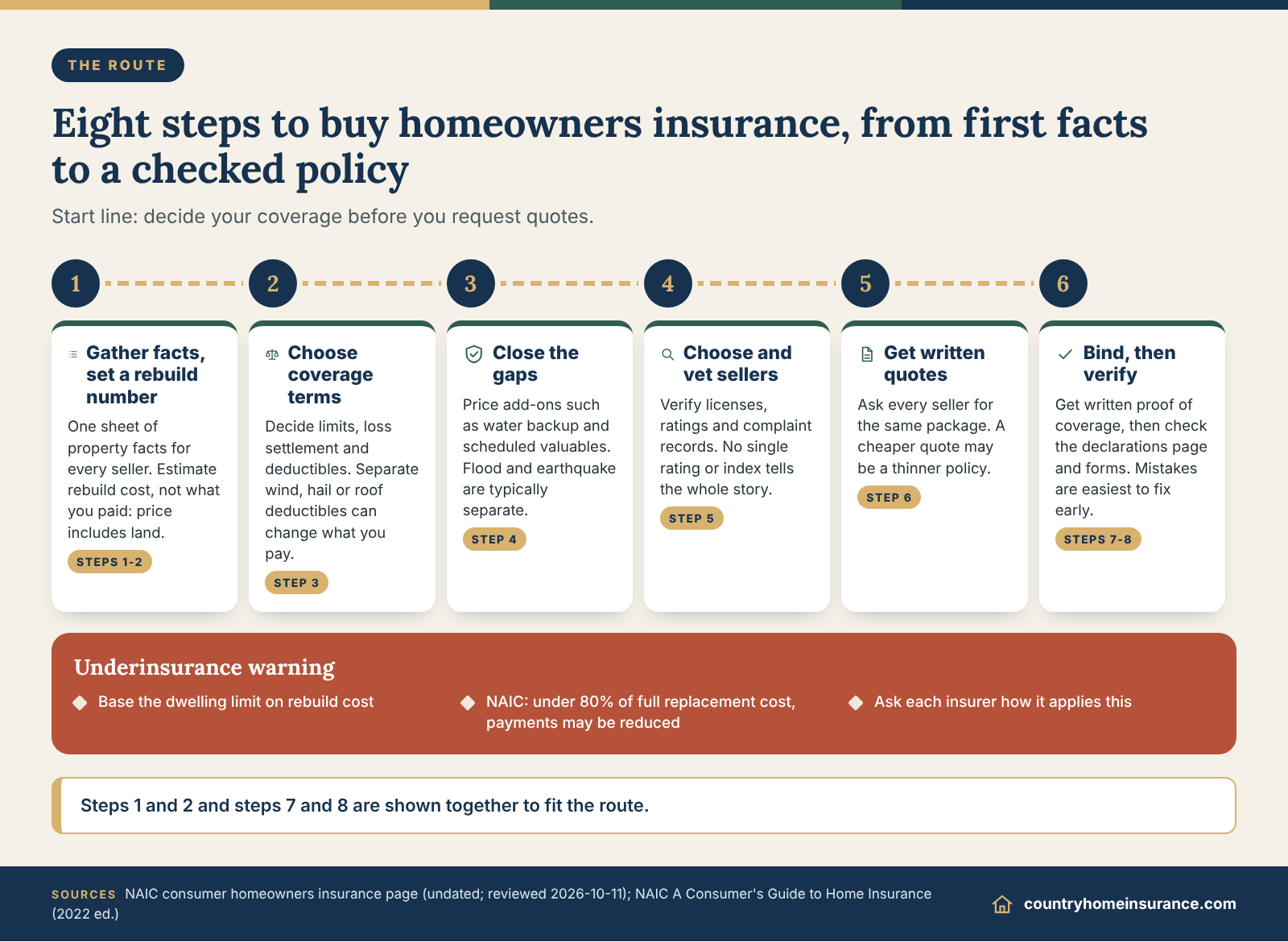
How to buy homeowners insurance comes down to eight steps: gather property and claims details, estimate what it would cost to rebuild, choose limits, loss settlement and deductibles, add coverage the base policy leaves out, pick and vet sellers, request matching written quotes, then bind coverage and check the policy that arrives. Price matters, but so do exclusions, deductibles, financial strength and complaint records. Rules and availability vary by state, so confirm specifics with your insurer, agent and state Department of Insurance.
Key takeaways
- Do the homework before you ask for a single quote: decide the coverages and limits you want first, then ask every seller for the same package.
- Base the dwelling limit on estimated rebuild cost, not purchase price. The NAIC says dwelling coverage below 80 percent of full replacement cost may lead to reduced claim payments.
- A standard homeowners policy typically does not cover flood or earthquake, and mold or infestations are usually excluded too, so plan for those gaps separately.
- Check the seller, not just the price: confirm the license with your state, review financial strength ratings, and look at complaint data, keeping each tool’s limits in mind.
- If standard insurers decline your property, FAIR plans and surplus lines insurers exist, but terms, protections and prices differ, so ask pointed questions before you accept.
- Coverage is not finished when you pay. Read the declarations page and forms when the policy arrives and compare them against your written quote.
| Step | What you do | What you should have when finished | Main caution |
|---|---|---|---|
| 1. Gather facts | Collect home details, claims history, insurance history and lender information | One sheet of property facts you can give every seller | Inconsistent answers produce inconsistent quotes |
| 2. Set a rebuild number | Estimate what it would cost to repair or rebuild the house, not what you paid for it | A rebuild estimate, ideally from more than one source | Purchase price and market value include land |
| 3. Choose coverage terms | Decide limits, loss settlement basis and deductibles | A written coverage specification | Separate wind, hail or roof deductibles can change your out-of-pocket cost |
| 4. Close the gaps | Decide on flood, water backup, scheduled valuables and rural exposures | A list of add-ons to price | Flood and earthquake are typically separate coverage |
| 5. Choose and vet sellers | Pick channels and verify licenses, ratings and complaint records | A short list of licensed sellers | No single rating or index tells the whole story |
| 6. Get written quotes | Request the same package from each seller and read each offer | Comparable written quotes with forms listed | A cheaper quote may be a thinner policy |
| 7. Bind and pay | Confirm effective date, proof of coverage and lender requirements | Written proof that coverage is in force | Do not end the old policy until the new one is in effect |
| 8. Verify and review | Check the declarations page, forms and endorsements; set a renewal reminder | A filed policy, inventory and renewal date | Mistakes are easiest to fix early |
How to buy homeowners insurance: the process from first question to signed policy
Most people shop for homeowners insurance the way they shop for a phone plan: type in a few details, glance at the monthly price, and choose. That approach can work for simple products, but a home policy is a contract with limits, exclusions and deductibles that decide what you actually receive after a loss. This guide walks through how to buy homeowners insurance as a sequence of decisions, in the order that tends to save the most headaches. We stay on the buying process itself. For side-by-side quote analysis, see our separate guide, and for the question of how many offers to collect, we have another article.
What you are actually buying
Before the steps, it helps to be clear about the product. A homeowners policy is not one coverage but a bundle, and the bundle is assembled from a base form, limits you choose and add-ons called endorsements.
A contract assembled from forms, limits and endorsements
The National Association of Insurance Commissioners (NAIC), the organization of state insurance regulators, tells consumers to read the policy before buying because it is a legal contract spelling out the responsibilities of both sides. In practice that contract has layers. A policy form sets the basic rules, the declarations page lists your specific limits and deductibles, and endorsements modify the form for things like water backup or scheduled jewelry. Two policies with the same dwelling limit can behave very differently once the form and endorsements are read, which is why this article keeps returning to documents rather than prices.
Where the price comes from versus where the protection comes from
Price is driven largely by who you are and where the house sits, while protection is driven by the policy language. The NAIC lists location, protection class, home value, construction, age, coverage amounts, deductible and discounts among the factors that shape the premium. Protection comes from different questions: what perils the form covers, how losses are settled, what the sublimits are and which exclusions apply. A shopper who only compares price is comparing the first list while ignoring the second, and the second is what you rely on when something goes wrong.
A timeline that fits your situation
The same eight steps apply whether you are buying a first home, switching insurers or recovering from a nonrenewal. What changes is how much time you have and which steps are urgent.
If you are buying a home
Home buyers have a hard deadline: the closing date. The NAIC’s consumer guide notes that lenders typically require homeowners insurance and want to be named as the mortgagee, meaning the lender with a financial interest in the property. Work backward from closing and start the first two steps as soon as your offer is accepted, because rebuild estimates, inspections and underwriting questions can take days. Ask your lender what evidence of insurance it needs and when, and put that date on your calendar. If you are buying in a flood-prone area, the flood timing rules in Step 4 matter too.
If you are replacing a policy at renewal
A renewal gives you the most room to work. The NAIC guide says policies normally run for 12 months, so you can start shopping well before your renewal date without any pressure. The cardinal rule is to keep your current coverage in force until the replacement policy is confirmed in writing as active. A gap, even a short one, can leave you exposed and may trigger lender action. If your current insurer has sent a nonrenewal or a large increase, treat it as a deadline rather than a surprise.
If you have been declined or nonrenewed
Some owners start the process after an insurer has already walked away. Reasons vary by insurer and state. The steps are the same, but Step 5 and the later section on availability matter more, because your realistic choices may include a state residual-market plan or a surplus lines insurer. Ask the insurer, in writing if you can, for its stated reason for nonrenewal, because the NAIC says you may request one, and the reason tells you what to fix or document before you apply elsewhere.
Steps 1 and 2: gather your facts and set a rebuild number
Good quotes depend on good inputs. Every question an agent or online form asks exists because it changes the price, the eligibility decision, or both. Spending an hour on the inputs up front keeps the quotes consistent and lets you spot a seller that skipped a question that matters.
The facts every seller will ask for
You will answer the same questions repeatedly, so write the answers down once. Alabama’s insurance department tells shoppers to give every producer or company the same information, including a description of the house, distance to the nearest fire department and fire hydrant, square footage, security devices, a picture of the home and the coverages and limits wanted.
The basics: age, size, construction, roof and systems
Insurers use the structure’s age and build to judge both rebuild cost and the likelihood of a loss. A Mississippi Insurance Department shopping guide (carrying a 2014 NAIC copyright, so partly dated) lists the age of the home and roof and the age of plumbing, electrical and heating systems among the factors insurers may consider. The NAIC adds that frame construction usually costs more to insure than brick. Pull together the year built, square footage, number of stories, foundation type, roof material and the year the roof was last replaced. If you have receipts for a roof, wiring or plumbing update, locate them now, since they are often the proof behind a discount or a favorable underwriting decision.
Rural details that standard forms do not assume
Country properties come with extra questions. How far is the house from the nearest fire station by road? Is there a hydrant, a pond, a dry hydrant or a tanker-supplied water source? The Texas Department of Insurance explains that the Insurance Services Office (ISO, a Verisk business) assigns a Public Protection Classification from 1 to 10 based on a community’s ability to suppress structure fires. In that explainer, properties beyond five road miles of a fire station fall into Class 10, and some properties within five miles but more than 1,000 feet from a creditable water supply receive a split class. That is one state’s description, so ask how your own insurer uses fire-protection grading where you live. Note your road distance, your fire department type (volunteer or paid), and any water source on the property, and ask each insurer what class it is using for your address.
Your own history: claims, prior coverage and credit
The NAIC’s consumer guide says insurers consider the claims history of the home and area as well as your own history with water, fire, theft or liability claims. The Mississippi guide adds that insurers may ask about claims made by a previous owner of a house you are buying, and that they may consider a credit-based insurance score and a CLUE report, which is a loss-history report compiled from insurer claims data. Credit use varies by state; the NAIC guide notes that insurers in many states use credit history and that a free annual credit report is available at annualcreditreport.com. Know your dates, claim types and amounts, and have your prior carrier’s name and policy number handy.
Setting a rebuild number before anyone quotes you
The most consequential number in the whole process is the dwelling limit, and it should start from a rebuild estimate. If you let a form default or an online estimate choose it, you may not notice a shortfall until you file a claim.
Why rebuild cost, not purchase price
The NAIC consumer guide says to estimate what it would cost to rebuild, not the purchase price, because the price paid includes land. It also says that if dwelling coverage is below 80 percent of full replacement cost, the insurer may reduce claim payments. That is a regulator’s warning, so ask each insurer exactly how it applies any percentage requirement. The NAIC’s separate explainer, published January 2, 2025, makes the same distinction between replacement cost and market value. Your lender may also set a minimum coverage amount that matches your mortgage, and that figure is not necessarily the same as your rebuild cost.
Three practical ways to get a number
The Colorado Division of Insurance’s buyer’s guide (also a 2014 NAIC publication) suggests asking a local builder or real estate agent for the average new construction cost per square foot for a similar home in your community. It adds that an agent or insurer can estimate rebuilding costs from your answers, and that multiple quotes mean multiple estimates. Combine them: your own per-square-foot figure, each insurer’s estimate, and, if the house is unusual, a professional opinion. Hypothetical example, not a quote: a 2,000-square-foot home at an assumed $150 per square foot suggests about $300,000 to rebuild, so 80 percent would be $240,000. A $200,000 limit would sit below that line, and the policy language would decide any payment consequences. The guide stresses that estimates are not guarantees, only a way to avoid being underinsured.
Why rural rebuild costs deserve extra scrutiny
This paragraph is our own analysis, not a sourced finding. Rural rebuilds may involve long hauls for materials, limited contractor availability, well and septic reconnection, driveway or private-road work and older construction that is costly to match. Any of these could push the true figure above a generic per-square-foot average. When you ask an insurer how it built its estimate, ask whether it accounts for features like a steep metal roof, a stone foundation, custom millwork or a remote building site, and whether you can adjust the inputs.
Making a home inventory before you shop
A home inventory is a list of your belongings, and it does two jobs: it informs the personal property limit you request, and it speeds a claim later.
What to record
The NAIC’s consumer page recommends sorting items by category, keeping receipts or appraisals, noting model and serial numbers, and capturing photos or video with estimated values. The NAIC also offers a free Home Inventory app that lets you photograph items, scan barcodes and group things by room. Walk through the house room by room, then do the garage, barn, shop and shed, since outbuildings often hold the most expensive equipment on a rural property. Don’t forget the contents of locked cabinets and the high-value items that may exceed sublimits, which we cover in Step 4.
Where to keep it
The NAIC suggests keeping copies where you can reach them after a loss and considering sharing one with your insurer. The app page notes you can export your inventory, so you are not locked into one place. A common-sense approach is two copies in different locations, one of them off the property, such as cloud storage or a relative’s house. A fire that destroys the home would also destroy a paper folder sitting in the hall closet.
Step 3: decide your limits, loss settlement and deductibles
With facts and a rebuild estimate in hand, you can decide what you want to buy. This is the step that separates a shopper who gets comparable quotes from one who collects a pile of numbers that cannot be lined up. Write your decisions down, because you will hand the same specification to every seller. Tables 2 and 3 summarize the main scope and limit decisions, and the sections that follow explain the reasoning.
| Exposure | Often included in a standard policy | Usually excluded or sold separately | Depends: confirm in writing |
|---|---|---|---|
| Named perils such as fire, windstorm and theft | Typically addressed by the policy form, subject to limits, deductible and exclusions | Perils the form does not name or expressly excludes | Which form you are quoted and its list of perils |
| Flood | Not included | Excluded; available through the National Flood Insurance Program (NFIP) or private insurers | Whether your lender requires it and when coverage starts |
| Earthquake | Not included | Excluded; may be offered as an endorsement or separate policy | Availability and price where you live |
| Mold, termites, rodents and other infestations | Usually not covered | Usually excluded | Whether a mold endorsement exists and what it limits |
| Sewer or drain backup, sump pump overflow | Generally not part of the base form | Often sold as an endorsement | Endorsement limit and its own deductible |
| Jewelry, furs, firearms, computers | Covered up to sublimits | Amounts above the sublimit | Scheduled personal property endorsement for higher values |
| Roof damage | Addressed by the form, with payment depending on the policy | Age, wear or mismatched shingles may reduce payment | Roof age schedule, depreciation, and wind or hail deductible |
| Detached structures such as barns and workshops | Typically a fraction of the dwelling limit | Business or farming use may be limited | Raising the limit and how the building is used |
The six coverages and the policy form
Standard homeowners policies are organized into lettered coverages. Insurers call the structure of a form by a number, such as HO-3, and the choices below determine most of the contract’s behavior.
Dwelling, other structures, personal property and loss of use
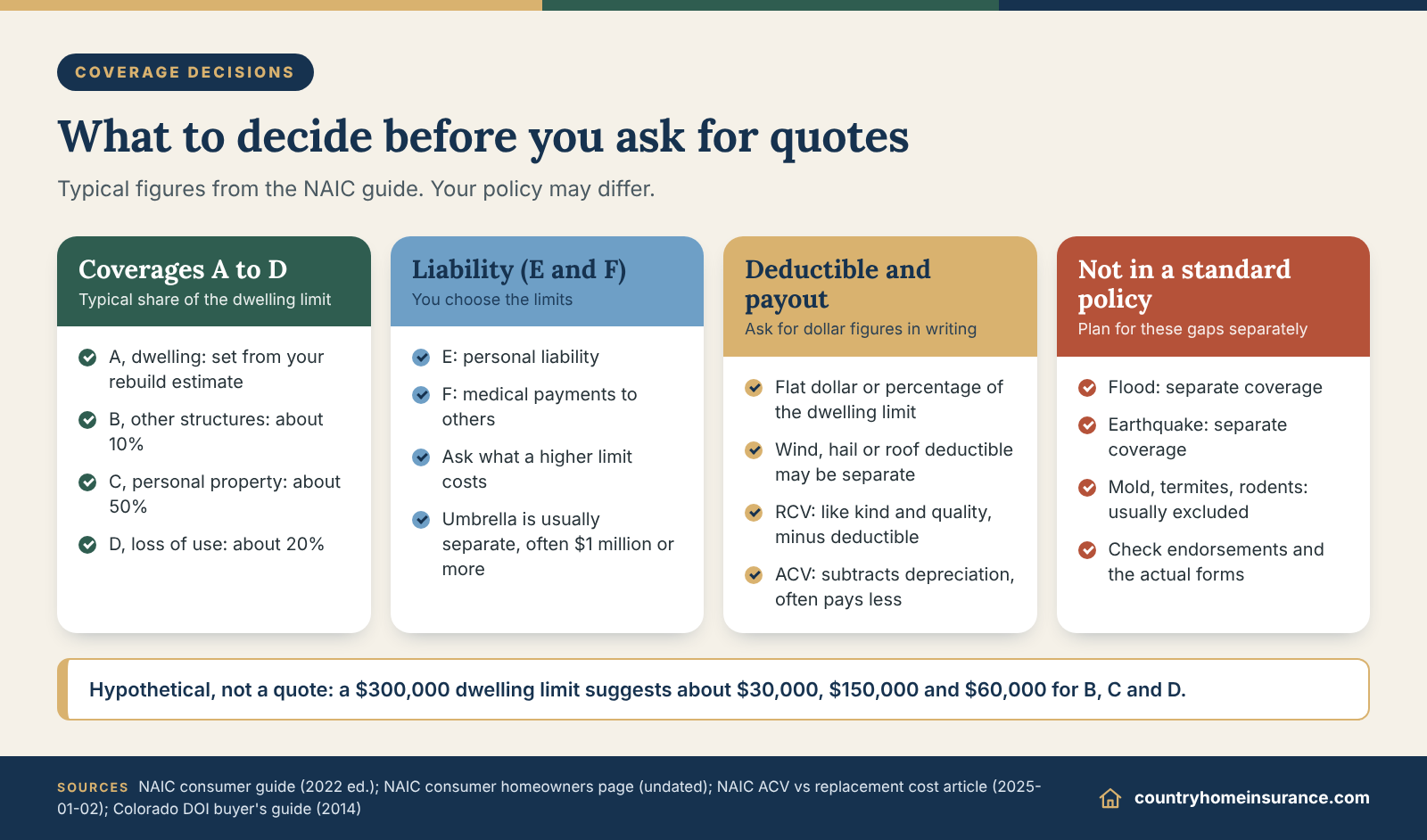
Coverage A is the dwelling, which is the house itself, and it is the limit you set from your rebuild estimate. Coverage B is other structures, such as a detached garage, shed or fence. Coverage C is personal property, meaning your belongings. Coverage D is loss of use, which pays additional living expenses if a covered loss makes the home unlivable. The NAIC’s 2022 consumer guide says the other three are typically set as percentages of the dwelling limit: about 10 percent for other structures, 50 percent for personal property and 20 percent for loss of use. On a $300,000 dwelling limit, those typical percentages would suggest about $30,000, $150,000 and $60,000, though your policy may differ and many insurers let you adjust them.
Liability, medical payments and the umbrella question
Coverage E is personal liability, which responds when someone sues you for injury or property damage, and Coverage F is medical payments to others, which pays small medical bills for guests hurt on your property regardless of fault. The NAIC guide says you choose these limits. It also suggests asking whether more liability or medical payments coverage is available for a small premium. The Colorado Division of Insurance buyer’s guide notes that umbrella liability is usually a separate policy and is usually sold with limits of $1 million or more. Rural owners with ponds, ATVs, horses, hay wagons or visitors may want to think harder about liability than a suburban owner would, and the right limit is a judgment between you and a licensed professional.
Which policy form you are being quoted
The Colorado guide and a Mississippi Insurance Department guide both list the common forms, HO-1, HO-2, HO-3, HO-5 and HO-8, in their comparison worksheets, so it makes sense to record which form each quote uses. In general terms, forms differ in how broadly they cover the dwelling and belongings and in how losses are settled. The NAIC consumer page also tells shoppers to compare named-peril packages and what each covers. You do not need to memorize the forms. You do need to ask each seller which form number it is quoting, request the form itself, and look at the list of covered causes of loss and the exclusions before you decide.
Loss settlement: replacement cost, actual cash value and the roof
Loss settlement describes how the insurer calculates a payment after a covered loss. It is one of the most important differences between two otherwise similar quotes.
Replacement cost versus actual cash value
The NAIC explains that actual cash value (ACV) pays to repair or replace property based on its value after subtracting depreciation for age and wear, and that it often does not pay enough to fully replace the property. Replacement cost value (RCV) pays to repair or replace with materials of like kind and quality. The NAIC’s example: with $10,000 of damage, an RCV policy pays $10,000 minus the deductible, while an ACV policy pays less because the insurer considers the age and condition of the property. The NAIC piece does not describe how and when any withheld depreciation is paid, so ask each insurer how the process works, when payments are released and what documentation it needs.
Roofs are often settled differently
The Texas Department of Insurance, in a March 2026 consumer column, says some policies pay the full cost of a new roof while others pay less based on the roof’s age and condition, and that many policies reduce coverage depending on roof age and materials. It adds that the deductible for wind and hail is often higher than for other damage and that a company might not replace an entire roof if new shingles do not match. A U.S. Government Accountability Office report, GAO-26-107867 (published February 27, 2026), described insurers paying the depreciated value of older roofs, using separate roof deductibles, and offering discounts to policyholders who accept lower roof payments. Ask directly how the quoted policy treats your roof by age and material.
Extended replacement cost, ordinance or law and inflation protection
The NAIC guide lists endorsements that adjust loss settlement: guaranteed replacement cost, which covers a full rebuild; personal property replacement cost; inflation guard, which raises the dwelling limit annually; and ordinance or law coverage, which pays for code-compliant rebuilding costs. The Colorado guide explains that extended replacement cost provides coverage above the dwelling limit up to a set percentage or dollar amount, while guaranteed replacement cost pays the full cost even above policy limits; it says very few insurers offer the latter and that shoppers should ask whether it has a cap. Older country houses may face code upgrades when rebuilt, so ordinance or law coverage is worth a direct question.
Choosing deductibles you can actually pay
A deductible is the amount you pay out of pocket on a covered loss before the policy pays. The NAIC says a higher deductible lowers the premium, and that you should choose a deductible you can afford after a loss. The details are where the trouble starts.
Flat dollar amounts versus percentages
The Colorado guide notes that deductibles can be a flat dollar amount or a percentage, and that the declarations page identifies them. A percentage deductible applies a percentage, typically of the dwelling limit, so the dollar amount rises when you raise the limit. When a seller quotes a percentage, ask it to state the dollar figure at your dwelling limit in writing. Hypothetical example, not a quote: a 2 percent deductible on a $300,000 dwelling limit would be $6,000, which is very different from a $1,000 flat deductible. Neither is better in the abstract; what matters is whether you can pay it.
Separate wind, hail, hurricane and roof deductibles
Both the Colorado and Mississippi worksheets prompt shoppers to ask about hurricane, wind and hail, and separate roof deductibles, and the Texas column and GAO report describe higher wind or hail deductibles and split roof deductibles. A policy can therefore carry more than one deductible. Ask which perils trigger which deductible, whether they apply per occurrence or per year, and whether the percentage uses the dwelling limit or another figure. These details are rarely in the headline quote, which is why we keep stressing the declarations page and the form itself.
A simple affordability test
The NAIC’s tradeoff is simple: a higher deductible usually reduces the premium but increases what you pay after a claim. Hypothetical example, not a quote or a promise of savings: suppose raising a deductible from $1,000 to $2,500 reduced the annual premium by $200. You would be accepting $1,500 more risk on every claim in exchange for $200 a year, and it would take roughly seven to eight claim-free years for the savings to equal the added exposure. The right test is practical: could you write a check for the deductible within a week of a loss without borrowing? If not, pick a lower one, even at a higher premium. Ask each seller to price two or three deductible options so you can see the real tradeoff.
| Decision | Typical starting point from regulator guides | What changes the price or payment | Question to ask each seller |
|---|---|---|---|
| Dwelling (Coverage A) | Estimated cost to rebuild; below 80 percent of full replacement cost, payments may be reduced (NAIC) | Higher limit usually raises premium; underinsuring risks a shortfall | How was the rebuild estimate built, and may I adjust it? |
| Other structures (Coverage B) | About 10 percent of the dwelling limit (NAIC) | Barns, shops and fences may need more | Can this limit be raised, and what building uses are excluded? |
| Personal property (Coverage C) | About 50 percent of the dwelling limit (NAIC) | Replacement cost versus actual cash value on contents | Is contents settled at replacement cost or ACV? |
| Loss of use (Coverage D) | About 20 percent of the dwelling limit (NAIC) | Rural rental housing may be scarce after a loss | Is there a dollar or time cap? |
| Liability and medical payments (E and F) | You choose the limits (NAIC); umbrella policies are usually sold at $1 million or more (Colorado guide) | Pools, trampolines, dogs and home businesses may affect eligibility | What does a higher limit cost, and what activities are excluded? |
| All-peril deductible | Flat dollar or percentage; shown on the declarations page | Higher deductible lowers premium (NAIC) | What are the premium options at two or three deductibles? |
| Wind, hail, hurricane or roof deductible | May be separate and higher (Texas DOI, Colorado guide, GAO) | Percentage deductibles scale with the dwelling limit | What is the dollar amount at my limit, and when does it apply? |
Step 4: close the gaps a standard policy leaves open
Every policy has edges. Step 4 is about finding yours before a loss does. Some gaps are sold as separate policies, some as endorsements, and some are simply not insurable at a price you would accept. The goal is to know which is which and to make a choice on purpose.
The big exclusions to plan around
The NAIC consumer page states plainly that floods and earthquakes are not covered by a standard policy, and that mold, termites, rodents and other infestations usually are not either. Those lines in a policy are not fine print; they are the reasons many claims go unpaid.
Flood: separate coverage with its own timing rules
FloodSmart, the NFIP’s public site, says most homeowners insurance does not cover flood damage, that flooding can happen away from the coast and that 99 percent of U.S. counties have had a flood event in the past 20 years. NFIP policies are sold through partner insurers and agents at the same pricing, so rates are not a reason to shop around among NFIP sellers. Coverage generally begins 30 days after purchase, with exceptions including purchases made in connection with a mortgage loan closing. For homeowners, NFIP limits are up to $250,000 on the building and $100,000 on contents. Private flood policies also exist, and their terms differ, so compare them against the NFIP policy on limits, waiting periods and what is excluded. Check your mortgage paperwork for flood requirements.
Earthquake, mold and pests
If you live where earthquakes are a realistic concern, the NAIC suggests asking whether an earthquake endorsement is available and inexpensive where you live; availability and cost vary by insurer and region. For mold, the NAIC guide lists a mold endorsement among possible add-ons and tells shoppers to ask whether mold damage is covered, so treat the standard exclusion and any endorsement as the two things to compare. Because infestations are usually excluded, prevention and prompt repair are the practical response. This is one place where a conversation with the agent or insurer, followed by the actual endorsement wording, is worth more than any summary.
Water backup and sump pump overflow
The NAIC guide names sewer or drain backup and sump pump overflow as endorsements, and the Colorado guide tells shoppers to ask whether the policy covers sewer or sump pump backup. Rural homes with septic systems, sump pits and basement drains have their own versions of this exposure. Ask for the endorsement’s limit and whether it carries a separate deductible, then read the actual endorsement wording before a loss rather than after one.
Endorsements and sublimits worth pricing
An endorsement is a written change to the policy that adds, removes or modifies coverage. A sublimit is a lower cap that applies to a category of property inside a larger coverage. Together they shape how well the base policy fits your life.
Valuables and scheduled personal property
The NAIC consumer page says typical sublimits are about $500 for furs or jewelry and about $1,000 for firearms or computers, which can be surprisingly low. It suggests asking about a scheduled personal property endorsement, which lists specific items and their values. For a rural household, firearms, tools, hobby equipment and heirloom antiques may all raise questions. Treat the NAIC numbers as typical, not universal; your declarations page and the policy’s special limits section show the real numbers. Photograph valuable items, keep receipts and appraisals, and ask whether the scheduled coverage uses a different deductible.
Home businesses, pools, pets and other activities
The NAIC suggests asking whether you need coverage for a home business, pets, a pool or a detached garage. The Colorado guide adds that prior claims, dogs, pools, trampolines, solar panels and wood stoves may affect eligibility. If you sell eggs, board animals, run a woodworking shop or store business inventory at home, say so up front. Coverage for business property and business liability under a homeowners policy may be limited, and a misunderstanding discovered at claim time is much harder to fix than one discovered during underwriting.
Rural and acreage gaps to ask about
Country properties are not suburban lots with extra grass. The questions below have no single national answer, so the aim is to put them in front of each seller and get answers you can compare.
Barns, shops, sheds and other outbuildings
As Table 3 shows, other structures coverage is typically about 10 percent of the dwelling limit. Hypothetical example, not a quote: a house with a $250,000 dwelling limit, a barn worth $60,000 and a shop worth $25,000. A 10 percent other-structures limit would be $25,000, well below the $85,000 combined value of the two buildings. Owners with outbuildings like these may need more than a tenth of the dwelling limit. Ask whether outbuildings are covered at replacement cost or actual cash value, whether older barns face age restrictions, and whether a separate farm or rural policy fits better.
Farm-like use, animals and hobby operations
Whether a homeowners policy responds to livestock, hay, equipment or a small farm business depends on the form and its exclusions. We did not find a single national rule in the sources used for this article, so rather than guess, ask each seller to state in writing how it treats the activities on your property and, if the answer is limited or excluded, whether it offers a farm, ranch or hobby-farm product. Our rural and acreage guides take this up in more detail.
Fences, wells, septic components and private roads
Items scattered across a property raise their own questions: is a fence covered as another structure, how a well pump or septic component is treated, and whether a private bridge or driveway is covered at all. Policies differ, and the sources we reviewed do not give a universal answer, so we will not guess. Make a list of the property features you would most hate to replace out of pocket, and ask each seller where each one sits in the policy and under what limit. Written answers from an agent are useful, but the policy form controls.
Step 5: choose where to buy and vet the insurer
Two sellers can offer the same coverage on paper and deliver very different experiences. Step 5 has two parts: decide how you want to buy, whether through an insurance agent or directly, and then check that the people and companies on your short list are licensed, financially sound and not drawing an unusual volume of complaints. None of these checks is perfect, so the goal is to use several and understand what each can and cannot tell you.
Choosing a channel: independent agent, exclusive agent or direct
Regulators describe three broad ways to buy. The NAIC’s consumer guide lists independent agents, exclusive agents, and direct sales over the internet, by mail or by phone.
Independent agents can quote several insurers
An independent agent represents more than one company, and the NAIC says that lets the agent provide multiple quotes. The New York Department of Financial Services notes that independent agents represent one or more insurers. Alabama’s department suggests asking any producer how many companies they represent, since that tells you how wide the search really is. An independent agent can be especially useful if your house has features that narrow the field, because one conversation can test several appetites. Ask which insurers the agent can actually place your property with, not only which ones they usually sell.
Exclusive agents and direct sellers
An exclusive agent sells for one company, which the New York department calls a captive agent. Direct writers sell through their own employees, phone, internet or mail. The Alabama and Vermont regulators both note that buying directly may cost less because no agent or broker commission is involved; Vermont adds that direct sellers may not provide the same guidance an agent would, so you may need to ask more pointed questions. A single-company agent can still be an excellent resource, because you get a person who knows that insurer’s forms well. Just remember that you will see only one company’s answer.
Brokers, comparison sites and shopping online
The New York department says brokers usually cannot issue policies or bind an insurer to coverage, which means a broker’s promise is not itself proof that coverage exists until an insurer accepts the application. It also warns that there are many scam websites and urges shoppers to confirm that any online seller is secure and licensed. Vermont’s regulator makes a similar point that an online advertisement does not mean a company is licensed in the state. Comparison sites can be a convenient way to see a range, but treat the results as leads, then confirm the details, the form and the license with the insurer or an agent whose license you have verified before relying on them.
Vetting the seller and the insurer
Think of vetting as four checks: license, financial strength, complaint record and claims reputation. Table 4 summarizes what each one reveals and where it falls short.
| Check | Where to look | What it can tell you | What it cannot tell you |
|---|---|---|---|
| License | Your state Department of Insurance lookup tools or hotline | Whether the agent, broker or company is authorized in your state | Whether the product fits your property |
| Financial strength rating | Rating agencies such as A.M. Best, S&P and Moody’s (named by the NAIC guide) | An independent opinion of the insurer’s ability to meet ongoing insurance obligations | How it handles claims; ratings are not guarantees and can change |
| Complaint index | State Department of Insurance reports where published; NAIC Consumer Insurance Search | How a company’s share of complaints compares with its share of business in that data set | Whether a complaint was valid, or how your own claim would go |
| Complaint details | NAIC Consumer Insurance Search (past three years, closed confirmed complaints) | Patterns by insurance type and reason | Anything outside that window or that was not reported to a regulator |
| Claims reputation | Neighbors, relatives, and questions to agents about claim service | Real-world experience in your area | Anything statistical; one story is only one story |
Confirming licenses before you sign anything
The NAIC consumer guide says business cards do not prove licensing, and that unlicensed sellers may not pay claims or refund premiums. Alabama’s insurance department gives a more specific warning: coverage from an unlicensed or out-of-state company not legally doing business in the state may not be protected by the guaranty fund if the company fails. A guaranty fund is a state-backed safety net that steps in for policyholders of a failed licensed insurer, subject to the state’s rules. The practical step is to call or use the online lookup of your state Department of Insurance and verify both the individual and the company before you sign an application. If an unlicensed seller contacts you, Alabama says to call the department right away.
Reading financial strength ratings sensibly
The NAIC guide says to check financial health using ratings from Standard and Poor’s, A.M. Best and Moody’s. A.M. Best describes its Financial Strength Rating as an independent opinion of an insurer’s ability to meet ongoing insurance obligations, based on balance sheet strength, operating performance and business profile. In an A.M. Best guide published in 2009 (so confirm the current scale on the company’s site), the scale runs from A++ and A+ (“Superior”) through A and A- (“Excellent”), B++ and B+ (“Good”), B and B- (“Fair”), and lower categories. The same guide says the ratings are not assigned to specific policies, do not address an insurer’s claims-payment policies and procedures, and are not a recommendation to buy a policy. New Hampshire’s agency adds that a rating is not a guarantee and can change. Use it as a screen against financially fragile companies, not as a ranking of service.
Using the complaint index without over-reading it
The complaint index is a ratio. The Kansas Insurance Department’s 2024 report explains that it compares a company’s share of complaints with its share of business in the state, so 1.00 means the two shares match, 2.00 means the complaint share is twice the business share, and 0.00 means no complaints. The NAIC’s consumer guide describes it as measuring complaints relative to company size. Kansas also cautions that the index is a one-year snapshot for one line of coverage, that small insurers can show a high index from only a handful of complaints, and that complaints are not confirmed violations. A Texas Department of Insurance data page notes that “confirmed” and “justified” complaints are used in different data sets without explanation, which is a reminder to check which measure you are looking at. The NAIC’s Consumer Insurance Search, per a 2022 NAIC article, covers closed, confirmed complaints from state insurance departments over the past three years. Compare homeowners data for homeowners coverage, in your own state, and weigh it alongside price and financial strength.
Asking about claims service in a way that gets real answers
The NAIC says claims service quality varies between companies, and the Alabama department suggests asking producers what claim service the companies they recommend have provided. The New York department says to weigh reputation and claim practices, noting that premium price is only one of many factors. Ask neighbors, especially anyone who has had a roof, tree or water claim, how long it took to get an adjuster, whether the estimate seemed fair, and whether the company paid for repairs on a reasonable timeline. Ask your agent how the agency helps when a claim is delayed or disputed. These answers are anecdotal, so use them to form questions rather than conclusions.
Step 6: request written quotes and read the offer
This step is where preparation pays off. Because you have decided your coverage in advance, each seller is quoting the same thing, and any difference you see is either a price difference or a coverage difference you can investigate. The mechanics of ranking quotes side by side have their own guide; here we focus on how to ask and what to look for in the offer you get back.
Give every seller the same package
The NAIC’s 2022 consumer guide gives the core rule in a few lines: ask each agent or company for the same coverages, limits and information, and get rate quotes in writing. Everything else is detail.
Build a one-page request sheet
Put your property facts from Step 1, your rebuild estimate from Step 2 and your coverage choices from Steps 3 and 4 on one page. Include the dwelling limit, the other-structures, personal property and loss-of-use limits, liability and medical payments limits, the deductible options you want priced, the loss-settlement basis for the dwelling, roof and contents, and the endorsements you want to price. Add a line asking which policy form number is quoted. Send the same page to every seller, so the only variable is the insurer. The Alabama department also recommends giving each producer the same description of the house, distance to the fire department and hydrant, security devices and a picture of the home.
Where the other shopping guides pick up
How many quotes are enough is a question regulators answer in similar words: the Colorado and Mississippi guides both suggest getting at least three before you buy. We leave the deeper discussion of numbers to a sibling article and the mechanics of lining them up to another one. Our approach here is to make sure that whatever number you collect is truly comparable. If you want to compare apples to apples, the request sheet is the single most useful tool you can bring.
Reading the offer before you say yes
A quote summary is a marketing document until it is attached to forms. Before accepting, look at what the quote actually promises.
The declarations page and the forms list
The California Department of Insurance’s residential guide (a January 2016 brochure, so check current rules) describes the declarations page as usually the first page of the policy, containing the insurer’s full legal name, your name and address, policy number, effective and expiration dates, premium, limits, covered property and deductibles. Ask for a sample declarations page with your quote, or a draft. Then ask for the list of forms and endorsements attached, with their form numbers. The details live in those documents. As the saying goes, the devil is in the details, and in insurance the details are usually in the endorsement you did not request a copy of.
Discounts and the assumptions behind them
The NAIC consumer page lists common discounts: insuring home and car with the same company, deadbolts, window security devices or burglar alarms, and replacing the roof; newer homes may also qualify. It cautions that a new wood-burning fireplace or a wooden deck may raise the price. The New York department points out that some insurers include extra coverage at no added premium while others charge for each added coverage, which can make the cheaper-looking quote the thinner one. For every discount, ask what proof is needed and whether it is built into the quote. Also ask how a claim would affect your renewal premium and how credit information is used, two questions the NAIC specifically suggests.
A hypothetical example of two quotes that look similar
Hypothetical example with invented figures, not real quotes: Quote A is $2,100 a year with a 2 percent wind and hail deductible and roof payments based on the roof’s age. Quote B is $2,500 a year with a $1,500 flat deductible and full replacement cost on the roof. On a $300,000 dwelling limit, a 2 percent deductible would be $6,000. The $400 annual premium gap looks large until a storm claim, when Quote A’s out-of-pocket share could be $4,500 higher before roof depreciation even enters the picture. Neither choice is wrong. The point is that a premium gap can be a coverage gap, and the only way to see it is to compare deductibles, roof terms and forms rather than totals.
Answering underwriting questions accurately
Underwriting is the insurer’s process of deciding whether to offer coverage and at what price. The answers you give set the terms.
Why accuracy matters more than a lower number
The New York department tells shoppers to answer every rate-quote question fully and accurately. The NAIC guide says that after the first 60 days, insurers generally cancel only for nonpayment, application misrepresentation or a substantial change in risk. In other words, an inaccurate answer that lowers your quote can turn into a reason to cancel or contest coverage later. If you are unsure about the age of the roof, the distance to the fire station or whether a wood stove counts, find out and say so rather than guessing. An agent can often help with the exact wording.
Roof, photos and inspection information
The Texas Department of Insurance column suggests asking whether the insurer’s information about your roof is correct, how much the policy will pay for roof damage, and whether you can get a discount if you replace the roof. Insurers may ask for photos or an inspection; the Alabama department itself lists a picture of the home among the information to provide. Ask what the insurer already has on file about your property, correct anything wrong, and keep a copy of what you submitted. Photographs you take now also serve as a baseline for later claims.
When standard insurers say no: FAIR plans, surplus lines and rural availability
Sometimes the problem is not price but availability. If several standard insurers decline your property or offer only limited terms, you are not out of options, but you are entering territory where the rules, protections and costs differ and where care pays off. The details vary enough by state that this section aims to give you the questions, not a national answer.
Why availability can be the first hurdle
Availability problems are not always about the house. They can reflect the area, the roof, the fire protection or the insurer’s appetite in your region.
What national data says about residual markets
A FAIR plan is a state-sponsored residual market, an insurer of last resort for people who cannot find coverage in the regular market. The U.S. Government Accountability Office reported that the national market share of FAIR and beach plans rose from about 1.4 percent in 2019 to about 2.5 percent in 2023, and that California FAIR Plan residential policies grew from about 200,000 in 2020 to about 450,000 in 2024. Those figures describe a trend, not your odds, and the GAO notes they are an indirect measure of availability. The takeaway for a shopper is that residual plans are part of the landscape, so you should know whether your state has one before you need it.
Fire protection and remote locations
For many country homes, the sticking point is fire protection. In the Texas Department of Insurance explainer introduced earlier, properties more than five road miles from a station are Class 10, properties within five to seven road miles with a creditable water supply might qualify as 10W, and hauled water can count as a creditable supply in some cases. The same document says insurers use these ratings at their own discretion. If a quote or decline seems to hinge on your protection class, ask which class the insurer assigned, whether it counts your water source and how to correct an error.
Your fallback options and the questions to ask
If the regular market is closed or too narrow, the common alternatives are a FAIR plan or other residual market and a surplus lines insurer. Both can be legitimate. Both need extra homework.
FAIR plans and other residual markets
Each state that has a FAIR plan sets its own rules, and some states use different structures and names. We were not able to retrieve an official FAIR plan page for this article, so we will not describe a specific plan’s coverage, limits or eligibility. The general practice is to start at your state Department of Insurance website, find the plan’s official page and read what perils and structures it covers, what deductibles apply and whether you will need a second policy for exposures it does not address. Ask an agent who works with the plan how to apply, and ask your lender what it will accept.
Surplus lines insurers
A surplus lines, or excess and surplus (E&S), insurer is one that is not licensed in the usual way in your state but is allowed to sell coverage that regular insurers will not write, typically through a specially licensed broker. This definition is general background rather than a figure from a source we retrieved. The practical difference to verify is the safety net: Alabama’s department warns that coverage from a company not legally doing business in the state may not be protected by the state guaranty fund. Ask your agent whether the insurer is admitted or non-admitted, whether any state guaranty protection applies, and confirm the answer with your Department of Insurance. Surplus lines policies can have terms that differ from standard forms, so read every page.
Questions to ask before accepting any fallback policy
Ask how long the policy lasts and how renewal works, what the deductibles are for wind, hail and roof, and how roof damage is paid. Ask what the policy excludes that a standard form would cover and whether you can buy that coverage elsewhere. Ask whether the lender has approved the insurer and whether flood coverage is still required. Ask what happens if the insurer later declines to renew, and how quickly you could move back to the standard market once you fix whatever caused the decline, such as a worn roof or a missing water source. Write down the answers, and take your time even if you feel rushed.
Steps 7 and 8: bind coverage, satisfy your lender and verify the policy
You have chosen a seller and a quote. The next two steps turn an offer into coverage you can rely on and then confirm that what you received matches what you were promised. Skipping the verification step is how small errors become big surprises years later.
Binding coverage and meeting your lender’s requirements
To bind coverage means to make it effective, often before the full policy documents are issued. This is the moment your protection actually begins, so get the details in writing.
Binders and written proof of coverage
The California Department of Insurance’s residential brochure defines a binder as a short-term agreement that provides temporary coverage until the policy can be issued or delivered. Ask for written confirmation of the insurer’s name, the policy or binder number, the effective date, the dwelling limit and the deductibles. The New York department notes that brokers usually cannot bind an insurer, so if you are working through one, ask who the insurer is and when it accepted the risk. A verbal assurance is not a substitute for a document you can show a lender or keep in a file. Also confirm the premium due date and what happens if a payment is missed.
Mortgagee clauses, escrow and force-placed insurance
The NAIC consumer guide says lenders typically require homeowners insurance and want to be listed as the mortgagee. If your policy lapses, the guide warns, the lender may buy a dwelling fire policy on its own, which costs more and covers only the structure. A Nolo explainer on the federal force-placed rules (a Level 3 consumer legal publisher, undated, so verify against the regulation itself) says servicers generally must send a first notice at least 45 days before buying a policy and a reminder before charging you, and that force-placed policies tend to be expensive and do not cover your belongings. If your premium is paid from escrow, ask the lender and insurer who sends the renewal bill. Keeping coverage continuous is the best defense against force-placed insurance.
Flood coverage at closing
If your lender requires flood insurance or you decide to buy it, timing matters. FloodSmart says NFIP coverage normally takes effect 30 days after purchase, but there is no waiting period when you buy it in connection with making, increasing, extending or renewing a mortgage, which includes purchasing at loan closing. Buying flood coverage after the closing date generally brings the 30-day wait back, so make the decision before the closing table, not after. FloodSmart also lists a one-day wait in certain newly mapped high-risk zones and after certain wildfire-related floods, so ask the agent whether a shorter wait applies to you.
The first 30 days with your new policy
Plan to do a careful read within a few weeks of the effective date, while changes are easy and the quote conversation is still fresh.
Compare the declarations page to your quote
When the policy arrives, check every number against the written quote: the named insured and mailing address, the property address, effective and expiration dates, dwelling and other limits, deductibles, mortgagee name, endorsements and form numbers. The Mississippi guide, like the others, tells shoppers to review the declarations page after buying and ask about anything unclear. New Hampshire’s guide says you should receive your policy within 30 days of buying it and, if you do not, to contact the insurance company rather than the agent. That guide has a 2010 copyright, so treat the timing as a general expectation and confirm your insurer’s practice. If something differs from the quote, raise it right away and get the correction in writing.
Cancellation windows and switching without a gap
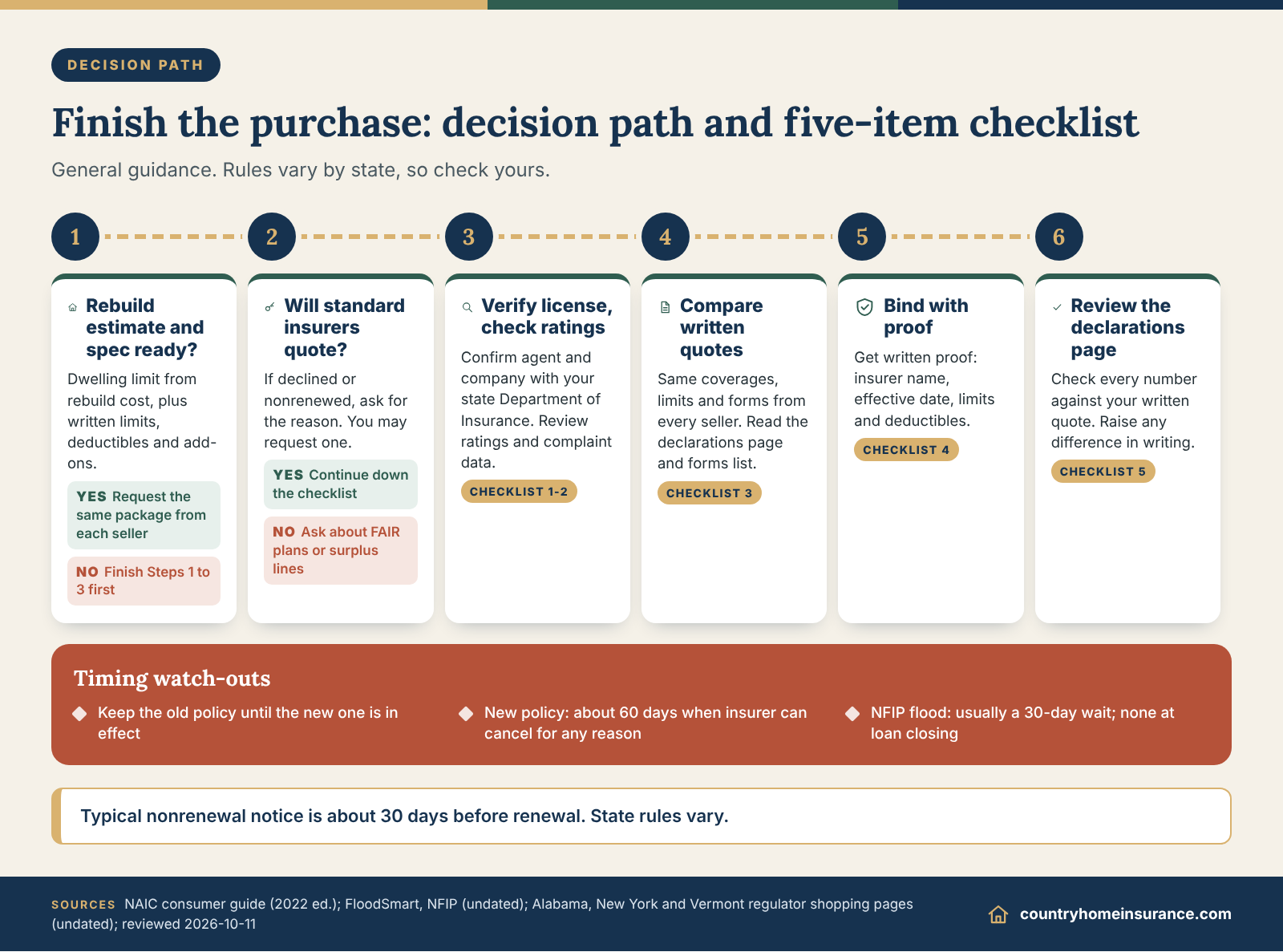
The NAIC consumer guide says new policyholders typically face a period of about 60 days during which the insurer can cancel for any reason, and that afterward cancellation is generally limited to nonpayment, application misrepresentation or a substantial change in risk. New Hampshire’s guide adds that you can cancel your own policy for any reason. If you are replacing a policy, the safest sequence is: bind the new coverage, receive written proof, then ask the old insurer to cancel as of the new effective date, and ask how any refund is calculated. Never assume the old policy ends automatically.
Organize your documents and inventory
The NAIC says to keep your policy in a safe place and to know your insurer’s name. Create one folder, digital and paper, with the declarations page, forms and endorsements, your rebuild estimate, inventory, photos of the home and outbuildings, receipts for major upgrades such as a roof, the agent’s contact details and the claims phone number. Share the digital copy with a trusted family member. If you ever file a claim, the first hour is much easier when these things are already in one place.
Renewals and annual reviews
Buying is not a one-time event. The policy renews, the house changes and the market moves, and each is a reason to check in.
What renewal and nonrenewal notices look like
The NAIC consumer guide says policies normally run 12 months, that insurers typically give notice of nonrenewal about 30 days before the renewal date, though the number of days varies by state, and that you may ask the insurer for the reason. California’s residential brochure, dated January 2016, shows how specific state rules can be: at least 45 days for nonrenewal notice, stating the reason, with cancellation notice periods of 20 days or, for nonpayment or fraud, 10 days. Do not assume these numbers apply in your state; look up your state’s rule through its Department of Insurance. Open every renewal packet and read the declarations page, because limits and deductibles can change at renewal.
Events that should trigger a mid-year review
The NAIC says to review your coverage yearly with your agent, especially after adding rooms, insulation or remodeling. Other triggers include a new roof, which may qualify for a discount according to the NAIC, a new barn or shop, a home business, buying valuable items, installing a wood stove or solar panels, and a change in fire protection or water supply. Each can change the right limit or the eligibility, and some can lower the price. Ask your agent for an annual review and send updates whenever a major change occurs.
Re-running the process every few years
The Texas Department of Insurance explainer on protection classes advises homeowners to compare providers at renewal, because insurers weigh underwriting factors differently. A practical rhythm is to refresh your rebuild estimate and inventory each year and to go through the full shopping process when your premium or terms change significantly, when you lose a discount, or every few years if nothing else prompts it. Switching is not always the answer, but knowing your alternatives gives you leverage in a conversation with your current agent.
| Stage | Verify | Document | Ask |
|---|---|---|---|
| Before requesting quotes | Year built, square footage, roof age, distance to fire station and water source | Rebuild estimate, home inventory, claims history, prior policy details | Which policy forms and endorsements does each seller offer for my property? |
| While comparing | License of each agent and insurer; financial strength rating; complaint data in your state | Written quotes with limits, deductibles, forms and endorsements listed | How is my roof settled, and what is my wind, hail or roof deductible in dollars? |
| Before binding | Application answers; lender requirements; flood requirement and timing | Binder or proof of coverage with effective date and insurer name | When does coverage start, and who sends the premium bill? |
| After the policy arrives | Declarations page and forms against the quote | Policy folder, photos, receipts and contact numbers in two places | What changes do I need to make now, and how do I report them? |
| At each renewal | Changes in limits, deductibles and premium; any notices | Updated rebuild estimate and inventory | What changed, why, and what are my options if I disagree? |
Frequently asked questions
Questions before you buy
Can I buy homeowners insurance without an agent?
Often yes. The NAIC’s consumer guide lists direct sales over the internet, by mail or by phone as one of the ways to buy, and the Alabama and Vermont regulators note that direct purchases may cost less because no agent commission is involved. The tradeoff is guidance: Vermont says direct sellers may not provide the same advice an agent would, so you will need to ask your own questions about forms, deductibles and exclusions. Whichever route you choose, verify the license and read the policy.
Does my mortgage lender choose my insurer?
No. The NAIC consumer page says you do not have to buy from your lender’s recommended insurer and encourages shopping around. Your lender may set a minimum coverage amount tied to your mortgage and typically requires you to name it as mortgagee. Ask the lender for its insurance requirements in writing, then make sure every quote meets them, including any flood requirement listed in your mortgage agreement.
How early should I start shopping?
Early enough that no one is rushing you. California’s brochure says never to make important decisions on the spot, and the NAIC guide notes that policies normally run 12 months, so a renewal gives a natural window. Because nonrenewal notices are typically due about 30 days before renewal and vary by state, begin your homework well before then. Home buyers should begin once an offer is accepted, since lenders will want proof of coverage by closing.
Is the lowest premium the right choice?
Not automatically. The New York department says premium is only one of many factors, and other regulators point to claim service, financial strength and coverage differences. A lower price can reflect a higher deductible, an actual cash value roof, a thinner form or fewer endorsements. Choose the lowest price among quotes that match your written specification, from sellers that pass your licensing, rating and complaint checks.
Questions after you buy
What if the policy I receive differs from my quote?
Compare the declarations page and forms to your written quote as soon as the policy arrives, and contact the insurer or agent in writing about any difference. New Hampshire’s guide advises contacting the insurance company if the policy has not arrived within 30 days. If you cannot resolve the problem, your state Department of Insurance accepts consumer complaints, and the NAIC explains how to prepare one: the type of insurance, your reason, supporting documents and a log of calls and emails.
Can I cancel if I find a better price later?
New Hampshire’s guide says you can cancel your own policy for any reason, though refund calculations and any fees depend on the policy and state rules. Before you cancel, make sure the replacement is bound in writing, your lender has the new proof of coverage, and the old policy ends on the day the new one begins. Ask the old insurer how it will calculate and send any refund.
What should I do if my insurer does not renew my policy?
Ask for the reason, which the NAIC says you may do, and check your notice date against your state’s rule. Then restart the process with Steps 1 through 6, giving extra attention to availability and to fixing the issue the insurer named, such as a roof or fire protection question. If standard insurers decline, review the section above on FAIR plans and surplus lines, and talk with an agent who works with those markets.
Sources
- NAIC consumer homeowners insurance page (undated; copyright 1991-2026; reviewed 2026-10-11)
- NAIC, A Consumer’s Guide to Home Insurance (2022 edition)
- NAIC, actual cash value versus replacement cost (published 2025-01-02)
- NAIC, how to file and research complaints against insurance carriers (2022-09-01)
- NAIC Home Inventory app page (undated)
- Kansas Insurance Department, 2024 complaint index report (complaints closed in calendar year 2024)
- Texas Department of Insurance, complaint data page (last updated 2022-06-21)
- A.M. Best, Guide to Best’s Financial Strength Ratings (2009 version, hosted by the State of Nevada; verify the current scale)
- New Hampshire, independent financial ratings page (health-insurer ratings as of 2018; used only for general rating caveats)
- New Hampshire Insurance Department, home insurance guide (2010 copyright)
- Colorado Division of Insurance, homeowners buyer’s guide (2014 NAIC copyright)
- Mississippi Insurance Department, shopping for homeowners insurance (2014 NAIC copyright)
- Alabama Department of Insurance, home insurance smart shopping (undated)
- New York Department of Financial Services, shopping for insurance (undated)
- Vermont Department of Financial Regulation, buying insurance guidance (undated)
- California Department of Insurance, residential insurance guide (Form 401, January 2016)
- FloodSmart, buy a flood insurance policy (NFIP; undated)
- FloodSmart, flood insurance basics (NFIP; undated)
- Texas Department of Insurance, what to know about insurance and your roof (March 2026)
- Texas Department of Insurance, public protection classification explainer (2023-03-23)
- U.S. Government Accountability Office, GAO-26-107867 on homeowners insurance premiums (published 2026-02-27)
- Nolo, federal rules on force-placed insurance (consumer legal publisher; undated; verify against the regulation)
Important coverage note
Coverage depends on your actual policy, including its endorsements, exclusions, limits, deductible and the cause of loss. State laws and insurance programs vary, and the guidance in this article is general. Your declarations page and policy forms control, and case-specific questions should be verified with your insurer or agent and your state Department of Insurance. This article is educational information only and is not legal advice or an offer of insurance, and it does not promise that any claim will be paid or that any quote or discount will be available to you.
About the editorial team
This guide was prepared by the countryhomeinsurance.com editorial team as general, educational information for homeowners. We research and summarize publicly available material, including state insurance departments, the NAIC, federal agencies, regulators’ consumer guides and published insurer and industry resources. We draw only on the sources that were available to us when we wrote this guide, and we list them in the Sources section with dates where we could find them.
Insurance rules, rates, products and program terms change, differ by state and by insurer, and can apply differently to your situation. We cannot guarantee that this content is complete, current or free of errors. It is not legal, financial, tax or insurance advice, it is not an offer to sell insurance or a recommendation of any insurer, agent or product, and reading it does not create a professional relationship of any kind.
To the fullest extent permitted by law, countryhomeinsurance.com and its editorial team, authors and contributors exclude all liability for any loss, damage or decision arising from the use of, or reliance on, this content. For questions about your own policy or claim, contact your insurer, a licensed agent or broker, your state Department of Insurance or another qualified professional.
Content created: October 11, 2026