
Quick answer
How much homeowners insurance do I need depends on five separate limits, not one number. Set the dwelling limit near the cost to rebuild your home (not its market price), then check the percentages your policy attaches to other structures, belongings and loss of use. Choose a liability limit that fits your assets and lifestyle, and a deductible you could pay tomorrow. Flood and earthquake need separate coverage. Your policy and state rules control.
Key takeaways
- Your dwelling limit should be based on the cost to rebuild, not the purchase price, tax value or mortgage balance, because rebuilding cost does not include land.
- Regulator guides describe typical starting percentages for other structures (about 10%), personal property (about 50%) and loss of use (about 20% in one NAIC guide), but your own policy may use different numbers.
- Insuring below the percentage of replacement cost your insurer requires, often 80% or more, can cause a reduced payment even on a partial loss.
- Liability and medical payments limits are your choice. There is no single regulator-approved number, so size them against your assets, property and activities, and ask about an umbrella policy above them.
- A deductible is risk you keep. Pick one you could pay in cash after a loss, and check whether wind, hail or roof losses carry a separate or percentage deductible.
- Standard homeowners policies generally do not cover flood or earthquake, and sewer backup, mold and farm or business exposures are commonly limited or excluded.
| Policy piece | What it generally protects | Typical starting point described by regulators | What to confirm on your declarations page |
|---|---|---|---|
| Coverage A: Dwelling | The house structure, including attached features | You choose the limit. NAIC says it should equal full replacement cost, which is not market value | Dollar limit, replacement cost or actual cash value, inflation protection |
| Coverage B: Other structures | Detached garage, shed, fencing and similar | Typically 10% of the dwelling limit in NAIC and Wisconsin guides | Whether barns or workshops fit, and whether business or farm use limits it |
| Coverage C: Personal property | Furniture, clothing, electronics and other belongings | Typically 50% of the dwelling limit in NAIC and Wisconsin guides; Triple-I says many companies use 50% to 70% | Replacement cost or actual cash value for contents, plus dollar sublimits on valuables |
| Coverage D: Loss of use | Additional living expenses while a covered loss makes the home unlivable | Typically 20% of the dwelling limit in the NAIC 2022 guide; another consumer source reports 10% or 20%, or a time limit | Percentage or dollar cap, any time limit, and what counts as a covered cause |
| Coverage E: Personal liability | Legal responsibility for injury to others or damage to their property | You choose the limit. Wisconsin’s guide describes a basic limit of $100,000 per occurrence | Per-occurrence limit, defense-cost treatment and whether an umbrella sits above it |
| Coverage F: Medical payments | Medical costs for guests hurt on your property, regardless of fault | You choose the limit. Wisconsin’s guide describes $1,000 per person as typical | Per-person and per-accident amounts |
| Deductible | The amount you pay before the policy pays a covered property loss | You choose among options offered. Some policies add a separate percentage deductible for wind or hail | Flat or percentage, and which perils each one applies to |
How much homeowners insurance do I need? Five numbers, not one
People usually ask this question as if the answer were a single dollar figure. A homeowners policy is really a bundle of separate limits that interact, so a better question is which limit matters most for your house, your belongings, your legal exposure and your savings. This guide walks through each one, shows the arithmetic regulators publish, and flags where the answer changes for country homes.
What is the question really asking?
The phrase can mean several different things, and each one has a different answer. Sorting them out first keeps you from fixing the wrong problem.
Five limits that all count
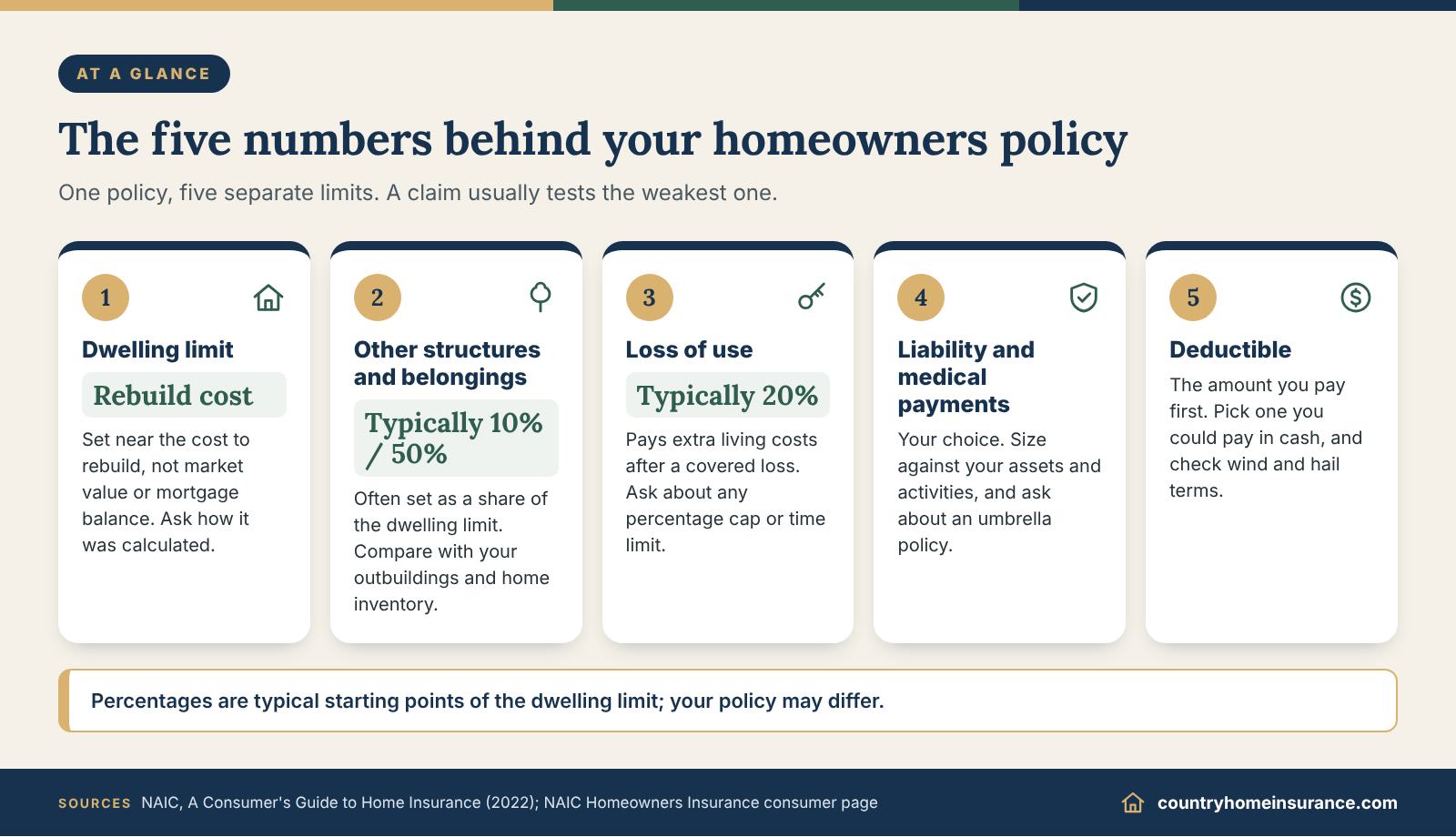
The five numbers are the dwelling limit, the limits for other structures and belongings, the loss-of-use limit, the liability and medical payments limits, and the deductible. The first four are caps on what the insurer may pay or defend; the fifth is the amount you absorb first. A policy can look generous on one line and thin on another, and a claim usually tests the weakest line.
Most of the other limits are written as percentages of the dwelling limit, so the dwelling number sets the scale for much of the policy. That makes it the number to get right first, and the reason the next major section spends the most time on it.
The declarations page is your map
The declarations page is the summary sheet at the front of your policy. It lists each coverage, its limit, the deductibles and any endorsements (written additions or changes to the standard policy). The Triple-I guide to insuring your house points readers to the Section I coverage lines on that page to see their current dwelling and personal property limits. Before you change anything, pull yours out and write down every figure on it, because every later comparison depends on that baseline.
Why is the answer different for a country home?
A rural property is not simply a suburban house with more land around it. The extra land brings extra buildings, longer distances and different liability exposure, and each of those can change what adequate coverage looks like.
Outbuildings, fences and the “other structures” squeeze
A detached garage, a workshop, a barn, a run-in shed and a few hundred feet of fence can easily add up to more than a 10% allowance on the dwelling limit, especially on a modest house. NAIC describes other structures coverage as typically 10% of the dwelling limit, which is generous for a small shed and tight for a working property. If your outbuildings are worth a lot, you will want to ask about raising that limit or insuring the buildings separately.
Distance, protection and rebuild logistics
Many rural properties sit far from a staffed fire station or a hydrant, and some rely on a volunteer fire department. Whether and how that affects price or eligibility is set by each insurer, so ask directly rather than assuming. Rebuilding a remote house may also raise labor and delivery costs, which is another reason to treat a published average or a rule of thumb as a starting point only, and to have the rebuild estimate reflect your actual site.
Dwelling coverage: how much is enough to rebuild?
Coverage A, the dwelling limit, is the biggest dollar figure on your policy and the one that scales most of the others. It is also the number most often set by default, from an insurer’s estimating tool at the time of purchase, and then left alone for years. Getting it close to right is the single most useful thing you can do with this page.
Why does rebuild cost, not market value, drive the number?
Insurance pays to restore a damaged house, so the limit has to be sized to the work of restoring it. Real estate prices measure something different.
Market value includes land and location
The NAIC explanation of actual cash value and replacement cost, dated January 2025, notes that replacement cost does not include the value of the land, while market value does and moves with the real estate market. A house in a hot market may sell for far more than it would cost to rebuild; a house in a soft rural market may sell for less. The Mississippi Insurance Department made the same point in a February 2025 release, warning that many people insure for the likely sale price even though it can differ from the cost of rebuilding.
Purchase price and mortgage balance are different yardsticks
Your lender may set a minimum, which NAIC’s consumer page says is often at least the mortgage amount. A lender minimum protects the lender’s collateral and may sit well below, or occasionally above, the true cost to rebuild. One consumer publisher reports that lenders typically want 100% of replacement cost insured, but requirements are set in your loan documents, so read yours rather than relying on a general rule. Treat the lender’s number as a floor and your own rebuild estimate as the target.
How do you estimate your rebuild cost?
No estimate is exact, and a house that has not been rebuilt has no price tag. What you can do is triangulate with more than one method and note what each one leaves out.
The square-foot shortcut and its limits
The quickest method is to multiply finished square footage by a local building cost per square foot. Triple-I’s guide illustrates the idea with a 2,000-square-foot house at $80 per square foot, or about $160,000. That figure is an illustration of arithmetic, not a current cost, and local rates differ widely, so never use it as an input. The shortcut also hides detail: a plain ranch and a house with a vaulted great room, a stone fireplace and a custom kitchen can share a square footage but not a price.
What a professional estimate asks about
Insurers and agents commonly use replacement cost software. A 2019 Verisk blog describes one such platform’s baseline study of more than 200,000 valuations using 32 common home characteristics, and a warning when an estimate falls below average or lowest reasonable cost per square foot for the area. The practical lesson is that the answer depends on what you tell the tool: foundation type, framing, roof material, number of stories, finishes, garage, porches and systems. Give accurate details, including upgrades and any custom or hard-to-match work, and ask for the inputs to be listed so you can check them.
Ask how your insurer arrived at the limit
A January 2026 Insurance Journal report on underinsurance after the Los Angeles wildfires noted that insurers use third-party estimating tools to set payout caps, that consumer advocates say those tools can underestimate rebuilding costs, and that Verisk says its estimates match claims data. You do not have to settle that debate to act on it. Ask your agent what tool was used, what characteristics were entered and when the estimate was last updated, and consider getting an independent opinion from a local builder or appraiser if your home is unusual. The same report cites United Policyholders for the point that courts often place the duty to determine adequate coverage on the homeowner, which is one more reason to check the number yourself.
How do you keep the limit current as costs change?
A limit that was right at purchase can drift out of date as construction costs rise or as you add a deck, a finished basement or a bigger kitchen. Several policy features exist to manage that drift, and they differ in important ways.
Inflation guard adjusts the limit at renewal
Triple-I describes an inflation guard as a clause that automatically raises the dwelling limit at renewal to reflect local construction cost changes, and suggests asking about adding it by endorsement if your policy lacks one. The Colorado Division of Insurance buyers guide, an NAIC-based document marked 2014, similarly tells shoppers to ask whether limits rise with inflation. An automatic adjustment helps, but it follows an index, not your actual house, so it does not replace an occasional full re-estimate.
Extended and guaranteed replacement cost add cushion
Extended replacement cost pays an additional amount above the dwelling limit, up to a set percentage or dollar figure. Triple-I says the add-on is typically 20% or more depending on the insurer; one consumer publisher’s example uses 25%, which would turn a $400,000 limit into $500,000. Guaranteed replacement cost goes further and pays what it takes to rebuild even above the limit, but the NAIC-based Mississippi shopping guide says very few insurers offer it and advises asking about any cap, and Triple-I adds that it generally excludes code-upgrade costs and may be unavailable for older homes. Wisconsin’s guide says guaranteed replacement cost typically requires insuring to 100% of replacement cost.
Ordinance or law coverage pays for code upgrades
When a damaged home is rebuilt, current building codes may require changes that the original house did not have. Standard policies generally do not pay for code-required upgrades, according to Triple-I, though an endorsement can add a specified amount. The United Policyholders page, last modified in March 2026, says the coverage is commonly expressed as 10%, 25% or 30% of the dwelling limit, may be built in or added by endorsement, and sometimes appears as an exclusion. If your home is older, ask for the percentage in writing and check whether it sits inside or on top of the dwelling limit.
What happens if you insure the home for too little?
Underinsurance rarely shows up until a claim, and by then it cannot be fixed. The consequences come from two places: the policy’s own loss-settlement terms, which may reduce a payment when the limit is below a stated share of replacement cost, and the hard ceiling that the limit places on what can be paid for a total loss.
How does the insurance-to-value penalty work?
Many policies require you to carry a minimum percentage of replacement cost, commonly called a coinsurance requirement. If you fall short, the payment on even a small loss can shrink.
The percentage requirement in plain English
The Maine Bureau of Insurance explains that standard policies often require insuring to 80% of replacement cost, though some require 90% or 100%. The Florida Department of Financial Services says insurers can require 80%, 90% or 100% and illustrates the stakes: on a $240,000 replacement cost those requirements would be $192,000, $216,000 and $240,000. The NAIC consumer guide adds that if your limit falls below 80% of full replacement cost, the insurer may reduce what it pays. Which percentage applies to you is written in your policy, so check the loss-settlement section rather than assuming 80%.
Worked examples from state regulators
The formula the regulators describe divides the amount you carried by the amount the policy required, then applies that ratio to the loss. Table 2 reproduces the arithmetic of the examples these departments published. The figures are the departments’ illustrations, not predictions for any particular claim, and the way a deductible is applied can vary with policy wording.
| Scenario | Rebuild cost and amount carried | Loss | Result described by the regulator |
|---|---|---|---|
| Maine: meets an 80% requirement | $100,000 rebuild cost; $80,000 carried | $25,000 fire loss, $500 deductible | Policy pays $24,500, which is the loss less the deductible |
| Maine: below an 80% requirement | $100,000 rebuild cost; $60,000 carried ($60,000 divided by $80,000 required is 75%) | $25,000 fire loss, $500 deductible | Policy pays 75% of the loss, or $18,750; the owner bears the remaining $6,250 plus the $500 deductible |
| Florida: carried half of what was needed | $200,000 needed; $100,000 carried | $50,000 loss | Policy pays $25,000, or 50% of the claim |
| What to take from it | The ratio applies to every covered loss, not only total losses | Any size | Verify your own percentage requirement and compare your limit to a current rebuild estimate |
How common is underinsurance, and why does it happen?
Nobody publishes a single reliable national underinsurance rate that covers every peril. The best available evidence comes from disasters, where the gap between coverage and rebuild cost becomes visible.
What the wildfire figures show and do not show
The January 2026 Insurance Journal report cites several wildfire-specific numbers. Triple-I is quoted as saying about two-thirds of U.S. homeowners are underinsured for wildfire, typically by roughly 20% and sometimes by as much as 60%. A study of the 2021 Marshall Fire in Boulder County, Colorado, found 74% of affected homeowners underinsured. United Policyholders surveys of wildfire survivors found about two-thirds underinsured by an average of $200,000 or more. These are wildfire and disaster-survivor findings drawn from a news report, so they should not be read as the underinsurance rate for every homeowner or every cause of loss. Still, they show the exposure is real when a whole community rebuilds at once.
Why estimates and limits fall behind
The same report lists several drivers: third-party estimating tools that may understate costs, a long shift from guaranteed replacement cost toward capped replacement-cost policies, post-disaster surges in demand for labor and materials, and affordability pressure that pushes some owners toward lower coverage or higher deductibles. The last point matters for budgeting. Trimming the dwelling limit to save on premium saves little compared with the risk it creates, whereas a higher deductible shifts risk in a way you can plan for.
Should the building be paid at replacement cost, actual cash value or something in between?
The limit tells you how much the policy can pay. The loss-settlement terms tell you how the payment is calculated, and the two work together.
Replacement cost versus actual cash value on the dwelling
Replacement cost value pays to repair or replace damaged property with materials of like kind and quality. Actual cash value subtracts depreciation for age and wear, and the NAIC article says it often does not pay enough to fully replace what was lost. The Mississippi shopping guide adds that policies often pay only actual cash value until repairs begin or are completed, and that replacement cost payments are capped at the dwelling limit. Pay attention to whether the policy lets you recover withheld depreciation after repairs, because that mechanism changes how much cash you need to front.
Functional and modified replacement cost
Some policies, especially on older homes, replace features with modern equivalents instead of matching the original. Triple-I calls this modified replacement cost, using standard current materials in place of items such as plaster walls or hardwood floors. The Mississippi guide describes functional replacement cost the same way, with drywall instead of plaster, and says it provides less coverage than standard replacement cost at a lower premium. If your house has plaster, built-in cabinetry or other period features, ask whether the policy rebuilds with like kind and quality or with functional equivalents.
Roofs often follow their own settlement rules
The NAIC consumer page suggests asking about full replacement cost on the roof with no depreciation deduction. The Texas Department of Insurance, in a March 2026 consumer column, explains that some policies pay the full cost of a new roof while others pay less depending on the roof’s age and condition, and that wind and hail deductibles are often higher than other deductibles. Texas rules are not national rules, but the pattern is common enough to check on any policy with an older roof.
Other structures, belongings and loss of use: how much is enough?
Once the dwelling limit is set, the next three coverages usually follow automatically as percentages. That is convenient, and it is also where country homeowners most often find a mismatch, because the percentages were built for a typical house, not a house with a barn, a shop and a decade of accumulated tools.
How much do detached buildings and landscaping need?
Coverage B pays for structures that are not attached to the house. The allowance is usually small, so test it against what you actually have standing on the property.
The 10% starting point and what it must stretch across
The NAIC 2022 consumer guide says other structures coverage is typically 10% of the dwelling limit, and it names fences, sheds and detached garages as examples. One consumer publisher illustrates the arithmetic with a $250,000 dwelling limit producing $25,000 for other structures. Add up the replacement cost of every detached building and every run of fence, and compare that total with the allowance. On a small house with a large workshop, the gap can be wide. Ask your agent what a higher other-structures limit would add to the premium.
Trees, plants and shrubs often have their own caps
Wisconsin’s consumer guide, revised July 2026, gives an example of a separate allowance for trees, plants and shrubs: 5% of the house coverage, up to $500 per item, with windstorm damage to them not covered. That is one state’s example, and policy forms differ, but it shows why a long driveway lined with mature trees may be less protected than it looks. Read the property section of your own policy for any landscaping sublimit.
Farm and business use can change the category
Wisconsin’s guide also notes that farmowners policies usually do not provide replacement cost on the dwelling unless you request it, and that crops, livestock and equipment generally need separate policies. A barn that houses a hobby flock, a roadside stand or equipment used for income is different from a barn that stores lawn furniture. Tell your agent how each building is used and ask in writing whether the policy will treat it as an other structure. A “no” is a useful answer because it tells you what to insure elsewhere.
How much do your belongings need?
Coverage C is typically a percentage of the dwelling limit, but the right amount comes from what you own, not from the percentage.
Build the number from a home inventory
NAIC’s consumer page says contents are typically 50% of the dwelling limit, so a $100,000 home would carry $50,000, and that you can raise the contents limit for a small extra charge without raising the dwelling limit. Triple-I says most companies set personal property at 50% to 70% of the dwelling limit and suggests comparing the limit with your inventory total. To build one, NAIC recommends grouping belongings by room or category, including rarely used items like tools and holiday decorations, gathering receipts or appraisals, noting model and serial numbers, and photographing or filming everything. Wisconsin’s guide suggests focusing on items worth $100 or more and storing records away from home, and cautions that a written list alone may not be accepted as proof of ownership. The NAIC Home Inventory app can help you capture items by room.
Special limits can be far below an item’s value
Even a generous contents limit has inner caps. The NAIC page says theft limits are typically about $500 for furs and jewelry and about $1,000 for firearms and computers, with many other categories limited to $500 or $1,000, and that a Scheduled Personal Property Endorsement can raise them. Triple-I describes the same idea as a floater and says silverware and some computers also carry special limits. If you own a collection, a firearm, a camera kit or equipment for a hobby, Table 3 shows which line items to compare against your inventory.
| Item or situation | Example limit described | Where it comes from | What to do |
|---|---|---|---|
| Furs and jewelry (theft) | Typically about $500 | NAIC consumer page | Appraise and ask about a scheduled personal property endorsement |
| Firearms and computers (theft) | Typically about $1,000 | NAIC consumer page | Total the value of your guns, laptops and equipment, then compare |
| Trees, plants and shrubs | 5% of house coverage, $500 per item; windstorm not covered (Wisconsin example) | Wisconsin OCI guide PI-015, July 2026 | Read your own landscaping provision, since forms vary |
| Belongings away from home | 10% of the personal property limit (Wisconsin example) | Wisconsin OCI guide PI-015, July 2026 | Ask about tools or equipment kept in a vehicle, storage unit or second location |
| Contents payment method | Replacement cost or actual cash value; many policies pay actual cash value until you replace the item | NAIC-based Mississippi shopping guide (2014) | Find the loss-settlement wording for personal property on your policy |
Replacement cost or actual cash value for contents
Many people carry replacement cost on the house and never look at how contents are paid. The Mississippi guide, based on a 2014 NAIC document, notes that actual cash value for contents pays the item’s value after depreciation, that replacement cost pays to replace it with like kind and quality, and that many policies pay only actual cash value until you actually replace the item. Triple-I points to the loss-settlement condition as the place to look. Ask what upgrading contents to replacement cost would add to the premium.
How much do you need for living costs after a loss?
Coverage D, called loss of use or additional living expense, pays extra costs when a covered loss makes the home unfit to live in. It is easy to ignore until a rebuild takes longer than anyone expected.
What additional living expenses cover
NAIC describes additional living expense as the necessary cost of maintaining your normal standard of living while the home cannot be occupied because of a covered loss. What counts, and for how long, is set by the policy wording, so read it before you need it. The NAIC 2022 guide notes that loss of use is typically 20% of the dwelling limit and that if the underlying peril is not covered, loss of use is not covered either. A flood that damages the house, for example, would not trigger it under a standard policy.
Percentage caps, time limits and rural rental markets
One consumer publisher reports that loss of use is often 10% or 20% of the dwelling limit, or tied to a time limit such as 12 or 24 months, and suggests comparing it with local rental prices. That last step matters in the country, where the closest comparable rental may be many miles away, in short supply or priced for seasonal demand. Ask how the policy decides when the expense period ends and whether it applies a percentage cap, a time limit or both.
What no policy limit will fill: gaps to cover separately
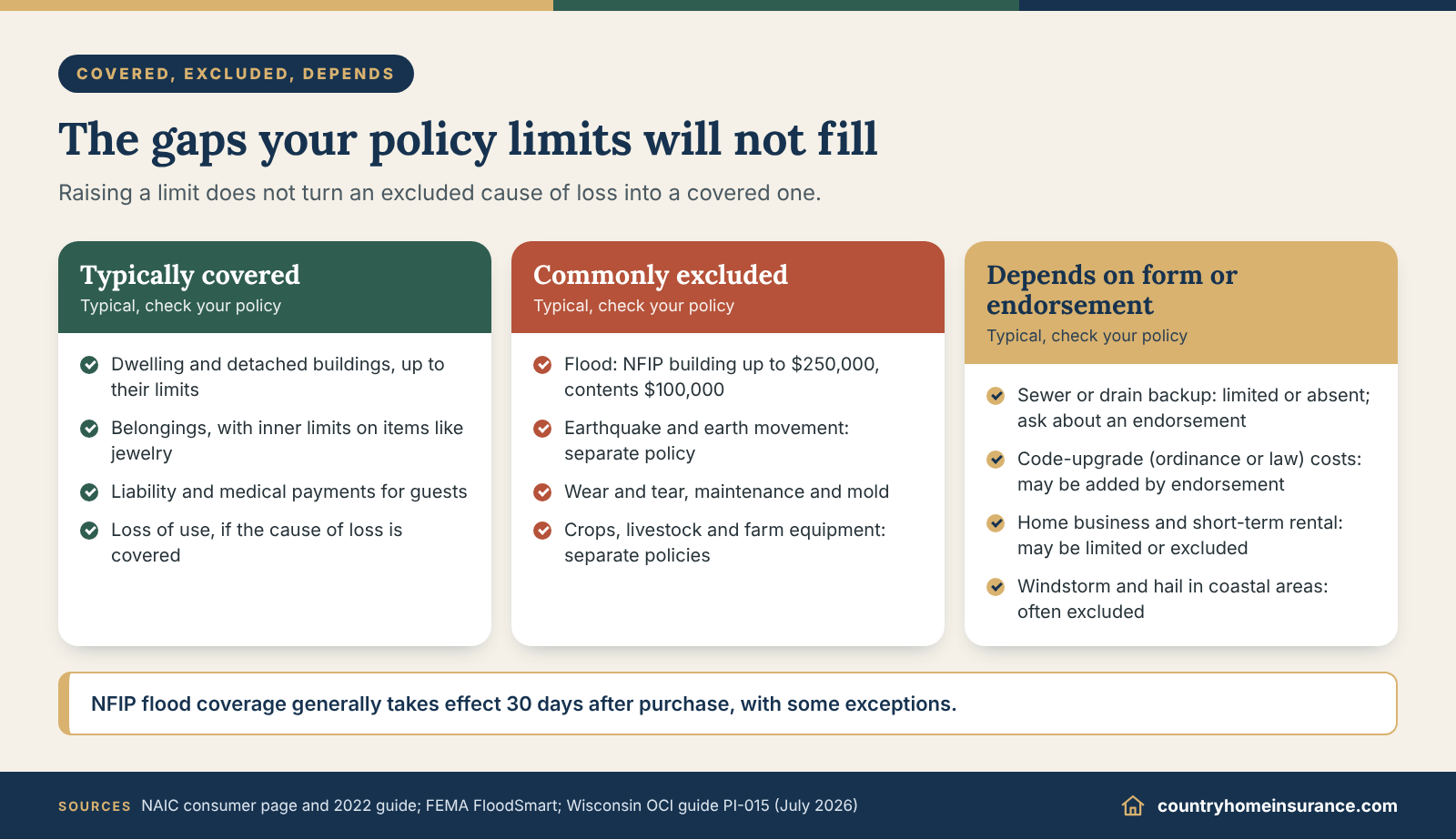
Raising a limit does not turn an excluded cause of loss into a covered one. Some of the most expensive gaps in a rural home’s protection are not about limits at all, they are about perils the standard homeowners form leaves out. Knowing the list is part of answering how much coverage you need, because the missing pieces come in separate policies with their own prices and waiting periods.
Do flood and earthquake need their own policies?
For most homeowners, yes. Both are commonly excluded, and neither can be solved by a higher dwelling limit.
Flood coverage is a separate purchase
The NAIC consumer page says flood is not covered by homeowners insurance, and lists ground water, rain runoff and snow melt as examples. FEMA’s FloodSmart site states that most homeowners insurance does not cover flood damage. For a single-family home, the FloodSmart purchase page says National Flood Insurance Program building policies cover up to $250,000 and contents up to $100,000, that building and contents are usually bought separately with separate deductibles, and that coverage generally takes effect 30 days after purchase unless you buy while making, increasing, extending or renewing a mortgage. NFIP policies are sold through partner insurers and agents at the same NFIP rates. Private flood insurance is also available, per NAIC, so ask your agent which options you have and how limits and waiting periods compare.
Earthquake and earth movement
NAIC’s 2022 guide says earthquake damage is commonly excluded, especially under the special form, and that it can be added by separate policy or endorsement. Wisconsin’s guide lists earth movement among the standard exclusions. Whether it is worth buying depends on your location and your budget, and the NAIC consumer page observes that earthquake coverage can be inexpensive in some areas, including the New Madrid fault zone. Ask for a quote so you can decide with real numbers.
What about water backup, mold and wear?
These everyday problems cause frequent disputes because they sit between covered and excluded depending on cause.
Sewer, drain and sump pump losses
The NAIC 2022 guide says coverage for mold, sewer or drain backup and sump pump overflow is limited or absent, though endorsements may be available. Wisconsin’s guide adds that a sewer backup endorsement must usually be requested and that sump pump losses are excluded. On a country property served by a septic system or a private well pump, ask your agent specifically how backup from your own system is treated, since the answer depends on policy wording.
Mold, maintenance and wear and tear
NAIC lists mold among the common exclusions, and its 2022 guide says wear and tear and maintenance are the owner’s responsibility, using rotted porch railings as an example of something that simply wore out. A higher dwelling limit will not change that. A maintenance routine and a prompt response to leaks do more than any endorsement to keep small problems from becoming denied claims.
Which farm, business and animal exposures sit outside the standard policy?
Country living invites activities that homeowners forms were not designed around. Naming them now is cheaper than discovering them at claim time.
Farm property and income activities
Wisconsin’s guide says crops, livestock and equipment usually need separate policies and that homeowners policies usually do not cover business liability or income lost when a home business is damaged. A hobby farm that sells eggs, hay or produce may cross that line. Describe your activities to an agent in plain terms and ask whether a farm or ranch policy, an endorsement or a business policy fits better.
Home business, short-term rental and animals
NAIC says homeowners insurance is generally not designed for business use and that a paid daycare needs additional liability insurance. Wisconsin’s guide says occasional short-term rentals may be limited or excluded and that pets and most animals, birds or fish are generally not covered as property. NAIC’s consumer page also notes that certain dog breeds or exotic pets can affect liability coverage. If you board horses, keep unusual animals or host guests for pay, treat the liability section as something to review line by line.
| Exposure | Standard homeowners policy typically | Ways to address it | Source |
|---|---|---|---|
| Flood | Not covered | NFIP or private flood policy; FloodSmart describes a 30-day wait in most cases | NAIC; FEMA FloodSmart |
| Earthquake and earth movement | Commonly excluded | Separate policy or endorsement | NAIC 2022 guide; Wisconsin OCI |
| Sewer or drain backup, sump pump overflow | Limited or absent | Endorsement, if available, usually requested | NAIC 2022 guide; Wisconsin OCI |
| Mold, wear and tear, maintenance | Commonly excluded or limited | Prevention and prompt repair; ask about any limited mold provision | NAIC consumer page and 2022 guide |
| Crops, livestock, farm equipment | Generally not covered | Farm or ranch coverage or separate policies | Wisconsin OCI guide |
| Home business liability and income | Generally not covered; some coverage may apply | Endorsement or business policy | NAIC 2022 guide; Wisconsin OCI |
| Windstorm and hail in coastal areas | Often excluded; separate policy may be required | Separate windstorm policy, where offered | NAIC 2022 guide |
How high should liability and medical payments limits go?
The dwelling limit is bounded by the cost of the house. Liability has no such natural ceiling, because a lawsuit can be worth more than everything you own. That makes this the part of the policy where “how much do I need” is most personal, and where regulators give the least numerical guidance.
What do Coverage E and Coverage F actually do?
The two coverages look alike on the declarations page and work differently in practice, so it helps to separate them before choosing amounts.
Personal liability pays for legal responsibility, including defense
The Mississippi shopping guide, drawn from a 2014 NAIC document, says personal liability protection covers your financial loss, including legal costs if you are sued, when you are legally responsible for someone else’s bodily injury or property damage. NAIC’s consumer page describes it as covering claims from accidents to others on property you own or rent. It does not pay for damage to your own house, and its limit is a cap per occurrence. Check whether defense costs are paid in addition to the limit or reduce it, because the declarations page does not always say.
Medical payments pays regardless of fault
NAIC says medical expense coverage has per-person and per-accident limits and pays regardless of legal liability for injuries to others on your premises, or elsewhere if caused by you, your family or your pets. Wisconsin’s guide describes $1,000 per person as typical, and one consumer publisher puts the usual range at $1,000 to $5,000. The amounts are small by design. Their value is in settling minor injuries quickly, such as a neighbor’s child who trips on a porch step, without a liability fight.
How do you choose a liability limit?
There is no regulator-endorsed formula, and anyone who quotes a universal figure is guessing. A workable approach starts with what you could lose and adds what you could be blamed for.
Start with what a judgment could reach
One insurer’s educational page says liability limits are often aligned with the value of all of your assets, not just the home, and that most insurers offer up to $500,000 on home policies; treat that as an insurer’s marketing view rather than a standard. A consumer publisher similarly advises choosing a limit at least high enough to cover your assets, and notes that limits often start at $100,000. Wisconsin’s guide gives $100,000 per occurrence as a typical basic limit. Add up your home equity, savings, investments and other assets that could be reachable, and think about future income. If the total is well above the policy limit, the gap is a question for an umbrella policy.
Country-living exposures worth discussing
The consumer publisher lists a dog, a pool, firearms, a trampoline and frequent parties as reasons to consider higher limits. A country property adds its own list of questions to put to your agent: ponds or creeks, ATVs and tractors used on the land, guests who hunt or ride, animals that may escape onto a road, private roads others use, and hired help. Whether each is covered, excluded or limited depends on your policy, so ask about the ones that apply and get the answer in writing rather than relying on a verbal assurance.
When does an umbrella policy make sense?
An umbrella is a separate liability policy that sits on top of your home and auto limits. It is the standard way to raise liability protection beyond what a homeowners policy sells.
How an umbrella works in practice
NAIC says personal umbrella liability insurance raises your liability coverage above the level in your homeowners policy. The Colorado and Mississippi guides describe umbrella policies as usually sold with limits of $1 million or more. Wisconsin’s guide says umbrellas start paying after underlying home and auto limits are used up, that common limits are $1 million or $5 million, and that insurers may require underlying limits of about $200,000 to $300,000 and may require you to buy your primary coverage from them. Its example is a $150,000 injury claim against a $100,000 homeowners limit, which would leave $50,000 for the umbrella.
Questions to ask before buying one
An umbrella has its own terms. Ask which underlying limits it requires on your home, your vehicles and any watercraft, how its deductible or retention works (Wisconsin’s guide gives $250 to $1,000 as a typical range), and whether any exposures on your property, such as business or farm activities, are excluded. If you must raise underlying limits to qualify, factor that cost into the total.
Deductibles: how much of the risk should you keep?
A deductible is not an amount of coverage, but it belongs in any discussion of how much insurance you need, because it decides how much of each loss comes out of your pocket. Setting it too low costs premium every year; setting it too high can turn a covered claim into a financial strain.
What kinds of deductibles can a policy have?
A single policy can carry more than one deductible, and the one that applies depends on the cause of loss.
Flat dollar deductibles
The Maine Bureau of Insurance says most policies use a flat deductible such as $500 or $1,000. Wisconsin’s guide describes $250 as a typical standard deductible with $500 and $1,000 options. NAIC adds that the deductible applies to the house and personal property coverages, not to liability. The deductible is subtracted from the covered loss, so a $10,000 repair with a $1,000 deductible leaves the policy to pay $9,000 if nothing else reduces the payment.
Percentage deductibles for wind, hail and hurricane
Maine’s example shows how percentage deductibles work: on $150,000 of dwelling coverage, a 1% windstorm deductible is $1,500. The NAIC 2022 guide notes that some areas use catastrophe deductibles expressed as a percentage rather than a dollar figure. Because the percentage applies to the dwelling limit, a higher dwelling limit raises the dollar deductible on the same storm. Hypothetical example: at 2% of a $400,000 dwelling limit, the deductible would be $8,000. That arithmetic is illustrative; your policy states the actual percentages and which perils trigger them.
Separate roof, wind and hail provisions
The Mississippi shopping guide says a policy may have more than one deductible, for example separate hurricane or wind deductibles or a separate roof deductible. The Texas Department of Insurance column dated March 2026 says wind and hail deductibles are often higher than other deductibles, so a roof repair after a storm may cost more out of pocket than a fire repair of the same size. Find these provisions on the declarations page, since they are easy to miss in a quote summary.
How do you choose the amount?
The right deductible balances premium savings against what you can pay without borrowing. Neither number can be chosen without the other.
Weigh savings against cash on hand
NAIC says a higher deductible generally lowers the premium and that you should choose one you can pay after a claim. Wisconsin’s guide says a $500 deductible may lower the premium by about 5% to 10% compared with a lower one, and the Mississippi guide suggests asking how much you would save by raising yours. Ask your agent to quote two or three deductible levels side by side so you compare apples to apples. If moving from $1,000 to $2,500 saves a small amount per year, the extra $1,500 of exposure may not be worth it; if it saves a lot, a dedicated emergency fund may justify the change.
Match the deductible to how losses actually happen
Triple-I’s page, using ISO data for 2023, reports that about 5.3% of insured homes had a claim, that the average claim was $20,062, and that the cause-of-loss breakdown put wind and hail at 42.5%, water damage and freezing at 22.6% and fire and lightning at 21.6%. These are national figures, not forecasts for your address, but they show why wind and hail deductibles deserve as much attention as the all-perils deductible. If wind and hail dominate your risk, read that provision first.
A worked example: putting the five numbers together
Abstract percentages are easier to judge against a concrete case. The example below is invented to show the arithmetic and the questions it raises. It is not a quote, a recommendation or a prediction of what any insurer will offer.
What does a sample country home look like?
The example uses round numbers and typical percentages from the regulator guides above. Your policy may use different percentages.
Hypothetical example: the property and its estimates
Hypothetical example. A family owns a 2,400-square-foot farmhouse on 12 acres. The property would sell for about $450,000, most of which reflects land and location. A local builder estimates the cost to rebuild the house at $390,000. The mortgage balance is $210,000. A detached garage and workshop, a small barn and several hundred feet of fence would cost roughly $85,000 to replace. The family estimates their belongings at $120,000 after a room-by-room inventory.
Hypothetical example: the resulting limits
The dwelling limit would target the $390,000 rebuild estimate, not the $450,000 market value or the $210,000 mortgage. At typical starting percentages, other structures would be 10%, or $39,000, personal property 50%, or $195,000, and loss of use 20%, or $78,000. A 1% wind and hail deductible would be $3,900 and a 2% deductible $7,800. An 80% insurance-to-value requirement would be $312,000. Liability would be chosen separately, based on assets and lifestyle.
What does the example reveal?
Running the numbers exposes the places where defaults and reality part ways.
Hypothetical example: where the gaps appear
Two things stand out. First, the $39,000 other-structures allowance is less than half of the $85,000 the family would need to replace its outbuildings, so they would need to ask about a higher limit or separate coverage. Second, the $195,000 contents allowance is well above the $120,000 inventory, so they might lower it, or keep it for cushion, depending on price. Neither conclusion would be visible without the inventory and the outbuilding list.
Hypothetical example: how a shortfall could change a payment
Suppose the family had carried $250,000 on the dwelling because a quote tool suggested it. Using the formula in the Maine and Florida examples, $250,000 divided by the $312,000 required is about 80.1%, so a $40,000 covered partial loss would be reduced to about $32,051 before any deductible treatment, leaving roughly $7,949 for the owners. Details vary by policy language, but the pattern holds: an undersized limit can reduce payment on a partial loss, not just a total loss.
What should you gather and ask before you change anything?
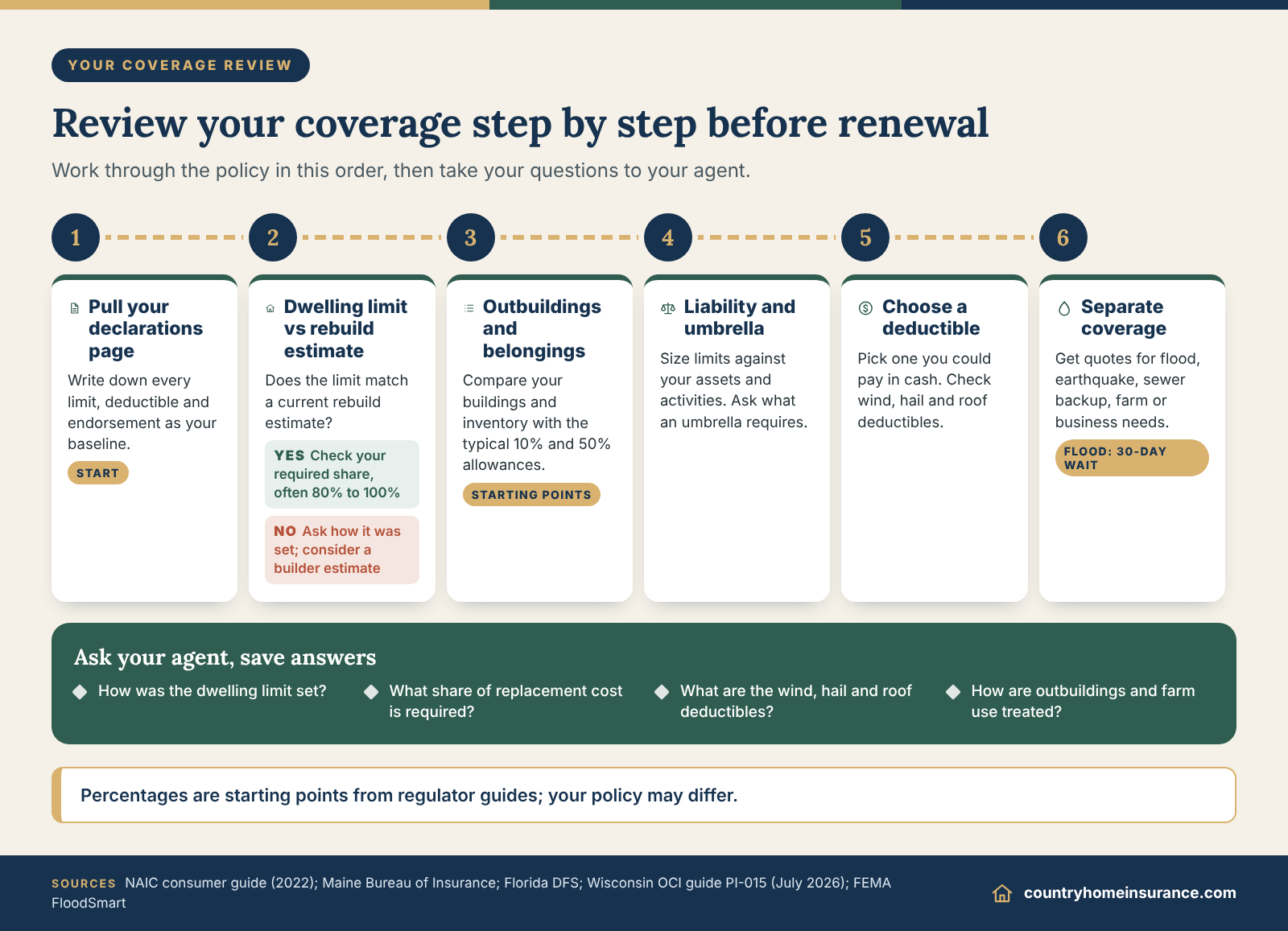
Good decisions come from a short list of documents and questions. Table 5 pulls them together so you can work through them with an agent or on your own before renewal.
Documents to gather first
Start with the current declarations page and the full policy form, including every endorsement. Add your inventory, appraisals for valuables, any recent contractor estimate for rebuild cost, the mortgage statement and any lender insurance requirements, and a list of every building and animal on the property. If you have made improvements since you bought the home, include the invoices.
Questions to put to your insurer or agent
Ask how the dwelling limit was calculated and when it was last updated. Ask what percentage of replacement cost the policy requires and how loss settlement works for the building, the roof and contents. Ask what the ordinance or law percentage is, whether extended or guaranteed replacement cost is offered, and what each deductible is. Ask how the policy treats your outbuildings, any farm or business activity and liability exposures, and what an umbrella would require.
| Item | What to verify | What to document or ask | Why it matters |
|---|---|---|---|
| Dwelling limit | Dollar limit against a current rebuild estimate | Estimating tool, inputs and date; an independent builder estimate for unusual homes | Limits payment and may set the insurance-to-value ratio |
| Loss settlement | Replacement cost or actual cash value for house, roof and contents | Whether depreciation is withheld until repairs are made | Determines how much cash is needed up front |
| Cushions | Inflation guard, extended or guaranteed replacement cost, ordinance or law percentage | Percentages and whether they sit inside or above the limit | Covers cost increases and code upgrades that the base limit may not |
| Other structures | Allowance against the replacement cost of every detached building and fence | List of buildings with use and value; ask about higher limits | Outbuildings can exceed the typical allowance |
| Personal property | Limit against inventory total, plus special limits | Inventory, appraisals, serial numbers; scheduled items | Inner caps can be far below an item’s value |
| Loss of use | Percentage or dollar cap and any time limit | Local rental prices and likely rebuild timeline | Rural rebuilds and rentals may take longer |
| Liability and umbrella | Per-occurrence limit, medical payments limit, umbrella requirements | Asset list, activities and animals on the property | Judgments are not capped by home value |
| Deductibles | Flat, percentage, wind and hail, roof | Premium quotes at two or three deductible levels | Sets what you pay out of pocket on each claim |
| Separate coverage | Flood, earthquake, sewer backup, farm and business | Quotes for each, waiting periods and limits | Standard policies typically exclude or limit these |
Frequently asked questions
Questions about the dwelling limit
Is 80% of replacement cost enough?
Eighty percent is a common minimum requirement in regulator examples, not a target. NAIC says the insurer may reduce payment if your limit is below 80% of full replacement cost, and Maine and Florida explain that some policies require 90% or 100%. Meeting a minimum avoids the penalty formula, but it still leaves you exposed to the remaining 20% on a total loss unless the policy has extended replacement cost or a similar feature. NAIC’s guide says the dwelling limit should equal full replacement cost, so treat 80% as the floor and ask about cushions such as extended replacement cost for surprises.
Should I insure for what I paid or what the house is worth?
Neither is the right basis. Purchase price and market value both include land and market conditions, which do not matter to a rebuild. The NAIC and Mississippi guidance points to the cost to repair or replace with like kind and quality, which is a construction number. Use purchase price or appraisal only as a rough check on whether your estimate is in a believable range.
Does my mortgage lender decide how much I need?
Your lender sets a minimum, which NAIC says is often at least the mortgage amount, but the lender’s interest ends where the loan ends. You may need more than the lender requires to rebuild fully. If your coverage lapses, NAIC says the lender may buy coverage on your behalf, which costs more and covers only the structure, so keep your own policy current.
Questions about other limits and deductibles
Is $100,000 in liability coverage enough?
It depends on what you have to lose and what you do on the property. Wisconsin’s guide describes $100,000 per occurrence as a basic limit, and several sources say limits go higher and that an umbrella can add $1 million or more. For a household with real savings, home equity or a high-risk activity, $100,000 may be thin. Ask an agent to price higher limits and an umbrella so you can compare the cost to the protection.
Can I raise my contents limit without raising my dwelling limit?
NAIC says you can raise contents coverage for a small extra charge without increasing dwelling coverage. Ask your insurer what the increase costs and whether the higher limit changes loss-settlement terms. For individual valuables, a scheduled personal property endorsement may work better than a higher blanket limit because it addresses special sublimits directly.
How often should I review my coverage?
NAIC suggests reviewing dwelling coverage periodically, and a practical rhythm is at each renewal and after any major purchase, renovation, addition or new outbuilding. A renewal notice is also the moment to check whether the limit, deductibles and endorsements changed without your noticing. Keep the inventory current at the same time, so the update takes minutes instead of hours.
Sources
- NAIC consumer guide: Homeowners Insurance (undated page; copyright 1991-2026; reviewed 2026-10-11)
- NAIC, A Consumer’s Guide to Home Insurance (2022 edition; reviewed 2026-10-11)
- NAIC: what is the difference between actual cash value and replacement cost coverage (January 2, 2025)
- NAIC: Home Inventory (undated page; reviewed 2026-10-11)
- FEMA FloodSmart: Buy a flood insurance policy (undated page; reviewed 2026-10-11)
- FEMA FloodSmart: Flood insurance basics (undated page; reviewed 2026-10-11)
- Wisconsin Office of the Commissioner of Insurance, Homeowners Insurance guide PI-015 (revision 07/2026; one state’s example)
- Maine Bureau of Insurance: out-of-pocket costs, deductibles and coinsurance (copyright 2022; undated)
- Florida Department of Financial Services: Homeowners insurance FAQs (undated)
- Mississippi Insurance Department press release on replacement cost and sale value (February 5, 2025)
- Mississippi Insurance Department: shopping guide for homeowners insurance (NAIC-based, copyright 2014; older source)
- Colorado Division of Insurance: Buyer’s guide to homeowners insurance (NAIC-based, marked 2014; older source)
- Texas Department of Insurance: what to know about replacing your roof with insurance (March 2026; Texas example)
- Triple-I: insurance for your house and personal possessions (undated page; copyright 2026)
- Triple-I: facts and statistics on homeowners and renters insurance (ISO 2023 data; reviewed 2026-10-11)
- Insurance Journal: LA fire survivors and underinsurance (January 20, 2026; news report on wildfire underinsurance)
- Verisk: ensuring coverage measures up by cost per square foot (October 24, 2019; older vendor source)
- United Policyholders: building code and ordinance or law compliance (modified March 25, 2026; consumer advocacy)
- NerdWallet: how much home insurance do you need (updated February 27, 2026; consumer publisher context)
- Farmers Insurance: how much home liability do I need (undated; insurer educational page)
Important coverage note
Coverage depends on your actual policy, endorsements, exclusions, limits, deductible and the cause of loss. State laws and insurance programs vary, and the examples above come from regulators in several different states and from national sources of differing ages. Verify case-specific questions with your insurer or agent and with your state Department of Insurance, and refer to the declarations page and policy form for the limits and terms that apply to you. This article is educational information, not legal advice, and it does not promise that any claim will be paid or that any insurer will offer any limit or price.
About the editorial team
This guide was prepared by the countryhomeinsurance.com editorial team as general, educational information for homeowners. We research and summarize publicly available material, including state insurance departments, the NAIC, federal agencies, regulators’ consumer guides and published insurer and industry resources. We draw only on the sources that were available to us when we wrote this guide, and we list them in the Sources section with dates where we could find them.
Insurance rules, rates, products and program terms change, differ by state and by insurer, and can apply differently to your situation. We cannot guarantee that this content is complete, current or free of errors. It is not legal, financial, tax or insurance advice, it is not an offer to sell insurance or a recommendation of any insurer, agent or product, and reading it does not create a professional relationship of any kind.
To the fullest extent permitted by law, countryhomeinsurance.com and its editorial team, authors and contributors exclude all liability for any loss, damage or decision arising from the use of, or reliance on, this content. For questions about your own policy or claim, contact your insurer, a licensed agent or broker, your state Department of Insurance or another qualified professional.
Content created: October 11, 2026
