Quick answer
A hail damage roof insurance claim usually starts with protecting the home, documenting the damage and reporting the loss promptly. The insurer’s adjuster then inspects, and what gets paid depends on your policy: the cause of loss, any cosmetic-damage wording, your wind/hail deductible, and whether the roof is settled at replacement cost or actual cash value. Avoid permanent repairs before inspection, and be wary of any contractor who offers to cover your deductible.
Key takeaways
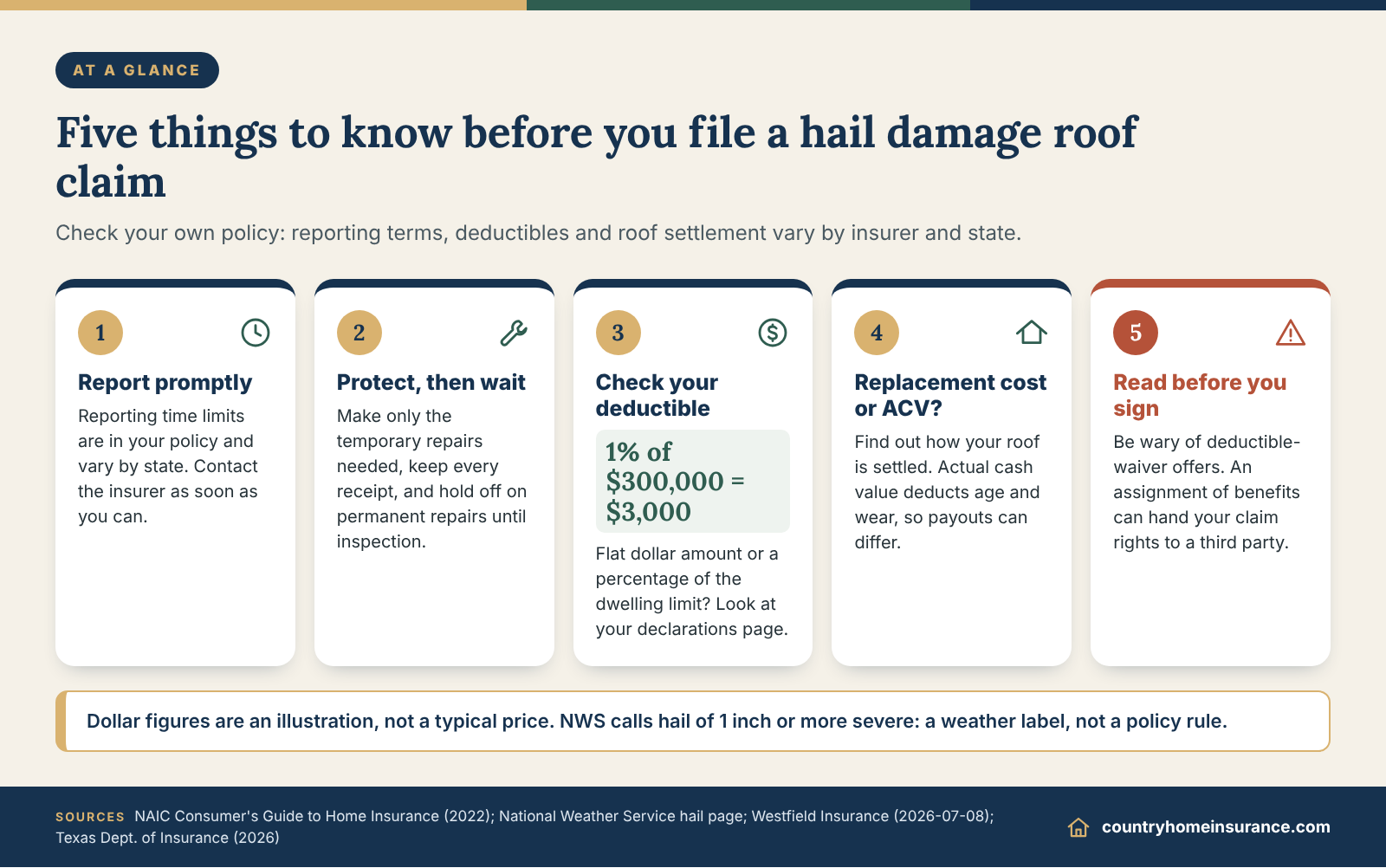
- Report the damage as soon as you can. Insurers set their own reporting requirements, and the exact time limit is in your policy and varies by state.
- Make only the temporary repairs needed to stop further damage, keep every receipt, and hold off on permanent repairs until the insurer has inspected.
- Many homes carry a separate wind/hail deductible, sometimes a percentage of the dwelling limit. On a $300,000 limit, a 1% deductible is $3,000 before the policy pays.
- Replacement cost coverage on a roof is often paid in two steps, while actual cash value deducts age and wear. Check your declarations page to see which one applies to your roof.
- Roofers in at least some states are barred from offering to waive your deductible, and signing an assignment of benefits can hand your claim rights to a third party.
- Whether dents or granule loss count as covered damage can turn on policy wording, so ask the adjuster to explain in writing how they reached the scope of repair.
| Scenario | Typical treatment | What it usually turns on |
|---|---|---|
| Hail cracks, punctures or tears shingles and the roof no longer sheds water | Typically covered when the policy covers hail | Cause of loss, the wind/hail deductible and how the roof is settled (replacement cost or actual cash value) |
| Hail dents a metal roof but nothing leaks | Depends | Whether the policy or an endorsement excludes cosmetic damage, and how the wording defines it |
| Granule loss or bruising on an older asphalt roof after a storm | Depends | Whether the insurer ties the damage to the storm or to wear, and what the policy says about age and condition |
| A roof that was already worn out or in poor condition | Typically not paid for wear alone | Insurers generally do not replace an old roof just because it is old; Texas regulators say so directly |
| Hail damage to a detached barn, shed or garage | Depends | Whether the building falls under Other Structures coverage, its limit, and whether it is used for farm or business purposes |
| Hail dents on a vehicle parked at the house | Not a homeowners claim | Vehicle damage generally belongs under auto insurance |
What a hail damage roof insurance claim actually involves
If a hailstorm just rolled across your property, you probably want two answers fast: will insurance help, and what do I do next? This guide is built around those two questions. It is about the claim itself, from the first phone call to the final check, and it focuses on asphalt-shingle and metal roofs of the kind you see on country homes, barns and shops. It will not give you a guaranteed outcome, because no article can. What it can do is show you how the pieces of a claim fit together, so the policy language in front of you makes sense.
A quick note on timing. Hail season runs on a different calendar in different regions, and damage can sit unnoticed for weeks. If you are reading this in October or November after a late-season storm, or after finding damage you missed in spring, the same steps apply, and the sooner you report, the better your position.
Where hail damage sits inside a homeowners policy
Before the mechanics of a claim, it helps to know which part of the policy responds to a damaged roof and what the standard framework looks like.
The roof is part of the dwelling, and hail is usually a covered peril
On a typical homeowners policy, the roof is part of the house itself, which the policy calls Coverage A (Dwelling). The National Association of Insurance Commissioners (NAIC), the group of state insurance regulators, notes in its Consumer’s Guide to Home Insurance that most states include windstorm and hail in a standard homeowners policy. It also warns that coastal policies often exclude wind, so a separate policy may be needed there. If your policy excludes wind or hail, or limits it by endorsement, a hail claim may be paid differently or not at all, so the declarations page and endorsement list are the first things to read.
Outbuildings fall under a different coverage line
If hail hit the barn, workshop or detached garage too, that damage generally falls under Other Structures (Coverage B), not the dwelling limit. The NAIC says Other Structures covers detached buildings such as a garage, work shed or fencing, and that some detached buildings may need additional coverage. Rural owners should read that last point carefully. A hay barn, a shop used for a side business or a livestock shelter may be treated differently from a plain garden shed, and the policy wording, not the building’s name, decides how it is treated.
How big does hail have to be to damage a roof?
People tend to ask whether the stones were “big enough.” The answer is more nuanced than a single number, and the nuance matters when an adjuster and a homeowner see the same roof differently.
The one-inch line is a weather-service label, not a policy rule
The National Weather Service classifies a thunderstorm as severe when it produces hail at least 1 inch across, roughly the size of a quarter, or winds of at least 58 miles per hour. Its size chart runs from pea-size at a quarter inch to golf ball at about 1.75 inches and baseball at about 2.75. That threshold exists to trigger warnings. Nothing in a standard homeowners policy says hail smaller than one inch cannot damage a roof, so a claim should rest on the condition of the roof, not on a weather-service label.
What recent IBHS research says about smaller hail
The Insurance Institute for Business & Home Safety (IBHS) is a nonprofit research group funded by the insurance industry. In a study published in the journal Frontiers in Materials in 2025, IBHS researchers fired frozen hailstones at installed asphalt shingle samples. Press coverage of the study reports that repeated impacts from hail under 1 inch caused more cumulative granule loss than a single 2-inch stone, and that shingles weathered for a year and then hit by small hail were about ten times more vulnerable to later severe hail. The authors suspect repeated small hits knock off enough granules to speed up aging, which they treat as a hypothesis.
It is worth keeping this in proportion. A laboratory study is not a policy provision. Defense-side lawyers quoted in the coverage point out that policies generally require damage from a distinct event, and that gradual wear across several storms is often excluded. Whether the study can be used in a dispute also depends on state evidence rules. For a homeowner, the practical takeaway is modest: small hail is not automatically harmless, and it is reasonable to ask for a careful inspection after any storm that left marks on soft metals, siding or vehicles.
Why hail claims are so common right now
You are not imagining the volume of hail claims. Understanding the backdrop helps explain why deductibles and roof settlement terms have been changing at renewal.
The scale of severe convective storm losses
According to a report from the Insurance Information Institute (Triple-I) as relayed by trade press in April 2026, severe convective storms, the category that includes hail, tornadoes and straight-line winds, caused about $51 billion in U.S. insured losses in 2025, citing Gallagher Re. That was the third straight year above $50 billion. The same coverage says hail makes up roughly 80% of severe convective storm claims in a typical year. These are national figures from one set of sources, not a forecast for your county or your premium.
What the numbers mean at your kitchen table
Triple-I’s chief insurance officer has said the biggest driver is greater exposure, meaning more homes, higher-value construction and rising rebuilding costs, more than necessarily stronger storms. For you, that tends to show up in three places: higher wind/hail deductibles, closer scrutiny of roof age and condition at renewal, and more careful claim inspections. None of that changes your rights under the policy you hold, but it is a good reason to read that policy before you need it.
First steps after a hailstorm: protect, report and document
The first hours after a storm shape the rest of the claim. The goal is simple: keep the damage from getting worse, tell the insurer, and capture evidence while the roof still looks the way the storm left it.
Staying safe and stopping further damage
Your policy almost certainly expects you to look after the property once the loss has happened, and regulators say the same thing.
Look from the ground first
A hail-damaged roof can be slick with loose granules and may have weakened spots. Nebraska’s Department of Insurance has long advised homeowners not to put themselves at risk to inspect, and to ask the insurer for a recommendation if you are unsure whether the roof is damaged. Walk the property and check from the ground: look for shingle pieces or granules in the gutters and at downspout outlets, dented vents and flashing, damaged skylights, and water stains on ceilings. A ladder or a drone-style inspection from a contractor can wait. Your safety is worth more than any photograph.
Temporary repairs and why receipts matter
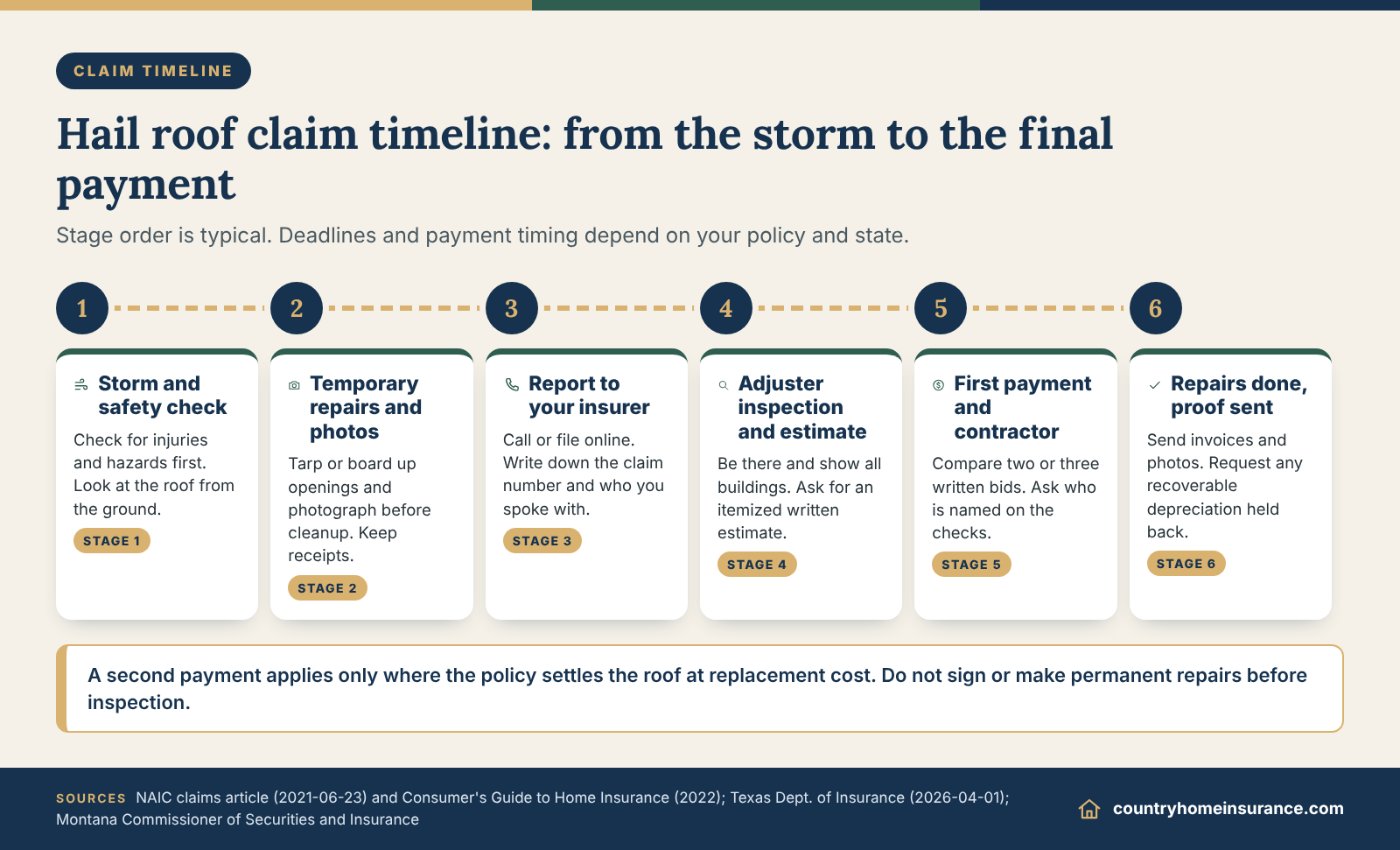
The NAIC consumer guide says you must take reasonable steps to prevent further damage, such as boarding up openings, and it advises keeping receipts for repairs. NAIC’s claims article adds that temporary repairs, such as covering roof holes, are typically reimbursed when the policy covers the loss. Think tarps, plywood and sheeting rather than a new roof. Ask the insurer or agent what it will accept and keep the work modest. Permanent repairs are different: the Mississippi, Montana and Nebraska insurance regulators each advise waiting until the insurer has inspected or agreed to costs.
Reporting the claim
Reporting is a step many people delay because they are unsure the damage “counts.” That is understandable, but it is rarely a good reason to wait.
How soon is soon enough?
The NAIC says insurers have deadlines for reporting claims and tells policyholders to contact them as soon as possible. The Mississippi Insurance Department adds that a policy may require notice within a set period. Beyond that, the specifics vary. Policies, endorsements and state laws set their own timelines, and no single number applies everywhere. Read the “Duties After Loss” or similar conditions section of your policy, and ask the insurer directly how much time you have. Where you suspect a roof problem from an older storm, ask the same question and explain when you first noticed it.
What to have ready when you call
NAIC suggests having your policy information, current contact details and a list of damaged property ready. For a roof claim, add the approximate date of the storm, the roof’s age and material if you know them, and any previous roof repairs or claims. Montana’s insurance regulator also suggests making your address visible from the street so the adjuster can find you, which is helpful if you are on a county road or a long private lane. Note the claim number, the name of the person you spoke with and the date, because the NAIC guide recommends keeping a record of conversations with your insurer.
Documenting the damage before anyone touches it
Documentation is the one area where a little effort pays off most. Regulators repeatedly say to document before cleanup, and the adjuster’s records help determine your settlement amount, so your own records are a useful counterweight.
A photo and video routine for roofs and outbuildings
Start wide and work in. Photograph each side of the house and each outbuilding from a distance, then move closer to dents in gutters, downspouts, vents, flashing, window screens, siding, garage doors and air-conditioning fins. These “soft” surfaces often show hail marks clearly even when shingles are harder to read. Take a short video walking the property with the date visible, and add photos of any interior water stains. If it is safe, your contractor or a drone operator can capture the roof surface later, but do not rely on that alone. Save damaged items, such as a broken skylight cover or torn screen, if possible, because the NAIC says insurers may want to inspect them.
Records that show the roof’s history
The Mississippi Insurance Department suggests being ready to show records of prior improvements, and Texas regulators urge policyholders to confirm that the roof age and material on the policy are correct. Gather the roof installation invoice, any warranty paperwork, repair receipts and earlier inspection reports. Photos of the roof from before the storm, even ones taken for another reason, can be surprisingly useful. If the roof is older, this paperwork can make the difference between a conversation about storm damage and one about general wear.
The adjuster’s inspection and how the scope of repair gets decided
Once the claim is reported, the part that feels most mysterious is the inspection. Understanding what the adjuster is deciding, and what you can do to help them decide accurately, keeps the process from feeling like a black box.
Who the adjuster is and how to work with one
An adjuster is the person who inspects the loss, writes an estimate and recommends how the claim should be handled. Two kinds of adjusters turn up in roof claims, and they are easy to confuse.
Company adjusters, independent adjusters and public adjusters
After you report a loss, the insurer assigns an adjuster. The NAIC consumer guide says that person may be an insurer employee or an independent contractor hired by the company, and the NAIC claims article says the adjuster’s documentation determines the settlement amount. Alabama’s insurance department, repeating NAIC guidance, notes that the insurer’s adjuster inspects at no cost to you. A public adjuster is different. That person works for the policyholder, charges a fee, and is licensed only in states that allow the role, so the NAIC suggests checking with your state department of insurance before hiring one. The distinction matters because a public adjuster’s fee comes out of your recovery, and you should read any contract before signing it.
Being present and making the visit count
Montana’s insurance regulator advises being present for the adjuster’s visit and pointing out all the damage you have found. That advice is practical. On acreage, there may be more roofs than the adjuster expects: the house, a detached garage, a barn, a pump house, a chicken coop. Walk them through the full property, show them the photos you took, and mention anything that is hard to see from the ground. Keep a log of who said what, as the NAIC suggests. If something is left out of the estimate, mention it right then, in writing afterward, rather than assuming it will be added.
Functional damage versus cosmetic damage
Few topics cause as much friction in hail claims as this one. A roof can look battered and still be doing its job, and policies increasingly care about the difference.
What “functional” damage usually means
In its 2022 consumer alert, Minnesota’s Department of Commerce said some insurers now cover wind and hail damage only when siding or shingles are punctured or torn so that they no longer function as a water barrier. In older IBHS lab testing described by the Alabama Farmers Federation in 2013, standard three-tab asphalt shingles mostly showed functional damage such as cracked shingle bases, while standing-seam metal roofing showed only cosmetic dents. That article is old and the products have changed, so treat it as an illustration, not a current ranking. The takeaway is that the same hailstorm can leave one roof leaking and another merely dimpled, and a policy that pays only for functional damage will treat them very differently.
Cosmetic damage exclusions and why the wording matters
Some policies or endorsements exclude cosmetic hail damage, and the definitions are not uniform. A 1998 Texas Department of Insurance bulletin, which is historic and should not be read as current Texas law, described cosmetic damage as damage that alters the appearance of a roof covering without allowing water penetration or causing the roof to fail its function. Minnesota’s Commerce Department has said state law there does not address cosmetic hail exclusions at all. Courts also read the language differently. In a commercial-policy dispute over dented metal school roofs, a federal trial court sided with the insurer in October 2025, then the Eighth Circuit vacated that ruling in July 2026. The appeals court reasoned that the exclusion’s “to the same extent” wording measures damage by degree, so hail that weakens a roof’s ability to bear snow or wind loads may fall outside the exclusion even without a leak. That case involved a commercial policy and specific wording, so it is not a rule for homeowners. It simply shows why you should find out before a storm whether your policy has a cosmetic-damage exclusion and how it defines the term.
Contractor estimates and the adjuster’s estimate
The adjuster’s estimate is the insurer’s view of what the repair should cost. A contractor’s estimate is what a specific contractor says the repair will cost. They often differ, and the gap is where most claim friction lives.
Collecting bids the right way
Montana’s regulator suggests getting at least three written bids on company letterhead with a phone number and address, and comparing them with the adjuster’s estimate. The NAIC also recommends multiple bids and notes that an adjuster may want to review estimates before repairs begin. Ask each contractor to list the materials and the scope in writing, including whether the bid covers the whole roof or specific slopes, and whether the price includes tear-off, underlayment, flashing and disposal. Bids that look like apples and oranges are a sign you need to ask more questions, not that one contractor is cheaper.
When the numbers do not match
If the adjuster’s number and your contractor’s number differ, the NAIC suggests trying to resolve it with the insurer first, and says your contractor can join the discussion. The Mississippi Insurance Department adds that you can ask for an itemized explanation of any settlement offer. Use that. An itemized estimate shows which line items were included, which were reduced, and how depreciation or the deductible was applied. You are not required to accept terms you are not comfortable with, as the NAIC puts it, and later sections cover appraisal and complaint options if you still disagree.
What gets paid: deductibles, replacement cost and actual cash value
This is the technical core of any hail damage roof insurance claim. Three levers decide most of the check you receive: the deductible, the way the roof is valued, and how much of the roof the insurer agrees to repair or replace. Each is set by your policy and by state rules, so what follows explains the mechanics, not a promised result.
How the wind/hail deductible works
A deductible is the amount you pay out of pocket on a claim before the policy pays, according to the NAIC. Many homeowners have an all-other-perils deductible for most losses and a separate deductible for wind and hail.
Flat-dollar and percentage deductibles
A flat deductible is a fixed dollar amount, such as $2,500. A percentage deductible is a share of the dwelling limit. Westfield Insurance explains in a July 2026 consumer article that on a home insured for $300,000, a 1% deductible is $3,000, and that percentage deductibles rise when the dwelling limit rises. The NAIC notes that some places use catastrophe deductibles set as a percentage. Minnesota’s Commerce Department has described wind and hail deductibles that are a flat amount or 1% or more of replacement value. Advocacy-group material citing Triple-I describes ranges of roughly 1% to 5%, but treat that as a general description and check your own declarations page for the actual figure. Your declarations page and renewal paperwork are where your deductible type and amount appear.
A worked example (hypothetical)
Hypothetical example: A home carries $250,000 of dwelling coverage and a 2% wind/hail deductible, which is $5,000. A hailstorm causes covered roof damage that the insurer estimates at $9,000. Before any depreciation or other policy terms, the policy would typically pay up to $4,000, because the first $5,000 is yours. If a separate covered estimate had come in at $4,500, the policy would pay nothing on that loss, since the damage falls below the deductible. These figures are illustrative only and do not reflect any insurer’s practice or a typical price.
When the damage is close to the deductible
The NAIC consumer guide notes that when repair costs are only slightly more than the deductible, some homeowners choose to pay for repairs without filing a claim. It also warns that most insurers report claims to databases such as CLUE, and that filing claims can affect your premium and whether your policy renews. That does not mean you should avoid reporting real damage. It means you should ask your agent how a claim is likely to be recorded, including whether an inquiry or a claim closed without payment appears on your record, before you decide whether to file.
Replacement cost versus actual cash value on a roof
The roof is the part of a house where this distinction bites hardest, because roofs wear out on a schedule and a policy can value an older roof very differently from a new one.
What the two settlement methods mean
Actual cash value (ACV) factors in the age and wear of the damaged property, according to the NAIC, and it often falls short of the cost to fully repair or replace. Replacement cost value (RCV) pays to repair or replace with materials of similar kind and quality. The NAIC’s consumer page also says many companies sell guaranteed replacement cost coverage for an extra premium, and it describes full replacement cost on the roof, with no depreciation deducted, as the single most important coverage to ask about. The page does not say every insurer offers it or at what price.
Two checks and recoverable depreciation
Texas regulators describe replacement-cost roof claims as typically paid in two parts: a first, partial payment, and the rest after repairs have begun. The general term for the withheld amount is recoverable depreciation, meaning the money held back until you show the work was done. The NAIC pages reviewed for this article do not describe the holdback mechanics, so the exact steps, proof you must submit and time limits come from your policy. Ask in advance how your insurer handles it, and keep invoices and photos of completed work. The table below shows how the arithmetic can work with invented numbers.
| Step in the claim | Roof settled at replacement cost | Roof settled at actual cash value |
|---|---|---|
| Estimated cost to replace roof (invented figure) | $15,000 | $15,000 |
| Depreciation applied for age and wear (invented figure) | $5,000 held back at first | $5,000 deducted permanently |
| Wind/hail deductible (1% of a $300,000 dwelling limit) | $3,000 | $3,000 |
| First payment | $7,000 ($15,000 less $5,000 less $3,000) | $7,000 ($15,000 less $5,000 less $3,000) |
| Second payment after repairs, if policy terms are met | Up to $5,000 of recoverable depreciation | None |
| Total from insurer under these assumptions | $12,000; you pay $3,000 of the $15,000 | $7,000; you pay $8,000 of the $15,000 |
Why roof age on the policy can change at renewal
The Texas Department of Insurance advises policyholders to check at renewal whether roof coverage has changed, because insurers may move an aging roof to ACV or stop covering a roof in poor condition. TDI also says insurers will not pay for a new roof just because the existing one is old or worn. If you replaced the roof, tell the insurer so the age on your record is updated; Texas regulators advise this too. A policy that settled your roof at replacement cost last year may not do so now, and the declarations page or a roof-settlement endorsement is where you will see it.
Repair, partial replacement or full replacement?
Hail rarely damages every square foot of a roof equally. Deciding how much of the roof the insurer pays to fix is one of the most contested parts of the claim.
Why not every damaged slope means a new roof
Texas regulators state plainly that the insurer may not replace the entire roof even if new shingles will not perfectly match the old ones. Other states handle matching differently, and this article did not review each state’s rule, so ask your state department of insurance whether it addresses matching or uniform appearance for roof repairs. Your contractor can help by explaining, in writing, whether the roof can be repaired without damaging adjacent shingles, whether the product is still available and whether the manufacturer’s installation requirements affect the repair.
Building code upgrades and ordinance or law coverage
Sometimes the code has changed since the roof was built. The NAIC consumer guide explains that an ordinance or law endorsement covers additional costs to rebuild to current building codes. Whether you have it, what it costs and how much it pays are policy questions. If your area has adopted newer roofing or wind requirements, ask whether the policy responds to the extra cost, and ask that question before the estimate is final, not after the repair is done.
| Factor | How it can change the payment | Where to check |
|---|---|---|
| Wind/hail deductible | A flat amount or a percentage of the dwelling limit comes off the loss first; a higher percentage can absorb a small roof repair entirely | Declarations page and renewal notices |
| Roof settlement method | Replacement cost pays closer to the cost of repair; actual cash value deducts age and wear | Loss settlement section and any roof-specific endorsement |
| Roof age and condition | Older roofs may be rated or settled differently, and worn-out roofs are not paid for just because they are old | Declarations, renewal letters, underwriting inspection reports |
| Cosmetic-damage wording | Dents or surface marks may not be paid if the policy limits coverage to functional damage | Endorsements and exclusions list |
| Scope of repair | Repairing some slopes costs less than replacing the roof; disagreements about scope drive many disputes | Adjuster estimate, contractor bids, policy language on matching |
| Code-upgrade coverage | Ordinance or law coverage may add money for required code changes; without it the extra cost may fall to you | Endorsements and declarations |
| Other Structures limit | Barn or shop roofs draw on a separate coverage line with its own limit | Declarations page, Coverage B |
| Prior damage and maintenance | Earlier storms, unrepaired leaks or neglected maintenance can complicate how much is attributed to the new event | Prior claim records, inspection photos, repair receipts |
From estimate to payment: who gets paid, and what if you disagree
After the inspection, the claim moves into a stretch that feels slower than the storm itself. This section covers how money typically flows once the insurer accepts the claim, and what your options are when the insurer’s number or decision does not match your expectations.
How payments typically reach you and your contractor
Payment on a roof claim is rarely a single check handed over on a single day. The sequence depends on the loss, the settlement method and who else has an interest in the property.
Advances, staged payments and what to ask for
Montana’s insurance regulator tells policyholders they can ask about an advance payment and about living-expense coverage if the home is not livable, and Alabama’s department notes that large claims can involve multiple payments, starting with an emergency advance. For a roof alone, the more common staging is the one Texas regulators describe for replacement cost settlement: a first partial payment, then the remainder once repairs are under way. Ask the adjuster in plain terms which payments you should expect, in what order and what proof the insurer will need for each one.
When your mortgage lender is on the check
If you have a mortgage, the lender has a financial interest in the house. Alabama’s department explains that structural damage payments may be made out to you and your lender jointly, and the lender may put the funds in escrow and release them as repairs are completed. That can add a step you did not expect. Call your lender early, ask what paperwork it requires and what inspections it performs, and find out whether it releases funds in installments. A lender’s release process can add time between a finished roof and the final payment, and you can plan around it if you know about it ahead of time.
How long should this take?
Mississippi’s insurance department notes that small losses may settle quickly while extensive claims take longer, and that widespread disasters can bring special procedures. Many states set legal timelines for insurers to acknowledge a claim, request information and pay or deny, but those clocks differ and this article did not verify any state’s numbers. Ask your insurer for its expected timeline, write down what it says, and check your state department of insurance website for the rules that apply to you.
Resolving a disagreement about the amount of the loss
Disagreements usually fall into two types: the insurer denies part of the claim, or it accepts the claim but values it below what a contractor says the repair costs. The tools differ, so it helps to know which one you are facing.
Start with a written, itemized conversation
The NAIC consumer guide recommends trying to settle the difference with the insurer first and says your contractor can take part. Put your concerns in writing, ask for the claim file notes relevant to your roof, and respond to specific line items, not the total. If the insurer says damage is wear and tear or cosmetic, ask which policy provision it relies on and ask what evidence it used. That moves the discussion from impressions to documents.
The appraisal clause
If the dispute is about the dollar value of a covered loss, the NAIC guide says to check your policy for an appraisal clause. Under a typical appraisal process, each side picks an appraiser and a neutral umpire resolves differences between them. Appraisal generally decides the amount of loss, not whether the loss is covered. Texas offers a recent example of how rules vary. A 2025 law, Senate Bill 458, adds a chapter to the Texas Insurance Code requiring personal auto and residential property policies to include an appraisal provision resolving only the amount of a loss. According to the Senate bill analysis, the law applies from January 1, 2026, awards are binding except in cases of fraud, accident or material mistake, and it excludes commercial policies and Texas Windstorm Insurance Association policies. TDI has described implementing appraisal rules as a proposal, so their final status is something to verify directly. Outside Texas, your own policy and state law control.
Public adjusters, attorneys and the department of insurance
The NAIC guide lists a public adjuster or an attorney as further options, and notes that public adjusters charge a fee and are not permitted in every state. Before hiring either, ask how they are paid and get the terms in writing. A free alternative is your state department of insurance. The NAIC says its consumer services staff can help resolve disputes with your insurer, and Montana’s regulator asks policyholders who dispute a denial or a payment amount to file a complaint. Minnesota’s Commerce Department reported in 2022 that homeowners insurance complaints had climbed nearly 20% since 2020, many involving denials or high out-of-pocket costs after wind or hail. That is a 2022 observation, but it illustrates why complaint channels exist and are used.
Common hail claim mistakes and contractor red flags
Most claim problems come from a handful of predictable missteps. Several involve contractors, because a damaged roof creates urgency, and urgency creates openings for pressure. Others involve the way we handle paperwork in the days after a storm.
Contractor and “storm chaser” pitfalls
Plenty of roofers are honest, local and good at their trade. The pitfalls below are about specific practices that state regulators warn about, whoever is doing them.
Offers to waive or absorb your deductible
The Texas Department of Insurance explains that a state law effective September 1, 2019 bars contractors from offering to waive or absorb a homeowner’s deductible or to promise a rebate of all or part of it, and describes penalties including a fine of up to $2,000 and up to six months in jail. Montana’s insurance regulator says state law there bars contractors and roofers from offering to waive the deductible, and advises finding a new contractor if one does. A Colorado roofing trade association says Colorado has a similar law, codified at C.R.S. 6-22-101 to 6-22-105; check the statute text for what it requires. Whatever the state, a “free roof” pitch that depends on not paying your deductible deserves a hard second look, because you are expected to pay it, and the insurer may ask for proof.
Assignment of benefits and documents you should not sign
An assignment of benefits (AOB) lets a third party, such as a roofer, seek payment directly from your insurer. The NAIC warns that once you sign, the policy’s rights and benefits go to that third party, including any money left after the repair bill, and that you are not required to sign one to get repairs done. Montana’s regulator advises reading every document, never signing anything with blank spaces, being cautious of papers labeled estimates or releases, and avoiding contracts that hand the contractor the full insurance proceeds. If a contractor asks for permission to speak for you with the insurer, the NAIC says to read the fine print first, since you may be signing away more than you meant to.
Payment timing and who holds the money
The NAIC says not to pay cash or write a check before work is complete and not to sign or pay upfront under pressure. Alabama’s department suggests paying in installments and making the final payment only after the work is finished. Montana’s regulator notes that out-of-town contractors may not legally request a down payment before starting work after a disaster, and advises confirming a contractor’s workers’ compensation and liability insurance. Treat these as starting points, then check your own state’s rules.
| Topic | Practice to question | Safer approach |
|---|---|---|
| Deductible | Promises to waive, absorb or rebate the deductible | Pay the deductible, keep proof of payment, and report the offer to the agency your state names for roofing-scam complaints |
| Contract and paperwork | Assignment of benefits, blank spaces, or contracts that pay the contractor the full proceeds | Read every page, decline an AOB if you prefer to control the claim, and get materials and scope in writing |
| Payment | Large upfront payment, cash, or payment in full before completion | Pay in installments tied to progress and make the final payment after satisfactory work |
| Estimates | A single bid or a verbal quote | Collect multiple written bids and compare them with the adjuster’s estimate |
| Credentials | Out-of-town crew with no local references or insurance proof | Check references, licensing where your state requires it, workers’ compensation and liability coverage |
| Insurer communication | Contractor negotiating on your behalf without your informed consent | Stay on the claim yourself, share the contractor’s estimate, and ask the adjuster to review it |
Claim-handling mistakes homeowners make
These are quieter errors. They rarely involve bad actors, only busy people after a bad day, which is why a checklist helps.
Permanent repairs and discarded evidence too soon
It is tempting to have the roofer start right away, especially when forecast rain looms. Mississippi, Montana and Nebraska regulators each advise waiting for the insurer to inspect before permanent repairs, and Montana adds that you should not throw anything away until the adjuster says it is all right. The balance is simple: do what protects the house, document it, and let the insurer see the roof as the storm left it. If the insurer is slow to inspect, say so in writing and ask when the visit will happen.
Waiting because the damage looks small
A roof that looks fine from the driveway may still have bruised or cracked shingles, and any notice requirement in the policy keeps running either way. If you notice problems well after a storm, report them and explain the timeline plainly. Delay is easier to explain when you can show photos, dates and a reason. The research on repeated small hail is a further reminder that it is better to ask for an inspection than to assume nothing happened.
Accepting the first number without the paperwork
An estimate that arrives without line items is hard to evaluate. Ask for the itemized version, check the roof area measured, the materials listed, the depreciation applied and the deductible, and compare those against your contractor’s bids. If you accept payment and later find a missed outbuilding or a leaking valley, ask what the policy says about reopening or supplementing a claim, and do it promptly. The speed at which you raise the issue can matter.
Mistakes that start before the storm
Some claim problems are baked in at renewal, long before the first hailstone falls.
Not knowing which deductible applies to hail
Texas regulators advise asking your agent whether the wind and hail deductible differs from your other deductibles, since you may pay more out of pocket for a roof loss. Minnesota’s Commerce Department urges homeowners to weigh any premium savings from a high deductible against the likely repair cost. If you could not write a check for your hail deductible tomorrow, that is worth fixing, either by building a reserve or by asking your agent about lower-deductible options and what they cost.
Skipping the renewal notice
Both Minnesota and Texas regulators single out renewal as the moment to check for changes in roof coverage, deductibles or exclusions. A letter that looks like routine mail can contain a new percentage deductible, a roof-age schedule or a cosmetic-damage endorsement. Read it when it arrives, circle any change and call the agent while there is still time to shop around.
Rural and country-home angles that standard hail advice misses
Most online advice for hail claims assumes a suburban house on a quarter acre. A country property usually has more roofs, longer distances and less contractor competition, and some of its buildings may not sit squarely in the homeowners policy at all.
Barns, shops and other detached buildings
If your hail claim is about more than the house, you will want to treat each building as its own question.
How Other Structures coverage applies
The NAIC says Other Structures coverage reaches detached buildings such as a garage, work shed or fencing, and that some detached buildings may need extra coverage. In practice, ask three questions about each building: is it listed or covered, what is the limit that applies to all detached structures together, and does the policy treat it as ordinary property or as farm or business property? Hay barns, equipment sheds, shops with customers and livestock shelters can be treated differently from a garden shed. Do not guess. Ask the agent, get the answer in writing, and do it before hail season rather than after.
Give the adjuster a structure-by-structure tour
On acreage it is easy for an outbuilding to be forgotten. Make a short list before the inspection with each building, its roof material, its approximate age and its condition. Photograph each one on its own. Tell the adjuster about structures that are far from the house, and ask whether each will be separately inspected and estimated. If one building is excluded, find out why and which policy language applies.
Roof materials common on country properties
Metal panels, older asphalt shingles and mixed-age roofs are everywhere in the country, and each raises its own claim questions.
Metal roofs and cosmetic-damage endorsements
Metal roofs can shrug off hail in a way that matters to function but still show dents, and that is precisely where cosmetic exclusions bite. The older IBHS test described by the Alabama Farmers Federation showed standing-seam metal with dents but no punctures. If you have or are considering metal roofing, ask whether the policy has any cosmetic-damage exclusion, whether it applies to roof surfaces, and whether a discount for the material comes with it. The Texas 1998 bulletin describes how such an arrangement was originally structured in Texas for roofs carrying impact-resistance credits, as history, not current practice.
Older roofs and mixed-age additions
A farmhouse with a 1990s main roof and a newer addition may carry several roof ages in one house. Texas regulators say many policies reduce payment based on the roof’s age, condition and materials, and some insurers will not cover a roof in poor condition. Keep records for each section, including photos of the attic or underside if the roof is exposed there, and pre-storm inspection reports. Those records separate storm damage from long-term wear in a way that memory alone cannot.
Distance, access and timing
Remote properties add friction that has nothing to do with the policy, yet it affects how fast the claim moves.
Making the property easy to find and safe to visit
Montana’s regulator suggests keeping your address visible from the street. On a county road or a private lane, add a gate code or a phone number the adjuster can use and tell the insurer about any locked gates or dogs. Secure livestock before inspectors and crews arrive. If your road washes out after storms, say so when you schedule the visit, because an adjuster who cannot reach the property may reschedule.
Finding a reliable crew after a widespread storm
After a regional hailstorm, local roofers are booked and out-of-town crews arrive. The advice from regulators still applies: check references, ask for proof of insurance, get multiple bids, and use caution with large down payments. Waiting a few weeks for a trusted local contractor, with temporary protection in place, is often worth it. Tell the insurer what you are doing and keep receipts for the temporary work, because it supports the claim if the schedule slips.
Reducing hail risk and claim friction before the next storm
No roof is hailproof, and no policy removes the hassle of a claim. You can, however, shift the odds a little and make the next claim smoother. The ideas below are about materials, discounts and an annual review habit, with realistic limits on what each can do.
Impact-resistant roofing: what testing shows and what it does not
Impact-resistant roofing is the most obvious upgrade, and it is worth understanding what the research actually supports before spending money on it.
How IBHS tests shingles
According to the IBHS page on relative impact resistance of asphalt shingles, the institute tests commercially available shingles with laboratory-made hailstones 1.5 and 2.0 inches in diameter, based on documented properties of natural hail. Its main report covers 22 products from five manufacturers, and the results feed the IBHS Impact-Resistant Shingle Ratings, which are meant as a benchmark for insurers, manufacturers and roofing professionals. IBHS is candid that the tests do not exactly replicate natural hailstone impacts. They allow controlled, repeatable comparison between products, not a guarantee for any particular roof in any particular storm.
Why an upgrade is not a promise
The 2025 small-hail study reported that impact-resistant shingles performed only slightly better than conventional shingles on cumulative granule loss from repeated sub-severe hits. Older Alabama Farmers Federation reporting on 2013 IBHS tests says impact-resistant architectural shingles mostly showed cosmetic damage while standard three-tab shingles showed functional damage, and notes that even the best shingles are rated for hail around two inches. Put together, the evidence suggests better materials can help, they do not make a roof immune, and dents or granule loss can still raise claim questions. If you are re-roofing anyway, upgraded materials are a reasonable choice. If your roof is sound, an upgrade chiefly to chase a discount deserves a careful cost comparison first.
Discounts, grants and what to verify before relying on them
Discount talk is where good intentions meet vague promises. A few facts are well sourced, and most details are insurer-specific.
What regulators say about roof discounts
The Texas Department of Insurance says wind-, hail- or fire-resistant materials may qualify a policyholder for a discount, and that new roofs often earn better rates. The word “may” matters. Eligibility, size and documentation are set by each insurer under its state’s filing rules, and no source reviewed for this article would justify quoting a percentage that applies to all insurers. Ask your agent which materials or ratings the company recognizes and what paperwork it wants, such as an installation invoice, product label or inspection certificate. Do that before signing a roofing contract.
Grant programs reported in some states
News coverage in June 2026 reported that Colorado has passed a law creating grants to help homeowners pay for hail-resistant roofs, with a board and grant offerings planned to begin in 2027. The report did not give a bill number or eligibility terms, so treat it as a lead and not a fact to rely on. If you live in a state with hail-mitigation programs, the state department of insurance or housing agency is the place to confirm current terms, funding and deadlines.
An annual review before hail season
The cheapest way to make a hail claim easier is a short review of the policy on a day when nothing is wrong.
Check the roof facts and the settlement method
Texas regulators advise confirming that the roof age and material shown on the policy are correct and telling the insurer when you replace the roof. Beyond that, find the loss-settlement language that applies to the roof. Is it replacement cost, actual cash value, or a schedule that pays less as the roof ages? The NAIC recommends insuring the home for at least 80% of its replacement value and reviewing coverage with your agent at least once a year. A roof endorsement can be changed at renewal, so it is worth asking what a guaranteed replacement cost option on the roof would cost and what conditions come with it.
Stress-test the deductible
Take your dwelling limit, multiply by the wind/hail percentage, and ask whether you could pay that amount within a week. A 2014 United Policyholders article, now old, made the same point: save enough to cover the deductible before a disaster strikes. If the number is uncomfortable, ask your agent for the premium difference between deductible options. Pay particular attention to how the cost of a lower deductible compares with the savings you would lose. Quotes can differ in more than price, so compare them with matching limits and deductibles.
Time your checks around local hail season
Hail seasons vary by region. One advocacy group, citing federal weather data, says April and May are historically the most active hail months in Texas, but that is a single-state observation, and your area may differ. Your local National Weather Service office is a good source for regional patterns. Whatever your calendar, a spring check of the roof and a fall check before winter are sensible habits, and any storm that dents your gutters or vehicles calls for an extra look.
Putting it together: a decision path and checklist
Here is the whole process condensed into an order of operations. Use it as a working document and adapt it to your policy and state.
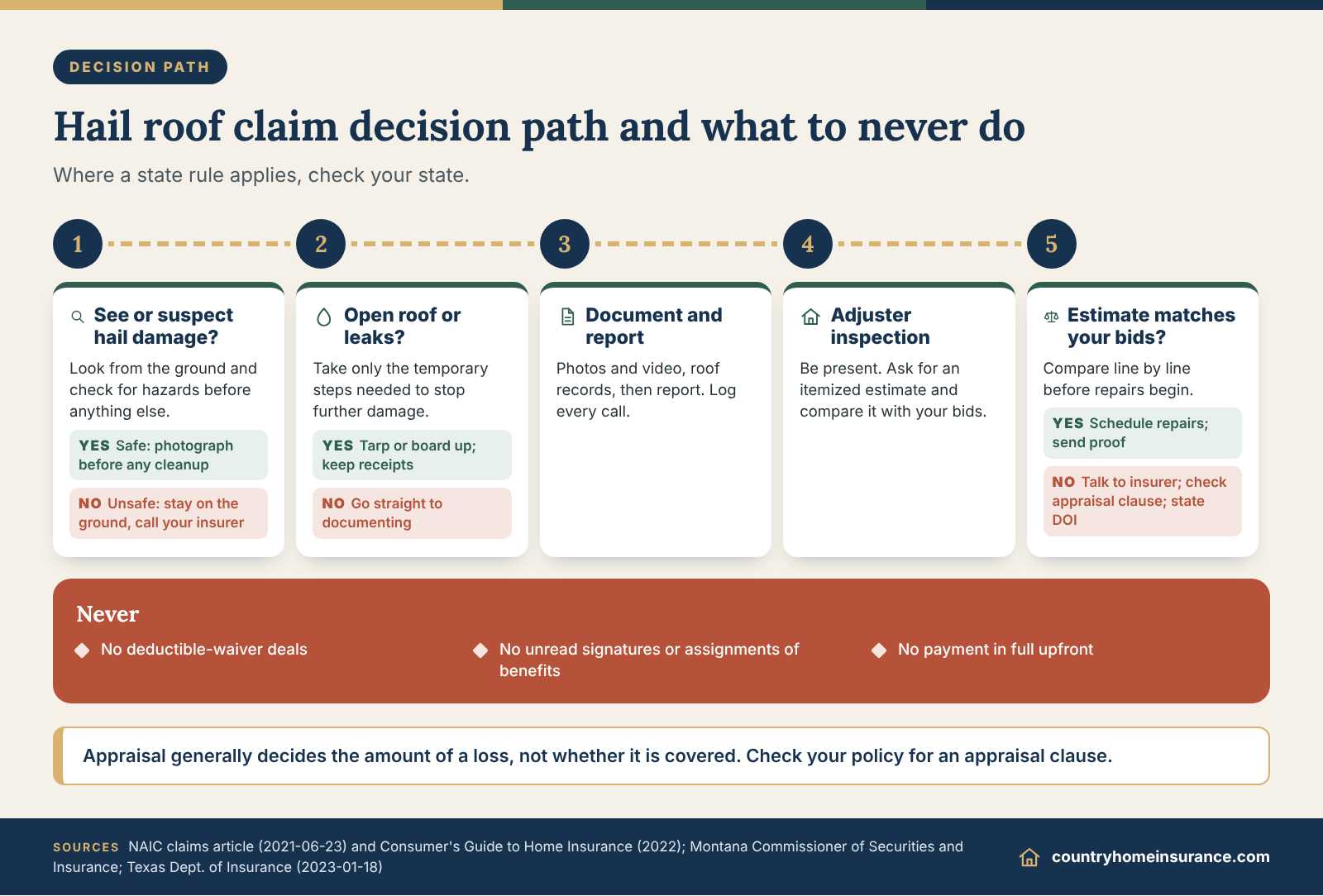
What to do, in order, if you suspect hail damage
The order matters more than speed in every step. Skipping ahead to repairs, for example, is the classic way to create a dispute.
Today and tomorrow
Check for injuries and hazards first. From the ground, look at the roof, gutters, vents and outbuildings, and photograph and video everything before any cleanup. Cover openings with tarps or boards if you can do so safely, and keep receipts. Find your policy and declarations page, note your deductible type and call your insurer or agent to report the loss. Write down the claim number and the name of whoever you spoke with. Decline any contract or signature that arrives at your door.
The first week or two
Be there for the adjuster’s inspection and bring your photos, roof records and a list of every building. Ask the adjuster what happens next and when, and request the written estimate in itemized form. Collect two or three contractor bids for comparison, ask your mortgage lender about its payment process, and keep a log of calls and emails. Hold off on permanent repairs until the insurer has inspected or approved the plan.
After the estimate arrives
Compare the estimate with your bids, line by line. Ask questions about anything you do not understand, including depreciation and the deductible. If you disagree, put it in writing and use the path described earlier: talk to the insurer, check the appraisal clause for amount-of-loss disputes, and consider your state department of insurance, a public adjuster or an attorney. When repairs are finished, send the documents the insurer requires to release any withheld depreciation.
Questions worth asking your insurer or agent
You do not need to be an insurance expert to ask good questions. You just need to ask them early and write down the answers.
Before a loss
Ask whether you have a separate wind/hail deductible and whether it is a flat amount or a percentage. Ask whether the roof is settled at replacement cost or actual cash value, whether any roof-age schedule applies, whether the policy has a cosmetic-damage exclusion, and what Other Structures coverage looks like for each building on the property. Ask how and when you must report a loss, what documents the insurer wants, and what roofing materials qualify for discounts.
During a claim
Ask who the adjuster is, whether they work for the insurer or are independent, when the inspection will occur and when to expect the estimate. Ask for the estimate and the depreciation worksheet in itemized form, how recoverable depreciation is released and what proof is needed, and whether the lender must be named on payments. Ask how to supplement the claim if more damage appears, and how to start an appraisal if you disagree on the amount of the loss.
| Stage | Verify or document | Ask the insurer or agent |
|---|---|---|
| Before storm season | Roof age and material on the policy; deductible type and amount; endorsements; Other Structures coverage for each building | Is the roof settled at replacement cost or actual cash value? Is there a cosmetic-damage exclusion or roof schedule? |
| Right after the storm | Photos and video of roof, gutters, vents, siding, outbuildings; dates; receipts for temporary repairs | What temporary repairs will you accept, and how soon must I report? |
| Reporting | Claim number, date and name of each person you speak with; policy number; contact details | What documents do you need, and when will the adjuster visit? |
| Inspection | List of every building and roof section; roof records; prior repairs | Can I have an itemized estimate and a copy of the inspection findings? |
| Contractor selection | Two or three written bids; references; proof of liability and workers’ compensation insurance; no deductible-waiver promises | Do you have recommended contractors, and will you review my contractor’s estimate? |
| Payment | Who is named on checks; lender requirements; proof of deductible payment; installment schedule | How and when is recoverable depreciation released, and what proof is required? |
| If you disagree | Itemized differences, bids, photos, policy provisions cited by the insurer | Which provision supports this decision, and how do I start appraisal or a supplement? |
Frequently asked questions
Coverage and payment questions
Does homeowners insurance cover hail damage to a roof?
Typically yes, if hail is a covered cause of loss under your policy and the damage is more than your deductible. The NAIC notes that most states include windstorm and hail in standard homeowners policies, while coastal policies often exclude wind. Even where hail is covered, the policy may limit payment through a separate deductible, a roof-age schedule, actual cash value settlement or a cosmetic-damage exclusion. Your declarations page and endorsements tell you which of these apply.
Will my insurer pay for a whole new roof?
Not automatically. Texas regulators say insurers will not pay for a new roof just because the old one is worn, and that an insurer may repair part of a roof even when new shingles do not match. A full replacement is more likely when hail has damaged the roof broadly enough that repair is not practical, but that judgment belongs first to the adjuster and then to the policy language. If you disagree, use the itemized estimate, contractor bids and, where relevant, the appraisal clause.
What is the difference between a deductible and depreciation?
The deductible is the amount you absorb on a claim before the policy pays. Depreciation is a reduction for age and wear used when a roof is valued at actual cash value, or held back temporarily under replacement cost until repairs are done. In the hypothetical example in Table 2, both reduce the first check. Only the depreciation may be recovered later, and only if your policy is a replacement cost policy and you meet its conditions.
Should I file a claim if the repair is only a little above my deductible?
It depends on the numbers and your tolerance for risk. The NAIC notes that some homeowners choose to pay for small repairs themselves, and also warns that claims are often reported to databases such as CLUE and may affect premiums and renewal. Ask your agent how a claim or an inquiry would be recorded before you decide. If the damage might worsen or the full scope is unclear, an inspection can still be worth requesting.
Process, contractor and timing questions
How soon do I have to report hail damage?
As soon as you can. The NAIC says insurers have reporting deadlines, and Mississippi’s department notes that a policy may require notice within a set period. The exact time limit depends on your policy and state law, and this article does not state one number for all. Read the duties-after-loss section of your policy, ask the insurer in writing how much time you have, and report now if you are unsure.
Can a roofer pay or waive my deductible?
You should treat that offer as a red flag. Texas and Montana regulators describe state laws that bar contractors from offering to waive or rebate a deductible, and a Colorado trade group cites a similar Colorado statute. Laws differ by state, but the practical advice does not: pay your deductible, keep proof of payment and walk away from a contractor who suggests otherwise. If you are unsure, ask your state department of insurance.
Should I let the contractor deal with the insurance company?
You are allowed to have a contractor attend a discussion, as the NAIC guide points out, but be careful about handing over control. The NAIC explains that an assignment of benefits transfers your policy rights and any leftover money to the third party and that you do not have to sign one. If you keep the claim in your own name, you can share the contractor’s estimate and ask the adjuster to review it.
What if I find damage months after the storm?
Report it promptly, explain when you noticed it and share any photos or records that show the condition before and after. Time limits in your policy and state law may affect what is possible, so ask the insurer directly and keep the exchange in writing. If the insurer attributes the damage to wear or to an earlier event, ask which policy provisions apply and request the evidence behind the conclusion.
Sources
- NAIC: Navigating the claims process, recover and rebuild (published 2021-06-23)
- NAIC: A Consumer’s Guide to Home Insurance (2022 edition)
- NAIC: Homeowners insurance consumer page (undated)
- NAIC: Actual cash value versus replacement cost coverage (2025-01-02)
- NAIC: After a storm, read the fine print before signing away benefits (2018-09-01; older article)
- Texas Department of Insurance: Replacing your roof (updated 2026-04-01)
- Texas Department of Insurance: What to know about replacing your roof with insurance (March 2026)
- Texas Department of Insurance: State law cracks down on roof scams (2019, updated 2023-01-18)
- Texas Department of Insurance: Commissioner’s Bulletin B-0030-98 (1998; historic)
- Texas Legislature: Senate Bill 458 bill analysis, appraisal provisions (2025 session)
- Texas Department of Insurance: appraisal rule proposal summary (2026; status to verify)
- Montana Commissioner of Securities and Insurance: Insurance before and after the storm (undated)
- Minnesota Department of Commerce: consumer alert on wind and hail coverage (2022-08-15)
- Mississippi Insurance Department: claim guidance news release (2026-01-27)
- Alabama Department of Insurance: How to navigate the claims process after a storm (2023-01-04)
- Nebraska Department of Insurance: tips for weather-related damage (2010; older release)
- National Weather Service: hail information and size chart (page date 2015)
- IBHS: Relative hail impact resistance of asphalt shingles (modified 2026-04-27)
- Insurance Journal: IBHS study on smaller hail and roofs (2025-10-02)
- Digital Insurance: Triple-I report on 2025 severe convective storm losses (2026-04-27)
- U.S. Court of Appeals for the Eighth Circuit: Cannon Falls Area Schools v. Hanover American Insurance Co. (filed 2026-07-27; commercial policy)
- Westfield Insurance: wind and hail deductibles explained (2026-07-08; insurer educational article)
- Colorado Roofing Association: waiving deductibles in Colorado (2019; trade group, verify against statute)
- Alabama Farmers Federation: Surviving hail (2013; older, illustrative only)
Important coverage note
Coverage depends on the actual policy, endorsements, exclusions, limits, deductible and cause of loss. State laws and insurance programs vary, and this article does not state every state’s rules. Check your declarations page and policy forms, and verify case-specific questions with your insurer or agent and your state Department of Insurance. This article is educational information, not legal advice, and it does not guarantee that any claim will be paid or at what amount.
About the editorial team
This guide was prepared by the countryhomeinsurance.com editorial team as general, educational information for homeowners. We research and summarize publicly available material, including state insurance departments, the NAIC, federal agencies, regulators’ consumer guides and published insurer and industry resources. We draw only on the sources that were available to us when we wrote this guide, and we list them in the Sources section with dates where we could find them.
Insurance rules, rates, products and program terms change, differ by state and by insurer, and can apply differently to your situation. We cannot guarantee that this content is complete, current or free of errors. It is not legal, financial, tax or insurance advice, it is not an offer to sell insurance or a recommendation of any insurer, agent or product, and reading it does not create a professional relationship of any kind.
To the fullest extent permitted by law, countryhomeinsurance.com and its editorial team, authors and contributors exclude all liability for any loss, damage or decision arising from the use of, or reliance on, this content. For questions about your own policy or claim, contact your insurer, a licensed agent or broker, your state Department of Insurance or another qualified professional.
Content created: October 11, 2026