Quick answer
How many home insurance quotes you need depends less on a magic number than on how many genuinely different insurers each quote reaches. An NAIC shopping tool, republished by state insurance departments, suggests at least three quotes, while other official guides name no number. We found no sourced figure for savings per extra quote. A reasonable working target is three to five comparable offers from more than one sales channel, with more only if prices are scattered or your property is hard to place.
Key takeaways
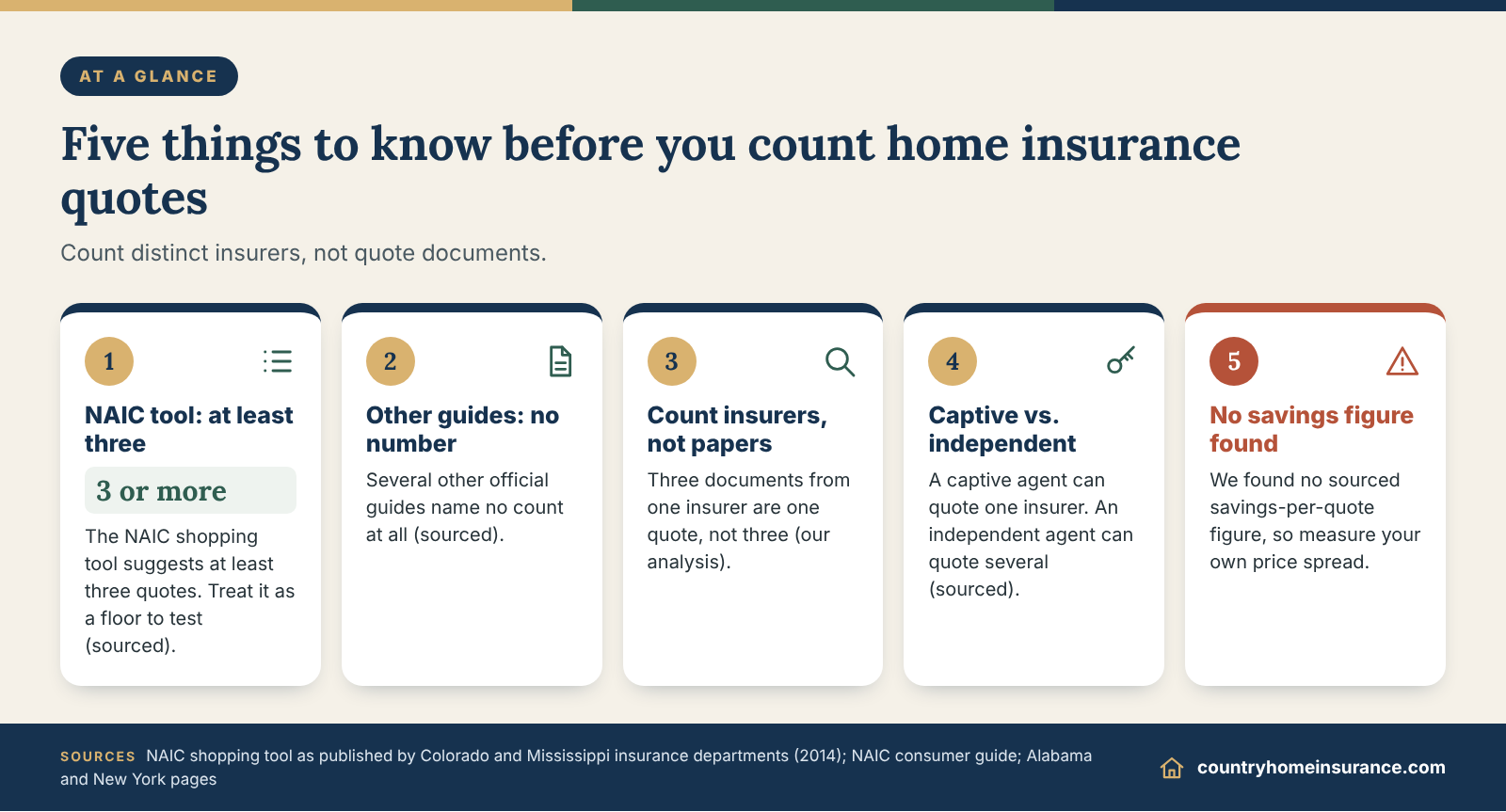
- The NAIC shopping tool suggests at least three quotes, but several other official guides give no count at all, so treat three as a floor to test rather than a rule.
- Count distinct insurers, not quote documents. One independent agent can quote several companies, while a captive agent can quote only one.
- Extra quotes help less each time you add one, but we could not find a sourced dollar figure for the savings, so this guide shows you how to measure your own results instead.
- We could not verify from official sources whether quote requests touch your credit report or claims-database record. Ask each seller directly before you share a Social Security number.
- Quotes only count if they are comparable. Give every seller the same coverages, limits, deductibles and property facts, and use the companion comparison guide to read the results.
- Time matters as much as count. Start earlier than you think, because a nonrenewal notice or a closing date can squeeze a comfortable search into a few days.
| Your situation | Starting point (our analysis) | Why that range | What the official sources add |
|---|---|---|---|
| Straightforward home, no recent claims, renewing | Three comparable offers, including your current insurer’s renewal | Enough to see whether your price is unusual without turning shopping into a part-time job | The NAIC shopping tool suggests at least three quotes; Texas regulators say to compare providers at renewal |
| Rural home with acreage, outbuildings or a distant fire station | Four to five offers, mixing a local independent agent with at least one direct or captive source | Insurers can treat fire protection and outbuildings differently, so spread between offers is often wider | Alabama and New York regulators note that sellers differ in how many insurers they can reach |
| Large premium increase at renewal | Four offers, started well before the notice window closes | You need enough data to tell a market-wide increase from an insurer-specific one | GAO reports that rating factors and weights differ by insurer and state |
| Closing on a purchase in a few weeks | Two to three offers, requested in the first days | Lenders and closing dates set the deadline, so speed and accuracy beat breadth | NAIC says you need not use the insurer your lender recommends |
| Declined or nonrenewed by a standard insurer | As many as it takes to find one willing insurer, with every decline documented | The goal shifts from lowest price to finding any workable coverage | GAO describes FAIR plans as a growing share of the market; rules vary by state |
How many home insurance quotes do official consumer guides recommend?
Ask five people how many quotes to get and you may hear “three,” “as many as you can,” and “just call my agent.” This section goes to the source documents instead. It sorts out what regulators have actually written, what they left unsaid, and how to turn a vague rule of thumb into a count that fits your own house, your own county and your own deadline.
What do regulators actually say about the number of quotes?
The honest answer is that the official record is thinner than most shopping articles suggest. A few guides name a number, several do not, and none of the pages we reviewed supports a precise claim about how much money each additional quote saves.
The “at least three quotes” guidance
The clearest numerical guidance we found sits in the NAIC shopping tool for homeowners insurance as published by the Colorado Division of Insurance, and the Mississippi Insurance Department hosts the same document. It says it is a good idea to get at least three quotes before you buy. The same guide adds a second, less noticed benefit: each quote may come with its own estimate of what it would cost to rebuild your home, so several quotes give you several estimates to check against each other.
Both copies carry a 2014 copyright, so treat the wording as older guidance rather than a current regulatory standard.
Guides that give no number at all
Not every regulator picks a count. The NAIC consumer guide to home insurance tells shoppers that insurers charge different rates for the same coverage and that claims service varies, yet it does not say how many companies to contact. California’s residential guide, dated January 2016, says to compare quotes for similar coverage, deductibles and limits and likewise names no number. The NAIC consumer homeowners page recommends shopping around without a count too.
That pattern matters. When regulators agree on the direction (compare) but not the number, it is a signal that the right count depends on your situation.
Why a number is a starting point, not a finish line
Three quotes from three captive agents of three different companies is a different search from three quotes pulled through one independent agent, and both differ from three quotes that quietly asked for different coverage. A raw count says nothing about whether the offers are comparable, whether they cover the same dwelling limit or whether they reached different insurers at all.
So read “at least three” as “at least three real alternatives, on matching terms.” If you cannot reach that bar with your first three requests, the guidance points toward asking again, not toward counting what you already have as enough.
How should you count quotes so the count means something?
A quote count is only useful if it measures choice. The three ideas below keep the number honest.
Count distinct insurers, not quote documents
A single comparison page can generate ten rows of prices, and a single agent can email you four PDFs. If three of those PDFs come from one insurer’s different policy forms or tiers, you have one insurer and several price points. That is useful for tuning deductibles, but it does not widen your choice of company.
Keep a simple tally with two columns: the insurer’s legal name as it appears on the quote, and the channel that produced it. Your real count is the number of different insurer names you can compare on matching terms. If two sellers return the same insurer, tally it once and keep looking.
A working range by situation
Table 1 above turns the “at least three” guidance into starting ranges for different situations. These ranges are our editorial analysis, built from the guidance above, and they are not statistics about how many quotes people actually collect or what they save. The logic is simple. A straightforward home in a well-served area needs fewer data points to judge whether a price is reasonable. A property with acreage, outbuildings, an older roof or a long drive to the nearest fire station gives insurers more room to disagree, so a wider net is more likely to uncover real differences.
If a first round of three produces offers within a narrow band on matching terms, you have learned something valuable: the market is agreeing about your house. If the first round is scattered, add more.
What counts as a quote versus an estimate
Online tools often show a “starting at” figure based on a few data points, such as your address and year built. The NAIC tool describes a quote as an estimate of premium for a specific coverage from a specific insurer, and it notes that optional coverages such as sewer backup or scheduled jewelry are typically priced by asking for a quote. That is a reminder that an early ballpark is a different thing from an offer built on your full answers.
For counting purposes, treat only an offer that lists the insurer, the dwelling limit, the deductibles and the endorsements as a quote. Everything else is a sample rate, and a sample rate is a reason to start a conversation, not to finish one.
Captive, independent, direct and online: how the sales channel changes your quote count
The channel you use decides how many insurers you reach with one phone call. That is why two people can both say they “got three quotes” and have done very different amounts of shopping. State regulators describe the channels with slightly different vocabulary, so it helps to translate them into one plain scheme.
Who can quote how many insurers?
Think of each channel as a doorway into the market. Some doors open onto one insurer, others onto several.
Captive and exclusive agents
New York’s Department of Financial Services describes captive agents as working for only one insurer, and the NAIC and Alabama use the term exclusive for the same idea. Vermont adds that an exclusive agent may sell for one insurer or for a group of related insurers and usually places most or all of their business there.
For counting purposes, a captive or exclusive agent is one quote, or a handful if the company group has several affiliates. Alabama’s guidance is direct about it: ask any producer how many companies they represent. Captive agents can still be valuable for service and local knowledge, but they do not widen your comparison on their own.
Independent agents
The NAIC consumer guide says independent agents represent several companies and can provide multiple quotes. New York is slightly more cautious, saying independent agents represent one or more insurers, which is a useful reminder that “independent” describes the agent’s business structure, not a guaranteed number of carriers.
A strong independent agent can be the most efficient way to collect several distinct insurers with one set of answers. The practical question to ask is which insurers they can actually quote for your kind of property, because an agent’s access to carriers that write rural or older homes may be narrower than their general list.
Direct writers and online purchase
Direct sales happen online, by mail or by phone, according to the NAIC. New York defines direct writers as insurers that sell through their own employees, exclusive representatives or websites, and it notes that many insurers and agents post pricing online and sometimes let you finish a purchase there. Each direct insurer typically counts as one quote.
New York also warns that scam websites exist, that you should verify the seller’s license before sharing information, and that the internet is convenient for comparing prices but not necessarily the best option for everyone. Vermont adds that an online advertisement does not prove an insurer is licensed in your state.
Brokers and broker fees
New York says brokers usually cannot issue policies or bind an insurer, but that premiums paid to a broker count as paid to the insurer once the broker finds a willing company. California’s residential guide describes a broker as a go-between who represents the consumer and searches the market, and it describes a broker-agent who can act in either role, with conditions on any broker fee.
If a broker is in your mix, ask whether a fee applies and whether the broker will show you the insurers they approached. Their value to your quote count is the breadth of the search they do on your behalf.
What are the trade-offs between channels?
Because each channel reaches a different slice of the market, mixing them is usually more informative than repeating one. The official pages are cautious about declaring any channel cheaper or better, and so are we.
Commissions, price and what the sources do not prove
Alabama and Vermont both note that direct sellers may cost less because they pay no commissions, and Alabama adds that some buyers pay more for a local producer because of the service. Vermont cautions that direct representatives may need more pushing to get clear answers. None of these pages measures an actual price gap, so there is no basis here to claim that direct is cheaper for your home.
The practical lesson is to avoid assuming. A direct quote and an agent quote are both just data points, and the only way to learn which is lower for your property is to collect one of each.
Advice, service and who answers your questions
Vermont expects agents to advise and assist, and Alabama reminds shoppers that producers are paid commissions, so coverage advice deserves a thoughtful ear. New York says price is only one factor and points shoppers to a company’s reputation, claim practices, reliability and services.
For a country home with unusual features, such as a detached shop, a well house or a few head of livestock, a person who can walk through those questions may be worth more than a few dollars of difference. That is a judgment for you, not a finding from the sources.
The same insurer through two doors
One of the easiest ways to inflate a quote count is to receive the same insurer’s offer from two channels. If your independent agent and a comparison site both return the same company, you have one choice, not two. We have not seen official guidance on how insurers handle duplicate requests, so ask each seller which insurers they will submit your application to before you give personal details.
Keeping the insurer name in your tally, as described above, prevents double counting and also keeps you from sharing sensitive data with more parties than you need to.
| Channel | Insurers per contact | What regulators note | Question to ask |
|---|---|---|---|
| Captive or exclusive agent | One insurer, or a group of related insurers | Sells for a single company (New York, Alabama, Vermont, NAIC) | Which other companies in your group can you quote? |
| Independent agent | One or more, often several | Represents several companies and can provide multiple quotes (NAIC, Alabama, Vermont) | Which insurers will you actually submit my property to? |
| Direct writer by phone or mail | One insurer | May cost less because no commission is added; may need more pushing for clear answers (Alabama, Vermont) | Who answers coverage questions after I buy? |
| Online quote or purchase | One insurer, or several if it is an agency site | Verify the license first; scam sites exist (New York, Vermont) | Is this seller licensed in my state, and who is the insurer? |
| Broker | Varies by market search | Usually cannot bind an insurer in New York; California describes broker fees and conditions | Do you charge a fee, and which insurers did you approach? |
Why each extra quote helps less: diminishing returns and where to stop
Almost everyone has a sense that the fifth quote is less valuable than the second. The question is how to turn that hunch into a decision. The sources tell us why prices differ, which is the reason to shop at all. They do not tell us how much each additional quote saves, so this section separates what is documented from what you can measure for yourself.
What does the evidence say about price differences between insurers?
Three facts hold up across the official pages we reviewed, and one important number is missing.
Insurers charge different rates for the same coverage
The NAIC consumer guide states plainly that companies charge different premiums for the same coverage and that claims service varies, which is why it recommends comparing. Alabama’s Department of Insurance says rates for the same coverage vary between companies, and it quotes a sentence worth remembering: competition only works if the consumer shops for coverage.
That is the whole case for getting more than one quote. It is a case for variation existing, not a measurement of how big the variation is in your county or for your kind of property.
Why the same house is priced differently by different insurers
GAO’s 2026 report on homeowners premiums found that the rating factors insurers use, and the weight they give each one, differ by insurer and by state. It also noted that one insurer offered wildfire mitigation discounts in California but not in Louisiana. In other words, even the discounts you may be hoping to earn are not uniform.
The state guides add concrete examples of what insurers may weigh: the age of the home, the roof and its systems, claims history, a credit-based insurance score, distance to fire protection, pools, trampolines, dogs, wood stoves and home businesses. Because each insurer blends these differently, the order of prices for your house cannot be predicted from the order for your neighbor’s.
What no source gives us: savings per extra quote
We did not find a regulator, consumer agency or rate study in our research that publishes a defensible, methodology-backed figure for how much a shopper saves by adding a third, fourth or fifth quote. Articles that offer such numbers often rely on one publisher’s sample profiles, which cannot be generalized to a farmhouse on twenty acres.
For that reason, this guide does not print a savings-per-quote number. A figure without a data year, a geography and a method would be exactly the kind of unsupported precision this site avoids. The measurement below is a better use of your time.
How can you measure your own diminishing returns?
You can see the curve for your own property in an afternoon, using nothing more than a notebook or a spreadsheet.
The spread test
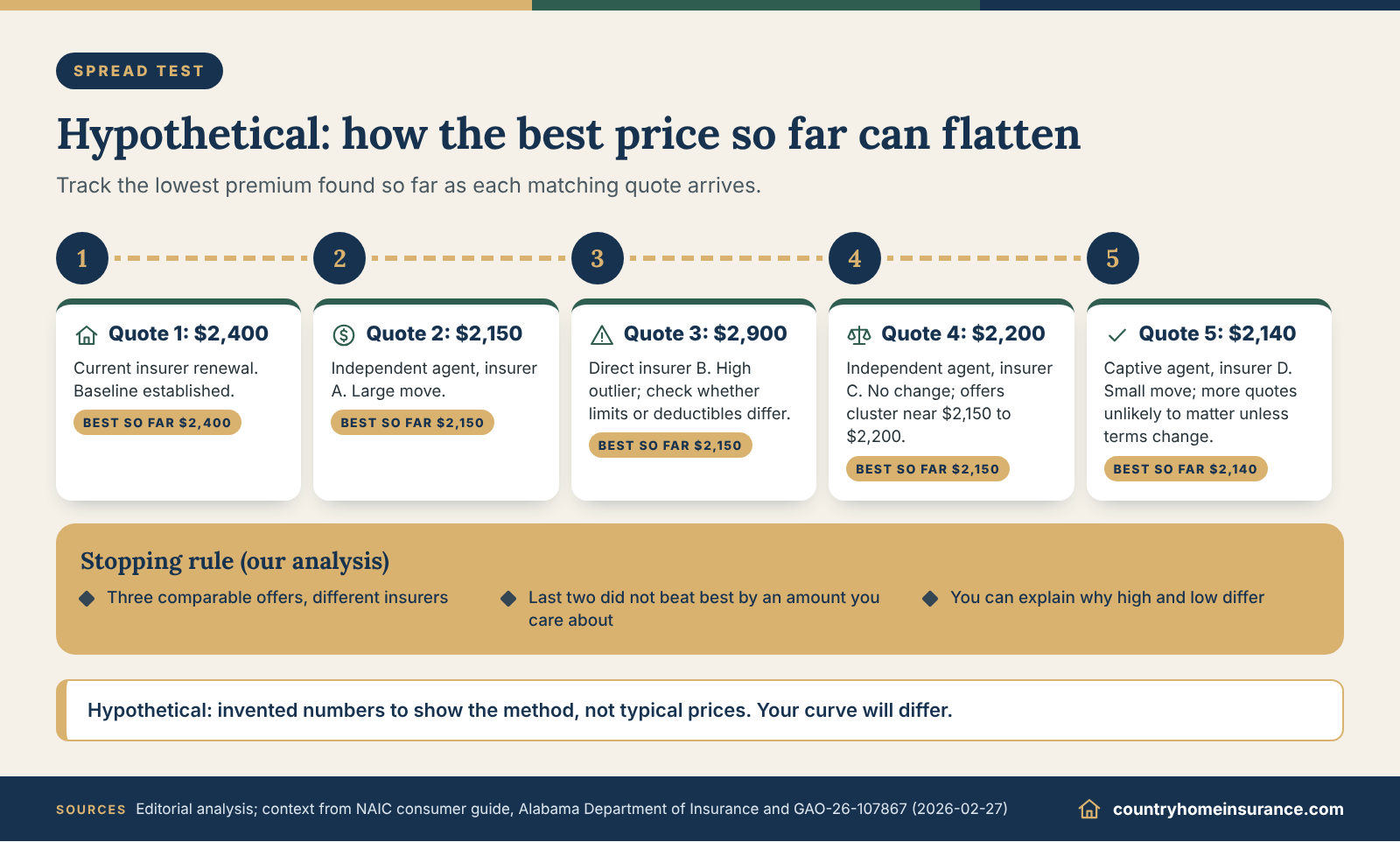
As each quote arrives on matching terms, write down its annual premium and then track the lowest premium found so far. In the early quotes, the “best so far” line tends to drop. Later it flattens, because new offers are landing at or above a price you already have. The point where that line stops moving is your own diminishing-returns point.
Hypothetical example (invented numbers to show the method, not typical prices): you receive five matching offers in this order, at $2,400, $2,150, $2,900, $2,200 and $2,140 a year. Your best-so-far line reads $2,400, $2,150, $2,150, $2,150 and $2,140. The second quote moved the line by $250. The third and fourth did nothing. The fifth moved it by $10. A shopper who stopped at three would have captured most of the available difference in this invented case, but a different property could look very different.
Three passes instead of one big sweep
Rather than collecting everything at once, work in passes. In the first pass, request two or three quotes through at least two channels, such as one independent agent and one direct insurer. Review the spread. If the offers cluster tightly, a second pass may be short, perhaps confirming your current insurer’s renewal figure and one more option. If they scatter widely, a second pass should add insurers you have not yet reached.
A third pass is for specific gaps: a company that writes rural property, a quote that includes a coverage the others dropped, or a revised quote after you change a deductible. Each pass has a purpose, which keeps the process from sprawling.
A stopping rule you can write down
Stopping is easier when you decide the rule before you start. Here is one example, offered as our analysis rather than a standard: stop when you hold at least three comparable offers from different insurers, when your last two new offers did not beat your best-so-far by an amount you care about, and when you understand why the cheapest and the most expensive offers differ.
The third condition matters most. A low price you cannot explain, such as a missing endorsement, a higher wind and hail deductible or a lower roof settlement basis, is not a savings until you have confirmed the policy matches your specification.
| Quote received | Annual premium (hypothetical) | Best so far | What to conclude |
|---|---|---|---|
| 1. Current insurer renewal | $2,400 | $2,400 | Baseline established |
| 2. Independent agent, insurer A | $2,150 | $2,150 | Large move; the market does not agree with your renewal price |
| 3. Direct insurer B | $2,900 | $2,150 | High outlier; check whether limits or deductibles differ |
| 4. Independent agent, insurer C | $2,200 | $2,150 | No change; offers are clustering near $2,150 to $2,200 |
| 5. Captive agent, insurer D | $2,140 | $2,140 | Small move; further quotes are unlikely to matter unless terms change |
Making every quote count: the same package from every seller
A quote count is worth little if the offers describe different policies. This section is deliberately short, because our separate guide on reading and comparing quotes covers line-by-line analysis. Here the focus is on how to request quotes so the count stays meaningful, and on the places where adding another quote buys you nothing.
What should every seller receive from you?
Consistency in what you ask for is the cheapest way to make a small number of quotes as informative as a large number of messy ones.
One written specification for all sellers
The NAIC consumer guide tells shoppers to get quotes in writing and to give each company or agent the same coverages, limits and information. Alabama lists the facts it wants every producer to hear: a description of the house, the distance to the nearest fire department and fire hydrant, square footage, security devices, a photograph of the home and the coverages and limits you want.
Put those items on one page and paste the same page into every request. For the choices behind the page, such as dwelling limit and loss settlement, see our guide on how to buy homeowners insurance. A written specification also gives you something to point to later if a quote and a policy disagree.
Terms that sound alike but are not the same
Anyone trying to compare apples to apples will hit this wall quickly. The NAIC shopping tool warns that insurers may define terms differently and suggests asking about the differences. New York’s Department of Financial Services adds that some companies include extra coverage at no added premium while others charge for each addition, and that policies differ between companies on co-insurance, deductibles and exclusions.
That means a lower price may reflect a narrower policy. Before you count a quote as an alternative, confirm the dwelling limit, the loss settlement basis, the deductible type and the endorsements, and read the fine print on any sublimit that matters to you.
Roof and deductible details that shift the price
Texas Department of Insurance guidance from March 2026 explains that some policies pay the full cost of a new roof while others pay less based on the roof’s age, condition or materials, and that wind and hail deductibles are often higher than other deductibles. It is Texas guidance, so rules in your state may differ, but the lesson travels: a roof term or a separate wind and hail deductible can make two similar-looking prices behave very differently after a storm.
Ask every seller for the same roof information and the same deductible structure, and confirm that the roof age and material on the quote are correct.
Where do extra quotes add little or nothing?
Some kinds of shopping are worth skipping because the answer will not change. Knowing which saves you effort for the places where it counts.
Flood coverage through the NFIP
FloodSmart explains that National Flood Insurance Program (NFIP) policies are sold through more than 48 partner insurance companies and thousands of independent agents, and that rates do not vary by provider. Premiums are set by location, construction and replacement cost, and building coverage for a homeowner is available up to $250,000, with contents up to $100,000, per the page we reviewed.
The practical consequence: if you are buying an NFIP policy, collecting five NFIP quotes from five agents is unlikely to produce five different prices. The useful comparison is on service and on whether a private flood product fits better, which is a separate decision. Our flood guides cover that choice.
Eligibility questions you can ask before a full quote
A full application is a lot of work to give an insurer that will not write your home. The NAIC shopping tool lists questions worth asking up front: whether you qualify if you have a prior homeowners claim with another insurer or a claim from a previous owner, auto claims, a dog, pool, trampoline or solar panels, or a wood-burning stove or heating oil tank. It also suggests asking whether the insurer will inspect or photograph the home.
A two-minute eligibility call can remove an insurer from your list before you spend an hour on its form, which makes your final count more honest, since you are counting only insurers that will actually write the policy.
Fire protection facts that must match across quotes
A rural address can be rated very differently from a village address. The Texas Department of Insurance explains that fire protection ratings come from a survey of a community’s ability to suppress structure fires. Property more than five road miles from a station falls into Class 10 in that system, a property within 1,000 feet of a creditable water supply is treated differently from one farther away, and hauled water could count as creditable. Insurers use these classifications at their own discretion.
That Texas explainer describes one state’s process, so check how your insurers treat fire protection where you live. What matters for quote counting is consistency: give every seller the same station distance and water source, because a quote built on a different fire-protection assumption is not an equal comparison.
Do quote requests affect your credit or claims record? What is documented and what to ask
This is the question that makes many careful shoppers stop at one or two quotes: will collecting quotes leave a mark? The honest answer from the official sources we could retrieve is that they describe how insurers use credit-based scores and claims databases, but they do not say how a quote request itself is recorded. We will tell you exactly where the documented ground ends, so you know which questions to put to each seller.
How do credit-based insurance scores enter the picture?
Insurers in many states look at credit-derived information when they decide whether to offer a policy and what to charge. That is different from the credit score a lender uses, and it is worth separating the two ideas.
What a credit-based insurance score is
The NAIC explains that credit-based insurance scores are built partly or entirely from credit history and are used in underwriting (whether to offer coverage) and in rating (how much to charge). They are designed to estimate how likely a person is to file a claim, not how likely they are to repay a loan. The NAIC page, last updated March 19, 2026, cites FICO’s estimate that about 85 percent of homeowners insurers use these scores where permitted.
The NAIC consumer guide to home insurance says the same thing in plainer terms: in many states insurers use credit history to decide whether to sell you a policy and what to charge, and you can ask an agent how your credit history will affect your premium.
Protections consumers generally have
According to the NAIC, in most states insurers cannot use these scores as the sole reason to raise rates or to deny, cancel or refuse to renew a policy, and some states set stricter limits or ban certain uses. Many states require an insurer to notify you when credit information contributed to an adverse decision, and consumers generally have the right to receive that notice, review their credit report and dispute inaccuracies.
Because the details vary by state, the dependable move is to ask. Which uses are allowed where you live, and what notice you are owed, is a question for your state Department of Insurance.
The question we could not answer from official sources
We looked for an official statement on whether an insurer’s look-up for a quote shows up on a credit report in a way other lenders can see, and whether it is the kind of inquiry that can lower a lending score. The NAIC credit page does not address insurer inquiries, and the NAIC shopping tool, as far as we could tell from our review, does not address whether requesting quotes affects your credit or claims history either, which leaves the insurer itself as the place to ask. We tried several other consumer-agency pages, but they were not retrievable in this research, so we are not going to guess.
What you can do is ask each seller three things before sharing a Social Security number: which report they will pull, whether the request is recorded as an inquiry on any file you could see, and whether they can give you a quote before pulling it. You can also check what your credit report shows. The New Hampshire Insurance Department’s reprint of the NAIC guide points to a free annual credit report at annualcreditreport.com, though that reprint is from 2010, so confirm the current process there.
What are claims databases, and how do they connect to shopping?
Credit is one input. The other is your claims history, and insurers often see it through shared databases rather than taking your word for it.
What CLUE and similar databases do
The NAIC consumer guide says most insurers report homeowners claims to nationwide databases, such as CLUE, which insurers use to see past claims. The NAIC shopping tool spells the name out as the Comprehensive Loss Underwriting Exchange and says insurers may check a CLUE report along with a credit-based insurance score. Mississippi’s copy of that tool lists a CLUE report among the information insurers may obtain from outside sources.
We did not retrieve the database operator’s own consumer page this time, so we are not describing how long records stay, what exactly is listed or how to request your copy. Ask your agent, or your state Department of Insurance, how to obtain your own claims report, and read it before a big shopping round so that nothing surprises you in an underwriting review.
A claim is not the same as a question
The sources are clear that claims can affect cost. The NAIC consumer guide says how often you file claims, and what types, can influence your premium and whether your insurer renews the policy, and it suggests that if repairs would cost only slightly more than your deductible you may want to pay for them yourself. It also recommends asking an agent how a claim would affect your premium at renewal.
What the sources do not settle is whether a phone call that stays a question is logged in the same way as a filed claim. Until you have a clear written answer from your insurer, treat the safest course as asking hypothetical questions of an agent in general terms and asking explicitly how such a call is handled. This is a place where a question to the insurer is worth more than an assumption from a web article, including this one.
Claims that belong to the house, not to you
Claims history attaches to more than your own record. The NAIC guide says a premium can be affected by the claims history of the home you are buying and of homes in the area, and it advises asking how to check a home’s claims history before buying. The NAIC shopping tool suggests asking whether a claim by a previous owner affects eligibility, and Mississippi’s copy lists previous owners’ claims among the points to raise.
For a buyer, this means the first round of quotes can reveal something about the house itself. If two insurers will write it readily and a third hesitates, the pattern is worth a conversation with the seller’s agent before you close.
What personal information should you share, and with whom?
Quoting widely means sharing details widely, so a few habits keep the process safe.
Social Security numbers and consent
The NAIC consumer guide notes that an agent may ask for your Social Security number to access your credit report. Mississippi’s copy of the shopping tool lists a Social Security number among the personal information an insurer may request for a quote. Those are legitimate parts of underwriting in many states, but you are still entitled to understand what is being pulled and why.
Ask which reports will be checked, whether the quote can begin with property facts and add personal identifiers later, and how the information will be stored. Share the number only with a seller whose license you have already confirmed.
License checks before you share
Alabama tells shoppers to confirm with the state insurance department that both the insurer and the producer are licensed before signing, and says business cards do not prove licensure. It warns that coverage from an unlicensed company may not be honored or protected by the state guaranty fund. New York lists license search tools for insurers and agents, and Vermont notes that an online advertisement is not evidence of a license.
Make license verification the first filter for anyone who is not already a known name, especially for online sellers you found through a search.
Answering accurately every time
New York reminds shoppers to answer quote questions fully and accurately because the rate depends on the answers. The NAIC consumer guide adds a consequence: after the first 60 days of a new policy, an insurer can typically cancel for nonpayment, for misrepresentation on the application, or for a substantial change in risk.
Shopping with several sellers tempts people to round things off, such as the roof’s age or the number of outbuildings. Answer the same way each time, and keep your one-page specification handy so your answers stay consistent.
| Topic | What the sources document | Not verified in our research | Ask the seller or your state regulator |
|---|---|---|---|
| Credit-based insurance score | Used by many insurers where permitted; typically cannot be the sole reason for a rate increase or denial; notice and dispute rights generally exist (NAIC, updated 2026-03-19) | Whether a quote request creates a visible credit inquiry or affects a lending score | Which report is pulled, is it recorded as an inquiry, and can I get a quote before you pull it? |
| Claims database such as CLUE | Most insurers report homeowners claims to nationwide databases that insurers use to see past claims (NAIC consumer guide) | Retention periods, exact contents and how to request your own copy | How can I obtain my own claims report, and what does it show for this address? |
| Questions that are not claims | Claim frequency and type can affect premium and renewal; ask how a claim affects premium at renewal (NAIC) | How an insurer records a general question that is not filed as a claim | How do you log a call that does not become a claim? |
| Previous owners’ claims | A home’s claims history and the area’s history can affect price; ask about eligibility (NAIC; Colorado and Mississippi copies of the shopping tool) | How each insurer weighs old claims on a purchase | Will you write this house, given the previous owner’s claims? |
| Personal data and licensing | An agent may request a Social Security number; confirm licensing first (NAIC; Alabama; New York; Vermont) | Each seller’s data handling practices | Which licenses do you hold in my state, and how is my data stored? |
When to shop: buying a home, renewing and switching mid-term
Quote counts and timing interact. A relaxed shopper can run three passes over several weeks, but a buyer with a closing date or a policyholder holding a nonrenewal notice may have days. This section covers the calendar side of shopping, using regulator guidance on notice periods and the first 60 days of a policy. Notice windows vary by state, so the figures below are examples from the documents we reviewed, not a statement of the law where you live.
How does timing change when you are buying a home?
A purchase puts a hard stop on your search, so planning backward from the closing date is the safest approach.
Lender requirements and your freedom to choose
Mississippi’s copy of the NAIC shopping tool says your mortgage lender will likely require at least enough coverage to pay off the loan, and it recommends basing your dwelling limit on the cost to rebuild rather than the purchase price. The NAIC consumer homeowners page adds that you do not have to buy from the insurer your lender recommends.
That freedom is what makes a multi-quote search possible during a purchase. Confirm the lender’s exact requirements first, then run your search against them.
Binders and proof of coverage
California’s residential guide defines a binder as a short-term agreement that provides temporary coverage until the policy is issued or delivered, and it advises confirming that the binder shows the correct limits, deductibles, coverage, insurer and dates. Other states may use different terms or practices, so ask what proof of coverage your lender will accept and when it will arrive.
When a closing is near, your last quote is the one that has to be bound, and a late surprise about a binder is more costly than a missed fourth quote.
Compressing the search into a short window
If you have only a few weeks, spend your effort where the sources say it matters. Ask eligibility questions first, send the same one-page specification to a small set of insurers across two channels, and ask each how it treats the home’s claims history. Consider flood timing too: FloodSmart says NFIP coverage generally starts 30 days after purchase, with no wait when the policy is bought in connection with making, increasing, extending or renewing a mortgage.
A compressed search of two to three solid quotes, as in Table 1, is a better outcome than a sprawling search that leaves you without bound coverage on closing day.
When should an existing policyholder re-shop?
Most homeowners do not need a full search every year, but they do need a trigger list and a calendar.
The annual check-in is not the same as a full re-shop
The NAIC consumer homeowners page recommends checking with your agent at least once a year to make sure your policy provides adequate coverage. That is a coverage review. It is not an instruction to collect new quotes every twelve months, and no source we reviewed sets a re-shopping schedule.
A sensible reading is to use the annual review to decide whether a re-shop is warranted. The Texas Department of Insurance advises comparing multiple providers when renewing a homeowner policy, which supports checking the market at least periodically.
Notice windows that decide how early to start
The NAIC consumer guide says insurers must give notice of nonrenewal, typically 30 days before the renewal date, though the period varies by state. California’s guide gives a longer window: at least 45 days before expiration, with the reason stated, and if proper notice is not given the existing policy stays in effect for 45 days from the date the notice is sent. California also requires at least 20 days’ notice of cancellation in most cases and 10 days for nonpayment or fraud.
Those numbers are examples, not a universal rule. The planning point holds everywhere: if the shortest plausible notice period is about a month, a search that takes three weeks leaves very little room. Start at the first sign of trouble, such as a large renewal increase or a letter about an inspection.
Events that justify a fresh round of quotes
Our analysis is that these events are worth a new search because they change what insurers see: a new roof, a major renovation, an outbuilding added or removed, a claim, or a renewal price that jumps well beyond your expectation. The Texas guidance supports the roof point, noting that newer roofs often earn better rates and that you should notify the insurer after a replacement so the age is updated.
Document the improvement with dates and invoices before you ask for quotes, so each insurer starts from the same facts.
How do you switch without leaving a gap?
Switching is where a good search can go wrong at the finish line.
Understanding the first 60 days
The NAIC consumer guide says new policyholders typically face a 60-day period during which an insurer can cancel for any reason. After that, cancellation is typically limited to nonpayment, misrepresentation on the application or a substantial change in risk. The detail varies by state, and California’s guide describes the same 60-day concept with legal limits afterward.
The implication is that a new policy is not fully settled until that window has passed, which is one more reason to give accurate answers and to keep your old policy details until the new one is confirmed.
Overlap rather than gap
You can cancel a policy at any time, per the NAIC. That freedom works in your favor only when the new coverage is already in force. Our practical advice is to get the new policy’s effective date and proof of coverage in writing before you ask the old insurer to cancel, and to ask the old insurer in writing for the cancellation date so the two periods meet or overlap slightly.
If you have a mortgage, notify the lender of the new insurer and confirm the lender has the proof of coverage it needs.
How refunds can differ
The NAIC consumer guide says the company may refund part of the premium if either party cancels. California’s guide explains that when you cancel, an insurer may use short-rate calculations that retain part of the unearned premium, or pro rata calculations, and your policy shows which applies. A broker may also keep a broker fee.
Before you move, read the cancellation provision in your current policy. A small refund penalty can erase a small savings, which is one more reason to compare the net difference rather than the headline figure.
| Event or window | What the source says | Source and scope | Planning implication |
|---|---|---|---|
| New policy, first 60 days | Insurers typically can cancel for any reason; after that, for nonpayment, misrepresentation or substantial change in risk | NAIC consumer guide; California describes a similar 60-day rule | Answer accurately and keep the old policy details until the new one is confirmed |
| Nonrenewal notice | Typically 30 days before renewal, varying by state | NAIC consumer guide (general) | Begin shopping at the first warning sign |
| California nonrenewal notice | At least 45 days before expiration, with the reason stated | California Department of Insurance guide, January 2016 (California only; older) | Longer in some states, so check yours |
| California cancellation notice | At least 20 days, or 10 days for nonpayment or fraud | California Department of Insurance guide, January 2016 | Do not rely on the old policy continuing after you request cancellation |
| NFIP flood waiting period | Coverage generally starts 30 days after purchase, with exceptions such as a mortgage transaction | FloodSmart buy-a-policy page (undated; reviewed 2026-10-11) | Buy flood coverage earlier than the other policy |
Rural and hard-to-place homes: when the number of quotes depends on who will write the policy
For a house at the end of a gravel road with a barn, a shop and a volunteer fire department several miles away, the question changes. It is less “how many quotes should I compare” and more “how many insurers will quote me at all.” The advice here is general, because availability differs sharply by state and insurer, and the sources we could retrieve are mostly national.
How do rural features change the quote search?
Rural features can narrow the pool of insurers and widen the spread of prices among those that remain.
Fire protection and distance to the station
Alabama asks shoppers to give every producer the distance to the nearest fire department and fire hydrant, and the NAIC consumer homeowners page lists location, protection class and hydrant distance among the things that affect price. The Texas explainer cited earlier shows how a system can treat a property differently depending on road miles to a station and distance to a creditable water supply.
When you collect quotes for a rural home, the single most useful consistency check is whether every insurer was told the same station distance and the same water source. A quote that quietly assumed a closer station will not survive underwriting review, and you do not want to discover that after you have cancelled another policy.
Outbuildings, animals and farm-like use
The NAIC shopping tool suggests asking whether an insurer will write homes with features such as dogs, pools, trampolines, solar panels, wood-burning stoves or heating oil tanks, and it suggests asking whether the insurer inspects or photographs the home. For country properties, add your own list: detached shop, barn, well house, fences, a pond, a small herd or a roadside stand.
Some of those items may fall outside an ordinary homeowners form or be limited by sublimits. Our guides on country homes and acreage explain the coverage side, and the point here is practical: ask each insurer about every feature before you invest in a full application, and count only those that say yes.
Why a local agent can shorten the search
An independent agent who writes many country properties may know which carriers accept older roofs, outbuildings or limited fire protection and which do not. That knowledge can shorten the search more than adding names to your list. It does not replace a second channel, though, because Alabama’s point stands: ask how many companies the producer represents, and check that a local agent’s quotes are not all from one group.
A fair use of both ideas is to start with a local independent agent for breadth and add one direct insurer as a cross-check. Table 1 reflects that mix for rural homes.
What if standard insurers decline you?
Sometimes the number of quotes you can get is simply small. That is a market condition, not a failure of your shopping.
Availability changes over time
GAO’s 2026 report explains that insurers may limit coverage or withdraw entirely where risk is too high to charge premiums that cover expected losses, and it describes availability as cyclical, with insurers becoming more selective when profitability is low. Representatives of the industry quoted by GAO expected availability to increase if profitability recovers. That is a view reported by GAO, not a forecast we are making.
If you are declined this month, ask the agent whether circumstances such as a roof replacement, a wildfire mitigation project or a clean claims period might change the answer, and ask when it makes sense to check again.
FAIR plans and the residual market
Fair Access to Insurance Requirements (FAIR) plans are state-run residual-market programs. GAO reports that total FAIR plan and beach plan market share in the U.S. rose from about 1.4 percent in 2019 to about 2.5 percent in 2023, using data from the Property Insurance Plans Service Office, and that California FAIR Plan residential policies grew from about 200,000 in 2020 to about 450,000 in 2024. GAO used plan share as a proxy for private-market availability, and its state analysis covered 32 states.
We did not retrieve an official FAIR plan eligibility page, so we do not describe any plan’s rules, such as whether you must be declined by other insurers first. Contact your state Department of Insurance for the program in your state, and ask whether a FAIR policy usually covers less than a standard homeowners policy and whether you could pair it with other coverage.
Keep a record of every decline
Whether you end up with a standard policy, a surplus lines policy or a FAIR plan policy, write down every insurer that declined, the date, the person you spoke with and the stated reason. Some programs and lenders may ask about your efforts, and a clear list helps an agent or regulator help you.
The record also serves your own count. If six insurers declined for the same reason, such as roof age, you have found the lever that matters, and fixing it may open the market more than any additional quote.
Checking your finalists: financial strength and complaint data, and their limits
After the first pass, you may have three or four offers close enough in price that the decision rests on the company behind each one. Two standard tools are available: financial strength ratings and complaint data. Both are useful when used for what they measure, and misleading when used for more.
What do financial strength ratings tell you?
A rating is a guide to an insurer’s ability to meet its obligations, which matters most when a large claim lands.
What a rating measures
The NAIC consumer guide lists S&P, A.M. Best and Moody’s as independent rating agencies for an insurer’s financial health. A.M. Best’s own description, in a rating-guide document hosted by the State of Nevada, defines its Financial Strength Rating as an independent opinion of an insurer’s ability to meet ongoing insurance obligations, with grades running from A++ and A+ (Superior) to A and A- (Excellent) and on down to lower categories. That document carries a 2009 version date, so confirm the current scale and the insurer’s current rating at ambest.com or the agency’s current site.
Use ratings as a screen, not a ranking. For most shoppers, the first question is whether an insurer is rated and in good standing, and the second is whether any finalist stands out for the wrong reason.
What a rating does not tell you
The same A.M. Best document says its rating does not address the insurer’s claims-payment policies or procedures, does not assess whether a particular policy suits a given buyer and is not a recommendation to buy, hold or cancel. In other words, a strong rating speaks to solvency, not to how pleasant the claim process will be.
That gap is why the second tool exists. For the claim experience side of the story, you look to complaint data.
How should you use complaint data without over-reading it?
Complaint information can surface patterns, but it needs context.
The complaint index in plain terms
The NAIC consumer guide describes a complaint index as the number of complaints a state insurance department receives about a company relative to the company’s size, and notes that many departments post it. Kansas Insurance Department’s 2024 report shows one concrete formula: a company’s share of complaints divided by its share of Kansas premium in the same line, so 1.00 means the shares match, above 1.00 means a larger share of complaints than of business, and 0.00 means no complaints.
The Kansas report covers complaints closed in calendar year 2024 and applies only to Kansas, so it is an illustration of how an index works rather than a rating for any insurer in your state. Other states may calculate and label their indexes differently.
Using the NAIC Consumer Insurance Search
An NAIC article dated September 2022 explains that the Consumer Insurance Search tool lets you filter by state, company and type of insurance, and shows closed, confirmed complaints compiled by state insurance departments, along with the insurer’s financial condition, years in business and direct premiums written. The complaint data covers the past three years.
Because the article is from 2022, check the tool itself for its current layout and coverage. The same article cautions against relying on the complaint index alone and notes that a company’s index can shift because of its own complaints or premiums or because the overall market changed.
Limits to keep in mind
The Kansas report warns that the index is a one-year snapshot of one company in one line, that it counts only formal written complaints about matters within the department’s authority, and that it should be weighed alongside service, cost and financial solvency. It also lists only the 20 largest writers plus any insurer with ten or more closed complaints, so a missing company is not necessarily a clean one. In 2024, homeowners and renters accounted for 21 percent of Kansas complaints, second to automobile at 32 percent, which is context about the line rather than a judgment about any insurer.
A sensible use is to compare your finalists on all three screens, ratings, complaint trends over several years and your own conversations, and to be wary of letting a single number decide.
A practical plan: log your quotes, decide when to stop and move to the next step
With the ideas above, you can run a search that is proportionate to your situation. This final section turns them into a record you can keep and a decision you can defend.
How do you keep an honest quote log?
A log is what turns a pile of emails into a count you can trust.
What to record for each quote
For each offer, record the insurer’s legal name, the channel and the person who gave it, the date, the dwelling limit, personal property limit, liability limit, deductibles (including any wind and hail or roof deductible), the loss settlement basis for the dwelling and roof, the endorsements priced, the annual premium and any conditions such as an inspection or a roof age requirement. Also note what the seller said about your credit report, claims database and data handling.
The NAIC shopping tool’s worksheet follows the same logic, covering dwelling and personal property limits, ACV or RCV settlement, liability, deductibles, optional coverages and annual premiums. Our log adds the channel and the credit and claims notes because they bear directly on the quote-count question.
How to treat outliers
If one quote is far lower than the rest, assume until proven otherwise that something is different: a smaller dwelling limit, a higher deductible, a lower roof payment basis or a dropped endorsement. If one quote is far higher, ask whether the insurer rated your home on an assumption you can correct, such as roof age or station distance.
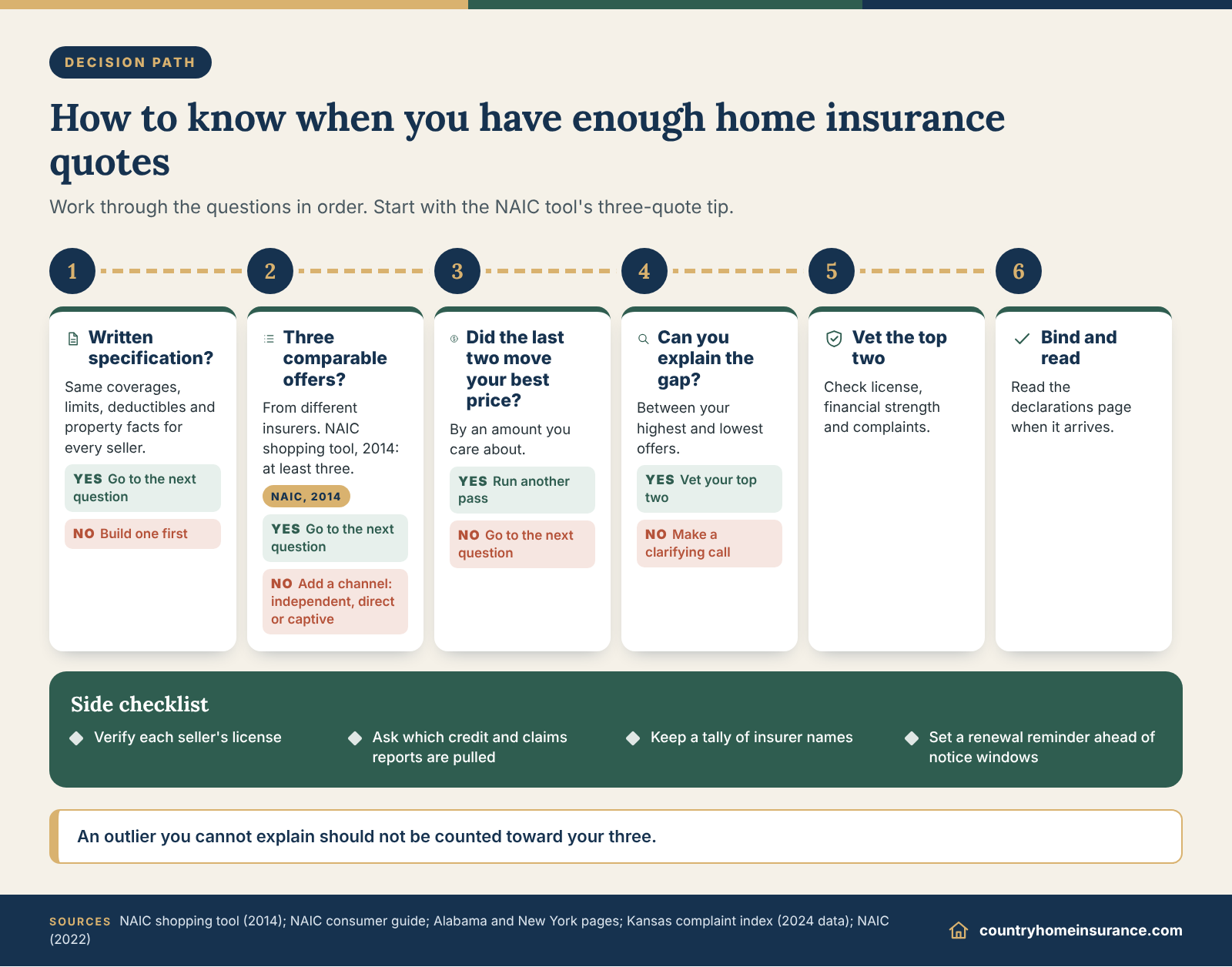
An outlier you can explain and fix is a useful data point. An outlier you cannot explain should not be counted toward your three.
How do you decide when you have enough?
The stopping rule is a decision, so make it deliberately and write down the reason.
A short decision sequence
First, confirm you have at least three comparable offers from different insurers, or fewer if the market simply has fewer willing writers. Second, check whether the last one or two quotes moved your best figure by an amount that matters to you. Third, confirm that you can explain the gap between your highest and lowest quotes. Fourth, vet your top two with ratings and complaint data, and confirm each seller’s license.
If the answers are yes, you have enough. If the third answer is no, the right next step is a clarifying call, not another quote.
What to do next
Choose between your finalists, then follow the buying steps in our guide on how to buy homeowners insurance: bind the coverage, confirm the effective date, arrange proof for any lender and read the declarations page and forms when they arrive. Set a calendar reminder for your annual review and for a point comfortably ahead of the notice windows described above.
If you later decide to re-shop, you will have a log and a method already in place, which makes the second round far faster than the first.
| Item to record | Why it matters for your count | What to verify or ask |
|---|---|---|
| Insurer legal name and channel | Prevents counting the same insurer twice | Is this seller licensed in my state, and which insurer issues the policy? |
| Dwelling limit, loss settlement basis and roof terms | Makes the price comparable | Are limits and roof payment terms identical to my written specification? |
| Deductibles, including wind, hail or roof | Changes out-of-pocket cost after a storm | Is there a separate deductible, and how is it calculated? |
| Endorsements and sublimits | Explains many price gaps | Which add-ons are included, and which cost extra? |
| Credit and claims-database handling | Documents what was pulled and why | Which reports, and is the request recorded as an inquiry? |
| Rating and complaint check | Screens finalists beyond price | Current rating, complaint trend over several years, and any recent regulatory action |
| Premium and conditions | Final comparison and stopping rule | Inspection, roof age or photo requirements before binding |
Frequently asked questions about how many quotes to get
Questions about the number of quotes
Is three quotes really enough?
Three is the number the NAIC shopping tool suggests as a minimum, and for a straightforward home it can be a sound starting point if the three come from different insurers on matching terms. It may not be enough if your offers scatter widely, if you have a rural or older property, or if you were declined by a standard insurer. The measure that matters is whether you understand the spread, not the count itself.
Is there a maximum number of quotes that makes sense?
No source we reviewed sets an upper limit. The practical limit is the point at which new quotes stop beating your best figure and you can explain the differences. For many shoppers that arrives somewhere in the range described in Table 1, but your own spread test will tell you more than any general ceiling.
Should my current insurer be one of the quotes?
Usually, yes. Your renewal offer is a real alternative and is often the easiest baseline, because the coverage is already familiar. The Texas Department of Insurance advises comparing multiple providers when renewing, and your renewal price is the natural first data point for that comparison.
Questions about credit, claims and privacy
Will getting quotes hurt my credit score?
We could not verify an official answer in our research, so we cannot say either way. The NAIC explains that many insurers use credit-based insurance scores and that consumers generally have notice and dispute rights, but its page does not address the effect of quote inquiries. Ask each seller which report they pull and whether the request is recorded as an inquiry, and check with your state Department of Insurance.
Do quote requests go on my CLUE report?
The sources we reviewed say most insurers report homeowners claims to databases such as CLUE, but they do not say how a quote request or a general question is recorded. Ask your agent how a call that does not become a claim is logged, and ask how to obtain your own report so you can see what it shows.
Is it safe to give my Social Security number to get a quote?
An agent may ask for it to access your credit report, according to the NAIC. Before sharing it, confirm the seller’s license with your state, ask which reports will be pulled and whether a quote can start without it. Do not share it with unlicensed sellers or on sites you cannot verify as legitimate.
Questions about timing and switching
How early should I start shopping before renewal?
Early enough to finish before any plausible notice deadline. Nonrenewal notice is typically 30 days before renewal under the NAIC description, with longer periods in some states such as California’s 45 days, so starting a month or more ahead leaves you time for a second pass. A large renewal increase is a good reason to start sooner.
Can I cancel my policy after I buy a new one?
The NAIC says you can cancel at any time. Make sure the new coverage is bound, confirm the effective date in writing, tell your lender and ask the old insurer how it will calculate any refund before you end the policy.
Should I re-shop every year?
No source we reviewed requires it. The NAIC advises an annual coverage review with your agent, and our suggestion is to treat that review as the trigger for deciding whether a broader search makes sense, especially after a large premium change, a claim or a major home improvement.
Sources
- NAIC, A Shopping Tool for Homeowners Insurance, as published by the Colorado Division of Insurance (2014 copyright; reviewed 2026-10-11)
- NAIC shopping tool for homeowners insurance, Mississippi Insurance Department copy (2014 copyright; reviewed 2026-10-11)
- NAIC, A Consumer’s Guide to Home Insurance (reviewed 2026-10-11)
- New Hampshire Insurance Department, consumer’s guide to home insurance (2010 copyright; older; reviewed 2026-10-11)
- NAIC, homeowners insurance consumer page (undated; reviewed 2026-10-11)
- NAIC, credit-based insurance scores (last updated 2026-03-19)
- NAIC, how to file a complaint and research complaints against insurance carriers (2022-09-01)
- Kansas Insurance Department, 2024 complaint index report (calendar 2024 data)
- Alabama Department of Insurance, smart shopping for home insurance (undated; reviewed 2026-10-11)
- New York Department of Financial Services, shopping for insurance (undated; reviewed 2026-10-11)
- Vermont Department of Financial Regulation, buying insurance (undated; reviewed 2026-10-11)
- California Department of Insurance, residential insurance guide (January 2016; California only)
- U.S. GAO, GAO-26-107867, homeowners insurance premiums and availability (published 2026-02-27)
- FloodSmart, buy a flood insurance policy (undated; reviewed 2026-10-11)
- Texas Department of Insurance, public protection classification explainer (2023-03-23; Texas)
- Texas Department of Insurance, what to know about insurance and your roof (March 2026; Texas)
- A.M. Best, Guide to Financial Strength Ratings, as hosted by the State of Nevada (2009 version; older)
Important coverage note
Coverage depends on the actual policy, endorsements, exclusions, limits, deductible and cause of loss. State laws and insurance programs vary, including notice periods, credit-scoring rules and residual-market eligibility. For questions about your own situation, check your declarations page and policy forms, then verify the details with your insurer or agent and your state Department of Insurance. This article is educational information and is not legal advice, and it does not guarantee that any quote, price or claim will be available or paid.
About the editorial team
This guide was prepared by the countryhomeinsurance.com editorial team as general, educational information for homeowners. We research and summarize publicly available material, including state insurance departments, the NAIC, federal agencies, regulators’ consumer guides and published insurer and industry resources. We draw only on the sources that were available to us when we wrote this guide, and we list them in the Sources section with dates where we could find them.
Insurance rules, rates, products and program terms change, differ by state and by insurer, and can apply differently to your situation. We cannot guarantee that this content is complete, current or free of errors. It is not legal, financial, tax or insurance advice, it is not an offer to sell insurance or a recommendation of any insurer, agent or product, and reading it does not create a professional relationship of any kind.
To the fullest extent permitted by law, countryhomeinsurance.com and its editorial team, authors and contributors exclude all liability for any loss, damage or decision arising from the use of, or reliance on, this content. For questions about your own policy or claim, contact your insurer, a licensed agent or broker, your state Department of Insurance or another qualified professional.
Content created: October 11, 2026